

Large language models encode clinical knowledge
Open accessThe DOI matches its Crossref record; 115 of the 116 references it cites were found in a registry or an index.
Abstract
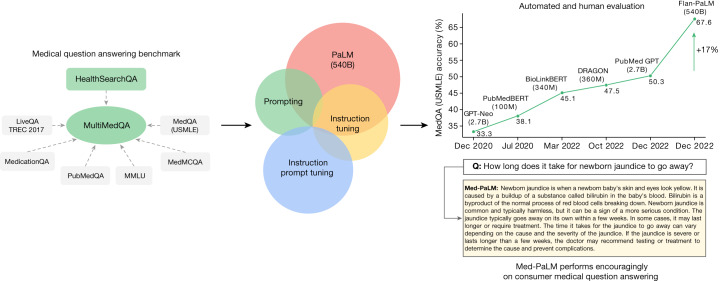
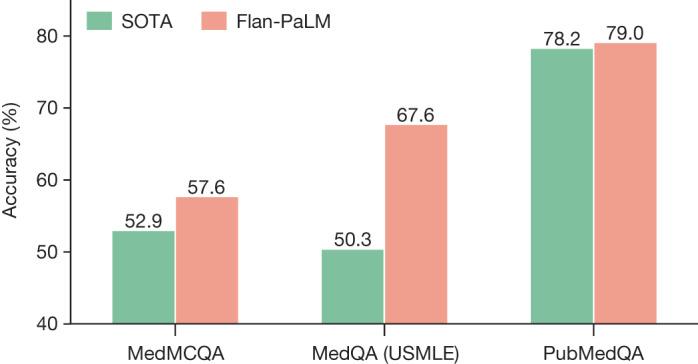
Large language models (LLMs) have demonstrated impressive capabilities, but the bar for clinical applications is high. Attempts to assess the clinical knowledge of models typically rely on automated evaluations based on limited benchmarks. Here, to address these limitations, we present MultiMedQA, a benchmark combining six existing medical question answering datasets spanning professional medicine, research and consumer queries and a new dataset of medical questions searched online, HealthSearchQA. We propose a human evaluation framework for model answers along multiple axes including factuality, comprehension, reasoning, possible harm and bias. In addition, we evaluate Pathways Language Model 1 (PaLM, a 540-billion parameter LLM) and its instruction-tuned variant, Flan-PaLM 2 on MultiMedQA. Using a combination of prompting strategies, Flan-PaLM achieves state-of-the-art accuracy on every MultiMedQA multiple-choice dataset (MedQA 3 , MedMCQA 4 , PubMedQA 5 and Measuring Massive Multitask Language Understanding (MMLU) clinical topics 6 ), including 67.6% accuracy on MedQA (US Medical Licensing Exam-style questions), surpassing the prior state of the art by more than 17%. However, human evaluation reveals key gaps. To resolve this, we introduce instruction prompt tuning, a parameter-efficient approach for aligning LLMs to new domains using a few exemplars. The resulting model, Med-PaLM, performs encouragingly, but remains inferior to clinicians. We show that comprehension, knowledge recall and reasoning improve with model scale and instruction prompt tuning, suggesting the potential utility of LLMs in medicine. Our human evaluations reveal limitations of today’s models, reinforcing the importance of both evaluation frameworks and method development in creating safe, helpful LLMs for clinical applications.
Overview
The claims and statistics of this paper haven’t been checked yet.
Free: it reads the open-access text and checks the first 5 claims that cite a source we can check. Create a free account to check every claim.
Integrity signals
Registry
Cites
Statistics
Figures
Verification
Claims the paper makes
The claims and statistics of this paper haven’t been checked yet.
Free: it reads the open-access text and checks the first 5 claims that cite a source we can check. Create a free account to check every claim.
Claims other papers make about this one
Each is checked against this paper’s own text: does it say what the citing paper says it does?
The cited source doesn’t support the claim as written.
In the citing paper
“Notably, in healthcare, medical NLP benchmarks like MedQA7, PubMedQA8 and the Massive Multitask Language Understanding (MMLU) serve as the de-facto reporting standard for state-of-the-art medical LLMs9–11 with claims of ‘superhuman’ performance in patient-facing tasks12.”
From Medical large language models are vulnerable to data-poisoning attacks (2025) · cites this paper as [9]
Checked by a reasoning model — may be wrong.
Experimental — accuracy not yet measuredThe cited source doesn’t support the claim as written.
In the citing paper
“Med-PaLM achieved a passing score of 67.6% on USMLE-style MedQA questions”
From Trustworthy Medical Question Answering: An Evaluation-Centric Survey (2025) · cites this paper as Singhal et al., 2023
Checked by a reasoning model — may be wrong.
Experimental — accuracy not yet measuredThe source backs part of the claim, not all of it — or backs it for a different population, condition or comparison.
In the citing paper
“Previous work has demonstrated potential across clinical NLP tasks22,23, adapting to the medical domain by training a new model24,25, fine-tuning an existing model26,27 or supplying task-specific examples in the model prompt27,28.”
From Adapted large language models can outperform medical experts in clinical text summarization (2024) · cites this paper as [24]
Experimental — accuracy not yet measuredThe source backs part of the claim, not all of it — or backs it for a different population, condition or comparison.
In the citing paper
“For example, Google’s Med-PaLM 2 demonstrated proficiency in medical question answering, achieving performance comparable to clinical experts on medical licensing examinations and performing better than generalist physicians in real-world medical questions.70”
From A foundational architecture for AI agents in healthcare (2025) · cites this paper as [70]
Experimental — accuracy not yet measuredThe source backs part of the claim, not all of it — or backs it for a different population, condition or comparison.
In the citing paper
“Large language models (LLMs) and multimodal foundation models now exhibit enhanced reasoning capabilities, natural language understanding, and the ability to interact with external tools such as calculators, databases, and application programming interfaces.”
From Medical AI Agents for Clinical Decision Support: Viewpoint Using the Planning, Action, Reflection, and Memory (PARM) Analytical Lens (2026) · cites this paper as [8]
Experimental — accuracy not yet measured
40 more claims about this paper
Create a free account to see every claim other papers make about this one.
Self-check
Percentages, sums and reported differences re-computed from the paper’s own numbers.
The self-check needs the paper’s full text.
Citations
Cites
Vaswani, A., Shazeer, N., Parmar, N., Uszkoreit, J., Jones, L., Gomez, A. N., Kaiser, L., & Polosukhin, I. (2017) · arXiv · doi:10.48550/arxiv.1706.03762 · Cited by 120,404 · cited 1×
“They owe their success to scaling up the training of transformer-based models [84].”
BackgroundExploring the Limits of Transfer Learning with a Unified Text-to-Text Transformer
Raffel, C., Shazeer, N., Roberts, A., Lee, K., Narang, S., Matena, M., Zhou, Y., Li, W., & Liu, P. J. (2019) · arXiv · doi:10.48550/arxiv.1910.10683 · Cited by 31,859 · cited 1×
“Large language models (LLMs) Over the past few years, LLMs have shown impressive performance on natural language processing (NLP) tasks [12, 14, 15, 30, 69, 70, 73, 89, 91, 99].”
BackgroundLanguage Models are Few-Shot Learners
Brown, T. B., Mann, B., Ryder, N., Subbiah, M., Kaplan, J., Dhariwal, P., Neelakantan, A., Shyam, P., Sastry, G., Askell, A., et al. (2020) · arXiv · doi:10.48550/arxiv.2005.14165 · Cited by 23,372
BLEU: a method for automatic evaluation of machine translation
Papineni, K., Roukos, S., Ward, T., & Zhu, W.-J. (2001) · Proceedings of the 40th Annual Meeting on Association for Computational Linguistics - ACL '02 · doi:10.3115/1073083.1073135 · Cited by 21,344
Decoupled Weight Decay Regularization
Loshchilov, I., & Hutter, F. (2017) · arXiv · doi:10.48550/arxiv.1711.05101 · Cited by 12,522
Scaling Laws for Neural Language Models
Kaplan, J., McCandlish, S., Henighan, T., Brown, T. B., Chess, B., Child, R., Gray, S., Radford, A., Wu, J., & Amodei, D. (2020) · arXiv · doi:10.48550/arxiv.2001.08361 · Cited by 9,550 · cited 1×
“It has been shown that model performance and data-efficiency scales with model size and dataset size [37].”
BioBERT: a pre-trained biomedical language representation model for biomedical text mining
Lee, J., Yoon, W., Kim, S., Kim, D., Kim, S., So, C. H., & Kang, J. (2020) · Bioinformatics · doi:10.1093/bioinformatics/btz682 · Cited by 7,218
Boateng, G. O., Neilands, T. B., Frongillo, E. A., Melgar-Quiñonez, H. R., & Young, S. L. (2018) · Frontiers in Public Health · doi:10.3389/fpubh.2018.00149 · Cited by 5,925
Chain-Of-Thought Prompting Elicits Reasoning in Large Language Models
Wei, J., Wang, X., Schuurmans, D., Bosma, M., Ichter, B., Xia, F., Chi, E., Le, Q. V., & Zhou, D. (2022) · Advances in Neural Information Processing Systems 35 · doi:10.52202/068431-1800 · Cited by 4,505
Self-citationLiu, P., Yuan, W., Fu, J., Jiang, Z., Hayashi, H., & Neubig, G. (2023) · ACM Computing Surveys · doi:10.1145/3560815 · Cited by 4,361
Research works printed but not linked: 2
- Abacha, A. B. et al. in Studies in Health Technology and Informatics (eds Ohno-Machado, L. & Séroussi, B.) 25–29 (IOS Press, 2019).
- Matheny, M., Israni, S. T., Ahmed, M. & Whicher, D. eds. Artificial Intelligence in Health Care: The Hope, the Hype, the Promise, the Peril (National Academy of Medicine, 2022). 39146448
Cited by
Items 1,101–1,129 of 1,129
Kong, S., Yang, X., Wei, Y., Wang, Z., Tang, H., Qin, J., Lan, S., Wang, Y., Bai, J., Chen, Z., et al. (2025) · arXiv · doi:10.48550/arxiv.2506.01252 · Cited by 3
“Domain-specific benchmarks have emerged to assess medical LLMs. Early efforts like MedQA [7] and MedMCQA [15] focused on Western medical knowledge through multiple-choice questions, later expanded by MultiMedQA [18] to include diverse clinical formats.”
Zheng, T., Jiang, Z., Liu, J., & Feng, S. (2026) · npj Digital Medicine · doi:10.1038/s41746-026-02671-w · Cited by 3
“This becomes particularly pro-blematicgiventhatLLMs ’ medicalperformancecanimprovebynearly20% within a single year 11 , necessitating timely and repeated evaluation to accurately track progress — yet the substantial fi nancial and operational burden makes such monitoring dif fi cult to sustain.”
Asoglu, H., Kose, S., Kayim, O., Abaci, A., Khatib, G., Vardar, M. A., Kilic Bagir, E., Gumurdulu, D., Kidi, M. M., Bayram, E., et al. (2026) · Journal of Clinical Medicine · doi:10.3390/jcm15124451 · Cited by 1
“These models, trained on vast biomedical corpora, have demonstrated remarkable capacity to encode clinical knowledge and generate contextually appropriate medical responses [1].”
LLM-driven medical document analysis: Enhancing trustworthy pathology and differential diagnosis
Kang, L., Fu, X., Terrades, O. R., Vazquez-Corral, J., Valveny, E., & Karatzas, D. (2026) · Lecture Notes in Computer Science · doi:10.1007/978-3-032-04624-6_36 · Cited by 1
Towards an AI biomedical scientist: Accelerating discoveries in neurodegenerative disease
Roberts, K. F., Landsness, E. C., Reese, J., Elbert, D., Strobel, G., Wu, E., Chen, Y., Lai, A., Abrams, Z. B., Zhu, M., et al. (2026) · The Journal of Prevention of Alzheimer's Disease · doi:10.1016/j.tjpad.2025.100398 · Cited by 1
“Examples include BioBERT[27], Bio-GPT[28], BiomedLM[29], Med-Gemini[30], and Med-PaLM[31].”
m1: Unleash the Potential of Test-Time Scaling for Medical Reasoning with Large Language Models
Huang, X., Wu, J., Liu, H., Tang, X., & Zhou, Y. (2025) · arXiv · doi:10.48550/arxiv.2504.00869 · Cited by 1
“While advanced proprietary models like GPT-4 [8] and Med-PaLM [21] have achieved expert-level scores on medical exams [32], open-source medical LLMs still struggle to reliably solve complex medical problems.”
Liao, Y., Franco, Z., Lizarraga Mazaba, J. E., & Chen, K. (2026) · Proceedings of the 17th ACM International Conference on Bioinformatics, Computational Biology and Health Informatics · doi:10.1145/3807503.3819453 · Cited by 1
Suzgen, E. E., Şahin, M. E., Bakir, M., Arisoy, Ç., Ulutaş, E. G., Günay, R. B., Yildiz, G., & Ulutaş, H. (2026) · 2026 2nd International Symposium on AI-Driven Engineering Systems (ISADES) · doi:10.1109/isades69945.2026.11608117
“Singhal et al. demonstrated that LLMs encode substantial clinical knowledge [11], a development culminating in Med-PaLM 2, which achieved near-expert performance on USMLE-style questions [12].”
The economics of accuracy for medical reasoning with large language models
Bhattacharyya, K., & Kamabattula, S. (2026) · PLOS Digital Health · doi:10.1371/journal.pdig.0001182 · Cited by 1
Explainability of decoder-only clinical large language models: A scoping review
Mishra, N., Abu-Hanna, A., & Calixto, I. (2026) · Artificial Intelligence in Medicine · doi:10.1016/j.artmed.2026.103501
Lewis, M., Thio, S., Roberts, A., Siju, C., Mukit, W., Kuruvilla, R., Jiang, Z. J., Möller-Grell, N., Borakati, A., Dobson, R. J., et al. (2025) · arXiv · doi:10.48550/arxiv.2510.02967
“Google has been at the forefront of training LLMs specifically for the medical domain with their Med-PaLM (Singhal et al., 2022, 2025), Med-Gemini (Saab et al., 2024) and MedGemma (Sellergren et al., 2025) models.”
Deceptive Grounding: Entity Attribution Failure in Clinical Retrieval-Augmented Generation
Caruzzo, C., Yoo, D., & Kim, T. S. (2026) · arXiv · doi:10.48550/arxiv.2607.09349
“Safety evaluations for clinical LLMs focus on factual accuracy, hallucination rates, and appropriate uncertainty [Singhal et al., 2023, Nori et al., 2023, Zakka et al., 2024, Xiong et al., 2024].”
SEMA-RAG: A Self-Evolving Multi-Agent Retrieval-Augmented Generation Framework for Medical Reasoning
Huang, Y., Chen, R., & Cheng, J. (2026) · Findings of the Association for Computational Linguistics: ACL 2026 · doi:10.18653/v1/2026.findings-acl.917
Beyond Literal Summarization: Redefining Hallucination for Medical SOAP Note Evaluation
Vachhani, B., Shrisvastava, K., Nema, P., & Chiranthan, S. (2026) · arXiv · doi:10.48550/arxiv.2604.14829 · Cited by 1
“Med PaLM [9] introduced, a medically fine tuned LLM evaluated against physician curated benchmarks.”
Accurate and Efficient Long-Term Memory for LLM Agents
Zhao, Z., Guo, X., Lv, L., Wang, M., Li, M., & Li, S. (2026) · arXiv · doi:10.48550/arxiv.2607.16211
“In clinical intake, a missed medication history propagates into incorrect risk stratification and potentially harmful prescribing [Singhal et al., 2023].”
DeepResearch Bench II: Diagnosing Deep Research Agents via Rubrics from Expert Reports
Li, R., Du, M., Xu, B., Zhu, C., Wang, X., & Mao, Z. (2026) · arXiv · doi:10.48550/arxiv.2601.08536 · Cited by 45
“Having relevant domain knowledge is feasible in fields such as healthcare and programming, and current research is working to enable LLMs to achieve this [Huynh and Lin, 2025, Singhal et al., 2023].”
Trustworthy Medical Question Answering: An Evaluation-Centric Survey
Wang, Y., Wang, B., Mercer, R. E., Rudzicz, F., Roy, S. S., Ren, P., Chen, Z., & Wang, X. (2025) · arXiv · doi:10.48550/arxiv.2506.03659
“For instance, Singhal et al. (2025b) and Aljo-hani et al. (2025) report that despite strong benchmark performance, models like Med-PaLM exhibited overconfidence, missing context, or poor refusal behaviour in live settings with consumer health queries.”
InfluentialEvidence on Demand: OpenEvidence versus Established LLMs on the Orthopaedic In-Training Examination
Khan, A. A., Lalvani, S. S., Pourarbab, S., Hyeamang, L. J., Lew, R. M., Hussain, Z. B., Nicholson, G. P., & Garrigues, G. E. (2026) · Journal of Orthopaedic Experience & Innovation · doi:10.60118/001c.162882
Liang, Z., Sheffield, C., Butera, G., & Antani, S. (2026) · JMIR AI · doi:10.2196/93761
“LLMs have demonstrated strong performance across a wide range of biomedical knowledge and reasoning tasks, accelerating their adoption in health care workflows [1-6].”
LiveMedBench: A Contamination-Limited Medical Benchmark for LLMs with Automated Rubric Evaluation
Yan, Z., Song, D., Fang, Z., Ji, Y., Li, X., Li, Q., & Sun, L. (2026) · Proceedings of the 32nd ACM SIGKDD Conference on Knowledge Discovery and Data Mining V.2 · doi:10.1145/3770855.3817579
“To improve data quality, we implement a filtering protocol following [28].”
InfluentialA Curated Dataset for Question Answering on Laboratory Test Reference Ranges and Interpretation
Bhasuran, B., Jin, Q., Deville, A., Wu, Y., Hanna, K., Lu, Z., & He, Z. (2026) · Scientific Data · doi:10.1038/s41597-026-07554-z
Med-KGMA: A novel AI-driven medical support system leveraging knowledge graphs and medical advisors
Varshney, S., Jain, B., Singh, P., Rani, D., & Mehra, S. (2025) · Computers in Biology and Medicine · doi:10.1016/j.compbiomed.2025.110929
Thinking with Images for Multimodal Reasoning: Foundations, Methods, and Future Frontiers
Su, Z., Xia, P., Guo, H., Liu, Z., Ma, Y., Qu, X., Liu, J., Li, Y., Zeng, K., Yang, Z., et al. (2025) · arXiv · doi:10.48550/arxiv.2506.23918
Xian, R. P., Lee, A. J., Lolla, S., Wang, V., Cui, Q., Ro, R., & Abbasi-Asl, R. (2024) · arXiv · doi:10.48550/arxiv.2402.10527
“Question answering (QA) has been the proving ground in recent achievements of biomedical language models (BLMs), here referring to GLMs adapted to the biomedical domain (Singhal et al., 2023a; Kung et al., 2023; Singhal et al., 2023b).”
BackgroundTowards Transparent Reasoning: What Drives Faithfulness in Large Language Models?
McMillan, T., Dominici, G., Gjoreski, M., & Langheinrich, M. (2025) · arXiv · doi:10.48550/arxiv.2510.24236
Retrieval-Augmented Agentic Rubric Generation for Reliable Medical Response Evaluation
Chen, Y., Maiga, A., Rahmani, H. A., & Yilmaz, E. (2026) · arXiv · doi:10.48550/arxiv.2601.15161
Collaborative Large Language Models for Automated Data Extraction in Living Systematic Reviews
Khan, M. A., Ayub, U., Naqvi, S. A. A., Khakwani, K. Z. R., Sipra, Z. B. R., Raina, A., Zou, S., He, H., Hossein, S. A., Hasan, B., et al. (2024) · doi:10.1101/2024.09.20.24314108 · Cited by 54
The opportunities and risks of large language models in mental health
Lawrence, H. R., Schneider, R. A., Rubin, S. B., Mataric, M. J., McDuff, D. J., & Bell, M. J. (2024) · arXiv · doi:10.48550/arxiv.2403.14814
“It should be apparent when information is generated using LLMs, how LLMs were developed and tested, and whether LLMs are general-purpose or fine-tuned for the domain of mental health [46,58,68].”
BackgroundInfluential
Metadata
- Authors
- Singhal, K., Azizi, S., Tu, T., Mahdavi, S. S., Wei, J., Chung, H. W., Scales, N., Tanwani, A., Cole-Lewis, H., Pfohl, S., Payne, P., Seneviratne, M., Gamble, P., Kelly, C., Babiker, A., Schärli, N., Chowdhery, A., Mansfield, P., Demner-Fushman, D., Agüera y Arcas, B., Webster, D., Corrado, G. S., Matias, Y., Chou, K., Gottweis, J., Tomasev, N., Liu, Y., Rajkomar, A., Barral, J., Semturs, C., Karthikesalingam, A., & Natarajan, V.
- Affiliations
- Google (United States) (US)
- Corresponding author
- Singhal, Karan
- Azizi, Shekoofeh
- Karthikesalingam, Alan
- Natarajan, Vivek
- ORCID
- Singhal, Karan
- Azizi, Shekoofeh
- Mahdavi, S. Sara
- Chung, Hyung Won
- Tanwani, Ajay
- Cole-Lewis, Heather
- Seneviratne, Martin
- Kelly, Chris
- Chowdhery, Aakanksha
- Mansfield, Philip
- Webster, Dale
- Corrado, Greg S.
- Matias, Yossi
- Chou, Katherine
- Gottweis, Juraj
- Tomasev, Nenad
- Liu, Yun
- Rajkomar, Alvin
- Barral, Joelle
- Semturs, Christopher
- Karthikesalingam, Alan
- Natarajan, Vivek
- Venue
- Nature
- Published
- 2023-07-12
- Volume
- 620
- Issue
- 7972
- Pages
- 172-180
- ISSN
- 0028-0836 (ISSN-L)
- 1476-4687
- PMC
- PMC10396962
- OpenAlex
- W4384071683
- Semantic Scholar
- 6052486bc9144dc1730c12bf35323af3792a1fd0
- Cited by
- 4,083
- References
- 85
- Citations by year
- 2026: 1627 · 2025: 1275 · 2024: 933 · 2023: 247
- FWCI
- 162.53
- Type
- journal article
- Language
- en
- Update notices
- correction (2023-07-27)
- Open access
- hybrid
- doi.org
- Licence
- cc-by
- creativecommons.org/licenses/by/4.0 (tdm)
- creativecommons.org/licenses/by/4.0 (vor)
- Locations
- Nature (publishedVersion, cc-by)
- PubMed Central (publishedVersion, cc-by)
- PubMed (publishedVersion)
- arXiv (Cornell University) (submittedVersion)
- RePEc: Research Papers in Economics (submittedVersion)
- arXiv (Cornell University) (cc-by)
- Funders
- DeepMind
- U.S. National Library of Medicine
- Topics
- Health Sciences › Medicine › Health Informatics › Artificial Intelligence in Healthcare and Education
- Physical Sciences › Computer Science › Artificial Intelligence › Topic Modeling
- Physical Sciences › Computer Science › Artificial Intelligence › Machine Learning in Healthcare
- Keywords
- large language models, clinical knowledge, medical question answering, human evaluation, Arecaceae, MedQA, MedMCQA, PubMedQA, MMLU, clinical reasoning
- MeSH terms
- Clinical Competence, Computer Simulation, Humans, Licensure, Medicine, Natural Language Processing, Physicians, Bias, Knowledge, Benchmarking, Comprehension, Patient Safety, Datasets as Topic
About these checks
Registry, retraction, Cites and statistics results are computed, not judged, with one exception: a printed reference that no index lists is read once by a model before it counts as a citation error. Claims are extracted by a model and kept only when their quote appears verbatim in the text; each cited source is then checked, with a model’s help, for whether it says what the claim relies on. Those verdicts can be wrong — read the claim’s quote and the cited source before relying on one.
Statistics and arithmetic are recomputed, not judged.
Confidence bands are shown only for fields calibrated on our annotated test set. None is calibrated yet, so no band is shown.
What counts as a claim ›How we measure confidence ›How we check this ›
Are you an author, or do you see a problem with this page? Request a review
Data sources
Bibliographic data: Semantic Scholar, OpenAlex, Crossref.
Contains information from the Semantic Scholar Academic Graph Datasets, made available under the ODC Attribution License (ODC-BY 1.0).
Semantic Scholar’s data is described in: Kinney, R., et al. (2023). The Semantic Scholar Open Data Platform. arXiv:2301.10140.
