

Large language models encode clinical knowledge
Open accessThe DOI matches its Crossref record; 115 of the 116 references it cites were found in a registry or an index.
Abstract
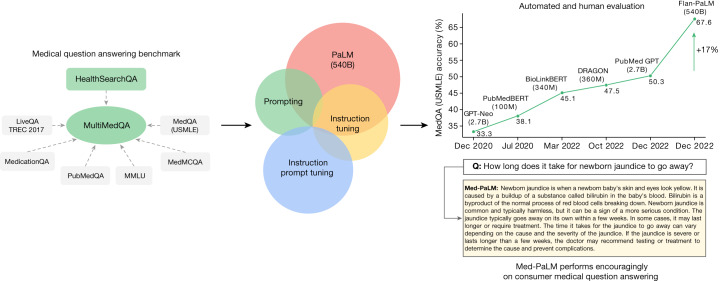
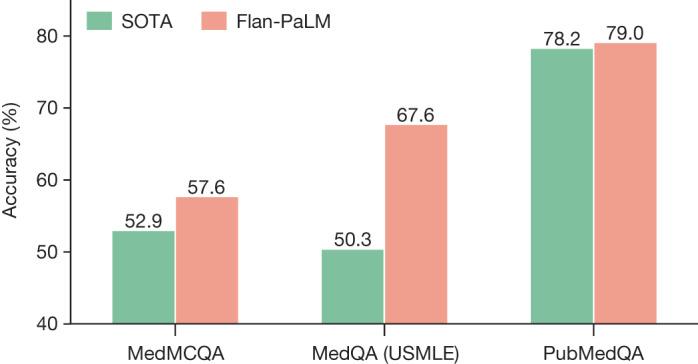
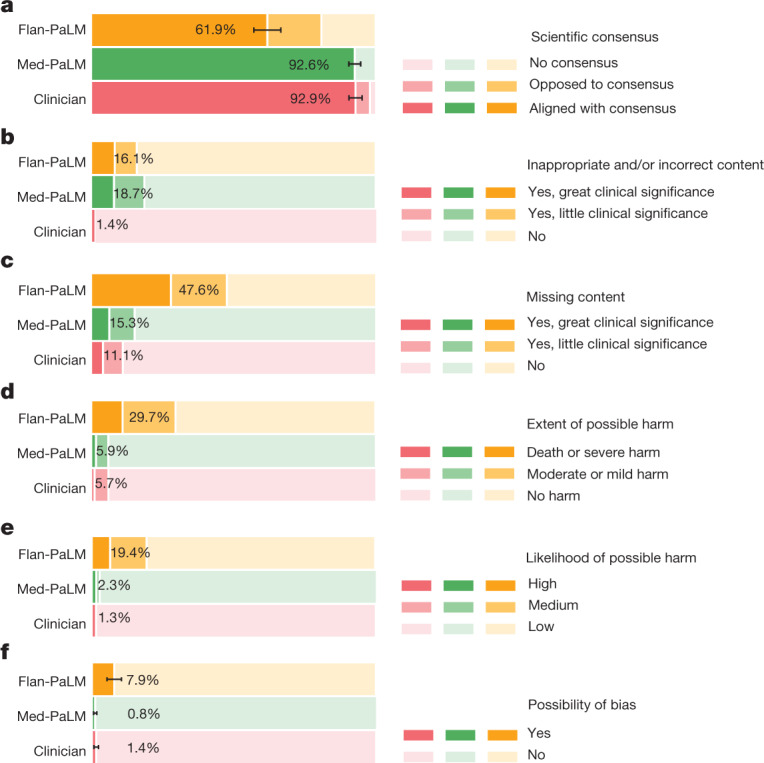
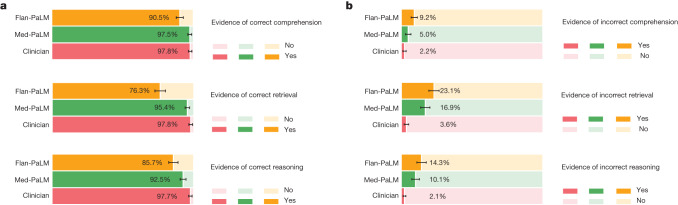
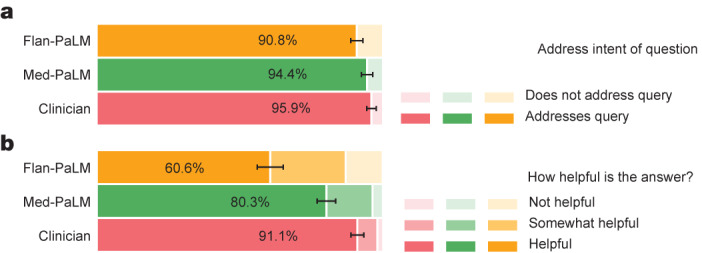
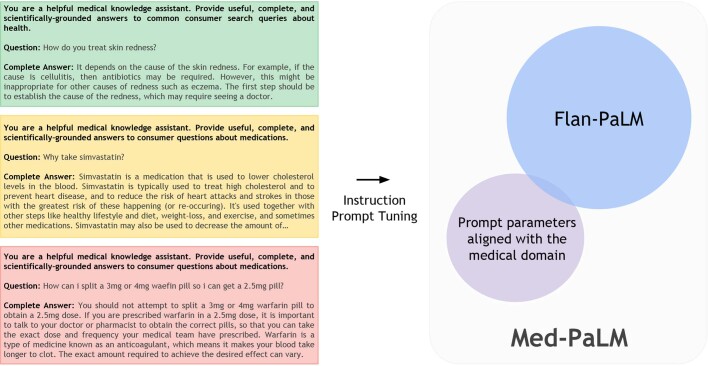
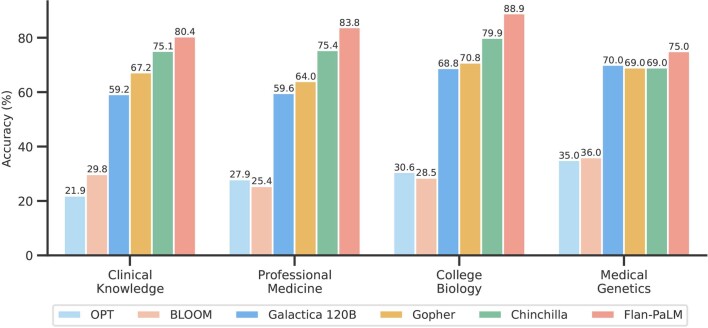
Large language models (LLMs) have demonstrated impressive capabilities, but the bar for clinical applications is high. Attempts to assess the clinical knowledge of models typically rely on automated evaluations based on limited benchmarks. Here, to address these limitations, we present MultiMedQA, a benchmark combining six existing medical question answering datasets spanning professional medicine, research and consumer queries and a new dataset of medical questions searched online, HealthSearchQA. We propose a human evaluation framework for model answers along multiple axes including factuality, comprehension, reasoning, possible harm and bias. In addition, we evaluate Pathways Language Model 1 (PaLM, a 540-billion parameter LLM) and its instruction-tuned variant, Flan-PaLM 2 on MultiMedQA. Using a combination of prompting strategies, Flan-PaLM achieves state-of-the-art accuracy on every MultiMedQA multiple-choice dataset (MedQA 3 , MedMCQA 4 , PubMedQA 5 and Measuring Massive Multitask Language Understanding (MMLU) clinical topics 6 ), including 67.6% accuracy on MedQA (US Medical Licensing Exam-style questions), surpassing the prior state of the art by more than 17%. However, human evaluation reveals key gaps. To resolve this, we introduce instruction prompt tuning, a parameter-efficient approach for aligning LLMs to new domains using a few exemplars. The resulting model, Med-PaLM, performs encouragingly, but remains inferior to clinicians. We show that comprehension, knowledge recall and reasoning improve with model scale and instruction prompt tuning, suggesting the potential utility of LLMs in medicine. Our human evaluations reveal limitations of today’s models, reinforcing the importance of both evaluation frameworks and method development in creating safe, helpful LLMs for clinical applications.
Overview
The claims and statistics of this paper haven’t been checked yet.
Free: it reads the open-access text and checks the first 5 claims that cite a source we can check. Create a free account to check every claim.
Integrity signals
Registry
Cites
Statistics
Figures
Verification
Claims the paper makes
The claims and statistics of this paper haven’t been checked yet.
Free: it reads the open-access text and checks the first 5 claims that cite a source we can check. Create a free account to check every claim.
Claims other papers make about this one
Each is checked against this paper’s own text: does it say what the citing paper says it does?
The cited source doesn’t support the claim as written.
In the citing paper
“Notably, in healthcare, medical NLP benchmarks like MedQA7, PubMedQA8 and the Massive Multitask Language Understanding (MMLU) serve as the de-facto reporting standard for state-of-the-art medical LLMs9–11 with claims of ‘superhuman’ performance in patient-facing tasks12.”
From Medical large language models are vulnerable to data-poisoning attacks (2025) · cites this paper as [9]
Checked by a reasoning model — may be wrong.
Experimental — accuracy not yet measuredThe cited source doesn’t support the claim as written.
In the citing paper
“Med-PaLM achieved a passing score of 67.6% on USMLE-style MedQA questions”
From Trustworthy Medical Question Answering: An Evaluation-Centric Survey (2025) · cites this paper as Singhal et al., 2023
Checked by a reasoning model — may be wrong.
Experimental — accuracy not yet measuredThe source backs part of the claim, not all of it — or backs it for a different population, condition or comparison.
In the citing paper
“Previous work has demonstrated potential across clinical NLP tasks22,23, adapting to the medical domain by training a new model24,25, fine-tuning an existing model26,27 or supplying task-specific examples in the model prompt27,28.”
From Adapted large language models can outperform medical experts in clinical text summarization (2024) · cites this paper as [24]
Experimental — accuracy not yet measuredThe source backs part of the claim, not all of it — or backs it for a different population, condition or comparison.
In the citing paper
“For example, Google’s Med-PaLM 2 demonstrated proficiency in medical question answering, achieving performance comparable to clinical experts on medical licensing examinations and performing better than generalist physicians in real-world medical questions.70”
From A foundational architecture for AI agents in healthcare (2025) · cites this paper as [70]
Experimental — accuracy not yet measuredThe source backs part of the claim, not all of it — or backs it for a different population, condition or comparison.
In the citing paper
“Large language models (LLMs) and multimodal foundation models now exhibit enhanced reasoning capabilities, natural language understanding, and the ability to interact with external tools such as calculators, databases, and application programming interfaces.”
From Medical AI Agents for Clinical Decision Support: Viewpoint Using the Planning, Action, Reflection, and Memory (PARM) Analytical Lens (2026) · cites this paper as [8]
Experimental — accuracy not yet measured
40 more claims about this paper
Create a free account to see every claim other papers make about this one.
Self-check
Percentages, sums and reported differences re-computed from the paper’s own numbers.
The self-check needs the paper’s full text.
Citations
Cites
Vaswani, A., Shazeer, N., Parmar, N., Uszkoreit, J., Jones, L., Gomez, A. N., Kaiser, L., & Polosukhin, I. (2017) · arXiv · doi:10.48550/arxiv.1706.03762 · Cited by 120,404 · cited 1×
“They owe their success to scaling up the training of transformer-based models [84].”
BackgroundExploring the Limits of Transfer Learning with a Unified Text-to-Text Transformer
Raffel, C., Shazeer, N., Roberts, A., Lee, K., Narang, S., Matena, M., Zhou, Y., Li, W., & Liu, P. J. (2019) · arXiv · doi:10.48550/arxiv.1910.10683 · Cited by 31,859 · cited 1×
“Large language models (LLMs) Over the past few years, LLMs have shown impressive performance on natural language processing (NLP) tasks [12, 14, 15, 30, 69, 70, 73, 89, 91, 99].”
BackgroundLanguage Models are Few-Shot Learners
Brown, T. B., Mann, B., Ryder, N., Subbiah, M., Kaplan, J., Dhariwal, P., Neelakantan, A., Shyam, P., Sastry, G., Askell, A., et al. (2020) · arXiv · doi:10.48550/arxiv.2005.14165 · Cited by 23,372
BLEU: a method for automatic evaluation of machine translation
Papineni, K., Roukos, S., Ward, T., & Zhu, W.-J. (2001) · Proceedings of the 40th Annual Meeting on Association for Computational Linguistics - ACL '02 · doi:10.3115/1073083.1073135 · Cited by 21,344
Decoupled Weight Decay Regularization
Loshchilov, I., & Hutter, F. (2017) · arXiv · doi:10.48550/arxiv.1711.05101 · Cited by 12,522
Scaling Laws for Neural Language Models
Kaplan, J., McCandlish, S., Henighan, T., Brown, T. B., Chess, B., Child, R., Gray, S., Radford, A., Wu, J., & Amodei, D. (2020) · arXiv · doi:10.48550/arxiv.2001.08361 · Cited by 9,550 · cited 1×
“It has been shown that model performance and data-efficiency scales with model size and dataset size [37].”
BioBERT: a pre-trained biomedical language representation model for biomedical text mining
Lee, J., Yoon, W., Kim, S., Kim, D., Kim, S., So, C. H., & Kang, J. (2020) · Bioinformatics · doi:10.1093/bioinformatics/btz682 · Cited by 7,218
Boateng, G. O., Neilands, T. B., Frongillo, E. A., Melgar-Quiñonez, H. R., & Young, S. L. (2018) · Frontiers in Public Health · doi:10.3389/fpubh.2018.00149 · Cited by 5,925
Chain-Of-Thought Prompting Elicits Reasoning in Large Language Models
Wei, J., Wang, X., Schuurmans, D., Bosma, M., Ichter, B., Xia, F., Chi, E., Le, Q. V., & Zhou, D. (2022) · Advances in Neural Information Processing Systems 35 · doi:10.52202/068431-1800 · Cited by 4,505
Self-citationLiu, P., Yuan, W., Fu, J., Jiang, Z., Hayashi, H., & Neubig, G. (2023) · ACM Computing Surveys · doi:10.1145/3560815 · Cited by 4,361
Research works printed but not linked: 2
- Abacha, A. B. et al. in Studies in Health Technology and Informatics (eds Ohno-Machado, L. & Séroussi, B.) 25–29 (IOS Press, 2019).
- Matheny, M., Israni, S. T., Ahmed, M. & Whicher, D. eds. Artificial Intelligence in Health Care: The Hope, the Hype, the Promise, the Peril (National Academy of Medicine, 2022). 39146448
Cited by
Items 501–600 of 1,129
Fei, L., Li, T., & Ding, W. (2024) · Information Fusion · doi:10.1016/j.inffus.2024.102585 · Cited by 65
Ong, C. S., Obey, N. T., Zheng, Y., Cohan, A., & Schneider, E. B. (2024) · npj Digital Medicine · doi:10.1038/s41746-024-01391-3 · Cited by 73
Prompt architecture induces methodological artifacts in large language models
Brucks, M. S., & Toubia, O. (2025) · PLoS ONE · doi:10.1371/journal.pone.0319159 · Cited by 90
“Evaluative tasks such as these, with multiple choices that are ordered and labeled, span many different LLM use cases, including diagnoses [9,11], opinion polls and surveys [2,3], and social science experiments [5,7,8].”
Faithful AI in Medicine: A Systematic Review with Large Language Models and Beyond
Xie, Q., Schenck, E. J., Yang, H. S., Chen, Y., Peng, Y., & Wang, F. (2023) · doi:10.21203/rs.3.rs-3661764/v1 · Cited by 57
“Nori et al 37 conducted a comprehensive study on the ability of GPT-4 on medical competency examinations and medical Q&A benchmarks recently 34 .”
BackgroundDatta, S., Lee, K., Paek, H., Manion, F. J., Ofoegbu, N., Du, J., Li, Y., Huang, L., Wang, J., Lin, B., et al. (2023) · Journal of the American Medical Informatics Association · doi:10.1093/jamia/ocad218 · Cited by 78
Peng, L., Luo, G., Zhou, S., Chen, J., Xu, Z., Sun, J., & Zhang, R. (2024) · npj Digital Medicine · doi:10.1038/s41746-024-01126-4 · Cited by 80
“To close the gap, specialized LLMs pre-trained on medicaltextdata 33 ormodel fi ne-tuning 34 canbeusedtofurtherimprovethe LLMs ’ performance.”
Oniani, D., Wu, X., Visweswaran, S., Kapoor, S., Kooragayalu, S., Polanska, K., & Wang, Y. (2024) · IEEE International Conference on Healthcare Informatics (ICHI) · doi:10.1109/ichi61247.2024.00111 · Cited by 87
“Moreover, recent research produced powerful healthcare LLMs, such as GatorTron [6] and Med-PaLM [7].”
MethodQin, H., Zhu, Y., Jiang, Y., Luo, S., & Huang, C. (2024) · Technology in Society · doi:10.1016/j.techsoc.2024.102726 · Cited by 67
Generative AI in the context of assistive technologies: Trends, limitations and future directions
Fu, B., Hadid, A., & Damer, N. (2024) · Image and Vision Computing · doi:10.1016/j.imavis.2024.105347 · Cited by 67
Large language models in oncology: a review
Chen, D., Parsa, R., Swanson, K. E., Nuñez, J.-J., Critch, A., Bitterman, D. S., Liu, F., & Raman, S. (2025) · BMJ Oncology · doi:10.1136/bmjonc-2025-000759 · Cited by 76
The Virtual Lab: AI Agents Design New SARS-CoV-2 Nanobodies with Experimental Validation
Swanson, K., Wu, W., Bulaong, N. L., Pak, J. E., & Zou, J. (2024) · bioRxiv (Cold Spring Harbor Laboratory) · doi:10.1101/2024.11.11.623004 · Cited by 56
Exploring Capabilities of Large Language Models such as ChatGPT in Radiation Oncology
Dennstädt, F., Hastings, J., Putora, P. M., Vu, E., Fischer, G. F., Süveg, K., Glatzer, M., Riggenbach, E., Hà, H.-L., & Cihoric, N. (2024) · Advances in Radiation Oncology · doi:10.1016/j.adro.2023.101400 · Cited by 48
“16 While the performance of LLMs such as Med-PaLM is assessed using benchmarks like medical question − answering data sets, this approach fails to encompass all relevant factors needed in daily clinical life.”
MethodChatbots for HIV Prevention and Care: a Narrative Review
van Heerden, A. C., Bosman, S., Swendeman, D. T., & Comulada, W. S. (2023) · Current HIV/AIDS Reports · doi:10.1007/s11904-023-00681-x · Cited by 60
“In the realm of medical education, LLMs have also shown promise, aiding learning and problem-solving, and demonstrating proficiency in medical knowledge without specialized training [22, 23].”
BackgroundGenerative AI and DT integrated intelligent process planning: a conceptual framework
Xu, Q., Zhou, G., Zhang, C., Chang, F., Cao, Y., & Zhao, D. (2024) · The International Journal of Advanced Manufacturing Technology · doi:10.1007/s00170-024-13861-9 · Cited by 63
“In education, Google Research introduces Minerva [43], a model based on the poly-encoders for language modeling (PaLM) [44] and an additional dataset focusing on science and math.”
Zhang, Y., Li, Q., Nahata, S., Jamal, T., Cheng, S.-K., Cauwenberghs, G., & Jung, T. (2024) · IEEE Transactions on Neural Systems and Rehabilitation Engineering · doi:10.1109/tnsre.2024.3435460 · Cited by 64
“Notable examples include GPT, Llama models developed by OpenAI and Meta, among others [1], [2], [3], [4].”
MethodVulnerability of Large Language Models to Prompt Injection When Providing Medical Advice
Lee, R. W., Jun, T. J., Lee, J.-M., Cho, S. I., Park, H. J., & Suh, J. (2025) · JAMA Network Open · doi:10.1001/jamanetworkopen.2025.49963 · Cited by 54
Quilt-1M: One Million Image-Text Pairs for Histopathology
Ikezogwo, W. O., Seyfioglu, M. S., Ghezloo, F., Geva, D. S. C., Mohammed, F. S., Anand, P. K., Krishna, R., & Shapiro, L. (2023) · arXiv · doi:10.48550/arxiv.2306.11207 · Cited by 55
“Furthermore, the growing versatility of large language models has shown promise as data annotators, information extractors [35, 63, 15, 22], text correctors [67], and as tools for medical information extraction and reasoning [1, 60].”
BackgroundShay, D., Kumar, B., Bellamy, D., Palepu, A. K., Dershwitz, M., Walz, J. M., Schaefer, M. S., & Beam, A. L. (2023) · British Journal of Anaesthesia · doi:10.1016/j.bja.2023.04.017 · Cited by 59
Kim, K., Cho, K., Jang, R., Kyung, S., Lee, S., Ham, S., Choi, E., Hong, G.-S., & Kim, N. (2024) · Korean Journal of Radiology · doi:10.3348/kjr.2023.0818 · Cited by 61
“A research team from Google introduced its counterpart, Med-PaLM, around the same time [66].”
MethodUsing Large Language Models to Generate Educational Materials on Childhood Glaucoma
Dihan, Q. A., Chauhan, M. Z., Eleiwa, T. K., Hassan, A. K., Sallam, A. B., Khouri, A. S., Chang, T. C., & Elhusseiny, A. M. (2024) · American Journal of Ophthalmology · doi:10.1016/j.ajo.2024.04.004 · Cited by 60
Moura, L., Jones, D. T., Sheikh, I. S., Murphy, S., Kalfin, M., Kummer, B., Weathers, A. L., Grinspan, Z., Silsbee, H. M., Jones, L. K., et al. (2024) · Neurology · doi:10.1212/wnl.0000000000209497 · Cited by 43
Xu, R., & Wang, Z. (2024) · Heliyon · doi:10.1016/j.heliyon.2024.e32364 · Cited by 65
“The recent release of Google ’ s Med-PaLM, a similar AI model tailored for medicine, and OpenAI ’ s application programming interface, which leverages ChatGPT to build healthcare software, further emphasize the technological revolution transforming healthcare [80].”
MethodVerlingue, L., Boyer, C., Olgiati, L., Brutti Mairesse, C., Morel, D., & Blay, J.-Y. (2024) · The Lancet Regional Health - Europe · doi:10.1016/j.lanepe.2024.101064 · Cited by 44
“19,43,44 In these scenarios, the application does not impact clinical decisions.”
BackgroundBiMediX: Bilingual Medical Mixture of Experts LLM
Pieri, S., Mullappilly, S. S., Khan, F. S., Anwer, R. M., Khan, S., Baldwin, T., & Cholakkal, H. (2024) · Findings of the Association for Computational Linguistics: EMNLP 2024 · doi:10.18653/v1/2024.findings-emnlp.989 · Cited by 20
Advancing real-time infectious disease forecasting using large language models
Du, H., Zhao, Y., Zhao, J., Xu, S., Lin, X., Chen, Y., Gardner, L., & Yang, H. (2025) · Nature Computational Science · doi:10.1038/s43588-025-00798-6 · Cited by 71
“For a model to effectively support public health decision-making, it needs to be reliable, trustworthy and accurate 15,17 .”
InfluentialPaperQA: Retrieval-Augmented Generative Agent for Scientific Research
Lála, J., O'Donoghue, O., Shtedritski, A., Cox, S., Rodriques, S. G., & White, A. D. (2023) · arXiv · doi:10.48550/arxiv.2312.07559 · Cited by 55
“The use of Large Language Models (LLMs) to answer scientific questions is increasingly seen in academia and research-heavy professions such as medicine [14, 15].”
BackgroundTesting AI on language comprehension tasks reveals insensitivity to underlying meaning
Dentella, V., Günther, F., Murphy, E., Marcus, G., & Leivada, E. (2024) · Scientific Reports · doi:10.1038/s41598-024-79531-8 · Cited by 54
“For instance, LLMs can reach high accuracy in answering medical questions 3 and are believed to be ready for testing in real-world simulations 67 .”
MMedAgent: Learning to Use Medical Tools with Multi-modal Agent
Li, B., Yan, T., Pan, Y., Luo, J., Ji, R., Ding, J., Xu, Z., Liu, S., Dong, H., Lin, Z., et al. (2024) · Findings of the Association for Computational Linguistics: EMNLP 2024 · doi:10.18653/v1/2024.findings-emnlp.510 · Cited by 54
Toward General Design Principles for Generative AI Applications
Weisz, J. D., Muller, M., He, J., & Houde, S. (2023) · arXiv · doi:10.48550/arxiv.2301.05578 · Cited by 54
Comparison of Large Language Models in Answering Immuno-Oncology Questions: A Cross-Sectional Study
Iannantuono, G. M., Bracken-Clarke, D., Karzai, F., Choo-Wosoba, H., Gulley, J. L., & Floudas, C. S. (2024) · The Oncologist · doi:10.1093/oncolo/oyae009 · Cited by 51
McBain, R. K., Cantor, J., Zhang, L. A., Baker, O., Zhang, F., Halbisen, A., Kofner, A., Breslau, J. A., Stein, B. D., Mehrotra, A., et al. (2025) · Journal of Medical Internet Research · doi:10.2196/67891 · Cited by 71
“On the other hand, researchers and advocates fear that LLMs could make poor, if not outright injurious, recommendations when engaging with individuals with who express suicidal ideation [10].”
Knowledge-Augmented Reasoning Distillation for Small Language Models in Knowledge-Intensive Tasks
Kang, M., Lee, S., Baek, J., Kawaguchi, K., & Hwang, S. J. (2023) · Advances in Neural Information Processing Systems 36 · doi:10.52202/075280-2109 · Cited by 10
Towards conversational artificial intelligence for disease management
Liévin, V., Palepu, A. K., Weng, W., Saab, K. K., Stutz, D., Cheng, Y., Kulkarni, K., Mahdavi, S. S., Barral, J. K., Webster, D. R., et al. (2026) · Nature · doi:10.1038/s41586-026-10764-5 · Cited by 75
“AMIE’s multiagent system and its ability to cite guidelines seem to have had a significant impact: confabulation rates were comparable between PCPs and AMIE and considerably lower than those reported in other studies 25,26 .”
Self-citationQuantifying the reasoning abilities of LLMs on clinical cases
Qiu, P., Wu, C., Liu, S., Fan, Y., Zhao, W., Chen, Z., Gu, H., Peng, C., Zhang, Y., Wang, Y., et al. (2025) · Nature Communications · doi:10.1038/s41467-025-64769-1 · Cited by 53
From Intention To Implementation: Automating Biomedical Research via LLMs
Luo, Y., Shi, L., Li, Y., Zhuang, A., Gong, Y., Liu, L., & Lin, C. (2024) · arXiv · doi:10.48550/arxiv.2412.09429 · Cited by 53
“Therefore, we have seen large amounts of applications based on LLMs [35–39].”
Omar, M., Agbareia, R., Glicksberg, B. S., Nadkarni, G. N., & Klang, E. (2025) · JMIR Medical Informatics · doi:10.2196/66917 · Cited by 53
“The efficacy of these models has been demonstrated in a variety of tasks, albeit with some limitations [5,6].”
Bushuven, S., Bentele, M., Bentele, S., Gerber, B., Bansbach, J., Ganter, J., Trifunovic-Koenig, M., & Ranisch, R. (2023) · Journal of Medical Systems · doi:10.1007/s10916-023-02019-x · Cited by 47
Maitland, A., Fowkes, R., & Maitland, S. (2024) · BMJ Open · doi:10.1136/bmjopen-2023-080558 · Cited by 47
“…ChatGPT using the framework and language derived from the established literature on cognitive biases and clinical reasoning provides a structure for users to evaluate responses for potential errors, including the relative likelihood of specific types of error, using concepts familiar to clinicians.”
MethodArtificial intelligence in perinatal mental health research: A scoping review
Kwok, W. H., Zhang, Y., & Wang, G. (2024) · Computers in Biology and Medicine · doi:10.1016/j.compbiomed.2024.108685 · Cited by 62
RadioRAG: Online Retrieval–Augmented Generation for Radiology Question Answering
Arasteh, S. T., Lotfinia, M., Bressem, K. K., Siepmann, R. M., Adams, L. C., Ferber, D., Kuhl, C. K., Kather, J. N., Nebelung, S., & Truhn, D. (2025) · Radiology Artificial Intelligence · doi:10.1148/ryai.240476 · Cited by 67
“The existing datasets for medical (QA) answering, such as MultiMedQA 11 , MedMCQA 22 , and PubMedQA 23 , focus on general medicine and do not cater to the specific needs of diagnostic radiology.”
Abdollahi, M., Yeganli, S. F., Baharloo, M. M., & Baniasadi, A. (2024) · Electronics · doi:10.3390/electronics14010120 · Cited by 87
Feng, Y., Zhou, L., Ma, C., Zheng, Y., He, R., & Li, Y. (2025) · GigaScience · doi:10.1093/gigascience/giae082 · Cited by 65
Zada, T., Tam, N., Barnard, F., Sittert, M. V., Bhat, V., & Rambhatla, S. (2025) · JMIR Formative Research · doi:10.2196/66207 · Cited by 60
“Despite the apparent high performance of LLMs in health care, they remain inferior compared to the judgment of human clinicians [49].”
Croxford, E., Gao, Y., Pellegrino, N., Wong, K., Wills, G. J., First, E., Schnier, M., Burton, K. A., Ebby, C. G., Gorski, J. K., et al. (2025) · Journal of the American Medical Informatics Association · doi:10.1093/jamia/ocaf068 · Cited by 70
MEDCO: Medical Education Copilots Based on a Multi-agent Framework
Wei, H., Qiu, J., Yu, H., & Yuan, W. (2025) · Lecture notes in computer science · doi:10.1007/978-3-031-91813-1_8 · Cited by 77
“According to . . . ”: Prompting Language Models Improves Quoting from Pre-Training Data
Weller, O., Marone, M., Weir, N., Lawrie, D. J., Khashabi, D., & Durme, B. V. (2023) · Conference of the European Chapter of the Association for Computational Linguistics · doi:10.18653/v1/2024.eacl-long.140 · Cited by 67
“We use datasets in the MultiMedQA benchmark suite (Singhal et al., 2022) Why is it that every time we put something down our throat toothbrush, finger etc. we start to gag but when we but food and water down our throat we don’t gag at all?”
MethodAlmanac: Retrieval-Augmented Language Models for Clinical MedicinePreprint
Zakka, C., Chaurasia, A., Shad, R., Dalal, A. R., Kim, J. L., Moor, M., Alexander, K. M., Ashley, E. A., Boyd, J. H., Boyd, K., et al. (2023) · arXiv (Cornell University) · doi:10.48550/arxiv.2303.01229 · Cited by 72
“…despite marked improvements with pre-training increasingly larger architecture sizes on domain specific datasets (e.g. GatorTron [29] and Med-PaLM [30]), these models still remain prone to hallucinations and biases, further highlighting the limitations and unreliability of large language models…”
BackgroundMethodAutomatic Interactive Evaluation for Large Language Models with State Aware Patient SimulatorPreprint
Liao, Y., Meng, Y., Wang, Y., Li, L., Liu, H., Wang, Y., & Wang, Y. (2024) · SSRN Electronic Journal · doi:10.2139/ssrn.4890649 · Cited by 59
Gupta, S., Basu, A., Nievas, M., Thomas, J., Wolfrath, N., Ramamurthi, A., Taylor, B., Kothari, A. N., Schwind, R., Miller, T. M., et al. (2024) · npj Digital Medicine · doi:10.1038/s41746-024-01274-7 · Cited by 93
“Languagemodelshaverecentlyshowngreatpromiseforavarietyofuse cases in healthcare 25,36 – 38 .”
Liu, X., Wu, J., Shao, A., Shen, W., Ye, P., Wang, Y., Ye, J., Jin, K., & Yang, J. (2024) · Journal of Medical Internet Research · doi:10.2196/51926 · Cited by 52
Towards evaluating and building versatile large language models for medicine
Wu, C., Qiu, P., Liu, J., Gu, H., Li, N., Zhang, Y., Wang, Y., & Xie, W. (2025) · npj Digital Medicine · doi:10.1038/s41746-024-01390-4 · Cited by 52
“These developments have also extended into the medical domain, where LLMs have achieved high scores on multiple-choice question-answering (MCQA) benchmarks in healthcare, and successfully passed the UMLS examination, as noted by Singhal et al. [37, 38].”
Artificial intelligence generated content (AIGC) in medicine: A narrative review.
Shao, L.-J., Chen, B., Zhang, Z.-Q., Zhang, Z., & Chen, X.-R. (2024) · Mathematical biosciences and engineering : MBE · doi:10.3934/mbe.2024073 · Cited by 42
“Singhal et al. [149] showed encouraging results on medical question answering based on PaLM [150] using a variety of datasets as training and test data.”
BackgroundGenerative artificial intelligence in surgery
Rodler, S., Ganjavi, C., BACKER, P. D., Magoulianitis, V., Ramacciotti, L. S., Abreu, A. L., Gill, I. S., & Cacciamani, G. E. (2024) · Surgery · doi:10.1016/j.surg.2024.02.019 · Cited by 59
Kozaily, E., Geagea, M., Akdogan, R. E., Atkins, J., Elshazly, M. B., Guglin, M. E., Tedford, R. J., & Wehbe, R. M. (2024) · International Journal of Cardiology · doi:10.1016/j.ijcard.2024.132115 · Cited by 61
Li, B., Gross, O., Crampton, N., Kapoor, M., Tauseef, S., Jain, M., Truong, K. N., & Mariakakis, A. T. (2024) · CHI Conference on Human Factors in Computing Systems · doi:10.1145/3613904.3641913 · Cited by 61
“The fact that LLMs have demonstrated decent aptitude at standardized medical exams has led to numerous proposals to integrate them into existing healthcare chatbots [38, 64, 70].”
BackgroundMcCoy, L. G., Ng, F. Y. C., Sauer, C. M., Legaspi, K. E. Y., Jain, B., Gallifant, J., McClurkin, M., Hammond, A., Goode, D., Gichoya, J. W., et al. (2024) · BMC Medical Education · doi:10.1186/s12909-024-06048-z · Cited by 63
Bevilacqua, M., Oketch, K., Qin, R., Stamey, W., Zhang, X., Gan, Y., Yang, K., & Abbasi, A. (2025) · ACM Transactions on Information Systems · doi:10.1145/3702639 · Cited by 56
“More recent LLM benchmarks place their performance on such exams as being even higher [95].”
Shi, H. H., Fang, L., Chen, X., Gu, C., Ma, K., Zhang, X., Zhang, Z., Gu, J., & Lim, E. G. (2024) · IET Smart Grid · doi:10.1049/stg2.12191 · Cited by 65
Yang, X., Xiao, Y., Liu, D., Zhang, Y., Deng, H., Huang, J. J., Shi, H., Liu, D., Liang, M., Jin, X., et al. (2025) · BMC Medical Informatics and Decision Making · doi:10.1186/s12911-024-02838-z · Cited by 55
Ethical-legal implications of AI-powered healthcare in critical perspective
Nasir, M., Siddiqui, K., & Ahmed, S. I. (2025) · Frontiers in Artificial Intelligence · doi:10.3389/frai.2025.1619463 · Cited by 62
Survey of Natural Language Processing for Education: Taxonomy, Systematic Review, and Future Trends
Lan, Y., Li, X., Du, H., Lu, X., Gao, M. Z., Qian, W., & Zhou, A. (2025) · IEEE Transactions on Knowledge and Data Engineering · doi:10.1109/tkde.2025.3621181 · Cited by 65
The anatomy of a personal health agent
Heydari, A. A., Gu, K., Srinivas, V., Yu, H., Paruchuri, A., Zhang, Z., Zhang, Y., He, Q., Palangi, H., Hammerquist, N., et al. (2026) · Nature · doi:10.48550/arxiv.2508.20148 · Cited by 57
Self-citationApplications of Generative AI in Healthcare: algorithmic, ethical, legal and societal considerationsPreprint
Okonji, O. R., Yunusov, K., & Gordon, B. (2024) · doi:10.36227/techrxiv.171527587.75649430/v1 · Cited by 58
“…6 popular medical QA datasets (MedQA [62], MedMCQA [63], PubMedQA [64], LiveQA [65], MedicationQA [66], MMLU Clinical Topics [67] and finally the newer Health-SearchQA [68]) • Chain of prompt prompting [29]: Using a series of prompts to help the LLM stay on track and avoid generating hallucinations.”
BackgroundLow, Y. S., Jackson, M. L., Hyde, R. J., Brown, R. E., Sanghavi, N. M., Baldwin, J. D., Pike, C. W., Muralidharan, J., Hui, G., Alexander, N., et al. (2025) · DIGITAL HEALTH · doi:10.1177/20552076251348850 · Cited by 51
“Even LLMs that perform well on medical benchmarks such as the United States Medical Licensing Examination 32 may not generalize across all medical tasks.”
Zhang, Z., Yao, Y., Zhang, A., Tang, X., Ma, X., He, Z., Wang, Y., Gerstein, M., Wang, R., Liu, G., et al. (2025) · ACM Computing Surveys · doi:10.1145/3719341 · Cited by 51
“Singhal et al. [128] presented MultiMedQA, a benchmark that combines six existing open question answering datasets, and HealthSearchQA, a new free-response dataset of medical questions searched online.”
Wang, L., Li, J., Zhuang, B., Huang, S., Fang, M., Wang, C., Li, W., Zhang, M., & Gong, S. (2025) · Journal of Medical Internet Research · doi:10.2196/64486 · Cited by 51
“Research has found that, when the parameter size of the PaLM model is expanded from 8B to 40B, the accuracy of answering medical questions is doubled [184].”
Can AI Keep You Safe? A Study of Large Language Models for Phishing Detection
Chataut, R., Gyawali, P., & Usman, Y. (2024) · IEEE Annual Computing and Communication Workshop and Conference (CCWC) · doi:10.1109/ccwc60891.2024.10427626 · Cited by 65
“Beyond text generation, LLMs have found applications in a range of fields, including medicine [14], and education [15], showcasing their versatility and potential for widespread impact.”
BackgroundRosenberg, G. S., Magnéli, M., Barle, N., Kontakis, M. G., Müller, A. M., Wittauer, M., Gordon, M., & Brodén, C. (2024) · Acta Orthopaedica · doi:10.2340/17453674.2024.40182 · Cited by 53
“The Quality Assessment criteria were developed by our group by adapting an already established framework previously published by Singhal et al. for assessing medical LLM responses to open-ended questions [ 15 ].”
MethodGraph Artificial Intelligence in Medicine
Johnson, R., Li, M. M., Noori, A., Queen, O., & Žitnik, M. (2024) · Annual Review of Biomedical Data Science · doi:10.1146/annurev-biodatasci-110723-024625 · Cited by 62
“Pretraining can be performed self-supervised on a general dataset unrelated to the medical domain (93–95).”
Tung, J. Y. M., Gill, S. R., Sng, G. G. R., Lim, D. Y. Z., Ke, Y., Tan, T. F., Jin, L., Elangovan, K., Ong, J. C. L., Abdullah, H. R., et al. (2024) · Journal of Medical Internet Research · doi:10.2196/57721 · Cited by 59
“In addition, independent expert evaluation of LLM output has also been used for physician evaluation of LLM output [9].”
Cybersecurity in the generative artificial intelligence era
Teo, Z. L., Quek, C. W. N., Wong, J. L. Y., & Ting, D. S. W. (2024) · Asia-Pacific Journal of Ophthalmology · doi:10.1016/j.apjo.2024.100091 · Cited by 62
Benchmarking Human–AI collaboration for common evidence appraisal tools
Woelfle, T., Hirt, J., Janiaud, P., Kappos, L., Ioannidis, J. P. A., & Hemkens, L. G. (2024) · Journal of Clinical Epidemiology · doi:10.1016/j.jclinepi.2024.111533 · Cited by 60
Andrikyan, W., Sametinger, S. M., Kosfeld, F., Jung‐Poppe, L., Fromm, M. F., Maas, R., & Nicolaus, H. F. (2024) · BMJ Quality & Safety · doi:10.1136/bmjqs-2024-017476 · Cited by 56
“…experts in medication safety using an anonymous survey aligned with an established framework for evaluation of clinical knowledge encoded by LLMs. 32 For this survey, a subset of 20 chatbot answers was selected by three authors (WA, SMS and HFN) based on their (1) low accuracy or (2) low…”
InfluentialLarge language models and synthetic health data: progress and prospects
Smolyak, D., Bjarnadóttir, M. V., Crowley, K., & Agarwal, R. (2024) · JAMIA Open · doi:10.1093/jamiaopen/ooae114 · Cited by 60
Cognitive Biases and Artificial Intelligence
Wang, J., & Redelmeier, D. A. (2024) · NEJM AI · doi:10.1056/aics2400639 · Cited by 56
Gu, Z., Chen, J., Liu, F., Yin, C., & Zhang, P. (2025) · Advanced Intelligent Systems · doi:10.1002/aisy.202500255 · Cited by 68
Human–large language model collaboration in clinical medicine: a systematic review and meta-analysis
Wang, G., Zhang, K., Jiang, J., Wang, C., Bi, H., Liang, H., Qi, Z., Huang, Y., Li, Y., & Yang, X. (2026) · npj Digital Medicine · doi:10.1038/s41746-026-02382-2 · Cited by 68
“In standardized interviews, remote OSCEs, or text-based tasks, LLMs can perform at a specialist level and outperform generalistsorjuniorcliniciansonseveraldimensions 1,9,20,39 ;inpatient-facing Q&A, independent raters often prefer AI-generated responses for quality and empathy 64 .”
Teaching multimodal LLMs to comprehend 12-lead electrocardiographic images
Liu, R., Bai, Y., Yue, X., & Zhang, P. (2026) · npj Digital Medicine · doi:10.1038/s41746-026-02551-3 · Cited by 59
Redefining Virtual Assistants in Health Care: The Future With Large Language Models
Sezgin, E. (2024) · Journal of Medical Internet Research · doi:10.2196/53225 · Cited by 47
“The body of literature demonstrating the capabilities of LLMs in medicine and health care has been growing, and a number of studies benchmarking LLMs’ performance against each other or humans’medical knowledge, decision-making processes, and empathic responses have been published [7-11].”
Wan, Y., Liu, Y., Ajith, A., Grazian, C., Hoex, B., Zhang, W., Kit, C., Xie, T., & Foster, I. T. (2024) · arXiv (Cornell University) · doi:10.48550/arxiv.2405.09939 · Cited by 68
“Besides general applications,this trend has perme-ated the natural sciences, giving rise to domain-specific models like BioBERT (Lee et al., 2020), Med-PALM (Singhal et al., 2022), and Galactica (Taylor et al., 2022).”
MethodSelf-citationMuse, E. D., & Topol, E. J. (2024) · Cell Metabolism · doi:10.1016/j.cmet.2024.02.002 · Cited by 50
Chen, D., Chauhan, K., Parsa, R., Liu, Z. A., Liu, F.-F., Mak, E., Eng, L., Hannon, B. L., Croke, J., Hope, A., et al. (2025) · npj Digital Medicine · doi:10.1038/s41746-025-01671-6 · Cited by 50
“Appli-cationofpromptengineeringtechniqueshaveseenstate-of-the-artsuccess inencodingclinicalknowledge 20 , motivating the design of structured prompts that encode human psychosocial cues to facilitate chatbot responses to patient emotion in messaging.”
neuroGPT-X: toward a clinic-ready large language model
Guo, E., Gupta, M., Sinha, S., Rössler, K., Tatagiba, M. S., Akagami, R., Al‐Mefty, O., Sugiyama, T., Stieg, P. E., Pickett, G. E., et al. (2023) · Journal of neurosurgery · doi:10.3171/2023.7.jns23573 · Cited by 54
Shao, J., Ma, J., Yu, Y., Zhang, S., Wang, W., Li, W., & Wang, C. (2024) · The Innovation · doi:10.1016/j.xinn.2024.100648 · Cited by 78
Sblendorio, E., Dentamaro, V., Lo Cascio, A., Germini, F., Piredda, M., & Cicolini, G. (2024) · International Journal of Medical Informatics · doi:10.1016/j.ijmedinf.2024.105501 · Cited by 44
Perspectives on Artificial Intelligence–Generated Responses to Patient Messages
Kim, J., Chen, M. L., Rezaei, S. J., Liang, A. S., Seav, S. M., Onyeka, S., Lee, J., Vedak, S., Mui, D., Lal, R., et al. (2024) · JAMA Network Open · doi:10.1001/jamanetworkopen.2024.38535 · Cited by 54
Chakraborty, C., Bhattacharya, M., Pal, S., Chatterjee, S., Das, A., & Lee, S. (2025) · Journal of Advanced Research · doi:10.1016/j.jare.2025.02.011 · Cited by 60
“ChatGPT has also exhibited a significant comprehension of medical semantics and the capacity to carry out intricate medical reasoning tasks [80].”
Zhou, S., Liu, K., Li, D., Fu, C., Ning, Y., Ji, W., Liu, X., Xiao, B., & Wei, R. (2025) · Advanced Engineering Informatics · doi:10.1016/j.aei.2025.103142 · Cited by 51
Li, H., Fu, J., & Python, A. (2025) · Journal of Medical Internet Research · doi:10.2196/71916 · Cited by 69
Navigating the AI Frontier in Toxicology: Trends, Trust, and Transformation
Luechtefeld, T., & Härtung, T. (2025) · Current Environmental Health Reports · doi:10.1007/s40572-025-00514-6 · Cited by 56
“By pre-training on massive text, image, or biological sequence corpora, models such as GPT-4 (OpenAI, 2023) [15], Med-PaLM [16 ], and AlphaFold [ 17] capture rich general-purpose representations that can be fine-tuned or prompt-tuned for toxicology tasks—literature mining for adverse outcome…”
Large Language Model Can Interpret Latent Space of Sequential Recommender
Yang, Z., Wu, J., Luo, Y., Zhang, J., Yuan, Y., Zhang, A., Wang, X., & He, X. (2026) · ACM Transactions on Information Systems · doi:10.1145/3786201 · Cited by 56
“Furthermore, some recent studies [3, 4] are concerned that LLMs lack recommendation-specific knowledge in the pre-training phase, thus proposing to leverage LLMs to implement specific tuning techniques to enhance their recommendation performance [3, 4, 26, 38, 46].”
Performance of multimodal artificial intelligence chatbots evaluated on clinical oncology cases
Chen, D., Huang, R. S., Jomy, J., Wong, P., Yan, M., Croke, J., Tong, D., Hope, A., Eng, L., & Raman, S. (2024) · JAMA Network Open · doi:10.1001/jamanetworkopen.2024.37711 · Cited by 49
Impacts of generative artificial intelligence on the future of labor market: a systematic review
Salari, N., Beiromvand, M., Hosseinian-Far, A., Habibi, J., Babajani, F., & Mohammadi, M. (2025) · Computers in Human Behavior Reports · doi:10.1016/j.chbr.2025.100652 · Cited by 49
“ChatGPT and DALL-E developed by OpenAI, and Gemini developed by Google are instances of GenAI technologies that have the ability to imitate human intelligence to some extent, by discovering relevant trends and patterns in different fields and domains (Liu et al., 2023; Singhal et al., 2023).”
MedAlign: A Clinician-Generated Dataset for Instruction Following with Electronic Medical Records
Fleming, S. L., Lozano, A., Haberkorn, W. J., Jindal, J. A., Reis, E., Thapa, R., Blankemeier, L., Genkins, J. Z., Steinberg, E., Nayak, A., et al. (2024) · Proceedings of the AAAI Conference on Artificial Intelligence · doi:10.1609/aaai.v38i20.30205 · Cited by 66
Sellergren, A., Kazemzadeh, S., Jaroensri, T., Kiraly, A., Traverse, M., Kohlberger, T., Xu, S., Jamil, F., Hughes, C., Lau, C., et al. (2025) · arXiv · doi:10.48550/arxiv.2507.05201 · Cited by 49
Self-citationMedical reasoning in LLMs: an in-depth analysis of DeepSeek R1
Moëll, B., Sand Aronsson, F., & Akbar, S. (2025) · Frontiers in Artificial Intelligence · doi:10.3389/frai.2025.1616145 · Cited by 49
“• Dual-process theory : Mirrored in the coexistence of fast, implicit completions (Type 1: zero-shot or few-shot inference) and slow, explicit reasoning traces (Type 2: deliberate chains or tree-of-thought sampling).”
Almeida, L. C., Farina, E. M. J. D. M., Kuriki, P. E. D. A., Abdala, N., & Kitamura, F. (2023) · Radiology Artificial Intelligence · doi:10.1148/ryai.230103 · Cited by 52
KoSEL: Knowledge subgraph enhanced large language model for medical question answering
Zeng, Z., Cheng, Q., Hu, X., Zhuang, Y., Liu, X., He, K., & Liu, Z. (2024) · Knowledge-Based Systems · doi:10.1016/j.knosys.2024.112837 · Cited by 60
The Frontier of Data Erasure: A Survey on Machine Unlearning for Large Language Models
Qu, Y., Ding, M., Sun, N., Thilakarathna, K., Zhu, T., & Niyato, D. T. (2025) · Computer · doi:10.1109/mc.2024.3405397 · Cited by 56
Mansoor, I., Abdullah, M., Rizwan, M. D., & Fraz, M. M. (2025) · Health Information Science and Systems · doi:10.1007/s13755-025-00403-0 · Cited by 56
“In a variety of contexts, including the medical field, LLMs like GPT-4, PaLM[13], and Med-PaLM[14] have proven their capacity to comprehend and produce text that is human-like.”
Influential
Metadata
- Authors
- Singhal, K., Azizi, S., Tu, T., Mahdavi, S. S., Wei, J., Chung, H. W., Scales, N., Tanwani, A., Cole-Lewis, H., Pfohl, S., Payne, P., Seneviratne, M., Gamble, P., Kelly, C., Babiker, A., Schärli, N., Chowdhery, A., Mansfield, P., Demner-Fushman, D., Agüera y Arcas, B., Webster, D., Corrado, G. S., Matias, Y., Chou, K., Gottweis, J., Tomasev, N., Liu, Y., Rajkomar, A., Barral, J., Semturs, C., Karthikesalingam, A., & Natarajan, V.
- Affiliations
- Google (United States) (US)
- Corresponding author
- Singhal, Karan
- Azizi, Shekoofeh
- Karthikesalingam, Alan
- Natarajan, Vivek
- ORCID
- Singhal, Karan
- Azizi, Shekoofeh
- Mahdavi, S. Sara
- Chung, Hyung Won
- Tanwani, Ajay
- Cole-Lewis, Heather
- Seneviratne, Martin
- Kelly, Chris
- Chowdhery, Aakanksha
- Mansfield, Philip
- Webster, Dale
- Corrado, Greg S.
- Matias, Yossi
- Chou, Katherine
- Gottweis, Juraj
- Tomasev, Nenad
- Liu, Yun
- Rajkomar, Alvin
- Barral, Joelle
- Semturs, Christopher
- Karthikesalingam, Alan
- Natarajan, Vivek
- Venue
- Nature
- Published
- 2023-07-12
- Volume
- 620
- Issue
- 7972
- Pages
- 172-180
- ISSN
- 0028-0836 (ISSN-L)
- 1476-4687
- PMC
- PMC10396962
- OpenAlex
- W4384071683
- Semantic Scholar
- 6052486bc9144dc1730c12bf35323af3792a1fd0
- Cited by
- 4,083
- References
- 85
- Citations by year
- 2026: 1627 · 2025: 1275 · 2024: 933 · 2023: 247
- FWCI
- 162.53
- Type
- journal article
- Language
- en
- Update notices
- correction (2023-07-27)
- Open access
- hybrid
- doi.org
- Licence
- cc-by
- creativecommons.org/licenses/by/4.0 (tdm)
- creativecommons.org/licenses/by/4.0 (vor)
- Locations
- Nature (publishedVersion, cc-by)
- PubMed Central (publishedVersion, cc-by)
- PubMed (publishedVersion)
- arXiv (Cornell University) (submittedVersion)
- RePEc: Research Papers in Economics (submittedVersion)
- arXiv (Cornell University) (cc-by)
- Funders
- DeepMind
- U.S. National Library of Medicine
- Topics
- Health Sciences › Medicine › Health Informatics › Artificial Intelligence in Healthcare and Education
- Physical Sciences › Computer Science › Artificial Intelligence › Topic Modeling
- Physical Sciences › Computer Science › Artificial Intelligence › Machine Learning in Healthcare
- Keywords
- large language models, clinical knowledge, medical question answering, human evaluation, Arecaceae, MedQA, MedMCQA, PubMedQA, MMLU, clinical reasoning
- MeSH terms
- Clinical Competence, Computer Simulation, Humans, Licensure, Medicine, Natural Language Processing, Physicians, Bias, Knowledge, Benchmarking, Comprehension, Patient Safety, Datasets as Topic
About these checks
Registry, retraction, Cites and statistics results are computed, not judged, with one exception: a printed reference that no index lists is read once by a model before it counts as a citation error. Claims are extracted by a model and kept only when their quote appears verbatim in the text; each cited source is then checked, with a model’s help, for whether it says what the claim relies on. Those verdicts can be wrong — read the claim’s quote and the cited source before relying on one.
Statistics and arithmetic are recomputed, not judged.
Confidence bands are shown only for fields calibrated on our annotated test set. None is calibrated yet, so no band is shown.
What counts as a claim ›How we measure confidence ›How we check this ›
Are you an author, or do you see a problem with this page? Request a review
Data sources
Bibliographic data: Semantic Scholar, OpenAlex, Crossref.
Contains information from the Semantic Scholar Academic Graph Datasets, made available under the ODC Attribution License (ODC-BY 1.0).
Semantic Scholar’s data is described in: Kinney, R., et al. (2023). The Semantic Scholar Open Data Platform. arXiv:2301.10140.
