

Large language models encode clinical knowledge
Open accessThe DOI matches its Crossref record; 115 of the 116 references it cites were found in a registry or an index.
Abstract
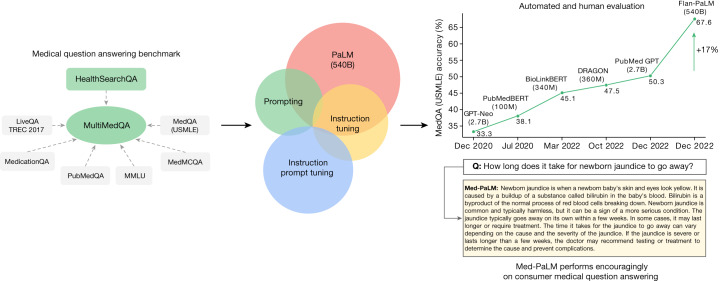
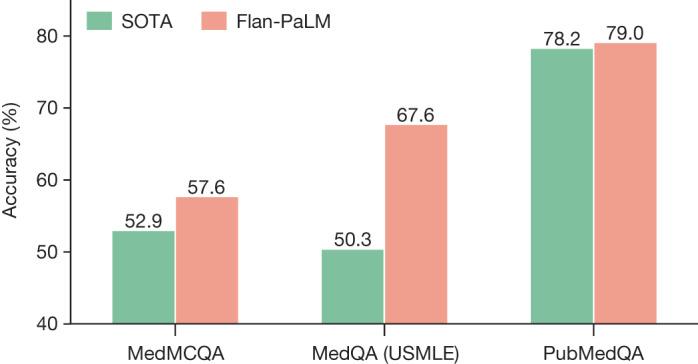
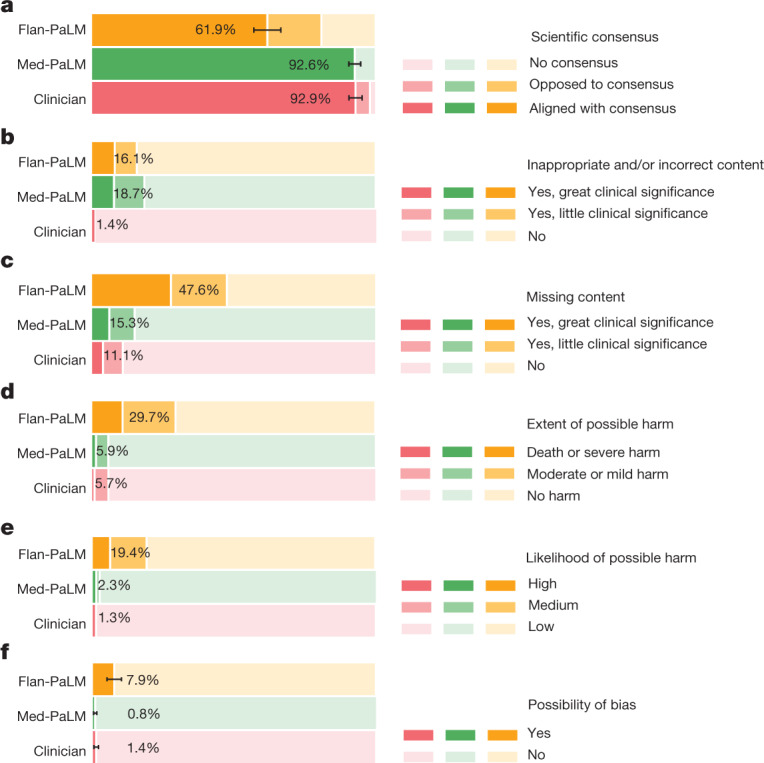
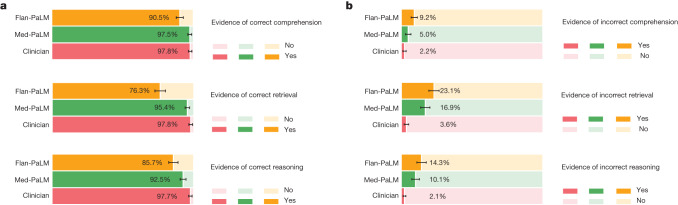
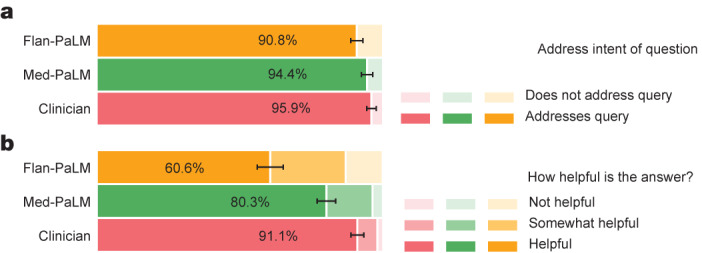
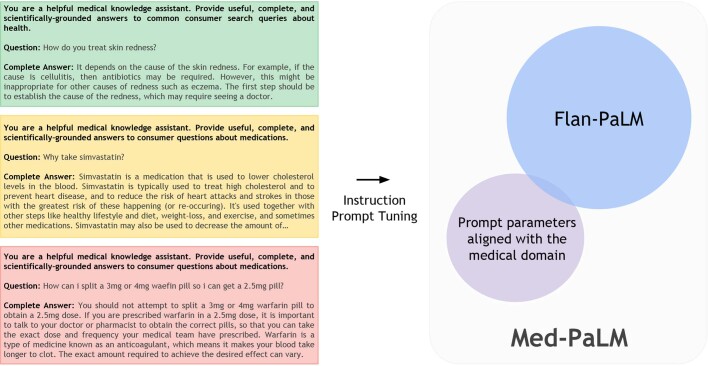
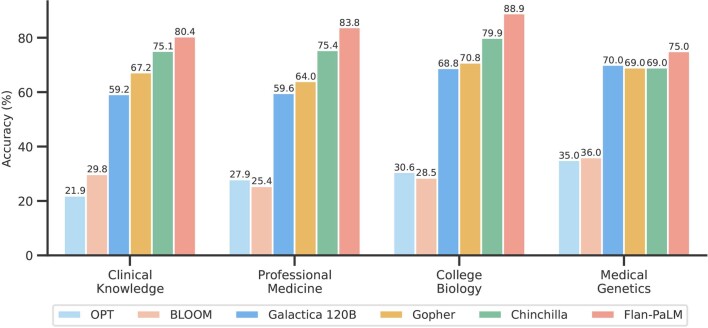
Large language models (LLMs) have demonstrated impressive capabilities, but the bar for clinical applications is high. Attempts to assess the clinical knowledge of models typically rely on automated evaluations based on limited benchmarks. Here, to address these limitations, we present MultiMedQA, a benchmark combining six existing medical question answering datasets spanning professional medicine, research and consumer queries and a new dataset of medical questions searched online, HealthSearchQA. We propose a human evaluation framework for model answers along multiple axes including factuality, comprehension, reasoning, possible harm and bias. In addition, we evaluate Pathways Language Model 1 (PaLM, a 540-billion parameter LLM) and its instruction-tuned variant, Flan-PaLM 2 on MultiMedQA. Using a combination of prompting strategies, Flan-PaLM achieves state-of-the-art accuracy on every MultiMedQA multiple-choice dataset (MedQA 3 , MedMCQA 4 , PubMedQA 5 and Measuring Massive Multitask Language Understanding (MMLU) clinical topics 6 ), including 67.6% accuracy on MedQA (US Medical Licensing Exam-style questions), surpassing the prior state of the art by more than 17%. However, human evaluation reveals key gaps. To resolve this, we introduce instruction prompt tuning, a parameter-efficient approach for aligning LLMs to new domains using a few exemplars. The resulting model, Med-PaLM, performs encouragingly, but remains inferior to clinicians. We show that comprehension, knowledge recall and reasoning improve with model scale and instruction prompt tuning, suggesting the potential utility of LLMs in medicine. Our human evaluations reveal limitations of today’s models, reinforcing the importance of both evaluation frameworks and method development in creating safe, helpful LLMs for clinical applications.
Overview
The claims and statistics of this paper haven’t been checked yet.
Free: it reads the open-access text and checks the first 5 claims that cite a source we can check. Create a free account to check every claim.
Integrity signals
Registry
Cites
Statistics
Figures
Verification
Claims the paper makes
The claims and statistics of this paper haven’t been checked yet.
Free: it reads the open-access text and checks the first 5 claims that cite a source we can check. Create a free account to check every claim.
Claims other papers make about this one
Each is checked against this paper’s own text: does it say what the citing paper says it does?
The cited source doesn’t support the claim as written.
In the citing paper
“Notably, in healthcare, medical NLP benchmarks like MedQA7, PubMedQA8 and the Massive Multitask Language Understanding (MMLU) serve as the de-facto reporting standard for state-of-the-art medical LLMs9–11 with claims of ‘superhuman’ performance in patient-facing tasks12.”
From Medical large language models are vulnerable to data-poisoning attacks (2025) · cites this paper as [9]
Checked by a reasoning model — may be wrong.
Experimental — accuracy not yet measuredThe cited source doesn’t support the claim as written.
In the citing paper
“Med-PaLM achieved a passing score of 67.6% on USMLE-style MedQA questions”
From Trustworthy Medical Question Answering: An Evaluation-Centric Survey (2025) · cites this paper as Singhal et al., 2023
Checked by a reasoning model — may be wrong.
Experimental — accuracy not yet measuredThe source backs part of the claim, not all of it — or backs it for a different population, condition or comparison.
In the citing paper
“Previous work has demonstrated potential across clinical NLP tasks22,23, adapting to the medical domain by training a new model24,25, fine-tuning an existing model26,27 or supplying task-specific examples in the model prompt27,28.”
From Adapted large language models can outperform medical experts in clinical text summarization (2024) · cites this paper as [24]
Experimental — accuracy not yet measuredThe source backs part of the claim, not all of it — or backs it for a different population, condition or comparison.
In the citing paper
“For example, Google’s Med-PaLM 2 demonstrated proficiency in medical question answering, achieving performance comparable to clinical experts on medical licensing examinations and performing better than generalist physicians in real-world medical questions.70”
From A foundational architecture for AI agents in healthcare (2025) · cites this paper as [70]
Experimental — accuracy not yet measuredThe source backs part of the claim, not all of it — or backs it for a different population, condition or comparison.
In the citing paper
“Large language models (LLMs) and multimodal foundation models now exhibit enhanced reasoning capabilities, natural language understanding, and the ability to interact with external tools such as calculators, databases, and application programming interfaces.”
From Medical AI Agents for Clinical Decision Support: Viewpoint Using the Planning, Action, Reflection, and Memory (PARM) Analytical Lens (2026) · cites this paper as [8]
Experimental — accuracy not yet measured
40 more claims about this paper
Create a free account to see every claim other papers make about this one.
Self-check
Percentages, sums and reported differences re-computed from the paper’s own numbers.
The self-check needs the paper’s full text.
Citations
Cites
Vaswani, A., Shazeer, N., Parmar, N., Uszkoreit, J., Jones, L., Gomez, A. N., Kaiser, L., & Polosukhin, I. (2017) · arXiv · doi:10.48550/arxiv.1706.03762 · Cited by 120,404 · cited 1×
“They owe their success to scaling up the training of transformer-based models [84].”
BackgroundExploring the Limits of Transfer Learning with a Unified Text-to-Text Transformer
Raffel, C., Shazeer, N., Roberts, A., Lee, K., Narang, S., Matena, M., Zhou, Y., Li, W., & Liu, P. J. (2019) · arXiv · doi:10.48550/arxiv.1910.10683 · Cited by 31,859 · cited 1×
“Large language models (LLMs) Over the past few years, LLMs have shown impressive performance on natural language processing (NLP) tasks [12, 14, 15, 30, 69, 70, 73, 89, 91, 99].”
BackgroundLanguage Models are Few-Shot Learners
Brown, T. B., Mann, B., Ryder, N., Subbiah, M., Kaplan, J., Dhariwal, P., Neelakantan, A., Shyam, P., Sastry, G., Askell, A., et al. (2020) · arXiv · doi:10.48550/arxiv.2005.14165 · Cited by 23,372
BLEU: a method for automatic evaluation of machine translation
Papineni, K., Roukos, S., Ward, T., & Zhu, W.-J. (2001) · Proceedings of the 40th Annual Meeting on Association for Computational Linguistics - ACL '02 · doi:10.3115/1073083.1073135 · Cited by 21,344
Decoupled Weight Decay Regularization
Loshchilov, I., & Hutter, F. (2017) · arXiv · doi:10.48550/arxiv.1711.05101 · Cited by 12,522
Scaling Laws for Neural Language Models
Kaplan, J., McCandlish, S., Henighan, T., Brown, T. B., Chess, B., Child, R., Gray, S., Radford, A., Wu, J., & Amodei, D. (2020) · arXiv · doi:10.48550/arxiv.2001.08361 · Cited by 9,550 · cited 1×
“It has been shown that model performance and data-efficiency scales with model size and dataset size [37].”
BioBERT: a pre-trained biomedical language representation model for biomedical text mining
Lee, J., Yoon, W., Kim, S., Kim, D., Kim, S., So, C. H., & Kang, J. (2020) · Bioinformatics · doi:10.1093/bioinformatics/btz682 · Cited by 7,218
Boateng, G. O., Neilands, T. B., Frongillo, E. A., Melgar-Quiñonez, H. R., & Young, S. L. (2018) · Frontiers in Public Health · doi:10.3389/fpubh.2018.00149 · Cited by 5,925
Chain-Of-Thought Prompting Elicits Reasoning in Large Language Models
Wei, J., Wang, X., Schuurmans, D., Bosma, M., Ichter, B., Xia, F., Chi, E., Le, Q. V., & Zhou, D. (2022) · Advances in Neural Information Processing Systems 35 · doi:10.52202/068431-1800 · Cited by 4,505
Self-citationLiu, P., Yuan, W., Fu, J., Jiang, Z., Hayashi, H., & Neubig, G. (2023) · ACM Computing Surveys · doi:10.1145/3560815 · Cited by 4,361
Research works printed but not linked: 2
- Abacha, A. B. et al. in Studies in Health Technology and Informatics (eds Ohno-Machado, L. & Séroussi, B.) 25–29 (IOS Press, 2019).
- Matheny, M., Israni, S. T., Ahmed, M. & Whicher, D. eds. Artificial Intelligence in Health Care: The Hope, the Hype, the Promise, the Peril (National Academy of Medicine, 2022). 39146448
Cited by
Items 801–900 of 1,129
MedAdapter: Efficient Test-Time Adaptation of Large Language Models Towards Medical Reasoning
Shi, W., Xu, R., Zhuang, Y., Yu, Y., Sun, H., Wu, H., Yang, C., & Wang, M. D. (2024) · Conference on Empirical Methods in Natural Language Processing (EMNLP) · doi:10.18653/v1/2024.emnlp-main.1244 · Cited by 62
Hou, Y., Bert, C., Gomaa, A., Lahmer, G., Höfler, D., Weißmann, T., Voigt, R., Schubert, P., Schmitter, C., Depardon, A., et al. (2025) · Frontiers in Artificial Intelligence · doi:10.3389/frai.2024.1493716 · Cited by 44
“These models have revolutionized diverse domains, including medicine (Singhal et al., 2023), by bringing transformative impacts on various applications.”
Can large language models fully automate or partially assist paper selection in systematic reviews?
Chen, H., Jiang, Z., Liu, X., Xue, C. C., Yew, S. M. E., Sheng, B., Zheng, Y., Wang, X., Wu, Y., Sivaprasad, S., et al. (2025) · British Journal of Ophthalmology · doi:10.1136/bjo-2024-326254 · Cited by 33
Yang, X., Li, T., Wang, H., Zhang, R., Ni, Z., Liu, N., Zhai, H., Zhao, J., Meng, F., Zhou, Z., et al. (2025) · npj Digital Medicine · doi:10.1038/s41746-025-01486-5 · Cited by 35
“Meanwhile, previous studiesfrequently usedmultiple-choicequestionsoraskedLLMstoprovide a single diagnosis to evaluate the diagnostic capabilities of LLMs 10,17,20 .”
Self-citationPlanFitting: Personalized Exercise Planning with Large Language Model-driven Conversational Agent
Shin, D.-H., Hsieh, G., & Kim, Y. (2025) · ACM Conference on Conversational User Interfaces (CUI) · doi:10.1145/3719160.3736607 · Cited by 42
Liu, Y., Yuan, Y., Yan, K., Li, Y., Saccà, V., Hodges, S., Cannistra, M., Jeong, P., Wu, J., & Kong, J. (2025) · npj Digital Medicine · doi:10.1038/s41746-025-01845-2 · Cited by 41
Self-citationVisionUnite: A Vision-Language Foundation Model for Ophthalmology Enhanced With Clinical Knowledge
Li, Z., Song, D., Yang, Z., Wang, D., Li, F., Zhang, X., Kinahan, P. E., & Qiao, Y. (2025) · IEEE Transactions on Pattern Analysis and Machine Intelligence · doi:10.1109/tpami.2025.3598734 · Cited by 51
“Advanced language models show a significant short-fall in effective vision-language integration [5], [6].”
Builtjes, L., Bosma, J. S., Prokop, M., van Ginneken, B., & Hering, A. (2025) · JAMIA Open · doi:10.1093/jamiaopen/ooaf109 · Cited by 46
“12,13 However, a substantial portion of the current literature 7–9,12–20 is focused primarily on proprietary models such as OpenAI’s GPT-4, 21 which pose challenges related to transparency, reproducibility, and ethical concerns in clinical applications.”
Zhao, Y., Wang, P., Zhao, Y., Du, H., & Yang, H. (2025) · Nature Communications · doi:10.1038/s41467-025-64574-w · Cited by 48
“The recent emergence of foundation models, especially Large Language Models (LLMs), presents a transformative opportunity to mitigate these enduring challenges by leveraging their advanced capabilities in processing and reasoning from complex, multi-modal information 11 – 15 .”
The pitfalls of multiple-choice questions in generative AI and medical education
Singh, S., Alyakin, A., Alber, D. A., Stryker, J., Tong, A. P., Sangwon, K. L., Goff, N. K., Paz, M. D. L., Hernandez‐Rovira, M. A., Park, K. Y., et al. (2025) · Scientific Reports · doi:10.1038/s41598-025-26036-7 · Cited by 41
Yan, Y., Zou, B., Liao, Y., Xu, G., Yao, R., Fan, H., Sun, J., Wang, X., Sprinkle, J. M., An, Z., et al. (2026) · Information Fusion · doi:10.1016/j.inffus.2026.104546 · Cited by 43
Sušnjak, T. (2023) · arXiv (Cornell University) · doi:10.48550/arxiv.2306.14905 · Cited by 43
Using Large Language Models to Generate, Validate, and Apply User Intent Taxonomies
Shah, C., White, R. W., Andersen, R., Buscher, G., Counts, S., Das, S. S. S., Montazer, A., Manivannan, S., Neville, J., Ni, X., et al. (2023) · arXiv · doi:10.48550/arxiv.2309.13063 · Cited by 33
“LLMs have been used to enable scientific discovery [28], with remarkable progress in areas such as medicine [47] and finance [6].”
Banerjee, P., Srivastava, A. K., Adjeroh, D. A., Reddy, R., & Karimian, N. (2025) · IEEE Access · doi:10.1109/access.2024.3524102 · Cited by 32
Hakim, J. B., Painter, J. L., Ramcharran, D., Kara, V., Powell, G., Sobczak, P., Sato, C., Bate, A., & Beam, A. (2025) · Scientific Reports · doi:10.1038/s41598-025-09138-0 · Cited by 32
A dataset and benchmark for hospital course summarization with adapted large language models
Aali, A., Van Veen, D., Arefeen, Y. I., Hom, J., Bluethgen, C., Reis, E. P., Gatidis, S., Clifford, N., Daws, J., Tehrani, A. S., et al. (2025) · Journal of the American Medical Informatics Association · doi:10.1093/jamia/ocae312 · Cited by 32
“Other works [40, 41] further explore domain adaptation of LLMs in the clinical domain through fine-tuning for improved performance in medical tasks.”
Sonoda, Y., Kurokawa, R., Hagiwara, A., Asari, Y., Fukushima, T., Kanzawa, J., Gonoi, W., & Abe, O. (2024) · Japanese Journal of Radiology · doi:10.1007/s11604-024-01712-2 · Cited by 32
“In the medical domain, a large number of studies have already provided evidence of LLMs’ clinical reasoning capabilities [4–6].”
Cheong, K. X., Zhang, C., Tan, T., Fenner, B. J., Wong, W., Teo, K. Y. C., Wang, Y. X., Sivaprasad, S., Keane, P. A., Lee, C. S., et al. (2024) · British Journal of Ophthalmology · doi:10.1136/bjo-2023-324533 · Cited by 36
Eroğlu, Z. T., Babayiğit, O., Şen, D. Ö., & Yarkaç, F. U. (2024) · Clinical Oral Investigations · doi:10.1007/s00784-024-05799-9 · Cited by 35
“Examples are Galactica and DRAGON, which have demonstrated the utility of a curated scientific corpus of training data [24–26].”
BackgroundERG-AI: enhancing occupational ergonomics with uncertainty-aware ML and LLM feedback
Sen, S., Gonzalez-Sanchez, V. E., Husom, E. J., Tverdal, S., Tokas, S., & Tjøsvoll, S. O. (2024) · Applied Intelligence · doi:10.1007/s10489-024-05796-1 · Cited by 34
“Singhal et al. [64] showcase cutting-edge uses of LLMs for medical knowledge, where LLMs when tuned with instruction prompts, demonstrate reasonable performance but still lag behind actual clinicians.”
How GPT models perform on the United States medical licensing examination: a systematic review
Brin, D., Sorin, V., Konen, E., Nadkarni, G. N., Glicksberg, B. S., & Klang, E. (2024) · Discover Applied Sciences · doi:10.1007/s42452-024-06194-5 · Cited by 36
“Prompting is considered to hold a significant role in shaping the performance of LLMs when answering queries [36, 37].”
So, J.-H., Chang, J., Kim, E., Na, J., Choi, J., Sohn, J.-Y., Kim, B.-H., & Chu, S. H. (2024) · JMIR Formative Research · doi:10.2196/58418 · Cited by 36
“The results align with recent evidence suggesting that LLMs can perform remarkably well on structured medical question-answering benchmarks [21,28,33].”
TRIZ-GPT: An LLM-Augmented Method For Problem-Solving
Chen, L., Song, Y., Ding, S., Sun, L., Childs, P., & Zuo, H. (2024) · ASME International Design Engineering Technical Conferences and Computers and Information in Engineering Conference (IDETC/CIE) · doi:10.1115/detc2024-143163 · Cited by 43
Few shot chain-of-thought driven reasoning to prompt LLMs for open-ended medical question answering
Nachane, S. S., Gramopadhye, O., Chanda, P., Ramakrishnan, G., Jadhav, K. S., Nandwani, Y., Raghu, D., & Joshi, S. (2024) · Findings of the Association for Computational Linguistics: EMNLP (Findings of EMNLP) · doi:10.18653/v1/2024.findings-emnlp.31 · Cited by 44
Cao, M., Wang, Q., Zhang, X., Liang, Z., Qiu, J., Yung, P. S., & Ong, M. T. (2024) · Journal of sport and health science/Journal of Sport and Health Science · doi:10.1016/j.jshs.2024.101016 · Cited by 37
Hao, J., Yao, Z., Tang, Y., Remis, A., Wu, K., & Yu, X. (2025) · Annals of Biomedical Engineering · doi:10.1007/s10439-025-03676-4 · Cited by 36
Large Language Models in Biochemistry Education: Comparative Evaluation of Performance
Bolgova, O., Shypilova, I., & Mavrych, V. (2025) · JMIR Medical Education · doi:10.2196/67244 · Cited by 33
Deva, R., Ramani, D., Divate, T., Jalota, S., & Ismail, A. (2025) · CHI Conference on Human Factors in Computing Systems · doi:10.1145/3706598.3713362 · Cited by 45
“Recent studies in HCI and health informatics show a growing interest in utilizing chatbots in configurable healthcare interventions to improve patient engagement due to their anthropomorphic communication styles [74, 82, 88, 92, 109].”
ORAN-Bench-13K: An Open Source Benchmark for Assessing LLMs in Open Radio Access Networks
Gajjar, P., & Shah, V. K. (2025) · IEEE Consumer Communications and Networking Conference · doi:10.1109/ccnc54725.2025.10975994 · Cited by 50
“…the inclusion of such LLMs is only possible after creating thorough evaluation strategies as existing benchmark datasets in multiple domains have played a crucial role in assessing model performance and guiding architectural design [5], with prominent examples being FLUE [14] and MultiMedQA [15].”
Multimodal generative AI for interpreting 3D medical images and videos
Lee, J.-O., Zhou, H.-Y., Berzin, T. M., Sodickson, D. K., & Rajpurkar, P. (2025) · npj Digital Medicine · doi:10.1038/s41746-025-01649-4 · Cited by 38
“Various vision-language models have emerged in the medical fi eld, including BioMedGPT 76 , MedPaLM 77 , LLaVa-Med 78 , and MedVersa 79 .”
The barriers to uptake of artificial intelligence in hepatology and how to overcome them
Clusmann, J., Balaguer‐Montero, M., Bassegoda, O., Schneider, C. V., Seraphin, T. P., Paintsil, E. K., Luedde, T., Pérez-López, R., Caldéraro, J., Gilbert, S., et al. (2025) · Journal of Hepatology · doi:10.1016/j.jhep.2025.07.003 · Cited by 34
RetractedAbtahi, F., Seoane, F., Pau, I., & Vega-Barbas, M. (2026) · Journal of Medical Internet Research · doi:10.2196/87969 · Cited by 40
“LLMs support clinical note generation [7], differential diagnoses [8], and patient-facing interactions [9]; medical imaging models interpret radiographs and computed tomography scans with minimal oversight [10,11]; and agentic AI systems increasingly coordinate scheduling, triage, and laboratory…”
AutoTrial: Prompting Language Models for Clinical Trial Design
Wang, Z., Xiao, C., & Sun, J. (2023) · Conference on Empirical Methods in Natural Language Processing (EMNLP) · doi:10.18653/v1/2023.emnlp-main.766 · Cited by 45
Evaluation of Question Answering Systems: Complexity of Judging a Natural Language
Farea, A., Yang, Z., Duong, K., Perera, N., & Emmert‐Streib, F. (2025) · ACM Computing Surveys · doi:10.1145/3744663 · Cited by 41
“Delving into human evaluation methods for LLMs demands careful consideration of various critical factors to ensure reliability and accuracy [155].”
Beyond Classification: Financial Reasoning in State-of-the-Art Language ModelsPreprint
Son, G., Jung, H., Hahm, M., Na, K., & Jin, S. (2023) · arXiv (Cornell University) · doi:10.48550/arxiv.2305.01505 · Cited by 49
Cacciamani, G. E., Eppler, M., Ganjavi, C., Pekan, A., Biedermann, B. M., Collins, G. S., & Gill, I. S. (2023) · arXiv (Cornell University) · doi:10.48550/arxiv.2307.08974 · Cited by 40
“This success spurred similar offerings from tech giants and open-source platforms alike, such as Google's Bard and Microsoft's Bing Chat [5, 6], MedPalm2 [7, 8] and many others [9].”
BackgroundOno, K., & Morita, A. (2024) · doi:10.36227/techrxiv.170956672.21573677/v1 · Cited by 38
SciLitLLM: How to Adapt LLMs for Scientific Literature Understanding
Li, S., Huang, J. H., Zhuang, J., Shi, Y., Cai, X., Xu, M., Wang, X., Zhang, L., Ke, G., & Cai, H. (2025) · International Conference on Learning Representations · doi:10.48550/arxiv.2408.15545 · Cited by 48
“{"CellLine": [], "Disease": [ "IGT", "impaired glucose tolerance","type 2 diabetes mellitus", "diabetes" ],"Variant": [ "rs3818247","rs2071197", "rs1884614","rs2144908","rs4810424" ] }”
HealthBench Professional: Evaluating Large Language Models on Real Clinician ChatsPreprint
Hicks, R. S., Trofimov, M., Lim, D., Arora, R. K., Tsimpourlas, F., Bowman, P., Sharman, M., Tong, C., Karthik, K., Dugar, A., et al. (2026) · arXiv (Cornell University) · doi:10.48550/arxiv.2604.27470 · Cited by 46
Self-citationPneumoLLM: Harnessing the power of large language model for pneumoconiosis diagnosis
Song, M., Wang, J., Yu, Z., Wang, J., Yang, L., Lu, Y., Li, B., Wang, X., Wang, X., Huang, Q., et al. (2024) · Medical Image Analysis · doi:10.1016/j.media.2024.103248 · Cited by 31
Ravi, A., Neinstein, A., & Murray, S. G. (2023) · ATS Scholar · doi:10.34197/ats-scholar.2023-0036ps · Cited by 31
Liu, L., Yang, X., Lei, J., Shen, Y., Wang, J., Wei, P., Chu, Z., Qin, Z., & Ren, K. (2026) · IEEE Transactions on Knowledge and Data Engineering · doi:10.1109/tkde.2026.3709941 · Cited by 31
“…despite the promising progress and detailed reviews, the potential pathways of Med-LLMs are still under-explored, e.g., aligning the development of Med-LLMs with the complex needs in the clinical environment, which is vital for better patient care and advancing medical research [18], [21].”
Benchmarking Large Language Models on Answering and Explaining Challenging Medical Questions
Chen, H., Fang, Z., Singla, Y., & Dredze, M. (2025) · Proceedings of the 2025 Conference of the Nations of the Americas Chapter of the Association for Computational Linguistics: Human Language Technologies (Volume 1: Long Papers) · doi:10.18653/v1/2025.naacl-long.182 · Cited by 31
MedHallu: A Comprehensive Benchmark for Detecting Medical Hallucinations in Large Language Models
Pandit, S., Xu, J., Hong, J., Wang, Z., Chen, T., Xu, K., & Ding, Y. (2025) · arXiv · doi:10.48550/arxiv.2502.14302 · Cited by 31
“…(LLMs) (Achiam et al., 2023) have catalyzed their widespread adoption as assistive tools across a multitude of domains, including software development (Krishna et al., 2024), healthcare (Singhal et al., 2022), weather prediction (Li et al., 2024), and financial applications (Nie et al., 2024).”
Busch, F., Han, T., Makowski, M. R., Truhn, D., Bressem, K. K., & Adams, L. C. (2024) · Journal of Medical Internet Research · doi:10.2196/54948 · Cited by 34
Deep learning for surgical workflow analysis: a survey of progresses, limitations, and trends
Li, Y., Zhao, Z.-J., Li, R.-B., & Li, F. (2024) · Artificial Intelligence Review · doi:10.1007/s10462-024-10929-6 · Cited by 34
Xu, L., AlMahri, S., Mak, S., & Brintrup, A. M. (2024) · IFAC-PapersOnLine · doi:10.1016/j.ifacol.2024.09.200 · Cited by 52
Torkamaan, H., Steinert, S., Pera, M. S., Kudina, O., Freire, S. K., Verma, H., Kelly, S., Sekwenz, M.-T., Yang, J., van Nunen, K., et al. (2024) · Behaviour and Information Technology · doi:10.1080/0144929x.2024.2431068 · Cited by 43
Yan, Z., Liu, J., Fan, Y., Lu, S., Xu, D., Yang, Y., Wang, H., Mao, J., Tseng, H.-C., Chang, T.-H., et al. (2025) · Journal of Medical Internet Research · doi:10.2196/62857 · Cited by 36
“Subsequent strategies include (1) using secondary LLMs tailored for various professional scenarios, such as Med-PalM [33], and (2) application of prompt engineering.”
GenAINet: Enabling Wireless Collective Intelligence via Knowledge Transfer and Reasoning
Zou, H., Zhao, Q., Bariah, L., Tian, Y., Bennis, M., Lasaulce, S., Debbah, M., & Bader, F. (2024) · IEEE Access · doi:10.1109/access.2025.3565859 · Cited by 38
“Such capabilities facilitate the wide adoption of LLMs in Telecom [5], [6], [7], finance [8], [9], healthcare [10], and so on.”
SeedLLM·Rice: A large language model integrated with rice biological knowledge graph
Yang, F., Kong, H., Ying, J., Chen, Z., Luo, T., Jiang, W., Yuan, Z., Wang, Z., Ma, Z., Wang, S., et al. (2025) · Molecular Plant · doi:10.1016/j.molp.2025.05.013 · Cited by 34
In Situ Graph Reasoning and Knowledge Expansion Using Graph‐PRefLexOR
Buehler, M. J. (2025) · Advanced Intelligent Discovery · doi:10.1002/aidi.202500006 · Cited by 37
Fine-tuning large language models for interdisciplinary environmental challenges
Zhang, Y., Lin, S., Xiong, Y., Li, N., Zhong, L., Ding, L., & Hu, Q. (2025) · Environmental Science and Ecotechnology · doi:10.1016/j.ese.2025.100608 · Cited by 41
“Although LLMs have begun to reshape domains such as medicine and law [15 – 18], their impact on environmental science remains limited, as no dedicated framework has yet combined domain-specific data generation and rigorous evaluation [19,20].”
A collaborative large language model for drug analysis
Zhou, H., Liu, F., Wu, J., Zhang, W., Huang, G., Clifton, L., Eyre, D. W., Luo, H., Liu, F., Branson, K., et al. (2025) · Nature Biomedical Engineering · doi:10.1038/s41551-025-01471-z · Cited by 44
“We follow previous works 5,23,24 , for example, Med-PaLM, to perform the prompt tuning experiment.”
InfluentialDisease progression strikingly differs in research and real-world Parkinson’s populations
Beaulieu‐Jones, B. K., Frau, F., Bozzi, S., Chandross, K. J., Peterschmitt, M., Cohen, C., Coulovrat, C., Kumar, D., Kruger, M. J., Lipnick, S., et al. (2024) · npj Parkinson s Disease · doi:10.1038/s41531-024-00667-5 · Cited by 31
TRIDENT: Benchmarking LLM Safety in Finance, Medicine, and LawPreprint
Hui, Z., Dong, Y. R., Shareghi, E., & Collier, N. (2025) · arXiv (Cornell University) · doi:10.48550/arxiv.2507.21134 · Cited by 33
“…such as MedQA (Jin et al., 2021), MedMCQA (Pal et al., 2022), and PubMedQA (Jin et al., 2019) test models on clinical and biomedical knowledge, while broader suites like BioASQ (Krithara et al., 2023) and MultiMedQA (Singhal et al., 2022) integrate professional exams and consumer health queries.”
Bian, C., Wang, X., Huang, Y., Zhou, S., & Lu, W. (2025) · Humanities and Social Sciences Communications · doi:10.1057/s41599-025-05860-2 · Cited by 30
“GAI has achieved signi fi cant progress in creativity, enabling computers to generate relevant and original text and images in response to simple natural language prompts (Allingham et al. 2023; Kasneci et al. 2023; Lu et al. 2024; Singhal et al. 2023).”
Automating expert-level medical reasoning evaluation of large language models
Zhou, S., Xie, W., Li, J., Zhan, Z., Song, M., Yang, H., Espinoza, C., Welton, L., Mai, X., Jin, Y., et al. (2025) · npj Digital Medicine · doi:10.1038/s41746-025-02208-7 · Cited by 30
“While this method aligns with the prevailing approaches to evaluating LLMs ’ medical capabilities and offers a coarse measurement 22,23 , it fails to capture the depth and validity of the reasoning process that underpins clinical decisions and cannot identify fl awed reasoning 24,25 .”
Standardizing and Scaffolding Health Care AI-Chatbot Evaluation: Systematic Review
Hua, Y., Xia, W., Bates, D., Hartstein, G. L., Kim, H. T., Li, M., Nelson, B. W., Stromeyer IV, C., King, D., Suh, J., et al. (2025) · JMIR AI · doi:10.2196/69006 · Cited by 30
“…care chatbots have received even more attention since they enable human-level fluent conversations, have reached physician-level performance on board residency examinations [3] and comparable performance on other medical examinations and questions [4-6], and offer easy ways to train and adapt.”
Rethinking assessment in response to generative artificial intelligence
Pearce, J., & Chiavaroli, N. (2023) · Medical Education · doi:10.1111/medu.15092 · Cited by 30
Large language model trained on clinical oncology data predicts cancer progression
Zhu, M., Lin, H., Jiang, J., Jinia, A. J., Jee, J., Pichotta, K., Waters, M., Rose, D., Schultz, N., Chalise, S., et al. (2025) · npj Digital Medicine · doi:10.1038/s41746-025-01780-2 · Cited by 30
“In the medical domain, numerous studies have demonstrated the improved performance of domain-speci fi c foundation LLMs, including BioMedLM 13 , BioGPT 14 , GatorTron 15 , MedPaLM 16 , MedPalM2 17 , and BioMistral 18 .”
Chen, Y., Zhang, S., Han, T., Du, Y., Zhang, W., & Li, J. (2024) · ISPRS Journal of Photogrammetry and Remote Sensing · doi:10.1016/j.isprsjprs.2024.04.024 · Cited by 33
Evaluating Large Language Model (LLM) Performance on Established Breast Classification Systems
Haider, S. A., Pressman, S. M., Borna, S., Gomez-Cabello, C. A., Sehgal, A., Leibovich, B. C., & Forte, A. J. (2024) · Diagnostics · doi:10.3390/diagnostics14141491 · Cited by 31
Systematic review and meta-analysis of preclinical studies
Ineichen, B. V., Held, U., Salanti, G., Macleod, M. R., & Wever, K. E. (2024) · Nature Reviews Methods Primers · doi:10.1038/s43586-024-00347-x · Cited by 32
Sükei, E., Rumetshofer, E., Schmidinger, N., Mayr, A., Schmidt-Erfurth, U. M., Klambauer, G., & Bogunović, H. (2024) · Scientific Reports · doi:10.1038/s41598-024-78515-y · Cited by 38
Mahmoud, R., Shuster, A., Kleinman, S., Arbel, S., Ianculovici, C., & Peleg, O. (2024) · Journal of Oral and Maxillofacial Surgery · doi:10.1016/j.joms.2024.11.007 · Cited by 36
The effects of generative AI’s human-like competencies on clinical decision-making
Spatscheck, N., Schaschek, M., & Winkelmann, A. (2024) · Journal of Decision Systems · doi:10.1080/12460125.2024.2430731 · Cited by 24
Large language models facilitating modern molecular biology and novel drug development
Liu, X., Lü, Z., Wang, T., & Liu, F. (2024) · Frontiers in Pharmacology · doi:10.3389/fphar.2024.1458739 · Cited by 33
A case study on using a large language model to analyze continuous glucose monitoring data
Healey, E., Tan, A. L. M., Flint, K. L., Ruiz, J., & Kohane, I. S. (2025) · Scientific Reports · doi:10.1038/s41598-024-84003-0 · Cited by 36
Eisele‐Metzger, A., Lieberum, J.-L., Toews, M., Siemens, W., Heilmeyer, F., Haverkamp, C., Böhringer, D., & Meerpohl, J. J. (2025) · Research Synthesis Methods · doi:10.1017/rsm.2025.12 · Cited by 32
Ah-Thiane, L., Heudel, P., Campone, M., Robert, M., Brillaud-Meflah, V., Rousseau, C., Blanc‐Onfroy, M. L., Tomaszewski, F., Supiot, S., Perennec, T., et al. (2025) · JCO Clinical Cancer Informatics · doi:10.1200/cci-24-00230 · Cited by 45
Hou, S., Zhao, A., Liang, J., Shen, Z., & Wu, H. (2025) · Knowledge-Based Systems · doi:10.1016/j.knosys.2025.113624 · Cited by 31
Prompt engineering for accurate statistical reasoning with large language models in medical research
Vilakati, S. (2025) · Frontiers in Artificial Intelligence · doi:10.3389/frai.2025.1658316 · Cited by 35
“Yet, as generative AI becomes more deeply embedded in the fabric of medical research (Singhal et al., 2023), it is essential to reflect on the longstanding challenges that have shaped the field, and chief among them is the misuse of statistics.”
Multi-step retrieval and reasoning improves radiology question answering with large language models
Wind, S., Sopa, J., Truhn, D., Lotfinia, M., Nguyen, T.-T., Bressem, K. K., Adams, L. C., Rusu, M., Koestler, H., Wellein, G., et al. (2025) · npj Digital Medicine · doi:10.1038/s41746-025-02250-5 · Cited by 42
“Beyondaccuracy,ouranalysisdemonstratedthatRaRimprovedfac-tualgrounding 6,14 and reduced hallucinations in model outputs.”
Artificial intelligence in primary care: innovation at a crossroads
Laranjo, L., Car, L. T., Payne, R. E., Neves, A. L., Kidd, M. R., & Miranda, J. J. (2025) · The Lancet Primary Care · doi:10.1016/j.lanprc.2025.100078 · Cited by 36
Towards Evaluation and Understanding of Large Language Models for Cyber Operation Automation
Sultana, M., Taylor, A., Li, L., & Majumdar, S. (2023) · IEEE Conference on Communications and Network Security · doi:10.1109/cns59707.2023.10288677 · Cited by 42
“Also, Biomedical Language Understanding Evaluation (BLUE) [16], ClimaBench [17], MultiMedQA [18] datasets have been created to evaluate LLM capabilities in biomedical, climate change, and medical domains.”
BackgroundMethodSheth, S., Baker, H. P., Prescher, H., & Strelzow, J. (2024) · Journal of the American Academy of Orthopaedic Surgeons · doi:10.5435/jaaos-d-23-00787 · Cited by 34
$\textbf{S}^2$IP-LLM: Semantic Space Informed Prompt Learning with LLM for Time Series Forecasting
Pan, Z., Jiang, Y., Garg, S., Schneider, A., Nevmyvaka, Y., & Song, D. (2024) · International Conference on Machine Learning · doi:10.48550/arxiv.2403.05798 · Cited by 194
“…and translate sentences be-tween multiple languages, but also exhibited tremendous potential in tackling applications of more complex or structured domains, such as code generation, healthcare, finance, and autonomous systems, etc (Singhal et al., 2022; Cui et al., 2024; Li et al., 2023).”
BackgroundTelecomRAG: Taming Telecom Standards with Retrieval Augmented Generation and LLMs
Yilma, G. M., Ayala‐Romero, J. A., García‐Saavedra, A., & Costa‐Pérez, X. (2024) · ACM SIGCOMM Computer Communication Review · doi:10.1145/3711992.3711996 · Cited by 35
“In health-care, Med-PaLM [10] achieves expert-level performance on the United States Medical Licensing Examination (USMLE).”
Generative AI could revolutionize health care — but not if control is ceded to big tech
Toma, A., Senkaiahliyan, S., Lawler, P. R., Rubin, B., & Wang, B. (2023) · Nature · doi:10.1038/d41586-023-03803-y · Cited by 29
Oniani, D., Hilsman, J., Zang, C., Wang, J., Cai, L., Zawała, J., & Wang, Y. (2024) · Scientific Reports · doi:10.1038/s41598-024-61124-0 · Cited by 33
“LLMs have also demonstrated promising performance in a variety of tasks across different scientific fields 16–19 .”
BackgroundMaximising Large Language Model Utility in Cardiovascular Care: A Practical Guide
Nolin-Lapalme, A., Thériault-Lauzier, P., Corbin, D., Tastet, O., Sharma, A., Hussin, J., Kadoury, S., Jiang, R., Krahn, A. D., Gallo, R., et al. (2024) · Canadian Journal of Cardiology · doi:10.1016/j.cjca.2024.05.024 · Cited by 39
Prognosticating the outcome of intensive care in older patients—a narrative review
Beil, M., Moreno, R. P., Fronczek, J., Kogan, Y., Moreno, R. P., Flaatten, H. K., Guidet, B., de Lange, D. W., Leaver, S. K., Nachshon, A., et al. (2024) · Annals of Intensive Care · doi:10.1186/s13613-024-01330-1 · Cited by 32
“These capabilities appear to be an emergent feature of very large models and may eventually enhance the gen-eralisability of the embedded information [79].”
BackgroundTong, L., Zhang, C., Liu, R., Yang, J. N., & Sun, Z. (2024) · Journal of Orthopaedic Surgery and Research · doi:10.1186/s13018-024-04996-2 · Cited by 34
Ralevski, A., Taiyab, N., Nossal, M., Mico, L., Piekos, S. N., & Hadlock, J. (2024) · Journal of Medical Internet Research · doi:10.2196/63445 · Cited by 34
Natural language processing data services for healthcare providers
Yeung, J. A., Shek, A., Searle, T., Kraljević, Ž., Dinu, V., Ratas, M., Al-Agil, M., Foy, A., Rafferty, B., Oliynyk, V., et al. (2024) · BMC Medical Informatics and Decision Making · doi:10.1186/s12911-024-02713-x · Cited by 35
“With the recent popularisation of large language models (LLM), there has been significant excitement on the potential of LLMs in healthcare [14, 15].”
Siu, A. H. Y., Gibson, D., Chiu, C., Kwok, A. M. F., Irwin, M., Christie, A., Koh, C., Keshava, A., Reece, M. M., Suen, M., et al. (2024) · Colorectal Disease · doi:10.1111/codi.17267 · Cited by 34
Qiu, Y., Mintenig, S. M., Barchiesi, M., & Koelmans, A. A. (2025) · Environment International · doi:10.1016/j.envint.2025.109341 · Cited by 32
AI-echocardiography: Current status and future direction
Sahashi, Y., Ouyang, D., Okura, H., & Kagiyama, N. (2025) · Journal of Cardiology · doi:10.1016/j.jjcc.2025.02.005 · Cited by 35
A data-driven risk assessment of cybersecurity challenges posed by generative AI
Mohawesh, R., Ottom, M. A., & Salameh, H. B. (2025) · Decision Analytics Journal · doi:10.1016/j.dajour.2025.100580 · Cited by 36
Critique of impure reason: Unveiling the reasoning behaviour of medical large language models
Sim, S. Z. Y., & Chen, T. (2025) · eLife · doi:10.7554/elife.106187 · Cited by 34
“The key steps in supervised fine-tuning are [33]: 1.”
InfluentialTavakoli, N., Abad, Z. S. H., Gowda, V., Samsel, K., Bedayat, A., Ghasemiesfe, A., Bağcı, U., Hsiao, A., Leiner, T., Carr, J., et al. (2025) · Radiology · doi:10.1148/radiol.242961 · Cited by 38
Sun, Z., Ting, Y.-S., Liang, Y., Duan, N., Huang, S., & Cai, Z. (2026) · The Astrophysical Journal Supplement Series · doi:10.3847/1538-4365/ae5d3a · Cited by 35
“These models have demonstrated capabilities in scientific reasoning across diverse fields (e.g., Azerbayev et al. 2023; Singhal et al. 2023; Jablonka et al. 2024b), leading to the development of LLM-based agents that can interact with their environment, make decisions, and perform actions (e.g., Wu…”
Artificial intelligence agents in cancer research and oncology
Truhn, D., Azizi, S., Zou, J., Cerdá-Alberich, L., Mahmood, F., & Kather, J. N. (2026) · Nature reviews. Cancer · doi:10.1038/s41568-025-00900-0 · Cited by 46
Self-citationA Comprehensive Review of Multimodal Large Language Models for Medical Imaging and Omics Data
Vavekanand, R. (2026) · Archives of Computational Methods in Engineering · doi:10.1007/s11831-026-10504-y · Cited by 34
Centering health equity in large language model deployment
Singh, N., Lawrence, K., Richardson, S., & Mann, D. M. (2023) · PLOS Digital Health · doi:10.1371/journal.pdig.0000367 · Cited by 25
“Prompting enhances the performance of general-purpose models on healthcare tasks [18–20] and can change model accuracy, safety, and bias [18].”
BackgroundThe Promises and Perils of Foundation Models in Dermatology
Gui, H., Omiye, J. A., Chang, C. T., & Daneshjou, R. (2024) · Journal of Investigative Dermatology · doi:10.1016/j.jid.2023.12.019 · Cited by 30
From Bench to Bedside With Large Language Models: AJR Expert Panel Narrative Review
Bhayana, R., Biswas, S. S., Cook, T. S., Kim, W. J., Kitamura, F., Gichoya, J. W., & Yi, P. H. (2024) · American Journal of Roentgenology · doi:10.2214/ajr.24.30928 · Cited by 35
Large-scale foundation models and generative AI for BigData neuroscience
Wang, R., & Chen, Z. S. (2024) · Neuroscience Research · doi:10.1016/j.neures.2024.06.003 · Cited by 34
Girton, M., Greene, D. N., Lambert-Messerlian, G. M., Keren, D. F., & Yu, M. (2024) · Clinical Chemistry · doi:10.1093/clinchem/hvae093 · Cited by 29
Metadata
- Authors
- Singhal, K., Azizi, S., Tu, T., Mahdavi, S. S., Wei, J., Chung, H. W., Scales, N., Tanwani, A., Cole-Lewis, H., Pfohl, S., Payne, P., Seneviratne, M., Gamble, P., Kelly, C., Babiker, A., Schärli, N., Chowdhery, A., Mansfield, P., Demner-Fushman, D., Agüera y Arcas, B., Webster, D., Corrado, G. S., Matias, Y., Chou, K., Gottweis, J., Tomasev, N., Liu, Y., Rajkomar, A., Barral, J., Semturs, C., Karthikesalingam, A., & Natarajan, V.
- Affiliations
- Google (United States) (US)
- Corresponding author
- Singhal, Karan
- Azizi, Shekoofeh
- Karthikesalingam, Alan
- Natarajan, Vivek
- ORCID
- Singhal, Karan
- Azizi, Shekoofeh
- Mahdavi, S. Sara
- Chung, Hyung Won
- Tanwani, Ajay
- Cole-Lewis, Heather
- Seneviratne, Martin
- Kelly, Chris
- Chowdhery, Aakanksha
- Mansfield, Philip
- Webster, Dale
- Corrado, Greg S.
- Matias, Yossi
- Chou, Katherine
- Gottweis, Juraj
- Tomasev, Nenad
- Liu, Yun
- Rajkomar, Alvin
- Barral, Joelle
- Semturs, Christopher
- Karthikesalingam, Alan
- Natarajan, Vivek
- Venue
- Nature
- Published
- 2023-07-12
- Volume
- 620
- Issue
- 7972
- Pages
- 172-180
- ISSN
- 0028-0836 (ISSN-L)
- 1476-4687
- PMC
- PMC10396962
- OpenAlex
- W4384071683
- Semantic Scholar
- 6052486bc9144dc1730c12bf35323af3792a1fd0
- Cited by
- 4,083
- References
- 85
- Citations by year
- 2026: 1627 · 2025: 1275 · 2024: 933 · 2023: 247
- FWCI
- 162.53
- Type
- journal article
- Language
- en
- Update notices
- correction (2023-07-27)
- Open access
- hybrid
- doi.org
- Licence
- cc-by
- creativecommons.org/licenses/by/4.0 (tdm)
- creativecommons.org/licenses/by/4.0 (vor)
- Locations
- Nature (publishedVersion, cc-by)
- PubMed Central (publishedVersion, cc-by)
- PubMed (publishedVersion)
- arXiv (Cornell University) (submittedVersion)
- RePEc: Research Papers in Economics (submittedVersion)
- arXiv (Cornell University) (cc-by)
- Funders
- DeepMind
- U.S. National Library of Medicine
- Topics
- Health Sciences › Medicine › Health Informatics › Artificial Intelligence in Healthcare and Education
- Physical Sciences › Computer Science › Artificial Intelligence › Topic Modeling
- Physical Sciences › Computer Science › Artificial Intelligence › Machine Learning in Healthcare
- Keywords
- large language models, clinical knowledge, medical question answering, human evaluation, Arecaceae, MedQA, MedMCQA, PubMedQA, MMLU, clinical reasoning
- MeSH terms
- Clinical Competence, Computer Simulation, Humans, Licensure, Medicine, Natural Language Processing, Physicians, Bias, Knowledge, Benchmarking, Comprehension, Patient Safety, Datasets as Topic
About these checks
Registry, retraction, Cites and statistics results are computed, not judged, with one exception: a printed reference that no index lists is read once by a model before it counts as a citation error. Claims are extracted by a model and kept only when their quote appears verbatim in the text; each cited source is then checked, with a model’s help, for whether it says what the claim relies on. Those verdicts can be wrong — read the claim’s quote and the cited source before relying on one.
Statistics and arithmetic are recomputed, not judged.
Confidence bands are shown only for fields calibrated on our annotated test set. None is calibrated yet, so no band is shown.
What counts as a claim ›How we measure confidence ›How we check this ›
Are you an author, or do you see a problem with this page? Request a review
Data sources
Bibliographic data: Semantic Scholar, OpenAlex, Crossref.
Contains information from the Semantic Scholar Academic Graph Datasets, made available under the ODC Attribution License (ODC-BY 1.0).
Semantic Scholar’s data is described in: Kinney, R., et al. (2023). The Semantic Scholar Open Data Platform. arXiv:2301.10140.
