

Mapping model units to visual neurons reveals population code for social behaviour
Open accessThe DOI matches its Crossref record; 99 of the 99 references it cites were found in a registry or an index; 34 of the 58 sources its claims cite were checked for support.
Abstract
The rich variety of behaviours observed in animals arises through the interplay between sensory processing and motor control. To understand these sensorimotor transformations, it is useful to build models that predict not only neural responses to sensory input 1–5 but also how each neuron causally contributes to behaviour 6,7 . Here we demonstrate a novel modelling approach to identify a one-to-one mapping between internal units in a deep neural network and real neurons by predicting the behavioural changes that arise from systematic perturbations of more than a dozen neuronal cell types. A key ingredient that we introduce is ‘knockout training’, which involves perturbing the network during training to match the perturbations of the real neurons during behavioural experiments. We apply this approach to model the sensorimotor transformations of Drosophila melanogaster males during a complex, visually guided social behaviour 8–11 . The visual projection neurons at the interface between the optic lobe and central brain form a set of discrete channels 12 , and prior work indicates that each channel encodes a specific visual feature to drive a particular behaviour 13,14 . Our model reaches a different conclusion: combinations of visual projection neurons, including those involved in non-social behaviours, drive male interactions with the female, forming a rich population code for behaviour. Overall, our framework consolidates behavioural effects elicited from various neural perturbations into a single, unified model, providing a map from stimulus to neuronal cell type to behaviour, and enabling future incorporation of wiring diagrams of the brain 15 into the model.
Overview
CoChat Summary
## TL;DR
The paper introduces “knockout training,” a DNN training scheme that matches network perturbations to neuronal silencing, to map model units one-to-one onto lobula columnar (LC/LPLC) neuron types in male *Drosophila*. The resulting model suggests courtship behavior is driven by a distributed population code: multiple LC types jointly encode female visual features and jointly contribute to singing and pursuit.
## Key findings
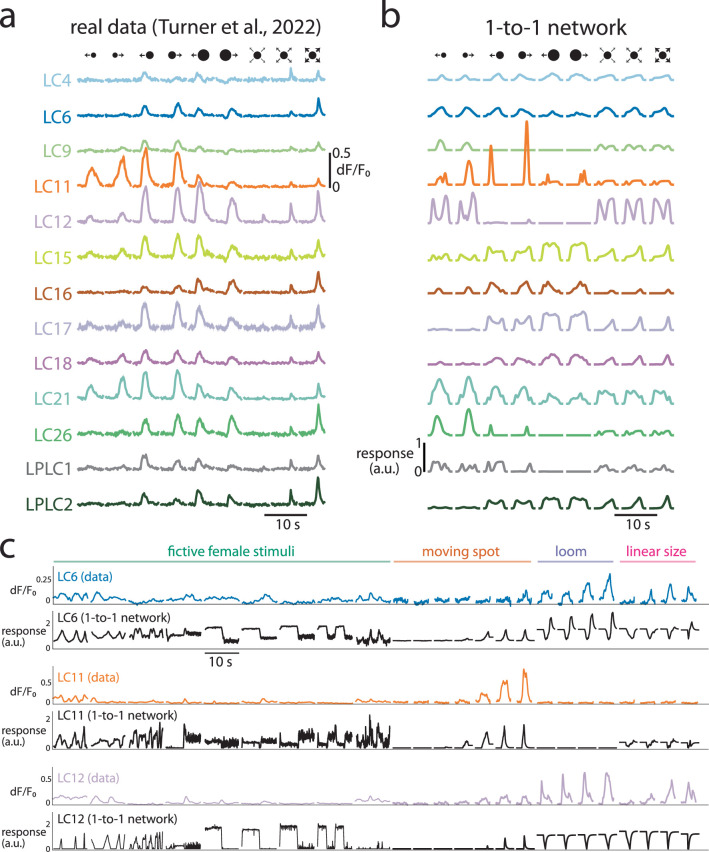
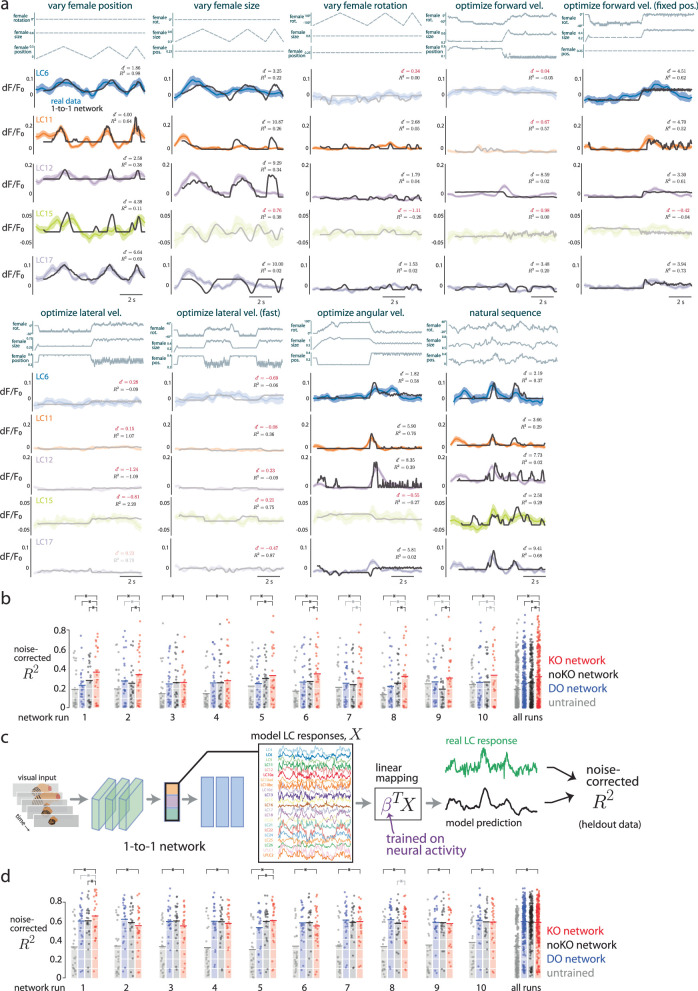
- The 1-to-1 network predicted real LC responses to artificial stimuli and naturalistic stimuli, with an average noise-corrected \(R^2 \approx 0.35\) for held-out neural responses.
- When a linear mapping from all model LC units to one real LC type was fit using neural data, held-out prediction improved to a noise-corrected \(R^2 \approx 0.65\).
- For behavior, cumulative inactivation showed that most model LC units contributed to multiple outputs, and each behavioral output was driven by multiple LC units.
- Connectome analysis found broad sharing of inputs and outputs: 60.2% of presynaptic neuron types projected to 2 or more LC types, and 55.6% of downstream neuron types received input from 2 or more LC types.
## Methods
- Built a 3-part DNN: a vision network, a 23-unit LC bottleneck, and a decision network predicting six outputs (forward, lateral, angular velocity; sine, Pfast, and Pslow song) from 10-frame visual input sequences.
- Trained on courtship data from 459 male-female pairs, including 23 LC silencing conditions plus control; behavior was extracted from video and audio, and training used about 11.6 million samples.
- Used “knockout training” by zeroing the model unit corresponding to the silenced LC type during training; compared against dropout, no-knockout, and untrained baselines.
- Validated neural predictions with two-photon calcium imaging from 5 LC types (LC6, LC11, LC12, LC15, LC17) and analyzed LC tuning plus causal contribution to behavior with cumulative inactivation.
## Limitations
- The paper states that if silencing an LC type does not noticeably change behavior, the model cannot infer that LC type’s tuning.
- It notes mismatches between real LC responses and model predictions, possibly because training data came from freely moving males while imaging was in head-fixed flies passively viewing stimuli.
- The text makes evident that the connectome analysis is based on a female fly connectome, not a male one, so inference about male circuits is indirect (text-evident limitation).
Model-written summary. Check it against the paper before relying on it.
Integrity signals
Registry
Cites
Statistics
Figures




Verification
Claims the paper makes
17 Valid · 1 Not valid · 7 Not checked · 114 Own results and interpretations
The cited sources support only part of this claim — read each source’s verdict below.
In the paper
“we found that silencing LC10a neurons resulted in failures to initiate chasing, as male-to-female distances remained large over time (Fig. 1d, middle, 1e, top)”
§ Mapping model units to visual neurons reveals population code for social behaviour > A deep network model of vision to behaviour The Drosophila visual system contains a bottleneck between the optic lobes and the central brain in the form of visual projection neurons, which comprise approximately 200 different cell types18,19. The primary cell types of this bottleneck (Fig. 1a) are the 57 lobula columnar (LC) and lobula plate (LPLC) neuron types identified so far (we use ‘LC types’ to refer both to LC and LPLC neuron types), making up about 3.5% of all neurons in the brain. The LC neuron types receive input from the lobula and lobula plate in the optic lobe and send axons to optic glomeruli in the central brain12,20. Neurons of a single LC type innervate only one optic glomerulus in the posterior lateral protocerebrum, posterior ventrolateral protocerebrum or anterior optic tubercle neuropils, and prior studies have uncovered mappings between specific LC types, visual features and specific behaviours11,21–28. For example, LPLC2 neurons respond to a looming object and synapse onto the giant fibre neuron to drive an escape take-off25. LC11 neurons respond to small, moving spots and contribute to freezing behaviour27,28. For courtship, the LC10a neurons (and LC9 neurons, to a lesser extent) of a male participate in tracking the position of the female and driving turns towards the female11,22,23, but it is not yet known whether other LC types contribute to male social behaviours. As recordings from LC neurons reveal that even simple stimuli can drive responses in multiple LC types29–31, we explored whether the representation of the female during courtship might be distributed across the LC population, and similarly whether multiple LC types might be required to drive behaviour. We designed a novel DNN modelling approach for identifying the functional roles of LC neuron types using behavioural data from genetically altered flies. The DNN model has three components: (1) a front-end convolutional vision network that reflects processing in the optic lobe; (2) a bottleneck layer of LC units in which each model LC unit represents the summed activity of neurons of the same LC type (that is, the overall activity level of an optic glomerulus); and (3) a decision network with dense connections that maps LC responses to behaviour, reflecting downstream processing in the central brain and ventral nerve cord (Fig. 1a). We imposed the bottleneck layer to have the same number of units as LC neuron types we manipulated, and our goal was to identify a one-to-one mapping between model LC units and LC neuron types. We did not incorporate biological realism into the vision and decision networks, opting instead for highly expressive mappings to ensure accurate prediction; we focused on explaining LC function. We collected training data to fit the model by blocking synaptic transmission32 in each of 23 different LC types in male flies12,33 and recorded the movements of the LC-silenced male and song production during natural courtship (Methods). We then devised a fitting procedure called knockout training, which involves training the model using the entire behavioural dataset of both perturbed and unperturbed sets of males. Critically, when training the model on data from a male with a particular LC type silenced (Fig. 1b), we set to 0 (that is, we knocked out) the activity of the corresponding model LC unit (correspondence was arbitrarily chosen at initialization; see Methods). The resulting model captures the behavioural repertoire of each genetically altered fly when the corresponding model LC unit is silenced, thereby aligning the model LC units to the real LC neurons. In simulations (Extended Data Fig. 2), knockout training correctly identified the activity and contribution to behaviour of each silenced neuron type (a one-to-one mapping) for neuron types that, when silenced, led to changes in behaviour. We refer to the resulting DNN model as the ‘1-to-1 network’. Before fitting the model with courtship data (Fig. 1c), we quantified the extent to which (bilaterally) silencing each LC neuron type changes behaviour of the male fly (Extended Data Fig. 1). Consistent with previous studies11,23, we found that silencing LC10a neurons resulted in failures to initiate chasing, as male-to-female distances remained large over time (Fig. 1d, middle, 1e, top); we found similar results with silencing LC922. We also found strong effects on both chasing and singing when silencing other LC types. For example, silencing LC6 and LC26 neurons resulted in stronger and more persistent chasing, as male-to-female distances remained small over time (Fig. 1d, bottom, 1e, top). We observed a large number of LC types (LC4, LC6, LC11, LPLC1, LPLC2 and LC10bc) that, after silencing, significantly increased the amount of sine song relative to pulse song (Fig. 1e, bottom)—sine song typically occurs near the female34. Across behavioural measures, we found that the silencing of any single LC type did not match the behavioural deficits of blind flies (Extended Data Fig. 1). This suggests that many LC types would need to be silenced together to uncover large effects on courtship. We therefore modelled the perturbed behavioural data with the 1-to-1 network, enabling us to silence any possible combination of LC types in silico. We performed knockout training to fit the parameters of the 1-to-1 network. The model inputs were videos of the visual input of the male fly during natural courtship (Methods and Fig. 1f, left); the model outputs comprised the male movements (forward, lateral and angular velocity) and song production, which included sine song and two forms of pulse song (Pfast and Pslow35). The 1-to-1 network reliably predicted these behavioural variables in held-out data (Fig. 1f, right and Extended Data Fig. 3). Notably, the 1-to-1 network also predicted differences in behaviour observed across silenced LC types (Fig. 1g,h and Extended Data Fig. 4). We confirmed that knockout training outperformed other possible training procedures, such as dropout training36 and training without knockout (that is, an unconstrained network) (Extended Data Figs. 3 and 4), and that results were largely consistent for different random initializations of the 1-to-1 network (Extended Data Fig. 5). Thus, the 1-to-1 network reliably estimated the behaviour of the male from visual input alone, even for male flies with a silenced LC type.
What the sources say
- Partly supportedcites [11] Hindmarsh Sten T Li R Otopalik A Ruta V Sexual arousal gates visual processing during drosophila courtship Nature 2021 595 549 553 34234348 PMC8973426 sourceExperimental — accuracy not yet measured
The 'LC10a gain is modulated during courtship' section reports that silencing LC10a neurons attenuated turning toward a visual target during tethered courtship. The Extended Data Figure 7 caption likewise reports failures to turn toward the silenced side, but neither passage reports failures to initiate chasing or persistently large male-to-female distances after silencing. (LLM, conf=0.86)
- Not checked — no full text of the sourcecites [23] Ribeiro IM Visual projection neurons mediating directed courtship in Drosophila Cell 2018 174 607 621 30033367 source
plainstates a cause- Asserted: passes — The authors put it forward as true.
- Checkable: passes — It can be checked against evidence.
- Load-bearing: passes — The paper’s conclusions depend on it.
- Based: passes — The paper gives a reason why it holds.
- Partly supported
The cited sources support only part of this claim — read each source’s verdict below.
In the paper
“A shortcoming of this approach is that the DNN does not predict how an individual neuron causally contributes to behaviour, making it difficult to interpret the role of the neuron in the sensorimotor transformation.”
§ Mapping model units to visual neurons reveals population code for social behaviour > Main
What the sources say
- Not checked — no full text of the sourcecites [1] Yamins DL DiCarlo JJ Using goal-driven deep learning models to understand sensory cortex Nat. Neurosci. 2016 19 356 365 26906502 source
- Partly supportedcites [2] Sussillo D Churchland MM Kaufman MT Shenoy KV A neural network that finds a naturalistic solution for the production of muscle activity Nat. Neurosci. 2015 18 1025 1033 26075643 PMC5113297 sourceExperimental — accuracy not yet measured
The Discussion (page unavailable) says individual-neuron responses rarely resemble muscle activity and warns against interpreting each response as a representation of a meaningful variable. That supports the difficulty of interpreting a neuron's role, but the paper does not say the network cannot predict an individual neuron's causal contribution to behaviour. (LLM, conf=0.84)
- Not checked — no full text of the sourcecites [3] Richards BA A deep learning framework for neuroscience Nat. Neurosci. 2019 22 1761 1770 31659335 PMC7115933 source
- Could not verifycites [5] Mano O Creamer MS Badwan BA Clark DA Predicting individual neuron responses with anatomically constrained task optimization Curr. Biol. 2021 31 4062 4075 34324832 PMC8741219 sourceExperimental — accuracy not yet measured
The Introduction and Discussion describe models that predict motion and reproduce properties of individual neurons, but do not address whether the models predict a neuron's causal contribution to behaviour. Searches for causal contribution, behavioural effects, and the neuron's role in sensorimotor transformation found no passage that settles the claim. (LLM, conf=0.73)
- Could not verifycites [16] Michaels, J. A., Schaffelhofer, S., Agudelo-Toro, A. & Scherberger, H. A goal-driven modular neural network predicts parietofrontal neural dynamics during grasping. Proc. Natl Acad. Sci. USA117, 32124–32135 (2020). PMC7749336 33257539 sourceExperimental — accuracy not yet measured
Across five targeted searches (individual neuron / causal contribution to behaviour, shortcomings or limitations of the DNN or goal-driven approach, interpretability and black-box issues, single-unit vs distributed coding), no passage of our copy states or discusses this limitation of deep-network modelling. The closest material runs the other way at the population level — the Results ('Modular Mechanisms of Memory and Movement Execution within the mRNN Model') stress that 'since our models are fully observable, we were able to probe our mRNN networks for explanations of the computations necessary for the task', and the lesioning analysis (Results, Fig. 6) silences random subsets of neurons per module, not individual neurons — but none of this asserts, or contradicts, the specific claim that a DNN fails to predict how an individual neuron causally contributes to behaviour. The claim therefore cannot be checked against this source. (LLM, conf=0.62)
- Partly supportedcites [17] Zhou B Li Z Kim S Lafferty J Clark DA Shallow neural networks trained to detect collisions recover features of visual loom-selective neurons eLife 2022 11 e72067 35023828 PMC8849349 sourceExperimental — accuracy not yet measured
The Results section (“An anatomically constrained mathematical model”; page unavailable) says the network combines model-unit responses to predict collision probability, not behaviour. The Discussion (page unavailable) says individual LPLC2 responses should be interpreted in light of the population response. These passages support a limitation on interpreting individual neurons, but do not establish the specific claim that the DNN cannot predict an individual neuron's causal contribution to behaviour. (LLM, conf=0.72)
plain- Asserted: passes — The authors put it forward as true.
- Checkable: passes — It can be checked against evidence.
- Load-bearing: passes — The paper’s conclusions depend on it.
- Based: passes — The paper gives a reason why it holds.
The cited sources support only part of this claim — read each source’s verdict below.
In the paper
“For courtship, the LC10a neurons (and LC9 neurons, to a lesser extent) of a male participate in tracking the position of the female and driving turns towards the female11,22,23”
§ Mapping model units to visual neurons reveals population code for social behaviour > A deep network model of vision to behaviour The Drosophila visual system contains a bottleneck between the optic lobes and the central brain in the form of visual projection neurons, which comprise approximately 200 different cell types18,19. The primary cell types of this bottleneck (Fig. 1a) are the 57 lobula columnar (LC) and lobula plate (LPLC) neuron types identified so far (we use ‘LC types’ to refer both to LC and LPLC neuron types), making up about 3.5% of all neurons in the brain. The LC neuron types receive input from the lobula and lobula plate in the optic lobe and send axons to optic glomeruli in the central brain12,20. Neurons of a single LC type innervate only one optic glomerulus in the posterior lateral protocerebrum, posterior ventrolateral protocerebrum or anterior optic tubercle neuropils, and prior studies have uncovered mappings between specific LC types, visual features and specific behaviours11,21–28. For example, LPLC2 neurons respond to a looming object and synapse onto the giant fibre neuron to drive an escape take-off25. LC11 neurons respond to small, moving spots and contribute to freezing behaviour27,28. For courtship, the LC10a neurons (and LC9 neurons, to a lesser extent) of a male participate in tracking the position of the female and driving turns towards the female11,22,23, but it is not yet known whether other LC types contribute to male social behaviours. As recordings from LC neurons reveal that even simple stimuli can drive responses in multiple LC types29–31, we explored whether the representation of the female during courtship might be distributed across the LC population, and similarly whether multiple LC types might be required to drive behaviour. We designed a novel DNN modelling approach for identifying the functional roles of LC neuron types using behavioural data from genetically altered flies. The DNN model has three components: (1) a front-end convolutional vision network that reflects processing in the optic lobe; (2) a bottleneck layer of LC units in which each model LC unit represents the summed activity of neurons of the same LC type (that is, the overall activity level of an optic glomerulus); and (3) a decision network with dense connections that maps LC responses to behaviour, reflecting downstream processing in the central brain and ventral nerve cord (Fig. 1a). We imposed the bottleneck layer to have the same number of units as LC neuron types we manipulated, and our goal was to identify a one-to-one mapping between model LC units and LC neuron types. We did not incorporate biological realism into the vision and decision networks, opting instead for highly expressive mappings to ensure accurate prediction; we focused on explaining LC function. We collected training data to fit the model by blocking synaptic transmission32 in each of 23 different LC types in male flies12,33 and recorded the movements of the LC-silenced male and song production during natural courtship (Methods). We then devised a fitting procedure called knockout training, which involves training the model using the entire behavioural dataset of both perturbed and unperturbed sets of males. Critically, when training the model on data from a male with a particular LC type silenced (Fig. 1b), we set to 0 (that is, we knocked out) the activity of the corresponding model LC unit (correspondence was arbitrarily chosen at initialization; see Methods). The resulting model captures the behavioural repertoire of each genetically altered fly when the corresponding model LC unit is silenced, thereby aligning the model LC units to the real LC neurons. In simulations (Extended Data Fig. 2), knockout training correctly identified the activity and contribution to behaviour of each silenced neuron type (a one-to-one mapping) for neuron types that, when silenced, led to changes in behaviour. We refer to the resulting DNN model as the ‘1-to-1 network’. Before fitting the model with courtship data (Fig. 1c), we quantified the extent to which (bilaterally) silencing each LC neuron type changes behaviour of the male fly (Extended Data Fig. 1). Consistent with previous studies11,23, we found that silencing LC10a neurons resulted in failures to initiate chasing, as male-to-female distances remained large over time (Fig. 1d, middle, 1e, top); we found similar results with silencing LC922. We also found strong effects on both chasing and singing when silencing other LC types. For example, silencing LC6 and LC26 neurons resulted in stronger and more persistent chasing, as male-to-female distances remained small over time (Fig. 1d, bottom, 1e, top). We observed a large number of LC types (LC4, LC6, LC11, LPLC1, LPLC2 and LC10bc) that, after silencing, significantly increased the amount of sine song relative to pulse song (Fig. 1e, bottom)—sine song typically occurs near the female34. Across behavioural measures, we found that the silencing of any single LC type did not match the behavioural deficits of blind flies (Extended Data Fig. 1). This suggests that many LC types would need to be silenced together to uncover large effects on courtship. We therefore modelled the perturbed behavioural data with the 1-to-1 network, enabling us to silence any possible combination of LC types in silico. We performed knockout training to fit the parameters of the 1-to-1 network. The model inputs were videos of the visual input of the male fly during natural courtship (Methods and Fig. 1f, left); the model outputs comprised the male movements (forward, lateral and angular velocity) and song production, which included sine song and two forms of pulse song (Pfast and Pslow35). The 1-to-1 network reliably predicted these behavioural variables in held-out data (Fig. 1f, right and Extended Data Fig. 3). Notably, the 1-to-1 network also predicted differences in behaviour observed across silenced LC types (Fig. 1g,h and Extended Data Fig. 4). We confirmed that knockout training outperformed other possible training procedures, such as dropout training36 and training without knockout (that is, an unconstrained network) (Extended Data Figs. 3 and 4), and that results were largely consistent for different random initializations of the 1-to-1 network (Extended Data Fig. 5). Thus, the 1-to-1 network reliably estimated the behaviour of the male from visual input alone, even for male flies with a silenced LC type.
What the sources say
- Partly supportedcites [11] Hindmarsh Sten T Li R Otopalik A Ruta V Sexual arousal gates visual processing during drosophila courtship Nature 2021 595 549 553 34234348 PMC8973426 sourceExperimental — accuracy not yet measured
The section ‘LC10a gain is modulated during courtship’ reports that silencing LC10a attenuated males’ turns toward a visual target, while activating it drove ipsilateral turning; it also describes LC10a as essential for accurate courtship tracking. The passages do not establish the claim’s additional point that LC9 neurons participate to a lesser extent (searched: LC9). (LLM, conf=0.88)
- Partly supportedcites [22] Bidaye SS Two brain pathways initiate distinct forward walking programs in Drosophila Neuron 2020 108 469 485 32822613 PMC9435592 sourceExperimental — accuracy not yet measured
The Results section on courtship reports that silencing LC9 decreased males’ following of females. The Discussion says LC10 neurons participate in object tracking during courtship, but does not specify LC10a or establish that either LC10a or LC9 drives turns toward the female; the Results attribute initiated forward turns to P9. No page numbers are available in our copy. (LLM, conf=0.86)
- Not checked — no full text of the sourcecites [23] Ribeiro IM Visual projection neurons mediating directed courtship in Drosophila Cell 2018 174 607 621 30033367 source
plainstates a cause- Asserted: passes — The authors put it forward as true.
- Checkable: passes — It can be checked against evidence.
- Load-bearing: unclear — It is unclear whether the paper’s conclusions depend on it.
- Based: passes — The paper gives a reason why it holds.
- Partly supported
The cited sources support only part of this claim — read each source’s verdict below.
In the paper
“exact matches were unlikely owing to differences in behavioural state during courtship (on which the 1-to-1 network was trained) and during imaging11,31.”
§ Mapping model units to visual neurons reveals population code for social behaviour > Comparing real and model neural activity
What the sources say
- Partly supportedcites [11] Hindmarsh Sten T Li R Otopalik A Ruta V Sexual arousal gates visual processing during drosophila courtship Nature 2021 595 549 553 34234348 PMC8973426 sourceExperimental — accuracy not yet measured
The section “LC10a gain is modulated during courtship” (page unavailable) reports weak LC10a responses in unaroused males and stronger responses during courtship, supporting the point that behavioural state affects LC responses. It does not say that the model and imaged responses were unlikely to match exactly because the animals were in different states during training and imaging; the paper also describes imaging during courtship. (LLM, conf=0.80)
- Partly supportedcites [31] Turner MH Krieger A Pang MM Clandinin TR Visual and motor signatures of locomotion dynamically shape a population code for feature detection in drosophila eLife 2022 11 e82587 36300621 PMC9651947 sourceExperimental — accuracy not yet measured
The Results section, “Walking behavior selectively suppresses responses of small-object detecting glomeruli” (page unavailable), shows that walking weakens visual responses in some LC-associated glomeruli. This supports the premise that behavioural state can affect LC responses, but the paper does not compare courtship with imaging or establish that such a difference makes exact model–response matches unlikely. (LLM, conf=0.83)
hedgedstates a cause- Asserted: passes — The authors put it forward as true.
- Checkable: passes — It can be checked against evidence.
- Load-bearing: unclear — It is unclear whether the paper’s conclusions depend on it.
- Based: passes — The paper gives a reason why it holds.
- Partly supported
The sources with a verdict support this claim; the rest weren’t checked yet, have no full text we could read, or their verdicts aren’t rated yet.
In the paper
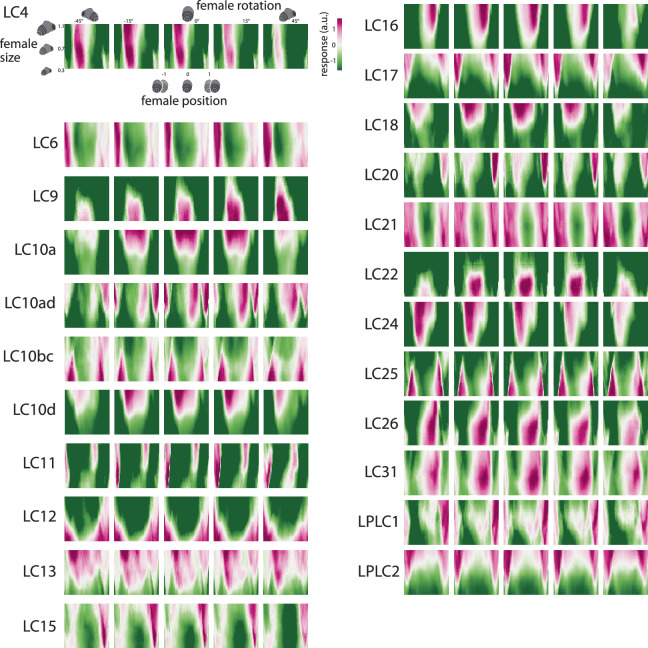
“Model LC10a was driven by female position (in front of the male), consistent with prior work11,23, but we found this was only true for conditions in which he is close and directly behind her (Fig. 3d, bottom).”
§ Mapping model units to visual neurons reveals population code for social behaviour > Visual feature encoding of the model LC units
What the sources say
- Supportedcites [11] Hindmarsh Sten T Li R Otopalik A Ruta V Sexual arousal gates visual processing during drosophila courtship Nature 2021 595 549 553 34234348 PMC8973426 source
The citation is attached to the prior-work point that LC10a responds to a target in front of the male, not to the citing authors’ subsequent close-and-directly-behind condition. In “LC10a gain is modulated during courtship” (page unavailable), the source reports robust LC10a activation as a visual target sweeps across the male’s ipsilateral hemifield; its Methods specify that stimuli were presented in front of the male. (LLM, conf=0.88)
- Not checked — no full text of the sourcecites [23] Ribeiro IM Visual projection neurons mediating directed courtship in Drosophila Cell 2018 174 607 621 30033367 source
plainstates an association- Asserted: passes — The authors put it forward as true.
- Checkable: passes — It can be checked against evidence.
- Load-bearing: unclear — It is unclear whether the paper’s conclusions depend on it.
- Based: passes — The paper gives a reason why it holds.
- Supported
90 more claims · 6 with their cited sources checked
Create a free account to see all 139 claims and to verify the 3 references still open.
- Probably not a substantial claim. 33
- The quote only partly states this claim. 1
- It may state two separate claims as one. 15
Claims other papers make about this one
Each is checked against this paper’s own text: does it say what the citing paper says it does?
The source backs part of the claim, not all of it — or backs it for a different population, condition or comparison.
In the citing paper
“Connectome-constrained DMN models generate meaningful predictions even in the complete absence of neural activity measurements, but can be further constrained by sparse measurements of neural activity as we showed (Fig. 3), or indeed directly fitted to measured neural activity51 and behaviour54.”
From Connectome-constrained networks predict neural activity across the fly visual system (2024) · cites this paper as [54]
Experimental — accuracy not yet measuredThe check wasn’t confident either way, so it gives no verdict — never disputed.
In the citing paper
“This adhesive force increases the normal force toward the object and the frictional force (in insects, normal and frictional forces are also correlated 52 ).”
From NeuroMechFly v2: simulating embodied sensorimotor control in adult Drosophila (2024) · cites this paper as [52]
Experimental — accuracy not yet measuredThe check wasn’t confident either way, so it gives no verdict — never disputed.
In the citing paper
“We opted for a relatively high adhesion force (20-40 mN) to be consistent with the high, but somewhat variable, forces reported across insect species 52,51 .”
From NeuroMechFly v2: simulating embodied sensorimotor control in adult Drosophila (2024) · cites this paper as [52]
Experimental — accuracy not yet measuredThe check wasn’t confident either way, so it gives no verdict — never disputed.
In the citing paper
“Substantial normal forces (10-100 times body weight 51,52,53 ) and frictional forces emerge from interactions between the substrate and the adhesive pad 49,54 .”
From NeuroMechFly v2: simulating embodied sensorimotor control in adult Drosophila (2024) · cites this paper as [52]
Experimental — accuracy not yet measured
Citations
Cites
(2014) · Cited by 33,419
Batch Normalization: Accelerating Deep Network Training by Reducing Internal Covariate Shift
Ioffe, S., & Szegedy, C. (2015) · arXiv · doi:10.48550/arxiv.1502.03167 · Cited by 27,818 · cited 1×
“3), overall mean changes to behaviour across silenced LC types (Extended Data Fig.”
MobileNets: Efficient Convolutional Neural Networks for Mobile Vision Applications
Howard, A. G., Zhu, M., Chen, B., Kalenichenko, D., Wang, W., Weyand, T., Andreetto, M., & Adam, H. (2017) · arXiv · doi:10.48550/arxiv.1704.04861 · Cited by 19,015
TensorFlow: A system for large-scale machine learning
Abadi, M., Barham, P., Chen, J., Chen, Z., Davis, A., Dean, J., Devin, M., Ghemawat, S., Irving, G., Isard, M., et al. (2016) · arXiv (Cornell University) · doi:10.48550/arxiv.1605.08695 · Cited by 11,822
Emergence of simple-cell receptive field properties by learning a sparse code for natural images
Olshausen, B. A., & Field, D. J. (1996) · Nature · doi:10.1038/381607a0 · Cited by 5,694
Random Features for Large-Scale Kernel Machines
Rahimi, A., & Recht, B. (2007) · Cited by 2,783
Shadlen, M. N., & Newsome, W. T. (1998) · The Journal of Neuroscience · doi:10.1523/jneurosci.18-10-03870.1998 · Cited by 2,178
Performance-optimized hierarchical models predict neural responses in higher visual cortex
Yamins, D. L. K., Hong, H., Cadieu, C. F., Solomon, E. A., Seibert, D., & DiCarlo, J. J. (2014) · Proceedings of the National Academy of Sciences · doi:10.1073/pnas.1403112111 · Cited by 1,924
Context-dependent computation by recurrent dynamics in prefrontal cortex
Mante, V., Sussillo, D., Shenoy, K. V., & Newsome, W. T. (2013) · Nature · doi:10.1038/nature12742 · Cited by 1,847
The importance of mixed selectivity in complex cognitive tasks
Rigotti, M., Barak, O., Warden, M. R., Wang, X.-J., Daw, N. D., Miller, E. K., & Fusi, S. (2013) · Nature · doi:10.1038/nature12160 · Cited by 1,639
Neural population dynamics during reaching
Churchland, M. M., Cunningham, J. P., Kaufman, M. T., Foster, J. D., Nuyujukian, P., Ryu, S. I., & Shenoy, K. V. (2012) · Nature · doi:10.1038/nature11129 · Cited by 1,626
Using goal-driven deep learning models to understand sensory cortex
Yamins, D. L. K., & DiCarlo, J. J. (2016) · Nature Neuroscience · doi:10.1038/nn.4244 · Cited by 1,621 · cited 17×
“Because DNNs are optimized via stochastic gradient descent, the training procedure of a DNN is not deterministic; different random initializations and different orderings of the training data may lead to DNNs with different prediction performances.”
BackgroundMethodInfluentialA high-resolution transcriptomic and spatial atlas of cell types in the whole mouse brain
Yao, Z., van Velthoven, C. T. J., Kunst, M., Zhang, M., McMillen, D., Lee, C., Jung, W., Goldy, J., Abdelhak, A., Aitken, M., et al. (2023) · Nature · doi:10.1038/s41586-023-06812-z · Cited by 1,203
A connectome and analysis of the adult Drosophila central brain
Scheffer, L. K., Xu, C. S., Januszewski, M., Lu, Z., Takemura, S.-Y., Hayworth, K. J., Huang, G. B., Shinomiya, K., Maitlin-Shepard, J., Berg, S., et al. (2020) · eLife · doi:10.7554/elife.57443 · Cited by 1,128
A Complete Electron Microscopy Volume of the Brain of Adult Drosophila melanogaster
Zheng, Z., Lauritzen, J. S., Perlman, E., Robinson, C. G., Nichols, M., Milkie, D., Torrens, O., Price, J., Fisher, C. B., Sharifi, N., et al. (2018) · Cell · doi:10.1016/j.cell.2018.06.019 · Cited by 1,050 · cited 1×
“To test this prediction, we analysed a recently released whole-brain connectome 15,19,41 (FlyWire) with exhaustive cell typing in the optic lobe 18 and central brain 19 , and in which 57 LC and LPLC neuron types have been identified so far.”
MethodA deep learning framework for neuroscience
Richards, B. A., Lillicrap, T. P., Beaudoin, P., Bengio, Y., Bogacz, R., Christensen, A., Clopath, C., Costa, R. P., de Berker, A., Ganguli, S., et al. (2019) · Nature Neuroscience · doi:10.1038/s41593-019-0520-2 · Cited by 1,027 · cited 2×
“…action, an emerging and popular approach is to first train a deep neural network (DNN) model on a behavioural task performed by an animal (for example, recognizing an object in an image) and then compare the neural activity of the animal to the internal activations of the DNN 1–3, 5, 16, 17 .”
BackgroundMethodCeramide-orchestrated signalling in cancer cells
Morad, S. A. F., & Cabot, M. C. (2013) · Nature Reviews Cancer · doi:10.1038/nrc3398 · Cited by 1,014
Sweeney, S. T., Broadie, K., Keane, J., Niemann, H., & O'Kane, C. J. (1995) · Neuron · doi:10.1016/0896-6273(95)90290-2 · Cited by 938 · cited 1×
“We collected training data to fit the model by blocking synaptic transmission 32 in each of 23 different LC types in male flies 12,33 and recorded the movements of the LC-silenced male and song production during natural courtship (Methods).”
MethodSLEAP: A deep learning system for multi-animal pose tracking
Pereira, T. D., Tabris, N., Matsliah, A., Turner, D. M., Li, J., Ravindranath, S., Papadoyannis, E. S., Normand, E., Deutsch, D. S., Wang, Z. Y., et al. (2022) · Nature Methods · doi:10.1038/s41592-022-01426-1 · Cited by 886 · cited 1×
“In total, behaviour was recorded and analysed from 459 pairs; the number of flies per condition were as follows: Joint positions for the male and female for every frame were tracked with a DNN trained for multi-animal pose estimation called SLEAP 51 .”
MethodSelf-citationExtracting information from neuronal populations: information theory and decoding approaches
Quian Quiroga, R., & Panzeri, S. (2009) · Nature Reviews Neuroscience · doi:10.1038/nrn2578 · Cited by 811
Information processing with population codes
Pouget, A., Dayan, P., & Zemel, R. (2000) · Nature Reviews Neuroscience · doi:10.1038/35039062 · Cited by 752
Similarity of Neural Network Representations Revisited
Kornblith, S., Norouzi, M., Lee, H., & Hinton, G. (2019) · arXiv · doi:10.48550/arxiv.1905.00414 · Cited by 724
Vector-based navigation using grid-like representations in artificial agents
Banino, A., Barry, C., Uria, B., Blundell, C., Lillicrap, T., Mirowski, P., Pritzel, A., Chadwick, M. J., Degris, T., Modayil, J., et al. (2018) · Nature · doi:10.1038/s41586-018-0102-6 · Cited by 677
A neural network that finds a naturalistic solution for the production of muscle activity
Sussillo, D., Churchland, M. M., Kaufman, M. T., & Shenoy, K. V. (2015) · Nature Neuroscience · doi:10.1038/nn.4042 · Cited by 598
Neuronal wiring diagram of an adult brain
Dorkenwald, S., Matsliah, A., Sterling, A. R., Schlegel, P., Yu, S.-C., McKellar, C. E., Lin, A., Costa, M., Eichler, K., Yin, Y., et al. (2024) · Nature · doi:10.1038/s41586-024-07558-y · Cited by 570
Self-citationDivisive Normalization in Olfactory Population Codes
Olsen, S. R., Bhandawat, V., & Wilson, R. I. (2010) · Neuron · doi:10.1016/j.neuron.2010.04.009 · Cited by 500 · cited 1×
“Such recurrence muddles the idea that each LC type is an independent feature detector, although these lateral connections may implement a divisive normalization mechanism 42 .”
BackgroundNeural population control via deep image synthesis
Bashivan, P., Kar, K., & DiCarlo, J. J. (2019) · Science · doi:10.1126/science.aav9436 · Cited by 434 · cited 1×
“These maximizing stimulus sequences represent predictions of the 1-to-1 network that can be tested in future experiments to see if they truly elicit large responses from LC neurons, much like recent work has identified images to drive visual cortical neurons of macaque monkey 64–67 .”
BackgroundWhole-brain annotation and multi-connectome cell typing of Drosophila
Schlegel, P., Yin, Y., Bates, A. S., Dorkenwald, S., Eichler, K., Brooks, P., Han, D. S., Gkantia, M., dos Santos, M., Munnelly, E. J., et al. (2024) · Nature · doi:10.1038/s41586-024-07686-5 · Cited by 413
Self-citationRandom convergence of olfactory inputs in the Drosophila mushroom body
Caron, S. J. C., Ruta, V., Abbott, L. F., & Axel, R. (2013) · Nature · doi:10.1038/nature12063 · Cited by 409
Early Olfactory Processing in Drosophila: Mechanisms and Principles
Wilson, R. I. (2013) · Annual Review of Neuroscience · doi:10.1146/annurev-neuro-062111-150533 · Cited by 394
Bhandawat, V., Olsen, S. R., Gouwens, N. W., Schlief, M. L., & Wilson, R. I. (2007) · Nature Neuroscience · doi:10.1038/nn1976 · Cited by 354
Visually mediated motor planning in the escape response of Drosophila
Card, G., & Dickinson, M. H. (2008) · Current Biology · doi:10.1016/j.cub.2008.07.094 · Cited by 309
Wu, M., Nern, A., Williamson, W. R., Morimoto, M. M., Reiser, M. B., Card, G. M., & Rubin, G. M. (2016) · eLife · doi:10.7554/elife.21022 · Cited by 304 · cited 7×
“The visual projection neurons at the interface between the optic lobe and central brain form a set of discrete channels 12 , and prior work indicates that each channel encodes a specific visual feature to drive a particular behaviour 13,14 .”
InfluentialPonce, C. R., Xiao, W., Schade, P. F., Hartmann, T. S., Kreiman, G., & Livingstone, M. S. (2019) · Cell · doi:10.1016/j.cell.2019.04.005 · Cited by 245
Otsuna, H., & Ito, K. (2006) · The Journal of Comparative Neurology · doi:10.1002/cne.21015 · Cited by 224
Inception loops discover what excites neurons most using deep predictive models
Walker, E. Y., Sinz, F. H., Cobos, E., Muhammad, T., Froudarakis, E., Fahey, P. G., Ecker, A. S., Reimer, J., Pitkow, X., & Tolias, A. S. (2019) · Nature Neuroscience · doi:10.1038/s41593-019-0517-x · Cited by 215
Unsupervised identification of the internal states that shape natural behavior
Calhoun, A. J., Pillow, J. W., & Murthy, M. (2019) · Nature Neuroscience · doi:10.1038/s41593-019-0533-x · Cited by 205 · cited 1×
“52).”
Self-citationDetection Theory: A User's Guide
Hautus, M. J., Macmillan, N. A., & Creelman, C. D. (2021) · Routledge eBooks · doi:10.4324/9781003203636 · Cited by 184
FUNCTIONAL ASPECTS OF DROSOPHILA COURTSHIP
EWING, A. W. (1983) · Biological Reviews · doi:10.1111/j.1469-185x.1983.tb00390.x · Cited by 184 · cited 2×
“We apply this approach to model the sensorimotor transformations of Drosophila melanogaster males during a complex, visually guided social behaviour 8–11 .”
A neural command circuit for grooming movement control
Hampel, S., Franconville, R., Simpson, J. H., & Seeds, A. M. (2015) · eLife · doi:10.7554/elife.08758 · Cited by 177 · cited 1×
“Recordings were stopped either after 30 min or after copulation, which-ever came sooner.”
Ultra-selective looming detection from radial motion opponency
Klapoetke, N. C., Nern, A., Peek, M. Y., Rogers, E. M., Breads, P., Rubin, G. M., Reiser, M. B., & Card, G. M. (2017) · Nature · doi:10.1038/nature24626 · Cited by 173 · cited 3×
“3d, top), whereas other model LC units, such as LPLC2, were driven by large female sizes, consistent with its known response to looming stimuli 17,24,25,31 .”
BackgroundBuilding an ommatidium one cell at a time
Kumar, J. P. (2012) · Developmental Dynamics · doi:10.1002/dvdy.23707 · Cited by 170 · cited 1×
“Because male flies perceive roughly 160 visual degrees on either side 53 , we removed from the image the 40 visual degrees directly behind the male, leading to images with 64 × 228 pixels.”
Dynamic sensory cues shape song structure in Drosophila
Coen, P., Clemens, J., Weinstein, A. J., Pacheco, D. A., Deng, Y., & Murthy, M. (2014) · Nature · doi:10.1038/nature13131 · Cited by 166
Self-citationGenetic and Neural Mechanisms that Inhibit Drosophila from Mating with Other Species
Fan, P., Manoli, D. S., Ahmed, O. M., Chen, Y., Agarwal, N., Kwong, S., Cai, A. G., Neitz, J., Renslo, A., Baker, B. S., et al. (2013) · Cell · doi:10.1016/j.cell.2013.06.008 · Cited by 164 · cited 1×
“1d,e), suggesting that these LC neurons may act partially as distractors to prevent relentless pursuit of the female 43,44 .”
BackgroundTesting Odor Response Stereotypy in the Drosophila Mushroom Body
Murthy, M., Fiete, I., & Laurent, G. (2008) · Neuron · doi:10.1016/j.neuron.2008.07.040 · Cited by 163
Self-citationVisual projection neurons mediating directed courtship in Drosophila
Ribeiro, I. M. A., Drews, M., Bahl, A., Machacek, C., Borst, A., & Dickson, B. J. (2018) · Cell · doi:10.1016/j.cell.2018.06.020 · Cited by 161 · cited 2×
“Model LC10a was driven by female position (in front of the male), consistent with prior work 11,23 , but we found this was only true for conditions in which he is close and directly behind her (Fig.”
ResultA complex peripheral code for salt taste in Drosophila
Jaeger, A. H., Stanley, M., Weiss, Z. F., Musso, P.-Y., Chan, R. C., Zhang, H., Feldman-Kiss, D., & Gordon, M. D. (2018) · eLife · doi:10.7554/elife.37167 · Cited by 157
Feature Integration Drives Probabilistic Behavior in the Drosophila Escape Response
von Reyn, C. R., Nern, A., Williamson, W. R., Breads, P., Wu, M., Namiki, S., & Card, G. M. (2017) · Neuron · doi:10.1016/j.neuron.2017.05.036 · Cited by 156 · cited 12×
“Recently, LPLC2 has also been found to encode the speed of a moving spot 38 , consistent with the predictions of our model (Fig.”
BackgroundInfluentialNeural Basis for Looming Size and Velocity Encoding in the Drosophila Giant Fiber Escape Pathway
Ache, J. M., Polsky, J., Alghailani, S., Parekh, R., Breads, P., Peek, M. Y., Bock, D. D., von Reyn, C. R., & Card, G. M. (2019) · Current Biology · doi:10.1016/j.cub.2019.01.079 · Cited by 153 · cited 4×
“3d, top), whereas other model LC units, such as LPLC2, were driven by large female sizes, consistent with its known response to looming stimuli 17,24,25,31 .”
BackgroundInfluentialMultiplexed and Robust Representations of Sound Features in Auditory Cortex
Walker, K. M. M., Bizley, J. K., King, A. J., & Schnupp, J. W. H. (2011) · Journal of Neuroscience · doi:10.1523/jneurosci.2074-11.2011 · Cited by 141
Sexual arousal gates visual processing during Drosophila courtship
Hindmarsh Sten, T., Li, R., Otopalik, A., & Ruta, V. (2021) · Nature · doi:10.1038/s41586-021-03714-w · Cited by 140 · cited 10×
“We show that the model extends beyond findings from direct recordings of LC neurons 29,30 , even in behaving flies 11,31 .”
BackgroundMethodResultInfluentialHow Can Single Sensory Neurons Predict Behavior?
Pitkow, X., Liu, S., Angelaki, D. E., DeAngelis, G. C., & Pouget, A. (2015) · Neuron · doi:10.1016/j.neuron.2015.06.033 · Cited by 138 · cited 1×
“To understand these sensorimotor transformations, it is useful to build models that predict not only neural responses to sensory input 1–5 but also how each neuron causally contributes to behaviour 6,7 .”
BackgroundA high-resolution transcriptomic and spatial atlas of cell types in the whole mouse brainPreprint
Yao, Z., van Velthoven, C. T. J., Kunst, M., et al. (2023) · bioRxiv (Cold Spring Harbor Laboratory) · doi:10.1101/2023.03.06.531121 · Cited by 138
Object-Detecting Neurons in Drosophila
Keleş, M. F., & Frye, M. A. (2017) · Current Biology · doi:10.1016/j.cub.2017.01.012 · Cited by 130 · cited 4×
“Neurons of a single LC type innervate only one optic glomerulus in the posterior lateral protocerebrum, posterior ventrolateral protocerebrum or anterior optic tubercle neuropils, and prior studies have uncovered mappings between specific LC types, visual features and specific behaviours 11,21–28 .”
BackgroundResultInfluentialImaging a Population Code for Odor Identity in the Drosophila Mushroom Body
Campbell, R. A. A., Honegger, K. S., Qin, H., Li, W., Demir, E., & Turner, G. C. (2013) · Journal of Neuroscience · doi:10.1523/jneurosci.0682-12.2013 · Cited by 128
Multi-channel acoustic recording and automated analysis of Drosophila courtship songs
Arthur, B. J., Sunayama-Morita, T., Coen, P., Murthy, M., & Stern, D. L. (2013) · BMC Biology · doi:10.1186/1741-7007-11-11 · Cited by 117
Self-citationThe neural basis for a persistent internal state in Drosophila females
Deutsch, D., Pacheco, D., Encarnacion-Rivera, L., Pereira, T., Fathy, R., Clemens, J., Girardin, C., Calhoun, A., Ireland, E., Burke, A., et al. (2020) · eLife · doi:10.7554/elife.59502 · Cited by 115 · cited 1×
“To best mimic how a male fly transforms his retina’s visual input into behaviour, we desired an image-computable model (that is, one that takes as input an image rather than abstract variables determined by the experimenter, such as female size or male-to-female distance).”
Self-citationThe Neural Basis for a Persistent Internal State in Drosophila Females
Deutsch, D., Pacheco, D. A., Encarnacion-Rivera, L. J., Pereira, T., Fathy, R., Calhoun, A., Ireland, E. C., Burke, A. T., Dorkenwald, S., McKellar, C., et al. (2020) · doi:10.1101/2020.02.13.947952 · Cited by 115
Self-citationTwo brain pathways initiate distinct forward walking programs in Drosophila
Bidaye, S. S., Laturney, M., Chang, A. K., Liu, Y., Bockemühl, T., Büschges, A., & Scott, K. (2020) · Neuron · doi:10.1016/j.neuron.2020.07.032 · Cited by 109
Genetic and optical targeting of neural circuits and behavior — zebrafish in the spotlight
Baier, H., & Scott, E. K. (2009) · Current Opinion in Neurobiology · doi:10.1016/j.conb.2009.08.001 · Cited by 109
Visual circuits in flies: beginning to see the whole picture
Behnia, R., & Desplan, C. (2015) · Current Opinion in Neurobiology · doi:10.1016/j.conb.2015.03.010 · Cited by 104
A goal-driven modular neural network predicts parietofrontal neural dynamics during grasping
Michaels, J. A., Schaffelhofer, S., Agudelo-Toro, A., & Scherberger, H. (2020) · Proceedings of the National Academy of Sciences · doi:10.1073/pnas.2005087117 · Cited by 103 · cited 1×
“…action, an emerging and popular approach is to first train a deep neural network (DNN) model on a behavioural task performed by an animal (for example, recognizing an object in an image) and then compare the neural activity of the animal to the internal activations of the DNN 1–3, 5, 16, 17 .”
BackgroundSparse and distributed coding of episodic memory in neurons of the human hippocampus
Wixted, J. T., Squire, L. R., Jang, Y., Papesh, M. H., Goldinger, S. D., Kuhn, J. R., Smith, K. A., Treiman, D. M., & Steinmetz, P. N. (2014) · Proceedings of the National Academy of Sciences · doi:10.1073/pnas.1408365111 · Cited by 103
Whole-brain annotation and multi-connectome cell typing quantifies circuit stereotypy in Drosophila
Schlegel, P., Yin, Y., Bates, A. S., Dorkenwald, S., Eichler, K., Brooks, P., Han, D. S., Gkantia, M., dos Santos, M., Munnelly, E. J., et al. (2023) · doi:10.1101/2023.06.27.546055 · Cited by 102
Self-citationNienborg, H., & Cumming, B. (2010) · Current Opinion in Neurobiology · doi:10.1016/j.conb.2010.05.002 · Cited by 102 · cited 1×
“To understand these sensorimotor transformations, it is useful to build models that predict not only neural responses to sensory input 1–5 but also how each neuron causally contributes to behaviour 6,7 .”
BackgroundA functionally ordered visual feature map in the Drosophila brain
Klapoetke, N. C., Nern, A., Rogers, E. M., Rubin, G. M., Reiser, M. B., & Card, G. M. (2022) · Neuron · doi:10.1016/j.neuron.2022.02.013 · Cited by 98 · cited 2×
“We show that the model extends beyond findings from direct recordings of LC neurons 29,30 , even in behaving flies 11,31 .”
MethodConnectome-driven neural inventory of a complete visual system
Nern, A., Loesche, F., Takemura, S.-Y., Burnett, L. E., Dreher, M., Gruntman, E., Hoeller, J., Huang, G. B., Januszewski, M., Klapoetke, N. C., et al. (2024) · doi:10.1101/2024.04.16.589741 · Cited by 98 · cited 2×
“We recorded LC calcium dynamics in head-fixed, passively viewing male flies walking on an air-supported ball (Fig.”
The relative roles of vision and chemosensation in mate recognition of Drosophila.
Agrawal, S., Safarik, S., & Dickinson, M. H. (2014) · Journal of Experimental Biology · doi:10.1242/jeb.105817 · Cited by 93 · cited 1×
“To assess whether the 1-to-1 network is consistent across training runs, we trained 10 runs of the 1-to-1 network with different random initializations and different random orderings of training samples.”
Connectome-driven neural inventory of a complete visual system
Nern, A., Loesche, F., Takemura, S.-Y., Burnett, L. E., Dreher, M., Gruntman, E., Hoeller, J., Huang, G. B., Januszewski, M., Klapoetke, N. C., et al. (2025) · Nature · doi:10.1038/s41586-025-08746-0 · Cited by 93
Sensorimotor Transformations Underlying Variability in Song Intensity during Drosophila Courtship
Coen, P., Xie, M., Clemens, J., & Murthy, M. (2016) · Neuron · doi:10.1016/j.neuron.2015.12.035 · Cited by 91
Self-citationMu, L., Ito, K., Bacon, J. P., & Strausfeld, N. J. (2012) · The Journal of Neuroscience · doi:10.1523/jneurosci.0221-12.2012 · Cited by 87
Moonwalker descending neurons mediate visually evoked retreat in Drosophila
Sen, R., Wu, M., Branson, K., Robie, A., Rubin, G. M., & Dickson, B. J. (2017) · Current Biology · doi:10.1016/j.cub.2017.02.008 · Cited by 85 · cited 2×
“4f, ‘vary female size’), and, if optogenetically activated, also drive turns 12,26 .”
BackgroundDrosophila olfaction: past, present and future
Benton, R. (2022) · Proceedings of the Royal Society B Biological Sciences · doi:10.1098/rspb.2022.2054 · Cited by 85
Neuronal parts list and wiring diagram for a visual system
Matsliah, A., Yu, S.-C., Kruk, K., Bland, D., Burke, A. T., Gager, J., Hebditch, J., Silverman, B., Willie, K. P., Willie, R., et al. (2024) · Nature · doi:10.1038/s41586-024-07981-1 · Cited by 85
Self-citationClemens, J., Coen, P., Roemschied, F. A., Pereira, T. D., Mazumder, D., Aldarondo, D. E., Pacheco, D. A., & Murthy, M. (2018) · Current Biology · doi:10.1016/j.cub.2018.06.011 · Cited by 83 · cited 11×
“(5) ‘Probability of fast pulse (Pfast) song’ and (6) ‘probability of slow pulse (Pslow) song’ were computed in the same manner as that for the probability of sine song.”
BackgroundMethodInfluentialSelf-citationNonlinear mixed selectivity supports reliable neural computation
Johnston, W. J., Palmer, S. E., & Freedman, D. J. (2020) · PLOS Computational Biology · doi:10.1371/journal.pcbi.1007544 · Cited by 72
Demixed Principal Component Analysis
Brendel, W., Romo, R., & Machens, C. K. (2011) · neural information processing systems · Cited by 71
Synaptic gradients transform object location to action
Dombrovski, M., Peek, M. Y., Park, J.-Y., Vaccari, A., Sumathipala, M., Morrow, C., Breads, P., Zhao, A., Kurmangaliyev, Y. Z., Sanfilippo, P., et al. (2023) · Nature · doi:10.1038/s41586-022-05562-8 · Cited by 67 · cited 2×
“More work is needed to understand how object position is encoded within a single optic glomerulus and how that information is read out 61 . b .”
BackgroundNeural system identification for large populations separating "what" and "where"Preprint
Klindt, D. A., Ecker, A. S., Euler, T., & Bethge, M. (2017) · arXiv (Cornell University) · doi:10.48550/arxiv.1711.02653 · Cited by 66
Visual processing in the fly, from photoreceptors to behavior
Currier, T. A., Pang, M. M., & Clandinin, T. R. (2023) · GENETICS · doi:10.1093/genetics/iyad064 · Cited by 63 · cited 1×
“Even LC types involved in non-social behaviours (for example, escape), such as LC4, LC6, LPLC1 and LPLC2 21,24,26,38–40 , participate in encoding the movements of the female and driving the courtship actions of the male.”
BackgroundNon-canonical Receptive Field Properties and Neuromodulation of Feature-Detecting Neurons in Flies
Städele, C., Keleş, M. F., Mongeau, J.-M., & Frye, M. A. (2020) · Current Biology · doi:10.1016/j.cub.2020.04.069 · Cited by 52 · cited 6×
“As recordings from LC neurons reveal that even simple stimuli can drive responses in multiple LC types 29–31 , we explored whether the representation of the female during courtship might be distributed across the LC population, and similarly whether multiple LC types might be required to drive…”
BackgroundMethodInfluentialObject-Displacement-Sensitive Visual Neurons Drive Freezing in Drosophila
Tanaka, R., & Clark, D. A. (2020) · Current Biology · doi:10.1016/j.cub.2020.04.068 · Cited by 44 · cited 3×
“This is especially true of model LC11 that prefers a small female moving at a fast speed, consistent with LC11 being a small object detector 27,28 .”
BackgroundResultFlexible circuit mechanisms for context-dependent song sequencing
Roemschied, F. A., Pacheco, D. A., Aragon, M. J., Ireland, E. C., Li, X., Thieringer, K., Pang, R., & Murthy, M. (2023) · Nature · doi:10.1038/s41586-023-06632-1 · Cited by 44 · cited 2×
“We also found a new role for LC10a in the production of sine song, consistent with the role of P1a neurons, whose activity directly gates LC10a activity 11 , in enabling sine song production 34 .”
BackgroundSelf-citationTurner, M. H., Krieger, A., Pang, M. M., & Clandinin, T. R. (2022) · eLife · doi:10.7554/elife.82587 · Cited by 42 · cited 6×
“For example, we varied the size of the female over time at different speeds, while keeping her position and rotation constant (Fig.”
InfluentialSelf-citationOptimal routing to cerebellum-like structures
Muscinelli, S. P., Wagner, M. J., & Litwin-Kumar, A. (2023) · Nature Neuroscience · doi:10.1038/s41593-023-01403-7 · Cited by 37
Multi-regional circuits underlying visually guided decision-making in Drosophila
Cheong, H. S., Siwanowicz, I., & Card, G. M. (2020) · Current Opinion in Neurobiology · doi:10.1016/j.conb.2020.10.010 · Cited by 33
Zhou, B., Li, Z., Kim, S., Lafferty, J., & Clark, D. A. (2022) · eLife · doi:10.7554/elife.72067 · Cited by 31
Lappalainen, J. K., Tschopp, F. D., Prakhya, S., McGill, M., Nern, A., Shinomiya, K., Takemura, S.-Y., Gruntman, E., Macke, J. H., & Turaga, S. C. (2023) · doi:10.1101/2023.03.11.532232 · Cited by 31
A visuomotor circuit for evasive flight turns in Drosophila
Kim, H., Park, H., Lee, J., & Kim, A. J. (2023) · Current Biology · doi:10.1016/j.cub.2022.12.014 · Cited by 28 · cited 3×
“Recently, LPLC2 has also been found to encode the speed of a moving spot 38 , consistent with the predictions of our model (Fig.”
BackgroundResultPredicting individual neuron responses with anatomically constrained task optimization
Mano, O., Creamer, M. S., Badwan, B. A., & Clark, D. A. (2021) · Current Biology · doi:10.1016/j.cub.2021.06.090 · Cited by 24 · cited 3×
“Our model-agnostic knockout training procedure can be used to train more biologically inspired models 5,45 that incorporate constraints from the FlyWire connectome 15,18 and emerging male brain wiring diagrams 33 to include recurrent connections, lateral connections between LC types (Fig.”
BackgroundMethodData-Driven Approaches to Understanding Visual Neuron Activity
Butts, D. A. (2019) · Annual Review of Vision Science · doi:10.1146/annurev-vision-091718-014731 · Cited by 23
Accounting for Bias in the Estimation ofr2between Two Sets of Noisy Neural Responses
Pospisil, D. A., & Bair, W. (2021) · Journal of Neuroscience · doi:10.1371/journal.pcbi.1009212 · Cited by 23 · cited 1×
“To measure prediction performance, we chose a noise-corrected R 2 metric recently proposed 59 that precisely accounts for noise across repeats and corrects for bias in estimating the ground truth normalized R 2 .”
MethodFlexible Circuit Mechanisms for Context-Dependent Song SequencingPreprint
Roemschied, F. A., Pacheco, D. A., Ireland, E. C., Li, X., Aragon, M. J., Pang, R., & Murthy, M. (2021) · bioRxiv · doi:10.1101/2021.11.01.466727 · Cited by 22
Self-citationNeuronal “parts list” and wiring diagram for a visual system
Matsliah, A., Yu, S.-C., Kruk, K., Bland, D., Burke, A., Gager, J., Hebditch, J., Silverman, B., Willie, K., Willie, R., et al. (2023) · bioRxiv (Cold Spring Harbor Laboratory) · doi:10.1101/2023.10.12.562119 · Cited by 21 · cited 3×
“The Drosophila visual system contains a bottleneck between the optic lobes and the central brain in the form of visual projection neurons, which comprise approximately 200 different cell types 18,19 .”
Self-citationA modular neural network model of grasp movement generationPreprint
Michaels, J. A., Schaffelhofer, S., Agudelo-Toro, A., & Scherberger, H. (2019) · bioRxiv (Cold Spring Harbor Laboratory) · doi:10.1101/742189 · Cited by 21
Adaptive stimulus selection for optimizing neural population responses.
Cowley, B. R., Williamson, R. C., Clemens, K., Smith, M. A., & Yu, B. M. (2017) · neural information processing systems · Cited by 20
Self-citationKeleş, M., & Frye, M. A. (2017) · eLife · doi:10.7554/elife.24896 · Cited by 13
Visualizing and Interacting with Large Imaging Data
Perlman, E. (2019) · Microscopy and Microanalysis · doi:10.1017/s1431927619007608 · Cited by 12
Identifying Inputs to Visual Projection Neurons in Drosophila Lobula by Analyzing Connectomic Data
Tanaka (田中涼介), R., & Clark, D. A. (2022) · eneuro · doi:10.1523/eneuro.0053-22.2022 · Cited by 10
Research works printed but not linked: 1
- Cadena, S. A. et al. How well do deep neural networks trained on object recognition characterize the mouse visual system? In Real Neurons & Hidden Units: Future Directions at the Intersection of Neuroscience and Artificial Intelligence@ NeurIPS 2019 (2019).
Cited by
Connectome-constrained networks predict neural activity across the fly visual system
Lappalainen, J. K., Tschopp, F. D., Prakhya, S., McGill, M., Nern, A., Shinomiya, K., Takemura, S.-Y., Gruntman, E., Macke, J. H., & Turaga, S. C. (2024) · Nature · doi:10.1038/s41586-024-07939-3 · Cited by 128
“3), or indeed directly fitted to measured neural activity 51 and behaviour 54 .”
BackgroundA Drosophila computational brain model reveals sensorimotor processing
Shiu, P. K., Sterne, G. R., Spiller, N., Franconville, R., Sandoval, A., Zhou, J., Simha, N., Kang, C. H., Yu, S., Kim, J. S., et al. (2024) · Nature · doi:10.1038/s41586-024-07763-9 · Cited by 97
“A second approach is to train a deep neural network to perform a task, and measure how neurons in that model compare with actual neurons in the brain 15,48 .”
BackgroundArtificial intelligence for life sciences: A comprehensive guide and future trends
Luo, M., Yang, W., Bai, L., Zhang, L., Huang, J., Cao, Y.-H., Xie, Y., Tong, L., Zhang, H., Lei, Y., et al. (2024) · The Innovation Life · doi:10.59717/j.xinn-life.2024.100105 · Cited by 66
The fly connectome reveals a path to the effectome
Pospisil, D. A., Aragon, M. J., Dorkenwald, S., Matsliah, A., Sterling, A. R., Schlegel, P., Yu, S.-C., McKellar, C. E., Costa, M., Eichler, K., et al. (2024) · Nature · doi:10.1038/s41586-024-07982-0 · Cited by 36
“32,33).”
Self-citationNeuroMechFly v2: simulating embodied sensorimotor control in adult Drosophila
Wang-Chen, S., Stimpfling, V. A., Lam, T. K. C., Özdil, P. G., Genoud, L., Hurtak, F., & Ramdya, P. (2024) · Nature Methods · doi:10.1038/s41592-024-02497-y · Cited by 43
“We obtained similar results even when using a smaller subset of neurons that provide inputs to LC9 and LC10–LC neurons implicated in courtship in particular 52 (Extended Data Fig.”
Metadata
- Authors
- Cowley, B. R., Calhoun, A. J., Rangarajan, N., Ireland, E., Turner, M. H., Pillow, J. W., & Murthy, M.
- Affiliations
- Princeton University (US)
- Stanford Medicine (US)
- Corresponding author
- Cowley, Benjamin R.
- Murthy, Mala
- ORCID
- Venue
- Nature
- Published
- 2024-05-22
- Volume
- 629
- Issue
- 8014
- Pages
- 1100-1108
- ISSN
- 0028-0836 (ISSN-L)
- 1476-4687
- PMC
- PMC11136655
- OpenAlex
- W4398201937
- Cited by
- 55
- References
- 64
- Citations by year
- 2026: 25 · 2025: 10 · 2024: 18
- FWCI
- 7.57
- Type
- journal article
- Language
- en
- Open access
- hybrid
- doi.org
- Licence
- cc-by
- creativecommons.org/licenses/by/4.0 (tdm)
- creativecommons.org/licenses/by/4.0 (vor)
- Locations
- Nature (publishedVersion, cc-by)
- bioRxiv (Cold Spring Harbor Laboratory) (submittedVersion, cc-by-nc-nd)
- PubMed Central (publishedVersion, cc-by)
- PubMed (publishedVersion)
- Cold Spring Harbor Laboratory Institutional Repository (Cold Spring Harbor Laboratory) (acceptedVersion)
- RePEc: Research Papers in Economics (submittedVersion)
- Funders
- Howard Hughes Medical Institute
- National Institutes of Health (NIH-P40OD018537, P40OD018537)
- National Institute of Mental Health (RF1MH129268)
- National Institute on Drug Abuse (RF1DA056404)
- National Institute of Neurological Disorders and Stroke (R01NS110060, R01NS104899, R35NS111580)
- Topics
- Life Sciences › Neuroscience › Cellular and Molecular Neuroscience › Neurobiology and Insect Physiology Research
- Life Sciences › Neuroscience › Cognitive Neuroscience › Neural dynamics and brain function
- Life Sciences › Neuroscience › Cognitive Neuroscience › Visual perception and processing mechanisms
- Keywords
- population coding, social behavior, Drosophila melanogaster, sensorimotor transformation, deep neural network, behavior prediction
- MeSH terms
- Animals, Brain, Drosophila melanogaster, Female, Male, Models, Neurological, Nerve Net, Neurons, Optic Lobe, Nonmammalian, Social Behavior, Visual Perception
About these checks
Registry, retraction, Cites and statistics results are computed, not judged, with one exception: a printed reference that no index lists is read once by a model before it counts as a citation error. Claims are extracted by a model and kept only when their quote appears verbatim in the text; each cited source is then checked, with a model’s help, for whether it says what the claim relies on. Those verdicts can be wrong — read the claim’s quote and the cited source before relying on one.
The claim verdicts this report counts are experimental: their accuracy is not yet measured.
A language model drew the claims from the paper on 2026-10-10, under version 3 of the claim definition (model deepseek-v4.1-flash, prompt extract-v3).
A second model labelled each claim on 2026-10-10 (model jev-1.13-20260917, definition revision gold-guideline-v0.2).
Cited sources are checked with a language model’s help (gpt-6-sol and qwen3.8-omni-flash).
Statistics and arithmetic are recomputed, not judged.
Confidence bands are shown only for fields calibrated on our annotated test set. None is calibrated yet, so no band is shown.
What counts as a claim ›How we measure confidence ›How we check this ›
Are you an author, or do you see a problem with this page? Request a review
Data sources
Bibliographic data: Semantic Scholar, OpenAlex, Crossref.
Contains information from the Semantic Scholar Academic Graph Datasets, made available under the ODC Attribution License (ODC-BY 1.0).
Semantic Scholar’s data is described in: Kinney, R., et al. (2023). The Semantic Scholar Open Data Platform. arXiv:2301.10140.
