

Profiling consumers who reported mass marketing scams: demographic characteristics and emotional sentiments associated with victimization
Open accessThe DOI matches its Crossref record; 70 of the 70 references it cites were found in a registry or an index; 13 of the 87 sources its claims cite were checked for support.
Abstract
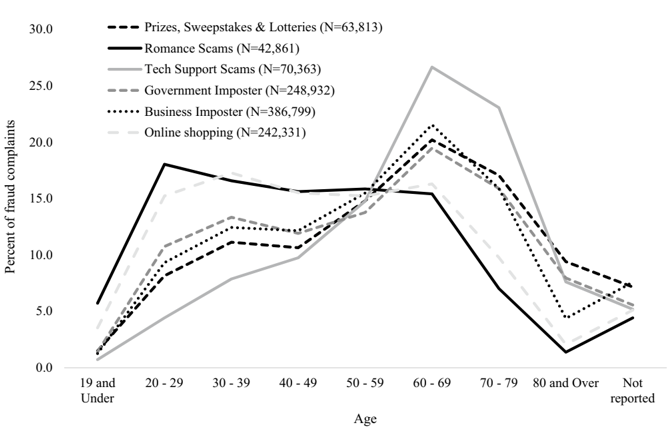
We examine the characteristics of consumers who reported scams to the U.S. Federal Trade Commission. We assess how consumers vary demographically across six scam types, and how the overall emotional sentiment of a consumer’s complaint (positive, negative, neutral/mixed) relates to reporting victimization versus attempted fraud (no losses). For romance, tech support, and prize, sweepstakes, and lottery scams, more older than young and middle-aged adults reported victimization. Across all scam types, consumers classified as Black, Hispanic, and Asian/Asian Pacific Islander were more likely than non-Hispanic white consumers to report victimization than attempted fraud. Relative to complaints categorized as emotionally neutral or mixed, we find that emotionally positive complaints and emotionally negative complaints were significantly associated with victimization, but that these relationships differed by scam type. This study helps identify which consumer groups are affected by specific scams and the association between emotion and victimization.
Overview
CoChat Summary
TL;DR
Using 1,010,748 FTC Consumer Sentinel complaints filed between November 2020 and April 2022, this study profiles demographic and emotional correlates of reporting victimization versus attempted fraud across six mass marketing scam types. It finds that age, race/ethnicity, and complaint sentiment relate to victimization differently by scam type, with older adults more likely to report losses for romance, tech support, and prize scams, and Black, Hispanic, and Asian/Asian Pacific Islander consumers more likely than non-Hispanic white consumers to report victimization than attempted fraud.
Key findings
- Victimization rates varied widely by scam type: online shopping 64.2%, romance 49.4%, tech support 25.3%, business imposter 17.5%, prize/sweepstakes/lottery 17.4%, and government imposter 11.1%; median losses were highest for romance ($2,500) and tech support ($1,200), and lowest for online shopping ($177).
- Age patterns were not uniform: for romance scams, adults 80+ were 76% more likely to report victimization than those in their 30s (OR 1.76, 95% CI 1.45–2.14); for tech support, teens were 85% more likely (OR 1.85, 95% CI 1.49–2.29) and adults 70+ were twice as likely (OR 2.09, 95% CI 1.89–2.31); for online shopping, adults 80+ were about half as likely (OR 0.47, 95% CI 0.44–0.51) while those 19 and younger were more than twice as likely (OR 2.16, 95% CI 2.00–2.32) relative to 30–39-year-olds.
- Across all scam types, consumers classified as Black, Hispanic, and Asian/Asian Pacific Islander were more likely than non-Hispanic white consumers to report victimization than attempted fraud; for example, in government imposter scams, Black consumers had OR 1.70 (95% CI 1.63–1.77), Asian/API OR 1.87 (95% CI 1.75–1.96), and American Indian/Alaska Native OR 1.56 (95% CI 1.17–2.06).
- Sentiment was associated with victimization but differed by scam type: in government imposter scams, positive complaints had OR 1.99 (95% CI 1.89–2.10) and negative complaints OR 1.41 (95% CI 1.34–1.49); in tech support, positive OR 1.38 (95% CI 1.27–1.50) and negative OR 1.16 (95% CI 1.06–1.26); in online shopping, positive sentiment was inversely associated with victimization (OR 0.73, 95% CI 0.70–0.76) and negative sentiment was not significant.
Methods
- The analysis used FTC Consumer Sentinel fraud complaints filed from November 1, 2020, to April 30, 2022 (18 months), restricted to six scam types: romance (N = 42,861), tech support (N = 70,363), government imposter (N = 248,932), business imposter (N = 386,802), prize/sweepstakes/lottery (N = 63,813), and online shopping (N = 242,331); after exclusions, the final sample was 1,010,748 complaints.
- Victimization was defined as reporting a financial loss of $1 or more (28.8% of complaints), and separate logistic regression models estimated the likelihood of victimization versus attempted fraud for each scam type, controlling for age, estimated sex, estimated race/ethnicity, contact method, season, proxy reporting, zip-code complaint rate, and narrative character length.
- Sentiment was classified using VADER into positive, negative, or neutral/mixed; sex was estimated with Gender Guesser 0.4.0, and race/ethnicity was estimated with Bayesian Improved First Name Surname Geocoding (BIFSG).
Limitations
- The paper states that complaint data reflect underlying fraud exposure, victimization, and reporting propensity, which cannot be separated analytically; fraud is widely underreported, and victims with higher losses and more education are likely overrepresented.
- The paper states that consumers self-select scam categories and the FTC does not independently verify each complaint; race/ethnicity and sex are estimated, BIFSG accuracy is poorer for American Indian/Alaska Native and multiracial individuals, about one-third of consumers could not be assigned male or female, and VADER was developed on Twitter text.
- The paper states that all cases were reported during the Covid-19 pandemic, so the extent to which increased reports reflect underlying fraud prevalence is unknown; evident from the text, the cross-sectional complaint design cannot establish causal relationships between emotion, demographics, and victimization.
Model-written summary. Check it against the paper before relying on it.
Integrity signals
Registry
Cites
Statistics
Figures
Verification
Claims the paper makes
11 Valid · 1 Not valid · 59 Not checked · 146 Own results and interpretations
The cited sources support only part of this claim — read each source’s verdict below.
In the paper
“Kircanski et al. (2018) found that young and older adults in positive and negative arousal states (excited and frustrated, respectively) were more likely to want to purchase a product featured in a misleading advertisement than those in a neutral emotional state.”
§ Profiling consumers who reported mass marketing scams: demographic characteristics and emotional sentiments associated with victimization > Emotion and fraud victimization
What the sources say
- Partly supportedcites Kircanski et al. 2018 matched to “Emotional arousal may increase susceptibility to fraud in older and younger adults.” (2018) sourceExperimental — accuracy not yet measured
The Results report greater purchase intention for misleadingly advertised items in both high-positive- and high-negative-arousal conditions than in the low-arousal condition. The age-group effects did not differ significantly, but the paper reports significant effects separately only for older adults. The citing sentence also calls the conditions “excited,” “frustrated,” and “neutral”; the Method describes arousal conditions, and the Discussion says discrete emotions were not measured. (LLM, conf=0.84)
plainstates an association- Asserted: passes — The authors put it forward as true.
- Checkable: passes — It can be checked against evidence.
- Load-bearing: unclear — It is unclear whether the paper’s conclusions depend on it.
- Based: passes — The paper gives a reason why it holds.
- Partly supported
Every source the paper cites for this claim was checked and supports it.
In the paper
“Predictive accuracy using BIFSG is poorer for American Indian/Alaska Natives (Sartin et al. 2021)”
§ Profiling consumers who reported mass marketing scams: demographic characteristics and emotional sentiments associated with victimization > Limitations
What the sources say
- Supportedcites Sartin et al. 2021 matched to “Facilitating research on racial and ethnic disparities and inequities in transportation: Application and evaluation of the Bayesian Improved Surname Geocoding (BISG) algorithm” (2021) source
The Discussion reports unacceptable concordance between BISG probabilities and reported race/ethnicity for American Indian/Alaska Native drivers, compared with excellent concordance for four larger groups. The claim’s “BIFSG” appears to refer to the paper’s BISG algorithm. Page numbers are not provided in our copy. (LLM, conf=0.94)
plainstates an association- Asserted: passes — The authors put it forward as true.
- Checkable: passes — It can be checked against evidence.
- Load-bearing: unclear — It is unclear whether the paper’s conclusions depend on it.
- Based: passes — The paper gives a reason why it holds.
- Supported
A result the paper reports from its own data — it cites no other source for it, so there is none to check. The quote shows it is in the paper.
In the paper
“Relative to complaints categorized as emotionally neutral or mixed, we find that emotionally positive complaints and emotionally negative complaints were significantly associated with victimization, but that these relationships differed by scam type.”
§ Profiling consumers who reported mass marketing scams: demographic characteristics and emotional sentiments associated with victimization > Abstract
plainstates an association- Asserted: passes — The authors put it forward as true.
- Checkable: passes — It can be checked against evidence.
- Load-bearing: passes — The paper’s conclusions depend on it.
- Based: passes — The paper gives a reason why it holds.
A result the paper reports from its own data — it cites no other source for it, so there is none to check. The quote shows it is in the paper.
In the paper
“Across all scam types, consumers classified as Black, Hispanic, and Asian/Asian Pacific Islander were more likely than non-Hispanic white consumers to report victimization than attempted fraud.”
§ Profiling consumers who reported mass marketing scams: demographic characteristics and emotional sentiments associated with victimization > Abstract
plainstates an association- Asserted: passes — The authors put it forward as true.
- Checkable: passes — It can be checked against evidence.
- Load-bearing: passes — The paper’s conclusions depend on it.
- Based: passes — The paper gives a reason why it holds.
87 more claims
Create a free account to see all 217 claims and to verify the 2 references still open.
- Probably not a substantial claim. 56
- It may state two separate claims as one. 87
Claims other papers make about this one
Each is checked against this paper’s own text: does it say what the citing paper says it does?
The source backs part of the claim, not all of it — or backs it for a different population, condition or comparison.
In the citing paper
“Additionally, large-scale analyses of victim self-reports indicated that emotional reactions such as distress, anger, regret, and shame are salient features of post-victimization, reinforcing the role of emotional processes as a pathway linking deceptive interactions to long-term psychological harm (DeLiema and Witt, 2024).”
From Mental health and psychosocial sequelae of fraud victimization: a systematic review (2026) · cites this paper as DeLiema and Witt, 2024
Experimental — accuracy not yet measuredThe source backs part of the claim, not all of it — or backs it for a different population, condition or comparison.
In the citing paper
“Additionally, large-scale analyses of victim self-reports indicated that emotional reactions such as distress, anger, regret, and shame are salient features of post-victimization, reinforcing the role of emotional processes as a pathway linking deceptive interactions to long-term psychological harm (DeLiema and Witt, 2024).”
From Mental health and psychosocial sequelae of fraud victimization: a systematic review (2026) · cites this paper as DeLiema and Witt, 2024
Experimental — accuracy not yet measured
Statistics that don’t add up
Each reported p-value recomputed from its test statistic and degrees of freedom, each partial η² from its F, and each ratio, mean difference or B printed with a p checked against its own confidence interval.
Rated minor: it would not touch a result — a value no result rests on, a p-value that stays on the same side of the significance level, or a conflict that is clerical, resolved elsewhere in the paper, or outside its own findings.
In the paper
“OR 0.52, 95%CI 0.54, 0.61, p < 0.001”
§ Profiling consumers who reported mass marketing scams: demographic characteristics and emotional sentiments associated with victimization > Government imposter scams
Self-check
Percentages, sums and reported differences re-computed from the paper’s own numbers.
Each contradiction between two passages listed here was confirmed by an independent check.
Rated minor: it would not touch a result — a value no result rests on, a p-value that stays on the same side of the significance level, or a conflict that is clerical, resolved elsewhere in the paper, or outside its own findings.
In the paper
“20-29 26,742 10.7 21.5 1000 11,061 9.3 30.7 800 36,914 15.2 79.0 219”
§ Profiling consumers who reported mass marketing scams: demographic characteristics and emotional sentiments associated with victimization > Romance scams
Reported 9.3 · recomputed 2.859625
Rated minor: it would not touch a result — a value no result rests on, a p-value that stays on the same side of the significance level, or a conflict that is clerical, resolved elsewhere in the paper, or outside its own findings.
In the paper
§ Profiling consumers who reported mass marketing scams: demographic characteristics and emotional sentiments associated with victimization > Government imposter scams
“Consumers who reported being contacted via text message were 43% less likely to report victimization compared to consumers contacted by phone (OR 0.52, 95%CI 0.54, 0.61, p < 0.001).”
§ Profiling consumers who reported mass marketing scams: demographic characteristics and emotional sentiments associated with victimization > Additional information
“Text message 0.57 0.000 0.54 0.61 0.45 0.000 0.44 0.47 1.02 0.528 0.96 1.09”
Rated minor: it would not touch a result — a value no result rests on, a p-value that stays on the same side of the significance level, or a conflict that is clerical, resolved elsewhere in the paper, or outside its own findings.
In the paper
§ Profiling consumers who reported mass marketing scams: demographic characteristics and emotional sentiments associated with victimization > Online shopping scams
“Just 32.9% of 70-to-79-year-olds who reported online shopping scams were victims compared to 79.0% of 20-to-29-year-olds.”
§ Profiling consumers who reported mass marketing scams: demographic characteristics and emotional sentiments associated with victimization > Romance scams
“70-79 39,546 15.9 6.7 2500 8489 15.9 13.8 1302 23,666 9.8 38.0 129 80 and Over 19,794 8.0 4.5 4000 2437 4.4 14.4 1900 5001 2.1 32.9 130”
Rated minor: it would not touch a result — a value no result rests on, a p-value that stays on the same side of the significance level, or a conflict that is clerical, resolved elsewhere in the paper, or outside its own findings.
In the paper
“58.5% NH white, 9.3% Hispanic, 28.5% NH Black, 9.3% Asian/Pacific Islander, 0.3% American Indian/Alaskan Native, and 3.4% multiracial”
§ Profiling consumers who reported mass marketing scams: demographic characteristics and emotional sentiments associated with victimization > Demographic characteristics
Reported 100 · recomputed 109.3
Rated minor: it would not touch a result — a value no result rests on, a p-value that stays on the same side of the significance level, or a conflict that is clerical, resolved elsewhere in the paper, or outside its own findings.
In the paper
“Older victims reported 5 to 13 times higher median losses compared to younger victims.For example, median losses were $6,830 for those in their 80 s compared to $300 for victims aged 20-to-49-years-old.”
§ Profiling consumers who reported mass marketing scams: demographic characteristics and emotional sentiments associated with victimization > Prize, sweepstakes, and lottery scams
Reported 13 · recomputed 22.766667
Citations
Cites
Social Change and Crime Rate Trends: A Routine Activity Approach
Cohen, L. E., & Felson, M. (1979) · American Sociological Review · doi:10.2307/2094589 · Cited by 8,856
VADER: a parsimonious rule-based model for sentiment analysis of social media text
Hutto, C., & Gilbert, E. (2014) · Proceedings of the International AAAI Conference on Web and Social Media · doi:10.1609/icwsm.v8i1.14550 · Cited by 6,087 · cited 1×
“VADER is an open-source lexicon and rule-based sentiment classifier developed by Hutto and Gilbert (2014).”
Petty, R. E., & Cacioppo, J. T. (1986) · doi:10.1007/978-1-4612-4964-1 · Cited by 5,219
The Elaboration Likelihood Model of Persuasion
Petty, R. E., & Cacioppo, J. T. (1986) · Communication and Persuasion · doi:10.1007/978-1-4612-4964-1_1 · Cited by 3,202
Out of Control: Visceral Influences on Behavior
Loewenstein, G. (1996) · Organizational Behavior and Human Decision Processes · doi:10.1006/obhd.1996.0028 · Cited by 2,610 · cited 1×
“Fraud perpetrators use visceral factors, including moods, emotions and drive states that have a direct hedonic impact, to manipulate decision making (Loewenstein 1996).”
(1977) · Medical Entomology and Zoology · Cited by 1,496
Feeling and Believing: The Influence of Emotion on Trust.
Dunn, J. R., & Schweitzer, M. E. (2005) · Journal of Personality and Social Psychology · doi:10.1037/0022-3514.88.5.736 · Cited by 1,301 · cited 1×
“For example, Dunn and Schweitzer (2005) reported that participants induced to feel happy rated acquaintances as more trustworthy than participants induced to feel angry or sad.”
Trends and issues in crime and criminal justice
Brown, T., Bricknell, S., Bryant, W., Lyneham, S., Tyson, D., & Arias, P. A. F. (2019) · Trends and issues in crime and criminal justice · Cited by 925
Brown, B., & Reed Benedict, W. (2002) · Policing: An International Journal of Police Strategies & Management · doi:10.1108/13639510210437032 · Cited by 703 · cited 1×
“Some research indicates that females hold more positive attitudes toward law enforcement (Nofziger and Williams 2005), although most findings on gender and attitudes toward police are mixed or show no significant gender differences (see Brown and Reed Benedict 2002; Worrall 1999).”
Applying Routine Activity Theory to Cybercrime: A Theoretical and Empirical Analysis
Leukfeldt, E. R., & Yar, M. (2016) · Deviant Behavior · doi:10.1080/01639625.2015.1012409 · Cited by 426 · cited 1×
“Although this theory was originally developed to explain direct-contact predatory offenses, it has also been applied to identity theft (Burnes et al. 2020; Guedes et al. 2022; Reynolds 2021), cybercrime (Khey and Sainato 2013; Leukfeldt and Yar 2016), and fraud (DeLiema 2018; Lee et al. 2022).”
Pratt, T. C., Holtfreter, K., & Reisig, M. D. (2010) · Journal of Research in Crime and Delinquency · doi:10.1177/0022427810365903 · Cited by 411 · cited 1×
“For example, Pratt et al. (2010) found that the frequency of internet use and online purchasing significantly increased the probability of being targeted by internet fraud.”
Mohammad, S. M. (2016) · Emotion Measurement · doi:10.1016/b978-0-08-100508-8.00009-6 · Cited by 391 · cited 1×
“Sentiment analysis is a computer-aided method to identify and extract subjective information in a large body of text to categorize its overall emotional valence (Mohammad 2015).”
LOW SELF‐CONTROL, ROUTINE ACTIVITIES, AND FRAUD VICTIMIZATION*
HOLTFRETER, K., REISIG, M. D., & PRATT, T. C. (2008) · Criminology · doi:10.1111/j.1745-9125.2008.00101.x · Cited by 375 · cited 1×
“Other surveys on fraud have found little to no association between race and risk of victimization (e.g., Holtfreter et al. 2008; Mesch and Dodel 2018), but sample sizes were significantly smaller and these studies focused on online forms of fraud.”
Emotion and persuasion: Cognitive and meta-cognitive processes impact attitudes
Petty, R. E., & Briñol, P. (2015) · Cognition and Emotion · doi:10.1080/02699931.2014.967183 · Cited by 336 · cited 1×
“High arousal emotions like fear and excitement influence how a per-suasion message is processed (Petty and Briñol 2015).”
Reyns, B. W. (2013) · Journal of Research in Crime and Delinquency · doi:10.1177/0022427811425539 · Cited by 287
Not a victimless crime: The impact of fraud on individual victims and their families
Button, M., Lewis, C., & Tapley, J. (2014) · Security Journal · doi:10.1057/sj.2012.11 · Cited by 268 · cited 1×
“Victims often report guilt, shame, embarrassment, severe stress and anxiety, trouble sleeping, relationship trouble, divorce, and indebtedness (Button et al. 2014; Cross 2015; FINRA Inves-tor Education Foundation 2015; Knüpfer et al. 2021).”
Using VADER sentiment and SVM for predicting customer response sentiment
Borg, A., & Boldt, M. (2020) · Expert Systems with Applications · doi:10.1016/j.eswa.2020.113746 · Cited by 251 · cited 1×
“Researchers have used VADER to analyze sentiments in Twitter posts associated with Covid-19 (Mittal et al. 2021), anti-vaccination beliefs (Garay et al. 2019), as well as sentiments in customer support emails (Borg and Boldt 2020).”
The Financial Costs of Sadness
Lerner, J. S., Li, Y., & Weber, E. U. (2013) · Psychological Science · doi:10.1177/0956797612450302 · Cited by 247 · cited 1×
“In another study, subjects in a sadness-induction condition were more impatient and chose to accept an immediate payout of less money instead of waiting to receive more money after a delay (Lerner et al. 2013).”
The online dating romance scam: causes and consequences of victimhood
Buchanan, T., & Whitty, M. T. (2014) · Psychology, Crime & Law · doi:10.1080/1068316x.2013.772180 · Cited by 229 · cited 1×
“One reason is that many fraud studies focus on a narrow sub-type of mass marking scams—such as investment fraud or romance scams (e.g., Buchanan and Whitty 2014; Deliema et al. 2020), and risk factors do not necessarily generalize across the universe of consumer fraud.”
Elliott, M. N., Morrison, P. A., Fremont, A., McCaffrey, D. F., Pantoja, P., & Lurie, N. (2009) · Health Services and Outcomes Research Methodology · doi:10.1007/s10742-009-0047-1 · Cited by 224 · cited 1×
“The original Bayesian Improved Surname Geoc-oding (BISG) algorithm was developed and validated using administrative health-care organization and mortgage lending application data (see Adjaye-Gbewonyo et al. 2014; Elliott et al. 2009).”
No laughing matter: Blaming the victim of online fraud
Cross, C. (2015) · International Review of Victimology · doi:10.1177/0269758015571471 · Cited by 197 · cited 1×
“Victims often report guilt, shame, embarrassment, severe stress and anxiety, trouble sleeping, relationship trouble, divorce, and indebtedness (Button et al. 2014; Cross 2015; FINRA Inves-tor Education Foundation 2015; Knüpfer et al. 2021).”
Anatomy of the online dating romance scam
Whitty, M. T. (2015) · Security Journal · doi:10.1057/sj.2012.57 · Cited by 165 · cited 1×
“This is more common in romance scams which typically last over a period of weeks to months (Whitty et al. 2015), and could explain why median losses are so high for this scam type.”
Elder Fraud and Financial Exploitation: Application of Routine Activity Theory
DeLiema, M. (2018) · The Gerontologist · doi:10.1093/geront/gnw258 · Cited by 156 · cited 1×
“Although this theory was originally developed to explain direct-contact predatory offenses, it has also been applied to identity theft (Burnes et al. 2020; Guedes et al. 2022; Reynolds 2021), cybercrime (Khey and Sainato 2013; Leukfeldt and Yar 2016), and fraud (DeLiema 2018; Lee et al. 2022).”
Self-citationPublic perceptions of police efficacy and image: The “fuzziness” of support for the police
Worrall, J. L. (1999) · American Journal of Criminal Justice · doi:10.1007/bf02887617 · Cited by 149 · cited 1×
“Some research indicates that females hold more positive attitudes toward law enforcement (Nofziger and Williams 2005), although most findings on gender and attitudes toward police are mixed or show no significant gender differences (see Brown and Reed Benedict 2002; Worrall 1999).”
Emotional arousal may increase susceptibility to fraud in older and younger adults.
Kircanski, K., Notthoff, N., DeLiema, M., Samanez-Larkin, G. R., Shadel, D., Mottola, G., Carstensen, L. L., & Gotlib, I. H. (2018) · Psychology and Aging · doi:10.1037/pag0000228 · Cited by 120 · cited 1×
“Kircanski et al. (2018) found that young and older adults in positive and negative arousal states (excited and frustrated, respectively) were more likely to want to purchase a product featured in a misleading advertisement than those in a neutral emotional state.”
Self-citationMild Cognitive Impairment and Susceptibility to Scams in Old Age
Han, S. D., Boyle, P. A., James, B. D., Yu, L., & Bennett, D. A. (2015) · Journal of Alzheimer's Disease · doi:10.3233/jad-150442 · Cited by 117 · cited 1×
“Studies that examine age-related declines in cognitive functioning suggest that older adults may be more susceptible to scams (Han et al. 2016a, 2016b), yet these and other prior studies do not control for different rates of fraud exposure by age.”
Perceptions of Police and Safety in a Small Town
Nofziger, S., & Williams, L. S. (2005) · Police Quarterly · doi:10.1177/1098611103258959 · Cited by 102 · cited 1×
“Some research indicates that females hold more positive attitudes toward law enforcement (Nofziger and Williams 2005), although most findings on gender and attitudes toward police are mixed or show no significant gender differences (see Brown and Reed Benedict 2002; Worrall 1999).”
Derose, S. F., Contreras, R., Coleman, K. J., Koebnick, C., & Jacobsen, S. J. (2013) · Medical Care Research and Review · doi:10.1177/1077558712466293 · Cited by 102
Profiling Victims of Investment Fraud: Mindsets and Risky Behaviors
Deliema, M., Shadel, D., & Pak, K. (2020) · Journal of Consumer Research · doi:10.1093/jcr/ucz020 · Cited by 100
Self-citationElliott, M. N., Morrison, P. A., Fremont, A. M., McCaffrey, D. F., Pantoja, P. M., & Lurie, N. (2009) · Health Services and Outcomes Research Methodology · doi:10.1007/s10742-009-0055-1 · Cited by 98
Studying the correlates of fraud victimization and reporting
Schoepfer, A., & Piquero, N. L. (2009) · Journal of Criminal Justice · doi:10.1016/j.jcrimjus.2009.02.003 · Cited by 94 · cited 1×
“Research also indicates that fraud victim reporting behavior is strongly associated with higher education (Copes et al. 2001; Kerley and Copes 2002; Schoepfer and Piquero 2009) and greater losses (Copes et al. 2001; Kerley and Copes 2002; Kemp 2022; Raval 2021).”
Labgold, K., Hamid, S., Shah, S., Gandhi, N. R., Chamberlain, A., Khan, F., Khan, S., Smith, S., Williams, S., Lash, T. L., et al. (2021) · Epidemiology · doi:10.1097/ede.0000000000001314 · Cited by 89 · cited 6×
“Consumer complaints of mass marketing scams received by the U.S. Federal Trade Commission (FTC) increased substantially throughout the Covid-19 pandemic, reaching a peak of 2.8 million in 2021 (FTC 2022a), and then declining to 2.4 million in 2022 (FTC 2023).”
InfluentialThe reporting experiences and support needs of victims of online fraud
Cross, C., Richards, K., & Smith, R. (2016) · Australian Institute of Criminology eBooks · doi:10.52922/ti148355 · Cited by 86 · cited 2×
“Victims may not report to law enforcement, survey researchers, and consumer protection agencies for reasons such as self-blame, shame, embarrassment, and the stigma of victimization (Cross et al. 2016).”
Reporting behavior of fraud victims and black's theory of law: An empirical assessment
Copes, H., Kerley, K. R., Mason, K. A., & Van Wyk, J. (2001) · Justice Quarterly · doi:10.1080/07418820100094931 · Cited by 75 · cited 1×
“Research also indicates that fraud victim reporting behavior is strongly associated with higher education (Copes et al. 2001; Kerley and Copes 2002; Schoepfer and Piquero 2009) and greater losses (Copes et al. 2001; Kerley and Copes 2002; Kemp 2022; Raval 2021).”
Risk and protective factors of identity theft victimization in the United States
Burnes, D., DeLiema, M., & Langton, L. (2020) · Preventive Medicine Reports · doi:10.1016/j.pmedr.2020.101058 · Cited by 75 · cited 1×
“Although this theory was originally developed to explain direct-contact predatory offenses, it has also been applied to identity theft (Burnes et al. 2020; Guedes et al. 2022; Reynolds 2021), cybercrime (Khey and Sainato 2013; Leukfeldt and Yar 2016), and fraud (DeLiema 2018; Lee et al. 2022).”
Self-citationCross, C. (2020) · Criminology & Criminal Justice · doi:10.1177/1748895819835910 · Cited by 72 · cited 1×
“Another reason for not reporting is not considering the incident to be a crime (Kemp 2022), and feeling that there is little that authorities can do to hold perpetrators accountable (Cross 2020).”
Assessing Fair Lending Risks Using Race/Ethnicity Proxies
Zhang, Y. (2018) · Management Science · doi:10.1287/mnsc.2016.2579 · Cited by 71 · cited 1×
“This method has been applied in studies examining racial disparities in Covid-19 (Labgold et al. 2021), polarized voting patterns (Bar-reto et al. 2021), and fair lending product analysis (Zhang 2018).”
Is there a scam for everyone? Psychologically profiling cyberscam victims
Whitty, M. T. (2020) · European Journal on Criminal Policy and Research · doi:10.1007/s10610-020-09458-z · Cited by 71 · cited 1×
“For example, Whitty (2020) found that men and educated people were more likely to be deceived by cyberscams in general.”
Racial Disparities in Hate Crime Reporting
Zaykowski, H. (2010) · Violence and Victims · doi:10.1891/0886-6708.25.3.378 · Cited by 66 · cited 1×
“Prior research indicates that low trust is associated with lower rates of crime reporting, particularly among those who are Black, Hispanic, and Asian (Martinez-Schuldt and Mar-tínez 2021; Zaykowski 2010).”
Using First Name Information to Improve Race and Ethnicity Classification
Voicu, I. (2018) · Statistics and Public Policy · doi:10.1080/2330443x.2018.1427012 · Cited by 66 · cited 8×
“Predictive accuracy using BIFSG is poorer for American Indian/Alaska Natives (Sartin et al. 2021) and for multiracial individuals (Derose et al. 2013).”
InfluentialAdjaye‐Gbewonyo, D., Bednarczyk, R. A., Davis, R. L., & Omer, S. B. (2014) · Health Services Research · doi:10.1111/1475-6773.12089 · Cited by 63
Martínez-Schuldt, R. D., & Martínez, D. E. (2021) · American Sociological Review · doi:10.1177/0003122420978406 · Cited by 59
Low Self-Control, Information Disclosure, and the Risk of Online Fraud
Mesch, G. S., & Dodel, M. (2018) · American Behavioral Scientist · doi:10.1177/0002764218787854 · Cited by 57 · cited 1×
“Other surveys on fraud have found little to no association between race and risk of victimization (e.g., Holtfreter et al. 2008; Mesch and Dodel 2018), but sample sizes were significantly smaller and these studies focused on online forms of fraud.”
Pyramids, Ponzis and fraud prevention: lessons from a case study
Bosley, S., & Knorr, M. (2018) · Journal of Financial Crime · doi:10.1108/jfc-10-2016-0062 · Cited by 51 · cited 1×
“In an analysis of case data from a high-profile pyramid scheme, Bosley and Knorr (2018) found that the scheme was prevalent in counties with high Hispanic populations.”
Personality, emotion and individual differences in response to online fraud
Norris, G., & Brookes, A. (2021) · Personality and Individual Differences · doi:10.1016/j.paid.2020.109847 · Cited by 50 · cited 1×
“While prior research suggests that emotional arousal increases susceptibility to persuasion and fraud (see Norris and Brookes (2021) for review), there is also research documenting the emotional outcomes of fraud.”
Whose Voice Do We Hear in the Marketplace? Evidence from Consumer Complaining Behavior
Raval, D. (2020) · Marketing Science · doi:10.1287/mksc.2018.1140 · Cited by 47 · cited 2×
“The complaint rate was closer to 1 in 10 victims for scams that involved significantly higher dollar losses (Raval 2020, Table 1, p. 171).”
Personal fraud victims and their official responses to victimization
Kerley, K. R., & Copes, H. (2002) · Journal of Police and Criminal Psychology · doi:10.1007/bf02802859 · Cited by 46 · cited 1×
“Research also indicates that fraud victim reporting behavior is strongly associated with higher education (Copes et al. 2001; Kerley and Copes 2002; Schoepfer and Piquero 2009) and greater losses (Copes et al. 2001; Kerley and Copes 2002; Kemp 2022; Raval 2021).”
Helping the Hacker? Library Information, Security, and Social Engineering
Thompson, S. T. C. (2006) · Information Technology and Libraries · doi:10.6017/ital.v25i4.3355 · Cited by 46 · cited 1×
“Mass marketing scams typically incorporate social engineering tactics that involve “trickery, persuasion, impersonation, emotional manipulation, and abuse of trust to gain information or computer-system access” (Thompson 2006, p. 1).”
Exploring the determinants of victimization and fear of online identity theft: an empirical study
Guedes, I., Martins, M., & Cardoso, C. S. (2023) · Security Journal · doi:10.1057/s41284-022-00350-5 · Cited by 43 · cited 1×
“Although this theory was originally developed to explain direct-contact predatory offenses, it has also been applied to identity theft (Burnes et al. 2020; Guedes et al. 2022; Reynolds 2021), cybercrime (Khey and Sainato 2013; Leukfeldt and Yar 2016), and fraud (DeLiema 2018; Lee et al. 2022).”
Grey matter correlates of susceptibility to scams in community-dwelling older adults
Duke Han, S., Boyle, P. A., Yu, L., Arfanakis, K., James, B. D., Fleischman, D. A., & Bennett, D. A. (2016) · Brain Imaging and Behavior · doi:10.1007/s11682-015-9422-4 · Cited by 42
Victims’ motivations for reporting to the ‘fraud justice network’
Cross, C. (2018) · Police Practice and Research · doi:10.1080/15614263.2018.1507891 · Cited by 35 · cited 2×
“Another contributor to negative psychological effects is that most fraud victims are not be eligible for victim assistance programs that could help them financially recover (Cross 2018a).”
(Mis)Understanding the Impact of Online Fraud: Implications for Victim Assistance Schemes
Cross, C. (2018) · Victims & Offenders · doi:10.1080/15564886.2018.1474154 · Cited by 34 · cited 2×
“Another contributor to negative psychological effects is that most fraud victims are not be eligible for victim assistance programs that could help them financially recover (Cross 2018a).”
You can trust me: a multimethod analysis of the Nigerian email scam
Rich, T. S. (2017) · Security Journal · doi:10.1057/s41284-017-0095-0 · Cited by 31 · cited 1×
“Messages about prizes, sweepstakes, and lotteries generally contain positive, trust-laden language promising financial rewards (Carter 2015; Rich 2018).”
“I Have Only Checked after the Event”: Consumer Approaches to Safe Online Shopping
Whittaker, J. M., Edwards, M., Cross, C., & Button, M. (2022) · Victims & Offenders · doi:10.1080/15564886.2022.2130486 · Cited by 31 · cited 1×
“There is significant variation in the types and prevalence of mass marketing scams, which change over time in response to new communication and money transfer methods, changes in culture and purchasing habits, and national and global events such as the Covid-19 pandemic (Whittaker et al. 2022).”
Fraud reporting in Catalonia in the Internet era: Determinants and motives
Kemp, S. (2022) · European Journal of Criminology · doi:10.1177/1477370820941405 · Cited by 28
Who is Victimized by Fraud? Evidence from Consumer Protection Cases
Raval, D. (2021) · Journal of Consumer Policy · doi:10.1007/s10603-020-09466-w · Cited by 28 · cited 10×
“Raval (2021) used the FTC Consumer Sentinel and compared consumer fraud reports to law enforcement case data on the same frauds.”
InfluentialThe anatomy of written scam communications: An empirical analysis
Carter, E. (2015) · Crime Media Culture An International Journal · doi:10.1177/1741659015572310 · Cited by 26 · cited 1×
“Messages about prizes, sweepstakes, and lotteries generally contain positive, trust-laden language promising financial rewards (Carter 2015; Rich 2018).”
Garay, J., Yap, R., & Sabellano, M. J. (2019) · IOP Conference Series: Materials Science and Engineering · doi:10.1088/1757-899x/482/1/012043 · Cited by 23 · cited 1×
“Researchers have used VADER to analyze sentiments in Twitter posts associated with Covid-19 (Mittal et al. 2021), anti-vaccination beliefs (Garay et al. 2019), as well as sentiments in customer support emails (Borg and Boldt 2020).”
Identification of affective valence of Twitter generated sentiments during the COVID-19 outbreak
Mittal, R., Mittal, A., & Aggarwal, I. (2021) · Social Network Analysis and Mining · doi:10.1007/s13278-021-00828-x · Cited by 23 · cited 6×
“Consumer complaints of mass marketing scams received by the U.S. Federal Trade Commission (FTC) increased substantially throughout the Covid-19 pandemic, reaching a peak of 2.8 million in 2021 (FTC 2022a), and then declining to 2.4 million in 2022 (FTC 2023).”
InfluentialKhey, D. N., & Sainato, V. A. (2013) · Security Journal · doi:10.1057/sj.2013.24 · Cited by 22 · cited 1×
“Although this theory was originally developed to explain direct-contact predatory offenses, it has also been applied to identity theft (Burnes et al. 2020; Guedes et al. 2022; Reynolds 2021), cybercrime (Khey and Sainato 2013; Leukfeldt and Yar 2016), and fraud (DeLiema 2018; Lee et al. 2022).”
The demographic profile of victims of investment fraud: an update
Lokanan, M. E., & Liu, S. (2021) · Journal of Financial Crime · doi:10.1108/jfc-09-2020-0191 · Cited by 18 · cited 1×
“However, a recent study that examined investment fraud cases in Canada showed that 60% of the defrauded investors were female (Lokanan and Liu 2021).”
Reynolds, D. (2021) · Security Journal · doi:10.1057/s41284-020-00258-y · Cited by 17 · cited 1×
“Although this theory was originally developed to explain direct-contact predatory offenses, it has also been applied to identity theft (Burnes et al. 2020; Guedes et al. 2022; Reynolds 2021), cybercrime (Khey and Sainato 2013; Leukfeldt and Yar 2016), and fraud (DeLiema 2018; Lee et al. 2022).”
Household Responses to Phantom RichesPreprint
Knüpfer, S., Rantala, V., Vihriälä, E., & Vokatá, P. (2021) · SSRN Electronic Journal · doi:10.2139/ssrn.3850928 · Cited by 17
(2004) · Digital Commons at University of Maryland Carey Law (University of Maryland Francis King Carey School of Law) · Cited by 16
Routine activities theory and food fraud victimization
Lee, B., Fenoff, R., & Spink, J. (2021) · Security Journal · doi:10.1057/s41284-021-00287-1 · Cited by 15
Sartin, E. B., Metzger, K. B., Pfeiffer, M. R., Myers, R. K., & Curry, A. E. (2021) · Traffic Injury Prevention · doi:10.1080/15389588.2021.1955109 · Cited by 14 · cited 1×
“Predictive accuracy using BIFSG is poorer for American Indian/Alaska Natives (Sartin et al. 2021) and for multiracial individuals (Derose et al. 2013).”
To Whom Do Victims of Mass-Market Consumer Fraud Complain?
Anderson, K. B. (2021) · doi:10.2139/ssrn.3852323 · Cited by 11 · cited 2×
“Using data from three mass marketing fraud prevalence studies administered in 2005, 2011, and 2017, Anderson (2021) found that only 4.8% percent of U.S. fraud victims complained to a government agency or the Better Business Bureau.”
InfluentialMixed Methods Analysis of Consumer Fraud Reports of the Social Security Administration Impostor Scam
DeLiema, M., & Witt, P. (2021) · University of Michigan · doi:10.7302/4195 · Cited by 5
Self-citationA Novel Method for Showing Racially Polarized Voting: Bayesian Improved Surname Geocoding
Barreto, M., Cohen, M., Collingwood, L., Dunn, C., & Waknin, S. (2021) · doi:10.2139/ssrn.3834818 · Cited by 5
Using First Name Information to Improve Race and Ethnicity Classification
Voicu, I. (2018) · Figshare · doi:10.6084/m9.figshare.5813859
Cited by
Evaluating community solar as a measure to promote equitable clean energy access
O’Shaughnessy, E., Barbose, G. L., Kannan, S., & Sumner, J. (2024) · Nature Energy · doi:10.1038/s41560-024-01546-2 · Cited by 46
Fraud victimization across the lifespan: evidence on repeat victimization using perpetrator data
DeLiema, M., Langton, L. L., Brannock, D., & Preble, E. A. (2024) · Journal of Elder Abuse & Neglect · doi:10.1080/08946566.2024.2321923 · Cited by 25
“Recent research indicates that older adults are more likely to report victimization by romance scams, tech support scams, and prize sweepstakes and lottery scams relative to younger adults targeted by these scams (DeLiema & Witt, 2023).”
BackgroundSelf-citationFinancial fraud detection using a hybrid deep belief network and quantum optimization approach
Yu, G., & Luo, Z. (2025) · Discover Applied Sciences · doi:10.1007/s42452-025-06999-y · Cited by 20
“This feature makes DBN have great potential in the field of fraud detection, especially when facing complex financial data, it can automatically learn potential fraud features from the data, thereby improving the classification accuracy of the model [16, 17].”
DeLiema, M., Gao, S., Brannock, D., & Langton, L. L. (2024) · Innovation in Aging · doi:10.1093/geroni/igae111 · Cited by 26
“Income, race, ethnicity, marital status, and education may affect the likelihood of being targeted by financial fraud (DeLiema & Witt, 2023; DeLiema et al., 2023).”
Self-citationDadà, C. B., Colautti, L., Rosi, A., Cavallini, E., Antonietti, A., & Iannello, P. (2025) · Computers in Human Behavior · doi:10.1016/j.chb.2025.108734 · Cited by 34
Metadata
- Authors
- DeLiema, M., & Witt, P.
- Affiliations
- University of Minnesota (US)
- Federal Trade Commission (US)
- Corresponding author
- DeLiema, Marguerite
- ORCID
- DeLiema, Marguerite
- Venue
- Security Journal
- Published
- 2023-09-28
- Volume
- 37
- Issue
- 3
- Pages
- 921-964
- ISSN
- 0955-1662 (ISSN-L)
- 1743-4645
- OpenAlex
- W4387117772
- Semantic Scholar
- 23c0c98faf107a45481c2f2c24d958f1063f1a93
- Cited by
- 20
- References
- 66
- Citations by year
- 2026: 4 · 2025: 6 · 2024: 10
- FWCI
- 4.69
- Type
- journal article
- Language
- en
- Open access
- hybrid
- doi.org
- Licence
- cc-by
- creativecommons.org/licenses/by/4.0 (tdm)
- creativecommons.org/licenses/by/4.0 (vor)
- Locations
- Security Journal (publishedVersion, cc-by)
- Funders
- U.S. Social Security Administration (RDR18000002-03)
- Topics
- Social Sciences › Law › Cybercrime and Law Enforcement Studies
- Physical Sciences › Computer Science › Information Systems › Spam and Phishing Detection
- Health Sciences › Medicine › Geriatrics and Gerontology › Elder Abuse and Neglect
- Keywords
- consumer fraud, victimization, complaint reporting, Federal Trade Commission, demographic factors, romance scams, age differences, racial and ethnic differences, consumer profiling
About these checks
Registry, retraction, Cites and statistics results are computed, not judged, with one exception: a printed reference that no index lists is read once by a model before it counts as a citation error. Claims are extracted by a model and kept only when their quote appears verbatim in the text; each cited source is then checked, with a model’s help, for whether it says what the claim relies on. Those verdicts can be wrong — read the claim’s quote and the cited source before relying on one.
The claim verdicts this report counts are experimental: their accuracy is not yet measured.
A language model drew the claims from the paper on 2026-10-04, under version 3 of the claim definition (model deepseek-v4.1-flash, prompt extract-v3).
A second model labelled each claim on 2026-10-04 (model jev-1.13-20260917, definition revision gold-guideline-v0.2).
Cited sources are checked with a language model’s help (gpt-6-sol).
Statistics and arithmetic are recomputed, not judged.
Confidence bands are shown only for fields calibrated on our annotated test set. None is calibrated yet, so no band is shown.
What counts as a claim ›How we measure confidence ›How we check this ›
Are you an author, or do you see a problem with this page? Request a review
Data sources
Bibliographic data: Semantic Scholar, OpenAlex, Crossref.
Contains information from the Semantic Scholar Academic Graph Datasets, made available under the ODC Attribution License (ODC-BY 1.0).
Semantic Scholar’s data is described in: Kinney, R., et al. (2023). The Semantic Scholar Open Data Platform. arXiv:2301.10140.
