

The DOI matches its Crossref record; 93 of the 93 references it cites were found in a registry or an index; 47 of the 143 sources its claims cite were checked for support.
The biocultural origins and dispersal of domestic chickens
Open accessAbstract
Though chickens are the most numerous and ubiquitous domestic bird, their origins, the circumstances of their initial association with people, and the routes along which they dispersed across the world remain controversial. In order to establish a robust spatial and temporal framework for their origins and dispersal, we assessed archaeological occurrences and the domestic status of chickens from ∼600 sites in 89 countries by combining zoogeographic, morphological, osteometric, stratigraphic, contextual, iconographic, and textual data. Our results suggest that the first unambiguous domestic chicken bones are found at Neolithic Ban Non Wat in central Thailand dated to ∼1650 to 1250 BCE, and that chickens were not domesticated in the Indian Subcontinent. Chickens did not arrive in Central China, South Asia, or Mesopotamia until the late second millennium BCE, and in Ethiopia and Mediterranean Europe by ∼800 BCE. To investigate the circumstances of their initial domestication, we correlated the temporal spread of rice and millet cultivation with the first appearance of chickens within the range of red junglefowl species. Our results suggest that agricultural practices focused on the production and storage of cereal staples served to draw arboreal red junglefowl into the human niche. Thus, the arrival of rice agriculture may have first facilitated the initiation of the chicken domestication process, and then, following their integration within human communities, allowed for their dispersal across the globe.
Overview
AI snapshot
Written from the paper’s full text.
TL;DR
This paper critically reassesses archaeological, iconographic, textual, and linguistic evidence for early chickens across >600 sites in 89 countries and argues that unambiguous domestic chickens appear only by ∼1650–1250 BCE in central Thailand, not in earlier China or Indus Valley contexts. It proposes that rice and millet cultivation created a human niche that attracted red junglefowl and catalyzed domestication, followed by rapid dispersal across Asia, Europe, and Africa.
Key findings
- Reanalysis of >600 sites in 89 countries found the earliest unambiguous domestic chicken remains at Neolithic Ban Non Wat, central Thailand, dated ∼1650–1250 BCE; >95% of the avifauna there was ascribed to *Gallus*, with an exceedingly high proportion of juvenile bones and deposition as grave goods alongside domestic pigs, dogs, and bovines.
- Claims for earlier chickens were not supported: northern China remains dated 11,000–8,000 y ago were pheasants, and key Indus Valley specimens from Mohenjo-daro and Harappa were misidentified, too large, or possibly intrusive; the earliest confident East Asian chickens date to the late Shang Dynasty ∼1350–1046 BCE, and South Asian poultry farming appears post-Harappan.
- Dispersal was relatively late and rapid: chickens reached Ethiopia and Mediterranean Europe by ∼700 BCE, with the earliest directly dated southern European chickens from Italian Greek colonies dated 776–540 BCE; they arrived in Near Oceania in the early first millennium BCE, Hawaii ∼1200 CE, Australia 1788 CE, and New Zealand 1773 CE.
- Rice and millet cultivation correlates with early chickens: sites with rice cultivation appeared within the distribution of *G. gallus spadiceus* from about 2000 BCE in southern Yunnan and northeast Thailand, suggesting cereal production and storage acted as a magnet for red junglefowl.
Methods
- The authors critically assessed published faunal databases and publications for >600 archaeological sites in 89 countries, revisiting species identification, domestic status, stratigraphic integrity, and zooarchaeological/cultural context, and evaluating zoogeographic, morphological, osteometric, iconographic, written, and linguistic records.
- They generated two datasets: confidently assigned domestic chicken remains (SI Appendix, Table S2) and ambiguous remains (SI Appendix, Table S3), and used 100 independent, confidently assigned, dated chicken remains for a spatial kriging interpolation of chicken arrival timing.
- They correlated the resulting spatiotemporal pattern with human subsistence strategies, especially the appearance and spread of rice and millet agriculture.
Limitations
- The paper states that additional archaeological investigations are necessary to test the chronology, and that new excavations may reveal earlier human–red junglefowl associations or earlier human-mediated translocations.
- The paper states that establishing osteological criteria to separate wild junglefowl from domestic relatives, and generating simultaneous morphological, isotopic, and ancient genetic datasets, is essential to refine chicken origins and dispersal.
- The paper notes that compiling the global dataset faced preservation, identification, recovery, and dating challenges; evident from the text, many determinations relied on published records or photographs rather than direct measurement of all bones, and geographic gaps remain, such as the lack of detailed avifaunal studies at prehistoric Yunnan sites.
Model-written summary. Check it against the paper before relying on it.
Integrity signals
Registry
Cites
Statistics
Figures
Verification
Claims the paper makes
37 Own interpretation · 21 Sources not found · 19 Partly supported · 17 No full text of the sources · 14 Supported · 13 Not checked yet · 10 No basis given · 7 Own result · 6 Supported so far · 3 Couldn’t confirm · 1 Own method · accuracy not yet measured
Every source the paper cites for this claim was checked and supports it.
In the paper
“The latter can lead to invalid claims regarding their dating and cultural context, and a recent program of radiocarbon dating demonstrated that numerous early claims for the first appearance of chickens in Europe were spurious (13).”
§ The biocultural origins and dispersal of domestic chickens > Abstract
What the sources say
- Supportedcites [13] J. Best., Redefining the timing and circumstances of the chicken’s introduction to Europe and north-west Africa. Antiquity, 10.15184/aqy.2021.90 (2022). source
The Discussion and Conclusion states that the radiocarbon-dating programme found no evidence for Neolithic, Chalcolithic or Bronze Age chickens in Europe and recommends rejecting claims of pre-Iron Age chickens without direct dating. The Materials and Methods describes direct dating of 23 bones from sites with purportedly early chickens, supporting the claim that the programme challenged numerous early reports. (LLM, conf=0.93)
boosteddirect- Asserted: passes — The authors put it forward as true.
- Checkable: passes — It can be checked against evidence.
- Load-bearing: passes — The paper’s conclusions depend on it.
- Based: passes — The paper gives a reason why it holds.
- Supported
The sources with a verdict support this claim; the rest weren’t checked yet, have no full text we could read, or their verdicts aren’t rated yet.
In the paper
“Although early Holocene bird remains from northern China were initially claimed to be chickens (8), a reanalysis of those bones based upon discrete osteomorphological criteria demonstrated that the specimens were derived from pheasants (1, 9).”
§ The biocultural origins and dispersal of domestic chickens > Abstract
What the sources say
- Supportedcites [1] J. Peters, O. Lebrasseur, H. Deng, G. Larson, Holocene cultural history of red jungle fowl (Gallus gallus) and its domestic descendant in East Asia. Quat. Sci. Rev. 142, 102– 119 (2016). source
Section 3.1 (Osteomorphology) describes the osteological criteria used to re-evaluate the remains and excludes Gallus as their identification. Section 3.4 says early and middle Holocene northern Chinese finds previously classified as Gallus were instead derived from pheasants. (LLM, conf=0.93)
- Not checked — no full text of the sourcecites [9] M. Eda, Reevaluation of early Holocene chicken domestication in northern China. J. Archaeol. Sci. 67, 25– 31 (2016). source
boosteddirect- Asserted: passes — The authors put it forward as true.
- Checkable: passes — It can be checked against evidence.
- Load-bearing: passes — The paper’s conclusions depend on it.
- Based: passes — The paper gives a reason why it holds.
- Supported
The cited sources support only part of this claim — read each source’s verdict below.
In the paper
“Previous claims for the presence of chickens in the Yellow River basin 11,000 to 8,000 y ago (8) are not supported by either the climatic, palynological, or archaeofaunal records, all of which suggest the environmental conditions in the region were not conducive to the thermophilic Gallus (1, 31).”
§ The biocultural origins and dispersal of domestic chickens > Results > Early Domestic Chickens Beyond the Distribution of Red Junglefowl.
What the sources say
- Supportedcites [1] J. Peters, O. Lebrasseur, H. Deng, G. Larson, Holocene cultural history of red jungle fowl (Gallus gallus) and its domestic descendant in East Asia. Quat. Sci. Rev. 142, 102– 119 (2016). source
Section 2.1 describes pollen and climate records indicating cool, dry conditions in early Holocene Northern China. Sections 3.1 and 6 conclude that re-evaluated early chicken remains do not establish Gallus there and that the region lacked suitable habitat for tropical Red jungle fowl. The paper also notes conflicting ancient-DNA results, but the claim is specifically about what the climatic, pollen, and archaeofaunal evidence supports. (LLM, conf=0.92)
- Partly supportedcites [31] J. Peters, Questioning new answers regarding Holocene chicken domestication in China. Proc. Natl. Acad. Sci. U.S.A. 112, E2415 (2015). 25886773 PMC4434763 sourceExperimental — accuracy not yet measured
The main text (p. E2415) cites paleoclimatic conditions and faunal remains as reasons to doubt early chicken domestication on the North China plain, and says Cishan and Wangyin were unsuitable for thermophilic red jungle fowl. It does not discuss palynological records or establish the stated 11,000–8,000-year interval; it also leaves open the possibility that the earlier conclusions may be valid. (LLM, conf=0.88)
hedged- Asserted: passes — The authors put it forward as true.
- Checkable: passes — It can be checked against evidence.
- Load-bearing: passes — The paper’s conclusions depend on it.
- Based: passes — The paper gives a reason why it holds.
- Supported
The cited sources support only part of this claim — read each source’s verdict below.
In the paper
“Their increasing numbers at Neo-Assyrian, Urartian, Phrygian (SI Appendix, Table S2), and Levantine sites (46) indicate growing economic interest in the species’ exploitation during the Iron Age II period (∼965 to 530 BCE).”
§ The biocultural origins and dispersal of domestic chickens > Results > Early Domestic Chickens Beyond the Distribution of Red Junglefowl.
What the sources say
- Partly supportedcites [46] L. Perry-Gal, A. Erlich, A. Gilboa, G. Bar-Oz, Earliest economic exploitation of chicken outside East Asia: Evidence from the Hellenistic Southern Levant. Proc. Natl. Acad. Sci. U.S.A. 112, 9849– 9854 (2015). 26195775 PMC4538678 sourceExperimental — accuracy not yet measured
The ‘Chickens in the Southern Levant’ section reports a gradual rise in Levantine sites with chicken remains, supporting the increasing-numbers portion of the citation. It also says exploitation before the Hellenistic period was sporadic and places the conspicuous increase in that later period; it does not establish growing economic exploitation during Iron Age II. The cited paper’s survey does not substantiate the Neo-Assyrian, Urartian, or Phrygian portions of the sentence. (LLM, conf=0.84)
hedgeddirect- Asserted: passes — The authors put it forward as true.
- Checkable: passes — It can be checked against evidence.
- Load-bearing: passes — The paper’s conclusions depend on it.
- Based: passes — The paper gives a reason why it holds.
- Partly supported
Every source the paper cites for this claim was checked and supports it.
In the paper
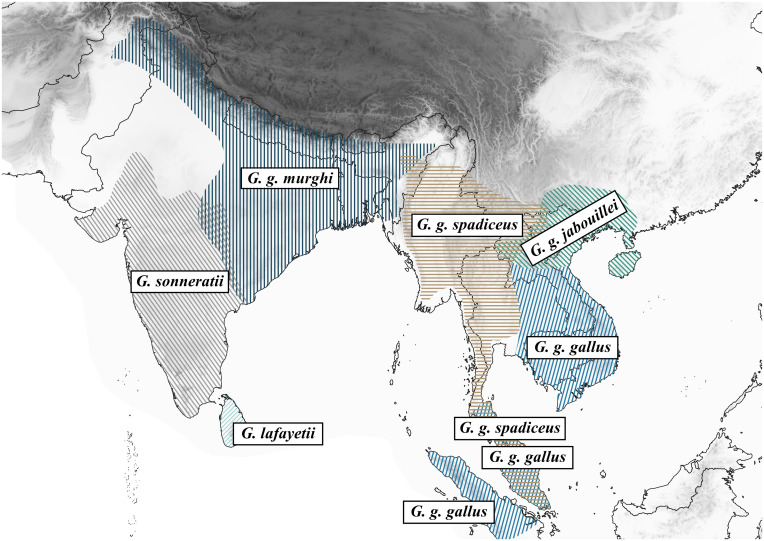
“This result suggests that the chicken domestication process began within the distribution of this subspecies in Southeast Asia (Fig. 1 and SI Appendix, Fig S1).”
§ The biocultural origins and dispersal of domestic chickens > Abstract
What the sources say
- Supportedcites [16] M.-S. Wang, 863 genomes reveal the origin and domestication of chicken. Cell Res. 30, 693– 701 (2020). 32581344 PMC7395088 source
The Discussion says domestic chickens were initially derived from G. g. spadiceus, which is indigenous to southwestern China, Thailand and Myanmar. The phylogeny and admixture section also refers to their domestication in Southeast Asia, supporting the claim’s suggested location. (LLM, conf=0.92)
hedgeddirect- Asserted: passes — The authors put it forward as true.
- Checkable: passes — It can be checked against evidence.
- Load-bearing: passes — The paper’s conclusions depend on it.
- Based: passes — The paper gives a reason why it holds.
- Rests on an assumption: The current geographic distribution of G. gallus spadiceus approximates its distribution at the time of chicken domestication.
- Supported
Every source the paper cites for this claim was checked and supports it.
In the paper
“A more recent study analyzed 863 genomes from modern Gallus specimens, including all five subspecies of red junglefowl, and identified the subspecies Gallus gallus spadiceus as the most likely progenitor of domestic chickens (16).”
§ The biocultural origins and dispersal of domestic chickens > Abstract
What the sources say
- Supportedcites [16] M.-S. Wang, 863 genomes reveal the origin and domestication of chicken. Cell Res. 30, 693– 701 (2020). 32581344 PMC7395088 source
The Discussion says the analyses suggest domestic chickens were initially derived from G. g. spadiceus. The phylogeny and admixture section likewise identifies it as the closest of the five red junglefowl subspecies and the likely source of domestication. Page numbers are not provided in our copy. (LLM, conf=0.95)
hedgeddirect- Asserted: passes — The authors put it forward as true.
- Checkable: passes — It can be checked against evidence.
- Load-bearing: passes — The paper’s conclusions depend on it.
- Based: passes — The paper gives a reason why it holds.
- Supported
The cited sources that could be checked couldn’t confirm or dispute this claim.
In the paper
“Although isolated chicken remains have been claimed on Bronze Age settlements, radiocarbon dating has revealed that specimens excavated at Korucutepe, Turkey (12) and Jerusalem, Israel were intrusive (SI Appendix, Table S3).”
§ The biocultural origins and dispersal of domestic chickens > Results > Early Domestic Chickens Beyond the Distribution of Red Junglefowl.
What the sources say
- Could not verifycites [12] L. Girdland Flink, Establishing the validity of domestication genes using DNA from ancient chickens. Proc. Natl. Acad. Sci. U.S.A. 111, 6184– 6189 (2014). 24753608 PMC4035994 sourceExperimental — accuracy not yet measured
The Archaeological specimens section (p. 14) discusses radiocarbon dating of a specimen from Kassope, Greece, and precautions against intrusive finds at German and Austrian sites. Searches for Korucutepe, Jerusalem, and radiocarbon-dated intrusive Bronze Age remains found no passage addressing the specimens named in the claim. (LLM, conf=0.74)
plaindirect- Asserted: passes — The authors put it forward as true.
- Checkable: passes — It can be checked against evidence.
- Load-bearing: passes — The paper’s conclusions depend on it.
- Based: passes — The paper gives a reason why it holds.
- Could not verify
The sources with a verdict support this claim; the rest weren’t checked yet, have no full text we could read, or their verdicts aren’t rated yet.
In the paper
“In addition, a reanalysis of the archaeological bones determined the remains did not belong to chickens (1, 9).”
§ The biocultural origins and dispersal of domestic chickens > Results > Early Domestic Chickens Beyond the Distribution of Red Junglefowl.
What the sources say
- Supportedcites [1] J. Peters, O. Lebrasseur, H. Deng, G. Larson, Holocene cultural history of red jungle fowl (Gallus gallus) and its domestic descendant in East Asia. Quat. Sci. Rev. 142, 102– 119 (2016). source
The Osteomorphology section (3.1) says a re-evaluation of early and middle Holocene specimens from Northern and Northwestern China excluded Gallus as their identification; many were identified as pheasants. The claim accurately paraphrases that morphological reanalysis, though it should not be read as applying to every archaeological bird bone from northern China. (LLM, conf=0.90)
- Not checked — no full text of the sourcecites [9] M. Eda, Reevaluation of early Holocene chicken domestication in northern China. J. Archaeol. Sci. 67, 25– 31 (2016). source
plain- Asserted: passes — The authors put it forward as true.
- Checkable: passes — It can be checked against evidence.
- Load-bearing: passes — The paper’s conclusions depend on it.
- Based: passes — The paper gives a reason why it holds.
- Supported
Every source the paper cites for this claim was checked and supports it.
In the paper
“The first chickens were likely derived from a population of the subspecies G. gallus spadiceus, whose current range spans southwestern China, northern Thailand, and Myanmar (16) (Fig.1).”
§ The biocultural origins and dispersal of domestic chickens > Discussion > Assessing the Spatiotemporal Pattern of Chicken Domestication.
What the sources say
- Supportedcites [16] M.-S. Wang, 863 genomes reveal the origin and domestication of chicken. Cell Res. 30, 693– 701 (2020). 32581344 PMC7395088 source
The Discussion states that domestic chickens were initially derived from G. g. spadiceus, which is currently indigenous to southwestern China, Thailand and Myanmar. The Abstract specifies that its present-day distribution is predominantly in southwestern China, northern Thailand and Myanmar, matching the claim’s geographic detail. (LLM, conf=0.95)
hedgedconditional- Asserted: passes — The authors put it forward as true.
- Checkable: passes — It can be checked against evidence.
- Load-bearing: passes — The paper’s conclusions depend on it.
- Based: passes — The paper gives a reason why it holds.
- Rests on an assumption: The current geographic distribution of G. gallus spadiceus approximates its distribution at the time of chicken domestication.
- Supported
The sources with a verdict support this claim; the rest weren’t checked yet, have no full text we could read, or their verdicts aren’t rated yet.
In the paper
“Regarding northern China, subsequent reevaluations of the galliform remains (1, 9), as well as photographs and drawings, demonstrate that they are pheasant bones (2, 82).”
§ The biocultural origins and dispersal of domestic chickens > Discussion > Assessing the Spatiotemporal Pattern of Chicken Domestication.
What the sources say
- Supportedcites [1] J. Peters, O. Lebrasseur, H. Deng, G. Larson, Holocene cultural history of red jungle fowl (Gallus gallus) and its domestic descendant in East Asia. Quat. Sci. Rev. 142, 102– 119 (2016). source
Section 3.4 states that re-analysis of northern Chinese galliform bones, including specimens depicted in publications, found that early and middle Holocene remains previously classified as Gallus were instead pheasants. Section 3.1 likewise reports that re-evaluation of depicted and curated specimens excluded Gallus and identified many as Phasianus colchicus. (LLM, conf=0.92)
- Not checked — no full text of the sourcecites [9] M. Eda, Reevaluation of early Holocene chicken domestication in northern China. J. Archaeol. Sci. 67, 25– 31 (2016). source
- Not matchedcites [2] N. Benecke, Der Mensch und seine Haustiere. Die Geschichte einer Jahrtausendealten Beziehung [in German]. (Theiss, Stuttgart, 1994).
Couldn’t be matched to a paper in Crossref, so it can’t be checked.
- Not checked yetcites [82] J. Peters, Hahn oder Kapaun? Zur Kastration von Hähnen in der Antike [in German]. Arch. Geflugelkd. 61, 1– 8 (1997).
boosted- Asserted: passes — The authors put it forward as true.
- Checkable: passes — It can be checked against evidence.
- Load-bearing: passes — The paper’s conclusions depend on it.
- Based: passes — The paper gives a reason why it holds.
- Supported
- It may state two separate claims as one. 43
- Probably not a substantial claim. 8
The cited sources support only part of this claim — read each source’s verdict below.
In the paper
“Additionally, chicken bones are prone to taphonomic loss through scavenger activity (11) and stratigraphic displacement (12).”
§ The biocultural origins and dispersal of domestic chickens > Abstract
What the sources say
- Not matchedcites [11] Ø. S. LaBianca, “ Ethnoarchaeological and taphonomical investigations in the village of Hesban” in Hesban13. Faunal Remains: Taphonomical and Zooarchaeological Studies of the Animal Remains from the Tell Hesban and Vicinity, Hesban, Ø. S. LaBianca, A. von den Driesch, Eds. (Andrew University Press, Berrien Springs, MI, 1995), pp. 15– 32.
Couldn’t be matched to a paper in Crossref, so it can’t be checked.
- Partly supportedcites [12] L. Girdland Flink, Establishing the validity of domestication genes using DNA from ancient chickens. Proc. Natl. Acad. Sci. U.S.A. 111, 6184– 6189 (2014). 24753608 PMC4035994 sourceExperimental — accuracy not yet measured
The citation is attached to stratigraphic displacement, not scavenger activity. The Archaeological specimens section (p. 14) identifies intrusive finds from later occupation phases as a problem and describes sampling choices made to avoid them. It does not say that chicken bones are prone to taphonomic loss through displacement. (LLM, conf=0.83)
plaindirect- Asserted: passes — The authors put it forward as true.
- Checkable: passes — It can be checked against evidence.
- Load-bearing: passes — The paper’s conclusions depend on it.
- Based: passes — The paper gives a reason why it holds.
It may state two separate claims as one.
- Not matched
The sources with a verdict support this claim; the rest weren’t checked yet, have no full text we could read, or their verdicts aren’t rated yet.
In the paper
“In Remote Oceania, chickens arrived with people in Hawaii ∼1200 CE (36), about 500 y prior to the earliest records of the European introduction of poultry in Australia (1788 CE) (39) and New Zealand (1773 CE) (40).”
§ The biocultural origins and dispersal of domestic chickens > Results > Early Domestic Chickens Beyond the Distribution of Red Junglefowl.
What the sources say
- Not checked — no full text of the sourcecites [36] A. Storey, “ Scratching out a living. Chickens in ancient Pacific economies” in The Routledge Handbook of Bioarchaeology in Southeast Asia and the Pacific Islands, M. Oxenham, H. Buckley, Eds. (Routledge, London, 2015) pp. 483– 501. source
- Not matchedcites [39] J. Cobley, Sydney Cove 1788 (Hodder and Stoughton, 1962).
Couldn’t be matched to a paper in Crossref, so it can’t be checked.
- Supportedcites [40] J. R. Wood, M. J. B. Herrera, R. P. Scofield, J. M. Wilmshurst, Origin and timing of New Zealand’s earliest domestic chickens: Polynesian commensals or European introductions? R. Soc. Open Sci. 3, 160258 (2016). 27853601 PMC5108951 source
Citation (40) supports the New Zealand part of the sentence. The Conclusion states that Captain Cook introduced chickens to New Zealand in 1773; the paper’s Abstract also links the earliest known chicken remains there to Cook’s 1773–1774 voyage. The Hawaii and Australia dates are attached to other citations. (LLM, conf=0.93)
plain- Asserted: passes — The authors put it forward as true.
- Checkable: passes — It can be checked against evidence.
- Load-bearing: unclear — It is unclear whether the paper’s conclusions depend on it.
- Based: passes — The paper gives a reason why it holds.
It may state two separate claims as one.
The cited sources support only part of this claim — read each source’s verdict below.
In the paper
“In Japan, chickens did not arrive until the Middle Yayoi ∼100 BCE to 100 CE, a timing consistent with their first appearance in the Korean Peninsula (1).”
§ The biocultural origins and dispersal of domestic chickens > Results > Early Domestic Chickens Beyond the Distribution of Red Junglefowl.
What the sources say
- Partly supportedcites [1] J. Peters, O. Lebrasseur, H. Deng, G. Larson, Holocene cultural history of red jungle fowl (Gallus gallus) and its domestic descendant in East Asia. Quat. Sci. Rev. 142, 102– 119 (2016). sourceExperimental — accuracy not yet measured
The Conclusions link the beginning of fowl husbandry in Japan to the middle Yayoi Period and say its timing fits the start of poultry farming in Korea. However, the paper dates the Japanese period to approximately 2.2–1.7 ka calBP, not the narrower ~100 BCE–100 CE range in the claim. (LLM, conf=0.86)
plaincorrelational- Asserted: passes — The authors put it forward as true.
- Checkable: passes — It can be checked against evidence.
- Load-bearing: unclear — It is unclear whether the paper’s conclusions depend on it.
- Based: passes — The paper gives a reason why it holds.
It may state two separate claims as one.
- Partly supported
The cited sources that could be checked couldn’t confirm or dispute this claim.
In the paper
“The bird’s Akkadian name, su-la-mu, describes it as dark-colored (42), which could correspond instead to black francolins (Francolinus francolinus) (43). Dark plumage could also imply gray junglefowl, a species common in the Indian subcontinent generally and in the Indus region specifically (44) (SI Appendix, Fig. S1).”
§ The biocultural origins and dispersal of domestic chickens > Results > Early Domestic Chickens Beyond the Distribution of Red Junglefowl.
What the sources say
- Not checked — no full text of the sourcecites [42] G. L. Possehl, “ India’s Relations with Western Empires, 2300-600 BC” in A Companion to the Archaeology of the Ancient Near East, D. T. Potts, Ed. (Wiley-Blackwell, Oxford, 2012) pp. 758– 769. source
- Could not verifycites [43] G. Forcina, Impacts of biological globalization in the Mediterranean: Unveiling the deep history of human-mediated gamebird dispersal. Proc. Natl. Acad. Sci. U.S.A. 112, 3296– 3301 (2015). 25733899 PMC4371972 sourceExperimental — accuracy not yet measured
The Black Francolin in the Mediterranean section describes the species and its historical presence, but does not connect it to the Akkadian name su-la-mu or a dark-colored bird. Searches for the name, dark plumage, and gray junglefowl found no passage addressing that identification. The statements about the name and gray junglefowl carry separate citations in the citing sentence. (LLM, conf=0.76)
- Not matchedcites [44] J. K. McGowan, “ Family Phasianidae (pheasants and partridges)” in Handbook of the Birds of the World: Vol. 2, New World Vultures to Guineafowl, J. del Hoyo, A. Elliott, J. Sargatal, Eds. (Lynx Editions, Bellaterra, 1994), pp. 434– 553.
Couldn’t be matched to a paper in Crossref, so it can’t be checked.
hedgedcorrelational- Asserted: passes — The authors put it forward as true.
- Checkable: passes — It can be checked against evidence.
- Load-bearing: fails — The paper’s conclusions may not depend on it.
- Based: passes — The paper gives a reason why it holds.
Probably not a substantial claim. The paper’s conclusions may not depend on it. It may state two separate claims as one.
The cited sources support only part of this claim — read each source’s verdict below.
In the paper
“Importantly, this range cannot be equated with the initiation of a domestication process. Instead, this timeframe represents the divergence between G. gallus spadiceus and the lineage from which domestic chickens were derived (17), and thus represents an upper bound on the chicken domestication timeframe.”
§ The biocultural origins and dispersal of domestic chickens > Abstract
What the sources say
- Partly supportedcites [17] E. K. Irving-Pease, L. A. F. Frantz, N. Sykes, C. Callou, G. Larson, Rabbits and the specious origins of domestication. Trends Ecol. Evol. 33, 149– 152 (2018). 29454669 sourceExperimental — accuracy not yet measured
Split into 2 atoms — 0 confirmed, 2 partially supported, 0 disputed, 0 misattributed, 0 unverifiable. Expand the claim to see per-atom verdicts.
plain- Asserted: passes — The authors put it forward as true.
- Checkable: passes — It can be checked against evidence.
- Load-bearing: passes — The paper’s conclusions depend on it.
- Based: passes — The paper gives a reason why it holds.
It may state two separate claims as one.
- Partly supported
The cited sources support only part of this claim — read each source’s verdict below.
In the paper
“The chicken’s name in Malagasy has no roots in any of the western Austronesian languages. Instead, linguistic elements in neighboring Comorian indicate a connection to Bantu, and hence an introduction from coastal Africa (62), which is supported by the close genetic affinity of Malagasy and East African chickens (63).”
§ The biocultural origins and dispersal of domestic chickens > Results > Early Domestic Chickens Beyond the Distribution of Red Junglefowl.
What the sources say
- Could not verifycites [62] R. Blench, The Austronesians in Madagascar and their interaction with the Bantu of the East African coast: Surveying the linguistic evidence for domestic and translocated animals. Studies in Philippine Languages and Cultures 18, 18– 43 (2008).Experimental — accuracy not yet measured
Split into 2 atoms — 0 confirmed, 0 partially supported, 0 disputed, 0 misattributed, 2 unverifiable. Expand the claim to see per-atom verdicts.
- Supportedcites [63] M. B. Herrera, East African origins for Madagascan chickens as indicated by mitochondrial DNA. R. Soc. Open Sci. 4, 160787 (2017). 28405364 PMC5383821 source
Split into 2 atoms — 2 confirmed, 0 partially supported, 0 disputed, 0 misattributed, 0 unverifiable. Expand the claim to see per-atom verdicts.
hedgeddirect- Asserted: passes — The authors put it forward as true.
- Checkable: passes — It can be checked against evidence.
- Load-bearing: passes — The paper’s conclusions depend on it.
- Based: passes — The paper gives a reason why it holds.
It may state two separate claims as one.
- Could not verify
Every source the paper cites for this claim was checked and supports it.
In the paper
“Throughout much of early medieval Europe, poultry farming likely benefited from the spread of Christianity (78), and chickens were also associated with early monastic contexts in Ireland (SI Appendix, Table S2).”
§ The biocultural origins and dispersal of domestic chickens > Results > Early Domestic Chickens Beyond the Distribution of Red Junglefowl.
What the sources say
- Supportedcites [78] L. Loog, Inferring allele frequency trajectories from ancient DNA indicates that selection on a chicken gene coincided with changes in medieval husbandry practices. Mol. Biol. Evol. 34, 1981– 1990 (2017). 28444234 PMC5850110 source
The Discussion links intensified medieval chicken and egg production to Christian fasting practices and says those practices became widely adopted across Europe around 1000 AD. It also notes increased chicken consumption coinciding with Christianization in parts of Scandinavia and northern Germany. The Ireland clause cites the citing paper’s own supplementary table, not this source. (LLM, conf=0.90)
hedgedconditional- Asserted: passes — The authors put it forward as true.
- Checkable: passes — It can be checked against evidence.
- Load-bearing: unclear — It is unclear whether the paper’s conclusions depend on it.
- Based: passes — The paper gives a reason why it holds.
It may state two separate claims as one.
- Supported
Every source the paper cites for this claim was checked and supports it.
In the paper
“The chicken’s first appearance in the eastern Baltic region dates to the late Pre-Roman Iron Age, where these remains may have been associated with a burial (77).”
§ The biocultural origins and dispersal of domestic chickens > Results > Early Domestic Chickens Beyond the Distribution of Red Junglefowl.
What the sources say
- Supportedcites [77] F. Ehrlich, In search of Estonia’s earliest chickens. Estonian Journal of Archaeology 25, 160– 181 (2021). source
The Results identify the Rebala bone, dated to 200 calBCE–5 calCE, as the earliest known chicken in the eastern Baltics. The Results and Discussion describe a possible but speculative connection to grave-field activity, consistent with the claim’s “may have been associated” wording; they do not establish a direct link to a burial. (LLM, conf=0.88)
hedgedcorrelationalSingle case- Asserted: passes — The authors put it forward as true.
- Checkable: passes — It can be checked against evidence.
- Load-bearing: unclear — It is unclear whether the paper’s conclusions depend on it.
- Based: passes — The paper gives a reason why it holds.
It may state two separate claims as one.
- Supported
The cited sources support only part of this claim — read each source’s verdict below.
In the paper
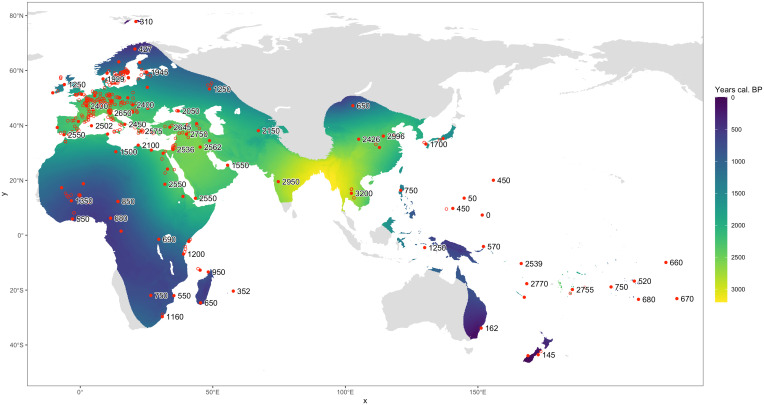
“By the late sixth/early fifth century BCE, chickens were present in the Upper Rhine and Danube River basins (76) (Fig. 2), and in southeast England (13).”
§ The biocultural origins and dispersal of domestic chickens > Results > Early Domestic Chickens Beyond the Distribution of Red Junglefowl.
What the sources say
- Not matchedcites [76] A. von den Driesch, J. Boessneck, Abschlußbericht über die zooarchäologischen Untersuchungen an Tierknochenfunden von der Heuneburg [in German]. (Ausgrabungsmethodik und Stratigraphie der Heuneburg. Heuneburgstudien VI., Römisch-Germanische Forschungen 45), pp. 131– 157 (1989).
Couldn’t be matched to a paper in Crossref, so it can’t be checked.
- Partly supportedcites [13] J. Best., Redefining the timing and circumstances of the chicken’s introduction to Europe and north-west Africa. Antiquity, 10.15184/aqy.2021.90 (2022). sourceExperimental — accuracy not yet measured
The paper’s discussion (section 4.1; page unavailable) says chickens were introduced into southern Britain by the sixth–fifth centuries BCE, supporting the broad timing and location. But the Results (section 3; page unavailable) place its earliest directly dated English specimen only as far back as the late fifth century BCE. The copy does not establish their presence specifically in southeast England by the late sixth or early fifth century BCE. The Upper Rhine and Danube claim is attached to a different citation. (LLM, conf=0.84)
plain- Asserted: passes — The authors put it forward as true.
- Checkable: passes — It can be checked against evidence.
- Load-bearing: passes — The paper’s conclusions depend on it.
- Based: passes — The paper gives a reason why it holds.
It may state two separate claims as one.
- Not matched
The cited sources support only part of this claim — read each source’s verdict below.
In the paper
“An analysis of the material culture (including pottery decoration) associated with these agriculturalists suggests that rice and millet cultivating communities dispersed from the Yangtze valley (89–92) into southern China, where they arrived by the mid-third millennium BCE (90, 93). From there, they continued into peninsular Southeast Asia, where people following distinct dispersal pathways emph”
§ The biocultural origins and dispersal of domestic chickens > Discussion > A Hypothesis for the Process of Chicken Domestication.
What the sources say
- Not matchedcites [89] P. Bellwood, First Farmers: The Origins of Agricultural Societies (Blackwell, 2005).
Couldn’t be matched to a paper in Crossref, so it can’t be checked.
- Partly supportedcites [90] F. Silva, Modelling the geographical origin of rice cultivation in Asia using the Rice Archaeological Database. PLoS One 10, e0137024 (2015). 26327225 PMC4556484 sourceExperimental — accuracy not yet measured
The Discussion identifies the wider Yangtze valley as an origin of rice farming and models the dispersal of cultivated rice from that region. The cited paper does not establish that rice-and-millet cultivating communities followed the stated route, arrived in southern China by the mid-third millennium BCE, or continued into peninsular Southeast Asia. (LLM, conf=0.86)
- Not checked — no full text of the sourcecites [91] Z. Chi, H.-C. Hung, The emergence of agriculture in southern China. Antiquity 84, 11– 25 (2010). source
- Not matchedcites [92] F. Rispoli, The incised & impressed pottery style of mainland Southeast Asia: Following the paths of neolithization. East and West 57, 235– 304 (2007).
Couldn’t be matched to a paper in Crossref, so it can’t be checked.
- Partly supportedcites [93] X. Yang, New radiocarbon evidence on early rice consumption and farming in South China. Holocene 27, 1045– 1051 (2017). sourceExperimental — accuracy not yet measured
The Conclusion dates the introduction of domesticated rice to the Pearl River Delta to 5000–4700 years ago and identifies the Yangtze region as its source. The Introduction links the southward spread of rice agriculture with expansion into mainland Southeast Asia. The paper does not establish that the dispersing communities cultivated millet or trace a specific onward route from southern China into peninsular Southeast Asia. (LLM, conf=0.86)
- Not checked — no full text of the sourcecites [94] C. F. W. Higham, The later prehistory of Southeast Asia and southern China: The impact of exchange, farming and metallurgy. Asian Archaeology 4, 63– 93 (2021). source
hedgeddirect- Asserted: passes — The authors put it forward as true.
- Checkable: passes — It can be checked against evidence.
- Load-bearing: unclear — It is unclear whether the paper’s conclusions depend on it.
- Based: passes — The paper gives a reason why it holds.
It may state two separate claims as one.
- Not matched
The cited sources support only part of this claim — read each source’s verdict below.
In the paper
“A recent study reevaluated key specimens used to postulate early chicken husbandry, but direct radiocarbon dating of the remains revealed that all the presumed Neolithic to Bronze Age chicken remains in Bulgaria, Greece, and France were intrusive, and that of these, the earliest sample dated to only 137 to 327 CE (13).”
§ The biocultural origins and dispersal of domestic chickens > Results > Early Domestic Chickens Beyond the Distribution of Red Junglefowl.
What the sources say
- Partly supportedcites [13] J. Best., Redefining the timing and circumstances of the chicken’s introduction to Europe and north-west Africa. Antiquity, 10.15184/aqy.2021.90 (2022). sourceExperimental — accuracy not yet measured
The Materials and Methods and Results report direct dating of selected specimens from Bulgaria, Greece, and France; the specimens proved later than their proposed prehistoric contexts. But Table 2 does not give 137–327 CE for the earliest of them: the earliest dated specimen proposed to be Neolithic or Bronze Age is from Galabovo, Bulgaria, at 215–338 cal AD. The study tested selected remains, not all presumed remains in those countries. (LLM, conf=0.90)
plain- Asserted: passes — The authors put it forward as true.
- Checkable: passes — It can be checked against evidence.
- Load-bearing: passes — The paper’s conclusions depend on it.
- Based: passes — The paper gives a reason why it holds.
It may state two separate claims as one.
- Partly supported
The cited sources support only part of this claim — read each source’s verdict below.
In the paper
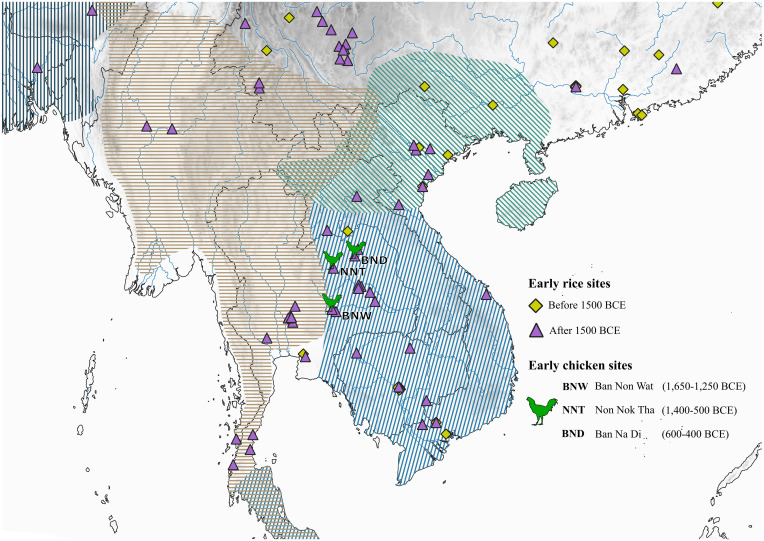
“In more interior zones, early rainfed rice/millet cultivation likely spurred a tighter relationship between people and G. gallus spadiceus, as attested by the earliest confirmed chicken bones at Ban Non Wat and Non Nok Tha (SI Appendix, Table S2) (98).”
§ The biocultural origins and dispersal of domestic chickens > Discussion > A Hypothesis for the Process of Chicken Domestication.
What the sources say
- Partly supportedcites [98] C. C. Castillo, Social responses to climate change in Iron Age north-east Thailand: New archaeobotanical evidence. Antiquity 92, 1274– 1291 (2018). sourceExperimental — accuracy not yet measured
The Methods section places early rice and millet farmers at Ban Non Wat and Non Nok Tha, and the Concluding remarks identify rainfall-dependent dryland rice farming at Ban Non Wat. The paper does not report chicken bones or a relationship with G. gallus spadiceus; the Results section also says no cultivated millet was identified at Ban Non Wat. Page numbers were not available in our copy. (LLM, conf=0.86)
hedgedconditional- Asserted: passes — The authors put it forward as true.
- Checkable: passes — It can be checked against evidence.
- Load-bearing: passes — The paper’s conclusions depend on it.
- Based: passes — The paper gives a reason why it holds.
It may state two separate claims as one.
- Partly supported
Every source the paper cites for this claim was checked and supports it.
In the paper
“these ancestral affinities are the result not of a local, independent domestication process, but the result of admixture with introduced domestic chickens derived from G. gallus spadiceus (16).”
§ The biocultural origins and dispersal of domestic chickens > Discussion > A Combined Chicken–Rice Dispersal Across Asia and Africa.
What the sources say
- Supportedcites [16] M.-S. Wang, 863 genomes reveal the origin and domestication of chicken. Cell Res. 30, 693– 701 (2020). 32581344 PMC7395088 source
The phylogeny and admixture section concludes that domestic chickens were initially derived from G. g. spadiceus rather than independently domesticated from other red jungle fowl subspecies. The Discussion says those chickens were subsequently translocated across Southeast and South Asia and interbred with local jungle fowl, accounting for ancestry from other subspecies. The supplied passages have section labels but no page numbers. (LLM, conf=0.88)
plaindirect- Asserted: passes — The authors put it forward as true.
- Checkable: passes — It can be checked against evidence.
- Load-bearing: passes — The paper’s conclusions depend on it.
- Based: passes — The paper gives a reason why it holds.
It may state two separate claims as one.
- Supported
None of the sources cited for this claim could be matched to a paper in Crossref, so there is nothing to check it against.
In the paper
“The zooarchaeological record corroborates an increased visibility of Gallus in the iconographic record, including a depiction on the orthostat of Tell Halaf (present day Syria) dated to ∼900 BCE (47), and on numerous cylinder seals between ∼800 to 600 BCE (41, 48).”
§ The biocultural origins and dispersal of domestic chickens > Results > Early Domestic Chickens Beyond the Distribution of Red Junglefowl.
What the sources say
- Not matchedcites [47] M. F. von Oppenheim, Tell Halaf. Band III: Die Bildwerke. Bearbeitet und herausgegeben von Anton Moortgat [in German] (Walter de Gruyter & Co., Berlin, 1955).
Couldn’t be matched to a paper in Crossref, so it can’t be checked.
- Not matchedcites [41] E. von der Osten-Sacken, Untersuchungen zur Geflügelwirtschaft im Alten Orient [in German], Orbis Biblicus et Orientalis, vol. 272 (Academic Press/Vandenhoeck & Ruprecht, 2015).
Couldn’t be matched to a paper in Crossref, so it can’t be checked.
- Not matchedcites [48] E. W. Moore, Neo-Babylonian Documents in the University of Michigan Collection (University of Michigan Press, Ann Arbor, 1939).
Couldn’t be matched to a paper in Crossref, so it can’t be checked.
plaincorrelational- Asserted: passes — The authors put it forward as true.
- Checkable: passes — It can be checked against evidence.
- Load-bearing: unclear — It is unclear whether the paper’s conclusions depend on it.
- Based: passes — The paper gives a reason why it holds.
It may state two separate claims as one.
- Not matched
None of the sources cited for this claim could be matched to a paper in Crossref, so there is nothing to check it against.
In the paper
“In Central Asia, the earliest evidence of chickens thus far consists of depictions of cockerels in the Pazyryk kurgans of the Altai Mountains dated to ∼500 to 300 BCE (32), and chicken remains have been identified in the late fourth century BCE fortress of Kurgansol (Uzbekistan) built by Alexander’s troops (33).”
§ The biocultural origins and dispersal of domestic chickens > Results > Early Domestic Chickens Beyond the Distribution of Red Junglefowl.
What the sources say
- Not matchedcites [32] L. Barkova, “ The cockerel design in ancient Altai art.” in Archaeological Collected Papers, No. 40, (The State Hermitage Publications, Saint Petersburg, 2015), pp. 143– 156.
Couldn’t be matched to a paper in Crossref, so it can’t be checked.
- Not matchedcites [33] N. Benecke, “ Faunal remains of Kurganzol” in Krepost Aleksandra Na Juge Uzbekistana, L. M. Sverchkov, Ed. (Tashkent, 2014), pp. 170– 176.
Couldn’t be matched to a paper in Crossref, so it can’t be checked.
hedged- Asserted: passes — The authors put it forward as true.
- Checkable: passes — It can be checked against evidence.
- Load-bearing: passes — The paper’s conclusions depend on it.
- Based: passes — The paper gives a reason why it holds.
It may state two separate claims as one.
- Not matched
None of the sources cited for this claim have been checked yet.
In the paper
“Our analysis demonstrates that key specimens from sites belonging to this cultural phase including Mohenjo-daro (24) and Harappa (25), have either been misidentified, or are too large to be confidently categorized as prehistoric domestic birds (SI Appendix, Table S3).”
§ The biocultural origins and dispersal of domestic chickens > Results > Early Domestic Chickens within the Distribution of Red Junglefowl.
What the sources say
- Not checked yetcites [24] R. B. S. Sewell, B. S. Guha, “ Zoological remains” in Mohenjo-Daro and the Indus Civilization: Being an Official Account of Archaeological Excavations at Mohenjo-Daro Carried out by the Government of India between the Years 1922 and 1927, J. H. Marshall, Ed. (A. Probsthain, London, 1931), pp. 649– 673.
- Not matchedcites [25] B. Prashad, Animal Remains from Harappa. Memoirs of the Archaeological Survey of India 51 (Director General, Archaeological Survey of India, New Delhi, 1936).
Couldn’t be matched to a paper in Crossref, so it can’t be checked.
boosted- Asserted: passes — The authors put it forward as true.
- Checkable: passes — It can be checked against evidence.
- Load-bearing: passes — The paper’s conclusions depend on it.
- Based: passes — The paper gives a reason why it holds.
It may state two separate claims as one.
In the paper
“At the site of Daimabad, India, Gallus is absent from earlier Savalda and Harappan levels, but prominent in the subsequent early Jorwe levels dating from ∼1500 to 1200 BCE (27).”
§ The biocultural origins and dispersal of domestic chickens > Results > Early Domestic Chickens within the Distribution of Red Junglefowl.
What the sources say
- Not matchedcites [27] G. L. Badam, “ Preliminary report on the faunal remains from Chalcolithic Daimabad, Maharashtra” in Archaeological Studies, (Bharat Kala Bhavan, Varanasi, 1986), pp. 93– 100.
Couldn’t be matched to a paper in Crossref, so it can’t be checked.
plain- Asserted: passes — The authors put it forward as true.
- Checkable: passes — It can be checked against evidence.
- Load-bearing: passes — The paper’s conclusions depend on it.
- Based: passes — The paper gives a reason why it holds.
It may state two separate claims as one.
- Not matched
In the paper
“Gallus bones have been reported from several other sites of the Jorwe period (Nevasa, Inamgaon, Tuljapur Garhi, Walki), as well as contemporaneous sites farther south (Southern Neolithic Period III) (22).”
§ The biocultural origins and dispersal of domestic chickens > Results > Early Domestic Chickens within the Distribution of Red Junglefowl.
What the sources say
- Not checked — no full text of the sourcecites [22] D. Q. Fuller, Agricultural origins and frontiers in South Asia: A working synthesis. J. World Prehist. 20, 1– 86 (2006). source
plain- Asserted: passes — The authors put it forward as true.
- Checkable: passes — It can be checked against evidence.
- Load-bearing: passes — The paper’s conclusions depend on it.
- Based: passes — The paper gives a reason why it holds.
It may state two separate claims as one.
A claim is checked only against the cited paper’s full text, never its abstract, and none is available for its sources.
In the paper
“South of the Horn, however, the earliest evidence for Gallus appears more than a millennium later (59), and arrived alongside the black rat, rice and mungbean that originated from the Indian subcontinent (60, 61).”
§ The biocultural origins and dispersal of domestic chickens > Results > Early Domestic Chickens Beyond the Distribution of Red Junglefowl.
What the sources say
- Not checked — no full text of the sourcecites [59] N. Boivin, D. Q. Fuller, Shell middens, ships and seeds: Exploring coastal subsistence, maritime trade and the dispersal of domesticates in and around the ancient Arabian Peninsula. J. World Prehist. 22, 113– 180 (2009). source
- Not checked — no full text of the sourcecites [60] N. Boivin, A. Crowther, R. Helm, D. Q. Fuller, East Africa and Madagascar in the Indian Ocean world. J. World Prehist. 26, 213– 281 (2013). source
- Not checked — no full text of the sourcecites [61] I. Plug, Overview of iron age fauna from the Limpopo valley. Goodwin Series 8, 117– 126 (2000). source
hedgedcorrelational- Asserted: passes — The authors put it forward as true.
- Checkable: passes — It can be checked against evidence.
- Load-bearing: passes — The paper’s conclusions depend on it.
- Based: passes — The paper gives a reason why it holds.
It may state two separate claims as one.
A result the paper reports from its own data — it cites no other source for it, so there is none to check. The quote shows it is in the paper.
In the paper
“Chicken farming became firmly established in western continental Europe during the late Iron Age and under Roman cultural influence in the Low Countries (SI Appendix, Table S2).”
§ The biocultural origins and dispersal of domestic chickens > Results > Early Domestic Chickens Beyond the Distribution of Red Junglefowl.
plaincorrelational- Asserted: passes — The authors put it forward as true.
- Checkable: passes — It can be checked against evidence.
- Load-bearing: unclear — It is unclear whether the paper’s conclusions depend on it.
- Based: passes — The paper gives a reason why it holds.
It may state two separate claims as one.
The paper states this without a source or data behind it here, so there is nothing to check it against. The quote shows it is in the paper.
In the paper
“Chickens arrived in coastal southwest Sweden at the onset of the first millennium CE or slightly earlier, before dispersing during the Migration period (∼400 to 550 CE).”
§ The biocultural origins and dispersal of domestic chickens > Results > Early Domestic Chickens Beyond the Distribution of Red Junglefowl.
plain- Asserted: passes — The authors put it forward as true.
- Checkable: passes — It can be checked against evidence.
- Load-bearing: passes — The paper’s conclusions depend on it.
- Based: passes — The paper gives a reason why it holds.
It may state two separate claims as one.
A result the paper reports from its own data — it cites no other source for it, so there is none to check. The quote shows it is in the paper.
In the paper
“By ∼700 BCE, chickens had arrived in Ethiopia and Mediterranean Europe (Fig. 2).”
§ The biocultural origins and dispersal of domestic chickens > Discussion > Assessing the Spatiotemporal Pattern of Chicken Domestication.
plain- Asserted: passes — The authors put it forward as true.
- Checkable: passes — It can be checked against evidence.
- Load-bearing: passes — The paper’s conclusions depend on it.
- Based: passes — The paper gives a reason why it holds.
It may state two separate claims as one.
The paper states this without a source or data behind it here, so there is nothing to check it against. The quote shows it is in the paper.
In the paper
“The first unambiguous chicken bones in the archaeological record are present within the faunal assemblage at Neolithic Ban Non Wat in central Thailand, and date to ∼1650 to 1250 BCE.”
§ The biocultural origins and dispersal of domestic chickens > Discussion > Assessing the Spatiotemporal Pattern of Chicken Domestication.
plain- Asserted: passes — The authors put it forward as true.
- Checkable: passes — It can be checked against evidence.
- Load-bearing: passes — The paper’s conclusions depend on it.
- Based: passes — The paper gives a reason why it holds.
It may state two separate claims as one.
A result the paper reports from its own data — it cites no other source for it, so there is none to check. The quote shows it is in the paper.
In the paper
“Our reanalysis of the two Harappan bones shows that one is morphologically inconsistent with Gallus, and the other’s taxonomic classification is ambiguous.”
§ The biocultural origins and dispersal of domestic chickens > Discussion > Assessing the Spatiotemporal Pattern of Chicken Domestication.
plain- Asserted: passes — The authors put it forward as true.
- Checkable: passes — It can be checked against evidence.
- Load-bearing: passes — The paper’s conclusions depend on it.
- Based: passes — The paper gives a reason why it holds.
It may state two separate claims as one.
None of the sources cited for this claim have been checked yet.
In the paper
“Under Ptolemaic rule (305 to 30 BCE), fowl husbandry intensified and spread from the Nile delta upstream to the region of the first cataract (56, 57).”
§ The biocultural origins and dispersal of domestic chickens > Results > Early Domestic Chickens Beyond the Distribution of Red Junglefowl.
What the sources say
- Not matchedcites [56] J. Boessneck, Die Tierwelt des Alten Ägypten [in German] (C. H. Beck, Munich, 1988).
Couldn’t be matched to a paper in Crossref, so it can’t be checked.
- Not checked yetcites [57] J. Sigl, Syene II. Die Tierfunde aus den Grabungen von 2000–2009: Ein Beitraag zur Umwelt—und Kulturgeschichte einer Oberägyptischen Stadt von der Pharaonischen Spät—bis in die Mameluckenzeit [in German] (PeWe-Verlag, Gladbeck, 2017).
plaindirect- Asserted: passes — The authors put it forward as true.
- Checkable: passes — It can be checked against evidence.
- Load-bearing: unclear — It is unclear whether the paper’s conclusions depend on it.
- Based: passes — The paper gives a reason why it holds.
It may state two separate claims as one.
- Not matched
In the paper
“Although there is confirmation of early rice farming near coastal areas and in low-lying wetlands (86, 94), the zooarchaeological records in Neolithic Vietnam, for example, show evidence for the hunting of wetland birds, but lack remains of Gallus (97).”
§ The biocultural origins and dispersal of domestic chickens > Discussion > A Hypothesis for the Process of Chicken Domestication.
What the sources say
- Not checked — no full text of the sourcecites [97] M. F. Oxenham, Emergence and diversification of the neolithic in Southern Vietnam: Insights from coastal Rach Nui. J. Island Coast. Archaeol. 10, 309– 338 (2015). source
plain- Asserted: passes — The authors put it forward as true.
- Checkable: passes — It can be checked against evidence.
- Load-bearing: unclear — It is unclear whether the paper’s conclusions depend on it.
- Based: passes — The paper gives a reason why it holds.
It may state two separate claims as one.
None of the sources cited for this claim have been checked yet.
In the paper
“The absence of chickens in this region prior to the late Iron Age ∼800 to 600 BCE (34, 35) contradicts the long-standing hypothesis that poultry farming spread west and north from the Yellow River basin during the Neolithic across Asia to Europe (6).”
§ The biocultural origins and dispersal of domestic chickens > Results > Early Domestic Chickens Beyond the Distribution of Red Junglefowl.
What the sources say
- Not checked — no full text of the sourcecites [34] N. Benecke, Iron Age economy of the Inner Asian steppe. A bioarchaeological perspective from the Talgar Region in the Ili River Valley, southeastern Kazakhstan. Eurasia Antiqua 9, 63– 84 (2003).
- Not matchedcites [35] S. N. Bogoljubskij, Происхождение и преобразование домашних животных (Proischoždenie i preobrazovanie domašnich životnych) [in Russian]. (Sovetskaja Nauka, Moscow, 1959).
Couldn’t be matched to a paper in Crossref, so it can’t be checked.
- Not checked — no full text of the sourcecites [6] B. West, B.-X. Zhou, Did chickens go north? New evidence for domestication. J. Archaeol. Sci. 15, 515– 533 (1988). source
plain- Asserted: passes — The authors put it forward as true.
- Checkable: passes — It can be checked against evidence.
- Load-bearing: passes — The paper’s conclusions depend on it.
- Based: passes — The paper gives a reason why it holds.
It may state two separate claims as one.
- Rests on an assumption: The archaeological absence of chicken remains at a site or region reflects the true absence of chickens rather than recovery, preservation, or identification bias.
A conclusion the paper draws from its own results — it cites no other source for it, so there is none to check. The quote shows it is in the paper.
In the paper
“Our reappraisal of published chicken bone specimens in Chalcolithic and Bronze Age sites across India and Pakistan dating ∼3500 to 1000 BCE undermines both the species identification (since they are located in the distribution range of gray junglefowl) (SI Appendix, Fig. S2) and the domestication status of these remains (SI Appendix, Table S3).”
§ The biocultural origins and dispersal of domestic chickens > Results > Early Domestic Chickens within the Distribution of Red Junglefowl.
plaindirect- Asserted: passes — The authors put it forward as true.
- Checkable: passes — It can be checked against evidence.
- Load-bearing: passes — The paper’s conclusions depend on it.
- Based: passes — The paper gives a reason why it holds.
It may state two separate claims as one.
A conclusion the paper draws from its own results — it cites no other source for it, so there is none to check. The quote shows it is in the paper.
In the paper
“Our reassessment of the zooarchaeological evidence from the Indian subcontinent implies that domestic fowl first appeared after the Harappan civilization, and that these translations may therefore be inaccurate.”
§ The biocultural origins and dispersal of domestic chickens > Results > Early Domestic Chickens Beyond the Distribution of Red Junglefowl.
hedgedconditional- Asserted: passes — The authors put it forward as true.
- Checkable: passes — It can be checked against evidence.
- Load-bearing: passes — The paper’s conclusions depend on it.
- Based: passes — The paper gives a reason why it holds.
It may state two separate claims as one.
A conclusion the paper draws from its own results — it cites no other source for it, so there is none to check. The quote shows it is in the paper.
In the paper
“Our analysis thus supports a much later arrival in this region consistent with the first appearance of chickens in Japan in the early first millennium CE, and in Mongolia during the early second millennium CE.”
§ The biocultural origins and dispersal of domestic chickens > Discussion > Assessing the Spatiotemporal Pattern of Chicken Domestication.
plaincorrelational- Asserted: passes — The authors put it forward as true.
- Checkable: passes — It can be checked against evidence.
- Load-bearing: passes — The paper’s conclusions depend on it.
- Based: passes — The paper gives a reason why it holds.
It may state two separate claims as one.
A conclusion the paper draws from its own results — it cites no other source for it, so there is none to check. The quote shows it is in the paper.
In the paper
“The presence of this bird may represent a trade import, however, since chickens were clearly exploited across the Baltic States and in Finland by the late Iron Age (∼600 to 800 CE) (Fig. 2 and SI Appendix, Table S2).”
§ The biocultural origins and dispersal of domestic chickens > Results > Early Domestic Chickens Beyond the Distribution of Red Junglefowl.
hedgedconditional- Asserted: passes — The authors put it forward as true.
- Checkable: passes — It can be checked against evidence.
- Load-bearing: unclear — It is unclear whether the paper’s conclusions depend on it.
- Based: passes — The paper gives a reason why it holds.
It may state two separate claims as one.
In the paper
“It is therefore likely that the natural range of gray junglefowl extended into the Indus River basin during the Mid-Holocene, and that these remains derive instead from local wild populations.”
§ The biocultural origins and dispersal of domestic chickens > Discussion > Assessing the Spatiotemporal Pattern of Chicken Domestication.
What the sources say
- Not checked — no full text of the sourcecites [80] E. Asouti, D. Q. Fuller, Trees and Woodlands of South India: Archaeological Perspectives (Left Coast Press, 2008).
hedged- Asserted: passes — The authors put it forward as true.
- Checkable: passes — It can be checked against evidence.
- Load-bearing: passes — The paper’s conclusions depend on it.
- Based: passes — The paper gives a reason why it holds.
It may state two separate claims as one.
A conclusion the paper draws from its own results — it cites no other source for it, so there is none to check. The quote shows it is in the paper.
In the paper
“Greek seafarers transported chickens across the northern Mediterranean and the earliest directly dated chickens in southern Europe have been excavated in Italy from two Greek colonies dated to 776 to 540 BCE.”
§ The biocultural origins and dispersal of domestic chickens > Results > Early Domestic Chickens Beyond the Distribution of Red Junglefowl.
plaindirect- Asserted: passes — The authors put it forward as true.
- Checkable: passes — It can be checked against evidence.
- Load-bearing: passes — The paper’s conclusions depend on it.
- Based: passes — The paper gives a reason why it holds.
It may state two separate claims as one.
In the paper
“Direct radiocarbon-dated chicken bones from Pre-Aksumite northern Ethiopia (∼800 to 600 BCE) demonstrate that, prior to their presence in Achaemenid Egypt, chickens had been translocated, likely across the Red Sea, to the Horn of Africa (58).”
§ The biocultural origins and dispersal of domestic chickens > Results > Early Domestic Chickens Beyond the Distribution of Red Junglefowl.
What the sources say
- Not checked — no full text of the sourcecites [58] H. S. Woldekiros, A. C. D’Andrea, Early evidence for domestic chickens (Gallus gallus domesticus) in the horn of Africa: Early evidence for domestic chickens. Int. J. Osteoarchaeol. 27, 329– 341 (2017). source
boosteddirect- Asserted: passes — The authors put it forward as true.
- Checkable: passes — It can be checked against evidence.
- Load-bearing: passes — The paper’s conclusions depend on it.
- Based: passes — The paper gives a reason why it holds.
It may state two separate claims as one.
A conclusion the paper draws from its own results — it cites no other source for it, so there is none to check. The quote shows it is in the paper.
In the paper
“By that time, chickens had also been introduced to the coastal Black Sea region through Greek trade networks, suggesting that the chicken’s initial dispersal in Europe was primarily through maritime routes.”
§ The biocultural origins and dispersal of domestic chickens > Results > Early Domestic Chickens Beyond the Distribution of Red Junglefowl.
hedgeddirect- Asserted: passes — The authors put it forward as true.
- Checkable: passes — It can be checked against evidence.
- Load-bearing: passes — The paper’s conclusions depend on it.
- Based: passes — The paper gives a reason why it holds.
It may state two separate claims as one.
None of the sources cited for this claim have been checked yet.
In the paper
“Given that fifth century BCE Phoenician seafarers (68) and Roman merchants both established trading posts on the Moroccan Atlantic coast (69) or somewhat inland (70), it is possible that chickens were introduced from Berber-speaking Northwest Africa to West Africa primarily by maritime trade.”
§ The biocultural origins and dispersal of domestic chickens > Results > Early Domestic Chickens Beyond the Distribution of Red Junglefowl.
What the sources say
- Not matchedcites [68] Hanno, The Voyage of Hanno: Translated, and Accompanied with the Greek Text, Explained from the Accounts of Modern Travellers, Defended Against the Objections of Mr. Dodwell and Other Writers, and Illustrated by Maps from Ptolemy, D’Anville, and Bougainville, T. Falconer (trans.) (Cadell and Davies, London, 1797).
Couldn’t be matched to a paper in Crossref, so it can’t be checked.
- Not matchedcites [69] C. Becker, A. von den Driesch, H. C. Küchelmann, “ Mogador, eine Handelsstation am Westlichen Rand der Phönizischen und Römischen Welt—Die Tierreste [in German]” in Current Discoveries from Outside and Within. Field Explorations and Critical Comments from the Lab. Documenta Archaeobiologiae 10, G. Grupe, G. McGlynn, J. Peters, Eds. (Verlag Marie Leidorf, Rahden, 2012) pp. 11– 159.
Couldn’t be matched to a paper in Crossref, so it can’t be checked.
- Not checked — no full text of the sourcecites [70] T. Oueslati, 1st century BCE occurrence of chicken, house mouse and black rat in Morocco: Socio-economic changes around the reign of Juba II on the site of Rirha. J. Archaeol. Sci. Rep. 29, 102162 (2020). source
hedgedconditional- Asserted: passes — The authors put it forward as true.
- Checkable: passes — It can be checked against evidence.
- Load-bearing: fails — The paper’s conclusions may not depend on it.
- Based: passes — The paper gives a reason why it holds.
Probably not a substantial claim. The paper’s conclusions may not depend on it.
- Not matched
A conclusion the paper draws from its own results — it cites no other source for it, so there is none to check. The quote shows it is in the paper.
In the paper
“The attractiveness of rice and millet agriculture to red junglefowl may have facilitated both the initiation of the domestication process, and the subsequent dispersal of domestic chickens.”
§ The biocultural origins and dispersal of domestic chickens > Conclusion
hedgedconditional- Asserted: passes — The authors put it forward as true.
- Checkable: passes — It can be checked against evidence.
- Load-bearing: passes — The paper’s conclusions depend on it.
- Based: passes — The paper gives a reason why it holds.
It may state two separate claims as one.
In the paper
“archaeobotanical evidence in the Niger Basin illustrates the prominent role of cereal diversification, including more widespread rice cultivation and increasing urbanism ∼300 to 900 CE (114)”
§ The biocultural origins and dispersal of domestic chickens > Discussion > A Combined Chicken–Rice Dispersal Across Asia and Africa.
What the sources say
- Not checked — no full text of the sourcecites [114] L. Champion, D. Q. Fuller, “ New evidence on the development of millet and tice economies in the Niger River Basin: Archaeobotanical results from Benin” in Plants and People in the African Past, A. Mercuri, A. D’Andrea, R. Fornaciari, A. Höhn, Eds., (Springer, Cham, Switzerland, 2018), pp. 529– 547. source
plaincorrelational- Asserted: passes — The authors put it forward as true.
- Checkable: passes — It can be checked against evidence.
- Load-bearing: unclear — It is unclear whether the paper’s conclusions depend on it.
- Based: passes — The paper gives a reason why it holds.
It may state two separate claims as one.
A conclusion the paper draws from its own results — it cites no other source for it, so there is none to check. The quote shows it is in the paper.
In the paper
“whereas later, more intensive rice agriculture would have provided grain surpluses to support larger populations of domestic birds.”
§ The biocultural origins and dispersal of domestic chickens > Conclusion
hedgeddirect- Asserted: passes — The authors put it forward as true.
- Checkable: passes — It can be checked against evidence.
- Load-bearing: passes — The paper’s conclusions depend on it.
- Based: fails — The paper may give no reason why it holds.
Probably not a substantial claim. The paper may give no reason why it holds.
A conclusion the paper draws from its own results — it cites no other source for it, so there is none to check. The quote shows it is in the paper.
In the paper
“Land reclamation for cereal cultivation led to the replacement of primary forest by secondary vegetation, a habitat more suitable for red junglefowl.”
§ The biocultural origins and dispersal of domestic chickens > Discussion > A Hypothesis for the Process of Chicken Domestication.
plaindirect- Asserted: passes — The authors put it forward as true.
- Checkable: passes — It can be checked against evidence.
- Load-bearing: passes — The paper’s conclusions depend on it.
- Based: fails — The paper may give no reason why it holds.
Probably not a substantial claim. The paper may give no reason why it holds.
A conclusion the paper draws from its own results — it cites no other source for it, so there is none to check. The quote shows it is in the paper.
In the paper
“and that they then rapidly spread south into Island Southeast Asia and west across South Asia and Mesopotamia to Europe and Africa.”
§ The biocultural origins and dispersal of domestic chickens > Conclusion
plaindirect- Asserted: passes — The authors put it forward as true.
- Checkable: passes — It can be checked against evidence.
- Load-bearing: passes — The paper’s conclusions depend on it.
- Based: passes — The paper gives a reason why it holds.
It may state two separate claims as one.
- Rests on an assumption: The earliest securely identified domestic chicken remains in the dataset approximate the actual timing of chicken domestication or incorporation, rather than being limited by preservation, sampling, or detection.
A conclusion the paper draws from its own results — it cites no other source for it, so there is none to check. The quote shows it is in the paper.
In the paper
“The novel presence of cultivated fields, fallow fields (necessary for either millet or rainfed rice), cereal harvest residues, remainders of human food preparation and consumption, invertebrates associated with keeping pigs and cattle, and other aspects of the human niche may have attracted red junglefowl to human settlements and their immediate catchment.”
§ The biocultural origins and dispersal of domestic chickens > Discussion > A Hypothesis for the Process of Chicken Domestication.
hedgedconditional- Asserted: passes — The authors put it forward as true.
- Checkable: passes — It can be checked against evidence.
- Load-bearing: passes — The paper’s conclusions depend on it.
- Based: passes — The paper gives a reason why it holds.
Probably not a substantial claim.
In the paper
“Because the rice was rainfed, it would have required more land area and fallow cycles relative to later, more productive irrigated rice (87), and these conditions would have created large areas of secondary thicket vegetation.”
§ The biocultural origins and dispersal of domestic chickens > Discussion > A Hypothesis for the Process of Chicken Domestication.
What the sources say
- Not checked — no full text of the sourcecites [87] L. Qin, D. Q. Fuller, “ Why rice farmers don’t sail: Coastal subsistence traditions and maritime trends in early China” in Prehistoric Maritime Cultures and Seafaring in East Asia, C. Wu, B. V. Rollett, Eds. (Springer Singapore, 2019), pp. 159– 191. source
hedgeddirect- Asserted: passes — The authors put it forward as true.
- Checkable: passes — It can be checked against evidence.
- Load-bearing: passes — The paper’s conclusions depend on it.
- Based: passes — The paper gives a reason why it holds.
It may state two separate claims as one.
A conclusion the paper draws from its own results — it cites no other source for it, so there is none to check. The quote shows it is in the paper.
In the paper
“In the northern region of the G. gallus spadiceus distribution, similar processes were likely possible, but detailed avifaunal studies at prehistoric archaeological sites in Yunnan have not yet been carried out.”
§ The biocultural origins and dispersal of domestic chickens > Discussion > A Hypothesis for the Process of Chicken Domestication.
hedged- Asserted: passes — The authors put it forward as true.
- Checkable: passes — It can be checked against evidence.
- Load-bearing: fails — The paper’s conclusions may not depend on it.
- Based: fails — The paper may give no reason why it holds.
Probably not a substantial claim. The paper’s conclusions may not depend on it. The paper may give no reason why it holds. It may state two separate claims as one.
A conclusion the paper draws from its own results — it cites no other source for it, so there is none to check. The quote shows it is in the paper.
In the paper
“These conditions likely also facilitated larger bird population densities near farming communities, followed by subsequent “accommodation” of birds within the village.”
§ The biocultural origins and dispersal of domestic chickens > Discussion > A Hypothesis for the Process of Chicken Domestication.
hedgedconditional- Asserted: passes — The authors put it forward as true.
- Checkable: passes — It can be checked against evidence.
- Load-bearing: passes — The paper’s conclusions depend on it.
- Based: passes — The paper gives a reason why it holds.
It may state two separate claims as one.
In the paper
“The long-term abundance of cereals within the human niche would have led to dramatic shifts in selective pressure that lasted multiple generations, including a relaxation of selection against larger clutch size, as well as increased selection against territoriality in cocks (10).”
§ The biocultural origins and dispersal of domestic chickens > Discussion > A Hypothesis for the Process of Chicken Domestication.
What the sources say
- Not checked yetcites [10] N. E. Collias, P. Saichuae, Ecology of the red junglefowl in Thailand and Malaya with reference to the origin of domestication. Nat. Hist. Bull. Siam Soc. 22, 189– 209 (1967).
hedgeddirect- Asserted: passes — The authors put it forward as true.
- Checkable: passes — It can be checked against evidence.
- Load-bearing: passes — The paper’s conclusions depend on it.
- Based: passes — The paper gives a reason why it holds.
It may state two separate claims as one.
A conclusion the paper draws from its own results — it cites no other source for it, so there is none to check. The quote shows it is in the paper.
In the paper
“Since the regular keeping of chickens for food did not take place until centuries after their arrival in Europe, this also undermines the hypothesis that meat consumption drove the chicken’s transition to a domestic bird.”
§ The biocultural origins and dispersal of domestic chickens > Conclusion
plaindirect- Asserted: passes — The authors put it forward as true.
- Checkable: passes — It can be checked against evidence.
- Load-bearing: passes — The paper’s conclusions depend on it.
- Based: passes — The paper gives a reason why it holds.
It may state two separate claims as one.
A conclusion the paper draws from its own results — it cites no other source for it, so there is none to check. The quote shows it is in the paper.
In the paper
“although rice and millet cultivation may have facilitated chicken husbandry in subtropical regions”
§ The biocultural origins and dispersal of domestic chickens > Conclusion
hedgedconditional- Asserted: passes — The authors put it forward as true.
- Checkable: passes — It can be checked against evidence.
- Load-bearing: passes — The paper’s conclusions depend on it.
- Based: fails — The paper may give no reason why it holds.
Probably not a substantial claim. The paper may give no reason why it holds.
What the paper did — it cites no source for this, so there is none to check. The quote shows it is in the paper.
In the paper
“We did so by revisiting and critiquing the species identification, the determination of domestic status, the integrity of the site’s stratigraphy, and the overall zooarchaeological and cultural context of the sites.”
§ The biocultural origins and dispersal of domestic chickens > Materials and Methods > Evaluation of Archaeological Chicken Remains.
plain- Asserted: passes — The authors put it forward as true.
- Checkable: passes — It can be checked against evidence.
- Load-bearing: passes — The paper’s conclusions depend on it.
- Based: passes — The paper gives a reason why it holds.
Probably not a substantial claim.
The paper relies on this without support.
The current geographic distribution of G. gallus spadiceus approximates its distribution at the time of chicken domestication.
“The first chickens were likely derived from a population of the subspecies G. gallus spadiceus, whose current range spans southwestern China, northern Thailand, and Myanmar (16) (Fig.1).”
The paper relies on this without support.
The archaeological absence of chicken remains at a site or region reflects the true absence of chickens rather than recovery, preservation, or identification bias.
“The evidence presented here demonstrates that chickens did not appear in archaeological contexts within Central China, South Asia, or Mesopotamia until the late second millennium BCE, just before their initial presence in Melanesia.”
The paper relies on this without support.
The earliest securely identified domestic chicken remains in the dataset approximate the actual timing of chicken domestication or incorporation, rather than being limited by preservation, sampling, or detection.
“Our conservative approach suggests that chickens were incorporated into human societies as domestic birds by 1500 BCE in peninsular Southeast Asia”
Self-check
Percentages, sums and reported differences re-computed from the paper’s own numbers.
Each contradiction between two passages listed here was confirmed by an independent check.
Rated minor: it would not touch a result — a value no result rests on, a p-value that stays on the same side of the significance level, or a conflict that is clerical, resolved elsewhere in the paper, or outside its own findings.
In the paper
§ The biocultural origins and dispersal of domestic chickens > Results > Early Domestic Chickens within the Distribution of Red Junglefowl.
“One exception is the Neolithic moated site of Ban Non Wat (∼1650 to 1250 BCE) in northeast Thailand”
§ The biocultural origins and dispersal of domestic chickens > Discussion > Assessing the Spatiotemporal Pattern of Chicken Domestication.
“The first unambiguous chicken bones in the archaeological record are present within the faunal assemblage at Neolithic Ban Non Wat in central Thailand, and date to ∼1650 to 1250 BCE.”
Citations
Cites
Prehistory of the Indo-Malaysian Archipelago
Bellwood, P. S. (1997) · University of Hawaii Press eBooks · doi:10.1515/9780824874681 · Cited by 709
The Evolution of Animal Domestication
Larson, G., & Fuller, D. Q. (2014) · Annual Review of Ecology, Evolution, and Systematics · doi:10.1146/annurev-ecolsys-110512-135813 · Cited by 640 · cited 1×
“The availability of cultivated cereals may have therefore catalyzed a shift in the relationship between people and red junglefowl consistent with the commensal pathway (95, 96).”
BackgroundSelf-citationA History of Domesticated Animals
Bennett, C. F., & Zeuner, F. E. (1964) · Geographical Review · doi:10.2307/213045 · Cited by 489
Multiple maternal origins of chickens: Out of the Asian jungles
Liu, Y.-P., Wu, G.-S., Yao, Y.-G., Miao, Y.-W., Luikart, G., Baig, M., Beja-Pereira, A., Ding, Z.-L., Palanichamy, M. G., & Zhang, Y.-P. (2006) · Molecular Phylogenetics and Evolution · doi:10.1016/j.ympev.2005.09.014 · Cited by 444 · cited 1×
“Regarding their geographic origin, genetic studies have demonstrated that of the four extant junglefowl species, chickens were primarily derived from the red junglefowl (14, 15).”
BackgroundFirst Farmers: The Origins of Agricultural Societies
Clement, C. R. (2006) · Economic Botany · doi:10.1663/0013-0001(2006)60[395:fftooa]2.0.co;2 · Cited by 414
Zeder, M. A. (2012) · Journal of Anthropological Research · doi:10.3998/jar.0521004.0068.201 · Cited by 406
Agricultural Origins and Frontiers in South Asia: A Working Synthesis
Fuller, D. Q. (2006) · Journal of World Prehistory · doi:10.1007/s10963-006-9006-8 · Cited by 387
Self-citationFumihito, A., Miyake, T., Sumi, S., Takada, M., Ohno, S., & Kondo, N. (1994) · Proceedings of the National Academy of Sciences · doi:10.1073/pnas.91.26.12505 · Cited by 374 · cited 1×
“Regarding their geographic origin, genetic studies have demonstrated that of the four extant junglefowl species, chickens were primarily derived from the red junglefowl (14, 15).”
BackgroundThe emergence of agriculture in southern China
Chi, Z., & Hung, H.-C. (2010) · Antiquity · doi:10.1017/s0003598x00099737 · Cited by 320
Stevens, C. J., Murphy, C., Roberts, R., Lucas, L., Silva, F., & Fuller, D. Q. (2016) · The Holocene · doi:10.1177/0959683616650268 · Cited by 303 · cited 1×
“(110, 111), precisely when poultry husbandry becomes visible archaeologically (Fig.”
BackgroundSelf-citationWater management and labour in the origins and dispersal of Asian rice
Fuller, D. Q., & Qin, L. (2009) · World Archaeology · doi:10.1080/00438240802668321 · Cited by 296 · cited 2×
“sive systems with periods of fallow (102, 106), and thus more”
BackgroundSelf-citationAncient crops provide first archaeological signature of the westward Austronesian expansion
Crowther, A., Lucas, L., Helm, R., Horton, M., Shipton, C., Wright, H. T., Walshaw, S., Pawlowicz, M., Radimilahy, C., Douka, K., et al. (2016) · Proceedings of the National Academy of Sciences · doi:10.1073/pnas.1522714113 · Cited by 288 · cited 1×
“Asian crops, such as rice, tree cotton, and mung bean (113).”
BackgroundSelf-citation863 genomes reveal the origin and domestication of chicken
Wang, M.-S., Thakur, M., Peng, M.-S., Jiang, Y., Frantz, L. A. F., Li, M., Zhang, J.-J., Wang, S., Peters, J., Otecko, N. O., et al. (2020) · Cell Research · doi:10.1038/s41422-020-0349-y · Cited by 286 · cited 3×
“The fi rst chickens were likely derived from a population of the subspecies G. gallus spadiceus , whose current range spans southwestern China, northern Thailand, and Myanmar (16) (Fig.1).”
BackgroundSelf-citationA Field Study of the Red Jungle Fowl in North-Central India
Collias, N. E., & Collias, E. C. (1967) · The Condor · doi:10.2307/1366199 · Cited by 269
Boivin, N., & Fuller, D. Q. (2009) · Journal of World Prehistory · doi:10.1007/s10963-009-9018-2 · Cited by 268 · cited 1×
“South of the Horn, however, the earliest evidence for Gallus appears more than a millennium later (59), and arrived alongside the black rat, rice and mungbean that originated from the Indian subcontinent (60, 61).”
BackgroundSelf-citationEast Africa and Madagascar in the Indian Ocean world
Boivin, N., Crowther, A., Helm, R., & Fuller, D. Q. (2013) · Journal of World Prehistory · doi:10.1007/s10963-013-9067-4 · Cited by 232
Self-citationAgricultural Origins and Frontiers in South Asia: A Working Synthesis
Fuller, D. Q. (2007) · Journal of World Prehistory · doi:10.1007/s10963-006-9007-7 · Cited by 232
Self-citationDid chickens go North? New evidence for domestication
West, B., & Zhou, B.-X. (1988) · Journal of Archaeological Science · doi:10.1016/0305-4403(88)90080-5 · Cited by 221
Early Holocene chicken domestication in northern China
Xiang, H., Gao, J., Yu, B., Zhou, H., Cai, D., Zhang, Y., Chen, X., Wang, X., Hofreiter, M., & Zhao, X. (2014) · Proceedings of the National Academy of Sciences · doi:10.1073/pnas.1411882111 · Cited by 214 · cited 7×
“Although early Holocene bird remains from northern China were initially claimed to be chickens (8), a reanalysis of those bones based upon discrete osteomorphological criteria demonstrated that the specimens were derived from pheasants (1, 9).”
BackgroundResultInfluentialIdentification, Classification and Zooarchaeology
Driver, J. C. (2011) · Ethnobiology Letters · doi:10.14237/ebl.2.2011.19-39 · Cited by 190
Identification, Classification and Zooarchaeology
Driver, J. C. (2011) · Ethnobiology Letters · doi:10.14237/ebl.2.2011.32 · Cited by 182 · cited 1×
“This conservative approach allowed us to generate two tables: one which includes the earliest recorded archaeological remains that we could confidently assign as domestic chickens (SI Appendix, Table S2), and a list of remains whose identification, dating, and stratigraphic position was ambiguous (SI Appendix, Table S…”
MethodModelling the Geographical Origin of Rice Cultivation in Asia Using the Rice Archaeological Database
Silva, F., Stevens, C. J., Weisskopf, A., Castillo, C., Qin, L., Bevan, A., & Fuller, D. Q. (2015) · PLOS ONE · doi:10.1371/journal.pone.0137024 · Cited by 146 · cited 2×
“0 (90), with newly added archaeological records and cleaned reports with associated dates that appear too early based on current under-”
BackgroundSelf-citationExamining the Farming/Language Dispersal Hypothesis.
Smith, D. G. (2004) · The American Journal of Human Genetics · doi:10.1086/426954 · Cited by 143
Storey, A. A., Athens, J. S., Bryant, D., Carson, M., Emery, K., deFrance, S., Higham, C., Huynen, L., Intoh, M., Jones, S., et al. (2012) · PLoS ONE · doi:10.1371/journal.pone.0039171 · Cited by 137
The End of the Bronze Age, Changes in Warfare and the Catastrophe ca. 1200 B. C.
Oates, J., & Drews, R. (1994) · Vetus Testamentum · doi:10.2307/1535232 · Cited by 137
MacDonald, K. C. (1992) · Journal of Archaeological Science · doi:10.1016/0305-4403(92)90019-y · Cited by 121 · cited 2×
“The zooarchaeological record, however, demonstrates that chickens were present in West African Mande-speaking territory prior to their arrival in the northern Sahel (66, 67) ( SI Appendix , Table S2).”
BackgroundBeastly Questions: Animal Answers to Archaeological Issues
(2014) · Bloomsbury Academic eBooks · doi:10.5040/9781472555595 · Cited by 121
Establishing the validity of domestication genes using DNA from ancient chickens
Girdland Flink, L., Allen, R., Barnett, R., Malmström, H., Peters, J., Eriksson, J., Andersson, L., Dobney, K., & Larson, G. (2014) · Proceedings of the National Academy of Sciences · doi:10.1073/pnas.1308939110 · Cited by 107 · cited 3×
“Although isolated chicken remains have been claimed on Bronze Age settlements, radiocarbon dating has revealed that specimens excavated at Korucutepe, Turkey (12) and Jerusalem, Israel were intrusive (SI Appendix, Table S3).”
BackgroundSelf-citationNew radiocarbon evidence on early rice consumption and farming in South China
Yang, X., Wang, W., Zhuang, Y., Li, Z., Ma, Z., Ma, Y., Cui, Y., Wei, J., & Fuller, D. Q. (2017) · The Holocene · doi:10.1177/0959683616678465 · Cited by 105 · cited 1×
“An analysis of the material culture (including pottery decoration) associated with these agriculturalists suggests that rice and millet cultivating communities dispersed from the Yangtze valley (89–92) into southern China, where they arrived by the mid-third millennium BCE (90, 93).”
BackgroundSelf-citationA review on the spread of prehistoric agriculture from southern China to mainland Southeast Asia
Gao, Y., Dong, G., Yang, X., & Chen, F. (2020) · Science China Earth Sciences · doi:10.1007/s11430-019-9552-5 · Cited by 98 · cited 1×
“This is especially the case in mainland Southeast Asia where most of the arrival of cereal agriculture is now thought to be ∼2500 BC for northern Vietnam and southernmost China only and ∼2000 BC for the rest of the region (94, 123).”
Background(2008) · UCL Discovery (University College London) · Cited by 94
Self-citation(2008) · OLAC - Open Language Archives Community · Cited by 88
Why Rice Farmers Don’t Sail: Coastal Subsistence Traditions and Maritime Trends in Early China
Qin, L., & Fuller, D. Q. (2019) · The Archaeology of Asia-Pacific Navigation · doi:10.1007/978-981-32-9256-7_9 · Cited by 88 · cited 4×
“In regions north of Yunnan, wet rice agriculture, characterized by small-scale, intensive wetland fields in the Yangtze (87, 99), is present as early as 4000 to 3000 BCE, and these wet paddyfield systems spread throughout central China during the Neolithic.”
BackgroundInfluentialSelf-citationNon-human genetics, agricultural origins and historical linguistics in South Asia
Fuller, D. Q. (2007) · Vertebrate Paleobiology and Paleoanthropology Series · doi:10.1007/1-4020-5562-5_18 · Cited by 87 · cited 1×
“This period appears to coincide with historical linguistic reconstructions for the Dravidian languages in South India, since each of three linguistic subphyla have distinct etyma, thus indicating that chickens became widespread after these languages diverged ∼1200 BCE (1500 to 500 BCE) (28, 29).”
BackgroundSelf-citationReevaluation of early Holocene chicken domestication in northern China
Eda, M., Lu, P., Kikuchi, H., Li, Z., Li, F., & Yuan, J. (2016) · Journal of Archaeological Science · doi:10.1016/j.jas.2016.01.012 · Cited by 85 · cited 3×
“In addition, a reanalysis of the archaeological bones determined the remains did not belong to chickens (1, 9).”
BackgroundLoog, L., Thomas, M. G., Barnett, R., Allen, R., Sykes, N., Paxinos, P. D., Lebrasseur, O., Dobney, K., Peters, J., Manica, A., et al. (2017) · Molecular Biology and Evolution · doi:10.1093/molbev/msx142 · Cited by 82 · cited 2×
“Throughout much of early medieval Europe, poultry farming likely benefited from the spread of Christianity (78), and chickens were also associated with early monastic contexts in Ireland (SI Appendix, Table S2).”
BackgroundSelf-citationNeo-Babylonian Documents in the University of Michigan Collection
Legrain, L., & Moore, E. W. (1940) · The Classical World · doi:10.2307/4340894 · Cited by 81 · cited 1×
“The zooarchaeological record corroborates an increased visibility of Gallus in the iconographic record, including a depiction on the orthostat of Tell Halaf (present day Syria) dated to ∼900 BCE (47), and on numerous cylinder seals between ∼800 to 600 BCE (41, 48).”
BackgroundPerry-Gal, L., Erlich, A., Gilboa, A., & Bar-Oz, G. (2015) · Proceedings of the National Academy of Sciences · doi:10.1073/pnas.1504236112 · Cited by 79 · cited 1×
“Their increasing numbers at Neo-Assyrian, Urartian, Phrygian (SI Appendix, Table S2), and Levantine sites (46) indicate growing economic interest in the species’ exploitation during the Iron Age II period (∼965 to 530 BCE).”
BackgroundEmergence and Diversification of the Neolithic in Southern Vietnam: Insights From Coastal Rach Nui
Oxenham, M. F., Piper, P. J., Bellwood, P., Bui, C. H., Nguyen, K. T. K., Nguyen, Q. M., Campos, F., Castillo, C., Wood, R., Sarjeant, C., et al. (2015) · The Journal of Island and Coastal Archaeology · doi:10.1080/15564894.2014.980473 · Cited by 77 · cited 1×
“Although there is confirmation of early rice farming near coastal areas and in low-lying wetlands (86, 94), the zooarchaeological records in Neolithic Vietnam, for example, show evidence for the hunting of wetland birds, but lack remains of Gallus (97).”
BackgroundPeters, J., Lebrasseur, O., Deng, H., & Larson, G. (2016) · Quaternary Science Reviews · doi:10.1016/j.quascirev.2016.04.004 · Cited by 76 · cited 7×
“In addition, high-resolution climate and precipitation records from temperate Holocene East Asia, and the habitat requirements of the vertebrate taxa associated with the pheasants, suggest that the subtropical forest habitat conducive to thermophilic red junglefowl did not extend into northern China during the Holocen…”
BackgroundInfluentialSelf-citationSocial responses to climate change in Iron Age north-east Thailand: new archaeobotanical evidence
Castillo, C. C., Higham, C. F. W., Miller, K., Chang, N., Douka, K., Higham, T. F. G., & Fuller, D. Q. (2018) · Antiquity · doi:10.15184/aqy.2018.198 · Cited by 61 · cited 1×
“gallus spadiceus, as attested by the earliest confirmed chicken bones at Ban Non Wat and Non Nok Tha (SI Appendix, Table S2) (98).”
BackgroundSelf-citationOverview of Iron Age Fauna from the Limpopo Valley
Plug, I. (2000) · Goodwin Series · doi:10.2307/3858053 · Cited by 60 · cited 1×
“South of the Horn, however, the earliest evidence for Gallus appears more than a millennium later (59), and arrived alongside the black rat, rice and mungbean that originated from the Indian subcontinent (60, 61).”
BackgroundApproaching rice domestication in South Asia: New evidence from Indus settlements in northern India
Bates, J., Petrie, C. A., & Singh, R. N. (2017) · Journal of Archaeological Science · doi:10.1016/j.jas.2016.04.018 · Cited by 59 · cited 2×
“hunter–fisher–gatherers in the middle Ganges plains predating ∼2000 BCE (102, 104, 105), proto-indica rice was managed in natural, seasonal wetlands that were unlikely to attract Gallus in large numbers.”
BackgroundPathways of rice diversification across Asia
Fuller, D. Q., Weisskopf, A. R., & Castillo, C. C. (2016) · Archaeology International · doi:10.5334/ai.1915 · Cited by 58 · cited 1×
“sive systems with periods of fallow (102, 106), and thus more”
BackgroundSelf-citationRabbits and the Specious Origins of Domestication
Irving-Pease, E. K., Frantz, L. A. F., Sykes, N., Callou, C., & Larson, G. (2018) · Trends in Ecology & Evolution · doi:10.1016/j.tree.2017.12.009 · Cited by 51 · cited 1×
“tic chickens were derived (17), and thus represents an upper”
BackgroundSelf-citationQuestioning new answers regarding Holocene chicken domestication in China
Peters, J., Lebrasseur, O., Best, J., Miller, H., Fothergill, T., Dobney, K., Thomas, R. M., Maltby, M., Sykes, N., Hanotte, O., et al. (2015) · Proceedings of the National Academy of Sciences · doi:10.1073/pnas.1503579112 · Cited by 49 · cited 1×
“Previous claims for the presence of chickens in the Yellow River basin 11,000 to 8,000 y ago (8) are not supported by either the climatic, palynological, or archaeofaunal records, all of which suggest the environmental conditions in the region were not conducive to the thermophilic Gallus (1, 31).”
BackgroundSelf-citationBronze Age Environment and Economy in the Troad. The Archaeobotany of Kumtepe and Troy
ger, K.-D. J. (2001) · European Journal of Archaeology · doi:10.1177/146195710100400307 · Cited by 48
Early Evidence for Domestic Chickens (Gallus gallus domesticus) in the Horn of Africa
Woldekiros, H. S., & D'Andrea, A. C. (2017) · International Journal of Osteoarchaeology · doi:10.1002/oa.2540 · Cited by 47 · cited 1×
“Direct radiocarbon-dated chicken bones from Pre-Aksumite northern Ethiopia (∼800 to 600 BCE) demonstrate that, prior to their presence in Achaemenid Egypt, chickens had been translocated, likely across the Red Sea, to the Horn of Africa (58).”
BackgroundMARSHALL, J. H. (1983) · Indological Book House · Cited by 45
Determining when rare (zoo-)archaeological phenomena are truly absent
Lyman, R. L. (1995) · Journal of Archaeological Method and Theory · doi:10.1007/bf02229004 · Cited by 44 · cited 1×
“This conservative approach allowed us to generate two tables: one which includes the earliest recorded archaeological remains that we could confidently assign as domestic chickens (SI Appendix, Table S2), and a list of remains whose identification, dating, and stratigraphic position was ambiguous (SI Appendix, Table S…”
MethodThe Routledge Handbook of bioarchaeology in Southeast Asia and the Pacific Islands
Bulbeck, D. (2016) · Australian Archaeology · doi:10.1080/03122417.2016.1245490 · Cited by 44
Neolithic−Early historic (2500–200 BC) plant use: The archaeobotany of Ganga Plain, India
Pokharia, A. K., Sharma, S., Tripathi, D., Mishra, N., Pal, J. N., Vinay, R., & Srivastava, A. (2017) · Quaternary International · doi:10.1016/j.quaint.2016.09.018 · Cited by 44
Early evidence for chickens at Iron Age Kirikongo (c. AD 100–1450), Burkina Faso
Dueppen, S. A. (2011) · Antiquity · doi:10.1017/s0003598x00067491 · Cited by 42
A review on the spread of prehistoric agriculture from southern China to mainland Southeast Asia
Gao, Y., Dong, G., Yang, X., & Chen, F. (2020) · doi:10.5194/egusphere-egu2020-12886 · Cited by 42
Silva, F., Weisskopf, A., Castillo, C., Murphy, C., Kingwell-Banham, E., Qin, L., & Fuller, D. Q. (2018) · The Holocene · doi:10.1177/0959683618788634 · Cited by 39 · cited 2×
“hunter–fisher–gatherers in the middle Ganges plains predating ∼2000 BCE (102, 104, 105), proto-indica rice was managed in natural, seasonal wetlands that were unlikely to attract Gallus in large numbers.”
BackgroundSelf-citationBest, J., Doherty, S., Armit, I., Boev, Z., Büster, L., Cunliffe, B., Foster, A., Frimet, B., Hamilton-Dyer, S., Higham, T., et al. (2022) · Antiquity · doi:10.15184/aqy.2021.90 · Cited by 35 · cited 4×
“Given the propensity for chicken bones to move between stratigraphic boundaries (13), it’s possible these remains are recent intrusions.”
BackgroundInfluentialSelf-citation(2022) · PIA · doi:10.5334/pia.465 · Cited by 32 · cited 1×
“increased from the eighth century BCE (112).”
Champion, L., & Fuller, D. Q. (2018) · Plants and People in the African Past · doi:10.1007/978-3-319-89839-1_23 · Cited by 30 · cited 1×
“more widespread rice cultivation and increasing urbanism ∼300 to 900 CE (114), a temporal window that coincides with”
BackgroundSelf-citationGURGA CHIYA AND TEPE MARANI: NEW EXCAVATIONS IN THE SHAHRIZOR PLAIN, IRAQI KURDISTAN
Wengrow, D., Carter, R., Brereton, G., Shepperson, M., Hamarashi, S. J., Saber, S. A., Bevan, A., Fuller, D., Himmelman, H., Sosnowska, H., et al. (2016) · Iraq · doi:10.1017/irq.2016.6 · Cited by 30
Self-citationEast African origins for Madagascan chickens as indicated by mitochondrial DNA
Herrera, M. B., Thomson, V. A., Wadley, J. J., Piper, P. J., Sulandari, S., Dharmayanthi, A. B., Kraitsek, S., Gongora, J., & Austin, J. J. (2017) · Royal Society Open Science · doi:10.1098/rsos.160787 · Cited by 28
The earliest farmers of northwest China exploited grain-fed pheasants not chickens
Barton, L., Bingham, B., Sankaranarayanan, K., Monroe, C., Thomas, A., & Kemp, B. M. (2020) · Scientific Reports · doi:10.1038/s41598-020-59316-5 · Cited by 28 · cited 1×
“For example, a recent genetic and isotopic study (115) of pheasant (Phasianus colchicus) bone remains (originally presumed to be chickens) from the site of Dadiwan in northern China demonstrated that the birds subsisted on cultivated millet, thus suggesting that this grain attracted different gallinaceous birds into v…”
BackgroundTransitions in Productivity: Rice Intensification from Domestication to Urbanisation
Fuller, D. Q. (2020) · Archaeology International · doi:10.14324/111.444.ai.2020.08 · Cited by 25 · cited 3×
“In regions north of Yunnan, wet rice agriculture, characterized by small-scale, intensive wetland fields in the Yangtze (87, 99), is present as early as 4000 to 3000 BCE, and these wet paddyfield systems spread throughout central China during the Neolithic.”
BackgroundSelf-citationForcina, G., Guerrini, M., van Grouw, H., Gupta, B. K., Panayides, P., Hadjigerou, P., Al-Sheikhly, O. F., Awan, M. N., Khan, A. A., Zeder, M. A., et al. (2015) · Proceedings of the National Academy of Sciences · doi:10.1073/pnas.1500677112 · Cited by 24 · cited 1×
“The bird’s Akkadian name, su-la-mu, describes it as dark-colored (42), which could correspond instead to black francolins (Francolinus francolinus) (43).”
BackgroundHandy, L. K., & Tadmor, H. (1997) · Journal of Biblical Literature · doi:10.2307/3266768 · Cited by 24
Higham, C. F. W. (2021) · Asian Archaeology · doi:10.1007/s41826-021-00040-y · Cited by 24 · cited 3×
“This is especially the case in mainland Southeast Asia where most of the arrival of cereal agriculture is now thought to be ∼2500 BC for northern Vietnam and southernmost China only and ∼2000 BC for the rest of the region (94, 123).”
BackgroundThree thousand years of farming strategies in central Thailand
d'Alpoim Guedes, J., Hanson, S., Lertcharnrit, T., Weiss, A. D., Pigott, V. C., Higham, C. F. W., Higham, T. F. G., & Weber, S. A. (2020) · Antiquity · doi:10.15184/aqy.2020.8 · Cited by 23
Bao, W., Chen, G., Li, B., Wu, X., Shu, J., Wu, S., Xu, Q., & Weigend, S. (2008) · Science in China Series C Life Sciences · doi:10.1007/s11427-008-0076-y · Cited by 22
Was chicken domesticated in northern China? New evidence from mitochondrial genomes
Huang, X.-H., Wu, Y.-J., Miao, Y.-W., Peng, M.-S., Chen, X., He, D.-L., Suwannapoom, C., Du, B.-W., Li, X.-Y., Weng, Z.-X., et al. (2018) · Science Bulletin · doi:10.1016/j.scib.2017.12.004 · Cited by 21 · cited 13×
“For example, a recent genetic and isotopic study (115) of pheasant ( Phasianus colchicus ) bone remains (originally presumed to be chickens) from the site of Dadiwan in northern China demonstrated that the birds subsisted on cultivated millet, thus suggesting that this grain attracted different gallina-ceous birds int…”
BackgroundInfluentialFuller, D. (2003) · UCL Discovery (University College London) · Cited by 20
Self-citationKyselý, R. (2010) · Acta Zoologica Cracoviensia - Series A Vertebrata · doi:10.3409/azc.53a_1-2.09-34 · Cited by 17
(2003) · Eurasia antiqua: Zeitschrift für Archäologie Eurasiens · Cited by 15
Oueslati, T., Kbiri Alaoui, M., Ichkhakh, A., Callegarin, L., de Chazelle, C.-A., Rocca, E., & Carrato, E. C. (2020) · Journal of Archaeological Science: Reports · doi:10.1016/j.jasrep.2019.102162 · Cited by 15 · cited 1×
“Given that fifth century BCE Phoenician seafarers (68) and Roman merchants both established trading posts on the Moroccan Atlantic coast (69) or somewhat inland (70), it is possible that chickens were introduced from Berber-speaking Northwest Africa to West Africa primarily by maritime trade.”
BackgroundElderkin, G. W. (1917) · American Journal of Archaeology · doi:10.2307/497326 · Cited by 14
(1961) · Special Scientific Report -- Wildlife · Cited by 13
Harappa excavations 1986-1990 : a multidisciplinary approach to third millenium urbanism
Meadow, R. (1991) · Medical Entomology and Zoology · Cited by 13
An Ostracon Depicting a Red Jungle-Fowl
Carter, H. (1923) · The Journal of Egyptian Archaeology · doi:10.1177/030751332300900101 · Cited by 13 · cited 1×
“Since the Annals of Pharaoh Tuthmose III (1479 to 1425 BCE) mention a tribute from Mesopotamia of four birds that “do bear every day” (51), it has been suggested that these birds were chickens and that they were first introduced into North Africa via the Nile Valley.”
BackgroundPeters, J. P. (1913) · Journal of the American Oriental Society · doi:10.2307/592841 · Cited by 13
Self-citationHigham, C. F., Kijngam, A., & Chantaratiyakarn, P. (1984) · B.A.R. eBooks · Cited by 12
Bird Divination in Mesopotamia : New Evidence from BM 108874
Zorzi, N. D. (2009) · doi:10.1400/136928 · Cited by 12 · cited 1×
“A “land of the chickens” (probably Media, located in modern northwest Iran) (49) is mentioned in the royal inscriptions of Tiglath-Pileser III (745 to 723 BCE), and the phrase “chickens being seen in the city” appears in the seventh century BCE omen series Summa alu (50).”
Background(2017) · UCL Discovery (University College London) · Cited by 11
Boev, Z. N. (2009) · Acta zoologica bulgarica · Cited by 8
(1977) · Cited by 7
Wood, J. R., Herrera, M. J. B., Scofield, R. P., & Wilmshurst, J. M. (2016) · Royal Society Open Science · doi:10.1098/rsos.160258 · Cited by 7 · cited 1×
“In Remote Oceania, chickens arrived with people in Hawaii ∼1200 CE (36), about 500 y prior to the earliest records of the European introduction of poultry in Australia (1788 CE) (39) and New Zealand (1773 CE) (40).”
BackgroundEda, M., Shoocongdej, R., Auetrakulvit, P., & Kachajiwa, J. (2018) · International Journal of Osteoarchaeology · doi:10.1002/oa.2731 · Cited by 7
Were chickens exploited in the Neolithic early rice cultivation society of the lower Yangtze River?
Eda, M., Kikuchi, H., Sun, G., & Matsui, A. (2019) · Archaeological and Anthropological Sciences · doi:10.1007/s12520-019-00783-x · Cited by 5
Tellkamp, M. P. (2019) · Archaeological and Anthropological Sciences · doi:10.1007/s12520-018-00772-6 · Cited by 4 · cited 1×
“Inferring chicken origins and dispersal have primarily been hampered by a paucity of archaeological remains, and more specifically, issues related to excavation and recovery biases, faunal identification, and dating (7).”
BackgroundIndia's Relations with Western Empires, 2300–600 BC
Possehl, G. L. (2012) · A Companion to the Archaeology of the Ancient Near East · doi:10.1002/9781444360790.ch40 · Cited by 3
In search of Estonia’s earliest chicken
Ehrlich, F., Rannamäe, E., Laneman, M., Tõrv, M., Lang, V., Oras, E., & Lõugas, L. (2021) · Estonian Journal of Archaeology · doi:10.3176/arch.2021.2.04 · Cited by 3 · cited 1×
“The chicken’s first appearance in the eastern Baltic region dates to the late Pre-Roman Iron Age, where these remains may have been associated with a burial (77).”
BackgroundHandbook of the birds of the world, vol. 2. New World vultures to guineafowl
Brazil, M. (1995) · Notornis · doi:10.63172/996952tvinrp · Cited by 2
(2015) · doi:10.4324/9781315725444-30 · Cited by 1
User, G. O. (2021) · Global Biodiversity Information Facility · doi:10.15468/dl.xuku8y · Cited by 1
User, G. O. (2021) · Global Biodiversity Information Facility · doi:10.15468/dl.sdvzwf · Cited by 1
User, G. O. (2021) · Global Biodiversity Information Facility · doi:10.15468/dl.tf8m8d · Cited by 1
Research works printed but not linked: 35
- N. Benecke, Der Mensch und seine Haustiere. Die Geschichte einer Jahrtausendealten Beziehung [in German]. (Theiss, Stuttgart, 1994).
- D. Serjeantson, Birds.( Cambridge Manuals in Archaeology, Cambridge University Press, 2009).
- N. E. Collias, P. Saichuae, Ecology of the red junglefowl in Thailand and Malaya with reference to the origin of domestication. Nat. Hist. Bull. Siam Soc. 22, 189–209 (1967).
- Ø. S. LaBianca, “Ethnoarchaeological and taphonomical investigations in the village of Hesban” in Hesban13. Faunal Remains: Taphonomical and Zooarchaeological Studies of the Animal Remains from the Tell Hesban and Vicinity, Hesban, Ø. S. LaBianca, A. von den Driesch, Eds. (Andrew University Press, Berrien Springs, MI, 1995), pp. 15–32.
- C. Higham, A. Kijngam, The Origins of the Civilization of Angkor. Vol. V: The Excavation of Ban Non Wat: The Bronze Age (Fine Arts Department of Thailand, Bangkok, 2012).
- A. Kijngam, “The mammalian fauna” in The Origins of the Civilization of Angkor. Vol. IV: The Excavation of Ban Non Wat Part Two: The Neolithic Age, C. F. W. Higham, A. Kijngam, Eds., (Fine Arts Department of Thailand, Bangkok, 2010) pp. 189–197.
- G. L. Possehl, Indus Age: The Beginnings (University of Pennsylvania Press, 1999).
- B. Prashad, Animal Remains from Harappa. Memoirs of the Archaeological Survey of India 51 (Director General, Archaeological Survey of India, New Delhi, 1936).
- L. Barkova, “The cockerel design in ancient Altai art.” in Archaeological Collected Papers, No. 40, (The State Hermitage Publications, Saint Petersburg, 2015), pp. 143–156.
- N. Benecke, “Faunal remains of Kurganzol” in Krepost Aleksandra Na Juge Uzbekistana, L. M. Sverchkov, Ed. (Tashkent, 2014), pp. 170–176.
- S. N. Bogoljubskij, Происхождение и преобразование домашних животных (Proischoždenie i preobrazovanie domašnich životnych) [in Russian]. (Sovetskaja Nauka, Moscow, 1959).
- P. V. Lape, Die erste Besiedlung auf den Banda-Inseln: 8000 Jahre Archäologie auf den Molukken [in German]. Antike Welt 5, 9–13 (2013).
- J. Cobley, Sydney Cove 1788 (Hodder and Stoughton, 1962).
- E. von der Osten-Sacken, Untersuchungen zur Geflügelwirtschaft im Alten Orient [in German], Orbis Biblicus et Orientalis, vol. 272 (Academic Press/Vandenhoeck & Ruprecht, 2015).
- M. F. von Oppenheim, Tell Halaf. Band III: Die Bildwerke. Bearbeitet und herausgegeben von Anton Moortgat [in German] (Walter de Gruyter & Co., Berlin, 1955).
- P. F. Houlihan, The Animal World of the Pharaohs (American University in Cairo Press, 1996).
- P. F. Houlihan, S. M. Goodman, The Birds of Ancient Egypt (American University in Cairo Press, 1988).
- A. von den Driesch, Tierreste aus Buto im Nildelta [in German]. Archaeofauna 6, 23–39 (1997).
- J. Boessneck, Die Tierwelt des Alten Ägypten [in German] (C. H. Beck, Munich, 1988).
- J. Sigl, Syene II. Die Tierfunde aus den Grabungen von 2000–2009: Ein Beitraag zur Umwelt—und Kulturgeschichte einer Oberägyptischen Stadt von der Pharaonischen Spät—bis in die Mameluckenzeit [in German] (PeWe-Verlag, Gladbeck, 2017).
- P. J. Barnwell, Visits and Dispatches: Mauritius, 1598–1948 (Standard Printing Establishment, Port Louis, Mauritius, 1948).
- K. Williamson “Towards Reconstructing Proto-Niger-Congo” in Proceedings of the 2nd World Congress of African Linguistics Leipzig 1997 E. W. Wolff O. D. Gensler Eds. (Köppe Köln 2000) pp. 49–70.
- Hanno, The Voyage of Hanno: Translated, and Accompanied with the Greek Text, Explained from the Accounts of Modern Travellers, Defended Against the Objections of Mr. Dodwell and Other Writers, and Illustrated by Maps from Ptolemy, D’Anville, and Bougainville, T. Falconer (trans.) (Cadell and Davies, London, 1797).
- C. Becker, A. von den Driesch, H. C. Küchelmann, “Mogador, eine Handelsstation am Westlichen Rand der Phönizischen und Römischen Welt—Die Tierreste [in German]” in Current Discoveries from Outside and Within. Field Explorations and Critical Comments from the Lab. Documenta Archaeobiologiae 10, G. Grupe, G. McGlynn, J. Peters, Eds. (Verlag Marie Leidorf, Rahden, 2012) pp. 11–159.
- Z. Boev, Avian remains from the Early Neolithic settlement near Yabalkovo Village (Haskovo Region, South-East Bulgaria). Acta Zool. Bulg. 61, 317–322 (2009).
- E. Kessler, E. Gál, Resturi fosile şi subfosile de păsări în siturile paleolitice şi neolitice din Cheile Turzii şi Cheile Turenilor (Judeţul Cluj). [in Romanian]. Angvistia 3, 9–12 (1998).
- G. Nobis, Die Tierreste von Karthago [in German]. (Ph. von Zabern, Mainz am Rhein, 1999).
- A. von den Driesch J. Boessneck Abschlußbericht über die zooarchäologischen Untersuchungen an Tierknochenfunden von der Heuneburg [in German]. (Ausgrabungsmethodik und Stratigraphie der Heuneburg. Heuneburgstudien VI. Römisch-Germanische Forschungen 45) pp. 131–157 (1989).
- E. J. H. Mackay, Further Excavations at Mohenjo-daro (Government of India, New Delhi, 1938).
- U. C. Chattopadyaya, “Researches in archaeozoology of the Holocene period (including the Harappan tradition in India and Pakistan)” in Indian Archaeology in Retrospect. Archaeology and Interactive Disciplines, S. Settar, R. Korisettar, Eds. (Manohar, New Delhi, 2002), pp. 365–422.
- J. Peters, Hahn oder Kapaun? Zur Kastration von Hähnen in der Antike [in German]. Arch. Geflugelkd. 61, 1–8 (1997).
- F. Rispoli, The incised & impressed pottery style of mainland Southeast Asia: Following the paths of neolithization. East and West 57, 235–304 (2007).
- D. F. Fuller, C. A. Murphy, “Food production in India: South Asian entanglements of domestication.” in A Companion to South Asia and the Past, G. R. Schug, S. R. Walimbe, Eds. (Wiley-Blackwell, Oxford, 2016), pp. 344–357.
- R. Pasternak, Übersicht über die Ergebnisse der archäobotanischen Arbeiten in Kuşaklı 1994–1997 und ein Interpretationsansatz zu den Befunden [in German]. Mitteilungen der Deutschen Orient-Gesellschaft zu Berlin 130, 160–170 (1998).
- N. F. Miller, “The Near East” in Progress in Old World Palaeoethnobotany, W. A. Van Zeist, K. Wasylikowa, K.-E. Behre, Eds. (A.A. Balkema, Rotterdam, 1991), pp. 133–160.
Cited by
Sorted by citations
Li, F., Li, X., Cheng, C. C., Bujdoš, D., Tollenaar, S. L., Simpson, D. J. W., Tasseva, G., Pérez-Muñoz, M. E., Frese, S. A., Gänzle, M. G., et al. (2023) · BMC Biology · doi:10.1186/s12915-023-01541-1 · Cited by 34
Best, J., Doherty, S., Armit, I., Boev, Z., Büster, L., Cunliffe, B., Foster, A., Frimet, B., Hamilton-Dyer, S., Higham, T., et al. (2022) · Antiquity · doi:10.15184/aqy.2021.90 · Cited by 35
Self-citationMartello, R. D., von Baeyer, M., Hudson, M., Bjørn, R., Leipe, C., Zach, B., Mir-Makhamad, B., Billings, T. N., Fernández, I. M. M., Huber, B., et al. (2023) · Agronomy · doi:10.3390/agronomy13041027 · Cited by 27
“[98–100].”
BackgroundA universally applicable definition for domestication
Lord, K. A., Larson, G., Allaby, R. G., & Karlsson, E. K. (2025) · Proceedings of the National Academy of Sciences · doi:10.1073/pnas.2413207122 · Cited by 26
“Today, nearly all chickens are raised for consumption, but the initial stages of chicken domestication were driven not by human exploitation but by the arrival of dry rice agricultural practices, which attracted red junglefowl (24).”
Self-citationBudi, T., Singchat, W., Tanglertpaibul, N., et al. (2023) · Sustainability · doi:10.3390/su15086878 · Cited by 23
Metadata
- Authors
- Peters, J., Lebrasseur, O., Irving-Pease, E. K., Paxinos, P. D., Best, J., Smallman, R., Callou, C., Gardeisen, A., Trixl, S., Frantz, L., Sykes, N., Fuller, D. Q., & Larson, G.
- Affiliations
- Bavarian Natural History Collections (DE)
- Centre National de la Recherche Scientifique (FR)
- University of Copenhagen (DK)
- Ludwig-Maximilians-Universität München (DE)
- Cardiff University (GB)
- University of Exeter (GB)
- Queen Mary University of London (GB)
- Northwest University (CN)
- University of Oxford (GB)
- Corresponding author
- Peters, Joris
- Larson, Greger
- ORCID
- Venue
- Proceedings of the National Academy of Sciences
- Publisher
- National Academy of Sciences
- Published
- 2022-06-06
- Volume
- 119
- Issue
- 24
- Pages
- e2121978119-e2121978119
- ISSN
- 0027-8424 (ISSN-L)
- 1091-6490
- PMC
- PMC9214543
- OpenAlex
- W4282945975
- Cited by
- 149
- References
- 91
- Citations by year
- 2026: 23 · 2025: 67 · 2024: 29 · 2023: 21 · 2022: 9
- FWCI
- 56.53
- Type
- journal article
- Language
- en
- Open access
- hybrid
- doi.org
- Licence
- Locations
- Proceedings of the National Academy of Sciences (publishedVersion, cc-by-nc-nd)
- PubMed Central (publishedVersion, cc-by-nc-nd)
- PubMed (publishedVersion)
- Research at the University of Copenhagen (University of Copenhagen) (publishedVersion, cc-by-nc-nd)
- ORCA Online Research @Cardiff (Cardiff University) (acceptedVersion)
- HAL (submittedVersion, cc-by-nc-nd)
- Queen Mary Research Online (Queen Mary University of London) (submittedVersion, cc-by-nc-nd)
- UCL Discovery (University College London) (submittedVersion)
- Oxford University Research Archive (ORA) (University of Oxford) (submittedVersion, cc-by-nc-nd)
- Funders
- European Commission (HORIZON2020, 895107)
- Agence Nationale de la Recherche (ANR-11-LABX-0032)
- Lundbeckfonden (R302-2018-2155)
- Novo Nordisk
- Novo Nordisk Fonden (NNF18SA0035006)
- H. Lundbeck A/S
- Arts and Humanities Research Council (AH/L006979/1)
- Natural Environment Research Council (NE/G005540/1, NE/K003402/1, NE/N010957/1)
- H2020 European Research Council (853272)
- FP7 Ideas: European Research Council (337574)
- Topics
- Social Sciences › Archeology › Archaeology and ancient environmental studies
- Life Sciences › Agricultural and Biological Sciences › Animal Science and Zoology › Livestock and Poultry Management
- Social Sciences › Arts and Humanities › Archeology (arts and humanities) › Archaeological and Geological Studies
- Keywords
- chickens, chicken domestication, red junglefowl, Ban Non Wat, rice cultivation, millet cultivation, cereal storage, human-nature interaction, zooarchaeology, osteometry
- MeSH terms
- Millets, Domestication, Animals, Animals, Domestic, Branchial Region, Chickens, Cultural Characteristics, Thailand
About these checks
Registry, retraction, Cites and statistics results are computed, not judged, with one exception: a printed reference that no index lists is read once by a model before it counts as a citation error. Claims are extracted by a model and kept only when their quote appears verbatim in the text; each cited source is then checked, with a model’s help, for whether it says what the claim relies on. Those verdicts can be wrong — read the claim’s quote and the cited source before relying on one.
A language model drew the claims from the paper on 2026-10-09, under version 3 of the claim definition (model deepseek-v4.1-flash, prompt extract-v3).
A second model labelled each claim on 2026-10-09 (model jev-1.13-20260917, definition revision gold-guideline-v0.2).
Cited sources are checked with a language model’s help (gpt-6-sol).
Statistics and arithmetic are recomputed, not judged.
Confidence bands are shown only for fields calibrated on our annotated test set. None is calibrated yet, so no band is shown.
What counts as a claim ›How we measure confidence ›How we check this ›
Are you an author, or do you see a problem with this page? Request a review
