

The DOI matches its Crossref record; 37 of the 40 references it cites were found in a registry or an index; 1 of the 19 sources its claims cite were checked for support.
ColabFold - Making protein folding accessible to all
Open accessPreprint — published as 10.1038/s41592-022-01488-1 · Paper page
Abstract
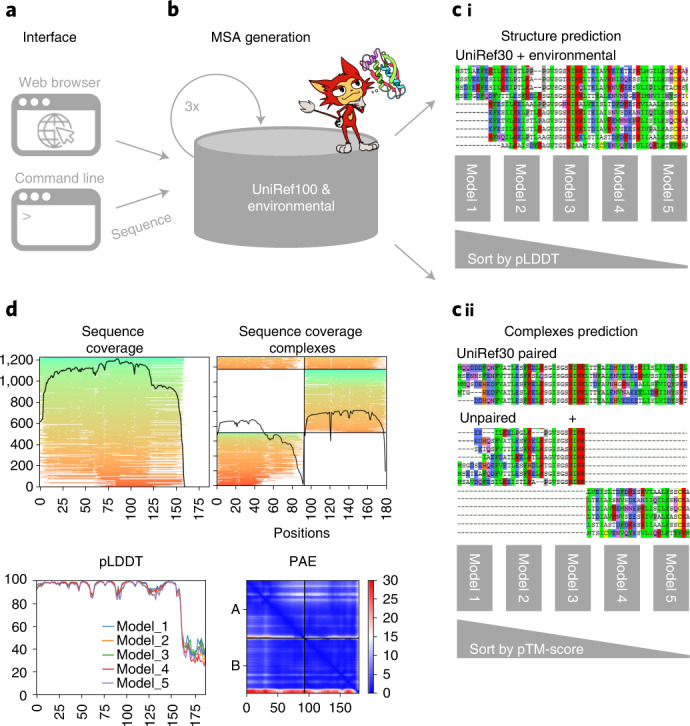
ColabFold offers accelerated protein structure and complex predictions by combining the fast homology search of MMseqs2 with AlphaFold2 or RoseTTAFold. ColabFold’s 40 - 60× faster search and optimized model use allows predicting close to a thousand structures per day on a server with one GPU. Coupled with Google Colaboratory, ColabFold becomes a free and accessible platform for protein folding. ColabFold is open-source software available at github.com/sokrypton/ColabFold . Its novel environmental databases are available at colabfold.mmseqs.com Contact: milot.mirdita@mpibpc.mpg.de , so@fas.harvard.edu , martin.steinegger@snu.ac.kr
Overview
AI snapshot
Written from the paper’s full text.
TL;DR
ColabFold accelerates protein structure and complex prediction by replacing AlphaFold2/RoseTTAFold homology search with MMseqs2, making folding accessible via Google Colaboratory and local command-line tools. It reports 40–60-fold faster MSA generation, ~90-fold batch speed-up, and prediction accuracy matching AlphaFold2 on CASP14 and AlphaFold-multimer on ClusPro.
Key findings
- ColabFold’s MMseqs2 search is 40–60-fold faster than AlphaFold2’s homology search, and batch prediction is ~90-fold faster by avoiding recompilation and adding early stopping; this enables close to 1,000 structures per day on one GPU.
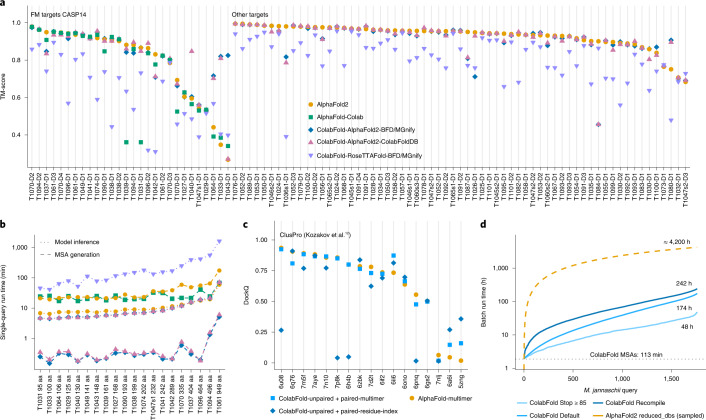
- On CASP14 free-modeling targets, mean TM-scores were 0.826 for ColabFold-AlphaFold2-BFD/MGnify, 0.818 for ColabFold-AlphaFold2-ColabFoldDB, 0.79 for AlphaFold2, 0.744 for AlphaFold-Colab, and 0.62 for ColabFold-RoseTTAFold-BFD/MGnify. Over all CASP14 targets, TM-scores were 0.887, 0.886, 0.888, and 0.754 for the respective methods excluding AlphaFold-Colab.
- ColabFold achieved the highest accuracy for complex prediction on the ClusPro dataset with the AlphaFold-multimer model, though some targets performed better using residue-index mode.
- The 1,762-protein *Methanocaldococcus jannaschii* proteome (proteins <1,000 amino acids) was predicted in 48 h on one Nvidia Titan RTX with early stopping at pLDDT ≥85; average pLDDTs for AlphaFold2 and ColabFold Stop ≥85 were 89.75 and 88.78 in a subsampled set of 50 proteins.
Methods
- ColabFold combines an MMseqs2-based homology search server with AlphaFold2 or RoseTTAFold; it searches UniRef100/UniRef30, PDB70, and either BFD/MGnify or ColabFoldDB, using a diversity-aware filter and optional MSA pairing for complexes.
- Benchmarks included 65 CASP14 targets containing 91 domains (20 free-modeling targets with 28 domains), 17 ClusPro complex targets evaluated with DockQ, and the *M. jannaschii* proteome; predictions were compared to experimental structures using TM-align and DockQ.
- Run-time measurements separated MSA generation and model inference, using specified CPU/GPU systems; ColabFold modes were executed without templates for benchmarking.
Limitations
- The paper states limitations of Google Colaboratory and provides the `colabfold_batch` command-line tool for tasks too large for Colab; it also notes AlphaFold-Colab cannot be used as a standalone and was excluded from the all-CASP14-target comparison.
- Evident from the text: ColabFold benchmarks were run without templates, so template-enabled performance is not directly benchmarked; free-modeling CASP14 targets were used to optimize MMseqs2 search parameters, which may make those results optimistic.
- Evident from the text: validation is limited to CASP14, ClusPro, and one proteome, so generalization to other target classes or larger proteomes is not established here.
Model-written summary. Check it against the paper before relying on it.
Integrity signals
Registry
Cites
Statistics
Figures
Verification
Claims the paper makes
22 Own result · 18 No basis given · 15 Not checked yet · 13 Own interpretation · 2 Own method · 1 Partly supported · accuracy not yet measured
A result the paper reports from its own data — it cites no other source for it, so there is none to check. The quote shows it is in the paper.
In the paper
“We show that ColabFold outperforms AlphaFold-Colab and matches AlphaFold2 on CASP14 targets and also matches AlphaFold-multimer on the ClusPro4,12 dataset in prediction quality.”
§ ColabFold: making protein folding accessible to all > Main
boosted- Asserted: passes — The authors put it forward as true.
- Checkable: passes — It can be checked against evidence.
- Load-bearing: passes — The paper’s conclusions depend on it.
- Based: passes — The paper gives a reason why it holds.
A result the paper reports from its own data — it cites no other source for it, so there is none to check. The quote shows it is in the paper.
In the paper
“We show that ColabFold outperforms AlphaFold-Colab and matches AlphaFold2 on CASP14 targets and also matches AlphaFold-multimer on the ClusPro4,12 dataset in prediction quality.”
§ ColabFold: making protein folding accessible to all > Main
boosteddirect- Asserted: passes — The authors put it forward as true.
- Checkable: passes — It can be checked against evidence.
- Load-bearing: passes — The paper’s conclusions depend on it.
- Based: passes — The paper gives a reason why it holds.
The paper states this without a source or data behind it here, so there is nothing to check it against. The quote shows it is in the paper.
In the paper
“ColabFold’s 40−60-fold faster search and optimized model utilization enables prediction of close to 1,000 structures per day on a server with one graphics processing unit.”
§ ColabFold: making protein folding accessible to all > Abstract
plaindirect- Asserted: passes — The authors put it forward as true.
- Checkable: passes — It can be checked against evidence.
- Load-bearing: passes — The paper’s conclusions depend on it.
- Based: passes — The paper gives a reason why it holds.
A result the paper reports from its own data — it cites no other source for it, so there is none to check. The quote shows it is in the paper.
In the paper
“We show that ColabFold outperforms AlphaFold-Colab and matches AlphaFold2 on CASP14 targets and also matches AlphaFold-multimer on the ClusPro4,12 dataset in prediction quality.”
§ ColabFold: making protein folding accessible to all > Main
boosted- Asserted: passes — The authors put it forward as true.
- Checkable: passes — It can be checked against evidence.
- Load-bearing: passes — The paper’s conclusions depend on it.
- Based: passes — The paper gives a reason why it holds.
A result the paper reports from its own data — it cites no other source for it, so there is none to check. The quote shows it is in the paper.
In the paper
“AlphaFold2 (reduced_dbs, v2.1.1), ColabFold (commit f5d0cec) default and ColabFold Stop ≥ 85 have an average pLDDT of 90.68, 90.22 and 89.33, respectively, for 50 randomly sampled proteins.”
§ ColabFold: making protein folding accessible to all > Methods > Benchmarking ColabFold
plain- Asserted: passes — The authors put it forward as true.
- Checkable: passes — It can be checked against evidence.
- Load-bearing: passes — The paper’s conclusions depend on it.
- Based: passes — The paper gives a reason why it holds.
A result the paper reports from its own data — it cites no other source for it, so there is none to check. The quote shows it is in the paper.
In the paper
“Interestingly, it was found that providing a separate MSA copy (padding by gap characters to extend to other copies) works significantly better than concatenating from left to right.”
§ ColabFold: making protein folding accessible to all > Methods > Modeling protein complexes with ColabFold
boosteddirect- Asserted: passes — The authors put it forward as true.
- Checkable: passes — It can be checked against evidence.
- Load-bearing: unclear — It is unclear whether the paper’s conclusions depend on it.
- Based: passes — The paper gives a reason why it holds.
The paper states this without a source or data behind it here, so there is nothing to check it against. The quote shows it is in the paper.
In the paper
“When templates are enabled, model 1 is compiled and weights from model 2 are used, model 3 is compiled and weights from models 4 and 5 are used. This saves 5 min of compile time.”
§ ColabFold: making protein folding accessible to all > Methods > Speeding up AlphaFold2’s model evaluation
plaindirect- Asserted: passes — The authors put it forward as true.
- Checkable: passes — It can be checked against evidence.
- Load-bearing: passes — The paper’s conclusions depend on it.
- Based: passes — The paper gives a reason why it holds.
A result the paper reports from its own data — it cites no other source for it, so there is none to check. The quote shows it is in the paper.
In the paper
“ColabFold achieves the highest accuracy in the prediction of complexes on the ClusPro4,12 dataset with the AlphaFold-multimer model, however, some targets performed better using the residue-index mode.”
§ ColabFold: making protein folding accessible to all > Main
plain- Asserted: passes — The authors put it forward as true.
- Checkable: passes — It can be checked against evidence.
- Load-bearing: unclear — It is unclear whether the paper’s conclusions depend on it.
- Based: passes — The paper gives a reason why it holds.
A result the paper reports from its own data — it cites no other source for it, so there is none to check. The quote shows it is in the paper.
In the paper
“For difficult targets as well as for designed proteins without known homologs, additional recycling iterations can result in a high-quality prediction (Supplementary Fig. 5).”
§ ColabFold: making protein folding accessible to all > Main
plainconditional- Asserted: passes — The authors put it forward as true.
- Checkable: passes — It can be checked against evidence.
- Load-bearing: passes — The paper’s conclusions depend on it.
- Based: passes — The paper gives a reason why it holds.
A result the paper reports from its own data — it cites no other source for it, so there is none to check. The quote shows it is in the paper.
In the paper
“In Supplementary Fig. 2 we show that ColabFoldDB, in comparison with BFD/MGnify, produces more diverse MSAs for domains in the protein families database (Pfam)19 with <30 members.”
§ ColabFold: making protein folding accessible to all > Main
plaindirect- Asserted: passes — The authors put it forward as true.
- Checkable: passes — It can be checked against evidence.
- Load-bearing: passes — The paper’s conclusions depend on it.
- Based: passes — The paper gives a reason why it holds.
- Probably not a substantial claim. 18
- It may state two separate claims as one. 17
- Borderline: one of the tests for a substantial claim is unclear. 1
- The quote only partly states this claim. 2
The cited sources support only part of this claim — read each source’s verdict below.
In the paper
“These environmental databases contain billions of proteins extracted from metagenomic and transcriptomic experiments, which often complement databases dominated by isolated genomes.”
§ ColabFold: making protein folding accessible to all > Main
What the sources say
- Partly supportedcites [1] sourceExperimental — accuracy not yet measured
Methods > Inputs and data sources reports that BFD covers 2.2 billion protein sequences from reference databases, metagenomes, and metatranscriptomes. It also says metagenomics databases help with targets poorly represented in UniRef, supporting the complementary role. The paper does not establish that billions of those sequences come specifically from environmental experiments or describe the other databases as dominated by isolated genomes. (LLM, conf=0.84)
- Not checked yetcites [6] (2020), Nucleic Acids Res.
plaincorrelational- Asserted: passes — The authors put it forward as true.
- Checkable: passes — It can be checked against evidence.
- Load-bearing: fails — The paper’s conclusions may not depend on it.
- Based: passes — The paper gives a reason why it holds.
Probably not a substantial claim. The paper’s conclusions may not depend on it. It may state two separate claims as one.
- Partly supported
The paper states this without a source or data behind it here, so there is nothing to check it against. The quote shows it is in the paper.
In the paper
“The prediction of target T1084 can be improved from a TM-score of 0.457 to 0.872 by ColabFold if MMseqs2’s compositional filter is disabled (Supplementary Fig. 3).”
directSingle case- Asserted: fails — The authors may not put it forward as true.
- Checkable: passes — It can be checked against evidence.
- Load-bearing: fails — The paper’s conclusions may not depend on it.
- Based: fails — The paper may give no reason why it holds.
Probably not a substantial claim. The authors may not put it forward as true. The paper’s conclusions may not depend on it. The paper may give no reason why it holds.
The paper states this without a source or data behind it here, so there is nothing to check it against. The quote shows it is in the paper.
In the paper
“The average pLDDTs of AlphaFold2 and ColabFold Stop ≥ 85 were 89.75 and 88.78 in a subsampled set of 50 proteins.”
- Asserted: passes — The authors put it forward as true.
- Checkable: passes — It can be checked against evidence.
- Load-bearing: passes — The paper’s conclusions depend on it.
- Based: unclear — It is unclear why the paper says it holds.
Borderline substantial claim. It is unclear why the paper says it holds.
None of the sources cited for this claim have been checked yet.
In the paper
“ColabFold’s 40−60-fold faster search and optimized model utilization enables prediction of close to 1,000 structures per day on a server with one graphics processing unit.”
§ ColabFold: making protein folding accessible to all > Abstract
What the sources say
plaindirect- Asserted: passes — The authors put it forward as true.
- Checkable: passes — It can be checked against evidence.
- Load-bearing: passes — The paper’s conclusions depend on it.
- Based: passes — The paper gives a reason why it holds.
The quote only partly states this claim.
A result the paper reports from its own data — it cites no other source for it, so there is none to check. The quote shows it is in the paper.
In the paper
“Early stopping results in a speed-up of 3.7-fold compared with the default and 4.8-fold compared with always recompiling.”
§ ColabFold: making protein folding accessible to all > Methods > Benchmarking ColabFold
plaindirect- Asserted: passes — The authors put it forward as true.
- Checkable: passes — It can be checked against evidence.
- Load-bearing: passes — The paper’s conclusions depend on it.
- Based: passes — The paper gives a reason why it holds.
It may state two separate claims as one.
A result the paper reports from its own data — it cites no other source for it, so there is none to check. The quote shows it is in the paper.
In the paper
“To reduce the size of the database we filtered each cluster, keeping only the 10 most diverse sequences using mmseqs filterresult --diff 10. This reduced the total number of sequences from 2.5 billion to 513 million, thus requiring only 84 GB RAM for headers and sequences.”
§ ColabFold: making protein folding accessible to all > Methods > ColabFold databases
plaindirect- Asserted: passes — The authors put it forward as true.
- Checkable: passes — It can be checked against evidence.
- Load-bearing: passes — The paper’s conclusions depend on it.
- Based: passes — The paper gives a reason why it holds.
It may state two separate claims as one.
- Rests on an assumption: BFD is a clustered protein database consisting of ~2.2 billion proteins organized in 64 million clusters.
- Rests on an assumption: MGnify (2019_05) contains ~300 million environmental proteins.
A result the paper reports from its own data — it cites no other source for it, so there is none to check. The quote shows it is in the paper.
In the paper
“Over all CASP14 targets (excluding AlphaFold-Colab because it cannot be used as a standalone) the TM-scores are 0.887, 0.886, 0.888 and 0.754 for the respective methods.”
§ ColabFold: making protein folding accessible to all > Main
plain- Asserted: passes — The authors put it forward as true.
- Checkable: passes — It can be checked against evidence.
- Load-bearing: passes — The paper’s conclusions depend on it.
- Based: passes — The paper gives a reason why it holds.
It may state two separate claims as one.
A result the paper reports from its own data — it cites no other source for it, so there is none to check. The quote shows it is in the paper.
In the paper
“All together, we show that the Methanocaldococcus jannaschii proteome of 1,762 proteins shorter than 1,000 amino acids can be predicted in 48 h with early stopping at a pLDDT (predicted local distance difference test; a per-residue confidence metric) of ≥85 on one Nvidia Titan RTX (Fig. 2d), while sacrificing little or no prediction accuracy (Methods 2.7.4).”
§ ColabFold: making protein folding accessible to all > Main
plain- Asserted: passes — The authors put it forward as true.
- Checkable: passes — It can be checked against evidence.
- Load-bearing: passes — The paper’s conclusions depend on it.
- Based: passes — The paper gives a reason why it holds.
It may state two separate claims as one.
The paper states this without a source or data behind it here, so there is nothing to check it against. The quote shows it is in the paper.
In the paper
“We sort the input queries by sequence length and process them in ascending order. We pad the input features by 10% (by default). All sequences that lie within the query length and an additional 10% margin are not required to be recompiled, resulting in a large speed-up for short proteins.”
§ ColabFold: making protein folding accessible to all > Methods > Speeding up AlphaFold2’s model evaluation
plaindirect- Asserted: passes — The authors put it forward as true.
- Checkable: passes — It can be checked against evidence.
- Load-bearing: passes — The paper’s conclusions depend on it.
- Based: passes — The paper gives a reason why it holds.
It may state two separate claims as one.
The paper states this without a source or data behind it here, so there is nothing to check it against. The quote shows it is in the paper.
In the paper
“Changing the random seed can result in different cluster centers and thus different structure predictions.”
§ ColabFold: making protein folding accessible to all > Methods > Advanced features
plainconditional- Asserted: passes — The authors put it forward as true.
- Checkable: passes — It can be checked against evidence.
- Load-bearing: fails — The paper’s conclusions may not depend on it.
- Based: passes — The paper gives a reason why it holds.
Probably not a substantial claim. The paper’s conclusions may not depend on it.
The paper states this without a source or data behind it here, so there is nothing to check it against. The quote shows it is in the paper.
In the paper
“In AlphaFold2 we find the same to be true, although surprisingly the paired alignment is often not needed (Fig. 2c).”
§ ColabFold: making protein folding accessible to all > Methods > Modeling protein complexes with ColabFold
plaindirect- Asserted: passes — The authors put it forward as true.
- Checkable: passes — It can be checked against evidence.
- Load-bearing: passes — The paper’s conclusions depend on it.
- Based: passes — The paper gives a reason why it holds.
It may state two separate claims as one.
A result the paper reports from its own data — it cites no other source for it, so there is none to check. The quote shows it is in the paper.
In the paper
“Rerunning the CASP14 benchmark with a recycle count of 12 resulted in an improvement of targets with little MSA information, resulting in an increased average TM-score of 0.898 (Supplementary Fig. 6).”
§ ColabFold: making protein folding accessible to all > Main
plaindirect- Asserted: passes — The authors put it forward as true.
- Checkable: passes — It can be checked against evidence.
- Load-bearing: unclear — It is unclear whether the paper’s conclusions depend on it.
- Based: passes — The paper gives a reason why it holds.
It may state two separate claims as one.
A result the paper reports from its own data — it cites no other source for it, so there is none to check. The quote shows it is in the paper.
In the paper
“We exposed the recycle count as a customizable parameter given that additional recycles can often improve a model (Supplementary Fig. 6) at the cost of a longer run time.”
§ ColabFold: making protein folding accessible to all > Methods > Speeding up AlphaFold2’s model evaluation
plainconditional- Asserted: passes — The authors put it forward as true.
- Checkable: passes — It can be checked against evidence.
- Load-bearing: passes — The paper’s conclusions depend on it.
- Based: passes — The paper gives a reason why it holds.
It may state two separate claims as one.
A result the paper reports from its own data — it cites no other source for it, so there is none to check. The quote shows it is in the paper.
In the paper
“The final database consists of 209,335,865 million representative sequences and 738,695,580 members (see the Data Availability section for the input files).”
§ ColabFold: making protein folding accessible to all > Methods > ColabFold databases
plain- Asserted: passes — The authors put it forward as true.
- Checkable: passes — It can be checked against evidence.
- Load-bearing: unclear — It is unclear whether the paper’s conclusions depend on it.
- Based: passes — The paper gives a reason why it holds.
It may state two separate claims as one. The quote only partly states this claim.
A result the paper reports from its own data — it cites no other source for it, so there is none to check. The quote shows it is in the paper.
In the paper
“The mean TM-scores for the free-modeling targets are 0.826, 0.818, 0.79, 0.744 and 0.62 for ColabFold-AlphaFold2-BFD/MGnify, ColabFold-AlphaFold2-ColabFoldDB, AlphaFold2, AlphaFold-Colab and ColabFold-RoseTTAFold-BFD/MGnify, respectively.”
§ ColabFold: making protein folding accessible to all > Main
plain- Asserted: passes — The authors put it forward as true.
- Checkable: passes — It can be checked against evidence.
- Load-bearing: passes — The paper’s conclusions depend on it.
- Based: passes — The paper gives a reason why it holds.
It may state two separate claims as one.
A result the paper reports from its own data — it cites no other source for it, so there is none to check. The quote shows it is in the paper.
In the paper
“MMseqs2 had a maximum resident set size of 308 GB during the search.”
§ ColabFold: making protein folding accessible to all > Methods > Benchmarking ColabFold
plainSingle case- Asserted: passes — The authors put it forward as true.
- Checkable: passes — It can be checked against evidence.
- Load-bearing: fails — The paper’s conclusions may not depend on it.
- Based: passes — The paper gives a reason why it holds.
Probably not a substantial claim. The paper’s conclusions may not depend on it.
None of the sources cited for this claim have been checked yet.
In the paper
“AlphaFold2 (ref. 1) was able to predict the 3D atomic coordinates of folded protein structures at a median global distance test total score (GDT_TS) of 92.4% in the latest round of the protein folding competition by the international community, CASP14 (Critical Assessment of protein Structure Prediction, round 14) (ref. 2).”
What the sources say
- Not checked yetcites ref. 1
- Not checked yetcites ref. 2
- Asserted: passes — The authors put it forward as true.
- Checkable: passes — It can be checked against evidence.
- Load-bearing: fails — The paper’s conclusions may not depend on it.
- Based: passes — The paper gives a reason why it holds.
Probably not a substantial claim. The paper’s conclusions may not depend on it.
In the paper
“Evans et al.4 have since released AlphaFold-multimer, a refined version of AlphaFold2 for the prediction of protein complexes.”
What the sources say
- Not checked yetcites Evans et al.4 Evans, R. et al. bioRxiv 2021.10.04.463034 (2021).
- Asserted: passes — The authors put it forward as true.
- Checkable: passes — It can be checked against evidence.
- Load-bearing: fails — The paper’s conclusions may not depend on it.
- Based: passes — The paper gives a reason why it holds.
Probably not a substantial claim. The paper’s conclusions may not depend on it.
In the paper
“For high-quality predictions it was shown that sequences should be provided in paired form to AlphaFold2 (ref. 22).”
What the sources say
- Not checked yetcites ref. 22
direct- Asserted: passes — The authors put it forward as true.
- Checkable: passes — It can be checked against evidence.
- Load-bearing: fails — The paper’s conclusions may not depend on it.
- Based: passes — The paper gives a reason why it holds.
Probably not a substantial claim. The paper’s conclusions may not depend on it.
In the paper
“Many ideas of AlphaFold2 were independently reproduced and implemented in RoseTTAFold (ref. 3).”
What the sources say
- Not checked yetcites ref. 3
- Asserted: passes — The authors put it forward as true.
- Checkable: passes — It can be checked against evidence.
- Load-bearing: fails — The paper’s conclusions may not depend on it.
- Based: passes — The paper gives a reason why it holds.
Probably not a substantial claim. The paper’s conclusions may not depend on it.
A conclusion the paper draws from its own results — it cites no other source for it, so there is none to check. The quote shows it is in the paper.
In the paper
“Coupled with Google Colaboratory, ColabFold becomes a free and accessible platform for protein folding.”
direct- Asserted: passes — The authors put it forward as true.
- Checkable: passes — It can be checked against evidence.
- Load-bearing: passes — The paper’s conclusions depend on it.
- Based: fails — The paper may give no reason why it holds.
Probably not a substantial claim. The paper may give no reason why it holds.
In the paper
“This results in less accurate predictions while still requiring long search times.”
§ ColabFold: making protein folding accessible to all > Main
What the sources say
- Not checked yetcites [9] (2021), Nature source
plaindirect- Asserted: passes — The authors put it forward as true.
- Checkable: passes — It can be checked against evidence.
- Load-bearing: passes — The paper’s conclusions depend on it.
- Based: passes — The paper gives a reason why it holds.
It may state two separate claims as one.
In the paper
“Concurrently, Tunyasuvunakool et al.9 developed an AlphaFold2 Jupyter Notebook for Google Colaboratory (referred to as AlphaFold-Colab), for which the input MSA is built by searching with HMMer against the UniProt Reference Clusters (UniRef90) and an eightfold-reduced environmental database.”
§ ColabFold: making protein folding accessible to all > Main
What the sources say
- Not checked yetcites [9] (2021), Nature source
plain- Asserted: passes — The authors put it forward as true.
- Checkable: passes — It can be checked against evidence.
- Load-bearing: passes — The paper’s conclusions depend on it.
- Based: passes — The paper gives a reason why it holds.
It may state two separate claims as one.
A conclusion the paper draws from its own results — it cites no other source for it, so there is none to check. The quote shows it is in the paper.
In the paper
“Thus, two highly accurate open-source prediction methods for single chains and one for protein complexes are now publicly available.”
§ ColabFold: making protein folding accessible to all > Main
plain- Asserted: passes — The authors put it forward as true.
- Checkable: passes — It can be checked against evidence.
- Load-bearing: passes — The paper’s conclusions depend on it.
- Based: passes — The paper gives a reason why it holds.
It may state two separate claims as one.
The paper states this without a source or data behind it here, so there is nothing to check it against. The quote shows it is in the paper.
In the paper
“MMseqs2 was initially built to perform fast many-against-many sequence searches.”
§ ColabFold: making protein folding accessible to all > Methods > Faster MSA generation with MMseqs2
plain- Asserted: passes — The authors put it forward as true.
- Checkable: passes — It can be checked against evidence.
- Load-bearing: fails — The paper’s conclusions may not depend on it.
- Based: passes — The paper gives a reason why it holds.
Probably not a substantial claim. The paper’s conclusions may not depend on it.
In the paper
“Shortly afterwards, Baek21 found that increasing the model's internal parameter, residue-index (the method that was used in RoseTTAFold), could also be done in AlphaFold2.”
§ ColabFold: making protein folding accessible to all > Main
What the sources say
- Not checked yetcites [21] Baek, M . Adding a big enough number for “residue_index” feature is enough to model hetero-complex using AlphaFold (green&cyan: crystal structure / magenta: predicted model w/ residue_index modification). https://twitter.com/minkbaek/status/1417538291709071362 (2021).
plain- Asserted: passes — The authors put it forward as true.
- Checkable: passes — It can be checked against evidence.
- Load-bearing: fails — The paper’s conclusions may not depend on it.
- Based: passes — The paper gives a reason why it holds.
Probably not a substantial claim. The paper’s conclusions may not depend on it.
A conclusion the paper draws from its own results — it cites no other source for it, so there is none to check. The quote shows it is in the paper.
In the paper
“The inter-chain predicted alignment error (inter-PAE) provided by AlphaFold2 helps to rank the complexes.”
§ ColabFold: making protein folding accessible to all > Main
plaindirect- Asserted: passes — The authors put it forward as true.
- Checkable: passes — It can be checked against evidence.
- Load-bearing: fails — The paper’s conclusions may not depend on it.
- Based: passes — The paper gives a reason why it holds.
Probably not a substantial claim. The paper’s conclusions may not depend on it.
A conclusion the paper draws from its own results — it cites no other source for it, so there is none to check. The quote shows it is in the paper.
In the paper
“ColabFold builds beyond the initial offerings of Alphafold2 by improving its sequence search, providing tools for modeling homo- and heteromer complexes, exposing advanced functionality, expanding the environmental databases and enabling large-scale batch prediction of protein structures, at an approximately 90-fold speed-up over AlphaFold2.”
§ ColabFold: making protein folding accessible to all > Main
plaindirect- Asserted: passes — The authors put it forward as true.
- Checkable: passes — It can be checked against evidence.
- Load-bearing: passes — The paper’s conclusions depend on it.
- Based: passes — The paper gives a reason why it holds.
It may state two separate claims as one.
What the paper did — it cites no source for this, so there is none to check. The quote shows it is in the paper.
In the paper
“MSA generation was repeated five times and the MSA generation times were averaged.”
§ ColabFold: making protein folding accessible to all > Methods > Benchmarking ColabFold
plain- Asserted: passes — The authors put it forward as true.
- Checkable: passes — It can be checked against evidence.
- Load-bearing: fails — The paper’s conclusions may not depend on it.
- Based: passes — The paper gives a reason why it holds.
Probably not a substantial claim. The paper’s conclusions may not depend on it. It may state two separate claims as one.
The paper states this without a source or data behind it here, so there is nothing to check it against. The quote shows it is in the paper.
In the paper
“Alphafold2, depending on model configuration, subsamples the MSA to a maximum of 512 cluster centers and 1,024 extra sequences.”
§ ColabFold: making protein folding accessible to all > Methods > Advanced features
plaindirect- Asserted: passes — The authors put it forward as true.
- Checkable: passes — It can be checked against evidence.
- Load-bearing: fails — The paper’s conclusions may not depend on it.
- Based: fails — The paper may give no reason why it holds.
Probably not a substantial claim. The paper’s conclusions may not depend on it. The paper may give no reason why it holds.
A conclusion the paper draws from its own results — it cites no other source for it, so there is none to check. The quote shows it is in the paper.
In the paper
“The advantage over a 3D renderer is that the images are very lightweight, can be used in animations and saved as vector graphics for lossless inclusion in documents.”
§ ColabFold: making protein folding accessible to all > Methods > Advanced features
plaindirect- Asserted: passes — The authors put it forward as true.
- Checkable: passes — It can be checked against evidence.
- Load-bearing: fails — The paper’s conclusions may not depend on it.
- Based: passes — The paper gives a reason why it holds.
Probably not a substantial claim. The paper’s conclusions may not depend on it. It may state two separate claims as one.
What the paper did — it cites no source for this, so there is none to check. The quote shows it is in the paper.
In the paper
“For a fair comparison, AlphaFold2 was modified to allow HMMer and HHblits to access one CPU core.”
§ ColabFold: making protein folding accessible to all > Methods > Benchmarking ColabFold
plain- Asserted: passes — The authors put it forward as true.
- Checkable: passes — It can be checked against evidence.
- Load-bearing: passes — The paper’s conclusions depend on it.
- Based: passes — The paper gives a reason why it holds.
Probably not a substantial claim.
The paper states this without a source or data behind it here, so there is nothing to check it against. The quote shows it is in the paper.
In the paper
“AlphaFold2 improves the predicted protein structure by recycling (by default) three times, meaning that the prediction is fed multiple times through the model.”
§ ColabFold: making protein folding accessible to all > Methods > Speeding up AlphaFold2’s model evaluation
plaindirect- Asserted: passes — The authors put it forward as true.
- Checkable: passes — It can be checked against evidence.
- Load-bearing: fails — The paper’s conclusions may not depend on it.
- Based: passes — The paper gives a reason why it holds.
Probably not a substantial claim. The paper’s conclusions may not depend on it.
A conclusion the paper draws from its own results — it cites no other source for it, so there is none to check. The quote shows it is in the paper.
In the paper
“Enabling the latter can be used to sample an ensemble of models for the uncertain parts of the structure prediction.”
§ ColabFold: making protein folding accessible to all > Methods > Advanced features
plaindirect- Asserted: passes — The authors put it forward as true.
- Checkable: passes — It can be checked against evidence.
- Load-bearing: fails — The paper’s conclusions may not depend on it.
- Based: passes — The paper gives a reason why it holds.
Probably not a substantial claim. The paper’s conclusions may not depend on it.
The paper relies on this without support.
Searches against large environmental databases can take up to hours for a single protein and require more than 2 TB of storage space alone.
“Due to their large size, searches can take up to hours for a single protein while requiring more than 2 TB of storage space alone.”
The paper relies on this without support.
Executing deep neural networks requires GPUs with large GPU RAM even for ~1,000 residue proteins.
“Second, to execute the deep neural networks, graphics processing units (GPUs) with a large amount of GPU RAM (random access memory) are required even for relatively common protein sizes of ~1,000 residues.”
The paper relies on this without support.
For these proteins, MSA generation dominates the overall run time.
“For these, however, the MSA generation dominates the overall run time.”
The paper relies on this without support.
Eukaryotic protein diversity is not well represented in the databases BFD and MGnify.
“The environmental search database presented an opportunity to improve structure predictions of non-bacterial sequences given that, for example, eukaryotic protein diversity is not well represented in the databases BFD and MGnify.”
The paper relies on this without support.
Limitations in assembly and gene calling due to complex intron and exon structures result in underrepresentation in reference databases.
“Limitations in assembly and gene calling due to complex intron and exon structures result in underrepresentation in reference databases.”
The paper relies on this without support.
AlphaFold2 was initially released without the capability to model protein complexes.
“AlphaFold2 was initially released without the capability to model protein complexes.”
The paper relies on this without support.
Generating MSAs for AlphaFold2 and RoseTTAFold is a time-consuming task.
“Generating MSAs for AlphaFold2 and RoseTTAFold is a time-consuming task.”
The paper relies on this without support.
This type of search requires the database to be indexed and stored in memory.
“This type of search requires the database to be indexed and stored in memory.”
The paper relies on this without support.
AlphaFold2 requires more than 2 TB of storage space for its databases, which is a significant hurdle for many researchers.
“AlphaFold2 requires more than 2 TB of storage space for its databases, which is a significant hurdle for many researchers.”
The paper relies on this without support.
BFD is a clustered protein database consisting of ~2.2 billion proteins organized in 64 million clusters.
“BFD is a clustered protein database consisting of ~2.2 billion proteins organized in 64 million clusters.”
The paper relies on this without support.
MGnify (2019_05) contains ~300 million environmental proteins.
“MGnify (2019_05) contains ~300 million environmental proteins.”
The paper relies on this without support.
The benchmark datasets used (CASP14 targets, ClusPro targets and the M. jannaschii proteome) are representative of the protein structure prediction tasks ColabFold is intended for.
“We show with multiple datasets that ColabFold does not sacrifice accuracy for its much faster run times.”
Claims other papers make about this one
Each is checked against this paper’s own text: does it say what the citing paper says it does?
The source backs part of the claim, not all of it — or backs it for a different population, condition or comparison.
In the citing paper
“allow users to run a modified AF2 protocol on open access servers in minutes”
From The power and pitfalls of AlphaFold2 for structure prediction beyond rigid globular proteins (2024) · cites this paper as [8]
Experimental — accuracy not yet measuredThe cited source says what the claim attributes to it.
In the citing paper
“However, AlphaFold and RoseTTAfold have recently demonstrated unprecedented accuracy in predicting structures of monomeric proteins (27,28,(61)(62)(63)(64)(65)(66) and complexes (35,62,67,68).”
From AI-based structure prediction empowers integrative structural analysis of human nuclear pores (2022) · cites this paper as [35]
The cited source says what the claim attributes to it.
In the citing paper
“However, a high confidence AlphaFold254,55,56 model of Retriever aligned well with the low-resolution 3D cryo-EM envelope (Figure 1B; Methods S1; Video S1).”
From Structure of the endosomal Commander complex linked to Ritscher-Schinzel syndrome (2023) · cites this paper as [56]
The cited source says what the claim attributes to it.
In the citing paper
“Initially, a model of the dodecamer including all ten COMMD proteins and the N-terminal regions of CCDC22 and CCDC93 was constructed using AlphaFold2 multimer54,55,56 (Figure S3A).”
From Structure of the endosomal Commander complex linked to Ritscher-Schinzel syndrome (2023) · cites this paper as [56]
The cited source says what the claim attributes to it.
In the citing paper
“Notably, the structure closely matches that predicted by AlphaFold2 multimer56,66 (Methods S1).”
From Structure of the endosomal Commander complex linked to Ritscher-Schinzel syndrome (2023) · cites this paper as [56]
The check wasn’t confident either way, so it gives no verdict — never disputed.
In the citing paper
“The QID is predicted to form an alpha-helix with high confidence and all five models suggest higher order assembly as a four-helical bundle with almost perfect overlap (Figure 1F and Figure S2C,D).”
From Tetramerisation governs SALL transcription factor function in development and disease (2025) · cites this paper as [37]
Experimental — accuracy not yet measuredIn the citing paper
“For targets without known homologs, such as computationally designed proteins, increasing the number of recycling iterations can improve the quality of the prediction8”
From The power and pitfalls of AlphaFold2 for structure prediction beyond rigid globular proteins (2024) · cites this paper as [8]
In the citing paper
“Another approach is to enable dropout layers in the neural network, which are usually commonly used only during neural network training8,106,107.”
From The power and pitfalls of AlphaFold2 for structure prediction beyond rigid globular proteins (2024) · cites this paper as [8]
In the citing paper
“it has been shown recently that contact predictions can be used to simultaneously fold and dock proteins17, and early reports have indicated that AF2 can predict the structure of complexes18–20, which it was not initially trained to handle.”
From A structural biology community assessment of AlphaFold2 applications (2022) · cites this paper as [19]
In the citing paper
“However, AF2 run using ColabFold34 predicts the thermodynamically unfavoured FS state for KaiBTE (Fig. 1c (left)).”
From Predicting multiple conformations via sequence clustering and AlphaFold2 (2024) · cites this paper as [34]
In the citing paper
“A much better solution is to modify the “residue_index” feature used by AF2, which eliminates the need for a covalent linker that likely creates artifacts20,21.”
From AF2Complex predicts direct physical interactions in multimeric proteins with deep learning (2022) · cites this paper as [20]
In the citing paper
“We predicted the structure of one homologous protein that is 64% identical to UniProt A0A1C5UEQ5 (Extended Data Fig. 8)—which originates from a cultured Lachnospiraceae bacterium that is part of the Culturable Genome Reference30 of the human gut—using ColabFold31 and confirmed that it has a similar structure DNA-binding domain structure (TM score of 0.97 and 0.56 in relation to UniProt A0A1C5UEQ5”
From Clustering predicted structures at the scale of the known protein universe (2023) · cites this paper as [31]
Self-check
Percentages, sums and reported differences re-computed from the paper’s own numbers.
Each contradiction between two passages listed here was confirmed by an independent check.
Rated minor: it would not touch a result — a value no result rests on, a p-value that stays on the same side of the significance level, or a conflict that is clerical, resolved elsewhere in the paper, or outside its own findings.
In the paper
“The average pLDDTs of AlphaFold2 and ColabFold Stop ≥ 85 were 89.75 and 88.78 in a subsampled set of 50 proteins.”
“AlphaFold2 (reduced_dbs, v2.1.1), ColabFold (commit f5d0cec) default and ColabFold Stop ≥ 85 have an average pLDDT of 90.68, 90.22 and 89.33, respectively, for 50 randomly sampled proteins.”
Citations
Cites
Highly accurate protein structure prediction with AlphaFold
Jumper, J., Evans, R., Pritzel, A., Green, T., Figurnov, M., Ronneberger, O., Tunyasuvunakool, K., Bates, R., Žídek, A., Potapenko, A., et al. (2021) · Nature · doi:10.1038/s41586-021-03819-2 · Cited by 43,764
Self-citationMatplotlib: a 2D graphics environment
Hunter, J. D. (2007) · Computing in Science & Engineering · doi:10.1109/mcse.2007.55 · Cited by 39,249
Unicycler: Resolving bacterial genome assemblies from short and long sequencing reads
Wick, R. R., Judd, L. M., Gorrie, C. L., & Holt, K. E. (2017) · PLoS Computational Biology · doi:10.1371/journal.pcbi.1005595 · Cited by 8,728
UniProt: a worldwide hub of protein knowledge
The UniProt Consortium (2019) · Nucleic Acids Research · doi:10.1093/nar/gky1049 · Cited by 7,698
Pfam: The protein families database in 2021
Mistry, J., Chuguransky, S., Williams, L., Qureshi, M., Salazar, G. A., Sonnhammer, E. L. L., Tosatto, S. C. E., Paladin, L., Raj, S., Richardson, L. J., et al. (2021) · Nucleic Acids Research · doi:10.1093/nar/gkaa913 · Cited by 7,452
Accelerated Profile HMM Searches
Eddy, S. R. (2011) · PLoS Computational Biology · doi:10.1371/journal.pcbi.1002195 · Cited by 6,975
Dropout as a bayesian approximation: Representing model uncertainty in deep learning
Gal, Y., & Ghahramani, Z. (2015) · arXiv · doi:10.48550/arxiv.1506.02142 · Cited by 6,471
Accurate prediction of protein structures and interactions using a 3-track network
Baek, M., DiMaio, F., Anishchenko, I., Dauparas, J., Ovchinnikov, S., Lee, G. R., Wang, J., Cong, Q., Kinch, L. N., Schaeffer, R. D., et al. (2021) · doi:10.1101/2021.06.14.448402 · Cited by 5,549
Self-citationMMseqs2 enables sensitive protein sequence searching for the analysis of massive data sets
Steinegger, M., & Söding, J. (2017) · Nature Biotechnology · doi:10.1038/nbt.3988 · Cited by 4,840
Self-citationProtein complex prediction with AlphaFold-Multimer
Evans, R., O’Neill, M., Pritzel, A., Antropova, N., Senior, A., Green, T., Žídek, A., Bates, R., Blackwell, S., Yim, J., et al. (2021) · doi:10.1101/2021.10.04.463034 · Cited by 3,808
Research works printed but not linked: 5
- Evans, R. et al. bioRxiv 2021.10.04.463034 (2021).
- (2020), Nucleic Acids Res., 48, D570
- Delmont, T. O. et al. bioRxiv 2020.10.15.341214 (2020).
- Alexander, H. et al. bioRxiv 2021.07.25.453713 (2021).
- Mosalaganti, S. et al. bioRxiv 2021.10.26.465776 (2021).
Cited by
Sorted by citations
Evolutionary-scale prediction of atomic level protein structure with a language model
Lin, Z., Akin, H., Rao, R., Hie, B., Zhu, Z., Lu, W., Smetanin, N., Verkuil, R., Kabeli, O., Shmueli, Y., et al. (2022) · doi:10.1101/2022.07.20.500902 · Cited by 5,990
UCSF ChimeraX : Tools for structure building and analysis
Meng, E. C., Goddard, T. D., Pettersen, E. F., Couch, G. S., Pearson, Z., Morris, J. H., & Ferrin, T. E. (2023) · Protein Science · doi:10.1002/pro.4792 · Cited by 4,706
Scientific discovery in the age of artificial intelligence.
Wang, H., Fu, T., Du, Y., Gao, W., Huang, K., Liu, Z., Chandak, P., Liu, S., Van Katwyk, P., Deac, A., et al. (2023) · Nature · doi:10.1038/s41586-023-06221-2 · Cited by 1,823
Harnessing protein folding neural networks for peptide–protein docking
Tsaban, T., Varga, J. K., Avraham, O., Ben-Aharon, Z., Khramushin, A., & Schueler-Furman, O. (2022) · Nature Communications · doi:10.1038/s41467-021-27838-9 · Cited by 1,205
Large language models generate functional protein sequences across diverse families
Madani, A., Krause, B., Greene, E. R., Subramanian, S., Mohr, B. P., Holton, J. M., Olmos, J. L., Xiong, C., Sun, Z. Z., Socher, R., et al. (2023) · Nature Biotechnology · doi:10.1038/s41587-022-01618-2 · Cited by 1,078
The Galaxy platform for accessible, reproducible, and collaborative data analyses: 2024 update
Community, T. G., Abueg, L. A. L., Afgan, E., Allart, O., Awan, A., Bacon, W., Baker, D., Bassetti, M. E., Batut, B., Bernt, M., et al. (2024) · Nucleic Acids Research · doi:10.1093/nar/gkae410 · Cited by 1,038
Boltz-2: Towards Accurate and Efficient Binding Affinity PredictionPreprint
Passaro, S., Corso, G., Wohlwend, J., Reveiz, M., Thaler, S., Somnath, V. R., Getz, N., Portnoi, T., Roy, J., Stark, H., et al. (2025) · bioRxiv (Cold Spring Harbor Laboratory) · doi:10.1101/2025.06.14.659707 · Cited by 940
ProtGPT2 is a deep unsupervised language model for protein design
Ferruz, N., Schmidt, S., & Höcker, B. (2022) · Nature Communications · doi:10.1038/s41467-022-32007-7 · Cited by 795
Automated model building and protein identification in cryo-EM maps
Jamali, K., Käll, L., Zhang, R., Brown, A., Kimanius, D., & Scheres, S. H. W. (2024) · Nature · doi:10.1038/s41586-024-07215-4 · Cited by 686
Automated model building and protein identification in cryo-EM maps
Jamali, K., Käll, L., Zhang, R., Brown, A., Kimanius, D., & Scheres, S. H. W. (2023) · doi:10.1101/2023.05.16.541002 · Cited by 686
A structural biology community assessment of AlphaFold2 applications
Akdel, M., Pires, D. E. V., Pardo, E. P., Jänes, J., Zalevsky, A. O., Mészáros, B., Bryant, P., Good, L. L., Laskowski, R. A., Pozzati, G., et al. (2022) · Nature Structural & Molecular Biology · doi:10.1038/s41594-022-00849-w · Cited by 675
Self-citationThe HADDOCK2.4 web server for integrative modeling of biomolecular complexes
Honorato, R. V., Trellet, M. E., Jiménez‐García, B., Schaarschmidt, J., Giulini, M., Reys, V., Koukos, P. I., Rodrigues, J., Karaca, E., van Zundert, G. C. P., et al. (2024) · Nature Protocols · doi:10.1038/s41596-024-01011-0 · Cited by 666
Sequence modeling and design from molecular to genome scale with Evo
Nguyen, E., Poli, M., Durrant, M. G., Kang, B., Katrekar, D., Li, D. B., Bartie, L. J., Thomas, A. W., King, S. H., Brixi, G., et al. (2024) · Science · doi:10.1126/science.ado9336 · Cited by 580
Predicting multiple conformations via sequence clustering and AlphaFold2
Wayment-Steele, H. K., Ojoawo, A., Otten, R., Apitz, J. M., Pitsawong, W., Hömberger, M., Ovchinnikov, S., Colwell, L., & Kern, D. (2024) · Nature · doi:10.1038/s41586-023-06832-9 · Cited by 545
Self-citationBoltz-1 Democratizing Biomolecular Interaction ModelingPreprint
Wohlwend, J., Corso, G., Passaro, S., Getz, N., Reveiz, M., Leidal, K., Swiderski, W., Atkinson, L., Portnoi, T., Chinn, I., et al. (2024) · bioRxiv (Cold Spring Harbor Laboratory) · doi:10.1101/2024.11.19.624167 · Cited by 592
Sampling alternative conformational states of transporters and receptors with AlphaFold2
del Alamo, D., Sala, D., Mchaourab, H. S., & Meiler, J. (2022) · eLife · doi:10.7554/elife.75751 · Cited by 511
“0.1 and a modified version of ColabFold ( Mirdita et al., 2021 ) that is available at https://github.com/delalamo/af2_conformations, ( Del Alamo, 2021b copy archived at swh:1:rev:d60db86886186e80622deaa91045caccaf4103d3).”
BackgroundInfluentialChai-1: Decoding the molecular interactions of life
Discovery, C., Boitreaud, J., Dent, J., McPartlon, M., Meier, J., Reis, V., Rogozhnikov, A., & Wu, K. (2024) · doi:10.1101/2024.10.10.615955 · Cited by 517
Ahdritz, G., Bouatta, N., Floristean, C., Kadyan, S., Xia, Q., Gerecke, W., O’Donnell, T. J., Berenberg, D., Fisk, I., Zanichelli, N., et al. (2024) · Nature Methods · doi:10.1038/s41592-024-02272-z · Cited by 439
“By analyzing intermediate structures produced during training, we also gain insights into the hierarchical manner in which OpenFold learns to fold.”
Improving de novo protein binder design with deep learning
Bennett, N. R., Coventry, B., Goreshnik, I., Huang, B., Allen, A., Vafeados, D., Peng, Y. P., Dauparas, J., Baek, M., Stewart, L., et al. (2023) · Nature Communications · doi:10.1038/s41467-023-38328-5 · Cited by 402
High-resolution de novo structure prediction from primary sequence
Wu, R., Ding, F., Wang, R., Shen, R., Zhang, X., Luo, S., Su, C., Wu, Z., Xie, Q., Berger, B., et al. (2022) · doi:10.1101/2022.07.21.500999 · Cited by 392
Gaurav, A., Bakht, P., Saini, M., Pandey, S., & Pathania, R. (2023) · Microbiology · doi:10.1099/mic.0.001333 · Cited by 414
Phase separation of FSP1 promotes ferroptosis
Nakamura, T., Hipp, C., Mourão, A., Borggräfe, J., Aldrovandi, M., Henkelmann, B., Wanninger, J., Mishima, E., Lytton, E., Emler, D., et al. (2023) · Nature · doi:10.1038/s41586-023-06255-6 · Cited by 372
Clustering predicted structures at the scale of the known protein universe
Barrio-Hernandez, I., Yeo, J., Jänes, J., Mirdita, M., Gilchrist, C. L. M., Wein, T., Varadi, M., Velankar, S., Beltrao, P., & Steinegger, M. (2023) · Nature · doi:10.1038/s41586-023-06510-w · Cited by 362
Self-citationAI-based structure prediction empowers integrative structural analysis of human nuclear pores
Mosalaganti, S., Obarska-Kosinska, A., Siggel, M., Taniguchi, R., Turoňová, B., Zimmerli, C. E., Buczak, K., Schmidt, F. H., Margiotta, E., Mackmull, M.-T., et al. (2022) · Science · doi:10.1126/science.abm9506 · Cited by 355
Fast, accurate antibody structure prediction from deep learning on massive set of natural antibodies
Ruffolo, J. A., Chu, L., Mahajan, S. P., & Gray, J. J. (2023) · Nature Communications · doi:10.1038/s41467-023-38063-x · Cited by 364
Scalable emulation of protein equilibrium ensembles with generative deep learning
Lewis, S., Hempel, T., Jiménez-Luna, J., Gastegger, M., Xie, Y., Foong, A. Y. K., Satorras, V. G., Abdin, O., Veeling, B. S., Zaporozhets, I., et al. (2025) · Science · doi:10.1126/science.adv9817 · Cited by 390
Benchmarking AlphaFold for protein complex modeling reveals accuracy determinants
Yin, R., Feng, B. Y., Varshney, A., & Pierce, B. G. (2022) · Protein Science · doi:10.1002/pro.4379 · Cited by 335
Benchmarking AlphaFold for protein complex modeling reveals accuracy determinants
Yin, R., Feng, B. Y., Varshney, A., & Pierce, B. G. (2021) · doi:10.1101/2021.10.23.465575 · Cited by 335
ImmuneBuilder: Deep-Learning models for predicting the structures of immune proteins
Abanades, B., Wong, W. K., Boyles, F., Georges, G. J., Bujotzek, A., & Deane, C. M. (2023) · Communications Biology · doi:10.1038/s42003-023-04927-7 · Cited by 323
Bilingual language model for protein sequence and structure
Heinzinger, M., Weissenow, K., Sanchez, J. G., Henkel, A., Mirdita, M., Steinegger, M., & Rost, B. (2024) · NAR Genomics and Bioinformatics · doi:10.1093/nargab/lqae150 · Cited by 311
Self-citationBefore and after AlphaFold2: An overview of protein structure prediction
Bertoline, L. M. F., Lima, A. N., Krieger, J. E., & Teixeira, S. K. (2023) · Frontiers in Bioinformatics · doi:10.3389/fbinf.2023.1120370 · Cited by 330
Tubiana, J., Schneidman-Duhovny, D., & Wolfson, H. J. (2022) · Nature Methods · doi:10.1038/s41592-022-01490-7 · Cited by 274
Neugebauer, M. E., Hsu, A., Arbab, M., Krasnow, N. A., McElroy, A. N., Pandey, S., Doman, J. L., Huang, T. P., Raguram, A., Banskota, S., et al. (2022) · Nature Biotechnology · doi:10.1038/s41587-022-01533-6 · Cited by 282
SPEACH_AF: Sampling protein ensembles and conformational heterogeneity with Alphafold2
Stein, R. A., & Mchaourab, H. S. (2022) · PLOS Computational Biology · doi:10.1371/journal.pcbi.1010483 · Cited by 258
Mechanisms and pathology of protein misfolding and aggregation
Louros, N. N., Schymkowitz, J. W. H., & Rousseau, F. (2023) · Nature Reviews Molecular Cell Biology · doi:10.1038/s41580-023-00647-2 · Cited by 271
Li, C., Stražar, M., Mohamed, A. M., Ávila-Pacheco, J., Walker, R. L., Lebar, T., Zhao, S., Lockart, J., Dame, A., Thurimella, K., et al. (2024) · Cell · doi:10.1016/j.cell.2024.03.014 · Cited by 269
AF2Complex predicts direct physical interactions in multimeric proteins with deep learning
Gao, M., Nakajima An, D., Parks, J. M., & Skolnick, J. (2022) · Nature Communications · doi:10.1038/s41467-022-29394-2 · Cited by 252
Systematic identification of conditionally folded intrinsically disordered regions by AlphaFold2
Alderson, T. R., Pritišanac, I., Kolarić, Đ., Moses, A. M., & Forman-Kay, J. D. (2023) · Proceedings of the National Academy of Sciences · doi:10.1073/pnas.2304302120 · Cited by 240
Programmable protein delivery with a bacterial contractile injection system
Kreitz, J., Friedrich, M., Guru, A., Lash, B., Saito, M., Macrae, R. K., & Zhang, F. (2023) · Nature · doi:10.1038/s41586-023-05870-7 · Cited by 236
PADLOC: a web server for the identification of antiviral defence systems in microbial genomes
Payne, L. J., Meaden, S., Mestre, M. R., Palmer, C., Toro, N., Fineran, P. C., & Jackson, S. A. (2022) · Nucleic Acids Research · doi:10.1093/nar/gkac400 · Cited by 227
Targeted protein degradation via intramolecular bivalent glues
Hsia, O., Hinterndorfer, M., Cowan, A. D., Iso, K., Ishida, T., Sundaramoorthy, R., Nakasone, M. A., Imrichova, H., Schätz, C., Rukavina, A., et al. (2024) · Nature · doi:10.1038/s41586-024-07089-6 · Cited by 222
Multi‐state modeling of G‐protein coupled receptors at experimental accuracy
Heo, L., & Feig, M. (2022) · Proteins: Structure, Function, and Bioinformatics · doi:10.1002/prot.26382 · Cited by 215
Self-citationFanzor is a eukaryotic programmable RNA-guided endonuclease
Saito, M., Xu, P., Faure, G., Maguire, S., Kannan, S., Altae-Tran, H., Vo, C.-D.-T., Desimone, A., Macrae, R. K., & Zhang, F. (2023) · Nature · doi:10.1038/s41586-023-06356-2 · Cited by 227
Machine Learning-Guided Protein Engineering
Kouba, P., Kohout, P., Haddadi, F., Bushuiev, A., Samusevich, R., Sedlář, J., Damborský, J., Pluskal, T., Šivic, J., & Mazurenko, S. (2023) · ACS Catalysis · doi:10.1021/acscatal.3c02743 · Cited by 218
Vidović, M., & Rikalović, M. (2022) · Cells · doi:10.3390/cells11111732 · Cited by 214
Design of highly functional genome editors by modelling CRISPR–Cas sequences
Ruffolo, J. A., Nayfach, S., Gallagher, J. P., Bhatnagar, A., Beazer, J., Hussain, R., Russ, J., Yip, J., Hill, E., Pačesa, M., et al. (2025) · Nature · doi:10.1038/s41586-025-09298-z · Cited by 233
Gan, Z. Y., Callegari, S., Cobbold, S. A., Cotton, T. R., Mlodzianoski, M. J., Schubert, A. F., Geoghegan, N. D., Rogers, K. L., Leis, A. P., Dewson, G., et al. (2021) · Nature · doi:10.1038/s41586-021-04340-2 · Cited by 212
Pandey, S., Gao, X. D., Krasnow, N. A., McElroy, A. N., Tao, Y., Duby, J. E., Steinbeck, B. J., McCreary, J., Pierce, S. E., Tolar, J., et al. (2024) · Nature Biomedical Engineering · doi:10.1038/s41551-024-01227-1 · Cited by 218
How good are AlphaFold models for docking-based virtual screening?
Scardino, V., Di Filippo, J. I., & Cavasotto, C. N. (2023) · iScience · doi:10.1016/j.isci.2022.105920 · Cited by 207
Protein structure generation via folding diffusion
Wu, K., Yang, K., van den Berg, R., Alamdari, S., Zou, J., Lu, A. X., & Amini, A. P. (2024) · Nature Communications · doi:10.1038/s41467-024-45051-2 · Cited by 265
Evaluation of AlphaFold-Multimer prediction on multi-chain protein complexes
Zhu, W., Shenoy, A., Kundrotas, P., & Elofsson, A. (2023) · Bioinformatics · doi:10.1093/bioinformatics/btad424 · Cited by 202
Meller, A., Ward, M. D., Borowsky, J. H., Kshirsagar, M., Lotthammer, J. M., Oviedo, F., Ferres, J. L., & Bowman, G. R. (2023) · Nature Communications · doi:10.1038/s41467-023-36699-3 · Cited by 207
Ankh ☥: Optimized Protein Language Model Unlocks General-Purpose ModellingPreprint
Elnaggar, A., Essam, H., Salah-Eldin, W., Moustafa, W., Elkerdawy, M., Rochereau, C., & Rost, B. (2023) · bioRxiv (Cold Spring Harbor Laboratory) · doi:10.1101/2023.01.16.524265 · Cited by 243
Impact of protein conformational diversity on AlphaFold predictions
Saldaño, T., Escobedo, N., Marchetti, J., Zea, D. J., Mac Donagh, J., Velez Rueda, A. J., Gonik, E., García Melani, A., Novomisky Nechcoff, J., Salas, M. N., et al. (2022) · Bioinformatics · doi:10.1093/bioinformatics/btac202 · Cited by 196
High-throughput prediction of protein conformational distributions with subsampled AlphaFold2
Monteiro da Silva, G., Cui, J. Y., Dalgarno, D. C., Lisi, G. P., & Rubenstein, B. M. (2024) · Nature Communications · doi:10.1038/s41467-024-46715-9 · Cited by 196
Structure of cytoplasmic ring of nuclear pore complex by integrative cryo-EM and AlphaFold
Fontana, P., Dong, Y., Pi, X., Tong, A. B., Hecksel, C. W., Wang, L., Fu, T.-M., Bustamante, C., & Wu, H. (2022) · Science · doi:10.1126/science.abm9326 · Cited by 195
Discovery of phage determinants that confer sensitivity to bacterial immune systems
Stokar-Avihail, A., Fedorenko, T., Hör, J., Garb, J., Leavitt, A., Millman, A., Shulman, G., Wojtania, N., Melamed, S., Amitai, G., et al. (2023) · Cell · doi:10.1016/j.cell.2023.02.029 · Cited by 176
Transformer-based deep learning for predicting protein properties in the life sciences
Chandra, A. A., Tünnermann, L., Löfstedt, T., & Gratz, R. (2023) · eLife · doi:10.7554/elife.82819 · Cited by 202
Elfmann, C., & Stülke, J. (2023) · Nucleic Acids Research · doi:10.1093/nar/gkad350 · Cited by 198
Shuoker, B., Pichler, M. J., Jin, C., Sakanaka, H., Wu, H., Gascueña, A. M., Liu, J., Nielsen, T. S., Holgersson, J., Karlsson, E. N., et al. (2023) · Nature Communications · doi:10.1038/s41467-023-37533-6 · Cited by 196
Virological characteristics of the SARS-CoV-2 Omicron BA.2.75 variant
Saito, A., Tamura, T., Zahradník, J., Deguchi, S., Tabata, K., Anraku, Y., Kimura, I., Ito, J., Yamasoba, D., Nasser, H., et al. (2022) · Cell Host & Microbe · doi:10.1016/j.chom.2022.10.003 · Cited by 188
AlphaFold heralds a data-driven revolution in biology and medicine
Thornton, J. M., Laskowski, R. A., & Borkakoti, N. (2021) · Nature Medicine · doi:10.1038/s41591-021-01533-0 · Cited by 185
Modeling conformational states of proteins with AlphaFold
Sala, D., Engelberger, F., Mchaourab, H. S., & Meiler, J. (2023) · Current Opinion in Structural Biology · doi:10.1016/j.sbi.2023.102645 · Cited by 182
State-specific protein–ligand complex structure prediction with a multiscale deep generative model
Qiao, Z., Nie, W., Vahdat, A., Miller, T. F., & Anandkumar, A. (2024) · Nature Machine Intelligence · doi:10.1038/s42256-024-00792-z · Cited by 210
Tumor-reactive antibodies evolve from non-binding and autoreactive precursors
Mazor, R. D., Nathan, N., Gilboa, A., Stoler‐Barak, L., Moss, L., Solomonov, I., Hanuna, A., Divinsky, Y., Shmueli, M. D., Hezroni, H., et al. (2022) · Cell · doi:10.1016/j.cell.2022.02.012 · Cited by 180
Visualization of translation and protein biogenesis at the ER membrane
Gemmer, M., Chaillet, M. L., van Loenhout, J., Arenas, R. C., Vismpas, D., Gröllers‐Mulderij, M., Koh, F., Albanese, P., Scheltema, R. A., Howes, S. C., et al. (2023) · Nature · doi:10.1038/s41586-022-05638-5 · Cited by 176
Chen, B., Cheng, X., Li, P., Geng, Y., Gong, J., Li, S., Bei, Z., Tan, X., Wang, B., Zeng, X., et al. (2025) · Nature Methods · doi:10.1038/s41592-025-02636-z · Cited by 216
AlphaFold2: A Role for Disordered Protein/Region Prediction?
Wilson, C. J., Choy, W.-Y., & Karttunen, M. (2022) · International Journal of Molecular Sciences · doi:10.3390/ijms23094591 · Cited by 173
Mining human microbiomes reveals an untapped source of peptide antibiotics
Torres, M. D. T., Brooks, E. F., Cesaro, A., Sberro, H., Gill, M. O., Nicolaou, C., Bhatt, A. S., & de la Fuente‐Núñez, C. (2024) · Cell · doi:10.1016/j.cell.2024.07.027 · Cited by 176
The Virtual Lab of AI agents designs new SARS-CoV-2 nanobodies
Swanson, K., Wu, W., Bulaong, N. L., Pak, J. E., & Zou, J. (2025) · Nature · doi:10.1038/s41586-025-09442-9 · Cited by 169
Mechanisms of calcium homeostasis orchestrate plant growth and immunity
Wang, C., Tang, R., Kou, S., Xu, X., Lu, Y., Rauscher, K., Voelker, A., & Luan, S. (2024) · Nature · doi:10.1038/s41586-024-07100-0 · Cited by 169
Direct observation of motor protein stepping in living cells using MINFLUX
Deguchi, T., Iwanski, M. K., Schentarra, E.-M., Heidebrecht, C., Schmidt, L., Heck, J., Weihs, T., Schnorrenberg, S., Hoess, P., Liu, S., et al. (2023) · Science · doi:10.1126/science.ade2676 · Cited by 167
Easy and accurate protein structure prediction using ColabFold
Kim, G., Lee, S., Karin, E. L., Kim, H., Moriwaki, Y., Ovchinnikov, S., Steinegger, M., & Mirdita, M. (2024) · Nature Protocols · doi:10.1038/s41596-024-01060-5 · Cited by 170
Self-citationAFsample: improving multimer prediction with AlphaFold using massive sampling
Wallner, B. (2023) · Bioinformatics · doi:10.1093/bioinformatics/btad573 · Cited by 164
Navigating the landscape of enzyme design: from molecular simulations to machine learning
Zhou, J., & Huang, M. (2024) · Chemical Society Reviews · doi:10.1039/d4cs00196f · Cited by 168
Cyclic peptide structure prediction and design using AlphaFold2
Rettie, S., Campbell, K. V., Bera, A. K., Kang, A., Kozlov, S., Bueso, Y. F., Cruz, J. D. L., Ahlrichs, M., Cheng, S., Gerben, S., et al. (2025) · Nature Communications · doi:10.1038/s41467-025-59940-7 · Cited by 174
Self-citationAlphaPulldown—a python package for protein–protein interaction screens using AlphaFold-Multimer
Yu, D., Chojnowski, G., Rosenthal, M., & Kosinski, J. (2023) · Bioinformatics · doi:10.1093/bioinformatics/btac749 · Cited by 162
PEP-FOLD4: a pH-dependent force field for peptide structure prediction in aqueous solution
Rey, J., Murail, S., de Vries, S. J., Derreumaux, P., & Tufféry, P. (2023) · Nucleic Acids Research · doi:10.1093/nar/gkad376 · Cited by 162
PeSTo: parameter-free geometric deep learning for accurate prediction of protein binding interfaces
Krapp, L. F., Abriata, L. A., Rodríguez, F. C., & Peraro, M. D. (2023) · Nature Communications · doi:10.1038/s41467-023-37701-8 · Cited by 181
Axonemal structures reveal mechanoregulatory and disease mechanisms
Walton, T., Gui, M., Velkova, S. A., Fassad, M. R., Hirst, R. A., Haarman, E. G., O’Callaghan, C., Bottier, M., Burgoyne, T., Mitchison, H. M., et al. (2023) · Nature · doi:10.1038/s41586-023-06140-2 · Cited by 160
Phyre2.2: A Community Resource for Template-based Protein Structure Prediction
Powell, H. R., Islam, S. A., David, A., & Sternberg, M. J. E. (2025) · Journal of Molecular Biology · doi:10.1016/j.jmb.2025.168960 · Cited by 172
AlphaFold predictions of fold-switched conformations are driven by structure memorization
Chakravarty, D., Schafer, J. W., Chen, E. A., Thole, J. F., Ronish, L. A., Lee, M., & Porter, L. L. (2024) · Nature Communications · doi:10.1038/s41467-024-51801-z · Cited by 159
Aberrant phase separation and nucleolar dysfunction in rare genetic diseases
Mensah, M. A., Niskanen, H., Magalhães, A. P., Basu, S., Kircher, M., Sczakiel, H. L., Reiter, A. M. V., Elsner, J., Meinecke, P., Biskup, S., et al. (2023) · Nature · doi:10.1038/s41586-022-05682-1 · Cited by 163
The power and pitfalls of AlphaFold2 for structure prediction beyond rigid globular proteins
Agarwal, V., & McShan, A. C. (2024) · Nature Chemical Biology · doi:10.1038/s41589-024-01638-w · Cited by 155
“For targets without known homologs, such as computationally designed proteins, increasing the Perspective https://doi.org/10.1038/s41589-024-01638-w number of recycling iterations can improve the quality of the prediction 8 .”
BackgroundInfluentialMultiscale photocatalytic proximity labeling reveals cell surface neighbors on and between cells
Lin, Z., Schaefer, K., Lui, I., Yao, Z. W., Fossati, A., Swaney, D. L., Palar, A., Šali, A., & Wells, J. A. (2024) · Science · doi:10.1126/science.adl5763 · Cited by 161
Protenix - Advancing Structure Prediction Through a Comprehensive AlphaFold3 ReproductionPreprint
ByteDance AML AI4Science Team, Chen, X., Zhang, Y., Lu, C., Ma, W., Guan, J., Gong, C., Yang, J., Zhang, H., Zhang, K., et al. (2025) · bioRxiv (Cold Spring Harbor Laboratory) · doi:10.1101/2025.01.08.631967 · Cited by 167
Critical assessment of methods of protein structure prediction ( CASP )—Round XV
Kryshtafovych, A., Schwede, T., Topf, M., Fidelis, K., & Moult, J. (2023) · Proteins: Structure, Function, and Bioinformatics · doi:10.1002/prot.26617 · Cited by 148
“But strikingly, two versions of standard AF2 procedures (dashed black lines), one models from the ColabFold server 22 and one using a local installation of AF2 with default parameters 23 have substantially worse performance, and performance does fall-off markedly as homology information weakens.”
MethodMaking it Rain: Cloud-Based Molecular Simulations for Everyone
Arantes, P. R., Polêto, M. D., Pedebos, C., & Ligabue-Braun, R. (2021) · Journal of Chemical Information and Modeling · doi:10.1021/acs.jcim.1c00998 · Cited by 148
Protein complexes in cells by AI‐assisted structural proteomics
(2023) · doi:10.15252/msb.202311544 · Cited by 147
Protein remote homology detection and structural alignment using deep learning
Hamamsy, T., Morton, J. T., Blackwell, R., Berenberg, D., Carriero, N. J., Gligorijević, V., Strauss, C. E. M., Leman, J. K., Cho, K., & Bonneau, R. (2023) · Nature Biotechnology · doi:10.1038/s41587-023-01917-2 · Cited by 157
Yin, R., & Pierce, B. G. (2024) · Protein Science · doi:10.1002/pro.4865 · Cited by 145
An atlas of protein homo-oligomerization across domains of life
Schweke, H., Pacesa, M., Levin, T., Goverde, C. A., Kumar, P., Duhoo, Y., Dornfeld, L. J., Dubreuil, B., Georgeon, S., Ovchinnikov, S., et al. (2024) · Cell · doi:10.1016/j.cell.2024.01.022 · Cited by 144
Self-citationKoonin, E. V., Dolja, V. V., & Krupovìč, M. (2022) · Cell Host & Microbe · doi:10.1016/j.chom.2022.06.008 · Cited by 156
NCOA4 drives ferritin phase separation to facilitate macroferritinophagy and microferritinophagy
Ohshima, T., Yamamoto, H., Sakamaki, Y., Saito, C., & Mizushima, N. (2022) · The Journal of Cell Biology · doi:10.1083/jcb.202203102 · Cited by 148
A Candida auris –specific adhesin, Scf1 , governs surface association, colonization, and virulence
Santana, D. J., Anku, J. A. E., Zhao, G., Zarnowski, R., Johnson, C. J., Hautau, H., Visser, N. D., Ibrahim, A. S., Andes, D., Nett, J. E., et al. (2023) · Science · doi:10.1126/science.adf8972 · Cited by 142
Protein language models learn evolutionary statistics of interacting sequence motifs
Zhang, Z., Wayment-Steele, H. K., Brixi, G., Wang, H., Kern, D., & Ovchinnikov, S. (2024) · Proceedings of the National Academy of Sciences · doi:10.1073/pnas.2406285121 · Cited by 140
Self-citationExploring structural diversity across the protein universe with The Encyclopedia of Domains
Lau, A. M., Bordin, N., Kandathil, S. M., Sillitoe, I., Waman, V. P., Wells, J., Orengo, C. A., & Jones, D. T. (2024) · Science · doi:10.1126/science.adq4946 · Cited by 140
Improved AlphaFold modeling with implicit experimental information
Terwilliger, T. C., Poon, B. K., Afonine, P. V., Schlicksup, C. J., Croll, T. I., Millán, C., Richardson, J. S., Read, R. J., & Adams, P. D. (2022) · Nature Methods · doi:10.1038/s41592-022-01645-6 · Cited by 140
Assessment of three‐dimensional RNA structure prediction in CASP15
Das, R., Kretsch, R. C., Simpkin, A. J., Mulvaney, T., Pham, P., Rangan, R., Bu, F., Keegan, R. M., Topf, M., Rigden, D. J., et al. (2023) · Proteins: Structure, Function, and Bioinformatics · doi:10.1002/prot.26602 · Cited by 139
Metadata
- Authors
- Mirdita, M., Schütze, K., Moriwaki, Y., Heo, L., Ovchinnikov, S., & Steinegger, M.
- Affiliations
- Max Planck Institute for Multidisciplinary Sciences (DE)
- Seoul National University (KR)
- Collaborative Research Institute for Innovative Microbiology, The University of Tokyo (JP)
- Michigan State University (US)
- Harvard University (US)
- Corresponding author
- Mirdita, Milot
- Ovchinnikov, Sergey
- Steinegger, Martin
- ORCID
- Venue
- Nature Methods
- Publisher
- openRxiv
- Published
- 2021-08-15
- Volume
- 19
- Issue
- 6
- Pages
- 679-682
- ISSN
- 1548-7091 (ISSN-L)
- PMC
- PMC9184281
- OpenAlex
- W4281790889
- Cited by
- 9,391
- References
- 40
- Citations by year
- 2026: 1465 · 2025: 2293 · 2024: 2715 · 2023: 2017 · 2022: 817 · 2021: 75
- FWCI
- 644.88
- Type
- journal article
- Language
- en
- Open access
- hybrid
- doi.org
- Licence
- cc-by
- Locations
- Nature Methods (publishedVersion, cc-by)
- bioRxiv (Cold Spring Harbor Laboratory) (acceptedVersion, cc-by-nc-nd)
- Research Square (acceptedVersion, cc-by)
- PubMed Central (publishedVersion, cc-by)
- PubMed (publishedVersion)
- GoeScholar The Publication Server of the Georg-August-Universität Göttingen (Georg-August-Universität Göttingen) (submittedVersion, cc-by)
- Seoul National University Open Repository (Seoul National University) (submittedVersion)
- Funders
- National Science Foundation (2032259)
- Japan Agency for Medical Research and Development (JP21am0101107)
- National Research Foundation (2019R1A6A1A10073437)
- Bundesministerium für Bildung und Forschung
- Seoul National University
- Georg-August-Universität Göttingen
- National Research Foundation of Korea (2021-R1C1-C102065, 2019R1A6A1A10073437, 2020M3A9G7103933, 2021R1C1C102065, 2021M3A9I4021220, 2021-M3A9-I4021220, 2020M3‐A9G7‐103933, 2019R1-A6A1-A10073437)
- Max-Planck-Gesellschaft
- National Institutes of Health (DP5OD026389)
- National Institute of Allergy and Infectious Diseases (R21AI156595)
- Topics
- Life Sciences › Biochemistry, Genetics and Molecular Biology › Molecular Biology › Protein Structure and Dynamics
- Life Sciences › Biochemistry, Genetics and Molecular Biology › Molecular Biology › Machine Learning in Bioinformatics
- Life Sciences › Biochemistry, Genetics and Molecular Biology › Structural Biology › Enzyme Structure and Function
- Keywords
- protein structure prediction, protein complex prediction, homology search, MMseqs2, AlphaFold2, RoseTTAFold, Google Colaboratory, GPU acceleration, open source software, environmental databases, ColabFold
- MeSH terms
- Computers, Proteins, Software, Databases, Factual, Protein Folding
About these checks
Registry, retraction, Cites and statistics results are computed, not judged, with one exception: a printed reference that no index lists is read once by a model before it counts as a citation error. Claims are extracted by a model and kept only when their quote appears verbatim in the text; each cited source is then checked, with a model’s help, for whether it says what the claim relies on. Those verdicts can be wrong — read the claim’s quote and the cited source before relying on one.
A language model drew the claims from the paper on 2026-10-10, under version 3 of the claim definition (model deepseek-v4.1-flash, prompt extract-v3).
A second model labelled each claim on 2026-10-10 (model jev-1.13-20260917, definition revision gold-guideline-v0.2).
Cited sources are checked with a language model’s help (gpt-6-sol).
Statistics and arithmetic are recomputed, not judged.
Confidence bands are shown only for fields calibrated on our annotated test set. None is calibrated yet, so no band is shown.
What counts as a claim ›How we measure confidence ›How we check this ›
Are you an author, or do you see a problem with this page? Request a review
