

The Cochrane Collaboration's tool for assessing risk of bias in randomised trials
Open accessThe DOI matches its Crossref record; 25 of the 26 references it cites were found in a registry or an index; none of the 1 sources its claims cite is checked for support yet.
Abstract
Flaws in the design, conduct, analysis, and reporting of randomised trials can cause the effect of an intervention to be underestimated or overestimated. The Cochrane Collaboration’s tool for assessing risk of bias aims to make the process clearer and more accurate
Overview
CoChat Summary
TL;DR
The paper presents the Cochrane Collaboration’s risk of bias tool for randomised trials, covering six bias domains with item-level support for judgment and low/unclear/high risk judgments. It describes the tool’s development, evaluation, and recommended use in systematic reviews and meta-analyses.
Key findings
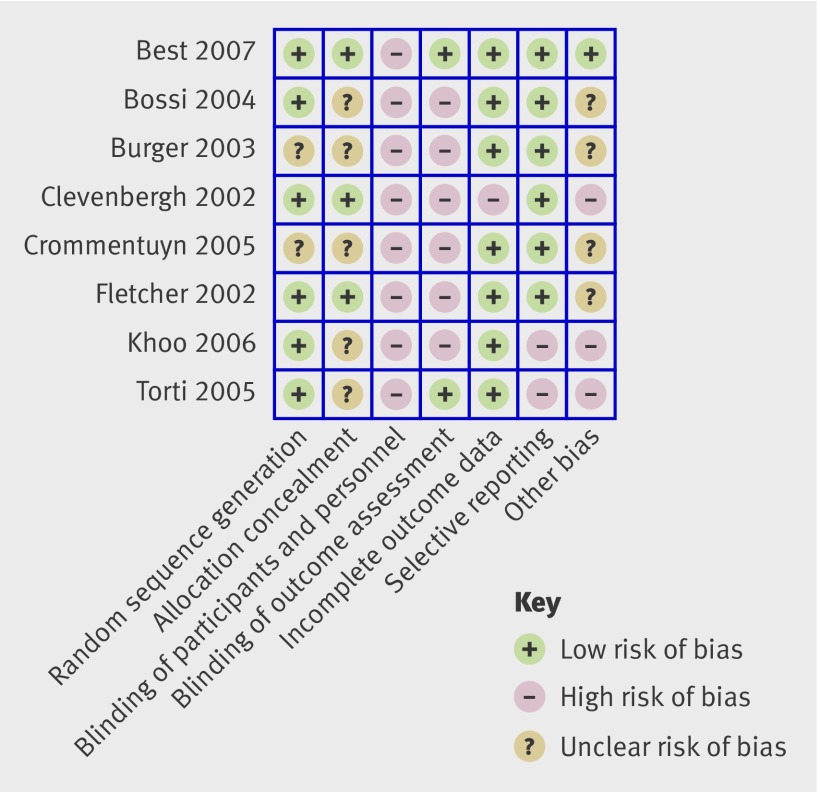
- The tool assesses six domains: selection bias, performance bias, detection bias, attrition bias, reporting bias, and other bias; each item has a support-for-judgment description and a judgment of low, unclear, or high risk of material bias.
- In evaluation, of 187 surveyed authors, 88% took longer than 10 minutes to complete the tool, 44% longer than 20 minutes, and 7% longer than an hour, but 83% considered the time taken acceptable.
- A cited study found a mean of 8.8 minutes per person for a single predetermined outcome using the tool compared with 1.5 minutes for a previous rating scale for quality of reporting; larger effect sizes were observed on average in studies rated at high risk of bias compared with low risk.
- Incomplete outcome data and selective reporting were the most difficult items to assess, with reported kappa measures of agreement of 0.32 (fair) and 0.13 (slight), respectively.
Methods
- The tool was developed at a May 2005 meeting by informal consensus, based on seven principles; detailed criteria and guidance were developed by pairs of authors and refined through feedback, email iterations, presentations, workshops, and pilot work, then published in February 2008.
- Evaluation began in early 2009 as a three-stage project: focus groups with review authors who had used the tool, three online surveys of review authors who had used the tool, review authors who had not used it, and editorial teams, plus a March 2010 meeting to consider revisions.
- The paper is a methods/guidance article describing the tool, its principles, presentation, summary assessment, and use in synthesis; survey findings are reported descriptively.
Limitations
- The paper states that the reliability of the tool has not been extensively studied and that, by explicitly incorporating judgments, agreements between assessors may not be as high as for some other tools.
- It states continuing uncertainty and great variation in practice over how to assess potential for bias in specific domains, how to summarise bias assessments across domains, and how to incorporate bias assessments into meta-analyses.
- Evident from the text: the evaluation reports selected survey percentages without a response rate or full survey methodology, and the reliability evidence cited is preliminary and limited.
Model-written summary. Check it against the paper before relying on it.
Integrity signals
Registry
Cites
Statistics
Figures
Verification
Claims the paper makes
0 Valid · 3 Not valid · 1 Not checked · 20 Own results and interpretations
In the paper
“This was published in February 2008 and adopted as the recommended method throughout the Cochrane Collaboration.”
What the sources say
- Not matchedcites [9] 9. Higgins JPT, Green S, eds. Cochrane handbook for systematic reviews of interventions . Wiley, 2008.
Couldn’t be matched to a paper, so it can’t be checked.
- Not matched
A result the paper reports from its own data — it cites no other source for it, so there is none to check. The quote shows it is in the paper.
In the paper
“The Cochrane Collaboration has developed a new tool for assessing risk of bias in randomised trials”
A result the paper reports from its own data — it cites no other source for it, so there is none to check. The quote shows it is in the paper.
In the paper
“The 2010 evaluation of the initial version found wide acceptance of the need for the risk of bias tool, with a consensus that it represents an improvement over methods previously recommended by the Collaboration or widely used in systematic reviews.”
A result the paper reports from its own data — it cites no other source for it, so there is none to check. The quote shows it is in the paper.
In the paper
“Participants in the focus groups noted that the tool took longer to complete than previous methods.”
A result the paper reports from its own data — it cites no other source for it, so there is none to check. The quote shows it is in the paper.
In the paper
“We believe our risk of bias tool is one of the most comprehensive approaches to assessing the potential for bias in randomised trials included in systematic reviews or meta-analyses.”
19 more claims
Create a free account to see all 24 claims and every source verdict.
Claims other papers make about this one
Each is checked against this paper’s own text: does it say what the citing paper says it does?
The source backs part of the claim, not all of it — or backs it for a different population, condition or comparison.
In the citing paper
“The methodological quality of the RCTs was assessed using the Cochrane collaboration’s Risk Interventions Risk of Bias Tool (Higgins et al., 2011) reporting each of its five domains (adequate randomization and allocation, blinding, loss to follow-up, selective reporting, and other sources of potential bias) into a low risk of bias, high risk of bias, or unclear risk of bias.”
From Augmentation strategies for treatment resistant major depression: A systematic review and network meta-analysis (2022) · cites this paper as Higgins et al., 2011
Experimental — accuracy not yet measuredThe source backs part of the claim, not all of it — or backs it for a different population, condition or comparison.
In the citing paper
“Checklists and protocols for gauging the quality of evidence in a systematic fashion 8,9 also do not single out these problematic reports.”
From Fraudulent studies are undermining the reliability of systematic reviews: on the prevalence of problematic images in preclinical depression studies (2025) · cites this paper as [9]
Experimental — accuracy not yet measuredThe source backs part of the claim, not all of it — or backs it for a different population, condition or comparison.
In the citing paper
“When assessing the risk of bias, seven general principles are relevant, based on theoretical considerations, empirical work, and the experience with assessing risk of bias in RCTs and other studies [55–57].”
From COSMOS-E: Guidance on conducting systematic reviews and meta-analyses of observational studies of etiology (2019) · cites this paper as [55]
Experimental — accuracy not yet measuredThe source backs part of the claim, not all of it — or backs it for a different population, condition or comparison.
In the citing paper
“Four reviewers (J.d.P.-C., B.d.P.-C., R.M.A.-R., and J.R.-M.) independently assessed the risk of bias of the included studies according to version 2 of the Cochrane riskof-bias tool for randomized trials (RoB 2) (26).”
From Optimal Dose and Type of Physical Activity to Improve Glycemic Control in People Diagnosed With Type 2 Diabetes: A Systematic Review and Meta-analysis (2024) · cites this paper as [26]
Experimental — accuracy not yet measuredThe source backs part of the claim, not all of it — or backs it for a different population, condition or comparison.
In the citing paper
“RCTs were appraised using the Cochrane RoB 2 tool and observational studies using methodological index for non-randomized studies (MINORS).13,14”
From Perioperative Analgesia and Postoperative Nausea and Vomiting Management in Otoplasty: A Systematic Review (2026) · cites this paper as [13]
Experimental — accuracy not yet measured
113 more claims about this paper
Create a free account to see every claim other papers make about this one.
Citations
Cites
Cochrane Handbook for Systematic Reviews of Interventions: Cochrane Book Series
(2008) · doi:10.1002/9780470712184 · Cited by 25,048
Self-citationGRADE: an emerging consensus on rating quality of evidence and strength of recommendations
Guyatt, G. H., Oxman, A. D., Vist, G. E., Kunz, R., Falck-Ytter, Y., Alonso-Coello, P., & Schünemann, H. J. (2008) · BMJ · doi:10.1136/bmj.39489.470347.ad · Cited by 23,305
Self-citationAssessing Risk of Bias in Included Studies
Higgins, J. P., & Altman, D. G. (2008) · Cochrane Handbook for Systematic Reviews of Interventions · doi:10.1002/9780470712184.ch8 · Cited by 3,396
Self-citationAssessing the quality of controlled clinical trials
Jüni, P., Altman, D. G., & Egger, M. (2001) · BMJ · doi:10.1136/bmj.323.7303.42 · Cited by 3,309
Self-citationWood, L., Egger, M., Gluud, L. L., Schulz, K. F., Jüni, P., Altman, D. G., Gluud, C., Martin, R. M., Wood, A. J. G., & Sterne, J. A. C. (2008) · BMJ · doi:10.1136/bmj.39465.451748.ad · Cited by 2,538
Self-citationSystematic Reviews in Health Care : Meta-Analysis in Context
Egger, M., Smith, G. D., & Altman, D. G. (2000) · Cited by 2,413
Self-citationThe Hazards of Scoring the Quality of Clinical Trials for Meta-analysis
Jüni, P. (1999) · JAMA · doi:10.1001/jama.282.11.1054 · Cited by 1,981
Self-citationMoher, D., Jadad, A. R., Nichol, G., Penman, M., Tugwell, P., & Walsh, S. (1995) · Controlled Clinical Trials · doi:10.1016/0197-2456(94)00031-w · Cited by 1,308
Self-citationControlling the risk of spurious findings from meta-regression
Higgins, J. P. T., & Thompson, S. G. (2004) · Statistics in Medicine · doi:10.1002/sim.1752 · Cited by 1,267
Self-citationDiscrepancies between Meta-Analyses and Subsequent Large Randomized, Controlled Trials
LeLorier, J., Grégoire, G., Benhaddad, A., Lapierre, J., & Derderian, F. (1997) · New England Journal of Medicine · doi:10.1056/nejm199708213370806 · Cited by 1,171
Research works printed but not linked: 3
- [9]9. Higgins JPT, Green S, eds. Cochrane handbook for systematic reviews of interventions . Wiley, 2008.
- [16]16. No commercial reuse: See rights and reprints http://www.bmj.com/permissions Subscribe: http://www.bmj.com/subscribe BMJ 2008;336:924-6.
- [17]17. Schünemann HJ, Oxman AD, Higgins JPT, Vist GE, Glasziou P, Guyatt GH, et al. Presenting results and "Summary of findings" tables. In: Higgins JPT, Green S, eds. Cochrane handbook for systematic reviews of interventions . Wiley, 2008:335-8.
Cited by
Items 2,301–2,382 of 2,382
Lu, J., Yang, Y., Chen, H., Ma, H., & Tan, Y. (2024) · Frontiers in Psychology · doi:10.3389/fpsyg.2024.1362127 · Cited by 11
Rahmati, M., Smith, L., Piyasena, M. P., Bowen, M., Boyer, L., Fond, G., Kazemi, A., Yon, D. K., Lee, H., Sehmbi, T., et al. (2025) · Eye · doi:10.1038/s41433-025-03849-4 · Cited by 11
Pemafibrate Tends to have Better Efficacy in Treating Dyslipidemia than Fenofibrate
Wang, H., Li, H., Zhou, Y., Liu, J., Wang, F., & Zhao, Q. (2020) · Current Pharmaceutical Design · doi:10.2174/1381612825666191126102943 · Cited by 11
Ranneh, Y., Hamsho, M., Shkorfu, W., Terzi, M., & Fadel, A. (2025) · Nutrients · doi:10.3390/nu17152436 · Cited by 11
A systematic review and meta-analysis of the acute effect of caffeine on attention
Kløve, K., & Petersen, A. (2025) · Psychopharmacology · doi:10.1007/s00213-025-06775-1 · Cited by 10
“The risk of bias in each included study was assessed by the first author using the tool from the Cochrane Collaboration (Higgins et al. 2011a, b).”
InfluentialLee, J., & Song, J.-U. (2020) · Journal of Korean Medical Science · doi:10.3346/jkms.2020.35.e48 · Cited by 10
Martin, K.-J., Golijani-Moghaddam, N., & dasNair, R. (2018) · International Journal of Therapy and Rehabilitation · doi:10.12968/ijtr.2018.25.2.82 · Cited by 10
Yuyan, Y., Jiaqi, L., Ting, W., Juan, X., Jinfeng, W., & Jing, L. (2025) · European Journal of Oncology Nursing · doi:10.1016/j.ejon.2025.102862 · Cited by 11
Acceptance and commitment therapy (ACT) among U.S. veterans: A systematic review
Donahue, M. L., Fruge, J. E., Andresen, F. J., & Twohig, M. P. (2024) · Journal of Contextual Behavioral Science · doi:10.1016/j.jcbs.2024.100731 · Cited by 10
Kirk, M. A., Pirbaglou, M., Weerasekera, R., & Ritvo, P. (2022) · International Journal of Mental Health · doi:10.1080/00207411.2021.1959807 · Cited by 10
Kanser Tanısı Olan Kişilerde Kabul ve Kararlılık Terapisi Uygulamaları: Sistematik Bir Derleme
Baş, S., & Dirik, G. (2019) · Psikoloji Çalışmaları / Studies in Psychology · doi:10.26650/sp2019-0025 · Cited by 10
Brief interventions for alcohol misuse among people living with HIV: a meta-analysis
Ghosh, A., Singh, G. K., Yadav, N., Singh, P., & Kathiravan, S. (2023) · The American Journal of Drug and Alcohol Abuse · doi:10.1080/00952990.2023.2248647 · Cited by 10
Almuntashiri, S. A., Alsubaie, F. F., & Alotaybi, M. (2025) · Cureus · doi:10.7759/cureus.78629 · Cited by 10
Jötten, L., Steinkraus, K. C., Traub, B., Graf, S., Mihaljevic, A. L., Kornmann, M., Michalski, C. W., & Hüttner, F. J. (2022) · BJS Open · doi:10.1093/bjsopen/zrac139 · Cited by 10
Du, H., Bo, L., Lai, X., Zhu, H., & Huo, X. (2023) · Frontiers in Aging Neuroscience · doi:10.3389/fnagi.2023.1095996 · Cited by 10
Iketani, R., Ohno, K., Kawasaki, Y., Matsumoto, K., Yamada, H., & Kishino, S. (2018) · Biological and Pharmaceutical Bulletin · doi:10.1248/bpb.b17-00929 · Cited by 10
Novak, A. S. (2019) · Journal of School Violence · doi:10.1080/15388220.2018.1512416 · Cited by 9
Association between Asthma and Caries-Related Salivary Factors: A Meta-Analysis
Hatipoğlu, Ö., & Pertek Hatipoğlu, F. (2022) · Journal of Asthma · doi:10.1080/02770903.2020.1826045 · Cited by 9
Kavanagh, B. E., Brennan-Olsen, S. L., Turner, A., Dean, O. M., Berk, M., Ashton, M. M., Koivumaa-Honkanen, H., & Williams, L. J. (2019) · BMJ Open · doi:10.1136/bmjopen-2018-025145 · Cited by 9
Kwan, Y. K., Lau, Y., Ang, W. W., & Lau, S. T. (2024) · Nicotine and Tobacco Research · doi:10.1093/ntr/ntad145 · Cited by 9
McGowan, B., Ciudin, A., Baker, J. L., Busetto, L., Dicker, D., Frühbeck, G., Goossens, G. H., Monami, M., Ragghianti, B., Sbraccia, P., et al. (2025) · Obesity Facts · doi:10.1159/000546855 · Cited by 9
Li, S., Liu, H., & Zhu, X. (2021) · Medicine · doi:10.1097/md.0000000000028386 · Cited by 8
How should we assess trustworthiness of randomized controlled trials?
Wilkinson, J., & Tovey, D. (2025) · Journal of Clinical Epidemiology · doi:10.1016/j.jclinepi.2025.111670 · Cited by 8
Wambier, L. M., Gonçalves, A. D. R., Wambier, D. S., Reis, A., & Chibinski, A. C. R. (2022) · Brazilian Oral Research · doi:10.1590/1807-3107bor-2022.vol36.0017 · Cited by 8
Huda, M. H., Rahman, M. F., Zalaya, Y., Mukminin, M. A., Purnamasari, T., Hendarwan, H., Su’udi, A., Hasugian, A. R., Yuniar, Y., Handayani, R. S., et al. (2024) · PLOS ONE · doi:10.1371/journal.pone.0312001 · Cited by 8
Rose, C. J., Bidonde, J., Ringsten, M., Glanville, J., Potrebny, T., Cooper, C., Muller, A. E., Bergsund, H. B., Meneses‐Echavez, J. F., & Berg, R. C. (2025) · Cochrane Evidence Synthesis and Methods · doi:10.1002/cesm.70048 · Cited by 8
Chen, D., Liu, Q., Zhang, L., & Qian, H. (2025) · Cancer Nursing · doi:10.1097/ncc.0000000000001307 · Cited by 8
Bannon, C. A., Gallacher, D., Hanson, P., Randeva, H. S., Weickert, M. O., & Barber, T. M. (2020) · Clinical Endocrinology · doi:10.1111/cen.14275 · Cited by 8
Jia, Y., Dong, X., Chai, Y., Bai, Z., Sun, T., & Hou, X. (2025) · BMJ Open · doi:10.1136/bmjopen-2024-087340 · Cited by 8
Lyzwinski, L., Zwicker, J. D., Mcdonald, S., & Tough, S. (2024) · JMIR Pediatrics and Parenting · doi:10.2196/59171 · Cited by 7
C. Ashe, M., 1 Centre for Hip Health and Mobility, V., L. Ekegren, C., M. Chudyk, A., Fleig, L., K. Gill, T., Langford, D., Martin-Martin, L., Ariza-Vega, P., 2 Department of Family Practice, T. U. O. B. C., et al. (2018) · AIMS Medical Science · doi:10.3934/medsci.2018.4.316 · Cited by 7
The role of diet in diabetes gastroparesis treatment: a systematic review and meta-analysis
Lin, D., Wang, H., Ou, Y., Li, L., Zhang, Q., Yan, J., Peng, D., & Peng, S. (2024) · Frontiers in Endocrinology · doi:10.3389/fendo.2024.1379398 · Cited by 7
Powers, H. J. (2021) · Proceedings of the Nutrition Society · doi:10.1017/s0029665121000562 · Cited by 7
Messias, A., Karasan, D., Nicolau, P., Pjetursson, B. E., & Guerra, F. (2023) · Clinical Oral Implants Research · doi:10.1111/clr.13931 · Cited by 7
Antoniou, S. A., Anastasiadou, A., Antoniou, G. A., Granderath, F.-A., & Kafatos, A. (2017) · European Surgery · doi:10.1007/s10353-016-0459-4 · Cited by 6
Grigg, M. J., Thake, C. D., Allgrove, J. E., King, J. A., Thackray, A. E., Stensel, D. J., Owen, A., & Broom, D. R. (2023) · Appetite · doi:10.1016/j.appet.2022.106375 · Cited by 9
Pellicano, G. R., Daniela, S., Chiara, C., Arianna, G., Paola, A., & Carlo, L. (2022) · Journal of Affective Disorders Reports · doi:10.1016/j.jadr.2022.100310 · Cited by 6
Ghoreshi, Z., Charostad, J., Arefinia, N., Nakhaie, M., Rezaei Zadeh Rukerd, M., & Salajegheh, F. (2024) · Pharmacology Research & Perspectives · doi:10.1002/prp2.70013 · Cited by 6
(2021) · doi:10.1136/bmjmilitary-2021-001955 · Cited by 6
Paradise, S. L., Beer, J. R., Cruz, C. A., Fechner, K. M., MacGregor, A. J., & Fraser, J. J. (2021) · doi:10.1101/2021.06.07.21258508 · Cited by 6
Prevention of burnout syndrome in physicians: a systematic review and meta-analysis
Krebs, L., Jung, L., & Arrich, J. (2026) · Wiener Klinische Wochenschrift · doi:10.1007/s00508-025-02601-y · Cited by 5
Kushner, R. F., Johansen, O. E., Araujo Torres, K., Phan, T.-M., & Marczewska, A. (2025) · Obesities · doi:10.3390/obesities5020029 · Cited by 5
The effect of mobile application-based technology on post-stroke aphasia: a systematic review
Jiang, Z., He, M., Zhang, C., & Chen, X. (2024) · Frontiers in Neurology · doi:10.3389/fneur.2024.1405209 · Cited by 6
Nagendra, L., Dutta, D., Mondal, S., Kapoor, N., Joshi, A., & Bhattacharya, S. (2024) · Journal of Clinical Densitometry · doi:10.1016/j.jocd.2023.101453 · Cited by 5
Amini, M. R., Rasaei, N., Jalalzadeh, M., Pourreza, S., & Hekmatdoost, A. (2024) · Phytotherapy Research · doi:10.1002/ptr.8357 · Cited by 5
The effect of tailored Web-based interventions on pain in adults: a systematic review protocol
Martorella, G., Gélinas, C., Bérubé, M., Boitor, M., Fredericks, S., & LeMay, S. (2016) · Systematic Reviews · doi:10.1186/s13643-016-0233-5 · Cited by 5
Zhang, X., Chang, Z., Zhao, S., & Ning, Z. (2025) · Frontiers in Psychology · doi:10.3389/fpsyg.2025.1662868 · Cited by 5
Kwon, C.-Y., & Lee, B. (2024) · Complementary Therapies in Medicine · doi:10.1016/j.ctim.2024.103016 · Cited by 5
Heltne, A., Frans, N., Hummelen, B., Falkum, E., Germans Selvik, S., & Paap, M. C. S. (2023) · Scandinavian Journal of Psychology · doi:10.1111/sjop.12918 · Cited by 5
Impact of electronic medical records on healthcare delivery in Nigeria: A review
Olukorode, S. O., Adedeji, O. J., Adetokun, A., & Abioye, A. I. (2024) · PLOS Digital Health · doi:10.1371/journal.pdig.0000420 · Cited by 5
Zhao, R., Amarnath, A., Karyotaki, E., Struijs, S. Y., & Cuijpers, P. (2022) · Psychological Medicine · doi:10.1017/s0033291722003518 · Cited by 5
Rose, C. J., Bidonde, J., Ringsten, M., Glanville, J., Berg, R. C., Cooper, C., Muller, A. E., Bergsund, H. B., Meneses-Echavez, J. F., & Potrebny, T. (2025) · BMC Medical Research Methodology · doi:10.1186/s12874-025-02631-0 · Cited by 5
Nasir, Y., & Rahimi, M. H. (2024) · Nutrition Clinique et Métabolisme · doi:10.1016/j.nupar.2024.04.006 · Cited by 5
Cannabis-Based Products for Chronic Pain: An Updated Systematic Review
Chou, R., Fu, R., Ahmed, A. Y., & Morasco, B. J. (2026) · Annals of Internal Medicine · doi:10.7326/annals-25-03152 · Cited by 4
Schopf, K., Mohr, C., Lippert, M. W., Sommer, K., Meyer, A. H., & Schneider, S. (2020) · Systematic Reviews · doi:10.1186/s13643-020-01337-2 · Cited by 4
Almutawif, Y. A., Najim, M. A., & Khan, N. U. (2025) · Infection · doi:10.1007/s15010-025-02580-2 · Cited by 4
Dallenbach, M. L., Moeller, K., & Givens, A. (2025) · Child and Adolescent Social Work Journal · doi:10.1007/s10560-024-00961-4 · Cited by 4
Jiang, S., Gao, X., Diao, H., Zhang, Y., Lu, G., Liu, X., & Li, Y. (2026) · JMIR mHealth and uHealth · doi:10.2196/70429 · Cited by 6
Khan, A., Kim, D., Atwater, R., & Reddy, R. (2025) · Medicina · doi:10.3390/medicina62010039 · Cited by 3
Poprzeczny, A. J., Mitchell, M., Deussen, A. R., Habibi, N., Cheung, T. O., & Grieger, J. A. (2025) · Australian and New Zealand Journal of Obstetrics and Gynaecology · doi:10.1111/ajo.70032 · Cited by 3
Carneiro, L., Silva, F., Vasoncelos-Raposo, J., Mota, M. P., Vieira-Coelho, M. A., Deslandes, A., Marinho, H., Amaral, G., & Monteiro-Júnior, R. (2020) · doi:10.21203/rs.3.rs-24600/v1 · Cited by 3
Scott, K., Becker, S. J., Helseth, S. A., Saldanha, I. J., Balk, E. M., Adam, G. P., Konnyu, K. J., & Steele, D. W. (2022) · Family Practice · doi:10.1093/fampra/cmab096 · Cited by 3
Berrío, J. P., & Kalliokoski, O. (2025) · FEBS Letters · doi:10.1002/1873-3468.70077 · Cited by 7
Vasodilators for women undergoing fertility treatment
Gutarra-Vilchez, R. B., Vazquez, J. C., Glujovsky, D., Lizaraso, F., Viteri-García, A., & Martinez-Zapata, M. J. (2025) · Cochrane Database of Systematic Reviews · doi:10.1002/14651858.cd010001.pub4 · Cited by 3
Giusti, E. M., Spatola, C. A. M., Brunani, A., Kumbhare, D., Oral, A., Ilieva, E., Kiekens, C., Pietrabissa, G., Manzoni, G. M., Imamura, M., et al. (2020) · The Journal of the International Society of Physical and Rehabilitation Medicine · doi:10.4103/jisprm.jisprm_6_20 · Cited by 2
Compliance of RCTs in endodontic instrumentation with the CONSORT Statement: A systematic review
Cabral, K. A., Martins, A. C. R., Wambier, L. M., Vivacqua-Gomes, N., Rezende, M., Reis, A., & Geus, J. L. D. (2021) · Research, Society and Development · doi:10.33448/rsd-v10i8.17350 · Cited by 2
Nukaly, H. Y., Halawani, I. R., Irtaza, H. M., Alturkistani, T., Serafi, M. R., Alhawsawi, W., Bogari, H. O., Ahmed, F. A., Alhaddad, Y., Shadid, A., et al. (2026) · Frontiers in Medicine · doi:10.3389/fmed.2026.1618306 · Cited by 3
Li, M., Patel, J., Ibrahim, S., & Katapally, T. R. (2025) · doi:10.1101/2025.08.20.25334071 · Cited by 2
Yang, X., Gao, Y.-Y., Xu, S.-Q., Wang, J.-C., Ma, Y.-J., Jiao, L.-H., Wang, L., Wang, X.-Y., Bashir, S., An, C.-X., et al. (2025) · World Journal of Meta-Analysis · doi:10.13105/wjma.v13.i1.99971 · Cited by 1
Fitzpatrick, D., & Burns, J. (2018) · Campbell Systematic Reviews: Better Evidence for a Better World · doi:10.1002/cl2.194 · Cited by 1
Kousios, A., Hadjivasilis, A., Kouis, P., & Panayiotou, A. (2020) · doi:10.21203/rs.3.rs-104160/v1 · Cited by 1
Meade, A., Santero, M., Savall-Esteve, O., Bracchiglione, J., Leache, L., Selva, A., Macias, I., Cerdà, P., & Bonfill Cosp, X. (2025) · Journal of Gastrointestinal Cancer · doi:10.1007/s12029-024-01155-y · Cited by 1
Julanon, N., Unhapipatpong, C., Wongjirattikarn, R., Anutraungkool, T., Chaowattanapanit, S., Choonhakarn, C., Sawanyawisuth, K., Shantavasinkul, P. C., Zouboulis, C. C., & Piguet, V. (2026) · Journal of Cutaneous Medicine and Surgery · doi:10.1177/12034754261445880 · Cited by 1
Alnufaei, A. H., AlSubaie, F. K., Aljabri, R. A., Aloqayli, S. Z., Alanshmi, S., Alotaibi, S. M., Ajeeb, Z. B., AlGhamdi, L. Y., Kattan, M. E., Alahmadi, B. H., et al. (2026) · Plastic and Reconstructive Surgery - Global Open · doi:10.1097/gox.0000000000007347
Tiraieyari, N., & Krauss, S. (2026) · Frontiers in Education · doi:10.3389/feduc.2026.1518053
Effectiveness of psychotherapy for Hwa-Byung: A systematic review of interventional studies
Kwon, C.-Y., & Lee, B. (2025) · Medicine · doi:10.1097/md.0000000000041315
Chiaramonte, R., Ferrillo, M., de Sire, A., & Vecchio, M. (2026) · Journal of Manual & Manipulative Therapy · doi:10.1080/10669817.2026.2629282 · Cited by 6
Ladopoulos, K., Pateras, E., & Ninos, G. (2026) · Cureus · doi:10.7759/cureus.104008
Liang, Z., Sheffield, C., Butera, G., & Antani, S. (2026) · JMIR AI · doi:10.2196/93761
Pardiñas López, S., Khouly, I., Aellos, F., Alccayhuaman, K. A., & Díaz Prado, S. M. (2026) · BMC Oral Health · doi:10.1186/s12903-026-08411-6
Susanti, E., Kosasih, C., Priambodo, A., Juniarti, N., Aziz, M., & Afriana, R. (2026) · Journal of Multidisciplinary Healthcare · doi:10.2147/jmdh.s605488
López, S. P., Khouly, I., Aellos, F., Alccayhuaman, K. A., & Díaz-Prado, S. (2025) · doi:10.21203/rs.3.rs-6038491/v1
Metadata
- Authors
- Higgins, J. P. T., Altman, D. G., Gotzsche, P. C., Juni, P., Moher, D., Oxman, A. D., Savovic, J., Schulz, K. F., Weeks, L., Sterne, J. A. C., Cochrane Bias Methods Group, & Cochrane Statistical Methods Group
- Affiliations
- MRC Biostatistics Unit (GB)
- University of Oxford (GB)
- University of Ottawa (CA)
- Nasjonalt Kunnskapssenter for Helsetjenesten (NO)
- Family Health International 360 (US)
- Ottawa Hospital Research Institute (CA)
- University of Bristol (GB)
- Corresponding author
- Higgins, J. P. T.
- Venue
- BMJ
- Publisher
- BMJ
- Published
- 2011-10-18
- Volume
- 343
- Issue
- oct18 2
- Pages
- d5928-d5928
- ISSN
- 0007-1447 (ISSN-L)
- 0959-8138
- 1468-5833
- PMC
- PMC3196245
- OpenAlex
- W2098923148
- Cited by
- 33,817
- References
- 26
- Citations by year
- 2026: 1970 · 2025: 3214 · 2024: 3745 · 2023: 3530 · 2022: 4008 · 2021: 4125 · 2020: 3755 · 2019: 2714 · 2018: 2012 · 2017: 1569 · 2016: 1203 · 2015: 881 · 2014: 591 · 2013: 342 · 2012: 97
- FWCI
- 352.06
- Type
- journal article
- Language
- en
- Open access
- hybrid
- doi.org
- Licence
- cc-by-nc
- Locations
- BMJ (publishedVersion, cc-by-nc)
- Europe PMC (PubMed Central) (publishedVersion, cc-by-nc)
- PubMed Central (publishedVersion, cc-by-nc)
- PubMed (publishedVersion)
- Research at the University of Copenhagen (University of Copenhagen) (publishedVersion)
- Bristol Research (University of Bristol) (publishedVersion)
- Bern Open Repository and Information System (University of Bern) (submittedVersion, cc-by-nc)
- Open Access CRIS of the University of Bern
- Funders
- Cancer Research UK (C-5592)
- Canadian Institutes of Health Research
- Topics
- Social Sciences › Decision Sciences › Statistics, Probability and Uncertainty › Meta-analysis and systematic reviews
- Physical Sciences › Mathematics › Statistics and Probability › Statistical Methods in Clinical Trials
- Physical Sciences › Mathematics › Statistics and Probability › Statistical Methods in Epidemiology
- Keywords
- risk of bias, Cochrane risk of bias tool, randomised trials, trial design flaws, trial conduct, trial analysis, trial reporting, bias assessment
- MeSH terms
- Humans, Research Design, Bias, Randomized Controlled Trials as Topic, Risk Assessment
About these checks
Registry, retraction, Cites and statistics results are computed, not judged, with one exception: a printed reference that no index lists is read once by a model before it counts as a citation error. Claims are extracted by a model and kept only when their quote appears verbatim in the text; each cited source is then checked, with a model’s help, for whether it says what the claim relies on. Those verdicts can be wrong — read the claim’s quote and the cited source before relying on one.
A language model drew the claims from the paper on 2026-09-24 (prompt extract-v1).
Statistics and arithmetic are recomputed, not judged.
Confidence bands are shown only for fields calibrated on our annotated test set. None is calibrated yet, so no band is shown.
What counts as a claim ›How we measure confidence ›How we check this ›
Are you an author, or do you see a problem with this page? Request a review
Data sources
Bibliographic data: Semantic Scholar, OpenAlex, Crossref.
Contains information from the Semantic Scholar Academic Graph Datasets, made available under the ODC Attribution License (ODC-BY 1.0).
Semantic Scholar’s data is described in: Kinney, R., et al. (2023). The Semantic Scholar Open Data Platform. arXiv:2301.10140.
