

The Cochrane Collaboration's tool for assessing risk of bias in randomised trials
Open accessThe DOI matches its Crossref record; 25 of the 26 references it cites were found in a registry or an index; none of the 1 sources its claims cite is checked for support yet.
Abstract
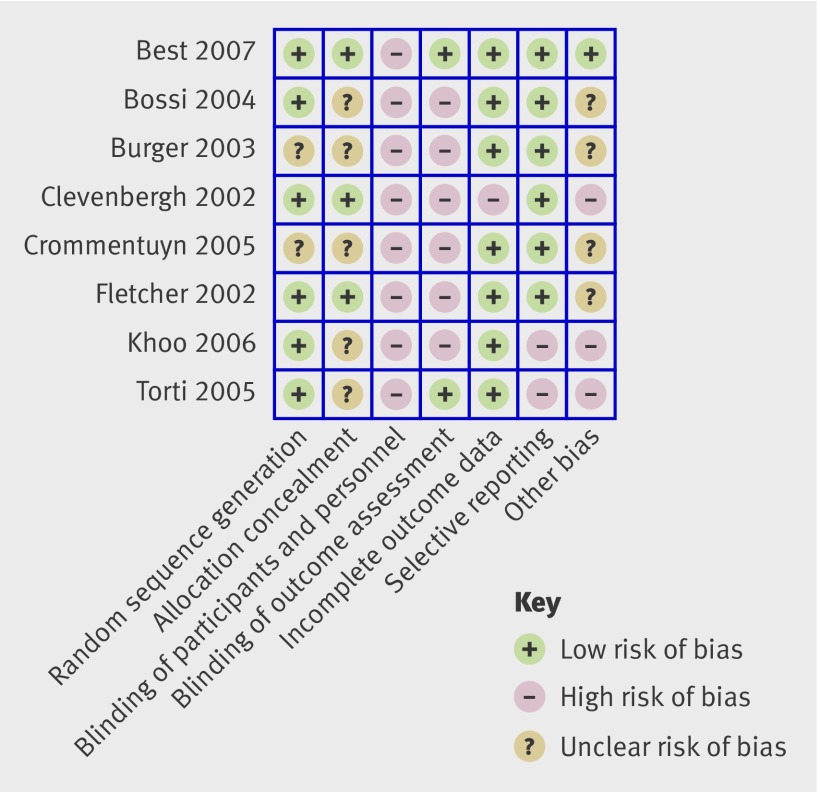
Flaws in the design, conduct, analysis, and reporting of randomised trials can cause the effect of an intervention to be underestimated or overestimated. The Cochrane Collaboration’s tool for assessing risk of bias aims to make the process clearer and more accurate
Overview
CoChat Summary
TL;DR
The paper presents the Cochrane Collaboration’s risk of bias tool for randomised trials, covering six bias domains with item-level support for judgment and low/unclear/high risk judgments. It describes the tool’s development, evaluation, and recommended use in systematic reviews and meta-analyses.
Key findings
- The tool assesses six domains: selection bias, performance bias, detection bias, attrition bias, reporting bias, and other bias; each item has a support-for-judgment description and a judgment of low, unclear, or high risk of material bias.
- In evaluation, of 187 surveyed authors, 88% took longer than 10 minutes to complete the tool, 44% longer than 20 minutes, and 7% longer than an hour, but 83% considered the time taken acceptable.
- A cited study found a mean of 8.8 minutes per person for a single predetermined outcome using the tool compared with 1.5 minutes for a previous rating scale for quality of reporting; larger effect sizes were observed on average in studies rated at high risk of bias compared with low risk.
- Incomplete outcome data and selective reporting were the most difficult items to assess, with reported kappa measures of agreement of 0.32 (fair) and 0.13 (slight), respectively.
Methods
- The tool was developed at a May 2005 meeting by informal consensus, based on seven principles; detailed criteria and guidance were developed by pairs of authors and refined through feedback, email iterations, presentations, workshops, and pilot work, then published in February 2008.
- Evaluation began in early 2009 as a three-stage project: focus groups with review authors who had used the tool, three online surveys of review authors who had used the tool, review authors who had not used it, and editorial teams, plus a March 2010 meeting to consider revisions.
- The paper is a methods/guidance article describing the tool, its principles, presentation, summary assessment, and use in synthesis; survey findings are reported descriptively.
Limitations
- The paper states that the reliability of the tool has not been extensively studied and that, by explicitly incorporating judgments, agreements between assessors may not be as high as for some other tools.
- It states continuing uncertainty and great variation in practice over how to assess potential for bias in specific domains, how to summarise bias assessments across domains, and how to incorporate bias assessments into meta-analyses.
- Evident from the text: the evaluation reports selected survey percentages without a response rate or full survey methodology, and the reliability evidence cited is preliminary and limited.
Model-written summary. Check it against the paper before relying on it.
Integrity signals
Registry
Cites
Statistics
Figures
Verification
Claims the paper makes
0 Valid · 3 Not valid · 1 Not checked · 20 Own results and interpretations
In the paper
“This was published in February 2008 and adopted as the recommended method throughout the Cochrane Collaboration.”
What the sources say
- Not matchedcites [9] 9. Higgins JPT, Green S, eds. Cochrane handbook for systematic reviews of interventions . Wiley, 2008.
Couldn’t be matched to a paper, so it can’t be checked.
- Not matched
A result the paper reports from its own data — it cites no other source for it, so there is none to check. The quote shows it is in the paper.
In the paper
“The Cochrane Collaboration has developed a new tool for assessing risk of bias in randomised trials”
A result the paper reports from its own data — it cites no other source for it, so there is none to check. The quote shows it is in the paper.
In the paper
“The 2010 evaluation of the initial version found wide acceptance of the need for the risk of bias tool, with a consensus that it represents an improvement over methods previously recommended by the Collaboration or widely used in systematic reviews.”
A result the paper reports from its own data — it cites no other source for it, so there is none to check. The quote shows it is in the paper.
In the paper
“Participants in the focus groups noted that the tool took longer to complete than previous methods.”
A result the paper reports from its own data — it cites no other source for it, so there is none to check. The quote shows it is in the paper.
In the paper
“We believe our risk of bias tool is one of the most comprehensive approaches to assessing the potential for bias in randomised trials included in systematic reviews or meta-analyses.”
19 more claims
Create a free account to see all 24 claims and every source verdict.
Claims other papers make about this one
Each is checked against this paper’s own text: does it say what the citing paper says it does?
The source backs part of the claim, not all of it — or backs it for a different population, condition or comparison.
In the citing paper
“The methodological quality of the RCTs was assessed using the Cochrane collaboration’s Risk Interventions Risk of Bias Tool (Higgins et al., 2011) reporting each of its five domains (adequate randomization and allocation, blinding, loss to follow-up, selective reporting, and other sources of potential bias) into a low risk of bias, high risk of bias, or unclear risk of bias.”
From Augmentation strategies for treatment resistant major depression: A systematic review and network meta-analysis (2022) · cites this paper as Higgins et al., 2011
Experimental — accuracy not yet measuredThe source backs part of the claim, not all of it — or backs it for a different population, condition or comparison.
In the citing paper
“Checklists and protocols for gauging the quality of evidence in a systematic fashion 8,9 also do not single out these problematic reports.”
From Fraudulent studies are undermining the reliability of systematic reviews: on the prevalence of problematic images in preclinical depression studies (2025) · cites this paper as [9]
Experimental — accuracy not yet measuredThe source backs part of the claim, not all of it — or backs it for a different population, condition or comparison.
In the citing paper
“When assessing the risk of bias, seven general principles are relevant, based on theoretical considerations, empirical work, and the experience with assessing risk of bias in RCTs and other studies [55–57].”
From COSMOS-E: Guidance on conducting systematic reviews and meta-analyses of observational studies of etiology (2019) · cites this paper as [55]
Experimental — accuracy not yet measuredThe source backs part of the claim, not all of it — or backs it for a different population, condition or comparison.
In the citing paper
“Four reviewers (J.d.P.-C., B.d.P.-C., R.M.A.-R., and J.R.-M.) independently assessed the risk of bias of the included studies according to version 2 of the Cochrane riskof-bias tool for randomized trials (RoB 2) (26).”
From Optimal Dose and Type of Physical Activity to Improve Glycemic Control in People Diagnosed With Type 2 Diabetes: A Systematic Review and Meta-analysis (2024) · cites this paper as [26]
Experimental — accuracy not yet measuredThe source backs part of the claim, not all of it — or backs it for a different population, condition or comparison.
In the citing paper
“RCTs were appraised using the Cochrane RoB 2 tool and observational studies using methodological index for non-randomized studies (MINORS).13,14”
From Perioperative Analgesia and Postoperative Nausea and Vomiting Management in Otoplasty: A Systematic Review (2026) · cites this paper as [13]
Experimental — accuracy not yet measured
113 more claims about this paper
Create a free account to see every claim other papers make about this one.
Citations
Cites
Cochrane Handbook for Systematic Reviews of Interventions: Cochrane Book Series
(2008) · doi:10.1002/9780470712184 · Cited by 25,048
Self-citationGRADE: an emerging consensus on rating quality of evidence and strength of recommendations
Guyatt, G. H., Oxman, A. D., Vist, G. E., Kunz, R., Falck-Ytter, Y., Alonso-Coello, P., & Schünemann, H. J. (2008) · BMJ · doi:10.1136/bmj.39489.470347.ad · Cited by 23,305
Self-citationAssessing Risk of Bias in Included Studies
Higgins, J. P., & Altman, D. G. (2008) · Cochrane Handbook for Systematic Reviews of Interventions · doi:10.1002/9780470712184.ch8 · Cited by 3,396
Self-citationAssessing the quality of controlled clinical trials
Jüni, P., Altman, D. G., & Egger, M. (2001) · BMJ · doi:10.1136/bmj.323.7303.42 · Cited by 3,309
Self-citationWood, L., Egger, M., Gluud, L. L., Schulz, K. F., Jüni, P., Altman, D. G., Gluud, C., Martin, R. M., Wood, A. J. G., & Sterne, J. A. C. (2008) · BMJ · doi:10.1136/bmj.39465.451748.ad · Cited by 2,538
Self-citationSystematic Reviews in Health Care : Meta-Analysis in Context
Egger, M., Smith, G. D., & Altman, D. G. (2000) · Cited by 2,413
Self-citationThe Hazards of Scoring the Quality of Clinical Trials for Meta-analysis
Jüni, P. (1999) · JAMA · doi:10.1001/jama.282.11.1054 · Cited by 1,981
Self-citationMoher, D., Jadad, A. R., Nichol, G., Penman, M., Tugwell, P., & Walsh, S. (1995) · Controlled Clinical Trials · doi:10.1016/0197-2456(94)00031-w · Cited by 1,308
Self-citationControlling the risk of spurious findings from meta-regression
Higgins, J. P. T., & Thompson, S. G. (2004) · Statistics in Medicine · doi:10.1002/sim.1752 · Cited by 1,267
Self-citationDiscrepancies between Meta-Analyses and Subsequent Large Randomized, Controlled Trials
LeLorier, J., Grégoire, G., Benhaddad, A., Lapierre, J., & Derderian, F. (1997) · New England Journal of Medicine · doi:10.1056/nejm199708213370806 · Cited by 1,171
Research works printed but not linked: 3
- [9]9. Higgins JPT, Green S, eds. Cochrane handbook for systematic reviews of interventions . Wiley, 2008.
- [16]16. No commercial reuse: See rights and reprints http://www.bmj.com/permissions Subscribe: http://www.bmj.com/subscribe BMJ 2008;336:924-6.
- [17]17. Schünemann HJ, Oxman AD, Higgins JPT, Vist GE, Glasziou P, Guyatt GH, et al. Presenting results and "Summary of findings" tables. In: Higgins JPT, Green S, eds. Cochrane handbook for systematic reviews of interventions . Wiley, 2008:335-8.
Cited by
Items 1,601–1,700 of 2,382
The effect of treatment as usual on major depressive disorder: A meta-analysis
Kolovos, S., van Tulder, M. W., Cuijpers, P., Prigent, A., Chevreul, K., Riper, H., & Bosmans, J. E. (2017) · Journal of Affective Disorders · doi:10.1016/j.jad.2016.12.013 · Cited by 79
Li, K.-P., Yang, X.-S., & Wu, T. (2022) · Frontiers in Endocrinology · doi:10.3389/fendo.2022.810242 · Cited by 79
Leukotriene Antagonists in Nasal Polyposis: A Meta-analysis and Systematic Review
Wentzel, J. L., Soler, Z. M., DeYoung, K., Nguyen, S. A., Lohia, S., & Schlosser, R. J. (2013) · American Journal of Rhinology & Allergy · doi:10.2500/ajra.2013.27.3976 · Cited by 79
Clifford, C., Challoumas, D., Paul, L., Syme, G., & Millar, N. L. (2020) · BMJ Open Sport & Exercise Medicine · doi:10.1136/bmjsem-2020-000760 · Cited by 79
Mathiesen, A. S., Egerod, I., Jensen, T., Kaldan, G., Langberg, H., & Thomsen, T. (2018) · Diabetes, Metabolic Syndrome and Obesity: Targets and Therapy · doi:10.2147/dmso.s179301 · Cited by 79
Leucht, S., Schneider‐Thoma, J., Burschinski, A., Peter, N., Wang, D., Dong, S., Huhn, M., Nikolakopoulou, A., Salanti, G., & Davis, J. M. (2023) · World Psychiatry · doi:10.1002/wps.21089 · Cited by 78
Madrid‐Cagigal, A., Kealy, C., Potts, C., Mulvenna, M. D., Byrne, M., Barry, M. M., & Donohoe, G. (2025) · Early Intervention in Psychiatry · doi:10.1111/eip.70017 · Cited by 78
Martinez, V., Pichard, X., & Fletcher, D. (2017) · Pain · doi:10.1097/j.pain.0000000000000838 · Cited by 78
How PARO can help older people in elderly care facilities: A systematic review of RCT
Wang, X., Shen, J., & Chen, Q. (2022) · International Journal of Nursing Knowledge · doi:10.1111/2047-3095.12327 · Cited by 78
Efficacy and safety of once-weekly semaglutide in adults with overweight or obesity: a meta-analysis
Zhong, P., Zeng, H., Huang, M., Fu, W., & Chen, Z. (2022) · Endocrine · doi:10.1007/s12020-021-02945-1 · Cited by 74
Ng, Q. X., Loke, W., Foo, N. X., Tan, W. J., Chan, H. W., Lim, D. Y., & Yeo, W. S. (2020) · Phytotherapy Research · doi:10.1002/ptr.6552 · Cited by 77
Barakat, S., Maguire, S., Smith, K. E., Mason, T. B., Crosby, R. D., & Touyz, S. (2019) · International Journal of Eating Disorders · doi:10.1002/eat.23131 · Cited by 77
Fu, S., Li, L., Deng, S., Zan, L., & Liu, Z. (2016) · Scientific Reports · doi:10.1038/srep37067 · Cited by 78
Lin, H., & Wu, X. (2014) · PLoS ONE · doi:10.1371/journal.pone.0104266 · Cited by 77
Yimam, Y., Nateghpour, M., Mohebali, M., & Abbaszadeh Afshar, M. J. (2021) · PLOS ONE · doi:10.1371/journal.pone.0248245 · Cited by 75
Martin, D. M., McClintock, S. M., Forster, J., & Loo, C. K. (2016) · Neuropsychology Review · doi:10.1007/s11065-016-9325-1 · Cited by 76
Launbo, N., Zobel, E. H., von Scholten, B. J., Færch, K., Jørgensen, P. G., & Christensen, R. H. (2021) · Obesity Reviews · doi:10.1111/obr.13136 · Cited by 76
Wong, J., Bahji, A., & Khalid-Khan, S. (2020) · The Canadian Journal of Psychiatry · doi:10.1177/0706743719878975 · Cited by 76
Hoogeboom, T. J., Kousemaker, M. C., van Meeteren, N. L., Howe, T., Bo, K., Tugwell, P., Ferreira, M., de Bie, R. A., van den Ende, C. H., & Stevens-Lapsley, J. E. (2021) · British Journal of Sports Medicine · doi:10.1136/bjsports-2019-101630 · Cited by 76
Shyam, S., Lee, K. X., Tan, A. S. W., Khoo, T. A., Harikrishnan, S., Lalani, S. A., & Ramadas, A. (2022) · Nutrients · doi:10.3390/nu14194104 · Cited by 76
Vitamin C supplementation in the critically ill: A systematic review and meta-analysis
Zhang, M., & Jativa, D. F. (2018) · SAGE Open Medicine · doi:10.1177/2050312118807615 · Cited by 76
Huiberts, R. O., Wüst, R. C. I., & van der Zwaard, S. (2024) · Sports Medicine · doi:10.1007/s40279-023-01943-9 · Cited by 75
Drukker, M., Weltens, I., van Hooijdonk, C. F. M., Vandenberk, E., & Bak, M. (2021) · Frontiers in Research Metrics and Analytics · doi:10.3389/frma.2021.675071 · Cited by 75
Medicinal herbs for the treatment of anxiety: a systematic review and network meta-analysis
Zhang, W., Yan, Y., Wu, Y., Yang, H., Zhu, P., Yan, F., Zhao, R., Tian, P., Wang, T., Fan, Q., et al. (2022) · Pharmacological Research · doi:10.1016/j.phrs.2022.106204 · Cited by 75
Zuelke, A. E., Luppa, M., Löbner, M., Pabst, A., Schlapke, C., Stein, J., & Riedel-Heller, S. G. (2021) · JMIR Mental Health · doi:10.2196/29661 · Cited by 75
Sheyholislami, H., & Connor, K. L. (2021) · Nutrients · doi:10.3390/nu13072382 · Cited by 75
Creedon, A. C., Hung, E. S., Berry, S. E., & Whelan, K. (2020) · Nutrients · doi:10.3390/nu12082347 · Cited by 75
Sleep deprivation as treatment for depression: systematic review and meta-analysis
Ioannou, M., Wartenberg, C., Greenbrook, J. T. V., Larson, T., Magnusson, K., Schmitz, L., Sjögren, P., Stadig, I., Szabó, Z., & Steingrimsson, S. (2021) · Acta Psychiatrica Scandinavica · doi:10.1111/acps.13253 · Cited by 75
Estevinho, M. M., Yuan, Y., Rodríguez‐Lago, I., Sousa‐Pimenta, M., Dias, C. C., Barreiro‐de Acosta, M., Jairath, V., & Magro, F. (2024) · United European gastroenterology journal · doi:10.1002/ueg2.12636 · Cited by 74
Cintron, D., Rodriguez-Gutierrez, R., Serrano, V., Latortue-Albino, P., Erwin, P. J., & Murad, M. H. (2017) · Endocrine · doi:10.1007/s12020-016-1046-y · Cited by 74
Ghielen, I., Rutten, S., Boeschoten, R. E., Houniet-de Gier, M., van Wegen, E. E. H., van den Heuvel, O. A., & Cuijpers, P. (2019) · Journal of Psychosomatic Research · doi:10.1016/j.jpsychores.2019.05.001 · Cited by 74
Cruz-Cobo, C., Bernal-Jiménez, M. Á., Vázquez-García, R., & Santi-Cano, M. J. (2022) · JMIR mHealth and uHealth · doi:10.2196/39593 · Cited by 74
Schnyder, J. L., De Pijper, C. A., Garcia Garrido, H. M., Daams, J. G., Goorhuis, A., Stijnis, C., Schaumburg, F., & Grobusch, M. P. (2020) · Travel Medicine and Infectious Disease · doi:10.1016/j.tmaid.2020.101868 · Cited by 74
Al-Dorzi, H. M., Albarrak, A., Ferwana, M., Murad, M. H., & Arabi, Y. M. (2016) · Critical Care · doi:10.1186/s13054-016-1539-3 · Cited by 74
O’Neill, M., Samaroo, D., Lopez, C., Tomlinson, G., Santa Mina, D., Sabiston, C., Culos-Reed, N., & Alibhai, S. M. H. (2020) · Integrative Cancer Therapies · doi:10.1177/1534735420959882 · Cited by 74
The role of social support in physical activity for cancer survivors: A systematic review
McDonough, M. H., Beselt, L. J., Daun, J. T., Shank, J., Culos‐Reed, S. N., Kronlund, L. J., & Bridel, W. (2019) · Psycho-Oncology · doi:10.1002/pon.5171 · Cited by 73
Rees, N. P., Shaheen, W., Quince, C., Tselepis, C., Horniblow, R. D., Sharma, N., Beggs, A. D., Iqbal, T. H., & Quraishi, M. N. (2022) · EBioMedicine · doi:10.1016/j.ebiom.2022.104088 · Cited by 73
Beaulieu, M., Tremblay, J., Baudry, C., Pearson, J., & Bertrand, K. (2021) · Social Science & Medicine · doi:10.1016/j.socscimed.2021.114289 · Cited by 73
Lam, R. W., Teng, M. Y., Jung, Y.-E., Evans, V. C., Gottlieb, J. F., Chakrabarty, T., Michalak, E. E., Murphy, J. K., Yatham, L. N., & Sit, D. K. (2020) · The Canadian Journal of Psychiatry · doi:10.1177/0706743719892471 · Cited by 70
Johns, C., Seav, S. M., Dominick, S. A., Gorman, J. R., Li, H., Natarajan, L., Mao, J. J., & Irene Su, H. (2016) · Breast Cancer Research and Treatment · doi:10.1007/s10549-016-3765-4 · Cited by 72
Chen, C., Liu, J., Sun, M., Liu, W., Han, J., & Wang, H. (2019) · Complementary Therapies in Clinical Practice · doi:10.1016/j.ctcp.2019.04.004 · Cited by 72
Ashtary-Larky, D., Bagheri, R., Abbasnezhad, A., Tinsley, G. M., Alipour, M., & Wong, A. (2020) · British Journal of Nutrition · doi:10.1017/s000711452000224x · Cited by 72
eHealth and mHealth psychosocial interventions for youths with chronic illnesses: systematic review
Lau, N., Waldbaum, S., Parigoris, R., O'Daffer, A., Walsh, C., Colt, S. F., Yi-Frazier, J. P., Palermo, T. M., McCauley, E., & Rosenberg, A. R. (2020) · JMIR Pediatrics and Parenting · doi:10.2196/22329 · Cited by 68
Maiorino, M. I., Longo, M., Scappaticcio, L., Bellastella, G., Chiodini, P., Esposito, K., & Giugliano, D. (2021) · Cardiovascular Diabetology · doi:10.1186/s12933-021-01401-8 · Cited by 72
Mueller, J., & Niederer, D. (2020) · Scientific Reports · doi:10.1038/s41598-020-73954-9 · Cited by 72
Yagiz, G., Akaras, E., Kubis, H.-P., & Owen, J. A. (2022) · Applied Sciences · doi:10.3390/app12031593 · Cited by 72
O'Daffer, A., Colt, S. F., Wasil, A. R., & Lau, N. (2022) · JMIR Mental Health · doi:10.2196/40924 · Cited by 72
Li, N.-X., Hu, Y.-R., Chen, W.-N., & Zhang, B. (2022) · Journal of Affective Disorders · doi:10.1016/j.jad.2021.09.041 · Cited by 72
Liu, Z., Chen, Q. L., & Sun, Y.-Y. (2017) · Clinical Interventions in Aging · doi:10.2147/cia.s146213 · Cited by 72
Naunton, J., Street, G., Littlewood, C., Haines, T., & Malliaras, P. (2020) · Clinical Rehabilitation · doi:10.1177/0269215520934147 · Cited by 72
Guan, L., Li, S., & Gu, M. M. (2024) · Computers and Education: Artificial Intelligence · doi:10.1016/j.caeai.2024.100323 · Cited by 72
Sabe, M., Sentissi, O., & Kaiser, S. (2019) · Schizophrenia Research · doi:10.1016/j.schres.2019.07.030 · Cited by 72
Tripney, J., Hombrados, J., Newman, M., Hovish, K., Brown, C., Steinka-Fry, K., & Wilkey, E. (2013) · Campbell Systematic Reviews: Better Evidence for a Better World · doi:10.4073/csr.2013.9 · Cited by 72
Bendtsen, M., McCambridge, J., Åsberg, K., & Bendtsen, P. (2021) · Addiction · doi:10.1111/add.15294 · Cited by 71
Lunny, C., Brennan, S. E., Reid, J., McDonald, S., & McKenzie, J. E. (2020) · Journal of Clinical Epidemiology · doi:10.1016/j.jclinepi.2019.09.025 · Cited by 71
Jiang, Q., Lou, K., Hou, L., Lu, Y., Sun, L., Tan, S. C., Low, T. Y., Kord-Varkaneh, H., & Pang, S. (2020) · Complementary Therapies in Medicine · doi:10.1016/j.ctim.2020.102360 · Cited by 71
Razaz, J. M., Rahmani, J., Varkaneh, H. K., Thompson, J., Clark, C., & Abdulazeem, H. M. (2019) · Primary Care Diabetes · doi:10.1016/j.pcd.2019.05.001 · Cited by 71
Chen, J. J., Wu, P.-T., Middlekauff, H. R., & Nguyen, K.-L. (2017) · American Journal of Physiology-Heart and Circulatory Physiology · doi:10.1152/ajpheart.00646.2016 · Cited by 71
Gene editing for plant resistance to abiotic factors: a systematic review
Nascimento, F. D. S., Rocha, A. D. J., Soares, J. M. D. S., Mascarenhas, M. S., Ferreira, M. D. S., Morais Lino, L. S., Ramos, A. P. D. S., Diniz, L. E. C., Mendes, T. A. D. O., Ferreira, C. F., et al. (2023) · Plants · doi:10.3390/plants12020305 · Cited by 71
Hadi, A., Askarpour, M., Salamat, S., Ghaedi, E., Symonds, M. E., & Miraghajani, M. (2020) · Pharmacological Research · doi:10.1016/j.phrs.2019.104622 · Cited by 71
Improving mental health of student and novice nurses to prevent dropout: A systematic review
Bakker, E. J. M., Kox, J. H. A. M., Boot, C. R. L., Francke, A. L., van der Beek, A. J., & Roelofs, P. D. D. M. (2020) · Journal of Advanced Nursing · doi:10.1111/jan.14453 · Cited by 71
Berk, L., van Boxtel, M., & van Os, J. (2017) · Aging & Mental Health · doi:10.1080/13607863.2016.1247423 · Cited by 70
Khan, S. U., Rahman, H., Okunrintemi, V., Riaz, H., Khan, M. S., Sattur, S., Kaluski, E., Lincoff, A. M., Martin, S. S., & Blaha, M. J. (2019) · Journal of the American Heart Association · doi:10.1161/jaha.118.011581 · Cited by 70
Saevarsdottir, S. R., & Gudmundsdottir, S. L. (2023) · Journal of Medical Internet Research · doi:10.2196/42852 · Cited by 68
Machine learning to assist risk-of-bias assessments in systematic reviews
Millard, L. A., Flach, P. A., & Higgins, J. P. (2016) · International Journal of Epidemiology · doi:10.1093/ije/dyv306 · Cited by 65
Self-citationKolovos, S., van Dongen, J. M., Riper, H., Buntrock, C., Cuijpers, P., Ebert, D. D., Geraedts, A. S., Kenter, R. M., Nobis, S., Smith, A., et al. (2018) · Depression and Anxiety · doi:10.1002/da.22714 · Cited by 63
Sterling, L. H., Windle, S. B., Filion, K. B., Touma, L., & Eisenberg, M. J. (2016) · Journal of the American Heart Association · doi:10.1161/jaha.115.002849 · Cited by 70
Khan, S. U., Khan, M. U., Valavoor, S., Khan, M. S., Okunrintemi, V., Mamas, M. A., Leucker, T. M., Blaha, M. J., & Michos, E. D. (2020) · European Journal of Preventive Cardiology · doi:10.1177/2047487319871733 · Cited by 67
Clemens, K. K., Woodward, M., Neal, B., & Zinman, B. (2020) · Diabetes Care · doi:10.2337/dc19-2257 · Cited by 70
Anderson, A., O’Connell, S. S., Thomas, C., & Chimmanamada, R. (2022) · Journal of Racial and Ethnic Health Disparities · doi:10.1007/s40615-021-01174-6 · Cited by 70
Nickow, A., Oreopoulos, P., & Quan, V. (2024) · American Educational Research Journal · doi:10.3102/00028312231208687 · Cited by 82
Lan, M., Law, N., & Pan, Q. (2022) · Computers in Human Behavior · doi:10.1016/j.chb.2022.107200 · Cited by 70
Na, R., Yang, J.-H., Yeom, Y., Kim, Y. J., Byun, S., Kim, K., & Kim, K. W. (2019) · Psychiatry Investigation · doi:10.30773/pi.2019.02.11.2 · Cited by 70
Sitko, K., Bewick, B. M., Owens, D., & Masterson, C. (2020) · Schizophrenia Bulletin Open · doi:10.1093/schizbullopen/sgaa023 · Cited by 70
Milne-Ives, M., Homer, S. R., Andrade, J., & Meinert, E. (2023) · Frontiers in Psychology · doi:10.3389/fpsyg.2023.1227443 · Cited by 69
Paterson, C., Karatzias, T., Dickson, A., Harper, S., Dougall, N., & Hutton, P. (2018) · British Journal of Clinical Psychology · doi:10.1111/bjc.12182 · Cited by 69
Lu, C., Sharma, S., McIntyre, L., Rhodes, A., Evans, L., Almenawer, S., Leduc, L., Angus, D. C., & Alhazzani, W. (2017) · Annals of Intensive Care · doi:10.1186/s13613-017-0282-5 · Cited by 69
Baer, R., Gu, J., Cavanagh, K., & Strauss, C. (2019) · Psychological Assessment · doi:10.1037/pas0000744 · Cited by 66
Mousavi, S. M., Rahmani, J., Kord-Varkaneh, H., Sheikhi, A., Larijani, B., & Esmaillzadeh, A. (2020) · Clinical Nutrition · doi:10.1016/j.clnu.2019.02.017 · Cited by 69
Mindfulness therapies on health professionals
Ruiz‐Fernández, M. D., Ortíz‐Amo, R., Ortega‐Galán, Á. M., Ibáñez‐Masero, O., Rodríguez‐Salvador, M. D. M., & Ramos‐Pichardo, J. D. (2020) · International Journal of Mental Health Nursing · doi:10.1111/inm.12652 · Cited by 67
Riddell, M., Ospina, M., & Holroyd-Leduc, J. M. (2016) · CJEM · doi:10.1017/cem.2015.94 · Cited by 68
Finitsis, D. J., Vose, B. A., Mahalak, J. G., & Salner, A. L. (2019) · Psycho-Oncology · doi:10.1002/pon.4959 · Cited by 68
Jardim, P. S. J., Rose, C. J., Ames, H. M., Echavez, J. F. M., Van de Velde, S., & Muller, A. E. (2022) · BMC Medical Research Methodology · doi:10.1186/s12874-022-01649-y · Cited by 68
The Role of Agentic Artificial Intelligence in Healthcare: A Systematic Review
Collaco, B. G., Haider, S. A., Prabha, S., Gomez-Cabello, C. A., Genovese, A., Wood, N. G., Bagaria, S. P., Gopala, N., Tao, C., & Forte, A. J. (2025) · doi:10.21203/rs.3.rs-7234499/v1 · Cited by 68
Rodríguez-Rivas, M. E., Cangas, A. J., Cariola, L. A., Varela, J. J., & Valdebenito, S. (2022) · JMIR Serious Games · doi:10.2196/35099 · Cited by 68
Vetrovsky, T., Borowiec, A., Juřík, R., Wahlich, C., Śmigielski, W., Steffl, M., Tufano, J. J., Drygas, W., Stastny, P., Harris, T., et al. (2022) · British Journal of Sports Medicine · doi:10.1136/bjsports-2021-105198 · Cited by 68
Lau, Y., Cheng, J.-Y., Wong, S.-H., Yen, K.-Y., & Cheng, L.-J. (2021) · World Journal of Psychiatry · doi:10.5498/wjp.v11.i4.133 · Cited by 68
Mao, L., Li, P., Wu, Y., Luo, L., & Hu, M. (2023) · Journal of Affective Disorders · doi:10.1016/j.jad.2022.10.022 · Cited by 68
Ponting, C., Mahrer, N. E., Zelcer, H., Dunkel Schetter, C., & Chavira, D. A. (2020) · Clinical Psychology & Psychotherapy · doi:10.1002/cpp.2424 · Cited by 68
“direct quotes from the article) that support each judgment of bias, increasing transparency (Higgins et al., 2011).”
Asbaghi, O., Nazarian, B., Yousefi, M., Anjom-Shoae, J., Rasekhi, H., & Sadeghi, O. (2023) · Nutrition Journal · doi:10.1186/s12937-023-00840-1 · Cited by 68
Kernick, L. A., Hogg, K. J., Millerick, Y., Murtagh, F. E. M., Djahit, A., & Johnson, M. (2018) · Palliative Medicine · doi:10.1177/0269216318801162 · Cited by 68
Zeng, Q., Xu, J., Mu, X., Shi, Y., Fan, H., & Li, S. (2023) · Frontiers in Endocrinology · doi:10.3389/fendo.2023.1214334 · Cited by 66
Zaragoza-Martí, A., Ruiz-Ródenas, N., Herranz-Chofre, I., Sánchez-SanSegundo, M., Serrano Delgado, V. D. L. C., & Hurtado-Sánchez, J. A. (2022) · Frontiers in Nutrition · doi:10.3389/fnut.2022.813942 · Cited by 67
The impact of vegan diet in the prevention and treatment of type 2 diabetes: A systematic review
Pollakova, D., Andreadi, A., Pacifici, F., Della-Morte, D., Lauro, D., & Tubili, C. (2021) · Nutrients · doi:10.3390/nu13062123 · Cited by 67
Maddock, A., & Blair, C. (2023) · Current Psychology · doi:10.1007/s12144-021-02082-y · Cited by 68
Aucoin, M., Lalonde-Parsi, M.-J., & Cooley, K. (2014) · Evidence-based Complementary and Alternative Medicine · doi:10.1155/2014/140724 · Cited by 67
Temporal effectiveness of interventions to improve medication adherence: a network meta-analysis
Wiecek, E., Tonin, F. S., Torres-Robles, A., Benrimoj, S. I., Fernandez-Llimos, F., & Garcia-Cardenas, V. (2019) · PLOS ONE · doi:10.1371/journal.pone.0213432 · Cited by 67
Phelps, A. J., Lethbridge, R., Brennan, S., Bryant, R. A., Burns, P., Cooper, J. A., Forbes, D., Gardiner, J., Gee, G., Jones, K., et al. (2022) · Australian & New Zealand Journal of Psychiatry · doi:10.1177/00048674211041917 · Cited by 66
Hopewell, S., Boutron, I., Altman, D. G., & Ravaud, P. (2013) · BMJ Open · doi:10.1136/bmjopen-2013-003342 · Cited by 66
Self-citationThe Biological Measurements of Mindfulness-based Stress Reduction: A Systematic Review
Reive, C. (2019) · EXPLORE · doi:10.1016/j.explore.2019.01.001 · Cited by 63
Metadata
- Authors
- Higgins, J. P. T., Altman, D. G., Gotzsche, P. C., Juni, P., Moher, D., Oxman, A. D., Savovic, J., Schulz, K. F., Weeks, L., Sterne, J. A. C., Cochrane Bias Methods Group, & Cochrane Statistical Methods Group
- Affiliations
- MRC Biostatistics Unit (GB)
- University of Oxford (GB)
- University of Ottawa (CA)
- Nasjonalt Kunnskapssenter for Helsetjenesten (NO)
- Family Health International 360 (US)
- Ottawa Hospital Research Institute (CA)
- University of Bristol (GB)
- Corresponding author
- Higgins, J. P. T.
- Venue
- BMJ
- Publisher
- BMJ
- Published
- 2011-10-18
- Volume
- 343
- Issue
- oct18 2
- Pages
- d5928-d5928
- ISSN
- 0007-1447 (ISSN-L)
- 0959-8138
- 1468-5833
- PMC
- PMC3196245
- OpenAlex
- W2098923148
- Cited by
- 33,817
- References
- 26
- Citations by year
- 2026: 1970 · 2025: 3214 · 2024: 3745 · 2023: 3530 · 2022: 4008 · 2021: 4125 · 2020: 3755 · 2019: 2714 · 2018: 2012 · 2017: 1569 · 2016: 1203 · 2015: 881 · 2014: 591 · 2013: 342 · 2012: 97
- FWCI
- 352.06
- Type
- journal article
- Language
- en
- Open access
- hybrid
- doi.org
- Licence
- cc-by-nc
- Locations
- BMJ (publishedVersion, cc-by-nc)
- Europe PMC (PubMed Central) (publishedVersion, cc-by-nc)
- PubMed Central (publishedVersion, cc-by-nc)
- PubMed (publishedVersion)
- Research at the University of Copenhagen (University of Copenhagen) (publishedVersion)
- Bristol Research (University of Bristol) (publishedVersion)
- Bern Open Repository and Information System (University of Bern) (submittedVersion, cc-by-nc)
- Open Access CRIS of the University of Bern
- Funders
- Cancer Research UK (C-5592)
- Canadian Institutes of Health Research
- Topics
- Social Sciences › Decision Sciences › Statistics, Probability and Uncertainty › Meta-analysis and systematic reviews
- Physical Sciences › Mathematics › Statistics and Probability › Statistical Methods in Clinical Trials
- Physical Sciences › Mathematics › Statistics and Probability › Statistical Methods in Epidemiology
- Keywords
- risk of bias, Cochrane risk of bias tool, randomised trials, trial design flaws, trial conduct, trial analysis, trial reporting, bias assessment
- MeSH terms
- Humans, Research Design, Bias, Randomized Controlled Trials as Topic, Risk Assessment
About these checks
Registry, retraction, Cites and statistics results are computed, not judged, with one exception: a printed reference that no index lists is read once by a model before it counts as a citation error. Claims are extracted by a model and kept only when their quote appears verbatim in the text; each cited source is then checked, with a model’s help, for whether it says what the claim relies on. Those verdicts can be wrong — read the claim’s quote and the cited source before relying on one.
A language model drew the claims from the paper on 2026-09-24 (prompt extract-v1).
Statistics and arithmetic are recomputed, not judged.
Confidence bands are shown only for fields calibrated on our annotated test set. None is calibrated yet, so no band is shown.
What counts as a claim ›How we measure confidence ›How we check this ›
Are you an author, or do you see a problem with this page? Request a review
Data sources
Bibliographic data: Semantic Scholar, OpenAlex, Crossref.
Contains information from the Semantic Scholar Academic Graph Datasets, made available under the ODC Attribution License (ODC-BY 1.0).
Semantic Scholar’s data is described in: Kinney, R., et al. (2023). The Semantic Scholar Open Data Platform. arXiv:2301.10140.
