

Evaluation of a manualised neurofeedback training in psychosomatic-psychotherapeutic outpatient treatment (Neuro-pp-out): study protocol for a clinical mixed-methods pilot study
Open accessThe DOI matches its Crossref record; 45 of the 45 references it cites were found in a registry or an index; 16 of the 47 sources its claims cite were checked for support.
Abstract
Introduction Electroencephalographic neurofeedback (NFB), as a non-invasive form of brainwave training, has been shown to be effective in the treatment of various mental health disorders. However, only few results regarding manualised and standardised NFB trainings exist. This makes comparison as well as replication of studies difficult. Therefore, we developed a standard manual for NFB training in patients with mental health disorders attending a psychosomatic outpatient clinic. The current study aims at investigating the conduction of a standardised manual for NFB training in patients with mental health disorders. If successful, the study provides new opportunities to investigate NFB in a more controlled and comparable manner in clinical practice. Methods and analysis 30 patients diagnosed with a mental health disorder will be included. After the educational interview, patients will undergo baseline diagnostics (T0). The subsequent intervention consists of 10 sessions of NFB training aiming at increasing sensorimotor rhythm and alpha-frequency amplitudes and decreasing theta-frequency and high beta-frequency amplitudes to induce relaxation and decrease subjective stress. All patients will undergo a post-treatment diagnostic assessment (T1) and a follow-up assessment 8 weeks following the closing session (T2). Changes in amplitude bands (primary outcome) will be recorded with electroencephalography during preassessments, post-assessments and follow-up assessments and during NFB sessions. Physiological (respiratory rate, blood volume pulse, muscle tension) and psychometric parameters (distress, perceived stress, relaxation ability, depressive and anxiety symptoms, insomnia, self-efficacy and quality of life) will be assessed at T0, T1 and T2. Moreover, satisfaction, acceptance and usability will be assessed at T1 after NFB training. Further, qualitative interviews about the experiences with the intervention will be conducted with NFB practitioners 6 months after the study starts. Quantitative data will be analysed using repeated measures analysis of variance as well as mediation analyses on mixed linear models. Qualitative data will be analysed using Mayring’s content analysis. © Author(s) (or their employer(s)) 2024.
Overview
CoChat Summary
## TL;DR
This is a 2024 BMJ Open study protocol for a single-arm, mixed-methods pilot study evaluating a manualised electroencephalographic neurofeedback (NFB) intervention in an outpatient psychosomatic-psychotherapeutic setting. The study aims to standardise NFB and examine changes in EEG bands plus clinical, physiological, and implementation outcomes, but it is not an efficacy trial with a control group.
## Key findings
- The planned sample is 31 participants: an a priori power analysis suggested n=27 for 1-ß = 0.8 with partial η² = 0.06 and r = 0.3, and the authors added 13% dropout.
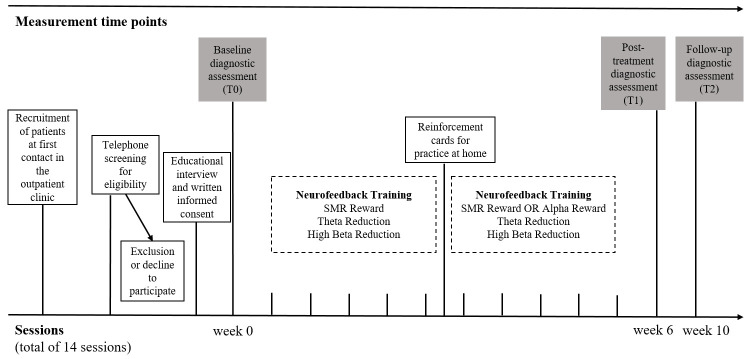
- The intervention consists of 10 NFB sessions in the abstract, but the manualised training is described elsewhere as 14 sessions over 7 weeks with two sessions per week; the protocol also includes a 2-month follow-up.
- Primary outcomes are EEG frequency amplitudes in the theta (4–8 Hz), alpha (8–12 Hz), SMR (12–15 Hz), and high-beta (23–30 Hz) bands.
- Secondary outcomes include physiological measures (respiratory rate, blood volume pulse, muscle tension) and psychometric measures such as distress, perceived stress, relaxation ability, depressive and anxiety symptoms, insomnia, self-efficacy, quality of life, satisfaction, usability, acceptance, and feasibility.
- The study is explicitly described as a pilot with no control group, and the authors state it is intended to provide initial indications and implementation experience rather than definitive efficacy testing.
## Methods
- Design: Monocentric, prospective, interventional, single-arm mixed-methods pilot study; quantitative data are combined with qualitative interviews of patients/practitioners to assess outcomes and implementation.
- Sample/data: Patients aged 18–75 with a confirmed mental health disorder commonly treated in the clinic (depression, eating disorder, somatoform disorder, PTSD) and informed consent; exclusion includes neurological/CNS disease, current psychological treatment at least every other week, or lack of German language skills. NFB practitioners are also interviewed 6 months after study start.
- Main analysis: Quantitative data are planned for repeated measures ANOVA across T0/T1/T2, with mixed linear models and mediation analyses; qualitative interviews will be analysed using Mayring’s structured content analysis.
## Limitations
- The paper states the study has only one intervention group and no control group, so it can provide only “assumptions” of effectiveness and should be followed by controlled and randomized studies.
- The authors state that recruitment is limited to patients who initially visited the clinic, so generalisability is limited.
- Evident from the protocol: the paper is a study protocol, so it reports planned analyses and outcomes rather than results.
Model-written summary. Check it against the paper before relying on it.
Integrity signals
Registry
Cites
Statistics
Figures
Verification
Claims the paper makes
15 Valid · 1 Not valid · 20 Not checked · 18 Own results and interpretations
Every source the paper cites for this claim was checked and supports it.
In the paper
“Our study group implemented biofeedback training in inpatient psychosomatic-psychotherapeutic care, making clear the need for further investigation.11”
§ Evaluation of a manualised neurofeedback training in psychosomatic-psychotherapeutic outpatient treatment (Neuro-pp-out): study protocol for a clinical mixed-methods pilot study > Introduction
What the sources say
- Supportedcites [11] Schmidt K, Barac-Dammeyer D, Kowalski A, et al. Implementing biofeedback treatment in a psychosomatic-psychotherapeutic inpatient unit: a mixed methods evaluation of acceptance, satisfaction, and feasibility. Front Psychiatry 2023; 14. 10.3389/fpsyt.2023.1140880 PMC10244572 37293401 source
The Abstract’s Introduction identifies this as a pilot study evaluating biofeedback treatment in an inpatient psychosomatic-psychotherapeutic unit. The Abstract’s Discussion says more research is needed on suitable protocols for these patients, supporting the stated need for further investigation. (LLM, conf=0.92)
boostedstates a cause- Asserted: passes — The authors put it forward as true.
- Checkable: passes — It can be checked against evidence.
- Load-bearing: passes — The paper’s conclusions depend on it.
- Based: passes — The paper gives a reason why it holds.
- Supported
The cited sources support only part of this claim — read each source’s verdict below.
In the paper
“Overall, current research has already extensively demonstrated that patients with mental health disorders benefit from feedback-based therapies.”
§ Evaluation of a manualised neurofeedback training in psychosomatic-psychotherapeutic outpatient treatment (Neuro-pp-out): study protocol for a clinical mixed-methods pilot study > Introduction
What the sources say
- Not checked — no full text of the sourcecites [8] Hammond DC. Neurofeedback treatment of depression and anxiety. J Adult Dev 2005; 12: 131– 7. 10.1007/s10804-005-7029-5 source
- Not checked — no full text of the sourcecites [9] Panisch LS, Hai AH. The effectiveness of using neurofeedback in the treatment of post-traumatic stress disorder: a systematic review. Trauma Violence Abuse 2020; 21: 541– 50. 10.1177/1524838018781103 29890906 source
- Partly supportedcites [10] Imperatori C, Mancini M, Della Marca G, et al. Feedback-based treatments for eating disorders and related symptoms: a systematic review of the literature. Nutrients 2018; 10. 10.3390/nu10111806 PMC6265864 30463330 sourceExperimental — accuracy not yet measured
The Discussion (page unavailable) reports preliminary benefits of biofeedback and neurofeedback for some eating-disorder-related behaviors. It does not establish that patients with mental health disorders generally benefit, and it cautions that most reviewed studies had a high risk of bias. The claim’s wording, particularly “extensively demonstrated,” overstates the evidence this review presents. (LLM, conf=0.88)
boostedstates a cause- Asserted: passes — The authors put it forward as true.
- Checkable: passes — It can be checked against evidence.
- Load-bearing: passes — The paper’s conclusions depend on it.
- Based: passes — The paper gives a reason why it holds.
The cited sources support only part of this claim — read each source’s verdict below.
In the paper
“The modulation of frequencies will take place at coordinate Cz, which receives projections of thalamic structures associated with executive functions of attention and information processing as well as memory processes.20”
§ Evaluation of a manualised neurofeedback training in psychosomatic-psychotherapeutic outpatient treatment (Neuro-pp-out): study protocol for a clinical mixed-methods pilot study > Introduction
What the sources say
- Partly supportedcites [20] Fama R, Sullivan EV. Thalamic structures and associated cognitive functions: relations with age and aging. Neurosci Biobehav Rev 2015; 54: 29– 37. 10.1016/j.neubiorev.2015.03.008 25862940 PMC4457546 sourceExperimental — accuracy not yet measured
The Introduction links thalamic structures to attention, information processing, and memory. The section on structural and functional thalamic networks describes projections to cortical regions, but our copy does not identify coordinate Cz or say that it receives those projections. (LLM, conf=0.88)
plainstates an association- Asserted: passes — The authors put it forward as true.
- Checkable: passes — It can be checked against evidence.
- Load-bearing: unclear — It is unclear whether the paper’s conclusions depend on it.
- Based: passes — The paper gives a reason why it holds.
- Partly supported
Every source the paper cites for this claim was checked and supports it.
In the paper
“the high-beta band is associated with stress experience.17”
§ Evaluation of a manualised neurofeedback training in psychosomatic-psychotherapeutic outpatient treatment (Neuro-pp-out): study protocol for a clinical mixed-methods pilot study > Introduction
What the sources say
- Supportedcites [17] Marzbani H, Marateb HR, Mansourian M. Neurofeedback: a comprehensive review on system design, methodology and clinical applications. Basic Clin Neurosci 2016; 7: 143– 58. 10.15412/J.BCN.03070208 27303609 PMC4892319 source
Table 1 in §2, “Various Frequency Components,” associates high beta (20–32 Hz) with anxiety and hyperalertness. Those characteristics support the citing sentence’s broad paraphrase of an association with the experience of stress. (LLM, conf=0.85)
plainstates an association- Asserted: passes — The authors put it forward as true.
- Checkable: passes — It can be checked against evidence.
- Load-bearing: passes — The paper’s conclusions depend on it.
- Based: passes — The paper gives a reason why it holds.
- Supported
Every source the paper cites for this claim was checked and supports it.
In the paper
“Based on a previous study of our study group on NFB treatment in the outpatient setting, we expect a dropout rate of 13%.43 Therefore, we will include 31 participants in the study.”
§ Evaluation of a manualised neurofeedback training in psychosomatic-psychotherapeutic outpatient treatment (Neuro-pp-out): study protocol for a clinical mixed-methods pilot study > Methods and analysis > Sample size calculation
What the sources say
- Supportedcites [43] Schmidt K, Krawutschke M, Kowalski A, et al. Cancer patients’ age-related benefits from mobile neurofeedback-therapy in quality of life and self-efficacy: a clinical waitlist control study. Appl Psychophysiol Biofeedback 2023; 48: 217– 27. 10.1007/s10484-022-09571-1 36401150 PMC9676905 source
The Methods (Neurofeedback Therapy; page unavailable) state that sessions took place in an outpatient clinic. The Results (Sample Characteristics; page unavailable) report that 3 of 23 participants discontinued—approximately 13%. Those discontinuations were attributed to the COVID-19 pandemic, a qualification to the rate used for the projection. (LLM, conf=0.90)
plain- Asserted: passes — The authors put it forward as true.
- Checkable: passes — It can be checked against evidence.
- Load-bearing: passes — The paper’s conclusions depend on it.
- Based: passes — The paper gives a reason why it holds.
- Supported
10 more claims · 2 with their cited sources checked
Create a free account to see all 54 claims and to verify the 5 references still open.
- Probably not a substantial claim. 31
- It may state two separate claims as one. 20
Self-check
Percentages, sums and reported differences re-computed from the paper’s own numbers.
Each contradiction between two passages listed here was confirmed by an independent check.
Rated minor: it would not touch a result — a value no result rests on, a p-value that stays on the same side of the significance level, or a conflict that is clerical, resolved elsewhere in the paper, or outside its own findings.
In the paper
§ Evaluation of a manualised neurofeedback training in psychosomatic-psychotherapeutic outpatient treatment (Neuro-pp-out): study protocol for a clinical mixed-methods pilot study > Methods and analysis > Sample size calculation
“Therefore, we will include 31 participants in the study.”
§ Evaluation of a manualised neurofeedback training in psychosomatic-psychotherapeutic outpatient treatment (Neuro-pp-out): study protocol for a clinical mixed-methods pilot study > Abstract > Methods and analysis
“30 patients diagnosed with a mental health disorder will be included.”
Citations
Cites
Statistical power analyses using G∗Power 3.1: tests for correlation and regression analyses
Faul, F., Erdfelder, E., Buchner, A., & Lang, A.-G. (2009) · Behavior Research Methods · doi:10.3758/brm.41.4.1149 · Cited by 37,615 · cited 1×
“41 The primary hypothesis was that the NFB training would lead to an increase in SMR and alpha frequency amplitudes, a decrease in theta frequency and high-beta frequency amplitudes, as well as an increase in heart rate variability, a decrease in muscle tension and respiratory rate.”
BackgroundA Brief Measure for Assessing Generalized Anxiety Disorder: The GAD-7
Spitzer, R. L., Kroenke, K., Williams, J. B. W., & Löwe, B. (2006) · Archives of Internal Medicine · doi:10.1001/archinte.166.10.1092 · Cited by 31,765
Depression and quality of life in older persons: A review
Sivertsen, H., Bjørkløf, G. H., Engedal, K., Selbæk, G., & Helvik, A.-S. (2015) · Dementia and Geriatric Cognitive Disorders · doi:10.1159/000437299 · Cited by 14,152
Development of the World Health Organization WHOQOL-BREF Quality of Life Assessment
THE WHOQOL GROUP (1998) · Psychological Medicine · doi:10.1017/s0033291798006667 · Cited by 7,933 · cited 1×
“36 It contains 26 items to assess quality of life in four domains: social, psychological, physical and environmental quality of life.”
BackgroundSPIRIT 2013 Statement: Defining Standard Protocol Items for Clinical Trials
Chan, A.-W., Tetzlaff, J. M., Altman, D. G., Laupacis, A., Gøtzsche, P. C., Krleža-Jerić, K., Hróbjartsson, A., Mann, H., Dickersin, K., Berlin, J. A., et al. (2013) · Annals of Internal Medicine · doi:10.7326/0003-4819-158-3-201302050-00583 · Cited by 7,363 · cited 2×
“This study protocol is reported according to the Standard Protocol Items: Recommendations for Interventional Trials checklist (SPIRIT) 22 and the Consensus on the reporting and experimental design of clinical and Open access cognitive-behavioural neurofeedback studies (CRED-nf checklist, see online…”
MethodKirschbaum, C., Pirke, K.-M., & Hellhammer, D. H. (2008) · Neuropsychobiology · doi:10.1159/000119004 · Cited by 6,093
An Empirical Evaluation of the System Usability Scale
Bangor, A., Kortum, P. T., & Miller, J. T. (2008) · International Journal of Human–Computer Interaction · doi:10.1080/10447310802205776 · Cited by 5,181
The PHQ-8 as a measure of current depression in the general population
Kroenke, K., Strine, T. W., Spitzer, R. L., Williams, J. B. W., Berry, J. T., & Mokdad, A. H. (2009) · Journal of Affective Disorders · doi:10.1016/j.jad.2008.06.026 · Cited by 5,121
Psychosomatic medicine in Germany: more timely than ever
Zipfel, S., Herzog, W., Kruse, J., & Henningsen, P. (2016) · Psychotherapy and Psychosomatics · doi:10.1159/000447701 · Cited by 2,323
Qualitative Content Analysis: Theoretical Background and Procedures
Mayring, P. (2015) · Advances in Mathematics Education · doi:10.1007/978-94-017-9181-6_13 · Cited by 2,263
Schwarzer, R., & Jerusalem, M. (2012) · PsycTESTS Dataset · doi:10.1037/t00393-000 · Cited by 1,572
Sonuga-Barke, E. J. S., Brandeis, D., Cortese, S., Daley, D., Ferrin, M., Holtmann, M., Stevenson, J., Danckaerts, M., van der Oord, S., Döpfner, M., et al. (2013) · American Journal of Psychiatry · doi:10.1176/appi.ajp.2012.12070991 · Cited by 1,167
Cannabis use and psychosocial adjustment in adolescence and young adulthood
Fergusson, D. M., Horwood, L. J., & Swain‐Campbell, N. (2002) · Addiction · doi:10.1046/j.1360-0443.2002.00103.x · Cited by 563 · cited 1×
“44 To perform the imputation, the SPSS multiple imputation module will be used.”
MethodMarzbani, H., Marateb, H., & Mansourian, M. (2016) · Basic and Clinical Neuroscience Journal · doi:10.15412/j.bcn.03070208 · Cited by 484 · cited 2×
“17”
BackgroundMehnert, A., Müller, D., Lehmann, C., & Koch, U. (2006) · Zeitschrift für Psychiatrie, Psychologie und Psychotherapie · doi:10.1024/1661-4747.54.3.213 · Cited by 440
Ros, T., Enriquez-Geppert, S., Zotev, V., Young, K. D., Wood, G., Whitfield-Gabrieli, S., Wan, F., Vuilleumier, P., Vialatte, F., Van De Ville, D., et al. (2020) · Brain · doi:10.1093/brain/awaa009 · Cited by 399
Thalamic structures and associated cognitive functions: Relations with age and aging
Fama, R., & Sullivan, E. V. (2015) · Neuroscience & Biobehavioral Reviews · doi:10.1016/j.neubiorev.2015.03.008 · Cited by 323
Clinical Utility of EEG in Attention-Deficit/Hyperactivity Disorder: A Research Update
Loo, S. K., & Makeig, S. (2012) · Neurotherapeutics · doi:10.1007/s13311-012-0131-z · Cited by 306 · cited 1×
“15 While theta reduction can be used to improve attention skill, 16 the high-beta band is associated with stress experience.”
Method(1989) · PubMed · Cited by 298
Validierung des “Perceived Stress Questionnaire“ (PSQ) an einer deutschen Stichprobe
Fliege, H., Rose, M., Arck, P., Levenstein, S., & Klapp, B. F. (2001) · Diagnostica · doi:10.1026//0012-1924.47.3.142 · Cited by 272
Neurofeedback Treatment of Depression and Anxiety
Hammond, D. C. (2005) · Journal of Adult Development · doi:10.1007/s10804-005-7029-5 · Cited by 226
Approaches to Qualitative Research in Mathematics Education: Examples of Methodology and Methods
(2015) · Advances in Mathematics Education · doi:10.1007/978-94-017-9181-6 · Cited by 187
Characterization of stress reactions to the Stroop Color Word Test
Tulen, J. H. M., Moleman, P., van Steenis, H. G., & Boomsma, F. (1989) · Pharmacology Biochemistry and Behavior · doi:10.1016/0091-3057(89)90204-9 · Cited by 182
Oken, D. (2001) · Elsevier eBooks · doi:10.1016/b0-08-043076-7/03770-0 · Cited by 163
(1991) · Cited by 149
Defar, S., Abraham, Y., Reta, Y., Deribe, B., Jisso, M., Yeheyis, T. Y., Mengistu, K., Beyene, B., & Ayalew, M. (2023) · Frontiers in Public Health · doi:10.3389/fpubh.2023.1134032 · Cited by 115
Micoulaud-Franchi, J.-A., McGonigal, A., Lopez, R., Daudet, C., Kotwas, I., & Bartolomei, F. (2015) · Neurophysiologie Clinique/Clinical Neurophysiology · doi:10.1016/j.neucli.2015.10.077 · Cited by 111
Wang, S.-Y., Lin, I.-M., Fan, S.-Y., Tsai, Y.-C., Yen, C.-F., Yeh, Y.-C., Huang, M.-F., Lee, Y., Chiu, N.-M., Hung, C.-F., et al. (2019) · Journal of Affective Disorders · doi:10.1016/j.jad.2019.07.026 · Cited by 78 · cited 1×
“19 The modulation of frequencies will take place at coordinate Cz, which receives projections of thalamic structures associated with executive functions of attention and information processing as well as memory processes.”
BackgroundPanisch, L. S., & Hai, A. H. (2020) · Trauma, Violence, & Abuse · doi:10.1177/1524838018781103 · Cited by 75
Dieck, A., Morin, C. M., & Backhaus, J. (2018) · Somnologie · doi:10.1007/s11818-017-0147-z · Cited by 72
A Systematic Review of the Safety and Effect of Neurofeedback on Fatigue and Cognition
Luctkar-Flude, M., & Groll, D. (2015) · Integrative Cancer Therapies · doi:10.1177/1534735415572886 · Cited by 69
Rogel, A., Loomis, A. M., Hamlin, E., Hodgdon, H., Spinazzola, J., & van der Kolk, B. (2020) · Psychological Trauma Theory Research Practice and Policy · doi:10.1037/tra0000648 · Cited by 52
Kriz, D., Nübling, R., Steffanowski, A., Wittmann, W. W., & Schmidt, J. (2008) · Zeitschrift für Medizinische Psychologie · doi:10.3233/zmp-2008-17_2-3_04 · Cited by 49
Personalised computerised feedback in e-mental health
Musiat, P., Hoffmann, L., & Schmidt, U. (2012) · Journal of Mental Health · doi:10.3109/09638237.2011.648347 · Cited by 47
Assessing momentary relaxation using the relaxation state questionnaire (RSQ)
Steghaus, S., & Poth, C. H. (2022) · Scientific Reports · doi:10.1038/s41598-022-20524-w · Cited by 44
Imperatori, C., Mancini, M., Della Marca, G., Valenti, E. M., & Farina, B. (2018) · Nutrients · doi:10.3390/nu10111806 · Cited by 43
The effect of alpha neurofeedback training on cognitive performance in healthy adults
Nawaz, R., Nisar, H., Yap, V. V., & Tsai, C.-Y. (2022) · Mathematics · doi:10.3390/math10071095 · Cited by 25 · cited 1×
“15 While theta reduction can be used to improve attention skill, 16 the high-beta band is associated with stress experience.”
MethodPraxisbuch Biofeedback und Neurofeedback
Haus, K.-M., Held, C., Kowalski, A., Krombholz, A., Nowak, M., Schneider, E., Strauß, G., & Wiedemann, M. (2013) · doi:10.1007/978-3-642-30179-7 · Cited by 23 · cited 1×
“20 Moreover, modulation at Cz is a common approach in most existing NFB protocols, 21 measuring activity in the somatosensory cortex, including attention, mental processing, calmness, emotion and empathy.”
Self-citationLeem, J., Cheong, M. J., Lee, H., Cho, E., Lee, S. Y., Kim, G.-W., & Kang, H. W. (2021) · Healthcare · doi:10.3390/healthcare9101351 · Cited by 23
Biswas, A., & Ray, S. (2019) · eneuro · doi:10.1523/eneuro.0498-18.2019 · Cited by 12 · cited 1×
“14 Moreover, cognitive abilities such as reaction time, cognitive control and selective attention could also be improved in healthy patients by training the alpha band.”
BackgroundNeurofeedback training content for treatment of stress
Hafeez, Y., Azhar Ali, S. S., & Malik, A. S. (2016) · 2016 IEEE EMBS Conference on Biomedical Engineering and Sciences (IECBES) · doi:10.1109/iecbes.2016.7843429 · Cited by 8 · cited 1×
“18 Additionally, previous research demonstrates an improvement in various psychological parameters through NFB training.”
BackgroundSchmidt, K., Krawutschke, M., Kowalski, A., Pasche, S., Bialek, A., Schweig, T., Weismüller, B., Tewes, M., Schuler, M., Hamacher, R., et al. (2023) · Applied Psychophysiology and Biofeedback · doi:10.1007/s10484-022-09571-1 · Cited by 8
Schmidt, K., Barac-Dammeyer, D., Kowalski, A., Teigelack, P., Pfeiffer, C., Robitzsch, A., Dörrie, N., Skoda, E.-M., Bäuerle, A., Fink, M., et al. (2023) · Frontiers in Psychiatry · doi:10.3389/fpsyt.2023.1140880 · Cited by 7
Self-citationBouny, P., Arsac, L. M., Pratviel, Y., Boffet, A., Touré Cuq, E., & Deschodt-Arsac, V. (2022) · Brain Sciences · doi:10.3390/brainsci12060794 · Cited by 6
Effects of Neurofeedback Training on Anxiety Symptoms Among University Students
Mutang, J. A., Seok, C. B., & Ee, G. T. (2021) · Advances in Social Science, Education and Humanities Research · doi:10.2991/assehr.k.210423.012 · Cited by 5
Cited by
Biofeedback Training in Inpatient Mental Health Facilities: A Scoping Review
Schmidt, K., Schlicht, M., Deutschendorf, L., Smets, L., Bäuerle, A., & Teufel, M. (2025) · Journal of Clinical Medicine · doi:10.3390/jcm14103491 · Cited by 3
“Schmidt et al. [46] developed a manualized NFB training and tested it in an outpatient setting.”
Self-citationKarl, M., Göke, H. L., Kowalski, A., Dörrie, N., Skoda, E., Bäuerle, A., Teufel, M., & Schmidt, K. (2025) · Psychiatry International · doi:10.3390/psychiatryint6010028 · Cited by 1
“With these issues in mind, we developed a standardized manual for NFB treatment in clinical settings (manual already published in [50]) to facilitate the workflow and address the identified problems.”
InfluentialSelf-citationThe Role of Neurofeedback in Audiology: A Review of Current Evidence and Future Directions
An, H. (2025) · Audiology and Speech Research · doi:10.21848/asr.250187
Metadata
- Authors
- Schmidt, K. L., Kowalski, A., Schweda, A., Dörrie, N., Skoda, E. M., Bäuerle, A., & Teufel, M.
- Affiliations
- Essen University Hospital (DE)
- NeuroFit GmbH, Kempen, Germany
- Corresponding author
- Schmidt, Kira Leandra
- Venue
- BMJ Open
- Publisher
- BMJ
- Published
- 2024-04
- Volume
- 14
- Issue
- 4
- Pages
- e079098
- ISSN
- 2044-6055 (ISSN-L)
- PMC
- PMC11029405
- OpenAlex
- W4394894283
- Cited by
- 3
- References
- 45
- Citations by year
- 2025: 3
- FWCI
- 0.73
- Type
- journal article
- Language
- en
- Open access
- gold
- doi.org
- Licence
- Locations
- BMJ Open (publishedVersion, cc-by-nc)
- PubMed Central (publishedVersion, cc-by-nc)
- PubMed (publishedVersion)
- DOAJ (DOAJ: Directory of Open Access Journals) (acceptedVersion)
- HighWire Press Open Archive (acceptedVersion)
- Universitätsbibliographie, Universität Duisburg-Essen (submittedVersion, cc-by-nc)
- DuEPublico (University of Duisburg-Essen) (submittedVersion, cc-by-nc)
- Funders
- Universität Duisburg-Essen
- Topics
- Life Sciences › Neuroscience › Cognitive Neuroscience › EEG and Brain-Computer Interfaces
- Social Sciences › Psychology › Clinical Psychology › Mindfulness and Compassion Interventions
- Social Sciences › Psychology › Clinical Psychology › Psychotherapy Techniques and Applications
- Keywords
- mental illness, sensorimotor rhythm, alpha frequency, relaxation, perceived stress, distress, depressive symptoms, anxiety symptoms, insomnia, self-efficacy, quality of life, mediation analysis
- MeSH terms
- Clinical Trials as Topic, Electroencephalography, Humans, Outpatients, Pilot Projects, Quality of Life, Neurofeedback
About these checks
Registry, retraction, Cites and statistics results are computed, not judged, with one exception: a printed reference that no index lists is read once by a model before it counts as a citation error. Claims are extracted by a model and kept only when their quote appears verbatim in the text; each cited source is then checked, with a model’s help, for whether it says what the claim relies on. Those verdicts can be wrong — read the claim’s quote and the cited source before relying on one.
The claim verdicts this report counts are experimental: their accuracy is not yet measured.
A language model drew the claims from the paper on 2026-10-11, under version 3 of the claim definition (model deepseek-v4.1-flash, prompt extract-v3).
A second model labelled each claim on 2026-10-11 (model jev-1.13-20260917, definition revision gold-guideline-v0.2).
Cited sources are checked with a language model’s help (gpt-6-sol).
Statistics and arithmetic are recomputed, not judged.
Confidence bands are shown only for fields calibrated on our annotated test set. None is calibrated yet, so no band is shown.
What counts as a claim ›How we measure confidence ›How we check this ›
Are you an author, or do you see a problem with this page? Request a review
Data sources
Bibliographic data: Semantic Scholar, OpenAlex, Crossref.
Contains information from the Semantic Scholar Academic Graph Datasets, made available under the ODC Attribution License (ODC-BY 1.0).
Semantic Scholar’s data is described in: Kinney, R., et al. (2023). The Semantic Scholar Open Data Platform. arXiv:2301.10140.
