

Does difficulty moderate learning? A comparative analysis of the desirable difficulties framework and cognitive load theory
Open accessThe DOI matches its Crossref record; 96 of the 96 references it cites were found in a registry or an index; 27 of the 121 sources its claims cite were checked for support.
Abstract
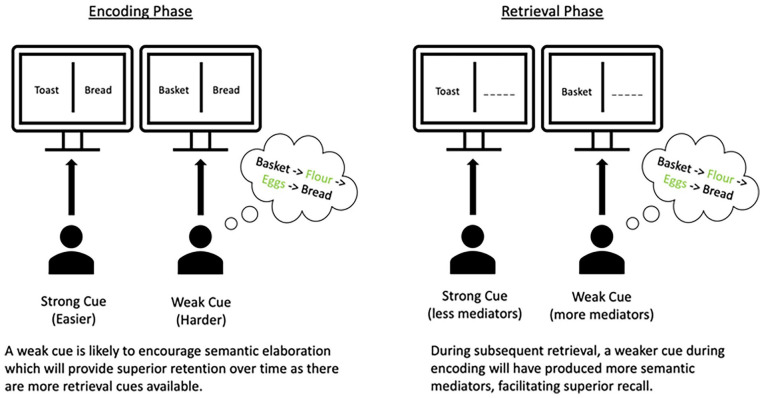
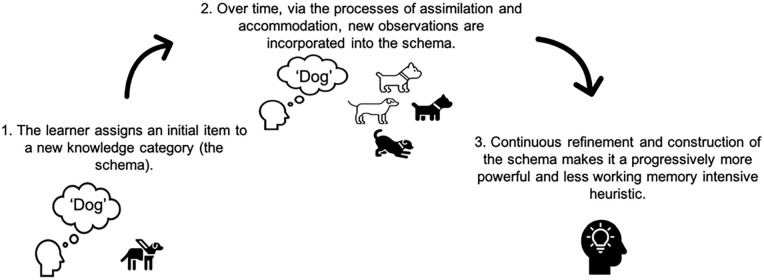
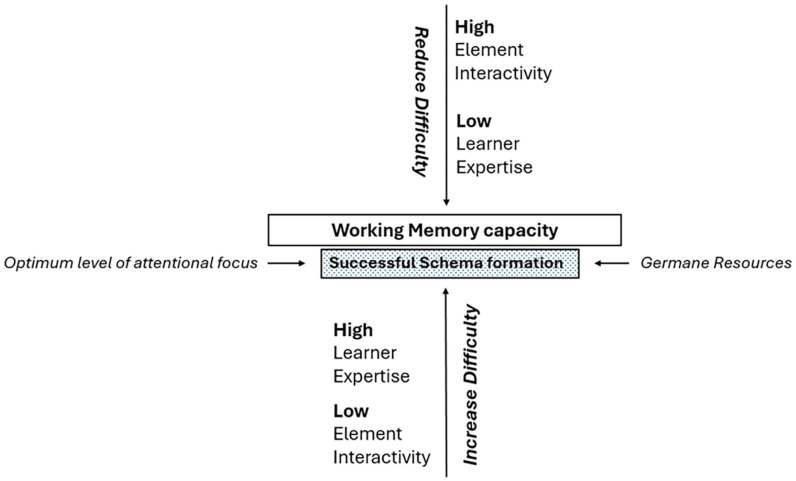
There is evidence to suggest that variations in difficulty during learning can moderate long-term retention. However, the direction of this effect is under contention throughout the literature. According to both the Desirable Difficulties Framework (DDF) and the Retrieval Effort Hypothesis (REH), increasing difficulty (thus relative effort) during retrieval-based learning can help achieve superior long-term retention. One reason for this is due to improved schema formation following a deeper encoding strategy, allowing for more efficient retrieval techniques. A conflicting theory discussed in this review is the Cognitive Load Theory (CLT). The CLT states that conditions for learning are best when extraneous load is reduced, and intrinsic load is optimised. By doing this, germane resources can focus on schema formation. While both theories consider schema formation key to successful retention, the way in which it is best achieved is conflicting. To date, both theories have yet to be compared despite their commonalities. This review evaluates the aforementioned theories, before proposing a new model of difficulty in learning. The proposed model integrates principles from the DDF, REH, and CLT, incorporating insights from Perceptual Load Theory (PLT). It suggests that task difficulty should be adjusted based on the material’s complexity and the learner’s expertise. Increasing difficulty benefits low-element-interactivity tasks by enhancing focus and retention, while reducing difficulty in high-element-interactivity tasks prevents cognitive overload.
Overview
CoChat Summary
## TL;DR
This is a review comparing the Desirable Difficulties Framework / Retrieval Effort Hypothesis with Cognitive Load Theory to explain when making learning harder helps or hurts retention. It proposes a new model: increase difficulty for low-element-interactivity tasks, but reduce difficulty for high-element-interactivity tasks and for less experienced learners.
## Key findings
- The review states that DDF/REH and CLT both treat schema formation as central, but disagree on whether difficulty should be increased or reduced for better learning.
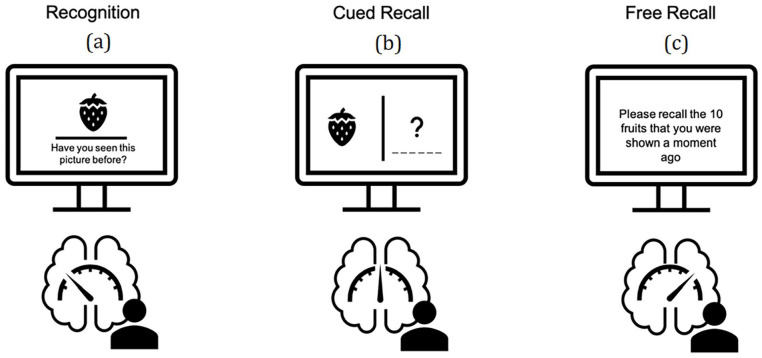
- For DDF/REH, retrieval-based learning tasks such as cued and free recall generally outperform recognition, and the paper cites studies showing improved long-term retention, including a strong retrieval practice effect in de Lima et al. (2020) and benefits of expanding spaced intervals in some studies.
- For CLT, reducing extraneous load and supporting schema construction is emphasized; the paper notes that increasing extraneous load through task difficulty and time pressure led to lower recall performance in Galy et al. (2012), while worked examples and goal-free problems improved memorisation.
- The proposed model says difficulty should be adjusted to material complexity and learner expertise: increasing difficulty helps low-element-interactivity tasks by improving focus and retention, while reducing difficulty helps prevent overload in high-element-interactivity tasks.
## Methods
- This is a narrative review, not an original experiment: it compares the Desirable Difficulties Framework, Retrieval Effort Hypothesis, Cognitive Load Theory, and related Perceptual Load Theory ideas.
- The paper synthesizes prior experimental and review literature across learning tasks such as recognition, cued recall, free recall, spacing, worked examples, goal-free problems, and divided-attention paradigms.
- The main analysis is conceptual/comparative, using cited studies to build a new integrated model of difficulty in learning.
## Limitations
- The paper itself notes that the two frameworks have “yet to be compared” directly, and that much of the CLT evidence it reviews is “dated” and would benefit from more recent evidence.
- The paper states that item-difficulty effects and the role of semantic mediators in retrieval learning are “still open to debate,” and that the REH perspective on item difficulty “requires further exploration before a conclusion can be made.”
- Evident from the text: this is a review article, so it does not present a new empirical dataset or a direct head-to-head experiment testing the proposed model.
Model-written summary. Check it against the paper before relying on it.
Integrity signals
Registry
Cites
Statistics
Figures
Verification
Claims the paper makes
21 Valid · 2 Not valid · 54 Not checked · 45 Own results and interpretations
Every source the paper cites for this claim was checked and supports it.
In the paper
“and when spacing is implemented (increasing difficulty), improved results are shown compared to massed study (Middleton et al., 2016, 2019).”
§ Does difficulty moderate learning? A comparative analysis of the desirable difficulties framework and cognitive load theory > DDF > RBL The concept of learning via retrieval has had its place in the literature since the early 20th century (Abbott, 1909; Gates, 1917; Spitzer, 1939). There has been much research on RBL, the fundamental basis of which relies on repeated testing of the participant on the subject material (Roediger & Butler, 2011). Typically, the participant is first shown the target stimuli (known as a study phase) before they move on to the next stage, the testing phase. Following this, there may be various patterns of study and test phases before a final test. In an experimental situation, this final test often measures the efficacy of RBL compared to say, study alone. An example of this pattern in an experimental group may be: Study, Test, Study, Test (STST); compared to a control Study alone group (SSSS). Learning via retrieval has consistently been shown to be more effective than studying the material alone (Carpenter et al., 2008; de Lima et al., 2020; Fazio & Marsh, 2019; Karpicke & Aue, 2015; Karpicke & Grimaldi, 2012; Karpicke & Roediger, 2008; Kornell et al., 2011; Roediger & Karpicke, 2006). Furthermore, as well as healthy populations, RBL has also been shown to be effective in language-impaired populations, compared to repetitive study (de Lima et al., 2021) and when spacing is implemented (increasing difficulty), improved results are shown compared to massed study (Middleton et al., 2016, 2019). In an experimental setting, the difference in performance between the retrieval group and the study-only group is known as the “testing effect.”
What the sources say
- Supportedcites Middleton et al., 2016 matched to “Towards a Theory of Learning for Naming Rehabilitation: Retrieval Practice and Spacing Effects” (2016) source
The Abstract/Results summary (Results) states 'spaced learning outperformed massed learning at retention test and at follow-up. Increases in spacing in the retrieval practice condition yielded more robust learning of retrieved information,' and the Spacing Effects results (Results, Fig. 1/Table 1) give the coefficients (Coef = 0.71, p < .001 retention; Coef = 0.45, p = .006 follow-up). The difficulty/effort parenthetical is also carried by the paper: lag-by-event analysis showed training accuracy fell with increasing lag while retention accuracy stayed stable, interpreted as effortful successful retrieval being more potent (Results). The demonstration is in 4 people with aphasia doing naming treatment, but the claim states no narrower or wider qualifier, so nothing attributed to this source is unsupported. (LLM, conf=0.85)
- Supportedcites Middleton et al., 2019 matched to “Retrieval practice and spacing effects in multi-session treatment of naming impairment in aphasia” (2019) source
The Results (Spacing Effects; page not provided) report significantly better retention after spaced than massed learning. The Introduction explains that spacing separates trials beyond short-term-memory limits, whereas massed trials remain accessible; this is consistent with the parenthetical description of increased difficulty. The follow-up advantage was only marginal. (LLM, conf=0.90)
plainstates a cause- Asserted: passes — The authors put it forward as true.
- Checkable: passes — It can be checked against evidence.
- Load-bearing: unclear — It is unclear whether the paper’s conclusions depend on it.
- Based: passes — The paper gives a reason why it holds.
- Supported
The cited sources support only part of this claim — read each source’s verdict below.
In the paper
“Regardless of the spacing, there is evidence to suggest that repeated retrieval sessions with corrective feedback improves long-term retention (Butler, 2010; Karpicke & Roediger, 2007b; Tse et al., 2010); for a review, see (Binks, 2018).”
§ Does difficulty moderate learning? A comparative analysis of the desirable difficulties framework and cognitive load theory > DDF > Task difficulty
What the sources say
- Not checked — no full text of the sourcecites Butler, 2010 matched to “Repeated testing produces superior transfer of learning relative to repeated studying.” (2010) source
- Not matchedcites Karpicke & Roediger, 2007b
More than one paper fits this citation.
- Partly supportedcites Tse et al., 2010 matched to “The benefits and costs of repeated testing on the learning of face–name pairs in healthy older adults.” (2010) sourceExperimental — accuracy not yet measured
Experiment 2’s Results report that feedback restored the benefit of repeated testing for final recall of face–name pairs, particularly in the oldest adults. The Present Research section specifies a 1.5-hour retention interval, and the paper does not establish that the benefit holds regardless of spacing. (LLM, conf=0.86)
hedgedstates a cause- Asserted: passes — The authors put it forward as true.
- Checkable: passes — It can be checked against evidence.
- Load-bearing: passes — The paper’s conclusions depend on it.
- Based: passes — The paper gives a reason why it holds.
The sources with a verdict support this claim; the rest weren’t checked yet, have no full text we could read, or their verdicts aren’t rated yet.
In the paper
“Learning via retrieval has consistently been shown to be more effective than studying the material alone (Carpenter et al., 2008; de Lima et al., 2020; Fazio & Marsh, 2019; Karpicke & Aue, 2015; Karpicke & Grimaldi, 2012; Karpicke & Roediger, 2008; Kornell et al., 2011; Roediger & Karpicke, 2006).”
§ Does difficulty moderate learning? A comparative analysis of the desirable difficulties framework and cognitive load theory > DDF > RBL The concept of learning via retrieval has had its place in the literature since the early 20th century (Abbott, 1909; Gates, 1917; Spitzer, 1939). There has been much research on RBL, the fundamental basis of which relies on repeated testing of the participant on the subject material (Roediger & Butler, 2011). Typically, the participant is first shown the target stimuli (known as a study phase) before they move on to the next stage, the testing phase. Following this, there may be various patterns of study and test phases before a final test. In an experimental situation, this final test often measures the efficacy of RBL compared to say, study alone. An example of this pattern in an experimental group may be: Study, Test, Study, Test (STST); compared to a control Study alone group (SSSS). Learning via retrieval has consistently been shown to be more effective than studying the material alone (Carpenter et al., 2008; de Lima et al., 2020; Fazio & Marsh, 2019; Karpicke & Aue, 2015; Karpicke & Grimaldi, 2012; Karpicke & Roediger, 2008; Kornell et al., 2011; Roediger & Karpicke, 2006). Furthermore, as well as healthy populations, RBL has also been shown to be effective in language-impaired populations, compared to repetitive study (de Lima et al., 2021) and when spacing is implemented (increasing difficulty), improved results are shown compared to massed study (Middleton et al., 2016, 2019). In an experimental setting, the difference in performance between the retrieval group and the study-only group is known as the “testing effect.”
What the sources say
- Supportedcites Carpenter et al., 2008 matched to “The effects of tests on learning and forgetting.” (2008) source
The General Discussion reports that test/study produced better recall than study alone in all three experiments and says the results are consistent with prior studies. The paper also states that testing has an advantage over simply restudying material. (LLM, conf=0.93)
- Not matchedcites de Lima et al., 2020
More than one paper fits this citation.
- Not checked — no full text of the sourcecites Fazio & Marsh, 2019 matched to “Retrieval-Based Learning in Children” (2019) source
boostedstates a cause- Asserted: passes — The authors put it forward as true.
- Checkable: passes — It can be checked against evidence.
- Load-bearing: unclear — It is unclear whether the paper’s conclusions depend on it.
- Based: passes — The paper gives a reason why it holds.
- Supported
The sources with a verdict support this claim; the rest weren’t checked yet, have no full text we could read, or their verdicts aren’t rated yet.
In the paper
“There are several studies that have directly tested the REH, each finding evidence in support of this notion (Carpenter & DeLosh, 2006; Karpicke & Roediger, 2007b; Pyc & Rawson, 2009).”
§ Does difficulty moderate learning? A comparative analysis of the desirable difficulties framework and cognitive load theory > DDF > REH
What the sources say
- Supportedcites Carpenter & DeLosh, 2006 matched to “Impoverished cue support enhances subsequent retention: Support for the elaborative retrieval explanation of the testing effect” (2006) source
The General Discussion reports that Experiments 2 and 3 varied retrieval-cue support and found better final retention for items retrieved with fewer cues. The paper calls this support for the elaborative retrieval hypothesis rather than using the term “Retrieval Effort Hypothesis,” but its direct test and finding support the point for which this study is cited. (LLM, conf=0.87)
- Not matchedcites Karpicke & Roediger, 2007b
More than one paper fits this citation.
- Not checked — no full text of the sourcecites Pyc & Rawson, 2009 matched to “Testing the retrieval effort hypothesis: Does greater difficulty correctly recalling information lead to higher levels of memory?” (2009) source
plainstates a cause- Asserted: passes — The authors put it forward as true.
- Checkable: passes — It can be checked against evidence.
- Load-bearing: unclear — It is unclear whether the paper’s conclusions depend on it.
- Based: passes — The paper gives a reason why it holds.
- Supported
The cited sources support only part of this claim — read each source’s verdict below.
In the paper
“This holds even when there is a mismatch in task type (i.e., recall during learning and recognition during retrieval; (Carpenter & DeLosh, 2006; Endres & Renkl, 2015; Rowland, 2014; Stenlund et al., 2016), highlighting the positive influence of recall during the learning phase.”
§ Does difficulty moderate learning? A comparative analysis of the desirable difficulties framework and cognitive load theory > DDF > Task difficulty
What the sources say
- Partly supportedcites Carpenter & DeLosh, 2006 matched to “Impoverished cue support enhances subsequent retention: Support for the elaborative retrieval explanation of the testing effect” (2006) sourceExperimental — accuracy not yet measured
The Final retention section reports that free recall during learning was associated with nominally higher retention on a later recognition test, so the paper addresses the task mismatch. But the effect was not statistically significant for the recognition-test group; the claim presents the positive influence as established in that condition. (LLM, conf=0.88)
- Partly supportedcites Endres & Renkl, 2015 matched to “Mechanisms behind the testing effect: an empirical investigation of retrieval practice in meaningful learning” (2015) sourceExperimental — accuracy not yet measured
The Results (Main Analysis; page not provided) report a testing benefit on both free-recall and short-answer posttests, supporting a benefit across the formats studied. The Methods (Procedure; page not provided) show that the posttests did not use recognition, so this paper does not establish the specific recall-during-learning, recognition-during-retrieval mismatch claimed. (LLM, conf=0.88)
- Not matchedcites Rowland, 2014
More than one paper fits this citation.
plainstates a cause- Asserted: passes — The authors put it forward as true.
- Checkable: passes — It can be checked against evidence.
- Load-bearing: unclear — It is unclear whether the paper’s conclusions depend on it.
- Based: passes — The paper gives a reason why it holds.
- Partly supported
49 more claims · 9 with their cited sources checked
Create a free account to see all 122 claims and to verify the 5 references still open.
- It may state two separate claims as one. 32
- Probably not a substantial claim. 50
Citations
Cites
Cognitive Load During Problem Solving: Effects on Learning
Sweller, J. (1988) · Cognitive Science · doi:10.1016/0364-0213(88)90023-7 · Cited by 11,048 · cited 7×
“While MEA could solve the problem, it is incompatible with learning because it is working memory intensive and does not lead to schema construction (Sweller, 1988; Sweller et al., 1998).”
InfluentialCognitive Architecture and Instructional Design
Sweller, J., van Merrienboer, J. J. G., & Paas, F. G. W. C. (1998) · Educational Psychology Review · doi:10.1023/a:1022193728205 · Cited by 6,023 · cited 7×
“Beyond these foundational assumptions, while cognitive load can generally be defined as the number of working memory resources employed to perform a task, CLT distinguishes between three different types (Sweller et al., 1998, 2019) each of which are reviewed below.”
InfluentialSweller, J., Ayres, P., & Kalyuga, S. (2011) · doi:10.1007/978-1-4419-8126-4 · Cited by 5,531
Sweller, J. (2011) · Psychology of Learning and Motivation · doi:10.1016/b978-0-12-387691-1.00002-8 · Cited by 4,856
Sweller, J. (2012) · Encyclopedia of the Sciences of Learning · doi:10.1007/978-1-4419-1428-6_446 · Cited by 4,405
Test-Enhanced Learning: Taking Memory Tests Improves Long-Term Retention
Roediger, H. L., & Karpicke, J. D. (2006) · Psychological Science · doi:10.1111/j.1467-9280.2006.01693.x · Cited by 2,867
Cognitive Architecture and Instructional Design: 20 Years Later
Sweller, J., van Merriënboer, J. J. G., & Paas, F. (2019) · Educational Psychology Review · doi:10.1007/s10648-019-09465-5 · Cited by 2,337 · cited 4×
“As a result, the emphasis has moved from simply increasing germane load to ensuring that learners’ cognitive efforts are directed towards the most meaningful and supportive tasks in the learning process (Sweller et al., 2019).”
InfluentialA spreading activation theory of memory.
Anderson, J. R. (1983) · Journal of Verbal Learning and Verbal Behavior · doi:10.1016/s0022-5371(83)90201-3 · Cited by 2,199 · cited 1×
“Spreading activation can be defined as the implicit creation of new cues in memory, which can then be utilised during retrieval (J. R. Anderson, 1983).”
Element Interactivity and Intrinsic, Extraneous, and Germane Cognitive Load
Sweller, J. (2010) · Educational Psychology Review · doi:10.1007/s10648-010-9128-5 · Cited by 2,020 · cited 3×
“As with intrinsic load, element interactivity is also relevant to extraneous load (Sweller et al., 2019), in the sense that a poor instructional design increases element interactivity , imposing a greater cognitive load (and therefore having a detrimental effect on memorisation (Sweller, 2010).”
The critical role of retrieval practice in long-term retention
Roediger, H. L., & Butler, A. C. (2011) · Trends in Cognitive Sciences · doi:10.1016/j.tics.2010.09.003 · Cited by 1,796 · cited 1×
“There has been much research on RBL, the fundamental basis of which relies on repeated testing of the participant on the subject material (Roediger & Butler, 2011).”
The Critical Importance of Retrieval for Learning
Karpicke, J. D., & Roediger, H. L. (2008) · Science · doi:10.1126/science.1152408 · Cited by 1,791 · cited 1×
“Learning via retrieval has consistently been shown to be more effective than studying the material alone (Carpenter et al., 2008; de Lima et al., 2020; Fazio & Marsh, 2019; Karpicke & Aue, 2015; Karpicke & Grimaldi, 2012; Karpicke & Roediger, 2008; Kornell et al., 2011; Roediger & Karpicke, 2006).”
Why Some Material Is Difficult to Learn
Sweller, J., & Chandler, P. (1994) · Cognition and Instruction · doi:10.1207/s1532690xci1203_1 · Cited by 1,455 · cited 1×
“A higher intrinsic load is considered to be more difficult and therefore requires more effort (Ayres, 2006; Beckmann, 2010; Sweller & Chandler, 1994; Wirzberger et al., 2016).”
The Use of Worked Examples as a Substitute for Problem Solving in Learning Algebra
Sweller, J., & Cooper, G. A. (1985) · Cognition and Instruction · doi:10.1207/s1532690xci0201_3 · Cited by 1,214 · cited 1×
“As with the goal-free effect , a wealth of studies lend support to the effectiveness of worked examples in terms of improving memorisation (Carroll, 1994; Cooper & Sweller, 1987; Paas & Van Merriënboer, 1994; Sweller & Cooper, 1985; Trafton & Reiser, 1993; Zhu & Simon, 1987).”
Paas, F. G. W. C., & Van Merriënboer, J. J. G. (1994) · Journal of Educational Psychology · doi:10.1037/0022-0663.86.1.122 · Cited by 1,198 · cited 1×
“As with the goal-free effect , a wealth of studies lend support to the effectiveness of worked examples in terms of improving memorisation (Carroll, 1994; Cooper & Sweller, 1987; Paas & Van Merriënboer, 1994; Sweller & Cooper, 1985; Trafton & Reiser, 1993; Zhu & Simon, 1987).”
Memory and Metamemory Considerations in the Training of Human Beings
Bjork, R. A. (1994) · Metacognition · doi:10.7551/mitpress/4561.003.0011 · Cited by 1,084 · cited 2×
“The DDF suggests that introducing certain difficulties during learning can enhance long-term retention (Bjork, 1994; Bjork & Bjork, 2020).”
The effect of testing versus restudy on retention: A meta-analytic review of the testing effect.
Rowland, C. A. (2014) · Psychological Bulletin · doi:10.1037/a0037559 · Cited by 1,066 · cited 4×
“When cued or free recall is employed during the learning phase, many studies have found improved subsequent memory performance on a final test compared to when recognition is used (Butler & Roediger, 2007; Kang et al., 2007; Stenlund et al., 2016); for reviews, see (McDermott, 2021; Rowland, 2014).”
InfluentialThe effects of divided attention on encoding and retrieval processes in human memory.
Craik, F. I. M., Govoni, R., Naveh-Benjamin, M., & Anderson, N. D. (1996) · Journal of Experimental Psychology: General · doi:10.1037/0096-3445.125.2.159 · Cited by 1,024 · cited 1×
“Studies that have carried this out with typical memory tasks (study-only) with separate encoding and retrieval phases, found that performance on the primary learning task was only affected by the secondary task during encoding, but not retrieval (N. D. Anderson et al., 1998; Craik et al., 1996).”
Cognitive Load Theory: How Many Types of Load Does It Really Need?
Kalyuga, S. (2011) · Educational Psychology Review · doi:10.1007/s10648-010-9150-7 · Cited by 725 · cited 2×
“For instance, when learners engage deeply with complex material, the cognitive effort they expend can be seen as contributing to both the intrinsic and germane loads, blurring the lines between them (Greenberg & Zheng, 2023; Kalyuga, 2011).”
Effects of schema acquisition and rule automation on mathematical problem-solving transfer.
Cooper, G., & Sweller, J. (1987) · Journal of Educational Psychology · doi:10.1037/0022-0663.79.4.347 · Cited by 688 · cited 2×
“As with the goal-free effect , a wealth of studies lend support to the effectiveness of worked examples in terms of improving memorisation (Carroll, 1994; Cooper & Sweller, 1987; Paas & Van Merriënboer, 1994; Sweller & Cooper, 1985; Trafton & Reiser, 1993; Zhu & Simon, 1987).”
Cognitive load as a factor in the structuring of technical material.
Sweller, J., Chandler, P., Tierney, P., & Cooper, M. (1990) · Journal of Experimental Psychology: General · doi:10.1037/0096-3445.119.2.176 · Cited by 629 · cited 1×
“Second, the design of high-quality worked examples is challenging, particularly if these require integration of multiple information sources, which could lead to a higher extraneous cognitive load (Sweller et al., 1990, 1998; Tarmizi & Sweller, 1988; Ward & Sweller, 1990).”
Repeated retrieval during learning is the key to long-term retention☆
KARPICKE, J., & ROEDIGERIII, H. (2007) · Journal of Memory and Language · doi:10.1016/j.jml.2006.09.004 · Cited by 598 · cited 4×
“This notion however has received conflicting views, with (Karpicke & Roediger, 2007a) finding repeated expanding intervals to only provide short-term benefits, with equally spaced intervals providing superior long-term benefits (Cull, 2000).”
InfluentialPyc, M. A., & Rawson, K. A. (2009) · Journal of Memory and Language · doi:10.1016/j.jml.2009.01.004 · Cited by 551 · cited 4×
“There are several studies that have directly tested the REH, each finding evidence in support of this notion (Carpenter & DeLosh, 2006; Karpicke & Roediger, 2007b; Pyc & Rawson, 2009).”
InfluentialConstraining effects of examples in a creative generation task
Smith, S. M., Ward, T. B., & Schumacher, J. S. (1993) · Memory & Cognition · doi:10.3758/bf03202751 · Cited by 542 · cited 1×
“First, it has been suggested that the excessive use of worked examples could lead to the formation of a rigid problem-solving template that possibly inhibits more creative and novel problem-solving solutions (Smith et al., 1993).”
Test format and corrective feedback modify the effect of testing on long-term retention
Kang, S. H. K., McDermott, K. B., & Roediger, H. L. (2007) · European Journal of Cognitive Psychology · doi:10.1080/09541440601056620 · Cited by 513 · cited 3×
“…learning literature, there are differences in how both task (the way in which the learning material is presented; (Carpenter & DeLosh, 2006; Kang et al., 2007; Pyc & Rawson, 2009; Stenlund et al., 2016) and item (the learning material itself; de Lima et al., 2020; Minear et al., 2018; Pyke…”
Cue strength as a moderator of the testing effect: The benefits of elaborative retrieval.
Carpenter, S. K. (2009) · Journal of Experimental Psychology: Learning, Memory, and Cognition · doi:10.1037/a0017021 · Cited by 503 · cited 4×
“Carpenter (2009) Word pairs Testing effect, elaborative retrieval Showed that stronger retrieval cues lead to better memory performance initially, with weaker cues benefitting long-term memory performance.”
InfluentialRepeated testing produces superior transfer of learning relative to repeated studying.
Butler, A. C. (2010) · Journal of Experimental Psychology: Learning, Memory, and Cognition · doi:10.1037/a0019902 · Cited by 492 · cited 2×
“Regardless of the spacing, there is evidence to suggest that repeated retrieval sessions with corrective feedback improves long-term retention (Butler, 2010; Karpicke & Roediger, 2007b; Tse et al., 2010); for a review, see (Binks, 2018).”
Guidance during mathematical problem solving.
Tarmizi, R. A., & Sweller, J. (1988) · Journal of Educational Psychology · doi:10.1037/0022-0663.80.4.424 · Cited by 464 · cited 1×
“Second, the design of high-quality worked examples is challenging, particularly if these require integration of multiple information sources, which could lead to a higher extraneous cognitive load (Sweller et al., 1990, 1998; Tarmizi & Sweller, 1988; Ward & Sweller, 1990).”
Cognitive-Load Theory: Methods to Manage Working Memory Load in the Learning of Complex Tasks
Paas, F., & van Merriënboer, J. J. G. (2020) · Current Directions in Psychological Science · doi:10.1177/0963721420922183 · Cited by 461 · cited 2×
“For these more complex tasks, providing a worked example can be more beneficial, as it frees up working memory resources, allowing for more effective schema formation (Paas & van Merriënboer, 2020; Sweller & Sweller, 2006).”
Testing improves long-term retention in a simulated classroom setting
Butler, A. C., & Roediger, H. L. (2007) · European Journal of Cognitive Psychology · doi:10.1080/09541440701326097 · Cited by 434 · cited 2×
“When cued or free recall is employed during the learning phase, many studies have found improved subsequent memory performance on a final test compared to when recognition is used (Butler & Roediger, 2007; Kang et al., 2007; Stenlund et al., 2016); for reviews, see (McDermott, 2021; Rowland, 2014).”
Karpicke, J. D., & Roediger, H. L. (2007) · Journal of Experimental Psychology: Learning, Memory, and Cognition · doi:10.1037/0278-7393.33.4.704 · Cited by 421 · cited 4×
“This notion however has received conflicting views, with (Karpicke & Roediger, 2007a) finding repeated expanding intervals to only provide short-term benefits, with equally spaced intervals providing superior long-term benefits (Cull, 2000).”
InfluentialStructuring Effective Worked Examples
Ward, M., & Sweller, J. (1990) · Cognition and Instruction · doi:10.1207/s1532690xci0701_1 · Cited by 396 · cited 1×
“Second, the design of high-quality worked examples is challenging, particularly if these require integration of multiple information sources, which could lead to a higher extraneous cognitive load (Sweller et al., 1990, 1998; Tarmizi & Sweller, 1988; Ward & Sweller, 1990).”
What is the relationship between mental workload factors and cognitive load types?
Galy, E., Cariou, M., & Mélan, C. (2012) · International Journal of Psychophysiology · doi:10.1016/j.ijpsycho.2011.09.023 · Cited by 395 · cited 1×
“Empirical research has highlighted that by increasing extraneous load (by increasing task difficulty and time pressure), lower recall performance is achieved (Galy et al., 2012).”
Carpenter, S. K., & Delosh, E. L. (2006) · Memory & Cognition · doi:10.3758/bf03193405 · Cited by 386 · cited 7×
“There are several studies that have directly tested the REH, each finding evidence in support of this notion (Carpenter & DeLosh, 2006; Karpicke & Roediger, 2007b; Pyc & Rawson, 2009).”
InfluentialUsing subjective measures to detect variations of intrinsic cognitive load within problems
Ayres, P. (2006) · Learning and Instruction · doi:10.1016/j.learninstruc.2006.09.001 · Cited by 381 · cited 1×
“A higher intrinsic load is considered to be more difficult and therefore requires more effort (Ayres, 2006; Beckmann, 2010; Sweller & Chandler, 1994; Wirzberger et al., 2016).”
Chan, J. C. K., McDermott, K. B., & Roediger, H. L. (2006) · Journal of Experimental Psychology: General · doi:10.1037/0096-3445.135.4.553 · Cited by 364 · cited 1×
“This semantic elaboration can aid future retrievals and can even spread to material that has not been initially tested, a phenomenon known as retrieval-induced facilitation (Chan, 2009; Chan et al., 2006; Oliva & Storm, 2023; Rowland & DeLosh, 2014).”
Learning Mathematics From Examples and by Doing
Zhu, X., & Simon, H. A. (1987) · Cognition and Instruction · doi:10.1207/s1532690xci0403_1 · Cited by 357 · cited 1×
“As with the goal-free effect , a wealth of studies lend support to the effectiveness of worked examples in terms of improving memorisation (Carroll, 1994; Cooper & Sweller, 1987; Paas & Van Merriënboer, 1994; Sweller & Cooper, 1985; Trafton & Reiser, 1993; Zhu & Simon, 1987).”
Anderson, N. D., Craik, F. I. M., & Naveh-Benjamin, M. (1998) · Psychology and Aging · doi:10.1037//0882-7974.13.3.405 · Cited by 356 · cited 1×
“Studies that have carried this out with typical memory tasks (study-only) with separate encoding and retrieval phases, found that performance on the primary learning task was only affected by the secondary task during encoding, but not retrieval (N. D. Anderson et al., 1998; Craik et al., 1996).”
Spitzer, H. F. (1939) · Journal of Educational Psychology · doi:10.1037/h0063404 · Cited by 306 · cited 1×
“The concept of learning via retrieval has had its place in the literature since the early 20th century (Abbott, 1909; Gates, 1917; Spitzer, 1939).”
Desirable difficulties in theory and practice.
Bjork, R. A., & Bjork, E. L. (2020) · Journal of Applied Research in Memory and Cognition · doi:10.1016/j.jarmac.2020.09.003 · Cited by 301 · cited 2×
“The DDF posits that difficulty must strike a balance between challenge and achievability for it to be desirable (Bjork & Bjork, 2020).”
The effects of tests on learning and forgetting.
Carpenter, S. K., Pashler, H., Wixted, J. T., & Vul, E. (2008) · Memory & Cognition · doi:10.3758/mc.36.2.438 · Cited by 281 · cited 1×
“Learning via retrieval has consistently been shown to be more effective than studying the material alone (Carpenter et al., 2008; de Lima et al., 2020; Fazio & Marsh, 2019; Karpicke & Aue, 2015; Karpicke & Grimaldi, 2012; Karpicke & Roediger, 2008; Kornell et al., 2011; Roediger & Karpicke, 2006).”
Natural Information Processing Systems
Sweller, J., & Sweller, S. (2006) · Evolutionary Psychology · doi:10.1177/147470490600400135 · Cited by 279 · cited 2×
“For these more complex tasks, providing a worked example can be more beneficial, as it frees up working memory resources, allowing for more effective schema formation (Paas & van Merriënboer, 2020; Sweller & Sweller, 2006).”
Why tests appear to prevent forgetting: A distribution-based bifurcation model
Kornell, N., Bjork, R. A., & Garcia, M. A. (2011) · Journal of Memory and Language · doi:10.1016/j.jml.2011.04.002 · Cited by 277 · cited 3×
“Without corrective feedback, incorrect answers could be learnt without the learner realising until the final test (Bifurcation theory; Kornell et al., 2011).”
The Impact of Goal Specificity on Strategy Use and the Acquisition of Problem Structure
Vollmeyer, R., Burns, B. D., & Holyoak, K. J. (1996) · Cognitive Science · doi:10.1207/s15516709cog2001_3 · Cited by 224 · cited 1×
“In practice, this assumption is supported by empirical research in a variety of experimental contexts (Ayres, 1993; Bobis et al., 1994; Owen & Sweller, 1985; Vollmeyer et al., 1996).”
Chen, O., Paas, F., & Sweller, J. (2023) · Educational Psychology Review · doi:10.1007/s10648-023-09782-w · Cited by 224 · cited 2×
“However, CLT suggests that this benefit is contingent upon the material being low in element interactivity (Chen et al., 2015, 2023; Sweller, 2023).”
Sweller, J. (2023) · Educational Psychology Review · doi:10.1007/s10648-023-09817-2 · Cited by 220 · cited 2×
“However, CLT suggests that this benefit is contingent upon the material being low in element interactivity (Chen et al., 2015, 2023; Sweller, 2023).”
Retrieval-Based Learning: A Perspective for Enhancing Meaningful Learning
Karpicke, J. D., & Grimaldi, P. J. (2012) · Educational Psychology Review · doi:10.1007/s10648-012-9202-2 · Cited by 219 · cited 1×
“Learning via retrieval has consistently been shown to be more effective than studying the material alone (Carpenter et al., 2008; de Lima et al., 2020; Fazio & Marsh, 2019; Karpicke & Aue, 2015; Karpicke & Grimaldi, 2012; Karpicke & Roediger, 2008; Kornell et al., 2011; Roediger & Karpicke, 2006).”
Using worked examples as an instructional support in the algebra classroom.
Carroll, W. M. (1994) · Journal of Educational Psychology · doi:10.1037/0022-0663.86.3.360 · Cited by 209 · cited 2×
“As with the goal-free effect , a wealth of studies lend support to the effectiveness of worked examples in terms of improving memorisation (Carroll, 1994; Cooper & Sweller, 1987; Paas & Van Merriënboer, 1994; Sweller & Cooper, 1985; Trafton & Reiser, 1993; Zhu & Simon, 1987).”
What do students learn while solving mathematics problems?
Owen, E., & Sweller, J. (1985) · Journal of Educational Psychology · doi:10.1037/0022-0663.77.3.272 · Cited by 206 · cited 1×
“In practice, this assumption is supported by empirical research in a variety of experimental contexts (Ayres, 1993; Bobis et al., 1994; Owen & Sweller, 1985; Vollmeyer et al., 1996).”
The testing effect in free recall is associated with enhanced organizational processes
Zaromb, F. M., & Roediger, H. L. (2010) · Memory & Cognition · doi:10.3758/mc.38.8.995 · Cited by 206 · cited 2×
“Indeed, Zaromb & Roediger (2010) employed categorised lists and free recall tasks to investigate whether the established recall-enhancing testing effect also improved the participant’s conceptual (i.e., schematic) organisation of the learning material, relative to studying alone.”
Chan, J. C. K. (2009) · Journal of Memory and Language · doi:10.1016/j.jml.2009.04.004 · Cited by 204 · cited 2×
“This semantic elaboration can aid future retrievals and can even spread to material that has not been initially tested, a phenomenon known as retrieval-induced facilitation (Chan, 2009; Chan et al., 2006; Oliva & Storm, 2023; Rowland & DeLosh, 2014).”
The Testing Effect Is Alive and Well with Complex Materials
Karpicke, J. D., & Aue, W. R. (2015) · Educational Psychology Review · doi:10.1007/s10648-015-9309-3 · Cited by 185 · cited 1×
“Learning via retrieval has consistently been shown to be more effective than studying the material alone (Carpenter et al., 2008; de Lima et al., 2020; Fazio & Marsh, 2019; Karpicke & Aue, 2015; Karpicke & Grimaldi, 2012; Karpicke & Roediger, 2008; Kornell et al., 2011; Roediger & Karpicke, 2006).”
Karpicke, J. D., Lehman, M., & Aue, W. R. (2014) · Psychology of Learning and Motivation · doi:10.1016/b978-0-12-800283-4.00007-1 · Cited by 185 · cited 1×
“Indeed, one criticism of the REH is that it is a purely descriptive account (Karpicke et al., 2014) and fails to explain reasons why an increase in effort may produce memory benefits.”
The worked example effect, the generation effect, and element interactivity.
Chen, O., Kalyuga, S., & Sweller, J. (2015) · Journal of Educational Psychology · doi:10.1037/edu0000018 · Cited by 167 · cited 1×
“However, CLT suggests that this benefit is contingent upon the material being low in element interactivity (Chen et al., 2015, 2023; Sweller, 2023).”
van Gog, T., & Sweller, J. (2015) · Educational Psychology Review · doi:10.1007/s10648-015-9310-x · Cited by 164 · cited 2×
“…beneficial for such material (Chen et al., 2016b), research indicates that the generation effect diminishes or even reverses when dealing with high-element-interactivity tasks, such as complex problem-solving (Leahy et al., 2015; van Gog et al., 2015), for a review, see van Gog and Sweller (2015).”
Lehman, M., Smith, M. A., & Karpicke, J. D. (2014) · Journal of Experimental Psychology: Learning, Memory, and Cognition · doi:10.1037/xlm0000012 · Cited by 146 · cited 1×
“Studies related to REH typically involve simple, low-element-interactivity material, such as paired associates (Pyc & Rawson, 2009; Vaughn et al., 2013) and word lists (Karpicke & Roediger, 2007b; Lehman et al., 2014).”
Nelson, T. O., & Dunlosky, J. (1994) · Memory · doi:10.1080/09658219408258951 · Cited by 140 · cited 1×
“This type of normative study, among others (de Lima & Buratto, 2021; Grimaldi et al., 2010; Nelson & Dunlosky, 1994; Pyke et al., 2023), allows future research to utilise individual items differently.”
Towards a Theory of Learning for Naming Rehabilitation: Retrieval Practice and Spacing Effects
Middleton, E. L., Schwartz, M. F., Rawson, K. A., Traut, H., & Verkuilen, J. (2016) · Journal of Speech, Language, and Hearing Research · doi:10.1044/2016_jslhr-l-15-0303 · Cited by 125 · cited 2×
“…as well as healthy populations, RBL has also been shown to be effective in language-impaired populations, compared to repetitive study (de Lima et al., 2021) and when spacing is implemented (increasing difficulty), improved results are shown compared to massed study (Middleton et al., 2016, 2019).”
Practicing Retrieval Facilitates Learning
McDermott, K. B. (2021) · Annual review of psychology · doi:10.1146/annurev-psych-010419-051019 · Cited by 113 · cited 3×
“When cued or free recall is employed during the learning phase, many studies have found improved subsequent memory performance on a final test compared to when recognition is used (Butler & Roediger, 2007; Kang et al., 2007; Stenlund et al., 2016); for reviews, see (McDermott, 2021; Rowland, 2014).”
On the analysis of the factor of recall in the learning process.
Abott, E. E. (1909) · The Psychological Review: Monograph Supplements · doi:10.1037/h0093018 · Cited by 102 · cited 1×
“The concept of learning via retrieval has had its place in the literature since the early 20th century (Abbott, 1909; Gates, 1917; Spitzer, 1939).”
Retrieval practice over the long term: Should spacing be expanding or equal-interval?
Kang, S. H. K., Lindsey, R. V., Mozer, M. C., & Pashler, H. (2014) · Psychonomic Bulletin & Review · doi:10.3758/s13423-014-0636-z · Cited by 90 · cited 1×
“By carrying out retrieval practice with progressively expanding spaced intervals, difficulty for the learner is increased, thus inducing more effort, which has been shown to subsequently improve long-term retention (Kang et al., 2014; Middleton et al., 2016).”
Beckmann, J. F. (2010) · Learning and Instruction · doi:10.1016/j.learninstruc.2009.02.024 · Cited by 89 · cited 1×
“A higher intrinsic load is considered to be more difficult and therefore requires more effort (Ayres, 2006; Beckmann, 2010; Sweller & Chandler, 1994; Wirzberger et al., 2016).”
Örün, Ö., & Akbulut, Y. (2019) · Computers in Human Behavior · doi:10.1016/j.chb.2018.11.027 · Cited by 87 · cited 1×
“The CLT, on the contrary, posits that excessive difficulty (cognitive load) inhibits retention (Howard et al., 2015; Örün & Akbulut, 2019; Sweller, 1988).”
Relations between the worked example and generation effects on immediate and delayed tests
Chen, O., Kalyuga, S., & Sweller, J. (2016) · Learning and Instruction · doi:10.1016/j.learninstruc.2016.06.007 · Cited by 82 · cited 7×
“While generating responses is beneficial for such material (Chen et al., 2016b), research indicates that the generation effect diminishes or even reverses when dealing with high-element-interactivity tasks, such as complex problem-solving (Leahy et al., 2015; van Gog et al., 2015), for a review,…”
InfluentialTse, C.-S., Balota, D. A., & Roediger, H. L. (2010) · Psychology and Aging · doi:10.1037/a0019933 · Cited by 80 · cited 1×
“Regardless of the spacing, there is evidence to suggest that repeated retrieval sessions with corrective feedback improves long-term retention (Butler, 2010; Karpicke & Roediger, 2007b; Tse et al., 2010); for a review, see (Binks, 2018).”
Rawson, K. A., Vaughn, K. E., & Carpenter, S. K. (2014) · Memory & Cognition · doi:10.3758/s13421-014-0477-z · Cited by 77 · cited 1×
“This principle aligns with the Elaborative Retrieval Hypothesis, which suggests that more effortful retrieval of weakly associated pairs improves long-term memory (Carpenter, 2009; Carpenter & DeLosh, 2006; Endres & Renkl, 2015; Rawson et al., 2015).”
Why goal-free problems can facilitate learning
Ayres, P. L. (1993) · Contemporary Educational Psychology · doi:10.1006/ceps.1993.1027 · Cited by 77 · cited 2×
“Task Used Theory Supported Findings Ayres (1993) General problem-solving tasks”
Leahy, W., Hanham, J., & Sweller, J. (2015) · Educational Psychology Review · doi:10.1007/s10648-015-9296-4 · Cited by 77
Endres, T., & Renkl, A. (2015) · Frontiers in Psychology · doi:10.3389/fpsyg.2015.01054 · Cited by 71 · cited 6×
“…also been shown in a previous study by Carpenter & DeLosh (2006), even when controlling for item difficulty (Experiment 3) and in a more recent study (Endres & Renkl, 2015), where interestingly the authors stated that the testing effect disappeared when statistically controlling for mental effort.”
Influentialvan Gog, T., Kester, L., Dirkx, K., Hoogerheide, V., Boerboom, J., & Verkoeijen, P. P. J. L. (2015) · Educational Psychology Review · doi:10.1007/s10648-015-9297-3 · Cited by 66 · cited 1×
“…beneficial for such material (Chen et al., 2016b), research indicates that the generation effect diminishes or even reverses when dealing with high-element-interactivity tasks, such as complex problem-solving (Leahy et al., 2015; van Gog et al., 2015), for a review, see van Gog and Sweller (2015).”
The benefits of retrieval practice depend on item difficulty and intelligence.
Minear, M., Coane, J. H., Boland, S. C., Cooney, L. H., & Albat, M. (2018) · Journal of Experimental Psychology: Learning, Memory, and Cognition · doi:10.1037/xlm0000486 · Cited by 63 · cited 1×
“…material is presented; (Carpenter & DeLosh, 2006; Kang et al., 2007; Pyc & Rawson, 2009; Stenlund et al., 2016) and item (the learning material itself; de Lima et al., 2020; Minear et al., 2018; Pyke et al., 2023; Vaughn et al., 2013) difficulty can affect final performance on a memory task.”
Rowland, C. A., & DeLosh, E. L. (2014) · Psychonomic Bulletin & Review · doi:10.3758/s13423-014-0625-2 · Cited by 61 · cited 1×
“This semantic elaboration can aid future retrievals and can even spread to material that has not been initially tested, a phenomenon known as retrieval-induced facilitation (Chan, 2009; Chan et al., 2006; Oliva & Storm, 2023; Rowland & DeLosh, 2014).”
Retrieval-Based Learning in Children
Fazio, L. K., & Marsh, E. J. (2019) · Current Directions in Psychological Science · doi:10.1177/0963721418806673 · Cited by 57 · cited 1×
“Learning via retrieval has consistently been shown to be more effective than studying the material alone (Carpenter et al., 2008; de Lima et al., 2020; Fazio & Marsh, 2019; Karpicke & Aue, 2015; Karpicke & Grimaldi, 2012; Karpicke & Roediger, 2008; Kornell et al., 2011; Roediger & Karpicke, 2006).”
Load Theory of Attention and Cognitive Control
Lavie, N., & Dalton, P. (2014) · Oxford Handbooks Online · doi:10.1093/oxfordhb/9780199675111.013.003 · Cited by 52 · cited 1×
“The reasoning behind why the task type can induce greater retention may be explained by the Perceptual Load Theory (PLT; Lavie & Dalton, 2014).”
Grimaldi, P. J., Pyc, M. A., & Rawson, K. A. (2010) · Behavior Research Methods · doi:10.3758/brm.42.3.634 · Cited by 45 · cited 1×
“This type of normative study, among others (de Lima & Buratto, 2021; Grimaldi et al., 2010; Nelson & Dunlosky, 1994; Pyke et al., 2023), allows future research to utilise individual items differently.”
When Instructional Guidance is Needed
Chen, O., Kalyuga, S., & Sweller, J. (2016) · The Educational and Developmental Psychologist · doi:10.1017/edp.2016.16 · Cited by 41 · cited 7×
“While generating responses is beneficial for such material (Chen et al., 2016b), research indicates that the generation effect diminishes or even reverses when dealing with high-element-interactivity tasks, such as complex problem-solving (Leahy et al., 2015; van Gog et al., 2015), for a review,…”
InfluentialAttention and the testing effect.
Mulligan, N. W., & Picklesimer, M. (2016) · Journal of Experimental Psychology: Learning, Memory, and Cognition · doi:10.1037/xlm0000227 · Cited by 39 · cited 1×
“Mulligan and Picklesimer (2016) investigated this question by comparing an RBL task (cued recall) with a study-only group under either full attention or divided attention.”
Testing enhances learning: A review of the literature
Binks, S. (2018) · Journal of Professional Nursing · doi:10.1016/j.profnurs.2017.08.008 · Cited by 38 · cited 2×
“Regardless of the spacing, there is evidence to suggest that repeated retrieval sessions with corrective feedback improves long-term retention (Butler, 2010; Karpicke & Roediger, 2007b; Tse et al., 2010); for a review, see (Binks, 2018).”
Effects of repeated testing on short- and long-term memory performance across different test formats
Stenlund, T., Sundström, A., & Jonsson, B. (2016) · Educational Psychology · doi:10.1080/01443410.2014.953037 · Cited by 34 · cited 4×
“When cued or free recall is employed during the learning phase, many studies have found improved subsequent memory performance on a final test compared to when recognition is used (Butler & Roediger, 2007; Kang et al., 2007; Stenlund et al., 2016); for reviews, see (McDermott, 2021; Rowland, 2014).”
InfluentialVaughn, K. E., Rawson, K. A., & Pyc, M. A. (2013) · Psychonomic Bulletin & Review · doi:10.3758/s13423-013-0434-z · Cited by 33 · cited 2×
“Studies related to REH typically involve simple, low-element-interactivity material, such as paired associates (Pyc & Rawson, 2009; Vaughn et al., 2013) and word lists (Karpicke & Roediger, 2007b; Lehman et al., 2014).”
Revisiting the debate on germane cognitive load versus germane resources
Greenberg, K., & Zheng, R. Z. (2022) · Journal of Cognitive Psychology · doi:10.1080/20445911.2022.2159416 · Cited by 33 · cited 1×
“For instance, when learners engage deeply with complex material, the cognitive effort they expend can be seen as contributing to both the intrinsic and germane loads, blurring the lines between them (Greenberg & Zheng, 2023; Kalyuga, 2011).”
Demands Imposed on Primary-School Students by Geometric Models
Bobis, J., Sweller, J., & Cooper, M. (1994) · Contemporary Educational Psychology · doi:10.1006/ceps.1994.1010 · Cited by 29 · cited 2×
“Bobis et al. (1994) Geometric problem-solving tasks”
Retrieval practice and spacing effects in multi-session treatment of naming impairment in aphasia
Middleton, E. L., Rawson, K. A., & Verkuilen, J. (2019) · Cortex · doi:10.1016/j.cortex.2019.07.003 · Cited by 29 · cited 1×
“…as well as healthy populations, RBL has also been shown to be effective in language-impaired populations, compared to repetitive study (de Lima et al., 2021) and when spacing is implemented (increasing difficulty), improved results are shown compared to massed study (Middleton et al., 2016, 2019).”
Elaborative retrieval: Do semantic mediators improve memory?
Lehman, M., & Karpicke, J. D. (2016) · Journal of Experimental Psychology: Learning, Memory, and Cognition · doi:10.1037/xlm0000267 · Cited by 27 · cited 1×
“On the contrary, a comprehensive study (7 experiments) by (Lehman & Karpicke, 2016) tested whether semantic mediators (cues linking to target information) related to the target word (e.g., Mother-Child-Father ) were exclusively produced during RBL, or whether they are also activated during restudy.”
The testing effect under divided attention.
Buchin, Z. L., & Mulligan, N. W. (2017) · Journal of Experimental Psychology: Learning, Memory, and Cognition · doi:10.1037/xlm0000427 · Cited by 27 · cited 1×
“The same was shown in two experiments using free recall (Buchin & Mulligan, 2017, 2019) and this held with both shorter and longer word lists, the latter of which required more effort.”
Behavioral and fMRI evidence of the differing cognitive load of domain-specific assessments
Howard, S. J., Burianová, H., Ehrich, J., Kervin, L., Calleia, A., Barkus, E., Carmody, J., & Humphry, S. (2015) · Neuroscience · doi:10.1016/j.neuroscience.2015.03.047 · Cited by 26 · cited 1×
“The CLT, on the contrary, posits that excessive difficulty (cognitive load) inhibits retention (Howard et al., 2015; Örün & Akbulut, 2019; Sweller, 1988).”
Retrieval Practice in Memory- and Language-Impaired Populations: A Systematic Review
de Lima, M. F. R., Cavendish, B. A., de Deus, J. S., & Buratto, L. G. (2020) · Archives of Clinical Neuropsychology · doi:10.1093/arclin/acaa035 · Cited by 23 · cited 2×
“This type of normative study, among others (de Lima & Buratto, 2021; Grimaldi et al., 2010; Nelson & Dunlosky, 1994; Pyke et al., 2023), allows future research to utilise individual items differently.”
Memory-related cognitive load effects in an interrupted learning task: A model-based explanation
Wirzberger, M., Borst, J. P., Krems, J. F., & Rey, G. D. (2020) · Trends in Neuroscience and Education · doi:10.1016/j.tine.2020.100139 · Cited by 22 · cited 1×
“Variations in the levels of mental resources devoted to schema construction have been shown to depend on intrinsic and extraneous load in empirical studies (Wirzberger et al., 2017, 2020).”
Wirzberger, M., Bijarsari, S. E., & Rey, G. D. (2017) · Acta Psychologica · doi:10.1016/j.actpsy.2017.07.001 · Cited by 17 · cited 1×
“Variations in the levels of mental resources devoted to schema construction have been shown to depend on intrinsic and extraneous load in empirical studies (Wirzberger et al., 2017, 2020).”
Divided attention and the encoding effects of retrieval
Buchin, Z. L., & Mulligan, N. W. (2019) · Quarterly Journal of Experimental Psychology · doi:10.1177/1747021819847141 · Cited by 13 · cited 1×
“The same was shown in two experiments using free recall (Buchin & Mulligan, 2017, 2019) and this held with both shorter and longer word lists, the latter of which required more effort.”
de Lima, M. F. R., Júnior, S. V. P., da Costa, J. F. D., & Buratto, L. G. (2020) · The Spanish Journal of Psychology · doi:10.1017/sjp.2020.33 · Cited by 13 · cited 4×
“This was tested by (de Lima et al., 2020) who, over two experiments compared study versus test conditions and easy versus difficult items, with a follow-up cued recall test 48 hours later.”
InfluentialNormative data for Chinese-English paired associates
Cho, K. W., Tse, C.-S., & Chan, Y.-L. (2020) · Behavior Research Methods · doi:10.3758/s13428-019-01240-2 · Cited by 12 · cited 1×
“For example, Cho et al. (2020) collected normative data for Chinese-English word pairs, requiring participants to partake in three study-test cycles for 160-word pairs.”
Wirzberger, M., Beege, M., Schneider, S., Nebel, S., & Rey, G. D. (2016) · Computers & Education · doi:10.1016/j.compedu.2016.04.010 · Cited by 11 · cited 1×
“A higher intrinsic load is considered to be more difficult and therefore requires more effort (Ayres, 2006; Beckmann, 2010; Sweller & Chandler, 1994; Wirzberger et al., 2016).”
Lima, M. F. R. D., & Buratto, L. G. (2021) · Sage Open · doi:10.1177/2158244020988524 · Cited by 11 · cited 1×
“This type of normative study, among others (de Lima & Buratto, 2021; Grimaldi et al., 2010; Nelson & Dunlosky, 1994; Pyke et al., 2023), allows future research to utilise individual items differently.”
Examining the effect size and duration of retrieval-induced facilitation
Oliva, M. T., & Storm, B. C. (2022) · Psychological Research · doi:10.1007/s00426-022-01729-0 · Cited by 6 · cited 1×
“This semantic elaboration can aid future retrievals and can even spread to material that has not been initially tested, a phenomenon known as retrieval-induced facilitation (Chan, 2009; Chan et al., 2006; Oliva & Storm, 2023; Rowland & DeLosh, 2014).”
Normative Data for Logographic and Lexical Japanese Paired Associates
Pyke, W., Lunau, J., & Javadi, A. (2022) · Social Sciences & Humanities Open · doi:10.1016/j.ssaho.2023.100398 · Cited by 3
Self-citation(2000) · doi:10.1002/(sici)1099-0720(200005/06)14:3<215::aid-acp640>3.0.co;2-1
Research works printed but not linked: 3
- Chi M. Glaser R. Rees E. (1982). Expertise in problem solving. In Sternberg R. (Ed.), Advances in the psychology of human intelligence (pp. 7– 75). Erlbaum.
- Gates A. I. (1917). Recitation as a factor in memorizing. Archives of Psychology, 6(40), 104.
- Trafton J. G. Reiser B. J. (1993). Studying examples and solving problems: Contributions to skill acquisition. In Proceedings of the 15th Conference of the Cognitive Science Society (pp. 1017– 1022). Lawrence Erlbaum Associates, Inc.
Cited by
Zhong, Y., Guo, K., Xu, L., & Fryer, L. K. (2026) · Educational Research Review · doi:10.1016/j.edurev.2026.100767 · Cited by 6
Immersive competence as a source of bias in virtual reality clinical assessment
Schaal, J., Leutritz, T., Lindner, M., Zamzow, A., Backhaus, J., Koenig, S., & Mühling, T. (2026) · npj Digital Medicine · doi:10.1038/s41746-026-02482-z · Cited by 7
EyeGPT: A Cognitive Load-Adaptive GenAI Assistant with Eye Tracking for Programming Education
Schulz, T., Krisam, C., & Seitz, J. (2025) · Lecture notes in information systems and organisation · doi:10.1007/978-3-032-00815-2_4 · Cited by 4
Eureka in the Age of Agentic AI: Educational Foundations for Creative Futures
Andreadakis, Z. (2026) · Advances in computational intelligence and robotics book series · doi:10.4018/979-8-3373-6471-1.ch009
Mora-Ruano, D., & Mora-Ruano, R. (2026) · Ensayos: Revista de la Facultad de Educación de Albacete · doi:10.18239/ensayos.v41i2.3949
Metadata
- Authors
- Pyke, W., Lunau, J., & Javadi, A.-H.
- Affiliations
- University of Kent (GB)
- Corresponding author
- Javadi, Amir-Homayoun
- ORCID
- Pyke, Wesley
- Venue
- Quarterly Journal of Experimental Psychology
- Publisher
- SAGE Publications
- Published
- 2024-12-24
- Volume
- 78
- Issue
- 10
- Pages
- 2181-2195
- ISSN
- 0033-555X (ISSN-L)
- 1747-0218
- 1747-0226
- PMC
- PMC12432286
- OpenAlex
- W4405116276
- Cited by
- 15
- References
- 95
- Citations by year
- 2026: 13 · 2025: 1
- FWCI
- 3.25
- Type
- journal article
- Language
- en
- Open access
- hybrid
- doi.org
- Licence
- cc-by-nc
- creativecommons.org/licenses/by-nc/4.0/ (vor)
- journals.sagepub.com/page/policies/text-and-data-mining-license (tdm)
- Locations
- Quarterly Journal of Experimental Psychology (publishedVersion, cc-by-nc)
- PubMed (publishedVersion)
- Kent Academic Repository (University of Kent) (submittedVersion)
- PubMed Central (submittedVersion, cc-by-nc)
- Europe PMC (PubMed Central) (submittedVersion, cc-by-nc)
- Topics
- Physical Sciences › Computer Science › Artificial Intelligence › Intelligent Tutoring Systems and Adaptive Learning
- Life Sciences › Neuroscience › Cognitive Neuroscience › Memory Processes and Influences
- Physical Sciences › Computer Science › Information Systems › Information Retrieval and Search Behavior
- Keywords
- desirable difficulties, cognitive load theory, task difficulty, long-term retention, schema formation, perceptual load theory, extraneous cognitive load, germane cognitive load
- MeSH terms
- Cognition, Humans, Learning, Models, Psychological, Psychological Theory, Retention, Psychology
About these checks
Registry, retraction, Cites and statistics results are computed, not judged, with one exception: a printed reference that no index lists is read once by a model before it counts as a citation error. Claims are extracted by a model and kept only when their quote appears verbatim in the text; each cited source is then checked, with a model’s help, for whether it says what the claim relies on. Those verdicts can be wrong — read the claim’s quote and the cited source before relying on one.
The claim verdicts this report counts are experimental: their accuracy is not yet measured.
A language model drew the claims from the paper on 2026-10-11, under version 3 of the claim definition (model deepseek-v4.1-flash, prompt extract-v3).
A second model labelled each claim on 2026-10-11 (model jev-1.13-20260917, definition revision gold-guideline-v0.2).
Cited sources are checked with a language model’s help (qwen3.8-omni-flash and gpt-6-sol).
Statistics and arithmetic are recomputed, not judged.
Confidence bands are shown only for fields calibrated on our annotated test set. None is calibrated yet, so no band is shown.
What counts as a claim ›How we measure confidence ›How we check this ›
Are you an author, or do you see a problem with this page? Request a review
Data sources
Bibliographic data: Semantic Scholar, OpenAlex, Crossref.
Contains information from the Semantic Scholar Academic Graph Datasets, made available under the ODC Attribution License (ODC-BY 1.0).
Semantic Scholar’s data is described in: Kinney, R., et al. (2023). The Semantic Scholar Open Data Platform. arXiv:2301.10140.
