

Men’s grief following pregnancy loss and neonatal loss: a systematic review and emerging theoretical model
Open accessPublished version of a preprint
The DOI matches its Crossref record; 124 of the 124 references it cites were found in a registry or an index; 66 of the 659 sources its claims cite were checked for support.
Abstract
Background: Emotional distress following pregnancy loss and neonatal loss is common, with enduring grief occurring for many parents. However, little is known about men’s grief, since the majority of existing literature and subsequent bereavement care guidelines have focused on women. To develop a comprehensive understanding of men’s grief, this systematic review sought to summarise and appraise the literature focusing on men’s grief following pregnancy loss and neonatal loss. Methods: A systematic review was undertaken with searches completed across four databases (PubMed, PsycINFO, Embase, and CINAHL). These were guided by two research questions: 1) what are men’s experiences of grief following pregnancy/neonatal loss; and 2) what are the predictors of men’s grief following pregnancy/neonatal loss? Eligible articles were qualitative, quantitative or mixed methods empirical studies including primary data on men’s grief, published between 1998 and October 2018. Eligibility for loss type included miscarriage or stillbirth (by any definition), termination of pregnancy for nonviable foetal anomaly, and neonatal death up to 28 days after a live birth. Results: A final sample of 46 articles were identified, including 26 qualitative, 19 quantitative, and one mixed methods paper. Findings indicate that men’s grief experiences are highly varied, and current grief measures may not capture all of the complexities of grief for men. Qualitative studies identified that in comparison to women, men may face different challenges including expectations to support female partners, and a lack of social recognition for their grief and subsequent needs. Men may face double-disenfranchised grief in relation to the pregnancy/neonatal loss experience. Conclusion: There is a need to increase the accessibility of support services for men following pregnancy/neonatal loss, and to provide recognition and validation of their experiences of grief. Cohort studies are required among varied groups of bereaved men to confirm grief-predictor relationships, and to refine an emerging socio-ecological model of men’s grief. Trials registration: PROSPERO registration number: CRD42018103981
Overview
CoChat Summary
TL;DR
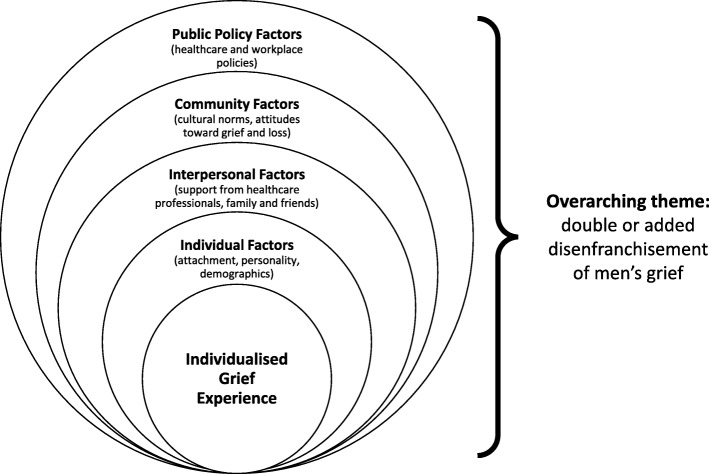
This systematic review synthesized 46 studies on men’s grief after pregnancy loss and neonatal loss and found that men’s grief is highly varied, often under-captured by existing grief measures, and shaped by individual, interpersonal, community, and policy-level factors. The authors propose an emerging socio-ecological model and argue that support for men needs to be more accessible, validating, and multi-level.
Key findings
- The review included 46 articles: 26 qualitative, 19 quantitative, and 1 mixed methods paper; all studies were from high-income countries.
- Across 12 quantitative studies reporting raw grief scores, men’s mean total PGS scores ranged from 36 to 133.19; most were between 73 and 83, and the review notes that scores above 91 indicate a high degree of grief.
- In 9 of 10 studies comparing men and women, men’s grief scores were significantly lower or less intense than women’s, though the authors caution that current measures may not validly capture men’s grief styles.
- Key qualitative themes included men’s roles as supporters of partners, lack of social recognition, expectations to “be strong,” woman-focused care/services, and the importance of attachment to the baby; the authors describe men’s grief as potentially “double-disenfranchised.”
Methods
- Systematic review following PRISMA, searching PubMed, PsycINFO, Embase, and CINAHL in October 2018; registered in PROSPERO (CRD42018103981).
- Included empirical studies published 1998 to October 2018 with primary data on men’s grief and/or predictors after miscarriage, stillbirth, termination for nonviable fetal anomaly, or neonatal death up to 28 days.
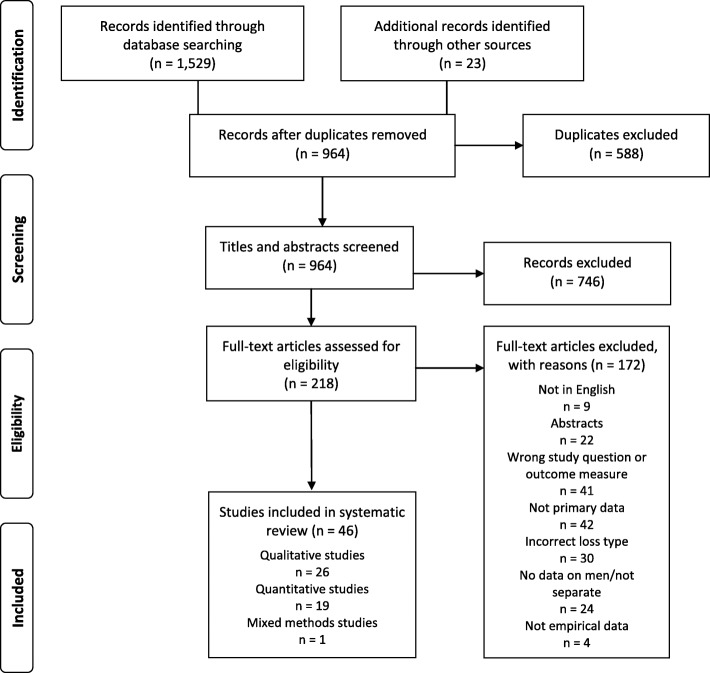
- Study yield: 1552 articles identified, 46 included; qualitative quality was appraised with CASP, and quantitative studies used standard analyses such as correlations, regressions, and group comparisons.
Limitations
- The paper states that most studies used convenience, purposive, or snowball sampling, so findings may not represent all bereaved men.
- The authors state that included participants were predominantly Caucasian, heterosexual men from high-income countries, and call for research in more diverse groups; this limits generalizability.
- The text makes evident that neonatal loss was under-studied: no paper focused exclusively on neonatal death, and the authors note a need for updated research on this group.
Model-written summary. Check it against the paper before relying on it.
Integrity signals
Registry
Cites
Statistics
Figures
Verification
Claims the paper makes
52 Valid · 4 Not valid · 91 Not checked · 40 Own results and interpretations
Some cited sources support this claim and some don’t — read each source’s verdict below.
In the paper
“However, some men in qualitative studies also expressed less extreme reactions to the loss, indicating representation of a range of experiences [56, 61, 69, 71–75, 78, 79].”
§ Men’s grief following pregnancy loss and neonatal loss: a systematic review and emerging theoretical model > Discussion > Limitations and future research
What the sources say
- Not matchedcites [56] Brierly LE. Couples' experiences grieving late-term pregnancy loss in the digital era. Dissertation Abstracts International: Section B: The Sciences and Engineering. 2018;79(8-B(E)).
Its entry has no title and year that we can search by.
- Not matchedcites [61] Obst KL Australian men’s experiences of support following pregnancy loss 2017 Adelaide University of Adelaide 30529832
We searched by its title and found no matching paper.
- Not checked — no full text of the sourcecites [69] Hamama-Raz Y Hemmendinger S Buchbinder E The unifying difference: dyadic coping with spontaneous abortion among religious Jewish couples Qual Health Res 2010 20 2 251 261 10.1177/1049732309357054 20065308 source
- Not checked — no full text of the sourcecites [71] Abboud L Liamputtong P Pregnancy loss: what it means to women who miscarry and their partners Soc Work Health Care 2003 36 3 37 62 10.1300/J010v36n03_03 12564651 source
- Not checked — no full text of the sourcecites [72] Abboud L Liamputtong P When pregnancy fails: coping strategies, support networks and experiences with health care of ethnic women and their partners J Reprod Infant Psychol 2005 23 1 3 18 10.1080/02646830512331330974 source
- Not checked — no full text of the sourcecites [73] Armstrong D Exploring fathers' experiences of pregnancy after a prior perinatal loss MCN Am J Matern Child Nurs 2001 26 3 147 153 10.1097/00005721-200105000-00012 11372213 source
- Disputedcites [74] Campbell-Jackson L, Bezance J, Horsch A. "A renewed sense of purpose": Mothers' and fathers' experience of having a child following a recent stillbirth. BMC Pregnancy Childbirth. 2014;14(1):423. PMC4279693 25522655 sourceExperimental — accuracy not yet measured
The Background (page unavailable) says fathers report fewer grief and anxiety symptoms, but explicitly cautions that their grief may be qualitatively different rather than less intense. The Discussion likewise describes different expressions of grief and difficulty finding space to grieve, not men expressing less extreme reactions to the loss. (LLM, conf=0.86)
Checked by a reasoning model — may be wrong.
- Not checked yetcites [75] Fisher KA Miscarriage: A phenomenological approach to the father's experience. Dissertation Abstracts International: Section B The Sciences and Engineering 2002 5032
- Partly supportedcites [78] Meaney S Corcoran P Spillane N O'Donoghue K BMJ Open 2017 7 3 e011382 10.1136/bmjopen-2016-011382 28348180 PMC5372116 sourceExperimental — accuracy not yet measured
The Discussion (page unavailable) says the men were less likely to discuss the miscarriage openly, supporting a difference in how they expressed their experiences. It cautions that this may reflect differences in expressing grief rather than less intense emotional reactions; the Findings also say the men were emotionally affected and grieved. The paper therefore does not establish that some men had less extreme reactions to the loss. (LLM, conf=0.83)
- Not checked — no full text of the sourcecites [79] Murphy F The experience of early miscarriage from a male perspective J Clin Nurs 1998 7 4 325 332 10.1046/j.1365-2702.1998.00153.x 9830973 source
hedged- Asserted: passes — The authors put it forward as true.
- Checkable: passes — It can be checked against evidence.
- Load-bearing: unclear — It is unclear whether the paper’s conclusions depend on it.
- Based: passes — The paper gives a reason why it holds.
- Not matched
The sources with a verdict support this claim; the rest weren’t checked yet, have no full text we could read, or their verdicts aren’t rated yet.
In the paper
“Although 13 studies used the Perinatal Grief Scale (PGS) as a primary measure of grief”
- Also stated in: § Findings relating to the grief experience · plain
“Thirteen quantitative studies used the PGS as the primary measure of grief [24, 25, 67, 84, 87–93, 95, 96].”
§ Men’s grief following pregnancy loss and neonatal loss: a systematic review and emerging theoretical model > Results > Quality of included studies
What the sources say
- Not matchedcites [24] Franche RL Psychologic and obstetric predictors of couples' grief during pregnancy after miscarriage or perinatal death Obstet Gynecol 2001 97 4 597 602 11275034
Its entry has no title and year that we can search by.
- Not checked — no full text of the sourcecites [25] Puddifoot J Johnson M Active grief, despair, and difficulty coping: some measured characteristics of male response following their partner's miscarriage J Reprod Infant Psychol 1999 17 1 89 93 10.1080/02646839908404587 source
- Supportedcites [67] Cope H Garrett ME Gregory S Ashley-Koch A Pregnancy continuation and organizational religious activity following prenatal diagnosis of a lethal fetal defect are associated with improved psychological outcome Prenat Diagn 2015 35 8 761 768 10.1002/pd.4603 25872901 PMC4968036 source
The Methods > Measures section identifies the PGS as the instrument this study used to measure grief, and the Results > Psychological outcome section reports PGS grief scores. This supports citing the paper as one of the studies using the PGS; the total of 13 is the citing document’s count of included studies, not a count attributed to this individual paper. Page numbers are unavailable in our copy. (LLM, conf=0.88)
- Not checked — no full text of the sourcecites [84] Franche RL Bulow C The impact of a subsequent pregnancy on grief and emotional adjustment following a perinatal loss Infant Ment Health J 1999 20 2 175 187 10.1002/(SICI)1097-0355(199922)20:2<175::AID-IMHJ5>3.0.CO;2-Q doi:10.1002/(sici)1097-0355(199922)20:2
- Not checked — no full text of the sourcecites [87] Johnson MP Puddifoot JE Miscarriage: is vividness of visual imagery a factor in the grief reaction of the partner? Br J Health Psychol 1998 3 137 146 10.1111/j.2044-8287.1998.tb00562.x source
- Not checked — no full text of the sourcecites [88] Barr P Guilt- and shame-proneness and the grief of perinatal bereavement Psychol Psychother Theory Res Pract 2004 77 4 493 510 10.1348/1476083042555442 15588457 source
- Not checked — no full text of the sourcecites [89] Barr P Relation between grief and subsequent pregnancy status 13 months after perinatal bereavement J Perinat Med 2006 34 3 207 211 10.1515/JPM.2006.036 16602840 source
- Not checked — no full text of the sourcecites [90] Barr P Negative self-conscious emotion and grief: an actor-partner analysis in couples bereaved by stillbirth or neonatal death Psychol Psychother 2012 85 3 310 326 10.1111/j.2044-8341.2011.02034.x 22903921 source
- Not checked — no full text of the sourcecites [91] Serrano F Lima ML Recurrent miscarriage: psychological and relational consequences for couples Psychol Psychother Theory Res Pract 2006 79 4 585 594 10.1348/147608306X96992 17312873 source
- Not checked — no full text of the sourcecites [92] Wilson PA Boyle FM Ware RS Holding a stillborn baby: the view from a specialist perinatal bereavement service Aus N Z J Obstet Gynaecol 2015 55 4 337 343 10.1111/ajo.12327 26129981 source
plain- Asserted: passes — The authors put it forward as true.
- Checkable: passes — It can be checked against evidence.
- Load-bearing: unclear — It is unclear whether the paper’s conclusions depend on it.
- Based: passes — The paper gives a reason why it holds.
- Also stated in: § Findings relating to the grief experience · plain
The sources with a verdict support this claim; the rest weren’t checked yet, have no full text we could read, or their verdicts aren’t rated yet.
In the paper
“Finally, 17 studies also grouped together different types of loss as part of the investigation of grief (e.g., miscarriage and stillbirth, stillbirth and neonatal death, or all three types together) [24, 46, 57–61, 73, 77, 80, 83, 84, 86, 88–90, 93].”
§ Men’s grief following pregnancy loss and neonatal loss: a systematic review and emerging theoretical model > Results > Quality of included studies
What the sources say
- Not matchedcites [24] Franche RL Psychologic and obstetric predictors of couples' grief during pregnancy after miscarriage or perinatal death Obstet Gynecol 2001 97 4 597 602 11275034
Its entry has no title and year that we can search by.
- Not checked — no full text of the sourcecites [46] McCreight BS A grief ignored: narratives of pregnancy loss from a male perspective Sociol Health Illn 2004 26 3 326 350 10.1111/j.1467-9566.2004.00393.x 15043602 source
- Not matchedcites [57] Cholette ME Exploring the meaning of the paternal experience of perinatal loss: a phenomenological study: University of Arizona 2012
We searched by its title and found no matching paper.
- Not matchedcites [58] Colon EJ Paternal experiences after a perinatal loss. Dissertation Abstracts International: Section B The Sciences and Engineering 2009 4084
We searched by its title and found no matching paper.
- Not matchedcites [59] Jones-Peeples AE Understanding paternal experience of perinatal loss and maternal expectations. Dissertation Abstracts International: Section B The Sciences and Engineering 2014
We searched by its title and found no matching paper.
- Not matchedcites [60] Lukas ML Paternal grief, mourning, and adaptation following perinatal loss. Dissertation Abstracts International: Section B The Sciences and Engineering 1999 5169
We searched by its title and found no matching paper.
- Not matchedcites [61] Obst KL Australian men’s experiences of support following pregnancy loss 2017 Adelaide University of Adelaide 30529832
We searched by its title and found no matching paper.
- Not checked — no full text of the sourcecites [73] Armstrong D Exploring fathers' experiences of pregnancy after a prior perinatal loss MCN Am J Matern Child Nurs 2001 26 3 147 153 10.1097/00005721-200105000-00012 11372213 source
- Supportedcites [77] Kavanaugh K Hershberger P Perinatal loss in low-income African American parents J Obstet Gynecol Neonatal Nurs 2005 34 5 595 605 10.1177/0884217505280000 16227515 PMC1388191 source
The Participants section states that this study included families who experienced stillbirth and families who experienced neonatal death. It therefore supports citing this paper as one of the studies that grouped different types of loss; the count of 17 studies is the citing paper’s aggregate, not a count attributed to this source. (LLM, conf=0.92)
- Not checked — no full text of the sourcecites [80] O'Leary J Thorwick C Fathers' perspectives during pregnancy, postperinatal loss J Obstet Gynecol Neonatal Nurs 2006 35 1 78 86 10.1111/j.1552-6909.2006.00017.x 16466355 source
plain- Asserted: passes — The authors put it forward as true.
- Checkable: passes — It can be checked against evidence.
- Load-bearing: passes — The paper’s conclusions depend on it.
- Based: passes — The paper gives a reason why it holds.
- Not matched
The cited sources support only part of this claim — read each source’s verdict below.
In the paper
“With the exception of one study which employed author-developed measures of grief and support service satisfaction [70] the remaining quantitative studies employed standardised and validated measures for both predictors and grief [23–25, 67, 76, 84, 86–96].”
§ Men’s grief following pregnancy loss and neonatal loss: a systematic review and emerging theoretical model > Results > Quality of included studies
What the sources say
- Not matchedcites [70] Khan RA Drudy L Sheehan J Harrison RF Geary M Early pregnancy loss: how do men feel? Ir Med J 2004 97 7 217 218 15491001
Its entry has no title and year that we can search by.
- Not checked — no full text of the sourcecites [23] Huffman CS Schwartz TA Swanson KM Couples and miscarriage: the influence of gender and reproductive factors on the impact of miscarriage Womens Health Issues 2015 25 5 570 578 10.1016/j.whi.2015.04.005 26082277 source
- Not matchedcites [24] Franche RL Psychologic and obstetric predictors of couples' grief during pregnancy after miscarriage or perinatal death Obstet Gynecol 2001 97 4 597 602 11275034
Its entry has no title and year that we can search by.
- Not checked — no full text of the sourcecites [25] Puddifoot J Johnson M Active grief, despair, and difficulty coping: some measured characteristics of male response following their partner's miscarriage J Reprod Infant Psychol 1999 17 1 89 93 10.1080/02646839908404587 source
- Partly supportedcites [67] Cope H Garrett ME Gregory S Ashley-Koch A Pregnancy continuation and organizational religious activity following prenatal diagnosis of a lethal fetal defect are associated with improved psychological outcome Prenat Diagn 2015 35 8 761 768 10.1002/pd.4603 25872901 PMC4968036 sourceExperimental — accuracy not yet measured
The Methods > Measures section says participants completed standardized instruments, including the Perinatal Grief Scale, and used items from the Duke University Religion Index to assess religious activity. But pregnancy management choices were collected with the Pregnancy History and Choices Questionnaires, which the authors say were developed specifically for this project; the claim that predictors were uniformly measured with standardized, validated instruments is therefore not supported for this study. (LLM, conf=0.88)
- Not checked — no full text of the sourcecites [76] Jansson C Volgsten H Huffman C Skoog Svanberg A Swanson KM Stavreus-Evers A Validation of the revised impact of miscarriage scale for Swedish conditions and comparison between Swedish and American couples' experiences after miscarriage Eur J Contracept Reprod Health Care 2017 22 6 412 417 10.1080/13625187.2017.1409346 29250992 source
- Not checked — no full text of the sourcecites [84] Franche RL Bulow C The impact of a subsequent pregnancy on grief and emotional adjustment following a perinatal loss Infant Ment Health J 1999 20 2 175 187 10.1002/(SICI)1097-0355(199922)20:2<175::AID-IMHJ5>3.0.CO;2-Q doi:10.1002/(sici)1097-0355(199922)20:2
- Partly supportedcites [86] Michon B Balkou S Hivon R Cyr C Death of a child: parental perception of grief intensity - end-of-life and bereavement care Paediatr Child Health 2003 8 6 363 366 10.1093/pch/8.6.363 20052330 PMC2795457 sourceExperimental — accuracy not yet measured
Materials and Methods (page not specified) describes a study-specific 1–10 grief rating, and Results (page not specified) reports whether parents found follow-up bereavement care helpful. But the study also measured grief with the TRIG-F, which Materials and Methods explicitly calls a standardized, reliable and valid instrument. The citation therefore overlooks a principal validated grief measure; the paper does not establish a formal author-developed support-service satisfaction scale. (LLM, conf=0.87)
- Not checked — no full text of the sourcecites [87] Johnson MP Puddifoot JE Miscarriage: is vividness of visual imagery a factor in the grief reaction of the partner? Br J Health Psychol 1998 3 137 146 10.1111/j.2044-8287.1998.tb00562.x source
- Not checked — no full text of the sourcecites [88] Barr P Guilt- and shame-proneness and the grief of perinatal bereavement Psychol Psychother Theory Res Pract 2004 77 4 493 510 10.1348/1476083042555442 15588457 source
plain- Asserted: passes — The authors put it forward as true.
- Checkable: passes — It can be checked against evidence.
- Load-bearing: unclear — It is unclear whether the paper’s conclusions depend on it.
- Based: passes — The paper gives a reason why it holds.
- Not matched
The sources with a verdict support this claim; the rest weren’t checked yet, have no full text we could read, or their verdicts aren’t rated yet.
In the paper
“With the exception of 12 studies, [25, 55, 68, 81, 86, 88–90, 92, 94–96], almost all studies used convenience, purposive or snowball sampling to recruit participants.”
§ Men’s grief following pregnancy loss and neonatal loss: a systematic review and emerging theoretical model > Results > Quality of included studies
What the sources say
- Not checked — no full text of the sourcecites [25] Puddifoot J Johnson M Active grief, despair, and difficulty coping: some measured characteristics of male response following their partner's miscarriage J Reprod Infant Psychol 1999 17 1 89 93 10.1080/02646839908404587 source
- Not checked — no full text of the sourcecites [55] Avelin P Rådestad I Säflund K Wredling R Erlandsson K Parental grief and relationships after the loss of a stillborn baby Midwifery. 2013 29 6 668 673 10.1016/j.midw.2012.06.007 22863238 source
- Not checked — no full text of the sourcecites [68] Ekelin M Crang-Svalenius E Nordström B Dykes AK Parents' experiences, reactions and needs regarding a nonviable fetus diagnosed at a second trimester routine ultrasound J Obstet Gynecol Neonatal Nurs 2008 37 4 446 454 10.1111/j.1552-6909.2008.00258.x 18754982 source
- Not checked — no full text of the sourcecites [81] Samuelsson M Rådestad I Segesten K A waste of life: fathers' experience of losing a child before birth Birth 2001 28 2 124 130 10.1046/j.1523-536X.2001.00124.x 11380384 source
- Supportedcites [86] Michon B Balkou S Hivon R Cyr C Death of a child: parental perception of grief intensity - end-of-life and bereavement care Paediatr Child Health 2003 8 6 363 366 10.1093/pch/8.6.363 20052330 PMC2795457 source
The citation identifies this paper as one of the exceptions, not as evidence for the sampling methods used by all the other studies. In Materials and Methods (Sample and procedures; page unavailable), the paper says it sought to include all families who lost a child in a defined region and period, subject to a stated exclusion, rather than recruiting by convenience, purposive or snowball sampling. (LLM, conf=0.89)
- Not checked — no full text of the sourcecites [88] Barr P Guilt- and shame-proneness and the grief of perinatal bereavement Psychol Psychother Theory Res Pract 2004 77 4 493 510 10.1348/1476083042555442 15588457 source
- Not checked — no full text of the sourcecites [89] Barr P Relation between grief and subsequent pregnancy status 13 months after perinatal bereavement J Perinat Med 2006 34 3 207 211 10.1515/JPM.2006.036 16602840 source
- Not checked — no full text of the sourcecites [90] Barr P Negative self-conscious emotion and grief: an actor-partner analysis in couples bereaved by stillbirth or neonatal death Psychol Psychother 2012 85 3 310 326 10.1111/j.2044-8341.2011.02034.x 22903921 source
- Not checked — no full text of the sourcecites [92] Wilson PA Boyle FM Ware RS Holding a stillborn baby: the view from a specialist perinatal bereavement service Aus N Z J Obstet Gynaecol 2015 55 4 337 343 10.1111/ajo.12327 26129981 source
- Not checked — no full text of the sourcecites [94] Alderman L Chisholm J Denmark F Salbod S Bereavement and stress of a miscarriage: as it affects the couple Omega: Journal of Death and Dying 1998 37 4 317 327 10.2190/DQNQ-PFAM-7V00-52F3 source
plain- Asserted: passes — The authors put it forward as true.
- Checkable: passes — It can be checked against evidence.
- Load-bearing: passes — The paper’s conclusions depend on it.
- Based: passes — The paper gives a reason why it holds.
106 more claims · 32 with their cited sources checked
Create a free account to see all 187 claims and to verify the 53 references still open.
- It may state two separate claims as one. 58
- Probably not a substantial claim. 21
- The quote only partly states this claim. 2
Claims other papers make about this one
Each is checked against this paper’s own text: does it say what the citing paper says it does?
The source backs part of the claim, not all of it — or backs it for a different population, condition or comparison.
In the citing paper
“At the individual level, factors contributing to men’s grief include demographic elements (e.g., age, religion, ethnicity), pregnancy loss/neonatal death history and number of living children.”
From Factors contributing to men’s grief following pregnancy loss and neonatal death: further development of an emerging model in an Australian sample (2021) · cites this paper as [36]
Experimental — accuracy not yet measuredThe source backs part of the claim, not all of it — or backs it for a different population, condition or comparison.
In the citing paper
“As many men have reported returning to work soon after pregnancy loss or neonatal death, bereavement leave policies may play a role in grief outcomes [36].”
From Factors contributing to men’s grief following pregnancy loss and neonatal death: further development of an emerging model in an Australian sample (2021) · cites this paper as [36]
Experimental — accuracy not yet measuredThe source backs part of the claim, not all of it — or backs it for a different population, condition or comparison.
In the citing paper
“Notably, most researchers have focused primarily on parents' emotions and their grief process (Obst et al., 2020; Payne et al., 2025).”
From Nurses' and midwives' experiences of supporting parents following perinatal bereavement: A qualitative systematic review (2026) · cites this paper as Obst et al., 2020
Experimental — accuracy not yet measuredThe source backs part of the claim, not all of it — or backs it for a different population, condition or comparison.
In the citing paper
“The few studies investigating men’s reactions after SB suggest that paternal and maternal reactions might differ [10, 59].”
From Depression, anxiety, PTSD, and OCD after stillbirth: a systematic review (2021) · cites this paper as [59]
Experimental — accuracy not yet measuredThe cited source says what the claim attributes to it.
In the citing paper
“Although this measure of ‘toughness’ did not emerge as a significant predictor in any of the models in the current study, it may still be an important factor to consider, as a low alpha value may indicate that this measure did not adequately capture men’s experiences of needing to be ‘strong’ or ‘tough’ as reported in previous qualitative studies [10, 12, 13, 31, 36].”
From Factors contributing to men’s grief following pregnancy loss and neonatal death: further development of an emerging model in an Australian sample (2021) · cites this paper as [36]
4 more claims about this paper
Create a free account to see every claim other papers make about this one.
Citations
Cites
Preferred Reporting Items for Systematic Reviews and Meta-Analyses: the PRISMA statement
Moher, D., Liberati, A., Tetzlaff, J., Altman, D. G., & for the PRISMA Group (2009) · BMJ · doi:10.1136/bmj.b2535 · Cited by 83,823
Preferred reporting items for systematic reviews and meta-analyses: the PRISMA Statement.
(2009) · PubMed Central · Cited by 44,859
Preferred reporting items for systematic reviews and meta-analyses: The PRISMA statement
Moher, D., Liberati, A., Tetzlaff, J., Altman, D. G., & the PRISMA Group* (2009) · Annals of Internal Medicine · doi:10.7326/0003-4819-151-4-200908180-00135 · Cited by 37,554
The Ecology of Human Development: Experiments by Nature and Design
Bronfenbrenner, U. (1979) · Harvard University Press eBooks · doi:10.4159/9780674028845 · Cited by 26,084
The ecology of human development : experiments by nature and design
Bronfenbrenner, U. (1979) · Cited by 12,580
The cochrane database of systematic reviews
Geddes, J. (1996) · Journal of Psychosomatic Research · doi:10.1016/s0022-3999(96)90063-x · Cited by 5,989
Kübler-Ross, E. (1975) · PubMed · Cited by 4,935
Men, masculinity, and the contexts of help seeking
Addis, M. E., & Mahalik, J. R. (2003) · American Psychologist · doi:10.1037/0003-066x.58.1.5 · Cited by 2,761
THE DUAL PROCESS MODEL OF COPING WITH BEREAVEMENT: RATIONALE AND DESCRIPTION
Schut, M. S. (1999) · Death Studies · doi:10.1080/074811899201046 · Cited by 2,560
International Journal of Nursing Studies
(2000) · Nursing Older People · doi:10.7748/nop.11.10.26.s15 · Cited by 1,932
Research works printed but not linked: 10
- Australian Bureau of Statistics Causes of Death, Australia, 2016 2017 Canberra Commonwealth of Australia
- Canada S Data quality, concepts and methodology: definitions 2012 Ontario Government of Canada
- Bowlby J Attachment and loss: sadness and depression London: Hogarth press 1980
- Brierly LE. Couples' experiences grieving late-term pregnancy loss in the digital era. Dissertation Abstracts International: Section B: The Sciences and Engineering. 2018;79(8-B(E)).
- Colon EJ Paternal experiences after a perinatal loss. Dissertation Abstracts International: Section B The Sciences and Engineering 2009 4084
- Jones-Peeples AE Understanding paternal experience of perinatal loss and maternal expectations. Dissertation Abstracts International: Section B The Sciences and Engineering 2014
- Lukas ML Paternal grief, mourning, and adaptation following perinatal loss. Dissertation Abstracts International: Section B The Sciences and Engineering 1999 5169
- Tennenbaum EA A qualitative investigation of the psychological effects of recurrent miscarriage on male partners. Dissertation Abstracts International: Section B The Sciences and Engineering 2008 1348
- Fisher KA Miscarriage: A phenomenological approach to the father's experience. Dissertation Abstracts International: Section B The Sciences and Engineering 2002 5032
- Doka KJ Martin T Grieving styles: Gender and grief Grief Matters: The Australian Journal of Grief and Bereavement 2011 14 2 42 45
Cited by
Depression, anxiety, PTSD, and OCD after stillbirth: a systematic review
Westby, C. L., Erlandsen, A. R., Nilsen, S. A., Visted, E., & Thimm, J. C. (2021) · BMC Pregnancy and Childbirth · doi:10.1186/s12884-021-04254-x · Cited by 148
“The few studies investigating men’s reactions after SB suggest that paternal and maternal reactions might differ [10, 59].”
BackgroundRecurrent pregnancy loss: a shared stressor---couple-orientated psychological research findings
Voss, P., Schick, M., Langer, L., Ainsworth, A., Ditzen, B., Strowitzki, T., Wischmann, T. H., & Kuon, R. (2020) · Fertility and Sterility · doi:10.1016/j.fertnstert.2020.08.1421 · Cited by 91
Heaney, S., Tomlinson, M., & Aventin, Á. (2022) · BMC Pregnancy and Childbirth · doi:10.1186/s12884-022-04770-4 · Cited by 86
“…Lafarge et al., 2019; Leichtentritt, 2011; Leichtentritt and Weinberg-Kurnik, 2016; Leichtentritt and Mahat-Shamir, 2017; Lotto et al., 2016; Mitchell, 2016; Obst et al., 2020; Pitt et al., 2016; Qin et al., 2019; Ramdaney et al., 2015; Smith et al., 2020a; Sun et al., 2018; Zareba et al.,…”
BackgroundInfluentialObst, K. L., Oxlad, M., Due, C., & Middleton, P. (2021) · BMC Pregnancy and Childbirth · doi:10.1186/s12884-020-03514-6 · Cited by 61
Self-citationSilverio, S. A., Easter, A., Storey, C., Jurković, D., Sandall, J., & on behalf of the PUDDLES Global Collaboration (2021) · BMC Pregnancy and Childbirth · doi:10.1186/s12884-021-04292-5 · Cited by 51
Lee, L., Ma, W., Davies, S., & Kammers, M. (2023) · Journal of Midwifery & Women's Health · doi:10.1111/jmwh.13414 · Cited by 50
Cyberthanathology: Death and beyond in the digital age
Beaunoyer, E., & Guitton, M. J. (2021) · Computers in Human Behavior · doi:10.1016/j.chb.2021.106849 · Cited by 53
Hambidge, S., Cowell, A., Arden-Close, E. J., & Mayers, A. (2021) · BMC Pregnancy and Childbirth · doi:10.1186/s12884-021-03947-7 · Cited by 63
Clark, O. E., Fortney, C. A., Dunnells, Z. D. O., Gerhardt, C. A., & Baughcum, A. E. (2021) · Journal of Pain and Symptom Management · doi:10.1016/j.jpainsymman.2021.02.015 · Cited by 41
de Castro, M. H. M., Mendonça, C. R., Noll, M. A., Tacon, F. S. D. A., & do Amaral, W. N. (2021) · International Journal of Environmental Research and Public Health · doi:10.3390/ijerph182413143 · Cited by 50
Kuforiji, O., Mills, T. A., & Lovell, K. (2022) · Women and Birth · doi:10.1016/j.wombi.2022.07.170 · Cited by 53
“The response stems from a lack of understanding on acknowledgment of perinatal death, recognition of deceased babies and cultural norms thereby leading to disenfranchised grief [41,42].”
BackgroundUța, C., Tîrziu, A., Zimbru, E.-L., Zimbru, R.-I., Georgescu, M., Haidar, L., & Panaitescu, C. B. (2024) · Medicina · doi:10.3390/medicina60111896 · Cited by 39
“This lack of recognition can lead to a sense of disenfranchised grief, where men feel that their sorrow is somehow invalid or secondary [11,12].”
Harty, T., Trench, M., Keegan, O., O'Donoghue, K., & Nuzum, D. (2022) · Health Expectations · doi:10.1111/hex.13452 · Cited by 24
“A heightened awareness of the psychological impact that pregnancy loss has on bereaved parents has led to increased research interest in this area in recent years.(11,12) Parents who have experienced a miscarriage often feel an overwhelming sense of grief that is coupled with a sense of loneliness in coping with this…”
BackgroundDepression and post-traumatic stress disorder after perinatal loss in fathers: a systematic review
Lamon, L., De Hert, M., Detraux, J., & Hompes, T. (2022) · European Psychiatry · doi:10.1192/j.eurpsy.2022.2326 · Cited by 23
“These traditional norms can influence their coping style and their decision to seek help [9, 44].”
BackgroundInfluentialSchoonover, K. L., Prokop, L., & Lapid, M. I. (2022) · Journal of Palliative Care · doi:10.1177/08258597211062762 · Cited by 22
Fernández-Ordóñez, E., González‐Cano‐Caballero, M., Guerra‐Marmolejo, C., Fernández-Fernández, E., & García‐Gámez, M. (2021) · International Journal of Environmental Research and Public Health · doi:10.3390/ijerph18062874 · Cited by 39
Azeez, S., Obst, K. L., Due, C., Oxlad, M., & Middleton, P. (2022) · Death Studies · doi:10.1080/07481187.2022.2030431 · Cited by 21
“This study formed part of a more extensive program of research exploring Australian fathers’ grief and support experiences following pregnancy loss or neonatal death (other results published elsewhere; Azeez et al., 2021; Obst et al., 2020).”
BackgroundInfluentialSelf-citationOKYAY, E. K., & Uçar, T. (2023) · Archives of Psychiatric Nursing · doi:10.1016/j.apnu.2023.04.027 · Cited by 27
Rumbold, A. R., Yelland, J. S., Stuart‐Butler, D., Forbes, M., Due, C., Boyle, F. M., & Middleton, P. (2020) · Women and Birth · doi:10.1016/j.wombi.2020.08.012 · Cited by 25
Self-citationHiefner, A. R., & Villareal, A. (2021) · Frontiers in Public Health · doi:10.3389/fpubh.2021.725762 · Cited by 27
“A growing literature base is identifying fathers’ needs for support after miscarriage (61), and grandparents and siblings of the baby may also benefit from support as they navigate what the loss means for them (62, 63).”
BackgroundPrevention of Pregnancy Loss: Combining Progestogen Treatment and Psychological Support
Картлосовна, Т. Н., Domar, A. D., & Bashiri, A. (2023) · Journal of Clinical Medicine · doi:10.3390/jcm12051827 · Cited by 27
Oxlad, M., Franke, E. F., Due, C., & Jaensch, L. (2023) · Women and Birth · doi:10.1016/j.wombi.2023.03.001 · Cited by 20
Self-citationLGBTQ+ peoples’ experiences of workplace leave and support following pregnancy loss
Rose, A., & Oxlad, M. (2022) · Community Work & Family · doi:10.1080/13668803.2021.2020727 · Cited by 25
Self-citationThe needs of women experiencing perinatal loss: A qualitative systematic review and meta-synthesis
Zhuang, S., Chen, M., Ma, X., Jiang, J., Xiao, G., Zhao, Y., Hou, J., & Wang, Y. (2023) · Women and Birth · doi:10.1016/j.wombi.2023.03.007 · Cited by 28
Initial Impact of Perinatal Loss on Mothers and Their Partners
Delgado, L., Cobo, J., Giménez, C., Fucho, G. F., Sammut, S., Martí, L. R., Heredia, C. L., Puig, S., Gutiérrez, N. O., Canet, Y., et al. (2023) · International Journal of Environmental Research and Public Health · doi:10.3390/ijerph20021304 · Cited by 28
“In fact, what different studies say is that fathers (and partners) have to face different challenges in these moments of loss—including expectations about a caring role for mothers—which further prevents them from being able to receive recognition of their needs and their right to bereavement [35,44].”
BackgroundInfluentialObst, K. L., Due, C., Oxlad, M., & Middleton, P. (2020) · Community Work & Family · doi:10.1080/13668803.2020.1823319 · Cited by 22
“Workplace-related policies, including recognition of grief from employers and bereavement leave provisions for men, are therefore important (Obst et al., 2020).”
BackgroundInfluentialSelf-citationTreatment of Couples Experiencing Pregnancy Loss: Reauthoring Loss from a Narrative Perspective
Romney, J., Fife, S. T., Sanders, D., & Behrens, S. (2020) · International Journal of Systemic Therapy · doi:10.1080/2692398x.2020.1855621 · Cited by 19
“As is typical with other grief and traumatic experiences, pregnancy loss can increase marital problems (Obst et al., 2020).”
BackgroundInfluentialBeauquier‐Maccotta, B., Shulz, J., de Wailly, D., Mériot, M.-E., Soubieux, M.-J., Ouss, L., Grosmaître, C., Salomon, L. J., Golse, B., Ville, Y. G., et al. (2022) · Journal of Gynecology Obstetrics and Human Reproduction · doi:10.1016/j.jogoh.2022.102353 · Cited by 23
“Your heart keeps bleeding”: lived experiences of parents with a perinatal death in Northern Uganda
Arach, A. A. O., Kiguli, J., Nankabirwa, V., Nakasujja, N., Mukunya, D., Musaba, M. W., Napyo, A. K., Tumwine, J. K., Ndeezi, G., & Rujumba, J. (2022) · BMC Pregnancy and Childbirth · doi:10.1186/s12884-022-04788-8 · Cited by 27
Obst, K. L., Due, C., Oxlad, M., & Middleton, P. (2021) · Journal of Clinical Nursing · doi:10.1111/jocn.15786 · Cited by 14
Self-citationThe unheard parental cry of a stillbirth: fathers and mothers
Sarkar, A., Siwatch, S., Aggarwal, N., Singla, R., & Grover, S. (2021) · Archives of Gynecology and Obstetrics · doi:10.1007/s00404-021-06120-9 · Cited by 21
Lockton, J., Oxlad, M., & Due, C. (2021) · Qualitative Health Research · doi:10.1177/10497323211041331 · Cited by 15
“…and expectations around masculinity appear to moderate men’s grief expression, while a lack of understanding 3 about the complexity of grief styles and reactions also contributes to these challenges (Addis & Mahalik, 2003; Bonnette & Broom, 2011; Doka & Martin, 2010; Obst et al., 2021).”
BackgroundResultInfluentialSelf-citationGower, S., Luddington, J., Khosa, D. K., Thaivalappil, A., & Papadopoulos, A. (2023) · BMC Pregnancy and Childbirth · doi:10.1186/s12884-023-05533-5 · Cited by 26
“However, patients consistently report increased levels of anxiety and depression in their subsequent pregnancies [2, 6–8], as do their partners [1, 9, 10].”
BackgroundPearson, T., Obst, K. L., & Due, C. (2022) · Journal of Clinical Nursing · doi:10.1111/jocn.16465 · Cited by 18
Self-citationRahmati, M., Naz, M. S. G., Azizi, F., & Tehrani, F. R. (2022) · Journal of Translational Medicine · doi:10.1186/s12967-022-03578-2 · Cited by 15
“Indeed, lack of support and facing diverse challenges due to pregnancy loss could manifold the disenfranchised grief for males [50].”
BackgroundA qualitative study of bereaved parents and healthcare professionals on perinatal loss
Jansens, J., Faes, K., Coninck, M. D., Gilissen, J., & kelst, L. V. (2024) · European Journal of Midwifery · doi:10.18332/ejm/194159 · Cited by 21
Post-traumatic growth from grief – a narrative literature review
Hurst, R., & Kannangara, C. S. (2022) · Mental Health and Social Inclusion · doi:10.1108/mhsi-09-2022-0059 · Cited by 17
Pesar no óbito fetal: luto sem voz
de Oliveira, H. T. L., Fonseca, L. F., Estancione, L. M. B., Corrêa, M. C. S. M., Oliveira, N. D. R., & Dias, V. D. V. V. A. (2022) · Revista Bioética · doi:10.1590/1983-80422022303558pt · Cited by 12
Andrews, C. J., Pade, A., Flenady, V., Moore, J., Tindal, K., Farrant, B. M., Stewart, S., Loughnan, S. A., Robinson, N., Oba, Y., et al. (2023) · Women and Birth · doi:10.1016/j.wombi.2023.12.005 · Cited by 12
Winter, A., Due, C., & Ziersch, A. M. (2023) · Journal of Immigrant and Minority Health · doi:10.1007/s10903-023-01510-4 · Cited by 14
“Similarly, emerging evidence demonstrates the impact pregnancy and infant loss has on men’s emotional wellbeing[77], however there is currently no data on this in a reset-tlement context for men or women.”
BackgroundSelf-citationCambonie, G., Desage, C., Thaller, P., Lemaitre, A., de Balanda, K. B., Combes, C., & Gavotto, A. (2023) · BMC Palliative Care · doi:10.1186/s12904-023-01183-8 · Cited by 17
Measuring EQ-5D-5L utility values in parents who have experienced perinatal death
Camacho, E. M., Gold, K. J., Murphy, M., Storey, C., & Heazell, A. E. P. (2024) · The European Journal of Health Economics · doi:10.1007/s10198-024-01677-z · Cited by 12
“Fathers/partners often do not disclose their own needs, or have their own needs met as they feel the need to remain emotionally strong for their partner [28].”
BackgroundMendes, D. C. G., Fonseca, A., & Cameirão, M. S. (2024) · Social Science & Medicine · doi:10.1016/j.socscimed.2024.117037 · Cited by 17
Tanacıoğlu, B., & Erdur‐Baker, Ö. (2021) · Death Studies · doi:10.1080/07481187.2021.1922542 · Cited by 19
“Due to societal pressures and gender role expectations supporting the view that men should be strong and be supportive of their partners (Obst et al., 2020), rapid recovery of men after their loss might be expected as a “normal” behavior (B€uchi et al., 2009).”
BackgroundWhen Words Fail: “Miscarriage,” Referential Ambiguity, and Psychological Harm
Bohn, J. A. (2023) · The Journal of Medicine and Philosophy A Forum for Bioethics and Philosophy of Medicine · doi:10.1093/jmp/jhad013 · Cited by 14
A Socioecological Examination of the Challenges Associated With Young Widowhood: A Systematic Review
Barros-Lane, L., Germany, A. F., Smith, P. M., & Stovall, T. (2024) · OMEGA - Journal of Death and Dying · doi:10.1177/00302228241227996 · Cited by 12
“…was initially intended to explain the effects of the social environment on human development (Bronfenbrenner, 1979); however, it has been used to understand other issues affected by societal structures, including enhancing an understanding of fathers ’ grief in pregnancy loss (Obst et al., 2020).”
Plagg, B., Oschmann, J., Ladurner, C., Kapeller, I., Lechner, M., Engl, A., & Piccoliori, G. (2024) · Death Studies · doi:10.1080/07481187.2024.2390905 · Cited by 11
“…similar to the (individual) grieving process experienced after other losses, while the intensity of the grief reaction is always modulated by personal experiences such as previous losses, the presence of other children and infertility (Brier, 2008; Obst et al., 2020; Volgsten et al., 2018).”
Decision‐making and future pregnancies after a positive fetal anomaly screen: A scoping review
Shorey, S., Lalor, J., Pereira, T. L., Jarašiūnaitė–Fedosejeva, G., & Downe, S. M. (2023) · Journal of Clinical Nursing · doi:10.1111/jocn.16628 · Cited by 10
Fernández‐Basanta, S., Coronado, C., & Movilla‐Fernández, M. (2022) · Journal of Midwifery & Women's Health · doi:10.1111/jmwh.13353 · Cited by 9
The silent cry: A psychiatric‐mental health nurse's guide for fathers experiencing perinatal loss
Robinson, M., & Robinson, C. D. (2022) · Journal of Psychiatric and Mental Health Nursing · doi:10.1111/jpm.12849 · Cited by 16
Loughnan, S. A., Boyle, F. M., Ellwood, D. A., Crocker, S., Lancaster, A., Astell, C., Dean, J., Horey, D., Callander, E. J., Jackson, C. L., et al. (2022) · Trials · doi:10.1186/s13063-022-06363-0 · Cited by 13
He, Y., & Sun, Y. (2022) · Frontiers in Psychology · doi:10.3389/fpsyg.2022.1030470 · Cited by 24
“The four-stage theory of grief and loss included: shocknumbness, yearning-searching, disorganization-despair, and reorganization (Parkes, 2002; Obst et al., 2020).”
BackgroundAlexopoulos, J., Tmej, A., Naderer, A., Grussmann, M., Tordy, K., Stammler‐Safar, M., Feichtinger, K., Gipperich, A., & Leithner, K. (2023) · International Journal of Gynecology & Obstetrics · doi:10.1002/ijgo.15234 · Cited by 11
Beaumont, J., Smith, D. M., Bailey, E., Barron, R., Tomlinson, E., & Heazell, A. E. P. (2025) · BJOG An International Journal of Obstetrics & Gynaecology · doi:10.1111/1471-0528.18212 · Cited by 13
Experiences of miscarriage: the voice of parents and health professionals
Figueredo-Borda, N., Ramírez-Pereira, M., Gaudiano, P., Cracco, C., & Ramos, B. (2022) · OMEGA - Journal of Death and Dying · doi:10.1177/00302228221085188 · Cited by 17
“The fathers, meanwhile, must align their expectations of paternity while struggling with the emotional pain felt by their wives (Obst et al., 2020).”
BackgroundBinion, K., & Brann, M. (2023) · Feminist Media Studies · doi:10.1080/14680777.2023.2215965 · Cited by 11
“…represented in research, noting men often display grief less openly than their partners (e.g., not wanting to take photos); however, men are equally vulnerable to emotional aspects of miscarriage due to societal pressures of not expressing grief and sadness (Bute and Brann 2015; Obst et al. 2020).”
BackgroundHeaney, S., Tomlinson, P. M., & Aventin, I. (2021) · Research Square · doi:10.21203/rs.3.rs-930061/v1 · Cited by 8
Silverio, S. A., George-Carey, R., Memtsa, M., Kent-Nye, F. E., Magee, L. A., Sheen, K. S., Burgess, K., Oza, M., Storey, C., Sandall, J., et al. (2024) · BMC Pregnancy and Childbirth · doi:10.1186/s12884-024-06721-7 · Cited by 7
The Lead up to Loss: How Context Shapes LGBTQ+ Experiences of Pregnancy Loss
Rose, A., & Oxlad, M. (2022) · LGBTQ+ Family An Interdisciplinary Journal · doi:10.1080/27703371.2022.2089308 · Cited by 7
Self-citationSalvini, S., D’Souza, L., McDowell, C., & Vivekananda, K. (2024) · OMEGA - Journal of Death and Dying · doi:10.1177/00302228241265525 · Cited by 8
“There appears to be a con fl ict between a father ’ s outward expression of emotions, and his desire to be validated in grief and parenthood (Bonnette & Broom, 2012; Cholette, 2012; Due et al., 2017; Jones et al., 2019; Obst et al., 2020).”
Grief, bereavement and prolonged grief disorder: scoping and mapping the evidence
Raine, G., Khouja, C., Khatwa, M., Fulbright, H., Sutcliffe, K., & Sowden, A. J. (2025) · BJPsych Open · doi:10.1192/bjo.2025.10050 · Cited by 12
“48,57,75,80,85,95,99,125,128 Seven of these reviews explored experiences following perinatal loss, including miscarriage and stillbirth, of which four focused on mothers only 48,75,85,128 and three on fathers only.”
Burgess, A., Murray, C. D., & Clancy, A. (2023) · OMEGA - Journal of Death and Dying · doi:10.1177/00302228231162736 · Cited by 11
“This is mirrored in the fathers ’ re fl ections on societal dismissal of the father-infant relationship, consistent with a recent review highlighting the lack of social recognition of fathers ’ grief in the context of pregnancy loss (Obst et al., 2020).”
Koert, E., Hartwig, T. S., Malling, G. M. H., Schmidt, L., & Nielsen, H. S. (2023) · Human Reproduction Open · doi:10.1093/hropen/hoad032 · Cited by 11
“There is now strong evidence of the short- and long-term negative mental health and psychosocial implications of PL for women and their partners (Brier, 2008; Kolte et al., 2015; Meaney et al., 2017; Koert et al., 2019; Obst et al., 2020; Williams et al., 2020; Quenby et al., 2021).”
BackgroundResultA proposed framework for perinatal loss trauma informed care
Berry, S. N., Winsor, T., & Huene, L. (2023) · Journal of Neonatal Nursing · doi:10.1016/j.jnn.2023.08.004 · Cited by 9
Blocksidge, H., Wittkowski, A., Heazell, A. E. P., & Smith, D. M. (2026) · Death Studies · doi:10.1080/07481187.2025.2452486 · Cited by 6
“A lack of social recognition is echoed in a review by Obst et al. (2020), who highlighted how fathers face double-disenfranchised grief, meaning their loss is made more complex by a lack of social recognition for men’s grief and an absence of cultural norms on how to grieve the death of a baby.”
Azeez, S., Obst, K. L., Oxlad, M., Due, C., & Middleton, P. (2021) · Journal of Perinatology · doi:10.1038/s41372-021-01210-7 · Cited by 6
“Interview questions were developed based on previous pregnancy loss studies [26–28], including the findings of the larger research programme [25].”
BackgroundMethodResultBreaking the Silence: Men's Experience of Miscarriage. An Interpretative Phenomenological Analysis
McGarva-Collins, S., Summers, S. J., & Caygill, L. (2022) · Illness Crisis & Loss · doi:10.1177/10541373221133003 · Cited by 12
Gaps in Stillbirth Bereavement Care: A Cross-Sectional Survey of U.S. Hospitals by Birth Volume
Gold, K. J., Boggs, M. E., & Plegue, M. A. (2023) · Maternal and Child Health Journal · doi:10.1007/s10995-023-03861-8 · Cited by 8
“(American College of Obstetricians and Gynecologists, 2020; Obst et al., 2020; Obst et al., 2021; Shakespeare et al., 2020) Families highly value memorial items and preservation of limited birth memories, (Fenstermacher & Hupcey, 2019; Gold et al., 2007) and these help create continuing bonds.”
Factors Associated with Perinatal Bereavement Among Mothers in Bolivia: A Qualitative Study
Cox, C. E. F., Ortiz, M. F. C., Lara, T., Schulmeyer, M. K., & Fernández‐Alcántara, M. (2025) · Healthcare · doi:10.3390/healthcare13060615 · Cited by 7
“Existing research carried out in different countries has shown that fathers often assume the role of supporting their partners during bereavement [34–36].”
du Fossé, N. A., Lashley, E. E. L. O., Treurniet, T. T., Lith, J. M. M. V., le Cessie, S., Boosman, H., & van der Hoorn, M. (2021) · BMC Pregnancy and Childbirth · doi:10.1186/s12884-021-04277-4 · Cited by 7
“Multiple studies showed that a significant part of men affected by pregnancy loss experienced little support from their social network and a reluctance to share their loss and feelings with them; their family and friends tend to direct their acknowledgement and support largely toward the female partner [5, 21, 22].”
BackgroundThe experience of men following stillbirth: the case of Israeli bereaved fathers
Chodik, N. G., & Baum, N. (2023) · Journal of Reproductive and Infant Psychology · doi:10.1080/02646838.2023.2237541 · Cited by 10
“In a previous research bereaving men felt unseen by medical and social services, and indicated that they wanted to be approached directly with a special tailored support to meet their special needs (Obst et al., 2020).”
Bakx, P., García‐Gómez, P., & Rellstab, S. (2022) · Oxford Bulletin of Economics and Statistics · doi:10.2139/ssrn.4075881 · Cited by 7
Yıldız Karaahmet, A., & Bilgiç, F. Ş. (2026) · OMEGA - Journal of Death and Dying · doi:10.1177/00302228241272686 · Cited by 6
“…grief and interventions, consisting of 46 articles, including 26 qualitative, 19 quantitative and one mixed methods article, it was reported that men ’ s grief experiences are quite diverse and that existing grief measures do not cover all the complexities of grief for men (Obst et al., 2020).”
Providing care to couples experiencing pregnancy loss
Latiff, H.-S.-B., Saime, N. S., Idris, D. R., Mohamad, S. M., Husaini, A., Matassan, N. S., Syam, A., & Mumin, K. H. A. (2023) · British Journal of Midwifery · doi:10.12968/bjom.2023.31.3.172 · Cited by 11
Developing text-messaging support for fathers after perinatal loss
Fletcher, R. J., Regan, C., May, C. D., Rennie, A., Ludski, K., & StGeorge, J. M. (2024) · Women and Birth · doi:10.1016/j.wombi.2024.101594 · Cited by 7
Smith, D. M., Beaumont, J., Bailey, E., Barron, R., Murphy, M., Tomlinson, E., & Heazell, A. E. P. (2025) · Health Expectations · doi:10.1111/hex.70464 · Cited by 9
“Partners ’ needs must be recognised, and healthcare professionals must treat them as individuals in maternity care following a previous loss [2, 37].”
InfluentialJansen, C., Kuhlmann, E., Scharli, P., Schick, M., Ditzen, B., Langer, L., Strowitzki, T., Kuon, R., & Wischmann, T. H. (2022) · Human Reproduction Open · doi:10.1093/hropen/hoac032 · Cited by 15
“With regard to social support, the significance of miscarriages and especially the burdens they represent for men are often underestimated by outsiders (Lang et al., 2011; Obst et al., 2020).”
BackgroundThe impact of the COVID-19 pandemic on perinatal loss among Italian couples: A mixed-method study
Testoni, I., Ronconi, L., Iacona, E., Trainini, A., Tralli, N., Nodari, L., Limongelli, G., & Cena, L. (2022) · Frontiers in Psychology · doi:10.3389/fpsyg.2022.929350 · Cited by 9
“Perinatal loss, comprised of experiences of miscarriage, stillbirth, and neonatal death, is a highly traumatic experience characterized by stressful conditions aggravated by the psychological dissolution of expectations regarding raising a child and developing a parental role (Obst et al., 2020; Testoni et al., 2020).”
BackgroundPsychosocial Support within the Context of Perinatal Palliative Care: The “SORROWFUL” Model
von der Hude, K., & Garten, L. (2022) · Children · doi:10.3390/children10010038 · Cited by 11
“Many parents may feel guilty about their situation, feel responsible, or feel incompetent [2,3].”
BackgroundAndersen, K. N., Shittu, F., Abdullahi, M., Ahmed, T., Bakare, D., Salako, J., Burgess, R. A., & King, C. (2022) · Global Health Action · doi:10.1080/16549716.2022.2120251 · Cited by 9
“We conducted a concurrent triangulation mixed-methods study (QUAL + quan), informed by Obst et al.’s (2020) socio-ecological model of grief [15].”
White Tears: A Phenomenological Study of Perinatal Loss
Pekyiğit, A., Yıldız, D., Deniz, A. Ö., & BAĞRIYANIK, B. Ç. (2024) · OMEGA - Journal of Death and Dying · doi:10.1177/00302228241234381 · Cited by 6
“The literature reveals only a limited number of studies investigating the experiences of men who have experienced perinatal loss (Due et al., 2017; Jones et al., 2019; Obst et al., 2020, 2021).”
Experiencias de duelo en hombres por la muerte de un ser querido: revisión integrativa
Esquivel, D. M., Araya-Solís, M., & Hernández, A. M. G. (2024) · Enfermería Clínica · doi:10.1016/j.enfcli.2024.02.005 · Cited by 6
Living with Loss: Evaluating an Internet-Based Program for Parents Following Perinatal Death
Loughnan, S. A., Lancaster, A., Crocker, S., Astell, C., Griffin, A., Wojcieszek, A. M., Boyle, F. M., Ellwood, D. A., Dean, J., Horey, D., et al. (2024) · Journal of Loss and Trauma · doi:10.1080/15325024.2024.2415708 · Cited by 8
“Obst and colleagues have highlighted the importance of responding to men’s unique needs with tailored bereavement support resources (Obst et al., 2020).”
Karali, H. F., Farhad, E. S., Poh, D. C. S. C., Wen, P. Y., Parveena, S., Siong, T. J., & Zaigham, M. T. (2021) · International Journal of Clinical Obstetrics and Gynaecology · doi:10.33545/gynae.2021.v5.i6a.1057 · Cited by 5
Lehmann, O. V., Kalstad, T. G., & Neimeyer, R. A. (2023) · Qualitative Health Research · doi:10.1177/10497323231216099 · Cited by 7
“Among other factors, men can experience a lack of ac-knowledgment for their needs in grieving, receive less attention from healthcare providers, and experience pressure to support their female partners (Mota et al., 2023; Obst et al., 2020).”
BackgroundProviding Palliative Care to Neonates With Anencephaly in the Home Setting
Berry, S. N. (2021) · Journal of Hospice and Palliative Nursing · doi:10.1097/njh.0000000000000770 · Cited by 5
Majumder, M., Kumar, G. A., Ali, S. B., Akbar, M., George, S., Dora, S. P., Akhouri, S. S., Kumari, S., Singh, M. K., Mahapatra, T., et al. (2025) · BMC Public Health · doi:10.1186/s12889-025-22823-z · Cited by 4
“Fathers, akin to mothers, also form emotional bonds with their unborn child during pregnancy [2, 3], however, they feel side-lined in the event of a perinatal loss [4], and perceive their role mainly as a ‘supporter’ to their partner [5–7].”
Stigmatized grief: Experiences of gay Israeli men with pregnancy loss via international surrogacy
Shamir, M. M. (2025) · Death Studies · doi:10.1080/07481187.2025.2513984 · Cited by 3
“Its psychological impact on women is well-established (Andipatin et al., 2019; Cassaday, 2018; Murphy & Cacciatore, 2017; Obst et al., 2020, 2021), with research indicating that women often experience shame, self-blame, and elevated risk of developing posttraumatic stress disorder, anxiety, and…”
“You’re on a Rollercoaster, Just Hold On”: The Lived Experience of the Dyad Following a Fetal Death
McDonough, M. R., & Leone-Sheehan, D. M. (2023) · Research and theory for nursing practice · doi:10.1891/rtnp-2023-0037 · Cited by 4
"Meu luto é mais dolorido que o dele": Experiências de Perda Gestacional
dos Santos, P. A., Tavares, S. T. N. D. S., Pimenta, C. F., & Levandowski, D. C. (2023) · Revista Subjetividades · doi:10.5020/23590777.rs.v23i2.e13725 · Cited by 3
Unheard and Unseen: Exploring the Disenfranchisement of Perinatal Loss in North-Indian Men
Kapil, A., & Chakraborty, R. (2024) · The Journal of Men s Studies · doi:10.1177/10608265241256962 · Cited by 6
“A systematic review by Obst et al. (2020) indicated the need for increased accessibility of support services and validation of grief experiences while discussing men ’ s grieving after perinatal loss.”
Hurricane-Force Grief: A Mirror of Fathers’ Love
Denhup, C. (2024) · OMEGA - Journal of Death and Dying · doi:10.1177/00302228241260979 · Cited by 4
“This is attributed to grief suppression because of societal expectations that men be stoic and supportive of their spouse (Badenhorst et al., 2006; Burden et al., 2016; Cacciatorre et al., 2013; Obst et al., 2020; Obst et al., 2021; Wood & Milo, 2001).”
Lee, L., Gerber, K., & Kammers, M. P. M. (2024) · Midwifery · doi:10.1016/j.midw.2024.104233 · Cited by 7
Levy, S., & Avitsur, R. (2022) · Psychological Studies · doi:10.1007/s12646-022-00691-6 · Cited by 8
Lockton, J., Oxlad, M., & Due, C. (2023) · PEC Innovation · doi:10.1016/j.pecinn.2023.100228 · Cited by 3
Self-citation“Trying to Find North”: Fathers Voice the Nature of Their Bereavement
Denhup, C. (2024) · OMEGA - Journal of Death and Dying · doi:10.1177/00302228241238383 · Cited by 4
“…in fl uence fathers ’ bereavement, such that men may be more solitary in their grief, less likely to express grief emotions, and have dif fi culty in seeking supportive care as they cope with profound loss (Addis et al., 2003; Cook, 1988; Doka & Martin, 1998; Obst et al., 2020; Seidler et al., 2016).”
Men’s Experiences With Perinatal Loss: An Integrative Review
Burrow, R. (2024) · Research and theory for nursing practice · doi:10.1891/rtnp-2023-0127 · Cited by 4
Moore, V., Rumbold, A. R., Fernandez, R. C., McElroy, H. J., Moore, L., Giles, L. C., Grzeskowiak, L. E., Roughead, E. E., Stark, M. J., Russell, D. L., et al. (2024) · The Journal of Clinical Endocrinology & Metabolism · doi:10.1210/clinem/dgae741 · Cited by 3
Couples’ Subjective Well‐Being Around Live Birth and Pregnancy Loss
Nallo, A. D. (2025) · Population and Development Review · doi:10.1111/padr.70010 · Cited by 4
“Previous literature suggests that healthcare services typically prioritize individual-level support for women while neglecting to provide suitable options for men’s individual needs (Obst et al. 2020).”
InfluentialPerinatal Grief in the Indian Context: Conceptualizing and Companioning the Grieving Process
Devendran, Y., Saravanan, V., Satyanarayana, V. A., S., S. C., Devi, G., & Desai, G. (2025) · Journal of Psychiatry Spectrum · doi:10.4103/jopsys.jopsys_85_24 · Cited by 3
Metadata
- Authors
- Obst, K. L., Due, C., Oxlad, M., & Middleton, P.
- Affiliations
- The University of Adelaide (AU)
- South Australian Health and Medical Research Institute (AU)
- Corresponding author
- Obst, Kate Louise
- Venue
- BMC Pregnancy and Childbirth
- Published
- 2020-01-10
- Volume
- 20
- Issue
- 1
- Pages
- 11-11
- ISSN
- 1471-2393 (ISSN-L)
- PMC
- PMC6953275
- OpenAlex
- W2999117352
- Semantic Scholar
- f38d4887c3534699601d0e8e6a26a9af1e7674eb
- Cited by
- 222
- References
- 120
- Citations by year
- 2026: 36 · 2025: 30 · 2024: 41 · 2023: 40 · 2022: 39 · 2021: 32 · 2020: 4
- FWCI
- 2.27
- Type
- journal article
- Language
- en
- Open access
- gold
- doi.org
- Licence
- cc-by
- creativecommons.org/licenses/by/4.0/ (tdm)
- creativecommons.org/licenses/by/4.0/ (vor)
- Locations
- BMC Pregnancy and Childbirth (publishedVersion, cc-by)
- Research Square (acceptedVersion, cc-by)
- PubMed Central (publishedVersion, cc-by)
- PubMed (publishedVersion)
- Adelaide Research & Scholarship (AR&S) (University of Adelaide) (submittedVersion, cc-by)
- DOAJ (DOAJ: Directory of Open Access Journals) (submittedVersion)
- Funders
- Australian Government Research Training Program Scholarship (N/A)
- Westpac Bicentennial Foundation (2018 Westpac Future Leaders Scholarship)
- Topics
- Social Sciences › Psychology › Clinical Psychology › Grief, Bereavement, and Mental Health
- Health Sciences › Medicine › Pediatrics, Perinatology and Child Health › Maternal and Neonatal Healthcare
- Social Sciences › Anthropology › Death, Funerary Practices, and Mourning
- Keywords
- men's grief, miscarriage, neonatal loss, stillbirth, abortion, neonatal death, bereavement, bereavement support
- MeSH terms
- Abortion, Spontaneous, Adult, Fathers, Female, Grief, Humans, Infant, Newborn, Male, Models, Theoretical, Pregnancy, Perinatal Death
About these checks
Registry, retraction, Cites and statistics results are computed, not judged, with one exception: a printed reference that no index lists is read once by a model before it counts as a citation error. Claims are extracted by a model and kept only when their quote appears verbatim in the text; each cited source is then checked, with a model’s help, for whether it says what the claim relies on. Those verdicts can be wrong — read the claim’s quote and the cited source before relying on one.
The claim verdicts this report counts are experimental: their accuracy is not yet measured.
A language model drew the claims from the paper on 2026-10-09, under version 3 of the claim definition (model deepseek-v4.1-flash, prompt extract-v3).
A second model labelled each claim on 2026-10-09 (model jev-1.13-20260917, definition revision gold-guideline-v0.2).
Cited sources are checked with a language model’s help (gpt-6-sol).
Statistics and arithmetic are recomputed, not judged.
Confidence bands are shown only for fields calibrated on our annotated test set. None is calibrated yet, so no band is shown.
What counts as a claim ›How we measure confidence ›How we check this ›
Are you an author, or do you see a problem with this page? Request a review
Data sources
Bibliographic data: Semantic Scholar, OpenAlex, Crossref.
Contains information from the Semantic Scholar Academic Graph Datasets, made available under the ODC Attribution License (ODC-BY 1.0).
Semantic Scholar’s data is described in: Kinney, R., et al. (2023). The Semantic Scholar Open Data Platform. arXiv:2301.10140.
