

The DOI matches its Crossref record, with a small difference in title or year; 157 of the 157 references it cites were found in a registry or an index; 7 of the 90 sources its claims cite were checked for support.
Bayesian model averaging: a tutorial (with comments by M. Clyde, David Draper and E. I. George, and a rejoinder by the authors
Open accessAbstract
Standard statistical practice ignores model uncertainty. Data analysts typically select a model from some class of models and then proceed as if the selected model had generated the data. This approach ignores the uncertainty in model selection, leading to over-confident inferences and decisions that are more risky than one thinks they are. Bayesian model averaging (BMA)provides a coherent mechanism for accounting for this model uncertainty. Several methods for implementing BMA have recently emerged. We discuss these methods and present a number of examples.In these examples, BMA provides improved out-of-sample predictive performance. We also provide a catalogue of currently available BMA software.
Overview
CoChat Summary
TL;DR
This tutorial argues that standard model selection ignores model uncertainty and presents Bayesian model averaging (BMA) as a coherent alternative that averages posterior distributions over models weighted by posterior model probabilities. Across examples, BMA improved out-of-sample predictive performance and produced posterior effect probabilities that often indicated weaker evidence than p-values from single selected models.
Key findings
- BMA provides better average predictive performance than any single model under logarithmic scoring. In the primary biliary cirrhosis (PBC) example, BMA had a partial predictive score of 217.1 versus 221.6 for the top posterior-probability model, 220.7 for stepwise selection, and 222.8 for the Fleming–Harrington model; the 3.6-point difference corresponds to about 6% better prediction per event than the top model, 10% better than the Fleming–Harrington model, and 2% better than stepwise. Over 20 splits, BMA averaged 2.7 points (5% per event) better than both the top posterior-probability model and stepwise selection.
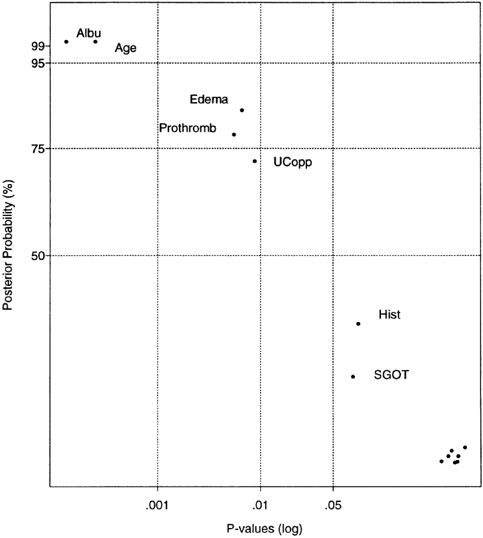
- In the PBC example, the model with the highest approximate posterior probability was the same as the stepwise model but represented only 17% of total posterior probability; the Fleming–Harrington model placed sixth with 5%. Posterior effect probabilities were 100% for bilirubin, albumen, and age; 84% for edema; 78% for prothrombin time; 72% for urine copper; 34% for histologic stage; 22% for SGOT; and 2% for treatment DPCA.
- In the body fat example with 13 predictors and 8,192 possible models, the top model accounted for only 14% of posterior probability and the top 10 models accounted for 57%. BMA predictive coverage was 90.8%, versus 84.4% for stepwise and minimum Mallow’s Cp and 83.5% for maximum adjusted R². Posterior effect probabilities were 100% for abdomen circumference, 97% for weight, 62% for wrist circumference, 35% for forearm, and 19% for neck.
- BMA implementation strategies discussed include Occam’s window, Markov chain Monte Carlo model composition (MC³), leaps-and-bounds search, and BIC, Laplace, and MLE approximations, with software catalogued for linear regression, generalized linear models, survival analysis, and graphical models.
Methods
- The paper is a tutorial/review that develops BMA theory and implementation details for linear regression, generalized linear models, survival analysis, and graphical models, then illustrates BMA in two examples.
- PBC example: Mayo Clinic randomized trial data on 312 patients; 8 omitted for incomplete data, leaving 304 patients, of whom 123 died and 181 were censored. The analysis used 14 prognostic variables plus treatment DPCA, compared BMA via leaps-and-bounds to stepwise selection, the top posterior-probability model, and the Fleming–Harrington model using partial predictive scores and predictive discrimination.
- Body fat example: 252 men with 13 simple body measurements; one subject with erroneous height was omitted, leaving 251. Posterior model probabilities were computed for all 2¹³ = 8,192 models under diffuse proper priors, and BMA was compared with stepwise, minimum Mallow’s Cp, and maximum adjusted R² using predictive coverage.
Limitations
- The paper states that BMA implementation faces major difficulties: the number of terms in the model sum can be enormous, the required integrals can be hard to compute, prior model probabilities are challenging to specify, and choosing the class of models over which to average is the fundamental modeling task. It also lists open questions including prior choice, performance when the true model is not in the model class, tuning Occam’s window versus full BMA, methodology for other model classes, and more efficient computation.
- The paper and rejoinder state that BMA is conditional on the selected model class and does not address uncertainty about model class selection; Occam’s window is heuristic and lacks formal theoretical support as an approximation to full BMA, though the authors say biases seem small in practice.
- Discussants note additional limitations evident in the text: posterior effect probabilities can be sensitive to prior hyperparameters and the model space; Occam’s window may bias posterior effect probabilities; the PBC high-risk predictive advantage is modest when uncertainty bands are attached; and BMA in the body fat example requires all 13 measurements.
Model-written summary. Check it against the paper before relying on it.
Integrity signals
Registry
Cites
Statistics
Figures

Verification
Claims the paper makes
6 Valid · 12 Not valid · 63 Not checked · 154 Own results and interpretations
The cited sources support only part of this claim — read each source’s verdict below.
In the paper
“Draper (1995), Raftery, Madigan and Volinsky (1996) and Volinsky et al. (1997) show its usefulness in the BMA context.”
What the sources say
- Supportedcites Draper (1995) source
Section 5.4 describes a large-sample approximation to a model-averaged predictive distribution that uses the MLE and maximum log-likelihood for each model. This supports the claim that an MLE-based approximation is useful in the BMA context. (LLM, conf=0.91)
- Not matchedcites Raftery, Madigan and Volinsky (1996)
Couldn’t be matched to a paper in Crossref, so it can’t be checked.
- Supportedcites Volinsky et al. (1997) source
Section 4.3 explicitly uses the MLE approximation to obtain predictive distributions for the paper’s BMA method. Section 5.2 (p. 445) reports that the resulting BMA approach performed well at identifying people at risk of stroke, supporting the broad claim of usefulness. (LLM, conf=0.88)
boosted- Asserted: passes — The authors put it forward as true.
- Checkable: passes — It can be checked against evidence.
- Load-bearing: unclear — It is unclear whether the paper’s conclusions depend on it.
- Based: passes — The paper gives a reason why it holds.
- Supported
The cited sources support only part of this claim — read each source’s verdict below.
In the paper
“Models like M ∗∗ are commonplace: for striking examples see Regal and Hook (1991), Draper (1995), Madigan and York (1995), Kass and Raftery (1995), and Raftery (1996).”
What the sources say
- Not checked — no full text of the sourcecites Regal and Hook (1991) source
- Partly supportedcites Draper (1995) sourceExperimental — accuracy not yet measured
Section 6.2 (page not provided) says that other models can fit equally well or better yet have different inferential or predictive consequences. This supports the general point, but the paper does not establish that this is commonplace specifically for alternative proportional hazards models or document the claimed differences in their effect sizes and standard errors. (LLM, conf=0.85)
- Not checked — no full text of the sourcecites Madigan and York (1995) source
plainstates a cause- Asserted: passes — The authors put it forward as true.
- Checkable: passes — It can be checked against evidence.
- Load-bearing: passes — The paper’s conclusions depend on it.
- Based: passes — The paper gives a reason why it holds.
The sources with a verdict support this claim; the rest weren’t checked yet, have no full text we could read, or their verdicts aren’t rated yet.
In the paper
“The Laplace method (Tierney and Kadane, 1986) can provide an excellent approximation to pr lparenOSCASB D vertSHT Mk rparenOSCASB ; in certain circumstances this yields the very simple BIC approximation (Schwarz, 1978; Kass and Wasserman 1995; Raftery, 1995).”
What the sources say
- Supportedcites Schwarz, 1978 source
In Section 3 (pp. 2–3), Schwarz derives an asymptotic approximation to the model-probability integral using a quadratic expansion around its maximum. The resulting large-sample model-selection rule on p. 1 is the BIC criterion. The paper does not use the name “Laplace method,” but the derivation supports the attributed paraphrase. (LLM, conf=0.89)
- Not matchedcites Kass and Wasserman 1995
Couldn’t be matched to a paper in Crossref, so it can’t be checked.
- Not checked — no full text of the sourcecites Raftery, 1995 source
plainstates a cause- Asserted: passes — The authors put it forward as true.
- Checkable: passes — It can be checked against evidence.
- Load-bearing: unclear — It is unclear whether the paper’s conclusions depend on it.
- Based: passes — The paper gives a reason why it holds.
- Supported
The sources with a verdict support this claim; the rest weren’t checked yet, have no full text we could read, or their verdicts aren’t rated yet.
In the paper
“In fact, p -values arguably overstate the evidence for an effect even when there is no model uncertainty (Edwards, Lindman and Savage, 1963; Berger and Delampady, 1987; Berger and Sellke, 1987).”
What the sources say
- Not checked — no full text of the sourcecites Edwards, Lindman and Savage, 1963 source
- Supportedcites Berger and Delampady, 1987 source
In 1.2 Motivation (p. 2), the paper compares a P-value with the posterior probability of a precise null under a specified test and finds the latter 5 to 50 times larger. In 4.6 Rejoinder 6 (p. 14), it likewise calculates that a result suggesting 20-to-1 or 40-to-1 surprise provides at most 7.5-to-1 evidence against the null. These examples support the claim without relying on model uncertainty. (LLM, conf=0.91)
- Not checked — no full text of the sourcecites Berger and Sellke, 1987 source
hedgedstates a cause- Asserted: passes — The authors put it forward as true.
- Checkable: passes — It can be checked against evidence.
- Load-bearing: unclear — It is unclear whether the paper’s conclusions depend on it.
- Based: passes — The paper gives a reason why it holds.
Every source the paper cites for this claim was checked and supports it.
In the paper
“The posterior probability of 'no effect' can be viewed as an approximation to the posterior probability of the effect being 'small,' namely, P lparenOSCASB vertSHT β vertSHT < ε rparenOSCASB , provided that ε is at most about onehalf of a standard error (Berger and Delampady, 1987).”
What the sources say
- Supportedcites Berger and Delampady, 1987 source
Section 2.2 (p. 5) defines the interval null as a negligible effect and describes replacing it with a point null assigned the same prior probability. It concludes that this Bayesian point-null approximation is reasonable when the interval’s half-width is no more than one-half of a sample standard deviation (the standard error in its normal model). (LLM, conf=0.90)
plain- Asserted: passes — The authors put it forward as true.
- Checkable: passes — It can be checked against evidence.
- Load-bearing: unclear — It is unclear whether the paper’s conclusions depend on it.
- Based: passes — The paper gives a reason why it holds.
- Supported
96 more claims · 1 with their cited sources checked
Create a free account to see all 235 claims and every source verdict.
- Borderline: one of the tests for a substantial claim is unclear. 1
- It may state two separate claims as one. 63
- Probably not a substantial claim. 93
Claims other papers make about this one
Each is checked against this paper’s own text: does it say what the citing paper says it does?
The source backs part of the claim, not all of it — or backs it for a different population, condition or comparison.
In the citing paper
“In-sample fit is not a robust measure of prediction when data are sparse or missing.”
From Modeling causes of death: an integrated approach using CODEm (2012) · cites this paper as [66]
Experimental — accuracy not yet measuredThe source backs part of the claim, not all of it — or backs it for a different population, condition or comparison.
In the citing paper
“Instead, out-of-sample predictive validity is the appropriate measure [66,68-72].”
From Modeling causes of death: an integrated approach using CODEm (2012) · cites this paper as [66]
Experimental — accuracy not yet measuredThe cited source says what the claim attributes to it.
In the citing paper
“Ensemble models that are weighted combinations of the posterior distributions of component models provide lower error for the point estimate and more accurate uncertainty intervals [62-66].”
From Modeling causes of death: an integrated approach using CODEm (2012) · cites this paper as [66]
Self-check
Percentages, sums and reported differences re-computed from the paper’s own numbers.
Each contradiction between two passages listed here was confirmed by an independent check.
Rated major: it would touch a result — a value a result rests on, reported and recomputed p-values on opposite sides of the significance level, two passages that conflict with no sign which is right, or a cited work retracted before this paper was published.
In the paper
“The difference in PPS of 3.6 can be viewed as an increase in predictive performance per event by a factor of exp lparenOSCASB 3 periodori 6 / 61 rparenOSCASB = 1 periodori 06 or by about 6%. This means that BMA predicts who is at risk 6% more effectively than a method which picks the model with the highest posterior model probability”
Reported 3.6 · recomputed 4.5
Rated minor: it would not touch a result — a value no result rests on, a p-value that stays on the same side of the significance level, or a conflict that is clerical, resolved elsewhere in the paper, or outside its own findings.
In the paper
§ 7.2 Example 2: Predicting Percent Body Fat
“All three standard model selection methods selected the same eight-predictor model (Table 8).”
§ 7.2 Example 2: Predicting Percent Body Fat
“| Stepwise and C p X 1 X 2 | X X 10 X 12 X | 84.4 | | Adjusted R 2 X 1 X | 6 13 2 X 4 X 6 X 7 X 8 X 10 X 12 X 13 | 83.5 |”
Rated minor: it would not touch a result — a value no result rests on, a p-value that stays on the same side of the significance level, or a conflict that is clerical, resolved elsewhere in the paper, or outside its own findings.
In the paper
§ 7.1Example 1 : Primary Biliary Cirrhosis
“Of the remaining 304 patients, 123 were followed until deathand the other 181 observations were censored.”
§ 7.1Example 1 : Primary Biliary Cirrhosis
“For assessing predictive performance, we randomly split the data into two parts suchth at an equal number of events (61 deaths) occurred in each part.”
Citations
Cites
Estimating the Dimension of a Model
Schwarz, G. (1978) · The Annals of Statistics · doi:10.1214/aos/1176344136 · Cited by 47,033
Regression Models and Life-Tables
Cox, D. R. (1972) · Journal of the Royal Statistical Society Series B: Statistical Methodology · doi:10.1111/j.2517-6161.1972.tb00899.x · Cited by 39,793
Information Theory and an Extension of the Maximum Likelihood Principle
Akaike, H. (1998) · Springer Series in Statistics · doi:10.1007/978-1-4612-1694-0_15 · Cited by 17,781
Structural Equations with Latent Variables.
Clogg, C. C., & Bollen, K. A. (1991) · Contemporary Sociology · doi:10.2307/2072165 · Cited by 17,442
Structural Equations with Latent Variables
Bollen, K. A. (1989) · Wiley series in probability and statistics · doi:10.1002/9781118619179 · Cited by 17,277
McCullagh, P., & Nelder, J. A. (1989) · doi:10.1007/978-1-4899-3242-6 · Cited by 16,836
Breiman, L. (1996) · Machine Learning · doi:10.1007/bf00058655 · Cited by 16,325
Kass, R. E., & Raftery, A. E. (1995) · Journal of the American Statistical Association · doi:10.1080/01621459.1995.10476572 · Cited by 12,558
Self-citationWolpert, D. H. (1992) · Neural Networks · doi:10.1016/s0893-6080(05)80023-1 · Cited by 7,951
Bayesian model selection in social research
Raftery, A. E. (1995) · Sociological Methodology · doi:10.2307/271063 · Cited by 6,823
Self-citationFaires, J. D. (1978) · Cited by 6,711
Reversible jump Markov chain Monte Carlo computation and Bayesian model determination
GREEN, P. J. (1995) · Biometrika · doi:10.1093/biomet/82.4.711 · Cited by 5,930
Generalized Linear Models (2nd ed.).
Therneau, T. M., McCullagh, P., & Nelder, J. A. (1993) · Journal of the American Statistical Association · doi:10.2307/2290358 · Cited by 4,907
Understanding the Metropolis-Hastings Algorithm
Chib, S., & Greenberg, E. (1995) · The American Statistician · doi:10.1080/00031305.1995.10476177 · Cited by 4,145
The Cardiovascular Health Study: design and rationale.
Fried, L. P., Borhani, N. O., Enright, P., Furberg, C. D., Gardin, J. M., Kronmal, R. A., Kuller, L. H., Manolio, T. A., Mittelmark, M. B., Newman, A., et al. (1991) · Annals of Epidemiology · doi:10.1016/1047-2797(91)90005-w · Cited by 3,652
Learning Bayesian Networks: The Combination of Knowledge and Statistical Data
Heckerman, D., Geiger, D., & Chickering, D. M. (1995) · Machine Learning · doi:10.1023/a:1022623210503 · Cited by 3,231
Bates, J. M., & Granger, C. W. J. (1969) · Journal of the Operational Research Society · doi:10.1057/jors.1969.103 · Cited by 3,201
Information Theory and an Extension of the Maximum Likelihood Principle
Akaike, H. (1992) · Springer Series in Statistics · doi:10.1007/978-1-4612-0919-5_38 · Cited by 3,028
Lauritzen, S. L. (1996) · doi:10.1093/oso/9780198522195.001.0001 · Cited by 2,976
Beckman, R. J. (1987) · Technometrics · doi:10.1080/00401706.1987.10488195 · Cited by 2,835
Variable Selection via Gibbs Sampling
George, E. I., & McCulloch, R. E. (1993) · Journal of the American Statistical Association · doi:10.1080/01621459.1993.10476353 · Cited by 2,828
POSTERIOR PREDICTIVE ASSESSMENT OF MODEL FITNESS VIA REALIZED DISCREPANCIES
Gelman, A., Meng, X., & Stern, H. S. (1996) · Cited by 2,639
Kass, R. E., & Raftery, A. E. (1995) · Journal of the American Statistical Association · doi:10.2307/2291091 · Cited by 2,312
Self-citationCounting Processes and Survival Analysis.
Dabrowska, D. M., Fleming, T. R., & Harrington, D. P. (1992) · Journal of the American Statistical Association · doi:10.2307/2290673 · Cited by 2,271
Bernardo, J. M., & Smith, A. F. M. (1994) · Wiley Series in Probability and Statistics · doi:10.1002/9780470316870 · Cited by 2,178
Combining forecasts: A review and annotated bibliography
Clemen, R. T. (1989) · International Journal of Forecasting · doi:10.1016/0169-2070(89)90012-5 · Cited by 2,164
Accurate Approximations for Posterior Moments and Marginal Densities
Tierney, L., & Kadane, J. B. (1986) · Journal of the American Statistical Association · doi:10.1080/01621459.1986.10478240 · Cited by 2,129
Bayes Estimates for the Linear Model
Lindley, D. V., & Smith, A. F. M. (1972) · Journal of the Royal Statistical Society Series B: Statistical Methodology · doi:10.1111/j.2517-6161.1972.tb00885.x · Cited by 2,025
Learning Bayesian networks: The combination of knowledge and statistical data
Heckerman, D., Geiger, D., & Chickering, D. M. (1995) · Machine Learning · doi:10.1007/bf00994016 · Cited by 2,017
Computing Bayes Factors by Combining Simulation and Asymptotic Approximations
Diciccio, T. J., Kass, R. E., Raftery, A., & Wasserman, L. (1997) · Journal of the American Statistical Association · doi:10.1080/01621459.1997.10474045 · Cited by 1,943
Self-citationBayesian Model Averaging for Linear Regression Models
Raftery, A. E., Hoeting, J. A., & Madigan, D. (1997) · Cited by 1,746
Self-citationBayesian statistical inference for psychological research.
Edwards, W., Lindman, H., & Savage, L. J. (1963) · Psychological Review · doi:10.1037/h0044139 · Cited by 1,734
Model Selection: An Integral Part of Inference
Buckland, S. T., Burnham, K. P., & Augustin, N. H. (1997) · Biometrics · doi:10.2307/2533961 · Cited by 1,717
Bayesian computation via the Gibbs sampler and related Markov chain Monte Carlo methods
Smith, A. F. M., & Roberts, G. O. (1993) · Journal of the Royal Statistical Society Series B: Statistical Methodology · doi:10.1111/j.2517-6161.1993.tb01466.x · Cited by 1,713
Estimating Optimal Transformations for Multiple Regression and Correlation
Breiman, L., & Friedman, J. H. (1985) · Journal of the American Statistical Association · doi:10.1080/01621459.1985.10478157 · Cited by 1,710
Holder, R. L., Mosteller, F., & Tukey, J. W. (1979) · Applied Statistics · doi:10.2307/2346739 · Cited by 1,676
Boosting a Weak Learning Algorithm by Majority
Freund, Y. (1995) · Information and Computation · doi:10.1006/inco.1995.1136 · Cited by 1,674
Assessment and Propagation of Model Uncertainty
Draper, D. (1995) · Journal of the Royal Statistical Society Series B: Statistical Methodology · doi:10.1111/j.2517-6161.1995.tb02015.x · Cited by 1,599
DENSITOMETRIC ANALYSIS OF BODY COMPOSITION: REVISION OF SOME QUANTITATIVE ASSUMPTIONS*
Brožek, J., Grande, F., Anderson, J. T., & Keys, A. (1963) · Annals of the New York Academy of Sciences · doi:10.1111/j.1749-6632.1963.tb17079.x · Cited by 1,531
Combining forecasts: A review and annotated bibliography
(1990) · Long Range Planning · doi:10.1016/0024-6301(90)90316-v · Cited by 1,465
Subset Selection in Regression
(2003) · Technometrics · doi:10.1198/tech.2003.s144 · Cited by 1,463
Bayesian Model Averaging for Linear Regression Models
Raftery, A. E., Madigan, D., & Hoeting, J. A. (1997) · Journal of the American Statistical Association · doi:10.1080/01621459.1997.10473615 · Cited by 1,287
Self-citationFeatherman, D. L., & Hauser, R. M. (1978) · Cited by 1,273
A Reference Bayesian Test for Nested Hypotheses and its Relationship to the Schwarz Criterion
Kass, R. E., & Wasserman, L. (1995) · Journal of the American Statistical Association · doi:10.1080/01621459.1995.10476592 · Cited by 1,253
Model Selection and Accounting for Model Uncertainty in Graphical Models Using Occam's Window
Madigan, D., & Raftery, A. E. (1994) · Journal of the American Statistical Association · doi:10.1080/01621459.1994.10476894 · Cited by 1,205 · cited 1×
“Other applications of BMA can be found in a number of works (Chatfield, 1995; Draper, 1995; Fernaindez, Ley and Steel, 1997; Hoeting, Raftery and Madigan, 1999; Hoeting, Raftery and Madigan, 1996; Madigan, Andersson, Perlman and Volinsky, 1996b; Madigan and Raftery, 1994; Raftery, Madigan and Hoeting, 1997; Raftery, 1…”
BackgroundSelf-citation(1997) · Cited by 1,193
Exact sampling with coupled Markov chains and applications to statistical mechanics
Propp, J. G., & Wilson, D. B. (1996) · Random Structures and Algorithms · doi:10.1002/(sici)1098-2418(199608/09)9:1/2<223::aid-rsa14>3.0.co;2-o · Cited by 1,159
Model uncertainty, data mining and statistical inference
Chatfield, C. (1995) · Journal of the Royal Statistical Society. Series A (Statistics in Society) · doi:10.2307/2983440 · Cited by 1,103
Bayesian Graphical Models for Discrete Data
Madigan, D., York, J., & Allard, D. (1995) · International Statistical Review / Revue Internationale de Statistique · doi:10.2307/1403615 · Cited by 1,090
Self-citationDawid, A. P. (1984) · Journal of the Royal Statistical Society. Series A (General) · doi:10.2307/2981683 · Cited by 1,085
Benchmark priors for Bayesian model averaging
Fernández, C., Ley, E., & Steel, M. F. J. (2001) · Journal of Econometrics · doi:10.1016/s0304-4076(00)00076-2 · Cited by 1,030
Bayesian Model Choice Via Markov Chain Monte Carlo Methods
Carlin, B. P., & Chib, S. (1995) · Journal of the Royal Statistical Society Series B: Statistical Methodology · doi:10.1111/j.2517-6161.1995.tb02042.x · Cited by 989
Fine, T. L., & Hacking, I. (1978) · The Philosophical Review · doi:10.2307/2184357 · Cited by 986
Good, I. J. (1952) · Journal of the Royal Statistical Society Series B: Statistical Methodology · doi:10.1111/j.2517-6161.1952.tb00104.x · Cited by 976
Scoring Rules for Continuous Probability Distributions
Matheson, J. E., & Winkler, R. L. (1976) · Management Science · doi:10.1287/mnsc.22.10.1087 · Cited by 957
Bayesian Computation and Stochastic Systems
Besag, J., Green, P., Higdon, D., & Mengersen, K. (1995) · Statistical Science · doi:10.1214/ss/1177010123 · Cited by 944
Sampling and Bayes' Inference in Scientific Modelling and Robustness
Box, G. E. P. (1980) · Journal of the Royal Statistical Society. Series A (General) · doi:10.2307/2982063 · Cited by 924
Probability and the Weighing of Evidence.
M., P. A., & Good, I. J. (1950) · Journal of the Royal Statistical Society. Series A (General) · doi:10.2307/2981046 · Cited by 753
Chipman, H. A., George, E. I., & McCulloch, R. E. (1998) · Journal of the American Statistical Association · doi:10.1080/01621459.1998.10473750 · Cited by 734
Bayesian Analysis in Expert Systems
Spiegelhalter, D. J., Dawid, A. P., Lauritzen, S. L., & Cowell, R. G. (1993) · Statistical Science · doi:10.1214/ss/1177010888 · Cited by 684
Berger, J. O., & Delampady, M. (1987) · Statistical Science · doi:10.1214/ss/1177013238 · Cited by 664
Model Determination using Predictive Distributions with Implementation via Sampling-Based Methods
Gelfand, A. E., Dey, D. K., & Chang, H. (1992) · Bayesian Statistics 4 · doi:10.1093/oso/9780198522669.003.0009 · Cited by 656
Approximate Bayes factors and accounting for model uncertainty in generalised linear models
Raftery, A. (1996) · Biometrika · doi:10.1093/biomet/83.2.251 · Cited by 633
Self-citationSubset Selection in Regression
Miller, A. J. (1990) · Springer eBooks · doi:10.1007/978-1-4899-2939-6 · Cited by 625
Regression, Prediction and Shrinkage
Copas, J. B. (1983) · Journal of the Royal Statistical Society Series B: Statistical Methodology · doi:10.1111/j.2517-6161.1983.tb01258.x · Cited by 612
Applied Linear Regression (2nd ed.).
Miller, R. B., & Weisberg, S. (1986) · Journal of the American Statistical Association · doi:10.2307/2289035 · Cited by 562
Testing a Point Null Hypothesis: The Irreconcilability of P Values and Evidence
Berger, J. O., & Sellke, T. (1987) · Journal of the American Statistical Association · doi:10.2307/2289131 · Cited by 548
Subset Selection in Regression.
Raab, G. M., & Miller, A. J. (1991) · Biometrics · doi:10.2307/2532418 · Cited by 547
Sequential updating of conditional probabilities on directed graphical structures
Spiegelhalter, D. J., & Lauritzen, S. L. (1990) · Networks · doi:10.1002/net.3230200507 · Cited by 521
Calibration and empirical Bayes variable selection
George, E. (2000) · Biometrika · doi:10.1093/biomet/87.4.731 · Cited by 520
Bates, J. M., & Granger, C. W. J. (1969) · OR · doi:10.2307/3008764 · Cited by 502
Estimating Optimal Transformations for Multiple Regression and Correlation
Breiman, L., & Friedman, J. H. (1985) · Journal of the American Statistical Association · doi:10.2307/2288473 · Cited by 452
Accurate Approximations for Posterior Moments and Marginal Densities
Tierney, L., & Kadane, J. B. (1986) · Journal of the American Statistical Association · doi:10.2307/2287970 · Cited by 424
Buntine, W. (1992) · Statistics and Computing · doi:10.1007/bf01889584 · Cited by 393
Good Thinking: The Foundations of Probability and Its Applications.
Berger, J. O., & Good, I. J. (1985) · Journal of the American Statistical Association · doi:10.2307/2288079 · Cited by 390
Bayesian Model Selection in Structural Equation Models
Raftery, A. E. (1992) · Cited by 364
Self-citationProbabilistic prediction in patient management and clinical trials
Spiegelhalter, D. J. (1986) · Statistics in Medicine · doi:10.1002/sim.4780050506 · Cited by 358
A Critique of the Bayesian Information Criterion for Model Selection
WEAKLIEM, D. L. (1999) · Sociological Methods & Research · doi:10.1177/0049124199027003002 · Cited by 349
Toward efficient agnostic learning
Kearns, M. J., Schapire, R. E., & Sellie, L. M. (1992) · Proceedings of the fifth annual workshop on Computational learning theory · doi:10.1145/130385.130424 · Cited by 330
Prediction with a Generalized Cost of Error Function
Granger, C. W. J. (1969) · Journal of the Operational Research Society · doi:10.1057/jors.1969.52 · Cited by 324
Hypothesis testing and model selection
(1995) · Markov Chain Monte Carlo in Practice · doi:10.1201/b14835-15 · Cited by 311
Bayesian Model Averaging for Linear Regression Models
Raftery, A. E., Madigan, D., & Hoeting, J. A. (1997) · Journal of the American Statistical Association · doi:10.2307/2291462 · Cited by 294
Self-citationVariable selection and Bayesian model averaging in case‐control studies
Viallefont, V., Raftery, A. E., & Richardson, S. (2001) · Statistics in Medicine · doi:10.1002/sim.976 · Cited by 266
Self-citationLearning Bayesian Networks: The Combination of Knowledge and Statistical Data
Heckerman, D., Geiger, D., & Chickering, D. M. (1994) · Uncertainty Proceedings 1994 · doi:10.1016/b978-1-55860-332-5.50042-0 · Cited by 261
Bias in the case - crossover design: implications for studies of air pollution
Lumley, T., & Levy, D. G. (2000) · Environmetrics · doi:10.1002/1099-095x(200011/12)11:6<745::aid-env431>3.3.co;2-e · Cited by 261
A Reference Bayesian Test for Nested Hypotheses and its Relationship to the Schwarz Criterion
Kass, R. E., & Wasserman, L. H. (1995) · Journal of the American Statistical Association · doi:10.2307/2291327 · Cited by 256
RAFTERY, A. E. (1999) · Sociological Methods & Research · doi:10.1177/0049124199027003005 · Cited by 249
Self-citationMultiple shrinkage and subset selection in wavelets
Clyde, M. (1998) · Biometrika · doi:10.1093/biomet/85.2.391 · Cited by 248
Efficient Screening of Nonnormal Regression Models
Lawless, J. F., & Singhal, K. (1978) · Biometrics · doi:10.2307/2530022 · Cited by 235
Efficacy of Liver Transplantation in Patients with Primary Biliary Cirrhosis
Markus, B. H., Dickson, E. R., Grambsch, P. M., Fleming, T. R., Mazzaferro, V., Klintmalm, G. B. G., Wiesner, R. H., Van Thiel, D. H., & Starzl, T. E. (1989) · New England Journal of Medicine · doi:10.1056/nejm198906293202602 · Cited by 234
Bayesian Model Averaging in Proportional Hazard Models: Assessing the Risk of a Stroke
Volinsky, C. T., Madigan, D., Raftery, A. E., & Kronmal, R. A. (1997) · Journal of the Royal Statistical Society Series C: Applied Statistics · doi:10.1111/1467-9876.00082 · Cited by 226
Self-citation[Bayesian Computation and Stochastic Systems]: Rejoinder
Besag, J., Green, P., Higdon, D., & Mengersen, K. (1995) · Statistical Science · doi:10.1214/ss/1177010130 · Cited by 220
Model Selection and Accounting for Model Uncertainty in Graphical Models Using Occam's Window
Madigan, D., & Raftery, A. E. (1994) · Journal of the American Statistical Association · doi:10.2307/2291017 · Cited by 212
Self-citationGraph puzzles, homotopy, and the alternating group
Wilson, R. M. (1974) · Journal of Combinatorial Theory, Series B · doi:10.1016/0095-8956(74)90098-7 · Cited by 181
Flexible Empirical Bayes Estimation for Wavelets
Clyde, M., & George, E. I. (2000) · Journal of the Royal Statistical Society Series B: Statistical Methodology · doi:10.1111/1467-9868.00257 · Cited by 181
Non-Optimality of Preliminary-Test Estimators for the Mean of a Multivariate Normal Distribution
Sclove, S. L., Morris, C., & Radhakrishnan, R. (1972) · The Annals of Mathematical Statistics · doi:10.1214/aoms/1177692380 · Cited by 180
On the Accuracy of Meta-learning for Scalable Data Mining
Chan, P. K., & Stolfo, S. J. (1997) · Journal of Intelligent Information Systems · doi:10.1023/a:1008640732416 · Cited by 178
Toward Efficient Agnostic Learning
Kearns, M. J., Schapire, R. E., & Sellie, L. M. (1994) · Machine Learning · doi:10.1007/bf00993468 · Cited by 172
Markov chain Monte Carlo model determination for hierarchical and graphical log-linear models
Dellaportas, P. (1999) · Biometrika · doi:10.1093/biomet/86.3.615 · Cited by 163
Kwok, S. W., & Carter, C. (1990) · Machine intelligence and pattern recognition · doi:10.1016/b978-0-444-88650-7.50030-5 · Cited by 156
Fitting Percentage of Body Fat to Simple Body Measurements
Johnson, R. W. (1996) · Journal of Statistics Education · doi:10.1080/10691898.1996.11910505 · Cited by 155
Greenland, S. (1993) · Statistics in Medicine · doi:10.1002/sim.4780120802 · Cited by 152
Does the Gender Composition of Sibships Affect Women's Educational Attainment?
Hauser, R. M., & Kuo, H. D. (1998) · The Journal of Human Resources · doi:10.2307/146336 · Cited by 149
Prediction via Orthogonalized Model Mixing
Clyde, M., Desimone, H., & Parmigiani, G. (1996) · Journal of the American Statistical Association · doi:10.1080/01621459.1996.10476989 · Cited by 145
Bayesian model averaging and model selection for markov equivalence classes of acyclic digraphs
Madigan, D., Andersson, S. A., Perlman, M. D., & Volinsky, C. T. (1996) · Communication in Statistics- Theory and Methods · doi:10.1080/03610929608831853 · Cited by 141
Self-citationRoberts, H. V. (1965) · Journal of the American Statistical Association · doi:10.1080/01621459.1965.10480774 · Cited by 137
A method for simultaneous variable selection and outlier identification in linear regression
Hoeting, J. A., Raftery, A. E., & Madigan, D. (1996) · Computational Statistics & Data Analysis · doi:10.1016/0167-9473(95)00053-4 · Cited by 134
Self-citationVague Theory and Model Uncertainty in Macrosociology
Western, B. (1996) · Sociological Methodology · doi:10.2307/271022 · Cited by 133
Inference for nonconjugate Bayesian Models using the Gibbs sampler
Carlin, B. P., & Polson, N. G. (1991) · Canadian Journal of Statistics · doi:10.2307/3315430 · Cited by 132
Asymptotic Inference for Mixture Models by Using Data-Dependent Priors
Wasserman, L. (2000) · Journal of the Royal Statistical Society Series B (Statistical Methodology) · doi:10.1111/1467-9868.00226 · Cited by 126
Some Statistical Results in the Combination of Forecasts
Dickinson, J. P. (1973) · Journal of the Operational Research Society · doi:10.1057/jors.1973.42 · Cited by 120
Assessment and propagation of model uncertainty
Draper, D. (1994) · Mathematical Social Sciences · doi:10.1016/0165-4896(94)90028-0 · Cited by 119
Bayesian model comparison via jump diffusions
Gilks, W. R., Richardson, S. T., & Spiegelhalter, D. J. (1995) · Chapman & Hall/CRC eBooks · doi:10.1201/b14835-18 · Cited by 116
Minimax Multiple Shrinkage Estimation
George, E. I. (1986) · The Annals of Statistics · doi:10.1214/aos/1176349849 · Cited by 115
Uncertainty, Policy Analysis and Statistics
Hodges, J. S. (1987) · Statistical Science · doi:10.1214/ss/1177013224 · Cited by 113
GENERALIZED BODY COMPOSITION PREDICTION EQUATION FOR MEN USING SIMPLE MEASUREMENT TECHNIQUES
Penrose, K. W., Nelson, A. G., & Fisher, A. (1985) · Medicine & Science in Sports & Exercise · doi:10.1249/00005768-198504000-00037 · Cited by 109
Grambsch, P. M., Dickson, R. E., Kaplan, M., Lesage, G., Fleming, T. R., & Langworthy, A. L. (1989) · Hepatology · doi:10.1002/hep.1840100516 · Cited by 107
(1950) · Philosophy · Cited by 105
Bayesian Radial Basis Functions of Variable Dimension
Holmes, C. C., & Mallick, B. K. (1998) · Neural Computation · doi:10.1162/089976698300017421 · Cited by 96
A Predictive Approach to the Analysis of Designed Experiments
Ibrahim, J. G., & Laud, P. W. (1994) · Journal of the American Statistical Association · doi:10.1080/01621459.1994.10476472 · Cited by 95
New Methods of Quality Control
Barnard, G. A. (1963) · Journal of the Royal Statistical Society. Series A (General) · doi:10.2307/2982365 · Cited by 93
Computing Bayes Factors by Combining Simulation and Asymptotic Approximations
DiCiccio, T. J., Kass, R. E., Raftery, A. E., et al. (1997) · Journal of the American Statistical Association · doi:10.2307/2965554 · Cited by 89
Self-citationBuntine, W. (1993) · Springer eBooks · doi:10.1007/978-1-4899-4537-2_15 · Cited by 74
Advances in Body Composition Assessment Current Issues in Exercise Science (Monograph No. 3)
Ostrove, S. M. (1993) · Pediatric Exercise Science · doi:10.1123/pes.5.2.200 · Cited by 73
The effects of model selection on confidence intervals for the size of a closed population
Regal, R. R., & Hook, E. B. (1991) · Statistics in Medicine · doi:10.1002/sim.4780100506 · Cited by 71
Combining Minimax Shrinkage Estimators
George, E. I. (1986) · Journal of the American Statistical Association · doi:10.1080/01621459.1986.10478288 · Cited by 68
On the relationship between MCMC model uncertainty methods
Godsill, S. (1997) · Cambridge University Engineering Department Publications Database · Cited by 62
The relation between theory and application in statistics
Cox, D. R., Bayarri, M. J., Bayarri, M. J., Cuadras, C. M., Bernadro, J. M., Girón, F. J., Moreno, E., Keiding, N., Lindley, D. V., Pericchi, L. R., et al. (1995) · Test · doi:10.1007/bf02562627 · Cited by 62
Eliciting prior information to enhance the predictive performance of bayesian graphical models
Madigan, D., Gavrin, J., & Raftery, A. E. (1995) · Communications in Statistics - Theory and Methods · doi:10.1080/03610929508831616 · Cited by 60
Self-citationEmpirical Bayes Estimation in Wavelet Nonparametric Regression
Clyde, M. A., & George, E. I. (1999) · Lecture notes in statistics · doi:10.1007/978-1-4612-0567-8_19 · Cited by 59
All Subsets Regression in a Proportional Hazards Model
Kuk, A. Y. C. (1984) · Biometrika · doi:10.1093/biomet/71.3.587 · Cited by 58
York, J., Madigan, D., Heuch, I., & Lie, R. T. (1995) · Applied Statistics · doi:10.2307/2986347 · Cited by 52
Self-citationStrategies for Graphical Model Selection
Madigan, D., Raftery, A. E., York, J. C., Bradshaw, J. M., & Almond, R. G. (1994) · Lecture notes in statistics · doi:10.1007/978-1-4612-2660-4_10 · Cited by 52
Self-citationOn Model Uncertainty and its Statistical Implications
Dijkstra, T. K. (1988) · Lecture notes in economics and mathematical systems · doi:10.1007/978-3-642-61564-1 · Cited by 51
On the Impact of Variable Selection in Fitting Regression Equations
Freedman, D. A., Navidi, W., & Peters, S. C. (1988) · Lecture Notes in Economics and Mathematical Systems · doi:10.1007/978-3-642-61564-1_1 · Cited by 51
Good thinking: the foundations of probability and its applications
Good, I. J. (1983) · CERN Document Server (European Organization for Nuclear Research) · Cited by 45
The Foundations of Statistical Inference.
Brillinger, D. R., & Savage, L. J. (1963) · American Mathematical Monthly · doi:10.2307/2312706 · Cited by 43
Bayesian Decision Theory and the Simplification of Models
Kadane, J. B., & Dickey, J. (1980) · Elsevier eBooks · doi:10.1016/b978-0-12-416550-2.50018-2 · Cited by 41
The use of R2 to determine the appropriate transformation of regression variables
Granger, C. W. J., & Newbold, P. (1976) · Journal of Econometrics · doi:10.1016/0304-4076(76)90032-4 · Cited by 33
Stewart, L. (1987) · Journal of the Royal Statistical Society Series D (The Statistician) · doi:10.2307/2348514 · Cited by 32
Estimation of posterior density functions from a posterior sample
Oh, M. (1999) · Computational Statistics & Data Analysis · doi:10.1016/s0167-9473(98)00068-1 · Cited by 30
Robust Likelihood Calculation for Time Series
Taplin, R. H. (1993) · Journal of the Royal Statistical Society Series B: Statistical Methodology · doi:10.1111/j.2517-6161.1993.tb01943.x · Cited by 29
Bayesian Model Choice: What and Why?
Key, J. T., Pericchi, L. R., & Smith, A. F. M. (1999) · doi:10.1093/oso/9780198504856.003.0015 · Cited by 29
A Research Agenda for Assessment and Propagation of Model Uncertainty
Draper, D., Hodges, J. S., Leamer, E. E., Morris, C. N., & Rubin, D. B. (1987) · Cited by 28
A Predictive Approach to the Analysis of Designed Experiments
Ibrahim, J. G., & Laud, P. W. (1994) · Journal of the American Statistical Association · doi:10.2307/2291227 · Cited by 28
Roberts, H. V. (1965) · Journal of the American Statistical Association · doi:10.2307/2283136 · Cited by 25
Toward Efficient Agnostic Learning
Kearns, M. J., Schapire, R. E., & Sellie, L. M. (1994) · Machine Learning · doi:10.1023/a:1022615600103 · Cited by 23
A formal bayes multiple shrinkage estimator
George, E. I. (1986) · Communication in Statistics- Theory and Methods · doi:10.1080/03610928608829237 · Cited by 23
Diagnostic systems by model selection: a case study
Lauritzen, S. L., Thiesson, B., & Spiegelhalter, D. J. (1994) · Lecture Notes in Statistics · doi:10.1007/978-1-4612-2660-4_15 · Cited by 15
Some Statistical Results in the Combination of Forecasts
Dickinson, J. P. (1973) · Operational Research Quarterly (1970-1977) · doi:10.2307/3007853 · Cited by 15
Model Selection and Accounting for Model Uncertainty in Graphical Models Using OCCAM's Window
Madigan, D., & Raftery, A. E. (1991) · doi:10.21236/ada241408 · Cited by 13
Self-citationBenchmark Priors for Bayesian Model AveragingPreprint
Fernández, C., Ley, E., & Steel, M. F. J. (1998) · RePEc: Research Papers in Economics · Cited by 8
MULTIPLE SHRINKAGE GENERALIZATIONS OF THE JAMES-STEIN ESTIMATOR
George, E. I. (1987) · Elsevier eBooks · doi:10.1016/b978-0-12-279450-6.50026-9 · Cited by 6
(1995) · Bristol Research (University of Bristol) · Cited by 1
[Uncertainty, Policy Analysis and Statistics]: Rejoinder
Hodges, J. S. (1987) · Statistical Science · doi:10.1214/ss/1177013231
All Subsets Regression in a Proportional Hazards Model
Kuk, A. Y. C. (1984) · Biometrika · doi:10.2307/2336568
FLEMING, T. R.; HAKRINGTON, D. P.: Counting Processes and Survival Analysis. Wiley
Fleming, T. R., & Harrington, D. P. (1992) · Biometrical Journal · doi:10.1002/bimj.4710340605
Research works printed but not linked: 9
- Volinsky, C. T. (1997). Bayesian model averaging for censored survival models. Ph.D. dissertation, Univ. Washington, Seattle.
- C. (1993). Combining information: National Research Council Panel on Statistical Issues and Opportunities for Research in the Combination of Information. National Academy Press, Washington, DC. Draper, D., Hodges, J. S., Leamer, E. E., Morris, C. N. and
- George, E. I. (1999). Bayesian model selection. In Encyclopedia of Statistical Sciences Update 3. Wiley, New York. To appear.
- Hoeting, J. A. (1994). Accounting for model uncertainty in linear regression. Ph.D. dissertation, Univ. Washington, Seattle.
- Leamer, E. E. (1978). Specification Searches. Wiley, New York.
- Raftery, A. E., Madigan, D. and Volinsky, C. T. (1996). Accounting for model uncertainty in survival analysis improves predictive performance (withdiscussion). In Bayesian Statistics 5 (J. Bernardo, J. Berger, A. Dawid and A. Smith, eds.) 323-349. Oxford Univ. Press.
- de Finetti, B. (1974, 1975). Theory of Probability 1 and 2. (Trans. by A. F. M. Smithand A. Machi). Wiley, New York.
- George, E. I. (1999). Discussion of "Model averaging and model searchstrategies" by M. Clyde. In Bayesian Statistics 6 (J. M. Bernardo, J. O. Berger, A. P. Dawid and A. F. M. Smith, eds.) 157-185. Oxford University Press.
- George, E. I. (1999). Discussion of "Model averaging and model searchby M. Clyde." In Bayesian Statistics 6 (J. M. Bernardo, J. O. Berger, A. P. Dawid and A. F. M. Smith, eds.) Oxford University Press.
Cited by
Multimodel Inference: Understanding AIC and BIC in Model Selection
Burnham, K. P., & Anderson, D. R. (2004) · Sociological Methods & Research · doi:10.1177/0049124104268644 · Cited by 11,648
“The literature (e.g., Hoeting et al. 1999) supports that the measurements and ( , , ) on a subject cany x x x œ 1 13á w be suitably modeled as multivariate normal.”
BackgroundMethodResultInfluential(2015) · doi:10.1007/s11222-016-9696-4 · Cited by 5,611
Matching as Nonparametric Preprocessing for Reducing Model Dependence in Parametric Causal Inference
Ho, D. E., Imai, K., King, G., & Stuart, E. A. (2007) · Political Analysis · doi:10.1093/pan/mpl013 · Cited by 4,205
“Other seemingly possible alternatives, such as Bayesian model averaging (Hoeting et al. 1999; Imai and King 2004) and cross-validation (Black and Smith 2004), are useful for predictive inference but not directly applicable in the context of causal inference.”
BackgroundBurnham, K. P., Anderson, D. R., & Huyvaert, K. P. (2011) · Behavioral Ecology and Sociobiology · doi:10.1007/s00265-010-1029-6 · Cited by 4,104
“The first approach is called model averaging (see Hoeting et al. 1999 for background and discussion from a Bayesian viewpoint) and this can be best understood from the viewpoint of prediction.”
BackgroundPosada, D., & Buckley, T. R. (2004) · Systematic Biology · doi:10.1080/10635150490522304 · Cited by 3,927
“Although in general model selection is concerned with the selection of just the best fit model, Bayesian approaches allow us to make inferences based on the entire set of candidate models, or model averaging (Hoeting et al., 1999; Madigan and Raftery, 1994; Raftery, 1996; Wasserman, 2000).”
Method
Metadata
- Authors
- Hoeting, J. A., Madigan, D., Raftery, A. E., & Volinsky, C. T.
- Venue
- Statistical Science
- Publisher
- Institute of Mathematical Statistics
- Published
- 1999-11-01
- Volume
- 14
- Issue
- 4
- Pages
- 382-417
- ISSN
- 0883-4237 (ISSN-L)
- OpenAlex
- W1603903339
- Semantic Scholar
- 86699ef1b674504eef0d750f085e53f182f13611
- Cited by
- 4,118
- References
- 148
- Citations by year
- 2026: 103 · 2025: 148 · 2024: 142 · 2023: 125 · 2022: 141 · 2021: 234 · 2020: 221 · 2019: 244 · 2018: 243 · 2017: 248 · 2016: 203 · 2015: 258 · 2014: 222 · 2013: 191 · 2012: 222
- FWCI
- 31.88
- Type
- journal article
- Language
- en
- Open access
- bronze
- doi.org
- Locations
- Statistical Science (publishedVersion)
- Project Euclid (Cornell University) (submittedVersion)
- Columbia Academic Commons (Columbia University)
- Funders
- National Science Foundation (9806243)
- Office of Naval Research (N00014)
- Topics
- Physical Sciences › Mathematics › Statistics and Probability › Statistical Methods and Bayesian Inference
- Physical Sciences › Mathematics › Statistics and Probability › Statistical Methods and Inference
- Physical Sciences › Mathematics › Statistics and Probability › Markov Chains and Monte Carlo Methods
- Keywords
- Bayesian model averaging, model uncertainty, model selection, out-of-sample forecasting, predictive performance
About these checks
Registry, retraction, Cites and statistics results are computed, not judged, with one exception: a printed reference that no index lists is read once by a model before it counts as a citation error. Claims are extracted by a model and kept only when their quote appears verbatim in the text; each cited source is then checked, with a model’s help, for whether it says what the claim relies on. Those verdicts can be wrong — read the claim’s quote and the cited source before relying on one.
The claim verdicts this report counts are experimental: their accuracy is not yet measured.
A language model drew the claims from the paper on 2026-09-28, under version 3 of the claim definition (prompt extract-v3).
A second model labelled each claim on 2026-09-28 (model jev-1.13-20260917, definition revision gold-guideline-v0.2).
Cited sources are checked with a language model’s help (gpt-6-sol).
Statistics and arithmetic are recomputed, not judged.
Confidence bands are shown only for fields calibrated on our annotated test set. None is calibrated yet, so no band is shown.
What counts as a claim ›How we measure confidence ›How we check this ›
Are you an author, or do you see a problem with this page? Request a review
Data sources
Bibliographic data: Semantic Scholar, OpenAlex, Crossref.
Contains information from the Semantic Scholar Academic Graph Datasets, made available under the ODC Attribution License (ODC-BY 1.0).
Semantic Scholar’s data is described in: Kinney, R., et al. (2023). The Semantic Scholar Open Data Platform. arXiv:2301.10140.
