

The DOI matches its Crossref record; 69 of the 69 references it cites were found in a registry or an index; none of the 25 sources its claims cite is checked for support yet.
Short-Term Compassion Training Increases Prosocial Behavior in a Newly Developed Prosocial Game
Open accessAbstract
Compassion has been suggested to be a strong motivator for prosocial behavior. While research has demonstrated that compassion training has positive effects on mood and health, we do not know whether it also leads to increases in prosocial behavior. We addressed this question in two experiments. In Experiment 1, we introduce a new prosocial game, the Zurich Prosocial Game (ZPG), which allows for repeated, ecologically valid assessment of prosocial behavior and is sensitive to the influence of reciprocity, helping cost, and distress cues on helping behavior. Experiment 2 shows that helping behavior in the ZPG increased in participants who had received short-term compassion training, but not in participants who had received short-term memory training. Interindividual differences in practice duration were specifically related to changes in the amount of helping under no-reciprocity conditions. Our results provide first evidence for the positive impact of short-term compassion training on prosocial behavior towards strangers in a training-unrelated task.
Overview
AI snapshot
Written from the paper’s full text.
TL;DR
Short-term compassion training increased prosocial helping toward strangers in a newly developed Zurich Prosocial Game (ZPG), whereas memory training did not. The ZPG also showed sensitivity to reciprocity, helping cost, and distress cues, and compassion training effects were observed two to five days after training.
Key findings
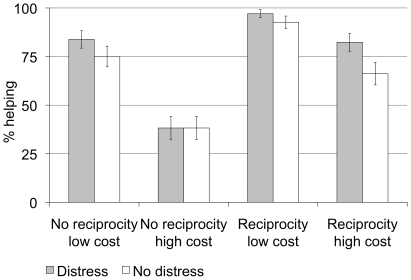
- In Experiment 1 (N = 68), helping in the ZPG was higher in reciprocity trials, low-cost trials, and distress-cue trials: main effects were reciprocity, F(67) = 73.22, p < .001, partial η² = .52; cost, F(67) = 73.78, p < .001, partial η² = .52; distress, F(67) = 7.02, p = .01, partial η² = .10.
- ZPG helping correlated with dictator-game giving, ρ(65) = .35, p = .004, but not with memory-task performance, ρ(64) = .06, p > .05, supporting convergent and divergent validity.
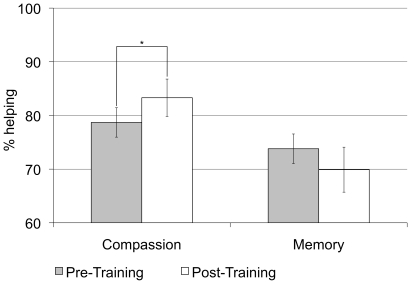
- In Experiment 2, compassion training significantly increased helping from pre- to post-training, t(26) = 1.85, p = .04, one-sided, while memory training did not, t(31) = −1.20, p = .24; the time × training interaction was F(1,57) = 4.09, p = .05, partial η² = .07.
- Reported compassion practice hours correlated with increased helping in no-reciprocity trials, ρ(17) = .39, p = .05, one-sided, but not with total helping, ρ(17) = .27, p = .13. Dictator-game giving did not change after training, F(1,56) = .02, p = .89.
Methods
- Two experiments with healthy female volunteers: Experiment 1 validated the ZPG in 68 participants; Experiment 2 tested compassion versus memory training in 69 participants, with 27 compassion and 32 memory participants in the reported samples.
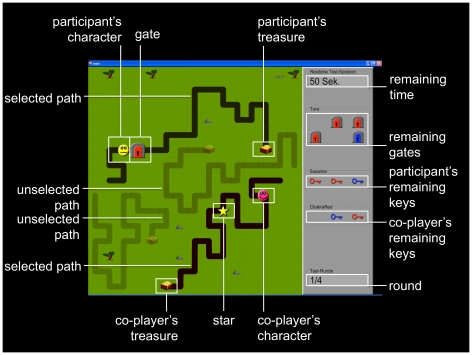
- The ZPG used a 2 × 2 × 2 within-subjects design: reciprocity (no reciprocity, reciprocity), cost (low, high), and distress (no distress cues, distress cues); participants navigated a maze, could help an ostensible co-player by donating keys, and could collect stars to control for attention.
- Experiment 2 compared a one-day, six-hour compassion meditation workshop with a one-day method-of-loci memory workshop; pre-test occurred one to two weeks before training and post-test two to five days after training. Analyses used repeated-measures ANOVAs, t-tests, and correlations.
Limitations
- The paper states that future research with longer training and bigger sample sizes is needed to determine how long-lasting the effects are and who benefits; it also notes that the study was not designed to test the distinction between compassion-based and norm-based prosocial behavior.
- The paper states that self-reported practice data were available only from a subset of participants (n = 19 compassion, n = 22 memory), and that mechanisms such as relaxation or perceived self-other overlap were not isolated.
- Evident from the text: both experiments included only healthy female volunteers aged 18–35 from the University of Zurich and surrounding community, limiting generalizability; the compassion-training effect was tested one-sided based on directional hypotheses.
Model-written summary. Check it against the paper before relying on it.
Integrity signals
Registry
Cites
Statistics
Figures
Verification
Claims the paper makes
46 Own result · 21 Own method · 18 Not checked yet · 16 Own interpretation · 2 No basis given
A result the paper reports from its own data — it cites no other source for it, so there is none to check. The quote shows it is in the paper.
In the paper
“As in Experiment 1, these main effects were qualified by a significant interaction between the two factors”
§ Short-Term Compassion Training Increases Prosocial Behavior in a Newly Developed Prosocial Game > Results > Experiment 2
plaincorrelational- Asserted: passes — The authors put it forward as true.
- Checkable: passes — It can be checked against evidence.
- Load-bearing: unclear — It is unclear whether the paper’s conclusions depend on it.
- Based: passes — The paper gives a reason why it holds.
A result the paper reports from its own data — it cites no other source for it, so there is none to check. The quote shows it is in the paper.
In the paper
“which allows for repeated, ecologically valid assessment of prosocial behavior and is sensitive to the influence of reciprocity, helping cost, and distress cues on helping behavior.”
- Also stated in: § Experiment 1 · hedged
“Thus, the ZPG indeed seems to be sensitive to the three operationalizations of the influencing factors”
§ Short-Term Compassion Training Increases Prosocial Behavior in a Newly Developed Prosocial Game > Abstract
plaincorrelational- Asserted: passes — The authors put it forward as true.
- Checkable: passes — It can be checked against evidence.
- Load-bearing: passes — The paper’s conclusions depend on it.
- Based: passes — The paper gives a reason why it holds.
- Also stated in: § Experiment 1 · hedged
A result the paper reports from its own data — it cites no other source for it, so there is none to check. The quote shows it is in the paper.
In the paper
“While there was no reliable change in helping from pre- to post-training for the memory training group, t(31) = −1.20, p = .24”
§ Short-Term Compassion Training Increases Prosocial Behavior in a Newly Developed Prosocial Game > Results > Experiment 2
plain- Asserted: passes — The authors put it forward as true.
- Checkable: passes — It can be checked against evidence.
- Load-bearing: passes — The paper’s conclusions depend on it.
- Based: passes — The paper gives a reason why it holds.
A result the paper reports from its own data — it cites no other source for it, so there is none to check. The quote shows it is in the paper.
In the paper
“participants helped significantly more in reciprocity trials, in trials with a low cost of helping, and in trials in which the co-player's virtual character expressed distress”
§ Short-Term Compassion Training Increases Prosocial Behavior in a Newly Developed Prosocial Game > Results > Experiment 1
plaincorrelational- Asserted: passes — The authors put it forward as true.
- Checkable: passes — It can be checked against evidence.
- Load-bearing: passes — The paper’s conclusions depend on it.
- Based: passes — The paper gives a reason why it holds.
A result the paper reports from its own data — it cites no other source for it, so there is none to check. The quote shows it is in the paper.
In the paper
“Increasing the cost of helping resulted in a larger decrease in prosocial behavior in the no-reciprocity compared to the reciprocity trials”
§ Short-Term Compassion Training Increases Prosocial Behavior in a Newly Developed Prosocial Game > Results > Experiment 1
plaindirect- Asserted: passes — The authors put it forward as true.
- Checkable: passes — It can be checked against evidence.
- Load-bearing: unclear — It is unclear whether the paper’s conclusions depend on it.
- Based: passes — The paper gives a reason why it holds.
A result the paper reports from its own data — it cites no other source for it, so there is none to check. The quote shows it is in the paper.
In the paper
“As both correlations were non-significant, we can preclude that interindividual differences in risk preferences, ρ(66) = .10, p>.05 (risk questionnaire) and ρ(66) = .02, p>.05 (lottery index), accounted for the difference in prosocial behavior between low and high cost trials.”
§ Short-Term Compassion Training Increases Prosocial Behavior in a Newly Developed Prosocial Game > Results > Experiment 1
plain- Asserted: passes — The authors put it forward as true.
- Checkable: passes — It can be checked against evidence.
- Load-bearing: passes — The paper’s conclusions depend on it.
- Based: passes — The paper gives a reason why it holds.
A result the paper reports from its own data — it cites no other source for it, so there is none to check. The quote shows it is in the paper.
In the paper
“the number of remembered words did not correlate with helping in the ZPG, ρ(66) = −.04, p>.05”
§ Short-Term Compassion Training Increases Prosocial Behavior in a Newly Developed Prosocial Game > Results > Experiment 2
plain- Asserted: passes — The authors put it forward as true.
- Checkable: passes — It can be checked against evidence.
- Load-bearing: unclear — It is unclear whether the paper’s conclusions depend on it.
- Based: passes — The paper gives a reason why it holds.
A result the paper reports from its own data — it cites no other source for it, so there is none to check. The quote shows it is in the paper.
In the paper
“For negative mood, a significant time x training interaction was revealed, F(1,68) = 6.11, p = .016, partial η2 = .08.”
§ Short-Term Compassion Training Increases Prosocial Behavior in a Newly Developed Prosocial Game > Results > Experiment 2
plaincorrelational- Asserted: passes — The authors put it forward as true.
- Checkable: passes — It can be checked against evidence.
- Load-bearing: unclear — It is unclear whether the paper’s conclusions depend on it.
- Based: passes — The paper gives a reason why it holds.
A result the paper reports from its own data — it cites no other source for it, so there is none to check. The quote shows it is in the paper.
In the paper
“The analysis did however yield a reciprocity x distress interaction: Distress cues increased helping in the no-reciprocity but not in the reciprocity trials”
§ Short-Term Compassion Training Increases Prosocial Behavior in a Newly Developed Prosocial Game > Results > Experiment 2
plaindirect- Asserted: passes — The authors put it forward as true.
- Checkable: passes — It can be checked against evidence.
- Load-bearing: unclear — It is unclear whether the paper’s conclusions depend on it.
- Based: passes — The paper gives a reason why it holds.
A result the paper reports from its own data — it cites no other source for it, so there is none to check. The quote shows it is in the paper.
In the paper
“These interactions were qualified by a significant three-way interaction between time x cost x training, F(1,57) = 4.55, p = .04, partial η2 = .07.”
§ Short-Term Compassion Training Increases Prosocial Behavior in a Newly Developed Prosocial Game > Results > Experiment 2
plaincorrelational- Asserted: passes — The authors put it forward as true.
- Checkable: passes — It can be checked against evidence.
- Load-bearing: passes — The paper’s conclusions depend on it.
- Based: passes — The paper gives a reason why it holds.
- It may state two separate claims as one. 27
- Probably not a substantial claim. 34
- The quote only partly states this claim. 1
A result the paper reports from its own data — it cites no other source for it, so there is none to check. The quote shows it is in the paper.
In the paper
“A significant main effect of time, F(1,54) = 5.84, p = .02, partial η2 = .10, was revealed for compassionate feelings that was qualified by a marginally significant interaction between time and training, F(1,54) = 3.61, p = .06, partial η2 = .06.”
§ Short-Term Compassion Training Increases Prosocial Behavior in a Newly Developed Prosocial Game > Results > Experiment 2
plaincorrelational- Asserted: passes — The authors put it forward as true.
- Checkable: passes — It can be checked against evidence.
- Load-bearing: passes — The paper’s conclusions depend on it.
- Based: passes — The paper gives a reason why it holds.
It may state two separate claims as one.
A result the paper reports from its own data — it cites no other source for it, so there is none to check. The quote shows it is in the paper.
In the paper
“The analysis again revealed main effects of reciprocity, and cost (see Table 1). Participants helped significantly more in reciprocity trials and in trials with a low cost of helping.”
§ Short-Term Compassion Training Increases Prosocial Behavior in a Newly Developed Prosocial Game > Results > Experiment 2
plain- Asserted: passes — The authors put it forward as true.
- Checkable: passes — It can be checked against evidence.
- Load-bearing: unclear — It is unclear whether the paper’s conclusions depend on it.
- Based: passes — The paper gives a reason why it holds.
It may state two separate claims as one.
A result the paper reports from its own data — it cites no other source for it, so there is none to check. The quote shows it is in the paper.
In the paper
“Participants in experiment 2 also reported to be very engaged in the game (range: 1–5; mean: 4.04, SD = 1.07). There was no differences between participants in the compassion and memory training group in the engagement with the game, t(52) = 1.78, p>.05”
§ Short-Term Compassion Training Increases Prosocial Behavior in a Newly Developed Prosocial Game > Results > Experiment 2
plain- Asserted: passes — The authors put it forward as true.
- Checkable: passes — It can be checked against evidence.
- Load-bearing: passes — The paper’s conclusions depend on it.
- Based: passes — The paper gives a reason why it holds.
It may state two separate claims as one.
A result the paper reports from its own data — it cites no other source for it, so there is none to check. The quote shows it is in the paper.
In the paper
“at pre-training, helping in the low-cost, t(57) = 1.21, p = .23, and high-cost trials, t(57) = .55, p = .58, did not differ between the compassion and the memory group”
§ Short-Term Compassion Training Increases Prosocial Behavior in a Newly Developed Prosocial Game > Results > Experiment 2
plain- Asserted: passes — The authors put it forward as true.
- Checkable: passes — It can be checked against evidence.
- Load-bearing: passes — The paper’s conclusions depend on it.
- Based: passes — The paper gives a reason why it holds.
It may state two separate claims as one.
A result the paper reports from its own data — it cites no other source for it, so there is none to check. The quote shows it is in the paper.
In the paper
“While negative mood decreased in the compassion-training group, t(23) = −1.94, p = .03, one-sided, it marginally significantly increased in the memory-training group, t(23) = 2.02, p = .05.”
§ Short-Term Compassion Training Increases Prosocial Behavior in a Newly Developed Prosocial Game > Results > Experiment 2
plain- Asserted: passes — The authors put it forward as true.
- Checkable: passes — It can be checked against evidence.
- Load-bearing: unclear — It is unclear whether the paper’s conclusions depend on it.
- Based: passes — The paper gives a reason why it holds.
It may state two separate claims as one.
A result the paper reports from its own data — it cites no other source for it, so there is none to check. The quote shows it is in the paper.
In the paper
“on average participants indicated that they were very engaged in the game (range: 2–5; mean: 4.15, SD: 0.74)”
§ Short-Term Compassion Training Increases Prosocial Behavior in a Newly Developed Prosocial Game > Results > Experiment 1
hedged- Asserted: passes — The authors put it forward as true.
- Checkable: passes — It can be checked against evidence.
- Load-bearing: fails — The paper’s conclusions may not depend on it.
- Based: passes — The paper gives a reason why it holds.
Probably not a substantial claim. The paper’s conclusions may not depend on it.
A result the paper reports from its own data — it cites no other source for it, so there is none to check. The quote shows it is in the paper.
In the paper
“Furthermore, the game is very engaging (on average participants rate their involvement in the game with 4 on a 1-to-5-scale and report later that they find the game very enjoyable)”
§ Short-Term Compassion Training Increases Prosocial Behavior in a Newly Developed Prosocial Game > Discussion
plain- Asserted: passes — The authors put it forward as true.
- Checkable: passes — It can be checked against evidence.
- Load-bearing: unclear — It is unclear whether the paper’s conclusions depend on it.
- Based: passes — The paper gives a reason why it holds.
It may state two separate claims as one.
A result the paper reports from its own data — it cites no other source for it, so there is none to check. The quote shows it is in the paper.
In the paper
“helping in no-reciprocity trials, but not helping in reciprocity trials, was related to interindividual differences in reported training hours in the compassion group.”
§ Short-Term Compassion Training Increases Prosocial Behavior in a Newly Developed Prosocial Game > Discussion
plaincorrelational- Asserted: passes — The authors put it forward as true.
- Checkable: passes — It can be checked against evidence.
- Load-bearing: passes — The paper’s conclusions depend on it.
- Based: passes — The paper gives a reason why it holds.
It may state two separate claims as one.
- Rests on an assumption: Participants' self-reported time spent practicing outside of training accurately reflects their actual practice duration.
A result the paper reports from its own data — it cites no other source for it, so there is none to check. The quote shows it is in the paper.
In the paper
“This is further supported by our finding that giving in the dictator game did not change from pre- to post-training in either group and that the modal giving at pre-training was 50%.”
§ Short-Term Compassion Training Increases Prosocial Behavior in a Newly Developed Prosocial Game > Discussion
plain- Asserted: passes — The authors put it forward as true.
- Checkable: passes — It can be checked against evidence.
- Load-bearing: passes — The paper’s conclusions depend on it.
- Based: passes — The paper gives a reason why it holds.
It may state two separate claims as one.
A conclusion the paper draws from its own results — it cites no other source for it, so there is none to check. The quote shows it is in the paper.
In the paper
“the ZPG is more ecologically valid than, for example, monetary exchange games, as it minimizes the influence of strategic considerations, minimizes effects of task-affordances due to explicit instructions and maximizes the influence of emotion-driven, fast decisions”
§ Short-Term Compassion Training Increases Prosocial Behavior in a Newly Developed Prosocial Game > Discussion
plaindirect- Asserted: passes — The authors put it forward as true.
- Checkable: passes — It can be checked against evidence.
- Load-bearing: passes — The paper’s conclusions depend on it.
- Based: passes — The paper gives a reason why it holds.
It may state two separate claims as one.
None of the sources cited for this claim have been checked yet.
In the paper
“This compassion meditation technique (called “Metta” in Pali) aims to foster an attitude of loving kindness, emotional positivity, benevolence, and friendliness towards oneself and others [20], [58].”
§ Short-Term Compassion Training Increases Prosocial Behavior in a Newly Developed Prosocial Game > Materials and Methods > Procedure
What the sources say
- Not checked yetcites [20] JW Carson, 2005, Loving-kindness meditation for chronic low back pain: Results from a pilot trial., J Holist Nurs source
- Not checked yetcites [58] S Salzberg, 1995, Loving-kindness: The revolutionary art of happiness.
plaindirect- Asserted: passes — The authors put it forward as true.
- Checkable: passes — It can be checked against evidence.
- Load-bearing: fails — The paper’s conclusions may not depend on it.
- Based: passes — The paper gives a reason why it holds.
Probably not a substantial claim. The paper’s conclusions may not depend on it.
A conclusion the paper draws from its own results — it cites no other source for it, so there is none to check. The quote shows it is in the paper.
In the paper
“Here we show for the first time that compassion training had longer-lasting effects on prosocial behavior as the post-test was completed two to five days after training.”
§ Short-Term Compassion Training Increases Prosocial Behavior in a Newly Developed Prosocial Game > Discussion
boosteddirect- Asserted: passes — The authors put it forward as true.
- Checkable: passes — It can be checked against evidence.
- Load-bearing: passes — The paper’s conclusions depend on it.
- Based: passes — The paper gives a reason why it holds.
It may state two separate claims as one. The quote only partly states this claim.
The paper states this without a source or data behind it here, so there is nothing to check it against. The quote shows it is in the paper.
In the paper
“In contrast to a momentary induction of empathic concern through instruction to feel for a specific person in distress in a specific situation, compassion training aims at permanently changing one's motivation and attitude towards others in general.”
§ Short-Term Compassion Training Increases Prosocial Behavior in a Newly Developed Prosocial Game > Materials and Methods > Procedure
plaindirect- Asserted: passes — The authors put it forward as true.
- Checkable: passes — It can be checked against evidence.
- Load-bearing: passes — The paper’s conclusions depend on it.
- Based: fails — The paper may give no reason why it holds.
Probably not a substantial claim. The paper may give no reason why it holds. It may state two separate claims as one.
In the paper
“The more time participants had actually spent training, the stronger the reduction in interleukin-6 release, suggesting a dose-dependent effect of compassion training.”
§ Short-Term Compassion Training Increases Prosocial Behavior in a Newly Developed Prosocial Game > Introduction
What the sources say
- Not checked yetcites [23] TWW Pace, 2009, Effect of compassion meditation on neuroendocrine, innate immune and behavioral responses to psychosocial stress., Psychoneuroendocrinology source
hedgedcorrelational- Asserted: passes — The authors put it forward as true.
- Checkable: passes — It can be checked against evidence.
- Load-bearing: fails — The paper’s conclusions may not depend on it.
- Based: passes — The paper gives a reason why it holds.
Probably not a substantial claim. The paper’s conclusions may not depend on it.
What the paper did — it cites no source for this, so there is none to check. The quote shows it is in the paper.
In the paper
“A novel game, the Zurich Prosocial Game (ZPG), was developed that allows for repeated assessment of prosocial behavior and for parsing the influence of reciprocity, cost, and distress on prosocial behavior.”
§ Short-Term Compassion Training Increases Prosocial Behavior in a Newly Developed Prosocial Game > Materials and Methods > Measures
plain- Asserted: passes — The authors put it forward as true.
- Checkable: passes — It can be checked against evidence.
- Load-bearing: passes — The paper’s conclusions depend on it.
- Based: passes — The paper gives a reason why it holds.
It may state two separate claims as one.
In the paper
“To assess the convergent validity of the ZPG, participants played the dictator game [31].”
§ Short-Term Compassion Training Increases Prosocial Behavior in a Newly Developed Prosocial Game > Materials and Methods > Measures
What the sources say
- Not checked yetcites [31] E Hoffman, 1994, Preferences, property rights, and anonymity in bargaining games., Games Econ Behav source
plain- Asserted: passes — The authors put it forward as true.
- Checkable: passes — It can be checked against evidence.
- Load-bearing: passes — The paper’s conclusions depend on it.
- Based: passes — The paper gives a reason why it holds.
Probably not a substantial claim.
What the paper did — it cites no source for this, so there is none to check. The quote shows it is in the paper.
In the paper
“35 participants entered the compassion-training group and 34 participants entered the memory-training group. 28 participants from the compassion group and 32 participants from the memory group completed the study. One participant of the compassion group was eliminated from the analysis as data on the ZPG was missing.”
§ Short-Term Compassion Training Increases Prosocial Behavior in a Newly Developed Prosocial Game > Materials and Methods > Participants
plainn = 32- Asserted: passes — The authors put it forward as true.
- Checkable: passes — It can be checked against evidence.
- Load-bearing: fails — The paper’s conclusions may not depend on it.
- Based: passes — The paper gives a reason why it holds.
Probably not a substantial claim. The paper’s conclusions may not depend on it. It may state two separate claims as one.
None of the sources cited for this claim have been checked yet.
In the paper
“The present results support the notion that similar to situation-specific induction of empathic concern for a specific person in need [8], [49], the training of compassionate motivation leads to increases in prosocial behavior.”
§ Short-Term Compassion Training Increases Prosocial Behavior in a Newly Developed Prosocial Game > Discussion
What the sources say
- Not checked yetcites [8] CD Batson, 1991, The altruism question: Towards a social-psychological answer.
- Not checked yetcites [49] N Eisenberg, 1987, The relation of empathy to prosocial and related behaviors., Psychol Bull source
plaindirect- Asserted: passes — The authors put it forward as true.
- Checkable: passes — It can be checked against evidence.
- Load-bearing: passes — The paper’s conclusions depend on it.
- Based: passes — The paper gives a reason why it holds.
It may state two separate claims as one.
What the paper did — it cites no source for this, so there is none to check. The quote shows it is in the paper.
In the paper
“On the phone, participants were given information about the timing but, importantly, in case of Experiment 2, not about the specific content of the study and underwent a structured psychological interview”
§ Short-Term Compassion Training Increases Prosocial Behavior in a Newly Developed Prosocial Game > Materials and Methods > Participants
plain- Asserted: passes — The authors put it forward as true.
- Checkable: passes — It can be checked against evidence.
- Load-bearing: fails — The paper’s conclusions may not depend on it.
- Based: passes — The paper gives a reason why it holds.
Probably not a substantial claim. The paper’s conclusions may not depend on it.
In the paper
“Ultimately, this should lead to an attitude of emotional positivity, benevolence, and friendliness towards oneself and others [58].”
§ Short-Term Compassion Training Increases Prosocial Behavior in a Newly Developed Prosocial Game > Materials and Methods > Procedure
What the sources say
- Not checked yetcites [58] S Salzberg, 1995, Loving-kindness: The revolutionary art of happiness.
hedgeddirect- Asserted: passes — The authors put it forward as true.
- Checkable: passes — It can be checked against evidence.
- Load-bearing: passes — The paper’s conclusions depend on it.
- Based: passes — The paper gives a reason why it holds.
Probably not a substantial claim.
What the paper did — it cites no source for this, so there is none to check. The quote shows it is in the paper.
In the paper
“Importantly, possible participants of Experiment 2 were additionally not allowed to have prior experience with mental compassion training or the method of loci.”
§ Short-Term Compassion Training Increases Prosocial Behavior in a Newly Developed Prosocial Game > Materials and Methods > Participants
plainn = 69- Asserted: passes — The authors put it forward as true.
- Checkable: passes — It can be checked against evidence.
- Load-bearing: passes — The paper’s conclusions depend on it.
- Based: passes — The paper gives a reason why it holds.
Probably not a substantial claim.
None of the sources cited for this claim have been checked yet.
In the paper
“The memory control group underwent a one-day training workshop in the method of loci, a technique used to memorize items in an ordered sequence [59], [60].”
§ Short-Term Compassion Training Increases Prosocial Behavior in a Newly Developed Prosocial Game > Materials and Methods > Procedure
What the sources say
- Not checked yetcites [59] GH Bower, 1970, Analysis of a mnemonic device., Am Sci
- Not checked yetcites [60] P Verhaeghen, 1996, On the mechanisms of plasticity in young and older adults after instruction in the method of loci: Evidence for an amplification model., Psychol Aging source
plain- Asserted: passes — The authors put it forward as true.
- Checkable: passes — It can be checked against evidence.
- Load-bearing: fails — The paper’s conclusions may not depend on it.
- Based: passes — The paper gives a reason why it holds.
Probably not a substantial claim. The paper’s conclusions may not depend on it.
What the paper did — it cites no source for this, so there is none to check. The quote shows it is in the paper.
In the paper
“Participants were asked after playing the game to indicate on a five-point scale how engaged they were when playing the game. A high engagement of the participants would indicate that they were emerged in the game and diminish the probability that demand effects and strategic decision-making influenced prosocial behavior in the ZPG.”
§ Short-Term Compassion Training Increases Prosocial Behavior in a Newly Developed Prosocial Game > Materials and Methods > Measures
hedgeddirect- Asserted: passes — The authors put it forward as true.
- Checkable: passes — It can be checked against evidence.
- Load-bearing: fails — The paper’s conclusions may not depend on it.
- Based: fails — The paper may give no reason why it holds.
Probably not a substantial claim. The paper’s conclusions may not depend on it. The paper may give no reason why it holds. It may state two separate claims as one.
What the paper did — it cites no source for this, so there is none to check. The quote shows it is in the paper.
In the paper
“Importantly, the two players do not share the same paths in the maze and do not compete for the same treasure. Thus, in principle, the game can be played while completely ignoring the other player.”
§ Short-Term Compassion Training Increases Prosocial Behavior in a Newly Developed Prosocial Game > Materials and Methods > Measures
plain- Asserted: passes — The authors put it forward as true.
- Checkable: passes — It can be checked against evidence.
- Load-bearing: passes — The paper’s conclusions depend on it.
- Based: passes — The paper gives a reason why it holds.
Probably not a substantial claim. It may state two separate claims as one.
What the paper did — it cites no source for this, so there is none to check. The quote shows it is in the paper.
In the paper
“As interindividual differences in the behavior in the high cost trials could be brought on by differences in risk preferences, i.e., participants differ in their perception of the risk of not reaching the treasure in the high cost trials, we assessed risk preferences.”
§ Short-Term Compassion Training Increases Prosocial Behavior in a Newly Developed Prosocial Game > Materials and Methods > Measures
hedged- Asserted: passes — The authors put it forward as true.
- Checkable: passes — It can be checked against evidence.
- Load-bearing: fails — The paper’s conclusions may not depend on it.
- Based: passes — The paper gives a reason why it holds.
Probably not a substantial claim. The paper’s conclusions may not depend on it.
In the paper
“Six to seven weeks of meditation-based compassion training result in increases in positive mood and life satisfaction [21]”
§ Short-Term Compassion Training Increases Prosocial Behavior in a Newly Developed Prosocial Game > Introduction
What the sources say
- Not checked yetcites [21] BL Fredrickson, 2008, Open hearts build lives: Positive emotions, induced through loving-kindness meditation, build consequential personal resources., J Pers Soc Psychol source
plaindirect- Asserted: passes — The authors put it forward as true.
- Checkable: passes — It can be checked against evidence.
- Load-bearing: fails — The paper’s conclusions may not depend on it.
- Based: passes — The paper gives a reason why it holds.
Probably not a substantial claim. The paper’s conclusions may not depend on it. It may state two separate claims as one.
A conclusion the paper draws from its own results — it cites no other source for it, so there is none to check. The quote shows it is in the paper.
In the paper
“Furthermore, the game is very engaging (on average participants rate their involvement in the game with 4 on a 1-to-5-scale and report later that they find the game very enjoyable) and fast, thus making strategic considerations difficult.”
§ Short-Term Compassion Training Increases Prosocial Behavior in a Newly Developed Prosocial Game > Discussion
plaindirect- Asserted: passes — The authors put it forward as true.
- Checkable: passes — It can be checked against evidence.
- Load-bearing: passes — The paper’s conclusions depend on it.
- Based: passes — The paper gives a reason why it holds.
It may state two separate claims as one.
In the paper
“Thus, as in compassion-focused therapy [7], compassion here is trained as a skill.”
§ Short-Term Compassion Training Increases Prosocial Behavior in a Newly Developed Prosocial Game > Materials and Methods > Procedure
What the sources say
- Not checked yetcites [7] P Gilbert, 2010, Compassion-focused therapy. source
plain- Asserted: passes — The authors put it forward as true.
- Checkable: passes — It can be checked against evidence.
- Load-bearing: passes — The paper’s conclusions depend on it.
- Based: passes — The paper gives a reason why it holds.
Probably not a substantial claim.
In the paper
“Giving in the dictator game is likely driven by fairness norms and not by kindness [35].”
§ Short-Term Compassion Training Increases Prosocial Behavior in a Newly Developed Prosocial Game > Introduction
What the sources say
- Not checked yetcites [35] GE Bolton, 1998, Dictator game giving: Rules of fairness versus acts of kindness., Int J Game Theory source
hedgeddirect- Asserted: passes — The authors put it forward as true.
- Checkable: passes — It can be checked against evidence.
- Load-bearing: passes — The paper’s conclusions depend on it.
- Based: passes — The paper gives a reason why it holds.
Probably not a substantial claim.
What the paper did — it cites no source for this, so there is none to check. The quote shows it is in the paper.
In the paper
“The advertisements for Experiment 2 asked for people interested in mental training but never mentioned the word compassion.”
§ Short-Term Compassion Training Increases Prosocial Behavior in a Newly Developed Prosocial Game > Materials and Methods > Participants
plain- Asserted: passes — The authors put it forward as true.
- Checkable: passes — It can be checked against evidence.
- Load-bearing: fails — The paper’s conclusions may not depend on it.
- Based: passes — The paper gives a reason why it holds.
Probably not a substantial claim. The paper’s conclusions may not depend on it. It may state two separate claims as one.
What the paper did — it cites no source for this, so there is none to check. The quote shows it is in the paper.
In the paper
“Importantly, to reduce demand effects, participants are never told that the purpose of the game is to help the co-player. Instead, the instructed aim of this computer game is to reach a goal, the treasure, in a short amount of time to optimize monetary winnings.”
§ Short-Term Compassion Training Increases Prosocial Behavior in a Newly Developed Prosocial Game > Materials and Methods > Measures
plaindirect- Asserted: passes — The authors put it forward as true.
- Checkable: passes — It can be checked against evidence.
- Load-bearing: passes — The paper’s conclusions depend on it.
- Based: passes — The paper gives a reason why it holds.
Probably not a substantial claim. It may state two separate claims as one.
In the paper
“if the costs of helping are low [41]”
§ Short-Term Compassion Training Increases Prosocial Behavior in a Newly Developed Prosocial Game > Introduction
What the sources say
- Not checked yetcites [41] JF Dovidio, 1991, The arousal-cost-reward model and the process of intervention: A review of the evidence.
plaindirect- Asserted: passes — The authors put it forward as true.
- Checkable: passes — It can be checked against evidence.
- Load-bearing: fails — The paper’s conclusions may not depend on it.
- Based: passes — The paper gives a reason why it holds.
Probably not a substantial claim. The paper’s conclusions may not depend on it.
In the paper
“only recently a differentiation between norm-based and compassion-based prosocial behavior has been suggested [2].”
§ Short-Term Compassion Training Increases Prosocial Behavior in a Newly Developed Prosocial Game > Introduction
What the sources say
- Not checked yetcites [2] T Singer, 2009, Differential roles of fairness- and compassion-based motivations for cooperation, defection, and punishment., Ann NY Acad Sci source
hedged- Asserted: passes — The authors put it forward as true.
- Checkable: passes — It can be checked against evidence.
- Load-bearing: passes — The paper’s conclusions depend on it.
- Based: passes — The paper gives a reason why it holds.
Probably not a substantial claim.
A conclusion the paper draws from its own results — it cites no other source for it, so there is none to check. The quote shows it is in the paper.
In the paper
“Moreover, the correlation between helping in the ZPG and giving in the dictator was modest suggesting that the two measures tap into different aspects of prosocial behavior.”
§ Short-Term Compassion Training Increases Prosocial Behavior in a Newly Developed Prosocial Game > Discussion
hedgedcorrelational- Asserted: passes — The authors put it forward as true.
- Checkable: passes — It can be checked against evidence.
- Load-bearing: passes — The paper’s conclusions depend on it.
- Based: passes — The paper gives a reason why it holds.
It may state two separate claims as one.
What the paper did — it cites no source for this, so there is none to check. The quote shows it is in the paper.
In the paper
“Trial types appeared in random order with the restriction that the first reciprocity trial could appear at the earliest as the third trial. This restriction was introduced to reduce the likelihood of an anchoring effect (helping agreed upon behavior) being introduced by experiencing a helpful co-player right away.”
§ Short-Term Compassion Training Increases Prosocial Behavior in a Newly Developed Prosocial Game > Materials and Methods > Measures
plaindirect- Asserted: passes — The authors put it forward as true.
- Checkable: passes — It can be checked against evidence.
- Load-bearing: fails — The paper’s conclusions may not depend on it.
- Based: passes — The paper gives a reason why it holds.
Probably not a substantial claim. The paper’s conclusions may not depend on it. It may state two separate claims as one.
A conclusion the paper draws from its own results — it cites no other source for it, so there is none to check. The quote shows it is in the paper.
In the paper
“The present study adds to these findings by showing that even a short-term compassion training may not only have benefits for the practitioner's health and subjective well-being but also for other people and society in general as it increases the propensity to act prosocially even towards people one has never met.”
§ Short-Term Compassion Training Increases Prosocial Behavior in a Newly Developed Prosocial Game > Discussion
hedgedconditional- Asserted: passes — The authors put it forward as true.
- Checkable: passes — It can be checked against evidence.
- Load-bearing: passes — The paper’s conclusions depend on it.
- Based: passes — The paper gives a reason why it holds.
It may state two separate claims as one.
What the paper did — it cites no source for this, so there is none to check. The quote shows it is in the paper.
In the paper
“They were told that they would play interactive computer games via the internet with other participants in different research institutes across Europe in order to investigate cross-cultural differences in interpersonal behaviors. In reality, there were no co-players; the ostensible co-players' behavior was pre-programmed.”
§ Short-Term Compassion Training Increases Prosocial Behavior in a Newly Developed Prosocial Game > Materials and Methods > Experiment 1
plain- Asserted: passes — The authors put it forward as true.
- Checkable: passes — It can be checked against evidence.
- Load-bearing: passes — The paper’s conclusions depend on it.
- Based: passes — The paper gives a reason why it holds.
Probably not a substantial claim. It may state two separate claims as one.
What the paper did — it cites no source for this, so there is none to check. The quote shows it is in the paper.
In the paper
“To offset individual differences in speed and proficiency with computer games, the individual time limit for all trials of a given game was set at the average time the individual required to reach the treasure in the four practice trials plus 5 s.”
§ Short-Term Compassion Training Increases Prosocial Behavior in a Newly Developed Prosocial Game > Materials and Methods > Measures
plain- Asserted: passes — The authors put it forward as true.
- Checkable: passes — It can be checked against evidence.
- Load-bearing: fails — The paper’s conclusions may not depend on it.
- Based: passes — The paper gives a reason why it holds.
Probably not a substantial claim. The paper’s conclusions may not depend on it.
None of the sources cited for this claim have been checked yet.
In the paper
“It has been shown that people help more often if they have been helped before [39], [40]”
§ Short-Term Compassion Training Increases Prosocial Behavior in a Newly Developed Prosocial Game > Introduction
What the sources say
plaindirect- Asserted: passes — The authors put it forward as true.
- Checkable: passes — It can be checked against evidence.
- Load-bearing: fails — The paper’s conclusions may not depend on it.
- Based: passes — The paper gives a reason why it holds.
Probably not a substantial claim. The paper’s conclusions may not depend on it.
In the paper
“as well as a reduction of interleukin-6 release in response to a psychosocial stressor [23].”
§ Short-Term Compassion Training Increases Prosocial Behavior in a Newly Developed Prosocial Game > Introduction
What the sources say
- Not checked yetcites [23] TWW Pace, 2009, Effect of compassion meditation on neuroendocrine, innate immune and behavioral responses to psychosocial stress., Psychoneuroendocrinology source
plaindirect- Asserted: passes — The authors put it forward as true.
- Checkable: passes — It can be checked against evidence.
- Load-bearing: fails — The paper’s conclusions may not depend on it.
- Based: passes — The paper gives a reason why it holds.
Probably not a substantial claim. The paper’s conclusions may not depend on it.
In the paper
“it has been demonstrated [10] that momentarily inducing feelings of empathic concern for a person in need by having participants focus on the person's feelings increases their prosocial behavior towards that person.”
§ Short-Term Compassion Training Increases Prosocial Behavior in a Newly Developed Prosocial Game > Introduction
What the sources say
- Not checked yetcites [10] CD Batson, 2007, An additional antecedent of empathic concern: Valuing the welfare of the person in need., J Pers Soc Psychol source
boosteddirect- Asserted: passes — The authors put it forward as true.
- Checkable: passes — It can be checked against evidence.
- Load-bearing: passes — The paper’s conclusions depend on it.
- Based: passes — The paper gives a reason why it holds.
Probably not a substantial claim.
What the paper did — it cites no source for this, so there is none to check. The quote shows it is in the paper.
In the paper
“To assess the divergent validity of the ZPG, we used a memory task that was later used as an outcome measure for the memory training group in the intervention experiment.”
§ Short-Term Compassion Training Increases Prosocial Behavior in a Newly Developed Prosocial Game > Materials and Methods > Measures
plain- Asserted: passes — The authors put it forward as true.
- Checkable: passes — It can be checked against evidence.
- Load-bearing: fails — The paper’s conclusions may not depend on it.
- Based: passes — The paper gives a reason why it holds.
Probably not a substantial claim. The paper’s conclusions may not depend on it.
None of the sources cited for this claim have been checked yet.
In the paper
“if they are confronted with signs of distress [42], [43].”
§ Short-Term Compassion Training Increases Prosocial Behavior in a Newly Developed Prosocial Game > Introduction
What the sources say
- Not checked yetcites [42] CD Batson, 1981, Empathy: A source of altruistic motivation for helping?
- Not checked yetcites [43] G Carlo, 1991, The altruistic personality: When is it apparent?, J Pers Soc Psychol source
plaindirect- Asserted: passes — The authors put it forward as true.
- Checkable: passes — It can be checked against evidence.
- Load-bearing: fails — The paper’s conclusions may not depend on it.
- Based: passes — The paper gives a reason why it holds.
Probably not a substantial claim. The paper’s conclusions may not depend on it.
In the paper
“Hutcherson et al. [25] report that a very brief (7-min) compassion meditation exercise results in a more positive attitude towards the target of the exercise.”
§ Short-Term Compassion Training Increases Prosocial Behavior in a Newly Developed Prosocial Game > Introduction
What the sources say
- Not checked yetcites [25] CA Hutcherson, 2008, Loving-kindness meditation increases social connectedness., Emotion source
plaindirect- Asserted: passes — The authors put it forward as true.
- Checkable: passes — It can be checked against evidence.
- Load-bearing: passes — The paper’s conclusions depend on it.
- Based: passes — The paper gives a reason why it holds.
Probably not a substantial claim.
What the paper did — it cites no source for this, so there is none to check. The quote shows it is in the paper.
In the paper
“Importantly, as the game is framed as a treasure hunt with monetary gains, demand effects induced by the content of the training should be less strong than in other prosocial tasks.”
§ Short-Term Compassion Training Increases Prosocial Behavior in a Newly Developed Prosocial Game > Discussion
hedgeddirect- Asserted: passes — The authors put it forward as true.
- Checkable: passes — It can be checked against evidence.
- Load-bearing: passes — The paper’s conclusions depend on it.
- Based: passes — The paper gives a reason why it holds.
Probably not a substantial claim.
What the paper did — it cites no source for this, so there is none to check. The quote shows it is in the paper.
In the paper
“The majority of the dropout in the compassion group (5/7) occurred before the training.”
§ Short-Term Compassion Training Increases Prosocial Behavior in a Newly Developed Prosocial Game > Materials and Methods > Participants
plainn = 7- Asserted: passes — The authors put it forward as true.
- Checkable: passes — It can be checked against evidence.
- Load-bearing: fails — The paper’s conclusions may not depend on it.
- Based: passes — The paper gives a reason why it holds.
Probably not a substantial claim. The paper’s conclusions may not depend on it.
What the paper did — it cites no source for this, so there is none to check. The quote shows it is in the paper.
In the paper
“Participants then answered five questions testing their comprehension of the game. The experimenter then checked the answers to ensure that participants fully understood the rules of the game.”
§ Short-Term Compassion Training Increases Prosocial Behavior in a Newly Developed Prosocial Game > Materials and Methods > Experiment 1
plain- Asserted: passes — The authors put it forward as true.
- Checkable: passes — It can be checked against evidence.
- Load-bearing: fails — The paper’s conclusions may not depend on it.
- Based: passes — The paper gives a reason why it holds.
Probably not a substantial claim. The paper’s conclusions may not depend on it. It may state two separate claims as one.
What the paper did — it cites no source for this, so there is none to check. The quote shows it is in the paper.
In the paper
“The compassion group and the memory group did not differ in age, t(57) = 1.98, p>.05, years of education, t(57) = .64, p>.05, prosocialness, t(54) = 1.91, p>.05, empathic concern, t(54) = .1, p>.05, alexithymic symptoms, t(57) = .89, p>.05, or depressive symptoms, t(57) = .87, p>.05. There was also no difference in the distribution of type of education between the samples (χ2 = 3.06, p>.05).”
§ Short-Term Compassion Training Increases Prosocial Behavior in a Newly Developed Prosocial Game > Materials and Methods > Participants
plain- Asserted: passes — The authors put it forward as true.
- Checkable: passes — It can be checked against evidence.
- Load-bearing: passes — The paper’s conclusions depend on it.
- Based: passes — The paper gives a reason why it holds.
It may state two separate claims as one.
None of the sources cited for this claim have been checked yet.
In the paper
“Only female participants were included in Experiments 1 and 2 because of better performance in emotional tasks [53] and higher self-reported empathy in women [54].”
§ Short-Term Compassion Training Increases Prosocial Behavior in a Newly Developed Prosocial Game > Materials and Methods > Participants
What the sources say
- Not checked yetcites [53] AM Kring, 1998, Sex differences in emotion: Expression, experience, and physiology., J Pers Soc Psychol source
- Not checked yetcites [54] S Baron-Cohen, 2004, The empathy quotient: An investigation of adults with Asperger syndrome or high functioning autism, and normal sex differences., J Autism Dev Disord source
plaincorrelational- Asserted: passes — The authors put it forward as true.
- Checkable: passes — It can be checked against evidence.
- Load-bearing: passes — The paper’s conclusions depend on it.
- Based: passes — The paper gives a reason why it holds.
It may state two separate claims as one.
What the paper did — it cites no source for this, so there is none to check. The quote shows it is in the paper.
In the paper
“Thus, the newly developed Zurich Prosocial Game was assessed in the context of several other non-helping tasks, which further helped to reduce possible demand effects of the compassion training.”
§ Short-Term Compassion Training Increases Prosocial Behavior in a Newly Developed Prosocial Game > Materials and Methods > Procedure
plaindirect- Asserted: passes — The authors put it forward as true.
- Checkable: passes — It can be checked against evidence.
- Load-bearing: fails — The paper’s conclusions may not depend on it.
- Based: passes — The paper gives a reason why it holds.
Probably not a substantial claim. The paper’s conclusions may not depend on it.
What the paper did — it cites no source for this, so there is none to check. The quote shows it is in the paper.
In the paper
“This particular mnemonic technique was chosen for the control group as it contains most elements also needed in the compassion training workshops: People need to actively engage in inner mental processing and to create active mental images and specific associations between items. The difference is that the memory group focuses purely on improving cognitive rather than affective skills.”
§ Short-Term Compassion Training Increases Prosocial Behavior in a Newly Developed Prosocial Game > Materials and Methods > Procedure
plain- Asserted: passes — The authors put it forward as true.
- Checkable: passes — It can be checked against evidence.
- Load-bearing: passes — The paper’s conclusions depend on it.
- Based: passes — The paper gives a reason why it holds.
Probably not a substantial claim.
The authors state this as an assumption.
Compassion training has effects on compassion-based prosocial behavior (and not on norm-based prosocial behavior).
“Based on the suggested distinction between compassion-based and norm-based prosocial behavior, and on the assumption that the compassion training has effects on the former this correlation could possibly only arise for non-reciprocity trials.”
The paper relies on this without support.
Participants' self-reported time spent practicing outside of training accurately reflects their actual practice duration.
“we calculated the correlation between participants' self-reported time spent praticing outside of the training and the change in helping from pre- to post-training (self-report data could only be obtained from a subset of the samples: n compassion = 19, n memory = 22).”
The paper relies on this without support.
Participants believed the cover story that they were playing with real co-players in other research institutes.
“They were told that they would play interactive computer games via the internet with other participants in different research institutes across Europe in order to investigate cross-cultural differences in interpersonal behaviors. In reality, there were no co-players; the ostensible co-players' behavior was pre-programmed.”
The paper relies on this without support.
The compassion and memory training workshops were equivalent in all aspects other than the trained skill, including teacher characteristics and participant expectations.
“This particular mnemonic technique was chosen for the control group as it contains most elements also needed in the compassion training workshops: People need to actively engage in inner mental processing and to create active mental images and specific associations between items. The difference is that the memory group focuses purely on improving cognitive rather than affective skills.”
Claims other papers make about this one
Each is checked against this paper’s own text: does it say what the citing paper says it does?
The source backs part of the claim, not all of it — or backs it for a different population, condition or comparison.
In the citing paper
“LKM is a useful tool during the COVID-19 pandemic because it promotes social interactions and builds resilience by cultivating positive emotions and social connection, increasing motivation to access and provide social support, and engendering prosocial behaviors (Leiberg, Klimecki & Singer, 2011).”
From Stress and coping in the time of COVID-19: Pathways to resilience and recovery (2020) · cites this paper as Leiberg, Klimecki & Singer, 2011
Experimental — accuracy not yet measuredIn the citing paper
“Short-term contemplative training in compassion increases helping, even when it is costly [51].”
From On the interaction of social affect and cognition: empathy, compassion and theory of mind (2018) · cites this paper as [51]
In the citing paper
“Behavioral research has shown that short-term training of loving-kindness and compassion is associated with increases in daily positive affect (Kok et al., 2013), prosocial behavior (Leiberg et al., 2011;Weng et al., 2013), resilience (Fredrickson et al., 2008) and empathy (Mascaro et al., 2013).”
From Compassion-based emotion regulation up-regulates experienced positive affect and associated neural networks (2015) · cites this paper as Leiberg et al., 2011
In the citing paper
“prosocial behavior (Leiberg et al., 2011)”
From Differential pattern of functional brain plasticity after compassion and empathy training (2014) · cites this paper as Leiberg et al., 2011
In the citing paper
“Accordingly, it has recently been shown that the frequency of helping behavior can indeed be increased with a similar short-term compassion training (Leiberg et al., 2011).”
From Differential pattern of functional brain plasticity after compassion and empathy training (2014) · cites this paper as Leiberg et al., 2011
Statistics recomputed
Every reported test result, recomputed from its test statistic and degrees of freedom. A result shows as not adding up only once an independent check has confirmed it.
- ConsistentF(1, 67) = 17.73reported p < .001 · recomputed p < .001
“F(1,67) = 17.73, p < .001”
- ConsistentF(1, 68) = 1.89reported p > .05 · recomputed p = .174
“F(1,68) = 1.89, p > .05”
- Consistentt(52) = 1.78reported p > .05 · recomputed p = .081
“t(52) = 1.78, p > .05”
- ConsistentF(1, 54) = 23.47reported p < .001 · recomputed p < .001
“F(1,54) = 23.47, p < .001”
- ConsistentF(1, 54) = 5.84reported p = .02 · recomputed p = .019
“F(1,54) = 5.84, p = .02”
- ConsistentF(1, 54) = 3.61reported p = .06 · recomputed p = .063
“F(1,54) = 3.61, p = .06”
- Consistentt(23) = 2.66reported p = .01 · recomputed p = .014
“t(23) = 2.66, p = .01”
- ConsistentF(1, 68) = 6.11reported p = .016 · recomputed p = .016
“F(1,68) = 6.11, p = .016”
- Consistentt(23) = -1.94reported p = .03 · recomputed p = .065
“t(23) = −1.94, p = .03”
The paper states a one-tailed test
- Consistentt(23) = 2.02reported p = .05 · recomputed p = .055
“t(23) = 2.02, p = .05”
- ConsistentF(1, 57) = 4.09reported p = .05 · recomputed p = .048
“F(1,57) = 4.09, p = .05”
- Consistentt(31) = -1.2reported p = .24 · recomputed p = .239
“t(31) = −1.20, p = .24”
- Consistentt(26) = 1.85reported p = .04 · recomputed p = .076
“t(26) = 1.85, p = .04”
The paper states a one-tailed test
- ConsistentF(1, 57) = 6.76reported p = .01 · recomputed p = .012
“F(1,57) = 6.76, p = .01”
- ConsistentF(1, 57) = 4.55reported p = .04 · recomputed p = .037
“F(1,57) = 4.55, p = .04”
- Consistentt(57) = 1.21reported p = .23 · recomputed p = .231
“t(57) = 1.21, p = .23”
- Consistentt(57) = 0.55reported p = .58 · recomputed p = .584
“t(57) = .55, p = .58”
- Consistentt(57) = 3.07reported p = .003 · recomputed p = .003
“t(57) = 3.07, p = .003”
- Consistentt(57) = 2.27reported p = .03 · recomputed p = .027
“t(57) = 2.27, p = .03”
- ConsistentF(1, 56) = 0.02reported p = .89 · recomputed p = .888
“F(1,56) = .02, p = .89”
- ConsistentF(1, 56) = 1.63reported p = .21 · recomputed p = .207
“F(1,56) = 1.63, p = .21”
- Consistentt(32) = 0.57reported p > .05 · recomputed p = .573
“t(32) = .57, p > .05”
- Consistentt(32) = 1.75reported p > .05 · recomputed p = .090
“t(32) = 1.75, p > .05”
- Consistentt(32) = -0.81reported p > .05 · recomputed p = .424
“t(32) = −.81, p > .05”
- Consistentt(32) = 1.7reported p > .05 · recomputed p = .099
“t(32) = 1.70, p > .05”
- Consistentt(32) = -0.75reported p > .05 · recomputed p = .459
“t(32) = −.75, p > .05”
- Consistentt(32) = -0.79reported p > .05 · recomputed p = .435
“t(32) = −.79, p > .05”
- Consistentt(32) = -0.99reported p > .05 · recomputed p = .330
“t(32) = −.99, p > .05”
- Consistentt(32) = 1.42reported p > .05 · recomputed p = .165
“t(32) = 1.42, p > .05”
- Consistentt(32) = -0.06reported p > .05 · recomputed p = .953
“t(32) = −.06, p > .05”
- Consistentt(57) = 1.98reported p > .05 · recomputed p = .053
“t(57) = 1.98, p > .05”
- Consistentt(57) = 0.64reported p > .05 · recomputed p = .525
“t(57) = .64, p > .05”
- Consistentt(54) = 1.91reported p > .05 · recomputed p = .061
“t(54) = 1.91, p > .05”
- Consistentt(54) = 0.1reported p > .05 · recomputed p = .921
“t(54) = .1, p > .05”
- Consistentt(57) = 0.89reported p > .05 · recomputed p = .377
“t(57) = .89, p > .05”
- Consistentt(57) = 0.87reported p > .05 · recomputed p = .388
“t(57) = .87, p > .05”
Self-check
Percentages, sums and reported differences re-computed from the paper’s own numbers.
Each contradiction between two passages listed here was confirmed by an independent check.
Rated minor: it would not touch a result — a value no result rests on, a p-value that stays on the same side of the significance level, or a conflict that is clerical, resolved elsewhere in the paper, or outside its own findings.
In the paper
“Memory training sample (N = 32)”
§ Short-Term Compassion Training Increases Prosocial Behavior in a Newly Developed Prosocial Game > Materials and Methods > Participants
Reported 6.3 · recomputed 3.125
Rated minor: it would not touch a result — a value no result rests on, a p-value that stays on the same side of the significance level, or a conflict that is clerical, resolved elsewhere in the paper, or outside its own findings.
In the paper
§ Short-Term Compassion Training Increases Prosocial Behavior in a Newly Developed Prosocial Game > Results > Experiment 2
“For negative mood, a significant time x training interaction was revealed, F(1,68) = 6.11, p = .016, partial η2 = .08.”
§ Short-Term Compassion Training Increases Prosocial Behavior in a Newly Developed Prosocial Game > Materials and Methods > Participants
“In Experiment 2, that aimed to assess the effect of a short-term compassion training workshop on prosocial behavior as measured using the newly developed ZPG, we investigated 69 healthy female volunteers (age: 18–34 years; mean: 23.69).”
Citations
Cites
Development and validation of brief measures of positive and negative affect: The PANAS scales.
Watson, D., Clark, L. A., & Tellegen, A. (1988) · Journal of Personality and Social Psychology · doi:10.1037/0022-3514.54.6.1063 · Cited by 32,433
The Evolution of Reciprocal Altruism
Trivers, R. L. (1971) · The Quarterly Review of Biology · doi:10.1086/406755 · Cited by 11,010
Measuring individual differences in empathy: Evidence for a multidimensional approach.
Davis, M. H. (1983) · Journal of Personality and Social Psychology · doi:10.1037/0022-3514.44.1.113 · Cited by 10,272
A Handbook of Child Psychology
(1932) · Nature · doi:10.1038/130331a0 · Cited by 10,133
Comparison of Beck Depression Inventories -IA and -II in psychiatric outpatients
Beck, A. T., Steer, R. A., Ball, R., & Ranieri, W. F. (1996) · Journal of Personality Assessment · doi:10.1207/s15327752jpa6703_13 · Cited by 5,965
Bagby, R. M., Parker, J. D. A., & Taylor, G. J. (1994) · Journal of Psychosomatic Research · doi:10.1016/0022-3999(94)90005-1 · Cited by 5,293
Baron-Cohen, S., & Wheelwright, S. (2004) · Journal of Autism and Developmental Disorders · doi:10.1023/b:jadd.0000022607.19833.00 · Cited by 4,093
Behavioral Game Theory: Experiments in Strategic Interaction
Camerer, C. F. (2003) · Cited by 3,722
Evolution of indirect reciprocity
Nowak, M. A., & Sigmund, K. (2005) · Nature · doi:10.1038/nature04131 · Cited by 2,762
The relation of empathy to prosocial and related behaviors
Eisenberg, N., & Miller, P. A. (1987) · Psychological Bulletin · doi:10.1037/0033-2909.101.1.91 · Cited by 2,672
Falk, A., & Fischbacher, U. (2006) · Games and Economic Behavior · doi:10.1016/j.geb.2005.03.001 · Cited by 2,416
The altruism question: toward a social-psychological answer
(1992) · Choice Reviews Online · doi:10.5860/choice.29-4797 · Cited by 2,402
Fairness in Simple Bargaining Experiments
Forsythe, R. S., Horowitz, J. L., Savin, N. E., & Sefton, M. (1994) · Games and Economic Behavior · doi:10.1006/game.1994.1021 · Cited by 2,383
Fredrickson, B. L., Cohn, M. A., Coffey, K. A., Pek, J., & Finkel, S. M. (2008) · Journal of Personality and Social Psychology · doi:10.1037/a0013262 · Cited by 2,365 · cited 2×
“Self-benefiting effects of compassion training such as increases in positive mood, life satisfaction, decreased depressive symptoms [21], and less reactivity to psychosocial stress [23] have been reported before.”
BackgroundThe social neuroscience of empathy
Singer, T., & Lamm, C. (2009) · Annals of the New York Academy of Sciences · doi:10.1111/j.1749-6632.2009.04418.x · Cited by 1,981
Self-citationSocial, emotional, and personality development
Eisenberg, N., & Damon, W. (1998) · Wiley eBooks · Cited by 1,903
Eisenberg, N., Fabes, R. A., & Spinrad, T. L. (2007) · Wiley eBooks · doi:10.1002/9780470147658.chpsy0311 · Cited by 1,847
Gilbert, P., & Procter, S. (2006) · Clinical Psychology & Psychotherapy · doi:10.1002/cpp.507 · Cited by 1,822 · cited 1×
“In a pilot study, Gilbert and Procter [22] administered compassionate mind training [CMT; 24], which aims at reducing self-criticism by focusing on compassionate images and emotions, to a sample of psychiatric patients with severe long-term difficulties.”
Preferences, property rights, and anonymity in bargaining games.
Hoffman, E., McCabe, K., Shachat, K., & Smith, V. (1994) · Games and Economic Behavior · doi:10.1006/game.1994.1056 · Cited by 1,674
Interpersonal forgiving in close relationships.
McCullough, M. E., Jr. Worthington Everett, L., & Rachal, K. C. (1997) · Journal of Personality and Social Psychology · doi:10.1037//0022-3514.73.2.321 · Cited by 1,666
Reinterpreting the empathy-altruism relationship: When one into one equals oneness.
Cialdini, R. B., Brown, S. L., Lewis, B. P., Luce, C. L., & Neuberg, S. L. (1997) · Journal of Personality and Social Psychology · doi:10.1037/0022-3514.73.3.481 · Cited by 1,467
Social exclusion decreases prosocial behavior
Twenge, J. M., Baumeister, R. F., DeWall, C. N., Ciarocco, N. J., & Bartels, J. M. (2007) · Journal of Personality and Social Psychology · doi:10.1037/0022-3514.92.1.56 · Cited by 1,271
Behavioral game theory, experiments in strategic interaction
Canté, F. (2004) · Cuadernos de Economía · Cited by 1,265
Interpersonal forgiving in close relationships.
McCullough, M. E., Worthington, E. L., & Rachal, K. C. (1997) · Journal of Personality and Social Psychology · doi:10.1037/0022-3514.73.2.321 · Cited by 1,189
These things called empathy: Eight related but distinct phenomena.
Batson, C. (2009) · The MIT Press eBooks · doi:10.7551/mitpress/9780262012973.003.0002 · Cited by 1,181
Is empathic emotion a source of altruistic motivation?
Batson, C. D., Duncan, B. D., Ackerman, P., Buckley, T., & Birch, K. (1981) · Journal of Personality and Social Psychology · doi:10.1037/0022-3514.40.2.290 · Cited by 1,169
Gratitude and Prosocial Behavior: Helping When It Costs You
Bartlett, M. Y., & DeSteno, D. (2006) · Psychological Science · doi:10.1111/j.1467-9280.2006.01705.x · Cited by 1,161
Altruism in Anonymous Dictator Games.
Eckel, C. C., & Grossman, P. J. (1996) · Games and Economic Behavior · doi:10.1006/game.1996.0081 · Cited by 1,126 · cited 1×
“In the context of game theoretical paradigms, the dictator game is most commonly used for assessing altruistic acts towards others [31–34].”
BackgroundSex differences in emotion: Expression, experience, and physiology.
Kring, A. M., & Gordon, A. H. (1998) · Journal of Personality and Social Psychology · doi:10.1037/0022-3514.74.3.686 · Cited by 1,067 · cited 3×
“(3)Toronto Alexithymia Scale [53] (TAS;.”
Background(2005) · doi:10.4324/9780203003459 · Cited by 1,041
depue, R. A., & morrone-strupinsky, J. V. (2005) · Behavioral and Brain Sciences · doi:10.1017/s0140525x05000063 · Cited by 958
Gilbert, P. (2010) · Routledge eBooks · doi:10.4324/9780203851197 · Cited by 957
The Economics of Fairness, Reciprocity and Altruism - Experimental Evidence and New TheoriesPreprint
Fehr, E., & Schmidt, K. M. (2005) · RePEc: Research Papers in Economics · doi:10.5282/ubm/epub.726 · Cited by 843
Fairness Versus Reason in the Ultimatum Game
Nowak, M. A., Page, K. M., & Sigmund, K. (2000) · Science · doi:10.1126/science.289.5485.1773 · Cited by 835
Compassionate love for close others and humanity
Sprecher, S., & Fehr, B. (2005) · Journal of Social and Personal Relationships · doi:10.1177/0265407505056439 · Cited by 770
Cooperative behavior cascades in human social networks
Fowler, J. H., & Christakis, N. A. (2010) · Proceedings of the National Academy of Sciences · doi:10.1073/pnas.0913149107 · Cited by 767
Loving-kindness meditation increases social connectedness.
Hutcherson, C. A., Seppala, E. M., & Gross, J. J. (2008) · Emotion · doi:10.1037/a0013237 · Cited by 758
Pace, T. W. W., Negi, L. T., Adame, D. D., Cole, S. P., Sivilli, T. I., Brown, T. D., Issa, M. J., & Raison, C. L. (2009) · Psychoneuroendocrinology · doi:10.1016/j.psyneuen.2008.08.011 · Cited by 748 · cited 2×
“Self-benefiting effects of compassion training such as increases in positive mood, life satisfaction, decreased depressive symptoms [21], and less reactivity to psychosocial stress [23] have been reported before.”
BackgroundAging, Training, and the Brain: A Review and Future Directions
Lustig, C., Shah, P., Seidler, R. D., & Reuter‐Lorenz, P. A. (2009) · Neuropsychology Review · doi:10.1007/s11065-009-9119-9 · Cited by 732
A New Scale for Measuring Adults' Prosocialness
Caprara, G. V., Steca, P., Zelli, A., & Capanna, C. (2005) · European Journal of Psychological Assessment · doi:10.1027/1015-5759.21.2.77 · Cited by 600
An additional antecedent of empathic concern: Valuing the welfare of the person in need.
Batson, C. D., Eklund, J. H., Chermok, V. L., Hoyt, J. L., & Ortiz, B. G. (2007) · Journal of Personality and Social Psychology · doi:10.1037/0022-3514.93.1.65 · Cited by 587
Encyclopedia of Social Psychology
Baumeister, R. F., & Vohs, K. D. (2007) · Sage eBooks · doi:10.4135/9781412956253 · Cited by 584
Burnstein, E., Crandall, C. S., & Kitayama, S. (1994) · Journal of Personality and Social Psychology · doi:10.1037/0022-3514.67.5.773 · Cited by 576
The sound of silence in prisoner's dilemma and dictator games
Bohnet, I., & Frey, B. S. (1999) · Journal of Economic Behavior & Organization · doi:10.1016/s0167-2681(98)00121-8 · Cited by 491
Golan, O., Ashwin, E., Granader, Y., McClintock, S. W., Day, K. A., Leggett, V., & Baron‐Cohen, S. (2009) · Journal of Autism and Developmental Disorders · doi:10.1007/s10803-009-0862-9 · Cited by 481
Dictator game giving: Rules of fairness versus acts of kindness.
Bolton, G. E., Katok, E., & Zwick, R. (1998) · International Journal of Game Theory · doi:10.1007/s001820050072 · Cited by 480
Emotional intelligence training and its implications for stress, health and performance
Slaski, M., & Cartwright, S. (2003) · Stress and Health · doi:10.1002/smi.979 · Cited by 475
Bower, G. H. (1970) · American Scientist · Cited by 440
Focused therapies and compassionate mind training for shame and self-attacking
(2005) · Routledge eBooks · doi:10.4324/9780203003459-15 · Cited by 406
Batson, C. D., Lange, P. A. M. V., Ahmad, N. Y., & Lishner, D. A. (2007) · SAGE Publications Ltd eBooks · doi:10.4135/9781848608221.n11 · Cited by 336
Loving-Kindness Meditation for Chronic Low Back Pain: Results From a Pilot Trial
Carson, J. W., Keefe, F. J., Lynch, T. R., Carson, K. M., Goli, V., Fras, A. M., & Thorp, S. R. (2005) · Journal of Holistic Nursing · doi:10.1177/0898010105277651 · Cited by 299
Perceptual learning: specificity versus generalization
Fahle, M. W. (2005) · Current Opinion in Neurobiology · doi:10.1016/j.conb.2005.03.010 · Cited by 282
Preferences, Property Rights, and Anonymity in Bargaining Games
Hoffman, E. N., McCabe, K., Shachat, K., & Smith, V. L. S. (2000) · Cambridge University Press eBooks · doi:10.1017/cbo9780511528347.008 · Cited by 266
From Games to Giving: Social Value Orientation Predicts Donations to Noble Causes
Lange, P. A. M. V., Bekkers, R., Schuyt, T. N. M., & van Vugt, M. (2007) · Basic and Applied Social Psychology · doi:10.1080/01973530701665223 · Cited by 261
Rockliff, H., Gilbert, P., McEwan, K., Lightman, S. L., & Glover, D. G. (2008) · University of Derby Online Research Archive. (University of Derby) · Cited by 234
Motor Learning Without Doing: Trial-by-Trial Improvement in Motor Performance During Mental Training
Gentili, R. J., Han, C. E., Schweighofer, N., & Papaxanthis, C. (2010) · Journal of Neurophysiology · doi:10.1152/jn.00257.2010 · Cited by 228
The arousal: Cost-reward model and the process of intervention: A review of the evidence.
Dovidio, J. F., Piliavin, J. A., Gaertner, S. L., Schroeder, D. A., & Clark, R. D. (1991) · Cited by 214
The altruistic personality: In what contexts is it apparent?
Carlo, G., Eisenberg, N., Troyer, D., Switzer, G. E., & al, E. (1991) · Journal of Personality and Social Psychology · doi:10.1037//0022-3514.61.3.450 · Cited by 203
The altruistic personality: In what contexts is it apparent?
Carlo, G., Eisenberg, N., Troyer, D., Switzer, G., & Speer, A. L. (1991) · Journal of Personality and Social Psychology · doi:10.1037/0022-3514.61.3.450 · Cited by 203
Greitemeyer, T. (2009) · Personality and Social Psychology Bulletin · doi:10.1177/0146167209341648 · Cited by 184
Verhaeghen, P., & Marcoen, A. (1996) · Psychology and Aging · doi:10.1037/0882-7974.11.1.164 · Cited by 180 · cited 1×
“The memory control group underwent a one-day training workshop in the method of loci, a technique used to memorize items in an ordered sequence [59,60].”
MethodLevine, R. V., Martinez, T. S., Brase, G. L., & Sorenson, K. (1994) · Journal of Personality and Social Psychology · doi:10.1037/0022-3514.67.1.69 · Cited by 163
The Science of compassionate love: theory, research, and applications
(2009) · Choice Reviews Online · doi:10.5860/choice.46-4143 · Cited by 153
10. Compassion Focused Therapy
Dale-Hewitt, V., Irons, C., Braham, L., & Smith, S. (2015) · doi:10.1515/9783110471014-012 · Cited by 148
Seeing Through Tears: Crying and Attachment
Nelson, J. K. (2005) · Cited by 102
Eisenberg, N., Spinrad, T. L., & Morris, A. S. (2013) · Oxford University Press eBooks · doi:10.1093/oxfordhb/9780199958474.013.0013 · Cited by 96
Singer, T., & Steinbeis, N. (2009) · Annals of the New York Academy of Sciences · doi:10.1111/j.1749-6632.2009.04733.x · Cited by 86
Self-citationThe obligation to help: The effects of amount of prior help on subsequent helping behavior
Wilke, H., & Lanzetta, J. T. (1970) · Journal of Experimental Social Psychology · doi:10.1016/0022-1031(70)90058-2 · Cited by 79
Tullberg, J. (2004) · American Journal of Economics and Sociology · doi:10.1111/j.1536-7150.2004.00341.x · Cited by 23
Research works printed but not linked: 1
- H Rockliff, 2008, Heart rate variability and salivary cortisol responses to compassion-focused imagery., J Clin Neuropsychiatry, 5, 132
Cited by
Sorted by citations
The Neuroscience of Mindfulness Meditation
Tang, Y.-Y., Hölzel, B. K., & Posner, M. I. (2015) · Nature reviews. Neuroscience · doi:10.1038/nrn3916 · Cited by 2,889
Singer, T., & Klimecki, O. M. (2014) · Current Biology · doi:10.1016/j.cub.2014.06.054 · Cited by 1,254
Self-citationThe interplay of microbially mediated and abiotic reactions in the biogeochemical Fe cycle
Melton, E. D., Swanner, E. D., Behrens, S., Schmidt, C., & Kappler, A. (2014) · Nature Reviews Microbiology · doi:10.1038/nrmicro3347 · Cited by 899
Reconstructing and deconstructing the self: cognitive mechanisms in meditation practice
Dahl, C. J., Lutz, A., & Davidson, R. J. (2015) · Trends in Cognitive Sciences · doi:10.1016/j.tics.2015.07.001 · Cited by 809
A Meta-Analysis of Compassion-Based Interventions: Current State of Knowledge and Future Directions
Kirby, J. N., Tellegen, C. L., & Steindl, S. R. (2017) · Behavior Therapy · doi:10.1016/j.beth.2017.06.003 · Cited by 827
Metadata
- Authors
- Leiberg, S., Klimecki, O., & Singer, T.
- Affiliations
- University of Zurich (CH)
- Corresponding author
- Leiberg, Susanne
- Venue
- PLoS ONE
- Publisher
- Public Library of Science (PLoS)
- Published
- 2011-03-09
- Volume
- 6
- Issue
- 3
- Pages
- e17798
- ISSN
- 1932-6203 (ISSN-L)
- PMC
- PMC3052380
- OpenAlex
- W1973616877
- Cited by
- 442
- References
- 69
- Citations by year
- 2026: 13 · 2025: 27 · 2024: 23 · 2023: 28 · 2022: 42 · 2021: 35 · 2020: 36 · 2019: 38 · 2018: 34 · 2017: 43 · 2016: 28 · 2015: 38 · 2014: 21 · 2013: 20 · 2012: 15
- FWCI
- 19.63
- Type
- journal article
- Language
- en
- Open access
- gold
- doi.org
- Locations
- PLoS ONE (publishedVersion, cc-by)
- PubMed Central (publishedVersion, cc-by)
- PubMed (publishedVersion)
- Archive ouverte UNIGE (University of Geneva) (publishedVersion, other-oa)
- Zurich Open Repository and Archive (University of Zurich) (acceptedVersion, cc-by)
- RePEc: Research Papers in Economics (submittedVersion)
- DOAJ (DOAJ: Directory of Open Access Journals) (submittedVersion, cc-by-sa)
- Max Planck Digital Library (submittedVersion, other-oa)
- MPG.PuRe (Max Planck Society) (submittedVersion, cc-by)
- MPG.PuRe (Max Planck Society) (submittedVersion, other-oa)
- Archive ouverte UNIGE (University of Geneva) (submittedVersion, cc-by)
- Zurich Open Repository and Archive (University of Zurich) (submittedVersion, cc-by)
- Zurich Open Repository and Archive (University of Zurich)
- Funders
- National Science Foundation (FP7/2007-2013)
- Mind and Life Institute
- Schweizerischer Nationalfonds zur Förderung der Wissenschaftlichen Forschung (FP7/2007-2013)
- Universität Zürich
- FP7 Ideas: European Research Council (205557)
- Topics
- Social Sciences › Psychology › Clinical Psychology › Mindfulness and Compassion Interventions
- Social Sciences › Economics, Econometrics and Finance › Economics and Econometrics › Experimental Behavioral Economics Studies
- Social Sciences › Psychology › Social Psychology › Psychological Well-being and Life Satisfaction
- Keywords
- compassion training, prosocial behavior, helping behavior, reciprocity, memory training, individual differences, practice duration, helping strangers
- MeSH terms
- Adolescent, Adult, Analysis of Variance, Empathy, Female, Games, Experimental, Helping Behavior, Humans, Memory, Social Behavior, Time Factors, Young Adult
About these checks
Registry, retraction, Cites and statistics results are computed, not judged, with one exception: a printed reference that no index lists is read once by a model before it counts as a citation error. Claims are extracted by a model and kept only when their quote appears verbatim in the text; each cited source is then checked, with a model’s help, for whether it says what the claim relies on. Those verdicts can be wrong — read the claim’s quote and the cited source before relying on one.
A language model drew the claims from the paper on 2026-10-10, under version 3 of the claim definition (model deepseek-v4.1-flash, prompt extract-v3).
A second model labelled each claim on 2026-10-10 (model jev-1.13-20260917, definition revision gold-guideline-v0.2).
Statistics and arithmetic are recomputed, not judged.
Confidence bands are shown only for fields calibrated on our annotated test set. None is calibrated yet, so no band is shown.
What counts as a claim ›How we measure confidence ›How we check this ›
Are you an author, or do you see a problem with this page? Request a review
