

Plastic pollution in the world’s oceans: more than 5 trillion plastic pieces weighing over 250,000 tons afloat at sea
Open accessThe DOI matches its Crossref record; 43 of the 43 references it cites were found in a registry or an index.
Abstract
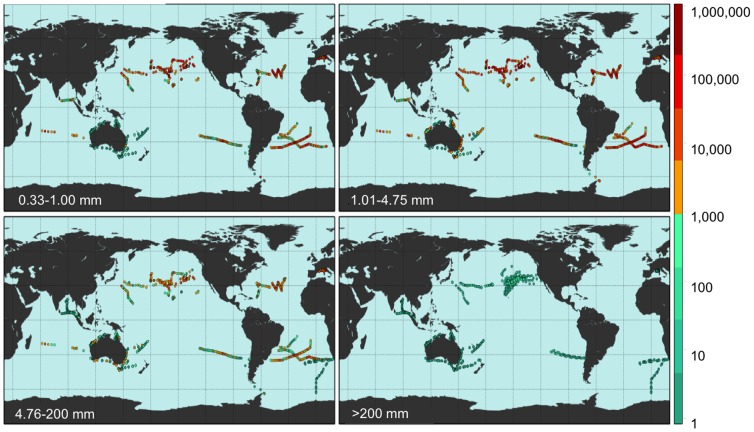
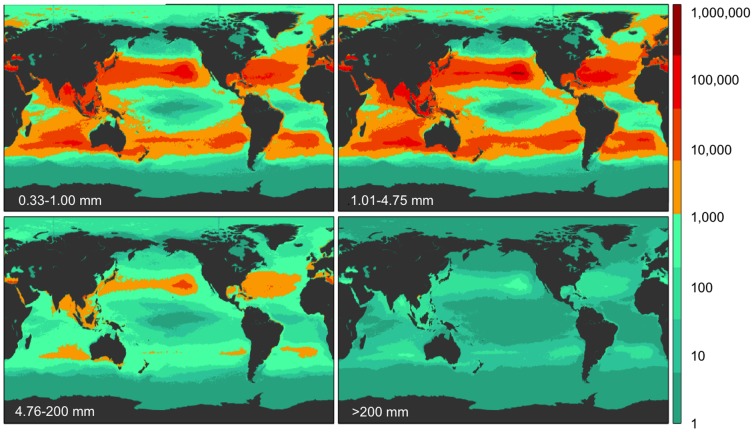
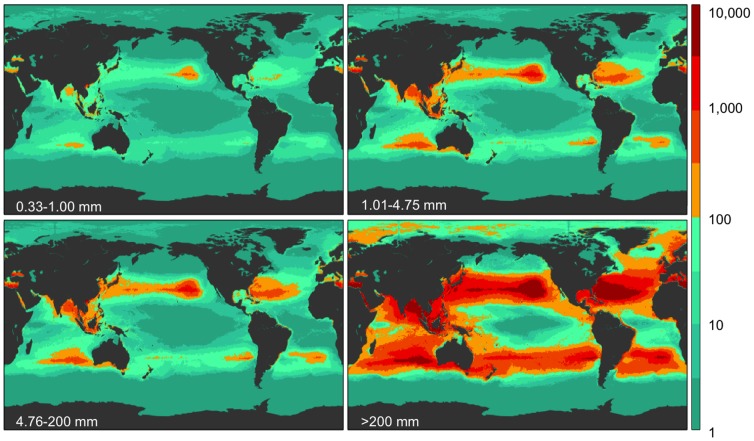
Plastic pollution is ubiquitous throughout the marine environment, yet estimates of the global abundance and weight of floating plastics have lacked data, particularly from the Southern Hemisphere and remote regions. Here we report an estimate of the total number of plastic particles and their weight floating in the world's oceans from 24 expeditions (2007-2013) across all five sub-tropical gyres, costal Australia, Bay of Bengal and the Mediterranean Sea conducting surface net tows (N = 680) and visual survey transects of large plastic debris (N = 891). Using an oceanographic model of floating debris dispersal calibrated by our data, and correcting for wind-driven vertical mixing, we estimate a minimum of 5.25 trillion particles weighing 268,940 tons. When comparing between four size classes, two microplastic <4.75 mm and meso- and macroplastic >4.75 mm, a tremendous loss of microplastics is observed from the sea surface compared to expected rates of fragmentation, suggesting there are mechanisms at play that remove <4.75 mm plastic particles from the ocean surface.
Overview
The claims and statistics of this paper haven’t been checked yet.
Free: it reads the open-access text and checks the first 5 claims that cite a source we can check. Create a free account to check every claim.
Integrity signals
Registry
Cites
Statistics
Figures
Verification
Claims the paper makes
The claims and statistics of this paper haven’t been checked yet.
Free: it reads the open-access text and checks the first 5 claims that cite a source we can check. Create a free account to check every claim.
Claims other papers make about this one
Each is checked against this paper’s own text: does it say what the citing paper says it does?
The source backs part of the claim, not all of it — or backs it for a different population, condition or comparison.
In the citing paper
“Measurements and model simulations revealed an uneven distribution of PMD, which complicates assessing global PMD inventories: highest PMD concentrations were found in the subtropical gyres (which have been termed 'trash vortexes' or 'garbage patches'), while PMD concentrations are much lower in the in the tropical and Arctic open ocean.51,53,54,[62][63][64]”
From The fate of plastic in the ocean environment – a minireview (2021) · cites this paper as [53]
Experimental — accuracy not yet measured
Self-check
Percentages, sums and reported differences re-computed from the paper’s own numbers.
The self-check needs the paper’s full text.
Citations
Cites
Lost at sea: where is all the plastic?
Thompson, R. C., Olsen, Y., Mitchell, R. P., Davis, A., Rowland, S. J., John, A. W. G., McGonigle, D., & Russell, A. E. (2004) · Science · doi:10.1126/science.1094559 · Cited by 7,765
Accumulation and fragmentation of plastic debris in global environments
Barnes, D. K. A., Galgani, F., Thompson, R. C., & Barlaz, M. (2009) · Philosophical Transactions of the Royal Society B: Biological Sciences · doi:10.1098/rstb.2008.0205 · Cited by 6,126 · cited 2×
“These include UV degradation, biodegradation, ingestion by organisms, decreased buoyancy due to fouling organisms, entrainment in settling detritus, and beaching [4].”
BackgroundSelf-citationHidalgo-Ruz, V., Gutow, L., Thompson, R. C., & Thiel, M. (2012) · Environmental Science & Technology · doi:10.1021/es2031505 · Cited by 5,440 · cited 2×
“33 mm, which is a commonly used lower limit for pelagic microplastics [31].”
BackgroundMethodSelf-citationLife in the “plastisphere”: microbial communities on plastic marine debris
Zettler, E. R., Mincer, T. J., & Amaral-Zettler, L. A. (2013) · Environmental Science & Technology · doi:10.1021/es401288x · Cited by 3,368 · cited 1×
“Furthermore, there is increasing evidence that some microbes can biodegrade microplastic particles [38–40].”
BackgroundPlastic debris in the open ocean
Cózar, A., Echevarría, F., González-Gordillo, J. I., Irigoien, X., Úbeda, B., Hernández-León, S., Palma, Á. T., Navarro, S., García-de-Lomas, J., Ruiz, A., et al. (2014) · Proceedings of the National Academy of Sciences · doi:10.1073/pnas.1314705111 · Cited by 3,133 · cited 4×
“Despite oceanographic model predictions of where debris might converge [24] estimates of regional and global abundance and weight of floating plastics have been limited to microplastics,5 mm [19, 25].”
BackgroundResultInfluentialTransport and release of chemicals from plastics to the environment and to wildlife
Teuten, E. L., Saquing, J. M., Knappe, D. R. U., Barlaz, M. A., Jonsson, S., Björn, A., Rowland, S. J., Thompson, R. C., Galloway, T. S., Yamashita, R., et al. (2009) · Philosophical Transactions of the Royal Society B: Biological Sciences · doi:10.1098/rstb.2008.0284 · Cited by 2,938 · cited 1×
“Adsorption of persistent organic pollutants onto plastic and their transfer into the tissues and organs through ingestion [15] is impacting marine megafauna [16] as well as lower trophic-level organisms [17, 18] and their predators [19, 20].”
BackgroundSelf-citationMicroplastic ingestion by zooplankton
Cole, M., Lindeque, P., Fileman, E., Halsband, C., Goodhead, R., Moger, J., & Galloway, T. S. (2013) · Environmental Science & Technology · doi:10.1021/es400663f · Cited by 2,763 · cited 2×
“In this manner, incorporation of smaller plastics into marine food chains could not only generate impacts on the health of the involved organisms [17–20], but also contribute to the removal of small microplastics from the sea surface [37].”
BackgroundLusher, A. L., McHugh, M., & Thompson, R. C. (2013) · Marine Pollution Bulletin · doi:10.1016/j.marpolbul.2012.11.028 · Cited by 2,075 · cited 1×
“via their prey organisms [34– 36].”
Plastic Resin Pellets as a Transport Medium for Toxic Chemicals in the Marine Environment
Mato, Y., Isobe, T., Takada, H., Kanehiro, H., Ohtake, C., & Kaminuma, T. (2001) · Environmental Science & Technology · doi:10.1021/es0010498 · Cited by 1,909 · cited 1×
“Plastic pollution is globally distributed across all oceans due to its properties of buoyancy and durability, and the sorption of toxicants to plastic while traveling through the environment [1, 2], have led some researchers to claim that synthetic polymers in the ocean should be regarded as hazardous waste [3].”
BackgroundGregory, M. R. (2009) · Philosophical Transactions of the Royal Society B: Biological Sciences · doi:10.1098/rstb.2008.0265 · Cited by 1,852 · cited 1×
“The impact of plastic pollution through ingestion and entanglement of marine fauna, ranging from zooplankton to cetaceans, seabirds and marine reptiles, are well documented [14].”
Background
Cited by
Items 1,001–1,035 of 1,035
Pei, X., Heng, X., & Chu, W. (2022) · Microbial Pathogenesis · doi:10.1016/j.micpath.2021.105387 · Cited by 100
Pennino, M. G., Bachiller, E., Lloret-Lloret, E., Albo-Puigserver, M., Esteban, A., Jadaud, A., Bellido, J. M., & Coll, M. (2020) · Marine Pollution Bulletin · doi:10.1016/j.marpolbul.2020.111399 · Cited by 95
Mancia, A., Chenet, T., Bono, G., Geraci, M. L., Vaccaro, C., Munari, C., Mistri, M., Cavazzini, A., & Pasti, L. (2020) · Marine Environmental Research · doi:10.1016/j.marenvres.2020.104876 · Cited by 93
Sources, distribution and fate of microfibres on the Great Barrier Reef, Australia
Jensen, L. H., Motti, C. A., Garm, A. L., Tonin, H., & Kroon, F. J. (2019) · Scientific Reports · doi:10.1038/s41598-019-45340-7 · Cited by 92
Napper, I. E., Parker-Jurd, F. N. F., Wright, S. L., & Thompson, R. C. (2023) · Science of The Total Environment · doi:10.1016/j.scitotenv.2022.159317 · Cited by 92
Li, H.-X., Shi, M., Tian, F., Lin, L., Liu, S., Hou, R., Peng, J.-P., & Xu, X.-R. (2022) · Science of The Total Environment · doi:10.1016/j.scitotenv.2022.156749 · Cited by 91
Brunner, K., Kukulka, T., Proskurowski, G., & Law, K. L. (2015) · Journal of Geophysical Research: Oceans · doi:10.1002/2015jc010840 · Cited by 87
A low-cost system to simulate environmental microplastic weathering
Andrade, J., Fernández-González, V., López-Mahía, P., & Muniategui, S. (2019) · Marine Pollution Bulletin · doi:10.1016/j.marpolbul.2019.110663 · Cited by 86
Impacts of polystyrene microplastics on Daphnia magna: A laboratory and a mesocosm study
Aljaibachi, R., Laird, W. B., Stevens, F., & Callaghan, A. (2020) · Science of The Total Environment · doi:10.1016/j.scitotenv.2019.135800 · Cited by 84
“…plastics, including polyethylene and polystyrene, whose fragments are smaller than 5 mm in size and are produced by the degradation of larger particles or are manufactured as microbeads for use in, for example, cosmetics and toiletries (Andrady, 2011; Imhof et al., 2013; Eriksen et al., 2014).”
BackgroundMacrofouling communities and the degradation of plastic bags in the sea: an in situ experiment
Pauli, N.-C., Petermann, J. S., Lott, C., & Weber, M. (2017) · Royal Society Open Science · doi:10.1098/rsos.170549 · Cited by 77
Boops boops as a Bioindicator of Microplastic Pollution along the Spanish Catalan Coast
Garcia-Garin, O., Vighi, M., Aguilar, A., Tsangaris, C., Digka, N., Kaberi, H., & Borrell, A. (2019) · Marine Pollution Bulletin · doi:10.1016/j.marpolbul.2019.110648 · Cited by 78
Siddiqui, S., Dickens, J. M., Cunningham, B. E., Hutton, S. J., Pedersen, E. I., Harper, B., Harper, S., & Brander, S. M. (2022) · Chemosphere · doi:10.1016/j.chemosphere.2022.133934 · Cited by 77
Shin, H. S., Lee, S. H., Moon, H. J., So, Y. H., Lee, H. R., Lee, E.-H., & Jung, E.-M. (2023) · Journal of Hazardous Materials · doi:10.1016/j.jhazmat.2023.131465 · Cited by 74
Polyethylene degradation and assimilation by the marine yeast Rhodotorula mucilaginosa
Vaksmaa, A., Polerecky, L., Dombrowski, N., Kienhuis, M. V. M., Posthuma, I., Gerritse, J., Boekhout, T., & Niemann, H. (2023) · ISME Communications · doi:10.1038/s43705-023-00267-z · Cited by 73
Stienbarger, C. D., Joseph, J., Athey, S. N., Monteleone, B., Andrady, A. L., Watanabe, W. O., Seaton, P., Taylor, A. R., & Brander, S. M. (2021) · Environmental Pollution · doi:10.1016/j.envpol.2021.117653 · Cited by 68
“Microplastics (synthetic particles ranging between 1 μ m – 5 mm in size; Brander et al., 2020) of both primary and secondary sources are ubiquitous and persistent in the aquatic environment (Barnes et al., 2009; Eriksen et al., 2014).”
Rose, R.-S., Richardson, K. H., Latvanen, E. J., Hanson, C. A., Resmini, M., & Sanders, I. A. (2020) · International Journal of Molecular Sciences · doi:10.3390/ijms21041176 · Cited by 67
Leissner, S., & Ryan-Fogarty, Y. (2019) · Resources, Conservation and Recycling · doi:10.1016/j.resconrec.2019.104462 · Cited by 54
Habib, R. Z., Aldhanhani, J. A. K., Ali, A. H., Ghebremedhin, F., Elkashlan, M., Mesfun, M., Kittaneh, W., Al Kindi, R., & Thiemann, T. (2022) · Environmental Science and Pollution Research · doi:10.1007/s11356-022-21773-y · Cited by 55
Biodegradation of polyethylene by the marine fungus Parengyodontium album
Vaksmaa, A., Vielfaure, H., Polerecky, L., Kienhuis, M. V. M., van der Meer, M. T. J., Pflüger, T., Egger, M., & Niemann, H. (2024) · Science of The Total Environment · doi:10.1016/j.scitotenv.2024.172819 · Cited by 52
Wu, B., Zhong, B., Zheng, L., Huang, R., Jiang, S., Li, M., Hong, L., & Tan, P. (2025) · Nature Communications · doi:10.1038/s41467-025-61599-z · Cited by 50
McMullen, K., Vargas, F. H., Calle, P., Alavarado-Cadena, O., Pakhomov, E. A., & Alava, J. J. (2024) · PLoS ONE · doi:10.1371/journal.pone.0296788 · Cited by 46
Mirjalili, A., Dong, B., Pena, P., Ozkan, C. S., & Ozkan, M. (2020) · Energy Storage · doi:10.1002/est2.201 · Cited by 46
“A recent study on plastic pollution in the world's oceans indicates that by the year 2014, there were more than 5 trillion plastic pieces afloat at sea.(6) Besides physical harm, the chemicals associated with plastics can harm both animals and humans.”
BackgroundEgger, M., Schilt, B., Wolter, H., Mani, T., de Vries, R., Zettler, E., & Niemann, H. (2022) · Scientific Reports · doi:10.1038/s41598-022-17742-7 · Cited by 42
Okeke, E. S., Ezeorba, T. P. C., Chen, Y., Mao, G., Feng, W., & Wu, X. (2022) · Environmental Science and Pollution Research · doi:10.1007/s11356-022-22612-w · Cited by 37
“25 trillion pieces of plastic weighing 268,940 tons float at the surface of the sea (Eriksen et al. 2014).”
BackgroundPhotoinduced Force Microscopy as an Efficient Method Towards the Detection of Nanoplastics
C. ten Have, I., Duijndam, A. J. A., Oord, R., van Berlo‐van den Broek, H. J. M., Vollmer, I., Weckhuysen, B. M., & Meirer, F. (2021) · Chemistry–Methods · doi:10.1002/cmtd.202100017 · Cited by 34
Optimisation of Process Parameters to Maximise the Oil Yield from Pyrolysis of Mixed Waste Plastics
Faisal, F., Rasul, M. G., Chowdhury, A. A., & Jahirul, M. I. (2024) · Sustainability · doi:10.3390/su16072619 · Cited by 30
“These fragments come in different sizes and shapes and weigh more than 250,000 tons [6].”
BackgroundAlex, R. K., Maes, T., & Devipriya, S. P. (2024) · Emerging Contaminants · doi:10.1016/j.emcon.2024.100326 · Cited by 28
Carrillo-Barragán, P., Fitzsimmons, C., Lloyd-Hartley, H., Tinlin-Mackenzie, A., Scott, C., & Sugden, H. (2024) · Environmental Pollution · doi:10.1016/j.envpol.2023.123060 · Cited by 23
Occurrence and sources of microplastics on Arctic beaches: Svalbard
Lloyd-Jones, T., Dick, J. J., Lane, T. P., Cunningham, E. M., & Kiriakoulakis, K. (2023) · Marine Pollution Bulletin · doi:10.1016/j.marpolbul.2023.115586 · Cited by 20
In situ laboratory for plastic degradation in the Red Sea
Brümmer, F., Schnepf, U., Resch, J., Jemmali, R., Abdi, R., Kamel, H. M., Bonten, C., & Müller, R.-W. (2022) · Scientific Reports · doi:10.1038/s41598-022-15310-7 · Cited by 14
Morris, P. T., Olsen, S. C., Santiago, M., Wang, H. M., Denton, E. H., Read de Alaniz, J., Bates, C. M., Albanese, K. R., & Hawker, C. J. (2026) · Journal of the American Chemical Society · doi:10.1021/jacs.5c20808 · Cited by 17
Miller, M. E., Santana, M. F. M., Carsique, M., Motti, C. A., Hamann, M., & Kroon, F. J. (2022) · Environmental Pollution · doi:10.1016/j.envpol.2022.119545 · Cited by 13
Chiu, H.-L., Wang, K.-J., & Wang, T.-H. (2025) · PLOS ONE · doi:10.1371/journal.pone.0320059 · Cited by 2
Carbon capture, storage, and utilization in cyanobacteria
Majhi, B. K. (2026) · Carbon Resources Conversion · doi:10.1016/j.crcon.2025.100388 · Cited by 2
(2026) · doi:10.1128/aem.01698-25
Metadata
- Authors
- Eriksen, M., Lebreton, L. C. M., Carson, H. S., Thiel, M., Moore, C. J., Borerro, J. C., Galgani, F., Ryan, P. G., & Reisser, J.
- Affiliations
- University of Hawaii at Hilo (US)
- University of Cape Town (ZA)
- Corresponding author
- Eriksen, Marcus
- Venue
- PLoS ONE
- Publisher
- Public Library of Science (PLoS)
- Published
- 2014-12-10
- Volume
- 9
- Issue
- 12
- Pages
- e111913
- ISSN
- 1932-6203 (ISSN-L)
- PMC
- PMC4262196
- OpenAlex
- W2130707940
- Cited by
- 4,710
- References
- 43
- Citations by year
- 2026: 255 · 2025: 425 · 2024: 499 · 2023: 585 · 2022: 598 · 2021: 648 · 2020: 531 · 2019: 419 · 2018: 308 · 2017: 200 · 2016: 149 · 2015: 86 · 2014: 4
- FWCI
- 103.05
- Type
- journal article
- Language
- en
- Open access
- gold
- doi.org
- Licence
- Locations
- PLoS ONE (publishedVersion, public-domain)
- PubMed Central (publishedVersion, public-domain)
- UWA Profiles and Research Repository (UWA) (publishedVersion, public-domain)
- PubMed (publishedVersion)
- HAL (submittedVersion)
- Institutional Archive of Ifremer (French Research Institute for Exploitation of the Sea) (submittedVersion, other-oa)
- DOAJ (DOAJ: Directory of Open Access Journals) (submittedVersion, cc-by-sa)
- Figshare (submittedVersion, cc-by)
- Open University of Cape Town (University of Cape Town) (submittedVersion, cc-by)
- Funders
- Commonwealth Scientific and Industrial Research Organisation
- National Oceanic and Atmospheric Administration
- Topics
- Physical Sciences › Environmental Science › Pollution › Microplastics and Plastic Pollution
- Physical Sciences › Environmental Science › Pollution › Oil Spill Detection and Mitigation
- Physical Sciences › Earth and Planetary Sciences › Oceanography › Marine Plankton and Biogeochemistry
- Keywords
- plastic pollution, marine plastic debris, microplastics, mesoplastics, macroplastics, plastic fragmentation, Southern Hemisphere, Bay of Bengal, Mediterranean Sea
- MeSH terms
- Models, Theoretical, Oceans and Seas, Plastics, Water Pollution, Wind, Linear Models, Hydrodynamics
About these checks
Registry, retraction, Cites and statistics results are computed, not judged, with one exception: a printed reference that no index lists is read once by a model before it counts as a citation error. Claims are extracted by a model and kept only when their quote appears verbatim in the text; each cited source is then checked, with a model’s help, for whether it says what the claim relies on. Those verdicts can be wrong — read the claim’s quote and the cited source before relying on one.
Statistics and arithmetic are recomputed, not judged.
Confidence bands are shown only for fields calibrated on our annotated test set. None is calibrated yet, so no band is shown.
What counts as a claim ›How we measure confidence ›How we check this ›
Are you an author, or do you see a problem with this page? Request a review
Data sources
Bibliographic data: Semantic Scholar, OpenAlex, Crossref.
Contains information from the Semantic Scholar Academic Graph Datasets, made available under the ODC Attribution License (ODC-BY 1.0).
Semantic Scholar’s data is described in: Kinney, R., et al. (2023). The Semantic Scholar Open Data Platform. arXiv:2301.10140.
