

Plastic pollution in the world’s oceans: more than 5 trillion plastic pieces weighing over 250,000 tons afloat at sea
Open accessThe DOI matches its Crossref record; 43 of the 43 references it cites were found in a registry or an index.
Abstract
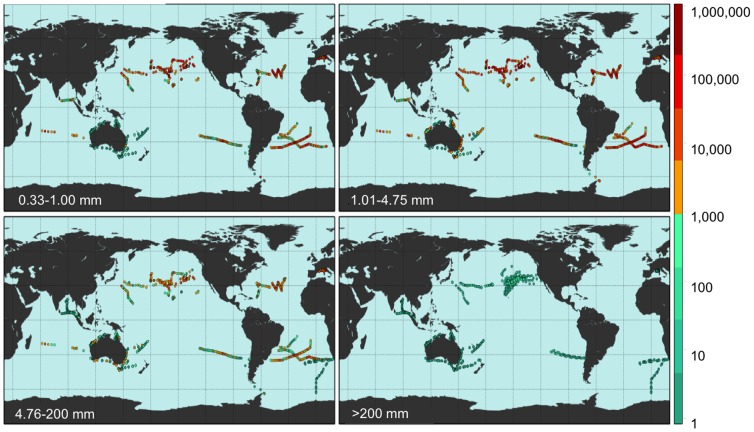
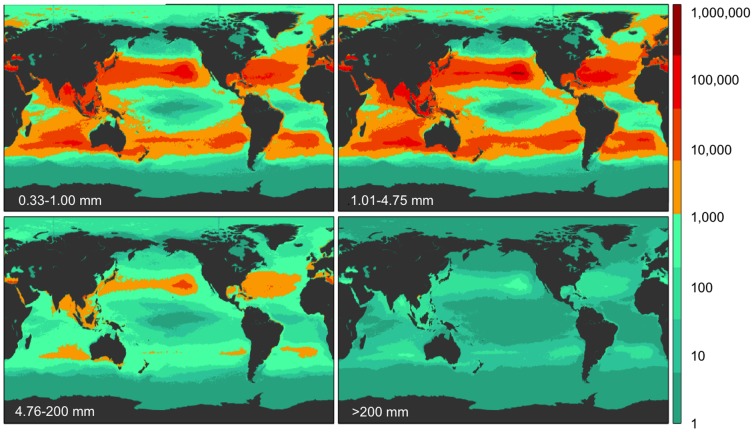
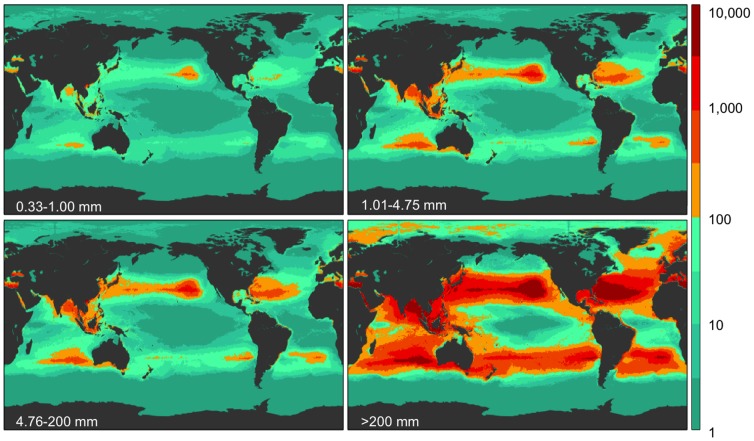
Plastic pollution is ubiquitous throughout the marine environment, yet estimates of the global abundance and weight of floating plastics have lacked data, particularly from the Southern Hemisphere and remote regions. Here we report an estimate of the total number of plastic particles and their weight floating in the world's oceans from 24 expeditions (2007-2013) across all five sub-tropical gyres, costal Australia, Bay of Bengal and the Mediterranean Sea conducting surface net tows (N = 680) and visual survey transects of large plastic debris (N = 891). Using an oceanographic model of floating debris dispersal calibrated by our data, and correcting for wind-driven vertical mixing, we estimate a minimum of 5.25 trillion particles weighing 268,940 tons. When comparing between four size classes, two microplastic <4.75 mm and meso- and macroplastic >4.75 mm, a tremendous loss of microplastics is observed from the sea surface compared to expected rates of fragmentation, suggesting there are mechanisms at play that remove <4.75 mm plastic particles from the ocean surface.
Overview
The claims and statistics of this paper haven’t been checked yet.
Free: it reads the open-access text and checks the first 5 claims that cite a source we can check. Create a free account to check every claim.
Integrity signals
Registry
Cites
Statistics
Figures
Verification
Claims the paper makes
The claims and statistics of this paper haven’t been checked yet.
Free: it reads the open-access text and checks the first 5 claims that cite a source we can check. Create a free account to check every claim.
Claims other papers make about this one
Each is checked against this paper’s own text: does it say what the citing paper says it does?
The source backs part of the claim, not all of it — or backs it for a different population, condition or comparison.
In the citing paper
“Measurements and model simulations revealed an uneven distribution of PMD, which complicates assessing global PMD inventories: highest PMD concentrations were found in the subtropical gyres (which have been termed 'trash vortexes' or 'garbage patches'), while PMD concentrations are much lower in the in the tropical and Arctic open ocean.51,53,54,[62][63][64]”
From The fate of plastic in the ocean environment – a minireview (2021) · cites this paper as [53]
Experimental — accuracy not yet measured
Self-check
Percentages, sums and reported differences re-computed from the paper’s own numbers.
The self-check needs the paper’s full text.
Citations
Cites
Lost at sea: where is all the plastic?
Thompson, R. C., Olsen, Y., Mitchell, R. P., Davis, A., Rowland, S. J., John, A. W. G., McGonigle, D., & Russell, A. E. (2004) · Science · doi:10.1126/science.1094559 · Cited by 7,765
Accumulation and fragmentation of plastic debris in global environments
Barnes, D. K. A., Galgani, F., Thompson, R. C., & Barlaz, M. (2009) · Philosophical Transactions of the Royal Society B: Biological Sciences · doi:10.1098/rstb.2008.0205 · Cited by 6,126 · cited 2×
“These include UV degradation, biodegradation, ingestion by organisms, decreased buoyancy due to fouling organisms, entrainment in settling detritus, and beaching [4].”
BackgroundSelf-citationHidalgo-Ruz, V., Gutow, L., Thompson, R. C., & Thiel, M. (2012) · Environmental Science & Technology · doi:10.1021/es2031505 · Cited by 5,440 · cited 2×
“33 mm, which is a commonly used lower limit for pelagic microplastics [31].”
BackgroundMethodSelf-citationLife in the “plastisphere”: microbial communities on plastic marine debris
Zettler, E. R., Mincer, T. J., & Amaral-Zettler, L. A. (2013) · Environmental Science & Technology · doi:10.1021/es401288x · Cited by 3,368 · cited 1×
“Furthermore, there is increasing evidence that some microbes can biodegrade microplastic particles [38–40].”
BackgroundPlastic debris in the open ocean
Cózar, A., Echevarría, F., González-Gordillo, J. I., Irigoien, X., Úbeda, B., Hernández-León, S., Palma, Á. T., Navarro, S., García-de-Lomas, J., Ruiz, A., et al. (2014) · Proceedings of the National Academy of Sciences · doi:10.1073/pnas.1314705111 · Cited by 3,133 · cited 4×
“Despite oceanographic model predictions of where debris might converge [24] estimates of regional and global abundance and weight of floating plastics have been limited to microplastics,5 mm [19, 25].”
BackgroundResultInfluentialTransport and release of chemicals from plastics to the environment and to wildlife
Teuten, E. L., Saquing, J. M., Knappe, D. R. U., Barlaz, M. A., Jonsson, S., Björn, A., Rowland, S. J., Thompson, R. C., Galloway, T. S., Yamashita, R., et al. (2009) · Philosophical Transactions of the Royal Society B: Biological Sciences · doi:10.1098/rstb.2008.0284 · Cited by 2,938 · cited 1×
“Adsorption of persistent organic pollutants onto plastic and their transfer into the tissues and organs through ingestion [15] is impacting marine megafauna [16] as well as lower trophic-level organisms [17, 18] and their predators [19, 20].”
BackgroundSelf-citationMicroplastic ingestion by zooplankton
Cole, M., Lindeque, P., Fileman, E., Halsband, C., Goodhead, R., Moger, J., & Galloway, T. S. (2013) · Environmental Science & Technology · doi:10.1021/es400663f · Cited by 2,763 · cited 2×
“In this manner, incorporation of smaller plastics into marine food chains could not only generate impacts on the health of the involved organisms [17–20], but also contribute to the removal of small microplastics from the sea surface [37].”
BackgroundLusher, A. L., McHugh, M., & Thompson, R. C. (2013) · Marine Pollution Bulletin · doi:10.1016/j.marpolbul.2012.11.028 · Cited by 2,075 · cited 1×
“via their prey organisms [34– 36].”
Plastic Resin Pellets as a Transport Medium for Toxic Chemicals in the Marine Environment
Mato, Y., Isobe, T., Takada, H., Kanehiro, H., Ohtake, C., & Kaminuma, T. (2001) · Environmental Science & Technology · doi:10.1021/es0010498 · Cited by 1,909 · cited 1×
“Plastic pollution is globally distributed across all oceans due to its properties of buoyancy and durability, and the sorption of toxicants to plastic while traveling through the environment [1, 2], have led some researchers to claim that synthetic polymers in the ocean should be regarded as hazardous waste [3].”
BackgroundGregory, M. R. (2009) · Philosophical Transactions of the Royal Society B: Biological Sciences · doi:10.1098/rstb.2008.0265 · Cited by 1,852 · cited 1×
“The impact of plastic pollution through ingestion and entanglement of marine fauna, ranging from zooplankton to cetaceans, seabirds and marine reptiles, are well documented [14].”
Background
Cited by
Plastic waste inputs from land into the ocean
Jambeck, J. R., Geyer, R., Wilcox, C., Siegler, T. R., Perryman, M., Andrady, A., Narayan, R., & Law, K. L. (2015) · Science · doi:10.1126/science.1260352 · Cited by 13,163
“(17) reported 35,540 tons of floating microplastics from plankton net data, and 233,400 tons of “larger plastic items” (> 20 cm in size) from shipboard visual survey data.”
BackgroundRiver plastic emissions to the world’s oceans
Lebreton, L. C. M., van der Zwet, J., Damsteeg, J.-W., Slat, B., Andrady, A., & Reisser, J. (2017) · Nature Communications · doi:10.1038/ncomms15611 · Cited by 4,011
“…from the literature (Table 3) demonstrated a statistically significant, positive correlation with the product of annual MPW production rates inside a catchment area downstream of artificial barriers and monthly averaged catchment runoff (Pearson product-moment test, r ¼ 0.4132, P o 0.05, n ¼ 29).”
BackgroundMethodInfluentialSelf-citationHorton, A. A., Walton, A., Spurgeon, D. J., Lahive, E., & Svendsen, C. (2017) · Science of The Total Environment · doi:10.1016/j.scitotenv.2017.01.190 · Cited by 3,756
“…of particles are all factors determining transport and 356 fate of particles within these aquatic systems and can lead to large variation, even within a relatively 357 small area (Castañeda et al., 2014; Eriksen et al., 2014; Eriksen et al., 2013; Fischer et al., 2016; Free 358 et al., 2014).”
Background(2015) · Springer eBooks · doi:10.1007/978-3-319-16510-3 · Cited by 3,502
“Eriksen et al. (2014) estimate a minimum of 5.25 trillion plastic particles weighing 268,940 tons Prefacex afloat in the sea, but this figure does not include debris on the seafloor or beaches.”
BackgroundInfluentialPlastic and Human Health: A Micro Issue?
Wright, S. L., & Kelly, F. J. (2017) · Environmental Science & Technology · doi:10.1021/acs.est.7b00423 · Cited by 3,413
Environmental exposure to microplastics: An overview on possible human health effects
Prata, J. C., da Costa, J. P., Lopes, I., Duarte, A. C., & Rocha-Santos, T. (2020) · Science of The Total Environment · doi:10.1016/j.scitotenv.2019.134455 · Cited by 2,690
Alimi, O. S., Farner Budarz, J., Hernandez, L. M., & Tufenkji, N. (2018) · Environmental Science & Technology · doi:10.1021/acs.est.7b05559 · Cited by 2,668
Auta, H. S., Emenike, C. U., & Fauziah, S. H. (2017) · Environment International · doi:10.1016/j.envint.2017.02.013 · Cited by 2,649
“Some are foundwithin the Artic and the Antarctic, transported by ocean currents, andwind (Cole et al., 2011; Eriksen et al., 2014; IMO, 2015; Van Cauwenberghe et al., 2015a,b; Setälä et al., 2015; Alomar et al., 2016; Ferreira et al., 2016).”
BackgroundThe plastic in microplastics: A review
Andrady, A. L. (2017) · Marine Pollution Bulletin · doi:10.1016/j.marpolbul.2017.01.082 · Cited by 2,372
Microplastics: Finding a consensus on the definition
Frias, J. P. G. L., & Nash, R. (2019) · Marine Pollution Bulletin · doi:10.1016/j.marpolbul.2018.11.022 · Cited by 2,167
Interactions of microplastic debris throughout the marine ecosystem
Galloway, T. S., Cole, M., & Lewis, C. (2017) · Nature Ecology & Evolution · doi:10.1038/s41559-017-0116 · Cited by 1,955
Microplastics in Seafood and the Implications for Human Health
Smith, M., Love, D. C., Rochman, C. M., & Neff, R. A. (2018) · Current Environmental Health Reports · doi:10.1007/s40572-018-0206-z · Cited by 1,875
Airborne microplastics: consequences to human health?
Prata, J. C. (2018) · Environmental Pollution · doi:10.1016/j.envpol.2017.11.043 · Cited by 1,852
“They have already been detected in water (Dris et al., 2015; Eriksen et al., 2014; Van Sebille et al., 2015), sediment (Browne et al., 2011; Frias et al., 2016) and several species of organisms (Davidson and Asch, 2011; Foekema et al., 2013; Vandermeersch et al., 2015).”
Evidence that the Great Pacific Garbage Patch is rapidly accumulating plastic
Lebreton, L., Slat, B., Ferrari, F., Sainte-Rose, B., Aitken, J., Marthouse, R., Hajbane, S., Cunsolo, S., Schwarz, A., Levivier, A., et al. (2018) · Scientific Reports · doi:10.1038/s41598-018-22939-w · Cited by 1,839
“A dynamic GPGP model boundary allowed us to determine whether surface net tows from previous studies 17,21,22,46–49 were sampling inside or outside the GPGP. Average plastic mass concentration measured by net tows inside the GPGP boundary showed an exponential increase over the last decades, rising…”
ResultInfluentialSelf-citationOyster reproduction is affected by exposure to polystyrene microplastics
Sussarellu, R., Suquet, M., Thomas, Y., Lambert, C., Fabioux, C., Pernet, M. E. J., Le Goïc, N., Quillien, V., Mingant, C., Epelboin, Y., et al. (2016) · Proceedings of the National Academy of Sciences · doi:10.1073/pnas.1519019113 · Cited by 1,827
“MP pollution in the world’s oceans has been recently estimated at over 5 trillion floating particles, corresponding to 250,000 tons (8).”
BackgroundBacteria and archaea on Earth and their abundance in biofilms
Flemming, H.-C., & Wuertz, S. (2019) · Nature Reviews Microbiology · doi:10.1038/s41579-019-0158-9 · Cited by 1,729
A global inventory of small floating plastic debris
van Sebille, E., Wilcox, C., Lebreton, L., Maximenko, N., Hardesty, B. D., van Franeker, J. A., Eriksen, M., Siegel, D., Galgani, F., & Law, K. L. (2015) · Environmental Research Letters · doi:10.1088/1748-9326/10/12/124006 · Cited by 1,713
Self-citationKoelmans, A. A., Bakir, A., Burton, G. A., & Janssen, C. R. (2016) · Environmental Science & Technology · doi:10.1021/acs.est.5b06069 · Cited by 1,599
Marine microplastic debris: An emerging issue for food security, food safety and human health
Barboza, L. G. A., Dick Vethaak, A., Lavorante, B. R. B. O., Lundebye, A.-K., & Guilhermino, L. (2018) · Marine Pollution Bulletin · doi:10.1016/j.marpolbul.2018.05.047 · Cited by 1,591
Rochman, C. M., Tahir, A., Williams, S. L., Baxa, D. V., Lam, R., Miller, J. T., Teh, F.-C., Werorilangi, S., & Teh, S. J. (2015) · Scientific Reports · doi:10.1038/srep14340 · Cited by 1,504
Rummel, C. D., Jahnke, A., Gorokhova, E., Kühnel, D., & Schmitt-Jansen, M. (2017) · Environmental Science & Technology Letters · doi:10.1021/acs.estlett.7b00164 · Cited by 1,444
Carbery, M., O'Connor, W., & Palanisami, T. (2018) · Environment International · doi:10.1016/j.envint.2018.03.007 · Cited by 1,425
Export of Plastic Debris by Rivers into the Sea
Schmidt, C., Krauth, T., & Wagner, S. (2017) · Environmental Science & Technology · doi:10.1021/acs.est.7b02368 · Cited by 1,418
A Global Perspective on Microplastics
Hale, R. C., Seeley, M. E., La Guardia, M. J., Mai, L., & Zeng, E. Y. (2020) · Journal of Geophysical Research: Oceans · doi:10.1029/2018jc014719 · Cited by 1,338
Occurrence and effects of plastic additives on marine environments and organisms: A review
Hermabessiere, L., Dehaut, A., Paul-Pont, I., Lacroix, C., Jezequel, R., Soudant, P., & Duflos, G. (2017) · Chemosphere · doi:10.1016/j.chemosphere.2017.05.096 · Cited by 1,301
“Low estimates predicted that floating marine plastic weigh between 70,000 and 270,000 tons (C ozar et al., 2014; Eriksen et al., 2014; Van Sebille et al., 2015).”
BackgroundPlastics and microplastics in the oceans: From emerging pollutants to emerged threat
Avio, C. G., Gorbi, S., & Regoli, F. (2017) · Marine Environmental Research · doi:10.1016/j.marenvres.2016.05.012 · Cited by 1,248
Anthropogenic contamination of tap water, beer, and sea salt
Kosuth, M., Mason, S. A., & Wattenberg, E. V. (2018) · PLOS ONE · doi:10.1371/journal.pone.0194970 · Cited by 1,244
Emergence of Nanoplastic in the Environment and Possible Impact on Human Health
Lehner, R., Weder, C., Petri-Fink, A., & Rothen-Rutishauser, B. (2019) · Environmental Science & Technology · doi:10.1021/acs.est.8b05512 · Cited by 1,242
Microbial Surface Colonization and Biofilm Development in Marine Environments
Dang, H., & Lovell, C. R. (2016) · Microbiology and Molecular Biology Reviews · doi:10.1128/mmbr.00037-15 · Cited by 1,231
“25 trillion plastic particles weighing 268,940 tons afloat at sea (539, 540).”
BackgroundKlein, S., Worch, E., & Knepper, T. P. (2015) · Environmental Science & Technology · doi:10.1021/acs.est.5b00492 · Cited by 1,181
Microplastic pollution is widely detected in US municipal wastewater treatment plant effluent
Mason, S. A., Garneau, D., Sutton, R., Chu, Y., Ehmann, K., Barnes, J., Fink, P., Papazissimos, D., & Rogers, D. L. (2016) · Environmental Pollution · doi:10.1016/j.envpol.2016.08.056 · Cited by 1,176
“Plastic pollution has now been identified within the worlds' oceans (Cole et al., 2011; Hidalgo-Ruz et al., 2012; Eriksen et al., 2015), seas (Faure et al., 2012; Dubaish and Liebezeit, 2013) and, more recently, freshwater systems (Eriksen et al., 2013; Free et al., 2014; Gasperi et al., 2014;…”
BackgroundLusher, A., Hollman, P., & Mendoza-Hill, J. (2017) · Helmholtz Centre for Ocean Research Kiel (GEOMAR) · Cited by 1,166
Plastic Teabags Release Billions of Microparticles and Nanoparticles into Tea
Hernandez, L. M., Xu, E. G., Larsson, H. C. E., Tahara, R., Maisuria, V. B., & Tufenkji, N. (2019) · Environmental Science & Technology · doi:10.1021/acs.est.9b02540 · Cited by 1,112
Microplastic pollution, a threat to marine ecosystem and human health: a short review
Sharma, S., & Chatterjee, S. (2017) · Environmental Science and Pollution Research · doi:10.1007/s11356-017-9910-8 · Cited by 1,110
Synthetic Polymer Contamination in Bottled Water
Mason, S. A., Welch, V. G., & Neratko, J. (2018) · Frontiers in Chemistry · doi:10.3389/fchem.2018.00407 · Cited by 1,100
Liu, G., Zhu, Z., Yang, Y., Sun, Y., Yu, F., & Ma, J. (2019) · Environmental Pollution · doi:10.1016/j.envpol.2018.11.100 · Cited by 1,080
Identification of microplastics using Raman spectroscopy: Latest developments and future prospects
Araujo, C. F., Nolasco, M. M., Ribeiro, A. M. P., & Ribeiro-Claro, P. J. A. (2018) · Water Research · doi:10.1016/j.watres.2018.05.060 · Cited by 1,059
Plastics in the Marine Environment
Law, K. L. (2017) · Annual Review of Marine Science · doi:10.1146/annurev-marine-010816-060409 · Cited by 1,059
Plastic pollution in the marine environment
Thushari, G. G. N., & Senevirathna, J. D. M. (2020) · Heliyon · doi:10.1016/j.heliyon.2020.e04709 · Cited by 1,052
“Plastic debris with counts of five trillion, weighing more than 260,000 tones, is floating over the world's ocean surface as a result of improper waste disposal (Eriksen et al., 2014).”
BackgroundTurning microplastics into nanoplastics through digestive fragmentation by Antarctic krill
Dawson, A. L., Kawaguchi, S., King, C. K., Townsend, K. A., King, R., Huston, W. M., & Bengtson Nash, S. M. (2018) · Nature Communications · doi:10.1038/s41467-018-03465-9 · Cited by 1,023
Primary microplastics in the oceans: A global evaluation of sources
Boucher, J., & Friot, D. (2017) · doi:10.2305/iucn.ch.2017.01.en · Cited by 1,023
Microplastics in soils: Analytical methods, pollution characteristics and ecological risks
He, D., Luo, Y., Lu, S., Liu, M., Song, Y., & Lei, L. (2018) · TrAC Trends in Analytical Chemistry · doi:10.1016/j.trac.2018.10.006 · Cited by 1,007
Microplastic contamination of river beds significantly reduced by catchment-wide flooding
Hurley, R., Woodward, J., & Rothwell, J. J. (2018) · Nature Geoscience · doi:10.1038/s41561-018-0080-1 · Cited by 1,003
COVID-19 Pandemic Repercussions on the Use and Management of Plastics
Prata, J. C., Silva, A. L. P., Walker, T. R., Duarte, A. C., & Rocha-Santos, T. (2020) · Environmental Science & Technology · doi:10.1021/acs.est.0c02178 · Cited by 999
Identification methods in microplastic analysis: A review
Shim, W. J., Hong, S. H., & Eo, S. E. (2017) · Analytical Methods · doi:10.1039/c6ay02558g · Cited by 995
The physical oceanography of the transport of floating marine debris
van Sebille, E., Aliani, S., Law, K. L., Maximenko, N., Alsina, J. M., Bagaev, A., Bergmann, M., Chapron, B., Chubarenko, I., Cózar, A., et al. (2020) · Environmental Research Letters · doi:10.1088/1748-9326/ab6d7d · Cited by 982
Self-citationUps and Downs in the Ocean: Effects of Biofouling on Vertical Transport of Microplastics
Kooi, M., Nes, E. H. V., Scheffer, M., & Koelmans, A. A. (2017) · Environmental Science & Technology · doi:10.1021/acs.est.6b04702 · Cited by 977
Microplastics in seafood: Benchmark protocol for their extraction and characterization
Dehaut, A., Cassone, A.-L., Frère, L., Hermabessiere, L., Himber, C., Rinnert, E., Rivière, G., Lambert, C., Soudant, P., Huvet, A., et al. (2016) · Environmental Pollution · doi:10.1016/j.envpol.2016.05.018 · Cited by 960
Nanoplastics are neither microplastics nor engineered nanoparticles
Gigault, J., El Hadri, H., Nguyen, B., Grassl, B., Rowenczyk, L., Tufenkji, N., Feng, S., & Wiesner, M. (2021) · Nature Nanotechnology · doi:10.1038/s41565-021-00886-4 · Cited by 954
Assessment of microplastics in freshwater systems: A review
Li, C., Busquets, R., & Campos, L. C. (2020) · Science of The Total Environment · doi:10.1016/j.scitotenv.2019.135578 · Cited by 954
“Their occurrences have been reported along the coasts of continents (Browne, 2015; Ivar do Sul and Costa, 2014), in remote areas such as the central Atlantic Islands (Ivar do Sul and Costa, 2014), sub-Antarctic region (Eriksen et al., 2014), the Arctic (Obbard et al.”
BackgroundMicroplastic in Aquatic Ecosystems
Ivleva, N. P., Wiesheu, A. C., & Niessner, R. (2017) · Angewandte Chemie International Edition · doi:10.1002/anie.201606957 · Cited by 943
The geological cycle of plastics and their use as a stratigraphic indicator of the Anthropocene
Zalasiewicz, J., Waters, C. N., Ivar do Sul, J. A., Corcoran, P. L., Barnosky, A. D., Cearreta, A., Edgeworth, M., Gałuszka, A., Jeandel, C., Leinfelder, R., et al. (2016) · Anthropocene · doi:10.1016/j.ancene.2016.01.002 · Cited by 929
“The global assessment by Eriksen et al. (2014) showed the scale of the phenomenon: 5 trillion plastic pieces weighing some 250 000 tons are now afloat at any one time.”
BackgroundInteraction of toxic chemicals with microplastics: A critical review
Wang, F., Wong, C. S., Chen, D., Lu, X., Wang, F., & Zeng, E. Y. (2018) · Water Research · doi:10.1016/j.watres.2018.04.003 · Cited by 925
“Microplastics are ubiquitously distributed in the marine environment, accounting for approximately 92% of global marine plastic debris (Eriksen et al., 2014).”
BackgroundMao, R., Lang, M., Yu, X., Wu, R., Yang, X., & Guo, X. (2020) · Journal of Hazardous Materials · doi:10.1016/j.jhazmat.2020.122515 · Cited by 925
Nanoplastic in the North Atlantic subtropical gyre
Ter Halle, A., Jeanneau, L., Martignac, M., Jardé, E., Pedrono, B., Brach, L., & Gigault, J. (2017) · Environmental Science & Technology · doi:10.1021/acs.est.7b03667 · Cited by 897
Plastic Waste: Challenges and Opportunities to Mitigate Pollution and Effective Management
Kibria, M. G., Masuk, N. I., Safayet, R., Nguyen, H. Q., & Mourshed, M. (2023) · International Journal of Environmental Research · doi:10.1007/s41742-023-00507-z · Cited by 884
Distribution of plastic polymer types in the marine environment; A meta-analysis
Erni-Cassola, G., Zadjelovic, V., Gibson, M. I., & Christie-Oleza, J. A. (2019) · Journal of Hazardous Materials · doi:10.1016/j.jhazmat.2019.02.067 · Cited by 874
Raman Microspectroscopy Detection and Characterisation of Microplastics in Human Breastmilk
Ragusa, A., Notarstefano, V., Svelato, A., Belloni, A., Gioacchini, G., Blondeel, C., Zucchelli, E., De Luca, C., D’Avino, S., Gulotta, A., et al. (2022) · Polymers · doi:10.3390/polym14132700 · Cited by 853
“In fact, as a consequence of the extensive production and employment of single-use products, which represent >40% of manufactured plastics, 250,000 tons of plastic litter is estimated to be floating in the oceans [4].”
BackgroundErni-Cassola, G., Gibson, M. I., Thompson, R. C., & Christie-Oleza, J. A. (2017) · Environmental Science & Technology · doi:10.1021/acs.est.7b04512 · Cited by 848
The behaviors of microplastics in the marine environment
Wang, J., Tan, Z., Peng, J., Qiu, Q., & Li, M. (2016) · Marine Environmental Research · doi:10.1016/j.marenvres.2015.10.014 · Cited by 836
Alimba, C. G., & Faggio, C. (2019) · Environmental Toxicology and Pharmacology · doi:10.1016/j.etap.2019.03.001 · Cited by 822
Akdogan, Z., & Guven, B. (2019) · Environmental Pollution · doi:10.1016/j.envpol.2019.113011 · Cited by 815
The plastic brain: neurotoxicity of micro- and nanoplastics
Prüst, M., Meijer, J., & Westerink, R. H. S. (2020) · Particle and Fibre Toxicology · doi:10.1186/s12989-020-00358-y · Cited by 811
Seafloor microplastic hotspots controlled by deep-sea circulation
Kane, I. A., Clare, M. A., Miramontes, E., Wogelius, R., Rothwell, J. J., Garreau, P., & Pohl, F. (2020) · Science · doi:10.1126/science.aba5899 · Cited by 810
Microplastic in marine organism: Environmental and toxicological effects
Guzzetti, E., Sureda, A., Tejada, S., & Faggio, C. (2018) · Environmental Toxicology and Pharmacology · doi:10.1016/j.etap.2018.10.009 · Cited by 806
Microplastics in the Antarctic marine system: An emerging area of research
Waller, C. L., Griffiths, H. J., Waluda, C. M., Thorpe, S. E., Loaiza, I., Moreno, B., Pacherres, C. O., & Hughes, K. A. (2017) · Science of The Total Environment · doi:10.1016/j.scitotenv.2017.03.283 · Cited by 795
“The Tara Expeditions Foundation found microplastics in each of four of their samples collected using towed neuston nets in the Southern Ocean, with a concentration of 0.55– 56.58 g km−2 for particles between 0.335 and 4.75 mm in size (Eriksen et al., 2014; see Fig.”
InfluentialAvio, C. G., Gorbi, S., & Regoli, F. (2015) · Marine Environmental Research · doi:10.1016/j.marenvres.2015.06.014 · Cited by 794
Plastic Accumulation in the Mediterranean Sea
Cózar, A., Sanz-Martín, M., Martí, E., González-Gordillo, J. I., Ubeda, B., Gálvez, J. Á., Irigoien, X., & Duarte, C. M. (2015) · PLOS ONE · doi:10.1371/journal.pone.0121762 · Cited by 793
The mediterranean plastic soup: synthetic polymers in mediterranean surface waters
Suaria, G., Avio, C. G., Mineo, A., Lattin, G. L., Magaldi, M. G., Belmonte, G., Moore, C. J., Regoli, F., & Aliani, S. (2016) · Scientific Reports · doi:10.1038/srep37551 · Cited by 791
“The Mediterranean Sea is the largest and deepest enclosed sea on earth, hot-spot of marine biodiversity and cradle of human civilization, whose unique outflow of water occurs at depth from the narrow Strait of Gibraltar.”
InfluentialSelf-citationSalvador Cesa, F., Turra, A., & Baruque-Ramos, J. (2017) · Science of The Total Environment · doi:10.1016/j.scitotenv.2017.04.172 · Cited by 787
Gallo, F., Fossi, C., Weber, R., Santillo, D., Sousa, J., Ingram, I., Nadal, A., & Romano, D. (2018) · Environmental Sciences Europe · doi:10.1186/s12302-018-0139-z · Cited by 787
“It is estimated that the ocean may already contain over 150 million tonnes of plastic [4], of which around 250,000 tonnes, fragmented into 5 trillion plastic pieces, may be floating at the oceans’ surface [5].”
BackgroundAuta, H. S., Emenike, C. U., Jayanthi, B., & Fauziah, S. H. (2018) · Marine Pollution Bulletin · doi:10.1016/j.marpolbul.2017.11.036 · Cited by 782
Enders, K., Lenz, R., Stedmon, C. A., & Nielsen, T. G. (2015) · Marine Pollution Bulletin · doi:10.1016/j.marpolbul.2015.09.027 · Cited by 775
Güven, O., Gökdağ, K., Jovanović, B., & Kıdeyş, A. E. (2017) · Environmental Pollution · doi:10.1016/j.envpol.2017.01.025 · Cited by 765
“The present results of seawater and sediment as well as some of the computer based estimates suggest that Mediterranean Sea rather fall within medium contaminated basins with microplastics (Eriksen et al., 2014; Sebille et al., 2015).”
ResultA high-performance protocol for extraction of microplastics in fish
Karami, A., Golieskardi, A., Choo, C. K., Romano, N., Ho, Y. B., & Salamatinia, B. (2017) · Science of The Total Environment · doi:10.1016/j.scitotenv.2016.10.213 · Cited by 762
Devriese, L. I., van der Meulen, M. D., Maes, T., Bekaert, K., Paul-Pont, I., Frère, L., Robbens, J., & Vethaak, A. D. (2015) · Marine Pollution Bulletin · doi:10.1016/j.marpolbul.2015.06.051 · Cited by 761
“Pollution of the oceans by these tiny pieces of plastic debris is now so widespread, that they are turning up in all the world’s major seas and oceans (Wright et al., 2013a; Eriksen et al., 2014; Woodall et al., 2014).”
BackgroundWilkinson, J., Hooda, P. S., Barker, J., Barton, S., & Swinden, J. (2017) · Environmental Pollution · doi:10.1016/j.envpol.2017.08.032 · Cited by 761
Removal of microplastics from the environment. A review
Padervand, M., Lichtfouse, E., Robert, D., & Wang, C. (2020) · Environmental Chemistry Letters · doi:10.1007/s10311-020-00983-1 · Cited by 759
Immunotoxicity and intestinal effects of nano- and microplastics: a review of the literature
Hirt, N., & Body-Malapel, M. (2020) · Particle and Fibre Toxicology · doi:10.1186/s12989-020-00387-7 · Cited by 758
“plastic particles including 35,500 metric tons of microplastics were floating at sea [9].”
Human Health and Ocean Pollution
Landrigan, P. J., Stegeman, J. J., Fleming, L. E., Allemand, D., Anderson, D. M., Backer, L. C., Brucker-Davis, F., Chevalier, N., Corra, L., Czerucka, D., et al. (2020) · Annals of Global Health · doi:10.5334/aogh.2831 · Cited by 756
Self-citationDissolved organic carbon leaching from plastics stimulates microbial activity in the ocean
Romera-Castillo, C., Pinto, M., Langer, T. M., Álvarez-Salgado, X. A., & Herndl, G. J. (2018) · Nature Communications · doi:10.1038/s41467-018-03798-5 · Cited by 753
Plastic as a Persistent Marine Pollutant
Worm, B., Lotze, H. K., Jubinville, I., Wilcox, C., & Jambeck, J. (2017) · Annual Review of Environment and Resources · doi:10.1146/annurev-environ-102016-060700 · Cited by 750
Evaluation of microplastic release caused by textile washing processes of synthetic fabrics
De Falco, F., Gullo, M. P., Gentile, G., Di Pace, E., Cocca, M., Gelabert, L., Brouta-Agnésa, M., Rovira, A., Escudero, R., Villalba, R., et al. (2018) · Environmental Pollution · doi:10.1016/j.envpol.2017.10.057 · Cited by 733
Global Distribution, Composition and Abundance of Marine Litter
Galgani, F., Hanke, G., & Maes, T. (2015) · Marine Anthropogenic Litter · doi:10.1007/978-3-319-16510-3_2 · Cited by 732
Self-citationTanaka, K., & Takada, H. (2016) · Scientific Reports · doi:10.1038/srep34351 · Cited by 724
“This proportion of plastics is consistent with those in previous studies of plastic debris in surface seawater, which were dominated by fragments 3,7,8 and by PE or PP 7,30,31 .”
Auta, H. S., Emenike, C. U., & Fauziah, S. H. (2017) · Environmental Pollution · doi:10.1016/j.envpol.2017.09.043 · Cited by 716
“In particular, microplastics (<5 mm in diameter) are widespread in the global marine environment (Cozar et al., 2014; Eriksen et al., 2014) and an increasing source of anthropogenic litter in aquatic environments (Bakir et al.”
BackgroundPaul-Pont, I., Lacroix, C., González Fernández, C., Hégaret, H., Lambert, C., Le Goïc, N., Frère, L., Cassone, A.-L., Sussarellu, R., Fabioux, C., et al. (2016) · Environmental Pollution · doi:10.1016/j.envpol.2016.06.039 · Cited by 714
Interactions between microplastics and phytoplankton aggregates: Impact on their respective fates
Long, M., Moriceau, B., Gallinari, M., Lambert, C., Huvet, A., Raffray, J., & Soudant, P. (2015) · Marine Chemistry · doi:10.1016/j.marchem.2015.04.003 · Cited by 711
Freshwater Microplastics: Emerging Environmental Contaminants?
(2018) · The Handbook of Environmental Chemistry · doi:10.1007/978-3-319-61615-5 · Cited by 701
Dogu, O., Pelucchi, M., Van de Vijver, R., Van Steenberge, P. H. M., D'hooge, D. R., Cuoci, A., Mehl, M., Frassoldati, A., Faravelli, T., & Van Geem, K. M. (2021) · Progress in Energy and Combustion Science · doi:10.1016/j.pecs.2020.100901 · Cited by 698
Effects of biofouling on the sinking behavior of microplastics
Kaiser, D., Kowalski, N., & Waniek, J. J. (2017) · Environmental Research Letters · doi:10.1088/1748-9326/aa8e8b · Cited by 689
“The abundance of microplastic in surface waters is lower than expected from the rate of fragmentation of floating macroplastic (Eriksen et al 2014).”
BackgroundZhang, H., Wang, J., Zhou, B., Zhou, Y., Dai, Z., Zhou, Q., Chriestie, P., & Luo, Y. (2018) · Environmental Pollution · doi:10.1016/j.envpol.2018.09.122 · Cited by 687
Microplastics Alter the Properties and Sinking Rates of Zooplankton Faecal Pellets
Cole, M., Lindeque, P. K., Fileman, E., Clark, J., Lewis, C., Halsband, C., & Galloway, T. S. (2016) · Environmental Science & Technology · doi:10.1021/acs.est.5b05905 · Cited by 683
“estimated there are over 5 trillion microplastics floating in the ocean.(2) In the North Pacific subtropical gyre the mass of neustonic plastic can exceed that of plankton six-fold,(13) and in Geoje Bay (Korea) waterborne concentrations of plastic can reach over 15,500 particles m.”
BackgroundPublic and Environmental Health Effects of Plastic Wastes Disposal: A Review
Okunola A, A., Kehinde I, O., Oluwaseun, A., & Olufiropo E, A. (2019) · Journal of Toxicology and Risk Assessment · doi:10.23937/2572-4061.1510021 · Cited by 682
Tackling the plastic problem: A review on perceptions, behaviors, and interventions
Heidbreder, L. M., Bablok, I., Drews, S., & Menzel, C. (2019) · Science of The Total Environment · doi:10.1016/j.scitotenv.2019.02.437 · Cited by 680
Enfrin, M., Dumée, L. F., & Lee, J. (2019) · Water Research · doi:10.1016/j.watres.2019.06.049 · Cited by 676
Ory, N. C., Sobral, P., Ferreira, J. L., & Thiel, M. (2017) · Science of The Total Environment · doi:10.1016/j.scitotenv.2017.01.175 · Cited by 673
“As a result, most anthropogenic litter items in the centre of the gyres are small (≤5 mm), i.e. microplastics (Eriksen et al., 2014).”
BackgroundInfluentialSelf-citationPlastic Pollution and Potential Solutions
Rhodes, C. J. (2018) · Science Progress · doi:10.3184/003685018x15294876706211 · Cited by 663
Placing nanoplastics in the context of global plastic pollution
Mitrano, D. M., Wick, P., & Nowack, B. (2021) · Nature Nanotechnology · doi:10.1038/s41565-021-00888-2 · Cited by 661
The presence of microplastics in commercial salts from different countries
Karami, A., Golieskardi, A., Keong Choo, C., Larat, V., Galloway, T. S., & Salamatinia, B. (2017) · Scientific Reports · doi:10.1038/srep46173 · Cited by 652
“The widespread distribution of MPs in aquatic bodies is well documented, such as in the Celtic sea 8 , Laurentian Great Lakes 9 , Persian Gulf 10 , and in sub-tropical gyres 11 .”
Metadata
- Authors
- Eriksen, M., Lebreton, L. C. M., Carson, H. S., Thiel, M., Moore, C. J., Borerro, J. C., Galgani, F., Ryan, P. G., & Reisser, J.
- Affiliations
- University of Hawaii at Hilo (US)
- University of Cape Town (ZA)
- Corresponding author
- Eriksen, Marcus
- Venue
- PLoS ONE
- Publisher
- Public Library of Science (PLoS)
- Published
- 2014-12-10
- Volume
- 9
- Issue
- 12
- Pages
- e111913
- ISSN
- 1932-6203 (ISSN-L)
- PMC
- PMC4262196
- OpenAlex
- W2130707940
- Cited by
- 4,710
- References
- 43
- Citations by year
- 2026: 255 · 2025: 425 · 2024: 499 · 2023: 585 · 2022: 598 · 2021: 648 · 2020: 531 · 2019: 419 · 2018: 308 · 2017: 200 · 2016: 149 · 2015: 86 · 2014: 4
- FWCI
- 103.05
- Type
- journal article
- Language
- en
- Open access
- gold
- doi.org
- Licence
- Locations
- PLoS ONE (publishedVersion, public-domain)
- PubMed Central (publishedVersion, public-domain)
- UWA Profiles and Research Repository (UWA) (publishedVersion, public-domain)
- PubMed (publishedVersion)
- HAL (submittedVersion)
- Institutional Archive of Ifremer (French Research Institute for Exploitation of the Sea) (submittedVersion, other-oa)
- DOAJ (DOAJ: Directory of Open Access Journals) (submittedVersion, cc-by-sa)
- Figshare (submittedVersion, cc-by)
- Open University of Cape Town (University of Cape Town) (submittedVersion, cc-by)
- Funders
- Commonwealth Scientific and Industrial Research Organisation
- National Oceanic and Atmospheric Administration
- Topics
- Physical Sciences › Environmental Science › Pollution › Microplastics and Plastic Pollution
- Physical Sciences › Environmental Science › Pollution › Oil Spill Detection and Mitigation
- Physical Sciences › Earth and Planetary Sciences › Oceanography › Marine Plankton and Biogeochemistry
- Keywords
- plastic pollution, marine plastic debris, microplastics, mesoplastics, macroplastics, plastic fragmentation, Southern Hemisphere, Bay of Bengal, Mediterranean Sea
- MeSH terms
- Models, Theoretical, Oceans and Seas, Plastics, Water Pollution, Wind, Linear Models, Hydrodynamics
About these checks
Registry, retraction, Cites and statistics results are computed, not judged, with one exception: a printed reference that no index lists is read once by a model before it counts as a citation error. Claims are extracted by a model and kept only when their quote appears verbatim in the text; each cited source is then checked, with a model’s help, for whether it says what the claim relies on. Those verdicts can be wrong — read the claim’s quote and the cited source before relying on one.
Statistics and arithmetic are recomputed, not judged.
Confidence bands are shown only for fields calibrated on our annotated test set. None is calibrated yet, so no band is shown.
What counts as a claim ›How we measure confidence ›How we check this ›
Are you an author, or do you see a problem with this page? Request a review
Data sources
Bibliographic data: Semantic Scholar, OpenAlex, Crossref.
Contains information from the Semantic Scholar Academic Graph Datasets, made available under the ODC Attribution License (ODC-BY 1.0).
Semantic Scholar’s data is described in: Kinney, R., et al. (2023). The Semantic Scholar Open Data Platform. arXiv:2301.10140.
