

The DOI matches its Crossref record; 115 of the 120 references it cites were found in a registry or an index; 1 of the 222 sources its claims cite were checked for support.
Adipokines, Myokines, and Hepatokines: Crosstalk and Metabolic Repercussions
Open accessAbstract
Adipose, skeletal, and hepatic muscle tissues are the main endocrine organs that produce adipokines, myokines, and hepatokines. These biomarkers can be harmful or beneficial to an organism and still perform crosstalk, acting through the endocrine, paracrine, and autocrine pathways. This study aims to review the crosstalk between adipokines, myokines, and hepatokines. Far beyond understanding the actions of each biomarker alone, it is important to underline that these cytokines act together in the body, resulting in a complex network of actions in different tissues, which may have beneficial or non-beneficial effects on the genesis of various physiological disorders and their respective outcomes, such as type 2 diabetes mellitus (DM2), obesity, metabolic syndrome, and cardiovascular diseases (CVD). Overweight individuals secrete more pro-inflammatory adipokines than those of a healthy weight, leading to an impaired immune response and greater susceptibility to inflammatory and infectious diseases. Myostatin is elevated in pro-inflammatory environments, sharing space with pro-inflammatory organokines, such as tumor necrosis factor-alpha (TNF-α), interleukin-1 (IL-1), resistin, and chemerin. Fibroblast growth factor FGF21 acts as a beta-oxidation regulator and decreases lipogenesis in the liver. The crosstalk mentioned above can interfere with homeostatic disorders and can play a role as a potential therapeutic target that can assist in the methods of diagnosing metabolic syndrome and CVD.
Overview
AI snapshot
Written from the paper’s full text.
TL;DR
This narrative review describes how adipokines, myokines, and hepatokines act through endocrine, paracrine, and autocrine crosstalk to influence insulin resistance, obesity, metabolic syndrome, and cardiovascular disease. It argues these organokines may serve as diagnostic/prognostic biomarkers and therapeutic targets, while calling for more in vivo and mechanistic studies.
Key findings
- Adipose, skeletal muscle, and liver are the main endocrine organs producing adipokines, myokines, and hepatokines; these biomarkers can be harmful or beneficial and act together in a complex network affecting DM2, obesity, metabolic syndrome, and CVD.
- Overweight individuals secrete more pro-inflammatory adipokines, leading to impaired immune response and greater susceptibility to inflammatory and infectious diseases; myostatin is elevated in pro-inflammatory environments alongside TNF-α, IL-1, resistin, and chemerin.
- FGF21 acts as a beta-oxidation regulator and decreases lipogenesis in the liver; exercise shifts secretion toward anti-inflammatory organokines such as irisin, IL-6, IL-15, myonectin, adiponectin, and FGF21, which mitigate harmful effects of myostatin, TNF-α, resistin, chemerin, and fetuin-A.
- The introduction cites an estimated 1.7 billion people vulnerable to health risks determined by body weight, 2.5 million deaths annually related to increased BMI expected to double by 2030, and CVDs responsible for approximately 17.9 million deaths per year, corresponding to 31% of total deaths worldwide.
Methods
- Descriptive review using PUBMED-Medline, Embase, and Cochrane databases.
- Mesh terms were adipokines, myokines, hepatokines, abdominal fat, insulin resistance, obesity, type 2 diabetes, metabolic syndrome, and cardiovascular diseases.
- Inclusion/exclusion was based on studies that included crosstalk among organokines, not just individual assessment of each one on insulin resistance, diabetes, obesity, metabolic syndrome, and cardiovascular complications.
Limitations
- The paper states that in vivo experimental studies are further needed addressing crosstalk between adipokines, myokines, and hepatokines to support future clinical treatments, and that biochemical mechanisms of action of organokines are needed to guide future clinical trials.
- Evident from the text: this is a descriptive/narrative review without a systematic protocol, risk-of-bias assessment, or quantitative synthesis; the search strategy and study selection are reported only briefly.
Model-written summary. Check it against the paper before relying on it.
Integrity signals
Registry
Cites
Statistics
Figures
Verification
Claims the paper makes
201 Not checked yet · 43 No basis given · 7 Own interpretation · 1 Couldn’t confirm · accuracy not yet measured
The cited sources that could be checked couldn’t confirm or dispute this claim.
In the paper
“METRNL also shows an anti-inflammatory role, especially in reducing adipose inflammation, increasing the expression of M2 macrophages in adipose tissue, and improving insulin resistance typical of obesity [62].”
§ Adipokines, Myokines, and Hepatokines: Crosstalk and Metabolic Repercussions > 2. Discussion > 2.2. Myokines
What the sources say
- Could not verifycites [62] Gholamrezayi, 2020, Characterization of the serum levels of Meteorin-like in patients with inflammatory bowel disease and its association with inflammatory cytokines, Lip. Health Dis. sourceExperimental — accuracy not yet measured
The Background says METRNL decreases adipose inflammation, and the Discussion reports reduced macrophage infiltration in mice. Neither passage says METRNL increases M2 macrophages in adipose tissue. Searches for “M2 macrophages” and “macrophage polarization” found no passage addressing that specific claim. (LLM, conf=0.76)
plaindirect- Asserted: passes — The authors put it forward as true.
- Checkable: passes — It can be checked against evidence.
- Load-bearing: unclear — It is unclear whether the paper’s conclusions depend on it.
- Based: passes — The paper gives a reason why it holds.
- Could not verify
In the paper
“Elevated levels of leptin were associated with development, progression and prognostication of non-alcoholic fatty liver disease (NAFLD) [41].”
§ Adipokines, Myokines, and Hepatokines: Crosstalk and Metabolic Repercussions > 2. Discussion > 2.1. Adipokines
What the sources say
- Not checked yetcites [41] Polyzos, 2016, Circulating leptin in non-alcoholic fatty liver disease: A systematic review and meta-analysis, Diabetology source
plaincorrelational- Asserted: passes — The authors put it forward as true.
- Checkable: passes — It can be checked against evidence.
- Load-bearing: unclear — It is unclear whether the paper’s conclusions depend on it.
- Based: passes — The paper gives a reason why it holds.
In the paper
“In adults with hyperleptinemia and leptin resistance administration of metreleptin showed marginal benefits with a reduction in glycated hemoglobin [43].”
§ Adipokines, Myokines, and Hepatokines: Crosstalk and Metabolic Repercussions > 2. Discussion > 2.1. Adipokines
What the sources say
- Not checked yetcites [43] Moon, 2011, Efficacy of metreleptin in obese patients with type 2 diabetes: Cellular and molecular pathways underlying leptin tolerance, Diabetes source
plaindirect- Asserted: passes — The authors put it forward as true.
- Checkable: passes — It can be checked against evidence.
- Load-bearing: unclear — It is unclear whether the paper’s conclusions depend on it.
- Based: passes — The paper gives a reason why it holds.
In the paper
“Leptin is released by subcutaneous white adipose tissue (WAT) [39]”
§ Adipokines, Myokines, and Hepatokines: Crosstalk and Metabolic Repercussions > 2. Discussion > 2.1. Adipokines
What the sources say
- Not checked yetcites [39] Scheja, 2019, The endocrine function of adipose tissues in health and cardiometabolic disease, Nat. Rev. Endocrinol. source
plaindirect- Asserted: passes — The authors put it forward as true.
- Checkable: passes — It can be checked against evidence.
- Load-bearing: unclear — It is unclear whether the paper’s conclusions depend on it.
- Based: passes — The paper gives a reason why it holds.
In the paper
“Therefore, they have specific associations with insulin resistance, diabetes mellitus, obesity, metabolic syndrome, and CVD [10].”
§ Adipokines, Myokines, and Hepatokines: Crosstalk and Metabolic Repercussions > 1. Introduction
What the sources say
- Not checked yetcites [10] Faramia, 2020, Metabolic adaptations after bariatric surgery: Adipokines, myokines and hepatokines, Curr. Opin. Pharmacol. source
plaincorrelational- Asserted: passes — The authors put it forward as true.
- Checkable: passes — It can be checked against evidence.
- Load-bearing: passes — The paper’s conclusions depend on it.
- Based: passes — The paper gives a reason why it holds.
- Rests on an assumption: Adipose, skeletal muscle, and hepatic tissues are the main endocrine organs that produce adipokines, myokines, and hepatokines.
- Rests on an assumption: These biomarkers can be harmful or beneficial and perform crosstalk through endocrine, paracrine, and autocrine pathways.
In the paper
“Hyperleptinemia contributes to the action of pro-inflammatory cytokines and continuous infiltration of M1 macrophages [11].”
§ Adipokines, Myokines, and Hepatokines: Crosstalk and Metabolic Repercussions > 2. Discussion > 2.1. Adipokines
What the sources say
- Not checked yetcites [11] Gonzalez-Gil, A.M., and Elizondo-Montemayor, L. (2020). The role of exercise in the interplay between myokines, hepatokines, osteokines, adipokines, and modulation of inflammation for energy substrate redistribution and fat mass loss: A review. Nutrients, 12. source
plaindirect- Asserted: passes — The authors put it forward as true.
- Checkable: passes — It can be checked against evidence.
- Load-bearing: unclear — It is unclear whether the paper’s conclusions depend on it.
- Based: passes — The paper gives a reason why it holds.
In the paper
“The excess weight combined with hyperglycemia predisposes oxidative stress and inflammation [2]”
§ Adipokines, Myokines, and Hepatokines: Crosstalk and Metabolic Repercussions > 1. Introduction
What the sources say
- Not checked yetcites [2] Sofra, 2020, Adverse effects of sedentary lifestyles: Inflammation, and high-glucose induced oxidative stress—A double blind randomized clinical trial on diabetic and prediabetic patients, Health source
plaindirect- Asserted: passes — The authors put it forward as true.
- Checkable: passes — It can be checked against evidence.
- Load-bearing: unclear — It is unclear whether the paper’s conclusions depend on it.
- Based: passes — The paper gives a reason why it holds.
In the paper
“High levels of LCN2 are associated with CVD, vascular remodeling, and instability of atherosclerotic plaques by regulating the metalloproteinase activity (MMP-9) [22].”
§ Adipokines, Myokines, and Hepatokines: Crosstalk and Metabolic Repercussions > 2. Discussion > 2.1. Adipokines
What the sources say
- Not checked yetcites [22] Cakirca, 2018, Serum matrix metalloproteinase-9, tissue inhibitor of metalloproteinase-1 and matrix metalloproteinase-9/ neutrophil gelatinase-associated lipocalin complex levels in patients with early-stage diabetic nephropathy, Iran. J. Kidney Dis.
plaincorrelational- Asserted: passes — The authors put it forward as true.
- Checkable: passes — It can be checked against evidence.
- Load-bearing: unclear — It is unclear whether the paper’s conclusions depend on it.
- Based: passes — The paper gives a reason why it holds.
The paper states this without a source or data behind it here, so there is nothing to check it against. The quote shows it is in the paper.
In the paper
“Lipocalin 2 (LCN2), also associated with neutrophil gelatinase-associated lipocalin (NGAL), is a glycoprotein identified as the cytokine of adipose tissue present in low-level systemic inflammation in obese patients with metabolic syndrome.”
§ Adipokines, Myokines, and Hepatokines: Crosstalk and Metabolic Repercussions > 2. Discussion > 2.1. Adipokines
plaincorrelational- Asserted: passes — The authors put it forward as true.
- Checkable: passes — It can be checked against evidence.
- Load-bearing: unclear — It is unclear whether the paper’s conclusions depend on it.
- Based: passes — The paper gives a reason why it holds.
In the paper
“Therefore, the inhibition of adipogenesis can restrict the storage of triglycerides in tissue adipose, increasing circulating levels (systemic hyperlipidemia) and lipid deposition in the liver and skeletal muscle [55].”
§ Adipokines, Myokines, and Hepatokines: Crosstalk and Metabolic Repercussions > 2. Discussion > 2.1. Adipokines
What the sources say
- Not checked yetcites [55] Fu, 2018, Circulating osteonectin and adipokine profiles in relation to metabolically healthy obesity in Chinese children: Findings from BCAMS, J. Am. Heart Assoc. source
plaindirect- Asserted: passes — The authors put it forward as true.
- Checkable: passes — It can be checked against evidence.
- Load-bearing: passes — The paper’s conclusions depend on it.
- Based: passes — The paper gives a reason why it holds.
- It may state two separate claims as one. 121
- Probably not a substantial claim. 22
In the paper
“can impair insulin signaling and promote the development of comorbidities, such as type 2 diabetes mellitus (DM2), hypertension, and other factors that induce cardiovascular complications. [2].”
§ Adipokines, Myokines, and Hepatokines: Crosstalk and Metabolic Repercussions > 1. Introduction
What the sources say
- Not checked yetcites [2] Sofra, 2020, Adverse effects of sedentary lifestyles: Inflammation, and high-glucose induced oxidative stress—A double blind randomized clinical trial on diabetic and prediabetic patients, Health source
plaindirect- Asserted: passes — The authors put it forward as true.
- Checkable: passes — It can be checked against evidence.
- Load-bearing: unclear — It is unclear whether the paper’s conclusions depend on it.
- Based: passes — The paper gives a reason why it holds.
It may state two separate claims as one.
In the paper
“It acts on insulin sensitivity, and its plasma reduction is related to insulin resistance and glucose intolerance, predisposing to advanced liver injury [44].”
§ Adipokines, Myokines, and Hepatokines: Crosstalk and Metabolic Repercussions > 2. Discussion > 2.1. Adipokines
What the sources say
- Not checked yetcites [44] Buechler, C., Haberl, E.M., Rein-Fischboeck, L., and Aslanidis, C. (2017). Adipokines in liver cirrhosis. Int. J. Mol. Sci., 18. source
plaincorrelational- Asserted: passes — The authors put it forward as true.
- Checkable: passes — It can be checked against evidence.
- Load-bearing: unclear — It is unclear whether the paper’s conclusions depend on it.
- Based: passes — The paper gives a reason why it holds.
It may state two separate claims as one.
The paper states this without a source or data behind it here, so there is nothing to check it against. The quote shows it is in the paper.
In the paper
“Adiponectin, an antisteatotic, anti-inflammatory, and antifibrotic adipokine, is expressed by adipocytes from WAT and brown adipose tissue (BAT).”
§ Adipokines, Myokines, and Hepatokines: Crosstalk and Metabolic Repercussions > 2. Discussion > 2.1. Adipokines
plaindirect- Asserted: passes — The authors put it forward as true.
- Checkable: passes — It can be checked against evidence.
- Load-bearing: unclear — It is unclear whether the paper’s conclusions depend on it.
- Based: passes — The paper gives a reason why it holds.
It may state two separate claims as one.
The paper states this without a source or data behind it here, so there is nothing to check it against. The quote shows it is in the paper.
In the paper
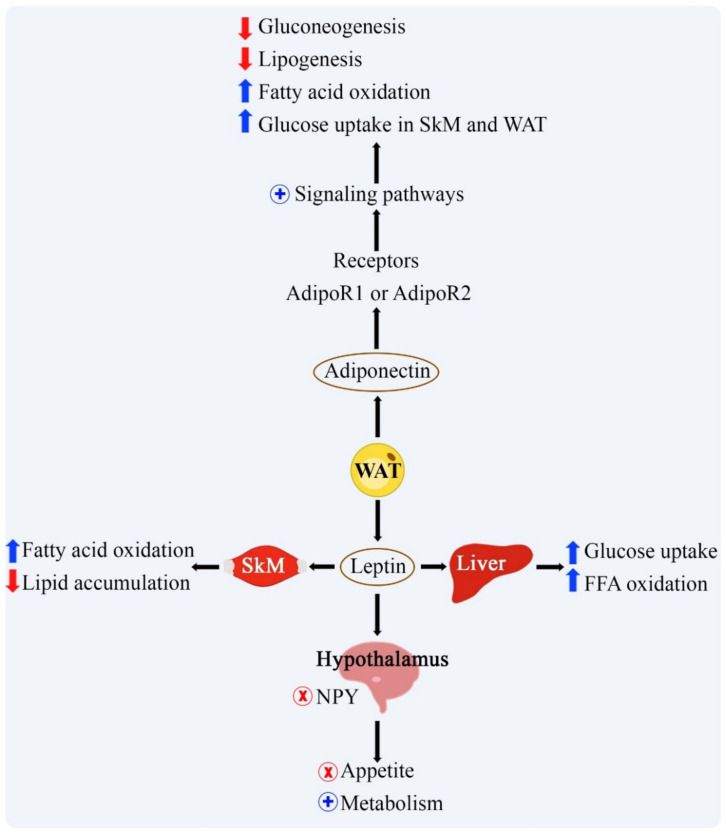
“In addition, leptin increases the oxidation and absorption of glucose and free fatty acid (FFA) in skeletal muscles and promotes intrahepatic lipid reduction through fatty acid oxidation (Figure 1).”
§ Adipokines, Myokines, and Hepatokines: Crosstalk and Metabolic Repercussions > 2. Discussion > 2.1. Adipokines
plaindirect- Asserted: passes — The authors put it forward as true.
- Checkable: passes — It can be checked against evidence.
- Load-bearing: unclear — It is unclear whether the paper’s conclusions depend on it.
- Based: passes — The paper gives a reason why it holds.
It may state two separate claims as one.
In the paper
“Eating behavior, delimited by cultural and social aspects, has a substantial impact on health conditions and the development of cardiovascular diseases and inflammatory complications [1].”
§ Adipokines, Myokines, and Hepatokines: Crosstalk and Metabolic Repercussions > 1. Introduction
What the sources say
- Not checked yetcites [1] Huber, B.C., Steffen, J., Schlichtiger, J., and Brunner, S. (2020). Altered nutrition behavior during COVID-19 pandemic lockdown in young adults. Eur. J. Nutr. source
plaindirect- Asserted: passes — The authors put it forward as true.
- Checkable: passes — It can be checked against evidence.
- Load-bearing: fails — The paper’s conclusions may not depend on it.
- Based: passes — The paper gives a reason why it holds.
Probably not a substantial claim. The paper’s conclusions may not depend on it.
None of the sources cited for this claim have been checked yet.
In the paper
“In obesity, its hypertrophy is directly related to chronic low-grade inflammation and an increase in chemotactic molecules, in addition to a reduction in adiponectin levels and the onset of leptin resistance.”
§ Adipokines, Myokines, and Hepatokines: Crosstalk and Metabolic Repercussions > 2. Discussion > 2.1. Adipokines
What the sources say
- Not checked yetcites [10] Faramia, 2020, Metabolic adaptations after bariatric surgery: Adipokines, myokines and hepatokines, Curr. Opin. Pharmacol. source
- Not checked yetcites [11] Gonzalez-Gil, A.M., and Elizondo-Montemayor, L. (2020). The role of exercise in the interplay between myokines, hepatokines, osteokines, adipokines, and modulation of inflammation for energy substrate redistribution and fat mass loss: A review. Nutrients, 12. source
- Not checked yetcites [13] Song, P., Kwon, Y., Joo, J.Y., Kim, D.G., and Yoon, J.H. (2019). Secretomics to discover regulators in diseases. Int. J. Mol. Sci., 20. source
plaindirect- Asserted: passes — The authors put it forward as true.
- Checkable: passes — It can be checked against evidence.
- Load-bearing: unclear — It is unclear whether the paper’s conclusions depend on it.
- Based: passes — The paper gives a reason why it holds.
It may state two separate claims as one.
In the paper
“Metreleptin is a recombinant methyl-human leptin hormone showing efficacy in children with congenital leptin deficiency reversal of obesity and metabolic improvement [42].”
§ Adipokines, Myokines, and Hepatokines: Crosstalk and Metabolic Repercussions > 2. Discussion > 2.1. Adipokines
What the sources say
- Not checked yetcites [42] Farooqi, 1999, Effects of recombinant leptin therapy in a child with congenital leptin deficiency, N. Engl. J. Med. source
plaindirect- Asserted: passes — The authors put it forward as true.
- Checkable: passes — It can be checked against evidence.
- Load-bearing: fails — The paper’s conclusions may not depend on it.
- Based: passes — The paper gives a reason why it holds.
Probably not a substantial claim. The paper’s conclusions may not depend on it. It may state two separate claims as one.
In the paper
“In obesity, the increase in leptin levels is associated with the state of leptin resistance, in addition to the increase in reactive oxygen species (ROS), IL-6, TNF-α, and chemokines.”
§ Adipokines, Myokines, and Hepatokines: Crosstalk and Metabolic Repercussions > 2. Discussion > 2.1. Adipokines
What the sources say
- Not checked yetcites [11] Gonzalez-Gil, A.M., and Elizondo-Montemayor, L. (2020). The role of exercise in the interplay between myokines, hepatokines, osteokines, adipokines, and modulation of inflammation for energy substrate redistribution and fat mass loss: A review. Nutrients, 12. source
plaincorrelational- Asserted: passes — The authors put it forward as true.
- Checkable: passes — It can be checked against evidence.
- Load-bearing: unclear — It is unclear whether the paper’s conclusions depend on it.
- Based: passes — The paper gives a reason why it holds.
It may state two separate claims as one.
In the paper
“Leptin stimulates the division of hepatic stellate cells and the synthesis of pro-fibrogenic and pro-inflammatory factors in these cells; moreover, it induces the synthesis of transforming growth factor b (TGFβ) in Kupffer cells [40].”
§ Adipokines, Myokines, and Hepatokines: Crosstalk and Metabolic Repercussions > 2. Discussion > 2.1. Adipokines
What the sources say
- Not checked yetcites [40] Merli, 2019, Sarcopenic obesity in fatty liver, Curr. Opin. Clin. Nutr. Metab. Care source
plaindirect- Asserted: passes — The authors put it forward as true.
- Checkable: passes — It can be checked against evidence.
- Load-bearing: unclear — It is unclear whether the paper’s conclusions depend on it.
- Based: passes — The paper gives a reason why it holds.
It may state two separate claims as one.
The paper states this without a source or data behind it here, so there is nothing to check it against. The quote shows it is in the paper.
In the paper
“acts as an endocrine signal by reducing appetite and stimulating energy expenditure by activating pro-opiomelanocortin (POMC)—expressing neurons, inhibiting the hypothalamus agouti-related protein (AgRP) and neuropeptide Y (NPY).”
§ Adipokines, Myokines, and Hepatokines: Crosstalk and Metabolic Repercussions > 2. Discussion > 2.1. Adipokines
plaindirect- Asserted: passes — The authors put it forward as true.
- Checkable: passes — It can be checked against evidence.
- Load-bearing: unclear — It is unclear whether the paper’s conclusions depend on it.
- Based: passes — The paper gives a reason why it holds.
It may state two separate claims as one.
In the paper
“Leptin and adiponectin (Table 1) are the classic adipokines of adipose tissue and have a substantial relationship in the pathogenesis of obesity and metabolic complications [12].”
§ Adipokines, Myokines, and Hepatokines: Crosstalk and Metabolic Repercussions > 2. Discussion > 2.1. Adipokines
What the sources say
- Not checked yetcites [12] Lund, 2020, Leptin, adiponectin, and their ratio as markers of insulin resistance and cardiometabolic risk in childhood obesity, Pediatr. Diab. source
plaincorrelational- Asserted: passes — The authors put it forward as true.
- Checkable: passes — It can be checked against evidence.
- Load-bearing: unclear — It is unclear whether the paper’s conclusions depend on it.
- Based: passes — The paper gives a reason why it holds.
It may state two separate claims as one.
In the paper
“The main circulating form of omentin is omentin-1, known as interleukin-1, expressed in visceral tissue adipose, and its levels are regulated by fibroblast growth factor-21, dexamethasone, glucose, and insulin [19].”
§ Adipokines, Myokines, and Hepatokines: Crosstalk and Metabolic Repercussions > 2. Discussion > 2.1. Adipokines
What the sources say
- Not checked yetcites [19] Watanabe, 2017, Adipose tissue-derived omentin-1 function and regulation, Compr. Physiol. source
plaindirect- Asserted: passes — The authors put it forward as true.
- Checkable: passes — It can be checked against evidence.
- Load-bearing: fails — The paper’s conclusions may not depend on it.
- Based: passes — The paper gives a reason why it holds.
Probably not a substantial claim. The paper’s conclusions may not depend on it. It may state two separate claims as one.
In the paper
“It is produced by macrophages and stimulated by the activation of the nuclear factor κ-light-chain-enhancer of activated B cells (NF-κB) and acts in inhibiting the expression of insulin receptor substrate 1 (IRS1) and glucose transporter type 4 (GLUT4) in adipocytes [14].”
§ Adipokines, Myokines, and Hepatokines: Crosstalk and Metabolic Repercussions > 2. Discussion > 2.1. Adipokines
What the sources say
- Not checked yetcites [14] Oh, K.J., Lee, D.S., Kim, W.K., Han, B.S., Lee, S.C., and Bae, K.H. (2016). Metabolic adaptation in obesity and type II diabetes: Myokines, adipokines and hepatokines. Int. J. Mol. Sci., 18. source
plaindirect- Asserted: passes — The authors put it forward as true.
- Checkable: passes — It can be checked against evidence.
- Load-bearing: unclear — It is unclear whether the paper’s conclusions depend on it.
- Based: passes — The paper gives a reason why it holds.
It may state two separate claims as one.
None of the sources cited for this claim have been checked yet.
In the paper
“It is an orexigenic hormone induced by fasting and produced by WAT, and increases food consumption and body weight through Agouti-related protein neurons (AgRP), and accelerates the production of liver glucose, activating the G protein-cAMP-protein kinase A (PKA) pathway [16,17].”
§ Adipokines, Myokines, and Hepatokines: Crosstalk and Metabolic Repercussions > 2. Discussion > 2.1. Adipokines
What the sources say
plaindirect- Asserted: passes — The authors put it forward as true.
- Checkable: passes — It can be checked against evidence.
- Load-bearing: unclear — It is unclear whether the paper’s conclusions depend on it.
- Based: passes — The paper gives a reason why it holds.
It may state two separate claims as one.
In the paper
“Another interesting study showed that asprosin is associated with the modulation of cardiac mitochondrial functions and in patients with dilated cardiomyopathy patients, elevated asprosin level is associated with less adverse cardiovascular issues in five years.”
§ Adipokines, Myokines, and Hepatokines: Crosstalk and Metabolic Repercussions > 2. Discussion > 2.1. Adipokines
What the sources say
- Not checked yetcites [51] Wen, M.S., Wang, C.Y., Yeh, J.K., Chen, C.C., Tsai, M.L., Ho, M.Y., Hung, K.C., and Hsieh, I.C. (2020). The role of Asprosin in patients with dilated cardiomyopathy. BMC Cardiovasc. Dis., 20. source
plaincorrelational- Asserted: passes — The authors put it forward as true.
- Checkable: passes — It can be checked against evidence.
- Load-bearing: unclear — It is unclear whether the paper’s conclusions depend on it.
- Based: passes — The paper gives a reason why it holds.
It may state two separate claims as one.
In the paper
“In addition, it increases the expression of uncoupling protein 1 (UCP1) and other thermogenic genes and stimulates the expression of adiponectin in the bloodstream and WAT [20].”
§ Adipokines, Myokines, and Hepatokines: Crosstalk and Metabolic Repercussions > 2. Discussion > 2.1. Adipokines
What the sources say
- Not checked yetcites [20] Mehta, 2019, Fibroblast growth factor 21 and browning of white adipose tissue, Front. Physiol. source
plaindirect- Asserted: passes — The authors put it forward as true.
- Checkable: passes — It can be checked against evidence.
- Load-bearing: unclear — It is unclear whether the paper’s conclusions depend on it.
- Based: passes — The paper gives a reason why it holds.
It may state two separate claims as one.
None of the sources cited for this claim have been checked yet.
In the paper
“SFRP5 is associated with comorbidities such as obesity, DM2, insulin resistance, and atherosclerosis, inhibiting the wingless-type family member 5a signaling (Wnt5a) and the non-canonical Wnt family and regulating the expression of pro-inflammatory cytokines [14,21].”
§ Adipokines, Myokines, and Hepatokines: Crosstalk and Metabolic Repercussions > 2. Discussion > 2.1. Adipokines
What the sources say
- Not checked yetcites [14] Oh, K.J., Lee, D.S., Kim, W.K., Han, B.S., Lee, S.C., and Bae, K.H. (2016). Metabolic adaptation in obesity and type II diabetes: Myokines, adipokines and hepatokines. Int. J. Mol. Sci., 18. source
- Not checked yetcites [21] Wang, 2020, Sfrp5/Wnt5a and leptin/adiponectin levels in the serum and the periarterial adipose tissue of patients with peripheral arterial occlusive disease, Clin. Biochem. source
plaindirect- Asserted: passes — The authors put it forward as true.
- Checkable: passes — It can be checked against evidence.
- Load-bearing: unclear — It is unclear whether the paper’s conclusions depend on it.
- Based: passes — The paper gives a reason why it holds.
It may state two separate claims as one.
The paper states this without a source or data behind it here, so there is nothing to check it against. The quote shows it is in the paper.
In the paper
“This adipokine contributes significantly to anti-inflammatory action, thermogenesis, lipolysis, and oxidation of fatty acids in skeletal muscle and liver.”
§ Adipokines, Myokines, and Hepatokines: Crosstalk and Metabolic Repercussions > 2. Discussion > 2.1. Adipokines
plaindirect- Asserted: passes — The authors put it forward as true.
- Checkable: passes — It can be checked against evidence.
- Load-bearing: unclear — It is unclear whether the paper’s conclusions depend on it.
- Based: passes — The paper gives a reason why it holds.
It may state two separate claims as one.
The paper states this without a source or data behind it here, so there is nothing to check it against. The quote shows it is in the paper.
In the paper
“Although initially found in bone tissue, SPARC is expressed in most tissues, being one of the proteins in the extracellular matrix of adipose tissue.”
§ Adipokines, Myokines, and Hepatokines: Crosstalk and Metabolic Repercussions > 2. Discussion > 2.1. Adipokines
plain- Asserted: passes — The authors put it forward as true.
- Checkable: passes — It can be checked against evidence.
- Load-bearing: unclear — It is unclear whether the paper’s conclusions depend on it.
- Based: passes — The paper gives a reason why it holds.
It may state two separate claims as one.
In the paper
“However, the function of vaspin is to improve glucose intolerance and insulin sensitivity and reduce the synthesis of pro-inflammatory cytokines [24].”
§ Adipokines, Myokines, and Hepatokines: Crosstalk and Metabolic Repercussions > 2. Discussion > 2.1. Adipokines
What the sources say
- Not checked yetcites [24] Kukla, 2020, Serum concentrations of selected adipokines in virus-related liver cirrhosis and hepatocellular carcinoma, Clin. Exp. Hepatol. source
plaindirect- Asserted: passes — The authors put it forward as true.
- Checkable: passes — It can be checked against evidence.
- Load-bearing: unclear — It is unclear whether the paper’s conclusions depend on it.
- Based: passes — The paper gives a reason why it holds.
It may state two separate claims as one.
The paper states this without a source or data behind it here, so there is nothing to check it against. The quote shows it is in the paper.
In the paper
“Its action occurs through several receptors, including adipoR1 and adipoR2.”
§ Adipokines, Myokines, and Hepatokines: Crosstalk and Metabolic Repercussions > 2. Discussion > 2.1. Adipokines
plaindirect- Asserted: passes — The authors put it forward as true.
- Checkable: passes — It can be checked against evidence.
- Load-bearing: fails — The paper’s conclusions may not depend on it.
- Based: passes — The paper gives a reason why it holds.
Probably not a substantial claim. The paper’s conclusions may not depend on it.
In the paper
“Asprosin, which is encoded by the FBN1 locus, has a role in the mediation of the lipodystrophy phenotype [48].”
§ Adipokines, Myokines, and Hepatokines: Crosstalk and Metabolic Repercussions > 2. Discussion > 2.1. Adipokines
What the sources say
- Not checked yetcites [48] Lin, 2020, Genetic and molecular mechanism for distinct clinical phenotypes conveyed by allelic truncating mutations implicated in FBN1, Mol. Genet. Genom. Med. source
plaindirect- Asserted: passes — The authors put it forward as true.
- Checkable: passes — It can be checked against evidence.
- Load-bearing: unclear — It is unclear whether the paper’s conclusions depend on it.
- Based: passes — The paper gives a reason why it holds.
It may state two separate claims as one.
In the paper
“Plasma levels of adiponectin can be reduced with the increase in pro-inflammatory cytokines such as TNF-α and IL-6, present in obesity, in addition to the levels of myostatin, a myokine that can elevate the adipose tissue mass [45].”
§ Adipokines, Myokines, and Hepatokines: Crosstalk and Metabolic Repercussions > 2. Discussion > 2.1. Adipokines
What the sources say
- Not checked yetcites [45] Mikolasevic, 2020, Nonalcoholic fatty liver disease and sarcopenia: Where do we stand?, Can. J. Gastroenterol. Hepatol. source
plaindirect- Asserted: passes — The authors put it forward as true.
- Checkable: passes — It can be checked against evidence.
- Load-bearing: unclear — It is unclear whether the paper’s conclusions depend on it.
- Based: passes — The paper gives a reason why it holds.
It may state two separate claims as one.
In the paper
“In a clinical study, it was found that obese people have a high concentration of asprosin, and it is also closely related to insulin resistance in humans, which is proven when higher serum levels of asprosin are identified in patients with DM2 [49].”
§ Adipokines, Myokines, and Hepatokines: Crosstalk and Metabolic Repercussions > 2. Discussion > 2.1. Adipokines
What the sources say
- Not checked yetcites [49] Kim, 2020, Newly discovered adipokines: Pathophysiological link between obesity and cardiometabolic disorders, Front. Physiol. source
boostedcorrelational- Asserted: passes — The authors put it forward as true.
- Checkable: passes — It can be checked against evidence.
- Load-bearing: unclear — It is unclear whether the paper’s conclusions depend on it.
- Based: passes — The paper gives a reason why it holds.
It may state two separate claims as one.
None of the sources cited for this claim have been checked yet.
In the paper
“Follistatin-like 1 (FSTL1), an adipokine and myokine reported as a pre-adipocyte/adipocyte-secreted protein, has a pro-inflammatory action and possible relationship with overweight and obesity.”
§ Adipokines, Myokines, and Hepatokines: Crosstalk and Metabolic Repercussions > 2. Discussion > 2.1. Adipokines
hedgedcorrelational- Asserted: passes — The authors put it forward as true.
- Checkable: passes — It can be checked against evidence.
- Load-bearing: unclear — It is unclear whether the paper’s conclusions depend on it.
- Based: passes — The paper gives a reason why it holds.
It may state two separate claims as one.
The paper states this without a source or data behind it here, so there is nothing to check it against. The quote shows it is in the paper.
In the paper
“In turn, omentin acts to improve insulin sensitivity and glucose absorption and acts as an anti-atherosclerotic factor.”
§ Adipokines, Myokines, and Hepatokines: Crosstalk and Metabolic Repercussions > 2. Discussion > 2.1. Adipokines
plaindirect- Asserted: passes — The authors put it forward as true.
- Checkable: passes — It can be checked against evidence.
- Load-bearing: unclear — It is unclear whether the paper’s conclusions depend on it.
- Based: passes — The paper gives a reason why it holds.
It may state two separate claims as one.
The paper states this without a source or data behind it here, so there is nothing to check it against. The quote shows it is in the paper.
In the paper
“On the other hand, the adipokine named chemerin, which is secreted and an inactive molecule, is activated by inflammatory and coagulation serine proteases, accentuates glucose intolerance, and makes insulin signaling difficult.”
§ Adipokines, Myokines, and Hepatokines: Crosstalk and Metabolic Repercussions > 2. Discussion > 2.1. Adipokines
plaindirect- Asserted: passes — The authors put it forward as true.
- Checkable: passes — It can be checked against evidence.
- Load-bearing: unclear — It is unclear whether the paper’s conclusions depend on it.
- Based: passes — The paper gives a reason why it holds.
It may state two separate claims as one.
The paper states this without a source or data behind it here, so there is nothing to check it against. The quote shows it is in the paper.
In the paper
“On the other hand, the family with sequence similarity to 19 member A5 (FAM19A5), initially demonstrated in mice, is released by adipose tissue, and its expression is reduced in obesity.”
§ Adipokines, Myokines, and Hepatokines: Crosstalk and Metabolic Repercussions > 2. Discussion > 2.1. Adipokines
plaincorrelational- Asserted: passes — The authors put it forward as true.
- Checkable: passes — It can be checked against evidence.
- Load-bearing: unclear — It is unclear whether the paper’s conclusions depend on it.
- Based: passes — The paper gives a reason why it holds.
It may state two separate claims as one.
In the paper
“Its action begins with the binding to its AdipoR1 or 2 receptors and the activation of AMP-activated protein kinase (AMPK), leading to reduced lipogenesis and gluconeogenesis and increased glucose absorption by skeletal muscle and WAT [46].”
§ Adipokines, Myokines, and Hepatokines: Crosstalk and Metabolic Repercussions > 2. Discussion > 2.1. Adipokines
What the sources say
- Not checked yetcites [46] Fang, 2018, Adiponectin regulation and function, Comprehensive Physiology source
plaindirect- Asserted: passes — The authors put it forward as true.
- Checkable: passes — It can be checked against evidence.
- Load-bearing: unclear — It is unclear whether the paper’s conclusions depend on it.
- Based: passes — The paper gives a reason why it holds.
It may state two separate claims as one.
None of the sources cited for this claim have been checked yet.
In the paper
“In humans, FGF21 is responsible for the browning of WAT, activation of brown adipocytes, and lipolysis.”
§ Adipokines, Myokines, and Hepatokines: Crosstalk and Metabolic Repercussions > 2. Discussion > 2.1. Adipokines
plaindirect- Asserted: passes — The authors put it forward as true.
- Checkable: passes — It can be checked against evidence.
- Load-bearing: unclear — It is unclear whether the paper’s conclusions depend on it.
- Based: passes — The paper gives a reason why it holds.
It may state two separate claims as one.
In the paper
“In the same perspective, visceral adipose tissue-derived serpin (vaspin), a protein that inhibits serine protease, is also found in greater quantities in obese individuals with DM2 and expressed by adipose tissue and skeletal muscle [53].”
§ Adipokines, Myokines, and Hepatokines: Crosstalk and Metabolic Repercussions > 2. Discussion > 2.1. Adipokines
What the sources say
- Not checked yetcites [53] Nicholson, T., Church, C., Tsintzas, K., Jones, R., Breen, L., Davis, E.T., Baker, D.J., and Jones, S.W. (2019). Vaspin promotes insulin sensitivity of elderly muscle and is upregulated in obesity. J. Endocrinol. source
plaincorrelational- Asserted: passes — The authors put it forward as true.
- Checkable: passes — It can be checked against evidence.
- Load-bearing: unclear — It is unclear whether the paper’s conclusions depend on it.
- Based: passes — The paper gives a reason why it holds.
It may state two separate claims as one.
In the paper
“Its action occurs through the chemerin receptor (ChemR) 23, and its receptors are mostly concentrated in adipose tissue and hepatocytes, despite existing throughout the human body [18].”
§ Adipokines, Myokines, and Hepatokines: Crosstalk and Metabolic Repercussions > 2. Discussion > 2.1. Adipokines
What the sources say
- Not checked yetcites [18] Shi, 2019, Cytokines and abnormal glucose and lipid metabolism, Front. Endocrinol. source
plaindirect- Asserted: passes — The authors put it forward as true.
- Checkable: passes — It can be checked against evidence.
- Load-bearing: unclear — It is unclear whether the paper’s conclusions depend on it.
- Based: passes — The paper gives a reason why it holds.
It may state two separate claims as one.
In the paper
“C1q/TNF-related proteins (CTRPs) are related to a family of adipokines with a structure similar to adiponectin, involved in the regulation of glucose and fat metabolism in peripheral tissues, food intake, and inflammatory processes of adipose tissue [28].”
§ Adipokines, Myokines, and Hepatokines: Crosstalk and Metabolic Repercussions > 2. Discussion > 2.1. Adipokines
What the sources say
- Not checked yetcites [28] Lei, 2017, C1q/TNF-related protein 6 (CTRP6) links obesity to adipose tissue inflammation and insulin resistance, J. Biol. Chem. source
plaindirect- Asserted: passes — The authors put it forward as true.
- Checkable: passes — It can be checked against evidence.
- Load-bearing: fails — The paper’s conclusions may not depend on it.
- Based: passes — The paper gives a reason why it holds.
Probably not a substantial claim. The paper’s conclusions may not depend on it. It may state two separate claims as one.
In the paper
“Resistin, a mediator of obesity-related insulin resistance, is a pro-inflammatory adipokine correlated with fat mass that acts on endothelial dysfunction and cardiovascular diseases [15].”
§ Adipokines, Myokines, and Hepatokines: Crosstalk and Metabolic Repercussions > 2. Discussion > 2.1. Adipokines
What the sources say
- Not checked yetcites [15] Musovic, 2020, Resistin is co-secreted with adiponectin in white mouse adipocytes, Biochem. Biophys. Res. Commun. source
plaindirect- Asserted: passes — The authors put it forward as true.
- Checkable: passes — It can be checked against evidence.
- Load-bearing: unclear — It is unclear whether the paper’s conclusions depend on it.
- Based: passes — The paper gives a reason why it holds.
It may state two separate claims as one.
None of the sources cited for this claim have been checked yet.
In the paper
“In the same perspective, IL-6, in adipose tissue, has pro-inflammatory characteristics, being directly related to the BMI, and is augmented in individuals with insulin resistance, obesity, and DM2.”
§ Adipokines, Myokines, and Hepatokines: Crosstalk and Metabolic Repercussions > 2. Discussion > 2.1. Adipokines
plaincorrelational- Asserted: passes — The authors put it forward as true.
- Checkable: passes — It can be checked against evidence.
- Load-bearing: unclear — It is unclear whether the paper’s conclusions depend on it.
- Based: passes — The paper gives a reason why it holds.
It may state two separate claims as one.
In the paper
“Studies in mice have demonstrated that the expression of CTRP6, regulated for adipose tissue in obesity and diabetes, is secreted by stromal vascular cells and macrophages, and its increased expression substantially compromised the disposal of glucose in peripheral tissues [23].”
§ Adipokines, Myokines, and Hepatokines: Crosstalk and Metabolic Repercussions > 2. Discussion > 2.1. Adipokines
What the sources say
- Not checked yetcites [23] Recinella, 2020, Adipokines: New potential therapeutic target for obesity and metabolic, rheumatic, and cardiovascular diseases, Front. Physiol. source
boosteddirect- Asserted: passes — The authors put it forward as true.
- Checkable: passes — It can be checked against evidence.
- Load-bearing: unclear — It is unclear whether the paper’s conclusions depend on it.
- Based: passes — The paper gives a reason why it holds.
It may state two separate claims as one.
The paper states this without a source or data behind it here, so there is nothing to check it against. The quote shows it is in the paper.
In the paper
“Fetuin-A (Fet-A), classically considered a hepatokine, is a natural insulin inhibitor tyrosine kinase and is associated with insulin resistance and inflammation in rodents and humans.”
§ Adipokines, Myokines, and Hepatokines: Crosstalk and Metabolic Repercussions > 2. Discussion > 2.1. Adipokines
plaincorrelational- Asserted: passes — The authors put it forward as true.
- Checkable: passes — It can be checked against evidence.
- Load-bearing: fails — The paper’s conclusions may not depend on it.
- Based: passes — The paper gives a reason why it holds.
Probably not a substantial claim. The paper’s conclusions may not depend on it. It may state two separate claims as one.
The paper states this without a source or data behind it here, so there is nothing to check it against. The quote shows it is in the paper.
In the paper
“From the same perspective, the wingless-type inducible signaling pathway protein-1 (WISP1), an adipokine associated with the extracellular matrix, is expressed for visceral and subcutaneous tissue adipose and stimulates the cytokine response in macrophages associated with tissue adipose.”
§ Adipokines, Myokines, and Hepatokines: Crosstalk and Metabolic Repercussions > 2. Discussion > 2.1. Adipokines
plaindirect- Asserted: passes — The authors put it forward as true.
- Checkable: passes — It can be checked against evidence.
- Load-bearing: unclear — It is unclear whether the paper’s conclusions depend on it.
- Based: passes — The paper gives a reason why it holds.
It may state two separate claims as one.
The paper states this without a source or data behind it here, so there is nothing to check it against. The quote shows it is in the paper.
In the paper
“Apelin, released mainly in resistance exercises, has an important anti-inflammatory role and other essential actions in metabolism, control of cardiac muscles and blood pressure, new vessels’ formation, and control of cell cycle and death.”
§ Adipokines, Myokines, and Hepatokines: Crosstalk and Metabolic Repercussions > 2. Discussion > 2.2. Myokines
plaindirect- Asserted: passes — The authors put it forward as true.
- Checkable: passes — It can be checked against evidence.
- Load-bearing: unclear — It is unclear whether the paper’s conclusions depend on it.
- Based: passes — The paper gives a reason why it holds.
It may state two separate claims as one.
The paper states this without a source or data behind it here, so there is nothing to check it against. The quote shows it is in the paper.
In the paper
“On the other hand, the glycoprotein progranulin, secreted by adipocytes from visceral tissue adipose, macrophages, chondrocytes, and other cells, has anti-inflammatory properties due to competition with TNF-α receptors (TNFR1 and TNFR2).”
§ Adipokines, Myokines, and Hepatokines: Crosstalk and Metabolic Repercussions > 2. Discussion > 2.1. Adipokines
plaindirect- Asserted: passes — The authors put it forward as true.
- Checkable: passes — It can be checked against evidence.
- Load-bearing: fails — The paper’s conclusions may not depend on it.
- Based: passes — The paper gives a reason why it holds.
Probably not a substantial claim. The paper’s conclusions may not depend on it. It may state two separate claims as one.
In the paper
“Each myokine appears to be related to a specific type of muscle fiber and different physical exercise modalities [56] (Table 2).”
§ Adipokines, Myokines, and Hepatokines: Crosstalk and Metabolic Repercussions > 2. Discussion > 2.2. Myokines
What the sources say
- Not checked yetcites [56] Barbalho, 2020, Myokines: A descriptive review, J. Sports Med. Phys. Fitness source
hedgedcorrelational- Asserted: passes — The authors put it forward as true.
- Checkable: passes — It can be checked against evidence.
- Load-bearing: unclear — It is unclear whether the paper’s conclusions depend on it.
- Based: passes — The paper gives a reason why it holds.
It may state two separate claims as one.
A conclusion the paper draws from its own results — it cites no other source for it, so there is none to check. The quote shows it is in the paper.
In the paper
“Therefore, induction of adipocyte browning by irisin suppresses adipogenesis and cholesterol synthesis and optimizes lipid oxidation and lipidic homeostasis by extension.”
§ Adipokines, Myokines, and Hepatokines: Crosstalk and Metabolic Repercussions > 2. Discussion > 2.2. Myokines
plaindirect- Asserted: passes — The authors put it forward as true.
- Checkable: passes — It can be checked against evidence.
- Load-bearing: passes — The paper’s conclusions depend on it.
- Based: unclear — It is unclear why the paper says it holds.
It may state two separate claims as one.
None of the sources cited for this claim have been checked yet.
In the paper
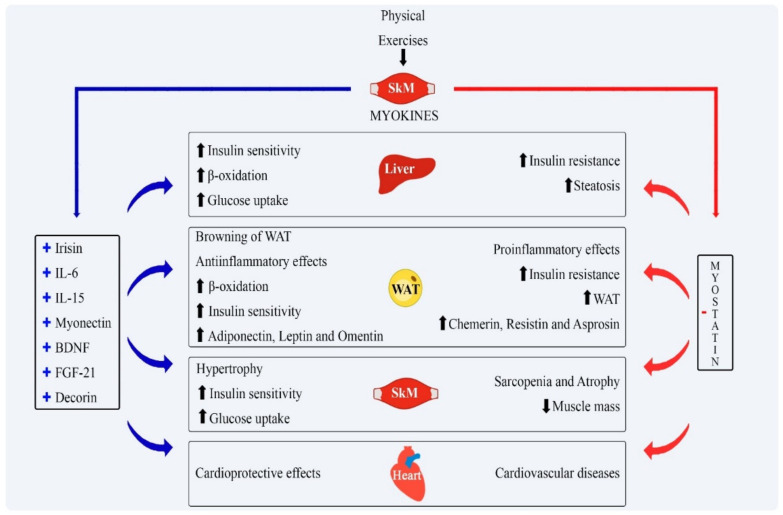
“These molecules are expressed mainly in physical activities or absence, allowing its communication with other body tissues, thereby showing actions that can be considered beneficial for most myokines or related to metabolic dysfunctions [8,14].”
§ Adipokines, Myokines, and Hepatokines: Crosstalk and Metabolic Repercussions > 2. Discussion > 2.2. Myokines
What the sources say
- Not checked yetcites [8] Barbalho, S.M., Flato, U.A.P., Tofano, R.J., Goulart, R.A., Guiguer, E.L., Detregiachi, C.R.P., Buchaim, D.V., Araújo, A.C., Buchaim, R.L., and Reina, F.T.R. (2020). Physical exercise and myokines: Relationships with sarcopenia and cardiovascular complications. Int. J. Mol. Sci., 21. source
- Not checked yetcites [14] Oh, K.J., Lee, D.S., Kim, W.K., Han, B.S., Lee, S.C., and Bae, K.H. (2016). Metabolic adaptation in obesity and type II diabetes: Myokines, adipokines and hepatokines. Int. J. Mol. Sci., 18. source
plaincorrelational- Asserted: passes — The authors put it forward as true.
- Checkable: passes — It can be checked against evidence.
- Load-bearing: unclear — It is unclear whether the paper’s conclusions depend on it.
- Based: passes — The paper gives a reason why it holds.
It may state two separate claims as one.
In the paper
“Despite this, the clinical study by Mikolajczak et al. showed that FGF21 levels are increased in the state of obesity, possibly as an adaptive mechanism against insulin resistance and its consequences [57].”
§ Adipokines, Myokines, and Hepatokines: Crosstalk and Metabolic Repercussions > 2. Discussion > 2.2. Myokines
What the sources say
- Not checked yetcites [57] Mikolajczak, 2017, Serum FGF21 in girls with anorexia nervosa—Comparison to normal weight and obese female adolescents, Neuro Endocrinol. Lett.
hedgedcorrelational- Asserted: passes — The authors put it forward as true.
- Checkable: passes — It can be checked against evidence.
- Load-bearing: unclear — It is unclear whether the paper’s conclusions depend on it.
- Based: passes — The paper gives a reason why it holds.
It may state two separate claims as one.
The paper states this without a source or data behind it here, so there is nothing to check it against. The quote shows it is in the paper.
In the paper
“Despite the pro-inflammatory cytokine label, mainly due to their role as an adipokine, IL-6 levels are increased after physical exercises, which promotes the secretion of interleukin-10 (IL-10), an IL-1 antagonist and possible inhibitor of TNF-α, characterizing an anti-inflammatory environment after increasing the concentration of IL-6 released by muscle tissue.”
§ Adipokines, Myokines, and Hepatokines: Crosstalk and Metabolic Repercussions > 2. Discussion > 2.2. Myokines
hedgeddirect- Asserted: passes — The authors put it forward as true.
- Checkable: passes — It can be checked against evidence.
- Load-bearing: unclear — It is unclear whether the paper’s conclusions depend on it.
- Based: passes — The paper gives a reason why it holds.
It may state two separate claims as one.
The paper states this without a source or data behind it here, so there is nothing to check it against. The quote shows it is in the paper.
In the paper
“In contrast, there is follistatin, a myokine, and hepatokine, released in the context of physical activity, which is opposed to myostatin’s actions, directly inhibiting it through binding.”
§ Adipokines, Myokines, and Hepatokines: Crosstalk and Metabolic Repercussions > 2. Discussion > 2.2. Myokines
plaindirect- Asserted: passes — The authors put it forward as true.
- Checkable: passes — It can be checked against evidence.
- Load-bearing: unclear — It is unclear whether the paper’s conclusions depend on it.
- Based: passes — The paper gives a reason why it holds.
It may state two separate claims as one.
None of the sources cited for this claim have been checked yet.
In the paper
“Its action is in regulating lipogenesis and lipolysis enzymes, in the stimulation of adiponectin production, and the browning of WAT.”
§ Adipokines, Myokines, and Hepatokines: Crosstalk and Metabolic Repercussions > 2. Discussion > 2.1. Adipokines
plaindirect- Asserted: passes — The authors put it forward as true.
- Checkable: passes — It can be checked against evidence.
- Load-bearing: unclear — It is unclear whether the paper’s conclusions depend on it.
- Based: passes — The paper gives a reason why it holds.
It may state two separate claims as one.
The paper states this without a source or data behind it here, so there is nothing to check it against. The quote shows it is in the paper.
In the paper
“Another adipokine secreted by adipose tissue is visfatin, a class type II phosphoribosyltransferase homodimer, which increases in obese people.”
§ Adipokines, Myokines, and Hepatokines: Crosstalk and Metabolic Repercussions > 2. Discussion > 2.1. Adipokines
plaindirect- Asserted: passes — The authors put it forward as true.
- Checkable: passes — It can be checked against evidence.
- Load-bearing: unclear — It is unclear whether the paper’s conclusions depend on it.
- Based: passes — The paper gives a reason why it holds.
It may state two separate claims as one.
In the paper
“Its secretion is more significant in the subcutaneous adipose tissue and is associated with an enzymatic activity such as nicotinamide phosphoribosyltransferase (NAMPT) [33].”
§ Adipokines, Myokines, and Hepatokines: Crosstalk and Metabolic Repercussions > 2. Discussion > 2.1. Adipokines
What the sources say
- Not checked yetcites [33] Franco-Trepat, E., Guillán-Fresco, M., Alonso-Pérez, A., Jorge-Mora, A., Francisco, V., Gualillo, O., and Gómez, R. (2019). Visfatin connection: Present and future in osteoarthritis and osteoporosis. J. Clin. Med., 8. source
plaincorrelational- Asserted: passes — The authors put it forward as true.
- Checkable: passes — It can be checked against evidence.
- Load-bearing: unclear — It is unclear whether the paper’s conclusions depend on it.
- Based: passes — The paper gives a reason why it holds.
It may state two separate claims as one.
In the paper
“Studies point to a relationship between high levels of irisin and low atherosclerosis burden in coronary arteries, proving its cardioprotective effects [8].”
§ Adipokines, Myokines, and Hepatokines: Crosstalk and Metabolic Repercussions > 2. Discussion > 2.2. Myokines
What the sources say
- Not checked yetcites [8] Barbalho, S.M., Flato, U.A.P., Tofano, R.J., Goulart, R.A., Guiguer, E.L., Detregiachi, C.R.P., Buchaim, D.V., Araújo, A.C., Buchaim, R.L., and Reina, F.T.R. (2020). Physical exercise and myokines: Relationships with sarcopenia and cardiovascular complications. Int. J. Mol. Sci., 21. source
boosteddirect- Asserted: passes — The authors put it forward as true.
- Checkable: passes — It can be checked against evidence.
- Load-bearing: unclear — It is unclear whether the paper’s conclusions depend on it.
- Based: passes — The paper gives a reason why it holds.
It may state two separate claims as one.
None of the sources cited for this claim have been checked yet.
In the paper
“Thus, follistatin contributes to the increase in muscle mass, optimizing glucose uptake by SkM and WAT lipolysis [11,13].”
§ Adipokines, Myokines, and Hepatokines: Crosstalk and Metabolic Repercussions > 2. Discussion > 2.2. Myokines
What the sources say
- Not checked yetcites [11] Gonzalez-Gil, A.M., and Elizondo-Montemayor, L. (2020). The role of exercise in the interplay between myokines, hepatokines, osteokines, adipokines, and modulation of inflammation for energy substrate redistribution and fat mass loss: A review. Nutrients, 12. source
- Not checked yetcites [13] Song, P., Kwon, Y., Joo, J.Y., Kim, D.G., and Yoon, J.H. (2019). Secretomics to discover regulators in diseases. Int. J. Mol. Sci., 20. source
plaindirect- Asserted: passes — The authors put it forward as true.
- Checkable: passes — It can be checked against evidence.
- Load-bearing: unclear — It is unclear whether the paper’s conclusions depend on it.
- Based: passes — The paper gives a reason why it holds.
It may state two separate claims as one.
In the paper
“Possibly, myostatin inhibition may be a therapeutic target for muscle mass loss disorders, such as atrophy, sarcopenia, and cancer [45].”
§ Adipokines, Myokines, and Hepatokines: Crosstalk and Metabolic Repercussions > 2. Discussion > 2.2. Myokines
What the sources say
- Not checked yetcites [45] Mikolasevic, 2020, Nonalcoholic fatty liver disease and sarcopenia: Where do we stand?, Can. J. Gastroenterol. Hepatol. source
hedgedconditional- Asserted: passes — The authors put it forward as true.
- Checkable: passes — It can be checked against evidence.
- Load-bearing: fails — The paper’s conclusions may not depend on it.
- Based: passes — The paper gives a reason why it holds.
Probably not a substantial claim. The paper’s conclusions may not depend on it.
In the paper
“It increases insulin sensitivity, reduces plasma glucose levels, and has lipolytic activity, which decreases plasma triglyceride levels [10].”
§ Adipokines, Myokines, and Hepatokines: Crosstalk and Metabolic Repercussions > 2. Discussion > 2.2. Myokines
What the sources say
- Not checked yetcites [10] Faramia, 2020, Metabolic adaptations after bariatric surgery: Adipokines, myokines and hepatokines, Curr. Opin. Pharmacol. source
plaindirect- Asserted: passes — The authors put it forward as true.
- Checkable: passes — It can be checked against evidence.
- Load-bearing: passes — The paper’s conclusions depend on it.
- Based: passes — The paper gives a reason why it holds.
It may state two separate claims as one.
In the paper
“A drop in myonectin levels, which can be caused by physical inactivity or a high-fat diet, is related to excess circulating FFA and subsequent accumulation in other tissues and insulin resistance [20].”
§ Adipokines, Myokines, and Hepatokines: Crosstalk and Metabolic Repercussions > 2. Discussion > 2.2. Myokines
What the sources say
- Not checked yetcites [20] Mehta, 2019, Fibroblast growth factor 21 and browning of white adipose tissue, Front. Physiol. source
plaincorrelational- Asserted: passes — The authors put it forward as true.
- Checkable: passes — It can be checked against evidence.
- Load-bearing: unclear — It is unclear whether the paper’s conclusions depend on it.
- Based: passes — The paper gives a reason why it holds.
It may state two separate claims as one.
In the paper
“Additionally, it helps in the reduction in visceral adipose tissue without reducing subcutaneous fat, showing performance in muscle-fat crosstalk [14].”
§ Adipokines, Myokines, and Hepatokines: Crosstalk and Metabolic Repercussions > 2. Discussion > 2.2. Myokines
What the sources say
- Not checked yetcites [14] Oh, K.J., Lee, D.S., Kim, W.K., Han, B.S., Lee, S.C., and Bae, K.H. (2016). Metabolic adaptation in obesity and type II diabetes: Myokines, adipokines and hepatokines. Int. J. Mol. Sci., 18. source
plaindirect- Asserted: passes — The authors put it forward as true.
- Checkable: passes — It can be checked against evidence.
- Load-bearing: unclear — It is unclear whether the paper’s conclusions depend on it.
- Based: passes — The paper gives a reason why it holds.
It may state two separate claims as one.
The paper states this without a source or data behind it here, so there is nothing to check it against. The quote shows it is in the paper.
In the paper
“Nesfatin-1, in turn, involved in energy homeostasis and satiety induction, is described as an anorexigenic molecule secreted by subcutaneous adipose tissue, pancreatic cells, gastric mucosa, and hypothalamus.”
§ Adipokines, Myokines, and Hepatokines: Crosstalk and Metabolic Repercussions > 2. Discussion > 2.1. Adipokines
plaindirect- Asserted: passes — The authors put it forward as true.
- Checkable: passes — It can be checked against evidence.
- Load-bearing: fails — The paper’s conclusions may not depend on it.
- Based: passes — The paper gives a reason why it holds.
Probably not a substantial claim. The paper’s conclusions may not depend on it. It may state two separate claims as one.
In the paper
“It is a transmembrane protein with a type III fibronectin domain secreted after physical exercise, which has shown participation in the browning of white tissue adipose (WAT) process by increasing the expression of uncoupling protein-1, the respiratory chain of BAT, which promotes energy expenditure especially in the form of heat, contributing to weight loss [11].”
§ Adipokines, Myokines, and Hepatokines: Crosstalk and Metabolic Repercussions > 2. Discussion > 2.2. Myokines
What the sources say
- Not checked yetcites [11] Gonzalez-Gil, A.M., and Elizondo-Montemayor, L. (2020). The role of exercise in the interplay between myokines, hepatokines, osteokines, adipokines, and modulation of inflammation for energy substrate redistribution and fat mass loss: A review. Nutrients, 12. source
hedgeddirect- Asserted: passes — The authors put it forward as true.
- Checkable: passes — It can be checked against evidence.
- Load-bearing: unclear — It is unclear whether the paper’s conclusions depend on it.
- Based: passes — The paper gives a reason why it holds.
It may state two separate claims as one.
The paper states this without a source or data behind it here, so there is nothing to check it against. The quote shows it is in the paper.
In the paper
“Furthermore, released in resistance modalities, myonectin acts on the metabolism of lipids, increasing their uptake by adipose tissue and liver, thus decreasing the plasma concentration of FFA.”
§ Adipokines, Myokines, and Hepatokines: Crosstalk and Metabolic Repercussions > 2. Discussion > 2.2. Myokines
plaindirect- Asserted: passes — The authors put it forward as true.
- Checkable: passes — It can be checked against evidence.
- Load-bearing: unclear — It is unclear whether the paper’s conclusions depend on it.
- Based: passes — The paper gives a reason why it holds.
It may state two separate claims as one.
The paper states this without a source or data behind it here, so there is nothing to check it against. The quote shows it is in the paper.
In the paper
“Interleukin-6 (IL-6), the first myokine to be described, is often characterized as a pro-inflammatory cytokine produced by various tissues, being considered myokines, adipokines, and hepatokine.”
§ Adipokines, Myokines, and Hepatokines: Crosstalk and Metabolic Repercussions > 2. Discussion > 2.2. Myokines
plain- Asserted: passes — The authors put it forward as true.
- Checkable: passes — It can be checked against evidence.
- Load-bearing: fails — The paper’s conclusions may not depend on it.
- Based: passes — The paper gives a reason why it holds.
Probably not a substantial claim. The paper’s conclusions may not depend on it. It may state two separate claims as one.
In the paper
“Visfatin in high concentrations causes insulin resistance and pancreatic beta-cell dysfunction and produces inflammation in adipocytes [34].”
§ Adipokines, Myokines, and Hepatokines: Crosstalk and Metabolic Repercussions > 2. Discussion > 2.1. Adipokines
What the sources say
- Not checked yetcites [34] Kumari, 2018, Adipokine visfatin’s role in pathogenesis of diabesity and related metabolic derangements, Curr. Mol. Med. source
plaindirect- Asserted: passes — The authors put it forward as true.
- Checkable: passes — It can be checked against evidence.
- Load-bearing: unclear — It is unclear whether the paper’s conclusions depend on it.
- Based: passes — The paper gives a reason why it holds.
It may state two separate claims as one.
In the paper
“Moreover, some experimental studies point to a possible correlation between increased levels of IL-6 and inhibition of appetite [52].”
§ Adipokines, Myokines, and Hepatokines: Crosstalk and Metabolic Repercussions > 2. Discussion > 2.2. Myokines
What the sources say
- Not checked yetcites [52] Yuan, 2020, Asprosin: A novel player in metabolic diseases, Front. Endocrinol. source
hedgedcorrelational- Asserted: passes — The authors put it forward as true.
- Checkable: passes — It can be checked against evidence.
- Load-bearing: fails — The paper’s conclusions may not depend on it.
- Based: passes — The paper gives a reason why it holds.
Probably not a substantial claim. The paper’s conclusions may not depend on it.
None of the sources cited for this claim have been checked yet.
In the paper
“In addition, irisin appears to increase insulin sensitivity, promoting glucose transporter mobilization in insulin-dependent tissues, and improves metabolic syndrome and CVD.”
§ Adipokines, Myokines, and Hepatokines: Crosstalk and Metabolic Repercussions > 2. Discussion > 2.2. Myokines
hedgedconditional- Asserted: passes — The authors put it forward as true.
- Checkable: passes — It can be checked against evidence.
- Load-bearing: passes — The paper’s conclusions depend on it.
- Based: passes — The paper gives a reason why it holds.
It may state two separate claims as one.
The paper states this without a source or data behind it here, so there is nothing to check it against. The quote shows it is in the paper.
In the paper
“IL-15 has anti-inflammatory properties, mainly by inhibiting the expression of TNF-α, which plays a role in oxidative stress.”
§ Adipokines, Myokines, and Hepatokines: Crosstalk and Metabolic Repercussions > 2. Discussion > 2.2. Myokines
plaindirect- Asserted: passes — The authors put it forward as true.
- Checkable: passes — It can be checked against evidence.
- Load-bearing: unclear — It is unclear whether the paper’s conclusions depend on it.
- Based: unclear — It is unclear why the paper says it holds.
It may state two separate claims as one.
In the paper
“It also prevents the reduction in muscle mass and increases the uptake of glucose by skeletal muscle by stimulating the mobilization of glucose transporters 4 (GLUT 4), contributing to muscle hypertrophy [18].”
§ Adipokines, Myokines, and Hepatokines: Crosstalk and Metabolic Repercussions > 2. Discussion > 2.2. Myokines
What the sources say
- Not checked yetcites [18] Shi, 2019, Cytokines and abnormal glucose and lipid metabolism, Front. Endocrinol. source
plaindirect- Asserted: passes — The authors put it forward as true.
- Checkable: passes — It can be checked against evidence.
- Load-bearing: unclear — It is unclear whether the paper’s conclusions depend on it.
- Based: passes — The paper gives a reason why it holds.
It may state two separate claims as one.
The paper states this without a source or data behind it here, so there is nothing to check it against. The quote shows it is in the paper.
In the paper
“Fibroblast growth factor 21 (FGF21) is produced by several tissues classified as myokine, adipokines, and hepatokine.”
§ Adipokines, Myokines, and Hepatokines: Crosstalk and Metabolic Repercussions > 2. Discussion > 2.2. Myokines
plain- Asserted: passes — The authors put it forward as true.
- Checkable: passes — It can be checked against evidence.
- Load-bearing: unclear — It is unclear whether the paper’s conclusions depend on it.
- Based: passes — The paper gives a reason why it holds.
It may state two separate claims as one.
None of the sources cited for this claim have been checked yet.
In the paper
“In rodents, injections of nesfatin-1 inhibit food intake, and its lack in the brain causes an increase in appetite, fat, and body weight.”
§ Adipokines, Myokines, and Hepatokines: Crosstalk and Metabolic Repercussions > 2. Discussion > 2.1. Adipokines
plaindirect- Asserted: passes — The authors put it forward as true.
- Checkable: passes — It can be checked against evidence.
- Load-bearing: unclear — It is unclear whether the paper’s conclusions depend on it.
- Based: passes — The paper gives a reason why it holds.
It may state two separate claims as one.
The paper states this without a source or data behind it here, so there is nothing to check it against. The quote shows it is in the paper.
In the paper
“This reduction in muscle mass, mediated by myostatin, facilitates the appearance of metabolic disorders, such as resistance to insulin and accumulation of fat in the liver, since skeletal muscle is the main source of glucose-dependent glucose uptake.”
§ Adipokines, Myokines, and Hepatokines: Crosstalk and Metabolic Repercussions > 2. Discussion > 2.2. Myokines
plaindirect- Asserted: passes — The authors put it forward as true.
- Checkable: passes — It can be checked against evidence.
- Load-bearing: passes — The paper’s conclusions depend on it.
- Based: passes — The paper gives a reason why it holds.
It may state two separate claims as one.
In the paper
“On the other hand, the adipokine zinc-α2-glycoprotein (ZAG) is expressed by both white and BAT and directly accelerates lipid metabolism [38].”
§ Adipokines, Myokines, and Hepatokines: Crosstalk and Metabolic Repercussions > 2. Discussion > 2.1. Adipokines
What the sources say
- Not checked yetcites [38] Zhang, 2020, Zinc-α2-glycoprotein knockout influenced genes expression profile in adipose tissue and decreased the lipid mobilizing after dexamethasone treatment in mice, Horm. Metab. Res. source
plaindirect- Asserted: passes — The authors put it forward as true.
- Checkable: passes — It can be checked against evidence.
- Load-bearing: unclear — It is unclear whether the paper’s conclusions depend on it.
- Based: passes — The paper gives a reason why it holds.
It may state two separate claims as one.
In the paper
“This myokine shows positive effects on the cardiovascular system, which may reveal a potential therapeutic target in CVD treatment [8].”
§ Adipokines, Myokines, and Hepatokines: Crosstalk and Metabolic Repercussions > 2. Discussion > 2.2. Myokines
What the sources say
- Not checked yetcites [8] Barbalho, S.M., Flato, U.A.P., Tofano, R.J., Goulart, R.A., Guiguer, E.L., Detregiachi, C.R.P., Buchaim, D.V., Araújo, A.C., Buchaim, R.L., and Reina, F.T.R. (2020). Physical exercise and myokines: Relationships with sarcopenia and cardiovascular complications. Int. J. Mol. Sci., 21. source
hedgedconditional- Asserted: passes — The authors put it forward as true.
- Checkable: passes — It can be checked against evidence.
- Load-bearing: unclear — It is unclear whether the paper’s conclusions depend on it.
- Based: passes — The paper gives a reason why it holds.
It may state two separate claims as one.
In the paper
“In addition, nesfatin-1 can regulate gastric distension and motility via the melanocortin pathway in the central nucleus of the amygdala [23].”
§ Adipokines, Myokines, and Hepatokines: Crosstalk and Metabolic Repercussions > 2. Discussion > 2.1. Adipokines
What the sources say
- Not checked yetcites [23] Recinella, 2020, Adipokines: New potential therapeutic target for obesity and metabolic, rheumatic, and cardiovascular diseases, Front. Physiol. source
plaindirect- Asserted: passes — The authors put it forward as true.
- Checkable: passes — It can be checked against evidence.
- Load-bearing: fails — The paper’s conclusions may not depend on it.
- Based: passes — The paper gives a reason why it holds.
Probably not a substantial claim. The paper’s conclusions may not depend on it.
None of the sources cited for this claim have been checked yet.
In the paper
“However, hyperprogranulinemia present in obesity is associated with insulin resistance and deficient insulin signaling, whereas its deficiency can protect from diet-induced insulin resistance [31,32].”
§ Adipokines, Myokines, and Hepatokines: Crosstalk and Metabolic Repercussions > 2. Discussion > 2.1. Adipokines
What the sources say
- Not checked yetcites [31] Abella, 2017, Leptin in the interplay of inflammation, metabolism and immune system disorders, Nat Rev. Rheumatol. source
- Not checked yetcites [32] Korolczuk, 2017, Progranulin, a new adipokine at the crossroads of metabolic syndrome, diabetes, dyslipidemia and hypertension, Curr. Pharm. Design source
plaincorrelational- Asserted: passes — The authors put it forward as true.
- Checkable: passes — It can be checked against evidence.
- Load-bearing: unclear — It is unclear whether the paper’s conclusions depend on it.
- Based: passes — The paper gives a reason why it holds.
It may state two separate claims as one.
In the paper
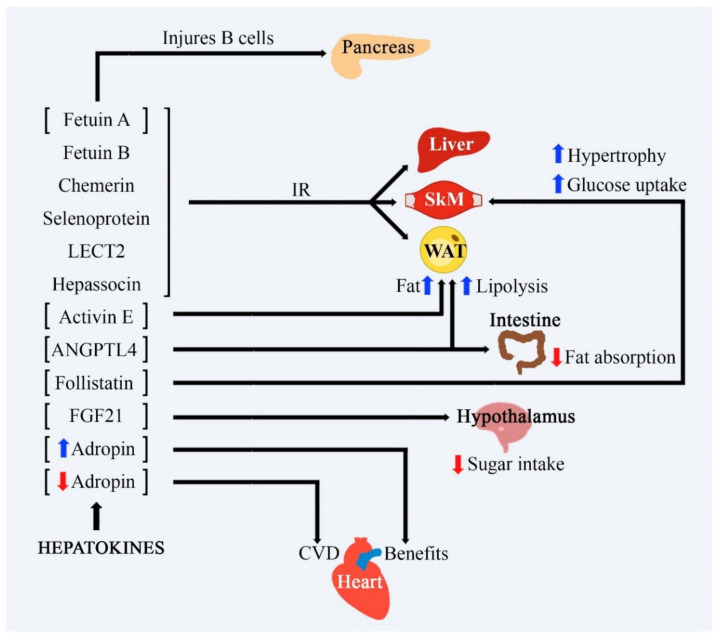
“On the other hand, it has been seen that in mice, the overexpression of adropin reduces weight gain, attenuates hepatosteatosis, increases fatty acid oxidation throughout the body, improves insulin sensitivity, and improves glucose tolerance [67].”
§ Adipokines, Myokines, and Hepatokines: Crosstalk and Metabolic Repercussions > 2. Discussion > 2.3. Hepatokines
What the sources say
- Not checked yetcites [67] Meex, 2017, Hepatokines: Linking nonalcoholic fatty liver disease and insulin resistance, Nat. Rev. Endocrinol. source
plaindirect- Asserted: passes — The authors put it forward as true.
- Checkable: passes — It can be checked against evidence.
- Load-bearing: unclear — It is unclear whether the paper’s conclusions depend on it.
- Based: passes — The paper gives a reason why it holds.
It may state two separate claims as one.
In the paper
“Hepatokines are proteins produced by the liver that have recently been discovered as new hormones, which can worsen or improve metabolic conditions [64].”
§ Adipokines, Myokines, and Hepatokines: Crosstalk and Metabolic Repercussions > 2. Discussion > 2.3. Hepatokines
What the sources say
- Not checked yetcites [64] Choi, 2016, The impact of organokines on insulin resistance, inflammation, and atherosclerosis, Endocrinol. Metab. source
plainconditional- Asserted: passes — The authors put it forward as true.
- Checkable: passes — It can be checked against evidence.
- Load-bearing: unclear — It is unclear whether the paper’s conclusions depend on it.
- Based: passes — The paper gives a reason why it holds.
It may state two separate claims as one.
In the paper
“It is secreted by skeletal muscle cells and is involved in the skeletal muscle hypertrophy and regulates muscle growth with the practice of physical exercise [63].”
§ Adipokines, Myokines, and Hepatokines: Crosstalk and Metabolic Repercussions > 2. Discussion > 2.2. Myokines
What the sources say
- Not checked yetcites [63] Domin, R., Dadej, D., Pytka, M., Zybek-Kocik, A., Ruchała, M., and Guzik, P. (2021). Effect of various exercise regimens on selected Exercise-induced cytokines in healthy people. Int. J. Environ. Res. Public Health, 18. source
plaindirect- Asserted: passes — The authors put it forward as true.
- Checkable: passes — It can be checked against evidence.
- Load-bearing: fails — The paper’s conclusions may not depend on it.
- Based: passes — The paper gives a reason why it holds.
Probably not a substantial claim. The paper’s conclusions may not depend on it.
The paper states this without a source or data behind it here, so there is nothing to check it against. The quote shows it is in the paper.
In the paper
“Studies have shown that in mice, plasma levels of adropin increase with feeding and decrease with fasting.”
§ Adipokines, Myokines, and Hepatokines: Crosstalk and Metabolic Repercussions > 2. Discussion > 2.3. Hepatokines
plaindirect- Asserted: passes — The authors put it forward as true.
- Checkable: passes — It can be checked against evidence.
- Load-bearing: unclear — It is unclear whether the paper’s conclusions depend on it.
- Based: passes — The paper gives a reason why it holds.
It may state two separate claims as one.
In the paper
“This metabolic pattern is caused due to the concentration of fetuin-A interfering with the insulin signaling cascade and the translocation of GLUT4 in insulin target tissues [79].”
§ Adipokines, Myokines, and Hepatokines: Crosstalk and Metabolic Repercussions > 2. Discussion > 2.3. Hepatokines
What the sources say
- Not checked yetcites [79] Iroz, 2015, Hepatokines: Unlocking the multi-organ network in metabolic diseases, Diabetologia source
plaindirect- Asserted: passes — The authors put it forward as true.
- Checkable: passes — It can be checked against evidence.
- Load-bearing: passes — The paper’s conclusions depend on it.
- Based: passes — The paper gives a reason why it holds.
It may state two separate claims as one.
In the paper
“Some studies address the role of SPARC in activating caspase-3 and caspase-8 dependent apoptosis, which reveals a potential benefit of physical exercise in decreasing the incidence of colon cancer [60].”
§ Adipokines, Myokines, and Hepatokines: Crosstalk and Metabolic Repercussions > 2. Discussion > 2.2. Myokines
What the sources say
- Not checked yetcites [60] Aoi, 2019, Secreted protein acidic and rich in cysteine (SPARC) improves glucose tolerance via AMP-activated protein kinase activation, FASEB J. source
hedgedconditional- Asserted: passes — The authors put it forward as true.
- Checkable: passes — It can be checked against evidence.
- Load-bearing: unclear — It is unclear whether the paper’s conclusions depend on it.
- Based: passes — The paper gives a reason why it holds.
It may state two separate claims as one.
In the paper
“The brain-derived neurotrophic factor (BDNF) is also released by muscle and brain tissue after exercise; however, unlike other myokines, it is not released into the bloodstream [61].”
§ Adipokines, Myokines, and Hepatokines: Crosstalk and Metabolic Repercussions > 2. Discussion > 2.2. Myokines
What the sources say
- Not checked yetcites [61] Cooper, 2018, On the run for hippocampal plasticity, Cold Spring Harbor Perspect. Med. source
plaindirect- Asserted: passes — The authors put it forward as true.
- Checkable: passes — It can be checked against evidence.
- Load-bearing: unclear — It is unclear whether the paper’s conclusions depend on it.
- Based: passes — The paper gives a reason why it holds.
It may state two separate claims as one.
In the paper
“SPARC is released in episodes of resistance exercises and muscle hypertrophy and has also been related to the optimization of glucose uptake by increased expression and translocation of GLUT 4 by activating the AMPK signaling pathway [56].”
§ Adipokines, Myokines, and Hepatokines: Crosstalk and Metabolic Repercussions > 2. Discussion > 2.2. Myokines
What the sources say
- Not checked yetcites [56] Barbalho, 2020, Myokines: A descriptive review, J. Sports Med. Phys. Fitness source
hedgeddirect- Asserted: passes — The authors put it forward as true.
- Checkable: passes — It can be checked against evidence.
- Load-bearing: unclear — It is unclear whether the paper’s conclusions depend on it.
- Based: passes — The paper gives a reason why it holds.
It may state two separate claims as one.
In the paper
“Besides that, it is also related to glucose and lipid metabolism regulation and increased insulin sensitivity when released by muscle [14].”
§ Adipokines, Myokines, and Hepatokines: Crosstalk and Metabolic Repercussions > 2. Discussion > 2.2. Myokines
What the sources say
- Not checked yetcites [14] Oh, K.J., Lee, D.S., Kim, W.K., Han, B.S., Lee, S.C., and Bae, K.H. (2016). Metabolic adaptation in obesity and type II diabetes: Myokines, adipokines and hepatokines. Int. J. Mol. Sci., 18. source
plaincorrelational- Asserted: passes — The authors put it forward as true.
- Checkable: passes — It can be checked against evidence.
- Load-bearing: unclear — It is unclear whether the paper’s conclusions depend on it.
- Based: passes — The paper gives a reason why it holds.
It may state two separate claims as one.
In the paper
“The study performed by Pedersen [56] suggests that exercise stimulates the release of myokines, such as cathepsin B and irisin, which in turn cross the blood–brain barrier to induce cerebral BDNF secretion.”
§ Adipokines, Myokines, and Hepatokines: Crosstalk and Metabolic Repercussions > 2. Discussion > 2.2. Myokines
What the sources say
- Not checked yetcites [56] Barbalho, 2020, Myokines: A descriptive review, J. Sports Med. Phys. Fitness source
hedgeddirect- Asserted: passes — The authors put it forward as true.
- Checkable: passes — It can be checked against evidence.
- Load-bearing: unclear — It is unclear whether the paper’s conclusions depend on it.
- Based: passes — The paper gives a reason why it holds.
It may state two separate claims as one.
The paper states this without a source or data behind it here, so there is nothing to check it against. The quote shows it is in the paper.
In the paper
“This acts primarily on neurons through tyrosine receptor kinases (Trk), allowing their growth and survival and playing a fundamental role for memory and learning.”
§ Adipokines, Myokines, and Hepatokines: Crosstalk and Metabolic Repercussions > 2. Discussion > 2.2. Myokines
plaindirect- Asserted: passes — The authors put it forward as true.
- Checkable: passes — It can be checked against evidence.
- Load-bearing: fails — The paper’s conclusions may not depend on it.
- Based: passes — The paper gives a reason why it holds.
Probably not a substantial claim. The paper’s conclusions may not depend on it. It may state two separate claims as one.
In the paper
“Still, in this respect, there is increasing evidence that adropin is a biomarker of cardiovascular dysfunction, initially because in vitro tests showed that endothelial cells treated with adropin had greater proliferation, migration, formation of a capillary-like tube, and positive regulation of the expression of nitric oxide endothelial synthase (eNOS).”
§ Adipokines, Myokines, and Hepatokines: Crosstalk and Metabolic Repercussions > 2. Discussion > 2.3. Hepatokines
What the sources say
- Not checked yetcites [81] Zhao, 2015, Serum adropin level in patients with stable coronary artery disease, Heart Lung Circulat. source
plaindirect- Asserted: passes — The authors put it forward as true.
- Checkable: passes — It can be checked against evidence.
- Load-bearing: passes — The paper’s conclusions depend on it.
- Based: passes — The paper gives a reason why it holds.
It may state two separate claims as one.
In the paper
“On the other hand, it has been seen that in mice, the overexpression of adropin reduces weight gain, attenuates hepatosteatosis, increases fatty acid oxidation throughout the body, improves insulin sensitivity, and improves glucose tolerance [67].”
§ Adipokines, Myokines, and Hepatokines: Crosstalk and Metabolic Repercussions > 2. Discussion > 2.3. Hepatokines
What the sources say
- Not checked yetcites [67] Meex, 2017, Hepatokines: Linking nonalcoholic fatty liver disease and insulin resistance, Nat. Rev. Endocrinol. source
plaindirect- Asserted: passes — The authors put it forward as true.
- Checkable: passes — It can be checked against evidence.
- Load-bearing: unclear — It is unclear whether the paper’s conclusions depend on it.
- Based: passes — The paper gives a reason why it holds.
It may state two separate claims as one.
In the paper
“It is also able to inhibit the formation of adipose tissue, increase the release of insulin and promote erythropoiesis [14].”
§ Adipokines, Myokines, and Hepatokines: Crosstalk and Metabolic Repercussions > 2. Discussion > 2.2. Myokines
What the sources say
- Not checked yetcites [14] Oh, K.J., Lee, D.S., Kim, W.K., Han, B.S., Lee, S.C., and Bae, K.H. (2016). Metabolic adaptation in obesity and type II diabetes: Myokines, adipokines and hepatokines. Int. J. Mol. Sci., 18. source
plaindirect- Asserted: passes — The authors put it forward as true.
- Checkable: passes — It can be checked against evidence.
- Load-bearing: unclear — It is unclear whether the paper’s conclusions depend on it.
- Based: passes — The paper gives a reason why it holds.
It may state two separate claims as one.
In the paper
“This hepatokine also acts on WAT, stimulating lipolysis and decreasing the enzyme lipoprotein lipase (LPL) action, that is, reducing the hydrolysis of triglycerides in circulating lipoproteins to FFA and reducing the accumulation of lipids in the white tissue adipose [75].”
§ Adipokines, Myokines, and Hepatokines: Crosstalk and Metabolic Repercussions > 2. Discussion > 2.3. Hepatokines
What the sources say
- Not checked yetcites [75] Ennequin, 2019, Role of exercise-induced hepatokines in metabolic disorders, Am. J. Physiol. Endocrinol. Metab. source
plaindirect- Asserted: passes — The authors put it forward as true.
- Checkable: passes — It can be checked against evidence.
- Load-bearing: unclear — It is unclear whether the paper’s conclusions depend on it.
- Based: passes — The paper gives a reason why it holds.
It may state two separate claims as one.
In the paper
“When seleno-protein is found in high serum levels, it is associated with metabolic diseases, insulin resistance, and increased ROS via the activation of AMPK, and it influences the drop in concentrations of irisin, meteorin-like (METRNL), and β-aminoisobutyric acid (BAIBA), which consequently attenuates the loss of fat mass induced by physical exercises [11].”
§ Adipokines, Myokines, and Hepatokines: Crosstalk and Metabolic Repercussions > 2. Discussion > 2.3. Hepatokines
What the sources say
- Not checked yetcites [11] Gonzalez-Gil, A.M., and Elizondo-Montemayor, L. (2020). The role of exercise in the interplay between myokines, hepatokines, osteokines, adipokines, and modulation of inflammation for energy substrate redistribution and fat mass loss: A review. Nutrients, 12. source
plaincorrelational- Asserted: passes — The authors put it forward as true.
- Checkable: passes — It can be checked against evidence.
- Load-bearing: unclear — It is unclear whether the paper’s conclusions depend on it.
- Based: passes — The paper gives a reason why it holds.
It may state two separate claims as one.
In the paper
“In addition, studies with mice have shown that follistatin overexpression is associated with insulin resistance in WAT, elevated hepatic glucose production, and glucose intolerance [11].”
§ Adipokines, Myokines, and Hepatokines: Crosstalk and Metabolic Repercussions > 2. Discussion > 2.3. Hepatokines
What the sources say
- Not checked yetcites [11] Gonzalez-Gil, A.M., and Elizondo-Montemayor, L. (2020). The role of exercise in the interplay between myokines, hepatokines, osteokines, adipokines, and modulation of inflammation for energy substrate redistribution and fat mass loss: A review. Nutrients, 12. source
plaincorrelational- Asserted: passes — The authors put it forward as true.
- Checkable: passes — It can be checked against evidence.
- Load-bearing: unclear — It is unclear whether the paper’s conclusions depend on it.
- Based: passes — The paper gives a reason why it holds.
It may state two separate claims as one.
In the paper
“In addition, studies have shown that intermittent hypoxia generates stress that increases the levels of seleno-protein P in human hepatocytes, increasing insulin resistance, accumulating fat in adipose tissue, and aggravating risks of developing atherosclerosis [67].”
§ Adipokines, Myokines, and Hepatokines: Crosstalk and Metabolic Repercussions > 2. Discussion > 2.3. Hepatokines
What the sources say
- Not checked yetcites [67] Meex, 2017, Hepatokines: Linking nonalcoholic fatty liver disease and insulin resistance, Nat. Rev. Endocrinol. source
plaindirect- Asserted: passes — The authors put it forward as true.
- Checkable: passes — It can be checked against evidence.
- Load-bearing: unclear — It is unclear whether the paper’s conclusions depend on it.
- Based: passes — The paper gives a reason why it holds.
It may state two separate claims as one.
The paper states this without a source or data behind it here, so there is nothing to check it against. The quote shows it is in the paper.
In the paper
“Chemerin is not only an adipokine, but is also produced by the liver and contributes to the decrease in glucose homeostasis.”
§ Adipokines, Myokines, and Hepatokines: Crosstalk and Metabolic Repercussions > 2. Discussion > 2.3. Hepatokines
plaindirect- Asserted: passes — The authors put it forward as true.
- Checkable: passes — It can be checked against evidence.
- Load-bearing: unclear — It is unclear whether the paper’s conclusions depend on it.
- Based: passes — The paper gives a reason why it holds.
It may state two separate claims as one.
In the paper
“Follistatin originates from the liver and rises when the glucagon-to-insulin ratio increases in the case of fasting and aerobic and resistance exercise [74].”
§ Adipokines, Myokines, and Hepatokines: Crosstalk and Metabolic Repercussions > 2. Discussion > 2.3. Hepatokines
What the sources say
- Not checked yetcites [74] Perakakis, 2018, Physiology of activins/follistatins: Associations with metabolic and anthropometric variables and response to exercise, J. Clin. Endocrinol. Metab. source
plaindirect- Asserted: passes — The authors put it forward as true.
- Checkable: passes — It can be checked against evidence.
- Load-bearing: unclear — It is unclear whether the paper’s conclusions depend on it.
- Based: passes — The paper gives a reason why it holds.
It may state two separate claims as one.
In the paper
“Thus, it has been shown that elevated LECT2 is associated with metabolic stress, which impairs insulin signal transduction, has a responsibility to promote and express adhesion molecules, and increases the appearance of pro-inflammatory cytokines.”
§ Adipokines, Myokines, and Hepatokines: Crosstalk and Metabolic Repercussions > 2. Discussion > 2.3. Hepatokines
What the sources say
- Not checked yetcites [67] Meex, 2017, Hepatokines: Linking nonalcoholic fatty liver disease and insulin resistance, Nat. Rev. Endocrinol. source
boosteddirect- Asserted: passes — The authors put it forward as true.
- Checkable: passes — It can be checked against evidence.
- Load-bearing: passes — The paper’s conclusions depend on it.
- Based: passes — The paper gives a reason why it holds.
It may state two separate claims as one.
In the paper
“However, in humans, activin E has been reported to reduce lipolysis and increase fat accumulation in adipocytes.”
§ Adipokines, Myokines, and Hepatokines: Crosstalk and Metabolic Repercussions > 2. Discussion > 2.3. Hepatokines
What the sources say
- Not checked yetcites [69] Sugiyama, M., Kikuchi, A., Misu, H., Igawa, H., Ashihara, M., Kushima, Y., Honda, K., Suzuki, Y., Kawabe, Y., and Kaneko, S. (2018). Inhibin βE (INHBE) is a possible insulin resistance-associated hepatokine identified by comprehensive gene expression analysis in human liver biopsy samples. PLoS ONE, 13. source
hedgeddirect- Asserted: passes — The authors put it forward as true.
- Checkable: passes — It can be checked against evidence.
- Load-bearing: unclear — It is unclear whether the paper’s conclusions depend on it.
- Based: passes — The paper gives a reason why it holds.
It may state two separate claims as one.
The paper states this without a source or data behind it here, so there is nothing to check it against. The quote shows it is in the paper.
In the paper
“On the other hand, overexpression of this organokine results in insulin sensitivity and elevated energy expenditure.”
§ Adipokines, Myokines, and Hepatokines: Crosstalk and Metabolic Repercussions > 2. Discussion > 2.3. Hepatokines
plaindirect- Asserted: passes — The authors put it forward as true.
- Checkable: passes — It can be checked against evidence.
- Load-bearing: fails — The paper’s conclusions may not depend on it.
- Based: fails — The paper may give no reason why it holds.
Probably not a substantial claim. The paper’s conclusions may not depend on it. The paper may give no reason why it holds. It may state two separate claims as one.
In the paper
“Despite this, IL-6 released during physical exercise can improve glucose and lipid metabolism, while plasma levels of TNF-α in exercise are reduced, although its expression in adipose tissue is not affected [14].”
§ Adipokines, Myokines, and Hepatokines: Crosstalk and Metabolic Repercussions > 2. Discussion > 2.4. Adipokines, Myokines and Hepatokines: Crosstalk and Metabolic Repercussions
What the sources say
- Not checked yetcites [14] Oh, K.J., Lee, D.S., Kim, W.K., Han, B.S., Lee, S.C., and Bae, K.H. (2016). Metabolic adaptation in obesity and type II diabetes: Myokines, adipokines and hepatokines. Int. J. Mol. Sci., 18. source
plaindirect- Asserted: passes — The authors put it forward as true.
- Checkable: passes — It can be checked against evidence.
- Load-bearing: unclear — It is unclear whether the paper’s conclusions depend on it.
- Based: passes — The paper gives a reason why it holds.
It may state two separate claims as one.
In the paper
“In parallel, myostatin promotes the state of obesity, sarcopenia, and sarcopenic obesity, which promotes the release of inflammatory adipokines and hepatokines while inhibiting the release of myokines and other anti-inflammatory and antioxidant organokines [14].”
§ Adipokines, Myokines, and Hepatokines: Crosstalk and Metabolic Repercussions > 2. Discussion > 2.4. Adipokines, Myokines and Hepatokines: Crosstalk and Metabolic Repercussions
What the sources say
- Not checked yetcites [14] Oh, K.J., Lee, D.S., Kim, W.K., Han, B.S., Lee, S.C., and Bae, K.H. (2016). Metabolic adaptation in obesity and type II diabetes: Myokines, adipokines and hepatokines. Int. J. Mol. Sci., 18. source
plaindirect- Asserted: passes — The authors put it forward as true.
- Checkable: passes — It can be checked against evidence.
- Load-bearing: passes — The paper’s conclusions depend on it.
- Based: passes — The paper gives a reason why it holds.
It may state two separate claims as one.
In the paper
“In addition to being involved in disease metabolism, adipokines can modulate bone mineral density and bone turnover as well as skeletal muscle catabolism in aging [97].”
§ Adipokines, Myokines, and Hepatokines: Crosstalk and Metabolic Repercussions > 2. Discussion > 2.4. Adipokines, Myokines and Hepatokines: Crosstalk and Metabolic Repercussions
What the sources say
- Not checked yetcites [97] Makowski, 2020, Chapter four—Myokines: The endocrine coupling of skeletal muscle and bone, Advances in Clinical Chemistry source
plaindirect- Asserted: passes — The authors put it forward as true.
- Checkable: passes — It can be checked against evidence.
- Load-bearing: unclear — It is unclear whether the paper’s conclusions depend on it.
- Based: passes — The paper gives a reason why it holds.
It may state two separate claims as one.
The paper states this without a source or data behind it here, so there is nothing to check it against. The quote shows it is in the paper.
In the paper
“ANGPTL6 is highly expressed in obesity, augmented lipid accumulation in skeletal muscle and liver, reduced energy expenditure, and increased insulin resistance.”
§ Adipokines, Myokines, and Hepatokines: Crosstalk and Metabolic Repercussions > 2. Discussion > 2.3. Hepatokines
plaindirect- Asserted: passes — The authors put it forward as true.
- Checkable: passes — It can be checked against evidence.
- Load-bearing: fails — The paper’s conclusions may not depend on it.
- Based: fails — The paper may give no reason why it holds.
Probably not a substantial claim. The paper’s conclusions may not depend on it. The paper may give no reason why it holds. It may state two separate claims as one.
None of the sources cited for this claim have been checked yet.
In the paper
“Insulin suppression leads to an increase in plasma fatty acid and consequent absorption by liver and muscle tissue, creating intracellular lipotoxic environments that prevent the translocation of GLUT4 in skeletal muscles and adipose tissue [104,105].”
§ Adipokines, Myokines, and Hepatokines: Crosstalk and Metabolic Repercussions > 2. Discussion > 2.4. Adipokines, Myokines and Hepatokines: Crosstalk and Metabolic Repercussions
What the sources say
- Not checked yetcites [104] Nayak, 2020, Mechanisms of muscle insulin resistance and the cross-talk with liver and adipose tissue, Physiol. Rep.
- Not checked yetcites [105] Goedeke, 2019, Emerging pharmacological targets for the treatment of nonalcoholic fatty liver disease, insulin resistance, and type 2 diabetes, Ann. Rev. Pharmacol. Toxicol. source
plaindirect- Asserted: passes — The authors put it forward as true.
- Checkable: passes — It can be checked against evidence.
- Load-bearing: passes — The paper’s conclusions depend on it.
- Based: passes — The paper gives a reason why it holds.
It may state two separate claims as one.
In the paper
“Many studies point to a decrease in myostatin through physical exercise, with positive effects in combating insulin resistance and reducing fat accumulation and muscle hypertrophy [95].”
§ Adipokines, Myokines, and Hepatokines: Crosstalk and Metabolic Repercussions > 2. Discussion > 2.4. Adipokines, Myokines and Hepatokines: Crosstalk and Metabolic Repercussions
What the sources say
- Not checked yetcites [95] Leal, 2018, Physical exercise-induced myokines and muscle-adipose tissue crosstalk: A review of current knowledge and the implications for health and metabolic diseases, Front. Physiol. source
plaindirect- Asserted: passes — The authors put it forward as true.
- Checkable: passes — It can be checked against evidence.
- Load-bearing: unclear — It is unclear whether the paper’s conclusions depend on it.
- Based: passes — The paper gives a reason why it holds.
It may state two separate claims as one.
The paper states this without a source or data behind it here, so there is nothing to check it against. The quote shows it is in the paper.
In the paper
“ANGPTL3 is expressed and release by the liver and works as a regulator of plasma triglyceride levels, positively associated with glycemia, and insulin levels in patients with insulin resistance.”
§ Adipokines, Myokines, and Hepatokines: Crosstalk and Metabolic Repercussions > 2. Discussion > 2.3. Hepatokines
plaindirect- Asserted: passes — The authors put it forward as true.
- Checkable: passes — It can be checked against evidence.
- Load-bearing: fails — The paper’s conclusions may not depend on it.
- Based: passes — The paper gives a reason why it holds.
Probably not a substantial claim. The paper’s conclusions may not depend on it. It may state two separate claims as one.
None of the sources cited for this claim have been checked yet.
In the paper
“Together, these cytokines induced in a healthy environment optimize the secretion and action of insulin; favor energy expenditure; reduce the storage of visceral fat; and, consequently, stimulate polarization of MϕM2 and reduction in Toll-like receptors (TLRs), decreasing the inflammatory pattern [11,102].”
§ Adipokines, Myokines, and Hepatokines: Crosstalk and Metabolic Repercussions > 2. Discussion > 2.4. Adipokines, Myokines and Hepatokines: Crosstalk and Metabolic Repercussions
What the sources say
- Not checked yetcites [11] Gonzalez-Gil, A.M., and Elizondo-Montemayor, L. (2020). The role of exercise in the interplay between myokines, hepatokines, osteokines, adipokines, and modulation of inflammation for energy substrate redistribution and fat mass loss: A review. Nutrients, 12. source
- Not checked yetcites [102] Gannar, 2018, Myokines, physical activity, insulin resistance and autoimmune diseases, Immunol. Lett. source
plaindirect- Asserted: passes — The authors put it forward as true.
- Checkable: passes — It can be checked against evidence.
- Load-bearing: passes — The paper’s conclusions depend on it.
- Based: passes — The paper gives a reason why it holds.
It may state two separate claims as one.
In the paper
“Thus, myostatin, TNF-α, leptin, resistin, chemerin, fetuin-A, and other cytokines build an inflammatory and oxidative stress scenario from the polarization of macrophages (M ϕ) M1 in adipose tissue, production of reactive oxygen species, decreased insulin action, and release of FFA in plasma [11].”
§ Adipokines, Myokines, and Hepatokines: Crosstalk and Metabolic Repercussions > 2. Discussion > 2.4. Adipokines, Myokines and Hepatokines: Crosstalk and Metabolic Repercussions
What the sources say
- Not checked yetcites [11] Gonzalez-Gil, A.M., and Elizondo-Montemayor, L. (2020). The role of exercise in the interplay between myokines, hepatokines, osteokines, adipokines, and modulation of inflammation for energy substrate redistribution and fat mass loss: A review. Nutrients, 12. source
plaindirect- Asserted: passes — The authors put it forward as true.
- Checkable: passes — It can be checked against evidence.
- Load-bearing: passes — The paper’s conclusions depend on it.
- Based: passes — The paper gives a reason why it holds.
It may state two separate claims as one.
None of the sources cited for this claim have been checked yet.
In the paper
“In obesity, leptin resistance caused by hyperleptinemia can limit muscle fatty acid oxidation and reduce lipolysis of adipose tissue.”
§ Adipokines, Myokines, and Hepatokines: Crosstalk and Metabolic Repercussions > 2. Discussion > 2.4. Adipokines, Myokines and Hepatokines: Crosstalk and Metabolic Repercussions
What the sources say
plaindirect- Asserted: passes — The authors put it forward as true.
- Checkable: passes — It can be checked against evidence.
- Load-bearing: unclear — It is unclear whether the paper’s conclusions depend on it.
- Based: passes — The paper gives a reason why it holds.
It may state two separate claims as one.
The paper states this without a source or data behind it here, so there is nothing to check it against. The quote shows it is in the paper.
In the paper
“Present at the origin of several metabolic disorders, myostatin has negative effects on metabolism, and its levels are increased with physical inactivity and high levels of fat mass.”
§ Adipokines, Myokines, and Hepatokines: Crosstalk and Metabolic Repercussions > 2. Discussion > 2.4. Adipokines, Myokines and Hepatokines: Crosstalk and Metabolic Repercussions
plaindirect- Asserted: passes — The authors put it forward as true.
- Checkable: passes — It can be checked against evidence.
- Load-bearing: unclear — It is unclear whether the paper’s conclusions depend on it.
- Based: passes — The paper gives a reason why it holds.
It may state two separate claims as one.
In the paper
“An important contribution to excess adiposity and favoring insulin resistance is the deregulation of the secretion and production of adipokines and myokines [96].”
§ Adipokines, Myokines, and Hepatokines: Crosstalk and Metabolic Repercussions > 2. Discussion > 2.4. Adipokines, Myokines and Hepatokines: Crosstalk and Metabolic Repercussions
What the sources say
- Not checked yetcites [96] Becerril, 2017, Crosstalk between adipokines and myokines in fat browning, Acta Physiol. source
plaindirect- Asserted: passes — The authors put it forward as true.
- Checkable: passes — It can be checked against evidence.
- Load-bearing: passes — The paper’s conclusions depend on it.
- Based: passes — The paper gives a reason why it holds.
It may state two separate claims as one.
In the paper
“In parallel, myostatin promotes the state of obesity, sarcopenia, and sarcopenic obesity, which promotes the release of inflammatory adipokines and hepatokines while inhibiting the release of myokines and other anti-inflammatory and antioxidant organokines [14].”
§ Adipokines, Myokines, and Hepatokines: Crosstalk and Metabolic Repercussions > 2. Discussion > 2.4. Adipokines, Myokines and Hepatokines: Crosstalk and Metabolic Repercussions
What the sources say
- Not checked yetcites [14] Oh, K.J., Lee, D.S., Kim, W.K., Han, B.S., Lee, S.C., and Bae, K.H. (2016). Metabolic adaptation in obesity and type II diabetes: Myokines, adipokines and hepatokines. Int. J. Mol. Sci., 18. source
plaindirect- Asserted: passes — The authors put it forward as true.
- Checkable: passes — It can be checked against evidence.
- Load-bearing: passes — The paper’s conclusions depend on it.
- Based: passes — The paper gives a reason why it holds.
It may state two separate claims as one.
None of the sources cited for this claim have been checked yet.
In the paper
“Studies indicate that the disproportionate release of pro-inflammatory adipokines and the reduction in lipolysis are simultaneous with insulin resistance, which plays a substantial role in the development of DM2.”
§ Adipokines, Myokines, and Hepatokines: Crosstalk and Metabolic Repercussions > 2. Discussion > 2.4. Adipokines, Myokines and Hepatokines: Crosstalk and Metabolic Repercussions
What the sources say
- Not checked yetcites [104] Nayak, 2020, Mechanisms of muscle insulin resistance and the cross-talk with liver and adipose tissue, Physiol. Rep.
- Not checked yetcites [105] Goedeke, 2019, Emerging pharmacological targets for the treatment of nonalcoholic fatty liver disease, insulin resistance, and type 2 diabetes, Ann. Rev. Pharmacol. Toxicol. source
hedgeddirect- Asserted: passes — The authors put it forward as true.
- Checkable: passes — It can be checked against evidence.
- Load-bearing: passes — The paper’s conclusions depend on it.
- Based: passes — The paper gives a reason why it holds.
It may state two separate claims as one.
None of the sources cited for this claim have been checked yet.
In the paper
“Tsukushi representes an inducible hepatokine associated with the regulation of energy expenditure and is mightily associated with obesity, nonalcoholic fatty liver disease (NAFLD), and nonalcoholic steatohepatitis (NASH).”
§ Adipokines, Myokines, and Hepatokines: Crosstalk and Metabolic Repercussions > 2. Discussion > 2.3. Hepatokines
What the sources say
- Not checked yetcites [78] Mouchiroud, 2019, The hepatokine Tsukushi is released in response to NAFLD and impacts cholesterol homeostasis, JCI Insight source
- Not checked yetcites [88] Potthoff, 2021, Hepatokines and metabolism: Deciphering communication from the liver, Mol. Metab. source
- Not checked yetcites [89] Huang, 2021, Tsukushi is a novel prognostic biomarker and correlates with tumor-infiltrating B cells in non-small cell lung cancer, Aging source
boostedcorrelational- Asserted: passes — The authors put it forward as true.
- Checkable: passes — It can be checked against evidence.
- Load-bearing: unclear — It is unclear whether the paper’s conclusions depend on it.
- Based: passes — The paper gives a reason why it holds.
It may state two separate claims as one.
In the paper
“Hyperglycemia contributes to the production of advanced glycation end products (AGES), which, together with reactive oxygen species, cause endothelial damage, while adhesion molecules and immune cells are attracted to the vascular bed [94].”
§ Adipokines, Myokines, and Hepatokines: Crosstalk and Metabolic Repercussions > 2. Discussion > 2.4. Adipokines, Myokines and Hepatokines: Crosstalk and Metabolic Repercussions
What the sources say
- Not checked yetcites [94] Castillo, 2020, Serum irisin levels, endothelial dysfunction, and inflammation in pediatric patients with type 2 diabetes mellitus and metabolic syndrome, J. Diab. Res.
plaindirect- Asserted: passes — The authors put it forward as true.
- Checkable: passes — It can be checked against evidence.
- Load-bearing: unclear — It is unclear whether the paper’s conclusions depend on it.
- Based: passes — The paper gives a reason why it holds.
It may state two separate claims as one.
In the paper
“Thus, myostatin is elevated in pro-inflammatory environments, sharing space with pro-inflammatory organokines such as TNF-α, IL-1, resistin, chemerin, and others [92].”
§ Adipokines, Myokines, and Hepatokines: Crosstalk and Metabolic Repercussions > 2. Discussion > 2.4. Adipokines, Myokines and Hepatokines: Crosstalk and Metabolic Repercussions
What the sources say
- Not checked yetcites [92] Li, 2017, Myokines and adipokines: Involvement in the crosstalk between skeletal muscle and adipose tissue, Cytokine Growth Factor Rev. source
plaincorrelational- Asserted: passes — The authors put it forward as true.
- Checkable: passes — It can be checked against evidence.
- Load-bearing: passes — The paper’s conclusions depend on it.
- Based: passes — The paper gives a reason why it holds.
It may state two separate claims as one.
In the paper
“Therefore, adropin is considered a protective factor of the endothelium, which increases the synthesis of nitric oxide (NO) due to the activation of eNOS.”
§ Adipokines, Myokines, and Hepatokines: Crosstalk and Metabolic Repercussions > 2. Discussion > 2.4. Adipokines, Myokines and Hepatokines: Crosstalk and Metabolic Repercussions
What the sources say
- Not checked yetcites [112] Mushala, 2021, Adropin: A hepatokine modulator of vascular function and cardiac fuel metabolism, Am. J. Physiol. Circ. Physiol. source
plaindirect- Asserted: passes — The authors put it forward as true.
- Checkable: passes — It can be checked against evidence.
- Load-bearing: passes — The paper’s conclusions depend on it.
- Based: passes — The paper gives a reason why it holds.
It may state two separate claims as one.
A conclusion the paper draws from its own results — it cites no other source for it, so there is none to check. The quote shows it is in the paper.
In the paper
“In this sense, the released organokines lead to numerous metabolic and physiological effects that can be harmful or beneficial to the body.”
§ Adipokines, Myokines, and Hepatokines: Crosstalk and Metabolic Repercussions > 4. Conclusions
plaindirect- Asserted: passes — The authors put it forward as true.
- Checkable: passes — It can be checked against evidence.
- Load-bearing: passes — The paper’s conclusions depend on it.
- Based: passes — The paper gives a reason why it holds.
Probably not a substantial claim.
In the paper
“It was also shown that they identified a less atherogenic apolipoprotein profile, reducing cardiovascular risks and promoting improvements in body weight and adiponectin levels [67].”
§ Adipokines, Myokines, and Hepatokines: Crosstalk and Metabolic Repercussions > 2. Discussion > 2.4. Adipokines, Myokines and Hepatokines: Crosstalk and Metabolic Repercussions
What the sources say
- Not checked yetcites [67] Meex, 2017, Hepatokines: Linking nonalcoholic fatty liver disease and insulin resistance, Nat. Rev. Endocrinol. source
plaindirect- Asserted: passes — The authors put it forward as true.
- Checkable: passes — It can be checked against evidence.
- Load-bearing: unclear — It is unclear whether the paper’s conclusions depend on it.
- Based: passes — The paper gives a reason why it holds.
It may state two separate claims as one.
In the paper
“In clinical studies, patients who had DM 2 were treated with concentrations of FGF21 (with the analog LY2405319), and they showed a reduction in low-density lipoprotein (LDL) cholesterol and triglycerides, an increase in high-density lipoprotein (HDL) cholesterol, and an improvement in insulin during periods of fasting [75].”
§ Adipokines, Myokines, and Hepatokines: Crosstalk and Metabolic Repercussions > 2. Discussion > 2.4. Adipokines, Myokines and Hepatokines: Crosstalk and Metabolic Repercussions
What the sources say
- Not checked yetcites [75] Ennequin, 2019, Role of exercise-induced hepatokines in metabolic disorders, Am. J. Physiol. Endocrinol. Metab. source
plaindirect- Asserted: passes — The authors put it forward as true.
- Checkable: passes — It can be checked against evidence.
- Load-bearing: unclear — It is unclear whether the paper’s conclusions depend on it.
- Based: passes — The paper gives a reason why it holds.
It may state two separate claims as one.
None of the sources cited for this claim have been checked yet.
In the paper
“FGF21 controls insulin sensitivity by improving fat oxidation in the muscle, de novo lipogenesis (DNL) in the liver, and thermogenesis in WAT and BAT.”
§ Adipokines, Myokines, and Hepatokines: Crosstalk and Metabolic Repercussions > 2. Discussion > 2.4. Adipokines, Myokines and Hepatokines: Crosstalk and Metabolic Repercussions
What the sources say
- Not checked yetcites [106] Degirolamo, 2016, Therapeutic potential of the endocrine fibroblast growth factors FGF19, FGF21 and FGF23, Nat. Rev. Drug Disc. source
- Not checked yetcites [107] Keipert, 2020, Adapting to the cold: A role for endogenous fibroblast growth factor 21 in thermoregulation?, Front. Endocrinol. source
plaindirect- Asserted: passes — The authors put it forward as true.
- Checkable: passes — It can be checked against evidence.
- Load-bearing: passes — The paper’s conclusions depend on it.
- Based: passes — The paper gives a reason why it holds.
It may state two separate claims as one.
In the paper
“In the same way that FGF21 is classified as myokine and adipokine, when working as an hepatokine, it acts as a beta-oxidation regulator and decreases lipogenesis in the liver, especially when it increases in the post-exercise period [11].”
§ Adipokines, Myokines, and Hepatokines: Crosstalk and Metabolic Repercussions > 2. Discussion > 2.4. Adipokines, Myokines and Hepatokines: Crosstalk and Metabolic Repercussions
What the sources say
- Not checked yetcites [11] Gonzalez-Gil, A.M., and Elizondo-Montemayor, L. (2020). The role of exercise in the interplay between myokines, hepatokines, osteokines, adipokines, and modulation of inflammation for energy substrate redistribution and fat mass loss: A review. Nutrients, 12. source
plaindirect- Asserted: passes — The authors put it forward as true.
- Checkable: passes — It can be checked against evidence.
- Load-bearing: unclear — It is unclear whether the paper’s conclusions depend on it.
- Based: passes — The paper gives a reason why it holds.
It may state two separate claims as one.
In the paper
“It is well known that obesity, insulin resistance, and inflammation are risk factors for several metabolic disorders [108].”
§ Adipokines, Myokines, and Hepatokines: Crosstalk and Metabolic Repercussions > 2. Discussion > 2.4. Adipokines, Myokines and Hepatokines: Crosstalk and Metabolic Repercussions
What the sources say
- Not checked yetcites [108] Lee, 2018, Obesity-induced insulin resistance and macrophage infiltration of the adipose tissue: A vicious cycle, J. Diabetes Investig. source
boostedcorrelational- Asserted: passes — The authors put it forward as true.
- Checkable: passes — It can be checked against evidence.
- Load-bearing: fails — The paper’s conclusions may not depend on it.
- Based: passes — The paper gives a reason why it holds.
Probably not a substantial claim. The paper’s conclusions may not depend on it. It may state two separate claims as one.
A conclusion the paper draws from its own results — it cites no other source for it, so there is none to check. The quote shows it is in the paper.
In the paper
“The adipose, muscular, and hepatic tissues release several molecules that communicate through crosstalk and are capable of being biomarkers of homeostatic disorders, and they can play roles as potential therapeutic targets that can assist in methods of diagnosing, prognosis, and perhaps future treatments of metabolic syndrome and CVD.”
§ Adipokines, Myokines, and Hepatokines: Crosstalk and Metabolic Repercussions > 4. Conclusions
plaincorrelational- Asserted: passes — The authors put it forward as true.
- Checkable: passes — It can be checked against evidence.
- Load-bearing: passes — The paper’s conclusions depend on it.
- Based: passes — The paper gives a reason why it holds.
It may state two separate claims as one.
A conclusion the paper draws from its own results — it cites no other source for it, so there is none to check. The quote shows it is in the paper.
In the paper
“The release and complex interaction of these organokines depend on numerous factors, such as the sedentary lifestyle and obesity.”
§ Adipokines, Myokines, and Hepatokines: Crosstalk and Metabolic Repercussions > 4. Conclusions
plaindirect- Asserted: passes — The authors put it forward as true.
- Checkable: passes — It can be checked against evidence.
- Load-bearing: fails — The paper’s conclusions may not depend on it.
- Based: fails — The paper may give no reason why it holds.
Probably not a substantial claim. The paper’s conclusions may not depend on it. The paper may give no reason why it holds.
In the paper
“As a result, plasma levels of adropin increase with physical training and culminate with the suppression of atherosclerosis due to the regulation of monocyte differentiation, precisely its anti-inflammatory type.”
§ Adipokines, Myokines, and Hepatokines: Crosstalk and Metabolic Repercussions > 2. Discussion > 2.4. Adipokines, Myokines and Hepatokines: Crosstalk and Metabolic Repercussions
What the sources say
- Not checked yetcites [112] Mushala, 2021, Adropin: A hepatokine modulator of vascular function and cardiac fuel metabolism, Am. J. Physiol. Circ. Physiol. source
plaindirect- Asserted: passes — The authors put it forward as true.
- Checkable: passes — It can be checked against evidence.
- Load-bearing: unclear — It is unclear whether the paper’s conclusions depend on it.
- Based: passes — The paper gives a reason why it holds.
It may state two separate claims as one.
In the paper
“However, circulating follistatin was elevated in patients with DM2 and generally correlates with insulin resistance markers, such as fasting glucose, glycated hemoglobin, and 2-h glucose during an oral glucose tolerance test [111].”
§ Adipokines, Myokines, and Hepatokines: Crosstalk and Metabolic Repercussions > 2. Discussion > 2.4. Adipokines, Myokines and Hepatokines: Crosstalk and Metabolic Repercussions
What the sources say
- Not checked yetcites [111] Hansen, 2016, Circulating follistatin is liver-derived and regulated by the glucagon-to-insulin ratio, J. Clin. Endocrinol. Metab. source
plaincorrelational- Asserted: passes — The authors put it forward as true.
- Checkable: passes — It can be checked against evidence.
- Load-bearing: unclear — It is unclear whether the paper’s conclusions depend on it.
- Based: passes — The paper gives a reason why it holds.
It may state two separate claims as one.
In the paper
“On the other hand, a case–control study showed that adropin levels decreased in patients with NASH and were negatively related to serum levels of alanine transaminase, aspartate aminotransferase, and gamma glutamyl transpeptidase.”
§ Adipokines, Myokines, and Hepatokines: Crosstalk and Metabolic Repercussions > 2. Discussion > 2.4. Adipokines, Myokines and Hepatokines: Crosstalk and Metabolic Repercussions
What the sources say
- Not checked yetcites [113] Chen, X., Sun, X., Shen, T., Chen, Q., Chen, S., Pang, J., Mi, J., Tang, Y., You, Y., and Xu, H. (2020). Lower adropin expression is associated with oxidative stress and severity of nonalcoholic fatty liver disease. Free Radic. Biol. Med., 160. source
plaincorrelational- Asserted: passes — The authors put it forward as true.
- Checkable: passes — It can be checked against evidence.
- Load-bearing: unclear — It is unclear whether the paper’s conclusions depend on it.
- Based: passes — The paper gives a reason why it holds.
It may state two separate claims as one.
A conclusion the paper draws from its own results — it cites no other source for it, so there is none to check. The quote shows it is in the paper.
In the paper
“The understanding of how myokines, adipokines, and hepatokines interact can open up new paths in addressing metabolic problems, such as resistance to the action of insulin and the development of diabetes, obesity, metabolic syndrome, and its countless repercussions in the body, such as cardiovascular diseases.”
§ Adipokines, Myokines, and Hepatokines: Crosstalk and Metabolic Repercussions > 4. Conclusions
plainconditional- Asserted: passes — The authors put it forward as true.
- Checkable: fails — It may be too vague to check against evidence.
- Load-bearing: passes — The paper’s conclusions depend on it.
- Based: passes — The paper gives a reason why it holds.
Probably not a substantial claim. It may be too vague to check against evidence.
In the paper
“In this scenario, it was also observed that adropin increases fibronectin and elastin expression in vascular smooth muscle cells (VSMCs) by overloading the PI3K-Akt pathway, thus assuming that adropin regulates plaque stability and elasticity vascular [112].”
§ Adipokines, Myokines, and Hepatokines: Crosstalk and Metabolic Repercussions > 2. Discussion > 2.4. Adipokines, Myokines and Hepatokines: Crosstalk and Metabolic Repercussions
What the sources say
- Not checked yetcites [112] Mushala, 2021, Adropin: A hepatokine modulator of vascular function and cardiac fuel metabolism, Am. J. Physiol. Circ. Physiol. source
hedgeddirect- Asserted: passes — The authors put it forward as true.
- Checkable: passes — It can be checked against evidence.
- Load-bearing: passes — The paper’s conclusions depend on it.
- Based: passes — The paper gives a reason why it holds.
It may state two separate claims as one.
In the paper
“Finally, fetuin-B also negatively impacts metabolism because its serum level is higher in patients with coronary artery disease, especially in those with the acute coronary syndrome, and it still positively correlates with LDL-c levels [114].”
§ Adipokines, Myokines, and Hepatokines: Crosstalk and Metabolic Repercussions > 2. Discussion > 2.4. Adipokines, Myokines and Hepatokines: Crosstalk and Metabolic Repercussions
What the sources say
- Not checked yetcites [114] Zhu, 2017, Increased serum levels of fetuin B in patients with coronary artery disease, Endocrine source
plaindirect- Asserted: passes — The authors put it forward as true.
- Checkable: passes — It can be checked against evidence.
- Load-bearing: unclear — It is unclear whether the paper’s conclusions depend on it.
- Based: passes — The paper gives a reason why it holds.
It may state two separate claims as one.
In the paper
“It is expressed in endothelial cells and promotes essential functions, such as proliferation, migration, and formation of the capillary tube, together with attenuation of vascular permeability and TNF-α-induced apoptosis.”
§ Adipokines, Myokines, and Hepatokines: Crosstalk and Metabolic Repercussions > 2. Discussion > 2.4. Adipokines, Myokines and Hepatokines: Crosstalk and Metabolic Repercussions
What the sources say
- Not checked yetcites [112] Mushala, 2021, Adropin: A hepatokine modulator of vascular function and cardiac fuel metabolism, Am. J. Physiol. Circ. Physiol. source
plaindirect- Asserted: passes — The authors put it forward as true.
- Checkable: passes — It can be checked against evidence.
- Load-bearing: passes — The paper’s conclusions depend on it.
- Based: passes — The paper gives a reason why it holds.
It may state two separate claims as one.
In the paper
“When activated by exercise, follistatin inactivates myostatin and, therefore, inhibits its pro-inflammatory effects, consequently cooperating with lipolysis in WAT.”
§ Adipokines, Myokines, and Hepatokines: Crosstalk and Metabolic Repercussions > 2. Discussion > 2.4. Adipokines, Myokines and Hepatokines: Crosstalk and Metabolic Repercussions
What the sources say
- Not checked yetcites [11] Gonzalez-Gil, A.M., and Elizondo-Montemayor, L. (2020). The role of exercise in the interplay between myokines, hepatokines, osteokines, adipokines, and modulation of inflammation for energy substrate redistribution and fat mass loss: A review. Nutrients, 12. source
plaindirect- Asserted: passes — The authors put it forward as true.
- Checkable: passes — It can be checked against evidence.
- Load-bearing: unclear — It is unclear whether the paper’s conclusions depend on it.
- Based: passes — The paper gives a reason why it holds.
It may state two separate claims as one.
In the paper
“They are usually elevated when associated with these pathologies and contribute to a state of systemic inflammation [88].”
§ Adipokines, Myokines, and Hepatokines: Crosstalk and Metabolic Repercussions > 2. Discussion > 2.4. Adipokines, Myokines and Hepatokines: Crosstalk and Metabolic Repercussions
What the sources say
- Not checked yetcites [88] Potthoff, 2021, Hepatokines and metabolism: Deciphering communication from the liver, Mol. Metab. source
plaindirect- Asserted: passes — The authors put it forward as true.
- Checkable: passes — It can be checked against evidence.
- Load-bearing: unclear — It is unclear whether the paper’s conclusions depend on it.
- Based: passes — The paper gives a reason why it holds.
It may state two separate claims as one.
A conclusion the paper draws from its own results — it cites no other source for it, so there is none to check. The quote shows it is in the paper.
In the paper
“The adipose, muscular, and hepatic tissues release several molecules that communicate through crosstalk and are capable of being biomarkers of homeostatic disorders, and they can play roles as potential therapeutic targets that can assist in methods of diagnosing, prognosis, and perhaps future treatments of metabolic syndrome and CVD.”
§ Adipokines, Myokines, and Hepatokines: Crosstalk and Metabolic Repercussions > 4. Conclusions
plainconditional- Asserted: passes — The authors put it forward as true.
- Checkable: fails — It may be too vague to check against evidence.
- Load-bearing: passes — The paper’s conclusions depend on it.
- Based: passes — The paper gives a reason why it holds.
Probably not a substantial claim. It may be too vague to check against evidence.
In the paper
“Overweight individuals secrete more pro-inflammatory adipokines, leading to an impaired immune response and greater susceptibility to inflammatory and infectious diseases [109].”
§ Adipokines, Myokines, and Hepatokines: Crosstalk and Metabolic Repercussions > 2. Discussion > 2.4. Adipokines, Myokines and Hepatokines: Crosstalk and Metabolic Repercussions
What the sources say
- Not checked yetcites [109] Soares, 2020, The role of adipokines in the Immunology of obesity, Res. Soc. Dev. source
plaindirect- Asserted: passes — The authors put it forward as true.
- Checkable: passes — It can be checked against evidence.
- Load-bearing: unclear — It is unclear whether the paper’s conclusions depend on it.
- Based: passes — The paper gives a reason why it holds.
It may state two separate claims as one.
The paper relies on this without support.
Adipose, skeletal muscle, and hepatic tissues are the main endocrine organs that produce adipokines, myokines, and hepatokines.
“Adipose, skeletal, and hepatic muscle tissues are the main endocrine organs that produce adipokines, myokines, and hepatokines.”
The paper relies on this without support.
These biomarkers can be harmful or beneficial and perform crosstalk through endocrine, paracrine, and autocrine pathways.
“These biomarkers can be harmful or beneficial to an organism and still perform crosstalk, acting through the endocrine, paracrine, and autocrine pathways.”
The paper relies on this without support.
Many organokines are secreted by all three tissues.
“Moreover, many organokines are secreted by all three tissues.”
The paper relies on this without support.
No review has shown a comprehensive overview of crosstalk among these organokines with focus on insulin resistance, diabetes, metabolic syndrome, and cardiovascular disease.
“To the best of our knowledge, no review has shown a comprehensive overview of crosstalk or these organokines with focus on insulin resistance, diabetes, metabolic syndrome, and CVD.”
The paper relies on this without support.
Overweight individuals secrete more pro-inflammatory adipokines than healthy-weight individuals, leading to impaired immune response and greater susceptibility to inflammatory and infectious diseases.
“Overweight individuals secrete more pro-inflammatory adipokines than those of a healthy weight, leading to an impaired immune response and greater susceptibility to inflammatory and infectious diseases.”
The paper relies on this without support.
Myostatin is elevated in pro-inflammatory environments and co-occurs with pro-inflammatory organokines such as TNF-alpha, IL-1, resistin, and chemerin.
“Myostatin is elevated in pro-inflammatory environments, sharing space with pro-inflammatory organokines, such as tumor necrosis factor-alpha (TNF-α), interleukin-1 (IL-1), resistin, and chemerin.”
Claims other papers make about this one
Each is checked against this paper’s own text: does it say what the citing paper says it does?
In the citing paper
“Fetuin-A, a systemic calcification inhibitor, induces a pro-inflammatory milieu by polarizing M1 macrophages in WAT, generating ROS and reducing insulin sensitivity, which combined with other pro-inflammatory cytokines causes the development of sarcopenia [122,123,124,125].”
From Exerkines and Sarcopenia: Unveiling the Mechanism Behind Exercise-Induced Mitochondrial Homeostasis (2025) · cites this paper as [124]
Self-check
Percentages, sums and reported differences re-computed from the paper’s own numbers.
Each contradiction between two passages listed here was confirmed by an independent check.
Rated minor: it would not touch a result — a value no result rests on, a p-value that stays on the same side of the significance level, or a conflict that is clerical, resolved elsewhere in the paper, or outside its own findings.
In the paper
§ Adipokines, Myokines, and Hepatokines: Crosstalk and Metabolic Repercussions > 2. Discussion > 2.1. Adipokines
“In humans, FGF21 is responsible for the browning of WAT, activation of brown adipocytes, and lipolysis.”
§ Adipokines, Myokines, and Hepatokines: Crosstalk and Metabolic Repercussions > 2. Discussion > 2.3. Hepatokines
“in the adipose tissue, FGF21 decreases lipolysis in vivo and in vitro”
Rated minor: it would not touch a result — a value no result rests on, a p-value that stays on the same side of the significance level, or a conflict that is clerical, resolved elsewhere in the paper, or outside its own findings.
In the paper
§ Adipokines, Myokines, and Hepatokines: Crosstalk and Metabolic Repercussions > 2. Discussion > 2.4. Adipokines, Myokines and Hepatokines: Crosstalk and Metabolic Repercussions
“the predominance of the secretion of anti-inflammatory myokines, adipokines, and hepatokines, such as irisin, IL-6, IL -15, myonectin, adiponectin, FGF21 (which mitigate the harmful effects of myostatin), TNF-α, resistin, chemerin, fetuin-A, and other cytokines [101].”
§ Adipokines, Myokines, and Hepatokines: Crosstalk and Metabolic Repercussions > 2. Discussion > 2.4. Adipokines, Myokines and Hepatokines: Crosstalk and Metabolic Repercussions
“myostatin, TNF-α, leptin, resistin, chemerin, fetuin-A, and other cytokines build an inflammatory and oxidative stress scenario”
Citations
Cites
Effects of Recombinant Leptin Therapy in a Child with Congenital Leptin Deficiency
Farooqi, I. S., Jebb, S. A., Langmack, G., Lawrence, E., Cheetham, C. H., Prentice, A. M., Hughes, I. A., McCamish, M. A., & O'Rahilly, S. (1999) · New England Journal of Medicine · doi:10.1056/nejm199909163411204 · Cited by 1,998
Sarcopenic obesity in older adults: aetiology, epidemiology and treatment strategies
Batsis, J. A., & Villareal, D. T. (2018) · Nature Reviews Endocrinology · doi:10.1038/s41574-018-0062-9 · Cited by 1,382 · cited 1×
“physical exercise and aggravated by an unhealthy lifestyle, as the pro-inflammatory state results in crosstalk that exacerbates the disease’s progression [99,100].”
BackgroundPhysical activity and muscle-brain crosstalk
Pedersen, B. K. (2019) · Nature Reviews Endocrinology · doi:10.1038/s41574-019-0174-x · Cited by 772
The endocrine function of adipose tissues in health and cardiometabolic disease
Scheja, L., & Heeren, J. (2019) · Nature Reviews Endocrinology · doi:10.1038/s41574-019-0230-6 · Cited by 663
Hepatokines: Linking nonalcoholic fatty liver disease and insulin resistance
Meex, R. C. R., & Watt, M. J. (2017) · Nature Reviews Endocrinology · doi:10.1038/nrendo.2017.56 · Cited by 631
Adiponectin regulation and function
Fang, H., & Judd, R. L. (2018) · Comprehensive physiology · doi:10.1002/cphy.c170046 · Cited by 631
Asprosin, a Fasting-Induced Glucogenic Protein Hormone
Romere, C., Duerrschmid, C., Bournat, J., Constable, P., Jain, M., Xia, F., Saha, P. K., Del Solar, M., Zhu, B., York, B., et al. (2016) · Cell · doi:10.1016/j.cell.2016.02.063 · Cited by 591
Osteosarcopenia: where bone, muscle, and fat collide
Hirschfeld, H. P., Kinsella, R., & Duque, G. (2017) · Osteoporosis International · doi:10.1007/s00198-017-4151-8 · Cited by 545
Leptin in the interplay of inflammation, metabolism and immune system disorders
Abella, V., Scotece, M., Conde, J., Pino, J., González-Gay, M. Á., Gómez-Reino, J. J., Mera, A., Lago, F., Gómez, R., & Gualillo, O. (2017) · Nature Reviews Rheumatology · doi:10.1038/nrrheum.2016.209 · Cited by 511
Muscle, Bone, and Fat Crosstalk: The Biological Role of Myokines, Osteokines, and Adipokines
Kirk, B., Feehan, J., Lombardi, G., & Duque, G. (2020) · Current Osteoporosis Reports · doi:10.1007/s11914-020-00599-y · Cited by 510
Research works printed but not linked: 2
- Sandhu, 2020, Cure of obesity in homeopathy: An approach to control a global epidemic, Tantian Univ. J. Homoeopath. Med. Sci., 1, 17
- Oliveira, 2019, Atualização da diretriz de prevenção cardiovascular da sociedade brasileira de cardiologia, Arq. Bras. Cardiol., 113, 787
Cited by
Sorted by citations
Pediatric obesity—Long‐term consequences and effect of weight loss
Marcus, C., Danielsson, P., & Hagman, E. (2022) · Journal of Internal Medicine · doi:10.1111/joim.13547 · Cited by 267
Ren, Y., Zhao, H., Yin, C., Lan, X., Wu, L., Du, X., Griffiths, H. R., & Gao, D. (2022) · Frontiers in Endocrinology · doi:10.3389/fendo.2022.873699 · Cited by 276
Sandireddy, R., Sakthivel, S., Gupta, P., Behari, J., Tripathi, M., & Singh, B. K. (2024) · Frontiers in Cell and Developmental Biology · doi:10.3389/fcell.2024.1433857 · Cited by 235
Koceva, A., Herman, R., Janež, A., Rakuša, M., & Jensterle, M. (2024) · International Journal of Molecular Sciences · doi:10.3390/ijms25137342 · Cited by 186
Ubiquitin-Specific Proteases (USPs) and Metabolic Disorders
Kitamura, H. (2023) · International Journal of Molecular Sciences · doi:10.3390/ijms24043219 · Cited by 146
Metadata
- Authors
- de Oliveira dos Santos, A. R., de Oliveira Zanuso, B., Miola, V. F. B., Barbalho, S. M., Santos Bueno, P. C., Flato, U. A. P., Detregiachi, C. R. P., Buchaim, D. V., Buchaim, R. L., Tofano, R. J., Mendes, C. G., Tofano, V. A. C., & dos Santos Haber, J. F.
- Affiliations
- Department of Biochemistry and Pharmacology, School of Medicine, University of Marília (UNIMAR), Avenida Higino Muzzi Filho 1001, Marília 17525-902, São Paulo, Brazil
- Universidade de Marília (BR)
- Postgraduate Program in Structural and Functional Interactions in Rehabilitation, University of Marilia (UNIMAR), Avenida Hygino Muzzy Filho 1001, Marília 17525-902, São Paulo, Brazil
- Universidade de São Paulo (BR)
- Corresponding author
- Barbalho, Sandra Maria
- ORCID
- Venue
- International Journal of Molecular Sciences
- Publisher
- MDPI AG
- Published
- 2021-03-05
- Volume
- 22
- Issue
- 5
- Pages
- 2639
- ISSN
- 1422-0067 (ISSN-L)
- PMC
- PMC7961600
- OpenAlex
- W3133763745
- Cited by
- 189
- References
- 120
- Citations by year
- 2026: 27 · 2025: 33 · 2024: 39 · 2023: 44 · 2022: 37 · 2021: 9
- FWCI
- 4.94
- Type
- journal article
- Language
- en
- Open access
- gold
- doi.org
- Licence
- Locations
- International Journal of Molecular Sciences (publishedVersion, cc-by)
- PubMed Central (publishedVersion, cc-by)
- PubMed (publishedVersion)
- DOAJ (DOAJ: Directory of Open Access Journals) (submittedVersion, cc-by-sa)
- Topics
- Health Sciences › Medicine › Endocrinology, Diabetes and Metabolism › Adipokines, Inflammation, and Metabolic Diseases
- Health Sciences › Medicine › Physiology (medical) › Adipose Tissue and Metabolism
- Health Sciences › Medicine › Physiology (medical) › Exercise and Physiological Responses
- Keywords
- adipokines, myokines, hepatokines, crosstalk, hormone signaling, paracrine signaling, autocrine signaling, type 2 diabetes, obesity, metabolic syndrome, cardiovascular disease, myostatin, FGF21, inflammatory cytokines, resistin, chemerin, TNF-α, interleukin-1, fatty acid beta-oxidation, lipogenesis, therapeutic target
- MeSH terms
- Animals, Cardiovascular Diseases, Diabetes Mellitus, Type 2, Humans, Obesity, Cytokines, Metabolic Syndrome, Adipokines
About these checks
Registry, retraction, Cites and statistics results are computed, not judged, with one exception: a printed reference that no index lists is read once by a model before it counts as a citation error. Claims are extracted by a model and kept only when their quote appears verbatim in the text; each cited source is then checked, with a model’s help, for whether it says what the claim relies on. Those verdicts can be wrong — read the claim’s quote and the cited source before relying on one.
A language model drew the claims from the paper on 2026-10-09, under version 3 of the claim definition (model deepseek-v4.1-flash, prompt extract-v3).
A second model labelled each claim on 2026-10-09 (model jev-1.13-20260917, definition revision gold-guideline-v0.2).
Cited sources are checked with a language model’s help (gpt-6-sol).
Statistics and arithmetic are recomputed, not judged.
Confidence bands are shown only for fields calibrated on our annotated test set. None is calibrated yet, so no band is shown.
What counts as a claim ›How we measure confidence ›How we check this ›
Are you an author, or do you see a problem with this page? Request a review
