

The DOI matches its Crossref record; 108 of the 116 references it cites were found in a registry or an index; none of the 89 sources its claims cite is checked for support yet.
The Pathogenesis of Adenomyosis vis-à-vis Endometriosis
Open accessAbstract
Adenomyosis is used to be called endometriosis interna, and deep endometriosis is now called adenomyosis externa. Thus, there is a question as to whether adenomyosis is simply endometriosis of the uterus, either from the perspective of pathogenesis or pathophysiology. In this manuscript, a comprehensive review was performed with a literature search using PubMed for all publications in English, related to adenomyosis and endometriosis, from inception to June 20, 2019. In addition, two prevailing theories, i.e., invagination—based on tissue injury and repair (TIAR) hypothesis—and metaplasia, on adenomyosis pathogenesis, are briefly overviewed and then critically scrutinized. Both theories have apparent limitations, i.e., difficulty in falsification, explaining existing data, and making useful predictions. Based on the current understanding of wound healing, a new hypothesis, called endometrial-myometrial interface disruption (EMID), is proposed to account for adenomyosis resulting from iatrogenic trauma to EMI. The EMID hypothesis not only highlights the more salient feature, i.e., hypoxia, at the wounding site, but also incorporates epithelial mesenchymal transition, recruitment of bone-marrow-derived stem cells, and enhanced survival and dissemination of endometrial cells dispersed and displaced due to iatrogenic procedures. More importantly, the EMID hypothesis predicts that the risk of adenomyosis can be reduced if certain perioperative interventions are performed. Consequently, from a pathogenic standpoint, adenomyosis is not simply endometriosis of the uterus, and, as such, may call for interventional procedures that are somewhat different from those for endometriosis to achieve the best results.
Overview
AI snapshot
Written from the paper’s full text.
TL;DR
This review argues that adenomyosis is not simply endometriosis of the uterus, because the two conditions have different risk profiles, age-specific incidence, and likely pathogenesis. It critiques the invagination/TIAR and metaplasia theories and proposes the endometrial–myometrial interface disruption (EMID) hypothesis, centered on iatrogenic trauma, hypoxia, EMT, and bone-marrow-derived stem cell recruitment.
Key findings
- Reported adenomyosis prevalence varies widely, from 10% to 57%; in a population-based study in Northeast Italy, estimated prevalence was 0.18% for adenomyosis versus 1.14% for endometriosis, with adenomyosis incidence peaking at ages 46–50 years.
- Parity is consistently a risk factor for adenomyosis, smoking is inconsistently protective, and a history of dilatation and curettage (D&C) is suggested as a risk factor; this risk profile differs from endometriosis, where greater parity is protective and earlier menarche/shorter menstrual cycles are risk factors.
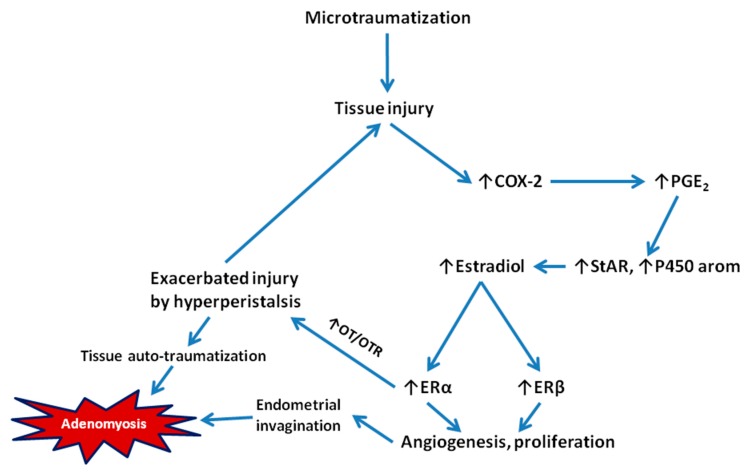
- The review criticizes both prevailing adenomyosis theories—invagination/TIAR and metaplasia—as difficult to falsify, unable to fully explain existing data, and limited in making useful predictions; it notes the TIAR feed-forward loop is based almost exclusively on endometriotic stromal cells, whereas normal endometrial stromal cells have hypermethylated/silenced aromatase, SF-1, and ERβ.
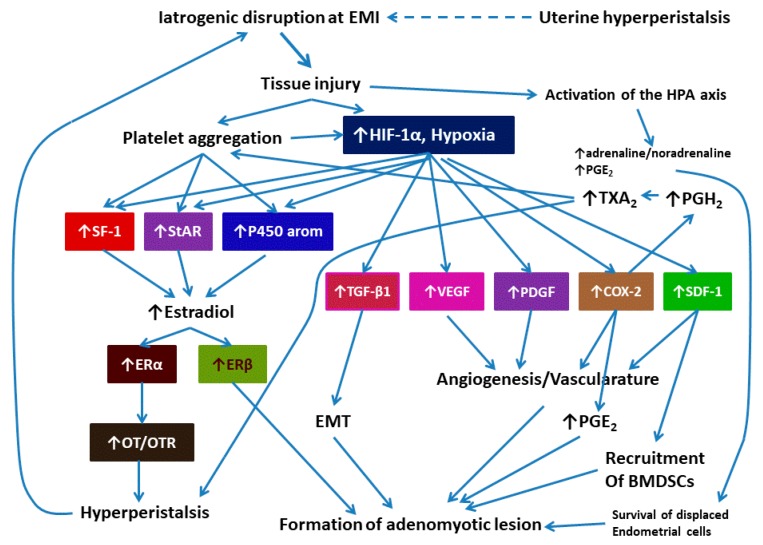
- The proposed EMID hypothesis holds that iatrogenic trauma to the endometrial–myometrial interface causes hypoxia, platelet aggregation, increased estrogen production, TGF-β1/VEGF/PDGF/COX-2/SDF-1 signaling, elevated PGE2, EMT, bone-marrow-derived stem cell recruitment, and impaired cell-mediated immunity, promoting survival and myometrial implantation of displaced endometrial cells; it predicts perioperative interventions may reduce adenomyosis risk.
Methods
- Comprehensive review with a PubMed literature search for all English publications related to adenomyosis and endometriosis from inception to June 20, 2019.
- Briefly overviews and critically scrutinizes the two prevailing adenomyosis pathogenesis theories—invagination/TIAR and metaplasia—then proposes the EMID hypothesis based on current understanding of wound healing.
- No primary experimental data are reported in this review; it mentions that EMID can robustly induce adenomyosis in mice (Hao et al., submitted for publication) as cited/unpublished evidence.
Limitations
- The paper states the EMID hypothesis may account for adenomyosis arising from iatrogenic trauma and perhaps persistent hyperperistalsis-induced EMID, but probably not focal adenomyosis of the outer myometrium (FAOM) or extrinsic/exterior adenomyosis.
- The paper states the model is by no means final or complete and is subject to change or modification; other aiders and abettors may yet be identified, and upstream cues or risk factors for hyperperistalsis-induced EMID need elucidation.
- Evident from the text: as a narrative review, it does not report a systematic review protocol, risk-of-bias assessment, or meta-analysis, and the mouse induction evidence is cited as submitted/unpublished rather than detailed in the paper.
Model-written summary. Check it against the paper before relying on it.
Integrity signals
Registry
Cites
Statistics
Figures
Verification
Claims the paper makes
52 Not checked yet · 42 Own interpretation · 3 No basis given
In the paper
“In fact, EMID can robustly induce adenomyosis in mice (Hao et al., submitted for publication).”
§ The Pathogenesis of Adenomyosis vis-à-vis Endometriosis > 3. Pathogenesis > 3.4. Revamping the TIAR Theory: The Endometrial-Myometrial Interface Disruption (EMID)
What the sources say
- Not checked yetcites Hao et al., submitted for publication
boosteddirect- Asserted: passes — The authors put it forward as true.
- Checkable: passes — It can be checked against evidence.
- Load-bearing: passes — The paper’s conclusions depend on it.
- Based: passes — The paper gives a reason why it holds.
In the paper
“This wide variability stems from variations in the histological criteria adopted for diagnosis and the techniques used to procure myometrial samples [15].”
§ The Pathogenesis of Adenomyosis vis-à-vis Endometriosis > 2. Epidemiology
What the sources say
- Not checked yetcites [15] Vercellini, 2006, Adenomyosis, epidemiological factors, Best Pr. Res. Clin. Obs. Gynaecol. source
plaindirect- Asserted: passes — The authors put it forward as true.
- Checkable: passes — It can be checked against evidence.
- Load-bearing: unclear — It is unclear whether the paper’s conclusions depend on it.
- Based: passes — The paper gives a reason why it holds.
None of the sources cited for this claim have been checked yet.
In the paper
“A preponderance of evidence suggests that a history of receiving dilatation and curettage (D&C) procedures is a risk factor for adenomyosis [19,20,21,22].”
§ The Pathogenesis of Adenomyosis vis-à-vis Endometriosis > 2. Epidemiology
What the sources say
- Not checked yetcites [19] Parazzini, 1997, Risk factors for adenomyosis, Hum. Reprod source
- Not checked yetcites [20] Levgur, 2000, Adenomyosis, symptoms, histology, and pregnancy terminations, Obs. Gynecol.
- Not checked yetcites [21] Curtis, 2002, Disruption of the endometrial-myometrial border during pregnancy as a risk factor for adenomyosis, Am. J. Obs. Gynecol. source
- Not checked yetcites [22] Panganamamula, 2004, Is prior uterine surgery a risk factor for adenomyosis?, Obs. Gynecol. source
hedgedcorrelational- Asserted: passes — The authors put it forward as true.
- Checkable: passes — It can be checked against evidence.
- Load-bearing: unclear — It is unclear whether the paper’s conclusions depend on it.
- Based: passes — The paper gives a reason why it holds.
A conclusion the paper draws from its own results — it cites no other source for it, so there is none to check. The quote shows it is in the paper.
In the paper
“The different risk profiles and the different age-specific incidence between the two diseases indicate that they are likely to have different pathogenesis.”
§ The Pathogenesis of Adenomyosis vis-à-vis Endometriosis > 2. Epidemiology
hedgedconditional- Asserted: passes — The authors put it forward as true.
- Checkable: passes — It can be checked against evidence.
- Load-bearing: passes — The paper’s conclusions depend on it.
- Based: passes — The paper gives a reason why it holds.
In the paper
“Even in women with leiomyomas, women with both leiomyomas and adenomyosis are reported to be older than those with leiomyomas alone [24].”
§ The Pathogenesis of Adenomyosis vis-à-vis Endometriosis > 2. Epidemiology
What the sources say
- Not checked yetcites [24] Brucker, 2014, Clinical characteristics indicating adenomyosis coexisting with leiomyomas, a retrospective, questionnaire-based study, Fertil. Steril. source
hedgedcorrelational- Asserted: passes — The authors put it forward as true.
- Checkable: passes — It can be checked against evidence.
- Load-bearing: passes — The paper’s conclusions depend on it.
- Based: passes — The paper gives a reason why it holds.
In the paper
“The age-specific incidence of adenomyosis is very different from that of endometriosis, reaching its peak at the age interval of 46–50 years [17].”
§ The Pathogenesis of Adenomyosis vis-à-vis Endometriosis > 2. Epidemiology
What the sources say
- Not checked yetcites [17] Morassutto, C., Monasta, L., Ricci, G., Barbone, F., and Ronfani, L. (2016). Incidence and Estimated Prevalence of Endometriosis and Adenomyosis in Northeast Italy, A Data Linkage Study. PLoS ONE, 11. source
plaincorrelational- Asserted: passes — The authors put it forward as true.
- Checkable: passes — It can be checked against evidence.
- Load-bearing: unclear — It is unclear whether the paper’s conclusions depend on it.
- Based: passes — The paper gives a reason why it holds.
In the paper
“In particular, neonatal exposure to diethylstilbestrol followed by continuous hormonal treatment—even progesterone alone—also results in adenomyosis [58].”
§ The Pathogenesis of Adenomyosis vis-à-vis Endometriosis > 3. Pathogenesis > 3.3. The TIAR Theory: The Need for Patching up
What the sources say
- Not checked yetcites [58] Ostrander, 1985, Long-term responses of the mouse uterus to neonatal diethylstilbestrol treatment and to later sex hormone exposure, J. Natl. Cancer Inst.
plaindirect- Asserted: passes — The authors put it forward as true.
- Checkable: passes — It can be checked against evidence.
- Load-bearing: unclear — It is unclear whether the paper’s conclusions depend on it.
- Based: passes — The paper gives a reason why it holds.
None of the sources cited for this claim have been checked yet.
In the paper
“Yet normal endometrial stromal cells are very different in behavior from endometriotic or even adenomyotic stromal cells.”
§ The Pathogenesis of Adenomyosis vis-à-vis Endometriosis > 3. Pathogenesis > 3.3. The TIAR Theory: The Need for Patching up
What the sources say
plain- Asserted: passes — The authors put it forward as true.
- Checkable: passes — It can be checked against evidence.
- Load-bearing: passes — The paper’s conclusions depend on it.
- Based: passes — The paper gives a reason why it holds.
None of the sources cited for this claim have been checked yet.
In the paper
“Consequent to vascular damage, activated platelets can also release an array of cellular growth factors and angiogenic factors such as PDGF and VEGF, as well as inflammatory mediators such as IL-8 [79,80,81].”
§ The Pathogenesis of Adenomyosis vis-à-vis Endometriosis > 3. Pathogenesis > 3.4. Revamping the TIAR Theory: The Endometrial-Myometrial Interface Disruption (EMID)
What the sources say
- Not checked yetcites [79] Holt, 1985, Biochemistry of alpha granule proteins, Semin. Hematol.
- Not checked yetcites [80] Gear, 2003, Platelet chemokines and chemokine receptors, linking hemostasis, inflammation, and host defense, Microcirculation source
- Not checked yetcites [81] Wagner, 2003, Platelets in inflammation and thrombosis, Arter. Thromb. Vasc. Biol. source
plaindirect- Asserted: passes — The authors put it forward as true.
- Checkable: passes — It can be checked against evidence.
- Load-bearing: unclear — It is unclear whether the paper’s conclusions depend on it.
- Based: passes — The paper gives a reason why it holds.
A conclusion the paper draws from its own results — it cites no other source for it, so there is none to check. The quote shows it is in the paper.
In the paper
“In iatrogenic trauma such as the D&C procedure, the injury to the endometrium can probably extend to the EMI.”
§ The Pathogenesis of Adenomyosis vis-à-vis Endometriosis > 3. Pathogenesis > 3.4. Revamping the TIAR Theory: The Endometrial-Myometrial Interface Disruption (EMID)
hedgedconditional- Asserted: passes — The authors put it forward as true.
- Checkable: passes — It can be checked against evidence.
- Load-bearing: passes — The paper’s conclusions depend on it.
- Based: unclear — It is unclear why the paper says it holds.
- It may state two separate claims as one. 31
- Probably not a substantial claim. 15
In the paper
“Sampson’s retrograde menstruation theory is the most widely accepted and has the most robust evidence [27].”
§ The Pathogenesis of Adenomyosis vis-à-vis Endometriosis > 3. Pathogenesis
What the sources say
- Not checked yetcites [27] Vercellini, 2014, Endometriosis, pathogenesis and treatment, Nat. Rev. Endocrinol. source
boosted- Asserted: passes — The authors put it forward as true.
- Checkable: passes — It can be checked against evidence.
- Load-bearing: unclear — It is unclear whether the paper’s conclusions depend on it.
- Based: passes — The paper gives a reason why it holds.
It may state two separate claims as one.
A conclusion the paper draws from its own results — it cites no other source for it, so there is none to check. The quote shows it is in the paper.
In the paper
“The D&C procedure, and perhaps other uterine surgeries as well, may disrupt the endometrial–myometrial interface (EMI) and facilitate the invasion, implantation, embedding, and establishment of endometrial colonies within the myometrial wall, increasing the risk of adenomyosis.”
§ The Pathogenesis of Adenomyosis vis-à-vis Endometriosis > 2. Epidemiology
hedgedconditional- Asserted: passes — The authors put it forward as true.
- Checkable: passes — It can be checked against evidence.
- Load-bearing: passes — The paper’s conclusions depend on it.
- Based: passes — The paper gives a reason why it holds.
It may state two separate claims as one.
In the paper
“In a rare population-based study, the estimated prevalence of adenomyosis in Northeast Italy is reported to be 0.18%, much lower than that of endometriosis (1.14%) [17].”
§ The Pathogenesis of Adenomyosis vis-à-vis Endometriosis > 2. Epidemiology
What the sources say
- Not checked yetcites [17] Morassutto, C., Monasta, L., Ricci, G., Barbone, F., and Ronfani, L. (2016). Incidence and Estimated Prevalence of Endometriosis and Adenomyosis in Northeast Italy, A Data Linkage Study. PLoS ONE, 11. source
hedged- Asserted: passes — The authors put it forward as true.
- Checkable: passes — It can be checked against evidence.
- Load-bearing: fails — The paper’s conclusions may not depend on it.
- Based: passes — The paper gives a reason why it holds.
Probably not a substantial claim. The paper’s conclusions may not depend on it. It may state two separate claims as one.
None of the sources cited for this claim have been checked yet.
In the paper
“Parity is consistently shown to be a risk factor, while smoking is inconsistently shown to be a protective factor [15,18].”
§ The Pathogenesis of Adenomyosis vis-à-vis Endometriosis > 2. Epidemiology
What the sources say
- Not checked yetcites [15] Vercellini, 2006, Adenomyosis, epidemiological factors, Best Pr. Res. Clin. Obs. Gynaecol. source
- Not checked yetcites [18] Taran, 2013, Adenomyosis, Epidemiology, Risk Factors, Clinical Phenotype and Surgical and Interventional Alternatives to Hysterectomy, Geburtshilfe Frauenheilkd source
boostedcorrelational- Asserted: passes — The authors put it forward as true.
- Checkable: passes — It can be checked against evidence.
- Load-bearing: unclear — It is unclear whether the paper’s conclusions depend on it.
- Based: passes — The paper gives a reason why it holds.
It may state two separate claims as one.
In the paper
“Aside from their similar symptomologies, both are estrogen-dependent [10] and share many molecular aberrations.”
§ The Pathogenesis of Adenomyosis vis-à-vis Endometriosis > 1. Introduction
What the sources say
- Not checked yetcites [10] Kitawaki, 2006, Adenomyosis, the pathophysiology of an oestrogen-dependent disease, Best Pr. Res. Clin. Obs. Gynaecol. source
plaincorrelational- Asserted: passes — The authors put it forward as true.
- Checkable: passes — It can be checked against evidence.
- Load-bearing: passes — The paper’s conclusions depend on it.
- Based: passes — The paper gives a reason why it holds.
It may state two separate claims as one.
None of the sources cited for this claim have been checked yet.
In the paper
“Adenomyosis, defined as the presence of endometrial glands and stroma infiltrated deep and haphazardly into the myometrium [1], is a common gynecologic disorder with poorly understood pathogenesis and pathophysiology [2,3,4].”
§ The Pathogenesis of Adenomyosis vis-à-vis Endometriosis > 1. Introduction
What the sources say
- Not checked yetcites [2] Bergeron, 2006, Pathology and physiopathology of adenomyosis, Best Pr. Res. Clin. Obs. Gynaecol. source
- Not checked yetcites [3] Vannuccini, 2017, Pathogenesis of adenomyosis, an update on molecular mechanisms, Reprod. Biomed. Online source
- Not checked yetcites [4] Donnez, 2018, Pathogenesis of uterine adenomyosis, invagination or metaplasia?, Fertil. Steril. source
plain- Asserted: passes — The authors put it forward as true.
- Checkable: passes — It can be checked against evidence.
- Load-bearing: fails — The paper’s conclusions may not depend on it.
- Based: passes — The paper gives a reason why it holds.
Probably not a substantial claim. The paper’s conclusions may not depend on it. It may state two separate claims as one.
The paper states this without a source or data behind it here, so there is nothing to check it against. The quote shows it is in the paper.
In the paper
“The definition of adenomyosis is essentially the presence of ectopic endometrium within the myometrium, very similar to that of endometriosis, which is the presence of ectopic endometrium outside of the uterine cavity.”
§ The Pathogenesis of Adenomyosis vis-à-vis Endometriosis > 1. Introduction
plaincorrelational- Asserted: passes — The authors put it forward as true.
- Checkable: passes — It can be checked against evidence.
- Load-bearing: passes — The paper’s conclusions depend on it.
- Based: passes — The paper gives a reason why it holds.
Probably not a substantial claim. It may state two separate claims as one.
A conclusion the paper draws from its own results — it cites no other source for it, so there is none to check. The quote shows it is in the paper.
In the paper
“Hence, the short answer to the question would be: adenomyosis is not simply endometriosis of the uterus; rather, it shares with endometriosis similar developmental features but probably not the causes.”
§ The Pathogenesis of Adenomyosis vis-à-vis Endometriosis > 1. Introduction
hedged- Asserted: passes — The authors put it forward as true.
- Checkable: passes — It can be checked against evidence.
- Load-bearing: passes — The paper’s conclusions depend on it.
- Based: passes — The paper gives a reason why it holds.
It may state two separate claims as one.
None of the sources cited for this claim have been checked yet.
In the paper
“The reported prevalence of adenomyosis varies greatly among different studies, from as low as 10% to as high as 57% [15,16].”
§ The Pathogenesis of Adenomyosis vis-à-vis Endometriosis > 2. Epidemiology
What the sources say
plain- Asserted: passes — The authors put it forward as true.
- Checkable: passes — It can be checked against evidence.
- Load-bearing: fails — The paper’s conclusions may not depend on it.
- Based: passes — The paper gives a reason why it holds.
Probably not a substantial claim. The paper’s conclusions may not depend on it.
In the paper
“The clinical treatment strategy for the two diseases also seems to be similar, and the drugs to treat the two diseases can be used interchangeably [11].”
§ The Pathogenesis of Adenomyosis vis-à-vis Endometriosis > 1. Introduction
What the sources say
- Not checked yetcites [11] Vannuccini, 2018, Role of medical therapy in the management of uterine adenomyosis, Fertil. Steril. source
hedgedcorrelational- Asserted: passes — The authors put it forward as true.
- Checkable: passes — It can be checked against evidence.
- Load-bearing: unclear — It is unclear whether the paper’s conclusions depend on it.
- Based: passes — The paper gives a reason why it holds.
It may state two separate claims as one.
In the paper
“The risk profiles for adenomyosis are thus quite different from that of endometriosis, in which greater parity is a protective factor, while earlier age at menarche and shorter menstrual cycle length—factors that are consistent with Sampson’s retrograde menstruation theory for the etiology of endometriosis—are risk factors [23].”
§ The Pathogenesis of Adenomyosis vis-à-vis Endometriosis > 2. Epidemiology
What the sources say
- Not checked yetcites [23] Shafrir, 2018, Risk for and consequences of endometriosis, A critical epidemiologic review, Best Pract. Res. Clin. Obstet. Gynaecol. source
plaincorrelational- Asserted: passes — The authors put it forward as true.
- Checkable: passes — It can be checked against evidence.
- Load-bearing: passes — The paper’s conclusions depend on it.
- Based: passes — The paper gives a reason why it holds.
It may state two separate claims as one.
None of the sources cited for this claim have been checked yet.
In the paper
“In fact, over 1000 genes are documented to be differentially expressed between adenomyotic lesions and eutopic endometrium [65] and close to 1000 genes are differentially expressed between ectopic and eutopic endometrium [66].”
§ The Pathogenesis of Adenomyosis vis-à-vis Endometriosis > 3. Pathogenesis > 3.3. The TIAR Theory: The Need for Patching up
What the sources say
plain- Asserted: passes — The authors put it forward as true.
- Checkable: passes — It can be checked against evidence.
- Load-bearing: passes — The paper’s conclusions depend on it.
- Based: passes — The paper gives a reason why it holds.
It may state two separate claims as one.
None of the sources cited for this claim have been checked yet.
In the paper
“In a nutshell, they showed that uterine peristalsis is critical for sperm transport, and women with endometriosis exhibit hyperperistalsis and dysperistalsis [38,39,40,41].”
§ The Pathogenesis of Adenomyosis vis-à-vis Endometriosis > 3. Pathogenesis > 3.1. Invagination
What the sources say
- Not checked yetcites [38] Leyendecker, 1996, Uterine hyperperistalsis and dysperistalsis as dysfunctions of the mechanism of rapid sperm transport in patients with endometriosis and infertility, Hum. Reprod. source
- Not checked yetcites [39] Kunz, 1996, The dynamics of rapid sperm transport through the female genital tract, evidence from vaginal sonography of uterine peristalsis and hysterosalpingoscintigraphy, Hum. Reprod. source
- Not checked yetcites [40] Kunz, 1998, Sonographic evidence for the involvement of the utero-ovarian counter-current system in the ovarian control of directed uterine sperm transport, Hum. Reprod. Update source
- Not checked yetcites [41] Wildt, 1998, Sperm transport in the human female genital tract and its modulation by oxytocin as assessed by hysterosalpingoscintigraphy, hysterotonography, electrohysterography and Doppler sonography, Hum. Reprod. Update source
boosteddirect- Asserted: passes — The authors put it forward as true.
- Checkable: passes — It can be checked against evidence.
- Load-bearing: passes — The paper’s conclusions depend on it.
- Based: passes — The paper gives a reason why it holds.
It may state two separate claims as one.
The paper states this without a source or data behind it here, so there is nothing to check it against. The quote shows it is in the paper.
In the paper
“In sharp contrast to endometriosis, the exact pathogenesis of adenomyosis is largely a conundrum.”
§ The Pathogenesis of Adenomyosis vis-à-vis Endometriosis > 3. Pathogenesis
plain- Asserted: passes — The authors put it forward as true.
- Checkable: fails — It may be too vague to check against evidence.
- Load-bearing: fails — The paper’s conclusions may not depend on it.
- Based: passes — The paper gives a reason why it holds.
Probably not a substantial claim. It may be too vague to check against evidence. The paper’s conclusions may not depend on it.
A conclusion the paper draws from its own results — it cites no other source for it, so there is none to check. The quote shows it is in the paper.
In the paper
“Both theories have apparent limitations, i.e., difficulty in falsification, explaining existing data, and making useful predictions.”
§ The Pathogenesis of Adenomyosis vis-à-vis Endometriosis > Abstract
hedged- Asserted: passes — The authors put it forward as true.
- Checkable: unclear — It is unclear whether it could be checked against evidence.
- Load-bearing: passes — The paper’s conclusions depend on it.
- Based: passes — The paper gives a reason why it holds.
It may state two separate claims as one.
A conclusion the paper draws from its own results — it cites no other source for it, so there is none to check. The quote shows it is in the paper.
In the paper
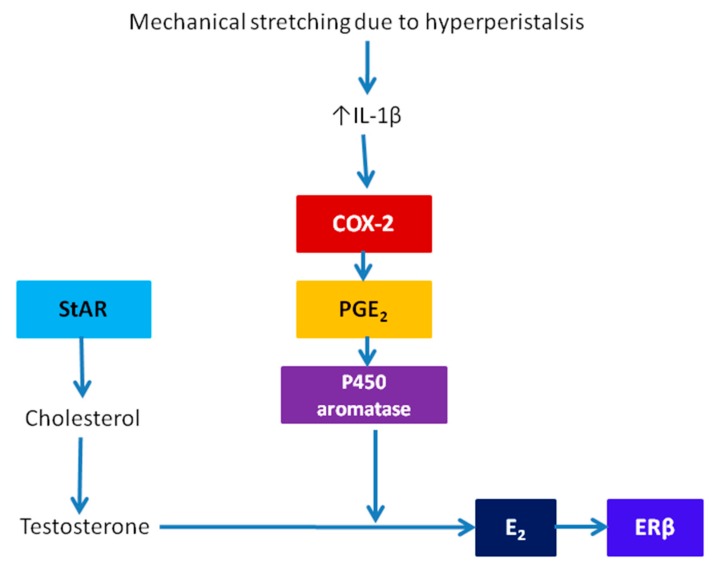
“Thus, hyperperistalsis may induce COX-2 expression and higher PGE2 production in endometrial stromal cells, but it is unlikely to further induce increased estrogen production.”
§ The Pathogenesis of Adenomyosis vis-à-vis Endometriosis > 3. Pathogenesis > 3.3. The TIAR Theory: The Need for Patching up
hedgedconditional- Asserted: passes — The authors put it forward as true.
- Checkable: passes — It can be checked against evidence.
- Load-bearing: passes — The paper’s conclusions depend on it.
- Based: passes — The paper gives a reason why it holds.
It may state two separate claims as one.
None of the sources cited for this claim have been checked yet.
In the paper
“Indeed, the newly reported association between focal adenomyosis of the outer myometrium (FAOM) and deep endometriosis (DE) [61,62] suggests that not all subtypes of adenomyosis are the same and may have a different pathogenesis.”
§ The Pathogenesis of Adenomyosis vis-à-vis Endometriosis > 3. Pathogenesis > 3.3. The TIAR Theory: The Need for Patching up
What the sources say
- Not checked yetcites [61] Chapron, 2017, Relationship between the magnetic resonance imaging appearance of adenomyosis and endometriosis phenotypes, Hum. Reprod. source
- Not checked yetcites [62] Marcellin, 2018, Anterior Focal Adenomyosis and Bladder Deep Infiltrating Endometriosis, Is There a Link?, J. Minim. Invasive Gynecol. source
hedgedcorrelational- Asserted: passes — The authors put it forward as true.
- Checkable: passes — It can be checked against evidence.
- Load-bearing: passes — The paper’s conclusions depend on it.
- Based: passes — The paper gives a reason why it holds.
It may state two separate claims as one.
In the paper
“but inhibition of pituitary prolactin secretion during youth in mice suppressed the induction of adenomyosis [60], suggesting the potential role of prolactin in the pathogenesis of adenomyosis.”
§ The Pathogenesis of Adenomyosis vis-à-vis Endometriosis > 3. Pathogenesis > 3.3. The TIAR Theory: The Need for Patching up
What the sources say
- Not checked yetcites [60] Nagasawa, 1982, Stimulation of mammary tumorigenesis and suppression of uterine adenomyosis by temporary inhibition of pituitary prolactin secretion during youth in mice (41492), Proc. Soc. Exp. Biol. Med. source
hedgedconditional- Asserted: passes — The authors put it forward as true.
- Checkable: passes — It can be checked against evidence.
- Load-bearing: unclear — It is unclear whether the paper’s conclusions depend on it.
- Based: passes — The paper gives a reason why it holds.
It may state two separate claims as one.
A conclusion the paper draws from its own results — it cites no other source for it, so there is none to check. The quote shows it is in the paper.
In the paper
“More importantly, it is difficult, if not impossible, to devise an experiment to prove or disprove either theory.”
§ The Pathogenesis of Adenomyosis vis-à-vis Endometriosis > 3. Pathogenesis > 3.3. The TIAR Theory: The Need for Patching up
plain- Asserted: passes — The authors put it forward as true.
- Checkable: fails — It may be too vague to check against evidence.
- Load-bearing: passes — The paper’s conclusions depend on it.
- Based: fails — The paper may give no reason why it holds.
Probably not a substantial claim. It may be too vague to check against evidence. The paper may give no reason why it holds.
None of the sources cited for this claim have been checked yet.
In the paper
“Thus, hypoxia may well be viewed as the single most important event following tissue injury, and, indeed, adaptation to hypoxic stress via HIF signaling plays a critical role in promoting wound healing processes [74,75].”
§ The Pathogenesis of Adenomyosis vis-à-vis Endometriosis > 3. Pathogenesis > 3.4. Revamping the TIAR Theory: The Endometrial-Myometrial Interface Disruption (EMID)
What the sources say
hedgedconditional- Asserted: passes — The authors put it forward as true.
- Checkable: passes — It can be checked against evidence.
- Load-bearing: passes — The paper’s conclusions depend on it.
- Based: passes — The paper gives a reason why it holds.
It may state two separate claims as one.
A conclusion the paper draws from its own results — it cites no other source for it, so there is none to check. The quote shows it is in the paper.
In the paper
“Hence, the injury to the EMI constitutes a trauma, leading to subsequent tissue hypoxia in myocytes and fibroblasts.”
§ The Pathogenesis of Adenomyosis vis-à-vis Endometriosis > 3. Pathogenesis > 3.4. Revamping the TIAR Theory: The Endometrial-Myometrial Interface Disruption (EMID)
plaindirect- Asserted: passes — The authors put it forward as true.
- Checkable: passes — It can be checked against evidence.
- Load-bearing: passes — The paper’s conclusions depend on it.
- Based: unclear — It is unclear why the paper says it holds.
It may state two separate claims as one.
A conclusion the paper draws from its own results — it cites no other source for it, so there is none to check. The quote shows it is in the paper.
In the paper
“Even though adenomyotic lesions (used to be called endometriosis interna) may resemble DE lesions (now called adenomyosis externa [107]) in their look and feel, their developmental paths may be similar but not entirely the same, due to their different microenvironment.”
§ The Pathogenesis of Adenomyosis vis-à-vis Endometriosis > 4. Conclusions
hedgedconditional- Asserted: passes — The authors put it forward as true.
- Checkable: passes — It can be checked against evidence.
- Load-bearing: passes — The paper’s conclusions depend on it.
- Based: passes — The paper gives a reason why it holds.
It may state two separate claims as one.
In the paper
“it raises a tantalizing possibility that perioperative intervention could reduce the risk of adenomyosis, as in the case of a reduction in recurrence risk in endometriosis [100].”
§ The Pathogenesis of Adenomyosis vis-à-vis Endometriosis > 3. Pathogenesis > 3.4. Revamping the TIAR Theory: The Endometrial-Myometrial Interface Disruption (EMID)
What the sources say
- Not checked yetcites [100] Long, 2019, Perioperative Intervention by beta-Blockade and NF-kappaB Suppression Reduces the Recurrence Risk of Endometriosis in Mice Due to Incomplete Excision, Reprod. Sci. source
hedgedconditional- Asserted: passes — The authors put it forward as true.
- Checkable: passes — It can be checked against evidence.
- Load-bearing: passes — The paper’s conclusions depend on it.
- Based: passes — The paper gives a reason why it holds.
Probably not a substantial claim.
A conclusion the paper draws from its own results — it cites no other source for it, so there is none to check. The quote shows it is in the paper.
In the paper
“Conceivably, these surgical procedures would result in the direct implantation of endometrial cells ectopically within the abdominal wall.”
§ The Pathogenesis of Adenomyosis vis-à-vis Endometriosis > 3. Pathogenesis > 3.5. Similarities and Difference in Pathogenesis between Adenomyosis and Endometriosis
hedgedconditional- Asserted: passes — The authors put it forward as true.
- Checkable: passes — It can be checked against evidence.
- Load-bearing: fails — The paper’s conclusions may not depend on it.
- Based: passes — The paper gives a reason why it holds.
Probably not a substantial claim. The paper’s conclusions may not depend on it.
In the paper
“Note that hypoxia-induced COX-2 overexpression can increase the production of not only PGE2 but also PGH2, which leads to increased production of thromboxane A2 (TXA2), a vasoconstrictor, a potent platelet activator, and a potent inducer of uterine contraction [99].”
§ The Pathogenesis of Adenomyosis vis-à-vis Endometriosis > 3. Pathogenesis > 3.4. Revamping the TIAR Theory: The Endometrial-Myometrial Interface Disruption (EMID)
What the sources say
- Not checked yetcites [99] Wilhelmsson, 1981, PGH2, TxA2 and PGI2 have potent and differentiated actions on human uterine contractility, Prostaglandins source
plaindirect- Asserted: passes — The authors put it forward as true.
- Checkable: passes — It can be checked against evidence.
- Load-bearing: passes — The paper’s conclusions depend on it.
- Based: passes — The paper gives a reason why it holds.
It may state two separate claims as one.
A conclusion the paper draws from its own results — it cites no other source for it, so there is none to check. The quote shows it is in the paper.
In the paper
“The release of adrenaline/noradrenaline and PGE2 can reduce cell-mediated immunity, promoting the survival of spread and displaced endometrial cells.”
§ The Pathogenesis of Adenomyosis vis-à-vis Endometriosis > 3. Pathogenesis > 3.4. Revamping the TIAR Theory: The Endometrial-Myometrial Interface Disruption (EMID)
plaindirect- Asserted: passes — The authors put it forward as true.
- Checkable: passes — It can be checked against evidence.
- Load-bearing: passes — The paper’s conclusions depend on it.
- Based: fails — The paper may give no reason why it holds.
Probably not a substantial claim. The paper may give no reason why it holds.
A conclusion the paper draws from its own results — it cites no other source for it, so there is none to check. The quote shows it is in the paper.
In the paper
“Thus, the increased estrogen levels may induce an ERα-mediated OT/OTR system, enhancing uterine peristalsis.”
§ The Pathogenesis of Adenomyosis vis-à-vis Endometriosis > 3. Pathogenesis > 3.4. Revamping the TIAR Theory: The Endometrial-Myometrial Interface Disruption (EMID)
hedgedconditional- Asserted: passes — The authors put it forward as true.
- Checkable: passes — It can be checked against evidence.
- Load-bearing: passes — The paper’s conclusions depend on it.
- Based: unclear — It is unclear why the paper says it holds.
It may state two separate claims as one.
None of the sources cited for this claim have been checked yet.
In the paper
“HIF-1α-induced COX-2 expression leads to elevated PGE2 levels, which can induce PGE2-mediated vascularization [87,88].”
§ The Pathogenesis of Adenomyosis vis-à-vis Endometriosis > 3. Pathogenesis > 3.4. Revamping the TIAR Theory: The Endometrial-Myometrial Interface Disruption (EMID)
What the sources say
plaindirect- Asserted: passes — The authors put it forward as true.
- Checkable: passes — It can be checked against evidence.
- Load-bearing: passes — The paper’s conclusions depend on it.
- Based: passes — The paper gives a reason why it holds.
It may state two separate claims as one.
A conclusion the paper draws from its own results — it cites no other source for it, so there is none to check. The quote shows it is in the paper.
In the paper
“While it can explain the genesis of adenomyosis induced by iatrogenic trauma, it may also explain the pathogenesis of adenomyosis due to persistent hyperperistalsis that causes EMID, but probably not FAOM or extrinsic/exterior adenomyosis.”
§ The Pathogenesis of Adenomyosis vis-à-vis Endometriosis > 3. Pathogenesis > 3.4. Revamping the TIAR Theory: The Endometrial-Myometrial Interface Disruption (EMID)
hedgedconditional- Asserted: passes — The authors put it forward as true.
- Checkable: passes — It can be checked against evidence.
- Load-bearing: passes — The paper’s conclusions depend on it.
- Based: passes — The paper gives a reason why it holds.
It may state two separate claims as one.
A conclusion the paper draws from its own results — it cites no other source for it, so there is none to check. The quote shows it is in the paper.
In the paper
“For example, perioperative intervention when iatrogenic procedures such as D&C are performed may reduce the risk of developing adenomyosis in the first place.”
§ The Pathogenesis of Adenomyosis vis-à-vis Endometriosis > 4. Conclusions
hedgedconditional- Asserted: passes — The authors put it forward as true.
- Checkable: passes — It can be checked against evidence.
- Load-bearing: passes — The paper’s conclusions depend on it.
- Based: fails — The paper may give no reason why it holds.
Probably not a substantial claim. The paper may give no reason why it holds.
In the paper
“As adenomyosis shares with endometriosis in cyclic bleeding and thus ReTIAR”
§ The Pathogenesis of Adenomyosis vis-à-vis Endometriosis > 4. Conclusions
What the sources say
- Not checked yetcites [104] Guo, 2018, Fibrogenesis resulting from cyclic bleeding, the Holy Grail of the natural history of ectopic endometrium, Hum. Reprod. source
plaindirect- Asserted: passes — The authors put it forward as true.
- Checkable: passes — It can be checked against evidence.
- Load-bearing: passes — The paper’s conclusions depend on it.
- Based: passes — The paper gives a reason why it holds.
It may state two separate claims as one.
A conclusion the paper draws from its own results — it cites no other source for it, so there is none to check. The quote shows it is in the paper.
In the paper
“In addition, increased estradiol levels would induce ERα, which further activate OT/OTR signaling pathway, causing increased peristalsis.”
§ The Pathogenesis of Adenomyosis vis-à-vis Endometriosis > 3. Pathogenesis > 3.4. Revamping the TIAR Theory: The Endometrial-Myometrial Interface Disruption (EMID)
hedgeddirect- Asserted: passes — The authors put it forward as true.
- Checkable: passes — It can be checked against evidence.
- Load-bearing: passes — The paper’s conclusions depend on it.
- Based: fails — The paper may give no reason why it holds.
Probably not a substantial claim. The paper may give no reason why it holds. It may state two separate claims as one.
A conclusion the paper draws from its own results — it cites no other source for it, so there is none to check. The quote shows it is in the paper.
In the paper
“That adenomyosis is not simply endometriosis of the uterus implies that, when it comes to management and prevention, interventions that are carefully tailored to adenomyosis should be more effective.”
§ The Pathogenesis of Adenomyosis vis-à-vis Endometriosis > 4. Conclusions
hedgeddirect- Asserted: passes — The authors put it forward as true.
- Checkable: fails — It may be too vague to check against evidence.
- Load-bearing: passes — The paper’s conclusions depend on it.
- Based: passes — The paper gives a reason why it holds.
Probably not a substantial claim. It may be too vague to check against evidence.
A conclusion the paper draws from its own results — it cites no other source for it, so there is none to check. The quote shows it is in the paper.
In the paper
“In fact, even for adenomyosis, there might be two or more different pathogenic origins, for example, the FAOM, or extrinsic or external adenomyosis, might originate from the invasion of neighboring DE lesions.”
§ The Pathogenesis of Adenomyosis vis-à-vis Endometriosis > 3. Pathogenesis > 3.5. Similarities and Difference in Pathogenesis between Adenomyosis and Endometriosis
hedgedconditional- Asserted: passes — The authors put it forward as true.
- Checkable: passes — It can be checked against evidence.
- Load-bearing: passes — The paper’s conclusions depend on it.
- Based: passes — The paper gives a reason why it holds.
It may state two separate claims as one.
A conclusion the paper draws from its own results — it cites no other source for it, so there is none to check. The quote shows it is in the paper.
In the paper
“Together, these catecholamines and PGE2 would impair the cell-mediated immunity, promoting the survival of displaced and dispersed cells that spread to the EMI and possibly beyond due to the procedure.”
§ The Pathogenesis of Adenomyosis vis-à-vis Endometriosis > 3. Pathogenesis > 3.4. Revamping the TIAR Theory: The Endometrial-Myometrial Interface Disruption (EMID)
hedgeddirect- Asserted: passes — The authors put it forward as true.
- Checkable: passes — It can be checked against evidence.
- Load-bearing: passes — The paper’s conclusions depend on it.
- Based: unclear — It is unclear why the paper says it holds.
It may state two separate claims as one.
A conclusion the paper draws from its own results — it cites no other source for it, so there is none to check. The quote shows it is in the paper.
In the paper
“In addition, since uterine procedures using different energy sources result in different severities of injury and bleeding patterns, the resultant EMID would lead to differential = risk of developing adenomyosis.”
§ The Pathogenesis of Adenomyosis vis-à-vis Endometriosis > 3. Pathogenesis > 3.4. Revamping the TIAR Theory: The Endometrial-Myometrial Interface Disruption (EMID)
hedgeddirect- Asserted: passes — The authors put it forward as true.
- Checkable: passes — It can be checked against evidence.
- Load-bearing: unclear — It is unclear whether the paper’s conclusions depend on it.
- Based: unclear — It is unclear why the paper says it holds.
It may state two separate claims as one.
A conclusion the paper draws from its own results — it cites no other source for it, so there is none to check. The quote shows it is in the paper.
In the paper
“The model depicted in Figure 3 is completely falsifiable.”
§ The Pathogenesis of Adenomyosis vis-à-vis Endometriosis > 3. Pathogenesis > 3.4. Revamping the TIAR Theory: The Endometrial-Myometrial Interface Disruption (EMID)
boosted- Asserted: passes — The authors put it forward as true.
- Checkable: fails — It may be too vague to check against evidence.
- Load-bearing: fails — The paper’s conclusions may not depend on it.
- Based: fails — The paper may give no reason why it holds.
Probably not a substantial claim. It may be too vague to check against evidence. The paper’s conclusions may not depend on it. The paper may give no reason why it holds.
A conclusion the paper draws from its own results — it cites no other source for it, so there is none to check. The quote shows it is in the paper.
In the paper
“Unlike the TIAR theory, the EMID hypothesis is easily falsifiable, at least in mouse.”
§ The Pathogenesis of Adenomyosis vis-à-vis Endometriosis > 4. Conclusions
plain- Asserted: passes — The authors put it forward as true.
- Checkable: fails — It may be too vague to check against evidence.
- Load-bearing: passes — The paper’s conclusions depend on it.
- Based: fails — The paper may give no reason why it holds.
Probably not a substantial claim. It may be too vague to check against evidence. The paper may give no reason why it holds.
A conclusion the paper draws from its own results — it cites no other source for it, so there is none to check. The quote shows it is in the paper.
In the paper
“Thus, when EMID occurs, such as in the D&C procedure, the resultant tissue hypoxia would lead to platelet aggregation, increased estrogen production, induction of the TGF-β1, VEGF, PDGF, COX-2, and SDF-1 signaling and the resultant elevated PGE2 production, induction of EMT, and increased recruitment of BMDSCs in the wound site, all of which can promote the mobility and implantation of endometrial”
§ The Pathogenesis of Adenomyosis vis-à-vis Endometriosis > 3. Pathogenesis > 3.4. Revamping the TIAR Theory: The Endometrial-Myometrial Interface Disruption (EMID)
hedgeddirect- Asserted: passes — The authors put it forward as true.
- Checkable: passes — It can be checked against evidence.
- Load-bearing: passes — The paper’s conclusions depend on it.
- Based: passes — The paper gives a reason why it holds.
It may state two separate claims as one.
A conclusion the paper draws from its own results — it cites no other source for it, so there is none to check. The quote shows it is in the paper.
In the paper
“Thus, EMID may induce EMT in adjacent endometrial epithelial cells and enhance their mobility and invasiveness, resulting in the crossing of EMI to the myometrium by endometrial epithelial cells.”
§ The Pathogenesis of Adenomyosis vis-à-vis Endometriosis > 3. Pathogenesis > 3.4. Revamping the TIAR Theory: The Endometrial-Myometrial Interface Disruption (EMID)
hedgedconditional- Asserted: passes — The authors put it forward as true.
- Checkable: passes — It can be checked against evidence.
- Load-bearing: passes — The paper’s conclusions depend on it.
- Based: passes — The paper gives a reason why it holds.
It may state two separate claims as one.
A conclusion the paper draws from its own results — it cites no other source for it, so there is none to check. The quote shows it is in the paper.
In the paper
“For example, the use of coagulation might lead to a lower risk of adenomyosis than the D&C procedure.”
§ The Pathogenesis of Adenomyosis vis-à-vis Endometriosis > 3. Pathogenesis > 3.4. Revamping the TIAR Theory: The Endometrial-Myometrial Interface Disruption (EMID)
hedgedconditional- Asserted: passes — The authors put it forward as true.
- Checkable: passes — It can be checked against evidence.
- Load-bearing: fails — The paper’s conclusions may not depend on it.
- Based: passes — The paper gives a reason why it holds.
Probably not a substantial claim. The paper’s conclusions may not depend on it.
A conclusion the paper draws from its own results — it cites no other source for it, so there is none to check. The quote shows it is in the paper.
In the paper
“This model can at least account for the genesis of adenomyosis arising from iatrogenic trauma such as uterine procedures, but perhaps not for adenomyosis induced by other causes.”
§ The Pathogenesis of Adenomyosis vis-à-vis Endometriosis > 3. Pathogenesis > 3.4. Revamping the TIAR Theory: The Endometrial-Myometrial Interface Disruption (EMID)
hedgedconditional- Asserted: passes — The authors put it forward as true.
- Checkable: passes — It can be checked against evidence.
- Load-bearing: passes — The paper’s conclusions depend on it.
- Based: passes — The paper gives a reason why it holds.
It may state two separate claims as one.
The paper relies on this without support.
The molecular mechanisms of wound healing in non-endometrial tissues apply to the endometrial–myometrial interface and adenomyosis pathogenesis.
“Based on the current understanding of wound healing, a new hypothesis, called endometrial-myometrial interface disruption (EMID), is proposed to account for adenomyosis resulting from iatrogenic trauma to EMI.”
The paper relies on this without support.
The mouse EMID model is a valid model for human adenomyosis.
“In fact, EMID can robustly induce adenomyosis in mice (Hao et al., submitted for publication).”
The paper relies on this without support.
Normal endometrial stromal cells studied in vitro reflect normal endometrial stromal cells in vivo.
“Yet normal endometrial stromal cells are very different in behavior from endometriotic or even adenomyotic stromal cells.”
The paper relies on this without support.
Iatrogenic procedures are common in gynecological practice nowadays.
“iatrogenic procedures aplenty nowadays in gynecological practice”
The paper relies on this without support.
Many medications used primarily for treating endometriosis can and have been used also for treating adenomyosis.
“many medications used primarily for treating endometriosis can and have been used also for treating adenomyosis”
Claims other papers make about this one
Each is checked against this paper’s own text: does it say what the citing paper says it does?
In the citing paper
“The majority of research includes instances of gynecologic surgery for benign conditions such as adenomyosis, uterine leiomyomas, and fibroids [17,18]”
From Challenges in Diagnosis and Prevention of Iatrogenic Endometriosis as a Long-Term Surgical Complication after C-Section (2022) · cites this paper as [18]
Citations
Cites
Activation of vascular endothelial growth factor gene transcription by hypoxia-inducible factor 1
Forsythe, J. A., Jiang, B.-H., Iyer, N. V., Agani, F., Leung, S. W., Koos, R. D., & Semenza, G. L. (1996) · Molecular and Cellular Biology · doi:10.1128/mcb.16.9.4604 · Cited by 3,981
Hypoxia-inducible factors in physiology and medicine
Semenza, G. L. (2012) · Cell · doi:10.1016/j.cell.2012.01.021 · Cited by 3,645 · cited 1×
“Once hypoxic, evolutionarily conserved adaptive processes, such as hypoxia-inducible factors (HIFs), are activated [73].”
BackgroundGiudice, L. C., & Kao, L. C. (2004) · The Lancet · doi:10.1016/s0140-6736(04)17403-5 · Cited by 3,166
Progenitor cell trafficking is regulated by hypoxic gradients through HIF-1 induction of SDF-1
Ceradini, D. J., Kulkarni, A. R., Callaghan, M. J., Tepper, O. M., Bastidas, N., Kleinman, M. E., Capla, J. M., Galiano, R. D., Levine, J. P., & Gurtner, G. C. (2004) · Nature Medicine · doi:10.1038/nm1075 · Cited by 2,600
Cyclooxygenase regulates angiogenesis induced by colon cancer cells
Tsujii, M., Kawano, S., Tsuji, S., Sawaoka, H., Hori, M., & DuBois, R. N. (1998) · Cell · doi:10.1016/s0092-8674(00)81433-6 · Cited by 2,272
Endometriosis: pathogenesis and treatment
Vercellini, P., Viganò, P., Somigliana, E., & Fedele, L. (2014) · Nature Reviews Endocrinology · doi:10.1038/nrendo.2013.255 · Cited by 1,940 · cited 1×
“Sampson’s retrograde menstruation theory is the most widely accepted and has the most robust evidence [27].”
BackgroundPathogenesis and pathophysiology of endometriosis
Burney, R. O., & Giudice, L. C. (2012) · Fertility and Sterility · doi:10.1016/j.fertnstert.2012.06.029 · Cited by 1,590 · cited 1×
“For endometriosis, several theories regarding its pathogenesis have been proposed, and these hypotheses can be divided into three themes: in situ development (such as coelomic metaplasia or embryonic cell rests), implantation, or a combination of in situ development and implantation [25,26].”
BackgroundHIF‐1α is required for solid tumor formation and embryonic vascularization
Ryan, H. E., Lo, J., & Johnson, R. S. (1998) · The EMBO Journal · doi:10.1093/emboj/17.11.3005 · Cited by 1,579 · cited 2×
“Hypoxia can also enhance cellular viability and proliferation through upregulation of insulin growth factor 2 (IGF-2) and IGF binding protein 3 (IGF-BP3) [85].”
BackgroundGreenhough, A., Smartt, H. J. M., Moore, A. E., Roberts, H. R., Williams, A. C., Paraskeva, C., & Kaidi, A. (2009) · Carcinogenesis · doi:10.1093/carcin/bgp014 · Cited by 1,220 · cited 1×
“HIF-1α-induced COX-2 expression leads to elevated PGE2 levels, which can induce PGE2-mediated vascularization [87,88].”
BackgroundRisk for and consequences of endometriosis: A critical epidemiologic review
Shafrir, A. L., Farland, L. V., Shah, D. K., Harris, H. R., Kvaskoff, M., Zondervan, K., & Missmer, S. A. (2018) · Best Practice & Research Clinical Obstetrics & Gynaecology · doi:10.1016/j.bpobgyn.2018.06.001 · Cited by 823 · cited 1×
“The risk profiles for adenomyosis are thus quite different from that of endometriosis, in which greater parity is a protective factor, while earlier age at menarche and shorter menstrual cycle length—factors that are consistent with Sampson’s retrograde menstruation theory for the etiology of endometriosis—are risk fa…”
Background
Research works printed but not linked: 1
- Lacassagne, 1935, Modifications progressive de I’uterus de la souris sous l’action prolongee de I’oestrone, C R Seances Soc. Bioi., 35, 320
Cited by
Sorted by citations
Pathogenesis of Endometriosis: The Origin of Pain and Subfertility
Gruber, T. M., & Mechsner, S. (2021) · Cells · doi:10.3390/cells10061381 · Cited by 237
“The actual AM prevalence has therefore been underestimated for many years [69].”
BackgroundImmunological changes associated with adenomyosis: a systematic review
Bourdon, M., Santulli, P., Jeljeli, M. M., Vannuccini, S., Marcellin, L., Doridot, L., Petraglia, F., Batteux, F., & Chapron, C. (2020) · Human Reproduction Update · doi:10.1093/humupd/dmaa038 · Cited by 195
Uterine bleeding: how understanding endometrial physiology underpins menstrual health
Jain, V., Chodankar, R. R., Maybin, J. A., & Critchley, H. (2022) · Nature Reviews Endocrinology · doi:10.1038/s41574-021-00629-4 · Cited by 206
Molecular Basis of Endometriosis and Endometrial Cancer: Current Knowledge and Future Perspectives
Terzić, M., Aimagambetova, G. N., Kunz, J., Bapayeva, G., Aitbayeva, B., Terzic, S., & Laganà, A. S. (2021) · International Journal of Molecular Sciences · doi:10.3390/ijms22179274 · Cited by 115
“Adenomyosis can be classified in several different subtypes: (a) intrinsic adenomyosis, (b) extrinsic adenomyosis, (c) adenomyosis externa, and (d) focal adenomyosis located in the outer myometrium [35,37,38].”
BackgroundCracking the enigma of adenomyosis: an update on its pathogenesis and pathophysiology
Guo, S. (2022) · Reproduction · doi:10.1530/rep-22-0224 · Cited by 93
Self-citationPathogenesis of Human Adenomyosis: Current Understanding and Its Association with Infertility
Khan, K. N., Fujishita, A., & Mori, T. (2022) · Journal of Clinical Medicine · doi:10.3390/jcm11144057 · Cited by 77
“Repeated tissue injury and repair at EMI caused by uncontrolled menstruation and EMID acts as initial trigger for EMT.”
BackgroundInfluentialRelationship between adenomyosis and endometriosis; Different phenotypes of a single disease?
Maruyama, S., Imanaka, S., Nagayasu, M., Kimura, M., & Kobayashi, H. (2020) · European Journal of Obstetrics & Gynecology and Reproductive Biology · doi:10.1016/j.ejogrb.2020.08.019 · Cited by 67
“The inner structure, which includes the endometrium, subendometrial junctional zone (JZ) and the underlying stratum subvasculare of the myometrium, is called ‘archimetra’ and originates from the Müllerian duct [7,15].”
BackgroundInfluentialOrigin and Pathogenic Mechanisms of Uterine Adenomyosis: What Is Known So Far
Stratopoulou, C. A., Donnez, J., & Dolmans, M. (2020) · Reproductive Sciences · doi:10.1007/s43032-020-00361-w · Cited by 69
Immunology and Immunotherapy of Endometriosis
Maksym, R., Hoffmann, M., Skibińska, M., Rabijewski, M., Mackiewicz, A. A., & Kiéda, C. (2021) · Journal of Clinical Medicine · doi:10.3390/jcm10245879 · Cited by 61
“and may contribute to fertility disorders in endometriosis [7,8].”
BackgroundEndometriosis: recent advances that could accelerate diagnosis and improve care
Griffiths, M. J., Horne, A. W., Gibson, D. A., Roberts, N., & Saunders, P. T. K. (2024) · Trends in Molecular Medicine · doi:10.1016/j.molmed.2024.06.008 · Cited by 64
Vercellini, P., Bandini, V., Viganò, P., Stefano, G. D., Merli, C. E. M., & Somigliana, E. (2023) · Human Reproduction · doi:10.1093/humrep/dead229 · Cited by 50
“…and blood-mediated tissue injury and repair and monthly transtubal ment-rual reflux may be greater than the female immune system has genetically evolved to handle at the endo-myometrial junction or within the pelvic environment, respectively (Guo, 2020; Maruyama et al. , 2020; Kobayashi, 2023).”
InfluentialHassanin, A. I., Youssef, A. A., Yousef, A. M., & Ali, M. K. (2021) · International Journal of Gynecology & Obstetrics · doi:10.1002/ijgo.13600 · Cited by 46
Alcázar, J. L., Vara, J., Usandizaga, C., AJOSSA, S., Pascual, M. A., & Guerriero, S. (2022) · International Journal of Gynecology & Obstetrics · doi:10.1002/ijgo.14609 · Cited by 52
Uterine disorders and iron deficiency anemia
Donnez, J., Carmona, F., Maitrot‐Mantelet, L., Dolmans, M., & Chapron, C. (2022) · Fertility and Sterility · doi:10.1016/j.fertnstert.2022.08.011 · Cited by 49
Yang, B. X., Gu, N.-H., Shu, S., Zhang, C., Chen, L., Ouyang, J., Lin, Y., Sun, F., & Xu, H. (2021) · Reproductive Sciences · doi:10.1007/s43032-021-00513-6 · Cited by 46
“Although endometriosis and adenomyosis are proximate in histomorphology and ectopic growth of the endometrium, their clinical characteristics and pathogenesis are not identical [15].”
BackgroundEndometriosis and Adenomyosis: From Pathogenesis to Follow-Up
Martire, F. G., Costantini, E., d’Abate, C., Schettini, G., Sorrenti, G., Centini, G., Zupi, E., & Lazzeri, L. (2025) · Current Issues in Molecular Biology · doi:10.3390/cimb47050298 · Cited by 46
“Following injury, SCs transform into a non-myelinated state [77], causing changes in EMI, mediated by the overexpression of several genes involved in tissue repair [78].”
Adenomyosis and Adolescence: A Challenging Diagnosis and Complex Management
Martire, F. G., d’Abate, C., Schettini, G., Cimino, G., Ginetti, A., Colombi, I., Cannoni, A., Centini, G., Zupi, E., & Lazzeri, L. (2024) · Diagnostics · doi:10.3390/diagnostics14212344 · Cited by 38
“A hypothesis on the pivotal role of dSCs in this process has been formulated, stating that dedifferentiated Schwann cells might differentiate into endometrial epithelial cells following multiple stimuli by growth factors, estrogen, and inflammatory cytokines [25,26].”
BackgroundHao, M., Liu, X., & Guo, S. (2020) · Reproductive BioMedicine Online · doi:10.1016/j.rbmo.2020.07.023 · Cited by 40
“…in endometriotic stromal cells (Qi et al., 2019; Qi et al., 2020), and identification of the role of hypoxia in dramatically changing cellular phenotypes in endometrial cells (Hsiao et al., 2015), this group has recently proposed a new hypothesis on the pathogenesis of adenomyosis (Guo, 2020).”
BackgroundSelf-citationADSC Exosomes Mediate lncRNA-MIAT Alleviation of Endometrial Fibrosis by Regulating miR-150-5p
Shao, X., Qin, J., Wan, C., et al. (2021) · Frontiers in Genetics · doi:10.3389/fgene.2021.679643 · Cited by 31
“The pathological manifestation of endometrial fibrosis is the attachment of endometrial glandular epithelium and interstitial fibrous tissue, resulting in a sharp decrease or even complete loss of normal endometrial tissue (Guo, 2020).”
BackgroundChen, T., Xu, Y., Xu, X., Wang, J., Qiu, Z., Yu, Y., Jiang, X., Shao, W., Bai, D., Wang, M., et al. (2024) · Protein & Cell · doi:10.1093/procel/pwae012 · Cited by 31
“The invagination theory implicates abnormal inward growth of endometrium, the metaplasia theory conversely suggests adenomyosis originates from stem cell dysregulation within the myometrial compartment (Guo, 2020).”
Bourdon, M., Santulli, P., Doridot, L., Jeljeli, M. M., Chêne, C., Chouzenoux, S., Nicco, C., Marcellin, L., Chapron, C., & Batteux, F. (2021) · Molecular Human Reproduction · doi:10.1093/molehr/gaab053 · Cited by 30
Mechanisms and Pathogenesis of Adenomyosis
Rossi, M., Vannuccini, S., Capezzuoli, T., Fambrini, M., Vannuzzi, V., Donati, C., & Petraglia, F. (2022) · Current Obstetrics and Gynecology Reports · doi:10.1007/s13669-022-00326-7 · Cited by 30
Habiba, M. A., Benagiano, G., & Guo, S. (2023) · Biomolecules · doi:10.3390/biom13060975 · Cited by 31
“Unfortunately, most of the arguments presented to support the theory [4–6] are based on the feed-forward loop model that is true for ectopic endometrium [58], not myometrium or normal endometrium, as elaborated previously [59].”
BackgroundSelf-citationSalmeri, N., Farina, A., Candiani, M., Dolci, C., Bonavina, G., Poziello, C., Viganò, P., & Cavoretto, P. I. (2022) · Diagnostics · doi:10.3390/diagnostics12051024 · Cited by 30
“Yet even if previous studies [19] have demonstrated significant differences in mean UtA-PIs between patients with diffuse adenomyosis and controls, we did not include adenomyosis in our work because of the well-known pathophysiological difference between endometriosis itself and adenomyosis [61].”
ResultWang, Y., Duan, H., Wang, S., Quan, Y., Huang, J., & Guo, Z. (2021) · Reproductive Sciences · doi:10.1007/s43032-020-00444-8 · Cited by 27
“Nevertheless, the classical invagination theory, as one of the two major prevailing theories on the pathogenesis of ADS, supported that the disease may develop through aberrant metaplasia and non-malignant invagination of the endometrial basalis embedded into the myometrium [3, 4].”
BackgroundDonnez, J., Donnez, O., Tourniaire, J., Brethous, M., Bestel, E., Garner, E. I. O., Charpentier, S., Humberstone, A., & Loumaye, E. (2021) · Journal of Clinical Medicine · doi:10.3390/jcm10245794 · Cited by 28
Identifying Common Pathogenic Features in Deep Endometriotic Nodules and Uterine Adenomyosis
Stratopoulou, C. A., Camboni, A., Donnez, J., & Dolmans, M. (2021) · Journal of Clinical Medicine · doi:10.3390/jcm10194585 · Cited by 27
Various types of adenomyosis and endometriosis: in search of optimal management
Guo, S. (2023) · Fertility and Sterility · doi:10.1016/j.fertnstert.2023.03.021 · Cited by 24
Self-citationWang, Y., Duan, H., Wang, S., Quan, Y., Huang, J., & Guo, Z. (2021) · Reproductive Biology and Endocrinology · doi:10.1186/s12958-021-00756-7 · Cited by 23
“According to the invagination and EMID (endometrial-myometrial interface disruption) theory [2, 3], ADS may actually derives from the excessive invasion of altered endometrial basalis into myometrium, after passing through the disrupted EMI.”
BackgroundKobayashi, H. (2023) · International Journal of Environmental Research and Public Health · doi:10.3390/ijerph20043762 · Cited by 22
“Recent advances in molecular biology and animal models have enriched our understanding of the pathogenesis of adenomyosis [2].”
BackgroundAlson, S., Jokubkiene, L., Hénic, E., & Sladkevicius, P. (2024) · Acta Obstetricia Et Gynecologica Scandinavica · doi:10.1111/aogs.14812 · Cited by 20
“32,33 Such trauma may consist of pregnancy or curettage, which can damage the JZ.”
BackgroundEndometrial microbiota in women with and without adenomyosis: A pilot study
Lin, Q., Duan, H., Wang, S., Guo, Z., Wang, S., Chang, Y., Chen, C., Shen, M., Shou, H., & Zhou, C. (2023) · Frontiers in Microbiology · doi:10.3389/fmicb.2023.1075900 · Cited by 19
“Frontiers in Microbiology 02 frontiersin.org Vannuccini et al., 2017; Guo, 2020; Zhai et al., 2020; Guo et al., 2022).”
Rees, C. O., Rupert, I. A. M., Nederend, J., et al. (2022) · European Journal of Obstetrics & Gynecology and Reproductive Biology · doi:10.1016/j.ejogrb.2022.02.026 · Cited by 18
Unveiling the Pathogenesis of Adenomyosis through Animal Models
Wang, X., Benagiano, G., Liu, X., & Guo, S. (2022) · Journal of Clinical Medicine · doi:10.3390/jcm11061744 · Cited by 19
Self-citationBiasioli, A., Degano, M., Restaino, S., Bagolin, M., Moro, F., Ciccarone, F., Testa, A. C., Greco, P., Scambia, G., Vizzielli, G., et al. (2024) · Biomedicines · doi:10.3390/biomedicines12020463 · Cited by 17
“Other studies have found adenomyosis in less than half of patients presenting with endometriosis, or even an absence of a relationship between adenomyosis and endometriosis [2,7].”
BackgroundBourdon, M., Santulli, P., Kateb, F., Pocate-Cheriet, K., Batteux, F., Maignien, C., Chouzenoux, S., Bordonné, C., Marcellin, L., Bertho, G., et al. (2021) · Fertility and Sterility · doi:10.1016/j.fertnstert.2021.02.031 · Cited by 20
Gràcia, M., de Guirior, C., Valdés‐Bango, M., Rius, M., Ros, C., Matas, I., Tortajada, M., Martínez‐Zamora, M. Á., Quintas, L., & Carmona, F. (2022) · Scientific Reports · doi:10.1038/s41598-022-11179-8 · Cited by 18
The Role of Platelets in the Pathogenesis and Pathophysiology of Adenomyosis
Guo, S. (2023) · Journal of Clinical Medicine · doi:10.3390/jcm12030842 · Cited by 17
“In view of extensive epidemiological reports that iatrogenic uterine procedures, such as dilatation and curettage and induced abortion, increase the risk of adenomyosis [67–71], a new hypothesis, termed endometrial-myometrial interface (EMI) disruption (EMID), has been proposed recently [65].”
Self-citationJin, T., Li, M., Li, T., Yan, S., Ran, Q., & Chen, W. (2023) · Reproductive Sciences · doi:10.1007/s43032-023-01189-w · Cited by 18
“Currently, the pathogenesis of adenomyosis is still unclear, but one of the generally accepted theories is the invagination theory, in which endometrial cells invade the myometrium by acquiring invasiveness [5, 6].”
BackgroundMicroRNAs as Biomarkers and Therapeutic Targets in Female Infertility
Chico-Sordo, L., & García-Velasco, J. A. (2024) · International Journal of Molecular Sciences · doi:10.3390/ijms252312979 · Cited by 21
Kobayashi, H., Matsubara, S., & Imanaka, S. (2021) · Journal of obstetrics and gynaecology research · doi:10.1111/jog.14803 · Cited by 16
“adenomyosis and endometriosis have become complicated, and the boundary between the two diseases has become unclear.(21,22) A disease characterized as the”
BackgroundMethodInvestigation of the role of platelets in the aetiopathogenesis of adenomyosis
Mosele, S., Stratopoulou, C. A., Camboni, A., Donnez, J., & Dolmans, M. (2021) · Reproductive BioMedicine Online · doi:10.1016/j.rbmo.2021.01.009 · Cited by 16
Han, B., Liang, T., Zhang, W., Ma, C., & Qiao, J. (2022) · Reproductive BioMedicine Online · doi:10.1016/j.rbmo.2022.09.021 · Cited by 16
Ho, N.-T., Lin, S.-W., Lee, Y.-R., Tzeng, C., & Kao, S. (2022) · International Journal of Molecular Sciences · doi:10.3390/ijms232315328 · Cited by 16
“[41], in which tissue autotraumatization caused by malfunction of the junctional zone (JZ) initiates the TIAR process through activated estrogen receptors [42].”
BackgroundThe Impact of Adenomyosis on Pregnancy
Tsikouras, P. N., Kritsotaki, N., Nikolettos, K., Kotanidou, S., Oikonomou, E., Bothou, Α., Andreou, S., Nalmpanti, T., Chalkia, K., Spanakis, V., et al. (2024) · Biomedicines · doi:10.3390/biomedicines12081925 · Cited by 15
“Similar to uterine fibroids, adenomyotic tissues synthesize and secrete estrogen [1,29,30].”
BackgroundPostoperative Pain Is Driven by Preoperative Pain, Not by Endometriosis
Kanellos, P., Nirgianakis, K., Siegenthaler, F., Vetter, C., Mueller, M. D., & Imboden, S. (2021) · Journal of Clinical Medicine · doi:10.3390/jcm10204727 · Cited by 17
“However, there is a strong association between them, including similar clinical manifestation, frequent co-prevalence, and partly common molecular origin [23].”
BackgroundRole of Pink1-mediated mitophagy in adenomyosis
Chen, M., Wang, W. J., Fu, X., et al. (2023) · PeerJ · doi:10.7717/peerj.16497 · Cited by 14
“The natural history of AM lesions is undergoing repeated tissue injury and repair, accompanied by increased endometrial fibrosis, contributing to hypoxia ( Guo, 2020 ).”
BackgroundNeamtu, R., Dahma, G., Mocanu, A. G., Bernad, E., Silaghi, C.-I., Stelea, L., Citu, C., Dobrescu, A., Bratosin, F., Grigoras, M. L., et al. (2022) · International Journal of Environmental Research and Public Health · doi:10.3390/ijerph19052791 · Cited by 12
“The majority of research includes instances of gynecologic surgery for benign conditions such as adenomyosis, uterine leiomyomas, and fibroids [17,18], with some of them raising the hypothesis of post-cesarean scar endometriosis [19].”
BackgroundMRI-Based Radiomics as a Promising Noninvasive Diagnostic Technique for Adenomyosis
Burla, L., Sartoretti, E., Mannil, M., Seidel, S., Sartoretti, T., Krentel, H., Wilde, R. L. D., & Imesch, P. (2024) · Journal of Clinical Medicine · doi:10.3390/jcm13082344 · Cited by 13
“In adenomyosis, endometrial-type glandular tissue and stroma are located in the myometrium [1–3].”
BackgroundGan, L., Li, Y., Chen, Y., et al. (2022) · Bioengineered · doi:10.1080/21655979.2022.2077614 · Cited by 12
“Although several studies have concentrated on AM, but the etiology and pathogenesis of the AM have still remained elusive, which are worthy of further assessment [3,4].”
BackgroundEndometrial stromal cell signaling and microRNA exosome content in women with adenomyosis
Zipponi, M., Cacciottola, L., Camboni, A., Stratopoulou, C. A., Taylor, H. S., & Dolmans, M. (2024) · Molecular Human Reproduction · doi:10.1093/molehr/gaae044 · Cited by 11
Exosomes: potential diagnostic markers and drug carriers for adenomyosis
Cheng, W.-X., Wei, S., Zhou, Y., Shao, Y., & Li, M.-Y. (2023) · Frontiers in Pharmacology · doi:10.3389/fphar.2023.1216149 · Cited by 11
“proposed the concept of endometrialmyometrial interface disruption (EMID) based on the mechanism of wound healing, which is a further refinement and complement to the TIAR mechanism and the above mechanisms (Guo, 2020).”
BackgroundIn the mouse, prostaglandin D2 signalling protects the endometrium against adenomyosis
Philibert, P., Déjardin, S., Pirot, N., Pruvost, A., Nguyen, A. L., Bernex, F., Poulat, F., & Boizet‐Bonhoure, B. (2021) · Molecular Human Reproduction · doi:10.1093/molehr/gaab029 · Cited by 11
Watrowski, R., Kostov, S. G., Palumbo, M., Rosati, A., Sparić, R., Alkatout, İ., Juhasz‐Böss, I., Vitale, S. G., & Mereu, L. (2025) · International Journal of Molecular Sciences · doi:10.3390/ijms262110713 · Cited by 10
Alternative treatments of adenomyosis – an update in procedural management and clinical outcomes
Zeccola, A. M., & Allen, S. E. (2024) · Current Opinion in Obstetrics & Gynecology · doi:10.1097/gco.0000000000000972 · Cited by 10
Burla, L., Kalaitzopoulos, D. R., Samartzis, N., Khazali, S., Bokor, A., Renner, S. P., Hudelist, G., Constantin, A., Schäfer, S. D., Nassif, J., et al. (2024) · Facts Views and Vision in ObGyn · doi:10.52054/fvvo.16.3.038 · Cited by 10
The Role of MRI in Diagnosis and Pre‐Surgical Mapping of Endometriosis
Shenoy‐Bhangle, A. S., Movilla, P. R., Joyce, S., Ghosh, S., Goldstone, R. N., Kilcoyne, A., Kambadakone, A. R., Morris, S., & Harisinghani, M. G. (2025) · Journal of Magnetic Resonance Imaging · doi:10.1002/jmri.70039 · Cited by 9
Han, L., Liu, Y., Lao, K., Jiang, J., Zhang, C., & Wang, Y. (2023) · Frontiers in Medicine · doi:10.3389/fmed.2023.1133042 · Cited by 10
“The other is the endometrial metastatic hypothesis, which believes that the enhancement and disorder of endometrial peristaltic waves, intrauterine infection (including Mycobacterium tuberculosis) or surgical procedures lead to the damage of endometrial-myometrial interface, namely the endometrial myometrium junction…”
BackgroundWang, X., Liu, X., & Guo, S. (2022) · Biomedicines · doi:10.3390/biomedicines10061218 · Cited by 9
“When EMID occurs following iatrogenic uterine procedures, the resulting tissue injury initiates tissue repair, featuring platelet aggregation and hemostasis, inflammation, hypoxia, proliferation and tissue remodeling [11].”
BackgroundSelf-citationLu, K., Zhong, G., Lian, B., Zhong, X., Xie, M., & Wu, Y. (2024) · BMC Women s Health · doi:10.1186/s12905-024-03457-6 · Cited by 9
Wang, Y., & Chen, L. (2022) · Journal of Gynecology Obstetrics and Human Reproduction · doi:10.1016/j.jogoh.2022.102349 · Cited by 8
Wen, Y., Pang, L., Fan, L.-X., Zhou, Y., Li, R., Zhao, T., & Zhang, M. (2023) · PubMed Central · doi:10.22074/cellj.2023.1989631.1230 · Cited by 8
“There are many reasons for the formation and development of EMS, such as inflammation, abnormal growth, and immune factors (23, 24).”
Mao, C., Liu, X., & Guo, S. (2024) · American Journal of Obstetrics and Gynecology · doi:10.1016/j.ajog.2024.02.016 · Cited by 8
Self-citationCurrent and Future Roles of Circular RNAs in Normal and Pathological Endometrium
Tu, J., Yang, H., Chen, Y., Chen, Y., Chen, H., Li, Z., Li, L., Zhang, Y., Chen, X., & Yu, Z. (2021) · Frontiers in Endocrinology · doi:10.3389/fendo.2021.668073 · Cited by 8
Krishnamoorthy, S. P., Vignesh, K., Manimegalai, S. C., et al. (2022) · Biochemical and Biophysical Research Communications · doi:10.1016/j.bbrc.2022.05.092 · Cited by 8
The cGAS-STING pathway and female reproductive system diseases
Li, R., Liu, H., & Liu, Y. (2024) · Frontiers in Immunology · doi:10.3389/fimmu.2024.1447719 · Cited by 8
“AM lesions undergo repeated tissue injury and repair, accompanied by increased endometrial fi brosis, leading to hypoxia (59).”
BackgroundEtrusco, A., Agrifoglio, V., D’Amato, A., Chiàntera, V., Laganà, A. S., Haydamous, J., Cobellis, L., FRANCISCIS, P. D., Vannuccini, S., Krentel, H., et al. (2025) · Frontiers in Endocrinology · doi:10.3389/fendo.2025.1571727 · Cited by 9
Exploring the Endocrine Mechanisms in Adenomyosis: From Pathogenesis to Therapies
d’Otreppe, J., Patiño-García, D., Piekos, P., de Codt, M., Manavella, D. D., Courtoy, G. E., & Orellana, R. (2024) · Endocrines · doi:10.3390/endocrines5010004 · Cited by 8
“This all intensifies the stress, resulting in the invagination process described hereinabove [29].”
BackgroundHeinosalo, T., Rytkönen, K. T., Saarinen, N., Järvensivu, P., Damdimopoulou, P., Strauss, L., Orasniemi, S., Horshauge, P., Gabriel, M., Koskimies, P., et al. (2022) · International Journal of Molecular Sciences · doi:10.3390/ijms23094815 · Cited by 6
“The pathways enriched in the overlapping genes included TNFα signaling via NFKB, estrogen response, RAS-signaling and response to wounding, all also involved in adenomyosis development [35,36].”
BackgroundCao, Y., Wang, X., Liu, X., Harada, T., & Guo, S. (2022) · Reproductive and Developmental Medicine · doi:10.1097/rd9.0000000000000012 · Cited by 7
“cue, we hypothesized that endometrial-myometrial interface disruption (EMID) resulting from iatrogenic uterine procedures may increase the risk of developing adenomyosis([15]) and proved,”
BackgroundSelf-citationYang, Q., Zhang, J., & Fan, Z. (2024) · Journal of Ovarian Research · doi:10.1186/s13048-024-01466-5 · Cited by 7
“…the occurrence of adenomyosis is more likely related to the disruption of the endometrial-myometrial junctional zone barrier, the invagination of the endometrial basalis, the metaplasia of displaced embryonic pluripotent Mullerian remnants, or the differentiation of adult stem cells [57, 66].”
BackgroundCui, L., Sang, C., Li, R., & Zhao, S. (2024) · CytoJournal · doi:10.25259/cytojournal_48_2024 · Cited by 6
Wang, S., Duan, H., Wang, S., Guo, Z., & Lin, Q. (2023) · Biochemical Genetics · doi:10.1007/s10528-023-10508-4 · Cited by 6
Matalliotakis, M., Zervou, M. I., Matalliotaki, C., Goulielmos, G. N., Krithinakis, K., Kapetanios, G., & Kalogiannidis, I. (2022) · Ginekologia Polska · doi:10.5603/gp.a2021.0174 · Cited by 6
Lin, C., Wu, M., Mau, Y., et al. (2023) · Taiwanese Journal of Obstetrics and Gynecology · doi:10.1016/j.tjog.2022.12.012 · Cited by 6
Maoga, J. B., Riaz, M. A., Mwaura, A. N., Scheiner‐Bobis, G., Mecha, E. O., Omwandho, C. O. A., Meinhold-Heerlein, I. M., & Konrad, L. (2022) · Diagnostics · doi:10.3390/diagnostics12040779 · Cited by 5
“Similar to endometriosis, the pathogenesis of adenomyosis is also still unclear [12], but currently, two mechanisms, namely invagination and metaplasia, have been proposed [16]; however, our recent data favor the invagination hypothesis [19].”
BackgroundResultMethods of diagnostics of adenomyosis: a systematic review
Adamyan, L. V., Sokolov, A. D., Avetisyan, J. S., & Shapovalenko, R. (2023) · Russian Journal of Human Reproduction · doi:10.17116/repro20232903181 · Cited by 5
Menstrual Effluent in the Pathogenesis and Diagnosis of Endometriosis—A Systematic Review
Watrowski, R., Kostov, S. G., Tsoneva, E., Schäfer, S. D., Sparić, R., Palumbo, M., Günther, V., Akšam, S. S., Yordanov, A. D., Chieppa, P., et al. (2026) · Diagnostics · doi:10.3390/diagnostics16050677 · Cited by 6
“The coexistence of endometriosis with adenomyosis is up to 80%, and the pathogenetic mechanisms and clinical presentations are shared [21–23].”
Khan, K. N. (2024) · Journal of physiological investigation. · doi:10.4103/ejpi.ejpi-d-24-00032 · Cited by 4
Fan, J., Liu, X., & Guo, S. (2024) · Reproductive Sciences · doi:10.1007/s43032-024-01599-4 · Cited by 5
“Granted, endometriosis and adenomyosis may have different pathogenesis [12] but the two diseases share remarkably many molecular aberrations most likely due to their commonality of being ectopic endometrium [82].”
Self-citationZhang, L., Zhu, L., Che, P., Sun, X., Guo, Y., Gao, M., & Wang, J. (2024) · American Journal of Reproductive Immunology · doi:10.1111/aji.13901 · Cited by 6
“As Bourdon et al. and Guo demonstrated, proinflammatory cytokines including interleukin-6 (IL-6), interferon-alpha (IFN-α ), tumor necrosis factor-alpha (TNF-α ), and others are elevated in adenomyotic uteri [3, 11].”
Shen, M., Liu, X., Ding, D., & Guo, S.-W. (2025) · Reproductive BioMedicine Online · doi:10.1016/j.rbmo.2025.104880 · Cited by 7
Self-citationShi, J., Zhu, S., Li, X., Dai, Y., & Leng, J. (2023) · Journal of Gynecology Obstetrics and Human Reproduction · doi:10.1016/j.jogoh.2023.102572 · Cited by 5
Establishment of an immortalized cell line derived from human adenomyosis ectopic lesions
Wang, Z., Cui, F., Chen, Y., Liu, H., Zhang, Y., Shi, Y., Zhang, Y., Wang, Y., Liang, N., Xu, L., et al. (2023) · Tissue and Cell · doi:10.1016/j.tice.2023.102284 · Cited by 4
Updates on adenomyosis and fertility
Shats, M., Zajicek, M., Siedhoff, M. T., & Meyer, R. (2025) · Current Opinion in Obstetrics & Gynecology · doi:10.1097/gco.0000000000001039 · Cited by 3
Gouesbet, S., Cheyron, J. D., Amazouz, H., Breton, Z., Pane, I., Toko-Kamga, L., Tran, V.-T., & Kvaskoff, M. (2025) · Human Reproduction · doi:10.1093/humrep/deaf160 · Cited by 4
Phenotypic heterogeneity in adenomyosis: internal and external subtypes
Liang, Y., Zhu, M., Sun, F., Liu, X., Liu, J., & Zhang, J. (2025) · Archives of Gynecology and Obstetrics · doi:10.1007/s00404-025-08166-5 · Cited by 3
Setiawan, A., Syam, H. H., Permadi, W., Anwar, R., Madjid, T. H., Tjahyadi, D., & Mahayasa, P. D. (2024) · Obstetrics & Gynecology Science · doi:10.5468/ogs.24021 · Cited by 3
“Adenomyosis has long been regarded as an “internal endometriosis”; however, despite its similarity to endometriosis in terms of ectopic endometrial tissue, the pathogenesis and clinical course of this condition remain unknown [1,2].”
BackgroundThe Involvement of Mitochondrial Dysfunction during the Development of Adenomyosis
Kay, N., Huang, C., Yu, Y.-C., Chen, C., Chang, C., & Huang, S.-T. J. (2025) · American Journal Of Pathology · doi:10.1016/j.ajpath.2025.01.014 · Cited by 3
Drug development for adenomyosis based on pathophysiology
Guo, S. (2025) · Journal of obstetrics and gynaecology research · doi:10.1111/jog.16322 · Cited by 4
“108 Recently, the EMID mouse model of adenomyosis has been used to gain new insight into the mechanisms underlying impaired fertility and perinatal outcomes in adenomyosis.”
InfluentialSelf-citationRudzitis‐Auth, J., Huwer, S. I., Scheuer, C., Menger, M. D., & Laschke, M. W. (2022) · Scientific Reports · doi:10.1038/s41598-022-09577-z · Cited by 3
Ikebuchi, A., Osaki, M., Wada, I., Nagata, H., Nagira, K., Azuma, Y., Okada, F., Harada, T., & Taniguchi, F. (2023) · Journal of Gynecology Obstetrics and Human Reproduction · doi:10.1016/j.jogoh.2023.102645 · Cited by 3
Etrusco, A., Riemma, G., Chiantera, V., Laganà, A. S., Agrifoglio, V., Donna, M. C. D., Pecorino, B., Scibilia, G., Tinelli, A., Malvası, A., et al. (2025) · Gynecologic and Obstetric Investigation · doi:10.1159/000543836 · Cited by 3
“Its prevalence is highly variable, ranging from 5% to 70% [120], depending on the population studied and the diagnostic method used, such as transvaginal ultrasound, magnetic resonance imaging, or histology [121].”
Yang, Q., Hong, J., Zheng, X., Liu, X., Lin, H., Chen, L., Zhong, F., Zhang, Q., Jiang, J., & Sun, P. (2025) · Journal of Inflammation Research · doi:10.2147/jir.s537221 · Cited by 2
Maclean, A., Johnson, E., Rushworth, C., Hill, C. J., Caamaño‐Gutiérrez, E., & Hapangama, D. K. (2026) · Science Advances · doi:10.1126/sciadv.aea6379 · Cited by 4
“Multiple theories have been proposed to explain their formation, including invagination of the endometrial basalis and metaplasia of myometrial stem cells, but none have been definitively proven ( 20 – 23 ).”
Physiopathologie de l’adénomyose : une énigme non résolue
Bourdon, M., Santulli, P., Marcellin, L., Maignien, C., Maitrot‐Mantelet, L., & Chapron, C. (2021) · Gynécologie Obstétrique Fertilité & Sénologie · doi:10.1016/j.gofs.2021.10.005 · Cited by 2
Boizet‐Bonhoure, B., Déjardin, S., Girard, M., Durix, Q., Poulat, F., & Philibert, P. (2024) · International Journal of Molecular Sciences · doi:10.3390/ijms25042003 · Cited by 2
“Adenomyosis and endometriosis are chronic estrogen-dependent inflammatory diseases [5], suggesting a common or overlapping natural history [6].”
BackgroundAnalysis of dysmenorrhea-related factors in adenomyosis and development of a risk prediction model
Fu, Y., Wang, X., Yang, X., & Zhao, R. (2025) · Archives of Gynecology and Obstetrics · doi:10.1007/s00404-025-07967-y · Cited by 2
An integrated approach to the treatment of pelvic pain associated with adenomyosis
Татарчук, Т. Ф., Kaluginа, L. V., Danylova, A. О., & Pavlova, K. S. (2021) · Reproductive Endocrinology · doi:10.18370/2309-4117.2021.59.53-60 · Cited by 2
Proposal for adenomyosis classification based on the endometriosis phenotype
Kobayashi, H. (2021) · Medical Hypotheses · doi:10.1016/j.mehy.2021.110742 · Cited by 2
Metadata
- Authors
- Guo, S.-W.
- Affiliations
- Fudan University (CN)
- Corresponding author
- Guo, Sun-Wei
- ORCID
- Guo, Sun-Wei
- Venue
- Journal of Clinical Medicine
- Publisher
- MDPI AG
- Published
- 2020-02-10
- Volume
- 9
- Issue
- 2
- Pages
- 485
- ISSN
- 2077-0383 (ISSN-L)
- PMC
- PMC7073526
- OpenAlex
- W3005308188
- Semantic Scholar
- 5a6ac6de5d69707a16c5a1e3292560d153248759
- Cited by
- 165
- References
- 116
- Citations by year
- 2026: 26 · 2025: 18 · 2024: 30 · 2023: 22 · 2022: 32 · 2021: 28 · 2020: 8
- FWCI
- 3.33
- Type
- journal article
- Language
- en
- Open access
- gold
- dx.doi.org
- Licence
- Locations
- Journal of Clinical Medicine (publishedVersion, cc-by)
- PubMed Central (publishedVersion, cc-by)
- PubMed (publishedVersion)
- DOAJ (DOAJ: Directory of Open Access Journals) (submittedVersion)
- Funders
- National Natural Science Foundation of China (81530040, 81771553)
- Topics
- Health Sciences › Medicine › Reproductive Medicine › Endometriosis Research and Treatment
- Health Sciences › Medicine › Obstetrics and Gynecology › Gynecological conditions and treatments
- Health Sciences › Medicine › Obstetrics and Gynecology › Uterine Myomas and Treatments
- Keywords
- adenomyosis, endometriosis, wound healing, hypoxia, epithelial-mesenchymal transition, bone marrow-derived stem cells, iatrogenic injury, perioperative interventions, deep infiltrating endometriosis
About these checks
Registry, retraction, Cites and statistics results are computed, not judged, with one exception: a printed reference that no index lists is read once by a model before it counts as a citation error. Claims are extracted by a model and kept only when their quote appears verbatim in the text; each cited source is then checked, with a model’s help, for whether it says what the claim relies on. Those verdicts can be wrong — read the claim’s quote and the cited source before relying on one.
A language model drew the claims from the paper on 2026-10-10, under version 3 of the claim definition (model deepseek-v4.1-flash, prompt extract-v3).
A second model labelled each claim on 2026-10-10 (model jev-1.13-20260917, definition revision gold-guideline-v0.2).
Statistics and arithmetic are recomputed, not judged.
Confidence bands are shown only for fields calibrated on our annotated test set. None is calibrated yet, so no band is shown.
What counts as a claim ›How we measure confidence ›How we check this ›
Are you an author, or do you see a problem with this page? Request a review
