

The DOI matches its Crossref record; 206 of the 208 references it cites were found in a registry or an index; 83 of the 183 sources its claims cite were checked for support.
Bioavailability, Efficacy, Safety, and Regulatory Status of Creatine and Related Compounds: A Critical Review
Open accessAbstract
In 2011, we published a paper providing an overview about the bioavailability, efficacy, and regulatory status of creatine monohydrate (CrM), as well as other “novel forms” of creatine that were being marketed at the time. This paper concluded that no other purported form of creatine had been shown to be a more effective source of creatine than CrM, and that CrM was recognized by international regulatory authorities as safe for use in dietary supplements. Moreover, that most purported “forms” of creatine that were being marketed at the time were either less bioavailable, less effective, more expensive, and/or not sufficiently studied in terms of safety and/or efficacy. We also provided examples of several “forms” of creatine that were being marketed that were not bioavailable sources of creatine or less effective than CrM in comparative effectiveness trials. We had hoped that this paper would encourage supplement manufacturers to use CrM in dietary supplements given the overwhelming efficacy and safety profile. Alternatively, encourage them to conduct research to show their purported “form” of creatine was a bioavailable, effective, and safe source of creatine before making unsubstantiated claims of greater efficacy and/or safety than CrM. Unfortunately, unsupported misrepresentations about the effectiveness and safety of various “forms” of creatine have continued. The purpose of this critical review is to: (1) provide an overview of the physiochemical properties, bioavailability, and safety of CrM; (2) describe the data needed to substantiate claims that a “novel form” of creatine is a bioavailable, effective, and safe source of creatine; (3) examine whether other marketed sources of creatine are more effective sources of creatine than CrM; (4) provide an update about the regulatory status of CrM and other purported sources of creatine sold as dietary supplements; and (5) provide guidance regarding the type of research needed to validate that a purported “new form” of creatine is a bioavailable, effective and safe source of creatine for dietary supplements. Based on this analysis, we categorized forms of creatine that are being sold as dietary supplements as either having strong, some, or no evidence of bioavailability and safety. As will be seen, CrM continues to be the only source of creatine that has substantial evidence to support bioavailability, efficacy, and safety. Additionally, CrM is the source of creatine recommended explicitly by professional societies and organizations and approved for use in global markets as a dietary ingredient or food additive.
Overview
AI snapshot
Written from the paper’s full text.
TL;DR
This critical review concludes that creatine monohydrate (CrM) remains the only creatine source with strong evidence of bioavailability, efficacy, and safety, while no marketed alternative has been shown to be superior. Other purported forms have limited or no supporting evidence and are often less bioavailable, less effective, or not regulatory-approved as dietary ingredients.
Key findings
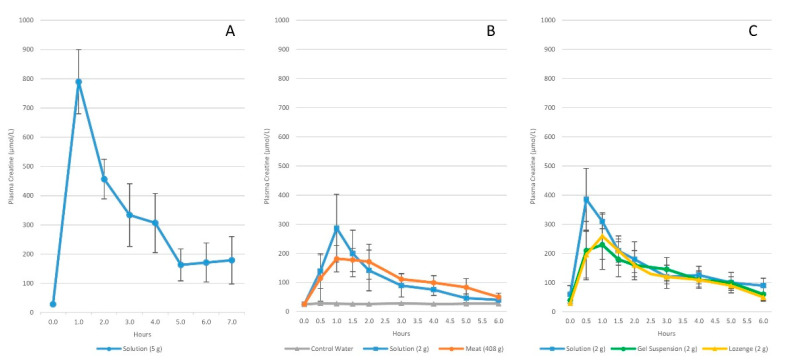
- CrM supplementation increases muscle creatine retention by 20–40% and brain creatine by 5–15%; high-intensity exercise performance is generally increased by 10–20%, with greater effects in those starting with lower muscle creatine. CrM is nearly 100% bioavailable, and 5 g orally raises plasma creatine to about 800 µmol/L after 1 h.
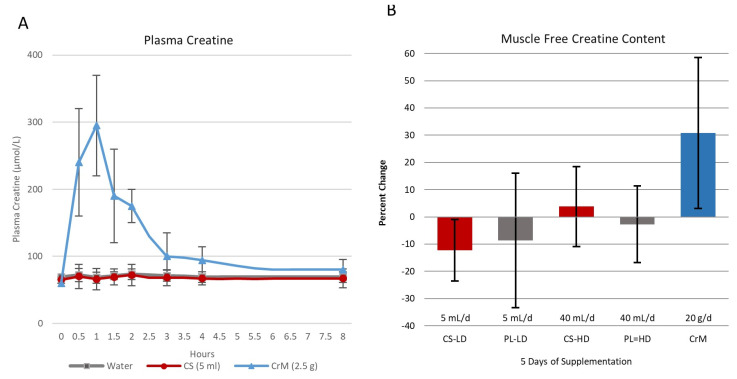
- No alternative form has demonstrated greater bioavailability, efficacy, or safety than CrM. For example, creatine ethyl ester (CEE) increased serum creatinine more than two-fold and produced smaller muscle creatine increases than CrM; creatine nitrate at 1.5–3 g produced lower plasma creatine AUC than 5 g CrM; buffered CrM at recommended doses did not significantly increase muscle creatine; creatine serum contained <10 mg creatine and 69 mg creatinine per 5 mL and had no effect on plasma or muscle creatine.
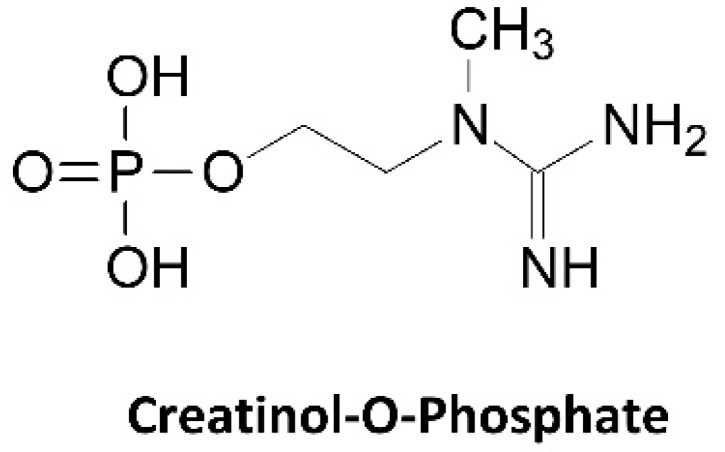
- The review categorizes CrM as having strong evidence; creatine salts, magnesium creatine chelate, CEE, creatine HCl, creatine nitrate, and buffered CrM as having some evidence; and other creatine salts, creatine serum, creatyl-L-leucine, and creatinol-O-phosphate as having no evidence to support bioavailability, efficacy, and safety.
- CrM is the only creatine form listed on the FDA’s GRAS inventory and is approved for sale in major markets including Australia, Canada, China, the EU, Japan, and South Korea; creatine nitrate is FDA-approved only at 750 mg/day, below levels expected to increase muscle creatine.
Methods
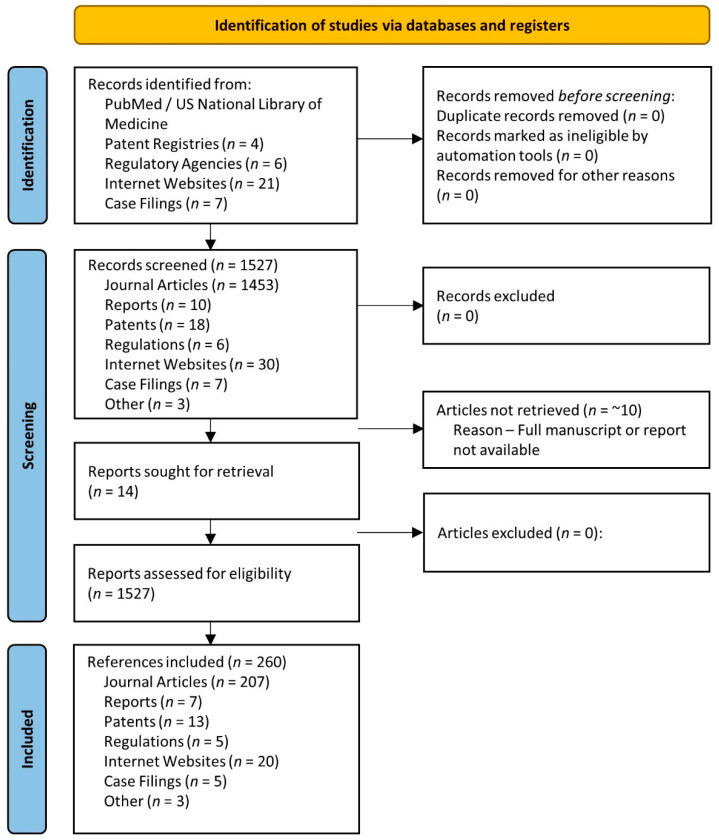
- Systematic review of literature from PubMed on creatine sources in dietary supplements, food products, and beverages, covering solubility, stability, bioavailability, supplementation, and performance.
- Additional searches included patents from the USPTO, European Patent Office, Japan Patent Office, and WIPO; company websites; publicly available court documents; and regulatory agencies including FDA, TGA, Health Canada, China’s State Administration for Market Regulation, EU Commission, Japan MHLW, and Korea FDA.
- Findings were summarized with a PRISMA flow chart; no new primary data were collected.
Limitations
- The paper states that a creatine nitrate crossover study used only a 7-day washout, which may have confounded results because muscle creatine can take about 4 weeks to return to normal; it also notes that some creatine HCl studies were in non-indexed journals and had methodological issues, and that many forms lack direct data on muscle or brain creatine content.
- The review is a critical narrative synthesis rather than a meta-analysis, and it relies partly on non-peer-reviewed reports, company materials, patents, and litigation documents; these limitations are evident from the described methods and sources.
Model-written summary. Check it against the paper before relying on it.
Integrity signals
Registry
Cites
Statistics
Figures
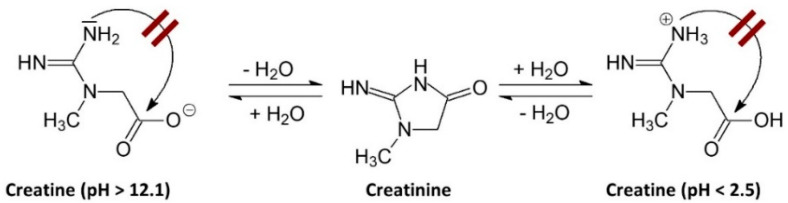
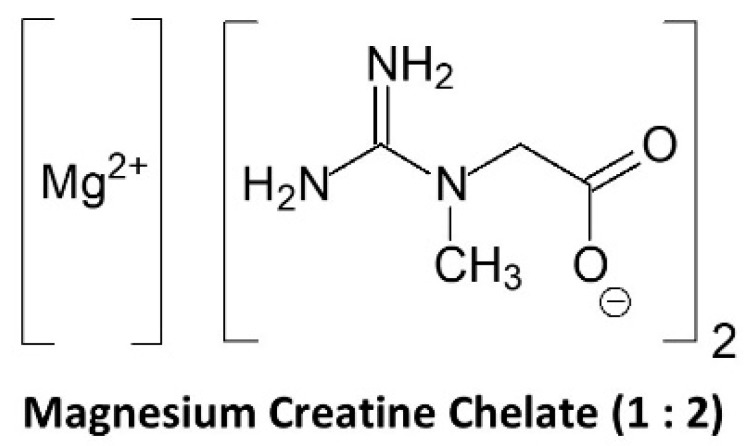
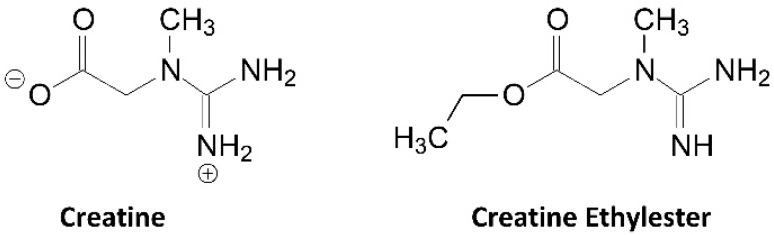
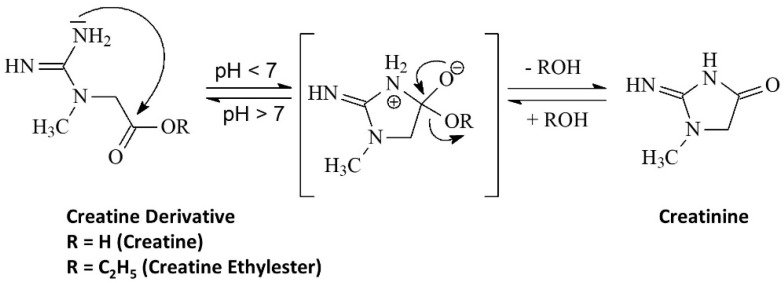
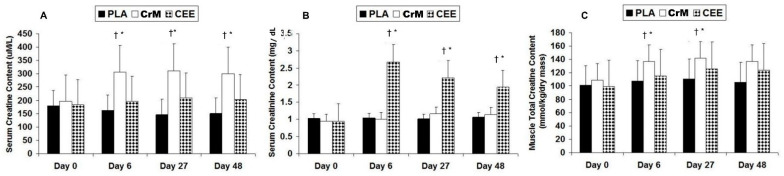
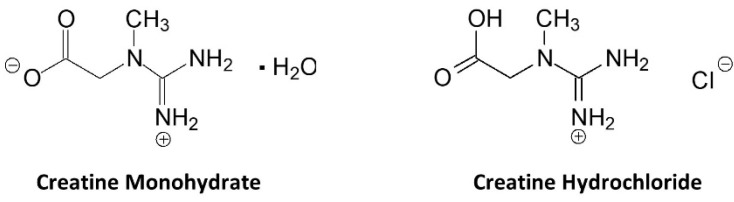
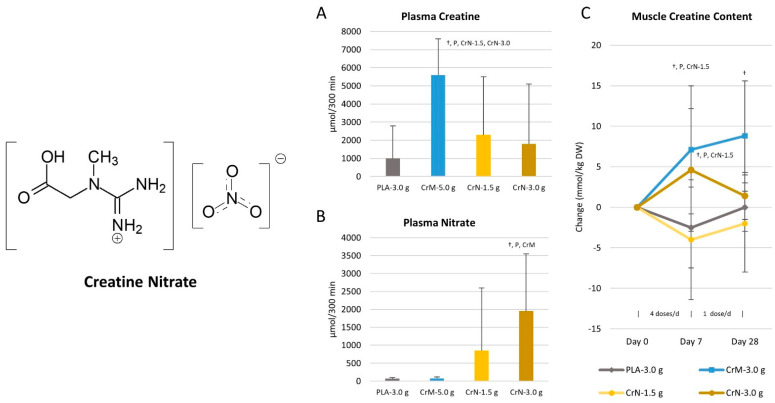
Verification
Claims the paper makes
71 Own interpretation · 50 No basis given · 29 Supported · 25 Not checked yet · 23 Partly supported · 20 No full text of the sources · 5 Supported so far · 2 Couldn’t confirm · 1 Not supported · 1 Own method · 1 Own result · accuracy not yet measured
Every source the paper cites for this claim was checked and supports it.
In the paper
“Creatine monohydrate is very stable in powder form, showing no signs of degradation to creatinine over years, even at elevated temperatures [25].”
§ Bioavailability, Efficacy, Safety, and Regulatory Status of Creatine and Related Compounds: A Critical Review > 5. Stability
What the sources say
- Supportedcites [25] Jager, 2011, Analysis of the efficacy, safety, and regulatory status of novel forms of creatine, Amino Acids source
The Stability in solid form section states that creatine monohydrate powder shows no degradation over years, even at elevated temperatures. It specifies that creatinine remained below the quantification limit after more than three years at 40°C; at 60°C, a small amount was detected after 44 months. (LLM, conf=0.93)
plain- Asserted: passes — The authors put it forward as true.
- Checkable: passes — It can be checked against evidence.
- Load-bearing: unclear — It is unclear whether the paper’s conclusions depend on it.
- Based: passes — The paper gives a reason why it holds.
- Supported
The cited sources support only part of this claim — read each source’s verdict below.
In the paper
“Creatine monohydrate is considered the gold standard to compare other purported sources of creatine because of its well-known physiochemical properties, high bioavailability, stability, low cost, and a large number of studies that have demonstrated efficacy and safety [15,25].”
§ Bioavailability, Efficacy, Safety, and Regulatory Status of Creatine and Related Compounds: A Critical Review > 4. Physio-Chemical Properties
What the sources say
- Partly supportedcites [15] Kreider, 2017, International Society of Sports Nutrition position stand: Safety and efficacy of creatine supplementation in exercise, sport, and medicine, J. Int. Soc. Sports Nutr. sourceExperimental — accuracy not yet measured
The Bioavailability section (page unavailable) describes creatine monohydrate as the most studied form, reports near-complete absorption of creatine, and finds no evidence that other forms provide greater retention. The Safety and ISSN Position sections (pages unavailable) support its efficacy and safety. The copy does not establish low cost as a reason for treating it as the comparison standard; it also qualifies stability by noting that creatine is stable in solid form but degrades in some solutions. (LLM, conf=0.84)
- Partly supportedcites [25] Jager, 2011, Analysis of the efficacy, safety, and regulatory status of novel forms of creatine, Amino Acids sourceExperimental — accuracy not yet measured
The Introduction describes creatine monohydrate (CM) as the comparator for newer forms, while the Bioavailability, Physio-chemical properties, and Summary sections support its high absorption, characterized properties, stability, and well-studied efficacy and safety. Our copy does not establish low cost as a reason for treating CM as the benchmark (pages unavailable). (LLM, conf=0.86)
boosteddirect- Asserted: passes — The authors put it forward as true.
- Checkable: passes — It can be checked against evidence.
- Load-bearing: passes — The paper’s conclusions depend on it.
- Based: passes — The paper gives a reason why it holds.
- Partly supported
Every source the paper cites for this claim was checked and supports it.
In the paper
“The increased creatine levels have been reported to enhance high-intensity exercise performance and exercise training adaptations [14,15,24].”
§ Bioavailability, Efficacy, Safety, and Regulatory Status of Creatine and Related Compounds: A Critical Review > 1. Introduction
What the sources say
- Supportedcites [14] Kerksick, 2018, ISSN exercise & sports nutrition review update: Research & recommendations, J. Int. Soc. Sports Nutr. source
The Muscle building supplements section says creatine supplementation increases high-intensity exercise capacity and enables harder training that promotes greater adaptations. The Performance enhancement supplements section also reports improvements in sprint performance and training adaptations. The cited passages do not provide page numbers. (LLM, conf=0.92)
- Supportedcites [15] Kreider, 2017, International Society of Sports Nutrition position stand: Safety and efficacy of creatine supplementation in exercise, sport, and medicine, J. Int. Soc. Sports Nutr. source
The Ergogenic value section states that creatine supplementation increases muscle creatine availability and can enhance exercise capacity and training adaptations. It also reports that high-intensity or repetitive exercise performance generally increases after creatine loading, depending on the rise in muscle phosphocreatine. (LLM, conf=0.94)
- Supportedcites [24] Wax, B., Kerksick, C.M., Jagim, A.R., Mayo, J.J., Lyons, B.C., and Kreider, R.B. (2021). Creatine for Exercise and Sports Performance, with Recovery Considerations for Healthy Populations. Nutrients, 13. source
Section 3.2 reports that creatine supplementation increases capacity for high-intensity exercise. Section 3.1 reports that increased intramuscular phosphocreatine can help increase training volume and augment training adaptations when combined with a structured training program. (LLM, conf=0.93)
hedgedconditional- Asserted: passes — The authors put it forward as true.
- Checkable: passes — It can be checked against evidence.
- Load-bearing: passes — The paper’s conclusions depend on it.
- Based: passes — The paper gives a reason why it holds.
- Supported
The sources with a verdict support this claim; the rest weren’t checked yet, have no full text we could read, or their verdicts aren’t rated yet.
In the paper
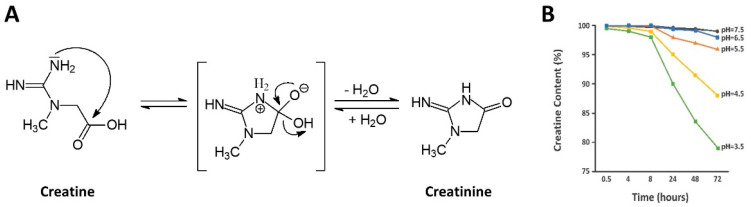
“Generally, creatine degrades to creatinine in solution at a faster rate as pH decreases and temperature increases [25,52,53,54].”
§ Bioavailability, Efficacy, Safety, and Regulatory Status of Creatine and Related Compounds: A Critical Review > 5. Stability
What the sources say
- Supportedcites [25] Jager, 2011, Analysis of the efficacy, safety, and regulatory status of novel forms of creatine, Amino Acids source
The “Stability in solutions” section states that creatine degrades faster in solution at lower pH and higher temperature. It also notes an exception at very low pH, which the citing sentence’s “Generally” accommodates. (LLM, conf=0.95)
- Not checked yetcites [52] Howard, A.N., and Harris, R.C. (1999). Compositions Containing Creatine. (No. 5,969,544, Application No. 08/866,517), U.S. Patent.
- Not checked — no full text of the sourcecites [53] Edgar, 1925, The equilibrium between creatine and creatinine, in aqueous solution: The effect of hydrogen ion, J. Am. Chem. Soc. source
- Not checked — no full text of the sourcecites [54] Cannon, 1990, Acute phase reponse in exercise: Interaction of age and vitamin E on neutrophils and muscle enzyme release, Am. J. Physiol. source
plaindirect- Asserted: passes — The authors put it forward as true.
- Checkable: passes — It can be checked against evidence.
- Load-bearing: passes — The paper’s conclusions depend on it.
- Based: passes — The paper gives a reason why it holds.
- Supported
The cited sources support only part of this claim — read each source’s verdict below.
In the paper
“CrM is the gold standard to compare other purported forms of creatine due to its known bioavailability, pharmacokinetics, efficacy, and safety [5,14,15,25,62].”
§ Bioavailability, Efficacy, Safety, and Regulatory Status of Creatine and Related Compounds: A Critical Review > 8. Strong Evidence to Support Bioavailability, Efficacy, and Safety > Creatine Monohydrate
What the sources say
- Partly supportedcites [5] Kreider, R.B., and Stout, J.R. (2021). Creatine in Health and Disease. Nutrients, 13. sourceExperimental — accuracy not yet measured
The Introduction and §4 (General Health Benefits; pages unavailable) describe creatine supplementation as well studied and effective, and §4 discusses research on its safety. However, our copy does not establish that creatine monohydrate is the gold-standard comparator for other forms or give its known bioavailability and pharmacokinetics as the reason. (LLM, conf=0.82)
- Partly supportedcites [14] Kerksick, 2018, ISSN exercise & sports nutrition review update: Research & recommendations, J. Int. Soc. Sports Nutr. sourceExperimental — accuracy not yet measured
The Background section on muscle-building supplements calls creatine monohydrate the most extensively studied and clinically effective form for muscle uptake and exercise capacity, and reports its safety. This supports using it as a comparator, but the copy does not identify it as a gold standard on the basis of known pharmacokinetics. (LLM, conf=0.84)
- Supportedcites [15] Kreider, 2017, International Society of Sports Nutrition position stand: Safety and efficacy of creatine supplementation in exercise, sport, and medicine, J. Int. Soc. Sports Nutr. source
The Bioavailability section identifies creatine monohydrate as the most studied form, describes its absorption and plasma-level timing, and compares other forms against it for creatine retention. The ISSN position section calls it the most extensively studied and clinically effective form, while the Safety section summarizes extensive safety evidence. Together, these passages support its use as the reference for comparing other forms, although the paper reserves the phrase “gold standards” for methods of measuring tissue effects. (LLM, conf=0.90)
- Supportedcites [25] Jager, 2011, Analysis of the efficacy, safety, and regulatory status of novel forms of creatine, Amino Acids source
The Introduction says the review compares newer creatine forms with creatine monohydrate (CM) on efficacy and safety. The Bioavailability section discusses CM absorption and pharmacokinetics, while the Summary describes its established efficacy and safety relative to newer forms. Together, these passages support calling CM the comparison standard. (LLM, conf=0.92)
- Supportedcites [62] Antonio, 2021, Common questions and misconceptions about creatine supplementation: What does the scientific evidence really show?, J. Int. Soc. Sports Nutr. source
The section on other forms of creatine describes creatine monohydrate as the most extensively studied form and reports its absorption, effects on muscle creatine and performance, and known safety. It also compares other forms against monohydrate and finds no evidence that equal amounts increase muscle creatine stores more, supporting its use as a benchmark. Page numbers are not provided in our copy. (LLM, conf=0.91)
boosted- Asserted: passes — The authors put it forward as true.
- Checkable: passes — It can be checked against evidence.
- Load-bearing: passes — The paper’s conclusions depend on it.
- Based: passes — The paper gives a reason why it holds.
- Partly supported
Every source the paper cites for this claim was checked and supports it.
In the paper
“There are no data showing that any other purported form of creatine is more effective in increasing tissue creatine content than CrM [62].”
§ Bioavailability, Efficacy, Safety, and Regulatory Status of Creatine and Related Compounds: A Critical Review > 6. Solubility
What the sources say
- Supportedcites [62] Antonio, 2021, Common questions and misconceptions about creatine supplementation: What does the scientific evidence really show?, J. Int. Soc. Sports Nutr. source
In the section on other forms of creatine, the paper says there are no peer-reviewed published papers showing that equal amounts of the listed alternative forms increase muscle creatine storage more than creatine monohydrate. Its Conclusions also state that other forms are not superior. The cited comparison concerns intramuscular stores specifically, which supports the claim about tissue creatine content. (LLM, conf=0.91)
plain- Asserted: passes — The authors put it forward as true.
- Checkable: passes — It can be checked against evidence.
- Load-bearing: passes — The paper’s conclusions depend on it.
- Based: passes — The paper gives a reason why it holds.
- Supported
The cited sources support only part of this claim — read each source’s verdict below.
In the paper
“and brain creatine content by 5–15% [72,73,74,75,76,77].”
§ Bioavailability, Efficacy, Safety, and Regulatory Status of Creatine and Related Compounds: A Critical Review > 8. Strong Evidence to Support Bioavailability, Efficacy, and Safety > Creatine Monohydrate
What the sources say
- Partly supportedcites [72] Choi, 2009, Magnetic resonance spectroscopy of regional brain metabolite markers in FALS mice and the effects of dietary creatine supplementation, Eur. J. Neurosci. sourceExperimental — accuracy not yet measured
The Results section reports that a 2% creatine diet increased brain creatine by about 11% in the medulla of mice, which falls within the claimed range. It also reports an increase of about 25% in the cerebellum and no significant increase in the cortex, so this source does not support 5–15% as a general brain-wide range or establish the claim for loading or low-dose intake. (LLM, conf=0.88)
- Not checked — no full text of the sourcecites [73] Lyoo, 2003, Multinuclear magnetic resonance spectroscopy of high-energy phosphate metabolites in human brain following oral supplementation of creatine-monohydrate, Psychiatry Res. source
- Partly supportedcites [74] Roschel, H., Gualano, B., Ostojic, S.M., and Rawson, E.S. (2021). Creatine Supplementation and Brain Health. Nutrients, 13. sourceExperimental — accuracy not yet measured
Section 2 reports that nine of twelve studies found significant increases in brain creatine, averaging about 5–10%, rather than establishing a 5–15% range. It also says the optimal supplementation strategy is unclear and does not establish that either loading or low-dose long-term intake reliably produces that increase. (LLM, conf=0.88)
- Not checked — no full text of the sourcecites [75] Dolan, 2019, Beyond muscle: The effects of creatine supplementation on brain creatine, cognitive processing, and traumatic brain injury, Eur. J. Sport Sci. source
- Not checked — no full text of the sourcecites [76] Gualano, 2016, Creatine supplementation in the aging population: Effects on skeletal muscle, bone and brain, Amino Acids source
- Not checked — no full text of the sourcecites [77] Rawson, 2011, Use of creatine in the elderly and evidence for effects on cognitive function in young and old, Amino Acids source
plaindirect- Asserted: passes — The authors put it forward as true.
- Checkable: passes — It can be checked against evidence.
- Load-bearing: passes — The paper’s conclusions depend on it.
- Based: passes — The paper gives a reason why it holds.
- Partly supported
Every source the paper cites for this claim was checked and supports it.
In the paper
“This paper concluded that no other purported form of creatine had been shown to be a more effective source of creatine than CrM”
§ Bioavailability, Efficacy, Safety, and Regulatory Status of Creatine and Related Compounds: A Critical Review > Abstract
What the sources say
- Supportedcites [25] Jager, 2011, Analysis of the efficacy, safety, and regulatory status of novel forms of creatine, Amino Acids source
The Summary concludes that there is little to no evidence supporting claims that newer creatine forms increase muscle creatine levels more effectively than creatine monohydrate (CM). This supports the citing sentence’s characterization of what the review concluded. (LLM, conf=0.90)
plain- Asserted: passes — The authors put it forward as true.
- Checkable: passes — It can be checked against evidence.
- Load-bearing: passes — The paper’s conclusions depend on it.
- Based: passes — The paper gives a reason why it holds.
- Supported
Every source the paper cites for this claim was checked and supports it.
In the paper
“the ISSN concluded that CrM is the most effective ergogenic nutrient currently available to athletes in terms of increasing high-intensity exercise capacity and lean body mass during training [8,15].”
§ Bioavailability, Efficacy, Safety, and Regulatory Status of Creatine and Related Compounds: A Critical Review > 8. Strong Evidence to Support Bioavailability, Efficacy, and Safety > Creatine Monohydrate
What the sources say
- Supportedcites [8] Buford, 2007, International Society of Sports Nutrition position stand: Creatine supplementation and exercise, J. Int. Soc. Sports Nutr. source
The “Effects of Supplementation on Exercise Performance and Training Adaptations” section (page not provided) explicitly concludes that creatine monohydrate is the most effective nutritional supplement available for increasing high-intensity exercise capacity and building lean mass. It also reports gains in lean body mass when supplementation is combined with training. (LLM, conf=0.95)
- Supportedcites [15] Kreider, 2017, International Society of Sports Nutrition position stand: Safety and efficacy of creatine supplementation in exercise, sport, and medicine, J. Int. Soc. Sports Nutr. source
The paper’s ‘Position of the international society of sports nutrition (ISSN)’ section explicitly concludes that creatine monohydrate is the most effective ergogenic nutritional supplement available to athletes for increasing high-intensity exercise capacity and lean body mass during training. The ‘Ergogenic value’ section also reports the same ISSN conclusion. (LLM, conf=0.95)
plaindirect- Asserted: passes — The authors put it forward as true.
- Checkable: passes — It can be checked against evidence.
- Load-bearing: passes — The paper’s conclusions depend on it.
- Based: passes — The paper gives a reason why it holds.
- Supported
The cited sources support only part of this claim — read each source’s verdict below.
In the paper
“Galvan and coworkers [29] also found no adverse effects after 28 days of supplementation (3 g/day).”
§ Bioavailability, Efficacy, Safety, and Regulatory Status of Creatine and Related Compounds: A Critical Review > 9. Some Evidence to Support Bioavailability, Efficacy, and Safety > 9.5. Creatine Nitrate
What the sources say
- Partly supportedcites [29] Galvan, 2016, Acute and chronic safety and efficacy of dose dependent creatine nitrate supplementation and exercise performance, J. Int. Soc. Sports Nutr. sourceExperimental — accuracy not yet measured
The Study 2 Results report no significant treatment-related differences in side effects or blood safety markers over 28 days, but participants did report minimal side effects. The Supplementation protocol also specifies that the 3 g/day creatine nitrate dose began on day 8; the high-dose group received 12 g/day during the first seven days. Thus, neither ‘no adverse effects’ nor 3 g/day throughout the 28 days accurately describes the study. (LLM, conf=0.90)
plain- Asserted: passes — The authors put it forward as true.
- Checkable: passes — It can be checked against evidence.
- Load-bearing: passes — The paper’s conclusions depend on it.
- Based: passes — The paper gives a reason why it holds.
- Partly supported
- It may state two separate claims as one. 111
- Probably not a substantial claim. 28
At least one cited source doesn’t support this claim or points to a different paper, and none confirmed it — see the verdicts below.
In the paper
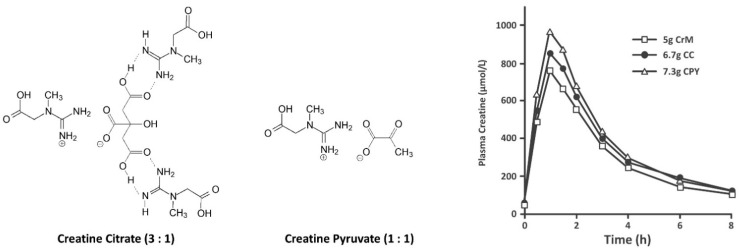
“Peak concentrations of creatine were significantly higher with CPY (CrM 761.9 ± 107.7, CC 855.3 ± 165.1, CPY 972.2 ± 184.1 µmol/L) while AUC values did not significantly differ among treatments (2384 ± 376.5, 2627 ± 506.8, 2985 ± 540.6 mM/h, respectively).”
§ Bioavailability, Efficacy, Safety, and Regulatory Status of Creatine and Related Compounds: A Critical Review > 9. Some Evidence to Support Bioavailability, Efficacy, and Safety > 9.1. Creatine Salts
What the sources say
- Disputedcites [63] Harris, 2007, Comparison of new forms of creatine in raising plasma creatine levels, J. Int. Soc. Sports Nutr. sourceExperimental — accuracy not yet measured
The Results report that peak creatine concentration was significantly higher with creatine pyruvate than with creatine citrate (p = 0.010), but not significantly higher than with creatine monohydrate (p = 0.075). Table 3 reports a significant overall difference in AUC among treatments (ANOVA p = 0.023), contrary to the claim that AUC values did not significantly differ. The quoted concentration values come from the one-hour measurements in Table 2, not the peak-concentration measurements in Table 3. (LLM, conf=0.90)
Checked by a reasoning model — may be wrong.
plain- Asserted: passes — The authors put it forward as true.
- Checkable: passes — It can be checked against evidence.
- Load-bearing: unclear — It is unclear whether the paper’s conclusions depend on it.
- Based: passes — The paper gives a reason why it holds.
It may state two separate claims as one.
- Disputed
None of the sources cited for this claim have been checked yet.
In the paper
“There is also no evidence that supplementation of micronized versions of CrM (i.e., CrM with smaller mesh size particles) are more bioavailable than CrM with normal mesh sized particles [138,139,140] or consuming CrM in effervescent fluid promotes greater creatine retention or performance benefits [22,141].”
§ Bioavailability, Efficacy, Safety, and Regulatory Status of Creatine and Related Compounds: A Critical Review > 8. Strong Evidence to Support Bioavailability, Efficacy, and Safety > Creatine Monohydrate
What the sources say
- Not checked — no full text of the sourcecites [138] Pakulak, A., Candow, D.G., Totosy de Zepetnek, J., Forbes, S.C., and Basta, D. (2021). Effects of Creatine and Caffeine Supplementation During Resistance Training on Body Composition, Strength, Endurance, Rating of Perceived Exertion and Fatigue in Trained Young Adults. J. Diet. Suppl., 1–16. source
- Not checked — no full text of the sourcecites [139] Tibirica, 2019, Effects of dietary supplementation with creatine on homocysteinemia and systemic microvascular endothelial function in individuals adhering to vegan diets, Fundam. Clin. Pharmacol. source
- Could not verifycites [140] Moraes, 2014, Effects of dietary creatine supplementation on systemic microvascular density and reactivity in healthy young adults, Nutr. J. sourceExperimental — accuracy not yet measured
The Methods section says the study used micronized creatine monohydrate, but it does not compare its bioavailability with normal-mesh creatine monohydrate. The cited paper therefore does not establish the claim attached to this citation. The separate claim about effervescent fluid is cited to other sources. (LLM, conf=0.76)
- Not checked yetcites [22] Greenwood, 2003, Differences in creatine retention among three nutritional formulations of oral creatine supplements, J. Exerc. Physiol. Online
- Not checked — no full text of the sourcecites [141] Falk, 2003, Effects of effervescent creatine, ribose, and glutamine supplementation on muscular strength, muscular endurance, and body composition, J. Strength Cond. Res. source
plain- Asserted: passes — The authors put it forward as true.
- Checkable: passes — It can be checked against evidence.
- Load-bearing: passes — The paper’s conclusions depend on it.
- Based: passes — The paper gives a reason why it holds.
It may state two separate claims as one.
The cited sources support only part of this claim — read each source’s verdict below.
In the paper
“For a dietary source of creatine to be bioavailable, creatine must be: (1) absorbed as creatine into the blood and transported to tissues [2,25]; (2) transported into tissue via tissue-specific creatine transporter genes (e.g., CRT1 or SLC6A8 in muscle) [6,7]; and (3) increase tissue and cellular creatine and PCr content by a physiologically meaningful amount to influence metabolic activity (e.g.,”
§ Bioavailability, Efficacy, Safety, and Regulatory Status of Creatine and Related Compounds: A Critical Review > 3. Bioavailability
What the sources say
- Not checked — no full text of the sourcecites [2] Brosnan, 2016, The role of dietary creatine, Amino Acids source
- Supportedcites [25] Jager, 2011, Analysis of the efficacy, safety, and regulatory status of novel forms of creatine, Amino Acids source
The citation is attached to the first step, absorption into the blood and transport to tissue. The Bioavailability section describes creatine uptake as two steps: uptake into the bloodstream, then uptake into the target tissue. The transporter genes and percentage increases appear in separate clauses and are not attributed to this citation in the supplied sentence. (LLM, conf=0.92)
- Partly supportedcites [6] Wallimann, 2011, The creatine kinase system and pleiotropic effects of creatine, Amino Acids sourceExperimental — accuracy not yet measured
Split into 2 atoms — 0 confirmed, 2 partially supported, 0 disputed, 0 misattributed, 0 unverifiable. Expand the claim to see per-atom verdicts.
- Partly supportedcites [7] Bonilla, D.A., Kreider, R.B., Stout, J.R., Forero, D.A., Kerksick, C.M., Roberts, M.D., and Rawson, E.S. (2021). Metabolic Basis of Creatine in Health and Disease: A Bioinformatics-Assisted Review. Nutrients, 13. sourceExperimental — accuracy not yet measured
Split into 2 atoms — 1 confirmed, 1 partially supported, 0 disputed, 0 misattributed, 0 unverifiable. Expand the claim to see per-atom verdicts.
- Partly supportedcites [5] Kreider, R.B., and Stout, J.R. (2021). Creatine in Health and Disease. Nutrients, 13. sourceExperimental — accuracy not yet measured
Split into 2 atoms — 1 confirmed, 1 partially supported, 0 disputed, 0 misattributed, 0 unverifiable. Expand the claim to see per-atom verdicts.
- Not checked — no full text of the sourcecites [12] Harris, 1992, Elevation of creatine in resting and exercised muscle of normal subjects by creatine supplementation, Clin. Sci. source
- Partly supportedcites [15] Kreider, 2017, International Society of Sports Nutrition position stand: Safety and efficacy of creatine supplementation in exercise, sport, and medicine, J. Int. Soc. Sports Nutr. sourceExperimental — accuracy not yet measured
Split into 2 atoms — 0 confirmed, 2 partially supported, 0 disputed, 0 misattributed, 0 unverifiable. Expand the claim to see per-atom verdicts.
- Not checked — no full text of the sourcecites [20] Green, 1996, Carbohydrate ingestion augments skeletal muscle creatine accumulation during creatine supplementation in humans, Am. J. Physiol. source
- Partly supportedcites [24] Wax, B., Kerksick, C.M., Jagim, A.R., Mayo, J.J., Lyons, B.C., and Kreider, R.B. (2021). Creatine for Exercise and Sports Performance, with Recovery Considerations for Healthy Populations. Nutrients, 13. sourceExperimental — accuracy not yet measured
Split into 2 atoms — 0 confirmed, 2 partially supported, 0 disputed, 0 misattributed, 0 unverifiable. Expand the claim to see per-atom verdicts.
- Not checked — no full text of the sourcecites [47] Vandenberghe, 1997, Long-term creatine intake is beneficial to muscle performance during resistance training, J. Appl. Physiol. source
plaindirect- Asserted: passes — The authors put it forward as true.
- Checkable: passes — It can be checked against evidence.
- Load-bearing: passes — The paper’s conclusions depend on it.
- Based: passes — The paper gives a reason why it holds.
It may state two separate claims as one.
The cited sources support only part of this claim — read each source’s verdict below.
In the paper
“The most extensively studied and effective form of creatine found in nutritional supplements that professional organizations recommend for use is creatine monohydrate (CrM) [14,15,17,18].”
§ Bioavailability, Efficacy, Safety, and Regulatory Status of Creatine and Related Compounds: A Critical Review > 1. Introduction
What the sources say
- Supportedcites [14] Kerksick, 2018, ISSN exercise & sports nutrition review update: Research & recommendations, J. Int. Soc. Sports Nutr. source
The Muscle building supplements section states that creatine monohydrate is the most extensively studied and clinically effective form of creatine for use in nutritional supplements. It also quotes the ISSN position stand endorsing creatine monohydrate as an effective ergogenic supplement and describing conditions for its use by younger athletes. (LLM, conf=0.92)
- Supportedcites [15] Kreider, 2017, International Society of Sports Nutrition position stand: Safety and efficacy of creatine supplementation in exercise, sport, and medicine, J. Int. Soc. Sports Nutr. source
The ISSN position statement explicitly calls creatine monohydrate the most extensively studied and clinically effective form of creatine for use in nutritional supplements, in terms of muscle uptake and increased high-intensity exercise capacity. Because this is the society’s own position statement, it also supports the claim that a professional organization recommends its use. (LLM, conf=0.94)
- Not checked — no full text of the sourcecites [17] Thomas, 2016, Position of the Academy of Nutrition and Dietetics, Dietitians of Canada, and the American College of Sports Medicine: Nutrition and Athletic Performance, J. Acad. Nutr. Diet source
- Partly supportedcites [18] Maughan, 2018, IOC Consensus Statement: Dietary Supplements and the High-Performance Athlete, Int. J. Sport Nutr. Exerc. Metab. sourceExperimental — accuracy not yet measured
The 'Supplement Proposed Mechanism of Action Evidence for Efficacy' section identifies creatine monohydrate and gives a recommended dose; the 'Overview' describes performance benefits from creatine loading. Our copy does not establish that monohydrate is the most extensively studied or most effective form relative to other forms, or that multiple professional organizations recommend it. (LLM, conf=0.86)
plain- Asserted: passes — The authors put it forward as true.
- Checkable: passes — It can be checked against evidence.
- Load-bearing: unclear — It is unclear whether the paper’s conclusions depend on it.
- Based: passes — The paper gives a reason why it holds.
It may state two separate claims as one.
- Supported
The sources with a verdict support this claim; the rest weren’t checked yet, have no full text we could read, or their verdicts aren’t rated yet.
In the paper
“Additionally, while mixing CrM in common juices and beverages with pHs ranging from 2.5–3.5 [61] would enhance solubility, it would also promote the conversion of creatine to creatinine over time [66].”
§ Bioavailability, Efficacy, Safety, and Regulatory Status of Creatine and Related Compounds: A Critical Review > 6. Solubility
What the sources say
- Supportedcites [61] Reddy, 2016, The pH of beverages in the United States, J. Am. Dent. Assoc. source
The citation to this paper is attached to the pH of common juices and beverages, not the claims about creatine solubility or conversion. The Results report mean pH values of 3.48 for juices, 2.99 for fruit drinks, and 3.12 for sodas, supporting the cited approximate pH range; the full measured ranges are wider. (LLM, conf=0.90)
- Not checked yetcites [66] Howard, A.N., and Harris, R. (1999). Compositions Containing Creatine and Aloe Vera Extract. (No. 6,168,802), U.S. Patent.
hedgeddirect- Asserted: passes — The authors put it forward as true.
- Checkable: passes — It can be checked against evidence.
- Load-bearing: passes — The paper’s conclusions depend on it.
- Based: passes — The paper gives a reason why it holds.
It may state two separate claims as one.
- Supported
Every source the paper cites for this claim was checked and supports it.
In the paper
“The solubility of creatine in water increases linearly with increasing temperature. In this regard, about 6 g of creatine dissolves in one liter of water at 4 °C (39.2 °F) while 14 g/L are dissolved at 20 °C (68 °F), 34 g/L are dissolved at 50 °C (122 °F); and, 45 g/L are dissolved at 60 °C (140 °F) [25].”
§ Bioavailability, Efficacy, Safety, and Regulatory Status of Creatine and Related Compounds: A Critical Review > 6. Solubility
What the sources say
- Supportedcites [25] Jager, 2011, Analysis of the efficacy, safety, and regulatory status of novel forms of creatine, Amino Acids source
The Solubility section states that creatine’s solubility increases with temperature, describes the relationship as almost linear, and gives all four temperatures and amounts exactly as cited. The claim’s ‘linearly’ is a slight simplification of ‘almost linear.’ (LLM, conf=0.94)
plaindirect- Asserted: passes — The authors put it forward as true.
- Checkable: passes — It can be checked against evidence.
- Load-bearing: unclear — It is unclear whether the paper’s conclusions depend on it.
- Based: passes — The paper gives a reason why it holds.
It may state two separate claims as one.
- Supported
The cited sources support only part of this claim — read each source’s verdict below.
In the paper
“Since stomach acid is generally less than 2.5, less than 1% of CrM is degraded to creatinine during digestion and 99% of creatine is taken up by tissue or excreted in urine after ingestion [12,25,58,59].”
§ Bioavailability, Efficacy, Safety, and Regulatory Status of Creatine and Related Compounds: A Critical Review > 5. Stability
What the sources say
- Not checked — no full text of the sourcecites [12] Harris, 1992, Elevation of creatine in resting and exercised muscle of normal subjects by creatine supplementation, Clin. Sci. source
- Partly supportedcites [25] Jager, 2011, Analysis of the efficacy, safety, and regulatory status of novel forms of creatine, Amino Acids sourceExperimental — accuracy not yet measured
The Stability section (page unavailable) says pH below 2.5 can prevent creatine degradation and that conversion to creatinine in the gastrointestinal tract is minimal. The Bioavailability section (page unavailable) says intestinal absorption of creatine monohydrate is close to 100% and discusses tissue uptake and urinary excretion. It does not give the claimed thresholds of less than 1% degraded or 99% taken up by tissue or excreted, nor state that stomach acid is generally below pH 2.5. (LLM, conf=0.88)
- Not checked — no full text of the sourcecites [58] Persky, 2003, Pharmacokinetics of the dietary supplement creatine, Clin. Pharmacokinet. source
- Partly supportedcites [59] Deldicque, 2008, Kinetics of creatine ingested as a food ingredient, Eur. J. Appl. Physiol. sourceExperimental — accuracy not yet measured
The Discussion estimates that at stomach pH near 2, about 1% of a 2 g dose converts to creatinine within the first hour, and describes gastrointestinal conversion overall as negligible. It also says creatine appearing in blood is taken up by tissues or eliminated in urine. But it does not establish less than 1% conversion throughout digestion: it says a larger proportion may degrade during the longer intestinal transit. Page numbers were not provided in our copy. (LLM, conf=0.88)
plaindirect- Asserted: passes — The authors put it forward as true.
- Checkable: passes — It can be checked against evidence.
- Load-bearing: passes — The paper’s conclusions depend on it.
- Based: passes — The paper gives a reason why it holds.
It may state two separate claims as one.
The cited sources support only part of this claim — read each source’s verdict below.
In the paper
“creatinine levels were also significantly increased throughout training with MgCr-C (0.83 to 1.87 mmol/L) compared to placebo (0.92 to 0.82 mmol/L), which is higher than reported in other long-term CrM studies during training in hot and humid environments that administered 5–10 g/day of CrM for 21 months in well-trained athletes [144].”
§ Bioavailability, Efficacy, Safety, and Regulatory Status of Creatine and Related Compounds: A Critical Review > 9. Some Evidence to Support Bioavailability, Efficacy, and Safety > 9.2. Magnesium Creatine Chelate
What the sources say
- Partly supportedcites [191] Zajac, A., Golas, A., Chycki, J., Halz, M., and Michalczyk, M.M. (2020). The Effects of Long-Term Magnesium Creatine Chelate Supplementation on Repeated Sprint Ability (RAST) in Elite Soccer Players. Nutrients, 12. sourceExperimental — accuracy not yet measured
The Results report that creatinine rose significantly from 0.83 at baseline to 1.87 after four weeks of MgCr-C, while it did not change significantly in the placebo group. The increase did not continue throughout training: creatinine fell to 1.38 by week 16. The Results give the placebo endpoint as 0.85, not 0.82, and the Discussion gives the creatinine unit as mg/dL, not mmol/L. Our copy does not support the claimed comparison with CrM studies conducted in hot and humid environments. (LLM, conf=0.91)
- Not checked — no full text of the sourcecites [144] Greenwood, 2003, Creatine supplementation during college football training does not increase the incidence of cramping or injury, Mol. Cell. Biochem. source
plaindirect- Asserted: passes — The authors put it forward as true.
- Checkable: passes — It can be checked against evidence.
- Load-bearing: unclear — It is unclear whether the paper’s conclusions depend on it.
- Based: passes — The paper gives a reason why it holds.
It may state two separate claims as one.
- Partly supported
The cited sources support only part of this claim — read each source’s verdict below.
In the paper
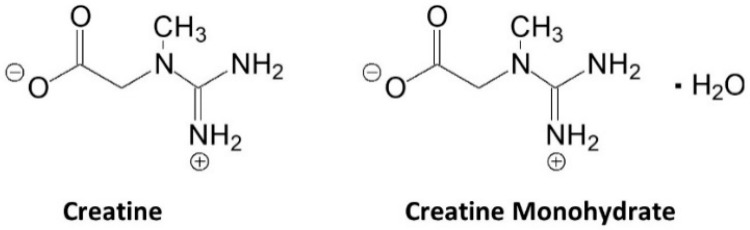
“This provides a powder containing 87.9% creatine that readily dissociates into creatine and water upon oral ingestion.”
§ Bioavailability, Efficacy, Safety, and Regulatory Status of Creatine and Related Compounds: A Critical Review > 4. Physio-Chemical Properties
What the sources say
- Partly supportedcites [25] Jager, 2011, Analysis of the efficacy, safety, and regulatory status of novel forms of creatine, Amino Acids sourceExperimental — accuracy not yet measured
The Physio-chemical properties section (page unavailable) states that creatine monohydrate contains 87.9% creatine and has one molecule of water of crystallization per molecule of creatine. The Solubility section says it dissolves in water, but our copy does not establish that it readily dissociates into creatine and water upon oral ingestion. (LLM, conf=0.84)
plaindirect- Asserted: passes — The authors put it forward as true.
- Checkable: passes — It can be checked against evidence.
- Load-bearing: unclear — It is unclear whether the paper’s conclusions depend on it.
- Based: passes — The paper gives a reason why it holds.
It may state two separate claims as one.
- Partly supported
Every source the paper cites for this claim was checked and supports it.
In the paper
“Moreover, that most purported “forms” of creatine that were being marketed at the time were either less bioavailable, less effective, more expensive, and/or not sufficiently studied in terms of safety and/or efficacy.”
§ Bioavailability, Efficacy, Safety, and Regulatory Status of Creatine and Related Compounds: A Critical Review > Abstract
What the sources say
- Supportedcites [25] Jager, 2011, Analysis of the efficacy, safety, and regulatory status of novel forms of creatine, Amino Acids source
The Summary (page unavailable) says the efficacy and safety of most newer creatine forms were not well established. The Regulatory status > Analysis section (page unavailable) describes newer forms as typically more expensive and says basic safety data are lacking; the Bioavailability section also identifies one form with less efficient bioavailability than creatine monohydrate. Together these support the claim’s qualified, either/or characterization. (LLM, conf=0.90)
plain- Asserted: passes — The authors put it forward as true.
- Checkable: passes — It can be checked against evidence.
- Load-bearing: passes — The paper’s conclusions depend on it.
- Based: passes — The paper gives a reason why it holds.
It may state two separate claims as one.
- Supported
The sources with a verdict support this claim; the rest weren’t checked yet, have no full text we could read, or their verdicts aren’t rated yet.
In the paper
“Research has clearly shown that CrM is not degraded into creatinine during normal digestion, it is nearly 100% bioavailable [12,25,58,59], and markedly increases blood and tissue creatine content.”
§ Bioavailability, Efficacy, Safety, and Regulatory Status of Creatine and Related Compounds: A Critical Review > 6. Solubility
What the sources say
- Not checked — no full text of the sourcecites [12] Harris, 1992, Elevation of creatine in resting and exercised muscle of normal subjects by creatine supplementation, Clin. Sci. source
- Supportedcites [25] Jager, 2011, Analysis of the efficacy, safety, and regulatory status of novel forms of creatine, Amino Acids source
The Abstract says creatine monohydrate is not degraded during normal digestion, and the Bioavailability section says its intestinal absorption is close to 100%. The Bioavailability section discusses plasma creatine after ingestion, while the Abstract reports increases of approximately 15–40% in muscle creatine and phosphocreatine. Our copy provides no page numbers for these passages. (LLM, conf=0.91)
- Not checked — no full text of the sourcecites [58] Persky, 2003, Pharmacokinetics of the dietary supplement creatine, Clin. Pharmacokinet. source
- Supportedcites [59] Deldicque, 2008, Kinetics of creatine ingested as a food ingredient, Eur. J. Appl. Physiol. source
The Protocol identifies the supplement as creatine monohydrate. The Discussion says conversion to creatinine during gastrointestinal transit is negligible and arterial bioavailability likely nearly 100%; the Plasma concentrations and Erythrocyte concentrations sections report substantial increases after supplementation. The paper qualifies bioavailability as arterial, rather than venous. (LLM, conf=0.91)
boosteddirect- Asserted: passes — The authors put it forward as true.
- Checkable: passes — It can be checked against evidence.
- Load-bearing: passes — The paper’s conclusions depend on it.
- Based: passes — The paper gives a reason why it holds.
It may state two separate claims as one.
The cited sources support only part of this claim — read each source’s verdict below.
In the paper
“CrM supplementation has been reported to improve acute exercise performance particularly in intermittent high-intensity exercise bouts as well as enhance training adaptations in adolescents [78,79,80,81,82], young adults [29,55,83,84,85,86,87,88,89,90,91,92], and older individuals [8,77,93,94,95,96,97,98,99,100,101].”
§ Bioavailability, Efficacy, Safety, and Regulatory Status of Creatine and Related Compounds: A Critical Review > 8. Strong Evidence to Support Bioavailability, Efficacy, and Safety > Creatine Monohydrate
What the sources say
- Not checked yetcites [78] Cornish, 2006, The effect of creatine monohydrate supplementation on sprint skating in ice-hockey players, J. Sports Med. Phys. Fit.
- Not checked — no full text of the sourcecites [79] Dawson, 2002, Effects of 4 weeks of creatine supplementation in junior swimmers on freestyle sprint and swim bench performance, J. Strength Cond. Res. source
- Not checked — no full text of the sourcecites [80] Grindstaff, 1997, Effects of creatine supplementation on repetitive sprint performance and body composition in competitive swimmers, Int. J. Sport Nutr. source
- Not checked — no full text of the sourcecites [81] Juhasz, 2009, Creatine supplementation improves the anaerobic performance of elite junior fin swimmers, Acta Physiol. Hung. source
- Not checked yetcites [82] Silva, 2007, Effect of creatine on swimming velocity, body composition and hydrodynamic variables, J. Sports Med. Phys. Fit.
- Partly supportedcites [29] Galvan, 2016, Acute and chronic safety and efficacy of dose dependent creatine nitrate supplementation and exercise performance, J. Int. Soc. Sports Nutr. sourceExperimental — accuracy not yet measured
The Methods describe young adult men undertaking resistance training, and the Results report increased lean mass in the CrM group. However, the Results (Study 2: chronic supplementation) say only the high-dose creatine nitrate group improved bench-press outcomes relative to placebo, and there were no significant treatment effects in the intermittent sprint test. This paper therefore does not support the claimed CrM performance benefit over placebo, particularly for intermittent high-intensity exercise; it also did not study adolescents or older individuals. (LLM, conf=0.84)
- Not checked — no full text of the sourcecites [55] Kreider, 1998, Effects of creatine supplementation on body composition, strength, and sprint performance, Med. Sci. Sports Exerc. source
- Not checked — no full text of the sourcecites [83] Stone, 1999, Effects of in-season (5 weeks) creatine and pyruvate supplementation on anaerobic performance and body composition in American football players, Int. J. Sport Nutr. source
- Not checked — no full text of the sourcecites [84] Bemben, 2001, Creatine supplementation during resistance training in college football athletes, Med. Sci. Sports Exerc. source
- Not checked — no full text of the sourcecites [85] Hoffman, 2006, Effect of creatine and beta-alanine supplementation on performance and endocrine responses in strength/power athletes, Int. J. Sport Nutr. Exerc. Metab. source
hedgeddirect- Asserted: passes — The authors put it forward as true.
- Checkable: passes — It can be checked against evidence.
- Load-bearing: passes — The paper’s conclusions depend on it.
- Based: passes — The paper gives a reason why it holds.
It may state two separate claims as one.
Every source the paper cites for this claim was checked and supports it.
In the paper
“Creatine monohydrate was the first source of creatine marketed as a dietary supplement and remains the most common source of creatine found in dietary supplements [25].”
§ Bioavailability, Efficacy, Safety, and Regulatory Status of Creatine and Related Compounds: A Critical Review > 4. Physio-Chemical Properties
What the sources say
- Supportedcites [25] Jager, 2011, Analysis of the efficacy, safety, and regulatory status of novel forms of creatine, Amino Acids source
The Introduction says creatine monohydrate was first marketed in the early 1990s, that alternate forms entered the marketplace later, and that it is the form most commonly found in dietary supplement products. The Regulatory status > USA section likewise dates its US market appearance to 1993 and describes alternate forms entering afterward. (LLM, conf=0.92)
plain- Asserted: passes — The authors put it forward as true.
- Checkable: passes — It can be checked against evidence.
- Load-bearing: unclear — It is unclear whether the paper’s conclusions depend on it.
- Based: passes — The paper gives a reason why it holds.
It may state two separate claims as one.
- Supported
Every source the paper cites for this claim was checked and supports it.
In the paper
“Zajac et al. [191] reported that 5.5 g/day of MgCr-C supplementation during 16 weeks of soccer training improved repeated sprint ability performance compared to placebo.”
- Also stated in: § 9.2. Magnesium Creatine Chelate · plain
“this study did not compare the effects of consuming MgCr-C to CrM, and performance changes were consistent with other studies conducted on CrM supplementation.”
§ Bioavailability, Efficacy, Safety, and Regulatory Status of Creatine and Related Compounds: A Critical Review > 9. Some Evidence to Support Bioavailability, Efficacy, and Safety > 9.2. Magnesium Creatine Chelate
What the sources say
- Supportedcites [191] Zajac, A., Golas, A., Chycki, J., Halz, M., and Michalczyk, M.M. (2020). The Effects of Long-Term Magnesium Creatine Chelate Supplementation on Repeated Sprint Ability (RAST) in Elite Soccer Players. Nutrients, 12. source
Split into 2 atoms — 2 confirmed, 0 partially supported, 0 disputed, 0 misattributed, 0 unverifiable. Expand the claim to see per-atom verdicts.
plaindirect- Asserted: passes — The authors put it forward as true.
- Checkable: passes — It can be checked against evidence.
- Load-bearing: unclear — It is unclear whether the paper’s conclusions depend on it.
- Based: passes — The paper gives a reason why it holds.
It may state two separate claims as one.
- Also stated in: § 9.2. Magnesium Creatine Chelate · plain
The cited sources that could be checked couldn’t confirm or dispute this claim.
In the paper
“Some creatine salts are less stable when compared to CrM. For example, storage of tri-creatine citrate at 40 °C (104 °F) for 28 days results in formation of 770 ppm of creatinine compared to no measurable amount with CrM powder [63].”
§ Bioavailability, Efficacy, Safety, and Regulatory Status of Creatine and Related Compounds: A Critical Review > 9. Some Evidence to Support Bioavailability, Efficacy, and Safety > 9.1. Creatine Salts
What the sources say
- Could not verifycites [63] Harris, 2007, Comparison of new forms of creatine in raising plasma creatine levels, J. Int. Soc. Sports Nutr. sourceExperimental — accuracy not yet measured
The Methods (Supplementation Protocol; page not provided) say that all three creatine products contained less than 100 ppm creatinine, but give no storage conditions or stability comparison. Searches for 770 ppm, 40 °C, 28 days, and storage stability found no passage supporting the claimed result. (LLM, conf=0.76)
plaindirect- Asserted: passes — The authors put it forward as true.
- Checkable: passes — It can be checked against evidence.
- Load-bearing: unclear — It is unclear whether the paper’s conclusions depend on it.
- Based: passes — The paper gives a reason why it holds.
It may state two separate claims as one.
- Could not verify
The cited sources support only part of this claim — read each source’s verdict below.
In the paper
“The researchers found that peak serum creatine increased to a greater degree with CrN + CrM supplementation (CrM 118.6 ± 12.9, CrN 163.8 ± 12.9; CrN + CrM 183.7 ± 15.5 µmol/L) while muscle creatine increased to a greater degree with CrN ingestion (CrM 2.1%, CrN 8.0%, CrN + CrM 9.6%).”
§ Bioavailability, Efficacy, Safety, and Regulatory Status of Creatine and Related Compounds: A Critical Review > 9. Some Evidence to Support Bioavailability, Efficacy, and Safety > 9.5. Creatine Nitrate
What the sources say
- Partly supportedcites [209] Ostojic, 2019, Searching for a better formulation to enhance muscle bioenergetics: A randomized controlled trial of creatine nitrate plus creatinine vs. creatine nitrate vs. creatine monohydrate in healthy men, Food Sci. Nutr. sourceExperimental — accuracy not yet measured
The Results (Single-dose experiment) report the quoted peak serum creatine values, and the Results (5-day intervention) report the quoted muscle-creatine increases. But the combination tested was creatine nitrate plus creatinine (CN-CRN), not creatine nitrate plus creatine monohydrate (CrN + CrM). The greatest muscle-creatine increase was also with CN-CRN (9.6%), rather than creatine nitrate alone (8.0%). (LLM, conf=0.90)
plaindirect- Asserted: passes — The authors put it forward as true.
- Checkable: passes — It can be checked against evidence.
- Load-bearing: unclear — It is unclear whether the paper’s conclusions depend on it.
- Based: passes — The paper gives a reason why it holds.
It may state two separate claims as one.
- Partly supported
The cited sources support only part of this claim — read each source’s verdict below.
In the paper
“First, this is only a theoretical modeling study. The researchers did not directly compare Cr-HCl to CrM intake on plasma or tissue creatine content.”
§ Bioavailability, Efficacy, Safety, and Regulatory Status of Creatine and Related Compounds: A Critical Review > 9. Some Evidence to Support Bioavailability, Efficacy, and Safety > 9.4. Creatine HCl
What the sources say
- Partly supportedcites [199] Alraddadi, E.A., Lillico, R., Vennerstrom, J.L., Lakowski, T.M., and Miller, D.W. (2018). Absolute Oral Bioavailability of Creatine Monohydrate in Rats: Debunking a Myth. Pharmaceutics, 10. sourceExperimental — accuracy not yet measured
The Methods (§2.2) describe an experimental rat study that administered creatine monohydrate and measured plasma and tissue samples, so the paper was not only a theoretical modeling study. The Results (§3.4) show that the creatine hydrochloride versus monohydrate comparison was simulated rather than directly tested, supporting the second sentence. (LLM, conf=0.90)
plain- Asserted: passes — The authors put it forward as true.
- Checkable: passes — It can be checked against evidence.
- Load-bearing: passes — The paper’s conclusions depend on it.
- Based: passes — The paper gives a reason why it holds.
It may state two separate claims as one.
- Partly supported
Every source the paper cites for this claim was checked and supports it.
In the paper
“In a double-blind manner, 36 resistance-trained participants were randomly assigned to ingest CrM (4 × 5 g/day for 7-days, 5 g/day for 21-days), CrM-Alk at recommended doses (1.5 g/day for 28-days), or CrM-Alk with equivalent doses to CrM (4 × 5 g/day for 7-days, 5 g/day for 21-days).”
§ Bioavailability, Efficacy, Safety, and Regulatory Status of Creatine and Related Compounds: A Critical Review > 9. Some Evidence to Support Bioavailability, Efficacy, and Safety > 9.6. Buffered Creatine Monohydrate
What the sources say
- Supportedcites [28] Jagim, 2012, A buffered form of creatine does not promote greater changes in muscle creatine content, body composition, or training adaptations than creatine monohydrate, J. Int. Soc. Sports Nutr. source
The Abstract Methods states that 36 resistance-trained participants were randomly assigned in a double-blind study to CrM, recommended-dose KA (the buffered creatine), or KA at CrM-equivalent doses. The Experimental design section confirms the three groups and their dosing schedules. The Results clarify that 36 participants completed the study after 41 were initially recruited. (LLM, conf=0.94)
plainn = 36- Asserted: passes — The authors put it forward as true.
- Checkable: passes — It can be checked against evidence.
- Load-bearing: passes — The paper’s conclusions depend on it.
- Based: passes — The paper gives a reason why it holds.
It may state two separate claims as one.
- Supported
The cited sources support only part of this claim — read each source’s verdict below.
In the paper
“Recommended dosages generally range between 300–600 mg ingested 1–2 h prior to exercise [204,205,206].”
§ Bioavailability, Efficacy, Safety, and Regulatory Status of Creatine and Related Compounds: A Critical Review > 9. Some Evidence to Support Bioavailability, Efficacy, and Safety > 9.5. Creatine Nitrate
What the sources say
- Partly supportedcites [204] Tan, R., Cano, L., Lago-Rodríguez, Á., and Domínguez, R. (2022). The Effects of Dietary Nitrate Supplementation on Explosive Exercise Performance: A Systematic Review. Int. J. Environ. Res. Public Health, 19. sourceExperimental — accuracy not yet measured
The Introduction (page unavailable) recommends at least ~6 mmol of nitrate, a dose within the claimed 300–600 mg range. But it specifies ingestion 2–3 hours before exercise, not 1–2 hours, and does not recommend 300–600 mg as a general dosage range. (LLM, conf=0.88)
- Could not verifycites [205] Gao, 2021, The effects of dietary nitrate supplementation on endurance exercise performance and cardiorespiratory measures in healthy adults: A systematic review and meta-analysis, J. Int. Soc. Sports Nutr. sourceExperimental — accuracy not yet measured
The Results (Subgroup analyses; page unavailable) say there were insufficient data to analyze effects by daily nitrate dose. The Discussion’s athlete perspective describes a personal protocol of 500 ml of beetroot juice 2–3 hours before exercise, not a recommendation of 300–600 mg 1–2 hours beforehand. Searches for those dose and timing ranges found no supporting passage in our copy. (LLM, conf=0.76)
- Partly supportedcites [206] Macuh, M., and Knap, B. (2021). Effects of Nitrate Supplementation on Exercise Performance in Humans: A Narrative Review. Nutrients, 13. sourceExperimental — accuracy not yet measured
Section 2.1 gives a likely effective dose of 5–9 mmol (310–560 mg), broadly consistent with the claimed 300–600 mg range. It recommends taking an acute dose 2–3 hours before exercise, not 1–2 hours, and says effects are not statistically significant when nitrate is taken less than 2 hours beforehand. No page number is provided in our copy. (LLM, conf=0.89)
plain- Asserted: passes — The authors put it forward as true.
- Checkable: passes — It can be checked against evidence.
- Load-bearing: fails — The paper’s conclusions may not depend on it.
- Based: passes — The paper gives a reason why it holds.
Probably not a substantial claim. The paper’s conclusions may not depend on it.
- Partly supported
The cited sources support only part of this claim — read each source’s verdict below.
In the paper
“These findings suggest that CrN can be a bioavailable source of creatine proportional to the amount of creatine delivered during the loading phase (i.e., 54.6 g for CrN-High versus 73.8 g for CrM), but not more bioavailable than CrM when equivalent doses are ingested.”
§ Bioavailability, Efficacy, Safety, and Regulatory Status of Creatine and Related Compounds: A Critical Review > 9. Some Evidence to Support Bioavailability, Efficacy, and Safety > 9.5. Creatine Nitrate
What the sources say
- Partly supportedcites [29] Galvan, 2016, Acute and chronic safety and efficacy of dose dependent creatine nitrate supplementation and exercise performance, J. Int. Soc. Sports Nutr. sourceExperimental — accuracy not yet measured
The Results (Study 2: chronic supplementation) show that CrN-High increased muscle creatine after seven days, supporting CrN as a source of creatine; the increase was smaller than with CrM. However, the Methods (Testing methodology) describe equal masses of the two supplements, not equivalent amounts of creatine, so the study does not directly establish their relative bioavailability at equivalent creatine doses. The cited 54.6 g and 73.8 g figures are not stated in the passages of our copy found for this claim. (LLM, conf=0.83)
hedged- Asserted: passes — The authors put it forward as true.
- Checkable: passes — It can be checked against evidence.
- Load-bearing: passes — The paper’s conclusions depend on it.
- Based: passes — The paper gives a reason why it holds.
It may state two separate claims as one.
- Partly supported
Every source the paper cites for this claim was checked and supports it.
In the paper
“Results revealed that 7 days of creatine loading (12 g/day of CrM and CrN) significantly increased muscle creatine content in the CrM (7.1 mmol/kg DW) and CrN-High (4.6 mmol/kg DW). However, no difference was seen compared to placebo was observed when ingesting 4 × 1.5 g/day of CrN for 7 days or after 28 days of taking 1.5 or 3 g/day of CrN.”
§ Bioavailability, Efficacy, Safety, and Regulatory Status of Creatine and Related Compounds: A Critical Review > 9. Some Evidence to Support Bioavailability, Efficacy, and Safety > 9.5. Creatine Nitrate
What the sources say
- Supportedcites [29] Galvan, 2016, Acute and chronic safety and efficacy of dose dependent creatine nitrate supplementation and exercise performance, J. Int. Soc. Sports Nutr. source
Split into 2 atoms — 2 confirmed, 0 partially supported, 0 disputed, 0 misattributed, 0 unverifiable. Expand the claim to see per-atom verdicts.
plaindirect- Asserted: passes — The authors put it forward as true.
- Checkable: passes — It can be checked against evidence.
- Load-bearing: passes — The paper’s conclusions depend on it.
- Based: passes — The paper gives a reason why it holds.
It may state two separate claims as one.
- Supported
Every source the paper cites for this claim was checked and supports it.
In the paper
“Dalton et al. [36] reported that ingestion of up to 6 g of CrN for 6 days does not negatively affect resting hemodynamics, response to a postural challenge, the ability to perform high-intensity exercise, or clinical chemistry profiles.”
§ Bioavailability, Efficacy, Safety, and Regulatory Status of Creatine and Related Compounds: A Critical Review > 9. Some Evidence to Support Bioavailability, Efficacy, and Safety > 9.5. Creatine Nitrate
What the sources say
- Supportedcites [36] Dalton, R.L., Sowinski, R.J., Grubic, T.J., Collins, P.B., Coletta, A.M., Reyes, A.G., Sanchez, B., Koozehchian, M., Jung, Y.P., and Rasmussen, C. (2017). Hematological and Hemodynamic Responses to Acute and Short-Term Creatine Nitrate Supplementation. Nutrients, 9. source
The Conclusion (section 5.4) reports that 3 g and 6 g doses did not alter hemodynamic responses to a postural challenge or significantly alter fasting clinical blood profiles in the healthy men and women studied. The Performance discussion (section 5.2) reports improvements in some high-intensity exercise measures after short-term supplementation, rather than an impairment. (LLM, conf=0.92)
plain- Asserted: passes — The authors put it forward as true.
- Checkable: passes — It can be checked against evidence.
- Load-bearing: passes — The paper’s conclusions depend on it.
- Based: passes — The paper gives a reason why it holds.
It may state two separate claims as one.
- Supported
The cited sources support only part of this claim — read each source’s verdict below.
In the paper
“Gufford et al. [194] reported that CEE converted to creatinine in a linear manner as pH levels dropped below 8.0 and that CEE was mostly stable at a pH of 1.0.”
§ Bioavailability, Efficacy, Safety, and Regulatory Status of Creatine and Related Compounds: A Critical Review > 9. Some Evidence to Support Bioavailability, Efficacy, and Safety > 9.3. Creatine Ethyl Ester
What the sources say
- Partly supportedcites [194] Gufford, 2013, pH-dependent stability of creatine ethyl ester: Relevance to oral absorption, J. Diet. Suppl. sourceExperimental — accuracy not yet measured
The Results (pH-Dependent CEE Stability) report a linear relationship between pH and the logarithm of the conversion rate constant only from pH 2.5 to 8.0, not at all pH levels below 8.0. The same section says CEE was most stable at pH 1.0, where it primarily hydrolyzed to creatine rather than cyclizing to creatinine. (LLM, conf=0.88)
plaindirect- Asserted: passes — The authors put it forward as true.
- Checkable: passes — It can be checked against evidence.
- Load-bearing: fails — The paper’s conclusions may not depend on it.
- Based: passes — The paper gives a reason why it holds.
Probably not a substantial claim. The paper’s conclusions may not depend on it. It may state two separate claims as one.
- Partly supported
Every source the paper cites for this claim was checked and supports it.
In the paper
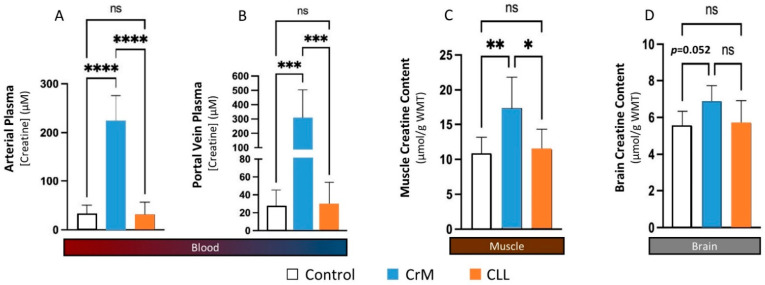
“As shown in Figure 16, rats fed CrM experienced significant increases in creatine concentrations in arterial plasma (+7-fold), portal vein plasma (+10-fold), muscle creatine content (+1.63-fold from control, and +1.53-fold from CLL) while tending to increase brain creatine content (p = 0.052) compared to controls.”
§ Bioavailability, Efficacy, Safety, and Regulatory Status of Creatine and Related Compounds: A Critical Review > 10. No Evidence to Support Bioavailability, Efficacy, and Safety > 10.3. Creatyl-L-Leucine
What the sources say
- Supportedcites [221] da Silva, R.P. (2022). The Dietary Supplement Creatyl-l-Leucine Does Not Bioaccumulate in Muscle, Brain or Plasma and Is Not a Significant Bioavailable Source of Creatine. Nutrients, 14. source
The Results report approximately 7-fold higher creatine in abdominal-aorta plasma and 10-fold higher creatine in portal-vein plasma in CrM-fed rats (Figure 4), plus 1.63-fold higher quadriceps creatine than controls and 1.53-fold higher than CLL-fed rats (Figure 5). They describe the brain difference as a trend, not a significant increase (adjusted P = 0.052); the Discussion explicitly calls the plasma and muscle increases significant. (LLM, conf=0.94)
plaindirectn = 24- Asserted: passes — The authors put it forward as true.
- Checkable: passes — It can be checked against evidence.
- Load-bearing: passes — The paper’s conclusions depend on it.
- Based: passes — The paper gives a reason why it holds.
It may state two separate claims as one.
- Supported
Every source the paper cites for this claim was checked and supports it.
In the paper
“The researcher concluded that provision of large doses of CLL to rats did not increase creatine bioaccumulation indicating that CLL is poorly absorbed by the intestine and is not a bioavailable source of creatine.”
§ Bioavailability, Efficacy, Safety, and Regulatory Status of Creatine and Related Compounds: A Critical Review > 10. No Evidence to Support Bioavailability, Efficacy, and Safety > 10.3. Creatyl-L-Leucine
What the sources say
- Supportedcites [221] da Silva, R.P. (2022). The Dietary Supplement Creatyl-l-Leucine Does Not Bioaccumulate in Muscle, Brain or Plasma and Is Not a Significant Bioavailable Source of Creatine. Nutrients, 14. source
The Discussion explicitly concludes that rats given large dietary doses of CLL did not show increased creatine concentrations in plasma, muscle, or brain, and that CLL was poorly absorbed by the intestine and was not a bioavailable source of creatine. It also notes that the assay cannot establish that no CLL was absorbed, a distinction the citing sentence preserves by saying “poorly absorbed.” (LLM, conf=0.95)
hedged- Asserted: passes — The authors put it forward as true.
- Checkable: passes — It can be checked against evidence.
- Load-bearing: passes — The paper’s conclusions depend on it.
- Based: passes — The paper gives a reason why it holds.
It may state two separate claims as one.
- Supported
Every source the paper cites for this claim was checked and supports it.
In the paper
“While this study indicates that higher than recommended doses of CEE can positively affect training adaptations, this study did not assess the effects of CEE supplementation on blood or muscle creatine content or compare the efficacy of CEE supplementation to CrM.”
§ Bioavailability, Efficacy, Safety, and Regulatory Status of Creatine and Related Compounds: A Critical Review > 9. Some Evidence to Support Bioavailability, Efficacy, and Safety > 9.3. Creatine Ethyl Ester
What the sources say
- Supportedcites [197] Arazi, 2019, Effect of creatine ethyl ester supplementation and resistance training on hormonal changes, body composition and muscle strength in underweight non-athlete men, Biomed. Hum. Kinet. source
The Introduction recommends 0.5–5 g of CEE daily; the Supplementation protocol used 20 g daily for five loading days, and the Conclusions report positive effects on body weight and leg strength in underweight non-athlete men. The Blood sampling section lists hormone assays but no creatine assay, and the protocol compares CEE with placebo, not creatine monohydrate. The higher-than-recommended dose applies to the loading phase, not the 5 g maintenance phase. (LLM, conf=0.91)
hedgeddirect- Asserted: passes — The authors put it forward as true.
- Checkable: passes — It can be checked against evidence.
- Load-bearing: unclear — It is unclear whether the paper’s conclusions depend on it.
- Based: passes — The paper gives a reason why it holds.
It may state two separate claims as one.
- Supported
The cited sources support only part of this claim — read each source’s verdict below.
In the paper
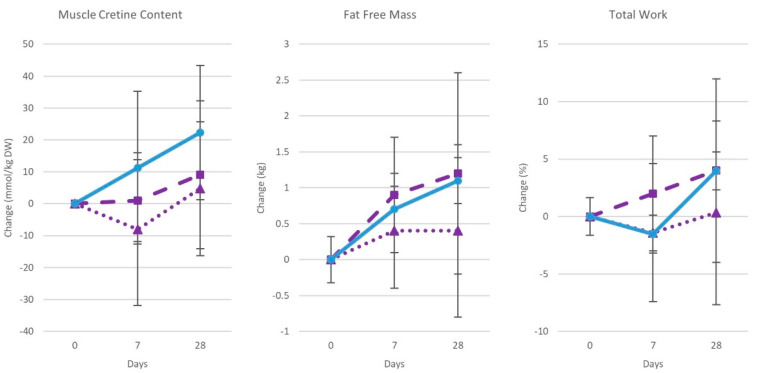
“while CEE supplementation promoted a significant increase in muscle total creatine content after 27 days of supplementation compared to those ingesting a placebo, those taking CrM observed significantly greater increases compared to the placebo and CEE groups (Figure 10C).”
§ Bioavailability, Efficacy, Safety, and Regulatory Status of Creatine and Related Compounds: A Critical Review > 9. Some Evidence to Support Bioavailability, Efficacy, and Safety > 9.3. Creatine Ethyl Ester
What the sources say
- Partly supportedcites [27] Spillane, 2009, The effects of creatine ethyl ester supplementation combined with heavy resistance training on body composition, muscle performance, and serum and muscle creatine levels, J. Int. Soc. Sports Nutr. sourceExperimental — accuracy not yet measured
The Results (Muscle creatine, Figure 2; page not provided) report higher total muscle creatine in both CEE and CRT than in placebo, and an increase in CEE at day 27. The Discussion (Serum and Muscle Creatine; page not provided) explicitly says CRT was not significantly greater than CEE in total muscle creatine, contrary to the claim's final comparison. (LLM, conf=0.90)
plaindirect- Asserted: passes — The authors put it forward as true.
- Checkable: passes — It can be checked against evidence.
- Load-bearing: passes — The paper’s conclusions depend on it.
- Based: passes — The paper gives a reason why it holds.
It may state two separate claims as one.
- Partly supported
The sources with a verdict support this claim; the rest weren’t checked yet, have no full text we could read, or their verdicts aren’t rated yet.
In the paper
“In the United States (US), congress enacted the Dietary Supplement Health and Education Act (DSHEA) of 1994 that placed dietary supplements in a special category of foods under the jurisdiction of the FDA.”
§ Bioavailability, Efficacy, Safety, and Regulatory Status of Creatine and Related Compounds: A Critical Review > 11. Regulatory Status > 11.1. United States
What the sources say
- Supportedcites [14] Kerksick, 2018, ISSN exercise & sports nutrition review update: Research & recommendations, J. Int. Soc. Sports Nutr. source
The Background section, under “Definition and regulation of dietary supplements,” says Congress passed DSHEA in 1994, placing supplements in a special category of foods. The same section states that the FDA regulates the dietary supplement industry as a result of DSHEA. (LLM, conf=0.95)
- Not checked yetcites [234] (2020, October 26). New Dietary Ingredients in Dietary Supplements-Background for Industry, Available online: https://www.fda.gov/food/new-dietary-ingredients-ndi-notification-process/new-dietary-ingredients-dietary-supplements-background-industry.
plaindirect- Asserted: passes — The authors put it forward as true.
- Checkable: passes — It can be checked against evidence.
- Load-bearing: fails — The paper’s conclusions may not depend on it.
- Based: passes — The paper gives a reason why it holds.
Probably not a substantial claim. The paper’s conclusions may not depend on it.
- Supported
The sources with a verdict support this claim; the rest weren’t checked yet, have no full text we could read, or their verdicts aren’t rated yet.
In the paper
“Phosphate loading has been found to increase myocardial ejection fraction during exercise and maximal aerobic capacity [231,232] and is considered an ergogenic aid for endurance athletes [14].”
§ Bioavailability, Efficacy, Safety, and Regulatory Status of Creatine and Related Compounds: A Critical Review > 10. No Evidence to Support Bioavailability, Efficacy, and Safety > 10.4. Creatinol-O-Phosphate
What the sources say
- Not checked — no full text of the sourcecites [231] Kreider, 1990, Effects of phosphate loading on oxygen uptake, ventilatory anaerobic threshold, and run performance, Med. Sci. Sports Exerc.
- Not checked — no full text of the sourcecites [232] Kreider, 1992, Effects of phosphate loading on metabolic and myocardial responses to maximal and endurance exercise, Int. J. Sport Nutr. source
- Supportedcites [14] Kerksick, 2018, ISSN exercise & sports nutrition review update: Research & recommendations, J. Int. Soc. Sports Nutr. source
The citation to this source is attached to the characterization of phosphate loading as an ergogenic aid for endurance athletes, not to the preceding ejection-fraction finding. The Performance enhancement supplements section describes phosphate’s proposed ergogenic action and reports improvements in aerobic capacity and other performance measures, while noting mixed results across studies. (LLM, conf=0.88)
plaindirect- Asserted: passes — The authors put it forward as true.
- Checkable: passes — It can be checked against evidence.
- Load-bearing: unclear — It is unclear whether the paper’s conclusions depend on it.
- Based: passes — The paper gives a reason why it holds.
It may state two separate claims as one.
Every source the paper cites for this claim was checked and supports it.
In the paper
“As seen in Figure 10A, fasting serum creatine levels significantly increased only in the CrM group.”
- Also stated in: § 9.3. Creatine Ethyl Ester · plain
“CEE supplementation had no effect on fasting serum creatine levels compared to a placebo.”
§ Bioavailability, Efficacy, Safety, and Regulatory Status of Creatine and Related Compounds: A Critical Review > 9. Some Evidence to Support Bioavailability, Efficacy, and Safety > 9.3. Creatine Ethyl Ester
What the sources say
- Supportedcites [27] Spillane, 2009, The effects of creatine ethyl ester supplementation combined with heavy resistance training on body composition, muscle performance, and serum and muscle creatine levels, J. Int. Soc. Sports Nutr. source
The Results (Serum creatine; no page given) report significant serum creatine increases at days 6, 27, and 48 only for the creatine monohydrate (CRT) group. The Methods (Muscle biopsies and venous blood sampling; no page given) state that participants fasted for eight hours before each blood draw. (LLM, conf=0.91)
plain- Asserted: passes — The authors put it forward as true.
- Checkable: passes — It can be checked against evidence.
- Load-bearing: passes — The paper’s conclusions depend on it.
- Based: passes — The paper gives a reason why it holds.
It may state two separate claims as one.
- Also stated in: § 9.3. Creatine Ethyl Ester · plain
Every source the paper cites for this claim was checked and supports it.
In the paper
“There was some evidence that ingesting higher doses of CrM-Alk increased muscle creatine content after 28 days (6.2 ± 29.2; 27.3 ± 49.1%, respectively), but these values were less than observed with CrM (23.5 ± 49.0; 50.4 ± 44.8%, respectively).”
§ Bioavailability, Efficacy, Safety, and Regulatory Status of Creatine and Related Compounds: A Critical Review > 9. Some Evidence to Support Bioavailability, Efficacy, and Safety > 9.6. Buffered Creatine Monohydrate
What the sources say
- Supportedcites [28] Jagim, 2012, A buffered form of creatine does not promote greater changes in muscle creatine content, body composition, or training adaptations than creatine monohydrate, J. Int. Soc. Sports Nutr. source
Table 6 (Results, Muscle creatine analysis) reports the quoted percentage changes for the higher-dose buffered creatine group (KA-H) and CrM: KA-H's mean changes were smaller at both day 7 and day 28. The first value in each pair is from day 7, not day 28. The Results also report no significant group-by-time interaction, so the comparison describes the observed means rather than a statistically established difference between groups. (LLM, conf=0.92)
hedgeddirect- Asserted: passes — The authors put it forward as true.
- Checkable: passes — It can be checked against evidence.
- Load-bearing: passes — The paper’s conclusions depend on it.
- Based: passes — The paper gives a reason why it holds.
It may state two separate claims as one.
- Supported
Every source the paper cites for this claim was checked and supports it.
In the paper
“A number of studies have indicated that dietary nitrates, typically ingested in the form of beet root juice or nitrate powder, can improve endurance [203] and explosive exercise capacity [204].”
§ Bioavailability, Efficacy, Safety, and Regulatory Status of Creatine and Related Compounds: A Critical Review > 9. Some Evidence to Support Bioavailability, Efficacy, and Safety > 9.5. Creatine Nitrate
What the sources say
- Supportedcites [203] Hlinský, T., Kumstát, M., and Vajda, P. (2020). Effects of Dietary Nitrates on Time Trial Performance in Athletes with Different Training Status: Systematic Review. Nutrients, 12. source
The Results and Conclusions report that dietary nitrate supplementation can improve time-trial performance, particularly in less-trained athletes. The Discussion (§4.3) identifies beetroot juice and encapsulated potassium nitrate among the forms studied. This source is attached to the endurance claim [203]; the separate explosive-exercise claim is cited to [204]. (LLM, conf=0.90)
- Supportedcites [204] Tan, R., Cano, L., Lago-Rodríguez, Á., and Domínguez, R. (2022). The Effects of Dietary Nitrate Supplementation on Explosive Exercise Performance: A Systematic Review. Int. J. Environ. Res. Public Health, 19. source
Citation [204] is attached to the explosive-exercise claim, not the endurance claim cited to [203]. The Discussion reports that dietary nitrate has the potential to improve sprint-type and resistance-type explosive performance; the Study Characteristics section identifies beetroot juice as the nitrate source in all but one reviewed study, which used potassium nitrate salts. (LLM, conf=0.91)
hedgedconditional- Asserted: passes — The authors put it forward as true.
- Checkable: passes — It can be checked against evidence.
- Load-bearing: unclear — It is unclear whether the paper’s conclusions depend on it.
- Based: passes — The paper gives a reason why it holds.
It may state two separate claims as one.
- Supported
Every source the paper cites for this claim was checked and supports it.
In the paper
“Results revealed that the plasma creatine AUC over a 5 h period for CrM (5634.4 ± 1949.8 μmol/L) was significantly greater than the placebo (1012.4 ± 1882.2 μmol/L), CrN-Low (2342.0 ± 3133.3 μmol/L, p = 0.004), and CrN-High (1761.7 ± 3408.8 μmol/L, p = 0.007) treatments with no differences seen between the CrN dosages.”
§ Bioavailability, Efficacy, Safety, and Regulatory Status of Creatine and Related Compounds: A Critical Review > 9. Some Evidence to Support Bioavailability, Efficacy, and Safety > 9.5. Creatine Nitrate
What the sources say
- Supportedcites [29] Galvan, 2016, Acute and chronic safety and efficacy of dose dependent creatine nitrate supplementation and exercise performance, J. Int. Soc. Sports Nutr. source
The Results for Study 1 (Plasma creatine and nitrate) give the quoted AUC values and report that CrM was significantly greater than placebo, CrN-Low, and CrN-High. The same passage reports no significant difference between the CrN dosages, and the Fig. 2 caption specifies that AUC was measured over 5 hours post-ingestion. (LLM, conf=0.95)
plain- Asserted: passes — The authors put it forward as true.
- Checkable: passes — It can be checked against evidence.
- Load-bearing: passes — The paper’s conclusions depend on it.
- Based: passes — The paper gives a reason why it holds.
It may state two separate claims as one.
- Supported
The cited sources support only part of this claim — read each source’s verdict below.
In the paper
“Given the health benefits of creatine, availability of ineffective sources of creatine or recommendations to take less creatine than needed to increase creatine stores in the muscle and/or brain can limit the benefits theses populations may derive from creatine supplementation [5].”
§ Bioavailability, Efficacy, Safety, and Regulatory Status of Creatine and Related Compounds: A Critical Review > 11. Regulatory Status > 11.3. Assessment and Guidance for Industry
What the sources say
- Partly supportedcites [5] Kreider, R.B., and Stout, J.R. (2021). Creatine in Health and Disease. Nutrients, 13. sourceExperimental — accuracy not yet measured
Section 3 (Metabolic Role; page unavailable) gives doses used to increase muscle creatine and notes that some clinical populations need higher doses to increase brain creatine. Sections 4 and 6.1 describe potential health benefits, but the copy does not establish that ineffective creatine sources are available or directly assess whether such sources limit those benefits. (LLM, conf=0.84)
plainconditional- Asserted: passes — The authors put it forward as true.
- Checkable: passes — It can be checked against evidence.
- Load-bearing: passes — The paper’s conclusions depend on it.
- Based: passes — The paper gives a reason why it holds.
It may state two separate claims as one.
- Partly supported
The paper states this without a source or data behind it here, so there is nothing to check it against. The quote shows it is in the paper.
In the paper
“To date, we are unaware of any study that has evaluated the effects of CC or CPY on muscle or brain creatine content.”
§ Bioavailability, Efficacy, Safety, and Regulatory Status of Creatine and Related Compounds: A Critical Review > 9. Some Evidence to Support Bioavailability, Efficacy, and Safety > 9.1. Creatine Salts
hedged- Asserted: passes — The authors put it forward as true.
- Checkable: passes — It can be checked against evidence.
- Load-bearing: fails — The paper’s conclusions may not depend on it.
- Based: passes — The paper gives a reason why it holds.
Probably not a substantial claim. The paper’s conclusions may not depend on it.
The paper states this without a source or data behind it here, so there is nothing to check it against. The quote shows it is in the paper.
In the paper
“Thus, there is substantial evidence to support the safety and efficacy of CrM supplementation (see Table 2).”
- Also stated in: § Creatine Monohydrate · boosted
“CrM is classified as having strong evidence from pharmacokinetic and tissue bioavailability studies, numerous randomized and controlled clinical trials, and a long-history of safety assessed in clinical trials and historical widespread use supporting bioavailability, efficacy, and safety.”
§ Bioavailability, Efficacy, Safety, and Regulatory Status of Creatine and Related Compounds: A Critical Review > 8. Strong Evidence to Support Bioavailability, Efficacy, and Safety > Creatine Monohydrate
boosteddirect- Asserted: passes — The authors put it forward as true.
- Checkable: passes — It can be checked against evidence.
- Load-bearing: passes — The paper’s conclusions depend on it.
- Based: passes — The paper gives a reason why it holds.
It may state two separate claims as one.
- Also stated in: § Creatine Monohydrate · boosted
The paper states this without a source or data behind it here, so there is nothing to check it against. The quote shows it is in the paper.
In the paper
“Since MgCr-C contains about 84.4% of creatine by molecular weight (see Table 1), it could theoretically serve as a good source of creatine if creatine easily dissociates from MgCr-C and equimolar amounts of creatine were consumed compared to CrM.”
§ Bioavailability, Efficacy, Safety, and Regulatory Status of Creatine and Related Compounds: A Critical Review > 9. Some Evidence to Support Bioavailability, Efficacy, and Safety > 9.2. Magnesium Creatine Chelate
hedgedconditional- Asserted: passes — The authors put it forward as true.
- Checkable: passes — It can be checked against evidence.
- Load-bearing: fails — The paper’s conclusions may not depend on it.
- Based: passes — The paper gives a reason why it holds.
Probably not a substantial claim. The paper’s conclusions may not depend on it. It may state two separate claims as one.
In the paper
“Results revealed that CrM and MgCr-C were both effective in increasing performance with no differences observed between types of creatine ingested.”
§ Bioavailability, Efficacy, Safety, and Regulatory Status of Creatine and Related Compounds: A Critical Review > 9. Some Evidence to Support Bioavailability, Efficacy, and Safety > 9.2. Magnesium Creatine Chelate
What the sources say
- Not checked — no full text of the sourcecites [190] Selsby, 2004, Mg2+-creatine chelate and a low-dose creatine supplementation regimen improve exercise performance, J. Strength Cond. Res. source
plaindirect- Asserted: passes — The authors put it forward as true.
- Checkable: passes — It can be checked against evidence.
- Load-bearing: passes — The paper’s conclusions depend on it.
- Based: passes — The paper gives a reason why it holds.
It may state two separate claims as one.
The paper states this without a source or data behind it here, so there is nothing to check it against. The quote shows it is in the paper.
In the paper
“Therefore, there are no studies indicating that CC is more bioavailable, more effective, or a safer source of creatine than CrM. Given this, CC is categorized as having limited evidence to support bioavailability, efficacy, and safety.”
§ Bioavailability, Efficacy, Safety, and Regulatory Status of Creatine and Related Compounds: A Critical Review > 9. Some Evidence to Support Bioavailability, Efficacy, and Safety > 9.1. Creatine Salts
plain- Asserted: passes — The authors put it forward as true.
- Checkable: passes — It can be checked against evidence.
- Load-bearing: passes — The paper’s conclusions depend on it.
- Based: passes — The paper gives a reason why it holds.
It may state two separate claims as one.
In the paper
“Results revealed that body water increased with MgCr-C, but not CrM while torque and power increased similarly with CrM and MgCr-C.”
§ Bioavailability, Efficacy, Safety, and Regulatory Status of Creatine and Related Compounds: A Critical Review > 9. Some Evidence to Support Bioavailability, Efficacy, and Safety > 9.2. Magnesium Creatine Chelate
What the sources say
- Not checked — no full text of the sourcecites [189] Brilla, 2003, Magnesium-creatine supplementation effects on body water, Metabolism source
plaindirect- Asserted: passes — The authors put it forward as true.
- Checkable: passes — It can be checked against evidence.
- Load-bearing: unclear — It is unclear whether the paper’s conclusions depend on it.
- Based: passes — The paper gives a reason why it holds.
It may state two separate claims as one.
The paper states this without a source or data behind it here, so there is nothing to check it against. The quote shows it is in the paper.
In the paper
“We are aware of no data showing that MgCr-C increases blood creatine levels or promotes greater creatine retention in skeletal muscle. Thus, there are no data supporting that MgCr-C is more bioavailable to tissue than CrM.”
§ Bioavailability, Efficacy, Safety, and Regulatory Status of Creatine and Related Compounds: A Critical Review > 9. Some Evidence to Support Bioavailability, Efficacy, and Safety > 9.2. Magnesium Creatine Chelate
hedged- Asserted: passes — The authors put it forward as true.
- Checkable: passes — It can be checked against evidence.
- Load-bearing: passes — The paper’s conclusions depend on it.
- Based: passes — The paper gives a reason why it holds.
It may state two separate claims as one.
The paper states this without a source or data behind it here, so there is nothing to check it against. The quote shows it is in the paper.
In the paper
“Consequently, there is no data showing that MgCr-C increases blood or muscle creatine and there is only limited data showing potential ergogenic effect. There is also no evidence that MgCr-C is more bioavailable, efficacious, and/or a safer source of creatine than CrM.”
§ Bioavailability, Efficacy, Safety, and Regulatory Status of Creatine and Related Compounds: A Critical Review > 9. Some Evidence to Support Bioavailability, Efficacy, and Safety > 9.2. Magnesium Creatine Chelate
plain- Asserted: passes — The authors put it forward as true.
- Checkable: passes — It can be checked against evidence.
- Load-bearing: passes — The paper’s conclusions depend on it.
- Based: passes — The paper gives a reason why it holds.
It may state two separate claims as one.
The paper states this without a source or data behind it here, so there is nothing to check it against. The quote shows it is in the paper.
In the paper
“As of this writing, no PubMed indexed articles have been published on Cr-HCl and muscle creatine retention or performance. However, several articles have been published in non-indexed journals from Brazil that have been cited in marketing materials.”
§ Bioavailability, Efficacy, Safety, and Regulatory Status of Creatine and Related Compounds: A Critical Review > 9. Some Evidence to Support Bioavailability, Efficacy, and Safety > 9.4. Creatine HCl
plain- Asserted: passes — The authors put it forward as true.
- Checkable: passes — It can be checked against evidence.
- Load-bearing: unclear — It is unclear whether the paper’s conclusions depend on it.
- Based: passes — The paper gives a reason why it holds.
It may state two separate claims as one.
In the paper
“gains in fat-free mass were greatest in the CrM group (+1.7 kg), but supposedly not significantly different than observed with 5 g/day of Cr-HCL (+1.6 kg) that were reported to be significantly different than controls (+1.1 kg) and those ingesting 1.5 g/day of Cr-HCl (+1.1 kg).”
§ Bioavailability, Efficacy, Safety, and Regulatory Status of Creatine and Related Compounds: A Critical Review > 9. Some Evidence to Support Bioavailability, Efficacy, and Safety > 9.4. Creatine HCl
What the sources say
- Not checked yetcites [65] Avelar, 2015, Creatine HCl and Creatine Monohydrate Improve Strength but Only Creatine HCl Induced Changes on Body Composition in Recreational Weightlifters, Food Nutr. Sci.
hedged- Asserted: passes — The authors put it forward as true.
- Checkable: passes — It can be checked against evidence.
- Load-bearing: fails — The paper’s conclusions may not depend on it.
- Based: passes — The paper gives a reason why it holds.
Probably not a substantial claim. The paper’s conclusions may not depend on it. It may state two separate claims as one.
In the paper
“CrM was assessed at a saturation pH of 8.6 while Cr-HCL was measured at a saturation pH of 0.3.”
§ Bioavailability, Efficacy, Safety, and Regulatory Status of Creatine and Related Compounds: A Critical Review > 9. Some Evidence to Support Bioavailability, Efficacy, and Safety > 9.4. Creatine HCl
What the sources say
- Not checked — no full text of the sourcecites [179] Gufford, 2010, Physicochemical characterization of creatine N-methylguanidinium salts, J. Diet. Suppl. source
plain- Asserted: passes — The authors put it forward as true.
- Checkable: passes — It can be checked against evidence.
- Load-bearing: passes — The paper’s conclusions depend on it.
- Based: passes — The paper gives a reason why it holds.
It may state two separate claims as one.
The paper states this without a source or data behind it here, so there is nothing to check it against. The quote shows it is in the paper.
In the paper
“there is no evidence that ingesting recommended doses of CEE is effective or that ingesting typical CrM loading, and maintenance doses of CEE is more effective than CrM.”
§ Bioavailability, Efficacy, Safety, and Regulatory Status of Creatine and Related Compounds: A Critical Review > 9. Some Evidence to Support Bioavailability, Efficacy, and Safety > 9.3. Creatine Ethyl Ester
plain- Asserted: passes — The authors put it forward as true.
- Checkable: passes — It can be checked against evidence.
- Load-bearing: passes — The paper’s conclusions depend on it.
- Based: passes — The paper gives a reason why it holds.
It may state two separate claims as one.
None of the sources cited for this claim have been checked yet.
In the paper
“there is no evidence that Cr-HCl is absorbed more effectively than CrM in humans; Cr-HCl promotes greater muscle creatine retention than CrM at equivalent doses; or, that lower doses of Cr-HCl are as effective as standard supplementation protocols with CrM.”
§ Bioavailability, Efficacy, Safety, and Regulatory Status of Creatine and Related Compounds: A Critical Review > 9. Some Evidence to Support Bioavailability, Efficacy, and Safety > 9.4. Creatine HCl
plain- Asserted: passes — The authors put it forward as true.
- Checkable: passes — It can be checked against evidence.
- Load-bearing: passes — The paper’s conclusions depend on it.
- Based: passes — The paper gives a reason why it holds.
It may state two separate claims as one.
The paper states this without a source or data behind it here, so there is nothing to check it against. The quote shows it is in the paper.
In the paper
“No alternative form of creatine has shown superior bioavailability, efficacy or safety compared to CrM.”
- Also stated in: § 12. Summary · plain
“However, there is no evidence that other “forms” of creatine are more bioavailable, effective, or safer forms of creatine compared to CrM.”
§ Bioavailability, Efficacy, Safety, and Regulatory Status of Creatine and Related Compounds: A Critical Review > 11. Regulatory Status > 11.3. Assessment and Guidance for Industry
plain- Asserted: passes — The authors put it forward as true.
- Checkable: passes — It can be checked against evidence.
- Load-bearing: passes — The paper’s conclusions depend on it.
- Based: passes — The paper gives a reason why it holds.
It may state two separate claims as one.
- Also stated in: § 12. Summary · plain
The paper states this without a source or data behind it here, so there is nothing to check it against. The quote shows it is in the paper.
In the paper
“Creatine monohydrate can be legally sold throughout the world although some countries limit the amount to of CrM that can be included per dose (e.g., no more than 3–5 g/serving).”
§ Bioavailability, Efficacy, Safety, and Regulatory Status of Creatine and Related Compounds: A Critical Review > 11. Regulatory Status > 11.2. International Regulation
plain- Asserted: passes — The authors put it forward as true.
- Checkable: passes — It can be checked against evidence.
- Load-bearing: unclear — It is unclear whether the paper’s conclusions depend on it.
- Based: passes — The paper gives a reason why it holds.
It may state two separate claims as one.
The paper states this without a source or data behind it here, so there is nothing to check it against. The quote shows it is in the paper.
In the paper
“For example, studies published in 2003 clearly showed that creatine serum was not a bioavailable source of creatine, yet it continues to be sold as a creatine-containing product.”
§ Bioavailability, Efficacy, Safety, and Regulatory Status of Creatine and Related Compounds: A Critical Review > 11. Regulatory Status > 11.3. Assessment and Guidance for Industry
boosted- Asserted: passes — The authors put it forward as true.
- Checkable: passes — It can be checked against evidence.
- Load-bearing: fails — The paper’s conclusions may not depend on it.
- Based: fails — The paper may give no reason why it holds.
Probably not a substantial claim. The paper’s conclusions may not depend on it. The paper may give no reason why it holds. It may state two separate claims as one.
The paper states this without a source or data behind it here, so there is nothing to check it against. The quote shows it is in the paper.
In the paper
“The bioavailability, efficacy, safety, and regulatory status of other purported sources of creatine are less clear, with only a few having some data supporting efficacy compared to placebo (see Table 7).”
§ Bioavailability, Efficacy, Safety, and Regulatory Status of Creatine and Related Compounds: A Critical Review > 12. Summary
plain- Asserted: passes — The authors put it forward as true.
- Checkable: passes — It can be checked against evidence.
- Load-bearing: passes — The paper’s conclusions depend on it.
- Based: passes — The paper gives a reason why it holds.
It may state two separate claims as one.
The paper states this without a source or data behind it here, so there is nothing to check it against. The quote shows it is in the paper.
In the paper
“While alternative forms of creatine are unlikely to pose a health risk, they are typically more expensive than CrM.”
§ Bioavailability, Efficacy, Safety, and Regulatory Status of Creatine and Related Compounds: A Critical Review > 11. Regulatory Status > 11.3. Assessment and Guidance for Industry
plaincorrelational- Asserted: passes — The authors put it forward as true.
- Checkable: passes — It can be checked against evidence.
- Load-bearing: fails — The paper’s conclusions may not depend on it.
- Based: fails — The paper may give no reason why it holds.
Probably not a substantial claim. The paper’s conclusions may not depend on it. The paper may give no reason why it holds.
The paper states this without a source or data behind it here, so there is nothing to check it against. The quote shows it is in the paper.
In the paper
“Since our last review in 2011, more data is available about several forms of creatine and several now have data providing some support as to efficacy and safety while others do not.”
§ Bioavailability, Efficacy, Safety, and Regulatory Status of Creatine and Related Compounds: A Critical Review > 11. Regulatory Status > 11.3. Assessment and Guidance for Industry
plain- Asserted: passes — The authors put it forward as true.
- Checkable: passes — It can be checked against evidence.
- Load-bearing: passes — The paper’s conclusions depend on it.
- Based: passes — The paper gives a reason why it holds.
It may state two separate claims as one.
The paper states this without a source or data behind it here, so there is nothing to check it against. The quote shows it is in the paper.
In the paper
“Alternatives to CrM continue to be prevalent in the marketplace, including several that do not appear to meet regulatory requirements in several countries.”
§ Bioavailability, Efficacy, Safety, and Regulatory Status of Creatine and Related Compounds: A Critical Review > 11. Regulatory Status > 11.3. Assessment and Guidance for Industry
hedged- Asserted: passes — The authors put it forward as true.
- Checkable: passes — It can be checked against evidence.
- Load-bearing: fails — The paper’s conclusions may not depend on it.
- Based: fails — The paper may give no reason why it holds.
Probably not a substantial claim. The paper’s conclusions may not depend on it. The paper may give no reason why it holds. It may state two separate claims as one.
The paper states this without a source or data behind it here, so there is nothing to check it against. The quote shows it is in the paper.
In the paper
“Pure CrM is the only source of creatine with strong evidence of bioavailability, efficacy, and safety and considered as GRAS by the FDA, approved for use in the EU and Australia, and evaluated for safety by Health Canada.”
§ Bioavailability, Efficacy, Safety, and Regulatory Status of Creatine and Related Compounds: A Critical Review > 11. Regulatory Status > 11.3. Assessment and Guidance for Industry
plain- Asserted: passes — The authors put it forward as true.
- Checkable: passes — It can be checked against evidence.
- Load-bearing: unclear — It is unclear whether the paper’s conclusions depend on it.
- Based: passes — The paper gives a reason why it holds.
It may state two separate claims as one.
The paper states this without a source or data behind it here, so there is nothing to check it against. The quote shows it is in the paper.
In the paper
“CrM remains the only source of creatine that has substantial evidence of bioavailability, efficacy and safety and is considered GRAS by the U.S. FDA, is approved for use with accompanying health claims in the EU, has been extensively reviewed and approved by Health Canada, and is approved to be sold in major global markets.”
§ Bioavailability, Efficacy, Safety, and Regulatory Status of Creatine and Related Compounds: A Critical Review > 12. Summary
plain- Asserted: passes — The authors put it forward as true.
- Checkable: passes — It can be checked against evidence.
- Load-bearing: passes — The paper’s conclusions depend on it.
- Based: passes — The paper gives a reason why it holds.
It may state two separate claims as one.
The paper states this without a source or data behind it here, so there is nothing to check it against. The quote shows it is in the paper.
In the paper
“Of these, the FDA initially rejected some of the IND notification applications, yet the forms were sold for years before finally submitting an acceptable IND notification application or Self-Affirming GRAS.”
§ Bioavailability, Efficacy, Safety, and Regulatory Status of Creatine and Related Compounds: A Critical Review > 11. Regulatory Status > 11.3. Assessment and Guidance for Industry
plain- Asserted: passes — The authors put it forward as true.
- Checkable: passes — It can be checked against evidence.
- Load-bearing: unclear — It is unclear whether the paper’s conclusions depend on it.
- Based: passes — The paper gives a reason why it holds.
It may state two separate claims as one.
A conclusion the paper draws from its own results — it cites no other source for it, so there is none to check. The quote shows it is in the paper.
In the paper
“To do so, the creatine salt must deliver physiologically effective doses of creatine (i.e., 3–5 g per serving) to the blood and tissue in an equivalent manner as CrM to be comparatively effective.”
§ Bioavailability, Efficacy, Safety, and Regulatory Status of Creatine and Related Compounds: A Critical Review > 9. Some Evidence to Support Bioavailability, Efficacy, and Safety > 9.1. Creatine Salts
plainconditional- Asserted: passes — The authors put it forward as true.
- Checkable: passes — It can be checked against evidence.
- Load-bearing: passes — The paper’s conclusions depend on it.
- Based: fails — The paper may give no reason why it holds.
Probably not a substantial claim. The paper may give no reason why it holds.
A conclusion the paper draws from its own results — it cites no other source for it, so there is none to check. The quote shows it is in the paper.
In the paper
“Thus, there is consensus among professional organizations that CrM is an effective nutritional ergogenic aid that may benefit athletes involved in numerous sports and individuals initiating exercise training to promote health and fitness.”
§ Bioavailability, Efficacy, Safety, and Regulatory Status of Creatine and Related Compounds: A Critical Review > 8. Strong Evidence to Support Bioavailability, Efficacy, and Safety > Creatine Monohydrate
hedgedconditional- Asserted: passes — The authors put it forward as true.
- Checkable: passes — It can be checked against evidence.
- Load-bearing: passes — The paper’s conclusions depend on it.
- Based: passes — The paper gives a reason why it holds.
It may state two separate claims as one.
The paper states this without a source or data behind it here, so there is nothing to check it against. The quote shows it is in the paper.
In the paper
“One of the limitations in terms of developing consumer products containing CrM is that CrM powder is not highly soluble. For example, when mixing CrM in solution, some CrM residue remains at the bottom of the glass requiring consumers to add more fluid, swirl, and quickly ingest to ensure they consumed all the creatine.”
§ Bioavailability, Efficacy, Safety, and Regulatory Status of Creatine and Related Compounds: A Critical Review > 6. Solubility
plaindirect- Asserted: passes — The authors put it forward as true.
- Checkable: passes — It can be checked against evidence.
- Load-bearing: unclear — It is unclear whether the paper’s conclusions depend on it.
- Based: passes — The paper gives a reason why it holds.
It may state two separate claims as one.
A conclusion the paper draws from its own results — it cites no other source for it, so there is none to check. The quote shows it is in the paper.
In the paper
“These studies indicate that CPY can serve as effective source of creatine to increase blood creatine content and a few short-term studies suggest there may be some ergogenic values.”
§ Bioavailability, Efficacy, Safety, and Regulatory Status of Creatine and Related Compounds: A Critical Review > 9. Some Evidence to Support Bioavailability, Efficacy, and Safety > 9.1. Creatine Salts
hedgedconditional- Asserted: passes — The authors put it forward as true.
- Checkable: passes — It can be checked against evidence.
- Load-bearing: passes — The paper’s conclusions depend on it.
- Based: passes — The paper gives a reason why it holds.
It may state two separate claims as one.
What the paper did — it cites no source for this, so there is none to check. The quote shows it is in the paper.
In the paper
“This paper was conducted as a systematic review of the literature related to sources of creatine marketed as ingredients for dietary supplements or found in dietary supplements, food products, and/or beverages marketed as containing creatine.”
§ Bioavailability, Efficacy, Safety, and Regulatory Status of Creatine and Related Compounds: A Critical Review > 2. Methods
plain- Asserted: passes — The authors put it forward as true.
- Checkable: passes — It can be checked against evidence.
- Load-bearing: passes — The paper’s conclusions depend on it.
- Based: passes — The paper gives a reason why it holds.
Probably not a substantial claim.
In the paper
“In support of this contention, classic experiments by Harris et al. [12] indicated that a dose of orally ingested creatine should ideally increase plasma creatine levels to greater than 500 µmol/L (75 µg/mL) to optimize tissue uptake.”
§ Bioavailability, Efficacy, Safety, and Regulatory Status of Creatine and Related Compounds: A Critical Review > 3. Bioavailability
What the sources say
- Not checked — no full text of the sourcecites [12] Harris, 1992, Elevation of creatine in resting and exercised muscle of normal subjects by creatine supplementation, Clin. Sci. source
hedgeddirect- Asserted: passes — The authors put it forward as true.
- Checkable: passes — It can be checked against evidence.
- Load-bearing: passes — The paper’s conclusions depend on it.
- Based: passes — The paper gives a reason why it holds.
Probably not a substantial claim.
In the paper
“However, ingestion of one oral dose of 5 g of CrM (equivalent to about 1.1 kg of uncooked beef) resulted in plasma creatine levels of about 800 µmol/L (120 µg/mL) after 1 h of ingestion. It sustained plasma creatine above 200 µmol/L (30 µg/mL) for over 4–5 h (see Figure 2A).”
§ Bioavailability, Efficacy, Safety, and Regulatory Status of Creatine and Related Compounds: A Critical Review > 3. Bioavailability
What the sources say
- Not checked — no full text of the sourcecites [12] Harris, 1992, Elevation of creatine in resting and exercised muscle of normal subjects by creatine supplementation, Clin. Sci. source
plaindirect- Asserted: passes — The authors put it forward as true.
- Checkable: passes — It can be checked against evidence.
- Load-bearing: passes — The paper’s conclusions depend on it.
- Based: passes — The paper gives a reason why it holds.
It may state two separate claims as one.
A conclusion the paper draws from its own results — it cites no other source for it, so there is none to check. The quote shows it is in the paper.
In the paper
“While these studies provide evidence that CC can serve as a viable source of creatine by increasing blood creatine level in a similar manner as CrM and there is some data supporting the ergogenic benefit compared to placebo”
§ Bioavailability, Efficacy, Safety, and Regulatory Status of Creatine and Related Compounds: A Critical Review > 9. Some Evidence to Support Bioavailability, Efficacy, and Safety > 9.1. Creatine Salts
plaindirect- Asserted: passes — The authors put it forward as true.
- Checkable: passes — It can be checked against evidence.
- Load-bearing: passes — The paper’s conclusions depend on it.
- Based: passes — The paper gives a reason why it holds.
It may state two separate claims as one.
The paper states this without a source or data behind it here, so there is nothing to check it against. The quote shows it is in the paper.
In the paper
“In this regard, CrM contains 87.9% creatine whereas creatine citrate (40.6%), di-creatine citrate (57.7%), creatine pyruvate (59.8%), and creatine HCl (78.2%) contain less creatine by weight compared to CrM.”
§ Bioavailability, Efficacy, Safety, and Regulatory Status of Creatine and Related Compounds: A Critical Review > 6. Solubility
plain- Asserted: passes — The authors put it forward as true.
- Checkable: passes — It can be checked against evidence.
- Load-bearing: passes — The paper’s conclusions depend on it.
- Based: passes — The paper gives a reason why it holds.
It may state two separate claims as one.
None of the sources cited for this claim have been checked yet.
In the paper
“Co-ingesting CrM with carbohydrates [20,21,22] and carbohydrate and protein [23] promotes more consistent and greater creatine retention.”
§ Bioavailability, Efficacy, Safety, and Regulatory Status of Creatine and Related Compounds: A Critical Review > 1. Introduction
What the sources say
- Not checked — no full text of the sourcecites [20] Green, 1996, Carbohydrate ingestion augments skeletal muscle creatine accumulation during creatine supplementation in humans, Am. J. Physiol. source
- Not checked — no full text of the sourcecites [21] Green, 1996, Carbohydrate ingestion augments creatine retention during creatine feeding in humans, Acta Physiol. Scand. source
- Not checked yetcites [22] Greenwood, 2003, Differences in creatine retention among three nutritional formulations of oral creatine supplements, J. Exerc. Physiol. Online
- Not checked — no full text of the sourcecites [23] Steenge, 2000, Protein- and carbohydrate-induced augmentation of whole body creatine retention in humans, J. Appl. Physiol. source
plaindirect- Asserted: passes — The authors put it forward as true.
- Checkable: passes — It can be checked against evidence.
- Load-bearing: unclear — It is unclear whether the paper’s conclusions depend on it.
- Based: passes — The paper gives a reason why it holds.
It may state two separate claims as one.
A conclusion the paper draws from its own results — it cites no other source for it, so there is none to check. The quote shows it is in the paper.
In the paper
“Purported sources of creatine that increase blood levels of creatine but do not increase tissue levels of creatine in physiologically effective amounts (i.e., 20–40% in muscle and 10–20% in brain) are not bioavailable sources of creatine.”
§ Bioavailability, Efficacy, Safety, and Regulatory Status of Creatine and Related Compounds: A Critical Review > 3. Bioavailability > 3.1. Methods to Assess Bioavailability
plaindirect- Asserted: passes — The authors put it forward as true.
- Checkable: passes — It can be checked against evidence.
- Load-bearing: passes — The paper’s conclusions depend on it.
- Based: passes — The paper gives a reason why it holds.
Probably not a substantial claim.
The paper states this without a source or data behind it here, so there is nothing to check it against. The quote shows it is in the paper.
In the paper
“Despite this clear scientific evidence, guidance from professional organizations, and regulatory challenges of selling other forms of creatine in the global marketplace, companies continue to market “new forms” of creatine that are purportedly more stable, bioavailable, and/or effective than CrM.”
§ Bioavailability, Efficacy, Safety, and Regulatory Status of Creatine and Related Compounds: A Critical Review > 1. Introduction
plain- Asserted: passes — The authors put it forward as true.
- Checkable: passes — It can be checked against evidence.
- Load-bearing: passes — The paper’s conclusions depend on it.
- Based: passes — The paper gives a reason why it holds.
Probably not a substantial claim.
A conclusion the paper draws from its own results — it cites no other source for it, so there is none to check. The quote shows it is in the paper.
In the paper
“some of the creatine in CEE converts to creatinine during digestion and therefore it is less bioavailable than CrM.”
§ Bioavailability, Efficacy, Safety, and Regulatory Status of Creatine and Related Compounds: A Critical Review > 7. Purported Creatine Related Compounds
plaindirect- Asserted: passes — The authors put it forward as true.
- Checkable: passes — It can be checked against evidence.
- Load-bearing: passes — The paper’s conclusions depend on it.
- Based: unclear — It is unclear why the paper says it holds.
It may state two separate claims as one.
A conclusion the paper draws from its own results — it cites no other source for it, so there is none to check. The quote shows it is in the paper.
In the paper
“(2) the optimal single dose of CrM to increase plasma creatine levels is 5 g, but that ingesting 2–3 g will increase plasma creatine to sufficient levels to promote creatine uptake to tissue;”
§ Bioavailability, Efficacy, Safety, and Regulatory Status of Creatine and Related Compounds: A Critical Review > 3. Bioavailability
plaindirect- Asserted: passes — The authors put it forward as true.
- Checkable: passes — It can be checked against evidence.
- Load-bearing: passes — The paper’s conclusions depend on it.
- Based: passes — The paper gives a reason why it holds.
It may state two separate claims as one.
In the paper
“(1) consuming 4 × 5 g of CrM per day for 6-days (i.e., creatine loading strategy) significantly increased muscle free creatine content by 33% and returned to baseline within 4-weeks after supplementation;”
§ Bioavailability, Efficacy, Safety, and Regulatory Status of Creatine and Related Compounds: A Critical Review > 3. Bioavailability
What the sources say
- Not checked — no full text of the sourcecites [11] Hultman, 1996, Muscle creatine loading in men, J. Appl. Physiol. source
plaindirect- Asserted: passes — The authors put it forward as true.
- Checkable: passes — It can be checked against evidence.
- Load-bearing: passes — The paper’s conclusions depend on it.
- Based: passes — The paper gives a reason why it holds.
It may state two separate claims as one.
The paper states this without a source or data behind it here, so there is nothing to check it against. The quote shows it is in the paper.
In the paper
“Additionally, CrM is the source of creatine recommended explicitly by professional societies and organizations and approved for use in global markets as a dietary ingredient or food additive.”
§ Bioavailability, Efficacy, Safety, and Regulatory Status of Creatine and Related Compounds: A Critical Review > Abstract
plain- Asserted: passes — The authors put it forward as true.
- Checkable: passes — It can be checked against evidence.
- Load-bearing: passes — The paper’s conclusions depend on it.
- Based: unclear — It is unclear why the paper says it holds.
It may state two separate claims as one.
A conclusion the paper draws from its own results — it cites no other source for it, so there is none to check. The quote shows it is in the paper.
In the paper
“Ultimately, the source of creatine must be transported into tissues by creatine-specific transporters and increase tissue levels of creatine in physiologically significant amounts to affect creatine-related metabolism (i.e., 20–40%).”
§ Bioavailability, Efficacy, Safety, and Regulatory Status of Creatine and Related Compounds: A Critical Review > 3. Bioavailability > 3.1. Methods to Assess Bioavailability
plaindirect- Asserted: passes — The authors put it forward as true.
- Checkable: passes — It can be checked against evidence.
- Load-bearing: passes — The paper’s conclusions depend on it.
- Based: passes — The paper gives a reason why it holds.
It may state two separate claims as one.
A conclusion the paper draws from its own results — it cites no other source for it, so there is none to check. The quote shows it is in the paper.
In the paper
“Therefore, it is classified in the no evidence to support category, and there is no evidence that CS outperforms CrM.”
§ Bioavailability, Efficacy, Safety, and Regulatory Status of Creatine and Related Compounds: A Critical Review > 10. No Evidence to Support Bioavailability, Efficacy, and Safety > 10.2. Creatine Serum
plain- Asserted: passes — The authors put it forward as true.
- Checkable: passes — It can be checked against evidence.
- Load-bearing: passes — The paper’s conclusions depend on it.
- Based: passes — The paper gives a reason why it holds.
It may state two separate claims as one.
None of the sources cited for this claim have been checked yet.
In the paper
“These reports provide additional data showing CLL is not degraded into creatine upon oral ingestion [222,223,226], CLL does not increase blood creatine content [222,223,226], and CLL does not increase muscle [224,225] or brain creatine content [224] even when administered at doses much higher than found in marketed products containing CLL in humans [222,223,224,225,226].”
§ Bioavailability, Efficacy, Safety, and Regulatory Status of Creatine and Related Compounds: A Critical Review > 10. No Evidence to Support Bioavailability, Efficacy, and Safety > 10.3. Creatyl-L-Leucine
What the sources say
- Not checked yetcites [222] Monster Energy Co., v. Vital Pharmaceuticals, Inc. et al. (2022, January 15). Case No. 5:18-cv-1882-JGB-SHK, Dkt. 434-46. C.D. Cal. Available online: https://www.law360.com/cases/5b8f06c4a5fd16342f7dd1b6.
- Not checked yetcites [223] Monster Energy Co., v. Vital Pharmaceuticals, Inc. et al. (2022, January 15). Case No. 5:18-cv-1882-JGB-SHK, Dkt. 434-53. C.D. Cal. Available online: https://www.law360.com/cases/5b8f06c4a5fd16342f7dd1b6.
- Not checked yetcites [226] Monster Energy Co., v. Vital Pharmaceuticals, Inc. et al. (2022, January 15). Case No. 5:18-cv-1882-JGB-SHK, Dkt. 434-133 (C.D. Cal.). Available online: https://www.law360.com/cases/5b8f06c4a5fd16342f7dd1b6.
- Not checked yetcites [224] Monster Energy Co., v. Vital Pharmaceuticals, Inc. et al. (2022, January 15). Case No. 5:18-cv-1882-JGB-SHK, Dkt. 434-50 (C.D. Cal.). Available online: https://www.law360.com/cases/5b8f06c4a5fd16342f7dd1b6.
- Not checked yetcites [225] Monster Energy Co., v. Vital Pharmaceuticals, Inc. et al. (2022, January 15). Case No. 5:18-cv-1882-JGB-SHK, Dkt. 434-51. (C.D. Cal.). Available online: https://www.law360.com/cases/5b8f06c4a5fd16342f7dd1b6.
plain- Asserted: passes — The authors put it forward as true.
- Checkable: passes — It can be checked against evidence.
- Load-bearing: passes — The paper’s conclusions depend on it.
- Based: passes — The paper gives a reason why it holds.
It may state two separate claims as one.
A conclusion the paper draws from its own results — it cites no other source for it, so there is none to check. The quote shows it is in the paper.
In the paper
“Thus, available evidence indicates that CLL is not creatine, CLL is not a bioavailable source of creatine, and CLL is not “super creatine” compared to CrM.”
§ Bioavailability, Efficacy, Safety, and Regulatory Status of Creatine and Related Compounds: A Critical Review > 10. No Evidence to Support Bioavailability, Efficacy, and Safety > 10.3. Creatyl-L-Leucine
hedged- Asserted: passes — The authors put it forward as true.
- Checkable: passes — It can be checked against evidence.
- Load-bearing: passes — The paper’s conclusions depend on it.
- Based: passes — The paper gives a reason why it holds.
It may state two separate claims as one.
In the paper
“Consequently, this study shows that CS does not contain creatine and has no bioavailability in the blood [38].”
§ Bioavailability, Efficacy, Safety, and Regulatory Status of Creatine and Related Compounds: A Critical Review > 10. No Evidence to Support Bioavailability, Efficacy, and Safety > 10.2. Creatine Serum
What the sources say
- Not checked — no full text of the sourcecites [38] Harris, 2004, The creatine content of Creatine Serum and the change in the plasma concentration with ingestion of a single dose, J. Sports Sci. source
boosted- Asserted: passes — The authors put it forward as true.
- Checkable: passes — It can be checked against evidence.
- Load-bearing: passes — The paper’s conclusions depend on it.
- Based: passes — The paper gives a reason why it holds.
It may state two separate claims as one.
A conclusion the paper draws from its own results — it cites no other source for it, so there is none to check. The quote shows it is in the paper.
In the paper
“As can be seen, there are limited published data on these purported sources of creatine, and the available evidence indicates that they are not bioavailable sources of creatine.”
§ Bioavailability, Efficacy, Safety, and Regulatory Status of Creatine and Related Compounds: A Critical Review > 10. No Evidence to Support Bioavailability, Efficacy, and Safety > 10.4. Creatinol-O-Phosphate
hedged- Asserted: passes — The authors put it forward as true.
- Checkable: passes — It can be checked against evidence.
- Load-bearing: passes — The paper’s conclusions depend on it.
- Based: passes — The paper gives a reason why it holds.
It may state two separate claims as one.
A conclusion the paper draws from its own results — it cites no other source for it, so there is none to check. The quote shows it is in the paper.
In the paper
“These findings directly refute claims that CEE is more bioavailable source of creatine than CrM and that CEE promotes greater training adaptations than CrM.”
§ Bioavailability, Efficacy, Safety, and Regulatory Status of Creatine and Related Compounds: A Critical Review > 9. Some Evidence to Support Bioavailability, Efficacy, and Safety > 9.3. Creatine Ethyl Ester
boosted- Asserted: passes — The authors put it forward as true.
- Checkable: passes — It can be checked against evidence.
- Load-bearing: passes — The paper’s conclusions depend on it.
- Based: passes — The paper gives a reason why it holds.
It may state two separate claims as one.
A conclusion the paper draws from its own results — it cites no other source for it, so there is none to check. The quote shows it is in the paper.
In the paper
“Since salts are relatively weak bonds, it is likely that these creatine salts would increase creatine in the blood at equimolar doses that are generally about 1.3–1.6 times greater than CrM.”
§ Bioavailability, Efficacy, Safety, and Regulatory Status of Creatine and Related Compounds: A Critical Review > 10. No Evidence to Support Bioavailability, Efficacy, and Safety > 10.1. Other Creatine Salts
hedgedconditional- Asserted: passes — The authors put it forward as true.
- Checkable: passes — It can be checked against evidence.
- Load-bearing: fails — The paper’s conclusions may not depend on it.
- Based: fails — The paper may give no reason why it holds.
Probably not a substantial claim. The paper’s conclusions may not depend on it. The paper may give no reason why it holds.
- Rests on an assumption: Salts are relatively weak bonds.
A conclusion the paper draws from its own results — it cites no other source for it, so there is none to check. The quote shows it is in the paper.
In the paper
“However, we are not aware of any pharmacokinetic or exercise related studies to test this hypothesis and benefits would seemingly be similar and more effectively dosed by co-ingestion of CrM and vitamin C.”
§ Bioavailability, Efficacy, Safety, and Regulatory Status of Creatine and Related Compounds: A Critical Review > 10. No Evidence to Support Bioavailability, Efficacy, and Safety > 10.1. Other Creatine Salts
hedged- Asserted: passes — The authors put it forward as true.
- Checkable: passes — It can be checked against evidence.
- Load-bearing: passes — The paper’s conclusions depend on it.
- Based: passes — The paper gives a reason why it holds.
Probably not a substantial claim.
None of the sources cited for this claim have been checked yet.
In the paper
“Creatinol in the form of COP is not creatine, nor was it intended to increase muscle creatine content.”
§ Bioavailability, Efficacy, Safety, and Regulatory Status of Creatine and Related Compounds: A Critical Review > 10. No Evidence to Support Bioavailability, Efficacy, and Safety > 10.4. Creatinol-O-Phosphate
plain- Asserted: passes — The authors put it forward as true.
- Checkable: passes — It can be checked against evidence.
- Load-bearing: passes — The paper’s conclusions depend on it.
- Based: passes — The paper gives a reason why it holds.
It may state two separate claims as one.
In the paper
“The researchers found that COP administration increased blood phosphate levels as well as urinary excretion of phosphate and creatinine.”
§ Bioavailability, Efficacy, Safety, and Regulatory Status of Creatine and Related Compounds: A Critical Review > 10. No Evidence to Support Bioavailability, Efficacy, and Safety > 10.4. Creatinol-O-Phosphate
What the sources say
- Not checked yetcites [228] Melloni, 1979, Acute clinical tolerance of creatinol-O-phosphate, Arzneimittelforschung
plaindirect- Asserted: passes — The authors put it forward as true.
- Checkable: passes — It can be checked against evidence.
- Load-bearing: unclear — It is unclear whether the paper’s conclusions depend on it.
- Based: passes — The paper gives a reason why it holds.
It may state two separate claims as one.
The paper states this without a source or data behind it here, so there is nothing to check it against. The quote shows it is in the paper.
In the paper
“Thus, CEE is a chemical alteration of creatine and is not actually creatine.”
§ Bioavailability, Efficacy, Safety, and Regulatory Status of Creatine and Related Compounds: A Critical Review > 9. Some Evidence to Support Bioavailability, Efficacy, and Safety > 9.3. Creatine Ethyl Ester
plain- Asserted: passes — The authors put it forward as true.
- Checkable: passes — It can be checked against evidence.
- Load-bearing: passes — The paper’s conclusions depend on it.
- Based: passes — The paper gives a reason why it holds.
It may state two separate claims as one.
None of the sources cited for this claim have been checked yet.
In the paper
“Childs and Tallon reported that CEE rapidly degrades to creatinine when exposed to stomach acid [34].”
- Also stated in: § 9.3. Creatine Ethyl Ester · plain
“Giese et al. [35,192] reported that under physiological conditions, CEE non-enzymatically converted to creatinine with no measurable conversion to creatine (see Figure 9).”
- Also stated in: § 9.3. Creatine Ethyl Ester · hedged
“Katseres and colleagues [193] reported that the half-life of CEE was in the order of one minute suggesting CEE may hydrolyze too quickly to reach muscle cells in its ester form.”
§ Bioavailability, Efficacy, Safety, and Regulatory Status of Creatine and Related Compounds: A Critical Review > 9. Some Evidence to Support Bioavailability, Efficacy, and Safety > 9.3. Creatine Ethyl Ester
What the sources say
- Not checked yetcites [34] Child, R., and Tallon, M.J. (2007, January 12). Creatine ethyl ester rapidly degrades to creatinine in stomach acid. Proceedings of the International Society of Sports Nutrition 4th Annual Meeting, Las Vegas, NV, USA.
- Not checked — no full text of the sourcecites [35] Giese, 2009, Non-enzymatic cyclization of creatine ethyl ester to creatinine, Biochem. Biophys. Res. Commun. source
- Not checked — no full text of the sourcecites [192] Giese, 2009, Qualitative in vitro NMR analysis of creatine ethyl ester pronutrient in human plasma, Int. J. Sports Med. source
- Not checked — no full text of the sourcecites [193] Katseres, 2009, Non-enzymatic hydrolysis of creatine ethyl ester, Biochem. Biophys. Res. Commun. source
plaindirect- Asserted: passes — The authors put it forward as true.
- Checkable: passes — It can be checked against evidence.
- Load-bearing: passes — The paper’s conclusions depend on it.
- Based: passes — The paper gives a reason why it holds.
It may state two separate claims as one.
- Also stated in: § 9.3. Creatine Ethyl Ester · plain
A conclusion the paper draws from its own results — it cites no other source for it, so there is none to check. The quote shows it is in the paper.
In the paper
“Given this analysis, Cr-HCl is classified in some evidence category to support efficacy compared to placebo. However, claims that Cr-HCl is more bioavailable, effective, and/or a safer source of creatine than CrM are not supported.”
§ Bioavailability, Efficacy, Safety, and Regulatory Status of Creatine and Related Compounds: A Critical Review > 9. Some Evidence to Support Bioavailability, Efficacy, and Safety > 9.4. Creatine HCl
plain- Asserted: passes — The authors put it forward as true.
- Checkable: passes — It can be checked against evidence.
- Load-bearing: passes — The paper’s conclusions depend on it.
- Based: passes — The paper gives a reason why it holds.
It may state two separate claims as one.
In the paper
“However, pharmacokinetic studies indicated that absorption of COP was complete when administered intramuscularly and distributed primarily to the kidney, liver, and heart and that COP could cross myocardial cell membranes [230].”
§ Bioavailability, Efficacy, Safety, and Regulatory Status of Creatine and Related Compounds: A Critical Review > 10. No Evidence to Support Bioavailability, Efficacy, and Safety > 10.4. Creatinol-O-Phosphate
What the sources say
- Not checked — no full text of the sourcecites [230] Marzo, 1979, Pharmacological and toxicological properties of creatinol O-phosphate. A review, Arzneimittelforschung
hedgeddirect- Asserted: passes — The authors put it forward as true.
- Checkable: passes — It can be checked against evidence.
- Load-bearing: unclear — It is unclear whether the paper’s conclusions depend on it.
- Based: passes — The paper gives a reason why it holds.
It may state two separate claims as one.
A conclusion the paper draws from its own results — it cites no other source for it, so there is none to check. The quote shows it is in the paper.
In the paper
“However, we are not aware of any pharmacokinetic or exercise related studies to test this hypothesis and benefits would seemingly be similar and more effectively dosed by co-ingestion of CrM and vitamin C.”
§ Bioavailability, Efficacy, Safety, and Regulatory Status of Creatine and Related Compounds: A Critical Review > 10. No Evidence to Support Bioavailability, Efficacy, and Safety > 10.1. Other Creatine Salts
hedgedconditional- Asserted: passes — The authors put it forward as true.
- Checkable: passes — It can be checked against evidence.
- Load-bearing: fails — The paper’s conclusions may not depend on it.
- Based: fails — The paper may give no reason why it holds.
Probably not a substantial claim. The paper’s conclusions may not depend on it. The paper may give no reason why it holds. It may state two separate claims as one.
A conclusion the paper draws from its own results — it cites no other source for it, so there is none to check. The quote shows it is in the paper.
In the paper
“Like other creatine salts, adding hydrochloric acid to creatine would be expected to decrease pH and improve solubility.”
§ Bioavailability, Efficacy, Safety, and Regulatory Status of Creatine and Related Compounds: A Critical Review > 9. Some Evidence to Support Bioavailability, Efficacy, and Safety > 9.4. Creatine HCl
hedgedconditional- Asserted: passes — The authors put it forward as true.
- Checkable: passes — It can be checked against evidence.
- Load-bearing: fails — The paper’s conclusions may not depend on it.
- Based: passes — The paper gives a reason why it holds.
Probably not a substantial claim. The paper’s conclusions may not depend on it. It may state two separate claims as one.
In the paper
“The researchers reported some benefits of Cr-HCl and CrM supplementation on leg press and skinfold determine body composition. However, the use of skinfold calipers to estimate body composition and statistical analysis methods employed make it difficult to draw any conclusions.”
§ Bioavailability, Efficacy, Safety, and Regulatory Status of Creatine and Related Compounds: A Critical Review > 9. Some Evidence to Support Bioavailability, Efficacy, and Safety > 9.4. Creatine HCl
What the sources say
- Not checked yetcites [65] Avelar, 2015, Creatine HCl and Creatine Monohydrate Improve Strength but Only Creatine HCl Induced Changes on Body Composition in Recreational Weightlifters, Food Nutr. Sci.
plainconditional- Asserted: passes — The authors put it forward as true.
- Checkable: passes — It can be checked against evidence.
- Load-bearing: passes — The paper’s conclusions depend on it.
- Based: passes — The paper gives a reason why it holds.
It may state two separate claims as one.
A conclusion the paper draws from its own results — it cites no other source for it, so there is none to check. The quote shows it is in the paper.
In the paper
“However, since the supplement contained caffeine and other ergogenic nutrients, the benefits cannot be attributed to CrN.”
§ Bioavailability, Efficacy, Safety, and Regulatory Status of Creatine and Related Compounds: A Critical Review > 9. Some Evidence to Support Bioavailability, Efficacy, and Safety > 9.5. Creatine Nitrate
plain- Asserted: passes — The authors put it forward as true.
- Checkable: passes — It can be checked against evidence.
- Load-bearing: passes — The paper’s conclusions depend on it.
- Based: passes — The paper gives a reason why it holds.
It may state two separate claims as one.
In the paper
“Results revealed that CrM loading significantly increased total muscle creatine (+31%) and phosphocreatine (+16%) (see Figure 13).”
§ Bioavailability, Efficacy, Safety, and Regulatory Status of Creatine and Related Compounds: A Critical Review > 10. No Evidence to Support Bioavailability, Efficacy, and Safety > 10.2. Creatine Serum
What the sources say
- Not checked yetcites [26] Kreider, 2003, Effects of serum creatine supplementation on muscle creatine content, J. Exerc. Physiol. Online
plaindirect- Asserted: passes — The authors put it forward as true.
- Checkable: passes — It can be checked against evidence.
- Load-bearing: passes — The paper’s conclusions depend on it.
- Based: passes — The paper gives a reason why it holds.
It may state two separate claims as one.
A conclusion the paper draws from its own results — it cites no other source for it, so there is none to check. The quote shows it is in the paper.
In the paper
“However, most studies have used higher than recommended doses, and those studies show that CrN is not more effective than CrM supplementation.”
§ Bioavailability, Efficacy, Safety, and Regulatory Status of Creatine and Related Compounds: A Critical Review > 9. Some Evidence to Support Bioavailability, Efficacy, and Safety > 9.5. Creatine Nitrate
plain- Asserted: passes — The authors put it forward as true.
- Checkable: passes — It can be checked against evidence.
- Load-bearing: passes — The paper’s conclusions depend on it.
- Based: passes — The paper gives a reason why it holds.
It may state two separate claims as one.
A conclusion the paper draws from its own results — it cites no other source for it, so there is none to check. The quote shows it is in the paper.
In the paper
“Claims that oral COP is a source of creatine and/or is more bioavailable than CrM are not supported.”
§ Bioavailability, Efficacy, Safety, and Regulatory Status of Creatine and Related Compounds: A Critical Review > 10. No Evidence to Support Bioavailability, Efficacy, and Safety > 10.4. Creatinol-O-Phosphate
plain- Asserted: passes — The authors put it forward as true.
- Checkable: passes — It can be checked against evidence.
- Load-bearing: passes — The paper’s conclusions depend on it.
- Based: passes — The paper gives a reason why it holds.
It may state two separate claims as one.
A conclusion the paper draws from its own results — it cites no other source for it, so there is none to check. The quote shows it is in the paper.
In the paper
“While mixing creatine in acidic solutions may improve solubility when mixed in water, as noted above, it would have no effect on bioavailability.”
§ Bioavailability, Efficacy, Safety, and Regulatory Status of Creatine and Related Compounds: A Critical Review > 9. Some Evidence to Support Bioavailability, Efficacy, and Safety > 9.4. Creatine HCl
hedged- Asserted: passes — The authors put it forward as true.
- Checkable: passes — It can be checked against evidence.
- Load-bearing: passes — The paper’s conclusions depend on it.
- Based: unclear — It is unclear why the paper says it holds.
It may state two separate claims as one.
A conclusion the paper draws from its own results — it cites no other source for it, so there is none to check. The quote shows it is in the paper.
In the paper
“since there is some evidence that ingesting high doses of CEE can increase muscle creatine content and performance compared to placebo, we have categorized CEE in some evidence category.”
§ Bioavailability, Efficacy, Safety, and Regulatory Status of Creatine and Related Compounds: A Critical Review > 9. Some Evidence to Support Bioavailability, Efficacy, and Safety > 9.3. Creatine Ethyl Ester
plaindirect- Asserted: passes — The authors put it forward as true.
- Checkable: passes — It can be checked against evidence.
- Load-bearing: passes — The paper’s conclusions depend on it.
- Based: passes — The paper gives a reason why it holds.
It may state two separate claims as one.
A conclusion the paper draws from its own results — it cites no other source for it, so there is none to check. The quote shows it is in the paper.
In the paper
“Additionally, amide bonds are generally very strong, so pharmacokinetic data would need to show that CLL breaks down into creatine, increases creatine in the blood, and increases tissue creatine content to establish that CLL is a bioavailable source of creatine.”
§ Bioavailability, Efficacy, Safety, and Regulatory Status of Creatine and Related Compounds: A Critical Review > 10. No Evidence to Support Bioavailability, Efficacy, and Safety > 10.3. Creatyl-L-Leucine
hedgeddirect- Asserted: passes — The authors put it forward as true.
- Checkable: passes — It can be checked against evidence.
- Load-bearing: passes — The paper’s conclusions depend on it.
- Based: passes — The paper gives a reason why it holds.
It may state two separate claims as one.
- Rests on an assumption: Amide bonds are generally very strong.
In the paper
“They reported that Cr-HCl contains about 78% creatine by molecular weight and that Cr-HCl was 37.9 times more soluble in water than CrM at 25 °C.”
§ Bioavailability, Efficacy, Safety, and Regulatory Status of Creatine and Related Compounds: A Critical Review > 9. Some Evidence to Support Bioavailability, Efficacy, and Safety > 9.4. Creatine HCl
What the sources say
- Not checked — no full text of the sourcecites [179] Gufford, 2010, Physicochemical characterization of creatine N-methylguanidinium salts, J. Diet. Suppl. source
plain- Asserted: passes — The authors put it forward as true.
- Checkable: passes — It can be checked against evidence.
- Load-bearing: fails — The paper’s conclusions may not depend on it.
- Based: passes — The paper gives a reason why it holds.
Probably not a substantial claim. The paper’s conclusions may not depend on it. It may state two separate claims as one.
A conclusion the paper draws from its own results — it cites no other source for it, so there is none to check. The quote shows it is in the paper.
In the paper
“Thus, while high doses of CrM-Alk may increase muscle creatine content to some degree over time, there is no evidence that CrM-Alk is up to 10 times more bioavailable than CrM and/or recommended doses are efficacious.”
§ Bioavailability, Efficacy, Safety, and Regulatory Status of Creatine and Related Compounds: A Critical Review > 9. Some Evidence to Support Bioavailability, Efficacy, and Safety > 9.6. Buffered Creatine Monohydrate
plain- Asserted: passes — The authors put it forward as true.
- Checkable: passes — It can be checked against evidence.
- Load-bearing: passes — The paper’s conclusions depend on it.
- Based: passes — The paper gives a reason why it holds.
It may state two separate claims as one.
A conclusion the paper draws from its own results — it cites no other source for it, so there is none to check. The quote shows it is in the paper.
In the paper
“Based on this analysis, these creatine salts are classified in the no evidence to support bioavailability, efficacy, and safety category. Therefore, they cannot be considered more effective than CrM.”
§ Bioavailability, Efficacy, Safety, and Regulatory Status of Creatine and Related Compounds: A Critical Review > 10. No Evidence to Support Bioavailability, Efficacy, and Safety > 10.1. Other Creatine Salts
plain- Asserted: passes — The authors put it forward as true.
- Checkable: passes — It can be checked against evidence.
- Load-bearing: passes — The paper’s conclusions depend on it.
- Based: passes — The paper gives a reason why it holds.
It may state two separate claims as one.
A conclusion the paper draws from its own results — it cites no other source for it, so there is none to check. The quote shows it is in the paper.
In the paper
“Since acidity in the stomach generally ranges from 1.5 to 3.5, it is likely that some CEE is degraded into creatinine during normal digestion while delivering some level of creatine to blood.”
§ Bioavailability, Efficacy, Safety, and Regulatory Status of Creatine and Related Compounds: A Critical Review > 9. Some Evidence to Support Bioavailability, Efficacy, and Safety > 9.3. Creatine Ethyl Ester
hedgedconditional- Asserted: passes — The authors put it forward as true.
- Checkable: passes — It can be checked against evidence.
- Load-bearing: passes — The paper’s conclusions depend on it.
- Based: passes — The paper gives a reason why it holds.
It may state two separate claims as one.
In the paper
“it is well-known that there are species specific differences in creatine metabolism and storage [200]. Therefore, you cannot directly extrapolate results from mice or rat data to human creatine oral dosing studies.”
§ Bioavailability, Efficacy, Safety, and Regulatory Status of Creatine and Related Compounds: A Critical Review > 9. Some Evidence to Support Bioavailability, Efficacy, and Safety > 9.4. Creatine HCl
What the sources say
- Not checked — no full text of the sourcecites [200] Kreider, 2003, Species-specific responses to creatine supplementation, Am. J. Physiol. Regul. Integr. Comp. Physiol. source
boosteddirect- Asserted: passes — The authors put it forward as true.
- Checkable: passes — It can be checked against evidence.
- Load-bearing: passes — The paper’s conclusions depend on it.
- Based: passes — The paper gives a reason why it holds.
It may state two separate claims as one.
None of the sources cited for this claim have been checked yet.
In the paper
“Additionally, several of these studies reported that ingesting equivalent doses of CrM promoted significantly greater increases in blood [222,223,226] and tissue creatine content [225] than those ingesting CLL and CLL ingestion was no different than placebo controls [225,226].”
§ Bioavailability, Efficacy, Safety, and Regulatory Status of Creatine and Related Compounds: A Critical Review > 10. No Evidence to Support Bioavailability, Efficacy, and Safety > 10.3. Creatyl-L-Leucine
What the sources say
- Not checked yetcites [222] Monster Energy Co., v. Vital Pharmaceuticals, Inc. et al. (2022, January 15). Case No. 5:18-cv-1882-JGB-SHK, Dkt. 434-46. C.D. Cal. Available online: https://www.law360.com/cases/5b8f06c4a5fd16342f7dd1b6.
- Not checked yetcites [223] Monster Energy Co., v. Vital Pharmaceuticals, Inc. et al. (2022, January 15). Case No. 5:18-cv-1882-JGB-SHK, Dkt. 434-53. C.D. Cal. Available online: https://www.law360.com/cases/5b8f06c4a5fd16342f7dd1b6.
- Not checked yetcites [226] Monster Energy Co., v. Vital Pharmaceuticals, Inc. et al. (2022, January 15). Case No. 5:18-cv-1882-JGB-SHK, Dkt. 434-133 (C.D. Cal.). Available online: https://www.law360.com/cases/5b8f06c4a5fd16342f7dd1b6.
- Not checked yetcites [225] Monster Energy Co., v. Vital Pharmaceuticals, Inc. et al. (2022, January 15). Case No. 5:18-cv-1882-JGB-SHK, Dkt. 434-51. (C.D. Cal.). Available online: https://www.law360.com/cases/5b8f06c4a5fd16342f7dd1b6.
plaindirect- Asserted: passes — The authors put it forward as true.
- Checkable: passes — It can be checked against evidence.
- Load-bearing: passes — The paper’s conclusions depend on it.
- Based: passes — The paper gives a reason why it holds.
It may state two separate claims as one.
In the paper
“Additionally, they found that one 5 mL oral dose of CS purportedly providing 2.5 g of creatine had no effect on plasma creatine levels (same as water) whereas ingestion of 2.5 g of CrM increased plasma creatine levels to about 300 µmol/L after one hour of ingestion and declining in a classical manner throughout the next 8 h (see Figure 14A) [38].”
§ Bioavailability, Efficacy, Safety, and Regulatory Status of Creatine and Related Compounds: A Critical Review > 10. No Evidence to Support Bioavailability, Efficacy, and Safety > 10.2. Creatine Serum
What the sources say
- Not checked — no full text of the sourcecites [38] Harris, 2004, The creatine content of Creatine Serum and the change in the plasma concentration with ingestion of a single dose, J. Sports Sci. source
plaindirect- Asserted: passes — The authors put it forward as true.
- Checkable: passes — It can be checked against evidence.
- Load-bearing: passes — The paper’s conclusions depend on it.
- Based: passes — The paper gives a reason why it holds.
It may state two separate claims as one.
A conclusion the paper draws from its own results — it cites no other source for it, so there is none to check. The quote shows it is in the paper.
In the paper
“Therefore, CO does not seem to be a good alternative for CrM in dietary supplements particularly when co-ingestion of effective doses of CrM and beta alanine would seeming be more effective.”
§ Bioavailability, Efficacy, Safety, and Regulatory Status of Creatine and Related Compounds: A Critical Review > 10. No Evidence to Support Bioavailability, Efficacy, and Safety > 10.1. Other Creatine Salts
hedged- Asserted: passes — The authors put it forward as true.
- Checkable: passes — It can be checked against evidence.
- Load-bearing: passes — The paper’s conclusions depend on it.
- Based: passes — The paper gives a reason why it holds.
It may state two separate claims as one.
A conclusion the paper draws from its own results — it cites no other source for it, so there is none to check. The quote shows it is in the paper.
In the paper
“These findings suggest a large amount of CEE is converted to creatinine and CEE is less effective in increasing muscle creatine content than CrM.”
§ Bioavailability, Efficacy, Safety, and Regulatory Status of Creatine and Related Compounds: A Critical Review > 9. Some Evidence to Support Bioavailability, Efficacy, and Safety > 9.3. Creatine Ethyl Ester
hedgeddirect- Asserted: passes — The authors put it forward as true.
- Checkable: passes — It can be checked against evidence.
- Load-bearing: passes — The paper’s conclusions depend on it.
- Based: passes — The paper gives a reason why it holds.
It may state two separate claims as one.
A conclusion the paper draws from its own results — it cites no other source for it, so there is none to check. The quote shows it is in the paper.
In the paper
“In terms of performance, Gavan and colleagues found some ergogenic benefit of CrN supplementation on muscular endurance, but they were unrelated to changes in muscle creatine content, suggesting the ergogenic benefit was primarily due to providing ergogenic levels of nitrate and not creatine at the dosages studied.”
§ Bioavailability, Efficacy, Safety, and Regulatory Status of Creatine and Related Compounds: A Critical Review > 9. Some Evidence to Support Bioavailability, Efficacy, and Safety > 9.5. Creatine Nitrate
hedgeddirect- Asserted: passes — The authors put it forward as true.
- Checkable: passes — It can be checked against evidence.
- Load-bearing: passes — The paper’s conclusions depend on it.
- Based: passes — The paper gives a reason why it holds.
It may state two separate claims as one.
A conclusion the paper draws from its own results — it cites no other source for it, so there is none to check. The quote shows it is in the paper.
In the paper
“Therefore, buffered creatine monohydrate is classified in some evidence to the support bioavailability, efficacy, and safety categories, but there is no evidence that buffered creatine is better.”
§ Bioavailability, Efficacy, Safety, and Regulatory Status of Creatine and Related Compounds: A Critical Review > 9. Some Evidence to Support Bioavailability, Efficacy, and Safety > 9.6. Buffered Creatine Monohydrate
plain- Asserted: passes — The authors put it forward as true.
- Checkable: passes — It can be checked against evidence.
- Load-bearing: passes — The paper’s conclusions depend on it.
- Based: passes — The paper gives a reason why it holds.
It may state two separate claims as one.
A conclusion the paper draws from its own results — it cites no other source for it, so there is none to check. The quote shows it is in the paper.
In the paper
“Collectively, these studies show that CS is not a bioavailable source of creatine, and therefore can have no creatine-related efficacy.”
§ Bioavailability, Efficacy, Safety, and Regulatory Status of Creatine and Related Compounds: A Critical Review > 10. No Evidence to Support Bioavailability, Efficacy, and Safety > 10.2. Creatine Serum
plaindirect- Asserted: passes — The authors put it forward as true.
- Checkable: passes — It can be checked against evidence.
- Load-bearing: passes — The paper’s conclusions depend on it.
- Based: passes — The paper gives a reason why it holds.
It may state two separate claims as one.
A conclusion the paper draws from its own results — it cites no other source for it, so there is none to check. The quote shows it is in the paper.
In the paper
“However, there are no data indicating that these creatine salts increase blood creatine content, increase tissue creatine content, have any ergogenic value, are safe for long-term supplementation, or are more effective sources of creatine than CrM.”
§ Bioavailability, Efficacy, Safety, and Regulatory Status of Creatine and Related Compounds: A Critical Review > 10. No Evidence to Support Bioavailability, Efficacy, and Safety > 10.1. Other Creatine Salts
plain- Asserted: passes — The authors put it forward as true.
- Checkable: passes — It can be checked against evidence.
- Load-bearing: passes — The paper’s conclusions depend on it.
- Based: passes — The paper gives a reason why it holds.
It may state two separate claims as one.
In the paper
“Dietary ingredients that were sold in the U.S. prior to October 15, 1994, were considered “grandfathered,” and therefore not NDIs subject to these requirements. This included CrM since it was introduced into the U.S. market in 1993 [236].”
§ Bioavailability, Efficacy, Safety, and Regulatory Status of Creatine and Related Compounds: A Critical Review > 11. Regulatory Status > 11.1. United States
What the sources say
- Not checked yetcites [236] (2020). U.S. Food and Drug Administation (Standard No. GRN, No. 931 Creatine Monohydrate).
plaindirect- Asserted: passes — The authors put it forward as true.
- Checkable: passes — It can be checked against evidence.
- Load-bearing: unclear — It is unclear whether the paper’s conclusions depend on it.
- Based: passes — The paper gives a reason why it holds.
It may state two separate claims as one.
In the paper
“However, a limitation to this study is that only a 7-day washout period was observed between treatments. It is well known that it takes about 4 weeks for muscle creatine to return to normal after creatine supplementation [47]. Thus, it is possible that the testing order may have confounded results.”
§ Bioavailability, Efficacy, Safety, and Regulatory Status of Creatine and Related Compounds: A Critical Review > 9. Some Evidence to Support Bioavailability, Efficacy, and Safety > 9.5. Creatine Nitrate
What the sources say
- Not checked — no full text of the sourcecites [47] Vandenberghe, 1997, Long-term creatine intake is beneficial to muscle performance during resistance training, J. Appl. Physiol. source
hedgedconditional- Asserted: passes — The authors put it forward as true.
- Checkable: passes — It can be checked against evidence.
- Load-bearing: passes — The paper’s conclusions depend on it.
- Based: passes — The paper gives a reason why it holds.
It may state two separate claims as one.
A conclusion the paper draws from its own results — it cites no other source for it, so there is none to check. The quote shows it is in the paper.
In the paper
“Additionally, was no evidence that CrM-Alk promoted greater training adaptations than those taking CrM or that participants taking CrM-Alk experienced fewer side effects than those taking CrM.”
§ Bioavailability, Efficacy, Safety, and Regulatory Status of Creatine and Related Compounds: A Critical Review > 9. Some Evidence to Support Bioavailability, Efficacy, and Safety > 9.6. Buffered Creatine Monohydrate
plain- Asserted: passes — The authors put it forward as true.
- Checkable: passes — It can be checked against evidence.
- Load-bearing: passes — The paper’s conclusions depend on it.
- Based: passes — The paper gives a reason why it holds.
It may state two separate claims as one.
A conclusion the paper draws from its own results — it cites no other source for it, so there is none to check. The quote shows it is in the paper.
In the paper
“Research on CrM has served as the basis to establish professional guidelines, recommendations, and establish regulation.”
§ Bioavailability, Efficacy, Safety, and Regulatory Status of Creatine and Related Compounds: A Critical Review > 12. Summary
plaindirect- Asserted: passes — The authors put it forward as true.
- Checkable: passes — It can be checked against evidence.
- Load-bearing: passes — The paper’s conclusions depend on it.
- Based: fails — The paper may give no reason why it holds.
Probably not a substantial claim. The paper may give no reason why it holds.
None of the sources cited for this claim have been checked yet.
In the paper
“Since then, AlzChem Trostberg GmbH (the Germany manufacturer of CrM) voluntary submitted a GRAS application to the FDA that was not acted upon, meaning it could claim that CrM has FDA approved GRAS status [237,238].”
§ Bioavailability, Efficacy, Safety, and Regulatory Status of Creatine and Related Compounds: A Critical Review > 11. Regulatory Status > 11.1. United States
What the sources say
- Not checked yetcites [237] Carlson, S.J. (2021). GRAS Notice No. GRN 000931, Center for Food Safety and Applied Nutrition.
- Not checked yetcites [238] U.S. Food & Drug Administration (2022, January 05). GRAS Notices, Available online: https://www.cfsanappsexternal.fda.gov/scripts/fdcc/index.cfm?set=GRASNotices&sort=GRN_No&order=DESC&startrow=1&type=basic&search=CLL.
hedgeddirect- Asserted: passes — The authors put it forward as true.
- Checkable: passes — It can be checked against evidence.
- Load-bearing: passes — The paper’s conclusions depend on it.
- Based: passes — The paper gives a reason why it holds.
It may state two separate claims as one.
The paper states this without a source or data behind it here, so there is nothing to check it against. The quote shows it is in the paper.
In the paper
“While FDA GRAS notifications are published and are accessible to the public, self-affirmed GRAS files are not published, which makes them difficult to search and to validate its content.”
§ Bioavailability, Efficacy, Safety, and Regulatory Status of Creatine and Related Compounds: A Critical Review > 11. Regulatory Status > 11.1. United States
plaindirect- Asserted: passes — The authors put it forward as true.
- Checkable: passes — It can be checked against evidence.
- Load-bearing: fails — The paper’s conclusions may not depend on it.
- Based: fails — The paper may give no reason why it holds.
Probably not a substantial claim. The paper’s conclusions may not depend on it. The paper may give no reason why it holds. It may state two separate claims as one.
A conclusion the paper draws from its own results — it cites no other source for it, so there is none to check. The quote shows it is in the paper.
In the paper
“Alteration of the chemical structure of creatine in any way is assumed to change the chemical activity and biological function and may negate any benefit of creatine supplementation.”
§ Bioavailability, Efficacy, Safety, and Regulatory Status of Creatine and Related Compounds: A Critical Review > 11. Regulatory Status > 11.3. Assessment and Guidance for Industry
hedgedconditional- Asserted: passes — The authors put it forward as true.
- Checkable: passes — It can be checked against evidence.
- Load-bearing: passes — The paper’s conclusions depend on it.
- Based: fails — The paper may give no reason why it holds.
Probably not a substantial claim. The paper may give no reason why it holds.
- The authors state this as an assumption: Alteration of the chemical structure of creatine in any way changes the chemical activity and biological function of creatine.
The paper states this without a source or data behind it here, so there is nothing to check it against. The quote shows it is in the paper.
In the paper
“Once an ingredient is self-affirmed as GRAS, it can be introduced into the food supply, and is then not required to submit an NDI Notification to FDA to be included in dietary supplement under the “present in the food supply” exemption noted above.”
§ Bioavailability, Efficacy, Safety, and Regulatory Status of Creatine and Related Compounds: A Critical Review > 11. Regulatory Status > 11.1. United States
plaindirect- Asserted: passes — The authors put it forward as true.
- Checkable: passes — It can be checked against evidence.
- Load-bearing: unclear — It is unclear whether the paper’s conclusions depend on it.
- Based: passes — The paper gives a reason why it holds.
It may state two separate claims as one.
The paper states this without a source or data behind it here, so there is nothing to check it against. The quote shows it is in the paper.
In the paper
“However, it is important to understand that an NDI Notification only indicates that the FDA considers the NDI to be reasonably be considered as safe for human consumption. It does not affirm efficacy and/or validate any claims made about the NDI.”
§ Bioavailability, Efficacy, Safety, and Regulatory Status of Creatine and Related Compounds: A Critical Review > 11. Regulatory Status > 11.1. United States
plain- Asserted: passes — The authors put it forward as true.
- Checkable: passes — It can be checked against evidence.
- Load-bearing: fails — The paper’s conclusions may not depend on it.
- Based: passes — The paper gives a reason why it holds.
Probably not a substantial claim. The paper’s conclusions may not depend on it. It may state two separate claims as one.
In the paper
“The legal and regulatory status of CrM in dietary supplements is indisputable because it appeared on the US market in 1993 [236], and there was a large body of evidence showing it was reasonably expected to be safe.”
§ Bioavailability, Efficacy, Safety, and Regulatory Status of Creatine and Related Compounds: A Critical Review > 11. Regulatory Status > 11.1. United States
What the sources say
- Not checked yetcites [236] (2020). U.S. Food and Drug Administation (Standard No. GRN, No. 931 Creatine Monohydrate).
boosteddirect- Asserted: passes — The authors put it forward as true.
- Checkable: passes — It can be checked against evidence.
- Load-bearing: unclear — It is unclear whether the paper’s conclusions depend on it.
- Based: passes — The paper gives a reason why it holds.
It may state two separate claims as one.
A conclusion the paper draws from its own results — it cites no other source for it, so there is none to check. The quote shows it is in the paper.
In the paper
“The reason why alternate marketed forms of creatine are in the marketplace without pre-market IND notification is likely due to confusion over legal definitions of dietary supplements, natural health products, and/or food additives in different countries as well as what is meant by chemical alteration in a nutrient.”
§ Bioavailability, Efficacy, Safety, and Regulatory Status of Creatine and Related Compounds: A Critical Review > 11. Regulatory Status > 11.3. Assessment and Guidance for Industry
hedgedconditional- Asserted: passes — The authors put it forward as true.
- Checkable: fails — It may be too vague to check against evidence.
- Load-bearing: fails — The paper’s conclusions may not depend on it.
- Based: fails — The paper may give no reason why it holds.
Probably not a substantial claim. It may be too vague to check against evidence. The paper’s conclusions may not depend on it. The paper may give no reason why it holds.
A conclusion the paper draws from its own results — it cites no other source for it, so there is none to check. The quote shows it is in the paper.
In the paper
“However, creatine pyruvate at doses of 5–10 g/day and creatine nitrate at 750 mg per day have not been objected to by the FDA and can be sold as dietary ingredients.”
§ Bioavailability, Efficacy, Safety, and Regulatory Status of Creatine and Related Compounds: A Critical Review > 11. Regulatory Status > 11.1. United States
plain- Asserted: passes — The authors put it forward as true.
- Checkable: passes — It can be checked against evidence.
- Load-bearing: passes — The paper’s conclusions depend on it.
- Based: passes — The paper gives a reason why it holds.
It may state two separate claims as one.
A conclusion the paper draws from its own results — it cites no other source for it, so there is none to check. The quote shows it is in the paper.
In the paper
“Additionally, binding creatine to other compounds may prevent creatine from being liberated in vivo, thereby making the form of creatine non-bioavailable or less bioavailable source of creatine.”
§ Bioavailability, Efficacy, Safety, and Regulatory Status of Creatine and Related Compounds: A Critical Review > 11. Regulatory Status > 11.3. Assessment and Guidance for Industry
hedgedconditional- Asserted: passes — The authors put it forward as true.
- Checkable: passes — It can be checked against evidence.
- Load-bearing: passes — The paper’s conclusions depend on it.
- Based: fails — The paper may give no reason why it holds.
Probably not a substantial claim. The paper may give no reason why it holds.
The paper states this without a source or data behind it here, so there is nothing to check it against. The quote shows it is in the paper.
In the paper
“After a dietary supplement is entered into the U.S. market, the FDA can restrict or ban its sale if it is deemed adulterated (e.g., unsafe). The FDA works with the Federal Trade Commission (FTC), who has jurisdiction over marketing claims that companies make about dietary supplements in advertising to regulate the dietary supplement industry.”
§ Bioavailability, Efficacy, Safety, and Regulatory Status of Creatine and Related Compounds: A Critical Review > 11. Regulatory Status > 11.1. United States
plain- Asserted: passes — The authors put it forward as true.
- Checkable: passes — It can be checked against evidence.
- Load-bearing: fails — The paper’s conclusions may not depend on it.
- Based: passes — The paper gives a reason why it holds.
Probably not a substantial claim. The paper’s conclusions may not depend on it. It may state two separate claims as one.
A conclusion the paper draws from its own results — it cites no other source for it, so there is none to check. The quote shows it is in the paper.
In the paper
“While alternative forms of creatine are unlikely to pose a health risk, they are typically more expensive than CrM.”
§ Bioavailability, Efficacy, Safety, and Regulatory Status of Creatine and Related Compounds: A Critical Review > 11. Regulatory Status > 11.3. Assessment and Guidance for Industry
hedged- Asserted: passes — The authors put it forward as true.
- Checkable: passes — It can be checked against evidence.
- Load-bearing: fails — The paper’s conclusions may not depend on it.
- Based: fails — The paper may give no reason why it holds.
Probably not a substantial claim. The paper’s conclusions may not depend on it. The paper may give no reason why it holds.
A conclusion the paper draws from its own results — it cites no other source for it, so there is none to check. The quote shows it is in the paper.
In the paper
“Regardless, confusion of over laws regulating dietary supplements combined with inadequate enforcement by regulators has created an environment where there are often little consequences of non-compliance.”
§ Bioavailability, Efficacy, Safety, and Regulatory Status of Creatine and Related Compounds: A Critical Review > 11. Regulatory Status > 11.3. Assessment and Guidance for Industry
plaindirect- Asserted: passes — The authors put it forward as true.
- Checkable: passes — It can be checked against evidence.
- Load-bearing: passes — The paper’s conclusions depend on it.
- Based: fails — The paper may give no reason why it holds.
Probably not a substantial claim. The paper may give no reason why it holds. It may state two separate claims as one.
The authors state this as an assumption.
A full creatine molecule is contained in each creatine-related compound and would be liberated as creatine in circulation.
“assuming that a full creatine molecule is contained in the compound and would be liberated as creatine in circulation.”
The authors state this as an assumption.
Creatine citrate would have similar bioavailability to CrM.
“if it had similar bioavailability.”
The authors state this as an assumption.
The other creatine-related sources would be bioavailable.
“if the other sources were indeed bioavailable.”
The paper relies on this without support.
Nitrates may lower blood pressure.
“In terms of safety, since nitrates may lower blood pressure, there has been some concern that CrN may promote hypotension, particularly around intense exercise and/or if individuals take higher than recommended doses.”
The paper relies on this without support.
Salts are relatively weak bonds.
“Since salts are relatively weak bonds, it is likely that these creatine salts would increase creatine in the blood at equimolar doses that are generally about 1.3–1.6 times greater than CrM.”
The paper relies on this without support.
Amide bonds are generally very strong.
“Additionally, amide bonds are generally very strong, so pharmacokinetic data would need to show that CLL breaks down into creatine, increases creatine in the blood, and increases tissue creatine content to establish that CLL is a bioavailable source of creatine.”
The authors state this as an assumption.
Any change in the chemical structure of an ingredient alters the biological activity of the ingredient, thereby requiring toxicology studies to establish that the NDI is reasonably expected to be safe as altered and that the biological behavior is comparable to the native ingredient.
“Any change in the chemical structure of an ingredient is assumed to alter the biological activity of the ingredient thereby requiring toxicology studies to establish that the NDI is reasonably expected to be safe as altered and that the biological behavior is comparable to the native ingredient.”
The authors state this as an assumption.
Alteration of the chemical structure of creatine in any way changes the chemical activity and biological function of creatine.
“Alteration of the chemical structure of creatine in any way is assumed to change the chemical activity and biological function and may negate any benefit of creatine supplementation.”
Claims other papers make about this one
Each is checked against this paper’s own text: does it say what the citing paper says it does?
The source backs part of the claim, not all of it — or backs it for a different population, condition or comparison.
In the citing paper
“To date, hundreds of clinical trials have been conducted in humans on healthy and medically managed populations with no adverse events reported and relatively few, if any, side effects noted [2,4,12,50].”
From Safety of creatine supplementation: analysis of the prevalence of reported side effects in clinical trials and adverse event reports (2025) · cites this paper as [2]
Experimental — accuracy not yet measuredThe source backs part of the claim, not all of it — or backs it for a different population, condition or comparison.
In the citing paper
“Nevertheless, anecdotally reported side effects and claims that CrM is not as effective as other “forms” of creatine continue to permeate the Internet [2,50].”
From Safety of creatine supplementation: analysis of the prevalence of reported side effects in clinical trials and adverse event reports (2025) · cites this paper as [2]
Experimental — accuracy not yet measuredThe source backs part of the claim, not all of it — or backs it for a different population, condition or comparison.
In the citing paper
“CrM is considered Generally Recognized as Safe (GRAS) by the Food and Drug Administration (FDA) in the United States [51] and is the only form of creatine approved for sale in the United States, Canada, Europe, Australia, Japan, the Republic of Korea, and China [2].”
From Safety of creatine supplementation: analysis of the prevalence of reported side effects in clinical trials and adverse event reports (2025) · cites this paper as [2]
Experimental — accuracy not yet measuredThe source backs part of the claim, not all of it — or backs it for a different population, condition or comparison.
In the citing paper
“Much of the misinformation about creatine comes from companies and influencers who are promoting different types of creatine as more effective than CrM with fewer “side effects” [2].”
From Safety of creatine supplementation: analysis of the prevalence of reported side effects in clinical trials and adverse event reports (2025) · cites this paper as [2]
Experimental — accuracy not yet measuredThe cited source says what the claim attributes to it.
In the citing paper
“The most effective and clinically assessed source of creatine for dietary supplements is creatine monohydrate (CrM) [2].”
From Safety of creatine supplementation: analysis of the prevalence of reported side effects in clinical trials and adverse event reports (2025) · cites this paper as [2]
The cited source says what the claim attributes to it.
In the citing paper
“Most studies show that creatine supplementation can benefit healthy active populations as they age and provide therapeutic benefits in some clinical populations [2,4].”
From Safety of creatine supplementation: analysis of the prevalence of reported side effects in clinical trials and adverse event reports (2025) · cites this paper as [2]
Self-check
Percentages, sums and reported differences re-computed from the paper’s own numbers.
Each contradiction between two passages listed here was confirmed by an independent check.
Rated major: it would touch a result — a value a result rests on, reported and recomputed p-values on opposite sides of the significance level, two passages that conflict with no sign which is right, or a cited work retracted before this paper was published.
In the paper
“In this regard, CrM contains 87.9% creatine whereas creatine citrate (40.6%), di-creatine citrate (57.7%), creatine pyruvate (59.8%), and creatine HCl (78.2%) contain less creatine by weight compared to CrM. Therefore, one would need to mix 1.54, 1.34, 1.32, and 1.11 times more of these forms of creatine in solution to deliver the same amount of creatine than CrM.”
§ Bioavailability, Efficacy, Safety, and Regulatory Status of Creatine and Related Compounds: A Critical Review > 6. Solubility
Reported 1.54 · recomputed 2.165025
Rated minor: it would not touch a result — a value no result rests on, a p-value that stays on the same side of the significance level, or a conflict that is clerical, resolved elsewhere in the paper, or outside its own findings.
In the paper
§ Bioavailability, Efficacy, Safety, and Regulatory Status of Creatine and Related Compounds: A Critical Review > 5. Stability
“Harris and coworkers [55] reported that creatine is relatively stable for 3 days in solution at neutral pH (6.5 to 7.5)”
§ Bioavailability, Efficacy, Safety, and Regulatory Status of Creatine and Related Compounds: A Critical Review > References
“55. Kreider R.B. Ferreira M. Wilson M. Grindstaff P. Plisk S. Reinardy J. Cantler E. Almada A.L. Effects of creatine supplementation on body composition, strength, and sprint performance Med. Sci. Sports Exerc. 1998 30 73 82 10.1097/00005768-199801000-00011 9475647”
Rated minor: it would not touch a result — a value no result rests on, a p-value that stays on the same side of the significance level, or a conflict that is clerical, resolved elsewhere in the paper, or outside its own findings.
In the paper
§ Bioavailability, Efficacy, Safety, and Regulatory Status of Creatine and Related Compounds: A Critical Review > 9. Some Evidence to Support Bioavailability, Efficacy, and Safety > 9.1. Creatine Salts
“Jäger et al. [63] compared the effects of oral ingestion of 5 g of CrM to 6.7 g of tri-creatine citrate (CC) and 7.7 g of creatine pyruvate (CPY) that provided equimolar amounts of creatine.”
§ Bioavailability, Efficacy, Safety, and Regulatory Status of Creatine and Related Compounds: A Critical Review > 9. Some Evidence to Support Bioavailability, Efficacy, and Safety > 9.1. Creatine Salts
“As seen in Figure 7, ingestion of 7.3 g of CPY promoted significant increases in plasma creatine levels in a similar manner as ingesting 5 g of CrM [63].”
Rated minor: it would not touch a result — a value no result rests on, a p-value that stays on the same side of the significance level, or a conflict that is clerical, resolved elsewhere in the paper, or outside its own findings.
In the paper
§ Bioavailability, Efficacy, Safety, and Regulatory Status of Creatine and Related Compounds: A Critical Review > 11. Regulatory Status > 11.3. Assessment and Guidance for Industry
“Pharmacokinetic studies must be performed to show that the novel form of creatine is degraded into creatine and increases blood creatine levels to physiological levels necessary to promote creatine uptake into tissue (e.g., >200–500 µmol/L or 25–65 µg/L).”
§ Bioavailability, Efficacy, Safety, and Regulatory Status of Creatine and Related Compounds: A Critical Review > 3. Bioavailability > 3.1. Methods to Assess Bioavailability
“Viable sources of creatine in dietary supplements should increase plasma creatine levels above 200–500 µmol/L (30–75 µg/mL) within the first hour of oral ingestion”
Citations
Cites
The PRISMA 2020 statement: An updated guideline for reporting systematic reviews
Page, M. J., McKenzie, J. E., Bossuyt, P. M., Boutron, I., Hoffmann, T. C., Mulrow, C. D., Shamseer, L., Tetzlaff, J. M., Akl, E. A., Brennan, S. E., et al. (2021) · BMJ · doi:10.1136/bmj.n71 · Cited by 108,283
Thomas, D. T., Erdman, K. A., & Burke, L. M. (2016) · Journal of the Academy of Nutrition and Dietetics · doi:10.1016/j.jand.2015.12.006 · Cited by 1,359
Elevation of creatine in resting and exercised muscle of normal subjects by creatine supplementation
Harris, R. C., Söderlund, K., & Hultman, E. (1992) · Clinical Science · doi:10.1042/cs0830367 · Cited by 1,168 · cited 10×
“In the case of creatine, individuals who consume meat and fish in their diet typically have a plasma creatine level of around 25 µmol/L (about 3.75 µg/mL), and a muscle creatine content of about 120 mmol/kg dry muscle mass (DMM) [11,12,19,20].”
BackgroundMethodInfluentialKreider, R. B., Kalman, D. S., Antonio, J., Ziegenfuss, T. N., Wildman, R., Collins, R., Candow, D. G., Kleiner, S. M., Almada, A. L., & Lopez, H. L. (2017) · Journal of the International Society of Sports Nutrition · doi:10.1186/s12970-017-0173-z · Cited by 1,057 · cited 13×
“R = randomized; DB = double-blind; p = placebo; SB = single blind; C = crossover; yrs = years; PLA = placebo, CHO = carbohydrate; PRO = protein; Cr = creatine; CrM = creatine monohydrate; CC = creatine citrate; CPY = creatine pyruvate; caPYR = calcium pyruvate, MgCr-C = magnesium creatine chelate, CEE = creatine ethyl…”
BackgroundInfluentialSelf-citationIOC Consensus Statement: Dietary Supplements and the High-performance Athlete
Maughan, R. J., Burke, L. M., Dvorak, J., Larson-Meyer, D. E., Peeling, P., Phillips, S. M., Rawson, E. S., Walsh, N. P., Garthe, I., Geyer, H., et al. (2018) · British Journal of Sports Medicine · doi:10.1136/bjsports-2018-099027 · Cited by 1,004
ISSN exercise & sports nutrition review update: research & recommendations
Kerksick, C. M., Wilborn, C. D., Roberts, M. D., Smith-Ryan, A., Kleiner, S. M., Jäger, R., Collins, R., Cooke, M., Davis, J. N., Galvan, E., et al. (2018) · Journal of the International Society of Sports Nutrition · doi:10.1186/s12970-018-0242-y · Cited by 945 · cited 8×
“Given the metabolic and ergogenic properties of CrM [7,14,15,24], there has also been interest in assessing the effects of CrM supplementation in various clinical populations that may benefit from increasing high-energy phosphate availability and/or increasing strength and muscle mass [5].”
BackgroundInfluentialSelf-citation(2009) · Journal of the American Dietetic Association · doi:10.1016/j.jada.2009.01.005 · Cited by 912
Muscle creatine loading in men
Hultman, E., Soderlund, K., Timmons, J. A., Cederblad, G., & Greenhaff, P. L. (1996) · Journal of Applied Physiology · doi:10.1152/jappl.1996.81.1.232 · Cited by 822
The creatine kinase system and pleiotropic effects of creatine
Wallimann, T., Tokarska-Schlattner, M., & Schlattner, U. (2011) · Amino Acids · doi:10.1007/s00726-011-0877-3 · Cited by 797
IOC Consensus Statement: Dietary Supplements and the High-Performance Athlete
Maughan, R. J., Burke, L. M., Dvorak, J., Larson-Meyer, D. E., Peeling, P., Phillips, S. M., Rawson, E. S., Walsh, N. P., Garthe, I., Geyer, H., et al. (2018) · International Journal of Sport Nutrition and Exercise Metabolism · doi:10.1123/ijsnem.2018-0020 · Cited by 540
Research works printed but not linked: 7
- Kreider, 2003, Effects of serum creatine supplementation on muscle creatine content, J. Exerc. Physiol. Online, 6, 24
- Child, R., and Tallon, M.J. (2007, January 12). Creatine ethyl ester rapidly degrades to creatinine in stomach acid. Proceedings of the International Society of Sports Nutrition 4th Annual Meeting, Las Vegas, NV, USA.
- Purpura, 2016, Reduction of plasma creatine concentrations as an indicator of improved bioavailability, J. Int. Soc. Sports Nutr., 13, 3
- Greenhaff, 1993, The influence of oral creatine supplementation on muscle phosphocreatine resynthesis following intenst contraction in man, J. Physiol., 467, 75P
- Falk, 2003, Effects of effervescent creatine, ribose, and glutamine supplementation on muscular strength, muscular endurance, and body composition, J. Strength Cond. Res., 17, 810
- Kreider, 1999, Effects of nutritional supplementation during off-season college football training on body composition and strength, J. Exerc. Physiol. Online, 2, 24
- Shimizu, 2008, Korean latest conditions of health food labeling, Food Style, 12, 54
Cited by
Sorted by citations
Ávila, M., Sánchez, M. G. M., Amador, A. S. B., & Paniagua, R. (2025) · Biomolecules · doi:10.3390/biom15010041 · Cited by 131
“Heads Up” for Creatine Supplementation and its Potential Applications for Brain Health and Function
Candow, D. G., Forbes, S. C., Ostojić, S. M., Prokopidis, K., Stock, M. S., Harmon, K. K., & Faulkner, P. (2023) · Sports Medicine · doi:10.1007/s40279-023-01870-9 · Cited by 104
Creatine supplementation and endurance performance: surges and sprints to win the race
Forbes, S. C., Candow, D. G., Neto, J. H. F., Kennedy, M. D., Forbes, J. L., Machado, M., Bustillo, E., Gómez-López, J., Zapata, A., & António, J. (2023) · Journal of the International Society of Sports Nutrition · doi:10.1080/15502783.2023.2204071 · Cited by 97
International society of sports nutrition position stand: tactical athlete nutrition
Gonzalez, D. E., McAllister, M. J., Waldman, H. S., Ferrando, A. A., Joyce, J., Barringer, N., Dawes, J. J., Kieffer, A. J., Harvey, T. M., Kerksick, C. M., et al. (2022) · Journal of the International Society of Sports Nutrition · doi:10.1080/15502783.2022.2086017 · Cited by 76
Self-citationGiraldo-Vallejo, J. E., Cardona-Guzmán, M. Á., Rodríguez-Alcivar, E. J., Kočí, J., Petro, J. L., Kreider, R. B., Cannataro, R., & Bonilla, D. A. (2023) · Nutrients · doi:10.3390/nu15040819 · Cited by 67
Self-citation
Metadata
- Authors
- Kreider, R. B., Jäger, R., & Purpura, M.
- Affiliations
- Texas A&M University (US)
- Increnovo LLC (United States) (US)
- Corresponding author
- Kreider, Richard B.
- Venue
- Nutrients
- Publisher
- MDPI AG
- Published
- 2022-02-28
- Volume
- 14
- Issue
- 5
- Pages
- 1035
- ISSN
- 2072-6643 (ISSN-L)
- PMC
- PMC8912867
- OpenAlex
- W4214502989
- Cited by
- 103
- References
- 208
- Citations by year
- 2026: 27 · 2025: 30 · 2024: 35 · 2023: 7 · 2022: 4
- FWCI
- 2.73
- Type
- journal article
- Language
- en
- Open access
- gold
- doi.org
- Licence
- Locations
- Nutrients (publishedVersion, cc-by)
- PubMed Central (publishedVersion, cc-by)
- PubMed (publishedVersion)
- DOAJ (DOAJ: Directory of Open Access Journals) (submittedVersion, cc-by-sa)
- Topics
- Health Sciences › Nursing › Nutrition and Dietetics › Muscle metabolism and nutrition
- Health Sciences › Medicine › Public Health, Environmental and Occupational Health › Nutrition and Health Studies
- Health Sciences › Medicine › Physiology (medical) › Biochemical effects in animals
- Keywords
- creatine monohydrate, bioavailability, supplement efficacy, supplement safety, regulatory status, dietary supplements, supplement marketing claims, comparative effectiveness trials
- MeSH terms
- Biological Availability, Creatine, Food Additives, Dietary Supplements
About these checks
Registry, retraction, Cites and statistics results are computed, not judged, with one exception: a printed reference that no index lists is read once by a model before it counts as a citation error. Claims are extracted by a model and kept only when their quote appears verbatim in the text; each cited source is then checked, with a model’s help, for whether it says what the claim relies on. Those verdicts can be wrong — read the claim’s quote and the cited source before relying on one.
A language model drew the claims from the paper on 2026-11-01, under version 3 of the claim definition (model deepseek-v4.1-flash, prompt extract-v3).
A second model labelled each claim on 2026-11-01 (model jev-1.13-20260917, definition revision gold-guideline-v0.2).
Cited sources are checked with a language model’s help (gpt-6-sol).
Statistics and arithmetic are recomputed, not judged.
Confidence bands are shown only for fields calibrated on our annotated test set. None is calibrated yet, so no band is shown.
What counts as a claim ›How we measure confidence ›How we check this ›
Are you an author, or do you see a problem with this page? Request a review
