

Cognitive Architecture and Instructional Design: 20 Years Later
Open accessThe DOI matches its Crossref record; 127 of the 129 references it cites were found in a registry or an index, and 1 are not checked yet; 22 of the 116 sources its claims cite were checked for support.
Abstract
Cognitive load theory was introduced in the 1980s as an instructional design theory based on several uncontroversial aspects of human cognitive architecture. Our knowledge of many of the characteristics of working memory, long-term memory and the relations between them had been well-established for many decades prior to the introduction of the theory. Curiously, this knowledge had had a limited impact on the field of instructional design with most instructional design recommendations proceeding as though working memory and long-term memory did not exist. In contrast, cognitive load theory emphasised that all novel information first is processed by a capacity and duration limited working memory and then stored in an unlimited long-term memory for later use. Once information is stored in long-term memory, the capacity and duration limits of working memory disappear transforming our ability to function. By the late 1990s, sufficient data had been collected using the theory to warrant an extended analysis resulting in the publication of Sweller et al. (Educational Psychology Review, 10, 251–296, 1998). Extensive further theoretical and empirical work have been carried out since that time and this paper is an attempt to summarise the last 20 years of cognitive load theory and to sketch directions for future research.
Verified 2026-11-25 · 1 reference not checked yet
Overview
CoChat Summary
TL;DR
This review argues that cognitive load theory (CLT) has substantially advanced since its 1998 summary, with new theoretical grounding, new instructional effects, and improved measurement approaches. It also frames future work around working-memory resource depletion, self-regulated learning, emotions/stress/uncertainty, and human movement.
Key findings
- The paper states that the 1998 article reported 7 cognitive load effects, and that 8 new effects were added in the 1998–2018 period, including compound effects.
- It says CLT’s theoretical basis was strengthened by grounding human cognitive architecture in evolutionary psychology, especially Geary’s distinction between biologically primary and biologically secondary knowledge.
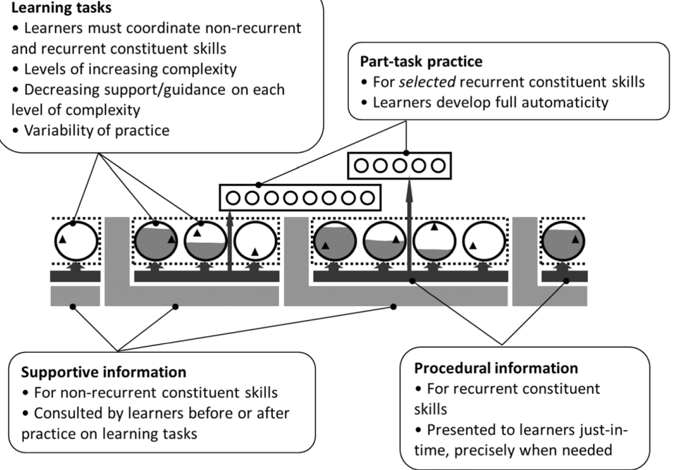
- The paper highlights 4C/ID as an extension of CLT for longer instructional programs and curricula, organized around 4 components: learning tasks, supportive information, procedural information, and part-task practice.
- It reports progress in measuring cognitive load, including a 10-item psychometric instrument that supported distinguishing intrinsic from extraneous load, and objective measures such as EEG, eye tracking, and secondary-task methods.
Methods
- This is a review article that retrospectively synthesizes CLT developments from 1998 to 2018, using the 1998 paper as a baseline and organizing the discussion into history, developments, future directions, and conclusions.
- The authors draw on prior theoretical and empirical studies and reviews cited throughout the paper; no new dataset or sample is reported in the text provided.
- Main analysis is a narrative synthesis of theoretical developments, instructional effects, and measurement approaches in CLT.
Limitations
- The paper explicitly says it is an attempt to summarise the last 20 years of CLT and sketch directions for future research, so it is a synthesis rather than a new empirical test.
- It repeatedly notes that more research is needed on cognitive-load measurement, including the optimal use of subjective rating scales, differentiating load types, and validating objective techniques.
- Evident from the text: several claims about future directions (e.g., resource depletion, self-regulated learning, emotions/stress/uncertainty, human movement) are presented as promising but not yet settled in the paper itself.
Model-written summary. Check it against the paper before relying on it.
Integrity signals
Registry
Cites
Statistics
Figures
Verification
Claims the paper makes
21 Valid · 23 Not valid · 90 Not checked · 158 Own results and interpretations
The sources with a verdict support this claim; the rest weren’t checked yet, have no full text we could read, or their verdicts aren’t rated yet.
In the paper
“Its basic premise is that human cognitive processing is heavily constrained by our limited working memory which can only process a limited number of information elements at a time.”
§ The Author(s) 2019 > Introduction
What the sources say
- Supportedcites Miller (1956) matched to “The magical number seven, plus or minus two: Some limits on our capacity for processing information.” (1956) source
The Summary says that immediate memory imposes severe limits on the information people can receive, process, and remember. The discussion of immediate memory (p. 93) specifies that its limit is the number of chunks, supporting the claim's broad paraphrase of a limited number of information elements at a time. (LLM, conf=0.91)
- Not checked — no full text of the sourcecites Peterson and Peterson (1959) matched to “Short-term retention of individual verbal items.” (1959) source
plainstates a cause- Asserted: passes — The authors put it forward as true.
- Checkable: passes — It can be checked against evidence.
- Load-bearing: passes — The paper’s conclusions depend on it.
- Based: passes — The paper gives a reason why it holds.
- Supported
The cited sources support only part of this claim — read each source’s verdict below.
In the paper
“The capacity and duration limits of working memory have been known at least since Miller (1956) and Peterson and Peterson (1959), although the fact that these limits effectively applied only to novel, not familiar information, seemed more implicit rather than explicit in most treatments.”
§ The Author(s) 2019 > Human Cognitive Architecture Used in 1998
What the sources say
- Partly supportedcites Miller (1956) matched to “The magical number seven, plus or minus two: Some limits on our capacity for processing information.” (1956) sourceExperimental — accuracy not yet measured
In the discussion of immediate memory (p. 93), Miller says its span is limited by the number of chunks and that familiar units allow more information to be packed into each chunk. That supports a distinction between novel material and familiar, recoded material, but not the claim that capacity limits apply only to novel information: the chunk limit remains. The paper also does not establish a duration limit that applies only to novel information. (LLM, conf=0.86)
- Not checked — no full text of the sourcecites Peterson and Peterson (1959) matched to “Short-term retention of individual verbal items.” (1959) source
hedged- Asserted: passes — The authors put it forward as true.
- Checkable: passes — It can be checked against evidence.
- Load-bearing: passes — The paper’s conclusions depend on it.
- Based: passes — The paper gives a reason why it holds.
- Partly supported
Every source the paper cites for this claim was checked and supports it.
In the paper
“The data summarised by Sala and Gobet (2017) provide a major justification for the post 1998 inclusion of evolutionary psychology into cognitive load theory.”
§ The Author(s) 2019 > Human Cognitive Architecture Seen Through the Prism of Evolutionary Psychology
What the sources say
- Supportedcites Sala and Gobet (2017) matched to “Does Far Transfer Exist? Negative Evidence From Chess, Music, and Working Memory Training” (2017) source
The Theoretical and Practical Implications section (page unavailable) summarises the paper’s evidence that chess, music and working-memory training do not reliably produce far transfer. The claim that these data justify a development in cognitive load theory is the citing authors’ interpretation, not a finding attributed to Sala and Gobet. (LLM, conf=0.86)
boostedstates a cause- Asserted: passes — The authors put it forward as true.
- Checkable: passes — It can be checked against evidence.
- Load-bearing: passes — The paper’s conclusions depend on it.
- Based: passes — The paper gives a reason why it holds.
- Supported
Every source the paper cites for this claim was checked and supports it.
In the paper
“The expertise reversal effect is, in essence, a variant of the more general element interactivity effect (Chen et al. 2017).”
§ The Author(s) 2019 > Instructional Effects Described After 1998
What the sources say
- Supportedcites Chen et al. 2017 matched to “The Expertise Reversal Effect is a Variant of the More General Element Interactivity Effect” (2017) source
The indexed copy lists the cited paper under the exact title “The Expertise Reversal Effect is a Variant of the More General Element Interactivity Effect.” Its title directly states the proposition attributed to it; no page number is available in the indexed passage. (LLM, conf=0.90)
plainstates a cause- Asserted: passes — The authors put it forward as true.
- Checkable: passes — It can be checked against evidence.
- Load-bearing: unclear — It is unclear whether the paper’s conclusions depend on it.
- Based: passes — The paper gives a reason why it holds.
- Supported
Every source the paper cites for this claim was checked and supports it.
In the paper
“When subsequently presented the fully integrated information, they only needed to learn how to integrate the individual elements and so more readily assimilated the entire, high element interactivity information.”
§ The Author(s) 2019 > Instructional Effects Described After 1998
What the sources say
- Supportedcites Pollock et al. 2002 matched to “Assimilating complex information” (2002) source
Split into 2 atoms — 2 confirmed, 0 partially supported, 0 disputed, 0 misattributed, 0 unverifiable. Expand the claim to see per-atom verdicts.
plainstates a cause- Asserted: passes — The authors put it forward as true.
- Checkable: passes — It can be checked against evidence.
- Load-bearing: passes — The paper’s conclusions depend on it.
- Based: passes — The paper gives a reason why it holds.
- Supported
132 more claims · 6 with their cited sources checked
Create a free account to see all 292 claims and to verify the 3 references still open.
- It may state two separate claims as one. 88
- Probably not a substantial claim. 95
Claims other papers make about this one
Each is checked against this paper’s own text: does it say what the citing paper says it does?
The source backs part of the claim, not all of it — or backs it for a different population, condition or comparison.
In the citing paper
“Another possible explanation is that the pre-training effect tends to be most effective for learners with minimal prior knowledge (Sweller et al., 2019)”
From Rethinking pre-training: cognitive load implications for learners with varying prior knowledge (2025) · cites this paper as Sweller et al., 2019
Experimental — accuracy not yet measuredThe cited source says what the claim attributes to it.
In the citing paper
“If the cognitive load imposed by a learning task is too high, it might interfere with the learner’s ability to effectively acquire and retain the skill [13, 25].”
From Teaching a single manual therapy technique at a time reduces cognitive load in physiotherapy students: a randomized controlled educational study (2025) · cites this paper as [13]
The cited source says what the claim attributes to it.
In the citing paper
“While cognitive load is often discussed in the context of instructional efficiency, it is important to note that cognitive load is not inherently detrimental. Rather, it is a natural component of learning that engages working memory resources for schema construction and automation [13].”
From Teaching a single manual therapy technique at a time reduces cognitive load in physiotherapy students: a randomized controlled educational study (2025) · cites this paper as [13]
The cited source says what the claim attributes to it.
In the citing paper
“Thus, an increased germane load is no longer believed to lead to cognitive overload and can thus no longer be assumed to be detrimental to learning performance.”
From Understanding Cognitive Load in Digital and Online Learning: a New Perspective on Extraneous Cognitive Load (2022) · cites this paper as Sweller et al., 2019
The cited source says what the claim attributes to it.
In the citing paper
“The major change from the 1998 model is that Sweller et al. (2019) have removed germane load from the additive equation of total load, but rather a dimension now called ' germane processing. '”
From Understanding Cognitive Load in Digital and Online Learning: a New Perspective on Extraneous Cognitive Load (2022) · cites this paper as Sweller et al., 2019
17 more claims about this paper
Create a free account to see every claim other papers make about this one.
Citations
Cites
The magical number seven, plus or minus two: Some limits on our capacity for processing information.
Miller, G. A. (1956) · Psychological Review · doi:10.1037/h0043158 · Cited by 17,812 · cited 1×
“The capacity and duration limits of working memory have been known at least since Miller (1956) and Peterson and Peterson (1959), although the fact that these limits effectively applied only to novel, not familiar information, seemed more implicit rather than explicit in most treatments.”
BackgroundThe magical number seven, plus or minus two: Some limits on our capacity for processing information.
Miller, G. A. (1994) · Psychological Review · doi:10.1037/0033-295x.101.2.343 · Cited by 17,161
Cognitive Load During Problem Solving: Effects on Learning
Sweller, J. (1988) · Cognitive Science · doi:10.1016/0364-0213(88)90023-7 · Cited by 11,048 · cited 4×
“Learning tasks (indicated by the big circles in Fig.”
BackgroundMethodInfluentialSelf-citationKirschner, P. A., Sweller, J., & Clark, R. E. (2006) · Educational Psychologist · doi:10.1207/s15326985ep4102_1 · Cited by 7,776
Self-citationRizzolatti, G., & Craighero, L. (2004) · Annual Review of Neuroscience · doi:10.1146/annurev.neuro.27.070203.144230 · Cited by 7,433
Cognitive Architecture and Instructional Design
Sweller, J., van Merrienboer, J. J. G., & Paas, F. G. W. C. (1998) · Educational Psychology Review · doi:10.1023/a:1022193728205 · Cited by 6,023
Self-citationCognitive load theory, learning difficulty, and instructional design
Sweller, J. (1994) · Learning and Instruction · doi:10.1016/0959-4752(94)90003-5 · Cited by 5,426 · cited 1×
“Element Interactivity Effect This effect was already known in 1998 but as a compound effect, it was not classed as a cognitive load effect (see Sweller 1994).”
BackgroundSelf-citationBaddeley, A. (1992) · Science · doi:10.1126/science.1736359 · Cited by 5,258
Ericsson, K. A., & Kintsch, W. (1995) · Psychological Review · doi:10.1037/0033-295x.102.2.211 · Cited by 3,498
Short-term retention of individual verbal items.
Peterson, L., & Peterson, M. J. (1959) · Journal of Experimental Psychology · doi:10.1037/h0049234 · Cited by 2,939 · cited 1×
“The capacity and duration limits of working memory have been known at least since Miller (1956) and Peterson and Peterson (1959), although the fact that these limits effectively applied only to novel, not familiar information, seemed more implicit rather than explicit in most treatments.”
Background
Research works printed but not linked: 4
- Centre for Education Statistics and Evaluation. (2017). Cognitive load theory: research that teachers really need to understand . Sydney: NSW Department of Education.
- Centre for Education Statistics and Evaluation. (2018). Cognitive load theory in practice . Sydney: NSW Department of Education.
- Clark, R. C. (2014). Evidence-based training methods: a guide for training professionals (2nd ed.). Alexandria: ATD Press.
- Miller, W. (1937). The picture crutch in reading. Elementary English Review, 14 , 263 -264.
Cited by
Items 901–1,000 of 2,268
Torres, D., Xu, A., & Abrams, B. (2025) · Journal of Chemical Education · doi:10.1021/acs.jchemed.5c00307 · Cited by 7
Tabari, M. A., & Lee, H. (2025) · Assessing Writing · doi:10.1016/j.asw.2025.100974 · Cited by 5
McPhail, G. J. (2025) · Curriculum Perspectives · doi:10.1007/s41297-025-00306-w · Cited by 4
“…model is underpinned by well-justified realist theories derived from epistemology (Kant, 1781; Ryle, 1946; Winch, 2019), sociology (Bernstein, 1999, 2000; Durkheim, 1998), psychology (Vygotsky, 1986), cognitive science (Sweller et al., 2019) and evolutionary psychology (Geary, 2024). to curriculum.”
Reid, C., Keighrey, C., Murray, N., Dunbar, R., & Buckley, J. (2020) · Sensors · doi:10.3390/s20236857 · Cited by 9
Young, J. Q., Thakker, K., John, M., Friedman, K. A., Sugarman, R., Sewell, J. L., & O’Sullivan, P. (2021) · Applied Cognitive Psychology · doi:10.1002/acp.3803 · Cited by 7
“In CLT, fatigue is understood to reduce working memory capacity and slow information retrieval and encoding (Sweller et al., 2019).”
BackgroundRoelofs, E. C., Emons, W. H. M., & Verschoor, A. J. (2021) · International Journal of Testing · doi:10.1080/15305058.2021.1916506 · Cited by 4
RELATIONSHIP BETWEEN ACADEMIC SELF-EFFICACY AND COGNITIVE LOAD FOR STUDENTS IN DISTANCE LEARNING
Griškēviča, I., & Iltners, M. (2025) · Education Innovation Diversity · doi:10.17770/eid2021.1.5426 · Cited by 9
“According to recent reports, inadequately designed educational content exceeding possible for perception elements can lead to overload and poor achievement results (Alyushin & Kolobashkina, 2019; Sweller et al., 2019).”
BackgroundResearch Methods in Multimedia Learning
Jarodzka, H. (2021) · Cambridge University Press eBooks · doi:10.1017/9781108894333.006 · Cited by 6
Implications of the Four Component Instructional Design Model for Multimedia Learning
Kester, L., & van Merriënboer, J. J. G. (2021) · Cambridge University Press eBooks · doi:10.1017/9781108894333.011 · Cited by 8
Self-citationRoelle, J., Endres, T., & Renkl, A. (2021) · Unterrichtswissenschaft · doi:10.1007/s42010-021-00139-2 · Cited by 4
Impact of Online Courses on University Student Visual Attention During the COVID-19 Pandemic
Gao, Q., & Li, S. (2022) · Frontiers in Psychiatry · doi:10.3389/fpsyt.2022.848844 · Cited by 7
The Current Trend in Educational Neuroscience Research: A Descriptive and Bibliometric Study
Saygıner, Ş., Balaman, F., & TİRYAKİ, S. H. (2022) · Journal of Computer and Education Research · doi:10.18009/jcer.1002588 · Cited by 7
Beyond left and right: Learning is a whole-brain process
Shin, D. D., Lee, M., & Bong, M. (2022) · Theory Into Practice · doi:10.1080/00405841.2022.2096386 · Cited by 8
“Emphasis on the multimodalities in learning materials is rooted in the cognitive architecture model (Sweller et al., 2019).”
BackgroundAdeniji, S. M., & Baker, P. (2022) · Journal on Mathematics Education · doi:10.22342/jme.v13i2.pp337-356 · Cited by 14
Effects of Cognitive Load Level on Students’ Attitude towards the Gamified Course
Topu, F. B. (2023) · Journal of Learning and Teaching in Digital Age · doi:10.53850/joltida.1147246 · Cited by 8
“In contrast, this situation may lead to overloading of limited capacity working memory and thus, negatively influence to students in cognitive aspect (Moreno, 2010; Sweller et al., 2019).”
Developing teacher curriculum design expertise: using the CDC Model in the music classroom
McPhail, G. J., Tibbles, S., & Cornish, M. (2022) · British Journal of Music Education · doi:10.1017/s0265051722000262 · Cited by 7
Scholl, D., Völschow, Y., Anders, D., Küth, S., Warrelmann, J.-N., Kleinknecht, M., Prilop, C. N., & Weber, K. E. (2022) · Verlag Julius Klinkhardt eBooks · doi:10.35468/5969-11 · Cited by 9
Balıkçı, İ., Tok, S., & Binboğa, E. (2023) · Brain and Behavior · doi:10.1002/brb3.3153 · Cited by 5
“Accordingly, it appears that TV’s auditory, visual, and verbal stimuli functioned as an extraneous cognitive load, as proposed by Sweller et al. (2019), that does not contribute to or even impair the limited capacity of the working memory.”
BackgroundStudents’ Learning Independence and Critical Thinking Ability Using Mobile Learning Technology
Maimun, M., & Bahtiar, B. (2023) · European Journal of Educational Research · doi:10.12973/eu-jer.12.4.1815 · Cited by 9
Learning out Loud: A Framework for Learning in an Era of Information Abundance
Caldwell, K. (2023) · IntechOpen eBooks · doi:10.5772/intechopen.1002923 · Cited by 4
Improving Middle-School Students' English Vocabulary Via Digital Storytelling
BinJwair, A. (2023) · Journal of Educational and Social Research · doi:10.36941/jesr-2023-0158 · Cited by 22
Kurban, F. (2024) · Problems of Education in the 21st Century · doi:10.33225/pec/24.82.202 · Cited by 11
“The CLT, used as a reference framework in designing the teaching process of this study, was formulated by John Sweller and his colleagues (See Sweller, 1988; Sweller et al., 2019; Sweller & Levine, 1982).”
MethodDifficult obstetric airway training: Current strategies, challenges and future innovations
Chan, J. J. I., Goy, R., Ithnin, F., & Sng, B. L. (2019) · Trends in Anaesthesia and Critical Care · doi:10.1016/j.tacc.2019.11.002 · Cited by 4
The effect of design tasks on the cognitive load level of instructional designers in 3D MUVEs
Çınar, M., Doğan, D., & Tüzün, H. (2020) · International Journal of Technology and Design Education · doi:10.1007/s10798-020-09637-3 · Cited by 5
A Conceptual Model for Meeting the Needs of Adult Learners in Distance Education and E-Learning
Fensie, A. (2023) · International Journal of Advanced Corporate Learning (iJAC) · doi:10.3991/ijac.v16i2.35729 · Cited by 10
Using Visual and Graphic Elements While Designing Instructional Activities
Sentz, J. (2021) · Cited by 3
Renkl, A. (2022) · Elsevier eBooks · doi:10.1016/b978-0-12-818630-5.14067-9 · Cited by 4
Qian, W., Yang, F., Cao, Y., Yi, L., Gu, R., & Wang, Z. (2026) · Frontiers in Psychology · doi:10.3389/fpsyg.2026.1921504 · Cited by 4
Miller, D. L., & Balter, S. (2024) · Journal of Radiological Protection · doi:10.1088/1361-6498/ad4042 · Cited by 3
“There are limitations on the amount of information an individual can receive, process, and remember [ 17 ] .”
Darejeh, A., Huynh, L., Ji, X., Marcus, N., & Polly, P. (2024) · IEEE International Symposium on Mixed and Augmented Reality Adjunct (ISMAR-Adjunct) · doi:10.1109/ismar-adjunct64951.2024.00142 · Cited by 5
“VR simulations create a sense of agency, making learners feel more in control of their learning processes, leading to increased motivation as individuals feel more invested in their actions [10]. but an unlimited capacity for familiar information stored in long-term memory [12, 13].”
Jahn, K., Suren, M., Sanchez‐Stockhammer, C., & Rey, G. D. (2025) · Frontiers in Virtual Reality · doi:10.3389/frvir.2025.1550004 · Cited by 4
Dechamps, T., & Skulmowski, A. (2025) · Trends in Neuroscience and Education · doi:10.1016/j.tine.2025.100256 · Cited by 3
“An important instructional framework dealing with such effects is cognitive load theory [43], which builds upon our knowledge of working memory capacity and recommends to use the capacity for relevant cognitive load.”
Costley, J., Kapuza, A., Gorbunova, A., & Щеглова, И. А. (2025) · Instructional Science · doi:10.1007/s11251-025-09736-5 · Cited by 5
“This may be because germane load redistributes working memory resources towards optimizing intrinsic load (Sweller et al., 2019).”
InfluentialPuri, B., Mushtaque, I., Fang, S., Chenhe, G., & Younas, A. (2025) · Acta Psychologica · doi:10.1016/j.actpsy.2025.105400 · Cited by 19
Cross-modal adaptive reconstruction of open education resources
Shengju, T., Li, F., Wang, Z., & Zhaoyuan, X. (2025) · Scientific Reports · doi:10.1038/s41598-025-15200-8 · Cited by 5
Peng, P., Wang, W., Lin, L., Liu, Y., Yan, X., Tan, Y., Zhang, Z., Zhang, W., & Huang, Y. (2025) · Educational Psychology Review · doi:10.1007/s10648-025-10063-x · Cited by 5
“Because individuals have a limited capacity of working memory, instruction should avoid overloading working memory (Sweller et al., 2019).”
Gorbunova, A., Адамович, К., Savelyev, A., & Costley, J. (2025) · Interactive Learning Environments · doi:10.1080/10494820.2025.2547273 · Cited by 6
“It focuses on the process by which information is transferred from short-term memory to long-term memory, and highlights the constraints of working memory capacity (Sweller et al., 2019).”
InfluentialDesigning for Immersion: A Cross-Platform Evaluation Framework for XR Heritage Storytelling
Shawash, J., Thibault, M., & Hamari, J. (2025) · international conference on 3D web technology · doi:10.1145/3746237.3746310 · Cited by 3
Zhang, S., & Yin, Z. (2025) · Thinking Skills and Creativity · doi:10.1016/j.tsc.2025.101984 · Cited by 4
A Human–Computer-Interaction Exploration of Working Memory Using EEG
Kyriaki, K., & Fidas, C. A. (2025) · IEEE Access · doi:10.1109/access.2025.3606802 · Cited by 4
“Cognitive Load Theory, for example, focuses on learning and instructional design [24].”
Brainwaves and higher-order thinking: An EEG study of cognitive engagement in mathematics tasks
Mohamed, N., & Saleh, S. (2025) · International Electronic Journal of Mathematics Education · doi:10.29333/iejme/16889 · Cited by 10
“Furthermore, the transition from formula-based learning to open-ended problem solving has left many students without adequate scaffolding, resulting in cognitive overload and mathematics anxiety (Sweller et al., 2019).”
Lee, J., Luna, J., & Wisniewski, M. G. (2025) · Journal of Safety Research · doi:10.1016/j.jsr.2025.09.009 · Cited by 7
Castillo, J. M., Parenthoën, M., & Louveton, N. (2025) · Cognition Technology & Work · doi:10.1007/s10111-025-00844-3 · Cited by 3
“The theory’s central premise posits that once the limits of short-term memory are reached, learning becomes impeded (Meguerdi-chian et al. 2016; Naismith et al. 2019; Sweller et al. 2019).”
MIIAM: An Algorithmic Model for Predicting Multimedia Effectiveness in eLearning Systems
Chikasha, S., Petegem, W. V., & Revesai, Z. (2025) · Digital · doi:10.3390/digital5040058 · Cited by 2
Nedaei, M., Säljö, R., Kanwal, S., & Goodchild, S. (2025) · Journal of Eye Movement Research · doi:10.3390/jemr18060065 · Cited by 3
The influence of clinical simulation on anxiety in nursing students: A scoping review
Cavalcante, F. M. L., Santos, F. C. D. A., Brito, O. D., Monteiro, A. C. S., Freire, V. E. C. D. S., Oliveira, A. R. D. S., Frota, N. M., & Barros, L. M. (2025) · Nurse Education in Practice · doi:10.1016/j.nepr.2025.104622 · Cited by 9
Investigating Debugging Processes: A Scoping Review
Spörer, E., & Michaeli, T. (2025) · Koli Calling International Conference on Computing Education Research · doi:10.1145/3769994.3770005 · Cited by 6
Bertrand, M. M., Besseyrias, A., Gouzi, F., & Tricot, A. (2025) · Anatomical Sciences Education · doi:10.1002/ase.70156 · Cited by 4
van den Broek, G. S. E., Scholten, S., van Thuil, B., van Rijn, H., van Gog, T., & van der Velde, M. (2025) · Computers in Human Behavior · doi:10.1016/j.chb.2025.108862 · Cited by 10
Qamar, M. T., Yasmeen, J., Alam, S., & Sadiqe, M. (2025) · Innovations in Education and Teaching International · doi:10.1080/14703297.2025.2603630 · Cited by 3
Zhou, J., Jin, L., & Hu, Y. (2026) · Frontiers in Psychology · doi:10.3389/fpsyg.2025.1592370 · Cited by 10
“Cognitive-load theory predicts that when intrinsic and extraneous loads saturate working-memory capacity, learners default to minimal-effort activities that rapidly relieve mental strain, such as scrolling brief videos (Sweller et al., 2019).”
Qi, J., Zhao, H., Xiang, R., Zhang, Y., Zhang, X., Wang, C., Jian, L., & Ji, F. (2026) · Journal of Research on Technology in Education · doi:10.1080/15391523.2025.2601067 · Cited by 9
Zhou, X., Zhao, S., Wu, P., & Chen, Y. (2026) · Applied Sciences · doi:10.3390/app16021068 · Cited by 7
Yin, P., & Sun, T. (2026) · Frontiers in Psychology · doi:10.3389/fpsyg.2025.1739300 · Cited by 8
Charting the growth of brain-based learning in higher education instructional design
Dueñas, J. S. R., Sánchez, A. D. V., Figueredo, O. B., & Mendoza, F. A. (2026) · Frontiers in Education · doi:10.3389/feduc.2026.1677395 · Cited by 5
Ying, Y., & Tiemann, R. (2026) · International Journal of Science and Mathematics Education · doi:10.1007/s10763-025-10629-9 · Cited by 5
“…according to its source, into intrinsic load, determined by the inherent complexity of the material and learners’ prior knowledge, and extraneous load, arising from aspects of the task presentation or interface that do not directly support learning (de Jong, 2010; Sweller et al., 2019).”
Bot or Not? Differences in Cognitive Load Between Human- and Chatbot-Led Post-Simulation Debriefings
Evangelou, D., Mulders, M., & Träg, K. H. (2026) · Education Sciences · doi:10.3390/educsci16020255 · Cited by 5
Moving beyond neurophobia to cultivate the neuroquisitive learner
Appel, J. R., & Porter‐Stransky, K. A. (2026) · Anatomical Sciences Education · doi:10.1002/ase.70196 · Cited by 4
Education for Problems of Sustainable Development
Bafarasat, A. Z. (2026) · Sustainable Development · doi:10.1002/sd.70837 · Cited by 4
Immersive competence as a source of bias in virtual reality clinical assessment
Schaal, J., Leutritz, T., Lindner, M., Zamzow, A., Backhaus, J., Koenig, S., & Mühling, T. (2026) · npj Digital Medicine · doi:10.1038/s41746-026-02482-z · Cited by 7
“…that in CO, subjective load was largely unrelated to procedural ef fi ciency, whereas in I2 higher load tended to co-occur with greater ef fi ciency (lower SPT), in line with the conceptualization of germane load as a redistribution of cognitive resources toward task-relevant processing 49 .”
Samsudin, A., Zahran, M., Nugraha, E., Nasbey, H., Sözbilir, M., Rahman, N. F. A., & Irie, T. (2026) · Computers & Education X Reality · doi:10.1016/j.cexr.2026.100152 · Cited by 8
Melguizo-Ibáñez, E., Zurita-Ortega, F., Tadeu, P. J. A., Ubago-Jiménez, J. L., & Alonso-Vargas, J. M. (2026) · Educational Psychology Review · doi:10.1007/s10648-026-10146-3 · Cited by 7
Tannert, S., Karlen, Y., Ader, E., Hertel, S., & Glogger‐Frey, I. (2026) · Metacognition and Learning · doi:10.1007/s11409-026-09455-3 · Cited by 4
Maton, K., & Howard, S. K. (2021) · Routledge eBooks · doi:10.4324/9781351129282-5 · Cited by 3
Suen, M. M. T., Lai, A. Y. K., Wang, M. P., Ho, S. Y., & Lam, T. (2022) · JMIR Formative Research · doi:10.2196/32894 · Cited by 3
Wagner, B. A. (2022) · Journal of Social Work in the Global Community · doi:10.5590/jswgc.2021.6.1.01 · Cited by 3
“Cognitive Load Theory Cognitive load theory was developed by Sweller and builds upon Miller’s (1956) human information processing model of how persons receive and process information (Hatague & Nabua, 2019; Sweller et al., 2019).”
BackgroundInfluentialXu, Y., Xie, J., Wang, F., Monk, R. L., Gaskin, J. E., & Wang, J. (2022) · Social Science Computer Review · doi:10.1177/08944393221128941 · Cited by 5
“Extraneous cognitive load is evoked by the features of the presented information and does not directly contribute to learning (Sweller et al., 2019; de Jong, 2010; Van Merri¨enboer & Sweller, 2005).”
BackgroundInfluentialPolat, H., & Delialioğlu, Ö. (2023) · International Journal of Technology in Education · doi:10.46328/ijte.396 · Cited by 8
“The cognitive load theory implies that effective design of any system reduces the element interactivity and allows users for allocating more working memory resources to the learning task (Sweller et al. 2019).”
The Cognitive Process with Intensive and Rapid Vocabulary Acquisition Tasks Using Multimedia Glosses
Jiang, M., Zou, D., Lee, L., Wang, F. L., & Wu, N. (2023) · The Journal of AsiaTEFL · doi:10.18823/asiatefl.2023.20.1.5.64 · Cited by 3
Rawski, S. L., Djurdjevic, E., Soderberg, A. T., & Foster, J. R. (2023) · Journal of Business Ethics · doi:10.1007/s10551-023-05479-w · Cited by 4
Hyttinen, M., & Suhonen, J. T. (2023) · International Journal of Technology in Education and Science · doi:10.46328/ijtes.498 · Cited by 6
“Inadequate teaching methods and unnecessary environmental distractions increase cognitive load and too much cognitive load hampers learning (Sweller et al., 2019).”
BackgroundHigh-fidelity burns moulage makes simulations “Come Alive”
Fourie, C., Botma, Y., & Botha, B. S. (2023) · Teaching and learning in nursing · doi:10.1016/j.teln.2023.10.019 · Cited by 7
Buntins, K., Mulders, M., & Schröder, N. (2023) · MedienPädagogik Zeitschrift für Theorie und Praxis der Medienbildung · doi:10.21240/mpaed/54/2023.11.19.x · Cited by 4
A Novel Model of Narrative Memory for Conscious Agents
Azam, M., Rafiq, T., Naz, F. G., Ghafoor, M., Nisa, M. U., & Malik, H. (2024) · International Journal of Information Systems and Computer Technologies · doi:10.58325/ijisct.003.01.0080 · Cited by 7
Khudhur, N., Pinandito, A., Hayashi, Y., & Hirashima, T. (2024) · IEICE Transactions on Information and Systems · doi:10.1587/transinf.2023edp7145 · Cited by 9
Krebs, R., Waldeyer, J., Rothstein, B., & Roelle, J. (2024) · Zeitschrift für Entwicklungspsychologie und Pädagogische Psychologie · doi:10.1026/0049-8637/a000296 · Cited by 6
Cross-task cognitive workload estimation using eye tracking
Yang, L., Wang, L., Xu, W., Wang, B., Ren, H., & Yang, A. (2025) · Signal Image and Video Processing · doi:10.1007/s11760-025-03931-0 · Cited by 4
Perspektive celoživotnog učenja u digitalnom okruženju
Nikolić, T., Koruga, N. Đ., & Bulajić, A. (2025) · Inovacije u nastavi · doi:10.5937/inovacije2501089n · Cited by 3
Trend and Issues in Educational Video Research: A Bibliometric Mapping Analysis
Polat, H., Kayaduman, H., & Battal, A. (2025) · Open Praxis · doi:10.55982/openpraxis.17.1.721 · Cited by 7
Sardareh, S. A., Brown, G., & Denny, P. C. (2025) · Journal of Statistics and Data Science Education · doi:10.1080/26939169.2025.2497550 · Cited by 9
“According to cognitive load theory, reducing extraneous cognitive load can enhance learning and task performance (Sweller, van Merriënboer, and Paas 2019; Sweller 2023).”
Chen, S. (2025) · Journal of Computer Assisted Learning · doi:10.1111/jcal.70053 · Cited by 5
Effects of Familiarity and Complexity on Inhibitory Control in Elementary Science Learning
Bélanger, É., Foisy, L. B., Masson, S., Ahr, E., & Potvin, P. (2025) · The Journal of Experimental Education · doi:10.1080/00220973.2025.2513246 · Cited by 4
Long, J., & Tan, Y. H. (2025) · Journal of Baltic Science Education · doi:10.33225/jbse/25.24.448 · Cited by 4
Krieglstein, F., Schmitz, M., Wesenberg, L., Spitzer, M., & Rey, G. D. (2025) · Memory & Cognition · doi:10.3758/s13421-025-01764-3 · Cited by 7
Reconceptualizing Cognitive Load Theory
Kalyuga, S., & Plass, J. L. (2025) · Oxford University Press eBooks · doi:10.1093/9780190078539.003.0007 · Cited by 4
La sobrecarga administrativa y su efecto en la práctica docente de Educación General Básica
Lucero, E. M. Y., Pin, J. L. P., Caicedo, L., & Navarrete, A. E. Z. (2025) · Boletín Científico Ideas y Voces · doi:10.60100/bciv.v5i3.237 · Cited by 10
Balaban, D. C., Mucundorfeanu, M., Szambolics, J., & Amrhein, C. (2025) · Computers in Human Behavior Reports · doi:10.1016/j.chbr.2025.100781 · Cited by 5
Ninaus, M., Dresen, V., Huber, S. E., Kiili, K. J. M., Dondio, P., Weiss, E. M., & Moeller, K. (2025) · Mind Brain and Education · doi:10.1111/mbe.70016 · Cited by 5
“However, the task’s simple structure and design probably also kept the overall intrinsic cognitive load low (Sweller, van Merriënboer, & Paas, 2019) and helped avoid potential cognitive overload (Mayer, 2020; Rey, 2012).”
Pavel, M. I., Mahmud, M. R., Setu, J. N., Desai, K., & Quarles, J. P. (2025) · ACM Symposium on Virtual Reality Software and Technology (VRST) · doi:10.1145/3756884.3766053 · Cited by 8
“The mental load was evaluated through a verbal prompt inspired by the Paas scale [75], whereas the physical load followed a question adapted from the NASA Task Load Index (NASA-TLX) [23], a tool for measuring and conducting a subjective mental workload (MWL) assessment.”
Facilitating student learning: An instructional design perspective for health professions educators
Noushad, B., & Khurshid, F. (2019) · Research and Development in Medical Education · doi:10.15171/rdme.2019.014 · Cited by 5
Differences in Self-Directed Learning: Middle-School Students’ Autonomous Outdoor Studying
Uus, Õ., Mettis, K., Väljataga, T., & Ley, T. (2021) · Frontiers in Education · doi:10.3389/feduc.2021.718295 · Cited by 8
“Therefore, the SDL approach can cause cognitive overload for a large proportion of students who do not yet have fully matured cognitive capability (Nęcka and Lulewicz, 2016), which, as a result, can lead to inadequate or only superficial knowledge gain (Sweller et al., 2019).”
BackgroundA Cognitive Load Perspective to Instructional Design for Online Learning
Dönmez, O. (2021) · Advances in mobile and distance learning book series · doi:10.4018/978-1-7998-8701-0.ch019 · Cited by 8
Thread-level Speculative Parallelization
Llanos, D. R. (2004) · Zenodo (CERN European Organization for Nuclear Research) · doi:10.5281/zenodo.14272911 · Cited by 3
Barnes, S. R., & Sontag, J. M. (2022) · Journalism Practice · doi:10.1080/17512786.2022.2049011 · Cited by 4
“The most succinct way to measure CL is through the use of Paas ’ nine-point CL scale (Ayres 2018; Paas 1992; Paas and Van Merriënboer 1993; Sweller et al. 2019).”
MethodArneson, J. B., & Offerdahl, E. G. (2022) · Research in Science Education · doi:10.1007/s11165-022-10057-7 · Cited by 6
“Procedural information is believed to be associated with lower element interactivity (Sweller et al., 2019).”
BackgroundMeasuring Cognitive Loads while Learning Computational Statistics
Quintero-Manes, R., Vieira, C., & Hernandez-Vargas, N. (2022) · IEEE Frontiers in Education Conference (FIE) · doi:10.1109/fie56618.2022.9962606 · Cited by 5
“In this process, the learner must attend to the new information, manipulate it mentally and give it meaning; when this happens, the received information for the first time is retained and can begin to be stored in the long-term memory [2, 3, 4, 5].”
BackgroundResultInfluentialDissaux, T., & Jancart, S. (2023) · Springer eBooks · doi:10.1007/978-3-031-20418-0_40 · Cited by 4
Hong, J., Hwang, M., Hsu, Y.-H., & Tai, K. (2023) · Thinking Skills and Creativity · doi:10.1016/j.tsc.2023.101235 · Cited by 3
Balancing Game Elements, Learning, and Emotions in Game Design
Natucci, G. C., & Borges, M. A. F. (2023) · Communications in computer and information science · doi:10.1007/978-3-031-27639-2_5 · Cited by 5
Prediction of Workload under Distraction using Supervised Learning Algorithms
Kujur, A., Bhattacharya, A., Sharma, G., & Kumar, J. (2022) · International Conference on Issues and Challenges in Intelligent Computing Techniques · doi:10.1109/icict55121.2022.10064593 · Cited by 3
Metadata
- Authors
- Sweller, J., van Merriënboer, J. J. G., & Paas, F.
- Affiliations
- UNSW Sydney (AU)
- University of Wollongong (AU)
- Corresponding author
- Sweller, John
- Venue
- Educational Psychology Review
- Published
- 2019-01-22
- Volume
- 31
- Issue
- 2
- Pages
- 261-292
- ISSN
- 1040-726X (ISSN-L)
- 1573-336X
- OpenAlex
- W2913144876
- Semantic Scholar
- e28d73214751d51c3f46a867920be41c49c45130
- Cited by
- 2,337
- References
- 129
- Citations by year
- 2026: 713 · 2025: 466 · 2024: 331 · 2023: 268 · 2022: 212 · 2021: 190 · 2020: 114 · 2019: 37
- FWCI
- 162.54
- Type
- journal article
- Language
- en
- Open access
- hybrid
- doi.org
- Licence
- cc-by
- creativecommons.org/licenses/by/4.0 (tdm)
- Locations
- Educational Psychology Review (publishedVersion, cc-by)
- EUR Research Repository (Erasmus University Rotterdam) (publishedVersion, other-oa)
- Research Online (University of Wollongong) (submittedVersion)
- EUR Research Repository (Erasmus University Rotterdam) (submittedVersion)
- Research Publications (Maastricht University) (submittedVersion, cc-by)
- Figshare (submittedVersion, cc-by)
- Research Publications (Maastricht University) (submittedVersion, other-oa)
- Topics
- Social Sciences › Psychology › Experimental and Cognitive Psychology › Visual and Cognitive Learning Processes
- Social Sciences › Psychology › Developmental and Educational Psychology › Innovative Teaching and Learning Methods
- Life Sciences › Neuroscience › Cognitive Neuroscience › Neuroscience, Education and Cognitive Function
- Keywords
- cognitive load theory, cognitive architecture, working memory, long-term memory, instructional design
About these checks
Registry, retraction, Cites and statistics results are computed, not judged, with one exception: a printed reference that no index lists is read once by a model before it counts as a citation error. Claims are extracted by a model and kept only when their quote appears verbatim in the text; each cited source is then checked, with a model’s help, for whether it says what the claim relies on. Those verdicts can be wrong — read the claim’s quote and the cited source before relying on one.
The claim verdicts this report counts are experimental: their accuracy is not yet measured.
A language model drew the claims from the paper on 2026-10-10, under version 3 of the claim definition (model deepseek-v4.1-flash, prompt extract-v3).
A second model labelled each claim on 2026-10-10 (model jev-1.13-20260917, definition revision gold-guideline-v0.2).
Cited sources are checked with a language model’s help (gpt-6-sol).
Statistics and arithmetic are recomputed, not judged.
Confidence bands are shown only for fields calibrated on our annotated test set. None is calibrated yet, so no band is shown.
What counts as a claim ›How we measure confidence ›How we check this ›
Are you an author, or do you see a problem with this page? Request a review
Data sources
Bibliographic data: Semantic Scholar, OpenAlex, Crossref.
Contains information from the Semantic Scholar Academic Graph Datasets, made available under the ODC Attribution License (ODC-BY 1.0).
Semantic Scholar’s data is described in: Kinney, R., et al. (2023). The Semantic Scholar Open Data Platform. arXiv:2301.10140.
