

Cognitive Architecture and Instructional Design: 20 Years Later
Open accessThe DOI matches its Crossref record; 127 of the 129 references it cites were found in a registry or an index, and 1 are not checked yet; 22 of the 116 sources its claims cite were checked for support.
Abstract
Cognitive load theory was introduced in the 1980s as an instructional design theory based on several uncontroversial aspects of human cognitive architecture. Our knowledge of many of the characteristics of working memory, long-term memory and the relations between them had been well-established for many decades prior to the introduction of the theory. Curiously, this knowledge had had a limited impact on the field of instructional design with most instructional design recommendations proceeding as though working memory and long-term memory did not exist. In contrast, cognitive load theory emphasised that all novel information first is processed by a capacity and duration limited working memory and then stored in an unlimited long-term memory for later use. Once information is stored in long-term memory, the capacity and duration limits of working memory disappear transforming our ability to function. By the late 1990s, sufficient data had been collected using the theory to warrant an extended analysis resulting in the publication of Sweller et al. (Educational Psychology Review, 10, 251–296, 1998). Extensive further theoretical and empirical work have been carried out since that time and this paper is an attempt to summarise the last 20 years of cognitive load theory and to sketch directions for future research.
Verified 2026-11-25 · 1 reference not checked yet
Overview
CoChat Summary
TL;DR
This review argues that cognitive load theory (CLT) has substantially advanced since its 1998 summary, with new theoretical grounding, new instructional effects, and improved measurement approaches. It also frames future work around working-memory resource depletion, self-regulated learning, emotions/stress/uncertainty, and human movement.
Key findings
- The paper states that the 1998 article reported 7 cognitive load effects, and that 8 new effects were added in the 1998–2018 period, including compound effects.
- It says CLT’s theoretical basis was strengthened by grounding human cognitive architecture in evolutionary psychology, especially Geary’s distinction between biologically primary and biologically secondary knowledge.
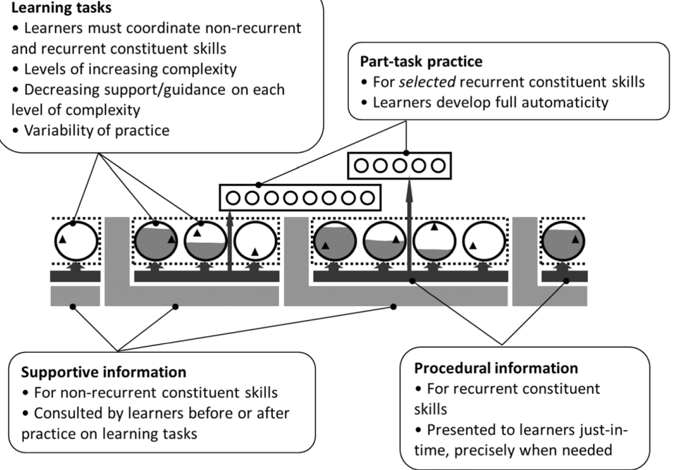
- The paper highlights 4C/ID as an extension of CLT for longer instructional programs and curricula, organized around 4 components: learning tasks, supportive information, procedural information, and part-task practice.
- It reports progress in measuring cognitive load, including a 10-item psychometric instrument that supported distinguishing intrinsic from extraneous load, and objective measures such as EEG, eye tracking, and secondary-task methods.
Methods
- This is a review article that retrospectively synthesizes CLT developments from 1998 to 2018, using the 1998 paper as a baseline and organizing the discussion into history, developments, future directions, and conclusions.
- The authors draw on prior theoretical and empirical studies and reviews cited throughout the paper; no new dataset or sample is reported in the text provided.
- Main analysis is a narrative synthesis of theoretical developments, instructional effects, and measurement approaches in CLT.
Limitations
- The paper explicitly says it is an attempt to summarise the last 20 years of CLT and sketch directions for future research, so it is a synthesis rather than a new empirical test.
- It repeatedly notes that more research is needed on cognitive-load measurement, including the optimal use of subjective rating scales, differentiating load types, and validating objective techniques.
- Evident from the text: several claims about future directions (e.g., resource depletion, self-regulated learning, emotions/stress/uncertainty, human movement) are presented as promising but not yet settled in the paper itself.
Model-written summary. Check it against the paper before relying on it.
Integrity signals
Registry
Cites
Statistics
Figures
Verification
Claims the paper makes
21 Valid · 23 Not valid · 90 Not checked · 158 Own results and interpretations
The sources with a verdict support this claim; the rest weren’t checked yet, have no full text we could read, or their verdicts aren’t rated yet.
In the paper
“Its basic premise is that human cognitive processing is heavily constrained by our limited working memory which can only process a limited number of information elements at a time.”
§ The Author(s) 2019 > Introduction
What the sources say
- Supportedcites Miller (1956) matched to “The magical number seven, plus or minus two: Some limits on our capacity for processing information.” (1956) source
The Summary says that immediate memory imposes severe limits on the information people can receive, process, and remember. The discussion of immediate memory (p. 93) specifies that its limit is the number of chunks, supporting the claim's broad paraphrase of a limited number of information elements at a time. (LLM, conf=0.91)
- Not checked — no full text of the sourcecites Peterson and Peterson (1959) matched to “Short-term retention of individual verbal items.” (1959) source
plainstates a cause- Asserted: passes — The authors put it forward as true.
- Checkable: passes — It can be checked against evidence.
- Load-bearing: passes — The paper’s conclusions depend on it.
- Based: passes — The paper gives a reason why it holds.
- Supported
The cited sources support only part of this claim — read each source’s verdict below.
In the paper
“The capacity and duration limits of working memory have been known at least since Miller (1956) and Peterson and Peterson (1959), although the fact that these limits effectively applied only to novel, not familiar information, seemed more implicit rather than explicit in most treatments.”
§ The Author(s) 2019 > Human Cognitive Architecture Used in 1998
What the sources say
- Partly supportedcites Miller (1956) matched to “The magical number seven, plus or minus two: Some limits on our capacity for processing information.” (1956) sourceExperimental — accuracy not yet measured
In the discussion of immediate memory (p. 93), Miller says its span is limited by the number of chunks and that familiar units allow more information to be packed into each chunk. That supports a distinction between novel material and familiar, recoded material, but not the claim that capacity limits apply only to novel information: the chunk limit remains. The paper also does not establish a duration limit that applies only to novel information. (LLM, conf=0.86)
- Not checked — no full text of the sourcecites Peterson and Peterson (1959) matched to “Short-term retention of individual verbal items.” (1959) source
hedged- Asserted: passes — The authors put it forward as true.
- Checkable: passes — It can be checked against evidence.
- Load-bearing: passes — The paper’s conclusions depend on it.
- Based: passes — The paper gives a reason why it holds.
- Partly supported
Every source the paper cites for this claim was checked and supports it.
In the paper
“The data summarised by Sala and Gobet (2017) provide a major justification for the post 1998 inclusion of evolutionary psychology into cognitive load theory.”
§ The Author(s) 2019 > Human Cognitive Architecture Seen Through the Prism of Evolutionary Psychology
What the sources say
- Supportedcites Sala and Gobet (2017) matched to “Does Far Transfer Exist? Negative Evidence From Chess, Music, and Working Memory Training” (2017) source
The Theoretical and Practical Implications section (page unavailable) summarises the paper’s evidence that chess, music and working-memory training do not reliably produce far transfer. The claim that these data justify a development in cognitive load theory is the citing authors’ interpretation, not a finding attributed to Sala and Gobet. (LLM, conf=0.86)
boostedstates a cause- Asserted: passes — The authors put it forward as true.
- Checkable: passes — It can be checked against evidence.
- Load-bearing: passes — The paper’s conclusions depend on it.
- Based: passes — The paper gives a reason why it holds.
- Supported
Every source the paper cites for this claim was checked and supports it.
In the paper
“The expertise reversal effect is, in essence, a variant of the more general element interactivity effect (Chen et al. 2017).”
§ The Author(s) 2019 > Instructional Effects Described After 1998
What the sources say
- Supportedcites Chen et al. 2017 matched to “The Expertise Reversal Effect is a Variant of the More General Element Interactivity Effect” (2017) source
The indexed copy lists the cited paper under the exact title “The Expertise Reversal Effect is a Variant of the More General Element Interactivity Effect.” Its title directly states the proposition attributed to it; no page number is available in the indexed passage. (LLM, conf=0.90)
plainstates a cause- Asserted: passes — The authors put it forward as true.
- Checkable: passes — It can be checked against evidence.
- Load-bearing: unclear — It is unclear whether the paper’s conclusions depend on it.
- Based: passes — The paper gives a reason why it holds.
- Supported
Every source the paper cites for this claim was checked and supports it.
In the paper
“When subsequently presented the fully integrated information, they only needed to learn how to integrate the individual elements and so more readily assimilated the entire, high element interactivity information.”
§ The Author(s) 2019 > Instructional Effects Described After 1998
What the sources say
- Supportedcites Pollock et al. 2002 matched to “Assimilating complex information” (2002) source
Split into 2 atoms — 2 confirmed, 0 partially supported, 0 disputed, 0 misattributed, 0 unverifiable. Expand the claim to see per-atom verdicts.
plainstates a cause- Asserted: passes — The authors put it forward as true.
- Checkable: passes — It can be checked against evidence.
- Load-bearing: passes — The paper’s conclusions depend on it.
- Based: passes — The paper gives a reason why it holds.
- Supported
132 more claims · 6 with their cited sources checked
Create a free account to see all 292 claims and to verify the 3 references still open.
- It may state two separate claims as one. 88
- Probably not a substantial claim. 95
Claims other papers make about this one
Each is checked against this paper’s own text: does it say what the citing paper says it does?
The source backs part of the claim, not all of it — or backs it for a different population, condition or comparison.
In the citing paper
“Another possible explanation is that the pre-training effect tends to be most effective for learners with minimal prior knowledge (Sweller et al., 2019)”
From Rethinking pre-training: cognitive load implications for learners with varying prior knowledge (2025) · cites this paper as Sweller et al., 2019
Experimental — accuracy not yet measuredThe cited source says what the claim attributes to it.
In the citing paper
“If the cognitive load imposed by a learning task is too high, it might interfere with the learner’s ability to effectively acquire and retain the skill [13, 25].”
From Teaching a single manual therapy technique at a time reduces cognitive load in physiotherapy students: a randomized controlled educational study (2025) · cites this paper as [13]
The cited source says what the claim attributes to it.
In the citing paper
“While cognitive load is often discussed in the context of instructional efficiency, it is important to note that cognitive load is not inherently detrimental. Rather, it is a natural component of learning that engages working memory resources for schema construction and automation [13].”
From Teaching a single manual therapy technique at a time reduces cognitive load in physiotherapy students: a randomized controlled educational study (2025) · cites this paper as [13]
The cited source says what the claim attributes to it.
In the citing paper
“Thus, an increased germane load is no longer believed to lead to cognitive overload and can thus no longer be assumed to be detrimental to learning performance.”
From Understanding Cognitive Load in Digital and Online Learning: a New Perspective on Extraneous Cognitive Load (2022) · cites this paper as Sweller et al., 2019
The cited source says what the claim attributes to it.
In the citing paper
“The major change from the 1998 model is that Sweller et al. (2019) have removed germane load from the additive equation of total load, but rather a dimension now called ' germane processing. '”
From Understanding Cognitive Load in Digital and Online Learning: a New Perspective on Extraneous Cognitive Load (2022) · cites this paper as Sweller et al., 2019
17 more claims about this paper
Create a free account to see every claim other papers make about this one.
Citations
Cites
The magical number seven, plus or minus two: Some limits on our capacity for processing information.
Miller, G. A. (1956) · Psychological Review · doi:10.1037/h0043158 · Cited by 17,812 · cited 1×
“The capacity and duration limits of working memory have been known at least since Miller (1956) and Peterson and Peterson (1959), although the fact that these limits effectively applied only to novel, not familiar information, seemed more implicit rather than explicit in most treatments.”
BackgroundThe magical number seven, plus or minus two: Some limits on our capacity for processing information.
Miller, G. A. (1994) · Psychological Review · doi:10.1037/0033-295x.101.2.343 · Cited by 17,161
Cognitive Load During Problem Solving: Effects on Learning
Sweller, J. (1988) · Cognitive Science · doi:10.1016/0364-0213(88)90023-7 · Cited by 11,048 · cited 4×
“Learning tasks (indicated by the big circles in Fig.”
BackgroundMethodInfluentialSelf-citationKirschner, P. A., Sweller, J., & Clark, R. E. (2006) · Educational Psychologist · doi:10.1207/s15326985ep4102_1 · Cited by 7,776
Self-citationRizzolatti, G., & Craighero, L. (2004) · Annual Review of Neuroscience · doi:10.1146/annurev.neuro.27.070203.144230 · Cited by 7,433
Cognitive Architecture and Instructional Design
Sweller, J., van Merrienboer, J. J. G., & Paas, F. G. W. C. (1998) · Educational Psychology Review · doi:10.1023/a:1022193728205 · Cited by 6,023
Self-citationCognitive load theory, learning difficulty, and instructional design
Sweller, J. (1994) · Learning and Instruction · doi:10.1016/0959-4752(94)90003-5 · Cited by 5,426 · cited 1×
“Element Interactivity Effect This effect was already known in 1998 but as a compound effect, it was not classed as a cognitive load effect (see Sweller 1994).”
BackgroundSelf-citationBaddeley, A. (1992) · Science · doi:10.1126/science.1736359 · Cited by 5,258
Ericsson, K. A., & Kintsch, W. (1995) · Psychological Review · doi:10.1037/0033-295x.102.2.211 · Cited by 3,498
Short-term retention of individual verbal items.
Peterson, L., & Peterson, M. J. (1959) · Journal of Experimental Psychology · doi:10.1037/h0049234 · Cited by 2,939 · cited 1×
“The capacity and duration limits of working memory have been known at least since Miller (1956) and Peterson and Peterson (1959), although the fact that these limits effectively applied only to novel, not familiar information, seemed more implicit rather than explicit in most treatments.”
Background
Research works printed but not linked: 4
- Centre for Education Statistics and Evaluation. (2017). Cognitive load theory: research that teachers really need to understand . Sydney: NSW Department of Education.
- Centre for Education Statistics and Evaluation. (2018). Cognitive load theory in practice . Sydney: NSW Department of Education.
- Clark, R. C. (2014). Evidence-based training methods: a guide for training professionals (2nd ed.). Alexandria: ATD Press.
- Miller, W. (1937). The picture crutch in reading. Elementary English Review, 14 , 263 -264.
Cited by
Items 1,001–1,100 of 2,268
On the Viability of Diagrams and Drawings as System Requirements
Kolligs, J., & Thomas, L. D. (2023) · Systems · doi:10.3390/systems11040176 · Cited by 3
Skulmowski, A. (2023) · Computers & Education X Reality · doi:10.1016/j.cexr.2023.100015 · Cited by 6
Skulmowski, A. (2023) · Current Research in Behavioral Sciences · doi:10.1016/j.crbeha.2023.100112 · Cited by 7
Modeling teachers’ reactions to unexpectedness
Kondé, Z., Kovács, Z., & Kónya, E. (2023) · Learning and Instruction · doi:10.1016/j.learninstruc.2023.101784 · Cited by 5
Knowledge Organisers for learning: Examples, non-examples and concept maps in university mathematics
Jeong, I., & Evans, T. (2023) · STEM Education · doi:10.3934/steme.2023008 · Cited by 5
Zhang, X., & Kubota, K. (2023) · Lecture notes in computer science · doi:10.1007/978-3-031-35731-2_15 · Cited by 3
Mikkilineni, S. D., & Lee, J. (2025) · Behaviour and Information Technology · doi:10.1080/0144929x.2025.2577221 · Cited by 5
“From the perspective of cognitive load theory, this demand is theorised as extraneous load, requiring users to allocate mental resources to processing the presentation format and multiple stimuli rather than the substantive content itself (Sweller, van Merriënboer, and Paas 2019).”
Delzenne, E., Slabbinck, H., Vanderstraeten, J., Branca, E., & Ismail, R. (2025) · The International Journal of Management Education · doi:10.1016/j.ijme.2025.101325 · Cited by 4
Choi, S., & Song, J. (2023) · International Journal of Educational Methodology · doi:10.12973/ijem.9.3.567 · Cited by 6
“As students performed complex tasks, the tasks increased in complexity when more knowledge was being obtained (Sweller et al., 2019).”
BackgroundDevelopment of the Cognitive Load Inventory for Surgical Skills: preliminary validity evidence
Edwards, A. L., O’Sullivan, P., Rapp, J. H., Alseidi, A. A., Chern, H., Sewell, J. L., Boscardin, C., & Syed, S. M. (2023) · Global Surgical Education - Journal of the Association for Surgical Education · doi:10.1007/s44186-023-00178-6 · Cited by 5
Wang, M., Yang, M., & Kyle, W. C. (2023) · Disciplinary and Interdisciplinary Science Education Research · doi:10.1186/s43031-023-00083-4 · Cited by 11
“From the cognitive load perspective (Sweller, 2010; Sweller et al., 2019), engaging in both retrieval and drawing may overwhelm the limited working memory capacity (Cowan, 2010).”
BackgroundTahil, S. K., Alibasa, J. T., Tahil, S. –. R. K., Marsin, J. M., & Tahil, S. –. S. K. (2023) · International Journal of Learning Teaching and Educational Research · doi:10.26803/ijlter.22.11.2 · Cited by 7
Costley, J., Gorbunova, A., Savelyev, A., Щеглова, И. А., & Lange, C. H. (2024) · Innovations in Education and Teaching International · doi:10.1080/14703297.2023.2301708 · Cited by 6
“In such cases, problem solving support may be unnecessary, as schemas connecting newly acquired information with prior knowledge have already been created in the instruction phase, leading to learners processing redundant information and increasing cognitive load (Sweller et al., 2019).”
InfluentialSankaranarayanan, R., & Mithun, S. (2023) · IEEE Frontiers in Education Conference (FIE) · doi:10.1109/fie58773.2023.10343237 · Cited by 4
“CLT identifies three distinct types of cognitive load experienced by students during instruction: intrinsic cognitive load (IL), extraneous cognitive load (EL), and germane cognitive load (GL) [10].”
BackgroundInfluentialWang, Z., Zeng, J., Ardasheva, Y., & Zhang, P. (2024) · Applied Cognitive Psychology · doi:10.1002/acp.4183 · Cited by 5
Jeong, J.-Y., Oh, J., & Jeong, J.-W. (2024) · Education and Information Technologies · doi:10.1007/s10639-024-12697-w · Cited by 4
“The test we used to measure cognitive load during lectures is divided into the intrinsic cognitive load (ICL), extraneous cognitive load (ECL), and germane cognitive load (GCL) (Klepsch et al., 2017; Sweller et al., 2019).”
Bichler, S., Sailer, M., Bauer, E., Kiesewetter, J., Härtl, H., Fischer, M. R., & Fischer, F. (2024) · European Journal of Psychology of Education · doi:10.1007/s10212-024-00874-x · Cited by 6
“Given the evidence that tasks with lower problem-solving demands are usually more beneficial for learners with less prior knowledge (Kalyuga, 2007; Sweller et al., 2019), it might be worth to trade-off authenticity elements (serial-cue case format) for an instructional design that matches…”
Hu, Y., Wouters, P., van der Schaaf, M. F., & Kester, L. (2024) · British Journal of Educational Technology · doi:10.1111/bjet.13510 · Cited by 10
Núñez‐Regueiro, F., Boissicat, N., Gimbert, F., Pobel-Burtin, C., Croset, M., Bosse, M., & Nurra, C. (2024) · Educational Psychology Review · doi:10.1007/s10648-024-09923-9 · Cited by 4
“Building on embodied cognition and cognitive load theories in instructional designs (Skulmowski & Rey, 2018; Sweller et al., 2019), the present experiment tested the impact of three instructional designs with increasing levels of bodily involvement (i.e., pencil-and-paper training, arm training,…”
InfluentialOther-self similarity, motivation, emotion, and learning
Heo, M. (2024) · Learning and Instruction · doi:10.1016/j.learninstruc.2024.102026 · Cited by 3
A Cognitive Approach to Improving Binary Reverse Engineering with Immersive Virtual Reality
Brown, D. G., Bauer, J., Wittbrodt, L., & Mulder, S. (2024) · IEEE Working Conference on Software Visualization (VISSOFT) · doi:10.1109/vissoft64034.2024.00023 · Cited by 3
Krieglstein, F., Beege, M., Wesenberg, L., Rey, G. D., & Schneider, S. (2024) · Educational Psychology Review · doi:10.1007/s10648-024-09980-0 · Cited by 10
“To manipulate ICL, the complexity of the different learning units was varied (Sweller et al., 2019).”
InfluentialSchool built environment and children’s health: a scientometric analysis
Zhang, M., & Meng, X. (2025) · Reviews on Environmental Health · doi:10.1515/reveh-2024-0137 · Cited by 10
Enhancing Stereochemistry Education through Inquiry-Based Learning and Concrete Molecular Models
Wong, K. H., Ip, I., & Ng, E. W. H. (2025) · Journal of Chemical Education · doi:10.1021/acs.jchemed.4c00829 · Cited by 7
Chen, C.-Y. (2025) · ACM Transactions on Computing Education · doi:10.1145/3732791 · Cited by 10
User Interaction Behavior Analysis for Cognitive Load Detection in Online Learning Processes
Suryani, M., Santoso, H. B., Aji, R. F., Hadi, S., & Schrepp, M. (2025) · Lecture notes in computer science · doi:10.1007/978-3-031-93221-2_25 · Cited by 10
Fuzzy model-based analysis of user feedback for product development insights
Sudár, A., Berki, B., & Horváth, I. (2025) · Heliyon · doi:10.1016/j.heliyon.2025.e43537 · Cited by 3
Using Simulation-Based Active Learning Strategies for Teaching Biofluids Concepts
Mukherjee, D., & Barker, A. J. (2021) · Journal of Biomechanical Engineering · doi:10.1115/1.4052933 · Cited by 3
The impact of algebra worked example presentations on student learning
Smith, H., Closser, A. H., Ottmar, E., & Chan, J. Y. (2022) · Applied Cognitive Psychology · doi:10.1002/acp.3925 · Cited by 7
A Conceptual Model for Meeting the Needs of Adult Learners in Distance Education
Fensie, A. (2022) · Lecture notes in networks and systems · doi:10.1007/978-3-031-21569-8_13 · Cited by 3
The Compound Area of Quadrilaterals and Triangles: A Worked Example Based Learning Design
Retnowati, E., & Fadlila, N. (2023) · JTAM (Jurnal Teori dan Aplikasi Matematika) · doi:10.31764/jtam.v7i1.11678 · Cited by 6
Toward Ability-Based Design for Novice Programmers with Learning (Dis)abilities
Haynes-Magyar, C. (2020) · ACM Conference on International Computing Education Research (ICER) · doi:10.1145/3372782.3407104 · Cited by 3
“The demand placed on working memory when executing a task is called cognitive load [16].”
BackgroundGonzález‐Cabañes, E., García, T., Rodríguez, C., Cuesta, M., & Núñez, J. C. (2020) · Sustainability · doi:10.3390/su12187306 · Cited by 6
Developing Effective Screencast Modules for Teaching Computational Techniques in Remote Modalities
Mukherjee, D. (2021) · Biomedical Engineering Education · doi:10.1007/s43683-020-00044-7 · Cited by 4
“Specifically, these helped enhance the intrinsic and germane cognitive load (per instruction design theory [12,13]), by highlighting key information and elucidating the structure and interconnection of this information in the videos.”
BackgroundDoes active or passive signaling support integration of text and graphs?
Ring, M., Brahm, T., Richter, J., Scheiter, K., & Randler, C. (2021) · Applied Cognitive Psychology · doi:10.1002/acp.3896 · Cited by 6
Les types de guidage des processus d'apprentissage avec des ressources numériques
Amadieu, F. (2021) · Alsic · doi:10.4000/alsic.5817 · Cited by 12
An Augmented Reality Learning Environment for Informal Geoinformatics Education
Buchner, J., Jeremias, P. M., Kobzare, N., König, L., Oberreiter, S., Reiter, S., & Resch, B. (2021) · GI_Forum · doi:10.1553/giscience2021_02_s3 · Cited by 4
“According to cognitive load theory (CLT) (Sweller et al., 2019), well-designed instructional materials can help learners to manage the cognitive demand induced by a learning activity and thus promote better learning.”
BackgroundSmart Memory Storage Solution and Elderly Oriented Smart Equipment Design under Deep Learning
Gong, C., Liu, R., Zhou, N., Luo, J., & Jain, D. K. (2022) · Computational Intelligence and Neuroscience · doi:10.1155/2022/6448302 · Cited by 4
“Sweller et al. (2019) introduced emotional memory from memory psychology into the field of product interaction design and established a basic emotional memory system architecture, proving the value of emotional memory in design innovation [23].”
BackgroundSweller, J., & Ayres, P. (2022) · Oxford University Press eBooks · doi:10.1093/oxfordhb/9780199841332.013.17 · Cited by 6
Self-citationBorrego, G., Cinco, R. R. P., PORTELA-PEÑUÑURI, L. T., & Cruz, J. (2022) · International Conference in Software Engineering Research and Innovation (CONISOFT) · doi:10.1109/conisoft55708.2022.00019 · Cited by 3
Using Mobile Devices to Augment Inquiry-Based Learning Processes with Multiple RepresentationsPreprint
Becker, S., Klein, P., Gößling, A., & Kühn, J. (2019) · arXiv (Cornell University) · doi:10.48550/arxiv.1908.11281 · Cited by 3
“In particular, when learning with (multiple) external representations, this can be achieved by avoiding the split-attention effect (Mayer & Pilegard, 2014; Sweller et al., 2019).”
BackgroundThe Medical Pause in Simulation Training
Lee, J. Y. (2022) · Research Publications (Maastricht University) · doi:10.26481/dis.20220608jl · Cited by 19
Cognitive load theory: researching and planning teaching to maximise learning
Szulewski, A., van Gog, T., Paas, F., & Sweller, J. (2022) · Researching Medical Education · doi:10.1002/9781119839446.ch27 · Cited by 3
Self-citationKearney, P. E., Logan, O., Dunton, A., & Coughlan, E. K. (2024) · International Journal of Sports Science & Coaching · doi:10.1177/17479541241247411 · Cited by 8
Surrency, M. (2021) · University of North Texas Digital Library (University of North Texas) · doi:10.12794/metadc1873813 · Cited by 3
Roelle, J., & Richter, T. (2025) · Learning and Instruction · doi:10.1016/j.learninstruc.2025.102277 · Cited by 9
Basic Refinery Training Courseware in Enhancing Technical Employees’ Visualization Skills
Yaacob, N., Ali, D. F., Abdullah, A. H., Zaid, N. M., Mokhtar, M., & Ibrahim, N. H. (2021) · International Journal of Interactive Mobile Technologies (iJIM) · doi:10.3991/ijim.v15i23.27591 · Cited by 3
“Other theory that related to this study is Cognitive load theory by [22], [23] which this theory is an instructional concept to optimize learning activities based on the human cognitive.”
BackgroundArchitecture Students' Search Behavior in Parametric Design
Dissaux, T., & Jancart, S. (2022) · eCAADe proceedings · doi:10.52842/conf.ecaade.2022.1.171 · Cited by 4
“Furthermore, low-quality information production and sharing can lead to considerable cognitive load (Sweller et al., 2019).”
BackgroundWang, Z., Abercrombie, S., Wong, R. M., Ren, Y., & Dai, S. (2023) · Journal of Computer Assisted Learning · doi:10.1111/jcal.12918 · Cited by 2
Prompts affect learning-by-teaching process and learning outcome in multimedia learning
Wang, F., HUANG, Y., ZHANG, Y., Wanling, Z. H. U., & Leng, X. (2024) · Acta Psychologica Sinica · doi:10.3724/sp.j.1041.2024.00469 · Cited by 2
Li, C., Dai, C., & Chan, W. K. (2024) · Lecture notes in computer science · doi:10.1007/978-3-031-60692-2_5 · Cited by 5
Braund, H., Hall, A. K., Caners, K., Walker, M., Dagnone, D., Sherbino, J., Sibbald, M., Wang, B., Howes, D. W., Day, A. G., et al. (2024) · Simulation in Healthcare The Journal of the Society for Simulation in Healthcare · doi:10.1097/sih.0000000000000825 · Cited by 3
Skulmowski, A. (2024) · Applied Cognitive Psychology · doi:10.1002/acp.70000 · Cited by 5
Temporary instructor presence in lecture slides does not enhance online learning
Kühl, T., Teske, F., Merkt, M., & Sondermann, C. (2024) · Educational Technology Research and Development · doi:10.1007/s11423-024-10435-0 · Cited by 6
“In the context of Cognitive Load Theory (CLT; Paas & Sweller, 2022; Sweller et al., 2019), such unnecessary demands on the limited capacity of working memory that are detrimental to learning are termed extraneous cognitive load (ECL).”
Abu-Rayyash, H., & Alhawamdeh, S. (2024) · Translation Cognition & Behavior · doi:10.1075/tcb.24002.abu · Cited by 3
Tian, Y., Liu, Z., Liu, H., & Fang, M. (2025) · Journal of Computer Assisted Learning · doi:10.1111/jcal.13121 · Cited by 2
Herbert, B., Hermkes, R., Mınnameıer, G., & Heuer-Kinscher, M. (2025) · Journal of Curriculum Studies · doi:10.1080/00220272.2025.2482200 · Cited by 7
“More broadly, drawing on cognitive load theory, a well-structured lesson is also expected to reduce cognitive load by enabling students to focus on information relevant to the current step in the learning process (Sweller et al., 2019).”
Abellanoza, B. V., Ilagan, S. U. X., Llanes, A. M., Amano, P., Castillo, K., Balantac, D. B., Ariola, M. J., Mangubat, A. K. M., Serafica, J. G., & Muria, N. M. (2025) · Psychology and Education A Multidisciplinary Journal · doi:10.70838/pemj.340807 · Cited by 5
A working memory reversal effect on design principles? Evidence on pauses in video among children
Pinelli, M., & Cojean, S. (2025) · Education and Information Technologies · doi:10.1007/s10639-025-13545-1 · Cited by 4
“The list of principles that can be followed to reduce extra - neous cognitive load (see Mayer & Fiorella, 2014 ; Sweller et al., 2019 ) is not exhaus - tive but includes as well signaling (i.e., using cues to help learners select and organise relevant information), redundancy (total redundancy…”
Lazović, M. (2025) · Frontiers in Communication · doi:10.3389/fcomm.2025.1519165 · Cited by 2
Vocabulary Retention Under Multimodal Coupling Strength Index (MCSI): Insights from Eye Tracking
Tang, Q., & Chen, C. (2025) · Applied Sciences · doi:10.3390/app15147645 · Cited by 4
Cognitive-digital interaction: the state of the field, weaknesses and solutions
Anufrieva, A. A. (2025) · Acta Psychologica · doi:10.1016/j.actpsy.2025.105229 · Cited by 7
Liu, X., Zhou, Y., & Zhang, Y. (2025) · Behavioral Sciences · doi:10.3390/bs15070966 · Cited by 5
“The cognitive load theory posits that human cognitive resources are limited (Sweller et al., 2019).”
Li, L., Chen, S., Tang, P., Lv, K., Li, P., & Xu, Y. (2025) · SAGE Open · doi:10.1177/21582440251365390 · Cited by 5
“Sweller et al. (2019) posited that effective learning require the integration of ECL, intrinsic cognitive load (ICL) and germane cognitive load (GCL).”
Highlight, Write, Elaborate: Note-Taking Strategies to Master Reality-Based Mathematical Tasks
Wienecke, L.-M., Leiß, D., & Ehmke, T. (2025) · Journal für Mathematik-Didaktik · doi:10.1007/s13138-025-00263-x · Cited by 8
“Such a strategy is particularly limited (Kintsch and van Dijk 1978; Paas K et al. 2003; Sweller et al. 2019), and most research examines correlations between strategy application and intra-mathematical tasks (Newton 2020).”
Wyssenbach, T., Kaufmann, K., & Schwaninger, A. (2025) · International Journal of Human-Computer Interaction · doi:10.1080/10447318.2025.2546054 · Cited by 2
“It has been demonstrated to be a reliable and valid measure of overall cognitive load (e.g., Szulewski et al., 2017) and has been widely applied (e.g., Skulmowski, 2022; Sweller et al., 2019).”
Comparison of Fraction Vocabulary Proficiency Between Students in the United States and China
Cui, H., Lin, X., Powell, S. R., et al. (2025) · School Science and Mathematics · doi:10.1111/ssm.18397 · Cited by 2
Wang, X., Lin, S., Chen, B., & Zhang, H. (2025) · Acta Psychologica · doi:10.1016/j.actpsy.2025.105670 · Cited by 4
van Nooijen, C. C. A., de Koning, B. B., Kok, E. M., Isahakyan, A., Asoodar, M., & PAAS, F. G. W. C. (2025) · Contemporary Educational Psychology · doi:10.1016/j.cedpsych.2025.102419 · Cited by 2
Self-citationGärtner, R., Peters, H., & Holzhausen, Y. (2025) · BMC Medical Education · doi:10.1186/s12909-025-08083-w · Cited by 2
Optimizing Scanning in Youth Female Football: The Role of Verbal Instructions
Hintermann, M., Romann, M., Lüdin, D., Taube, W., & Fuchslocher, J. (2025) · European Journal of Sport Science · doi:10.1002/ejsc.70070 · Cited by 4
“Thus, the quality of the subsequent action did not decline, suggesting that players did not experience cognitive overload (Sweller et al. 2019) and were able to maintain their success rate despite increased scanning before receiving the ball.”
Wu, J., Marsh, H. W., Guo, J., Reeve, J., Pekrun, R. H., Dicke, T., Jang, H.-R., & Basarkod, G. (2025) · Learning and Individual Differences · doi:10.1016/j.lindif.2025.102816 · Cited by 2
Goliath and the Cognitive Load Theory
Freitas, T. C., Neto, A. C., Pereira, M. J. V., & Henriques, P. R. (2025) · Journal of Computer Languages · doi:10.1016/j.cola.2025.101372 · Cited by 3
Idris, M. D. (2025) · IEEE International Conference on High Performance Computing and Communications; IEEE International Conference on Smart City; IEEE International Conference on Data Science and Systems (HPCC/SmartCity/DSS) · doi:10.1109/hpcc67675.2025.00129 · Cited by 2
Characterizing students’ energy learning trajectories
Wyrwich, T., Domenichini, D., Gombert, S., Kubsch, M., & Neumann, K. (2025) · Disciplinary and Interdisciplinary Science Education Research · doi:10.1186/s43031-025-00141-z · Cited by 2
Miró, À., Alier, M., Chen, O., Serrano, J. M., & Castro-Alonso, J. C. (2025) · Journal of Curriculum Studies · doi:10.1080/00220272.2025.2585442 · Cited by 4
Roc, A., Kolodzienski, L., Dreyer, P., Appriou, A., Monseigne, T., & Lotte, F. (2025) · Brain Research · doi:10.1016/j.brainres.2025.150085 · Cited by 3
Saha, A., Kasilingam, D. L., & Jublee, D. I. (2025) · Journal of Retailing and Consumer Services · doi:10.1016/j.jretconser.2025.104656 · Cited by 3
Zhang, L., Wang, X., Chen, W., Ji, S., Liu, Z., & Ouyang, F. (2026) · International Journal of STEM Education · doi:10.1186/s40594-025-00591-x · Cited by 5
“Grounded in cognitive load theory (Kalyuga & Singh, 2016; Sweller et al., 2019), worked examples present students with expert-generated, step-by-step solutions to complex problems (Atkinson, 2000; Renkl & Atkinson, 2003).”
Variations in Repeated Measures of Cognitive Load and Interest During Complex Learning Tasks
Schuessler, K., Koenen, J., Sumfleth, E., & Rost, M. (2026) · Educational Psychology Review · doi:10.1007/s10648-025-10105-4 · Cited by 5
“ing process but as the major factor that determines the success of an instructional intervention” (Paas et al., 2003a , p. 64), research has sought to measure cognitive load since 1988 (Sweller, 2018b ; Sweller et al., 2019 ).”
InfluentialTufail, M., Park, H., Wang, H., & Kim, K. (2026) · International Journal of Design Creativity and Innovation · doi:10.1080/21650349.2026.2617533 · Cited by 4
“The DM medium induces a significant extraneous cognitive load, thereby supporting CLT within a modern design context (Kirschner, 2002; Sweller et al., 2019).”
Alkan, A. (2026) · International Journal of Human-Computer Interaction · doi:10.1080/10447318.2026.2623540 · Cited by 2
“This contributed to balancing cognitive load (Sweller et al., 2019).”
Pimblett, C., & Rowe, L. (2026) · Education + Training · doi:10.1108/et-05-2025-0311 · Cited by 4
Huangfu, Q., Deng, T., Guo, Y., Li, Y., Feng, R., & Wang, Z. (2026) · British Journal of Educational Technology · doi:10.1111/bjet.70046 · Cited by 4
Mokhithi, M., Campbell, A. L., Shock, J. P., & Padayachee, P. (2026) · Education Sciences · doi:10.3390/educsci16030385 · Cited by 2
Enhance or hinder? Exploring the role of AI-powered notetaking in Video-based STEM learning
Pi, Z., Zhou, D., Zheng, S., Li, X., & Zhao, X. (2026) · Contemporary Educational Psychology · doi:10.1016/j.cedpsych.2026.102455 · Cited by 5
Teng, J., & Cho, S. (2026) · The Visual Computer · doi:10.1007/s00371-026-04399-w · Cited by 2
The Relationship Between Cognitive Offloading and the Transient Information Effect
Chen, O., Allen, R. J., Waterman, A., & Sweller, J. (2026) · Educational Psychology Review · doi:10.1007/s10648-026-10132-9 · Cited by 2
Self-citationLooi, C., Zhaolong, L. I. U., & Sun, D. (2026) · Computers and Education Artificial Intelligence · doi:10.1016/j.caeai.2026.100586 · Cited by 7
Application of an iterative generative AI-augmented teaching model in medical immunology education
Niu, Y., Xu, J., Yang, W., Yuan, H., Liu, Z., Zhang, W., & Liu, L. (2026) · Frontiers in Artificial Intelligence · doi:10.3389/frai.2026.1788369 · Cited by 4
Using AI to adapt reading input for mixed-proficiency EFL learners
Aldamen, H. A. K., Alnemrat, A., Al‐Deaibes, M., & Alsharefeen, R. (2026) · Frontiers in Education · doi:10.3389/feduc.2026.1737903 · Cited by 11
Alawamleh, T., Alkasasbeh, W. J., Orhan, B. E., Alfaouri, H., & Hasan, S. O. (2026) · Frontiers in Sports and Active Living · doi:10.3389/fspor.2026.1788570 · Cited by 3
“Cognitive Load Theory (28, 29) suggests that learning becomes more effective when instructional designs reduce unnecessary mental effort, allowing learners to focus on essential task components.”
Huang, Y., Chen, S., Zhang, W., & Chen, M. (2026) · Education Sciences · doi:10.3390/educsci16060816 · Cited by 9
Students’ emotions and cognitive loads in chatbot-versus peer-supported reading
Guan, X., Su, Y., Jin, T., Lai, C., & Li, Y. (2026) · Language learning & technology · doi:10.64152/10125/73683 · Cited by 5
“The influential model of CL proposed by Sweller et al. (2019) underscores intrinsic cognitive load (ICL) and extraneous cognitive load (ECL).”
Jou, M., & Hao, Y. (2026) · Journal of Computing in Higher Education · doi:10.1007/s12528-026-09496-2 · Cited by 4
Germane processes moderate the effectiveness of complex desirable difficulty tasks
Zeitlhofer, I., & Zumbach, J. (2026) · Instructional Science · doi:10.1007/s11251-026-09807-1 · Cited by 3
“Although both frameworks are based on the functioning of working memory (human cognitive architecture: Sweller, 2008; Sweller et al., 2019; theory of disuse: Bjork & Bjork, 1992), their design guidelines address different aspects of the learning task: CLT offers guidance for structuring instruc -…”
InfluentialZheng, F., Wang, H., Gu, X., & Wang, G. (2026) · Acta Psychologica · doi:10.1016/j.actpsy.2026.107190 · Cited by 5
A Biological Learning Theory: How We Learn in the Era of AI
Díaz, B., Bekerman, Z., & Nussbaum, M. (2026) · Journal of Science Education and Technology · doi:10.1007/s10956-026-10340-6 · Cited by 3
ARPG+: a simulation-based study of real-time coaching for educational LLM prompting
Ye, P.-G., Mo, K., Long, Y., Liu, M., Sang, H., & Zheng, J. (2026) · International Journal of Educational Technology in Higher Education · doi:10.1186/s41239-026-00606-9 · Cited by 4
“…20-year retrospective on cognitive load theory reminds us that the value of an instructional move depends on its interaction with prior knowledge (Sweller et al., 2019), and generative AI complicates the picture further because evaluating model output is itself cognitive work that did not exist…”
Stefan, H., Mortimer, M., Wright, B., & Horan, B. (2026) · Computers & Education X Reality · doi:10.1016/j.cexr.2026.100171 · Cited by 2
Metadata
- Authors
- Sweller, J., van Merriënboer, J. J. G., & Paas, F.
- Affiliations
- UNSW Sydney (AU)
- University of Wollongong (AU)
- Corresponding author
- Sweller, John
- Venue
- Educational Psychology Review
- Published
- 2019-01-22
- Volume
- 31
- Issue
- 2
- Pages
- 261-292
- ISSN
- 1040-726X (ISSN-L)
- 1573-336X
- OpenAlex
- W2913144876
- Semantic Scholar
- e28d73214751d51c3f46a867920be41c49c45130
- Cited by
- 2,337
- References
- 129
- Citations by year
- 2026: 713 · 2025: 466 · 2024: 331 · 2023: 268 · 2022: 212 · 2021: 190 · 2020: 114 · 2019: 37
- FWCI
- 162.54
- Type
- journal article
- Language
- en
- Open access
- hybrid
- doi.org
- Licence
- cc-by
- creativecommons.org/licenses/by/4.0 (tdm)
- Locations
- Educational Psychology Review (publishedVersion, cc-by)
- EUR Research Repository (Erasmus University Rotterdam) (publishedVersion, other-oa)
- Research Online (University of Wollongong) (submittedVersion)
- EUR Research Repository (Erasmus University Rotterdam) (submittedVersion)
- Research Publications (Maastricht University) (submittedVersion, cc-by)
- Figshare (submittedVersion, cc-by)
- Research Publications (Maastricht University) (submittedVersion, other-oa)
- Topics
- Social Sciences › Psychology › Experimental and Cognitive Psychology › Visual and Cognitive Learning Processes
- Social Sciences › Psychology › Developmental and Educational Psychology › Innovative Teaching and Learning Methods
- Life Sciences › Neuroscience › Cognitive Neuroscience › Neuroscience, Education and Cognitive Function
- Keywords
- cognitive load theory, cognitive architecture, working memory, long-term memory, instructional design
About these checks
Registry, retraction, Cites and statistics results are computed, not judged, with one exception: a printed reference that no index lists is read once by a model before it counts as a citation error. Claims are extracted by a model and kept only when their quote appears verbatim in the text; each cited source is then checked, with a model’s help, for whether it says what the claim relies on. Those verdicts can be wrong — read the claim’s quote and the cited source before relying on one.
The claim verdicts this report counts are experimental: their accuracy is not yet measured.
A language model drew the claims from the paper on 2026-10-10, under version 3 of the claim definition (model deepseek-v4.1-flash, prompt extract-v3).
A second model labelled each claim on 2026-10-10 (model jev-1.13-20260917, definition revision gold-guideline-v0.2).
Cited sources are checked with a language model’s help (gpt-6-sol).
Statistics and arithmetic are recomputed, not judged.
Confidence bands are shown only for fields calibrated on our annotated test set. None is calibrated yet, so no band is shown.
What counts as a claim ›How we measure confidence ›How we check this ›
Are you an author, or do you see a problem with this page? Request a review
Data sources
Bibliographic data: Semantic Scholar, OpenAlex, Crossref.
Contains information from the Semantic Scholar Academic Graph Datasets, made available under the ODC Attribution License (ODC-BY 1.0).
Semantic Scholar’s data is described in: Kinney, R., et al. (2023). The Semantic Scholar Open Data Platform. arXiv:2301.10140.
