

Cognitive Architecture and Instructional Design: 20 Years Later
Open accessThe DOI matches its Crossref record; 127 of the 129 references it cites were found in a registry or an index, and 1 are not checked yet; 22 of the 116 sources its claims cite were checked for support.
Abstract
Cognitive load theory was introduced in the 1980s as an instructional design theory based on several uncontroversial aspects of human cognitive architecture. Our knowledge of many of the characteristics of working memory, long-term memory and the relations between them had been well-established for many decades prior to the introduction of the theory. Curiously, this knowledge had had a limited impact on the field of instructional design with most instructional design recommendations proceeding as though working memory and long-term memory did not exist. In contrast, cognitive load theory emphasised that all novel information first is processed by a capacity and duration limited working memory and then stored in an unlimited long-term memory for later use. Once information is stored in long-term memory, the capacity and duration limits of working memory disappear transforming our ability to function. By the late 1990s, sufficient data had been collected using the theory to warrant an extended analysis resulting in the publication of Sweller et al. (Educational Psychology Review, 10, 251–296, 1998). Extensive further theoretical and empirical work have been carried out since that time and this paper is an attempt to summarise the last 20 years of cognitive load theory and to sketch directions for future research.
Verified 2026-11-25 · 1 reference not checked yet
Overview
CoChat Summary
TL;DR
This review argues that cognitive load theory (CLT) has substantially advanced since its 1998 summary, with new theoretical grounding, new instructional effects, and improved measurement approaches. It also frames future work around working-memory resource depletion, self-regulated learning, emotions/stress/uncertainty, and human movement.
Key findings
- The paper states that the 1998 article reported 7 cognitive load effects, and that 8 new effects were added in the 1998–2018 period, including compound effects.
- It says CLT’s theoretical basis was strengthened by grounding human cognitive architecture in evolutionary psychology, especially Geary’s distinction between biologically primary and biologically secondary knowledge.
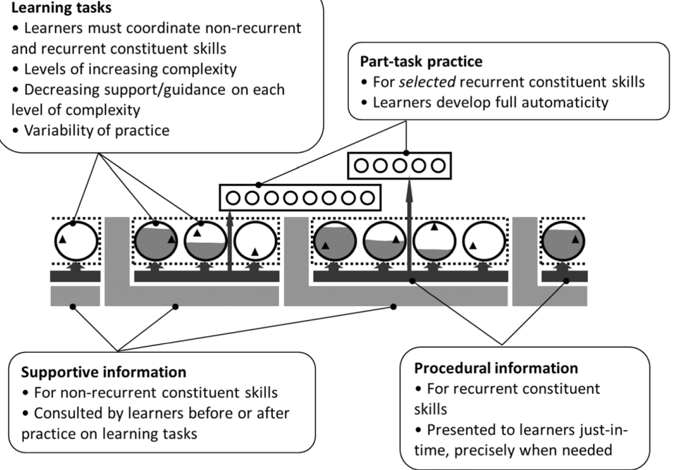
- The paper highlights 4C/ID as an extension of CLT for longer instructional programs and curricula, organized around 4 components: learning tasks, supportive information, procedural information, and part-task practice.
- It reports progress in measuring cognitive load, including a 10-item psychometric instrument that supported distinguishing intrinsic from extraneous load, and objective measures such as EEG, eye tracking, and secondary-task methods.
Methods
- This is a review article that retrospectively synthesizes CLT developments from 1998 to 2018, using the 1998 paper as a baseline and organizing the discussion into history, developments, future directions, and conclusions.
- The authors draw on prior theoretical and empirical studies and reviews cited throughout the paper; no new dataset or sample is reported in the text provided.
- Main analysis is a narrative synthesis of theoretical developments, instructional effects, and measurement approaches in CLT.
Limitations
- The paper explicitly says it is an attempt to summarise the last 20 years of CLT and sketch directions for future research, so it is a synthesis rather than a new empirical test.
- It repeatedly notes that more research is needed on cognitive-load measurement, including the optimal use of subjective rating scales, differentiating load types, and validating objective techniques.
- Evident from the text: several claims about future directions (e.g., resource depletion, self-regulated learning, emotions/stress/uncertainty, human movement) are presented as promising but not yet settled in the paper itself.
Model-written summary. Check it against the paper before relying on it.
Integrity signals
Registry
Cites
Statistics
Figures
Verification
Claims the paper makes
21 Valid · 23 Not valid · 90 Not checked · 158 Own results and interpretations
The sources with a verdict support this claim; the rest weren’t checked yet, have no full text we could read, or their verdicts aren’t rated yet.
In the paper
“Its basic premise is that human cognitive processing is heavily constrained by our limited working memory which can only process a limited number of information elements at a time.”
§ The Author(s) 2019 > Introduction
What the sources say
- Supportedcites Miller (1956) matched to “The magical number seven, plus or minus two: Some limits on our capacity for processing information.” (1956) source
The Summary says that immediate memory imposes severe limits on the information people can receive, process, and remember. The discussion of immediate memory (p. 93) specifies that its limit is the number of chunks, supporting the claim's broad paraphrase of a limited number of information elements at a time. (LLM, conf=0.91)
- Not checked — no full text of the sourcecites Peterson and Peterson (1959) matched to “Short-term retention of individual verbal items.” (1959) source
plainstates a cause- Asserted: passes — The authors put it forward as true.
- Checkable: passes — It can be checked against evidence.
- Load-bearing: passes — The paper’s conclusions depend on it.
- Based: passes — The paper gives a reason why it holds.
- Supported
The cited sources support only part of this claim — read each source’s verdict below.
In the paper
“The capacity and duration limits of working memory have been known at least since Miller (1956) and Peterson and Peterson (1959), although the fact that these limits effectively applied only to novel, not familiar information, seemed more implicit rather than explicit in most treatments.”
§ The Author(s) 2019 > Human Cognitive Architecture Used in 1998
What the sources say
- Partly supportedcites Miller (1956) matched to “The magical number seven, plus or minus two: Some limits on our capacity for processing information.” (1956) sourceExperimental — accuracy not yet measured
In the discussion of immediate memory (p. 93), Miller says its span is limited by the number of chunks and that familiar units allow more information to be packed into each chunk. That supports a distinction between novel material and familiar, recoded material, but not the claim that capacity limits apply only to novel information: the chunk limit remains. The paper also does not establish a duration limit that applies only to novel information. (LLM, conf=0.86)
- Not checked — no full text of the sourcecites Peterson and Peterson (1959) matched to “Short-term retention of individual verbal items.” (1959) source
hedged- Asserted: passes — The authors put it forward as true.
- Checkable: passes — It can be checked against evidence.
- Load-bearing: passes — The paper’s conclusions depend on it.
- Based: passes — The paper gives a reason why it holds.
- Partly supported
Every source the paper cites for this claim was checked and supports it.
In the paper
“The data summarised by Sala and Gobet (2017) provide a major justification for the post 1998 inclusion of evolutionary psychology into cognitive load theory.”
§ The Author(s) 2019 > Human Cognitive Architecture Seen Through the Prism of Evolutionary Psychology
What the sources say
- Supportedcites Sala and Gobet (2017) matched to “Does Far Transfer Exist? Negative Evidence From Chess, Music, and Working Memory Training” (2017) source
The Theoretical and Practical Implications section (page unavailable) summarises the paper’s evidence that chess, music and working-memory training do not reliably produce far transfer. The claim that these data justify a development in cognitive load theory is the citing authors’ interpretation, not a finding attributed to Sala and Gobet. (LLM, conf=0.86)
boostedstates a cause- Asserted: passes — The authors put it forward as true.
- Checkable: passes — It can be checked against evidence.
- Load-bearing: passes — The paper’s conclusions depend on it.
- Based: passes — The paper gives a reason why it holds.
- Supported
Every source the paper cites for this claim was checked and supports it.
In the paper
“The expertise reversal effect is, in essence, a variant of the more general element interactivity effect (Chen et al. 2017).”
§ The Author(s) 2019 > Instructional Effects Described After 1998
What the sources say
- Supportedcites Chen et al. 2017 matched to “The Expertise Reversal Effect is a Variant of the More General Element Interactivity Effect” (2017) source
The indexed copy lists the cited paper under the exact title “The Expertise Reversal Effect is a Variant of the More General Element Interactivity Effect.” Its title directly states the proposition attributed to it; no page number is available in the indexed passage. (LLM, conf=0.90)
plainstates a cause- Asserted: passes — The authors put it forward as true.
- Checkable: passes — It can be checked against evidence.
- Load-bearing: unclear — It is unclear whether the paper’s conclusions depend on it.
- Based: passes — The paper gives a reason why it holds.
- Supported
Every source the paper cites for this claim was checked and supports it.
In the paper
“When subsequently presented the fully integrated information, they only needed to learn how to integrate the individual elements and so more readily assimilated the entire, high element interactivity information.”
§ The Author(s) 2019 > Instructional Effects Described After 1998
What the sources say
- Supportedcites Pollock et al. 2002 matched to “Assimilating complex information” (2002) source
Split into 2 atoms — 2 confirmed, 0 partially supported, 0 disputed, 0 misattributed, 0 unverifiable. Expand the claim to see per-atom verdicts.
plainstates a cause- Asserted: passes — The authors put it forward as true.
- Checkable: passes — It can be checked against evidence.
- Load-bearing: passes — The paper’s conclusions depend on it.
- Based: passes — The paper gives a reason why it holds.
- Supported
132 more claims · 6 with their cited sources checked
Create a free account to see all 292 claims and to verify the 3 references still open.
- It may state two separate claims as one. 88
- Probably not a substantial claim. 95
Claims other papers make about this one
Each is checked against this paper’s own text: does it say what the citing paper says it does?
The source backs part of the claim, not all of it — or backs it for a different population, condition or comparison.
In the citing paper
“Another possible explanation is that the pre-training effect tends to be most effective for learners with minimal prior knowledge (Sweller et al., 2019)”
From Rethinking pre-training: cognitive load implications for learners with varying prior knowledge (2025) · cites this paper as Sweller et al., 2019
Experimental — accuracy not yet measuredThe cited source says what the claim attributes to it.
In the citing paper
“If the cognitive load imposed by a learning task is too high, it might interfere with the learner’s ability to effectively acquire and retain the skill [13, 25].”
From Teaching a single manual therapy technique at a time reduces cognitive load in physiotherapy students: a randomized controlled educational study (2025) · cites this paper as [13]
The cited source says what the claim attributes to it.
In the citing paper
“While cognitive load is often discussed in the context of instructional efficiency, it is important to note that cognitive load is not inherently detrimental. Rather, it is a natural component of learning that engages working memory resources for schema construction and automation [13].”
From Teaching a single manual therapy technique at a time reduces cognitive load in physiotherapy students: a randomized controlled educational study (2025) · cites this paper as [13]
The cited source says what the claim attributes to it.
In the citing paper
“Thus, an increased germane load is no longer believed to lead to cognitive overload and can thus no longer be assumed to be detrimental to learning performance.”
From Understanding Cognitive Load in Digital and Online Learning: a New Perspective on Extraneous Cognitive Load (2022) · cites this paper as Sweller et al., 2019
The cited source says what the claim attributes to it.
In the citing paper
“The major change from the 1998 model is that Sweller et al. (2019) have removed germane load from the additive equation of total load, but rather a dimension now called ' germane processing. '”
From Understanding Cognitive Load in Digital and Online Learning: a New Perspective on Extraneous Cognitive Load (2022) · cites this paper as Sweller et al., 2019
17 more claims about this paper
Create a free account to see every claim other papers make about this one.
Citations
Cites
The magical number seven, plus or minus two: Some limits on our capacity for processing information.
Miller, G. A. (1956) · Psychological Review · doi:10.1037/h0043158 · Cited by 17,812 · cited 1×
“The capacity and duration limits of working memory have been known at least since Miller (1956) and Peterson and Peterson (1959), although the fact that these limits effectively applied only to novel, not familiar information, seemed more implicit rather than explicit in most treatments.”
BackgroundThe magical number seven, plus or minus two: Some limits on our capacity for processing information.
Miller, G. A. (1994) · Psychological Review · doi:10.1037/0033-295x.101.2.343 · Cited by 17,161
Cognitive Load During Problem Solving: Effects on Learning
Sweller, J. (1988) · Cognitive Science · doi:10.1016/0364-0213(88)90023-7 · Cited by 11,048 · cited 4×
“Learning tasks (indicated by the big circles in Fig.”
BackgroundMethodInfluentialSelf-citationKirschner, P. A., Sweller, J., & Clark, R. E. (2006) · Educational Psychologist · doi:10.1207/s15326985ep4102_1 · Cited by 7,776
Self-citationRizzolatti, G., & Craighero, L. (2004) · Annual Review of Neuroscience · doi:10.1146/annurev.neuro.27.070203.144230 · Cited by 7,433
Cognitive Architecture and Instructional Design
Sweller, J., van Merrienboer, J. J. G., & Paas, F. G. W. C. (1998) · Educational Psychology Review · doi:10.1023/a:1022193728205 · Cited by 6,023
Self-citationCognitive load theory, learning difficulty, and instructional design
Sweller, J. (1994) · Learning and Instruction · doi:10.1016/0959-4752(94)90003-5 · Cited by 5,426 · cited 1×
“Element Interactivity Effect This effect was already known in 1998 but as a compound effect, it was not classed as a cognitive load effect (see Sweller 1994).”
BackgroundSelf-citationBaddeley, A. (1992) · Science · doi:10.1126/science.1736359 · Cited by 5,258
Ericsson, K. A., & Kintsch, W. (1995) · Psychological Review · doi:10.1037/0033-295x.102.2.211 · Cited by 3,498
Short-term retention of individual verbal items.
Peterson, L., & Peterson, M. J. (1959) · Journal of Experimental Psychology · doi:10.1037/h0049234 · Cited by 2,939 · cited 1×
“The capacity and duration limits of working memory have been known at least since Miller (1956) and Peterson and Peterson (1959), although the fact that these limits effectively applied only to novel, not familiar information, seemed more implicit rather than explicit in most treatments.”
Background
Research works printed but not linked: 4
- Centre for Education Statistics and Evaluation. (2017). Cognitive load theory: research that teachers really need to understand . Sydney: NSW Department of Education.
- Centre for Education Statistics and Evaluation. (2018). Cognitive load theory in practice . Sydney: NSW Department of Education.
- Clark, R. C. (2014). Evidence-based training methods: a guide for training professionals (2nd ed.). Alexandria: ATD Press.
- Miller, W. (1937). The picture crutch in reading. Elementary English Review, 14 , 263 -264.
Cited by
Items 1,101–1,200 of 2,268
Martin, C. (2026) · European Journal of Education & Language Review · doi:10.20897/ejelr/18945 · Cited by 1
“Second, introduce words through coordinated modes that clarify meaning without overloading learners (Mayer, 2020; Mayer & Moreno, 2003; Sweller et al., 2019).”
When Can AI Models Explain Learning? Validity Criteria for AI as Cognitive Models in Education
Wang, P., Viberg, O., Law, E. L.-C., & Greiff, S. (2026) · Educational Psychology Review · doi:10.1007/s10648-026-10202-y · Cited by 3
“…a “working memory module” is only meaningful if it shows hallmark properties educational psychologists care about (Oberauer, 2019 ), such as capacity limits, decay, interference, and selective load effects that parallel learners’ performance under instructional demands (Sweller et al., 2019 ).”
Kaharuddin, A., Tulak, T., & Tulak, H. (2026) · Educational Technology Research and Development · doi:10.1007/s11423-026-10702-2 · Cited by 3
Kaboli, M., kadivar, P., Abdollahi, M. H., & Arabzadeh, M. (2020) · Journal of Archives in Military Medicine · doi:10.5812/jamm.111339 · Cited by 2
“Therefore, it affects learning outcomes (7).”
BackgroundInfluentialRagazou, V., & Karasavvidis, I. (2021) · Interactive Technology and Smart Education · doi:10.1108/itse-05-2021-0091 · Cited by 5
Jiang, M. L., & Tse, A. W. C. (2021) · International Conference on Education and E-Learning (ICEEL) · doi:10.1145/3502434.3502451 · Cited by 4
“[32] contended that plenty of the instructional designs have not paid enough attention to learner’s working memory and long-term memory.”
BackgroundInfluentialPerfil autodirigido y procrastinación en estudiantes de educación en línea
Jimmy Zambrano, R., Chumaña, J., León, S. M. J., & Cuadros-López, A. (2022) · Educar · doi:10.5565/rev/educar.1507 · Cited by 10
Song, N., Chen, K., Jin, X., & Zhao, Y. (2022) · Journal of Computer Assisted Learning · doi:10.1111/jcal.12737 · Cited by 3
Transfer of learning in young children: Magic digital or similarity-based?
Mombo, W. T., & Clerc, J. (2022) · L’Année psychologique · doi:10.3917/anpsy1.223.0471 · Cited by 2
Online Learning: Does Integrated Video Lecture Help You Learn More Efficiently?
Bai, X., & Vu, K. L. (2022) · Automation, collaboration, and e-services · doi:10.1007/978-3-031-10780-1_29 · Cited by 3
van Zyl, S., & Mentz, E. (2022) · Workshop in Primary and Secondary Computing Education · doi:10.1145/3556787.3556873 · Cited by 2
“The aim of cognitive load theory is to provide more resources to a student’s working memory [16].”
BackgroundInfluential“What are they talking about?” A sociocultural linguistic approach to practical task effectiveness
Hennah, N. (2022) · Chemistry Education Research and Practice · doi:10.1039/d2rp00233g · Cited by 6
Fischer, B., & Viens, D. (2023) · Canadian Modern Language Review/ La Revue canadienne des langues vivantes · doi:10.3138/cmlr-2022-0031 · Cited by 3
Ramli, R., & Purba, K. R. (2023) · IEEE International Colloquium on Signal Processing & Its Applications (CSPA) · doi:10.1109/cspa57446.2023.10087548 · Cited by 2
“Reducing clutter is one of the ways to improve attention, especially with the use of colours[13].”
BackgroundHellier, S. D., & Sperring, C. (2023) · The Journal of Continuing Education in Nursing · doi:10.3928/00220124-20230511-06 · Cited by 4
Willert, N., & Eriksson, J. (2023) · European Conference on Software Engineering Education (ECSEE) · doi:10.1145/3593663.3593677 · Cited by 4
Stimulating inference-making in second grade children when reading and listening to narrative texts
van Zeijts, B. E. J., Ganushchak, L. Y., de Koning, B. B., & Tabbers, H. K. (2023) · Reading and Writing · doi:10.1007/s11145-023-10463-x · Cited by 8
LIFT - A System to Create Mixed 360° Video and 3D Content for Live Immersive Virtual Field Trip
Li, L., Carnell, S., Harris, K. P., et al. (2023) · ACM International Conference on Interactive Media Experiences · doi:10.1145/3573381.3596162 · Cited by 2
KNOWS strategy in action: Solving word problems involving ratios
Emran, A. B. H., Shahrıll, M., & Asamoah, D. (2023) · Asian Journal for Mathematics Education · doi:10.1177/27527263231197244 · Cited by 4
“One common concept of instructional design connected with cognitivism is that knowledge is assimilated more effectively if processed and presented in manageable components (Sweller et al., 2019).”
BackgroundLin, L., Xu, M. K., Zhang, P., & Zuo, G. (2023) · Current Psychology · doi:10.1007/s12144-023-05191-y · Cited by 2
“Existing instructional design principles, such as those based on cognitive load theory (Sweller et al., 2019), may be incorporated into the future design of the utility value intervention.”
Kueker, D., & Moore, J. L. (2023) · Journal of Computer Assisted Learning · doi:10.1111/jcal.12875 · Cited by 6
Input Modality and its Effect on Memory Recall
Dzulkifli, M. A., & Halim, A. Z. A. (2023) · Journal of Cognitive Sciences and Human Development · doi:10.33736/jcshd.5699.2023 · Cited by 3
“According to cognitive load theory (Sweller, 1988; Sweller et al., 1994, Sweller et al., 2019), any learning task induces some processing load which will affect the ability of students to process past, current and new information.”
BackgroundLow, P. Y., & Lim, G.-B. (2023) · ImmunoHorizons · doi:10.4049/immunohorizons.2300004 · Cited by 5
“( 35, 36).”
BackgroundMoloo, R. K. (2023) · IEEE Transactions on Learning Technologies · doi:10.1109/tlt.2023.3330529 · Cited by 4
The Dilemma and Way Out of Cognitive Load Theory in School Learning
徐, 前. (2023) · Advances in Social Sciences · doi:10.12677/ass.2023.12121007 · Cited by 2
BeeLife: a mobile application to foster environmental awareness in classroom settings
Stock, A., Stock, O., Mönch, J., Suren, M., Koch, N. N., Rey, G. D., & Wirzberger, M. (2024) · Frontiers in Computer Science · doi:10.3389/fcomp.2023.1298888 · Cited by 5
Jones, K., Miller, D. J., & Noble, P. (2024) · Journal of Veterinary Medical Education · doi:10.3138/jvme-2023-0135 · Cited by 2
Molnár, B. (2023) · IEEE International Conference on Cognitive Infocommunications · doi:10.1109/coginfocom59411.2023.10397536
Ramos, M. Á. T. (2024) · Supervisión 21: revista de educación e inspección · doi:10.52149/sp21/71.8 · Cited by 3
Khan, M. O., Nazim, M., & Alzubi, A. A. F. (2024) · International Journal of Religion · doi:10.61707/e9j18r87 · Cited by 5
“The Cognitive Load Theory served as the foundation for the theory's development (Sweller et.al, 2019).”
MethodAlmusharraf, A. M., Mahdi, H. S., Al‐Nofaie, H., Ghobain, E. A., & Aljasser, A. (2024) · Journal of Psycholinguistic Research · doi:10.1007/s10936-024-10070-z · Cited by 11
“Cognitive load theory explains how learners process new information and build knowledge in long-term memory: human brains have limited abilities to process several pieces of information at the same time (Sweller et al., 2019).”
Exploring the multimedia effect in testing: the role of coherence and item-level analysis
Arts, J., Emons, W. H. M., Dirkx, K., Brinke, D. J.-T., & Jarodzka, H. (2024) · Frontiers in Education · doi:10.3389/feduc.2024.1344012 · Cited by 5
Perry, M., Azevedo, R. F. L., Henricks, G. M., Crues, R. W., & Bhat, S. (2024) · International Journal of Human-Computer Interaction · doi:10.1080/10447318.2024.2328914 · Cited by 5
“…format because a large-scale study in a MOOC context found that videos under 9 minutes of duration were perceived to be most engaging (Berg et al., 2014; Guo et al., 2014; Kurzweil et al., 2020; see also the video segmentation recommendations in Lange & Costley, 2020 and Sweller et al., 2019).”
Online Lecture Videos by Non-Native English-Speaking Instructors
Chen, H.-T. M., McClure, K. L., & Morris, T. W. (2024) · Technology Knowledge and Learning · doi:10.1007/s10758-024-09738-1 · Cited by 5
“One of the most comprehensive multimedia design theories is the Cognitive Theory of Multimedia Learning (CTML; Mayer, 2005, 2009, 2017 ; Moreno & Mayer, 1999; Sweller et al., 2019).”
Blissett, S., Rodriguez, S., Qasim, A., & O’Sullivan, P. (2024) · Academic Medicine · doi:10.1097/acm.0000000000005763 · Cited by 2
Impact of reading messages on student learning and note‐taking during a video lecture
Colliot, T., & Flanigan, A. E. (2024) · Journal of Computer Assisted Learning · doi:10.1111/jcal.13002 · Cited by 3
Papathanasiou-Zuhrt, D. (2024) · Springer proceedings in business and economics · doi:10.1007/978-3-031-51038-0_23 · Cited by 3
The Worked-Example Effect and a Mastery Approach Goal Orientation
Lee, H. M., & Ayres, P. (2024) · Education Sciences · doi:10.3390/educsci14060597 · Cited by 10
McClure, K. L., & Chen, H.-T. M. (2024) · Psychology of Language and Communication · doi:10.58734/plc-2024-0010 · Cited by 3
Enhancing Problem-Solving Skills for Word Problems: Impact of Diagram and Learner Expertise
Ngu, B. H., Phan, H. P., Usop, H. H., & Anding, P. N. (2024) · The Journal of Experimental Education · doi:10.1080/00220973.2024.2394956 · Cited by 5
“In line with the design principles of cognitive load theory (Sweller et al., 2011; 2019), it is plausible for more knowledgeable students to take advantage of their prior knowledge of a unit concept to successfully solve percentage problems, using the unitary approach with or without the aid of…”
Isbej, L., Oyarzo, N., Véliz, C., & Ríos, J. C. (2024) · Revista Médica Clínica Las Condes · doi:10.1016/j.rmclc.2024.08.004 · Cited by 4
Kidwai, S., Rojas-Velázquez, D., Lopez‐Rincon, A., Kraneveld, A. D., Oberski, D. L., & Meijerman, I. (2024) · Currents in Pharmacy Teaching and Learning · doi:10.1016/j.cptl.2024.102231 · Cited by 4
Beban Kognitif Siswa Dalam Pembelajaran BerdasarkanKurikulum Merdeka Sekolah Dasar
Zarkasyi, M. H., Abidin, Z., & Praherdhiono, H. (2024) · Journal of Educational Technology Studies and Applied Research. · doi:10.70125/jetsar.v1i2y2024a18 · Cited by 12
“Dalam perkembangannya, beban kognitif dikemukakan oleh Sweller (2019).”
Hash Table Notional Machines: A Comparison of 2D and 3D Representations
Lewis, C. M., Miller, C. S., Jeuring, J. T., Pearce, J. L., & Petersen, A. (2024) · ACM Virtual Global Computing Education Conference (SIGCSE Virtual) · doi:10.1145/3649165.3690118 · Cited by 2
“Representations are Familiar (2D) vs. Memorable (3D) : The 2D representations likely use conventions familiar to many CS students; this familiarity may facilitate learning because of a decrease in cognitive load [11, 23, 25, 26] and make the 3D representation more distracting [24].”
Does Instruction-First or Problem-Solving-First Depend on Learners’ Prior Knowledge?
He, C.-W., Fiorella, L., & Lemons, P. P. (2025) · Educational Psychology Review · doi:10.1007/s10648-025-09993-3 · Cited by 8
“Importantly, worked examples often become less effective (and eventually can even impair learning) as learners’ expertise increases (Sweller et al., 2019), a pattern often referred to as the expertise reversal effect (Kalyuga, 2007).”
Edin, A., Abraha, A., Molla, Y., Utura, T., & Ayele, A. (2025) · Journal of Medical Education and Curricular Development · doi:10.1177/23821205251329739 · Cited by 2
VR Study Highlights the Need for an Adaptive Learning Environment in Industrial Safety Training
Hannah, R., Matuszczak, J., & Briggs, M. (2025) · Journal of Educational Technology Systems · doi:10.1177/00472395251330646 · Cited by 5
“According to Sweller et al. (2019), cognitive load is split into the three following categories: (a) intrinsic load, which is focused on the complexity of the information presented, (b) extraneous load, or how the information is presented, and (c) germane load, which is based on the learning that…”
Mägdefrau, J., Wecker, C., Engelmann, K., Michler, A., Baumgartner, I., & Böhm, M. (2025) · Learning and Instruction · doi:10.1016/j.learninstruc.2025.102116 · Cited by 7
Enhancing video-based instruction: the impact of affective pedagogical agents and cognitive prompts
Wang, Z., Zhao, H., Yang, J., Xu, Y., & Chen, X. (2025) · Interactive Learning Environments · doi:10.1080/10494820.2025.2494162 · Cited by 4
“Higher ECL is detrimental to learning; and (c) Germane cognitive load (GCL) refers to the cognitive resources that learners use for task processing, and higher GCL is associated with better learning outcomes (Sweller et al., 2019).”
Mokhtari, K., Ghimire, N., & Bentahar, A. (2025) · Education Sciences · doi:10.3390/educsci15050599 · Cited by 3
“This finding These results underscore the importance of considering contextual di ff erences when assessing the impact of media multitasking on reading activities. load theory perspective (Sweller et al., 2019), which proposes that domain frees up cognitive resources that”
Al‐Omari, H., Aljawarneh, Y. M., & Al-Rawashdeh, S. Y. (2025) · Critical Public Health · doi:10.1080/09581596.2025.2504074 · Cited by 3
“…framework has been explored extensively, emphasizing the tripartite division of cognitive load into intrinsic, extraneous, and germane loads (sweller et al., 2019). such description explains the influence of content complexity, learning environments, and strengthful processing on the…”
Integrating Human Movement in Learning: Advancements in Language Instruction, Multimedia, and Theory
de Koning, B. B., Zhang, S., & Sepp, S. (2025) · Educational Psychology Review · doi:10.1007/s10648-025-10027-1 · Cited by 4
“Specifically, theorizing within Cognitive Load Theory (CLT; Sweller et al., 2019) distinguishes between biologically primary knowledge and biologically secondary knowledge.”
Gonscherowski, P. M., Lindenbauer, E., Kaspar, K., & Rott, B. (2025) · Applied Sciences · doi:10.3390/app15116024 · Cited by 3
Effects of finger tracing on learning from spatially separated and integrated multimedia materials
Zuo, G., de Koning, B. B., & PAAS, F. G. W. C. (2025) · Educational Psychology · doi:10.1080/01443410.2025.2516549 · Cited by 2
“…with intrinsic cognitive load in the most recent conceptualisation within CLT, germane cognitive load is reframed as germane processing of intrinsic aspects of the learning task (Kalyuga, 2011; Leppink & van den Heuvel, 2015; Paas & Van Merriënboer, 2020; Sweller, 2010; Sweller et al., 2019).”
Self-citationTheelen, H., Canisius, E., & Lambert, G. (2025) · Active Learning in Higher Education · doi:10.1177/14697874251356242 · Cited by 5
“…raises the question of whether these strategies, while supported by cognitive theories (such as cognitive load theory; Bjork & Bjork, 2011; Mayer, 2022; Sweller et al., 2019), are simply employed because they are easier to implement or more commonly accepted in traditional pedagogical practices.”
Criticisms and Desired Additional Modifications
Kalyuga, S., & Plass, J. L. (2025) · Oxford University Press eBooks · doi:10.1093/9780190078539.003.0004 · Cited by 1
Bauersfeld, J. L., & Gold, B. (2025) · Instructional Science · doi:10.1007/s11251-025-09738-3 · Cited by 2
“Cognitive load theory (Sweller et al., 2019) provides a useful framework for designing instructional support for video-based analyses.”
InfluentialDialogic vs. Structured AI in Physics Education: Theoretical Frameworks and Pedagogical Implications
Kotsis, K. Τ. (2025) · European Journal of Contemporary Education and E-Learning · doi:10.59324/ejceel.2025.3(5).02 · Cited by 2
“This design strongly adheres to cognitive load theory, which underscores the necessity for instructional sequencing that minimizes superfluous load and optimizes Germane processing (Sweller et al., 2019).”
Polat, H., Kayaduman, H., Taş, N., Battal, A., Kaban, A., & Bayram, E. (2025) · Educational Technology Research and Development · doi:10.1007/s11423-025-10559-x · Cited by 3
“Conversely, the CLT emphasizes the necessity of minimizing extraneous cognitive load to optimize instructional design (Sweller et al., 2019).”
InfluentialGoing Beyond a Singular ‘Science of Learning’ Framework
Tytler, R., Salimpour, S., & Prain, V. (2025) · New Zealand Journal of Educational Studies · doi:10.1007/s40841-025-00414-1 · Cited by 3
“…distinguishes between intrinsic cognitive load, a function of the learning material, extraneous load, being distractions or unnecessary processing demands, and ‘germane load’ which refers to the working memory resources devoted to dealing with intrinsic cognitive load (Sweller et al., 2019 ).”
InfluentialWhen Help Hurts: Verification Load and Fatigue with AI Coding Assistants
Fan, G. F., Liu, D., Pan, L., & Zhang, R. (2026) · CHI Conference on Human Factors in Computing Systems · doi:10.1145/3772318.3791176 · Cited by 12
Romine, W. L., Schroeder, N. L., Edwards, A., & Banerjee, T. (2021) · Lecture notes in computer science · doi:10.1007/978-3-030-68790-8_8 · Cited by 4
“Since the working memory is limited in both capacity [5, 6] and duration [1, 3], CLT suggests that it is important to minimize the mental effort learners have to expend on tasks that are not essential to learning the material [7].”
BackgroundQuantifying Novice Behavior, Experience, and Mental Effort in Code Puzzle Pathways
Allen, J., & Kelleher, C. L. (2021) · CHI Conference Extended Abstracts on Human Factors in Computing Systems (CHI EA) · doi:10.1145/3411763.3451752 · Cited by 2
“retrieved from long-term memory and used to process and organize more novel information in working memory at no cost to working memory capacity [31, 32].”
BackgroundInfluentialDesigning an Augmented Reality Digital Game for Adaptive Number Knowledge Development
Yu, J., & Denham, A. R. (2021) · Advances in game-based learning · doi:10.1007/978-3-030-75142-5_11 · Cited by 2
Olivier, J. (2021) · NWU self-directed learning series · doi:10.4102/aosis.2021.bk279.03 · Cited by 2
Modular Tasks Design for Teaching Young Students on Physical Computing Platforms
Jin, K. H. (2019) · Conference on Information Technology Education · doi:10.1145/3349266.3351416 · Cited by 3
“Previous research has also shown that, when dealing with novel information, individual elements can be learned separately before they are integrated together to avoid excessive load on working memory, which is known as the isolated element effect [13].”
BackgroundFour component instructional design (4C/ID) model confirmed for secondary tertiary mathematics
Wade, C. H., Wilkens, C. P., Sonnert, G., & Sadler, P. M. (2020) · Mathematics Education Across Cultures: Proceedings of the 42nd Meeting of the North American Chapter of the International Group for the Psychology of Mathematics Education · doi:10.51272/pmena.42.2020-386 · Cited by 2
Reis, H. M., Alvares, D., Jaques, P. A., & Isotani, S. (2021) · Revista Brasileira de Informática na Educação · doi:10.5753/rbie.2021.29.0.48 · Cited by 4
Curriculum Coherence and the CDC Model: A History Example
Rata, E. (2021) · Springer briefs in education · doi:10.1007/978-981-16-2908-2_3 · Cited by 2
Principles for Reducing Extraneous Processing in Multimedia Learning
Mayer, R. E., & Fiorella, L. (2021) · Cambridge University Press eBooks · doi:10.1017/9781108894333.018 · Cited by 10
Theories of Blended Learning: A Novel Approach to Tertiary Neuroanatomy
Whiting, H., Blackmore, C., Vitali, J., Langfield, T., Colthorpe, K. L., Ernst, H., & Ainscough, L. (2022) · International Journal of Higher Education · doi:10.5430/ijhe.v11n4p191 · Cited by 2
BEBAN KOGNITIF INTRINSIC DALAM PEMBELAJARAN MATERI EKSISTENSI BILANGAN IRRASIONAL
Yohanes, B. (2022) · EDUPEDIA · doi:10.24269/ed.v6i1.1177 · Cited by 2
Effects of rule variant reasoning in far transfer problem solving
Zhang, Q., ZHANG, Q., ZHANG, X., & Gao, C. (2022) · Acta Psychologica Sinica · doi:10.3724/sp.j.1041.2023.00117 · Cited by 2
Akhtar, S., & Rata, E. (2022) · Social Sciences · doi:10.3390/socsci11110494 · Cited by 2
Student conceptual level scale: Development and initial validation
Yang, X. J., Dong, J., & Tan, D. (2022) · Frontiers in Education · doi:10.3389/feduc.2022.965643 · Cited by 4
“Sixteen of the SCLS items were correlated with the LCQ, 15 of which were significant, confirming a strong relationship between mental effort and individual characteristics (Miller, 1956; Sweller, 2010; Sweller et al., 2019; Paas and Merrinboer, 2020; Brosnan et al., 2021).”
MethodFlynn, S., Erickson, S., & Serry, T. A. (2023) · Australian Journal of Learning Difficulties · doi:10.1080/19404158.2023.2210602 · Cited by 3
Vertical Integration in the Pediatrics Clerkship: A Case Study
Hall, J. M., Anand, R., Copes, L. E., Moran-Crusio, K., Davis, J. N., Doyle, M., Maffeo, C., & Kilchevsky, E. S. (2023) · Education Sciences · doi:10.3390/educsci13060545 · Cited by 3
González‐Cabañes, E., García, T., Chase, C. C., & Núñez, J. C. (2023) · Campbell Systematic Reviews · doi:10.1002/cl2.1337 · Cited by 3
“In turn, this can generate extraneous cognitive load (Clark, 2012), which refers to a saturation in our attentional capacity due to processing irrelevant aspects, and can reduce the attentional resources available to focus on important information (Sweller, 2019).”
BackgroundUsing Conceptual Chunking to Support Information Processing While Solving Complex Industrial Tasks
Klichowicz, A., Morgenstern, T., & Bocklisch, F. (2023) · Lecture notes in networks and systems · doi:10.1007/978-981-99-3091-3_4 · Cited by 3
van Dooren, E. (2020) · Architecture and the Built Environment · doi:10.59490/abe.2020.19.5351 · Cited by 2
THE DEVELOPMENT OF A MOBILE APPLICATION ISMIND FOR FORMATIVE STUDENTS’ ASSESSMENT
Saad, A., Khairulanuar, F. N., & Rahmatullah, B. (2023) · Information Technologies and Learning Tools · doi:10.33407/itlt.v98i6.5370 · Cited by 8
“Instead, the germane cognitive load which is useful in the learning process is more needed to help in understanding the course [40].”
BackgroundKhan, R. R., & Romkey, L. (2024) · ASEE Annual Conference & Exposition · doi:10.18260/1-2--41691 · Cited by 2
“In other words, the ability to transfer knowledge and problem-solve emerges from domain-specific contexts, not generic ones [11].”
BackgroundPemberton, I. (2024) · Springer eBooks · doi:10.1007/978-3-031-53414-0_8 · Cited by 2
de Koning, B. B. (2024) · Education Sciences · doi:10.3390/educsci14030284 · Cited by 4
“According to cognitive load theory (CLT; [1]), an instructional theory to optimize learning activities and materials while taking into account the limited capacity of working memory, the provision of specific guidance to learners enables learners to reduce the high and unnecessary cognitive load…”
BackgroundA short mindfulness induction might increase women’s mental rotation performance
Bauer, R., & Jansen, P. (2024) · Consciousness and Cognition · doi:10.1016/j.concog.2024.103721 · Cited by 2
“According to this theory, intrinsic cognitive load is elicited by the interacting elements of a task, which have to be processed simultaneously (see Sweller et al., 2019).”
Gonnermann-Müller, J., & Teichmann, M. R. (2024) · Lecture notes in information systems and organisation · doi:10.1007/978-3-031-58396-4_29 · Cited by 3
Antecedents of Usability to Sustain Users’ Engagement in Online Learning
Ghai, A. (2024) · Springer eBooks · doi:10.1007/978-3-031-58795-5_11 · Cited by 4
Seyderhelm, A. J. A., & Blackmore, K. L. (2024) · International Journal of Serious Games · doi:10.17083/ijsg.v11i3.733 · Cited by 4
“Cognitive load theory (CLT) describes the way new information is processed and subsequently stored in long-term memory [8].”
BackgroundMethodBalslev, T., Muijtjens, A. M. M., de Grave, W. S., Awneh, H., & van Merriënboer, J. J. G. (2020) · Advances in Health Sciences Education · doi:10.1007/s10459-020-10001-2 · Cited by 4
Self-citationSykes, L., Postma, T. C., Uys, A., Brandt, P. D., & Crafford, E. (2020) · South African Dental Journal · doi:10.17159/2519-0105/2020/v75no7a5 · Cited by 4
Principles Based on Generative Activity in Multimedia Learning
Mayer, R. E., & Fiorella, L. (2021) · Cambridge University Press eBooks · doi:10.1017/9781108894333.035 · Cited by 4
Hewitt, M., Watkins, J. C., & Yohn, T. L. (2017) · SSRN Electronic Journal · doi:10.2139/ssrn.2902632 · Cited by 2
Why robots should be technical: Correcting mental models through technical architecture conceptsPreprint
Hindemith, L., Vollmer, A.-L., Göpfert, J. P., Wiebel-Herboth, C. B., & Wrede, B. (2020) · arXiv (Cornell University) · doi:10.48550/arxiv.2011.02731 · Cited by 2
“This results in stimulating the user in a multi-modal way and thereby improves the information reception (Sweller et al., 2019).”
BackgroundShamim, M. S., Baig, L. A., Torda, A. J., & Balasooriya, C. D. (2021) · Research Square · doi:10.21203/rs.3.rs-658417/v1 · Cited by 2
Introduction to the special issue. Designing instruction for learning technologies
Tricot, A. (2022) · L’Année psychologique · doi:10.3917/anpsy1.223.0399 · Cited by 2
Sudár, A., & Csapó, Á. (2023) · Research Square · doi:10.21203/rs.3.rs-3640301/v1 · Cited by 2
Effects of an Onscreen Instructor’s Emotions and Picture Types on Poetry Aesthetic AppreciationPreprint
Wang, Y., Zhang, M., Yu, Q., et al. (2024) · Research Square · doi:10.21203/rs.3.rs-4233583/v1 · Cited by 2
Self-citationRajic, A., Olanka, S. K., Generelli, M., et al. (2025) · doi:10.2196/preprints.78736 · Cited by 2
A 3-Tier machine Learning Framework for Early Detection of Learning Difficulties in Basic settingPreprint
Odoom, S., Osei, E. O., Effah, E. Q., Boafo, V., Dusu, S., & Appiah, A. K. (2025) · Research Square · doi:10.21203/rs.3.rs-7876870/v1 · Cited by 3
Approaches to Teaching for Achieving Equitable Outcomes
McPhail, G. J. (2021) · Springer briefs in education · doi:10.1007/978-981-16-2908-2_2 · Cited by 1
Metadata
- Authors
- Sweller, J., van Merriënboer, J. J. G., & Paas, F.
- Affiliations
- UNSW Sydney (AU)
- University of Wollongong (AU)
- Corresponding author
- Sweller, John
- Venue
- Educational Psychology Review
- Published
- 2019-01-22
- Volume
- 31
- Issue
- 2
- Pages
- 261-292
- ISSN
- 1040-726X (ISSN-L)
- 1573-336X
- OpenAlex
- W2913144876
- Semantic Scholar
- e28d73214751d51c3f46a867920be41c49c45130
- Cited by
- 2,337
- References
- 129
- Citations by year
- 2026: 713 · 2025: 466 · 2024: 331 · 2023: 268 · 2022: 212 · 2021: 190 · 2020: 114 · 2019: 37
- FWCI
- 162.54
- Type
- journal article
- Language
- en
- Open access
- hybrid
- doi.org
- Licence
- cc-by
- creativecommons.org/licenses/by/4.0 (tdm)
- Locations
- Educational Psychology Review (publishedVersion, cc-by)
- EUR Research Repository (Erasmus University Rotterdam) (publishedVersion, other-oa)
- Research Online (University of Wollongong) (submittedVersion)
- EUR Research Repository (Erasmus University Rotterdam) (submittedVersion)
- Research Publications (Maastricht University) (submittedVersion, cc-by)
- Figshare (submittedVersion, cc-by)
- Research Publications (Maastricht University) (submittedVersion, other-oa)
- Topics
- Social Sciences › Psychology › Experimental and Cognitive Psychology › Visual and Cognitive Learning Processes
- Social Sciences › Psychology › Developmental and Educational Psychology › Innovative Teaching and Learning Methods
- Life Sciences › Neuroscience › Cognitive Neuroscience › Neuroscience, Education and Cognitive Function
- Keywords
- cognitive load theory, cognitive architecture, working memory, long-term memory, instructional design
About these checks
Registry, retraction, Cites and statistics results are computed, not judged, with one exception: a printed reference that no index lists is read once by a model before it counts as a citation error. Claims are extracted by a model and kept only when their quote appears verbatim in the text; each cited source is then checked, with a model’s help, for whether it says what the claim relies on. Those verdicts can be wrong — read the claim’s quote and the cited source before relying on one.
The claim verdicts this report counts are experimental: their accuracy is not yet measured.
A language model drew the claims from the paper on 2026-10-10, under version 3 of the claim definition (model deepseek-v4.1-flash, prompt extract-v3).
A second model labelled each claim on 2026-10-10 (model jev-1.13-20260917, definition revision gold-guideline-v0.2).
Cited sources are checked with a language model’s help (gpt-6-sol).
Statistics and arithmetic are recomputed, not judged.
Confidence bands are shown only for fields calibrated on our annotated test set. None is calibrated yet, so no band is shown.
What counts as a claim ›How we measure confidence ›How we check this ›
Are you an author, or do you see a problem with this page? Request a review
Data sources
Bibliographic data: Semantic Scholar, OpenAlex, Crossref.
Contains information from the Semantic Scholar Academic Graph Datasets, made available under the ODC Attribution License (ODC-BY 1.0).
Semantic Scholar’s data is described in: Kinney, R., et al. (2023). The Semantic Scholar Open Data Platform. arXiv:2301.10140.
