

Cognitive Architecture and Instructional Design: 20 Years Later
Open accessThe DOI matches its Crossref record; 127 of the 129 references it cites were found in a registry or an index, and 1 are not checked yet; 22 of the 116 sources its claims cite were checked for support.
Abstract
Cognitive load theory was introduced in the 1980s as an instructional design theory based on several uncontroversial aspects of human cognitive architecture. Our knowledge of many of the characteristics of working memory, long-term memory and the relations between them had been well-established for many decades prior to the introduction of the theory. Curiously, this knowledge had had a limited impact on the field of instructional design with most instructional design recommendations proceeding as though working memory and long-term memory did not exist. In contrast, cognitive load theory emphasised that all novel information first is processed by a capacity and duration limited working memory and then stored in an unlimited long-term memory for later use. Once information is stored in long-term memory, the capacity and duration limits of working memory disappear transforming our ability to function. By the late 1990s, sufficient data had been collected using the theory to warrant an extended analysis resulting in the publication of Sweller et al. (Educational Psychology Review, 10, 251–296, 1998). Extensive further theoretical and empirical work have been carried out since that time and this paper is an attempt to summarise the last 20 years of cognitive load theory and to sketch directions for future research.
Verified 2026-11-25 · 1 reference not checked yet
Overview
CoChat Summary
TL;DR
This review argues that cognitive load theory (CLT) has substantially advanced since its 1998 summary, with new theoretical grounding, new instructional effects, and improved measurement approaches. It also frames future work around working-memory resource depletion, self-regulated learning, emotions/stress/uncertainty, and human movement.
Key findings
- The paper states that the 1998 article reported 7 cognitive load effects, and that 8 new effects were added in the 1998–2018 period, including compound effects.
- It says CLT’s theoretical basis was strengthened by grounding human cognitive architecture in evolutionary psychology, especially Geary’s distinction between biologically primary and biologically secondary knowledge.
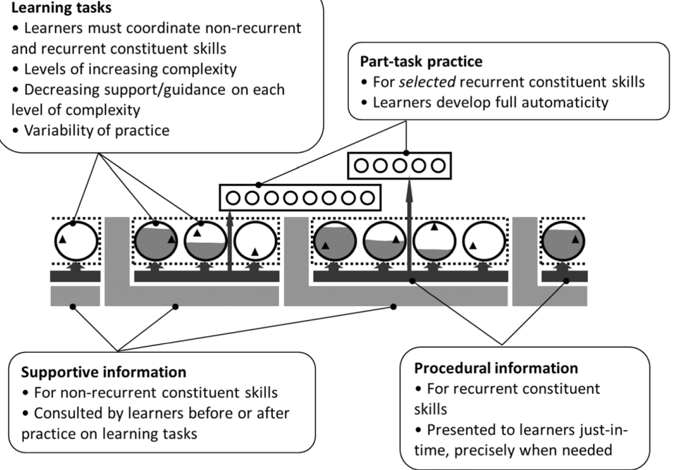
- The paper highlights 4C/ID as an extension of CLT for longer instructional programs and curricula, organized around 4 components: learning tasks, supportive information, procedural information, and part-task practice.
- It reports progress in measuring cognitive load, including a 10-item psychometric instrument that supported distinguishing intrinsic from extraneous load, and objective measures such as EEG, eye tracking, and secondary-task methods.
Methods
- This is a review article that retrospectively synthesizes CLT developments from 1998 to 2018, using the 1998 paper as a baseline and organizing the discussion into history, developments, future directions, and conclusions.
- The authors draw on prior theoretical and empirical studies and reviews cited throughout the paper; no new dataset or sample is reported in the text provided.
- Main analysis is a narrative synthesis of theoretical developments, instructional effects, and measurement approaches in CLT.
Limitations
- The paper explicitly says it is an attempt to summarise the last 20 years of CLT and sketch directions for future research, so it is a synthesis rather than a new empirical test.
- It repeatedly notes that more research is needed on cognitive-load measurement, including the optimal use of subjective rating scales, differentiating load types, and validating objective techniques.
- Evident from the text: several claims about future directions (e.g., resource depletion, self-regulated learning, emotions/stress/uncertainty, human movement) are presented as promising but not yet settled in the paper itself.
Model-written summary. Check it against the paper before relying on it.
Integrity signals
Registry
Cites
Statistics
Figures
Verification
Claims the paper makes
21 Valid · 23 Not valid · 90 Not checked · 158 Own results and interpretations
The sources with a verdict support this claim; the rest weren’t checked yet, have no full text we could read, or their verdicts aren’t rated yet.
In the paper
“Its basic premise is that human cognitive processing is heavily constrained by our limited working memory which can only process a limited number of information elements at a time.”
§ The Author(s) 2019 > Introduction
What the sources say
- Supportedcites Miller (1956) matched to “The magical number seven, plus or minus two: Some limits on our capacity for processing information.” (1956) source
The Summary says that immediate memory imposes severe limits on the information people can receive, process, and remember. The discussion of immediate memory (p. 93) specifies that its limit is the number of chunks, supporting the claim's broad paraphrase of a limited number of information elements at a time. (LLM, conf=0.91)
- Not checked — no full text of the sourcecites Peterson and Peterson (1959) matched to “Short-term retention of individual verbal items.” (1959) source
plainstates a cause- Asserted: passes — The authors put it forward as true.
- Checkable: passes — It can be checked against evidence.
- Load-bearing: passes — The paper’s conclusions depend on it.
- Based: passes — The paper gives a reason why it holds.
- Supported
The cited sources support only part of this claim — read each source’s verdict below.
In the paper
“The capacity and duration limits of working memory have been known at least since Miller (1956) and Peterson and Peterson (1959), although the fact that these limits effectively applied only to novel, not familiar information, seemed more implicit rather than explicit in most treatments.”
§ The Author(s) 2019 > Human Cognitive Architecture Used in 1998
What the sources say
- Partly supportedcites Miller (1956) matched to “The magical number seven, plus or minus two: Some limits on our capacity for processing information.” (1956) sourceExperimental — accuracy not yet measured
In the discussion of immediate memory (p. 93), Miller says its span is limited by the number of chunks and that familiar units allow more information to be packed into each chunk. That supports a distinction between novel material and familiar, recoded material, but not the claim that capacity limits apply only to novel information: the chunk limit remains. The paper also does not establish a duration limit that applies only to novel information. (LLM, conf=0.86)
- Not checked — no full text of the sourcecites Peterson and Peterson (1959) matched to “Short-term retention of individual verbal items.” (1959) source
hedged- Asserted: passes — The authors put it forward as true.
- Checkable: passes — It can be checked against evidence.
- Load-bearing: passes — The paper’s conclusions depend on it.
- Based: passes — The paper gives a reason why it holds.
- Partly supported
Every source the paper cites for this claim was checked and supports it.
In the paper
“The data summarised by Sala and Gobet (2017) provide a major justification for the post 1998 inclusion of evolutionary psychology into cognitive load theory.”
§ The Author(s) 2019 > Human Cognitive Architecture Seen Through the Prism of Evolutionary Psychology
What the sources say
- Supportedcites Sala and Gobet (2017) matched to “Does Far Transfer Exist? Negative Evidence From Chess, Music, and Working Memory Training” (2017) source
The Theoretical and Practical Implications section (page unavailable) summarises the paper’s evidence that chess, music and working-memory training do not reliably produce far transfer. The claim that these data justify a development in cognitive load theory is the citing authors’ interpretation, not a finding attributed to Sala and Gobet. (LLM, conf=0.86)
boostedstates a cause- Asserted: passes — The authors put it forward as true.
- Checkable: passes — It can be checked against evidence.
- Load-bearing: passes — The paper’s conclusions depend on it.
- Based: passes — The paper gives a reason why it holds.
- Supported
Every source the paper cites for this claim was checked and supports it.
In the paper
“The expertise reversal effect is, in essence, a variant of the more general element interactivity effect (Chen et al. 2017).”
§ The Author(s) 2019 > Instructional Effects Described After 1998
What the sources say
- Supportedcites Chen et al. 2017 matched to “The Expertise Reversal Effect is a Variant of the More General Element Interactivity Effect” (2017) source
The indexed copy lists the cited paper under the exact title “The Expertise Reversal Effect is a Variant of the More General Element Interactivity Effect.” Its title directly states the proposition attributed to it; no page number is available in the indexed passage. (LLM, conf=0.90)
plainstates a cause- Asserted: passes — The authors put it forward as true.
- Checkable: passes — It can be checked against evidence.
- Load-bearing: unclear — It is unclear whether the paper’s conclusions depend on it.
- Based: passes — The paper gives a reason why it holds.
- Supported
Every source the paper cites for this claim was checked and supports it.
In the paper
“When subsequently presented the fully integrated information, they only needed to learn how to integrate the individual elements and so more readily assimilated the entire, high element interactivity information.”
§ The Author(s) 2019 > Instructional Effects Described After 1998
What the sources say
- Supportedcites Pollock et al. 2002 matched to “Assimilating complex information” (2002) source
Split into 2 atoms — 2 confirmed, 0 partially supported, 0 disputed, 0 misattributed, 0 unverifiable. Expand the claim to see per-atom verdicts.
plainstates a cause- Asserted: passes — The authors put it forward as true.
- Checkable: passes — It can be checked against evidence.
- Load-bearing: passes — The paper’s conclusions depend on it.
- Based: passes — The paper gives a reason why it holds.
- Supported
132 more claims · 6 with their cited sources checked
Create a free account to see all 292 claims and to verify the 3 references still open.
- It may state two separate claims as one. 88
- Probably not a substantial claim. 95
Claims other papers make about this one
Each is checked against this paper’s own text: does it say what the citing paper says it does?
The source backs part of the claim, not all of it — or backs it for a different population, condition or comparison.
In the citing paper
“Another possible explanation is that the pre-training effect tends to be most effective for learners with minimal prior knowledge (Sweller et al., 2019)”
From Rethinking pre-training: cognitive load implications for learners with varying prior knowledge (2025) · cites this paper as Sweller et al., 2019
Experimental — accuracy not yet measuredThe cited source says what the claim attributes to it.
In the citing paper
“If the cognitive load imposed by a learning task is too high, it might interfere with the learner’s ability to effectively acquire and retain the skill [13, 25].”
From Teaching a single manual therapy technique at a time reduces cognitive load in physiotherapy students: a randomized controlled educational study (2025) · cites this paper as [13]
The cited source says what the claim attributes to it.
In the citing paper
“While cognitive load is often discussed in the context of instructional efficiency, it is important to note that cognitive load is not inherently detrimental. Rather, it is a natural component of learning that engages working memory resources for schema construction and automation [13].”
From Teaching a single manual therapy technique at a time reduces cognitive load in physiotherapy students: a randomized controlled educational study (2025) · cites this paper as [13]
The cited source says what the claim attributes to it.
In the citing paper
“Thus, an increased germane load is no longer believed to lead to cognitive overload and can thus no longer be assumed to be detrimental to learning performance.”
From Understanding Cognitive Load in Digital and Online Learning: a New Perspective on Extraneous Cognitive Load (2022) · cites this paper as Sweller et al., 2019
The cited source says what the claim attributes to it.
In the citing paper
“The major change from the 1998 model is that Sweller et al. (2019) have removed germane load from the additive equation of total load, but rather a dimension now called ' germane processing. '”
From Understanding Cognitive Load in Digital and Online Learning: a New Perspective on Extraneous Cognitive Load (2022) · cites this paper as Sweller et al., 2019
17 more claims about this paper
Create a free account to see every claim other papers make about this one.
Citations
Cites
The magical number seven, plus or minus two: Some limits on our capacity for processing information.
Miller, G. A. (1956) · Psychological Review · doi:10.1037/h0043158 · Cited by 17,812 · cited 1×
“The capacity and duration limits of working memory have been known at least since Miller (1956) and Peterson and Peterson (1959), although the fact that these limits effectively applied only to novel, not familiar information, seemed more implicit rather than explicit in most treatments.”
BackgroundThe magical number seven, plus or minus two: Some limits on our capacity for processing information.
Miller, G. A. (1994) · Psychological Review · doi:10.1037/0033-295x.101.2.343 · Cited by 17,161
Cognitive Load During Problem Solving: Effects on Learning
Sweller, J. (1988) · Cognitive Science · doi:10.1016/0364-0213(88)90023-7 · Cited by 11,048 · cited 4×
“Learning tasks (indicated by the big circles in Fig.”
BackgroundMethodInfluentialSelf-citationKirschner, P. A., Sweller, J., & Clark, R. E. (2006) · Educational Psychologist · doi:10.1207/s15326985ep4102_1 · Cited by 7,776
Self-citationRizzolatti, G., & Craighero, L. (2004) · Annual Review of Neuroscience · doi:10.1146/annurev.neuro.27.070203.144230 · Cited by 7,433
Cognitive Architecture and Instructional Design
Sweller, J., van Merrienboer, J. J. G., & Paas, F. G. W. C. (1998) · Educational Psychology Review · doi:10.1023/a:1022193728205 · Cited by 6,023
Self-citationCognitive load theory, learning difficulty, and instructional design
Sweller, J. (1994) · Learning and Instruction · doi:10.1016/0959-4752(94)90003-5 · Cited by 5,426 · cited 1×
“Element Interactivity Effect This effect was already known in 1998 but as a compound effect, it was not classed as a cognitive load effect (see Sweller 1994).”
BackgroundSelf-citationBaddeley, A. (1992) · Science · doi:10.1126/science.1736359 · Cited by 5,258
Ericsson, K. A., & Kintsch, W. (1995) · Psychological Review · doi:10.1037/0033-295x.102.2.211 · Cited by 3,498
Short-term retention of individual verbal items.
Peterson, L., & Peterson, M. J. (1959) · Journal of Experimental Psychology · doi:10.1037/h0049234 · Cited by 2,939 · cited 1×
“The capacity and duration limits of working memory have been known at least since Miller (1956) and Peterson and Peterson (1959), although the fact that these limits effectively applied only to novel, not familiar information, seemed more implicit rather than explicit in most treatments.”
Background
Research works printed but not linked: 4
- Centre for Education Statistics and Evaluation. (2017). Cognitive load theory: research that teachers really need to understand . Sydney: NSW Department of Education.
- Centre for Education Statistics and Evaluation. (2018). Cognitive load theory in practice . Sydney: NSW Department of Education.
- Clark, R. C. (2014). Evidence-based training methods: a guide for training professionals (2nd ed.). Alexandria: ATD Press.
- Miller, W. (1937). The picture crutch in reading. Elementary English Review, 14 , 263 -264.
Cited by
Items 201–300 of 2,268
Khanam, F., Hossain, A. B. M. A., & Ahmad, M. (2022) · Brain-Computer Interfaces · doi:10.1080/2326263x.2022.2109855 · Cited by 33
Effects of mode and medium in reading comprehension tests on cognitive load
Brüggemann, T., Ludewig, U., Lorenz, R., & McElvany, N. (2022) · Computers & Education · doi:10.1016/j.compedu.2022.104649 · Cited by 45
Stanney, K. M., Skinner, A. D., & Hughes, C. L. (2023) · International Journal of Human-Computer Interaction · doi:10.1080/10447318.2023.2188529 · Cited by 46
“…learning experiences should be designed to reduce working memory “ load ” in order to promote acquisition of schemas (i.e., knowledge structures and associated retrieval cues that support recall of learned information; Jalani & Sern, 2015; Sweller et al., 2019; Paas & van Merri € enboer, 2020).”
BackgroundSaving a semester of learning: MIT’s emergency transition to online instruction
Kessler, A., Barnes, S., Rajagopal, K., Rankin, J., Pouchak, L. C., Silis, M., & Esser, W. (2020) · Information and Learning Sciences · doi:10.1108/ils-04-2020-0097 · Cited by 37
Haynes-Magyar, C., & Ericson, B. J. (2021) · CHI Conference on Human Factors in Computing Systems · doi:10.1145/3411764.3445292 · Cited by 40
“Cognitive Load Theory (CLT) explains the types of strain learners encounter and how to design instruction and assessment to reduce the demands on working memory [90].”
BackgroundInfluentialSuryanto, H., Degeng, I. N. S., Djatmika, E. T., & Kuswandi, D. (2021) · Creativity Studies · doi:10.3846/cs.2021.12364 · Cited by 73
Neurodiversity and cognitive load in online learning: A systematic review with narrative synthesis
Cunff, A. L., Giampietro, V., & Dommett, E. J. (2024) · Educational Research Review · doi:10.1016/j.edurev.2024.100604 · Cited by 66
Cunff, A. L., Martis, B.-L., Glover, C., Ahmed, E., Ford, R. M., Giampietro, V., & Dommett, E. J. (2025) · Frontiers in Education · doi:10.3389/feduc.2024.1437673 · Cited by 64
Alyami, H., Alawami, M., Lyndon, M., Alyami, M. M., Coomarasamy, C., Henning, M. A., Hill, A. G., & Sundram, F. (2019) · JMIR Serious Games · doi:10.2196/13748 · Cited by 41
Darejeh, A., Marcus, N., & Sweller, J. (2021) · Educational Technology Research and Development · doi:10.1007/s11423-021-10024-5 · Cited by 29
Self-citationThe effect of signaling in dependence on the extraneous cognitive load in learning environments
Beege, M., Nebel, S., Schneider, S., & Rey, G. D. (2020) · Cognitive Processing · doi:10.1007/s10339-020-01002-5 · Cited by 41
Zhang, Y., Tian, Y., Yao, L., Duan, C., Sun, X., & Niu, G. (2023) · Teaching and Teacher Education · doi:10.1016/j.tate.2023.104167 · Cited by 30
Learning from split-attention materials: effects of teaching physical and mental learning strategies
de Koning, B. B., Rop, G., & Paas, F. (2020) · Contemporary Educational Psychology · doi:10.1016/j.cedpsych.2020.101873 · Cited by 30
Self-citationUsing Evidence-Based Learning Theories to Guide the Development of Virtual Simulations
McDonald, C., Davis, M., & Benson, C. L. (2021) · Clinical Social Work Journal · doi:10.1007/s10615-021-00809-9 · Cited by 34
“Given the severe constraints of short-term or working memory, which CLT is designed to address (Sweller et al., 2019), each learning experience in VHS and VMI is designed to teach a single skill.”
BackgroundImpact of programming on primary mathematics learning
Laurent-Chevalier, M., Crisci, R., Bressoux, P., Chaachoua, H., Nurra, C., de Vries, E., & Tchounikine, P. (2022) · Learning and Instruction · doi:10.1016/j.learninstruc.2022.101667 · Cited by 44
Bian, C., Wang, X., Huang, Y., Zhou, S., & Lu, W. (2025) · Humanities and Social Sciences Communications · doi:10.1057/s41599-025-05860-2 · Cited by 30
“However, this shift introduces new germane load components, such as prompt engineering and iterative re fi nement, which require structured scaffolding to avoid overwhelming learners (Sweller et al. 2019).”
The effect of worked examples on learning solution steps and knowledge transfer
Chen, O., Retnowati, E., Chan, B. K. Y., & Kalyuga, S. (2023) · Educational Psychology · doi:10.1080/01443410.2023.2273762 · Cited by 68
“Human cognitive architecture, discussing the relations between working memory and long-term memory, serves as the base of CLT (Paas & van Merri € enboer, 2020; Sweller et al., 2019).”
BackgroundDever, D. A., Wiedbusch, M. D., Romero, S. M., & Azevedo, R. (2024) · British Journal of Educational Technology · doi:10.1111/bjet.13432 · Cited by 46
Zheng, C., Wang, K., Gao, S., Yu, Y. W., Wang, Z., & Tang, Y. (2024) · Journal of Intelligent Manufacturing · doi:10.1007/s10845-024-02451-x · Cited by 42
“This concept was first introduced by Sweller et al. (2019), whose work on cognitive load theory (CLT) acted as the fundamental framework for instructional design and presented the implications of presenting information effectively to learners, designing user interfaces, and optimizing human…”
Using cognitive load theory to tailor clinical reasoning training for preclinical medical students
Si, J. (2024) · BMC Medical Education · doi:10.1186/s12909-024-06111-9 · Cited by 39
Farkish, A., Bosaghzadeh, A., Amiri, S. H., & Ebrahimpour, R. (2022) · Education and Information Technologies · doi:10.1007/s10639-022-11283-2 · Cited by 41
“Cognitive load theory categorizes the imposed load on the working memory into three kinds: intrinsic cognitive load, extraneous cognitive load, and germane cognitive load (Paas & Sweller, 2014, pp. 27-43; Sweller et al., 2019).”
BackgroundInfluentialNoetel, M., Parker, P. D., Dicke, T., Beauchamp, M. R., Ntoumanis, N., Hulteen, R. M., Diezmann, C. M., Yeung, A. S., Ahmadi, A., Vasconcellos, D., et al. (2023) · Educational Psychology Review · doi:10.1007/s10648-023-09786-6 · Cited by 44
“Similarly, the benefits of clear instructions can be understood through cognitive load theory (Sweller et al., 2019), where poor instructions lead to cognitive overload.”
BackgroundFischer, K., Sullivan, A. M., Cohen, A. P., King, R. W., Cockrill, B. A., & Besche, H. C. (2023) · BMC Medical Education · doi:10.1186/s12909-023-04325-x · Cited by 28
“CLT defines instruction as “efficient,” when it provides the learner with sufficient guidance to successfully process novel information without overloading the limited capacity of working memory [23, 24].”
BackgroundMethodInfluentialTaxipulati, S., & Hai-dong, L. (2021) · Frontiers in Psychology · doi:10.3389/fpsyg.2021.706821 · Cited by 46
Persuasive communication and spatial presence: a systematic literature review and conceptual model
Breves, P. L. (2023) · Annals of the International Communication Association · doi:10.1080/23808985.2023.2169952 · Cited by 42
“…2021; Roettl & Terlutter, 2018), have been found to increase the extraneous cognitive load (i.e. mental efforts required due to the instruction and presentation of the task), which can have various negative consequences if it reaches a certain degree (Skulmowski & Xu, 2022; Sweller et al., 2019).”
BackgroundEndres, T., Eitel, A., Renninger, K. A., Vössing, C., & Renkl, A. (2024) · Learning and Instruction · doi:10.1016/j.learninstruc.2024.101962 · Cited by 31
Mavilidi, M. F., & Zhong, L. (2019) · Educational Psychology Review · doi:10.1007/s10648-019-09463-7 · Cited by 40
Skuballa, I. T., Xu, M. K., & Jarodzka, H. (2019) · Computers in Human Behavior · doi:10.1016/j.chb.2019.06.016 · Cited by 38
Arcia, A., George, M., Lor, M., Mangal, S., & Bruzzese, J. (2019) · Applied Clinical Informatics · doi:10.1055/s-0039-1693713 · Cited by 30
Learning from animations and computer simulations: Modality and reverse modality effects
Liu, T., Lin, Y., Hsu, C., Hsu, C., & PAAS, F. G. W. C. (2020) · British Journal of Educational Technology · doi:10.1111/bjet.12996 · Cited by 33
Self-citationUsing Adaptive Parsons Problems to Scaffold Write-Code Problems
Hou, X., Ericson, B. J., & Wang, X. (2022) · ACM Conference on International Computing Education Research (ICER) · doi:10.1145/3501385.3543977 · Cited by 38
“After this reconceptualization, only intrinsic and extrinsic cognitive load are distinguished as core cognitive load categories [70].”
BackgroundInfluentialPetchamé, J., Iriondo, I., & Azanza, G. (2022) · International Journal of Environmental Research and Public Health · doi:10.3390/ijerph19159615 · Cited by 32
“According to [72], different categories conform to the cognitive load: (1) intrinsic, i.”
BackgroundA Study of Design Change Management for Infrastructure Development Projects in New Zealand
Wang, R., Samarasinghe, D. A. S., Skelton, L., & Rotimi, J. O. B. (2022) · Buildings · doi:10.3390/buildings12091486 · Cited by 48
Yilmaz-Na, E., & Sönmez, E. (2022) · Computers & Education · doi:10.1016/j.compedu.2022.104683 · Cited by 37
Schneider, S., Krieglstein, F., Beege, M., & Rey, G. D. (2023) · Heliyon · doi:10.1016/j.heliyon.2023.e13229 · Cited by 27
“In contrast, extraneous cognitive load (ECL) is caused by the presentation form of the learning material ([20]).”
BackgroundConcept maps as assessment for learning in university mathematics
Evans, T., & Jeong, I. (2023) · Educational Studies in Mathematics · doi:10.1007/s10649-023-10209-0 · Cited by 52
Beyond the “Wow” Factor: Using Generative AI for Increasing Generative Sense-Making
Makransky, G., Shiwalia, B. M., Herlau, T., & Blurton, S. (2025) · Educational Psychology Review · doi:10.1007/s10648-025-10039-x · Cited by 27
“…into three broad levels: explicit instruction, scaffolded practice, and independent practice which align with research on GLAs (Fiorella & Zhang, 2018; McNamara, 2017) and cognitive load theory (Sweller et al., 2019), progressing from worked examples to partial problems to problem-solving practice.”
Heitmann, S., Grund, A., Fries, S., Berthold, K., & Roelle, J. (2021) · Learning and Instruction · doi:10.1016/j.learninstruc.2021.101526 · Cited by 32
Framework for Preparation of Engaging Online Educational Materials—A Cognitive Approach
Namestovski, Ž., & Kővári, A. (2022) · Applied Sciences · doi:10.3390/app12031745 · Cited by 42
Emotional and cognitive effects of learning with computer simulations and computer videogames
Magana, A. J., Hwang, J., Feng, S., Rebello, N. S., Zu, T., & Kao, D. (2022) · Journal of Computer Assisted Learning · doi:10.1111/jcal.12654 · Cited by 42
Ten quick tips for teaching with participatory live coding
Nederbragt, A. J., Harris, R. M., Hill, A. P., & Wilson, G. (2020) · PLoS Computational Biology · doi:10.1371/journal.pcbi.1008090 · Cited by 44
Roussel, S., Tricot, A., & Sweller, J. (2021) · British Journal of Educational Psychology · doi:10.1111/bjep.12468 · Cited by 49
Self-citationDo, M., Sanford, K., Roseff, S. D., Hovaguimian, A., Besche, H. C., & Fischer, K. (2023) · BMC Medical Education · doi:10.1186/s12909-023-04951-5 · Cited by 36
“The shared design was guided by educational theories such as the cognitive load theory [11, 37, 38] and the cognitive theory of multimedia learning [6, 10].”
Methodvan Merriënboer, J. J. G., & de Bruin, A. B. H. (2019) · Computers in Human Behavior · doi:10.1016/j.chb.2019.07.021 · Cited by 34
Self-citationProviding students with agency to self-scaffold in a computational science and engineering course
Vieira, C., Magana, A. J., Roy, A., & Falk, M. L. (2020) · Journal of Computing in Higher Education · doi:10.1007/s12528-020-09267-7 · Cited by 36
Radkowitsch, A., Sailer, M., Schmidmaier, R., Fischer, M. R., & Fischer, F. (2021) · Learning and Instruction · doi:10.1016/j.learninstruc.2021.101487 · Cited by 42
“Thus, the high demands of the complex learning environment combined with the static collaboration script could have exceeded learners ’ cognitive capacity and impeded learning (Sweller, van Merri ¨ enboer, & Paas, 2019).”
Vella, K. M., Hall, A. K., van Merriënboer, J. J. G., Hopman, W. M., & Szulewski, A. (2021) · AEM Education and Training · doi:10.1002/aet2.10634 · Cited by 38
Self-citationKrieglstein, F., Schneider, S., Gröninger, J., Beege, M., Nebel, S., Wesenberg, L., Suren, M., & Rey, G. D. (2022) · Computers & Education · doi:10.1016/j.compedu.2022.104702 · Cited by 38
Mindset effects on the regulation of thinking time in problem-solving
Ackerman, R., & Levontin, L. (2023) · Thinking & Reasoning · doi:10.1080/13546783.2023.2259550 · Cited by 32
“…acknowledges the value of utilizing findings from basic cognitive research for informing instructional design (e.g., de Bruin & van Gog, 2012; Sweller et al., 2019). however, the same body of research has just started to refer to the opportunities carried by manipulations of mindset (de…”
Zhang, Y., & Dong, C. (2024) · Behavioral Sciences · doi:10.3390/bs14111015 · Cited by 43
Evidence for validity for the Cognitive Load Inventory for Handoffs
Young, J. Q., John, M., Thakker, K., Friedman, K. A., Sugarman, R., Sewell, J. L., & O’Sullivan, P. (2020) · Medical Education · doi:10.1111/medu.14292 · Cited by 28
YouTube in the secondary classroom: how teachers use instructional videos in mainstream classrooms
Fyfield, M. (2021) · Technology Pedagogy and Education · doi:10.1080/1475939x.2021.1980429 · Cited by 44
“This qualitative inquiry differs from the dominant research agendas regarding instructional videos, which largely emerge from theories such as cognitive load theory (Sweller et al., 2019) and the cognitive theory of multimedia learning (Mayer, 2014).”
BackgroundTo Be Expressive or Not: The Role of Teachers’ Emotions in Students’ Learning
Wang, Y. (2022) · Frontiers in Psychology · doi:10.3389/fpsyg.2021.737310 · Cited by 35
Seyderhelm, A. J. A., & Blackmore, K. L. (2023) · Simulation & Gaming · doi:10.1177/10468781231169910 · Cited by 34
“Similarly, if the intrinsic game dif fi culty is too hard, or easy, it can be modi fi ed to help improve fl ow or engagement to enhance the learning outcomes (Skulmowski & Xu, 2021; Sweller et al., 2019).”
BackgroundInfluentialThees, M., Kapp, S., Altmeyer, K., Malone, S., Brünken, R., & Kühn, J. (2021) · Frontiers in Education · doi:10.3389/feduc.2021.705551 · Cited by 33
Wang, X. E., Chou, M., Lai, X., Tang, J., Chen, J., Kong, W. K., Chi, H.-L., & Yam, M. C. H. (2023) · Journal of Civil Engineering Education · doi:10.1061/jceecd.eieng-1995 · Cited by 30
Wu, J., Jiang, H., Long, L., & Zhang, X. (2024) · Education and Information Technologies · doi:10.1007/s10639-024-12768-y · Cited by 74
“Cognitive load is a multidimensional structure of the effort that learners add to their cognitive system when dealing with specific tasks, and its theory focuses on the difficulty of processing information in working memory (Sweller et al., 2019).”
Şimşek, B., DİREKÇİ, B., Koparan, B., Canbulat, M., Gülmez, M., & Nalçacıgil, E. (2024) · Education and Information Technologies · doi:10.1007/s10639-024-12864-z · Cited by 43
“…that multimedia tools used in the teaching process reduce cognitive load (Buchner et al., 2022; Thees et al., 2020), there is also reports that the use of multimedia tools with complex designs in the learning process creates cognitive load on students (Bastiaens, 2012; Sweller et al., 2019).”
Lin, L., Lin, X., Zhang, X., & Ginns, P. (2024) · Educational Psychology Review · doi:10.1007/s10648-024-09933-7 · Cited by 55
“This diversity is a reflection of the development of cognitive load theory (Sweller et al., 2019).”
InfluentialThe effects of generative AI’s human-like competencies on clinical decision-making
Spatscheck, N., Schaschek, M., & Winkelmann, A. (2024) · Journal of Decision Systems · doi:10.1080/12460125.2024.2430731 · Cited by 24
Candido, V., & Cattaneo, A. (2025) · Computers in Human Behavior Reports · doi:10.1016/j.chbr.2025.100678 · Cited by 70
Investigating the effectiveness of emotional design principle to attenuate ego depletion effect
Le, Y., Chen, Z., Liu, S., Pang, W., & Deng, C. (2021) · Computers & Education · doi:10.1016/j.compedu.2021.104311 · Cited by 29
Is there an optimum of realism in computer-generated instructional visualizations?
Skulmowski, A. (2022) · Education and Information Technologies · doi:10.1007/s10639-022-11043-2 · Cited by 25
“This theory divides the information that learners are presented with into an intrinsic and an extraneous component (Sweller et al., 2019).”
BackgroundBerkowitz, M., Edelsbrunner, P. A., & Stern, E. (2022) · Intelligence · doi:10.1016/j.intell.2022.101649 · Cited by 38
Roelle, J., Froese, L., Krebs, R., Obergassel, N., & Waldeyer, J. (2022) · Learning and Instruction · doi:10.1016/j.learninstruc.2022.101634 · Cited by 37
Martin, M., Farrell, M., Seidel, T., Rieß, W., Könings, K. D., van Merriënboer, J. J. G., & Renkl, A. (2023) · Teaching and Teacher Education · doi:10.1016/j.tate.2023.104014 · Cited by 33
Self-citationTonkin, K., Page, S., & Forsey, M. (2019) · Foreign Language Annals · doi:10.1111/flan.12412 · Cited by 33
Lu, J., Kalyuga, S., & Sweller, J. (2020) · Applied Cognitive Psychology · doi:10.1002/acp.3668 · Cited by 31
Self-citationTwenty-First Century Learning and the Case for More Knowledge About Knowledge
McPhail, G. J. (2020) · New Zealand Journal of Educational Studies · doi:10.1007/s40841-020-00172-2 · Cited by 34
Teacher‐created video instruction in the elementary classroom—Its impact on students and teachers
Torrington, J., & Bower, M. (2021) · Journal of Computer Assisted Learning · doi:10.1111/jcal.12549 · Cited by 33
Muilwijk, S. E., & Lazonder, A. W. (2023) · Frontiers in Education · doi:10.3389/feduc.2023.1163024 · Cited by 49
“Rooted in theoretical conceptions of working memory (Baddeley, 2012) and cognitive load (Sweller et al., 2019), this theory postulates that the brain has separate processing channels for visual, auditory, and tactile information.”
BackgroundLavoie, J. A. A., Álvarez, N., Baker, V., & Kohl, J. (2023) · Policing A Journal of Policy and Practice · doi:10.1093/police/paad069 · Cited by 39
Gorbunova, A., Lange, C. H., Savelyev, A., Adamovich, K., & Costley, J. (2024) · Education Sciences · doi:10.3390/educsci14080860 · Cited by 54
Kim, B., & Kim, M. (2025) · Journal of Environmental Management · doi:10.1016/j.jenvman.2025.125102 · Cited by 28
Geary, D. C., Scofield, J. E., Hoard, M. K., & Nugent, L. D. (2020) · Developmental Science · doi:10.1111/desc.13063 · Cited by 25
Skulmowski, A. (2022) · Journal of Computer Assisted Learning · doi:10.1111/jcal.12640 · Cited by 26
Evolution of Self-Awareness and the Cultural Emergence of Academic and Non-academic Self-Concepts
Geary, D. C., & Xu, M. K. (2022) · Educational Psychology Review · doi:10.1007/s10648-022-09669-2 · Cited by 41
Effects of game-based learning supports on students’ math performance and perceived game flow
Pan, Y., & Ke, F. (2023) · Educational Technology Research and Development · doi:10.1007/s11423-022-10183-z · Cited by 49
“Empirical studies supported the proposition that presenting completion tasks is superior to studying complete worked-out examples (e.g., Sweller et al., 2019; van Merriënboer & de Croock, 1992).”
ResultChen, O., & Kalyuga, S. (2019) · Advances in educational technologies and instructional design book series · doi:10.4018/978-1-5225-9833-6.ch001 · Cited by 36
Toward flexible visual analytics augmented through smooth display transitions
Tominski, C., Andrienko, G., Andrienko, N. V., Bleisch, S., Fabrikant, S. I., Mayr, E., Miksch, S., Pohl, M., & Skupin, A. (2021) · Visual Informatics · doi:10.1016/j.visinf.2021.06.004 · Cited by 29
Insights on biology student motivations and challenges when reading and analyzing primary literature
Howard, K. N., Stapleton, E. K., Nelms, A. A., Ryan, K. C., & Segura-Totten, M. (2021) · PLOS ONE · doi:10.1371/journal.pone.0251275 · Cited by 23
“This can easily overload the short-term memory of undergraduates who do not know these terms and techniques since an individual’s short-term memory can only hold a limited number of facts [38, 39].”
BackgroundPilot of an adaptive learning platform in a graduate nursing education pathophysiology course
Hinkle, J. F., Jones, C. A., & Saccomano, S. (2020) · Journal of Nursing Education · doi:10.3928/01484834-20200520-05 · Cited by 22
Pi, Z., Zhang, Y., Yu, Q., & Yang, J. (2023) · International Journal of Educational Technology in Higher Education · doi:10.1186/s41239-023-00418-1 · Cited by 28
Breaking Boundaries: How Immersive Virtual Reality Is Reshaping Nursing Education
Bradley, C. S., Aebersold, M., DiClimente, L., Flaten, C., Muehlbauer, M. K., & Loomis, A. (2024) · Journal of Nursing Regulation · doi:10.1016/s2155-8256(24)00053-x · Cited by 30
Nasri, M. (2025) · ACM Conference on User Modeling, Adaptation and Personalization (UMAP) · doi:10.1145/3699682.3727575 · Cited by 51
The role of visuospatial abilities and the level of expertise in memorising soccer animations
Mahfoudh, H. B., & Zoudji, B. (2021) · International Journal of Sport and Exercise Psychology · doi:10.1080/1612197x.2021.1940240 · Cited by 23
“From a Cognitive Load perspective (Choi et al., 2014; Sweller et al., 2011; Sweller et al., 2019) the processing of dynamic presentations exposes learners’ limited Working Memory (WM: Baddeley, 2002; Baddeley, 2003; Cowan, 2001; Farrington, 2011; Miller, 1956) to both intrinsic cognitive load,…”
BackgroundSchneider, S., Krieglstein, F., Beege, M., & Rey, G. D. (2021) · Computers and Education Open · doi:10.1016/j.caeo.2021.100040 · Cited by 30
Ace Your Self-Study: A Mobile Application to Support Self-Regulated Learning
Baars, M., Zafar, F., Hrehovcsik, M. M., de Jongh, E., & PAAS, F. G. W. C. (2022) · Frontiers in Psychology · doi:10.3389/fpsyg.2022.793042 · Cited by 31
Self-citationShen, Z., Tan, S., & Pritchard, M. J. (2022) · IEEE Transactions on Professional Communication · doi:10.1109/tpc.2022.3156225 · Cited by 32
Mobile Augmented Reality Based on Multimodal Inputs for Experiential Learning
Hashim, N. C., Majid, N. A. A., Arshad, H., Hashim, H. B., & Alyasseri, Z. A. A. (2022) · IEEE Access · doi:10.1109/access.2022.3193498 · Cited by 33
Video Complexity: Describing Videos Used for Teacher Learning
Amador, J. M., Keehr, J., Wallin, A. J., & Chilton, C. (2020) · Eurasia Journal of Mathematics Science and Technology Education · doi:10.29333/ejmste/113288 · Cited by 28
Barbour, C., & Quinn, K. L. (2020) · English in Education · doi:10.1080/04250494.2019.1703553 · Cited by 28
“Wewere also aware that, in Year 3, asking the children to plan, revise, text generate and transcribe all at once would likely lead to cognitive overload (Sweller et al 2019).”
BackgroundHoogerheide, V., & Roelle, J. (2020) · Applied Cognitive Psychology · doi:10.1002/acp.3706 · Cited by 30
Rexigel, E., Kühn, J., Becker, S., & Malone, S. (2024) · Educational Psychology Review · doi:10.1007/s10648-024-09958-y · Cited by 71
Maričić, M., Anđić, B., Soeharto, S., Mumcu, F., Cvjetičanin, S., & Lavicza, Z. (2024) · Education and Information Technologies · doi:10.1007/s10639-024-13141-9 · Cited by 35
“Research that studied this issue in more detail reported that negative emotions such as boredom and anxiety lead to mental fatigue and impair cognitive performance - the processes of working memory and allocation of attention resources (Ati-omo, 2020; Sweller et al., 2019).”
Gonnermann-Müller, J., & Krüger, J. M. (2024) · Journal of Computer Assisted Learning · doi:10.1111/jcal.13095 · Cited by 43
Embodied Cognition, Science Education, and Visuospatial Processing
Castro-Alonso, J. C., PAAS, F. G. W. C., & Ginns, P. (2019) · Springer eBooks · doi:10.1007/978-3-030-20969-8_7 · Cited by 30
Self-citationDesign Thinking in STEM Education: A Review
Alashwal, M. (2020) · International Research in Higher Education · doi:10.5430/irhe.v5n1p18 · Cited by 21
Rodemer, M., Lindner, M. A., Eckhard, J., Graulich, N., & Bernholt, S. (2022) · Applied Cognitive Psychology · doi:10.1002/acp.3973 · Cited by 30
Revisiting the debate on germane cognitive load versus germane resources
Greenberg, K., & Zheng, R. Z. (2022) · Journal of Cognitive Psychology · doi:10.1080/20445911.2022.2159416 · Cited by 33
“Its underlying assumption is that if the increased cognitive effort leads to increased performance, the load must be germane to learning and is therefore different from intrinsic and extraneous load (Sweller et al., 2019).”
Background
Metadata
- Authors
- Sweller, J., van Merriënboer, J. J. G., & Paas, F.
- Affiliations
- UNSW Sydney (AU)
- University of Wollongong (AU)
- Corresponding author
- Sweller, John
- Venue
- Educational Psychology Review
- Published
- 2019-01-22
- Volume
- 31
- Issue
- 2
- Pages
- 261-292
- ISSN
- 1040-726X (ISSN-L)
- 1573-336X
- OpenAlex
- W2913144876
- Semantic Scholar
- e28d73214751d51c3f46a867920be41c49c45130
- Cited by
- 2,337
- References
- 129
- Citations by year
- 2026: 713 · 2025: 466 · 2024: 331 · 2023: 268 · 2022: 212 · 2021: 190 · 2020: 114 · 2019: 37
- FWCI
- 162.54
- Type
- journal article
- Language
- en
- Open access
- hybrid
- doi.org
- Licence
- cc-by
- creativecommons.org/licenses/by/4.0 (tdm)
- Locations
- Educational Psychology Review (publishedVersion, cc-by)
- EUR Research Repository (Erasmus University Rotterdam) (publishedVersion, other-oa)
- Research Online (University of Wollongong) (submittedVersion)
- EUR Research Repository (Erasmus University Rotterdam) (submittedVersion)
- Research Publications (Maastricht University) (submittedVersion, cc-by)
- Figshare (submittedVersion, cc-by)
- Research Publications (Maastricht University) (submittedVersion, other-oa)
- Topics
- Social Sciences › Psychology › Experimental and Cognitive Psychology › Visual and Cognitive Learning Processes
- Social Sciences › Psychology › Developmental and Educational Psychology › Innovative Teaching and Learning Methods
- Life Sciences › Neuroscience › Cognitive Neuroscience › Neuroscience, Education and Cognitive Function
- Keywords
- cognitive load theory, cognitive architecture, working memory, long-term memory, instructional design
About these checks
Registry, retraction, Cites and statistics results are computed, not judged, with one exception: a printed reference that no index lists is read once by a model before it counts as a citation error. Claims are extracted by a model and kept only when their quote appears verbatim in the text; each cited source is then checked, with a model’s help, for whether it says what the claim relies on. Those verdicts can be wrong — read the claim’s quote and the cited source before relying on one.
The claim verdicts this report counts are experimental: their accuracy is not yet measured.
A language model drew the claims from the paper on 2026-10-10, under version 3 of the claim definition (model deepseek-v4.1-flash, prompt extract-v3).
A second model labelled each claim on 2026-10-10 (model jev-1.13-20260917, definition revision gold-guideline-v0.2).
Cited sources are checked with a language model’s help (gpt-6-sol).
Statistics and arithmetic are recomputed, not judged.
Confidence bands are shown only for fields calibrated on our annotated test set. None is calibrated yet, so no band is shown.
What counts as a claim ›How we measure confidence ›How we check this ›
Are you an author, or do you see a problem with this page? Request a review
Data sources
Bibliographic data: Semantic Scholar, OpenAlex, Crossref.
Contains information from the Semantic Scholar Academic Graph Datasets, made available under the ODC Attribution License (ODC-BY 1.0).
Semantic Scholar’s data is described in: Kinney, R., et al. (2023). The Semantic Scholar Open Data Platform. arXiv:2301.10140.
