

The DOI matches its Crossref record; 451 of the 451 references it cites were found in a registry or an index; 5 of the 281 sources its claims cite were checked for support.
Japanese Clinical Practice Guideline for Diabetes 2019
Open accessOverview
AI snapshot
Written from the paper’s full text.
TL;DR
This is the 6th edition of the Japanese Clinical Practice Guideline for Diabetes 2019, developed by the Japan Diabetes Society to promote evidence-based, rational, efficient and consistent diabetes care. It presents graded recommendations (Grade A/B) across diagnosis, management, complications, and special populations using a clinical question (CQ)/question (Q) format.
Key findings
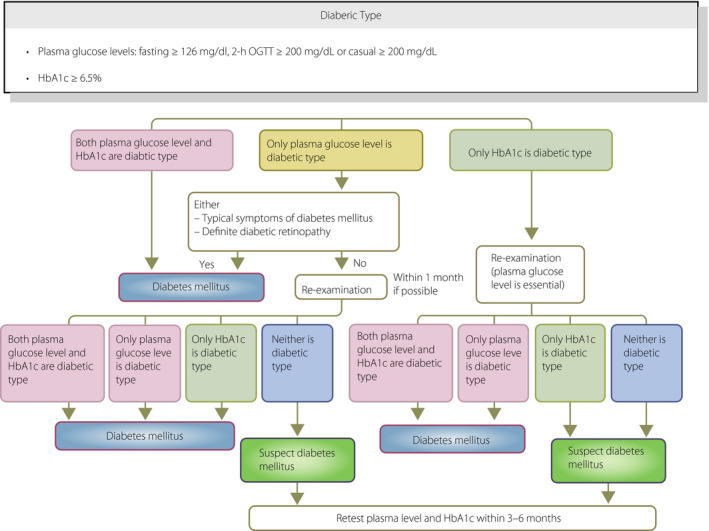
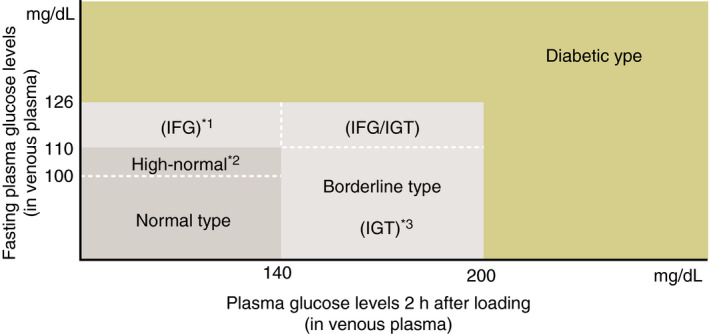
- Diagnosis is confirmed by two assessments of diabetic type (one blood glucose mandatory), one assessment plus typical hyperglycemia symptoms, or evidence of prior diagnosis; fasting glucose 100–109 mg/dL is classified as "high normal" within the normal type.
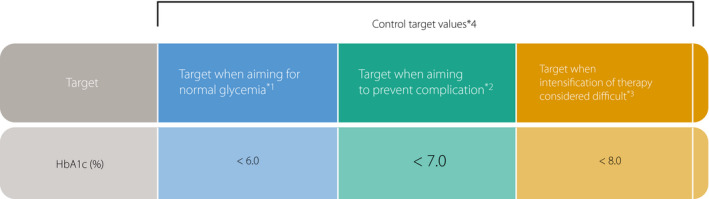
- Glycemic target is generally HbA1c <7.0% (corresponding to fasting glucose <130 mg/dL and 2-h postprandial <180 mg/dL), set individually by age, duration, organ damage, hypoglycemia risk, and support.
- Numerous Grade A recommendations with stated agreement: MNT effective (100%), MNT education by registered dieticians (95%), physical activity/exercise (100%), organized self-management education (100%), intensive insulin therapy for microangiopathy in type 1 (100%) and type 2 (94%) diabetes, routine ophthalmologic check-up (95%), glycemic control for nephropathy (100%), and glycemic control for neuropathy (90%).
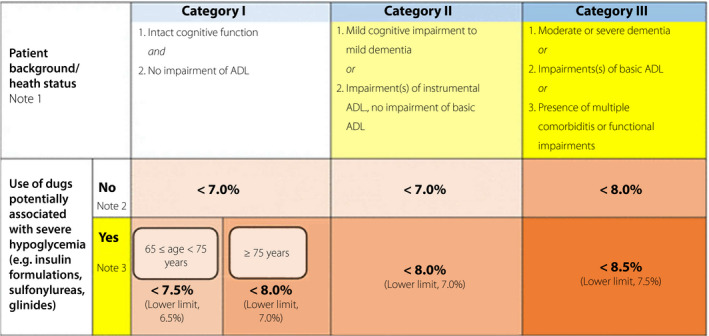
- For elderly patients, appropriate glycemic control focused on safety rather than tight control is recommended (Grade A), with a J-curve noted between HbA1c and macroangiopathy/mortality.
Methods
- Guideline development used general questions (Qs) and clinical questions (CQs); recommendation statements were developed solely for CQs.
- Clinical Guideline Committee members conducted systematic reviews, with a support team assisting literature retrieval and evidence-level confirmation; abstract tables used PICO, study design, and evidence level (1+ highest to 3 lowest).
- Grades were determined considering certainty of overall evidence, balance of benefits and harms, patient preferences/values, and costs; Grade A = strongly recommended, Grade B = weakly recommended; a 75% agreement among eligible committee members was required to approve each recommendation.
Limitations
- The paper states a paucity of evidence in several areas, including routine foot examinations for preventing diabetic foot, protein restriction for diabetic nephropathy, behavioral therapy for glycemic control in type 2 diabetes with obesity, and increased physical activity/exercise in pregnancy.
- It states no clear evidence exists for ideal energy-producing nutrient ratios, and that no evidence supports long-term safety of protein intake ≥20% of total energy.
- Evident from the text: several recommendations rest on consensus rather than trial evidence (e.g., routine foot examination graded "A by consensus," foot care education "B by consensus"), and the document is a guideline synthesis rather than a primary study generating new data.
Model-written summary. Check it against the paper before relying on it.
Integrity signals
Registry
Cites
Statistics
Figures
Verification
Claims the paper makes
145 Not checked yet · 72 No basis given · 10 Own interpretation · 3 Own method · accuracy not yet measured
None of the sources cited for this claim have been checked yet.
In the paper
“Diabetes management is aimed not merely at glycemic control 1 but also at ensuring continued smoking cessation and control of blood pressure and lipid levels, thereby preventing chronic diabetic complications or delaying their progression 2 , 3 , 4 , 5 .”
§ Japanese Clinical Practice Guideline for Diabetes 2019 > 2 GOALS AND STRATEGIES FOR DIABETES MANAGEMENT
What the sources say
- Not checked yetcites [2] World Health Organization. Report of a WHO consultation: definition, diagnosis and classification of diabetes mellitus and its complications. Part 1: diagnosis and classification of diabetes mellitus. Geneva: World Health Organization Department of Noncommunicable Disease Surveillance. 1999. http://www.staff.ncl.ac.uk/philip.home/who_dmc.htm.
- Not checked yetcites [3] Kuzuya T, Nakagawa S, Satoh J, et al. Report of the Committee of Japan Diabetes Society on the classification and diagnostic criteria of diabetes mellitus. J Jpn Diabetes Soc. 1999;42:385–404 (in Japanese).
- Could not verifycites [4] Seino Y, Nanjo K, Tajima N. et al. Report of the Committee on the classification and diagnostic criteria of diabetes mellitus: the Committee of the Japan Diabetes Society on the diagnostic criteria of diabetes mellitus. Diabetol Int. 2010;1:2. sourceExperimental — accuracy not yet measured
The Concept of diabetes mellitus section describes chronic complications, and Health screening mentions blood pressure, hypertension and dyslipidemia as screening information or risk factors. Neither section says that continued smoking cessation or control of blood pressure and lipids prevents diabetic complications or delays their progression. Searches for smoking cessation and complication prevention found no passage addressing that management claim. (LLM, conf=0.72)
plaindirect- Asserted: passes — The authors put it forward as true.
- Checkable: passes — It can be checked against evidence.
- Load-bearing: passes — The paper’s conclusions depend on it.
- Based: passes — The paper gives a reason why it holds.
None of the sources cited for this claim have been checked yet.
In the paper
“Ezetimibe or a PCSK9 inhibitor as add‐on to statin therapy is shown to reduce the incidence of CVD in patients with diabetes and hyper‐LDL‐cholesterolemia 29 , 30 , 31 , 32 , 33 , 34 , 35 , 36 (grade B: 88% agreement).”
§ Japanese Clinical Practice Guideline for Diabetes 2019 > DYSLIPIDEMIA ASSOCIATED WITH DIABETES
What the sources say
- Could not verifycites [29] Muraki I, Imamura F, Manson JE, et al. Fruit consumption and risk of type 2 diabetes: results from three prospective longitudinal cohort studies. BMJ. 2013;347:f5001. sourceExperimental — accuracy not yet measured
The cited paper’s results concern fruit consumption and the risk of type 2 diabetes, not cardiovascular outcomes from lipid-lowering treatment. Searches of our copy for ezetimibe, PCSK9 inhibitors, statins, and LDL-cholesterol treatment found no passage addressing the claimed effect. The indexed passages provide section labels but no page numbers. (LLM, conf=0.78)
- Could not verifycites [30] Bazzano LA, Li TY, Joshipura KJ, et al. Intake of fruit, vegetables, and fruit juices and risk of diabetes in women. Diabetes Care. 2008;31:1311–7. sourceExperimental — accuracy not yet measured
The Methods section identifies incident type 2 diabetes as the primary outcome and treats high cholesterol only as a self-reported covariate. Searches for ezetimibe, PCSK9 inhibitors, statin add-on therapy, and cardiovascular outcomes found no passage addressing the claimed treatment effect. No page numbers were provided in our copy. (LLM, conf=0.76)
- Not checked yetcites [31] Halbesma N, Bakker SJ, Jansen DF, et al. High protein intake associates with cardiovascular events but not with loss of renal function. J Am Soc Nephrol. 2009;20:1797–804. source
boosteddirect- Asserted: passes — The authors put it forward as true.
- Checkable: passes — It can be checked against evidence.
- Load-bearing: passes — The paper’s conclusions depend on it.
- Based: passes — The paper gives a reason why it holds.
- Could not verify
None of the sources cited for this claim have been checked yet.
In the paper
“Longer time spent in watching television or working in a sitting position is associated with an increased risk of type 2 diabetes 16 , 17 .”
§ Japanese Clinical Practice Guideline for Diabetes 2019 > 21 PREVENTION OF TYPE 2 DIABETES
What the sources say
- Not checked yetcites [16] Diabetes Prevention Program Research Group. Reduction in the incidence of type 2 diabetes with lifestyle intervention or metformin. N Engl J Med. 2002;346:393–403 [level 1] source
- Could not verifycites [17] The Look AHEAD Research Group. Cardiovascular effects of intensive lifestyle intervention in type 2 diabetes. N Engl J Med. 2013;369:145–54 [level 1] sourceExperimental — accuracy not yet measured
The Abstract Methods and Background describe a trial in people who already had type 2 diabetes, with cardiovascular events as its primary outcome. Searches for television viewing, sitting at work, sedentary behavior, and diabetes incidence found no passage in our copy linking those exposures to increased type 2 diabetes risk. (LLM, conf=0.73)
plaincorrelational- Asserted: passes — The authors put it forward as true.
- Checkable: passes — It can be checked against evidence.
- Load-bearing: passes — The paper’s conclusions depend on it.
- Based: passes — The paper gives a reason why it holds.
None of the sources cited for this claim have been checked yet.
In the paper
“In the management of diabetes, lifestyle modification centered on MNT is shown to be effective 1 , 2 , 3 , 4 , 5 , 6 , 7 , 8 , 9 (grade A: 100% agreement).”
§ Japanese Clinical Practice Guideline for Diabetes 2019 > 3 MEDICAL NUTRITION THERAPY (MNT)
What the sources say
- Not checked yetcites [1] Kosaka K, Akanuma Y, Goto Y, et al. Report of Committee on the classification and diagnostic criteria of diabetes mellitus. J Jpn Diabetes Soc. 1982;25:859–66 (in Japanese).
- Not checked yetcites [2] World Health Organization. Report of a WHO consultation: definition, diagnosis and classification of diabetes mellitus and its complications. Part 1: diagnosis and classification of diabetes mellitus. Geneva: World Health Organization Department of Noncommunicable Disease Surveillance. 1999. http://www.staff.ncl.ac.uk/philip.home/who_dmc.htm.
- Not checked yetcites [3] Kuzuya T, Nakagawa S, Satoh J, et al. Report of the Committee of Japan Diabetes Society on the classification and diagnostic criteria of diabetes mellitus. J Jpn Diabetes Soc. 1999;42:385–404 (in Japanese).
boosteddirect- Asserted: passes — The authors put it forward as true.
- Checkable: passes — It can be checked against evidence.
- Load-bearing: passes — The paper’s conclusions depend on it.
- Based: passes — The paper gives a reason why it holds.
In the paper
“Individual patients may have multiple etiological factors 4 .”
§ Japanese Clinical Practice Guideline for Diabetes 2019 > 1 GUIDELINE FOR THE DIAGNOSIS OF DIABETES MELLITUS
What the sources say
- Not checked yetcites [4] Seino Y, Nanjo K, Tajima N. et al. Report of the Committee on the classification and diagnostic criteria of diabetes mellitus: the Committee of the Japan Diabetes Society on the diagnostic criteria of diabetes mellitus. Diabetol Int. 2010;1:2. source
hedged- Asserted: passes — The authors put it forward as true.
- Checkable: passes — It can be checked against evidence.
- Load-bearing: unclear — It is unclear whether the paper’s conclusions depend on it.
- Based: passes — The paper gives a reason why it holds.
In the paper
“Achieving and maintaining favorable glycemic control early after initiation of treatment is likely to lead to favorable long‐term outcomes in these individuals 1 .”
§ Japanese Clinical Practice Guideline for Diabetes 2019 > 2 GOALS AND STRATEGIES FOR DIABETES MANAGEMENT
What the sources say
- Not checked yetcites [1] Kosaka K, Akanuma Y, Goto Y, et al. Report of Committee on the classification and diagnostic criteria of diabetes mellitus. J Jpn Diabetes Soc. 1982;25:859–66 (in Japanese).
hedgedconditional- Asserted: passes — The authors put it forward as true.
- Checkable: passes — It can be checked against evidence.
- Load-bearing: passes — The paper’s conclusions depend on it.
- Based: passes — The paper gives a reason why it holds.
The paper states this without a source or data behind it here, so there is nothing to check it against. The quote shows it is in the paper.
In the paper
“No evidence is available to support the benefits of n‐3 fatty acids in diabetes management.”
§ Japanese Clinical Practice Guideline for Diabetes 2019 > 3 MEDICAL NUTRITION THERAPY (MNT) > Target total energy intake
plain- Asserted: passes — The authors put it forward as true.
- Checkable: passes — It can be checked against evidence.
- Load-bearing: passes — The paper’s conclusions depend on it.
- Based: unclear — It is unclear why the paper says it holds.
The paper states this without a source or data behind it here, so there is nothing to check it against. The quote shows it is in the paper.
In the paper
“given that the intake of fructose up to a certain amount is not shown to affect diabetes.”
§ Japanese Clinical Practice Guideline for Diabetes 2019 > 3 MEDICAL NUTRITION THERAPY (MNT) > Target total energy intake
plain- Asserted: passes — The authors put it forward as true.
- Checkable: passes — It can be checked against evidence.
- Load-bearing: passes — The paper’s conclusions depend on it.
- Based: unclear — It is unclear why the paper says it holds.
In the paper
“No evidence is available to support the long‐term safety of the practice 18 .”
§ Japanese Clinical Practice Guideline for Diabetes 2019 > 3 MEDICAL NUTRITION THERAPY (MNT) > Target total energy intake
What the sources say
- Not checked yetcites [18] Terranova CO, Brakenridge CL, Lawler SP, et al. Effectiveness of lifestyle-based weight loss interventions for adults with type 2 diabetes: a systematic review and meta-analysis. Diabetes Obes Metab. 2015;17:371–8 [level 1] source
plain- Asserted: passes — The authors put it forward as true.
- Checkable: passes — It can be checked against evidence.
- Load-bearing: passes — The paper’s conclusions depend on it.
- Based: passes — The paper gives a reason why it holds.
In the paper
“There is no clear evidence available for determining ideal energy‐producing nutrient ratios toward the prevention and management of diabetes 12 .”
§ Japanese Clinical Practice Guideline for Diabetes 2019 > 3 MEDICAL NUTRITION THERAPY (MNT) > Target total energy intake
What the sources say
- Not checked yetcites [12] Look ARG, Gregg EW, Jakicic JM, et al. Association of the magnitude of weight loss and changes in physical fitness with long-term cardiovascular disease outcomes in overweight or obese people with type 2 diabetes: a post-hoc analysis of the Look AHEAD randomised clinical trial. Lancet Diabetes Endocrinol. 2016;4:913–21. source
plain- Asserted: passes — The authors put it forward as true.
- Checkable: passes — It can be checked against evidence.
- Load-bearing: passes — The paper’s conclusions depend on it.
- Based: passes — The paper gives a reason why it holds.
- It may state two separate claims as one. 58
- Probably not a substantial claim. 18
- The quote only partly states this claim. 1
None of the sources cited for this claim have been checked yet.
In the paper
“Combination therapy with insulin and oral glucose‐lowering agents (SUs 13 , 14 , fast‐acting insulin secretagogues [glinides] 15 , 16 , 17 ), biguanides 18 , 19 , 20 , 21 , α‐glucosidase inhibitors 22 , 23 , insulin sensitizers 24 , 25 , 26 , 27 , and, DPP‐4 inhibitors 28 , and SGLT2 inhibitors 29 or GLP‐1 receptor agonists 30 are shown to improve glycemic control and reduce the insulin dose being”
§ Japanese Clinical Practice Guideline for Diabetes 2019 > 6 INSULIN THERAPY
What the sources say
- Not checked yetcites [13] Sone H, Tanaka S, Tanaka S, et al. Serum level of triglycerides is a potent risk factor comparable to LDL cholesterol for coronary heart disease in Japanese patients with type 2 diabetes: subanalysis of the Japan Diabetes Complications Study (JDCS). J Clin Endocrinol Metab. 2011;96:3448–56. source
- Not checked yetcites [14] Ueki K, Sasako T, Okazaki Y, Group JDS, et al. Effect of an intensified multifactorial intervention on cardiovascular outcomes and mortality in type 2 diabetes (J-DOIT3): an open-label, randomised controlled trial. Lancet Diabetes Endocrinol. 2017;5:951–64. source
- Could not verifycites [15] Tuomilehto J, Lindström J, Eriksson JG, et al. Prevention of type 2 diabetes mellitus by changes in lifestyle among subjects with impaired glucose tolerance. N Engl J Med. 2001;344:1343–50 [level 1] sourceExperimental — accuracy not yet measured
The Study Design and Results sections describe lifestyle counseling for people with impaired glucose tolerance and report changes in glucose levels and serum insulin after a glucose challenge. Searches for insulin combined with oral glucose-lowering agents and for reduced insulin dose found no passage addressing that treatment claim; the measured serum insulin concentration is not an insulin dose. (LLM, conf=0.78)
plaindirect- Asserted: passes — The authors put it forward as true.
- Checkable: passes — It can be checked against evidence.
- Load-bearing: passes — The paper’s conclusions depend on it.
- Based: passes — The paper gives a reason why it holds.
It may state two separate claims as one.
In the paper
“Patients with fulminant type 1 diabetes frequently develop ketosis or ketoacidosis within 1 week of the onset of hyperglycemia, require insulin therapy immediately, and are characterized as having lower HbA1c values relative to their glucose values 9 .”
§ Japanese Clinical Practice Guideline for Diabetes 2019 > 1 GUIDELINE FOR THE DIAGNOSIS OF DIABETES MELLITUS
What the sources say
- Not checked yetcites [9] Imagawa A, Hanafusa T, Awata T, et al. Report of the Committee of the Japan Diabetes Society on the Research of Fulminant and Acute-onset Type 1 Diabetes Mellitus: New Diagnostic Criteria of Fulminant Type 1 Diabetes Mellitus (2012). Diabetol Int. 2012;3:179–83. source
plaincorrelational- Asserted: passes — The authors put it forward as true.
- Checkable: passes — It can be checked against evidence.
- Load-bearing: passes — The paper’s conclusions depend on it.
- Based: passes — The paper gives a reason why it holds.
It may state two separate claims as one.
In the paper
“Patients with slowly‐progressive (insulin‐dependent) type 1 diabetes do not develop ketosis or ketoacidosis and do not require insulin therapy immediately, although their diagnosis is established by a positive test for anti‐GAD antibodies or islet cell antibodies (ICA) 8 .”
§ Japanese Clinical Practice Guideline for Diabetes 2019 > 1 GUIDELINE FOR THE DIAGNOSIS OF DIABETES MELLITUS
What the sources say
- Not checked yetcites [8] Tanaka S, Ohmori M, Awata T, et al. Erratum to: Diagnostic criteria for slowly progressive insulin-dependent (type 1) diabetes mellitus (SPIDDM) (2012): report by the Committee on Slowly Progressive Insulin-Dependent (Type 1) Diabetes Mellitus of the Japan Diabetes Society. Diabetol Int. 2012;2015(6):149.
plain- Asserted: passes — The authors put it forward as true.
- Checkable: passes — It can be checked against evidence.
- Load-bearing: passes — The paper’s conclusions depend on it.
- Based: passes — The paper gives a reason why it holds.
It may state two separate claims as one.
In the paper
“Patients with acute type 1 diabetes are generally likely to develop ketosis or ketoacidosis within 3 months of the onset of hyperglycemia and require insulin therapy immediately 7 .”
§ Japanese Clinical Practice Guideline for Diabetes 2019 > 1 GUIDELINE FOR THE DIAGNOSIS OF DIABETES MELLITUS
What the sources say
- Not checked yetcites [7] Kawasaki E, Maruyama T, Imagawa A, et al. Diagnostic criteria for acute-onset type 1 diabetes mellitus (2012): Report of the Committee of Japan Diabetes Society on the Research of Fulminant and Acute-onset Type 1 Diabetes Mellitus. Diabetol Int. 2012;2013(4):221. source
hedgeddirect- Asserted: passes — The authors put it forward as true.
- Checkable: passes — It can be checked against evidence.
- Load-bearing: passes — The paper’s conclusions depend on it.
- Based: passes — The paper gives a reason why it holds.
It may state two separate claims as one.
None of the sources cited for this claim have been checked yet.
In the paper
“However, they should abstain from sucrose‐rich sweets and juices, which are thought likely to worsen glycemic control and promote the metabolic syndrome 15 , 16 .”
§ Japanese Clinical Practice Guideline for Diabetes 2019 > 3 MEDICAL NUTRITION THERAPY (MNT) > Target total energy intake
What the sources say
- Not checked yetcites [15] Tuomilehto J, Lindström J, Eriksson JG, et al. Prevention of type 2 diabetes mellitus by changes in lifestyle among subjects with impaired glucose tolerance. N Engl J Med. 2001;344:1343–50 [level 1] source
- Not checked yetcites [16] Diabetes Prevention Program Research Group. Reduction in the incidence of type 2 diabetes with lifestyle intervention or metformin. N Engl J Med. 2002;346:393–403 [level 1] source
hedgedconditional- Asserted: passes — The authors put it forward as true.
- Checkable: passes — It can be checked against evidence.
- Load-bearing: passes — The paper’s conclusions depend on it.
- Based: passes — The paper gives a reason why it holds.
It may state two separate claims as one.
What the paper did — it cites no source for this, so there is none to check. The quote shows it is in the paper.
In the paper
“A 75% agreement among eligible CGC members was required to approve each recommendation and its strength.”
§ Japanese Clinical Practice Guideline for Diabetes 2019 > METHODS OF DEVELOPING THE ‘JAPANESE CLINICAL PRACTICE GUIDELINE FOR DIABETES 2019’
plain- Asserted: passes — The authors put it forward as true.
- Checkable: passes — It can be checked against evidence.
- Load-bearing: fails — The paper’s conclusions may not depend on it.
- Based: passes — The paper gives a reason why it holds.
Probably not a substantial claim. The paper’s conclusions may not depend on it.
The paper states this without a source or data behind it here, so there is nothing to check it against. The quote shows it is in the paper.
In the paper
“Regularly eating three meals a day is shown to be effective in preventing the onset of diabetes.”
§ Japanese Clinical Practice Guideline for Diabetes 2019 > 3 MEDICAL NUTRITION THERAPY (MNT) > Target total energy intake
boosteddirect- Asserted: passes — The authors put it forward as true.
- Checkable: passes — It can be checked against evidence.
- Load-bearing: fails — The paper’s conclusions may not depend on it.
- Based: fails — The paper may give no reason why it holds.
Probably not a substantial claim. The paper’s conclusions may not depend on it. The paper may give no reason why it holds.
None of the sources cited for this claim have been checked yet.
In the paper
“Despite lack of consensus on its role in improving glycemic control in patients with type 1 diabetes, long‐term exercise is shown to reduce risk factors for cardiovascular disease and improve quality of life (QOL) 15 , 16 , 17 , 18 (grade B: 100% agreement).”
§ Japanese Clinical Practice Guideline for Diabetes 2019 > 4 PHYSICAL ACTIVITY/EXERCISE
What the sources say
- Not checked yetcites [15] Tuomilehto J, Lindström J, Eriksson JG, et al. Prevention of type 2 diabetes mellitus by changes in lifestyle among subjects with impaired glucose tolerance. N Engl J Med. 2001;344:1343–50 [level 1] source
- Not checked yetcites [16] Diabetes Prevention Program Research Group. Reduction in the incidence of type 2 diabetes with lifestyle intervention or metformin. N Engl J Med. 2002;346:393–403 [level 1] source
- Not checked yetcites [17] The Look AHEAD Research Group. Cardiovascular effects of intensive lifestyle intervention in type 2 diabetes. N Engl J Med. 2013;369:145–54 [level 1] source
plaindirect- Asserted: passes — The authors put it forward as true.
- Checkable: passes — It can be checked against evidence.
- Load-bearing: passes — The paper’s conclusions depend on it.
- Based: passes — The paper gives a reason why it holds.
It may state two separate claims as one.
A conclusion the paper draws from its own results — it cites no other source for it, so there is none to check. The quote shows it is in the paper.
In the paper
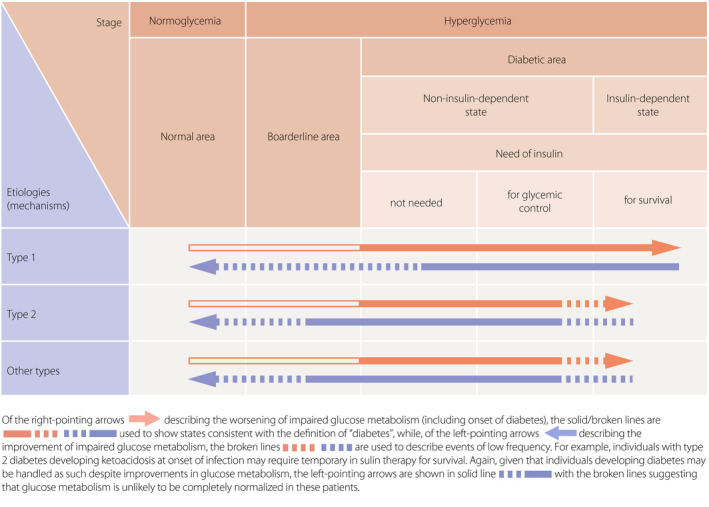
“Thus, it should be noted that patients receiving insulin therapy are not always in an insulin‐dependent state.”
§ Japanese Clinical Practice Guideline for Diabetes 2019 > 1 GUIDELINE FOR THE DIAGNOSIS OF DIABETES MELLITUS
plain- Asserted: passes — The authors put it forward as true.
- Checkable: passes — It can be checked against evidence.
- Load-bearing: passes — The paper’s conclusions depend on it.
- Based: passes — The paper gives a reason why it holds.
Probably not a substantial claim.
The paper states this without a source or data behind it here, so there is nothing to check it against. The quote shows it is in the paper.
In the paper
“While sucrose intake is a risk factor for diabetes, the influence of artificial sweeteners on the risk of diabetes and glycemic control has not been sufficiently elucidated.”
§ Japanese Clinical Practice Guideline for Diabetes 2019 > 3 MEDICAL NUTRITION THERAPY (MNT) > Target total energy intake
plain- Asserted: passes — The authors put it forward as true.
- Checkable: passes — It can be checked against evidence.
- Load-bearing: passes — The paper’s conclusions depend on it.
- Based: fails — The paper may give no reason why it holds.
Probably not a substantial claim. The paper may give no reason why it holds.
The paper states this without a source or data behind it here, so there is nothing to check it against. The quote shows it is in the paper.
In the paper
“While sucrose intake is a risk factor for diabetes, the influence of artificial sweeteners on the risk of diabetes and glycemic control has not been sufficiently elucidated.”
§ Japanese Clinical Practice Guideline for Diabetes 2019 > 3 MEDICAL NUTRITION THERAPY (MNT) > Target total energy intake
plaindirect- Asserted: passes — The authors put it forward as true.
- Checkable: passes — It can be checked against evidence.
- Load-bearing: passes — The paper’s conclusions depend on it.
- Based: fails — The paper may give no reason why it holds.
Probably not a substantial claim. The paper may give no reason why it holds.
What the paper did — it cites no source for this, so there is none to check. The quote shows it is in the paper.
In the paper
“The grade of recommendation was determined by each CGC member with consideration given to certainty of overall evidence, balance of benefits and harms, patient preferences/values, and costs (Table 2).”
§ Japanese Clinical Practice Guideline for Diabetes 2019 > METHODS OF DEVELOPING THE ‘JAPANESE CLINICAL PRACTICE GUIDELINE FOR DIABETES 2019’
plaindirect- Asserted: passes — The authors put it forward as true.
- Checkable: passes — It can be checked against evidence.
- Load-bearing: fails — The paper’s conclusions may not depend on it.
- Based: passes — The paper gives a reason why it holds.
Probably not a substantial claim. The paper’s conclusions may not depend on it.
None of the sources cited for this claim have been checked yet.
In the paper
“Aerobic exercise and resistance exercise are shown to be effective individually, and more in combination in improving glycemic control in patients with type 2 diabetes 1 , 6 , 8 , 14 (grade A 100% agreement).”
§ Japanese Clinical Practice Guideline for Diabetes 2019 > 4 PHYSICAL ACTIVITY/EXERCISE
What the sources say
- Not checked yetcites [1] Kosaka K, Akanuma Y, Goto Y, et al. Report of Committee on the classification and diagnostic criteria of diabetes mellitus. J Jpn Diabetes Soc. 1982;25:859–66 (in Japanese).
- Not checked yetcites [6] Kadowaki T, Haneda M, Tominaga M, et al. Report of the Japan Diabetes Society’s Committee on the diagnostic criteria for diabetes mellitus and glucose metabolism disorder—a new category of fasting plasma glucose values: “high-normal”. J Jpn Diabetes Soc. 2008;51:281–3 (in Japanese).
- Not checked yetcites [8] Tanaka S, Ohmori M, Awata T, et al. Erratum to: Diagnostic criteria for slowly progressive insulin-dependent (type 1) diabetes mellitus (SPIDDM) (2012): report by the Committee on Slowly Progressive Insulin-Dependent (Type 1) Diabetes Mellitus of the Japan Diabetes Society. Diabetol Int. 2012;2015(6):149.
boosteddirect- Asserted: passes — The authors put it forward as true.
- Checkable: passes — It can be checked against evidence.
- Load-bearing: passes — The paper’s conclusions depend on it.
- Based: passes — The paper gives a reason why it holds.
It may state two separate claims as one.
What the paper did — it cites no source for this, so there is none to check. The quote shows it is in the paper.
In the paper
“Clinical guideline committee (CGC) members conducted systematic review (SR) of evidence from several resources to develop a statement of recommendation for CQs and presented a strength of recommendation rated as a grade.”
§ Japanese Clinical Practice Guideline for Diabetes 2019 > METHODS OF DEVELOPING THE ‘JAPANESE CLINICAL PRACTICE GUIDELINE FOR DIABETES 2019’
plaindirect- Asserted: passes — The authors put it forward as true.
- Checkable: passes — It can be checked against evidence.
- Load-bearing: passes — The paper’s conclusions depend on it.
- Based: passes — The paper gives a reason why it holds.
Probably not a substantial claim.
In the paper
“In general, screening for cardiovascular disease is not necessary in asymptomatic patients implementing light‐ to moderate‐intensity exercise (e.g., one that can be implemented as a daily activity, e.g., brisk walking) 19 .”
§ Japanese Clinical Practice Guideline for Diabetes 2019 > 4 PHYSICAL ACTIVITY/EXERCISE
What the sources say
- Not checked yetcites [19] Chen L, Pei JH, Kuang J, et al. Effect of lifestyle intervention in patients with type 2 diabetes: a meta-analysis. Metabolism. 2015;64:338–47 [level 1] source
plain- Asserted: passes — The authors put it forward as true.
- Checkable: passes — It can be checked against evidence.
- Load-bearing: passes — The paper’s conclusions depend on it.
- Based: passes — The paper gives a reason why it holds.
Probably not a substantial claim.
None of the sources cited for this claim have been checked yet.
In the paper
“Physical activity/exercise involving aerobic exercise, resistance exercise or their combination is shown to improve glycemic control 1 , 2 , 3 , 4 , 5 , 6 and risk factors for cardiovascular disease 7 , 8 , 9 , 10 , 11 , 12 , 13 , 14 .”
§ Japanese Clinical Practice Guideline for Diabetes 2019 > 4 PHYSICAL ACTIVITY/EXERCISE
What the sources say
- Not checked yetcites [1] Kosaka K, Akanuma Y, Goto Y, et al. Report of Committee on the classification and diagnostic criteria of diabetes mellitus. J Jpn Diabetes Soc. 1982;25:859–66 (in Japanese).
- Not checked yetcites [2] World Health Organization. Report of a WHO consultation: definition, diagnosis and classification of diabetes mellitus and its complications. Part 1: diagnosis and classification of diabetes mellitus. Geneva: World Health Organization Department of Noncommunicable Disease Surveillance. 1999. http://www.staff.ncl.ac.uk/philip.home/who_dmc.htm.
- Not checked yetcites [3] Kuzuya T, Nakagawa S, Satoh J, et al. Report of the Committee of Japan Diabetes Society on the classification and diagnostic criteria of diabetes mellitus. J Jpn Diabetes Soc. 1999;42:385–404 (in Japanese).
plaindirect- Asserted: passes — The authors put it forward as true.
- Checkable: passes — It can be checked against evidence.
- Load-bearing: passes — The paper’s conclusions depend on it.
- Based: passes — The paper gives a reason why it holds.
It may state two separate claims as one.
A conclusion the paper draws from its own results — it cites no other source for it, so there is none to check. The quote shows it is in the paper.
In the paper
“Their etiology (mechanism) and pathophysiological states (stages) represent dimensions distinct from each other and both should be used to describe the condition in each individual patient.”
§ Japanese Clinical Practice Guideline for Diabetes 2019 > 1 GUIDELINE FOR THE DIAGNOSIS OF DIABETES MELLITUS
plain- Asserted: passes — The authors put it forward as true.
- Checkable: passes — It can be checked against evidence.
- Load-bearing: passes — The paper’s conclusions depend on it.
- Based: passes — The paper gives a reason why it holds.
Probably not a substantial claim.
None of the sources cited for this claim have been checked yet.
In the paper
“Strict glycemic control with intensive insulin therapy has been shown to be effective in preventing the onset of microangiopathy (retinopathy, nephropathy, and neuropathy) as well as in suppressing the progression of microangiopathy 8 , 9 (grade A: 94% agreement).”
§ Japanese Clinical Practice Guideline for Diabetes 2019 > 6 INSULIN THERAPY
What the sources say
- Not checked yetcites [8] Tanaka S, Ohmori M, Awata T, et al. Erratum to: Diagnostic criteria for slowly progressive insulin-dependent (type 1) diabetes mellitus (SPIDDM) (2012): report by the Committee on Slowly Progressive Insulin-Dependent (Type 1) Diabetes Mellitus of the Japan Diabetes Society. Diabetol Int. 2012;2015(6):149.
- Not checked yetcites [9] Imagawa A, Hanafusa T, Awata T, et al. Report of the Committee of the Japan Diabetes Society on the Research of Fulminant and Acute-onset Type 1 Diabetes Mellitus: New Diagnostic Criteria of Fulminant Type 1 Diabetes Mellitus (2012). Diabetol Int. 2012;3:179–83. source
boosteddirect- Asserted: passes — The authors put it forward as true.
- Checkable: passes — It can be checked against evidence.
- Load-bearing: passes — The paper’s conclusions depend on it.
- Based: passes — The paper gives a reason why it holds.
It may state two separate claims as one.
None of the sources cited for this claim have been checked yet.
In the paper
“Insulin therapy may be associated with hypoglycemia as well as a transient worsening of retinopathy or neuropathy in some patients 1 , 2 .”
§ Japanese Clinical Practice Guideline for Diabetes 2019 > 6 INSULIN THERAPY
What the sources say
- Not checked yetcites [1] Kosaka K, Akanuma Y, Goto Y, et al. Report of Committee on the classification and diagnostic criteria of diabetes mellitus. J Jpn Diabetes Soc. 1982;25:859–66 (in Japanese).
- Not checked yetcites [2] World Health Organization. Report of a WHO consultation: definition, diagnosis and classification of diabetes mellitus and its complications. Part 1: diagnosis and classification of diabetes mellitus. Geneva: World Health Organization Department of Noncommunicable Disease Surveillance. 1999. http://www.staff.ncl.ac.uk/philip.home/who_dmc.htm.
hedgedcorrelational- Asserted: passes — The authors put it forward as true.
- Checkable: passes — It can be checked against evidence.
- Load-bearing: unclear — It is unclear whether the paper’s conclusions depend on it.
- Based: passes — The paper gives a reason why it holds.
It may state two separate claims as one.
None of the sources cited for this claim have been checked yet.
In the paper
“Intensive insulin therapy, which combines multiple insulin injections or CSII and self‐monitoring of blood glucose (SMBG) has been shown to be effective in preventing the onset of microangiopathy (retinopathy, nephropathy and neuropathy) and in suppressing their progression 4 , 5 (grade A: 100% agreement).”
§ Japanese Clinical Practice Guideline for Diabetes 2019 > 6 INSULIN THERAPY
What the sources say
- Not checked yetcites [4] Seino Y, Nanjo K, Tajima N. et al. Report of the Committee on the classification and diagnostic criteria of diabetes mellitus: the Committee of the Japan Diabetes Society on the diagnostic criteria of diabetes mellitus. Diabetol Int. 2010;1:2. source
- Not checked yetcites [5] American Diabetes Association. Classification and Diagnosis of Diabetes: Standards of Medical Care in Diabetes—2018. Diabetes Care. 2018;41(Suppl 1):S13–27. source
boosteddirect- Asserted: passes — The authors put it forward as true.
- Checkable: passes — It can be checked against evidence.
- Load-bearing: passes — The paper’s conclusions depend on it.
- Based: passes — The paper gives a reason why it holds.
It may state two separate claims as one.
None of the sources cited for this claim have been checked yet.
In the paper
“Both group and individualized education has been shown to be useful for diabetes management 5 , 6 , 7 , 8 (grade A: 95% agreement).”
§ Japanese Clinical Practice Guideline for Diabetes 2019 > 7 DIABETES SELF‐MANAGEMENT EDUCATION AND SUPPORT FOR THE SELF‐MANAGEMENT OF DIABETES
What the sources say
- Not checked yetcites [5] American Diabetes Association. Classification and Diagnosis of Diabetes: Standards of Medical Care in Diabetes—2018. Diabetes Care. 2018;41(Suppl 1):S13–27. source
- Not checked yetcites [6] Kadowaki T, Haneda M, Tominaga M, et al. Report of the Japan Diabetes Society’s Committee on the diagnostic criteria for diabetes mellitus and glucose metabolism disorder—a new category of fasting plasma glucose values: “high-normal”. J Jpn Diabetes Soc. 2008;51:281–3 (in Japanese).
- Not checked yetcites [7] Kawasaki E, Maruyama T, Imagawa A, et al. Diagnostic criteria for acute-onset type 1 diabetes mellitus (2012): Report of the Committee of Japan Diabetes Society on the Research of Fulminant and Acute-onset Type 1 Diabetes Mellitus. Diabetol Int. 2012;2013(4):221. source
boosteddirect- Asserted: passes — The authors put it forward as true.
- Checkable: passes — It can be checked against evidence.
- Load-bearing: passes — The paper’s conclusions depend on it.
- Based: passes — The paper gives a reason why it holds.
It may state two separate claims as one.
None of the sources cited for this claim have been checked yet.
In the paper
“Diabetes is often associated with depressive symptoms and anxiety disorders specific to the disease 18 , 19 , 20 , leading to suboptimal self‐care, worsening of glycemic control, an increased risk of diabetic complications, and an impaired QOL, thus adversely affecting the prognosis of affected patients 21 , 22 .”
§ Japanese Clinical Practice Guideline for Diabetes 2019 > 7 DIABETES SELF‐MANAGEMENT EDUCATION AND SUPPORT FOR THE SELF‐MANAGEMENT OF DIABETES
What the sources say
- Not checked yetcites [21] Zhang X, Devlin HM, Smith B, et al. Effect of lifestyle interventions on cardiovascular risk factors among adults without impaired glucose tolerance or diabetes: a systematic review and meta-analysis. PLoS One. 2017;12:e0176436 [level 1] source
- Not checked yetcites [22] Franz MJ, Boucher JL, Rutten-Ramos S, et al. Lifestyle weight-loss intervention outcomes in overweight and obese adults with type 2 diabetes: a systematic review and meta-analysis of randomized clinical trials. J Acad Nutr Diet. 2015;115:1447–63 [level 1] source
plaindirect- Asserted: passes — The authors put it forward as true.
- Checkable: passes — It can be checked against evidence.
- Load-bearing: passes — The paper’s conclusions depend on it.
- Based: passes — The paper gives a reason why it holds.
It may state two separate claims as one.
None of the sources cited for this claim have been checked yet.
In the paper
“The risk factors for the onset/progression of diabetic neuropathy include: ① poor glycemic control, ② duration of diabetes, ③ hypertension, ④ dyslipidemia, ⑤ smoking, and ⑥ obesity 3 , 4 , 5 .”
§ Japanese Clinical Practice Guideline for Diabetes 2019 > 10 DIABETIC NEUROPATHY
What the sources say
- Not checked yetcites [3] Kuzuya T, Nakagawa S, Satoh J, et al. Report of the Committee of Japan Diabetes Society on the classification and diagnostic criteria of diabetes mellitus. J Jpn Diabetes Soc. 1999;42:385–404 (in Japanese).
- Not checked yetcites [4] Seino Y, Nanjo K, Tajima N. et al. Report of the Committee on the classification and diagnostic criteria of diabetes mellitus: the Committee of the Japan Diabetes Society on the diagnostic criteria of diabetes mellitus. Diabetol Int. 2010;1:2. source
- Not checked yetcites [5] American Diabetes Association. Classification and Diagnosis of Diabetes: Standards of Medical Care in Diabetes—2018. Diabetes Care. 2018;41(Suppl 1):S13–27. source
plaincorrelational- Asserted: passes — The authors put it forward as true.
- Checkable: passes — It can be checked against evidence.
- Load-bearing: passes — The paper’s conclusions depend on it.
- Based: passes — The paper gives a reason why it holds.
It may state two separate claims as one.
None of the sources cited for this claim have been checked yet.
In the paper
“When diabetic foot is complicated by infection, it is likely to become severe, leading not only to lower limb amputation, but also to a worse prognosis 1 , 2 .”
§ Japanese Clinical Practice Guideline for Diabetes 2019 > 11 DIABETIC FOOT
What the sources say
- Not checked yetcites [1] Kosaka K, Akanuma Y, Goto Y, et al. Report of Committee on the classification and diagnostic criteria of diabetes mellitus. J Jpn Diabetes Soc. 1982;25:859–66 (in Japanese).
- Not checked yetcites [2] World Health Organization. Report of a WHO consultation: definition, diagnosis and classification of diabetes mellitus and its complications. Part 1: diagnosis and classification of diabetes mellitus. Geneva: World Health Organization Department of Noncommunicable Disease Surveillance. 1999. http://www.staff.ncl.ac.uk/philip.home/who_dmc.htm.
hedgeddirect- Asserted: passes — The authors put it forward as true.
- Checkable: passes — It can be checked against evidence.
- Load-bearing: unclear — It is unclear whether the paper’s conclusions depend on it.
- Based: passes — The paper gives a reason why it holds.
It may state two separate claims as one.
None of the sources cited for this claim have been checked yet.
In the paper
“Glycemic control is shown to be effective in inhibiting the onset of diabetic nephropathy as well as in inhibiting the progression of early‐stage nephropathy 5 , 6 , 7 , 8 , 9 , 10 (grade A: 100% agreement).”
§ Japanese Clinical Practice Guideline for Diabetes 2019 > 9 DIABETIC NEPHROPATHY
What the sources say
- Not checked yetcites [5] American Diabetes Association. Classification and Diagnosis of Diabetes: Standards of Medical Care in Diabetes—2018. Diabetes Care. 2018;41(Suppl 1):S13–27. source
- Not checked yetcites [6] Kadowaki T, Haneda M, Tominaga M, et al. Report of the Japan Diabetes Society’s Committee on the diagnostic criteria for diabetes mellitus and glucose metabolism disorder—a new category of fasting plasma glucose values: “high-normal”. J Jpn Diabetes Soc. 2008;51:281–3 (in Japanese).
- Not checked yetcites [7] Kawasaki E, Maruyama T, Imagawa A, et al. Diagnostic criteria for acute-onset type 1 diabetes mellitus (2012): Report of the Committee of Japan Diabetes Society on the Research of Fulminant and Acute-onset Type 1 Diabetes Mellitus. Diabetol Int. 2012;2013(4):221. source
boosteddirect- Asserted: passes — The authors put it forward as true.
- Checkable: passes — It can be checked against evidence.
- Load-bearing: passes — The paper’s conclusions depend on it.
- Based: passes — The paper gives a reason why it holds.
It may state two separate claims as one.
None of the sources cited for this claim have been checked yet.
In the paper
“Team‐based care is shown to be effective for prevention of foot lesions and treatment of foot ulcers 12 , 13 (grade B: 90% agreement).”
§ Japanese Clinical Practice Guideline for Diabetes 2019 > 11 DIABETIC FOOT
What the sources say
- Not checked yetcites [12] Look ARG, Gregg EW, Jakicic JM, et al. Association of the magnitude of weight loss and changes in physical fitness with long-term cardiovascular disease outcomes in overweight or obese people with type 2 diabetes: a post-hoc analysis of the Look AHEAD randomised clinical trial. Lancet Diabetes Endocrinol. 2016;4:913–21. source
- Not checked yetcites [13] Sone H, Tanaka S, Tanaka S, et al. Serum level of triglycerides is a potent risk factor comparable to LDL cholesterol for coronary heart disease in Japanese patients with type 2 diabetes: subanalysis of the Japan Diabetes Complications Study (JDCS). J Clin Endocrinol Metab. 2011;96:3448–56. source
boosteddirect- Asserted: passes — The authors put it forward as true.
- Checkable: passes — It can be checked against evidence.
- Load-bearing: passes — The paper’s conclusions depend on it.
- Based: passes — The paper gives a reason why it holds.
It may state two separate claims as one.
None of the sources cited for this claim have been checked yet.
In the paper
“Diabetic retinopathy is a risk factor for diabetic nephropathy and macroangiopathy 15 , 16 , 17 , 18 , 19 , 20 .”
§ Japanese Clinical Practice Guideline for Diabetes 2019 > 8 DIABETIC RETINOPATHY
What the sources say
- Not checked yetcites [15] Tuomilehto J, Lindström J, Eriksson JG, et al. Prevention of type 2 diabetes mellitus by changes in lifestyle among subjects with impaired glucose tolerance. N Engl J Med. 2001;344:1343–50 [level 1] source
- Not checked yetcites [16] Diabetes Prevention Program Research Group. Reduction in the incidence of type 2 diabetes with lifestyle intervention or metformin. N Engl J Med. 2002;346:393–403 [level 1] source
- Not checked yetcites [17] The Look AHEAD Research Group. Cardiovascular effects of intensive lifestyle intervention in type 2 diabetes. N Engl J Med. 2013;369:145–54 [level 1] source
plaindirect- Asserted: passes — The authors put it forward as true.
- Checkable: passes — It can be checked against evidence.
- Load-bearing: unclear — It is unclear whether the paper’s conclusions depend on it.
- Based: passes — The paper gives a reason why it holds.
It may state two separate claims as one.
In the paper
“A decreased GFR and the occurrence of albuminuria are independent risk factors for cardiovascular disease 24 .”
§ Japanese Clinical Practice Guideline for Diabetes 2019 > 9 DIABETIC NEPHROPATHY
What the sources say
- Not checked yetcites [24] Møller G, Andersen HK, Snorgaard O. A systematic review and meta-analysis of nutrition therapy compared with dietary advice in patients with type 2 diabetes. Am J Clin Nutr. 2017;106:1394–400 [level 1] source
plaincorrelational- Asserted: passes — The authors put it forward as true.
- Checkable: passes — It can be checked against evidence.
- Load-bearing: passes — The paper’s conclusions depend on it.
- Based: passes — The paper gives a reason why it holds.
It may state two separate claims as one.
None of the sources cited for this claim have been checked yet.
In the paper
“Glycemic control is shown to be effective not only for preventing the onset of foot lesions and sparing lower limb amputation 6 , 7 but also for preventing neuropathy as a risk factor for foot lesions 7 (grade A: 85% agreement).”
§ Japanese Clinical Practice Guideline for Diabetes 2019 > 11 DIABETIC FOOT
What the sources say
- Not checked yetcites [6] Kadowaki T, Haneda M, Tominaga M, et al. Report of the Japan Diabetes Society’s Committee on the diagnostic criteria for diabetes mellitus and glucose metabolism disorder—a new category of fasting plasma glucose values: “high-normal”. J Jpn Diabetes Soc. 2008;51:281–3 (in Japanese).
- Not checked yetcites [7] Kawasaki E, Maruyama T, Imagawa A, et al. Diagnostic criteria for acute-onset type 1 diabetes mellitus (2012): Report of the Committee of Japan Diabetes Society on the Research of Fulminant and Acute-onset Type 1 Diabetes Mellitus. Diabetol Int. 2012;2013(4):221. source
boosteddirect- Asserted: passes — The authors put it forward as true.
- Checkable: passes — It can be checked against evidence.
- Load-bearing: passes — The paper’s conclusions depend on it.
- Based: passes — The paper gives a reason why it holds.
It may state two separate claims as one.
In the paper
“SGLT2 inhibitor monotherapy may be effective for glycemic control while being less likely associated with hypoglycemia 10 .”
§ Japanese Clinical Practice Guideline for Diabetes 2019 > 14 DIABETES COMPLICATED BY OBESITY (INCLUDING METABOLIC SYNDROME)
What the sources say
- Not checked yetcites [10] United Kingdom Prospective Diabetes Study (UKPDS) Group: Intensive blood-glucose control with sulphonylureas or insulin compared with conventional treatment and risk of complications in patients with type 2 diabetes (UKPDS 33). Lancet. 1998;352:837–853. source
hedgedconditional- Asserted: passes — The authors put it forward as true.
- Checkable: passes — It can be checked against evidence.
- Load-bearing: passes — The paper’s conclusions depend on it.
- Based: passes — The paper gives a reason why it holds.
It may state two separate claims as one.
None of the sources cited for this claim have been checked yet.
In the paper
“Patients with diabetic foot are significantly associated with high all‐cause mortality 16 , as well as a high incidence of cardiovascular/cerebrovascular diseases, depression 17 , and cognitive impairment 18 , suggesting that diabetic foot lesions likely represent a risk factor for mortality and these diseases.”
§ Japanese Clinical Practice Guideline for Diabetes 2019 > 11 DIABETIC FOOT
What the sources say
- Not checked yetcites [16] Diabetes Prevention Program Research Group. Reduction in the incidence of type 2 diabetes with lifestyle intervention or metformin. N Engl J Med. 2002;346:393–403 [level 1] source
- Not checked yetcites [17] The Look AHEAD Research Group. Cardiovascular effects of intensive lifestyle intervention in type 2 diabetes. N Engl J Med. 2013;369:145–54 [level 1] source
- Not checked yetcites [18] Terranova CO, Brakenridge CL, Lawler SP, et al. Effectiveness of lifestyle-based weight loss interventions for adults with type 2 diabetes: a systematic review and meta-analysis. Diabetes Obes Metab. 2015;17:371–8 [level 1] source
hedgedcorrelational- Asserted: passes — The authors put it forward as true.
- Checkable: passes — It can be checked against evidence.
- Load-bearing: passes — The paper’s conclusions depend on it.
- Based: passes — The paper gives a reason why it holds.
It may state two separate claims as one.
In the paper
“Both diabetes and hypertension are established risk factors for atherosclerosis‐associated macroangiopathy; patients with diabetes and hypertension have a higher incidence of macroangiopathy and a poorer prognosis 1 .”
§ Japanese Clinical Practice Guideline for Diabetes 2019 > 15 HYPERTENSION ASSOCIATED WITH DIABETES
What the sources say
- Not checked yetcites [1] Kosaka K, Akanuma Y, Goto Y, et al. Report of Committee on the classification and diagnostic criteria of diabetes mellitus. J Jpn Diabetes Soc. 1982;25:859–66 (in Japanese).
boostedcorrelational- Asserted: passes — The authors put it forward as true.
- Checkable: passes — It can be checked against evidence.
- Load-bearing: passes — The paper’s conclusions depend on it.
- Based: passes — The paper gives a reason why it holds.
It may state two separate claims as one.
The paper states this without a source or data behind it here, so there is nothing to check it against. The quote shows it is in the paper.
In the paper
“Elderly patients with diabetes are mainly characterized as: ① Being susceptible to postprandial hyperglycemia and hypoglycemia (see II‐CQ‐2) and as being vulnerable to hypoglycemia (see II‐CQ‐4);”
§ Japanese Clinical Practice Guideline for Diabetes 2019 > 19 SYNOPSIS OF THE JGS/JDS CLINICAL PRACTICE GUIDELINES FOR THE TREATMENT OF DIABETES IN THE ELDERLY (Clinical questions [CQ], summaries and grades of recommendation) > I. Background and characteristics of diabetes in the elderly
plaincorrelational- Asserted: passes — The authors put it forward as true.
- Checkable: passes — It can be checked against evidence.
- Load-bearing: passes — The paper’s conclusions depend on it.
- Based: passes — The paper gives a reason why it holds.
It may state two separate claims as one.
The paper states this without a source or data behind it here, so there is nothing to check it against. The quote shows it is in the paper.
In the paper
“Patients with diabetes 75 years old or older are particularly highly likely to be associated with geriatric syndrome, e.g., dementia, decreased ADL, sarcopenia, falls/fractures, frailty, urinary incontinence, and undernutrition.”
§ Japanese Clinical Practice Guideline for Diabetes 2019 > 19 SYNOPSIS OF THE JGS/JDS CLINICAL PRACTICE GUIDELINES FOR THE TREATMENT OF DIABETES IN THE ELDERLY (Clinical questions [CQ], summaries and grades of recommendation) > I. Background and characteristics of diabetes in the elderly
hedgedcorrelational- Asserted: passes — The authors put it forward as true.
- Checkable: passes — It can be checked against evidence.
- Load-bearing: fails — The paper’s conclusions may not depend on it.
- Based: fails — The paper may give no reason why it holds.
Probably not a substantial claim. The paper’s conclusions may not depend on it. The paper may give no reason why it holds.
The paper states this without a source or data behind it here, so there is nothing to check it against. The quote shows it is in the paper.
In the paper
“Elderly patients with diabetes need to be watched for depression (depressive tendency or depression) and decreased quality of life (QOL) to which they are susceptible.”
§ Japanese Clinical Practice Guideline for Diabetes 2019 > 19 SYNOPSIS OF THE JGS/JDS CLINICAL PRACTICE GUIDELINES FOR THE TREATMENT OF DIABETES IN THE ELDERLY (Clinical questions [CQ], summaries and grades of recommendation) > II. Diagnosis/pathophysiology of diabetes in the elderly
plaincorrelational- Asserted: passes — The authors put it forward as true.
- Checkable: passes — It can be checked against evidence.
- Load-bearing: fails — The paper’s conclusions may not depend on it.
- Based: fails — The paper may give no reason why it holds.
Probably not a substantial claim. The paper’s conclusions may not depend on it. The paper may give no reason why it holds. It may state two separate claims as one.
The paper states this without a source or data behind it here, so there is nothing to check it against. The quote shows it is in the paper.
In the paper
“Glucose tolerance deteriorates, and the frequency of occurrence of diabetes increases with aging.”
§ Japanese Clinical Practice Guideline for Diabetes 2019 > 19 SYNOPSIS OF THE JGS/JDS CLINICAL PRACTICE GUIDELINES FOR THE TREATMENT OF DIABETES IN THE ELDERLY (Clinical questions [CQ], summaries and grades of recommendation) > I. Background and characteristics of diabetes in the elderly
plaindirect- Asserted: passes — The authors put it forward as true.
- Checkable: passes — It can be checked against evidence.
- Load-bearing: fails — The paper’s conclusions may not depend on it.
- Based: fails — The paper may give no reason why it holds.
Probably not a substantial claim. The paper’s conclusions may not depend on it. The paper may give no reason why it holds. It may state two separate claims as one.
In the paper
“While there is a paucity of evidence to support the usefulness of increased physical activity/exercise in the management of hyperglycemic disorders in pregnancy, increased physical activity/exercise may have a role to promote health with improving maternal glycemic control, and suppressing excessive weight gain 12 .”
§ Japanese Clinical Practice Guideline for Diabetes 2019 > 17 HYPERGLYCEMIC DISORDERS IN PREGNANCY
What the sources say
- Not checked yetcites [12] Look ARG, Gregg EW, Jakicic JM, et al. Association of the magnitude of weight loss and changes in physical fitness with long-term cardiovascular disease outcomes in overweight or obese people with type 2 diabetes: a post-hoc analysis of the Look AHEAD randomised clinical trial. Lancet Diabetes Endocrinol. 2016;4:913–21. source
hedgedconditional- Asserted: passes — The authors put it forward as true.
- Checkable: passes — It can be checked against evidence.
- Load-bearing: passes — The paper’s conclusions depend on it.
- Based: passes — The paper gives a reason why it holds.
It may state two separate claims as one.
In the paper
“Sulfonylureas (SUs) have been shown to be effective in treating patients with KCNJ11/ABCCB8 gene mutations and to allow these patients to discontinue insulin therapy 12 .”
§ Japanese Clinical Practice Guideline for Diabetes 2019 > 18 PEDIATRIC/ADOLESCENT DIABETES
What the sources say
- Not checked yetcites [12] Look ARG, Gregg EW, Jakicic JM, et al. Association of the magnitude of weight loss and changes in physical fitness with long-term cardiovascular disease outcomes in overweight or obese people with type 2 diabetes: a post-hoc analysis of the Look AHEAD randomised clinical trial. Lancet Diabetes Endocrinol. 2016;4:913–21. source
boosteddirect- Asserted: passes — The authors put it forward as true.
- Checkable: passes — It can be checked against evidence.
- Load-bearing: passes — The paper’s conclusions depend on it.
- Based: passes — The paper gives a reason why it holds.
It may state two separate claims as one.
The paper states this without a source or data behind it here, so there is nothing to check it against. The quote shows it is in the paper.
In the paper
“Diabetes in the elderly is associated with many complications which result from atherosclerosis as an underlying disease and may remain asymptomatic in many cases.”
§ Japanese Clinical Practice Guideline for Diabetes 2019 > 19 SYNOPSIS OF THE JGS/JDS CLINICAL PRACTICE GUIDELINES FOR THE TREATMENT OF DIABETES IN THE ELDERLY (Clinical questions [CQ], summaries and grades of recommendation) > II. Diagnosis/pathophysiology of diabetes in the elderly
hedgedcorrelational- Asserted: passes — The authors put it forward as true.
- Checkable: passes — It can be checked against evidence.
- Load-bearing: unclear — It is unclear whether the paper’s conclusions depend on it.
- Based: unclear — It is unclear why the paper says it holds.
It may state two separate claims as one.
The paper states this without a source or data behind it here, so there is nothing to check it against. The quote shows it is in the paper.
In the paper
“They are likely to develop into hypoglycemia unawareness (asymptomatic hypoglycemia) and severe hypoglycemia.”
§ Japanese Clinical Practice Guideline for Diabetes 2019 > 19 SYNOPSIS OF THE JGS/JDS CLINICAL PRACTICE GUIDELINES FOR THE TREATMENT OF DIABETES IN THE ELDERLY (Clinical questions [CQ], summaries and grades of recommendation) > II. Diagnosis/pathophysiology of diabetes in the elderly
hedgedconditional- Asserted: passes — The authors put it forward as true.
- Checkable: passes — It can be checked against evidence.
- Load-bearing: passes — The paper’s conclusions depend on it.
- Based: unclear — It is unclear why the paper says it holds.
It may state two separate claims as one.
In the paper
“MNT in pregnant women with hyperglycemic disorders not only provides necessary and sufficient nutrition for healthy fetal development, but also ensures strict glycemic control and appropriate weight gain 11 .”
§ Japanese Clinical Practice Guideline for Diabetes 2019 > 17 HYPERGLYCEMIC DISORDERS IN PREGNANCY
What the sources say
- Not checked yetcites [11] Schauer PR, Bhatt DL, Kirwan JP, et al. Bariatric surgery versus intensive medical therapy for diabetes—3-year outcomes. N Engl J Med. 2014;370:2002–13. source
plaindirect- Asserted: passes — The authors put it forward as true.
- Checkable: passes — It can be checked against evidence.
- Load-bearing: passes — The paper’s conclusions depend on it.
- Based: passes — The paper gives a reason why it holds.
It may state two separate claims as one.
The paper states this without a source or data behind it here, so there is nothing to check it against. The quote shows it is in the paper.
In the paper
“Thus, hypoglycemia is likely to adversely affect the elderly.”
§ Japanese Clinical Practice Guideline for Diabetes 2019 > 19 SYNOPSIS OF THE JGS/JDS CLINICAL PRACTICE GUIDELINES FOR THE TREATMENT OF DIABETES IN THE ELDERLY (Clinical questions [CQ], summaries and grades of recommendation) > II. Diagnosis/pathophysiology of diabetes in the elderly
hedgedconditional- Asserted: passes — The authors put it forward as true.
- Checkable: passes — It can be checked against evidence.
- Load-bearing: passes — The paper’s conclusions depend on it.
- Based: passes — The paper gives a reason why it holds.
The quote only partly states this claim.
The paper states this without a source or data behind it here, so there is nothing to check it against. The quote shows it is in the paper.
In the paper
“Institutionalized elderly patients with diabetes are characterized as frequently requiring emergency room visits or hospital admissions and as being frequently associated with bedsore and hypoglycemia.”
§ Japanese Clinical Practice Guideline for Diabetes 2019 > 19 SYNOPSIS OF THE JGS/JDS CLINICAL PRACTICE GUIDELINES FOR THE TREATMENT OF DIABETES IN THE ELDERLY (Clinical questions [CQ], summaries and grades of recommendation) > XIV. Diabetes in institutionalized elderly patients
plaincorrelational- Asserted: passes — The authors put it forward as true.
- Checkable: passes — It can be checked against evidence.
- Load-bearing: fails — The paper’s conclusions may not depend on it.
- Based: fails — The paper may give no reason why it holds.
Probably not a substantial claim. The paper’s conclusions may not depend on it. The paper may give no reason why it holds. It may state two separate claims as one.
None of the sources cited for this claim have been checked yet.
In the paper
“The Cochrane reviews demonstrate that lactic acidosis occurs only very rarely in elderly patients receiving metformin, with its incidence shown to be not significantly higher than that in those not receiving metformin.”
§ Japanese Clinical Practice Guideline for Diabetes 2019 > 19 SYNOPSIS OF THE JGS/JDS CLINICAL PRACTICE GUIDELINES FOR THE TREATMENT OF DIABETES IN THE ELDERLY (Clinical questions [CQ], summaries and grades of recommendation) > X. Oral hypoglycemic agents and GLP‐1 receptor agonists in elderly patients with diabetes
boosted- Asserted: passes — The authors put it forward as true.
- Checkable: passes — It can be checked against evidence.
- Load-bearing: passes — The paper’s conclusions depend on it.
- Based: passes — The paper gives a reason why it holds.
It may state two separate claims as one.
The paper states this without a source or data behind it here, so there is nothing to check it against. The quote shows it is in the paper.
In the paper
“Attention needs to be given to gastrointestinal symptoms and dosing frequency with α‐glucosidase inhibitors (α‐GIs), the risk of cardiac failure and fracture with thiazolidinediones (TZDs), and dehydration and urogenital infections with SGLT2 inhibitors.”
§ Japanese Clinical Practice Guideline for Diabetes 2019 > 19 SYNOPSIS OF THE JGS/JDS CLINICAL PRACTICE GUIDELINES FOR THE TREATMENT OF DIABETES IN THE ELDERLY (Clinical questions [CQ], summaries and grades of recommendation) > X. Oral hypoglycemic agents and GLP‐1 receptor agonists in elderly patients with diabetes
plaincorrelational- Asserted: passes — The authors put it forward as true.
- Checkable: passes — It can be checked against evidence.
- Load-bearing: passes — The paper’s conclusions depend on it.
- Based: passes — The paper gives a reason why it holds.
It may state two separate claims as one.
The paper states this without a source or data behind it here, so there is nothing to check it against. The quote shows it is in the paper.
In the paper
“While glinides are suitable for use in improving postprandial hyperglycemia characteristic of diabetes in the elderly, the risk of hypoglycemia associated with their use, as well as their dosing frequency and timings, is likely to increase the patient’s burden.”
§ Japanese Clinical Practice Guideline for Diabetes 2019 > 19 SYNOPSIS OF THE JGS/JDS CLINICAL PRACTICE GUIDELINES FOR THE TREATMENT OF DIABETES IN THE ELDERLY (Clinical questions [CQ], summaries and grades of recommendation) > X. Oral hypoglycemic agents and GLP‐1 receptor agonists in elderly patients with diabetes
hedgedconditional- Asserted: passes — The authors put it forward as true.
- Checkable: passes — It can be checked against evidence.
- Load-bearing: passes — The paper’s conclusions depend on it.
- Based: passes — The paper gives a reason why it holds.
It may state two separate claims as one.
The paper states this without a source or data behind it here, so there is nothing to check it against. The quote shows it is in the paper.
In the paper
“Elderly patients with diabetes are susceptible to such infections as pneumonia, urinary tract infections, septicemia and tuberculosis.”
§ Japanese Clinical Practice Guideline for Diabetes 2019 > 19 SYNOPSIS OF THE JGS/JDS CLINICAL PRACTICE GUIDELINES FOR THE TREATMENT OF DIABETES IN THE ELDERLY (Clinical questions [CQ], summaries and grades of recommendation) > IV. Assessment of complications in elderly patients with diabetes
plaincorrelational- Asserted: passes — The authors put it forward as true.
- Checkable: passes — It can be checked against evidence.
- Load-bearing: unclear — It is unclear whether the paper’s conclusions depend on it.
- Based: unclear — It is unclear why the paper says it holds.
It may state two separate claims as one.
The paper states this without a source or data behind it here, so there is nothing to check it against. The quote shows it is in the paper.
In the paper
“Diabetes in elderly patients is a likely risk factor for nursing home institutionalization.”
§ Japanese Clinical Practice Guideline for Diabetes 2019 > 19 SYNOPSIS OF THE JGS/JDS CLINICAL PRACTICE GUIDELINES FOR THE TREATMENT OF DIABETES IN THE ELDERLY (Clinical questions [CQ], summaries and grades of recommendation) > XIV. Diabetes in institutionalized elderly patients
hedgedconditional- Asserted: passes — The authors put it forward as true.
- Checkable: passes — It can be checked against evidence.
- Load-bearing: passes — The paper’s conclusions depend on it.
- Based: fails — The paper may give no reason why it holds.
Probably not a substantial claim. The paper may give no reason why it holds.
The paper states this without a source or data behind it here, so there is nothing to check it against. The quote shows it is in the paper.
In the paper
“Elderly patients with diabetes need to be assessed for cognitive function, as cognitive impairment in these patients leads to decreased adherence to their self‐management (self‐care) resulting in an increased risk of severe hypoglycemia.”
§ Japanese Clinical Practice Guideline for Diabetes 2019 > 19 SYNOPSIS OF THE JGS/JDS CLINICAL PRACTICE GUIDELINES FOR THE TREATMENT OF DIABETES IN THE ELDERLY (Clinical questions [CQ], summaries and grades of recommendation) > III. Comprehensive geriatric assessment in elderly patients with diabetes
plaindirect- Asserted: passes — The authors put it forward as true.
- Checkable: passes — It can be checked against evidence.
- Load-bearing: passes — The paper’s conclusions depend on it.
- Based: passes — The paper gives a reason why it holds.
It may state two separate claims as one.
The paper states this without a source or data behind it here, so there is nothing to check it against. The quote shows it is in the paper.
In the paper
“DPP‐4 inhibitors are less likely to cause hypoglycemia when used as monotherapy but may cause severe hypoglycemia when used in combination with SU.”
§ Japanese Clinical Practice Guideline for Diabetes 2019 > 19 SYNOPSIS OF THE JGS/JDS CLINICAL PRACTICE GUIDELINES FOR THE TREATMENT OF DIABETES IN THE ELDERLY (Clinical questions [CQ], summaries and grades of recommendation) > X. Oral hypoglycemic agents and GLP‐1 receptor agonists in elderly patients with diabetes
hedgedconditional- Asserted: passes — The authors put it forward as true.
- Checkable: passes — It can be checked against evidence.
- Load-bearing: passes — The paper’s conclusions depend on it.
- Based: passes — The paper gives a reason why it holds.
It may state two separate claims as one.
The paper states this without a source or data behind it here, so there is nothing to check it against. The quote shows it is in the paper.
In the paper
“Attention needs to be given to gastrointestinal symptoms (e.g., nausea and vomiting) and weight loss with GLP‐1 receptor agonists.”
§ Japanese Clinical Practice Guideline for Diabetes 2019 > 19 SYNOPSIS OF THE JGS/JDS CLINICAL PRACTICE GUIDELINES FOR THE TREATMENT OF DIABETES IN THE ELDERLY (Clinical questions [CQ], summaries and grades of recommendation) > X. Oral hypoglycemic agents and GLP‐1 receptor agonists in elderly patients with diabetes
plaincorrelational- Asserted: passes — The authors put it forward as true.
- Checkable: passes — It can be checked against evidence.
- Load-bearing: passes — The paper’s conclusions depend on it.
- Based: passes — The paper gives a reason why it holds.
Probably not a substantial claim.
The paper states this without a source or data behind it here, so there is nothing to check it against. The quote shows it is in the paper.
In the paper
“While diabetic neuropathy is usually diagnosed based on the bilateral absence of Achilles tendon reflex, decreased vibratory sensation in the lower extremities and subjective symptoms, it should be kept in mind that vibratory sensation becomes attenuated with aging.”
§ Japanese Clinical Practice Guideline for Diabetes 2019 > 19 SYNOPSIS OF THE JGS/JDS CLINICAL PRACTICE GUIDELINES FOR THE TREATMENT OF DIABETES IN THE ELDERLY (Clinical questions [CQ], summaries and grades of recommendation) > IV. Assessment of complications in elderly patients with diabetes
plaindirect- Asserted: passes — The authors put it forward as true.
- Checkable: passes — It can be checked against evidence.
- Load-bearing: passes — The paper’s conclusions depend on it.
- Based: fails — The paper may give no reason why it holds.
Probably not a substantial claim. The paper may give no reason why it holds.
The paper states this without a source or data behind it here, so there is nothing to check it against. The quote shows it is in the paper.
In the paper
“It should be noted that typical autonomic symptoms of hypoglycemia (e.g., palpitation, perspiration and tremor) are likely to become attenuated, and atypical symptoms (e.g., dizziness and shakiness) are likely to become more frequent, with advancing years.”
§ Japanese Clinical Practice Guideline for Diabetes 2019 > 19 SYNOPSIS OF THE JGS/JDS CLINICAL PRACTICE GUIDELINES FOR THE TREATMENT OF DIABETES IN THE ELDERLY (Clinical questions [CQ], summaries and grades of recommendation) > XII. Countermeasures against hypoglycemia and sick days in elderly patients with diabetes
hedgedconditional- Asserted: passes — The authors put it forward as true.
- Checkable: passes — It can be checked against evidence.
- Load-bearing: passes — The paper’s conclusions depend on it.
- Based: fails — The paper may give no reason why it holds.
Probably not a substantial claim. The paper may give no reason why it holds. It may state two separate claims as one.
A conclusion the paper draws from its own results — it cites no other source for it, so there is none to check. The quote shows it is in the paper.
In the paper
“Resistance training improves glycemic control and increases lean body mass and muscle strength in elderly patients with type 2 diabetes (grade B).”
§ Japanese Clinical Practice Guideline for Diabetes 2019 > 19 SYNOPSIS OF THE JGS/JDS CLINICAL PRACTICE GUIDELINES FOR THE TREATMENT OF DIABETES IN THE ELDERLY (Clinical questions [CQ], summaries and grades of recommendation) > IX. Physical activity/exercise for elderly patients with diabetes
plaindirect- Asserted: passes — The authors put it forward as true.
- Checkable: passes — It can be checked against evidence.
- Load-bearing: passes — The paper’s conclusions depend on it.
- Based: passes — The paper gives a reason why it holds.
It may state two separate claims as one.
A conclusion the paper draws from its own results — it cites no other source for it, so there is none to check. The quote shows it is in the paper.
In the paper
“Physical activity/exercise, e.g., regular physical activity and walking, is effective not only in correcting metabolic derangement but also in maintaining life prognosis and ADL and reducing cognitive impairment in elderly patients with diabetes as well (grade A)”
§ Japanese Clinical Practice Guideline for Diabetes 2019 > 19 SYNOPSIS OF THE JGS/JDS CLINICAL PRACTICE GUIDELINES FOR THE TREATMENT OF DIABETES IN THE ELDERLY (Clinical questions [CQ], summaries and grades of recommendation) > IX. Physical activity/exercise for elderly patients with diabetes
plaindirect- Asserted: passes — The authors put it forward as true.
- Checkable: passes — It can be checked against evidence.
- Load-bearing: passes — The paper’s conclusions depend on it.
- Based: passes — The paper gives a reason why it holds.
It may state two separate claims as one.
The paper states this without a source or data behind it here, so there is nothing to check it against. The quote shows it is in the paper.
In the paper
“Hyperglycemia, too, is a likely risk factor but requires to be examined in greater detail for its association with dementia.”
§ Japanese Clinical Practice Guideline for Diabetes 2019 > 19 SYNOPSIS OF THE JGS/JDS CLINICAL PRACTICE GUIDELINES FOR THE TREATMENT OF DIABETES IN THE ELDERLY (Clinical questions [CQ], summaries and grades of recommendation) > V. Glycemic control and dementia
hedgedconditional- Asserted: passes — The authors put it forward as true.
- Checkable: passes — It can be checked against evidence.
- Load-bearing: passes — The paper’s conclusions depend on it.
- Based: unclear — It is unclear why the paper says it holds.
It may state two separate claims as one.
The paper states this without a source or data behind it here, so there is nothing to check it against. The quote shows it is in the paper.
In the paper
“Given its proven efficacy in decreasing the number of institutionalized patients and in decreasing mortality, multidisciplinary CGA is to be implemented in elderly patients with diabetes (grade of recommendation: A)”
§ Japanese Clinical Practice Guideline for Diabetes 2019 > 19 SYNOPSIS OF THE JGS/JDS CLINICAL PRACTICE GUIDELINES FOR THE TREATMENT OF DIABETES IN THE ELDERLY (Clinical questions [CQ], summaries and grades of recommendation) > III. Comprehensive geriatric assessment in elderly patients with diabetes
boosteddirect- Asserted: passes — The authors put it forward as true.
- Checkable: passes — It can be checked against evidence.
- Load-bearing: passes — The paper’s conclusions depend on it.
- Based: unclear — It is unclear why the paper says it holds.
It may state two separate claims as one.
The paper states this without a source or data behind it here, so there is nothing to check it against. The quote shows it is in the paper.
In the paper
“Risk factors for hypoglycemia in elderly patients with diabetes include: insulin therapy; use of SUs; low/high HbA1c values; prolonged duration of diabetes; history of coronary artery disease or stroke; advanced age (75–80 years); cognitive impairment or dementia; depression; decreased ADL; renal impairment; liver disease; decreased dietary intake; infections; multi‐drug combination therapy; early”
§ Japanese Clinical Practice Guideline for Diabetes 2019 > 19 SYNOPSIS OF THE JGS/JDS CLINICAL PRACTICE GUIDELINES FOR THE TREATMENT OF DIABETES IN THE ELDERLY (Clinical questions [CQ], summaries and grades of recommendation) > XII. Countermeasures against hypoglycemia and sick days in elderly patients with diabetes
plaincorrelational- Asserted: passes — The authors put it forward as true.
- Checkable: passes — It can be checked against evidence.
- Load-bearing: passes — The paper’s conclusions depend on it.
- Based: passes — The paper gives a reason why it holds.
It may state two separate claims as one.
The paper states this without a source or data behind it here, so there is nothing to check it against. The quote shows it is in the paper.
In the paper
“Favorable and appropriate glycemic control should be ensured for elderly patients with diabetes, given that hyperglycemia is a risk factor for diabetic microangiopathy, macroangiopathy, infections (see VII‐CQ‐2), mortality, cognitive impairment (see V‐CQ‐1), decreased ADL, sarcopenia, frailty, and falls/fractures (see VI‐CQ‐1) in elderly patients with diabetes (grade A).”
§ Japanese Clinical Practice Guideline for Diabetes 2019 > 19 SYNOPSIS OF THE JGS/JDS CLINICAL PRACTICE GUIDELINES FOR THE TREATMENT OF DIABETES IN THE ELDERLY (Clinical questions [CQ], summaries and grades of recommendation) > VII. Glycemic control goals in elderly patients with diabetes
plaindirect- Asserted: passes — The authors put it forward as true.
- Checkable: passes — It can be checked against evidence.
- Load-bearing: passes — The paper’s conclusions depend on it.
- Based: passes — The paper gives a reason why it holds.
It may state two separate claims as one.
None of the sources cited for this claim have been checked yet.
In the paper
“Various risk factors have been identified for type 2 diabetes, and a risk model (risk scores) is currently being developed for type 2 diabetes in Japanese 1 , 2 , 3 .”
§ Japanese Clinical Practice Guideline for Diabetes 2019 > 21 PREVENTION OF TYPE 2 DIABETES
What the sources say
- Not checked yetcites [1] Kosaka K, Akanuma Y, Goto Y, et al. Report of Committee on the classification and diagnostic criteria of diabetes mellitus. J Jpn Diabetes Soc. 1982;25:859–66 (in Japanese).
- Not checked yetcites [2] World Health Organization. Report of a WHO consultation: definition, diagnosis and classification of diabetes mellitus and its complications. Part 1: diagnosis and classification of diabetes mellitus. Geneva: World Health Organization Department of Noncommunicable Disease Surveillance. 1999. http://www.staff.ncl.ac.uk/philip.home/who_dmc.htm.
- Not checked yetcites [3] Kuzuya T, Nakagawa S, Satoh J, et al. Report of the Committee of Japan Diabetes Society on the classification and diagnostic criteria of diabetes mellitus. J Jpn Diabetes Soc. 1999;42:385–404 (in Japanese).
plaincorrelational- Asserted: passes — The authors put it forward as true.
- Checkable: passes — It can be checked against evidence.
- Load-bearing: fails — The paper’s conclusions may not depend on it.
- Based: passes — The paper gives a reason why it holds.
Probably not a substantial claim. The paper’s conclusions may not depend on it. It may state two separate claims as one.
None of the sources cited for this claim have been checked yet.
In the paper
“There is a negative dose‐response relationship between physical activity level and risk of type 2 diabetes, while overexercise is not associated with the risk of type 2 diabetes 12 , 13 .”
§ Japanese Clinical Practice Guideline for Diabetes 2019 > 21 PREVENTION OF TYPE 2 DIABETES
What the sources say
- Not checked yetcites [12] Look ARG, Gregg EW, Jakicic JM, et al. Association of the magnitude of weight loss and changes in physical fitness with long-term cardiovascular disease outcomes in overweight or obese people with type 2 diabetes: a post-hoc analysis of the Look AHEAD randomised clinical trial. Lancet Diabetes Endocrinol. 2016;4:913–21. source
- Not checked yetcites [13] Sone H, Tanaka S, Tanaka S, et al. Serum level of triglycerides is a potent risk factor comparable to LDL cholesterol for coronary heart disease in Japanese patients with type 2 diabetes: subanalysis of the Japan Diabetes Complications Study (JDCS). J Clin Endocrinol Metab. 2011;96:3448–56. source
plaincorrelational- Asserted: passes — The authors put it forward as true.
- Checkable: passes — It can be checked against evidence.
- Load-bearing: passes — The paper’s conclusions depend on it.
- Based: passes — The paper gives a reason why it holds.
It may state two separate claims as one.
None of the sources cited for this claim have been checked yet.
In the paper
“Not only aerobic exercise but muscle training is associated with a reduced risk of type 2 diabetes, with their combination shown to markedly decrease the risk further 14 , 15 .”
§ Japanese Clinical Practice Guideline for Diabetes 2019 > 21 PREVENTION OF TYPE 2 DIABETES
What the sources say
- Not checked yetcites [14] Ueki K, Sasako T, Okazaki Y, Group JDS, et al. Effect of an intensified multifactorial intervention on cardiovascular outcomes and mortality in type 2 diabetes (J-DOIT3): an open-label, randomised controlled trial. Lancet Diabetes Endocrinol. 2017;5:951–64. source
- Not checked yetcites [15] Tuomilehto J, Lindström J, Eriksson JG, et al. Prevention of type 2 diabetes mellitus by changes in lifestyle among subjects with impaired glucose tolerance. N Engl J Med. 2001;344:1343–50 [level 1] source
plaincorrelational- Asserted: passes — The authors put it forward as true.
- Checkable: passes — It can be checked against evidence.
- Load-bearing: passes — The paper’s conclusions depend on it.
- Based: passes — The paper gives a reason why it holds.
It may state two separate claims as one.
In the paper
“Overweight during childhood to early adulthood is shown to increase the future risk of type 2 diabetes. Overweight during early adulthood is particularly important 7 .”
§ Japanese Clinical Practice Guideline for Diabetes 2019 > 21 PREVENTION OF TYPE 2 DIABETES
What the sources say
- Not checked yetcites [7] Kawasaki E, Maruyama T, Imagawa A, et al. Diagnostic criteria for acute-onset type 1 diabetes mellitus (2012): Report of the Committee of Japan Diabetes Society on the Research of Fulminant and Acute-onset Type 1 Diabetes Mellitus. Diabetol Int. 2012;2013(4):221. source
plaindirect- Asserted: passes — The authors put it forward as true.
- Checkable: passes — It can be checked against evidence.
- Load-bearing: passes — The paper’s conclusions depend on it.
- Based: passes — The paper gives a reason why it holds.
It may state two separate claims as one.
None of the sources cited for this claim have been checked yet.
In the paper
“Sleeping hours are associated with the risk of type 2 diabetes. Both short and long sleeping hours are associated with an increased risk 29 , 30 .”
§ Japanese Clinical Practice Guideline for Diabetes 2019 > 21 PREVENTION OF TYPE 2 DIABETES
What the sources say
- Not checked yetcites [29] Muraki I, Imamura F, Manson JE, et al. Fruit consumption and risk of type 2 diabetes: results from three prospective longitudinal cohort studies. BMJ. 2013;347:f5001. source
- Not checked yetcites [30] Bazzano LA, Li TY, Joshipura KJ, et al. Intake of fruit, vegetables, and fruit juices and risk of diabetes in women. Diabetes Care. 2008;31:1311–7. source
plaincorrelational- Asserted: passes — The authors put it forward as true.
- Checkable: passes — It can be checked against evidence.
- Load-bearing: passes — The paper’s conclusions depend on it.
- Based: passes — The paper gives a reason why it holds.
It may state two separate claims as one.
None of the sources cited for this claim have been checked yet.
In the paper
“Mental stress 32 and depressive tendencies (depression) 33 , 34 are associated with an increased risk of diabetes.”
§ Japanese Clinical Practice Guideline for Diabetes 2019 > 21 PREVENTION OF TYPE 2 DIABETES
What the sources say
- Not checked yetcites [32] Pedersen AN, Kondrup J, Børsheim E. Health effects of protein intake in healthy adults: a systematic literature review. Food Nutr Res. 2013;57:21245. source
- Not checked yetcites [33] Guasch-Ferré M, Becerra-Tomás N, Ruiz-Canela M, et al. Total and subtypes of dietary fat intake and risk of type 2 diabetes mellitus in the Prevencio´ n con Dieta Mediterra´ nea (PREDIMED) study. Am J Clin Nutr. 2017;105:723–35. source
- Not checked yetcites [34] Tobias DK, Chen M, Hu FB, et al. Effect of low-fat diet interventions versus other diet interventions on long-term weight change in adults: a systematic review and meta-analysis. Lancet Diabetes Endocrinol. 2015;3:968–79. source
plaincorrelational- Asserted: passes — The authors put it forward as true.
- Checkable: passes — It can be checked against evidence.
- Load-bearing: passes — The paper’s conclusions depend on it.
- Based: passes — The paper gives a reason why it holds.
It may state two separate claims as one.
None of the sources cited for this claim have been checked yet.
In the paper
“Biguanides 45 , α‐glucosidase inhibitors 46 , 47 , 48 , thiazolidinediones (TZDs) 49 , basal insulin formulations 50 , and GLP‐1 receptor agonists (GLP‐1RA) 51 are shown to have inhibitory effects on the onset of type 2 diabetes.”
§ Japanese Clinical Practice Guideline for Diabetes 2019 > 21 PREVENTION OF TYPE 2 DIABETES
What the sources say
- Not checked yetcites [45] Schwingshackl L, Missbach B, Dias S, et al. Impact of different training modalities on glycaemic control and blood lipids in patients with type 2 diabetes: a systematic review and network meta-analysis. Diabetologia. 2014;57:1789–97 [level 1+] source
- Not checked yetcites [46] Figueira FR, Umpierre D, Cureau FV, et al. Association between physical activity advice only or structured exercise training with blood pressure levels in patients with type 2 diabetes: a systematic review and meta-analysis. Sports Med. 2014;44:1557–72 [level 1+] source
- Not checked yetcites [47] Boulé NG, Kenny GP, Haddad E, et al. Meta-analysis of the effect of structured exercise training on cardiorespiratory fitness in Type 2 diabetes mellitus. Diabetologia. 2003;46:1071–81 (level 1+) source
plaindirect- Asserted: passes — The authors put it forward as true.
- Checkable: passes — It can be checked against evidence.
- Load-bearing: passes — The paper’s conclusions depend on it.
- Based: passes — The paper gives a reason why it holds.
It may state two separate claims as one.
None of the sources cited for this claim have been checked yet.
In the paper
“Intake of dietary fibers 20 , 21 and dietary magnesium 20 , 22 , 23 is associated with a reduced risk of type 2 diabetes.”
§ Japanese Clinical Practice Guideline for Diabetes 2019 > 21 PREVENTION OF TYPE 2 DIABETES
What the sources say
- Not checked yetcites [20] Huang XL, Pan JH, Chen D, et al. Efficacy of lifestyle interventions in patients with type 2 diabetes: , systematic review and meta-analysis. Eur J Intern Med. 2016;27:37–47 [level 1] source
- Not checked yetcites [21] Zhang X, Devlin HM, Smith B, et al. Effect of lifestyle interventions on cardiovascular risk factors among adults without impaired glucose tolerance or diabetes: a systematic review and meta-analysis. PLoS One. 2017;12:e0176436 [level 1] source
- Not checked yetcites [22] Franz MJ, Boucher JL, Rutten-Ramos S, et al. Lifestyle weight-loss intervention outcomes in overweight and obese adults with type 2 diabetes: a systematic review and meta-analysis of randomized clinical trials. J Acad Nutr Diet. 2015;115:1447–63 [level 1] source
plaincorrelational- Asserted: passes — The authors put it forward as true.
- Checkable: passes — It can be checked against evidence.
- Load-bearing: passes — The paper’s conclusions depend on it.
- Based: passes — The paper gives a reason why it holds.
It may state two separate claims as one.
None of the sources cited for this claim have been checked yet.
In the paper
“While statins are shown to be associated with an increased risk of type 2 diabetes 54 , this disadvantage does not outweigh the benefits of their cardiovascular event‐inhibitory effects 54 , 55 .”
§ Japanese Clinical Practice Guideline for Diabetes 2019 > 21 PREVENTION OF TYPE 2 DIABETES
What the sources say
- Not checked yetcites [54] Tonoli C, Heyman E, Roelands B, et al. Effects of different types of acute and chronic (training) exercise on glycaemic control in type 1 diabetes mellitus: a meta-analysis. Sports Med. 2012;42:1059–80 [level 2] source
- Not checked yetcites [55] Kennedy A, Nirantharakumar K, Chimen M, et al. Does exercise improve glycaemic control in type 1 diabetes? A systematic review and meta-analysis. PLoS One. 2013;8:e58861 [level 2] source
plaincorrelational- Asserted: passes — The authors put it forward as true.
- Checkable: passes — It can be checked against evidence.
- Load-bearing: passes — The paper’s conclusions depend on it.
- Based: passes — The paper gives a reason why it holds.
It may state two separate claims as one.
None of the sources cited for this claim have been checked yet.
In the paper
“Decreased quality of sleep 30 and excessive daytime naps 31 are associated with an increased risk of type 2 diabetes.”
§ Japanese Clinical Practice Guideline for Diabetes 2019 > 21 PREVENTION OF TYPE 2 DIABETES
What the sources say
- Not checked yetcites [30] Bazzano LA, Li TY, Joshipura KJ, et al. Intake of fruit, vegetables, and fruit juices and risk of diabetes in women. Diabetes Care. 2008;31:1311–7. source
- Not checked yetcites [31] Halbesma N, Bakker SJ, Jansen DF, et al. High protein intake associates with cardiovascular events but not with loss of renal function. J Am Soc Nephrol. 2009;20:1797–804. source
plaincorrelational- Asserted: passes — The authors put it forward as true.
- Checkable: passes — It can be checked against evidence.
- Load-bearing: passes — The paper’s conclusions depend on it.
- Based: passes — The paper gives a reason why it holds.
It may state two separate claims as one.
In the paper
“Smoking cessation is temporarily associated with increased risk of diabetes due to associated weight gain, but is associated with a decreased risk of diabetes over the long term 28 .”
§ Japanese Clinical Practice Guideline for Diabetes 2019 > 21 PREVENTION OF TYPE 2 DIABETES
What the sources say
- Not checked yetcites [28] Noto H, Goto A, Tsujimoto T, et al. Long-term low-carbohydrate diets and type 2 diabetes risk: a systematic review and meta-analysis of observational studies. J Gen Fam Med. 2016;17:60–70. source
plaincorrelational- Asserted: passes — The authors put it forward as true.
- Checkable: passes — It can be checked against evidence.
- Load-bearing: passes — The paper’s conclusions depend on it.
- Based: passes — The paper gives a reason why it holds.
It may state two separate claims as one.
None of the sources cited for this claim have been checked yet.
In the paper
“It is shown that angiotensin II receptor blockers (ARBs) and angiotensin‐converting enzyme (ACE) inhibitors decrease, and thiazide diuretics increase, the risk of type 2 diabetes 52 , 53 .”
§ Japanese Clinical Practice Guideline for Diabetes 2019 > 21 PREVENTION OF TYPE 2 DIABETES
What the sources say
- Not checked yetcites [52] Ostman C, Jewiss D, King N, et al. Clinical outcomes to exercise training in Type 1 diabetes: a systematic review and meta-analysis. Diabetes Res Clin Pract. 2018;139:380–91 [level 2] source
- Not checked yetcites [53] Yardley JE, Hay J, Abou-Setta AM, et al. A systematic review and meta-analysis of exercise interventions in adults with type 1 diabetes. Diabetes Res Clin Pract. 2014;106:393–400 [level 2] source
plaindirect- Asserted: passes — The authors put it forward as true.
- Checkable: passes — It can be checked against evidence.
- Load-bearing: passes — The paper’s conclusions depend on it.
- Based: passes — The paper gives a reason why it holds.
It may state two separate claims as one.
None of the sources cited for this claim have been checked yet.
In the paper
“Lifestyle intervention focused on dietary and/or exercise modification is shown to delay the onset of type 2 diabetes 8 , 9 , 10 , with its effects shown to last even after completion of the intervention 42 , 43 , 44 (grade A: 100% agreement).”
§ Japanese Clinical Practice Guideline for Diabetes 2019 > 21 PREVENTION OF TYPE 2 DIABETES
What the sources say
- Not checked yetcites [8] Tanaka S, Ohmori M, Awata T, et al. Erratum to: Diagnostic criteria for slowly progressive insulin-dependent (type 1) diabetes mellitus (SPIDDM) (2012): report by the Committee on Slowly Progressive Insulin-Dependent (Type 1) Diabetes Mellitus of the Japan Diabetes Society. Diabetol Int. 2012;2015(6):149.
- Not checked yetcites [9] Imagawa A, Hanafusa T, Awata T, et al. Report of the Committee of the Japan Diabetes Society on the Research of Fulminant and Acute-onset Type 1 Diabetes Mellitus: New Diagnostic Criteria of Fulminant Type 1 Diabetes Mellitus (2012). Diabetol Int. 2012;3:179–83. source
- Not checked yetcites [10] United Kingdom Prospective Diabetes Study (UKPDS) Group: Intensive blood-glucose control with sulphonylureas or insulin compared with conventional treatment and risk of complications in patients with type 2 diabetes (UKPDS 33). Lancet. 1998;352:837–853. source
boosteddirect- Asserted: passes — The authors put it forward as true.
- Checkable: passes — It can be checked against evidence.
- Load-bearing: passes — The paper’s conclusions depend on it.
- Based: passes — The paper gives a reason why it holds.
It may state two separate claims as one.
The paper relies on this without support.
The BMI value least associated with all-cause mortality varies with age and falls within a certain range.
“Given that the body mass index (BMI) value least associated with all‐cause mortality is expected to vary with age and fall within a certain range, the target body weight is to be calculated for each patient by the following formula:”
The paper relies on this without support.
Insulin has a wide-ranging action affecting not only glucose metabolism but lipid and protein metabolism, all of which are closely linked.
“Given that insulin is shown to have a wide‐ranging action affecting not only glucose metabolism but lipid and protein metabolism, all of which are closely linked, energy‐producing nutrients as components of MNT must be assessed for their balance and validity against each patient’s disease condition, as well as associated risks including hyperglycemia.”
The paper relies on this without support.
The treatment strategy for diabetes varies depending on disease type, disease condition, patient age, metabolic abnormalities, and status of diabetic complications.
“The treatment strategy for diabetes may vary depending on the disease type, disease condition, patient age, metabolic abnormalities, and status of diabetic complications.”
The paper relies on this without support.
Obesity is associated with abnormal eating behavior, such as speed eating, impulse eating, and eating between meals from post-lunch to nighttime, which can be problematic in many patients with type 2 diabetes and obesity.
“Obesity is associated with abnormal eating behavior, such as speed eating characterized by an excessive intake of energy over a short time, impulse eating, and eating between meals from post‐lunch to nighttime, can be problematic in many of these patients.”
The paper relies on this without support.
Behavioral enhancement through routine motivation measures is effective in maintaining desired behavioral changes.
“Behavioral enhancement through routine motivation measures is thought to be effective in maintaining desired behavioral changes.”
The paper relies on this without support.
SGLT2 inhibitor is associated with a weight loss of about 3 kg in obese patients with type 2 diabetes.
“SGLT2 inhibitor is shown to be associated with a weight loss of about 3 kg in obese patients with type 2 diabetes.”
The paper relies on this without support.
Concomitant hypertension in patients with diabetes is a risk factor for microangiopathy, such as diabetic neuropathy, diabetic retinopathy, and diabetic nephropathy.
“Concomitant hypertension in patients with diabetes is a risk factor for microangiopathy, such as diabetic neuropathy, diabetic retinopathy, and diabetic nephropathy (see also relevant pages for diabetic neuropathy, diabetic retinopathy, and diabetic nephropathy).”
The paper relies on this without support.
Hypoglycemia is likely to be associated with cognitive impairment.
“Hypoglycemia is likely to be associated with cognitive impairment.”
The paper relies on this without support.
Hypoglycemia may not be recognized in patients below 6–7 years of age and may therefore become severe.
“Hypoglycemia may not be recognized in patients below 6–7 years of age and may therefore become severe.”
The paper relies on this without support.
Persistent hyperglycemia is associated with cognitive impairment.
“It is also to be noted that persistent hyperglycemia is associated with cognitive impairment.”
Claims other papers make about this one
Each is checked against this paper’s own text: does it say what the citing paper says it does?
In the citing paper
“Two guidelines for Japanese populations with diabetes (type 1 and/or type 2) recommended fruit intake be limited to ≤1 unit of fructose (fruit) [38] or 1 unit (80 kcal)/d, given that fruits currently on markets often contain a large amount of sugar because of selective breeding [46].”
Self-check
Percentages, sums and reported differences re-computed from the paper’s own numbers.
Each contradiction between two passages listed here was confirmed by an independent check.
Rated major: it would touch a result — a value a result rests on, reported and recomputed p-values on opposite sides of the significance level, two passages that conflict with no sign which is right, or a cited work retracted before this paper was published.
In the paper
§ Japanese Clinical Practice Guideline for Diabetes 2019 > 1 GUIDELINE FOR THE DIAGNOSIS OF DIABETES MELLITUS
“Patients with slowly‐progressive (insulin‐dependent) type 1 diabetes do not develop ketosis or ketoacidosis and do not require insulin therapy immediately”
§ Japanese Clinical Practice Guideline for Diabetes 2019 > 1 GUIDELINE FOR THE DIAGNOSIS OF DIABETES MELLITUS
“While affected individuals are expected to present with ketosis or ketoacidosis at disease onset or diagnosis, they do not require immediate insulin therapy.”
Rated minor: it would not touch a result — a value no result rests on, a p-value that stays on the same side of the significance level, or a conflict that is clerical, resolved elsewhere in the paper, or outside its own findings.
In the paper
§ Japanese Clinical Practice Guideline for Diabetes 2019 > 14 DIABETES COMPLICATED BY OBESITY (INCLUDING METABOLIC SYNDROME)
“visceral fat area ≥100 m2 on CT measurement at the level of the umbilicus”
§ Japanese Clinical Practice Guideline for Diabetes 2019 > 14 DIABETES COMPLICATED BY OBESITY (INCLUDING METABOLIC SYNDROME)
“an umbilical‐level CT‐measured visceral fat area (VFA) of 100 cm2 or higher is used for the diagnosis of visceral obesity in both males and females.”
Citations
Cites
(1993) · New England Journal of Medicine · doi:10.1056/nejm199309303291401 · Cited by 24,667
Reduction in the incidence of type 2 diabetes with lifestyle intervention or metformin
(2002) · New England Journal of Medicine · doi:10.1056/nejmoa012512 · Cited by 19,011
Empagliflozin, Cardiovascular Outcomes, and Mortality in Type 2 Diabetes
Zinman, B., Wanner, C., Lachin, J. M., Fitchett, D., Bluhmki, E., Hantel, S., Mattheus, M., Devins, T., Johansen, O. E., Woerle, H. J., et al. (2015) · New England Journal of Medicine · doi:10.1056/nejmoa1504720 · Cited by 12,315 · cited 2×
“• Mental stress [32] and depressive tendencies (depression) [33, 34] are associated with an increased risk of diabetes.”
BackgroundAhmed, A., Jorna, T., & Bhandari, S. (2016) · The Nephron journals/Nephron journals · doi:10.1159/000447068 · Cited by 11,782
Tuomilehto, J., Lindström, J., Eriksson, J. G., Valle, T. T., Hämäläinen, H., Ilanne-Parikka, P., Keinänen-Kiukaanniemi, S., Laakso, M., Louheranta, A., Rastas, M., et al. (2001) · New England Journal of Medicine · doi:10.1056/nejm200105033441801 · Cited by 10,873
Stratton, I. M. (2000) · BMJ · doi:10.1136/bmj.321.7258.405 · Cited by 9,059
OLSSON, A. G., McMurray, J. J. V., Thorgeirsson, G., Spaulding, C. M., Slattery, J., Pyörälà, K., Færgeman, O., Wright, R. S., Berg, K. M., Wilhelmsen, L., et al. (1994) · The Lancet · Cited by 8,467
Turner, R. C., Fox, C., Matthews, McElroy, H. H., Cull, C. A., Holman, R. R., Neil, P., Hadden, D. R., Wright, D., Manley, E., et al. (1998) · The Lancet · Cited by 8,419
Canagliflozin and Cardiovascular and Renal Events in Type 2 Diabetes
Neal, B., Perkovic, V., Mahaffey, K. W., de Zeeuw, D., Fulcher, G., Erondu, N., Shaw, W., Law, G., Desai, M., & Matthews, D. R. (2017) · New England Journal of Medicine · doi:10.1056/nejmoa1611925 · Cited by 7,830
10-year follow-up of intensive glucose control in type 2 diabetes
Holman, R. R., Paul, S. K., Bethel, M. A., Matthews, D. R., & Neil, H. A. W. (2008) · New England Journal of Medicine · doi:10.1056/nejmoa0806470 · Cited by 7,751
Liraglutide and Cardiovascular Outcomes in Type 2 Diabetes
Marso, S. P., Daniels, G. H., Brown-Frandsen, K., Kristensen, P., Mann, J. F. E., Nauck, M. A., Nissen, S. E., Pocock, S., Poulter, N. R., Ravn, L. S., et al. (2016) · New England Journal of Medicine · doi:10.1056/nejmoa1603827 · Cited by 7,629 · cited 4×
“• Decreased quality of sleep [30] and excessive daytime naps [31] are associated with an increased risk of type 2 diabetes.”
BackgroundInfluentialIntensive blood glucose control and vascular outcomes in patients with type 2 diabetes
(2008) · New England Journal of Medicine · doi:10.1056/nejmoa0802987 · Cited by 7,397
Semaglutide and Cardiovascular Outcomes in Patients with Type 2 Diabetes
Marso, S. P., Bain, S. C., Consoli, A., Eliaschewitz, F. G., Jódar, E., Leiter, L. A., Lingvay, I., Rosenstock, J., Seufert, J., Warren, M. L., et al. (2016) · New England Journal of Medicine · doi:10.1056/nejmoa1607141 · Cited by 6,900 · cited 2×
“• Combination therapy with insulin and oral glucoselowering agents (SUs [13,14], fast-acting insulin secretagogues [glinides] [15-17], biguanides [18-21], α-glucosidase inhibitors [22,23], insulin sensitizers [2427], DPP-4 inhibitors [28], and SGLT2 inhibitors [29]) or GLP-1 receptor agonists [30] are shown to improve…”
BackgroundRevised Equations for Estimated GFR From Serum Creatinine in Japan
Matsuo, S., Imai, E., Horio, M., Yasuda, Y., Tomita, K., Nitta, K., Yamagata, K., Tomino, Y., Yokoyama, H., & Hishida, A. (2009) · American Journal of Kidney Diseases · doi:10.1053/j.ajkd.2008.12.034 · Cited by 6,440
Evolocumab and Clinical Outcomes in Patients with Cardiovascular Disease
Sabatine, M. S., Giugliano, R. P., Keech, A. C., Honarpour, N., Wiviott, S. D., Murphy, S. A., Kuder, J. F., Wang, H., Liu, T., Wasserman, S. M., et al. (2017) · New England Journal of Medicine · doi:10.1056/nejmoa1615664 · Cited by 6,138
Lewis, E. J., Hunsicker, L. G., Clarke, W. R., Berl, T., Pohl, M. A., Lewis, J. B., Ritz, E., Atkins, R. C., Rohde, R., & Raz, I. (2001) · New England Journal of Medicine · doi:10.1056/nejmoa011303 · Cited by 5,987
Intensive diabetes treatment and cardiovascular disease in patients with type 1 diabetes
(2005) · New England Journal of Medicine · doi:10.1056/nejmoa052187 · Cited by 5,138
Intensive versus Conventional Glucose Control in Critically Ill Patients
(2009) · New England Journal of Medicine · doi:10.1056/nejmoa0810625 · Cited by 5,119
Targeting Hypoxia-Inducible Factors for the Treatment of Anemia in Chronic Kidney Disease Patients
Locatelli, F., Fishbane, S. N., Block, G. A., & Macdougall, I. C. (2017) · American Journal of Nephrology · doi:10.1159/000455166 · Cited by 4,836
Stearne, M. R., Palmer, S. L., Hammersley, M. S., Franklin, S. L., Spivey, R. S., Lévy, J., Tidy, C. R., Bell, N. J., Steemson, J., Barrow, B. A., et al. (1998) · UCL Discovery (University College London) · Cited by 4,803
Glucose control and vascular complications in veterans with type 2 diabetes
Duckworth, W., Abraira, C., Moritz, T., Reda, D., Emanuele, N., Reaven, P. D., Zieve, F. J., Marks, J., Davis, S. N., Hayward, R., et al. (2009) · New England Journal of Medicine · doi:10.1056/nejmoa0808431 · Cited by 4,762
Ezetimibe Added to Statin Therapy after Acute Coronary Syndromes
Cannon, C. P., Blazing, M. A., Giugliano, R. P., McCagg, A., White, J. A., Theroux, P., Darius, H., Lewis, B. S., Ophuis, T. O., Jukema, J. W., et al. (2015) · New England Journal of Medicine · doi:10.1056/nejmoa1410489 · Cited by 4,487
Multifactorial intervention and cardiovascular disease in patients with type 2 diabetes
Gæde, P., Vedel, P., Larsen, N., Jensen, G. V. H., Parving, H.-H., & Pedersen, O. (2003) · New England Journal of Medicine · doi:10.1056/nejmoa021778 · Cited by 4,378
Gupta, A., & Uribarri, J. (2016) · Hormone Research in Paediatrics · doi:10.1159/000444053 · Cited by 4,023
Colhoun, H. M., Betteridge, D. J., Durrington, P. N., Hitman, G. A., W Neil, H. A., Livingstone, S. J., Thomason, M. J., Mackness, M. I., Charlton-Menys, V., & Fuller, J. H. (2004) · The Lancet · doi:10.1016/s0140-6736(04)16895-5 · Cited by 3,755
SCANDINAVIANSIMVASTATINSURVIVAL (1994) · The Lancet · doi:10.1016/s0140-6736(94)90566-5 · Cited by 3,638
Alirocumab and Cardiovascular Outcomes after Acute Coronary Syndrome
Schwartz, G. G., Steg, P. G., Szarek, M., Bhatt, D. L., Bittner, V. A., Diaz, R., Edelberg, J. M., Goodman, S. G., Hanotin, C., Harrington, R. A., et al. (2018) · New England Journal of Medicine · doi:10.1056/nejmoa1801174 · Cited by 3,634
Davies, M. J., D’Alessio, D. A., Fradkin, J., Kernan, W. N., Mathieu, C., Mingrone, G., Rossing, P., Tsapas, A., Wexler, D. J., & Buse, J. B. (2018) · Diabetes Care · doi:10.2337/dci18-0033 · Cited by 3,518
Saxagliptin and cardiovascular outcomes in patients with type 2 diabetes mellitus
Scirica, B. M., Bhatt, D. L., Braunwald, E., Steg, P. G., Davidson, J., Hirshberg, B., Ohman, P., Frederich, R., Wiviott, S. D., Hoffman, E. B., et al. (2013) · New England Journal of Medicine · doi:10.1056/nejmoa1307684 · Cited by 3,470
Effect of a multifactorial intervention on mortality in type 2 diabetes
Gæde, P., Lund-Andersen, H., Parving, H.-H., & Pedersen, O. (2008) · New England Journal of Medicine · doi:10.1056/nejmoa0706245 · Cited by 3,465
Type 2 diabetes mellitus after gestational diabetes: a systematic review and meta-analysis
Bellamy, L., Casas, J.-P., Hingorani, A. D., & Williams, D. (2009) · The Lancet · doi:10.1016/s0140-6736(09)60731-5 · Cited by 3,253
Gerstein, H. C., Colhoun, H. M., Dagenais, G. R., Diaz, R., Lakshmanan, M., Pais, P., Probstfield, J., Riesmeyer, J. S., Riddle, M. C., Rydén, L., et al. (2019) · The Lancet · doi:10.1016/s0140-6736(19)31149-3 · Cited by 3,163
2. Classification and Diagnosis of Diabetes: Standards of Medical Care in Diabetes—2018
American Diabetes Association (2018) · Diabetes Care · doi:10.2337/dc18-s002 · Cited by 3,159
Ohkubo, Y., Kishikawa, H., Araki, E., Miyata, T., Isami, S., Motoyoshi, S., Kojima, Y., Furuyoshi, N., & Shichiri, M. (1995) · Diabetes Research and Clinical Practice · doi:10.1016/0168-8227(95)01064-k · Cited by 3,079
Self-citationPhysical activity/exercise and diabetes: A position statement of the American Diabetes Association
Colberg, S. R., Sigal, R. J., Yardley, J. E., Riddell, M. C., Dunstan, D. W., Dempsey, P. C., Horton, E. S., Castorino, K., & Tate, D. F. (2016) · Diabetes Care · doi:10.2337/dc16-1728 · Cited by 2,991
Cardiovascular effects of intensive lifestyle intervention in type 2 diabetes
The Look AHEAD Research Group (2013) · New England Journal of Medicine · doi:10.1056/nejmoa1212914 · Cited by 2,908
Effects of Combination Lipid Therapy in Type 2 Diabetes Mellitus
(2010) · New England Journal of Medicine · doi:10.1056/nejmoa1001282 · Cited by 2,837
Biswas, A., Oh, P. I., Faulkner, G. E., Bajaj, R. R., Silver, M. A., Mitchell, M. S., & Alter, D. A. (2015) · Annals of Internal Medicine · doi:10.7326/m14-1651 · Cited by 2,726
Effect of Sitagliptin on Cardiovascular Outcomes in Type 2 Diabetes
Green, J. B., Bethel, M. A., Armstrong, P. W., Buse, J. B., Engel, S. S., Garg, J., Josse, R., Kaufman, K. D., Koglin, J., Korn, S., et al. (2015) · New England Journal of Medicine · doi:10.1056/nejmoa1501352 · Cited by 2,577
Acarbose for prevention of type 2 diabetes mellitus: the STOP-NIDDM randomised trial
Chiasson, J.-L., Josse, R. G., Gomis, R., Hanefeld, M., Karasik, A., & Laakso, M. (2002) · The Lancet · doi:10.1016/s0140-6736(02)08905-5 · Cited by 2,543
Economic Costs of Diabetes in the U.S. in 2017
American Diabetes Association (2018) · Diabetes Care · doi:10.2337/dci18-0007 · Cited by 2,528
Alogliptin after acute coronary syndrome in patients with type 2 diabetes
White, W. B., Cannon, C. P., Heller, S. R., Nissen, S. E., Bergenstal, R. M., Bakris, G. L., Perez, A. T., Fleck, P. R., Mehta, C. R., Kupfer, S., et al. (2013) · New England Journal of Medicine · doi:10.1056/nejmoa1305889 · Cited by 2,502
Baigent, C., Landray, M. J., Reith, C., Emberson, J., Wheeler, D. C., Tomson, C., Wanner, C., Krane, V., Cass, A., Craig, J., et al. (2011) · The Lancet · doi:10.1016/s0140-6736(11)60739-3 · Cited by 2,479
Statins and risk of incident diabetes: A collaborative meta-analysis of randomised statin trials
Sattar, N., Preiss, D., Murray, H. M., Welsh, P., Buckley, B. M., de Craen, A. J., Seshasai, S. R. K., McMurray, J. J., Freeman, D. J., Jukema, J. W., et al. (2010) · The Lancet · doi:10.1016/s0140-6736(09)61965-6 · Cited by 2,436
Lixisenatide in Patients with Type 2 Diabetes and Acute Coronary Syndrome
Pfeffer, M. A., Claggett, B., Diaz, R., Dickstein, K., Gerstein, H. C., Køber, L. V., Lawson, F. C., Ping, L., Wei, X., Lewis, E. F., et al. (2015) · New England Journal of Medicine · doi:10.1056/nejmoa1509225 · Cited by 2,409
Adler, A. I. (2000) · BMJ · doi:10.1136/bmj.321.7258.412 · Cited by 2,133
Fuller, N. R., Colagiuri, S., SCHOFIELD, D. J., Olson, A. D., Shrestha, R. N., Holzapfel, C., Wolfenstetter, S. B., Holle, R., Ahern, A. L., Hauner, H., et al. (2012) · International Journal of Obesity · doi:10.1038/ijo.2012.139 · Cited by 2,127
A trial of darbepoetin alfa in type 2 diabetes and chronic kidney disease
Pfeffer, M. A., Burdmann, E. A., Chen, C.-Y., Cooper, M. E., de Zeeuw, D., Eckardt, K.-U., Feyzi, J. M., Ivanovich, P., Kewalramani, R., Levey, A. S., et al. (2009) · New England Journal of Medicine · doi:10.1056/nejmoa0907845 · Cited by 2,096
Collaborators, C. T. T. (. (2008) · The Lancet · doi:10.1016/s0140-6736(08)60104-x · Cited by 2,081
Hyperglycemic crises in adult patients with diabetes
Kitabchi, A. E., Umpierrez, G. E., Miles, J. M., & Fisher, J. N. (2009) · Diabetes Care · doi:10.2337/dc09-9032 · Cited by 2,062
Turner, R. C., Millns, H., Neil, H. A. W., Stratton, I. M., Manley, S. E., Matthews, D. R., & Holman, R. R. (1998) · BMJ · doi:10.1136/bmj.316.7134.823 · Cited by 2,014
Colberg, S. R., Sigal, R. J., Fernhall, B., Regensteiner, J. G., Blissmer, B. J., Rubin, R. R., Chasan-Taber, L., Albright, A. L., & Braun, B. (2010) · Diabetes Care · doi:10.2337/dc10-9990 · Cited by 1,955
Bariatric Surgery versus Intensive Medical Therapy for Diabetes — 3-Year Outcomes
Schauer, P. R., Bhatt, D. L., Kirwan, J. P., Wolski, K., Brethauer, S. A., Navaneethan, S. D., Aminian, A., Pothier, C. E., Kim, E. S. H., Nissen, S. E., et al. (2014) · New England Journal of Medicine · doi:10.1056/nejmoa1401329 · Cited by 1,901
Boulé, N. G., Haddad, E., Kenny, G. P., Wells, G. A., & Sigal, R. J. (2001) · JAMA · doi:10.1001/jama.286.10.1218 · Cited by 1,889
The Japanese Society of Hypertension Guidelines for the Management of Hypertension (JSH 2019)
Umemura, S., Arima, H., Arima, S., Asayama, K., Dohi, Y., Hirooka, Y., Horio, T., Hoshide, S., Ikeda, S., Ishimitsu, T., et al. (2019) · Hypertension Research · doi:10.1038/s41440-019-0284-9 · Cited by 1,880
Boulton, A. J. M., Vinik, A. I., Arezzo, J. C., Bril, V., Feldman, E. L., Freeman, R., Malik, R. A., Maser, R. E., Sosenko, J. M., & Ziegler, D. (2005) · Diabetes Care · doi:10.2337/diacare.28.4.956 · Cited by 1,859
Sjöström, L. (2013) · Journal of Internal Medicine · doi:10.1111/joim.12012 · Cited by 1,835
Vestergaard, P. F. (2006) · Osteoporosis International · doi:10.1007/s00198-006-0253-4 · Cited by 1,803
Report of the Committee on the Classification and Diagnostic Criteria of Diabetes Mellitus
Seino, Y., Nanjo, K., Tajima, N., Kadowaki, T., Kashiwagi, A., Araki, E., Ito, C., Inagaki, N., Iwamoto, Y., Kasuga, M., et al. (2010) · Journal of Diabetes Investigation · doi:10.1111/j.2040-1124.2010.00074.x · Cited by 1,799
Self-citationStearne, M. R., Palmer, S. L., Hammersley, M. S., Franklin, S. L., Spivey, R. S., Lévy, J., Tidy, C. R., Bell, N. J., Steemson, J., Barrow, B., et al. (1998) · BMJ · doi:10.1136/bmj.317.7160.713 · Cited by 1,789
Lipsky, B. A., Berendt, A. R., Cornia, P. B., Pile, J. C., Peters, E. J. G., Armstrong, D. G., Deery, H. G., Embil, J. M., Joseph, W. S., Karchmer, A. W., et al. (2012) · Clinical Infectious Diseases · doi:10.1093/cid/cis346 · Cited by 1,771
Collaborative care for patients with depression and chronic illnesses
Katon, W. J., Lin, E. H. B., Von Korff, M., Ciechanowski, P., Ludman, E. J., Young, B., Peterson, D., Rutter, C. M., McGregor, M., & McCulloch, D. (2010) · New England Journal of Medicine · doi:10.1056/nejmoa1003955 · Cited by 1,697
Chang, S.-H., Stoll, C. R. T., Song, J., Varela, J. E., Eagon, C. J., & Colditz, G. A. (2014) · JAMA Surgery · doi:10.1001/jamasurg.2013.3654 · Cited by 1,688
Quantity and Quality of Sleep and Incidence of Type 2 Diabetes
Cappuccio, F. P., D'Elia, L., Strazzullo, P., & Miller, M. A. (2010) · Diabetes Care · doi:10.2337/dc09-1124 · Cited by 1,670
New Criteria for `Obesity Disease' in Japan
The Examination Committee of Criter (2002) · Circulation Journal · doi:10.1253/circj.66.987 · Cited by 1,650
Basal insulin and cardiovascular and other outcomes in dysglycemia
The ORIGIN Trial Investigators (2012) · New England Journal of Medicine · doi:10.1056/nejmoa1203858 · Cited by 1,636
Pyörälä, K., Pedersen, T. R., Kjekshus, J., Faergeman, O., Olsson, A. G., Thorgeirsson, G., & The Scandinavian Simvastatin Survival Study (4S) Group (1997) · Diabetes Care · doi:10.2337/diacare.20.4.614 · Cited by 1,623
Lindholm, L. H., Ibsen, H., Dahlöf, B., Devereux, R. B., Beevers, G., de Faire, U., Fyhrquist, F., Julius, S., Kjeldsen, S. E., Kristiansson, K., et al. (2002) · The Lancet · doi:10.1016/s0140-6736(02)08090-x · Cited by 1,560
DeFronzo, R. A., Ratner, R. E., Han, J., Kim, D. D., Fineman, M. S., & Baron, A. D. (2005) · Diabetes Care · doi:10.2337/diacare.28.5.1092 · Cited by 1,559
Kinaan, M., Ding, H., & Triggle, C. R. (2015) · Medical Principles and Practice · doi:10.1159/000381643 · Cited by 1,515
Ismail-Beigi, F., Craven, T., Banerji, M. A., Basile, J., Calles, J., Cohen, R. M., Cuddihy, R., Cushman, W. C., Genuth, S., Grimm, R. H., et al. (2010) · The Lancet · doi:10.1016/s0140-6736(10)60576-4 · Cited by 1,428
Stearne, M. R., Palmer, S. L., Hammersley, M. S., Franklin, S. L., Spivey, R. S., Lévy, J., Tidy, C. R., Bell, N. J., Steemson, J., Barrow, B. A., et al. (1998) · UCL Discovery (University College London) · Cited by 1,406
Home, P. D., Pocock, S. J., Beck-Nielsen, H., Curtis, P. S., Gomis, R., Hanefeld, M., Jones, N. P., Komajda, M., & McMurray, J. J. (2009) · The Lancet · doi:10.1016/s0140-6736(09)60953-3 · Cited by 1,393
Preiss, D. (2011) · JAMA · doi:10.1001/jama.2011.860 · Cited by 1,390
Ogihara, T., Kikuchi, K. M., Matsuoka, H., Fujita, T., Higaki, J., Horiuchi, M., Imai, Y., Imaizumi, T., Ito, S., Iwao, H., et al. (2014) · Hypertension Research · doi:10.1038/hr.2014.68 · Cited by 1,384
Umpierre, D. (2011) · JAMA · doi:10.1001/jama.2011.576 · Cited by 1,358
Vascular risk factors and diabetic neuropathy
Tesfaye, S., Chaturvedi, N., Eaton, S. E. M., Ward, J. D., Manes, C., Ionescu-Tirgoviste, C., Witte, D. R., & Fuller, J. H. (2005) · New England Journal of Medicine · doi:10.1056/nejmoa032782 · Cited by 1,323
Effects of medical therapies on retinopathy progression in type 2 diabetes
The ACCORD Study Group and ACCORD Eye Study Group (2010) · New England Journal of Medicine · doi:10.1056/nejmoa1001288 · Cited by 1,311
Kidney disease and increased mortality risk in type 2 diabetes
Afkarian, M., Sachs, M. C., Kestenbaum, B., Hirsch, I. B., Tuttle, K. R., Himmelfarb, J., & de Boer, I. H. (2013) · Journal of the American Society of Nephrology · doi:10.1681/asn.2012070718 · Cited by 1,298
Systematic Review of Type 1 and Type 2 Diabetes Mellitus and Risk of Fracture
Janghorbani, M., van Dam, R. M., Willett, W. C., & Hu, F. B. (2007) · American Journal of Epidemiology · doi:10.1093/aje/kwm106 · Cited by 1,223
Beck, R. W., Riddlesworth, T., Ruedy, K., Ahmann, A., Bergenstal, R., Haller, S., Kollman, C., Kruger, D., McGill, J. B., Polonsky, W., et al. (2017) · JAMA · doi:10.1001/jama.2016.19975 · Cited by 1,185
Kendall, D. M., Riddle, M. C., Rosenstock, J., Zhuang, D., Kim, D. D., Fineman, M. S., & Baron, A. D. (2005) · Diabetes Care · doi:10.2337/diacare.28.5.1083 · Cited by 1,177
(2010) · Archives of Internal Medicine · doi:10.1001/archinternmed.2010.334 · Cited by 1,162
Estacio, R. O., Jeffers, B. W., Hiatt, W. R., Biggerstaff, S. L., Gifford, N., & Schrier, R. W. (1998) · New England Journal of Medicine · doi:10.1056/nejm199803053381003 · Cited by 1,151
Kalantar‐Zadeh, K. (2017) · American Journal of Nephrology · doi:10.1159/000455387 · Cited by 1,149
Keech, A., Mitchell, P., Summanen, P., O'Day, J., Davis, T., Moffitt, M., Taskinen, M.-R., Simes, R., Tse, D., Williamson, E., et al. (2007) · The Lancet · doi:10.1016/s0140-6736(07)61607-9 · Cited by 1,109
Rosenstock, J., Perkovic, V., Johansen, O. E., Cooper, M. E., Kahn, S. E., Marx, N., Alexander, J. H., Pencina, M., Toto, R. D., Wanner, C., et al. (2019) · JAMA · doi:10.1001/jama.2018.18269 · Cited by 1,084
Diabetes and Cancer: A Consensus Report
Giovannucci, E. L., Harlan, D. M., Archer, M. C., Bergenstal, R. M., Gapstur, S. M., Habel, L. A., Pollak, M., Regensteiner, J. G., & Yee, D. (2010) · CA A Cancer Journal for Clinicians · doi:10.3322/caac.20078 · Cited by 1,082
Infections in Patients with Diabetes Mellitus
Joshi, N., Caputo, G. M., Weitekamp, M. R., & Karchmer, A. W. (1999) · New England Journal of Medicine · doi:10.1056/nejm199912163412507 · Cited by 1,047
Diabetes Mellitus and Risk of Colorectal Cancer: A Meta-Analysis
Larsson, S. C., Orsini, N., & Wolk, A. (2005) · JNCI: Journal of the National Cancer Institute · doi:10.1093/jnci/dji375 · Cited by 1,038
Long-term effects of intensive glucose lowering on cardiovascular outcomes
The ACCORD Study Group (2011) · New England Journal of Medicine · doi:10.1056/nejmoa1006524 · Cited by 1,035
(2015) · The Lancet Diabetes & Endocrinology · doi:10.1016/s2213-8587(15)00291-0 · Cited by 1,029
Incident diabetes in clinical trials of antihypertensive drugs: a network meta-analysis
Elliott, W. J., & Meyer, P. M. (2007) · The Lancet · doi:10.1016/s0140-6736(07)60108-1 · Cited by 1,016
Imamura, F., O’Connor, L., Ye, Z., Mursu, J., Hayashino, Y., Bhupathiraju, S. N., & Forouhi, N. G. (2015) · BMJ · doi:10.1136/bmj.h3576 · Cited by 977
Vaccines for preventing pneumococcal infection in adults
Moberley, S. A., Holden, J., Tatham, D. P., & Andrews, R. M. (2013) · Cochrane Database of Systematic Reviews · doi:10.1002/14651858.cd000422.pub3 · Cited by 970
Imamura, F., O’Connor, L., Ye, Z., Mursu, J., Hayashino, Y., Bhupathiraju, S. N., & Forouhi, N. G. (2016) · British Journal of Sports Medicine · doi:10.1136/bjsports-2016-h3576rep · Cited by 968
Neighborhoods, obesity, and diabetes—a randomized social experiment.
Ludwig, J., Sanbonmatsu, L., Gennetian, L., Adam, E., Duncan, G. J., Katz, L. F., Kessler, R. C., Kling, J. R., Lindau, S. T., Whitaker, R. C., et al. (2011) · New England Journal of Medicine · doi:10.1056/nejmsa1103216 · Cited by 964
Nakamura, H., Arakawa, K., Itakura, H., Kitabatake, A., Goto, Y., Toyota, T., Nakaya, N., Nishimoto, S., Muranaka, M., Yamamoto, A., et al. (2006) · The Lancet · doi:10.1016/s0140-6736(06)69472-5 · Cited by 941
Rooke, T. W., Hirsch, A. T., Misra, S., Sidawy, A. N., Beckman, J. A., Findeiss, L., Golzarian, J., Gornik, H. L., Halperin, J. L., Jaff, M. R., et al. (2011) · Journal of the American College of Cardiology · doi:10.1016/j.jacc.2011.08.023 · Cited by 932
Sleep duration and risk of type 2 diabetes: a meta-analysis of prospective studies
Shan, Z., Ma, H., Xie, M., Yan, P., Guo, Y., Bao, W., Rong, Y., Jackson, C. L., Hu, F. B., & Liu, L. (2015) · Diabetes Care · doi:10.2337/dc14-2073 · Cited by 902
Bolinder, J., Antuna, R., Geelhoed-Duijvestijn, P., Kröger, J., & Weitgasser, R. (2016) · The Lancet · doi:10.1016/s0140-6736(16)31535-5 · Cited by 893
Kraut, J. A., & Madias, N. E. (2014) · New England Journal of Medicine · doi:10.1056/nejmra1309483 · Cited by 887
Barone, B. B. (2008) · JAMA · doi:10.1001/jama.2008.824 · Cited by 881
Aune, D., Norat, T., Leitzmann, M., Tonstad, S., & Vatten, L. J. (2015) · European Journal of Epidemiology · doi:10.1007/s10654-015-0056-z · Cited by 880
Grøntved, A. (2011) · JAMA · doi:10.1001/jama.2011.812 · Cited by 873
Blood Pressure Lowering in Type 2 Diabetes: A Systematic Review and Meta-analysis
Emdin, C. A., Rahimi, K., Neal, B., Callender, T., Perkovic, V., & Patel, A. (2015) · JAMA · doi:10.1001/jama.2014.18574 · Cited by 854
Nissen, S. E., Nicholls, S. J., Wolski, K., Nesto, R., Kupfer, S., Perez, A., Jure, H., De Larochellière, R., Staniloae, C. S., Mavromatis, K., et al. (2008) · JAMA · doi:10.1001/jama.299.13.1561 · Cited by 850
le Roux, C. W., Astrup, A., Fujioka, K., Greenway, F., Lau, D. C. W., Van Gaal, L., Ortiz, R. V., Wilding, J. P. H., Skjøth, T. V., Manning, L. S., et al. (2017) · The Lancet · doi:10.1016/s0140-6736(17)30069-7 · Cited by 850
Steiner, G. (2001) · The Lancet · doi:10.1016/s0140-6736(00)04209-4 · Cited by 849
Diabetic Foot Disorders: A Clinical Practice Guideline (2006 Revision)
Frykberg, R. G., Zgonis, T., Armstrong, D. G., Driver, V. R., Giurini, J. M., Kravitz, S. R., Landsman, A. S., Lavery, L. A., Moore, J. C., Schuberth, J. M., et al. (2006) · The Journal of Foot & Ankle Surgery · doi:10.1016/s1067-2516(07)60001-5 · Cited by 844
Tatti, P., Pahor, M., Byington, R. P., Mauro, P. D., Guarisco, R., Strollo, G., & Strollo, F. (1998) · Diabetes Care · doi:10.2337/diacare.21.4.597 · Cited by 843
Snowling, N. J., & Hopkins, W. G. (2006) · Diabetes Care · doi:10.2337/dc06-1317 · Cited by 813
Brugts, J. J., Yetgin, T., Hoeks, S. E., Gotto, A. M., Shepherd, J., Westendorp, R. G. J., de Craen, A. J. M., Knopp, R. H., Nakamura, H., Ridker, P., et al. (2009) · BMJ · doi:10.1136/bmj.b2376 · Cited by 792
Report of the Committee on the classification and diagnostic criteria of diabetes mellitus
Kuzuya, T., Nakagawa, S., Satoh, J., Kanazawa, Y., Iwamoto, Y., Kobayashi, M., Nanjo, K., Sasaki, A., Seino, Y., Ito, C., et al. (2002) · Diabetes Research and Clinical Practice · doi:10.1016/s0168-8227(01)00365-5 · Cited by 778
Pioglitazone for Diabetes Prevention in Impaired Glucose Tolerance
DeFronzo, R. A., Tripathy, D., Schwenke, D. C., Banerji, M., Bray, G. A., Buchanan, T. A., Clement, S. C., Henry, R. R., Hodis, H. N., Kitabchi, A. E., et al. (2011) · New England Journal of Medicine · doi:10.1056/nejmoa1010949 · Cited by 766
Casas, J. P., Chua, W., Loukogeorgakis, S., Vallance, P. J., Smeeth, L. L., Hingorani, A. D., & MacAllister, R. J. (2005) · The Lancet · doi:10.1016/s0140-6736(05)67814-2 · Cited by 738
(2016) · The Lancet Diabetes & Endocrinology · doi:10.1016/s2213-8587(16)30162-0 · Cited by 738
Exercise for type 2 diabetes mellitus
Thomas, D., Elliott, E. J., & Naughton, G. A. (2006) · Cochrane Database of Systematic Reviews · doi:10.1002/14651858.cd002968.pub2 · Cited by 728
Long-term results of the Kumamoto Study on optimal diabetes control in type 2 diabetic patients.
Shichiri, M., Kishikawa, H., Ohkubo, Y., & Wake, N. (2000) · PubMed · Cited by 727
Addition of Biphasic, Prandial, or Basal Insulin to Oral Therapy in Type 2 Diabetes
Holman, R. R., Thorne, K. I., Farmer, A. A., Davies, M. J., Keenan, J. F., Paul, S. K., & Lévy, J. (2007) · New England Journal of Medicine · doi:10.1056/nejmoa075392 · Cited by 710
Lind, M., Polonsky, W., Hirsch, I. B., Heise, T., Bolinder, J., Dahlqvist, S., Schwarz, E., Ólafsdóttir, A. F., Frid, A., Wedel, H., et al. (2017) · JAMA · doi:10.1001/jama.2016.19976 · Cited by 705
Amitriptyline relieves diabetic neuropathy pain in patients with normal or depressed mood
Max, M. B., Culnane, M., Schafer, S. C., Gracely, R. H., Walther, D., Smoller, B. M., & Dubner, R. A. (1987) · Neurology · doi:10.1212/wnl.37.4.589 · Cited by 702
Franz, M. J., Boucher, J. L., Rutten-Ramos, S., & VanWormer, J. J. (2015) · Journal of the Academy of Nutrition and Dietetics · doi:10.1016/j.jand.2015.02.031 · Cited by 672
de Veciana, M., Major, C. A., Morgan, M. A., Asrat, T., Toohey, J. S., Lien, J. M., & Evans, A. T. (1995) · New England Journal of Medicine · doi:10.1056/nejm199511093331901 · Cited by 666
Coffee Consumption and Risk of Type 2 Diabetes: A Systematic Review
van Dam, R. M., & Hu, F. B. (2005) · JAMA · doi:10.1001/jama.294.1.97 · Cited by 662
Prevention of type 2 diabetes by lifestyle intervention: a Japanese trial in IGT males
Kosaka, K., Noda, M., & Kuzuya, T. (2005) · Diabetes Research and Clinical Practice · doi:10.1016/j.diabres.2004.06.010 · Cited by 656
Self-citationPatz, A., Fine, S. L., Finkelstein, D., Prout, T., Aiello, L., Bradley, R. F., Briones, J. C., Myers, F. L., Bresnick, G. H., de Venecia, G., et al. (1978) · Ophthalmology · doi:10.1016/s0161-6420(78)35693-1 · Cited by 649
Haak, T., Hanaire, H., Ajjan, R., Hermanns, N., Riveline, J.-P., & Rayman, G. (2017) · Diabetes Therapy · doi:10.1007/s13300-016-0223-6 · Cited by 623
Gong, Q., Zhang, P., Wang, J., Ma, J., An, Y., Chen, Y., Zhang, B., Feng, X., Li, H., Chen, X., et al. (2019) · The Lancet Diabetes & Endocrinology · doi:10.1016/s2213-8587(19)30093-2 · Cited by 615
Seino, Y., Nanjo, K., Tajima, N., Kadowaki, T., Kashiwagi, A., Araki, E., Ito, C., Inagaki, N., Iwamoto, Y., Kasuga, M., et al. (2010) · Diabetology International · doi:10.1007/s13340-010-0006-7 · Cited by 614
Self-citationSabatine, M. S., Leiter, L. A., Wiviott, S. D., Giugliano, R. P., Deedwania, P., De Ferrari, G. M., Murphy, S. A., Kuder, J. F., Gouni-Berthold, I., Lewis, B. S., et al. (2017) · The Lancet Diabetes & Endocrinology · doi:10.1016/s2213-8587(17)30313-3 · Cited by 603
Haddad, E., Wells, G. A., Sigal, R. J., Boul�, N. G., & Kenny, G. P. (2003) · Diabetologia · doi:10.1007/s00125-003-1160-2 · Cited by 601
Single-Donor, Marginal-Dose Islet Transplantation in Patients With Type 1 Diabetes
Hering, B. J. (2005) · JAMA · doi:10.1001/jama.293.7.830 · Cited by 595
Pan, A., Wang, Y., Talaei, M., Hu, F. B., & Wu, T. (2015) · The Lancet Diabetes & Endocrinology · doi:10.1016/s2213-8587(15)00316-2 · Cited by 587
Wolff, L. F., Smith, Q. T., Snyder, W. K., Bedrick, J. A., Liljemark, W. F., Aeppli, D. M., & Bandt, C. L. (1988) · Journal Of Clinical Periodontology · doi:10.1111/j.1600-051x.1988.tb01003.x · Cited by 577
4. Lifestyle Management: Standards of Medical Care in Diabetes—2018
American Diabetes Association (2018) · Diabetes Care · doi:10.2337/dc18-s004 · Cited by 563
Inoue, M. (2006) · Archives of Internal Medicine · doi:10.1001/archinte.166.17.1871 · Cited by 561
Wright, A. D., Burden, A. C., Paisey, R., Cull, C. A., Holman, R. R., & for the U.K. Prospective Diabetes Study Group (2002) · Diabetes Care · doi:10.2337/diacare.25.2.330 · Cited by 553
Long-term use of thiazolidinediones and fractures in type 2 diabetes: a meta-analysis
Loke, Y. K., Singh, S., & Furberg, C. D. (2008) · Canadian Medical Association Journal · doi:10.1503/cmaj.080486 · Cited by 553
(DPS), F. T. F. D. P. S., Lindström, J., Peltonen, M., Eriksson, J. G., Ilanne-Parikka, P., Aunola, S., Keinänen-Kiukaanniemi, S., Uusitupa, M., & Tuomilehto, J. (2013) · Diabetologia · doi:10.1007/s00125-012-2752-5 · Cited by 551
Knopp, R. H., d’Emden, M., Smilde, J. G., Pocock, S. J., & on behalf of the ASPEN Study Group (2006) · Diabetes Care · doi:10.2337/dc05-2415 · Cited by 550
Muraki, I., Imamura, F., Manson, J. E., Hu, F. B., Willett, W. C., van Dam, R. M., & Sun, Q. (2013) · BMJ · doi:10.1136/bmj.f5001 · Cited by 544
Fiber and Magnesium Intake and Incidence of Type 2 Diabetes: A Prospective Study and Meta-analysis
Schulze, M. B. (2007) · Archives of Internal Medicine · doi:10.1001/archinte.167.9.956 · Cited by 537
Ismail, K., Winkley, K., & Rabe-Hesketh, S. (2004) · The Lancet · doi:10.1016/s0140-6736(04)16202-8 · Cited by 531
Zoungas, S., Arima, H., Gerstein, H. C., Holman, R. R., Woodward, M., Reaven, P., Hayward, R. A., Craven, T., Coleman, R. L., & Chalmers, J. (2017) · The Lancet Diabetes & Endocrinology · doi:10.1016/s2213-8587(17)30104-3 · Cited by 529
Gæde, P., Oellgaard, J., Carstensen, B., Rossing, P., Lund-Andersen, H., Parving, H.-H., & Pedersen, O. (2016) · Diabetologia · doi:10.1007/s00125-016-4065-6 · Cited by 528
Shepherd, J., Barter, P., Carmena, R., Deedwania, P., Fruchart, J.-C., Haffner, S., Hsia, J., Breazna, A., LaRosa, J., Grundy, S., et al. (2006) · Diabetes Care · doi:10.2337/dc05-2465 · Cited by 525
Hermansen, K., Kipnes, M. S., Luo, E., Fanurik, D., Khatami, H., Stein, P., & Sitagliptin Study 035 Group (2007) · Diabetes Obesity and Metabolism · doi:10.1111/j.1463-1326.2007.00744.x · Cited by 524
Early Worsening of Diabetic Retinopathy in the Diabetes Control and Complications Trial
(1998) · Archives of Ophthalmology · doi:10.1001/archopht.116.7.874 · Cited by 509
Miller, K. M., Beck, R. W., Bergenstal, R. M., Goland, R. S., Haller, M. J., McGill, J. B., Rodriguez, H., Simmons, J. H., Hirsch, I. B., & for the T1D Exchange Clinic Network (2013) · Diabetes Care · doi:10.2337/dc12-1770 · Cited by 505
A journey into a Mediterranean diet and type 2 diabetes: a systematic review with meta-analyses
Esposito, K., Maiorino, M. I., Bellastella, G., Chiodini, P., Panagiotakos, D., & Giugliano, D. (2015) · BMJ Open · doi:10.1136/bmjopen-2015-008222 · Cited by 501
BMI Cut Points to Identify At-Risk Asian Americans for Type 2 Diabetes Screening
Hsu, W. C., Araneta, M. R. G., Kanaya, A. M., Chiang, J. L., & Fujimoto, W. (2015) · Diabetes Care · doi:10.2337/dc14-2391 · Cited by 500
Perrin, N. E., Davies, M. J., Robertson, N., Snoek, F. J., & Khunti, K. (2017) · Diabetic Medicine · doi:10.1111/dme.13448 · Cited by 495
Bolinder, J., Ljunggren, Ö., Johansson, L. O. M., Wilding, J. P. H., Langkilde, A., Sjöström, C. D., Sugg, J. E., & Parikh, S. J. (2013) · Diabetes Obesity and Metabolism · doi:10.1111/dom.12189 · Cited by 492
Introduction: Standards of Medical Care in Diabetes—2018
(2018) · Diabetes Care · doi:10.2337/dc18-sint01 · Cited by 472
メタボリックシンドローム診断基準検討委員会 (2005) · Nihon Naika Gakkai Zasshi · doi:10.2169/naika.94.794 · Cited by 471
The Wisconsin Epidemiologic Study of Diabetic Retinopathy
Klein, R. (1989) · Archives of Ophthalmology · doi:10.1001/archopht.1989.01070010243030 · Cited by 470
White, N. H., Cleary, P. A., Dahms, W. T., Goldstein, D. E., Malone, J. K., & Tamborlane, W. V. (2001) · The Journal of Pediatrics · doi:10.1067/mpd.2001.118887 · Cited by 458
Intake of Fruit, Vegetables, and Fruit Juices and Risk of Diabetes in Women
Bazzano, L. A., Li, T. Y., Joshipura, K. J., & Hu, F. B. (2008) · Diabetes Care · doi:10.2337/dc08-0080 · Cited by 437
Yki-Järvinen, H., Ryysy, L., Nikkilä, K., Tulokas, T., Vanamo, R., & Heikkilä, M. (1999) · Annals of Internal Medicine · doi:10.7326/0003-4819-130-5-199903020-00002 · Cited by 433
Ray, J. G. (2001) · QJM · doi:10.1093/qjmed/94.8.435 · Cited by 430
Smith, A. D., Crippa, A., Woodcock, J., & Brage, S. (2016) · Diabetologia · doi:10.1007/s00125-016-4079-0 · Cited by 430
Giugliano, R. P., Cannon, C. P., Blazing, M. A., Nicolau, J. C., Corbalán, R., Špinar, J., Park, J.-G., White, J. A., Bohula, E. A., & Braunwald, E. (2018) · Circulation · doi:10.1161/circulationaha.117.030950 · Cited by 427
Prevention of foot ulcers in the at‐risk patient with diabetes: a systematic review
van Netten, J. J., Price, P., Lavery, L. A., Monteiro‐Soares, M., Rasmussen, A., Jubiz, Y., Bus, S. A., & on behalf of the International Working Group on the Diabetic Foot (IWGDF) (2015) · Diabetes/Metabolism Research and Reviews · doi:10.1002/dmrr.2701 · Cited by 426
Seaquist, E. R., Anderson, J., Childs, B., Cryer, P., Dagogo-Jack, S., Fish, L., Heller, S. R., Rodriguez, H., Rosenzweig, J., & Vigersky, R. (2013) · The Journal of Clinical Endocrinology & Metabolism · doi:10.1210/jc.2012-4127 · Cited by 412
Ma, L., Oei, L., Jiang, L., Estrada, K., Chen, H., Wang, Z., Yu, Q., Zillikens, M. C., Gao, X., & Rivadeneira, F. (2012) · European Journal of Epidemiology · doi:10.1007/s10654-012-9674-x · Cited by 411
Fracture Risk in Type 2 Diabetes: Update of a Population-Based Study
Melton, L. J., Leibson, C. L., Achenbach, S. J., Therneau, T. M., & Khosla, S. (2008) · Journal of Bone and Mineral Research · doi:10.1359/jbmr.080323 · Cited by 411
Nunnelee, J. D. (2008) · Journal of Vascular Nursing · doi:10.1016/j.jvn.2008.08.002 · Cited by 407
Bhupathiraju, S. N., Tobias, D. K., Malik, V. S., Pan, A., Hruby, A., Manson, J. E., Willett, W. C., & Hu, F. B. (2014) · The American Journal of Clinical Nutrition · doi:10.3945/ajcn.113.079533 · Cited by 402
Assessment of Group Versus Individual Diabetes Education
Rickheim, P., Weaver, T. W., Flader, J. L., & Kendall, D. M. (2002) · Diabetes Care · doi:10.2337/diacare.25.2.269 · Cited by 400
Berl, T., Hunsicker, L. G., Lewis, J. B., Pfeffer, M. A., Porush, J. G., Rouleau, J. L., Drury, P., Esmatjes, E., Hricik, D. E., Parikh, C. R., et al. (2003) · Annals of Internal Medicine · doi:10.7326/0003-4819-138-7-200304010-00010 · Cited by 400
Definition, epidemiology, and classification of diabetes in children and adolescents
Craig, M. E., Jefferies, C., Dabelea, D., Balde, N. M., Seth, A., & Donaghue, K. C. (2014) · Pediatric Diabetes · doi:10.1111/pedi.12186 · Cited by 399
Deriving ethnic-specific BMI cutoff points for assessing diabetes risk.
Chiu, M., Austin, P. C., Manuel, D. G., Shah, B. R., & Tu, J. V. (2011) · Diabetes Care · doi:10.2337/dc10-2300 · Cited by 398
UK Prospective Diabetes Study (UKPDS) Group (2004) · Archives of Ophthalmology · doi:10.1001/archopht.122.11.1631 · Cited by 396
Palmer, S. C., Mavridis, D., Navarese, E., Craig, J. C., Tonelli, M., Salanti, G., Wiebe, N., Ruospo, M., Wheeler, D. C., & Strippoli, G. F. M. (2015) · The Lancet · doi:10.1016/s0140-6736(14)62459-4 · Cited by 395
Effect of Metformin in Pediatric Patients With Type 2 Diabetes
Jones, K. L., Arslanian, S., Peterokova, V. A., Park, J.-S., & Tomlinson, M. J. (2002) · Diabetes Care · doi:10.2337/diacare.25.1.89 · Cited by 392
Change in Overweight from Childhood to Early Adulthood and Risk of Type 2 Diabetes
Bjerregaard, L. G., Jensen, B. W., Ängquist, L., Osler, M., Sørensen, T. I. A., & Baker, J. L. (2018) · New England Journal of Medicine · doi:10.1056/nejmoa1713231 · Cited by 392
Intensified versus conventional management of gestational diabetes
Langer, O., Rodriguez, D. A., Xenakis, E. M.-J., McFarland, M. B., Berkus, M. D., & Arredondo, F. (1994) · American Journal of Obstetrics and Gynecology · doi:10.1016/s0002-9378(94)70097-4 · Cited by 391
Inhalation of levomepromazine in severe acute asthma
Pedersen, J. E., Olsen, A., & BANNING, A. P. (1994) · The Lancet · doi:10.1016/s0140-6736(94)91755-8 · Cited by 390
Reduction in Cardiovascular Events With Atorvastatin in 2,532 Patients With Type 2 Diabetes
Sever, P. S., Poulter, N. R., Dahlöf, B., Wedel, H., Collins, R., Beevers, G., Caulfield, M., Kjeldsen, S. E., Kristinsson, A., McInnes, G. T., et al. (2005) · Diabetes Care · doi:10.2337/diacare.28.5.1151 · Cited by 390
(1998) · Annals of Internal Medicine · doi:10.7326/0003-4819-128-3-199802010-00001 · Cited by 385
Night Shift Work, Genetic Risk, and Type 2 Diabetes in the UK Biobank
Vetter, C., Dashti, H. S., Lane, J. M., Anderson, S. G., Schernhammer, E. S., Rutter, M. K., Saxena, R., & Scheer, F. A. J. L. (2018) · Diabetes Care · doi:10.2337/dc17-1933 · Cited by 382
Eng, C., Kramer, C. K., Zinman, B., & Retnakaran, R. R. (2014) · The Lancet · doi:10.1016/s0140-6736(14)61335-0 · Cited by 381
Knott, C., Bell, S., & Britton, A. (2015) · Diabetes Care · doi:10.2337/dc15-0710 · Cited by 375
Tobias, D. K., Chen, M., Manson, J. E., Ludwig, D. S., Willett, W., & Hu, F. B. (2015) · The Lancet Diabetes & Endocrinology · doi:10.1016/s2213-8587(15)00367-8 · Cited by 373
Graziani, F., Gennai, S., Solini, A., & Petrini, M. (2017) · Journal Of Clinical Periodontology · doi:10.1111/jcpe.12837 · Cited by 373
on behalf of the FIELD Study investigators, Davis, T. M. E., Ting, R., Best, J. D., Donoghoe, M. W., Drury, P. L., Sullivan, D. R., Jenkins, A. J., O’Connell, R. L., Whiting, M. J., et al. (2011) · Diabetologia · doi:10.1007/s00125-010-1951-1 · Cited by 371
Hering, B. J., Kandaswamy, R., Harmon, J. V., Ansite, J. D., Clemmings, S. M., Sakai, T., Paraskevas, S., Eckman, P., Sageshima, J., Nakano, M., et al. (2004) · American Journal of Transplantation · doi:10.1046/j.1600-6143.2003.00351.x · Cited by 369
Diabetic ketoacidosis and hyperglycemic hyperosmolar state
Wolfsdorf, J. I., Allgrove, J., Craig, M. E., Edge, J., Glaser, N. S., Jain, V., Lee, W. W., Mungai, L., Rosenbloom, A. L., Sperling, M. A., et al. (2014) · Pediatric Diabetes · doi:10.1111/pedi.12165 · Cited by 369
EINHORN, D. F., Rendell, M., Rosenzweig, J. L., Egan, J. W., Mathisen, A. L., & Schneider, R. L. (2000) · Clinical Therapeutics · doi:10.1016/s0149-2918(00)83039-8 · Cited by 366
Reduction in Diabetic Amputations Over 11 Years in a Defined U.K. Population
Krishnan, S. T. M., Nash, F., Baker, N., Fowler, D., & Rayman, G. A. (2007) · Diabetes Care · doi:10.2337/dc07-1178 · Cited by 366
Wang, L., Folsom, A. R., Zheng, Z.-J., Pankow, J. S., & Eckfeldt, J. H. (2003) · The American Journal of Clinical Nutrition · doi:10.1093/ajcn/78.1.91 · Cited by 364
Research works printed but not linked: 29
- Kaku K, Tajima N, Kawamori R, et al. Melbin Observational Research (MORE) study of metformin therapy in patients with type 2 diabetes mellitus. J Jpn Diabetes Soc. 2006;49:325–31 (in Japanese).
- Iwakura T, Fujimoto K, Tahara Y, et al. A case of severe hypoglycemia induced by sitagliptin added to ongoing glimepiride therapy in patients with type 2 diabetes. J Jpn Diabetes Soc. 2010;53:505–8 (in Japanese).
- Han A, Katoh S, Nemoto M, et al. Effect of combination therapy of premixtured 50 R and voglibose in patients with type 2 diabetes. J Jpn Diabetes Soc. 2004;47:137–40 (in Japanese).
- Diabetes Control Complications Trial Research Group, Nathan DM, Genuth S, et al. The effect of intensive treatment of diabetes on the development and progression of long-term complications in insulin-dependent diabetes mellitus. N Engl J Med. 1993;329:977–86 [level 1] · DOI · Paper page
- Diabetes Control and Complications Trial Research Group. The effect of intensive treatment of diabetes on the development and progression of long-term complications in insulin-dependent diabetes mellitus. N Engl J Med. 1993;329:977–86 [level 1] · DOI · Paper page
- United Kingdom Prospective Diabetes Study (UKPDS) Group. Intensive blood-glucose control with sulphonylureas or insulin compared with conventional treatment and risk of complications in patients with type 2 diabetes (UKPDS 33). Lancet. 1998;352:837–53 [level 1] · DOI · Paper page
- Diabetes C, Complications Trial Research G, Nathan DM, et al. The effect of intensive treatment of diabetes on the development and progression of long-term complications in insulin-dependent diabetes mellitus. N Engl J Med. 1993;329:977–86 [level 1] · DOI · Paper page
- Intensive blood-glucose control with sulphonylureas or insulin compared with conventional treatment and risk of complications in patients with type 2 diabetes (UKPDS 33). UK Prospective Diabetes Study (UKPDS) Group. Lancet. 1998;352:837–53 [level 1] · DOI · Paper page
- Ohkubo Y, Kishikawa H, Araki E, et al. Intensive insulin therapy prevents the progression of diabetic microvascular complications in Japanese patients with non-insulin-dependent diabetes mellitus: a randomized prospective 6-year study. Diabetes Res Clin Pract. 1995;28:103–17 [level 1] · DOI · Paper page
- Diabetes Control and Complications Trial Research Group, Nathan DM, Genuth S, Lachin J, Cleary, P et al. The effect of intensive treatment of diabetes on the development and progression of long-term complications in insulin-dependent diabetes mellitus. N Engl J Med. 1993;329:977–86 [level 1] · DOI · Paper page
- Ohkubo Y, Kishikawa H, Araki E, et al. Intensive insulin therapy prevents the progression of diabetic microvascular complications in Japanese patients with non-insulin-dependent diabetes mellitus: a randomized prospective 6-year study. Diabetes Res Clin Pract. 1995;28:103–17 [level 2] · DOI · Paper page
- Ismail-Beigi F, Craven T, Banerji MA, et al. Effect of intensive treatment of hyperglycaemia on microvascular outcomes in type 2 diabetes: an analysis of the ACCORD randomised trial. Lancet. 2010;376:419–30 [level 1] · DOI · Paper page
- Stratton IM, Adler A, Meil HAW, et al. Association of glycaemia with macrovascular and microvascular complications of type 2 diabetes (UKPDS 35): prospective observational study. 2000;321:405–2 [level 2] · DOI · Paper page
- Ueki K, Sasako T, Okazaki Y, et al. Effect of an intensified multifactorial intervention on cardiovascular outcomes and mortality in type 2 diabetes (J-DOIT3): an open-label, randomised controlled trial. Lancet Diabetes Endocrinol. 2017;5:951–64. · DOI · Paper page
- Stratton IM, Adler AI, Neil HA, et al. Association of glycaemia with macrovascular and microvascular complications of type 2 diabetes (UKPDS 35): prospective observational study. BMJ. 2000;321:405–12 [level 2] · DOI · Paper page
- Matsuzawa Y, Sakata T, Ikeda Y, et al. Guidelines for the management of obesity disease. 2006;2006:1–91 (in Japanese).
- Saito Y, Shirai A, Nakamura M, et al. Diagnostic criteria for obesity disease. 2011;2011:1–78 (in Japanese).
- Ueki K, Sasako T, Okazaki Y, Kato M, et al. Effect of an intensified multifactorial intervention on cardiovascular outcomes and mortality in type 2 diabetes (J-DOIT3): an open-label, randomised controlled trial. Lancet Diabetes Endcrinol. 2017;5:951–64 [level 1]
- Lewis EJ, Hunsicker LG, Clarke WR, et al. Renoprotective effect of the angiotensin-receptor antagonist irbesartan in patients with nephropathy due to type 2 diabetes. N Engl J Med. 2001;345:851–860 [level 1] · DOI · Paper page
- Huang XL, Pan JH, Chen D, et al. Efficacy of lifestyle interventions in patients with type 2 diabetes: a systematic review and meta-analysis. Eur J Intern Med. 2016;27:37–47 [level 1+] · DOI · Paper page
- Hayashino Y, Jackson JL, Fukumori N, et al. Effects of supervised exercise on lipid profiles and blood pressure control in people with type 2 diabetes mellitus: a meta-analysis of randomized controlled trials. Diabetes Res Clin Pract. 2012;98:349–60 [level 2] · DOI
- Thomas DE, Elliott EJ, Naughton GA. Exercise for type 2 diabetes mellitus. Cochrane Database Syst Rev. 2006;CD002968 [level 1+] · DOI · Paper page
- Gaede P, Lund-Andersen H, Parving HH, et al. Effect of a multifactorial intervention on mortality in type 2 diabetes. N Engl J Med. 2008;358:580–91 [level 2] · DOI · Paper page
- Ueki K, Sasako T, Okazaki Y, et al.; J-DOIT3 Study Group. Effect of an intensified multifactorial intervention on cardiovascular outcomes and mortality in type 2 diabetes (J-DOIT3): an open-label, randomised controlled trial. Lancet Diabetes Endocrinol. 2017;5:951–64 [level 1]
- Hiramatsu Y. Workshop “Gestational diabetes mellitus and self monitoring of blood glucose (SMBG)”. Diabetes Pregnancy. 2015;15:89–90 (in Japanese).
- Hiramatsu Y, Haneda M, et al. The joint committee with the Japan Society of Diabetes and Pregnancy and the Japan Diabetes Society “An abnormal glucose metabolism during pregnancy and the standardization of its diagnostic criteria.”. J Jpn Diabetes Soc. 2015;58:801–3 (in Japanese).
- Matsuura N, Takeuchi M, Amemiya S, et al. Trial of metformin clinical trial of metformin monotherapy in children and adolescents with type 2 diabetes mellitus in Japan. J Jpn Diabet Soc. 2008;51(5):427–34.
- Knowler WC, Barrett-Connor E, Fowler SE, et al. Reduction in the incidence of type 2 diabetes with lifestyle intervention or metformin. N Engl J Med. 2002;346:393–403. · DOI · Paper page
- Loke YK, Singh S, Furberg CD. Long-term use of thiazolidinediones and fractures in type 2 diabetes: a meta-analysis. CMAJ. 2009;180:32–9. · DOI
Cited by
Sorted by citations
Cara, K. C., Goldman, D. M., Kollman, B. K., Amato, S. S., Tull, M. D., & Karlsen, M. C. (2023) · Advances in Nutrition · doi:10.1016/j.advnut.2023.03.007 · Cited by 44
Significance of Glycemic Variability in Diabetes Mellitus
Kusunoki, Y., Konishi, K., Tsunoda, T., & Koyama, H. (2022) · Internal Medicine · doi:10.2169/internalmedicine.8424-21 · Cited by 40
Kiyosue, A., Dunn, J. P., Cui, X., Hickey, A., Hirase, T., Imaoka, T., & Heine, R. J. (2023) · Diabetes, Obesity and Metabolism · doi:10.1111/dom.14952 · Cited by 30
Smyth, A., Jenkins, M., Dunham, M., Kutzer, Y., Taheri, S., & Whitehead, L. (2020) · Diabetes Research and Clinical Practice · doi:10.1016/j.diabres.2020.108532 · Cited by 28
Kokubo, E., Morita, S., Nagashima, H., Oshio, K., Iwamoto, H., & Miyaji, K. (2022) · Nutrients · doi:10.3390/nu14122386 · Cited by 13
Metadata
- Authors
- Araki, E., Goto, A., Kondo, T., Noda, M., Noto, H., Origasa, H., Osawa, H., Taguchi, A., Tanizawa, Y., Tobe, K., & Yoshioka, N.
- Affiliations
- Kumamoto University (JP)
- Yokohama City University (JP)
- Kumamoto University Hospital (JP)
- International University of Health and Welfare Ichikawa Medical Center (JP)
- St. Luke's International Hospital (JP)
- University of Toyama (JP)
- Ehime University (JP)
- Yamaguchi University (JP)
- NTT Medical Center Sapporo (JP)
- Corresponding author
- Araki, Eiichi
- ORCID
- Venue
- Diabetology International
- Published
- 2020-07
- Volume
- 11
- Issue
- 3
- Pages
- 165-223
- ISSN
- 2190-1678 (ISSN-L)
- 2190-1686
- PMC
- PMC7378414
- OpenAlex
- W3044697752
- Cited by
- 545
- References
- 451
- Citations by year
- 2026: 27 · 2025: 86 · 2024: 116 · 2023: 123 · 2022: 107 · 2021: 71 · 2020: 11
- FWCI
- 11.97
- Type
- journal article
- Language
- en
- Open access
- green
- www.ncbi.nlm.nih.gov
- Licence
- Locations
- Diabetology International (publishedVersion)
- PubMed Central (publishedVersion, cc-by-nc-nd)
- PubMed Central (publishedVersion)
- PubMed (publishedVersion)
- Funders
- Japan Society for the Promotion of Science (18K08482)
- Topics
- Health Sciences › Medicine › Endocrinology, Diabetes and Metabolism › Diabetes Treatment and Management
- Health Sciences › Medicine › Public Health, Environmental and Occupational Health › Clinical practice guidelines implementation
- Health Sciences › Medicine › Endocrinology, Diabetes and Metabolism › Diabetes Management and Research
- Keywords
- diabetes mellitus, diabetes management, glycemic control, diabetes complications
About these checks
Registry, retraction, Cites and statistics results are computed, not judged, with one exception: a printed reference that no index lists is read once by a model before it counts as a citation error. Claims are extracted by a model and kept only when their quote appears verbatim in the text; each cited source is then checked, with a model’s help, for whether it says what the claim relies on. Those verdicts can be wrong — read the claim’s quote and the cited source before relying on one.
A language model drew the claims from the paper on 2026-10-09, under version 3 of the claim definition (model deepseek-v4.1-flash, prompt extract-v3).
A second model labelled each claim on 2026-10-09 (model jev-1.13-20260917, definition revision gold-guideline-v0.2).
Cited sources are checked with a language model’s help (gpt-6-sol).
Statistics and arithmetic are recomputed, not judged.
Confidence bands are shown only for fields calibrated on our annotated test set. None is calibrated yet, so no band is shown.
What counts as a claim ›How we measure confidence ›How we check this ›
Are you an author, or do you see a problem with this page? Request a review
