

The DOI matches its Crossref record; 123 of the 123 references it cites were found in a registry or an index; 29 of the 100 sources its claims cite were checked for support.
Transgender Women in the Female Category of Sport: Perspectives on Testosterone Suppression and Performance Advantage
Open accessAbstract
Males enjoy physical performance advantages over females within competitive sport. The sex-based segregation into male and female sporting categories does not account for transgender persons who experience incongruence between their biological sex and their experienced gender identity. Accordingly, the International Olympic Committee (IOC) determined criteria by which a transgender woman may be eligible to compete in the female category, requiring total serum testosterone levels to be suppressed below 10 nmol/L for at least 12 months prior to and during competition. Whether this regulation removes the male performance advantage has not been scrutinized. Here, we review how differences in biological characteristics between biological males and females affect sporting performance and assess whether evidence exists to support the assumption that testosterone suppression in transgender women removes the male performance advantage and thus delivers fair and safe competition. We report that the performance gap between males and females becomes significant at puberty and often amounts to 10–50% depending on sport. The performance gap is more pronounced in sporting activities relying on muscle mass and explosive strength, particularly in the upper body. Longitudinal studies examining the effects of testosterone suppression on muscle mass and strength in transgender women consistently show very modest changes, where the loss of lean body mass, muscle area and strength typically amounts to approximately 5% after 12 months of treatment. Thus, the muscular advantage enjoyed by transgender women is only minimally reduced when testosterone is suppressed. Sports organizations should consider this evidence when reassessing current policies regarding participation of transgender women in the female category of sport.
Overview
AI snapshot
Written from the paper’s full text.
TL;DR
This review argues that current testosterone-suppression criteria for transgender women in female sport do not remove the male performance advantage established at puberty. It reports male–female performance gaps of 10–50% and only modest (~5%) average loss of lean mass or muscle size after 12 months of testosterone suppression, with skeletal and strength advantages largely retained.
Key findings
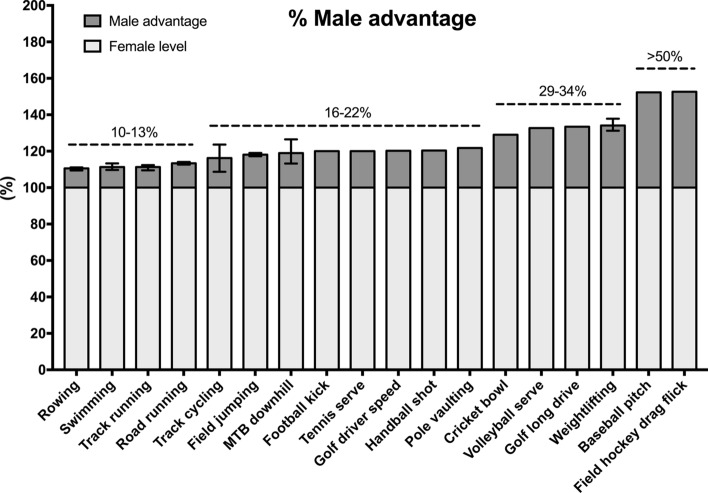
- The male–female performance gap becomes significant at puberty and often amounts to 10–50% depending on sport; it is larger in activities relying on muscle mass and explosive strength, especially upper-body actions (e.g., Olympic weightlifting 31–37%, tennis serve 20%, baseball pitch and field hockey drag flick >50%).
- Across 12 longitudinal studies, testosterone suppression to female-typical levels produced only modest changes: approximately −5% lean body mass or muscle size after 12 months, with no study reporting muscle loss exceeding −12% after 3 years; baseline male–female muscle mass differences are about 40%.
- Strength advantages persist: after 12 months, transgender women remained about 50% stronger than reference females in one study; grip strength fell 4–9% but retained a 17–23% advantage; height, skeletal parameters, and bone mineral density were maintained.
- Endurance effects are less clear: hemoglobin decreases by 11–14% with an estimated 2–5% performance penalty, but effects on VO2max, cardiac parameters, lactate threshold, and exercise economy remain unknown.
Methods
- Narrative/systematic review of biological sex differences in sporting performance and a literature search on anthropometric and muscle characteristics of transgender women (search terms in Supplementary Table S1).
- Performance gaps were compiled from publicly available sports federation databases and competition records; the main synthesis focused on 12 longitudinal studies of testosterone suppression and lean body mass, muscle size, or strength (Table 4), plus cross-sectional and related training/androgen-deprivation evidence.
- No new primary data were collected; the paper synthesizes existing studies and discusses implications for transgender inclusion policies.
Limitations
- The authors state that findings come from healthy adults with regular or low physical activity levels, not highly trained athletes, so further research is required in athletic transgender populations.
- The authors state that no controlled longitudinal study has explored endurance performance, and effects on VO2max, left ventricular size, stroke volume, blood volume, cardiac output, lactate threshold, and exercise economy remain unknown; no research evaluates agility, jumping, sprint, competition strength, or discipline-specific performance.
- Evident from the text: the review relies on heterogeneous studies, some with small samples, and cross-sectional data without baseline measurements; the running analysis by Harper used self-reported, uncontrolled race times, and there is no consensus on an acceptable residual advantage.
Model-written summary. Check it against the paper before relying on it.
Integrity signals
Registry
Cites
Statistics
Figures
Verification
Claims the paper makes
31 Own interpretation · 27 No full text of the sources · 25 No basis given · 12 Partly supported · 7 Own result · 4 Supported · 3 Supported so far · 3 Sources not found · 2 Not checked yet · accuracy not yet measured
Every source the paper cites for this claim was checked and supports it.
In the paper
“Thus, the biological effects of elevated pubertal testosterone are primarily responsible for driving the divergence of athletic performances between males and females [4].”
§ Transgender Women in the Female Category of Sport: Perspectives on Testosterone Suppression and Performance Advantage > The Biological Basis for Sporting Performance Advantages in Males
What the sources say
- Supportedcites [4] Handelsman DJ, Hirschberg AL, Bermon S. Circulating testosterone as the hormonal basis of sex differences in athletic performance. Endocr Rev. 2018;39(5):803–29. source
The 'Sex, Fairness, and Segregation in Sport' section says male testosterone rises sharply after puberty and provides a major physical advantage in sport. The 'Muscle' section likewise describes athletic performances diverging from puberty onward as male testosterone levels increase. No page numbers are supplied in the passages. (LLM, conf=0.94)
plaindirect- Asserted: passes — The authors put it forward as true.
- Checkable: passes — It can be checked against evidence.
- Load-bearing: passes — The paper’s conclusions depend on it.
- Based: passes — The paper gives a reason why it holds.
- Supported
The cited sources support only part of this claim — read each source’s verdict below.
In the paper
“Many of these physiological factors differ significantly between biological males and females as a result of genetic differences and androgen-directed development of secondary sex characteristics [3, 4].”
§ Transgender Women in the Female Category of Sport: Perspectives on Testosterone Suppression and Performance Advantage > Introduction
What the sources say
- Partly supportedcites [3] Haizlip KM, Harrison BC, Leinwand LA. Sex-based differences in skeletal muscle kinetics and fiber-type composition. Physiology. 2015;30(1):30–9. sourceExperimental — accuracy not yet measured
The Abstract reports sex differences in skeletal-muscle physiology and gene expression, and the Conclusions implicate testosterone in muscle growth and fiber size (page numbers unavailable). The paper does not establish that broad physiological differences result from genetic differences or androgen-directed development of secondary sex characteristics; its discussion is focused on skeletal muscle. (LLM, conf=0.86)
- Partly supportedcites [4] Handelsman DJ, Hirschberg AL, Bermon S. Circulating testosterone as the hormonal basis of sex differences in athletic performance. Endocr Rev. 2018;39(5):803–29. sourceExperimental — accuracy not yet measured
The sections on muscle and bone link several male–female physiological differences to androgen action, and the section on other androgen-sensitive effects says many aspects of physiology differ by sex. But that section says the androgen dependence of other differences remains uncertain, while the section on genetic effects of the Y chromosome does not support a general genetic explanation for them. Our copy provides no page numbers for these passages. (LLM, conf=0.86)
plaindirect- Asserted: passes — The authors put it forward as true.
- Checkable: passes — It can be checked against evidence.
- Load-bearing: passes — The paper’s conclusions depend on it.
- Based: passes — The paper gives a reason why it holds.
- Partly supported
The sources with a verdict support this claim; the rest weren’t checked yet, have no full text we could read, or their verdicts aren’t rated yet.
In the paper
“Segregating sports by biological sex does not account for transgender persons who experience incongruence between their biological sex and their experienced gender identity, and whose legal sex may be different to that recorded at birth [6, 7].”
§ Transgender Women in the Female Category of Sport: Perspectives on Testosterone Suppression and Performance Advantage > Introduction
What the sources say
- Not checked — no full text of the sourcecites [6] Genel M. Transgender athletes: how can they be accommodated? Curr Sports Med Rep. 2017;16(1):12–3. source
- Supportedcites [7] Coggon J, Hammond N, Holm S. Transsexuals in sport—fairness and freedom, regulation and law. Sport Ethics Philos. 2008;2(1):4–17. source
The Definitions section describes gender dysphoria as a gender identity different from anatomical sex. The Gender Recognition Act 2004 section says a person can be legally recognised in a sex different from the one into which they were born while retaining their original biological characteristics. Together with the paper’s discussion of transsexual participation in sex-segregated sport, these passages support the paraphrase. Page numbers were not available in our copy. (LLM, conf=0.93)
plain- Asserted: passes — The authors put it forward as true.
- Checkable: passes — It can be checked against evidence.
- Load-bearing: passes — The paper’s conclusions depend on it.
- Based: passes — The paper gives a reason why it holds.
The cited sources support only part of this claim — read each source’s verdict below.
In the paper
“Despite this modest reduction in strength, transgender women retained a 17% grip strength advantage over transgender men measured at baseline.”
§ Transgender Women in the Female Category of Sport: Perspectives on Testosterone Suppression and Performance Advantage > Is the Male Performance Advantage Lost when Testosterone is Suppressed in Transgender Women? > Muscle and Strength Metrics
What the sources say
- Partly supportedcites [70] Scharff M, Wiepjes CM, Klaver M, et al. Change in grip strength in trans people and its association with lean body mass and bone density. Endocr Connect. 2019;8:1020–8. sourceExperimental — accuracy not yet measured
Table 1 (Results > Characteristics; page unavailable) reports grip strength of 40.0 kg for transgender women after treatment and 33.1 kg for transgender men at baseline, supporting the comparison despite the women's modest decline. The gap is 17% of the women's 40.0 kg value, but approximately 21% of the men's baseline value; the stated 17% advantage over baseline transgender men therefore depends on an unstated denominator. (LLM, conf=0.86)
plaincorrelationaln = 249- Asserted: passes — The authors put it forward as true.
- Checkable: passes — It can be checked against evidence.
- Load-bearing: passes — The paper’s conclusions depend on it.
- Based: passes — The paper gives a reason why it holds.
- Partly supported
The sources with a verdict support this claim; the rest weren’t checked yet, have no full text we could read, or their verdicts aren’t rated yet.
In the paper
“Including Gooren and Bunck [62], 12 longitudinal studies [53, 63–73] have examined the effects of testosterone suppression on lean body mass or muscle size in transgender women.”
§ Transgender Women in the Female Category of Sport: Perspectives on Testosterone Suppression and Performance Advantage > Is the Male Performance Advantage Lost when Testosterone is Suppressed in Transgender Women? > Muscle and Strength Metrics
What the sources say
- Not checked — no full text of the sourcecites [62] Gooren LJG, Bunck MCM. Transsexuals and competitive sports. Eur J Endocrinol. 2004;151(4):425–9. source
- Not checked — no full text of the sourcecites [53] Van Caenegem E, Wierckx K, Taes Y, et al. Preservation of volumetric bone density and geometry in trans women during cross-sex hormonal therapy: a prospective observational study. Osteoporos Int. 2015a;26(1):35–47. source
- Not checked — no full text of the sourcecites [63] Haraldsen IR, Haug E, Falch J, et al. Cross-sex pattern of bone mineral density in early onset gender identity disorder. Horm Behav. 2007;52(3):334–43. source
- Not checked — no full text of the sourcecites [64] Mueller A, Zollver H, Kronawitter D, et al. Body composition and bone mineral density in male-to-female transsexuals during cross-sex hormone therapy using gonadotrophin-releasing hormone agonist. Exp Clin Endocrinol Diabetes. 2011;119(2):95–100. source
- Supportedcites [65] Wierckx K, Van Caenegem E, Schreiner T, et al. Cross-sex hormone therapy in trans persons is safe and effective at short-time follow-up: results from the European network for the investigation of gender incongruence. J Sex Med. 2014;11(8):1999–2011. source
The Abstract describes a one-year prospective study that included 53 trans women treated with cyproterone acetate and estradiol. The Trans Women section reports a decrease in total body lean mass during treatment, so this paper qualifies as one of the longitudinal studies cited. The count of 12 is the citing authors’ tally across multiple references, not a finding attributed to this paper alone. (LLM, conf=0.91)
- Not checked — no full text of the sourcecites [66] Gava G, Cerpolini S, Martelli V, et al. Cyproterone acetate vs leuprolide acetate in combination with transdermal oestradiol in transwomen: a comparison of safety and effectiveness. Clin Endocrinol (Oxf). 2016;85(2):239–46. source
- Supportedcites [67] Auer MK, Ebert T, Pietzner M, et al. Effects of sex hormone treatment on the metabolic syndrome in transgender individuals: focus on metabolic cytokines. J Clin Endocrinol Metab. 2018;103(2):790–802. source
The Patients section describes a study with one-year follow-up in transwomen. The Sex hormones section reports decreased testosterone, and Markers of the MS reports that lean mass was measured and remained unchanged. This supports citing the paper as one of the longitudinal studies in the group; it does not itself establish the total of 12. (LLM, conf=0.90)
- Supportedcites [68] Klaver M, De Blok CJM, Wiepjes CM, et al. Changes in regional body fat, lean body mass and body shape in trans persons using cross-sex hormonal therapy: results from a multicenter prospective study. Eur J Endocrinol. 2018;178(2):163–71. source
The Introduction says transwomen received estradiol with an anti-androgen. The Results report lean body mass in 179 transwomen after approximately one year of follow-up, confirming that this paper is one of the longitudinal studies identified by the citation. (LLM, conf=0.91)
- Not checked — no full text of the sourcecites [69] Fighera TM, da Silva E, Lindenau JDR, Spritzer PM. Impact of cross-sex hormone therapy on bone mineral density and body composition in transwomen. Clin Endocrinol (Oxf). 2018;88(6):856–62. source
- Supportedcites [70] Scharff M, Wiepjes CM, Klaver M, et al. Change in grip strength in trans people and its association with lean body mass and bone density. Endocr Connect. 2019;8:1020–8. source
This citation identifies one of the longitudinal studies, rather than supporting the total of 12 on its own. The Study design and study population section describes anti-androgen treatment in transwomen, the DXA methods describe measurement of lean body mass, and the Results (Characteristics) report lean-body-mass analyses for 171 transwomen. Page numbers are unavailable in our copy. (LLM, conf=0.90)
plain- Asserted: passes — The authors put it forward as true.
- Checkable: passes — It can be checked against evidence.
- Load-bearing: passes — The paper’s conclusions depend on it.
- Based: passes — The paper gives a reason why it holds.
The paper states this without a source or data behind it here, so there is nothing to check it against. The quote shows it is in the paper.
In the paper
“The performance gap is more pronounced in sporting activities relying on muscle mass and explosive strength, particularly in the upper body.”
§ Transgender Women in the Female Category of Sport: Perspectives on Testosterone Suppression and Performance Advantage > Abstract
plaincorrelational- Asserted: passes — The authors put it forward as true.
- Checkable: passes — It can be checked against evidence.
- Load-bearing: passes — The paper’s conclusions depend on it.
- Based: passes — The paper gives a reason why it holds.
The paper states this without a source or data behind it here, so there is nothing to check it against. The quote shows it is in the paper.
In the paper
“In Olympic weightlifting, where weight categories differ between males and females, the performance gap is between 31 and 37% across the range of competitive body weights between 1998 and 2020 (Fig. 1).”
§ Transgender Women in the Female Category of Sport: Perspectives on Testosterone Suppression and Performance Advantage > Sports Performance Differences Between Males and Females > Olympic Weightlifting
plain- Asserted: passes — The authors put it forward as true.
- Checkable: passes — It can be checked against evidence.
- Load-bearing: unclear — It is unclear whether the paper’s conclusions depend on it.
- Based: unclear — It is unclear why the paper says it holds.
A result the paper reports from its own data — it cites no other source for it, so there is none to check. The quote shows it is in the paper.
In the paper
“Between 1998 and 2018, a 69 kg category was common to both males and females, with the male record holder (69 kg, 1.68 m) lifting a combined weight 30.1% heavier than the female record holder (69 kg, 1.64 m).”
§ Transgender Women in the Female Category of Sport: Perspectives on Testosterone Suppression and Performance Advantage > Sports Performance Differences Between Males and Females > Olympic Weightlifting
plaincorrelational- Asserted: passes — The authors put it forward as true.
- Checkable: passes — It can be checked against evidence.
- Load-bearing: passes — The paper’s conclusions depend on it.
- Based: passes — The paper gives a reason why it holds.
The paper states this without a source or data behind it here, so there is nothing to check it against. The quote shows it is in the paper.
In the paper
“Performance differences larger than 20% are generally present when considering sports and activities that involve extensive upper body contributions.”
§ Transgender Women in the Female Category of Sport: Perspectives on Testosterone Suppression and Performance Advantage > Sports Performance Differences Between Males and Females > An Overview of Elite Adult Athletes
plaincorrelational- Asserted: passes — The authors put it forward as true.
- Checkable: passes — It can be checked against evidence.
- Load-bearing: unclear — It is unclear whether the paper’s conclusions depend on it.
- Based: passes — The paper gives a reason why it holds.
The paper states this without a source or data behind it here, so there is nothing to check it against. The quote shows it is in the paper.
In the paper
“For example, in the top/open weight category of Olympic weightlifting, in the absence of weight (and associated height) limits, maximum male lifting strength exceeds female lifting strength by nearly 40%.”
§ Transgender Women in the Female Category of Sport: Perspectives on Testosterone Suppression and Performance Advantage > Sports Performance Differences Between Males and Females > Olympic Weightlifting
plaincorrelational- Asserted: passes — The authors put it forward as true.
- Checkable: passes — It can be checked against evidence.
- Load-bearing: unclear — It is unclear whether the paper’s conclusions depend on it.
- Based: passes — The paper gives a reason why it holds.
- It may state two separate claims as one. 46
- Probably not a substantial claim. 11
Every source the paper cites for this claim was checked and supports it.
In the paper
“Testosterone in males induces changes in muscle mass, strength, anthropometric variables and hemoglobin levels [4], as part of the range of sexually dimorphic characteristics observed in humans.”
§ Transgender Women in the Female Category of Sport: Perspectives on Testosterone Suppression and Performance Advantage > The Biological Basis for Sporting Performance Advantages in Males
What the sources say
- Supportedcites [4] Handelsman DJ, Hirschberg AL, Bermon S. Circulating testosterone as the hormonal basis of sex differences in athletic performance. Endocr Rev. 2018;39(5):803–29. source
The Muscle section reports testosterone-related increases in muscle mass and strength in men. The Hemoglobin section reports a dose-dependent increase in hemoglobin in young and older men, while the Bone section links male pubertal testosterone exposure to differences in height and bone size—anthropometric characteristics. The indexed passages provide no page numbers. (LLM, conf=0.91)
plaindirect- Asserted: passes — The authors put it forward as true.
- Checkable: passes — It can be checked against evidence.
- Load-bearing: passes — The paper’s conclusions depend on it.
- Based: passes — The paper gives a reason why it holds.
It may state two separate claims as one.
- Supported
The sources with a verdict support this claim; the rest weren’t checked yet, have no full text we could read, or their verdicts aren’t rated yet.
In the paper
“During puberty, testes-derived testosterone levels increase 20-fold in males, but remain low in females, resulting in circulating testosterone concentrations at least 15 times higher in males than in females of any age [4, 25].”
§ Transgender Women in the Female Category of Sport: Perspectives on Testosterone Suppression and Performance Advantage > The Biological Basis for Sporting Performance Advantages in Males
What the sources say
- Supportedcites [4] Handelsman DJ, Hirschberg AL, Bermon S. Circulating testosterone as the hormonal basis of sex differences in athletic performance. Endocr Rev. 2018;39(5):803–29. source
The ‘Sex, Fairness, and Segregation in Sport’ section states that after puberty men produce 20 times more testosterone than women, resulting in circulating concentrations 15-fold higher than in women of any age. The ‘Sex Difference in Circulating Testosterone Levels’ section adds that testosterone in girls rises during puberty but remains below 2 nmol/L. (LLM, conf=0.94)
- Not checked — no full text of the sourcecites [25] Bae YJ, Zeidler R, Baber R, et al. Reference intervals of nine steroid hormones over the life-span analyzed by LC-MS/MS: Effect of age, gender, puberty, and oral contraceptives. J Steroid Biochem Mol Biol. 2019;193:105409. source
plaindirect- Asserted: passes — The authors put it forward as true.
- Checkable: passes — It can be checked against evidence.
- Load-bearing: passes — The paper’s conclusions depend on it.
- Based: passes — The paper gives a reason why it holds.
It may state two separate claims as one.
- Supported
The cited sources support only part of this claim — read each source’s verdict below.
In the paper
“superior cardiovascular and respiratory function, with larger blood and heart volumes, higher hemoglobin concentration, greater cross-sectional area of the trachea and lower oxygen cost of respiration [3, 4, 39, 40].”
§ Transgender Women in the Female Category of Sport: Perspectives on Testosterone Suppression and Performance Advantage > The Biological Basis for Sporting Performance Advantages in Males
What the sources say
- Could not verifycites [3] Haizlip KM, Harrison BC, Leinwand LA. Sex-based differences in skeletal muscle kinetics and fiber-type composition. Physiology. 2015;30(1):30–9. sourceExperimental — accuracy not yet measured
The Abstract mentions sex-based differences in cardiovascular health and disease, but does not describe males as having superior cardiovascular or respiratory function. Searches for blood and heart volume, hemoglobin, tracheal area, and the oxygen cost of respiration found no passage in our copy addressing those comparisons. (LLM, conf=0.76)
- Partly supportedcites [4] Handelsman DJ, Hirschberg AL, Bermon S. Circulating testosterone as the hormonal basis of sex differences in athletic performance. Endocr Rev. 2018;39(5):803–29. sourceExperimental — accuracy not yet measured
The Hemoglobin section (page not provided) says men have, on average, 12% higher circulating hemoglobin than women and estimates greater maximal oxygen transfer. The Other androgen-sensitive sex dichotomous effects section notes sex differences in exercise-induced cardiac and lung function, but does not establish the claimed larger blood and heart volumes, greater tracheal cross-sectional area, or lower oxygen cost of respiration. (LLM, conf=0.88)
- Not checked — no full text of the sourcecites [39] Dominelli PB, Molgat-Seon Y, Sheel AW. Sex differences in the pulmonary system influence the integrative response to exercise. Exerc Sport Sci Rev. 2019;47(3):142–50. source
- Not checked — no full text of the sourcecites [40] Wingate S. Cardiovascular anatomy and physiology in the female. Crit Care Nurs Clin N Am. 1997;9(4):447–52. source
plaincorrelational- Asserted: passes — The authors put it forward as true.
- Checkable: passes — It can be checked against evidence.
- Load-bearing: passes — The paper’s conclusions depend on it.
- Based: passes — The paper gives a reason why it holds.
It may state two separate claims as one.
- Could not verify
The cited sources support only part of this claim — read each source’s verdict below.
In the paper
“reduced fat mass, and different distribution of body fat and lean muscle mass, which increases power to weight ratios and upper to lower limb strength in sports where this may be a crucial determinant of success”
§ Transgender Women in the Female Category of Sport: Perspectives on Testosterone Suppression and Performance Advantage > The Biological Basis for Sporting Performance Advantages in Males
What the sources say
- Partly supportedcites [28] Lee DH, Keum N, Hu FB, et al. Development and validation of anthropometric prediction equations for lean body mass, fat mass and percent fat in adults using the National Health and Nutrition Examination Survey (NHANES) 1999–2006. Br J Nutr. 2017;118(10):858–66. sourceExperimental — accuracy not yet measured
The Results (page unavailable) report that men had lower fat mass and higher lean body mass than women; the Discussion (page unavailable) describes a possible sex difference in where fat accumulates. The paper does not establish differences in limb-specific muscle distribution or show that these body-composition differences increase power-to-weight ratios, upper-to-lower limb strength, or sporting success. (LLM, conf=0.88)
- Not checked — no full text of the sourcecites [29] Janssen I, Heymsfield SB, Wang ZM, Ross R. Skeletal muscle mass and distribution in 468 men and women aged 18–88 yr. J Appl Physiol. 2000;89:81–8. source
- Partly supportedcites [30] Bohannon RW, Wang YC, Yen SC, Grogan KA. Handgrip strength: a comparison of values obtained from the NHANES and NIH Toolbox studies. Am J Occup Ther. 2019;73(2):1–9. sourceExperimental — accuracy not yet measured
The Results (page unavailable) report higher handgrip strength in males than females. The paper does not address fat mass, the distribution of body fat or lean muscle, power-to-weight ratios, or relative upper- and lower-limb strength; those parts of the claim are unsupported. (LLM, conf=0.84)
- Not checked — no full text of the sourcecites [31] Neder JA, Nery LE, Shinzato GT, et al. Reference values for concentric knee isokinetic strength and power in nonathletic men and women from 20 to 80 years old. J Orthop Sports Phys Ther. 1999;29:116–26. source
- Not checked — no full text of the sourcecites [32] Jantz LM, Jantz RL. Secular change in long bone length and proportion in the United States, 1800–1970. Am J Phys Anthropol. 1999;110(1):57–67. source
- Not checked — no full text of the sourcecites [33] Brinckmann P, Hoefert H, Jongen HT. Sex differences in the skeletal geometry of the human pelvis and hip joint. J Biomech. 1981;14(6):427–30. source
- Not checked — no full text of the sourcecites [34] Lepley AS, Joseph MF, Daigle NR, et al. Sex differences in mechanical properties of the Achilles tendon: longitudinal response to repetitive loading exercise. J Strength Cond Res. 2018;32(11):3070–9. source
- Not checked — no full text of the sourcecites [35] Pate RR, Kriska A. Physiological basis of the sex difference in cardiorespiratory endurance. Sports Med. 1984;1(2):87–9. source
- Not checked — no full text of the sourcecites [36] Astrand PO, Cuddy TE, Saltin B, Stenberg J. Cardiac output during submaximal and maximal work. J Appl Physiol. 1964;19:268–74. source
- Not checked — no full text of the sourcecites [37] Best SA, Okada Y, Galbreath MM, et al. Age and sex differences in muscle sympathetic nerve activity in relation to haemodynamics, blood volume and left ventricular size. Exp Physiol. 2014;99(6):839–48. source
plaindirect- Asserted: passes — The authors put it forward as true.
- Checkable: passes — It can be checked against evidence.
- Load-bearing: passes — The paper’s conclusions depend on it.
- Based: passes — The paper gives a reason why it holds.
It may state two separate claims as one.
- Partly supported
The cited sources support only part of this claim — read each source’s verdict below.
In the paper
“longer and larger skeletal structure, which creates advantages in sports where levers influence force application, where longer limb/digit length is favorable, and where height, mass and proportions are directly responsible for performance capacity”
§ Transgender Women in the Female Category of Sport: Perspectives on Testosterone Suppression and Performance Advantage > The Biological Basis for Sporting Performance Advantages in Males
What the sources say
- Partly supportedcites [28] Lee DH, Keum N, Hu FB, et al. Development and validation of anthropometric prediction equations for lean body mass, fat mass and percent fat in adults using the National Health and Nutrition Examination Survey (NHANES) 1999–2006. Br J Nutr. 2017;118(10):858–66. sourceExperimental — accuracy not yet measured
Split into 2 atoms — 0 confirmed, 1 partially supported, 0 disputed, 0 misattributed, 1 unverifiable. Expand the claim to see per-atom verdicts.
- Not checked — no full text of the sourcecites [29] Janssen I, Heymsfield SB, Wang ZM, Ross R. Skeletal muscle mass and distribution in 468 men and women aged 18–88 yr. J Appl Physiol. 2000;89:81–8. source
- Could not verifycites [30] Bohannon RW, Wang YC, Yen SC, Grogan KA. Handgrip strength: a comparison of values obtained from the NHANES and NIH Toolbox studies. Am J Occup Ther. 2019;73(2):1–9. sourceExperimental — accuracy not yet measured
Split into 2 atoms — 0 confirmed, 0 partially supported, 0 disputed, 0 misattributed, 2 unverifiable. Expand the claim to see per-atom verdicts.
- Not checked — no full text of the sourcecites [31] Neder JA, Nery LE, Shinzato GT, et al. Reference values for concentric knee isokinetic strength and power in nonathletic men and women from 20 to 80 years old. J Orthop Sports Phys Ther. 1999;29:116–26. source
- Not checked — no full text of the sourcecites [32] Jantz LM, Jantz RL. Secular change in long bone length and proportion in the United States, 1800–1970. Am J Phys Anthropol. 1999;110(1):57–67. source
- Not checked — no full text of the sourcecites [33] Brinckmann P, Hoefert H, Jongen HT. Sex differences in the skeletal geometry of the human pelvis and hip joint. J Biomech. 1981;14(6):427–30. source
- Not checked — no full text of the sourcecites [34] Lepley AS, Joseph MF, Daigle NR, et al. Sex differences in mechanical properties of the Achilles tendon: longitudinal response to repetitive loading exercise. J Strength Cond Res. 2018;32(11):3070–9. source
- Not checked — no full text of the sourcecites [35] Pate RR, Kriska A. Physiological basis of the sex difference in cardiorespiratory endurance. Sports Med. 1984;1(2):87–9. source
- Not checked — no full text of the sourcecites [36] Astrand PO, Cuddy TE, Saltin B, Stenberg J. Cardiac output during submaximal and maximal work. J Appl Physiol. 1964;19:268–74. source
- Not checked — no full text of the sourcecites [37] Best SA, Okada Y, Galbreath MM, et al. Age and sex differences in muscle sympathetic nerve activity in relation to haemodynamics, blood volume and left ventricular size. Exp Physiol. 2014;99(6):839–48. source
plaindirect- Asserted: passes — The authors put it forward as true.
- Checkable: passes — It can be checked against evidence.
- Load-bearing: passes — The paper’s conclusions depend on it.
- Based: passes — The paper gives a reason why it holds.
It may state two separate claims as one.
- Partly supported
The cited sources support only part of this claim — read each source’s verdict below.
In the paper
“Males have: larger and denser muscle mass, and stiffer connective tissue, with associated capacity to exert greater muscular force more rapidly and efficiently”
§ Transgender Women in the Female Category of Sport: Perspectives on Testosterone Suppression and Performance Advantage > The Biological Basis for Sporting Performance Advantages in Males
What the sources say
- Partly supportedcites [28] Lee DH, Keum N, Hu FB, et al. Development and validation of anthropometric prediction equations for lean body mass, fat mass and percent fat in adults using the National Health and Nutrition Examination Survey (NHANES) 1999–2006. Br J Nutr. 2017;118(10):858–66. sourceExperimental — accuracy not yet measured
The Results (page not available in our copy) report that men had, on average, 18 kg more lean body mass than women. Lean body mass is not a direct measure of muscle size or density, and the paper does not establish the claimed differences in connective-tissue stiffness or the speed and efficiency of force production. (LLM, conf=0.87)
- Not checked — no full text of the sourcecites [29] Janssen I, Heymsfield SB, Wang ZM, Ross R. Skeletal muscle mass and distribution in 468 men and women aged 18–88 yr. J Appl Physiol. 2000;89:81–8. source
- Partly supportedcites [30] Bohannon RW, Wang YC, Yen SC, Grogan KA. Handgrip strength: a comparison of values obtained from the NHANES and NIH Toolbox studies. Am J Occup Ther. 2019;73(2):1–9. sourceExperimental — accuracy not yet measured
The Results report higher handgrip strength values for males than females, supporting the claim of greater measured grip force. The paper does not address muscle size or density, connective-tissue stiffness, or whether males exert force more rapidly or efficiently; it does not establish those as explanations for the grip-strength difference. The indexed copy provides no page numbers for these passages. (LLM, conf=0.90)
- Not checked — no full text of the sourcecites [31] Neder JA, Nery LE, Shinzato GT, et al. Reference values for concentric knee isokinetic strength and power in nonathletic men and women from 20 to 80 years old. J Orthop Sports Phys Ther. 1999;29:116–26. source
- Not checked — no full text of the sourcecites [32] Jantz LM, Jantz RL. Secular change in long bone length and proportion in the United States, 1800–1970. Am J Phys Anthropol. 1999;110(1):57–67. source
- Not checked — no full text of the sourcecites [33] Brinckmann P, Hoefert H, Jongen HT. Sex differences in the skeletal geometry of the human pelvis and hip joint. J Biomech. 1981;14(6):427–30. source
- Not checked — no full text of the sourcecites [34] Lepley AS, Joseph MF, Daigle NR, et al. Sex differences in mechanical properties of the Achilles tendon: longitudinal response to repetitive loading exercise. J Strength Cond Res. 2018;32(11):3070–9. source
- Not checked — no full text of the sourcecites [35] Pate RR, Kriska A. Physiological basis of the sex difference in cardiorespiratory endurance. Sports Med. 1984;1(2):87–9. source
- Not checked — no full text of the sourcecites [36] Astrand PO, Cuddy TE, Saltin B, Stenberg J. Cardiac output during submaximal and maximal work. J Appl Physiol. 1964;19:268–74. source
- Not checked — no full text of the sourcecites [37] Best SA, Okada Y, Galbreath MM, et al. Age and sex differences in muscle sympathetic nerve activity in relation to haemodynamics, blood volume and left ventricular size. Exp Physiol. 2014;99(6):839–48. source
plaincorrelational- Asserted: passes — The authors put it forward as true.
- Checkable: passes — It can be checked against evidence.
- Load-bearing: passes — The paper’s conclusions depend on it.
- Based: passes — The paper gives a reason why it holds.
It may state two separate claims as one.
- Partly supported
The cited sources support only part of this claim — read each source’s verdict below.
In the paper
“handgrip strength in transgender women was in approximately the 25th percentile for males but was over the 90th percentile for females, both before and after hormone treatment.”
§ Transgender Women in the Female Category of Sport: Perspectives on Testosterone Suppression and Performance Advantage > Is the Male Performance Advantage Lost when Testosterone is Suppressed in Transgender Women? > Muscle and Strength Metrics
What the sources say
- Partly supportedcites [70] Scharff M, Wiepjes CM, Klaver M, et al. Change in grip strength in trans people and its association with lean body mass and bone density. Endocr Connect. 2019;8:1020–8. sourceExperimental — accuracy not yet measured
The Discussion reports that, after 12 months of hormone treatment, transwomen’s median grip strength was at the 95th percentile for age-matched females. But it assigns the 25th percentile for age-matched males to transmen, not transwomen, and does not give both percentile comparisons for transwomen before treatment. The Results report that transwomen’s grip strength decreased during treatment, but do not establish the claimed pretreatment percentiles. (LLM, conf=0.90)
plainn = 249- Asserted: passes — The authors put it forward as true.
- Checkable: passes — It can be checked against evidence.
- Load-bearing: passes — The paper’s conclusions depend on it.
- Based: passes — The paper gives a reason why it holds.
It may state two separate claims as one.
- Partly supported
The cited sources support only part of this claim — read each source’s verdict below.
In the paper
“examination of 249 transgender women revealed a decrease of − 4% in grip strength after 12 months of cross-hormone treatment, with no variation between different testosterone level, age or BMI tertiles”
§ Transgender Women in the Female Category of Sport: Perspectives on Testosterone Suppression and Performance Advantage > Is the Male Performance Advantage Lost when Testosterone is Suppressed in Transgender Women? > Muscle and Strength Metrics
What the sources say
- Partly supportedcites [70] Scharff M, Wiepjes CM, Klaver M, et al. Change in grip strength in trans people and its association with lean body mass and bone density. Endocr Connect. 2019;8:1020–8. sourceExperimental — accuracy not yet measured
The study population section reports 249 transwomen, and the Results > Grip strength section reports a 1.8 kg decrease after 12 months with no difference across age or BMI groups. Table 1 gives a baseline grip strength of 41.8 kg, making the decrease approximately 4%. However, the Results explicitly say testosterone-concentration analyses could not be performed in transwomen, so the claimed absence of variation across testosterone tertiles is unsupported; age and BMI were analyzed as groups, not tertiles. Page numbers are unavailable in our copy. (LLM, conf=0.90)
plaindirectn = 249- Asserted: passes — The authors put it forward as true.
- Checkable: passes — It can be checked against evidence.
- Load-bearing: passes — The paper’s conclusions depend on it.
- Based: passes — The paper gives a reason why it holds.
It may state two separate claims as one.
- Partly supported
Every source the paper cites for this claim was checked and supports it.
In the paper
“Circulating hemoglobin levels are androgen-dependent [82] and typically reported as 12% higher in males compared with females [4].”
§ Transgender Women in the Female Category of Sport: Perspectives on Testosterone Suppression and Performance Advantage > Is the Male Performance Advantage Lost when Testosterone is Suppressed in Transgender Women? > Endurance Performance and Cardiovascular Parameters
What the sources say
- Supportedcites [82] Coviello AD, Kaplan B, Lakshman KM, et al. Effects of graded doses of testosterone on erythropoiesis in healthy young and older men. J Clin Endocrinol Metab. 2008;93(3):914–9. source
Citation [82] supports only the statement that hemoglobin levels are androgen-dependent; the 12% male–female comparison has a separate citation [4]. In the Hormones section, hemoglobin changed in a testosterone dose-dependent fashion and its change correlated with testosterone concentrations. (LLM, conf=0.93)
- Supportedcites [4] Handelsman DJ, Hirschberg AL, Bermon S. Circulating testosterone as the hormonal basis of sex differences in athletic performance. Endocr Rev. 2018;39(5):803–29. source
Citation [4] is attached to the claim that circulating hemoglobin is about 12% higher in males than females. The Hemoglobin section states that it is higher in men by 12% on average (page not specified). (LLM, conf=0.95)
plaindirect- Asserted: passes — The authors put it forward as true.
- Checkable: passes — It can be checked against evidence.
- Load-bearing: passes — The paper’s conclusions depend on it.
- Based: passes — The paper gives a reason why it holds.
It may state two separate claims as one.
- Supported
The cited sources support only part of this claim — read each source’s verdict below.
In the paper
“studies have found very consistent changes in lean body mass (using dual-energy X-ray absorptiometry) after 12 months of treatment, where the change has always been between − 3 and − 5% on average, with slightly greater reductions in the arm compared with the leg region [68].”
§ Transgender Women in the Female Category of Sport: Perspectives on Testosterone Suppression and Performance Advantage > Is the Male Performance Advantage Lost when Testosterone is Suppressed in Transgender Women? > Muscle and Strength Metrics
What the sources say
- Partly supportedcites [68] Klaver M, De Blok CJM, Wiepjes CM, et al. Changes in regional body fat, lean body mass and body shape in trans persons using cross-sex hormonal therapy: results from a multicenter prospective study. Eur J Endocrinol. 2018;178(2):163–71. sourceExperimental — accuracy not yet measured
The Results report a 3% decrease in total lean body mass after one year in transwomen, and the regional-results section reports a larger decrease in the arm (6%). But the arm result falls outside the claimed −3% to −5% range, and lean body mass increased by 10% in transmen. The paper therefore does not support the unqualified claim that changes were always within that range. (LLM, conf=0.88)
plaindirect- Asserted: passes — The authors put it forward as true.
- Checkable: passes — It can be checked against evidence.
- Load-bearing: passes — The paper’s conclusions depend on it.
- Based: passes — The paper gives a reason why it holds.
It may state two separate claims as one.
- Partly supported
The cited sources support only part of this claim — read each source’s verdict below.
In the paper
“The more novel measure of radiological attenuation of the quadriceps muscle, a valid proxy of contractile density [74, 75], showed no significant change in transgender women after 12 months of treatment, whereas the parallel group of transgender men demonstrated a + 6% increase in contractile density with testosterone supplementation.”
§ Transgender Women in the Female Category of Sport: Perspectives on Testosterone Suppression and Performance Advantage > Is the Male Performance Advantage Lost when Testosterone is Suppressed in Transgender Women? > Muscle and Strength Metrics
What the sources say
- Partly supportedcites [74] Aubrey J, Esfandiari N, Baracos VE, et al. Measurement of skeletal muscle radiation attenuation and basis of its biological variation. Acta Physiol (Oxf). 2014;210(3):489–97. sourceExperimental — accuracy not yet measured
Split into 2 atoms — 0 confirmed, 1 partially supported, 0 disputed, 0 misattributed, 1 unverifiable. Expand the claim to see per-atom verdicts.
- Supportedcites [75] Rasch A, Byström AH, Dalen N, Berg HE. Reduced muscle radiological density, cross-sectional area, and strength of major hip and knee muscles in 22 patients with hip osteoarthritis. Acta Orthop. 2007;78(4):505–10. source
Split into 2 atoms — 2 confirmed, 0 partially supported, 0 disputed, 0 misattributed, 0 unverifiable. Expand the claim to see per-atom verdicts.
plainn = 11- Asserted: passes — The authors put it forward as true.
- Checkable: passes — It can be checked against evidence.
- Load-bearing: passes — The paper’s conclusions depend on it.
- Based: passes — The paper gives a reason why it holds.
It may state two separate claims as one.
- Partly supported
The cited sources support only part of this claim — read each source’s verdict below.
In the paper
“The final average lean body mass of the transgender women was 51.2 kg, which puts them in the 90th percentile for women [79].”
§ Transgender Women in the Female Category of Sport: Perspectives on Testosterone Suppression and Performance Advantage > Is the Male Performance Advantage Lost when Testosterone is Suppressed in Transgender Women? > Muscle and Strength Metrics
What the sources say
- Partly supportedcites [79] Imboden MT, Swartz AM, Finch HW, et al. Reference standards for lean mass measures using GE dual energy x-ray absorptiometry in Caucasian adults. PLoS ONE. 2017;12(4):e0176161. sourceExperimental — accuracy not yet measured
Table 2 (Results) places 51.2 kg approximately at the 90th percentile for women aged 20–29 (51.1 kg), but its percentiles vary by age; it does not establish a single 90th-percentile value for all women. The paper provides reference values, not the reported final average for transgender women. (LLM, conf=0.86)
plain- Asserted: passes — The authors put it forward as true.
- Checkable: passes — It can be checked against evidence.
- Load-bearing: passes — The paper’s conclusions depend on it.
- Based: passes — The paper gives a reason why it holds.
It may state two separate claims as one.
- Partly supported
Every source the paper cites for this claim was checked and supports it.
In the paper
“We acknowledge that changes in muscle mass are not always correlated in magnitude to changes in strength measurements because muscle mass (or total mass) is not the only contributor to strength [103].”
§ Transgender Women in the Female Category of Sport: Perspectives on Testosterone Suppression and Performance Advantage > Discussion > The Focus on Muscle Mass and Strength
What the sources say
- Supportedcites [103] Balshaw TG, Massey GJ, Maden-Wilkinson TM, et al. Changes in agonist neural drive, hypertrophy and pre-training strength all contribute to the individual strength gains after resistance training. Eur J Appl Physiol. 2017;117:631–40. source
The Discussion (page not supplied) reports a moderate correlation between changes in quadriceps volume and strength (r = 0.461), so changes in muscle size do not fully account for the magnitude of strength gains. It also identifies agonist neural drive and pre-training strength as additional contributors. (LLM, conf=0.93)
plaincorrelational- Asserted: passes — The authors put it forward as true.
- Checkable: passes — It can be checked against evidence.
- Load-bearing: unclear — It is unclear whether the paper’s conclusions depend on it.
- Based: passes — The paper gives a reason why it holds.
It may state two separate claims as one.
- Supported
The cited sources support only part of this claim — read each source’s verdict below.
In the paper
“factors such as fiber types, biomechanical levers, pennation angle, fascicle length and tendon/extracellular matrix composition may all influence the ability to develop muscular force [105].”
§ Transgender Women in the Female Category of Sport: Perspectives on Testosterone Suppression and Performance Advantage > Discussion > The Focus on Muscle Mass and Strength
What the sources say
- Partly supportedcites [105] Maden-Wilkinson TM, Balshaw TG, Massey GJ, Folland JP. What makes long-term resistance-trained individuals so strong? A comparison of skeletal muscle morphology, architecture, and joint mechanics. J Appl Physiol. 2020;128:1000–11. sourceExperimental — accuracy not yet measured
The Introduction links pennation angle to force-generating capacity and identifies fiber-type composition as a possible contributor to contractile specific tension. The Methods use fascicle length in a measure of muscular force production, and the Discussion says joint leverage may contribute to maximal torque. The paper does not address how tendon or extracellular-matrix composition influences force development. (LLM, conf=0.88)
hedgedconditional- Asserted: passes — The authors put it forward as true.
- Checkable: passes — It can be checked against evidence.
- Load-bearing: fails — The paper’s conclusions may not depend on it.
- Based: passes — The paper gives a reason why it holds.
Probably not a substantial claim. The paper’s conclusions may not depend on it. It may state two separate claims as one.
- Partly supported
The paper states this without a source or data behind it here, so there is nothing to check it against. The quote shows it is in the paper.
In the paper
“We report that the performance gap between males and females becomes significant at puberty and often amounts to 10–50% depending on sport.”
§ Transgender Women in the Female Category of Sport: Perspectives on Testosterone Suppression and Performance Advantage > Abstract
plaindirect- Asserted: passes — The authors put it forward as true.
- Checkable: passes — It can be checked against evidence.
- Load-bearing: passes — The paper’s conclusions depend on it.
- Based: unclear — It is unclear why the paper says it holds.
It may state two separate claims as one.
The paper states this without a source or data behind it here, so there is nothing to check it against. The quote shows it is in the paper.
In the paper
“The performance gap increases to an average of 16% in track cycling, with higher variation across events (from 9% in the 4000 m team pursuit to 24% in the flying 500 m time trial).”
§ Transgender Women in the Female Category of Sport: Perspectives on Testosterone Suppression and Performance Advantage > Sports Performance Differences Between Males and Females > An Overview of Elite Adult Athletes
plaindirect- Asserted: passes — The authors put it forward as true.
- Checkable: passes — It can be checked against evidence.
- Load-bearing: unclear — It is unclear whether the paper’s conclusions depend on it.
- Based: unclear — It is unclear why the paper says it holds.
It may state two separate claims as one.
The paper states this without a source or data behind it here, so there is nothing to check it against. The quote shows it is in the paper.
In the paper
“The smallest performance gaps were seen in rowing, swimming and running (11–13%), with low variation across individual events within each of those categories.”
§ Transgender Women in the Female Category of Sport: Perspectives on Testosterone Suppression and Performance Advantage > Sports Performance Differences Between Males and Females > An Overview of Elite Adult Athletes
plain- Asserted: passes — The authors put it forward as true.
- Checkable: passes — It can be checked against evidence.
- Load-bearing: passes — The paper’s conclusions depend on it.
- Based: passes — The paper gives a reason why it holds.
It may state two separate claims as one.
The paper states this without a source or data behind it here, so there is nothing to check it against. The quote shows it is in the paper.
In the paper
“The average performance gap is 18% in jumping events (long jump, high jump and triple jump).”
§ Transgender Women in the Female Category of Sport: Perspectives on Testosterone Suppression and Performance Advantage > Sports Performance Differences Between Males and Females > An Overview of Elite Adult Athletes
plain- Asserted: passes — The authors put it forward as true.
- Checkable: passes — It can be checked against evidence.
- Load-bearing: fails — The paper’s conclusions may not depend on it.
- Based: fails — The paper may give no reason why it holds.
Probably not a substantial claim. The paper’s conclusions may not depend on it. The paper may give no reason why it holds.
The paper states this without a source or data behind it here, so there is nothing to check it against. The quote shows it is in the paper.
In the paper
“The gap between fastest recorded tennis serve is 20%, while the gaps between fastest recorded baseball pitches and field hockey drag flicks exceed 50%.”
§ Transgender Women in the Female Category of Sport: Perspectives on Testosterone Suppression and Performance Advantage > Sports Performance Differences Between Males and Females > An Overview of Elite Adult Athletes
plain- Asserted: passes — The authors put it forward as true.
- Checkable: passes — It can be checked against evidence.
- Load-bearing: fails — The paper’s conclusions may not depend on it.
- Based: fails — The paper may give no reason why it holds.
Probably not a substantial claim. The paper’s conclusions may not depend on it. The paper may give no reason why it holds. It may state two separate claims as one.
The paper states this without a source or data behind it here, so there is nothing to check it against. The quote shows it is in the paper.
In the paper
“On the contrary, it appears that the net loss of lean mass and grip strength is not substantially decreased at year 2 or 3 of cross-hormone treatment (Table 4), nor evident in cohorts after an average 8 years after transition.”
§ Transgender Women in the Female Category of Sport: Perspectives on Testosterone Suppression and Performance Advantage > Discussion > Testosterone-Based Criteria for Inclusion of Transgender Women in Female Sports
hedged- Asserted: passes — The authors put it forward as true.
- Checkable: passes — It can be checked against evidence.
- Load-bearing: passes — The paper’s conclusions depend on it.
- Based: passes — The paper gives a reason why it holds.
It may state two separate claims as one.
The paper states this without a source or data behind it here, so there is nothing to check it against. The quote shows it is in the paper.
In the paper
“there is no research evaluating the effects of transgender hormone treatment on factors such as agility, jumping or sprint performance, competition strength performance (e.g. bench press), or discipline-specific performance.”
§ Transgender Women in the Female Category of Sport: Perspectives on Testosterone Suppression and Performance Advantage > Discussion > The Focus on Muscle Mass and Strength
plain- Asserted: passes — The authors put it forward as true.
- Checkable: passes — It can be checked against evidence.
- Load-bearing: fails — The paper’s conclusions may not depend on it.
- Based: passes — The paper gives a reason why it holds.
Probably not a substantial claim. The paper’s conclusions may not depend on it.
The paper states this without a source or data behind it here, so there is nothing to check it against. The quote shows it is in the paper.
In the paper
“Rather, the data show that strength, lean body mass, muscle size and bone density are only trivially affected.”
§ Transgender Women in the Female Category of Sport: Perspectives on Testosterone Suppression and Performance Advantage > Conclusions
boosted- Asserted: passes — The authors put it forward as true.
- Checkable: passes — It can be checked against evidence.
- Load-bearing: passes — The paper’s conclusions depend on it.
- Based: passes — The paper gives a reason why it holds.
It may state two separate claims as one.
A claim is checked only against the cited paper’s full text, never its abstract, and none is available for its sources.
In the paper
“Yet, since the 1990s, the difference in performance records between males and females has been relatively stable, suggesting that biological differences created by androgenization explain most of the male advantage, and are insurmountable [5, 26, 27].”
§ Transgender Women in the Female Category of Sport: Perspectives on Testosterone Suppression and Performance Advantage > The Biological Basis for Sporting Performance Advantages in Males
What the sources say
- Not checked — no full text of the sourcecites [5] Sandbakk Ø, Solli GS, Holmberg HC. Sex differences in world-record performance: the influence of sport discipline and competition duration. Int J Sports Physiol Perform. 2018;13(1):2–8. source
- Not checked — no full text of the sourcecites [26] Thibault V, Guillaume M, Berthelot G, et al. Women and men in sport performance: the gender gap has not evolved since 1983. J Sport Sci Med. 2010;9(2):214–23.
- Not checked — no full text of the sourcecites [27] Millard-Stafford M, Swanson AE, Wittbrodt MT. Nature versus nurture: have performance gaps between men and women reached an asymptote? Int J Sports Physiol Perform. 2018;13(4):530–5. source
hedgeddirect- Asserted: passes — The authors put it forward as true.
- Checkable: passes — It can be checked against evidence.
- Load-bearing: passes — The paper’s conclusions depend on it.
- Based: passes — The paper gives a reason why it holds.
It may state two separate claims as one.
A conclusion the paper draws from its own results — it cites no other source for it, so there is none to check. The quote shows it is in the paper.
In the paper
“Further, in sports where contact, collision or combat are important for gameplay, widely different physiological attributes may create safety and athlete welfare concerns, necessitating not only segregation of sport into male and female categories, but also, for example, into weight and age classes.”
§ Transgender Women in the Female Category of Sport: Perspectives on Testosterone Suppression and Performance Advantage > Introduction
hedgedconditional- Asserted: passes — The authors put it forward as true.
- Checkable: passes — It can be checked against evidence.
- Load-bearing: passes — The paper’s conclusions depend on it.
- Based: passes — The paper gives a reason why it holds.
Probably not a substantial claim. It may state two separate claims as one.
The paper states this without a source or data behind it here, so there is nothing to check it against. The quote shows it is in the paper.
In the paper
“Males also have longer arms than females, which allows greater torque production from the arm lever when, for example, throwing a ball, punching or pushing.”
§ Transgender Women in the Female Category of Sport: Perspectives on Testosterone Suppression and Performance Advantage > Sports Performance Differences Between Males and Females > An Overview of Elite Adult Athletes
plaindirect- Asserted: passes — The authors put it forward as true.
- Checkable: passes — It can be checked against evidence.
- Load-bearing: fails — The paper’s conclusions may not depend on it.
- Based: fails — The paper may give no reason why it holds.
Probably not a substantial claim. The paper’s conclusions may not depend on it. The paper may give no reason why it holds. It may state two separate claims as one.
In the paper
“the performance gap is known to be substantial, and throwing represents the widest sex difference in motor performance from an early age [42].”
§ Transgender Women in the Female Category of Sport: Perspectives on Testosterone Suppression and Performance Advantage > Sports Performance Differences Between Males and Females > An Overview of Elite Adult Athletes
What the sources say
- Not checked — no full text of the sourcecites [42] Thomas JR, French KE. Gender differences across age in motor performance a meta-analysis. Psychol Bull. 1985;98(2):260–82. source
boostedcorrelational- Asserted: passes — The authors put it forward as true.
- Checkable: passes — It can be checked against evidence.
- Load-bearing: unclear — It is unclear whether the paper’s conclusions depend on it.
- Based: passes — The paper gives a reason why it holds.
It may state two separate claims as one.
In the paper
“vertical jump performance is on average 33% greater in elite men than women, with differences ranging from 27.8% for endurance sports to in excess of 40% for precision and combat sports [41].”
§ Transgender Women in the Female Category of Sport: Perspectives on Testosterone Suppression and Performance Advantage > Sports Performance Differences Between Males and Females > An Overview of Elite Adult Athletes
What the sources say
- Not checked — no full text of the sourcecites [41] Haugen T, Breitschädel F, Wiig H, Seiler S. Countermovement jump height in national team athletes of various sports: a framework for practitioners and scientists. Int J Sports Physiol Perform. 2020 (accessed 4 May 2020 from Researchgate) source
plaincorrelational- Asserted: passes — The authors put it forward as true.
- Checkable: passes — It can be checked against evidence.
- Load-bearing: passes — The paper’s conclusions depend on it.
- Based: passes — The paper gives a reason why it holds.
It may state two separate claims as one.
A conclusion the paper draws from its own results — it cites no other source for it, so there is none to check. The quote shows it is in the paper.
In the paper
“It shows that, even after adjustment for mass, biological males are significantly stronger (30%) than females, and that females who are 60% heavier than males do not overcome these strength deficits.”
§ Transgender Women in the Female Category of Sport: Perspectives on Testosterone Suppression and Performance Advantage > Sports Performance Differences Between Males and Females > Olympic Weightlifting
plaincorrelational- Asserted: passes — The authors put it forward as true.
- Checkable: passes — It can be checked against evidence.
- Load-bearing: passes — The paper’s conclusions depend on it.
- Based: passes — The paper gives a reason why it holds.
It may state two separate claims as one.
The paper states this without a source or data behind it here, so there is nothing to check it against. The quote shows it is in the paper.
In the paper
“Strength differences range between 30 and 100%, depending upon the cohort studied and the task used to assess strength.”
§ Transgender Women in the Female Category of Sport: Perspectives on Testosterone Suppression and Performance Advantage > Is the Male Performance Advantage Lost when Testosterone is Suppressed in Transgender Women? > Muscle and Strength Metrics
plain- Asserted: passes — The authors put it forward as true.
- Checkable: passes — It can be checked against evidence.
- Load-bearing: passes — The paper’s conclusions depend on it.
- Based: fails — The paper may give no reason why it holds.
Probably not a substantial claim. The paper may give no reason why it holds.
None of the sources cited for this claim have been checked yet.
In the paper
“males have a lower incidence of knee injuries, often attributed to low quadriceps (Q) angle conferred by a narrow pelvic girdle [59, 60].”
§ Transgender Women in the Female Category of Sport: Perspectives on Testosterone Suppression and Performance Advantage > Is the Male Performance Advantage Lost when Testosterone is Suppressed in Transgender Women? > Anthropometrics
What the sources say
- Not checked — no full text of the sourcecites [59] Sigward SM, Powers CM. The influence of gender on knee kinematics, kinetics and muscle activation patterns during side-step cutting. Clin Biomech. 2006;21(1):41–8. source
- Not matchedcites [60] Francis P, Whatman C, Sheerin K, et al. The proportion of lower limb running injuries by gender, anatomical location and specific pathology: a systematic review. J Sport Sci Med. 2019;18(1):21–31.
Couldn’t be matched to a paper in Crossref, so it can’t be checked.
plainconditional- Asserted: passes — The authors put it forward as true.
- Checkable: passes — It can be checked against evidence.
- Load-bearing: unclear — It is unclear whether the paper’s conclusions depend on it.
- Based: passes — The paper gives a reason why it holds.
It may state two separate claims as one.
In the paper
“The males had 57% greater muscle size, 109% greater isometric strength, and 89% greater 1RM strength than age-matched females.”
§ Transgender Women in the Female Category of Sport: Perspectives on Testosterone Suppression and Performance Advantage > Sports Performance Differences Between Males and Females > Performance Differences in Non-elite Individuals
What the sources say
- Not checked — no full text of the sourcecites [49] Hubal MJ, Gordish-Dressman H, Thompson PD, et al. Muscle size and strength gain after unilateral resistance training. Med Sci Sport Exerc. 2005;37(6):964–72.
plaincorrelationaln = 342- Asserted: passes — The authors put it forward as true.
- Checkable: passes — It can be checked against evidence.
- Load-bearing: passes — The paper’s conclusions depend on it.
- Based: passes — The paper gives a reason why it holds.
It may state two separate claims as one.
In the paper
“The power produced during a punch was 162% greater in males than in females, and the least powerful man produced more power than the most powerful woman.”
§ Transgender Women in the Female Category of Sport: Perspectives on Testosterone Suppression and Performance Advantage > Sports Performance Differences Between Males and Females > Performance Differences in Non-elite Individuals
What the sources say
- Not checked — no full text of the sourcecites [50] Morris JS, Link J, Martin JC, Carrier DR. Sexual dimorphism in human arm power and force: implications for sexual selection on fighting ability. J Exp Biol. 2020;223(Pt 2):jeb212365. source
plain- Asserted: passes — The authors put it forward as true.
- Checkable: passes — It can be checked against evidence.
- Load-bearing: passes — The paper’s conclusions depend on it.
- Based: passes — The paper gives a reason why it holds.
It may state two separate claims as one.
A conclusion the paper draws from its own results — it cites no other source for it, so there is none to check. The quote shows it is in the paper.
In the paper
“These data overwhelmingly confirm that testosterone-driven puberty, as the driving force of development of male secondary sex characteristics, underpins sporting advantages that are so large no female could reasonably hope to succeed without sex segregation in most sporting competitions.”
§ Transgender Women in the Female Category of Sport: Perspectives on Testosterone Suppression and Performance Advantage > Sports Performance Differences Between Males and Females > Perspectives on Elite Athlete Performance Differences
boosteddirect- Asserted: passes — The authors put it forward as true.
- Checkable: passes — It can be checked against evidence.
- Load-bearing: passes — The paper’s conclusions depend on it.
- Based: passes — The paper gives a reason why it holds.
It may state two separate claims as one.
In the paper
“Similarly, punch power is 162% greater in men than women even though no single parameter that produces punching actions achieves this magnitude of difference [50].”
§ Transgender Women in the Female Category of Sport: Perspectives on Testosterone Suppression and Performance Advantage > Sports Performance Differences Between Males and Females > Performance Differences in Non-elite Individuals
What the sources say
- Not checked — no full text of the sourcecites [50] Morris JS, Link J, Martin JC, Carrier DR. Sexual dimorphism in human arm power and force: implications for sexual selection on fighting ability. J Exp Biol. 2020;223(Pt 2):jeb212365. source
plain- Asserted: passes — The authors put it forward as true.
- Checkable: passes — It can be checked against evidence.
- Load-bearing: unclear — It is unclear whether the paper’s conclusions depend on it.
- Based: passes — The paper gives a reason why it holds.
It may state two separate claims as one.
In the paper
“Similarly, the final grip strength was 41 kg, 25% higher than the female reference value [80].”
§ Transgender Women in the Female Category of Sport: Perspectives on Testosterone Suppression and Performance Advantage > Is the Male Performance Advantage Lost when Testosterone is Suppressed in Transgender Women? > Muscle and Strength Metrics
What the sources say
- Not checked — no full text of the sourcecites [80] Bohannon RW, Peolsson A, Massy-Westropp N, et al. Reference values for adult grip strength measured with a Jamar dynamometer: a descriptive meta-analysis. Physiotherapy. 2006;92(1):11–5. source
plain- Asserted: passes — The authors put it forward as true.
- Checkable: passes — It can be checked against evidence.
- Load-bearing: passes — The paper’s conclusions depend on it.
- Based: passes — The paper gives a reason why it holds.
It may state two separate claims as one.
A conclusion the paper draws from its own results — it cites no other source for it, so there is none to check. The quote shows it is in the paper.
In the paper
“In running events, for example, where the male–female gap is approximately 11%, it follows that many thousands of males are faster than the very best females.”
§ Transgender Women in the Female Category of Sport: Perspectives on Testosterone Suppression and Performance Advantage > Sports Performance Differences Between Males and Females > Perspectives on Elite Athlete Performance Differences
plaindirect- Asserted: passes — The authors put it forward as true.
- Checkable: passes — It can be checked against evidence.
- Load-bearing: passes — The paper’s conclusions depend on it.
- Based: passes — The paper gives a reason why it holds.
It may state two separate claims as one.
The paper states this without a source or data behind it here, so there is nothing to check it against. The quote shows it is in the paper.
In the paper
“Sex differences in endurance performance are generally smaller than for events relying more on muscle mass and explosive strength.”
§ Transgender Women in the Female Category of Sport: Perspectives on Testosterone Suppression and Performance Advantage > Is the Male Performance Advantage Lost when Testosterone is Suppressed in Transgender Women? > Endurance Performance and Cardiovascular Parameters
plaincorrelational- Asserted: passes — The authors put it forward as true.
- Checkable: passes — It can be checked against evidence.
- Load-bearing: passes — The paper’s conclusions depend on it.
- Based: fails — The paper may give no reason why it holds.
Probably not a substantial claim. The paper may give no reason why it holds.
In the paper
“The results showed that transgender women had 17% less lean mass and 25% lower peak quadriceps muscle strength than the control males [78].”
§ Transgender Women in the Female Category of Sport: Perspectives on Testosterone Suppression and Performance Advantage > Is the Male Performance Advantage Lost when Testosterone is Suppressed in Transgender Women? > Muscle and Strength Metrics
What the sources say
- Not checked — no full text of the sourcecites [78] Lapauw B, Taes Y, Simoens S, et al. Body composition, volumetric and areal bone parameters in male-to-female transsexual persons. Bone. 2008;43(6):1016–21. source
plaincorrelationaln = 23- Asserted: passes — The authors put it forward as true.
- Checkable: passes — It can be checked against evidence.
- Load-bearing: passes — The paper’s conclusions depend on it.
- Based: passes — The paper gives a reason why it holds.
It may state two separate claims as one.
In the paper
“The age-graded scores for these eight runners were the same in both categories, suggesting that cross-hormone treatment reduced running performance by approximately the size of the typical male advantage.”
§ Transgender Women in the Female Category of Sport: Perspectives on Testosterone Suppression and Performance Advantage > Is the Male Performance Advantage Lost when Testosterone is Suppressed in Transgender Women? > Endurance Performance and Cardiovascular Parameters
What the sources say
- Not checked — no full text of the sourcecites [81] Harper J. Race times for transgender athletes. J Sport Cult Identities. 2015;6(1):1–9. source
hedgeddirectn = 8- Asserted: passes — The authors put it forward as true.
- Checkable: passes — It can be checked against evidence.
- Load-bearing: passes — The paper’s conclusions depend on it.
- Based: passes — The paper gives a reason why it holds.
It may state two separate claims as one.
In the paper
“They reported that muscle strength after 12 months of testosterone suppression was comparable to baseline strength. As a result, transgender women remained about 50% stronger than both the group of transgender men at baseline and a reference group of females.”
§ Transgender Women in the Female Category of Sport: Perspectives on Testosterone Suppression and Performance Advantage > Is the Male Performance Advantage Lost when Testosterone is Suppressed in Transgender Women? > Muscle and Strength Metrics
What the sources say
- Not checked — no full text of the sourcecites [71] Wiik A, Lundberg TR, Rullman E, et al. Muscle strength, size, and composition following 12 months of gender-affirming treatment in transgender individuals. J Clin Endocrinol Metab. 2020;105(3):247. source
plain- Asserted: passes — The authors put it forward as true.
- Checkable: passes — It can be checked against evidence.
- Load-bearing: passes — The paper’s conclusions depend on it.
- Based: passes — The paper gives a reason why it holds.
It may state two separate claims as one.
A conclusion the paper draws from its own results — it cites no other source for it, so there is none to check. The quote shows it is in the paper.
In the paper
“this study demonstrates that training during a period of testosterone suppression not only counteracts muscle loss, but can actually increase muscle mass and strength.”
§ Transgender Women in the Female Category of Sport: Perspectives on Testosterone Suppression and Performance Advantage > Discussion > Perspectives on Athletic Status of Transgender Women
boosteddirect- Asserted: passes — The authors put it forward as true.
- Checkable: passes — It can be checked against evidence.
- Load-bearing: passes — The paper’s conclusions depend on it.
- Based: passes — The paper gives a reason why it holds.
It may state two separate claims as one.
A conclusion the paper draws from its own results — it cites no other source for it, so there is none to check. The quote shows it is in the paper.
In the paper
“which may create safety considerations and may alter the importance of retained performance advantages.”
§ Transgender Women in the Female Category of Sport: Perspectives on Testosterone Suppression and Performance Advantage > Conclusions
hedgedconditional- Asserted: passes — The authors put it forward as true.
- Checkable: passes — It can be checked against evidence.
- Load-bearing: passes — The paper’s conclusions depend on it.
- Based: passes — The paper gives a reason why it holds.
It may state two separate claims as one.
- Rests on an assumption: Different sports differ vastly in terms of physiological determinants of success.
In the paper
“in select exercises used during the training program, 10RM leg press and bench press increased + 32% and + 17%, respectively.”
§ Transgender Women in the Female Category of Sport: Perspectives on Testosterone Suppression and Performance Advantage > Discussion > Perspectives on Athletic Status of Transgender Women
What the sources say
- Not checked — no full text of the sourcecites [93] Kvorning T, Andersen M, Brixen K, Madsen K. Suppression of endogenous testosterone production attenuates the response to strength training: a randomized, placebo-controlled, and blinded intervention study. Am J Physiol Metab. 2006;291:E1325-32. source
plaindirect- Asserted: passes — The authors put it forward as true.
- Checkable: passes — It can be checked against evidence.
- Load-bearing: unclear — It is unclear whether the paper’s conclusions depend on it.
- Based: passes — The paper gives a reason why it holds.
It may state two separate claims as one.
In the paper
“a phenomenon also noted in transgender men, where the increase in muscle mass seems to stabilise between the first and the second year of testosterone treatment [111].”
§ Transgender Women in the Female Category of Sport: Perspectives on Testosterone Suppression and Performance Advantage > Discussion > Testosterone-Based Criteria for Inclusion of Transgender Women in Female Sports
What the sources say
- Not matchedcites [111] Elbers JMH, Asscheman H, Seidell JC, et al. Long-term testosterone administration increases visceral fat in female to male transsexuals. J Clin Endocrinol Metab. 1997;82(7):2044–7.
Couldn’t be matched to a paper in Crossref, so it can’t be checked.
hedgedconditional- Asserted: passes — The authors put it forward as true.
- Checkable: passes — It can be checked against evidence.
- Load-bearing: fails — The paper’s conclusions may not depend on it.
- Based: passes — The paper gives a reason why it holds.
Probably not a substantial claim. The paper’s conclusions may not depend on it.
- Not matched
A conclusion the paper draws from its own results — it cites no other source for it, so there is none to check. The quote shows it is in the paper.
In the paper
“and the balance between inclusion, safety and fairness therefore differs between sports.”
§ Transgender Women in the Female Category of Sport: Perspectives on Testosterone Suppression and Performance Advantage > Conclusions
plaincorrelational- Asserted: passes — The authors put it forward as true.
- Checkable: passes — It can be checked against evidence.
- Load-bearing: passes — The paper’s conclusions depend on it.
- Based: passes — The paper gives a reason why it holds.
Probably not a substantial claim.
- Rests on an assumption: Performance in most sports may be influenced by factors outside muscle mass and strength.
A conclusion the paper draws from its own results — it cites no other source for it, so there is none to check. The quote shows it is in the paper.
In the paper
“If the advantage persists to a large degree, as evidence suggests, then a stated objective of targeting a certain testosterone level to be eligible will not achieve its objective”
§ Transgender Women in the Female Category of Sport: Perspectives on Testosterone Suppression and Performance Advantage > Conclusions
hedgedconditional- Asserted: passes — The authors put it forward as true.
- Checkable: passes — It can be checked against evidence.
- Load-bearing: passes — The paper’s conclusions depend on it.
- Based: passes — The paper gives a reason why it holds.
It may state two separate claims as one.
In the paper
“it is acknowledged that the findings presented here are from healthy adults with regular or even low physical activity levels [91], and not highly trained athletes.”
§ Transgender Women in the Female Category of Sport: Perspectives on Testosterone Suppression and Performance Advantage > Discussion > Perspectives on Athletic Status of Transgender Women
What the sources say
- Not checked — no full text of the sourcecites [91] Muchicko MM, Lepp A, Barkley JE. Peer victimization, social support and leisure-time physical activity in transgender and cisgender individuals. Leis Loisir. 2014;3–4:295–308. source
plain- Asserted: passes — The authors put it forward as true.
- Checkable: passes — It can be checked against evidence.
- Load-bearing: passes — The paper’s conclusions depend on it.
- Based: passes — The paper gives a reason why it holds.
It may state two separate claims as one.
In the paper
“Oxygen-carrying capacity in transgender women is most likely reduced with testosterone suppression, with a concomitant performance penalty estimated at 2–5% for the female athletic population [83].”
§ Transgender Women in the Female Category of Sport: Perspectives on Testosterone Suppression and Performance Advantage > Is the Male Performance Advantage Lost when Testosterone is Suppressed in Transgender Women? > Endurance Performance and Cardiovascular Parameters
What the sources say
- Not checked — no full text of the sourcecites [83] Bermon S. Androgens and athletic performance of elite female athletes. Curr Opin Endocrinol Diabetes Obes. 2017;24(3):246–51. source
hedgedconditional- Asserted: passes — The authors put it forward as true.
- Checkable: passes — It can be checked against evidence.
- Load-bearing: passes — The paper’s conclusions depend on it.
- Based: passes — The paper gives a reason why it holds.
It may state two separate claims as one.
A conclusion the paper draws from its own results — it cites no other source for it, so there is none to check. The quote shows it is in the paper.
In the paper
“Thus, while a reduction in hemoglobin is strongly predicted to impact aerobic capacity and reduce endurance performance in transgender women, it is unlikely to completely close the baseline gap in aerobic capacity between males and females.”
§ Transgender Women in the Female Category of Sport: Perspectives on Testosterone Suppression and Performance Advantage > Is the Male Performance Advantage Lost when Testosterone is Suppressed in Transgender Women? > Endurance Performance and Cardiovascular Parameters
boostedconditional- Asserted: passes — The authors put it forward as true.
- Checkable: passes — It can be checked against evidence.
- Load-bearing: passes — The paper’s conclusions depend on it.
- Based: passes — The paper gives a reason why it holds.
It may state two separate claims as one.
A conclusion the paper draws from its own results — it cites no other source for it, so there is none to check. The quote shows it is in the paper.
In the paper
“Thus, in well-controlled studies in biological males who train while undergoing testosterone reduction, training is protective of, and may even enhance, muscle mass and strength attributes.”
§ Transgender Women in the Female Category of Sport: Perspectives on Testosterone Suppression and Performance Advantage > Discussion > Perspectives on Athletic Status of Transgender Women
hedgedconditional- Asserted: passes — The authors put it forward as true.
- Checkable: passes — It can be checked against evidence.
- Load-bearing: passes — The paper’s conclusions depend on it.
- Based: unclear — It is unclear why the paper says it holds.
It may state two separate claims as one.
The paper states this without a source or data behind it here, so there is nothing to check it against. The quote shows it is in the paper.
In the paper
“Other factors that may impact sports performance, known to be affected by testosterone and some of them measurably different between males and females, include visuospatial abilities, aggressiveness, coordination and flexibility.”
§ Transgender Women in the Female Category of Sport: Perspectives on Testosterone Suppression and Performance Advantage > Discussion > The Focus on Muscle Mass and Strength
hedgedcorrelational- Asserted: passes — The authors put it forward as true.
- Checkable: passes — It can be checked against evidence.
- Load-bearing: fails — The paper’s conclusions may not depend on it.
- Based: fails — The paper may give no reason why it holds.
Probably not a substantial claim. The paper’s conclusions may not depend on it. The paper may give no reason why it holds. It may state two separate claims as one.
In the paper
“Despite testosterone suppression to female levels of 2 nmol/L, there was a significant + 4% increase in leg lean mass and a + 2% increase in total lean body mass, and a measurable though insignificant increase in isometric knee extension strength.”
§ Transgender Women in the Female Category of Sport: Perspectives on Testosterone Suppression and Performance Advantage > Discussion > Perspectives on Athletic Status of Transgender Women
What the sources say
- Not checked — no full text of the sourcecites [93] Kvorning T, Andersen M, Brixen K, Madsen K. Suppression of endogenous testosterone production attenuates the response to strength training: a randomized, placebo-controlled, and blinded intervention study. Am J Physiol Metab. 2006;291:E1325-32. source
plaindirect- Asserted: passes — The authors put it forward as true.
- Checkable: passes — It can be checked against evidence.
- Load-bearing: passes — The paper’s conclusions depend on it.
- Based: passes — The paper gives a reason why it holds.
It may state two separate claims as one.
The authors state this as an assumption.
The IOC's rationale for the 10 nmol/L testosterone threshold is that it reduces the male performance advantages to an acceptable degree, thus permitting fair and safe competition.
“Given the IOC’s stated position that the “overriding sporting objective is and remains the guarantee of fair competition” [14], it is reasonable to assume that the rationale for this requirement is that it reduces the male performance advantages described previously to an acceptable degree, thus permitting fair and safe competition.”
The paper relies on this without support.
Bone mineral density is maintained in transgender women undergoing testosterone suppression.
“Given the maintenance of BMD”
The paper relies on this without support.
No plausible biological mechanism exists by which testosterone suppression might affect skeletal measurements such as bone length and hip width.
“the lack of a plausible biological mechanism by which testosterone suppression might affect skeletal measurements such as bone length and hip width”
The paper relies on this without support.
The male performance advantage established by testosterone at puberty translates in elite athletes to a 10–50% performance advantage.
“the male performance advantage, established by testosterone at puberty and translating in elite athletes to a 10–50% performance advantage”
The paper relies on this without support.
The biological factors underpinning athletic performance are unequivocally established.
“it is still important to recognize that the biological factors underpinning athletic performance are unequivocally established.”
The paper relies on this without support.
Different sports differ vastly in terms of physiological determinants of success.
“it is clear that different sports differ vastly in terms of physiological determinants of success”
The paper relies on this without support.
Performance in most sports may be influenced by factors outside muscle mass and strength.
“It is also important to recognize that performance in most sports may be influenced by factors outside muscle mass and strength”
Claims other papers make about this one
Each is checked against this paper’s own text: does it say what the citing paper says it does?
The source backs part of the claim, not all of it — or backs it for a different population, condition or comparison.
In the citing paper
“the main criticism of this review is the purely biological argument from an elite male versus elite female position, implying that transwomen athletes are the same as elite male athletes”
From Integrating Transwomen and Female Athletes with Differences of Sex Development (DSD) into Elite Competition: The FIMS 2021 Consensus Statement (2021) · cites this paper as [43]
Experimental — accuracy not yet measuredThe cited source says what the claim attributes to it.
In the citing paper
“The authors concluded that anthropometric and muscle mass advantages are sustained in transwomen after 12 months of gender-affirming treatment based on studies showing the physiological changes caused by HRT in transwomen and chemical castration in men.”
From Integrating Transwomen and Female Athletes with Differences of Sex Development (DSD) into Elite Competition: The FIMS 2021 Consensus Statement (2021) · cites this paper as [43]
Self-check
Percentages, sums and reported differences re-computed from the paper’s own numbers.
Each contradiction between two passages listed here was confirmed by an independent check.
Rated minor: it would not touch a result — a value no result rests on, a p-value that stays on the same side of the significance level, or a conflict that is clerical, resolved elsewhere in the paper, or outside its own findings.
In the paper
§ Transgender Women in the Female Category of Sport: Perspectives on Testosterone Suppression and Performance Advantage > Is the Male Performance Advantage Lost when Testosterone is Suppressed in Transgender Women? > Muscle and Strength Metrics
“Thigh volume (both anterior and posterior thigh) and quadriceps cross-sectional area decreased − 4 and − 5%, respectively, after the 12-month period”
§ Transgender Women in the Female Category of Sport: Perspectives on Testosterone Suppression and Performance Advantage > Is the Male Performance Advantage Lost when Testosterone is Suppressed in Transgender Women? > Muscle and Strength Metrics
“Thigh volume1 yr − 5%Quad area1 yr − 4%”
Citations
Cites
Skeletal muscle mass and distribution in 468 men and women aged 18–88 yr
Janssen, I., Heymsfield, S. B., Wang, Z., & Ross, R. (2000) · Journal of Applied Physiology · doi:10.1152/jappl.2000.89.1.81 · Cited by 3,087
The importance of muscular strength: Training considerations
Suchomel, T. J., Nimphius, S., Bellon, C. R., & Stone, M. H. (2018) · Sports Medicine · doi:10.1007/s40279-018-0862-z · Cited by 940
Cardiac output during submaximal and maximal work
Åstrand, P.-O., Cuddy, T. E., Saltin, B., & Stenberg, J. (1964) · Journal of Applied Physiology · doi:10.1152/jappl.1964.19.2.268 · Cited by 722
Measurement of skeletal muscle radiation attenuation and basis of its biological variation
Aubrey, J., Esfandiari, N., Baracos, V. E., Buteau, F. A., Frenette, J., Putman, C. T., & Mazurak, V. C. (2014) · Acta Physiologica · doi:10.1111/apha.12224 · Cited by 720
Gender differences across age in motor performance: A meta-analysis.
Thomas, J. R., & French, K. E. (1985) · Psychological Bulletin · doi:10.1037/0033-2909.98.2.260 · Cited by 614
Bohannon, R. W., Peolsson, A., Massy-Westropp, N., Desrosiers, J., & Bear-Lehman, J. (2006) · Physiotherapy · doi:10.1016/j.physio.2005.05.003 · Cited by 598
Circulating Testosterone as the Hormonal Basis of Sex Differences in Athletic Performance
Handelsman, D. J., Hirschberg, A. L., & Bermon, S. (2018) · Endocrine Reviews · doi:10.1210/er.2018-00020 · Cited by 594
Sex-Based Differences in Skeletal Muscle Kinetics and Fiber-Type Composition
Haizlip, K. M., Harrison, B. C., & Leinwand, L. A. (2015) · Physiology · doi:10.1152/physiol.00024.2014 · Cited by 521
Disorders of sex development: a new definition and classification
Hughes, I. A. (2008) · Best Practice & Research Clinical Endocrinology & Metabolism · doi:10.1016/j.beem.2007.11.001 · Cited by 440
Integration of the Physiological Factors Determining Endurance Performance Ability
COYLE, E. F. (1995) · Exercise and Sport Sciences Reviews · doi:10.1249/00003677-199500230-00004 · Cited by 424
Cited by
Sorted by citations
Nuzzo, J. L. (2022) · The Journal of Strength and Conditioning Research · doi:10.1519/jsc.0000000000004329 · Cited by 360
“First, a general update on sex differences in muscle strength would be timely given ongoing discussions about (a) biological male subjects competing in the female category of sport (44,191,218,226,227,385) and (b) sex-specific physical fitness standards within the military (124), law enforcement (281), and firefightin…”
BackgroundHUNTER, S. K., S. ANGADI, S., BHARGAVA, A., HARPER, J., HIRSCHBERG, A. L., D. LEVINE, B., L. MOREAU, K., J. NOKOFF, N., STACHENFELD, N. S., & BERMON, S. (2023) · Medicine & Science in Sports & Exercise · doi:10.1249/mss.0000000000003300 · Cited by 241
Sex differences in skeletal muscle fiber types: A meta‐analysis
Nuzzo, J. L. (2023) · Clinical Anatomy · doi:10.1002/ca.24091 · Cited by 260
Sex differences in human performance
Hunter, S. K., & Senefeld, J. W. (2024) · The Journal of Physiology · doi:10.1113/jp284198 · Cited by 172
“…anatomical structure develop, such that, on average, males are taller; have longer limbs; have larger lungs and greater cross-sectional areas of conducting airways; possess more muscle mass, and have larger hearts than females (Dominelli et al., 2019; Hilton & Lundberg, 2021; Hunter et al., 2023).”
Sex and gender in respiratory physiology
LoMauro, A., & Aliverti, A. (2021) · European Respiratory Review · doi:10.1183/16000617.0038-2021 · Cited by 102
The Impact of Gender-Affirming Hormone Therapy on Physical Performance
Cheung, A. S., Zwickl, S., Miller, K., Nolan, B. J., Wong, A. F. Q., Jones, P. R., & Eynon, N. (2023) · The Journal of Clinical Endocrinology & Metabolism · doi:10.1210/clinem/dgad414 · Cited by 97
Pataky, M. W., Dasari, S., Michie, K. L., Sevits, K. J., Kumar, A., Klaus, K. A., Heppelmann, C. J. H., Robinson, M. M., Carter, R. E., Lanza, I. R., et al. (2023) · Cell Metabolism · doi:10.1016/j.cmet.2023.10.010 · Cited by 67
Safety, fairness, and inclusion: transgender athletes and the essence of Rugby
Pike, J. (2020) · Journal of the Philosophy of Sport · doi:10.1080/00948705.2020.1863814 · Cited by 76
The Gender Wars, Academic Freedom and Education
Suissa, J., & Sullivan, A. (2021) · Journal of Philosophy of Education · doi:10.1111/1467-9752.12549 · Cited by 64
Alvares, L. A. M., dos Santos, M. R., de Souza, F. R., Santos, L. M., Mendonca, B. B., Costa, E. M. F., Alves, M. J. D. N. N., & Domenice, S. (2022) · British Journal of Sports Medicine · doi:10.1136/bjsports-2021-105400 · Cited by 79
“8 Alterations in both of these parameters start in the first year after initiation of GAHT.”
BackgroundEvidence on sex differences in sports performance
Joyner, M. J., Hunter, S. K., & Senefeld, J. W. (2024) · Journal of Applied Physiology · doi:10.1152/japplphysiol.00615.2024 · Cited by 62
Strength, power and aerobic capacity of transgender athletes: a cross-sectional study
Hamilton, B., Brown, A., Montagner-Moraes, S., Comeras-Chueca, C., Bush, P. G., Guppy, F. M., & Pitsiladis, Y. P. (2024) · British Journal of Sports Medicine · doi:10.1136/bjsports-2023-108029 · Cited by 63
“11 Both the absolute and relative V̇ O 2 max differences between groups contradict one previous study in non-athlete transgender populations that found transgender women had higher absolute O 2 peak and no difference in relative O 2 peak compared with cisgender women.”
BackgroundResultInfluentialLundberg, T. R., Tucker, R., McGawley, K., Williams, A. G., Millet, G. P., Sandbakk, Ø. B., Howatson, G., Brown, G. A., Carlson, L. A., Chantler, S., et al. (2024) · Scandinavian Journal of Medicine and Science in Sports · doi:10.1111/sms.14581 · Cited by 51
“Conversely, numerous studies have shown that biological differences persist after testosterone is suppressed, 25,44,46 with physical performance implications.”
InfluentialSelf-citationHunter, S. K., Angadi, S. S., Bhargava, A., Harper, J., Hirschberg, A. L., Levine, B. D., Moreau, K. L., Nokoff, N. J., Stachenfeld, N. S., & Bermon, S. (2023) · Translational Journal of the American College of Sports Medicine · doi:10.1249/tjx.0000000000000236 · Cited by 43
Hormonal Basis of Biological Sex Differences in Human Athletic Performance
Senefeld, J. W., & Hunter, S. K. (2024) · Endocrinology · doi:10.1210/endocr/bqae036 · Cited by 44
Chan, A. S. W., Choong, A., Phang, K. C., Leung, L. M., Tang, P. M., & Yan, E. (2024) · BMC Psychology · doi:10.1186/s40359-023-01493-9 · Cited by 36
“Notably, the public announcement by Caitlin Jenner, a former athlete and current television personality, about her transgender identity during a widely viewed television interview, has contributed to increased visibility [28].”
BackgroundSex Differences in Athletic Performance: Perspectives on Transgender Athletes
Nokoff, N., Senefeld, J. W., Krausz, C. G., Hunter, S. K., & Joyner, M. J. (2023) · Exercise and Sport Sciences Reviews · doi:10.1249/jes.0000000000000317 · Cited by 39
Toward a Robust Definition of Sport Sex
Handelsman, D. J. (2024) · Endocrine Reviews · doi:10.1210/endrev/bnae013 · Cited by 34
Devine, C. (2021) · International Review for the Sociology of Sport · doi:10.1177/10126902211021559 · Cited by 39
Reynolds, A., & Jahromi, A. H. (2021) · Frontiers in Sports and Active Living · doi:10.3389/fspor.2021.704178 · Cited by 60
“Interestingly, the muscular advantage of TGW over cis-gender women is only minimally reduced after testosterone suppression (Hilton and Lundberg, 2021).”
BackgroundNuzzo, J. L., & Pinto, M. D. (2025) · European Journal of Sport Science · doi:10.1002/ejsc.12282 · Cited by 46
“…et al. 2023; Brown et al. 2024a; Brown et al. 2024b, 2025a, 2025b; B. Hamilton et al. 2024; B. R. Hamilton et al. 2024a, 2024b; Handelsman 2017; Hilton and Lundberg 2021; Hunter et al. 2023; Hunter and Senefeld 2024; B.A.Jonesetal.2017;Lundberg,O’Connor,etal.2024;Lundberg, O’Connor, et al.…”
Fit Transitioning: When Can Transgender Airmen Fitness Test in Their Affirmed Gender?
Chiccarelli, E., Aden, J., Ahrendt, D. M., & Smalley, J. M. (2022) · Military Medicine · doi:10.1093/milmed/usac320 · Cited by 33
Baglietto, N., Vaquero‐Cristóbal, R., Albaladejo-Saura, M., Mecherques-Carini, M., & Esparza-Ros, F. (2024) · Frontiers in Nutrition · doi:10.3389/fnut.2024.1445892 · Cited by 41
Integrating transwomen athletes into elite competition: The case of elite archery and shooting
Hamilton, B., Guppy, F. M., Barrett, J., Seal, L., & Pitsiladis, Y. P. (2021) · European Journal of Sport Science · doi:10.1080/17461391.2021.1938692 · Cited by 33
“Secondly, this strength advantage is also typically coupled with a larger skeletal structure (Hilton & Lundberg, 2021).”
BackgroundResultInfluentialHunter, S. K. (2024) · Journal of Applied Physiology · doi:10.1152/japplphysiol.00866.2023 · Cited by 29
Hamilton, B. R., Lima, G., Barrett, J., Seal, L., Kolliari-Turner, A., Wang, G., Karanikolou, A., Bigard, X., Löllgen, H., Zupet, P., et al. (2021) · Sports Medicine · doi:10.1007/s40279-021-01451-8 · Cited by 30
Sex Differences in Track and Field Elite Youth
Atkinson, M. A., James, J. J., Quinn, M., et al. (2024) · Medicine & Science in Sports & Exercise · doi:10.1249/mss.0000000000003423 · Cited by 25
“However, the magnitude of the sex differences in athletic performance can range from ~10-30%, depending on the athletic event (2), with larger sex differences observed in events that rely heavily on muscular power including weightlifting and jumping events (2, 3, 5).”
Trans women participation in sport: A feminist alternative to Pike’s position
Burke, M. D. (2022) · Journal of the Philosophy of Sport · doi:10.1080/00948705.2022.2043754 · Cited by 23
Why ‘Meaningful Competition’ is not fair competition
Pike, J. (2023) · Journal of the Philosophy of Sport · doi:10.1080/00948705.2023.2167720 · Cited by 26
Lundberg, T. R., Tryfonos, A., Eriksson, L. M. J., Rundqvist, H., Rullman, E., Holmberg, M., Maqdasy, S., Linge, J., Leinhard, O. D., Arver, S., et al. (2024) · Journal of Internal Medicine · doi:10.1111/joim.20039 · Cited by 23
“Despite the untrained status of the participants, the results may also be relevant for inferences regarding athletic performance proxies and the associated effects of hormone therapy in this respect [45].”
Self-citationSex‐based limits to running speed in the human, horse and dog: The role of sexual dimorphisms
Senefeld, J. W., Shepherd, J. R. A., Baker, S. E., & Joyner, M. J. (2021) · The FASEB Journal · doi:10.1096/fj.202100161r · Cited by 20
Influence of Sex and Gender on Musculoskeletal Conditions and How They Are Reported
Tosi, L. L., Templeton, K. J., Pennington, A. M., Reid, K. A., & Boyan, B. D. (2024) · Journal of Bone and Joint Surgery · doi:10.2106/jbjs.24.00194 · Cited by 24
Martínková, I., Parry, J., & Imbrišević, M. (2021) · Sport Ethics and Philosophy · doi:10.1080/17511321.2021.1974530 · Cited by 20
Equity360: Gender, Race, and Ethnicity: Sex and Fairness in Sports
O’Connor, M. I. (2023) · Clinical Orthopaedics and Related Research · doi:10.1097/corr.0000000000002679 · Cited by 19
Kuikman, M. A., McKay, A. K. A., Smith, E. S., Ackerman, K. E., Harris, R., Elliott-Sale, K. J., Stellingwerff, T., & Burke, L. M. (2023) · International Journal of Sport Nutrition and Exercise Metabolism · doi:10.1123/ijsnem.2022-0214 · Cited by 19
Bezuglov, E., Ahmetov, I. I., Lazarev, A. M., Mskhalaya, G. J., Talibov, O., Ustinov, V., Shoshorina, M., Bogachko, E., Azimi, V., Morgans, R., et al. (2023) · Physiology & Behavior · doi:10.1016/j.physbeh.2023.114344 · Cited by 25
Ma, N., & Gao, F. (2025) · BMC Musculoskeletal Disorders · doi:10.1186/s12891-024-08272-6 · Cited by 17
Sex Differences in Grip Strength From Birth to Age 16: A Meta‐Analysis
Nuzzo, J. L. (2025) · European Journal of Sport Science · doi:10.1002/ejsc.12268 · Cited by 23
Jakubowska, H. (2023) · International Review for the Sociology of Sport · doi:10.1177/10126902231194570 · Cited by 21
“…“ male ” advantages, which raises the question of whether these advantages concern all sport events or to what extent these advantages should be perceived as (in)tolerable (Devine, 2019; Knox, Anderson and Heather, 2019; see also Harper et al., 2021; Hilton and Lundberg, 2021; Jones et al., 2017).”
BackgroundFemale Sports Participation, Gender Identity and the British 2010 Equality Act
Devine, C. (2021) · Sport Ethics and Philosophy · doi:10.1080/17511321.2021.1993982 · Cited by 15
Physical Fitness and Exercise Performance of Transgender Women
Saitong, A., Naeowong, W., Suksom, D., & Tanaka, H. (2024) · Medicine & Science in Sports & Exercise · doi:10.1249/mss.0000000000003536 · Cited by 12
“Previous research studies investigating sex-related differences indicate that upper body muscle strength of women is markedly lower than those of men, although such differences are smaller in lower body strength (6,9).”
Patriarchy in Disguise: Burke on Pike and World Rugby
Imbrišević, M. (2022) · Sport Ethics and Philosophy · doi:10.1080/17511321.2022.2114534 · Cited by 15
Exploring Hormone Therapy Effects on Reproduction and Health in Transgender Individuals
Moustakli, E., & Tsonis, O. (2023) · Medicina · doi:10.3390/medicina59122094 · Cited by 15
“Nevertheless, certain disparities regarding the effects of GAHT on anger and aggression require further investigation [57].”
BackgroundWho Is a Woman: Sex, Gender and Policy Making
Joel, D., & Fine, C. (2022) · Journal of Controversial Ideas · doi:10.35995/jci02020006 · Cited by 13
Kataoka, R., Spitz, R. W., Wong, V. H. Y., Bell, Z. W., Yamada, Y., Song, J. S., Hammert, W. B., Dankel, S. J., Abe, T., & Loenneke, J. P. (2023) · American Journal of Human Biology · doi:10.1002/ajhb.23862 · Cited by 12
A dialectical-relational approach to anti-trans sentiments on Hupu
Peng, A. Y., & Sun, Y. M. (2022) · Discourse Context & Media · doi:10.1016/j.dcm.2022.100654 · Cited by 11
“Yet , while raising legitimate questions concerning the fairness of trans-inclusivity in current sports governance that deserves scientific scrutiny (Hilton and Lundberg, 2021), the post simultaneously entails an anti-trans undertone, evidenced by the male Hupu user ’ s nomination of transwomen as…”
The Future of Women's Sport Includes Transgender Women and Girls
Schultz, J., Baeth, A. C., Lieberman, A., Pieper, L. P., & Sharrow, E. A. (2022) · Emerald Group Publishing Limited eBooks · doi:10.1108/978-1-80262-985-920221002 · Cited by 12
Trans women participation in sport: a commentary on the conservatism of gender critical feminism
Burke, M. D. (2022) · International Journal of Sport Policy and Politics · doi:10.1080/19406940.2022.2101503 · Cited by 11
Physiology of Health and Performance: Enabling Success of Women in Combat Arms Roles.
Dyches, K. D., Friedl, K., Greeves, J., Keller, M., McClung, H., McGurk, M., Popp, K., & Teyhen, D. (2023) · Military Medicine · doi:10.1093/milmed/usac256 · Cited by 9
Brown, G. A., Shaw, B. S., & Shaw, I. (2024) · European Journal of Sport Science · doi:10.1002/ejsc.12237 · Cited by 10
“In adults, the sex - based differences in competitive running and swimming performance are similarly in the 5%–13% range for both running and swimming (Hilton & Lundberg, 2021; Hunter et al., 2023; Millard - Stafford et al., 2018).”
Testosterone, Athletic Context, Oral Contraceptive Use, and Competitive Persistence in Women
Casto, K., Arthur, L. C., Hamilton, D. K., & Edwards, D. A. (2021) · Adaptive Human Behavior and Physiology · doi:10.1007/s40750-021-00180-6 · Cited by 10
“There is a demonstrated sporting benefit, e.g., physical strength and power, to both testosterone-mediated developmental masculinization and the long-term exogenous supplementation of testosterone in men and women (for review, Handelsman et al., 2018; Hilton & Lundberg, 2020; Wood & Stanton, 2012).”
BackgroundBrown, G. A., Shaw, B. S., & Shaw, I. (2024) · European Journal of Sport Science · doi:10.1002/ejsc.12241 · Cited by 9
Schiappa, E. (2021) · Routledge eBooks · doi:10.4324/9781003250494 · Cited by 9
Nolan, D. A., Horgan, P., MacNamara, Á., & Egan, B. (2023) · International Journal of Sports Science & Coaching · doi:10.1177/17479541231169371 · Cited by 9
Tidmas, V., Halsted, C., Cohen, M., & Bottoms, L. M. (2023) · Sports · doi:10.3390/sports11070133 · Cited by 10
“The performance difference is greater when assessing powerlifting; the World Open Classic Records show that the open male records for squat, bench press, and deadlift total weight are ~65% greater than the female equivalents [18].”
BackgroundInfluentialLopes‐Silva, J. P., Richardson, D., & Franchini, É. (2022) · Journal of Science in Sport and Exercise · doi:10.1007/s42978-021-00149-7 · Cited by 9
“It has been reported that in Olympic weightlifting, where the weight categories differ between sexes, the performance gap is between 31% and 37% [7].”
BackgroundHamilton, B., Guppy, F. M., & Pitsiladis, Y. P. (2023) · Sports Medicine · doi:10.1007/s40279-023-01928-8 · Cited by 10
“This publication by Hilton and Lundberg [3] has been prominently cited in numerous policies that exclude [4–7] and restrict [8] transgender women from the female category, with the suggestion that it offers relevant scientific evidence.”
InfluentialA Scoping Review of Transgender Policies in the 15 Most Commonly Played UK Professional Sports
McLarnon, M. E. D., Thornton, J. S., Knudson, G., Jones, N. E., Glover, D., Murray, A. D., Cummings, M., & Heron, N. (2023) · International Journal of Environmental Research and Public Health · doi:10.3390/ijerph20043568 · Cited by 10
“Researchers and policymakers cite variables that differentiate biological male and female athletic performance [7–10] produced by exposure to testosterone from the onset of male puberty, amongst other influences [5,11,12], which include height, muscle mass, pelvic and lower limb anatomy (e.”
BackgroundInfluentialGoldbach, C., Chambers-Baltz, S. M., Feeser, K., et al. (2022) · International Journal of Sport and Exercise Psychology · doi:10.1080/1612197x.2022.2161109 · Cited by 8
Sex Differences in Competitiveness in Massively Multiplayer Online Role-Playing Games (MMORPGs)
Deaner, R. O., Dunlap, L. C., & Bleske-Rechek, A. L. (2022) · Evolutionary Psychology · doi:10.1177/14747049221109388 · Cited by 7
Greey, A. D. (2023) · Canadian Review of Sociology/Revue canadienne de sociologie · doi:10.1111/cars.12415 · Cited by 7
Sgrò, P., Antinozzi, C., Wasson, C. W., Galdo, F. D., Dimauro, I., & Luigi, L. D. (2024) · Biology · doi:10.3390/biology13100796 · Cited by 7
Jensen, M., Schorer, J., & Faber, I. R. (2022) · Sports Medicine - Open · doi:10.1186/s40798-022-00520-0 · Cited by 8
“Hilton EN, Lundberg TR. Transgender women in the female category of sport: perspectives on testosterone suppression and performance advantage.”
BackgroundMaking Sense of Debate Over Transgender Athletes in Olympic Sport
Pielke, R. A. (2022) · Emerald Group Publishing Limited eBooks · doi:10.1108/978-1-80262-985-920221003 · Cited by 7
Trans* Athletes in Sport: Not Ceding to the Sex/Gender Binary of Gender Critical Feminism1
Burke, M. D., & Klugman, M. (2024) · Sociology of Sport Journal · doi:10.1123/ssj.2024-0030 · Cited by 7
Frías, F. J. L., & Torres, C. R. (2023) · Sport Ethics and Philosophy · doi:10.1080/17511321.2023.2260112 · Cited by 10
“Among these differences are larger and denser muscle mass, reduced fat mass, longer and larger skeletal structure, superior cardiovascular and respiratory function, and higher hemoglobin concentration (Hilton and Lundberg 2021).”
Shaw, A., Williams, A. G., Stebbings, G. K., Chollier, M., Harvey, A., & Heffernan, S. M. (2024) · Journal of Sports Sciences · doi:10.1080/02640414.2024.2326354 · Cited by 6
“…it should be recognised that ath-letes’ understanding of the available scientific research regarding retained advantage may affect their perception towards trans-gender inclusion (Flores et al., 2020; Hilton & Lundberg, 2021; Jones et al., 2017) and their opinion regarding eligibility criteria.”
BackgroundClinical Concerns on Sex Steroids Variability in Cisgender and Transgender Women Athletes
Luigi, L. D., Greco, E. A., FOSSATI, C., Aversa, A., Sgrò, P., & Antinozzi, C. (2022) · International Journal of Sports Medicine · doi:10.1055/a-1909-1196 · Cited by 7
English, C., & Pieper, L. P. (2022) · Emerald Group Publishing Limited eBooks · doi:10.1108/978-1-80262-985-920221008 · Cited by 6
Hamilton, B., Hu, K., Guppy, F. M., & Pitsiladis, Y. P. (2024) · Translational Exercise Biomedicine · doi:10.1515/teb-2024-0017 · Cited by 6
The future of sex in elite sport
Photopoulos, J. (2021) · Nature · doi:10.1038/d41586-021-00819-0 · Cited by 6
Ren, Y., Gou, B., Chen, R., et al. (2025) · Work · doi:10.1177/10519815251351849 · Cited by 5
“…which could be attributed to the fact that lower CDG settings result in a greater range of arm movement and that testosterone levels are usually higher in men than in women 48 ; therefore, male muscles are usually more developed and more easily adapted to a greater range of muscle activity.”
McGarrigal, L. D., Morse, C. I., Sims, D. T., & Stebbings, G. K. (2025) · The Journal of Strength and Conditioning Research · doi:10.1519/jsc.0000000000005191 · Cited by 9
Harper, J. M., Blagrove, R. C., Hunsicker, E., Witcomb, G. L., Ferguson, R. A., & O’Donnell, E. (2025) · European Journal of Sport Science · doi:10.1002/ejsc.70036 · Cited by 5
The gender-diverse/non-binary category in sport
Smith, I. A. (2025) · Sport Ethics and Philosophy · doi:10.1080/17511321.2025.2490553 · Cited by 5
Teaching About Sex and Gender in Neuroscience: More Than Meets the “XY”
Casto, K. V., Leininger, E. C., & Tan, T. M. (2022) · Journal of Undergraduate Neuroscience Education · doi:10.59390/azvz2988 · Cited by 5
Analyzing brain data by sex: Are we asking the right question?Preprint
Alon, N., Meilijson, I., & Joel, D. (2020) · bioRxiv (Cold Spring Harbor Laboratory) · doi:10.1101/2020.11.09.373258 · Cited by 5
Reply to Imbrišević: Moving Outside the Bubble of Gender Critical Feminism
Burke, M. D. (2022) · Sport Ethics and Philosophy · doi:10.1080/17511321.2022.2150784 · Cited by 5
Perception Matters: Attitudes Toward Transgender Inclusion in Campus Recreational Sports
Knee, E., Anderson, A. R., Miller, A. M., & Ramos, W. D. (2024) · Recreational Sports Journal · doi:10.1177/15588661241280414 · Cited by 4
“While Hilton and Lundberg (2021) attributed speci fi c attributes to male competitive advantage, this research is far from providing consensus that this advantage is biologically based (Jones et al., 2017a).”
Biology and Management of Male‐Bodied Athletes in Elite Female Sports
Handelsman, D. J., & Bermon, S. (2025) · Drug Testing and Analysis · doi:10.1002/dta.3876 · Cited by 4
Defining sex in the sporting world
Handelsman, D. J., & Bermon, S. (2025) · Best Practice & Research Clinical Endocrinology & Metabolism · doi:10.1016/j.beem.2025.102005 · Cited by 5
McCoy, L. (2022) · Journal of Global Sport Management · doi:10.1080/24704067.2022.2071321 · Cited by 7
Bascharon, R. A., Sethi, N. K., Estevez, R., Gordon, M., Guevara, C., Twohey, E. E., & deWeber, K. (2023) · The Physician and Sportsmedicine · doi:10.1080/00913847.2023.2286943 · Cited by 5
“…the future will bring in terms of revised transgender policies, it is clear that different sports differ vastly in terms of physiological determinants of success, which should create sports-specific safety considerations and may alter the importance of retained performance advantages [12,44,46].”
InfluentialMaking History in 1 h: How Sex, Aging, Technology, and Elevation Affect the Cycling Hour Record
Harnish, C., Swinand, G. P., & Fisher, A. E. (2023) · Medicine & Science in Sports & Exercise · doi:10.1249/mss.0000000000003328 · Cited by 4
“…this study is the first direct comparison between men and women of wide age ranges during the quintessential time trial test, the CHR. Based on running performance (12,17,22,34 – 36) and triath-lon performance (15,22), we hypothesized that across all CHR men would be more than 10% faster.”
BackgroundInfluentialTransgender athletes and the sex category: change in competition level
Sadamasu, A., Travlos, A. K., Martínková, I., & Parry, J. (2024) · European Journal for Sport and Society · doi:10.1080/16138171.2024.2420488 · Cited by 4
“…Imbrišević, 2023; Lopez frias & Torres, 2023; Pike, 2023; Sailors, 2020), via qualitative research (e.g. Devine, 2022a; Pérez-Samaniego et al., 2019; Phipps, 2021; Sadamasu et al., 2022) and from a scientific point of view (e.g. Hamilton et al., 2021; Hilton & Lundberg, 2021; Knox et al., 2019).”
InfluentialSport, Transgender Athletes, and Nonbinary Experience
Travers, T. (2022) · Oxford University Press eBooks · doi:10.1093/oxfordhb/9780197519011.013.49 · Cited by 4
Alvares, L. A. M., Ferreira, R. E. S., Nakamoto, F. P., Quaresma, M. V. L. D. S., Santos, L. M., Degani‐Costa, L. H., Navarro, L. S., Navarro, G. S., Oliveira-Junior, A. A., Barbosa, R. C. C., et al. (2023) · BMJ Open Sport & Exercise Medicine · doi:10.1136/bmjsem-2023-001641 · Cited by 7
Female Testosterone: Contested Terrain
Krane, V., Calow, E., & Panunti, B. A. (2021) · Kinesiology Review · doi:10.1123/kr.2021-0062 · Cited by 4
Eberman, L. E., Winkelmann, Z. K., Crossway, A. K., Lopez, R. M., Nye, E. A., Rogers, S. M., Walen, D. R., & Olewinski, L. (2022) · Clinical Journal of Sport Medicine · doi:10.1097/jsm.0000000000001067 · Cited by 4
Improving competition and mental health for transgender athletes
Kamis, D., & Glick, I. D. (2021) · The Physician and Sportsmedicine · doi:10.1080/00913847.2021.1949250 · Cited by 4
World in transition: sport and transgender athletes
Rizzone, K. H. (2022) · British Journal of Sports Medicine · doi:10.1136/bjsports-2021-105075 · Cited by 18
Baglietto, N., Albaladejo-Saura, M., Esparza-Ros, F., Mecherques-Carini, M., & Vaquero‐Cristóbal, R. (2025) · Journal of the International Society of Sports Nutrition · doi:10.1080/15502783.2025.2542368 · Cited by 4
Anti-doping sciences, abjection and women’s sport as a protected category
Schneider, A. J.-A., Oldham, A. C., & Butcher, L. (2023) · Frontiers in Sports and Active Living · doi:10.3389/fspor.2023.1106446 · Cited by 3
Aghazadeh, S. A., Capizzo, L. W., & Tindall, N. T. J. (2023) · Journal of Public Relations Research · doi:10.1080/1062726x.2023.2285067 · Cited by 4
“For instance, Save Women’s Sports’ (n.d.) webpage, simply titled “The Facts,” argued against including trans women in sports, often misgendering trans women as “male” and sharing scientific studies that claim muscular advantages of male puberty (e.g., Hilton & Lundberg, 2021).”
BackgroundHow can universities promote academic freedom? Insights from the front line of the gender wars
Suissa, J., & Sullivan, A. (2022) · Impact · doi:10.1111/2048-416x.2022.12007.x · Cited by 3
Casto, K. V., & Carré, J. M. (2023) · Policy Insights from the Behavioral and Brain Sciences · doi:10.1177/23727322231197583 · Cited by 4
“On average and at the upper levels, men outperform women on certain sporting outcomes, particularly when the sport involves physical strength and power (for review, Bassett et al., 2020; Handelsman et al., 2018; Hilton & Lundberg, 2021; Wood & Stanton, 2012).”
BackgroundA burst of fenoterol excretion during the recovery of a weight loss protocol
Cheibub, A. M., Muniz‐Santos, R., Murgu, M., et al. (2022) · Journal of Pharmaceutical and Biomedical Analysis · doi:10.1016/j.jpba.2022.115209 · Cited by 3
Gender Differences and Performance Changes in Sprinting and Long Jump Among Young Athletes
Bezuglov, E., Ачкасов, Е. Е., Vakhidov, T., Malyakin, G. I., Kapralova, E., Kolesnichenko, V., Vinogradov, M. A., Zharikova, T. S., & Emanov, A. (2024) · Sports · doi:10.3390/sports12120347 · Cited by 2
“In sports where muscle mass and explosive strength are key to success, this difference can reach 50% [19].”
Biological Breakdown of Sports in Athletics Based on Multimedia Image Acquisition Techniques
Sun, P., Zhang, B., Chen, Q., et al. (2022) · Computational Intelligence and Neuroscience · doi:10.1155/2022/3497942 · Cited by 2
“However, if the chain ball does not move correctly from the preswing phase to the spin phase, then even if the spin technique is used properly, the best throwing results will not be achieved [10].”
MethodRetractedMomb, B. A., Szabo, G. K., Mogus, J. P., Chipkin, S. R., Vandenberg, L. N., & Miller, M. S. (2023) · Endocrinology · doi:10.1210/endocr/bqad132 · Cited by 2
Metadata
- Authors
- Hilton, E. N., & Lundberg, T. R.
- Affiliations
- University of Manchester (GB)
- Karolinska University Hospital (SE)
- Corresponding author
- Lundberg, Tommy R.
- Venue
- Sports Medicine
- Published
- 2020-12-08
- Volume
- 51
- Issue
- 2
- Pages
- 199-214
- ISSN
- 0112-1642 (ISSN-L)
- 1179-2035
- PMC
- PMC7846503
- OpenAlex
- W3112696807
- Cited by
- 236
- References
- 112
- Citations by year
- 2026: 63 · 2025: 35 · 2024: 41 · 2023: 40 · 2022: 34 · 2021: 20 · 2020: 3
- FWCI
- 4.70
- Type
- journal article
- Language
- en
- Update notices
- correction (2021-04-29)
- Open access
- hybrid
- doi.org
- Locations
- Sports Medicine (publishedVersion, cc-by)
- Preprints.org (submittedVersion, cc-by)
- PubMed Central (publishedVersion, cc-by)
- PubMed (publishedVersion)
- Research Explorer (The University of Manchester) (submittedVersion, other-oa)
- Funders
- Karolinska Institute
- Topics
- Social Sciences › Gender Studies › Sports, Gender, and Society
- Social Sciences › Psychology › Social Psychology › LGBTQ Health, Identity, and Policy
- Health Sciences › Medicine › Orthopedics and Sports Medicine › Sports Performance and Training
- Keywords
- transgender women, testosterone suppression, serum testosterone levels, muscle mass, muscle strength, lean body mass, puberty, gender identity
- MeSH terms
- Emotions, Female, Gender Identity, Humans, Male, Sports, Testosterone, Transgender Persons
About these checks
Registry, retraction, Cites and statistics results are computed, not judged, with one exception: a printed reference that no index lists is read once by a model before it counts as a citation error. Claims are extracted by a model and kept only when their quote appears verbatim in the text; each cited source is then checked, with a model’s help, for whether it says what the claim relies on. Those verdicts can be wrong — read the claim’s quote and the cited source before relying on one.
A language model drew the claims from the paper on 2026-10-09, under version 3 of the claim definition (model deepseek-v4.1-flash, prompt extract-v3).
A second model labelled each claim on 2026-10-09 (model jev-1.13-20260917, definition revision gold-guideline-v0.2).
Cited sources are checked with a language model’s help (gpt-6-sol).
Statistics and arithmetic are recomputed, not judged.
Confidence bands are shown only for fields calibrated on our annotated test set. None is calibrated yet, so no band is shown.
What counts as a claim ›How we measure confidence ›How we check this ›
Are you an author, or do you see a problem with this page? Request a review
