

The DOI matches its Crossref record; 142 of the 148 references it cites were found in a registry or an index; none of the 83 sources its claims cite is checked for support yet.
The Still Dark Side of the Moon: Molecular Mechanisms of Lunar-Controlled Rhythms and Clocks
Open accessAbstract
Starting with the beginning of the last century, a multitude of scientific studies has documented that the lunar cycle times behaviors and physiology in many organisms. It is plausible that even the first life forms adapted to the different rhythms controlled by the moon. Consistently, many marine species exhibit lunar rhythms, and also the number of documented "lunar-rhythmic" terrestrial species is increasing. Organisms follow diverse lunar geophysical/astronomical rhythms, which differ significantly in terms of period length: from hours (circalunidian and circatidal rhythms) to days (circasemilunar and circalunar cycles). Evidence for internal circatital and circalunar oscillators exists for a range of species based on past behavioral studies, but those species with well-documented behaviorally free-running lunar rhythms are not typically used for molecular studies. Thus, the underlying molecular mechanisms are largely obscure: the dark side of the moon. Here we review findings that start to connect molecular pathways with moon-controlled physiology and behaviors. The present data indicate connections between metabolic/endocrine pathways and moon-controlled rhythms, as well as interactions between circadian and circatidal/circalunar rhythms. Moreover, recent high-throughput analyses provide useful leads toward pathways, as well as molecular markers. However, for each interpretation, it is important to carefully consider the, partly substantially differing, conditions used in each experimental paradigm. In the future, it will be important to use lab experiments to delineate the specific mechanisms of the different solar- and lunar-controlled rhythms, but to also start integrating them together, as life has evolved equally long under rhythms of both sun and moon.
Overview
AI snapshot
Written from the paper’s full text.
TL;DR
This review synthesizes evidence that lunar-controlled rhythms, from circatidal to circalunar periods, are widespread and that molecular links are emerging with circadian clock genes, metabolic/endocrine pathways, and high-throughput markers. It argues that mechanisms remain largely obscure because species with well-documented behavioral free-running lunar rhythms are rarely used for molecular work and experimental conditions vary widely.
Key findings
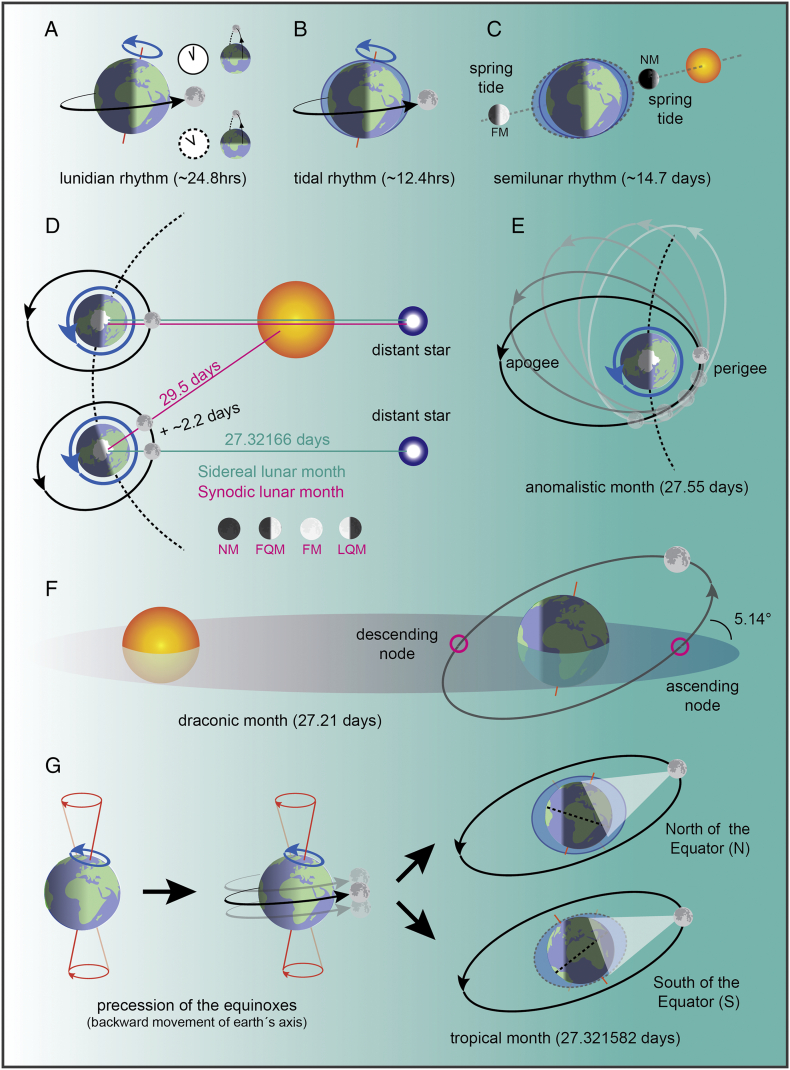
- Lunar geophysical cycles span hours to days: lunidian ~24.8 h, semilunar ~14.8 days, synodic ~29.5 days; other lunar months include sidereal 27.32166 days, anomalistic 27.55 days, draconic 27.212220 days, and tropical 27.321582 days.
- Circadian clock genes interact with lunar rhythms but not uniformly: in *Platynereis dumerilii*, free-running FM showed significantly higher mRNA for *pdp1*, *period*, *clock*, and *tim*; the CK1δ/ε inhibitor PF-670462 rendered clock gene transcription and locomotor activity arrhythmic but left monthly spawning unaffected. In *Eurydice pulchra*, circatidal timekeeping was independent of PER and TIM cycles, no circatidal oscillations were found in core clock genes, only *tim* showed a clear circadian profile, and peroxiredoxin plus 10 of 11 detected mitochondrial genes followed circatidal patterns.
- Endocrine and metabolic pathways are implicated: melatonin levels were reduced around FM in several fish, melatonin receptors and *aanat* showed lunar-phase-dependent expression, and *Platynereis* GnRH-like/corazonin1 was differentially expressed across the circalunar cycle.
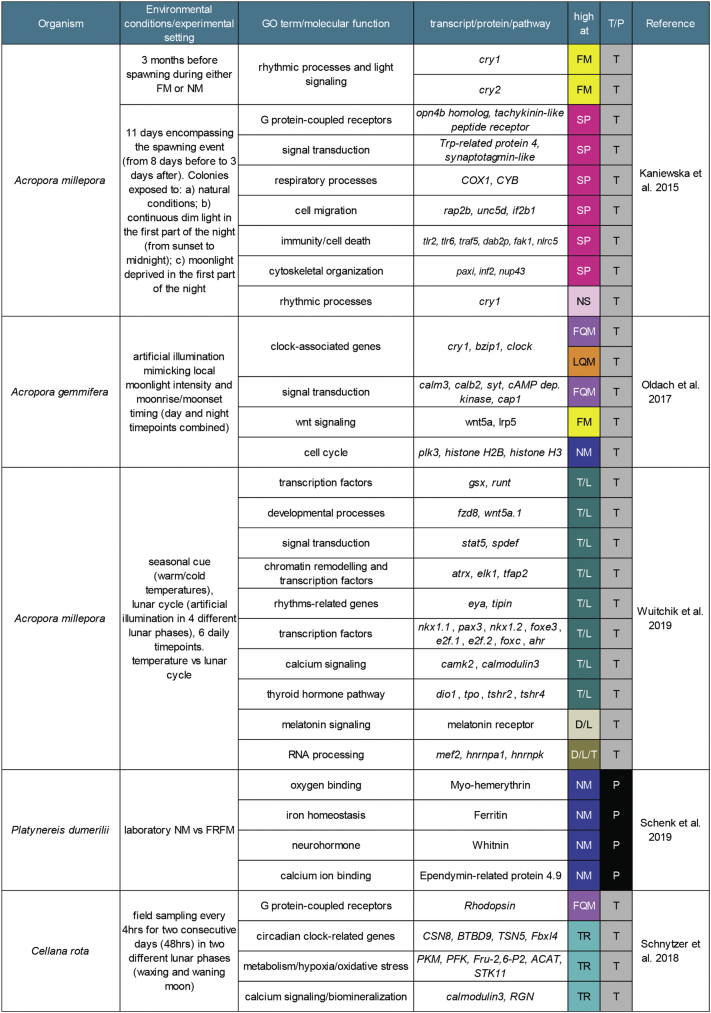
- High-throughput studies provide candidate markers: coral spawning transcriptomes showed downregulation of clock genes and upregulation of GPCR, calcium signaling, and respiratory genes; in *Platynereis* heads, about 25% of the analyzed proteome was differentially regulated between NM and free-running FM, a much higher circalunar regulation than at the transcript level.
Methods
- Narrative review, not a primary experimental study; it synthesizes behavioral, molecular, pharmacological, genetic linkage, transcriptomic, and proteomic findings across marine and terrestrial organisms.
- Data/sample: published literature on corals, *Platynereis dumerilii*, *Eurydice pulchra*, *Clunio marinus*, fish, mollusks, *Drosophila*, rodents, and humans, among others.
- Main analysis: compares experimental paradigms—natural versus artificial moonlight, free-running versus entrainment, field versus laboratory conditions—and highlights candidate pathways and molecular markers.
Limitations
- Stated: the underlying molecular mechanisms are largely obscure; species with well-documented behaviorally free-running lunar rhythms are not typically used for molecular studies; data variability likely arises from differing experimental regimes; current resolution may be insufficient to distinguish among different lunar cycles; laboratory versus field discrepancies exist; functional studies, knockouts, and transgenic models are needed.
- Stated: many interpretations require careful consideration of partly substantially differing experimental conditions, and some analyses, such as those on the HPG axis and lunar rhythmicity, are inconclusive.
- Evident: as a review, it reports no new primary data; cited studies show conflicting results, and many candidate mechanisms remain functionally untested.
Model-written summary. Check it against the paper before relying on it.
Integrity signals
Registry
Cites
Statistics
Figures
Verification
Claims the paper makes
58 Not checked yet · 25 Own interpretation · 10 No basis given
A conclusion the paper draws from its own results — it cites no other source for it, so there is none to check. The quote shows it is in the paper.
In the paper
“Thus, the underlying molecular mechanisms are largely obscure: the dark side of the moon.”
§ The Still Dark Side of the Moon: Molecular Mechanisms of Lunar-Controlled Rhythms and Clocks > Abstract
plain- Asserted: passes — The authors put it forward as true.
- Checkable: passes — It can be checked against evidence.
- Load-bearing: passes — The paper’s conclusions depend on it.
- Based: passes — The paper gives a reason why it holds.
In the paper
“In line with this, it is not surprising that lunar rhythms are widespread among marine species [3], especially those living in relatively shallow waters and coastal reef habitats.”
§ The Still Dark Side of the Moon: Molecular Mechanisms of Lunar-Controlled Rhythms and Clocks > The Moon Controls Rhythms of Physiology and Behavior
What the sources say
- Not checked yetcites [3] Raible F. Takekata H. Tessmar-Raible K. An overview of monthly rhythms and clocks Front. Neurol. 8 2017 1 14 10.3389/fneur.2017.00189 28553258 PMC5428424 source
plaincorrelational- Asserted: passes — The authors put it forward as true.
- Checkable: passes — It can be checked against evidence.
- Load-bearing: unclear — It is unclear whether the paper’s conclusions depend on it.
- Based: passes — The paper gives a reason why it holds.
The paper states this without a source or data behind it here, so there is nothing to check it against. The quote shows it is in the paper.
In the paper
“Starting with the beginning of the last century, a multitude of scientific studies has documented that the lunar cycle times behaviors and physiology in many organisms.”
§ The Still Dark Side of the Moon: Molecular Mechanisms of Lunar-Controlled Rhythms and Clocks > Abstract
boosteddirect- Asserted: passes — The authors put it forward as true.
- Checkable: passes — It can be checked against evidence.
- Load-bearing: passes — The paper’s conclusions depend on it.
- Based: unclear — It is unclear why the paper says it holds.
None of the sources cited for this claim have been checked yet.
In the paper
“However, it is interesting to report that potential effects of the anomalistic cycle on biological rhythmicity approximating the synodic month have been shown in Crassostrea gigas, both at the behavioral and reproductive levels [6,9].”
§ The Still Dark Side of the Moon: Molecular Mechanisms of Lunar-Controlled Rhythms and Clocks > The Moon Controls Rhythms of Physiology and Behavior
What the sources say
- Not checked yetcites [6] Tran D. Nadau A. Durrieu G. Ciret P. Parisot J.P. Massabuau J.C. Field chronobiology of a molluscan bivalve: how the moon and sun cycles interact to drive oyster activity rhythms Chronobiol. Int. 28 2011 307 317 10.3109/07420528.2011.565897 21539422 source
- Not checked yetcites [9] Bernard I. Massabuau J.C. Ciret P. Sow M. Sottolichio A. Pouvreau S. Tran D. In situ spawning in a marine broadcast spawner, the Pacific oyster Crassostrea gigas: timing and environmental triggers Limnol. Oceanogr. 61 2016 635 647 10.1002/lno.10240 source
hedgedconditional- Asserted: passes — The authors put it forward as true.
- Checkable: passes — It can be checked against evidence.
- Load-bearing: unclear — It is unclear whether the paper’s conclusions depend on it.
- Based: passes — The paper gives a reason why it holds.
In the paper
“As witnessed by the crew on Colombo's caravel, also in the Bermuda fireworm, Odontosyllis enopla, reproductive swarming occurs precisely during the first nights after FM in summer and early autumn [20].”
§ The Still Dark Side of the Moon: Molecular Mechanisms of Lunar-Controlled Rhythms and Clocks > The Moon Controls Rhythms of Physiology and Behavior
What the sources say
- Not checked yetcites [20] Fischer A. Fischer U. On the life-style and life-cycle of the luminescent polychaete Odontosyllis enopla (Annelida: Polychaeta) Invert. Biol. 114 2019 236 247 10.2307/3226878 source
plaincorrelational- Asserted: passes — The authors put it forward as true.
- Checkable: passes — It can be checked against evidence.
- Load-bearing: unclear — It is unclear whether the paper’s conclusions depend on it.
- Based: passes — The paper gives a reason why it holds.
None of the sources cited for this claim have been checked yet.
In the paper
“Like inside a shaken snow globe, once every year, the barrier reef explodes of eggs and sperms, few days after FM, during late spring/summer nights, a phenomenon even visible from the space [21,22].”
§ The Still Dark Side of the Moon: Molecular Mechanisms of Lunar-Controlled Rhythms and Clocks > The Moon Controls Rhythms of Physiology and Behavior
What the sources say
- Not checked yetcites [21] Babcock R.C. Bull G.D. Harrison P.L. Heyward A.J. Oliver J.K. Wallace C.C. Willis B.L. Synchronous spawnings of 105 scleractinian coral species on the Great Barrier Reef Mar. Biol. 90 1986 379 394 10.1007/BF00428562 source
- Not checked yetcites [22] Fogarty N.D. Marhaver K.L. Coral spawning, unsynchronized Science. 365 2019 987 988 10.1126/science.aay7457 31488677 source
plaincorrelational- Asserted: passes — The authors put it forward as true.
- Checkable: passes — It can be checked against evidence.
- Load-bearing: unclear — It is unclear whether the paper’s conclusions depend on it.
- Based: passes — The paper gives a reason why it holds.
A conclusion the paper draws from its own results — it cites no other source for it, so there is none to check. The quote shows it is in the paper.
In the paper
“This cycle is defined as semilunar (~ 14.8 days, half a lunar synodic cycle) and is probably mostly related to tidal phenomena rather than moonlight intensity”
§ The Still Dark Side of the Moon: Molecular Mechanisms of Lunar-Controlled Rhythms and Clocks > The Moon Controls Rhythms of Physiology and Behavior
hedgedconditional- Asserted: passes — The authors put it forward as true.
- Checkable: passes — It can be checked against evidence.
- Load-bearing: unclear — It is unclear whether the paper’s conclusions depend on it.
- Based: passes — The paper gives a reason why it holds.
The paper states this without a source or data behind it here, so there is nothing to check it against. The quote shows it is in the paper.
In the paper
“Evidence for internal circatital and circalunar oscillators exists for a range of species based on past behavioral studies”
§ The Still Dark Side of the Moon: Molecular Mechanisms of Lunar-Controlled Rhythms and Clocks > Abstract
plaincorrelational- Asserted: passes — The authors put it forward as true.
- Checkable: passes — It can be checked against evidence.
- Load-bearing: passes — The paper’s conclusions depend on it.
- Based: passes — The paper gives a reason why it holds.
A conclusion the paper draws from its own results — it cites no other source for it, so there is none to check. The quote shows it is in the paper.
In the paper
“as well as interactions between circadian and circatidal/circalunar rhythms.”
§ The Still Dark Side of the Moon: Molecular Mechanisms of Lunar-Controlled Rhythms and Clocks > Abstract
plaincorrelational- Asserted: passes — The authors put it forward as true.
- Checkable: passes — It can be checked against evidence.
- Load-bearing: passes — The paper’s conclusions depend on it.
- Based: passes — The paper gives a reason why it holds.
None of the sources cited for this claim have been checked yet.
In the paper
“Since the beginning of the 20th century, detailed scientific studies have shown that the reproductive behavior and sexual maturation of animals as diverse as corals, polychaetes, echinoderms or fishes are synchronized by the lunar cycle, reviewed in [2,3].”
§ The Still Dark Side of the Moon: Molecular Mechanisms of Lunar-Controlled Rhythms and Clocks > Route to the Moon: From Popular Beliefs to Scientific Knowledge
What the sources say
- Not checked yetcites [2] Tessmar-Raible K. Raible F. Arboleda E. Another place, another timer: marine species and the rhythms of life BioEssays. 33 2011 165 172 10.1002/bies.201000096 21254149 PMC3182551 source
- Not checked yetcites [3] Raible F. Takekata H. Tessmar-Raible K. An overview of monthly rhythms and clocks Front. Neurol. 8 2017 1 14 10.3389/fneur.2017.00189 28553258 PMC5428424 source
plaindirect- Asserted: passes — The authors put it forward as true.
- Checkable: passes — It can be checked against evidence.
- Load-bearing: unclear — It is unclear whether the paper’s conclusions depend on it.
- Based: passes — The paper gives a reason why it holds.
- It may state two separate claims as one. 26
- Probably not a substantial claim. 15
- The quote only partly states this claim. 1
None of the sources cited for this claim have been checked yet.
In the paper
“Unfortunately, reef corals are losing this critical reproductive synchrony, likely due to anthropogenic impact [22,23].”
§ The Still Dark Side of the Moon: Molecular Mechanisms of Lunar-Controlled Rhythms and Clocks > The Moon Controls Rhythms of Physiology and Behavior
What the sources say
- Not checked yetcites [22] Fogarty N.D. Marhaver K.L. Coral spawning, unsynchronized Science. 365 2019 987 988 10.1126/science.aay7457 31488677 source
- Not checked yetcites [23] Shlesinger T. Loya Y. Breakdown in spawning synchrony: a silent threat to coral persistence Science. 365 2019 1002 1007 10.1126/science.aax0110 31488683 source
hedgedconditional- Asserted: passes — The authors put it forward as true.
- Checkable: passes — It can be checked against evidence.
- Load-bearing: unclear — It is unclear whether the paper’s conclusions depend on it.
- Based: passes — The paper gives a reason why it holds.
It may state two separate claims as one.
The paper states this without a source or data behind it here, so there is nothing to check it against. The quote shows it is in the paper.
In the paper
“but those species with well-documented behaviorally free-running lunar rhythms are not typically used for molecular studies.”
§ The Still Dark Side of the Moon: Molecular Mechanisms of Lunar-Controlled Rhythms and Clocks > Abstract
plain- Asserted: passes — The authors put it forward as true.
- Checkable: passes — It can be checked against evidence.
- Load-bearing: passes — The paper’s conclusions depend on it.
- Based: fails — The paper may give no reason why it holds.
Probably not a substantial claim. The paper may give no reason why it holds.
The paper states this without a source or data behind it here, so there is nothing to check it against. The quote shows it is in the paper.
In the paper
“Consistently, many marine species exhibit lunar rhythms, and also the number of documented “lunar-rhythmic” terrestrial species is increasing.”
§ The Still Dark Side of the Moon: Molecular Mechanisms of Lunar-Controlled Rhythms and Clocks > Abstract
plain- Asserted: passes — The authors put it forward as true.
- Checkable: passes — It can be checked against evidence.
- Load-bearing: fails — The paper’s conclusions may not depend on it.
- Based: fails — The paper may give no reason why it holds.
Probably not a substantial claim. The paper’s conclusions may not depend on it. The paper may give no reason why it holds. It may state two separate claims as one.
A conclusion the paper draws from its own results — it cites no other source for it, so there is none to check. The quote shows it is in the paper.
In the paper
“As external fertilization is frequent among these animals, its synchronization with a reliable environmental cycle maximizes the probability that eggs and sperms encounter, and hence is critical for the survival of these species.”
§ The Still Dark Side of the Moon: Molecular Mechanisms of Lunar-Controlled Rhythms and Clocks > Route to the Moon: From Popular Beliefs to Scientific Knowledge
plaindirect- Asserted: passes — The authors put it forward as true.
- Checkable: passes — It can be checked against evidence.
- Load-bearing: fails — The paper’s conclusions may not depend on it.
- Based: passes — The paper gives a reason why it holds.
Probably not a substantial claim. The paper’s conclusions may not depend on it. It may state two separate claims as one.
A conclusion the paper draws from its own results — it cites no other source for it, so there is none to check. The quote shows it is in the paper.
In the paper
“In animals where the gonads contribute to a large proportion of the body mass, such as sea urchins or mussels, this effect is particularly prominent, leading indeed to significant changes in body mass”
§ The Still Dark Side of the Moon: Molecular Mechanisms of Lunar-Controlled Rhythms and Clocks > Route to the Moon: From Popular Beliefs to Scientific Knowledge
plaindirect- Asserted: passes — The authors put it forward as true.
- Checkable: passes — It can be checked against evidence.
- Load-bearing: fails — The paper’s conclusions may not depend on it.
- Based: fails — The paper may give no reason why it holds.
Probably not a substantial claim. The paper’s conclusions may not depend on it. The paper may give no reason why it holds.
In the paper
“In this case, the spawning occurred 17–18 days after mating, in a precise lunar phase, between LQM and NM [19].”
§ The Still Dark Side of the Moon: Molecular Mechanisms of Lunar-Controlled Rhythms and Clocks > The Moon Controls Rhythms of Physiology and Behavior
What the sources say
- Not checked yetcites [19] A.M. Adamczewska, S. Morris, Ecology and behavior of Gecarcoidea natalis, the Christmas Island red crab, during the annual breeding migration, (2001) 305–320. 11441973 source
plaincorrelational- Asserted: passes — The authors put it forward as true.
- Checkable: passes — It can be checked against evidence.
- Load-bearing: unclear — It is unclear whether the paper’s conclusions depend on it.
- Based: passes — The paper gives a reason why it holds.
It may state two separate claims as one.
A conclusion the paper draws from its own results — it cites no other source for it, so there is none to check. The quote shows it is in the paper.
In the paper
“Moreover, recent high-throughput analyses provide useful leads toward pathways, as well as molecular markers.”
§ The Still Dark Side of the Moon: Molecular Mechanisms of Lunar-Controlled Rhythms and Clocks > Abstract
plaincorrelational- Asserted: passes — The authors put it forward as true.
- Checkable: fails — It may be too vague to check against evidence.
- Load-bearing: fails — The paper’s conclusions may not depend on it.
- Based: passes — The paper gives a reason why it holds.
Probably not a substantial claim. It may be too vague to check against evidence. The paper’s conclusions may not depend on it.
None of the sources cited for this claim have been checked yet.
In the paper
“The anomalistic cycle, modulating the proximity of our satellite to earth, can impact for instance on tides amplitude during the synodic month (spring–neap tides cycle, 14.76 days), although slightly out of phase (13.78 days from perigee to apogee) [5,7].”
§ The Still Dark Side of the Moon: Molecular Mechanisms of Lunar-Controlled Rhythms and Clocks > The Moon Controls Rhythms of Physiology and Behavior
What the sources say
- Not checked yetcites [5] Coughenour C.L. Archer A.W. Lacovara K.J. Tides, tidalites, and secular changes in the earth–moon system Earth-Science Rev. 97 2009 59 79 10.1016/j.earscirev.2009.09.002 source
- Not checked yetcites [7] Kvale E.P. The origin of neap–spring tidal cycles Mar. Geol. 235 2006 5 18 10.1016/j.margeo.2006.10.001 source
plainconditional- Asserted: passes — The authors put it forward as true.
- Checkable: passes — It can be checked against evidence.
- Load-bearing: fails — The paper’s conclusions may not depend on it.
- Based: passes — The paper gives a reason why it holds.
Probably not a substantial claim. The paper’s conclusions may not depend on it.
The paper states this without a source or data behind it here, so there is nothing to check it against. The quote shows it is in the paper.
In the paper
“Organisms follow diverse lunar geophysical/astronomical rhythms, which differ significantly in terms of period length: from hours (circalunidian and circatidal rhythms) to days (circasemilunar and circalunar cycles).”
§ The Still Dark Side of the Moon: Molecular Mechanisms of Lunar-Controlled Rhythms and Clocks > Abstract
plaincorrelational- Asserted: passes — The authors put it forward as true.
- Checkable: passes — It can be checked against evidence.
- Load-bearing: fails — The paper’s conclusions may not depend on it.
- Based: passes — The paper gives a reason why it holds.
Probably not a substantial claim. The paper’s conclusions may not depend on it.
A conclusion the paper draws from its own results — it cites no other source for it, so there is none to check. The quote shows it is in the paper.
In the paper
“While for short and long lunar period lengths marine examples are very well established, this is less clear for terrestrial organisms.”
§ The Still Dark Side of the Moon: Molecular Mechanisms of Lunar-Controlled Rhythms and Clocks > The Moon Controls Rhythms of Physiology and Behavior
boosted- Asserted: passes — The authors put it forward as true.
- Checkable: passes — It can be checked against evidence.
- Load-bearing: fails — The paper’s conclusions may not depend on it.
- Based: fails — The paper may give no reason why it holds.
Probably not a substantial claim. The paper’s conclusions may not depend on it. The paper may give no reason why it holds. It may state two separate claims as one.
In the paper
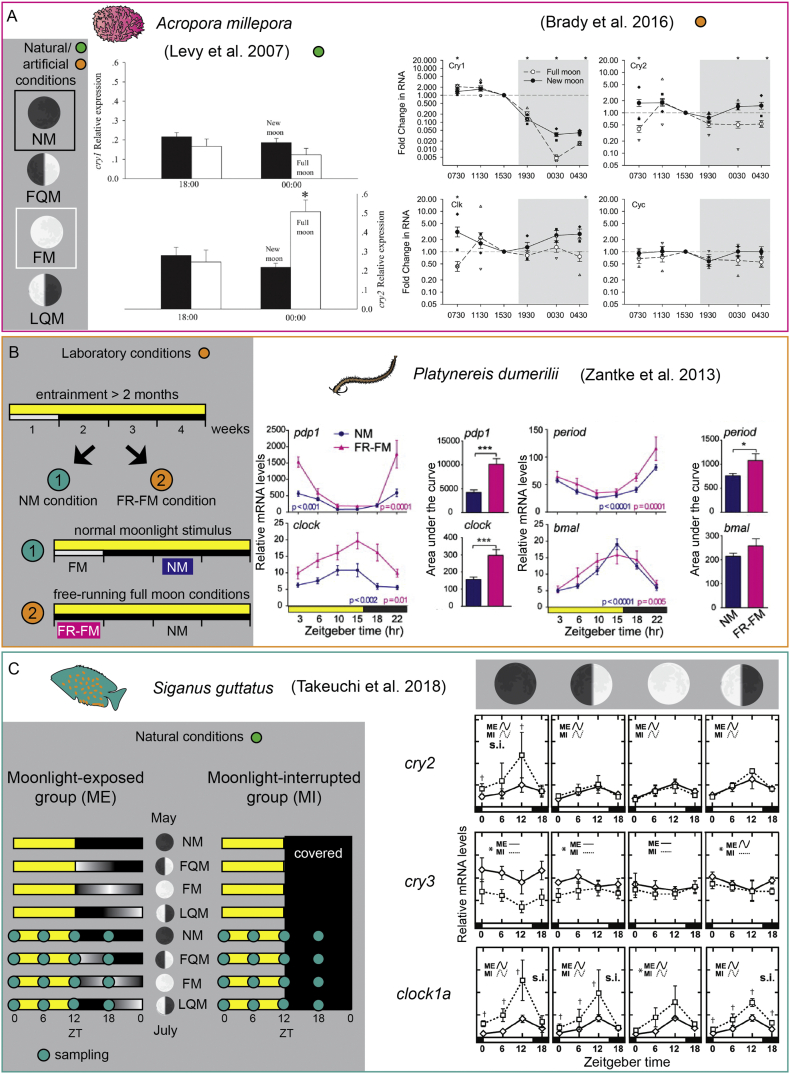
“Most of the genes analyzed showed similar circadian expression profiles in the two different lunar phases, but significantly higher mRNA levels during FR-FM were found for pdp1, period, clock, and tim (see Figure 2), suggesting that a subset of circadian clock transcripts is affected by the circalunar clock, independently of nocturnal light cues.”
§ The Still Dark Side of the Moon: Molecular Mechanisms of Lunar-Controlled Rhythms and Clocks > Core Circadian Clock Genes and Lunar-Regulated Processes: Are There Connections? > Circalunar rhythms and clocks
What the sources say
- Not checked yetcites [28] Zantke J. Ishikawa-Fujiwara T. Arboleda E. Lohs C. Schipany K. Hallay N. Straw A.D. Todo T. Circadian and circalunar clock interactions in a marine annelid Cell Rep. 5 2013 99 113 10.1016/j.celrep.2013.08.031 24075994 PMC3913041 source
hedgedcorrelational- Asserted: passes — The authors put it forward as true.
- Checkable: passes — It can be checked against evidence.
- Load-bearing: passes — The paper’s conclusions depend on it.
- Based: passes — The paper gives a reason why it holds.
It may state two separate claims as one.
A conclusion the paper draws from its own results — it cites no other source for it, so there is none to check. The quote shows it is in the paper.
In the paper
“These data suggest that the integration of multiple environmental features and/or the specific light spectrum of sunlight and moonlight might affect the expression of these genes.”
§ The Still Dark Side of the Moon: Molecular Mechanisms of Lunar-Controlled Rhythms and Clocks > Core Circadian Clock Genes and Lunar-Regulated Processes: Are There Connections? > Circalunar rhythms and clocks
hedgedconditional- Asserted: passes — The authors put it forward as true.
- Checkable: passes — It can be checked against evidence.
- Load-bearing: passes — The paper’s conclusions depend on it.
- Based: passes — The paper gives a reason why it holds.
It may state two separate claims as one.
A conclusion the paper draws from its own results — it cites no other source for it, so there is none to check. The quote shows it is in the paper.
In the paper
“In spite of the increasing literature, the elucidation of the mechanisms underlying circalunar/circasemilunar and circatidal/circalunidian rhythms is still at an early stage.”
§ The Still Dark Side of the Moon: Molecular Mechanisms of Lunar-Controlled Rhythms and Clocks > Core Circadian Clock Genes and Lunar-Regulated Processes: Are There Connections?
plain- Asserted: passes — The authors put it forward as true.
- Checkable: passes — It can be checked against evidence.
- Load-bearing: passes — The paper’s conclusions depend on it.
- Based: fails — The paper may give no reason why it holds.
Probably not a substantial claim. The paper may give no reason why it holds.
In the paper
“In this species, the circalunar clock seems to also affect locomotor activity levels, with worms showing a weaker circadian rhythmicity during free-running FM (FR-FM) compared to NM.”
§ The Still Dark Side of the Moon: Molecular Mechanisms of Lunar-Controlled Rhythms and Clocks > Core Circadian Clock Genes and Lunar-Regulated Processes: Are There Connections? > Circalunar rhythms and clocks
What the sources say
- Not checked yetcites [28] Zantke J. Ishikawa-Fujiwara T. Arboleda E. Lohs C. Schipany K. Hallay N. Straw A.D. Todo T. Circadian and circalunar clock interactions in a marine annelid Cell Rep. 5 2013 99 113 10.1016/j.celrep.2013.08.031 24075994 PMC3913041 source
hedgedconditional- Asserted: passes — The authors put it forward as true.
- Checkable: passes — It can be checked against evidence.
- Load-bearing: unclear — It is unclear whether the paper’s conclusions depend on it.
- Based: passes — The paper gives a reason why it holds.
It may state two separate claims as one.
None of the sources cited for this claim have been checked yet.
In the paper
“Before this time, the scientific literature is rich in examples of other rhythms, including tidal and monthly. Those were mainly focused on behavioral observations and include many studies that provide evidence for free-running rhythms (for overviews, see [24,25]).”
§ The Still Dark Side of the Moon: Molecular Mechanisms of Lunar-Controlled Rhythms and Clocks > The Moon Controls Rhythms of Physiology and Behavior
What the sources say
- Not checked yetcites [24] Fingerman M. Lunar rhythmicity in marine organisms Am. Nat. 91 1957 167 178 source
- Not checked yetcites [25] Numata H. Helm B. Annual, Lunar, and Tidal Clocks: Patterns and Mechanisms of Nature’s Enigmatic Rhythms 2014 Springer
plaincorrelational- Asserted: passes — The authors put it forward as true.
- Checkable: passes — It can be checked against evidence.
- Load-bearing: unclear — It is unclear whether the paper’s conclusions depend on it.
- Based: passes — The paper gives a reason why it holds.
It may state two separate claims as one.
In the paper
“In the reef-building coral Acropora millepora, which reproduces once every year integrating both seasonal, lunar and daily cues, natural FM, as well as artificial night illumination mimicking FM, have been shown to impact on clock genes expression.”
§ The Still Dark Side of the Moon: Molecular Mechanisms of Lunar-Controlled Rhythms and Clocks > Core Circadian Clock Genes and Lunar-Regulated Processes: Are There Connections? > Circalunar rhythms and clocks
What the sources say
- Not checked yetcites [26] Levy O. Appelbaum L. Leggat W. Gothlif Y. Hayward D.C. Miller D.J. Hoegh-Guldberg O. Light-responsive cryptochromes from a simple multicellular animal, the coral Acropora millepora Science. 318 2007 467 470 10.1126/science.1145432 17947585 source
boosteddirect- Asserted: passes — The authors put it forward as true.
- Checkable: passes — It can be checked against evidence.
- Load-bearing: passes — The paper’s conclusions depend on it.
- Based: passes — The paper gives a reason why it holds.
It may state two separate claims as one.
In the paper
“Both cry1 and cry2 were expressed in the ectodermal layer of larvae and adults, and their mRNA levels peaked during daylight phases.”
§ The Still Dark Side of the Moon: Molecular Mechanisms of Lunar-Controlled Rhythms and Clocks > Core Circadian Clock Genes and Lunar-Regulated Processes: Are There Connections? > Circalunar rhythms and clocks
What the sources say
- Not checked yetcites [26] Levy O. Appelbaum L. Leggat W. Gothlif Y. Hayward D.C. Miller D.J. Hoegh-Guldberg O. Light-responsive cryptochromes from a simple multicellular animal, the coral Acropora millepora Science. 318 2007 467 470 10.1126/science.1145432 17947585 source
plaincorrelational- Asserted: passes — The authors put it forward as true.
- Checkable: passes — It can be checked against evidence.
- Load-bearing: unclear — It is unclear whether the paper’s conclusions depend on it.
- Based: passes — The paper gives a reason why it holds.
It may state two separate claims as one.
None of the sources cited for this claim have been checked yet.
In the paper
“For instance, only cry1 (but not cry2) was affected by exposure to DD, whereas, although not significantly, cry2 increased under natural moonlight compared to the artificial one during both LQM and FM [27,31].”
§ The Still Dark Side of the Moon: Molecular Mechanisms of Lunar-Controlled Rhythms and Clocks > Core Circadian Clock Genes and Lunar-Regulated Processes: Are There Connections? > Circalunar rhythms and clocks
What the sources say
- Not checked yetcites [27] Brady A.K. Willis B.L. Harder L.D. Vize P.D. Lunar phase modulates circadian gene expression cycles in the broadcast spawning coral Acropora millepora Biol. Bull. 230 2016 130 142 10.1086/BBLv230n2p130 27132135 source
- Not checked yetcites [31] Brady A.K. Snyder K.A. Vize P.D. Circadian cycles of gene expression in the coral, Acropora millepora PLoS One 6 2011 10.1371/journal.pone.0025072 PMC3176305 21949855 source
hedgeddirect- Asserted: passes — The authors put it forward as true.
- Checkable: passes — It can be checked against evidence.
- Load-bearing: unclear — It is unclear whether the paper’s conclusions depend on it.
- Based: passes — The paper gives a reason why it holds.
It may state two separate claims as one. The quote only partly states this claim.
A conclusion the paper draws from its own results — it cites no other source for it, so there is none to check. The quote shows it is in the paper.
In the paper
“This phenomenon threatens several species, not only corals, but entire reef communities.”
§ The Still Dark Side of the Moon: Molecular Mechanisms of Lunar-Controlled Rhythms and Clocks > The Moon Controls Rhythms of Physiology and Behavior
plaindirect- Asserted: passes — The authors put it forward as true.
- Checkable: passes — It can be checked against evidence.
- Load-bearing: unclear — It is unclear whether the paper’s conclusions depend on it.
- Based: passes — The paper gives a reason why it holds.
It may state two separate claims as one.
A conclusion the paper draws from its own results — it cites no other source for it, so there is none to check. The quote shows it is in the paper.
In the paper
“These and other data reported in this review suggest a high level of data variability, likely due to differences in experimental regimes, as well as strong environmental and possibly population variability.”
§ The Still Dark Side of the Moon: Molecular Mechanisms of Lunar-Controlled Rhythms and Clocks > Core Circadian Clock Genes and Lunar-Regulated Processes: Are There Connections? > Circalunar rhythms and clocks
hedgedconditional- Asserted: passes — The authors put it forward as true.
- Checkable: passes — It can be checked against evidence.
- Load-bearing: passes — The paper’s conclusions depend on it.
- Based: passes — The paper gives a reason why it holds.
It may state two separate claims as one.
In the paper
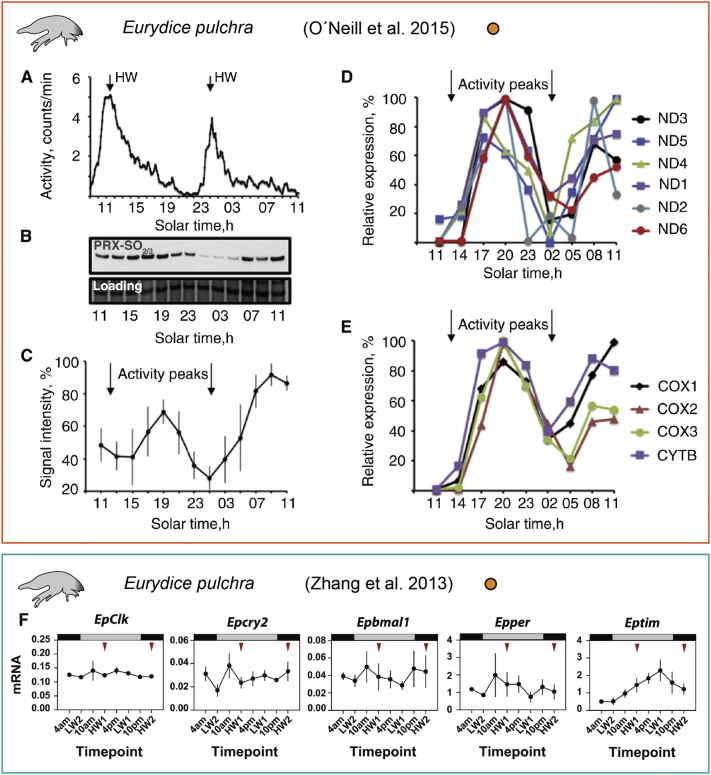
“This intertidal isopod showed robust tidal rhythmicity after being caught in the wild and released in DD, suggesting the existence of a true circatidal endogenous oscillator.”
§ The Still Dark Side of the Moon: Molecular Mechanisms of Lunar-Controlled Rhythms and Clocks > Core Circadian Clock Genes and Lunar-Regulated Processes: Are There Connections? > Circatidal rhythms and clocks
What the sources say
- Not checked yetcites [10] Zhang L. Hastings M.H. Green E.W. Tauber E. Sladek M. Webster S.G. Kyriacou C.P. Wilcockson D.C. Dissociation of circadian and circatidal timekeeping in the marine crustacean Eurydice pulchra Curr. Biol. 23 2013 1863 1873 10.1016/j.cub.2013.08.038 24076244 PMC3793863 source
hedgedconditional- Asserted: passes — The authors put it forward as true.
- Checkable: passes — It can be checked against evidence.
- Load-bearing: passes — The paper’s conclusions depend on it.
- Based: passes — The paper gives a reason why it holds.
It may state two separate claims as one.
In the paper
“Furthermore, circadian rhythm disruption through LL exposure affected neither the tidal swimming period nor overall activity levels [10].”
§ The Still Dark Side of the Moon: Molecular Mechanisms of Lunar-Controlled Rhythms and Clocks > Core Circadian Clock Genes and Lunar-Regulated Processes: Are There Connections? > Circatidal rhythms and clocks
What the sources say
- Not checked yetcites [10] Zhang L. Hastings M.H. Green E.W. Tauber E. Sladek M. Webster S.G. Kyriacou C.P. Wilcockson D.C. Dissociation of circadian and circatidal timekeeping in the marine crustacean Eurydice pulchra Curr. Biol. 23 2013 1863 1873 10.1016/j.cub.2013.08.038 24076244 PMC3793863 source
plain- Asserted: passes — The authors put it forward as true.
- Checkable: passes — It can be checked against evidence.
- Load-bearing: passes — The paper’s conclusions depend on it.
- Based: passes — The paper gives a reason why it holds.
It may state two separate claims as one.
The paper states this without a source or data behind it here, so there is nothing to check it against. The quote shows it is in the paper.
In the paper
“Circatidal clocks and their relation with circadian clocks are particularly interesting, because in essence a 12.4 h period is just half of 24.8 h, i.e. a period covered by the conventional core circadian clock network.”
§ The Still Dark Side of the Moon: Molecular Mechanisms of Lunar-Controlled Rhythms and Clocks > Core Circadian Clock Genes and Lunar-Regulated Processes: Are There Connections? > Circatidal rhythms and clocks
plaincorrelational- Asserted: passes — The authors put it forward as true.
- Checkable: passes — It can be checked against evidence.
- Load-bearing: fails — The paper’s conclusions may not depend on it.
- Based: passes — The paper gives a reason why it holds.
Probably not a substantial claim. The paper’s conclusions may not depend on it. It may state two separate claims as one.
In the paper
“Genetic linkage analysis identified two specific chromosomal regions responsible for diurnal emergence and two related to lunar timing.”
§ The Still Dark Side of the Moon: Molecular Mechanisms of Lunar-Controlled Rhythms and Clocks > Core Circadian Clock Genes and Lunar-Regulated Processes: Are There Connections? > Circalunar rhythms and clocks
What the sources say
- Not checked yetcites [46] Kaiser T.S. Poehn B. Szkiba D. Preussner M. Sedlazeck F.J. Zrim A. Neumann T. Nguyen L.T. The genomic basis of circadian and circalunar timing adaptations in a midge Nature. 540 2016 69 73 10.1038/nature20151 27871090 PMC5133387 source
plaindirect- Asserted: passes — The authors put it forward as true.
- Checkable: passes — It can be checked against evidence.
- Load-bearing: passes — The paper’s conclusions depend on it.
- Based: passes — The paper gives a reason why it holds.
It may state two separate claims as one.
A conclusion the paper draws from its own results — it cites no other source for it, so there is none to check. The quote shows it is in the paper.
In the paper
“Thus, the data presented might actually suggest the presence of both a photo-repressive mechanism and an endogenous clock contributing together to the circalunar timing.”
§ The Still Dark Side of the Moon: Molecular Mechanisms of Lunar-Controlled Rhythms and Clocks > Core Circadian Clock Genes and Lunar-Regulated Processes: Are There Connections? > Circalunar rhythms and clocks
hedgedconditional- Asserted: passes — The authors put it forward as true.
- Checkable: passes — It can be checked against evidence.
- Load-bearing: passes — The paper’s conclusions depend on it.
- Based: passes — The paper gives a reason why it holds.
It may state two separate claims as one.
In the paper
“In spite of the observed phase delay, the amplitude of tidal oscillations was robust and comparable to the untreated control.”
§ The Still Dark Side of the Moon: Molecular Mechanisms of Lunar-Controlled Rhythms and Clocks > Core Circadian Clock Genes and Lunar-Regulated Processes: Are There Connections? > Circatidal rhythms and clocks
What the sources say
- Not checked yetcites [10] Zhang L. Hastings M.H. Green E.W. Tauber E. Sladek M. Webster S.G. Kyriacou C.P. Wilcockson D.C. Dissociation of circadian and circatidal timekeeping in the marine crustacean Eurydice pulchra Curr. Biol. 23 2013 1863 1873 10.1016/j.cub.2013.08.038 24076244 PMC3793863 source
plain- Asserted: passes — The authors put it forward as true.
- Checkable: passes — It can be checked against evidence.
- Load-bearing: passes — The paper’s conclusions depend on it.
- Based: passes — The paper gives a reason why it holds.
It may state two separate claims as one.
In the paper
“Moreover, per4 showed a robust oscillation over the lunar cycle under all the light regimes, but in antiphase compared to cry3.”
§ The Still Dark Side of the Moon: Molecular Mechanisms of Lunar-Controlled Rhythms and Clocks > Core Circadian Clock Genes and Lunar-Regulated Processes: Are There Connections? > Circalunar rhythms and clocks
What the sources say
- Not checked yetcites [50] Toda R. Okano K. Takeuchi Y. Yamauchi C. Fukushiro M. Takemura A. Okano T. Hypothalamic expression and moonlight-independent changes of Cry3 and Per4 implicate their roles in lunar clock oscillators of the lunar-responsive goldlined spinefoot PLoS One 9 2014 10.1371/journal.pone.0109119 PMC4182804 25272159 source
plaincorrelational- Asserted: passes — The authors put it forward as true.
- Checkable: passes — It can be checked against evidence.
- Load-bearing: passes — The paper’s conclusions depend on it.
- Based: passes — The paper gives a reason why it holds.
It may state two separate claims as one.
A conclusion the paper draws from its own results — it cites no other source for it, so there is none to check. The quote shows it is in the paper.
In the paper
“These data potentially indicate the existence of a circatidal clock in the grass puffer brain, which, together with the circadian clock, might contribute to set the proper daily and lunar-related reproductive rhythms.”
§ The Still Dark Side of the Moon: Molecular Mechanisms of Lunar-Controlled Rhythms and Clocks > Circalunar Rhythms and Clocks: An Endocrine Perspective > Melatonin
hedgedconditional- Asserted: passes — The authors put it forward as true.
- Checkable: passes — It can be checked against evidence.
- Load-bearing: passes — The paper’s conclusions depend on it.
- Based: passes — The paper gives a reason why it holds.
It may state two separate claims as one.
In the paper
“Thus, the authors suggested that peaks of PRX activity and mitochondrially encoded transcript levels might anticipate changes in the energy demand and reactive oxygen species production originating from the prevailing metabolic program, following in this case a circatidal rest/activity rhythm.”
§ The Still Dark Side of the Moon: Molecular Mechanisms of Lunar-Controlled Rhythms and Clocks > Core Circadian Clock Genes and Lunar-Regulated Processes: Are There Connections? > Circatidal rhythms and clocks
What the sources say
- Not checked yetcites [54] O’Neill J.S. Lee K.D. Zhang L. Feeney K. Webster S.G. Blades M.J. Kyriacou C.P. Hastings M.H. Metabolic molecular markers of the tidal clock in the marine crustacean Eurydice pulchra Curr. Biol. 25 2015 R326 R327 10.1016/j.cub.2015.02.052 25898100 PMC4406942 source
hedgedconditionalSingle case- Asserted: passes — The authors put it forward as true.
- Checkable: passes — It can be checked against evidence.
- Load-bearing: passes — The paper’s conclusions depend on it.
- Based: passes — The paper gives a reason why it holds.
Probably not a substantial claim.
None of the sources cited for this claim have been checked yet.
In the paper
“Moreover, melatonin synthesis is exquisitely light sensitive, inhibited by light exposure, and fueled in the dark [48,58,59]”
§ The Still Dark Side of the Moon: Molecular Mechanisms of Lunar-Controlled Rhythms and Clocks > Circalunar Rhythms and Clocks: An Endocrine Perspective > Melatonin
What the sources say
- Not checked yetcites [48] Takemura A. Susilo E.S. Rahman M.D.S. Morita M. Perception and possible utilization of moonlight intensity for reproductive activities in a lunar-synchronized spawner, the golden rabbitfish J. Exp. Zool. Part A Comp. Exp. Biol. 301 2004 844 851 10.1002/jez.a.105 15449345 source
- Not checked yetcites [58] Rahman M.S. Kim B.H. Takemura A. Park C.B. Lee Y.D. Effects of moonlight exposure on plasma melatonin rhythms in the seagrass rabbitfish, Siganus canaliculatus J. Biol. Rhythm. 19 2004 325 334 10.1177/0748730404266712 15245651 source
- Not checked yetcites [59] Rahman M.S. Kim B.H. Takemura A. Park C.B. Lee Y.D. Influence of light-dark and lunar cycles on the ocular melatonin rhythms in the seagrass rabbitfish, a lunar-synchronized spawner J. Pineal Res. 37 2004 122 128 10.1111/j.1600-079X.2004.00147.x 15298671 source
boosteddirect- Asserted: passes — The authors put it forward as true.
- Checkable: passes — It can be checked against evidence.
- Load-bearing: passes — The paper’s conclusions depend on it.
- Based: passes — The paper gives a reason why it holds.
It may state two separate claims as one.
The paper states this without a source or data behind it here, so there is nothing to check it against. The quote shows it is in the paper.
In the paper
“Given its role as an endocrine mediator of other light-dependent rhythms (daily/circadian, i.e. daily sleep–wake cycle) in vertebrates, also melatonin has been suggested as a potential component of the molecular mechanisms contributing to lunar-regulated rhythms.”
§ The Still Dark Side of the Moon: Molecular Mechanisms of Lunar-Controlled Rhythms and Clocks > Circalunar Rhythms and Clocks: An Endocrine Perspective > Melatonin
hedgedconditional- Asserted: passes — The authors put it forward as true.
- Checkable: passes — It can be checked against evidence.
- Load-bearing: fails — The paper’s conclusions may not depend on it.
- Based: passes — The paper gives a reason why it holds.
Probably not a substantial claim. The paper’s conclusions may not depend on it.
None of the sources cited for this claim have been checked yet.
In the paper
“The period of these oscillations was consistent with swimming activity and respiratory rate tidal cycles, which peak around high tides [54,56].”
§ The Still Dark Side of the Moon: Molecular Mechanisms of Lunar-Controlled Rhythms and Clocks > Core Circadian Clock Genes and Lunar-Regulated Processes: Are There Connections? > Circatidal rhythms and clocks
What the sources say
- Not checked yetcites [54] O’Neill J.S. Lee K.D. Zhang L. Feeney K. Webster S.G. Blades M.J. Kyriacou C.P. Hastings M.H. Metabolic molecular markers of the tidal clock in the marine crustacean Eurydice pulchra Curr. Biol. 25 2015 R326 R327 10.1016/j.cub.2015.02.052 25898100 PMC4406942 source
- Not checked yetcites [56] Hastings M.H. Semi-lunar variations of endogenous circa-tidal rhythms of activity and respiration in the isopod Eurydice pulchra Mar. Ecol Prog Ser. 4 1981 85 90 10.3354/meps004085 source
plaincorrelational- Asserted: passes — The authors put it forward as true.
- Checkable: passes — It can be checked against evidence.
- Load-bearing: passes — The paper’s conclusions depend on it.
- Based: passes — The paper gives a reason why it holds.
It may state two separate claims as one.
None of the sources cited for this claim have been checked yet.
In the paper
“Taking all above findings together might start to indicate that the circadian clockwork could be more plastic than previously thought and capable to adjust to the environmental cycle(s) most relevant for a given species [53,54,57].”
§ The Still Dark Side of the Moon: Molecular Mechanisms of Lunar-Controlled Rhythms and Clocks > Core Circadian Clock Genes and Lunar-Regulated Processes: Are There Connections? > Circatidal rhythms and clocks
What the sources say
- Not checked yetcites [53] Tran D. Perrigault M. Ciret P. Payton L. Bivalve mollusc circadian clock genes can run at tidal frequency Proc. Biol. Sci. 287 2020 20192440 10.1098/rspb.2019.2440 31910786 PMC7003461
- Not checked yetcites [54] O’Neill J.S. Lee K.D. Zhang L. Feeney K. Webster S.G. Blades M.J. Kyriacou C.P. Hastings M.H. Metabolic molecular markers of the tidal clock in the marine crustacean Eurydice pulchra Curr. Biol. 25 2015 R326 R327 10.1016/j.cub.2015.02.052 25898100 PMC4406942 source
- Not checked yetcites [57] Schnytzer Y. Simon-Blecher N. Li J. Ben-Asher H.W. Salmon-Divon M. Achituv Y. Hughes M.E. Levy O. Tidal and diel orchestration of behaviour and gene expression in an intertidal mollusc Sci. Rep. 8 2018 1 13 10.1038/s41598-018-23167-y 29559663 PMC5861051 source
hedgedconditional- Asserted: passes — The authors put it forward as true.
- Checkable: passes — It can be checked against evidence.
- Load-bearing: passes — The paper’s conclusions depend on it.
- Based: passes — The paper gives a reason why it holds.
It may state two separate claims as one.
A conclusion the paper draws from its own results — it cites no other source for it, so there is none to check. The quote shows it is in the paper.
In the paper
“This lack of both circatidal and circadian rhythmicity in clock gene expression is also conceivable with the idea that specific subsets of the core circadian clock might be differentially recruited in a tissue-dependent manner, and depending on cellular context form circadian, circatidal, or circalunidian clocks.”
§ The Still Dark Side of the Moon: Molecular Mechanisms of Lunar-Controlled Rhythms and Clocks > Core Circadian Clock Genes and Lunar-Regulated Processes: Are There Connections? > Circatidal rhythms and clocks
hedgedconditionalSingle case- Asserted: passes — The authors put it forward as true.
- Checkable: passes — It can be checked against evidence.
- Load-bearing: fails — The paper’s conclusions may not depend on it.
- Based: passes — The paper gives a reason why it holds.
Probably not a substantial claim. The paper’s conclusions may not depend on it.
The paper states this without a source or data behind it here, so there is nothing to check it against. The quote shows it is in the paper.
In the paper
“Laboratory studies provide a better control of the multitude of environmental variables present in nature, allowing the investigation of the single contributions of a certain cue”
§ The Still Dark Side of the Moon: Molecular Mechanisms of Lunar-Controlled Rhythms and Clocks > Perspectives
plaindirect- Asserted: passes — The authors put it forward as true.
- Checkable: passes — It can be checked against evidence.
- Load-bearing: fails — The paper’s conclusions may not depend on it.
- Based: fails — The paper may give no reason why it holds.
Probably not a substantial claim. The paper’s conclusions may not depend on it. The paper may give no reason why it holds.
The paper states this without a source or data behind it here, so there is nothing to check it against. The quote shows it is in the paper.
In the paper
“the generation of knockouts and transgenic animals clearly allow for a detailed functional dissection that is difficult to meet with other methods”
§ The Still Dark Side of the Moon: Molecular Mechanisms of Lunar-Controlled Rhythms and Clocks > Perspectives
boosteddirect- Asserted: passes — The authors put it forward as true.
- Checkable: passes — It can be checked against evidence.
- Load-bearing: passes — The paper’s conclusions depend on it.
- Based: fails — The paper may give no reason why it holds.
Probably not a substantial claim. The paper may give no reason why it holds.
None of the sources cited for this claim have been checked yet.
In the paper
“complex chronobiological changes likely caused by anthropogenic impacts (i.e. light pollution, temperature changes, architectural barriers) that are endangering the world's ecosystems as we know them [22,23], and possibly human health”
§ The Still Dark Side of the Moon: Molecular Mechanisms of Lunar-Controlled Rhythms and Clocks > Perspectives
What the sources say
- Not checked yetcites [22] Fogarty N.D. Marhaver K.L. Coral spawning, unsynchronized Science. 365 2019 987 988 10.1126/science.aay7457 31488677 source
- Not checked yetcites [23] Shlesinger T. Loya Y. Breakdown in spawning synchrony: a silent threat to coral persistence Science. 365 2019 1002 1007 10.1126/science.aax0110 31488683 source
hedgedconditional- Asserted: passes — The authors put it forward as true.
- Checkable: passes — It can be checked against evidence.
- Load-bearing: passes — The paper’s conclusions depend on it.
- Based: passes — The paper gives a reason why it holds.
It may state two separate claims as one.
The paper relies on this without support.
Life has evolved equally long under both lunar and solar influences.
“As the moon formed about 4.51 billion years ago, life evolved equally long under both lunar and solar influences”
The paper relies on this without support.
The lunar cycle is a reliable and steady environmental cue.
“Animals exploit reliable and steady environmental cues to synchronize crucial events of their life”
Claims other papers make about this one
Each is checked against this paper’s own text: does it say what the citing paper says it does?
The cited source says what the claim attributes to it.
In the citing paper
“The Moon exhibits three different cycles that affect moonlight intensity and gravity on Earth and that are illustrated in Fig. 1 [see also figure 1 in the work by Andreatta and Tessmar-Raible (5)].”
From Women temporarily synchronize their menstrual cycles with the luminance and gravimetric cycles of the Moon (2021) · cites this paper as [5]
The cited source says what the claim attributes to it.
In the citing paper
“In many marine species (1–5) and some terrestrial species (6–9), reproductive behavior is synchronized with a particular phase of the lunar cycle (often full or new moon).”
From Women temporarily synchronize their menstrual cycles with the luminance and gravimetric cycles of the Moon (2021) · cites this paper as [5]
Self-check
Percentages, sums and reported differences re-computed from the paper’s own numbers.
Each contradiction between two passages listed here was confirmed by an independent check.
Rated minor: it would not touch a result — a value no result rests on, a p-value that stays on the same side of the significance level, or a conflict that is clerical, resolved elsewhere in the paper, or outside its own findings.
In the paper
§ The Still Dark Side of the Moon: Molecular Mechanisms of Lunar-Controlled Rhythms and Clocks > Circalunar Rhythms and Clocks: An Endocrine Perspective > Melatonin
“arylalkylamine N-acetyltransferase (aanat, enzyme involved in melatonin synthesis) in the retina were reduced during FM nights compared to NM in the grass puffer [62,63].”
§ The Still Dark Side of the Moon: Molecular Mechanisms of Lunar-Controlled Rhythms and Clocks > References
“62. Kashiwagi T. Park Y.J. Park J.G. Imamura S. Takeuchi Y. Hur S.P. Takemura A. Moonlight affects mRNA abundance of arylalkylamine N-acetyltransferase in the retina of a lunar-synchronized spawner, the goldlined spinefoot”
Rated minor: it would not touch a result — a value no result rests on, a p-value that stays on the same side of the significance level, or a conflict that is clerical, resolved elsewhere in the paper, or outside its own findings.
In the paper
§ The Still Dark Side of the Moon: Molecular Mechanisms of Lunar-Controlled Rhythms and Clocks > The Moon Controls Rhythms of Physiology and Behavior
“because of earth's axis clockwise rotation (Figure 1(f)).”
§ The Still Dark Side of the Moon: Molecular Mechanisms of Lunar-Controlled Rhythms and Clocks > The Moon Controls Rhythms of Physiology and Behavior
“(F) Draconic month. The plane described by moon's orbit is inclined (5.14°) compared to the plane on which the sun and the earth lay, and the two planes cross in two points called nodes (purple circles). (G) Tropical month:”
Rated minor: it would not touch a result — a value no result rests on, a p-value that stays on the same side of the significance level, or a conflict that is clerical, resolved elsewhere in the paper, or outside its own findings.
In the paper
§ The Still Dark Side of the Moon: Molecular Mechanisms of Lunar-Controlled Rhythms and Clocks > -omics under the Moon: Transcriptional Signatures and Protein Dynamics from High-Throughput Data > Mollusks
“The intertidal limpet Cellana rota exhibits circatidal locomotor activity [57] and oxygen consumption [99].”
§ The Still Dark Side of the Moon: Molecular Mechanisms of Lunar-Controlled Rhythms and Clocks > References
“99. Balaparameswara Rao M. Studies on the oxygen consumption of a tropical intertidal limpet Cellana radiata (Born): effect of body size and tidal rhythm”
Citations
Cites
Peroxiredoxins are conserved markers of circadian rhythms
Edgar, R. S., Green, E. W., Zhao, Y., Gerben Van Ooijen, A., Olmedo, M., Qin, X., Xu, Y. Q., Pan, M., Valekunja, U. K., Feeney, K. A., et al. (2012) · Nature · doi:10.1038/nature11088 · Cited by 915
Melanopsin ( Opn4 ) Requirement for Normal Light-Induced Circadian Phase Shifting
Panda, S., Sato, T. K., Castrucci, A. M., Rollag, M. D., DeGrip, W. J., Hogenesch, J. B., Provencio, I., & Kay, S. A. (2002) · Science · doi:10.1126/science.1076848 · Cited by 861
Synchronous spawnings of 105 scleractinian coral species on the Great Barrier Reef
Babcock, R. C., Bull, G. D., Harrison, P. L., Heyward, A. J., Oliver, J. K., Wallace, C. C., & Willis, B. L. (1986) · Marine Biology · doi:10.1007/bf00428562 · Cited by 788
Morning and evening peaks of activity rely on different clock neurons of the Drosophila brain
Grima, B., Chélot, E., Xia, R., & Rouyer, F. (2004) · Nature · doi:10.1038/nature02935 · Cited by 684
Control of Mammalian Circadian Rhythm by CKIε-Regulated Proteasome-Mediated PER2 Degradation
Eide, E. J., Woolf, M. F., Kang, H., Woolf, P., Hurst, W., Camacho, F., Vielhaber, E. L., Giovanni, A., & Virshup, D. M. (2005) · Molecular and Cellular Biology · doi:10.1128/mcb.25.7.2795-2807.2005 · Cited by 495
Smith, J. T., Coolen, L. M., Kriegsfeld, L. J., Sari, I. P., Jaafarzadehshirazi, M. R., Maltby, M., Bateman, K., Goodman, R. L., Tilbrook, A. J., Ubuka, T., et al. (2008) · Endocrinology · doi:10.1210/en.2008-0581 · Cited by 387
Zhu, H., Šauman, I., Yuan, Q., Casselman, A. L., Emery-Le, M., Emery, P., & Reppert, S. M. (2008) · PLoS Biology · doi:10.1371/journal.pbio.0060004 · Cited by 325
Nelson, D. E., & Takahashi, J. S. (1991) · The Journal of Physiology · doi:10.1113/jphysiol.1991.sp018660 · Cited by 316
Distinct Contributions of Rod, Cone, and Melanopsin Photoreceptors to Encoding Irradiance
Lall, G. S., Revell, V. L., Momiji, H., al Enezi, J., Altimus, C. M., Güler, A. D., Aguilar, C., Cameron, M. A., Allender, S., Hankins, M. W., et al. (2010) · Neuron · doi:10.1016/j.neuron.2010.04.037 · Cited by 306
SPDEF regulates goblet cell hyperplasia in the airway epithelium
Park, K.-S., Korfhagen, T. R., Bruno, M. D., Kitzmiller, J. A., Wan, H., Wert, S. E., Hershey, G. K. K., Chen, G., & Whitsett, J. A. (2007) · Journal of Clinical Investigation · doi:10.1172/jci29176 · Cited by 284
Rod photoreceptors drive circadian photoentrainment across a wide range of light intensities
Altimus, C. M., Güler, A. D., Alam, N. M., Arman, A. C., Prusky, G. T., Sampath, A. P., & Hattar, S. S. (2010) · Nature Neuroscience · doi:10.1038/nn.2617 · Cited by 267
Light-Responsive Cryptochromes from a Simple Multicellular Animal, the Coral Acropora millepora
Levy, O., Appelbaum, L., Leggat, W., Gothlif, Y., Hayward, D. C., Miller, D. J., & Hoegh-Guldberg, O. (2007) · Science · doi:10.1126/science.1145432 · Cited by 263
Unexpected features of Drosophila circadian behavioural rhythms under natural conditions
Vanin, S., Bhutani, S., Montelli, S., Menegazzi, P., Green, E. W., Pegoraro, M., Sandrelli, F., Costa, R., & Kyriacou, C. P. (2012) · Nature · doi:10.1038/nature10991 · Cited by 255
Kotler, B. P., Brown, J. S., Mukherjee, S., Berger‐Tal, O., & Bouskila, A. (2010) · Proceedings of the Royal Society B Biological Sciences · doi:10.1098/rspb.2009.2036 · Cited by 228
Another place, another timer: marine species and the rhythms of life
Tessmar‐Raible, K., Raible, F., & Arboleda, E. (2011) · BioEssays · doi:10.1002/bies.201000096 · Cited by 208
Self-citationMoonlight drives ocean-scale mass vertical migration of zooplankton during the arctic winter
Last, K. S., Hobbs, L., Berge, J., Brierley, A. S., & Cottier, F. (2016) · Current Biology · doi:10.1016/j.cub.2015.11.038 · Cited by 193
Dissociation of circadian and circatidal timekeeping in the marine crustacean Eurydice pulchra
Zhang, L., Hastings, M. H., Green, E. W., Tauber, E., Sladek, M., Webster, S. G., Kyriacou, C. P., & Wilcockson, D. C. (2013) · Current Biology · doi:10.1016/j.cub.2013.08.038 · Cited by 187
Selective Inhibition of Casein Kinase 1ϵ Minimally Alters Circadian Clock Period
Walton, K. M., Fisher, K., Rubitski, D., Marconi, M., Meng, Q.-J., Sládek, M., Adams, J., Bass, M., Chandrasekaran, R., Butler, T., et al. (2009) · The Journal of Pharmacology and Experimental Therapeutics · doi:10.1124/jpet.109.151415 · Cited by 184
Evidence that the Lunar Cycle Influences Human Sleep
Cajochen, C., Altanay-Ekici, S., Münch, M., Frey, S., Knoblauch, V., & Wirz-Justice, A. (2013) · Current Biology · doi:10.1016/j.cub.2013.06.029 · Cited by 182
Lachaise, D., & Silvain, J.-F. (2004) · Genetica · doi:10.1023/b:gene.0000017627.27537.ef · Cited by 169
Signaling cascades and the importance of moonlight in coral broadcast mass spawning
Kaniewska, P., Alon, S., Karako‐Lampert, S., Hoegh‐Guldberg, O., & Levy, O. (2015) · eLife · doi:10.7554/elife.09991 · Cited by 153
Picot, M., Cusumano, P., Klarsfeld, A., Ueda, R., & Rouyer, F. (2007) · PLoS Biology · doi:10.1371/journal.pbio.0050315 · Cited by 149
Circadian and circalunar clock interactions in a marine annelid
Zantke, J., Ishikawa-Fujiwara, T., Arboleda, E., Lohs, C., Schipany, K., Hallay, N., Straw, A. D., Todo, T., & Tessmar-Raible, K. (2013) · Cell Reports · doi:10.1016/j.celrep.2013.08.031 · Cited by 148
Self-citationDrosophila CRYPTOCHROME Is a Circadian Transcriptional Repressor
Collins, B. H., Mazzoni, E. O., Stanewsky, R., & Blau, J. (2006) · Current Biology · doi:10.1016/j.cub.2006.01.034 · Cited by 147
A cell-autonomous mammalian 12 hr clock coordinates metabolic and stress rhythms
Zhu, B., Zhang, Q., Pan, Y., Mace, E. M., York, B., Antoulas, A. C., Dacso, C. C., & O’Malley, B. W. (2017) · Cell Metabolism · doi:10.1016/j.cmet.2017.05.004 · Cited by 146
The origin of neap–spring tidal cycles
Kvale, E. P. (2006) · Marine Geology · doi:10.1016/j.margeo.2006.10.001 · Cited by 143
New Insights into Ancient Seasonal Life Timers
Hazlerigg, D. G., & Loudon, A. S. I. (2008) · Current Biology · doi:10.1016/j.cub.2008.07.040 · Cited by 138
Breakdown in spawning synchrony: a silent threat to coral persistence
Shlesinger, T., & Loya, Y. (2019) · Science · doi:10.1126/science.aax0110 · Cited by 136
Hauenschild, C. (1960) · Cold Spring Harbor Symposia on Quantitative Biology · doi:10.1101/sqb.1960.025.01.051 · Cited by 134
Moonlight shifts the endogenous clock of Drosophila melanogaster
Bachleitner, W., Kempinger, L., Wülbeck, C., Rieger, D., & Helfrich‐Förster, C. (2007) · Proceedings of the National Academy of Sciences · doi:10.1073/pnas.0606870104 · Cited by 128
An Overview of Monthly Rhythms and Clocks
Raible, F., Takekata, H., & Tessmar-Raible, K. (2017) · Frontiers in Neurology · doi:10.3389/fneur.2017.00189 · Cited by 121
Self-citationThe effect of different light intensities on pineal melatonin content
Brainard, G. C., Richardson, B. A., Petterborg, L. J., & Reiter, R. J. (1982) · Brain Research · doi:10.1016/0006-8993(82)90931-3 · Cited by 120
Neumann, D. (1966) · Zeitschrift f�r Vergleichende Physiologie · doi:10.1007/bf00343045 · Cited by 116
Tran, D., Nadau, A., Durrieu, G., Ciret, P., Parisot, J.-P., & Massabuau, J.-C. (2011) · Chronobiology International · doi:10.3109/07420528.2011.565897 · Cited by 115
The genomic basis of circadian and circalunar timing adaptations in a midge
Kaiser, T. S., Poehn, B., Szkiba, D., Preussner, M., Sedlazeck, F. J., Zrim, A., Neumann, T., Nguyen, L.-T., Betancourt, A. J., Hummel, T., et al. (2016) · Nature · doi:10.1038/nature20151 · Cited by 109
Self-citationEnergy balance and puberty onset: Emerging role of central mTOR signaling
Roa, J., & Tena-Sempere, M. (2010) · Trends in Endocrinology & Metabolism · doi:10.1016/j.tem.2010.05.003 · Cited by 106
Tides, tidalites, and secular changes in the Earth–Moon system
Coughenour, C. L., Archer, A. W., & Lacovara, K. J. (2009) · Earth-Science Reviews · doi:10.1016/j.earscirev.2009.09.002 · Cited by 104
Shahjahan, M., Ikegami, T., Osugi, T., Ukena, K., Doi, H., Hattori, A., Tsutsui, K., & Ando, H. (2010) · Journal of Neuroendocrinology · doi:10.1111/j.1365-2826.2010.02081.x · Cited by 100
Reliability of lunar orbital periods extracted from ancient cyclic tidal rhythmites
Archer, A. W. (1996) · Earth and Planetary Science Letters · doi:10.1016/0012-821x(96)00063-5 · Cited by 99
Sivachenko, A., Li, Y., Abruzzi, K. C., & Rosbash, M. (2013) · Neuron · doi:10.1016/j.neuron.2013.05.015 · Cited by 97
Kisspeptin and seasonality in sheep
Clarke, I. J., Smith, J. T., Caraty, A., Goodman, R. L., & Lehman, M. N. (2009) · Peptides · doi:10.1016/j.peptides.2008.08.022 · Cited by 96
Rahman, M. S., Takemura, A., & Takano, K. (2000) · Comparative Biochemistry and Physiology Part B Biochemistry and Molecular Biology · doi:10.1016/s0305-0491(00)00240-6 · Cited by 95
A Population Representation of Absolute Light Intensity in the Mammalian Retina
Milner, E. S., & Do, M. T. H. (2017) · Cell · doi:10.1016/j.cell.2017.09.005 · Cited by 94
Changes in brain GnRH associated with photorefractoriness in house sparrows (Passer domesticus)
Hahn, T. P., & Ball, G. F. (1995) · General and Comparative Endocrinology · doi:10.1006/gcen.1995.1119 · Cited by 93
Lunar periodicity in reproduction
Fox, H. M. (1924) · Proceedings of the Royal Society of London Series B Containing Papers of a Biological Character · doi:10.1098/rspb.1924.0004 · Cited by 93
Nelson, D. E., & Takahashi, J. S. (1991) · Brain Research · doi:10.1016/0006-8993(91)90200-f · Cited by 92
Takemura, A., Susilo, E. S., Rahman, M. D. S., & Morita, M. (2004) · Journal of Experimental Zoology Part A Comparative Experimental Biology · doi:10.1002/jez.a.105 · Cited by 91
The cryptochrome/photolyase family in aquatic organisms
Oliveri, P., Fortunato, A. E., Petrone, L., Ishikawa-Fujiwara, T., Kobayashi, Y., Todo, T., Antonova, O., Arboleda, E., Zantke, J., Tessmar-Raible, K., et al. (2014) · Marine Genomics · doi:10.1016/j.margen.2014.02.001 · Cited by 90
Self-citationCounihan, R. T., McNamara, D., Souter, D., Jebreen, E. J., Preston, N. P., Johnson, C. R., & Degnan, B. M. (2001) · Marine Ecology Progress Series · doi:10.3354/meps213193 · Cited by 89
Circadian molecular clockworks in non-model insects
Tomioka, K., & Matsumoto, A. (2014) · Current Opinion in Insect Science · doi:10.1016/j.cois.2014.12.006 · Cited by 84
The Circadian Clock Is a Key Driver of Steroid Hormone Production in Drosophila
Cara, F. D., & King‐Jones, K. (2016) · Current Biology · doi:10.1016/j.cub.2016.07.004 · Cited by 84
Chen, S. X., Bogerd, J., Schoonen, N. E., Martijn, J., de Waal, P. P., & Schulz, R. W. (2013) · General and Comparative Endocrinology · doi:10.1016/j.ygcen.2013.01.005 · Cited by 81
Adamczewska, A. M., & Morris, S. (2001) · The Biological Bulletin · doi:10.2307/1543512 · Cited by 79
Zhang, Y., Markert, M. J., Groves, S. C., Hardin, P. E., & Merlin, C. (2017) · Proceedings of the National Academy of Sciences · doi:10.1073/pnas.1702014114 · Cited by 77
Ikeno, T., Numata, H., & Goto, S. G. (2008) · Gene · doi:10.1016/j.gene.2008.05.002 · Cited by 76
Circadian clock gene expression in the coral Favia fragum over diel and lunar reproductive cycles
Hoadley, K. D., Szmant, A. M., & Pyott, S. J. (2011) · PLoS ONE · doi:10.1371/journal.pone.0019755 · Cited by 71
Bipolar mood cycles and lunar tidal cycles
Wehr, T. A. (2018) · Molecular Psychiatry · doi:10.1038/mp.2016.263 · Cited by 71
12-h clock regulation of genetic information flow by XBP1s
Pan, Y., Ballance, H., Meng, H., Gonzalez, N., Kim, S.-M., Abdurehman, L., York, B., Chen, X., Schnytzer, Y., Levy, O., et al. (2020) · PLOS Biology · doi:10.1371/journal.pbio.3000580 · Cited by 70
Extreme responsiveness of the pupil of the dark-adapted mouse to steady retinal illumination.
Pennesi, M. E., Lyubarsky, A., & Pugh, E. N. (1998) · PubMed · Cited by 67
Sorek, M., Schnytzer, Y., Ben‐Asher, H. W., Caspi, V. C., Chen, C.-S., Miller, D. J., & Levy, O. (2018) · Microbiome · doi:10.1186/s40168-018-0465-9 · Cited by 67
Circadian Effects of Light No Brighter Than Moonlight
Evans, J. A., Elliott, J. A., & Gorman, M. R. (2007) · Journal of Biological Rhythms · doi:10.1177/0748730407301988 · Cited by 66
Navarro‐Castilla, Á., & Barja, I. (2014) · Behavioral Ecology and Sociobiology · doi:10.1007/s00265-014-1759-y · Cited by 64
Gotter, A. L. (2003) · Journal of Molecular Biology · doi:10.1016/s0022-2836(03)00633-8 · Cited by 64
The lunar cycle drives migration of a nocturnal bird
Norevik, G., Åkesson, S., Andersson, A., Bäckman, J., & Hedenström, A. (2019) · PLoS Biology · doi:10.1371/journal.pbio.3000456 · Cited by 63
Rhythms of behavior: are the times changin’?
Häfker, N. S., & Tessmar‐Raible, K. (2019) · Current Opinion in Neurobiology · doi:10.1016/j.conb.2019.10.005 · Cited by 61
Self-citationAndreatta, G., Broyart, C., Borghgraef, C., Vadiwala, K., Kozin, V., Polo, A., Bileck, A., Beets, I., Schoofs, L., Gerner, C., et al. (2020) · Proceedings of the National Academy of Sciences · doi:10.1073/pnas.1910262116 · Cited by 61
Self-citationAnnual, Lunar, and Tidal Clocks
Numata, H., & Helm, B. (2014) · Springer eBooks · doi:10.1007/978-4-431-55261-1 · Cited by 60
Schenk, S., Bannister, S. C., Sedlazeck, F. J., Anrather, D., Minh, B. Q., Bileck, A., Hartl, M., von Haeseler, A., Gerner, C., Raible, F., et al. (2019) · eLife · doi:10.7554/elife.41556 · Cited by 59
Self-citationTidal and diel orchestration of behaviour and gene expression in an intertidal mollusc
Schnytzer, Y., Simon-Blecher, N., Li, J., Waldman Ben-Asher, H., Salmon-Divon, M., Achituv, Y., Hughes, M. E., & Levy, O. (2018) · Scientific Reports · doi:10.1038/s41598-018-23167-y · Cited by 58
Bivalve mollusc circadian clock genes can run at tidal frequency
Tran, D., Perrigault, M., Ciret, P., & Payton, L. (2020) · Proceedings of the Royal Society B Biological Sciences · doi:10.1098/rspb.2019.2440 · Cited by 57
Brainard, G. C., Richardson, B. A., Hurlbut, E. C., Steinlechner, S., Matthews, S. A., & Reiter, R. J. (1984) · Journal of Pineal Research · doi:10.1111/j.1600-079x.1984.tb00202.x · Cited by 56
Circadian cycles of gene expression in the coral, Acropora millepora
Brady, A. K., Snyder, K. A., & Vize, P. D. (2011) · PLoS ONE · doi:10.1371/journal.pone.0025072 · Cited by 56
Deviche, P., Saldanha, C. J., & Silver, R. (2000) · General and Comparative Endocrinology · doi:10.1006/gcen.1999.7361 · Cited by 56
Kempinger, L., Dittmann, R., Rieger, D., & Helfrich‐Förster, C. (2009) · Chronobiology International · doi:10.1080/07420520902747124 · Cited by 56
Smith, J. T. (2012) · Domestic Animal Endocrinology · doi:10.1016/j.domaniend.2011.11.003 · Cited by 55
Lunar Periodicity of Aquatic Insects in Lake Victoria
Corbet, P. S. (1958) · Nature · doi:10.1038/182330a0 · Cited by 53
Molecular mechanism of the photoperiodic response of gonads in birds and mammals
Yoshimura, T. (2005) · Comparative Biochemistry and Physiology Part A Molecular & Integrative Physiology · doi:10.1016/j.cbpa.2005.09.009 · Cited by 52
Rahman, M. S., Kim, B.-H., Takemura, A., Park, C.-B., & Lee, Y.-D. (2004) · Journal of Biological Rhythms · doi:10.1177/0748730404266712 · Cited by 50
Functional characterization of the circadian clock in the Antarctic krill, Euphausia superba
Biscontin, A., Wallach, T. E., Sales, G., Grudziecki, A., Janke, L., Sartori, E., Bertolucci, C., Mazzotta, G. M., Pittà, C. D., Meyer, B., et al. (2017) · Scientific Reports · doi:10.1038/s41598-017-18009-2 · Cited by 49
Brady, A. K., Willis, B. L., Harder, L. D., & Vize, P. D. (2016) · The Biological Bulletin · doi:10.1086/bblv230n2p130 · Cited by 48
Cerdà, J., Calman, B. G., LaFleur, G., & Limesand, S. W. (1996) · General and Comparative Endocrinology · doi:10.1006/gcen.1996.0090 · Cited by 47
Fukushiro, M., Takeuchi, T., Takeuchi, Y., Hur, S.-P., Sugama, N., Takemura, A., Kubo, Y., Okano, K., & Okano, T. (2011) · PLoS ONE · doi:10.1371/journal.pone.0028643 · Cited by 47
Kaiser, T. S., Neumann, D., & Heckel, D. G. (2011) · BMC Genetics · doi:10.1186/1471-2156-12-49 · Cited by 47
Tokuoka, A., Itoh, T. Q., Hori, S., Uryu, O., Danbara, Y., Nose, M., Bando, T., Tanimura, T., & Tomioka, K. (2017) · Zoological Letters · doi:10.1186/s40851-017-0066-7 · Cited by 46
Bernard, I., Massabuau, J.-C., Ciret, P., Sow, M., Sottolichio, A., Pouvreau, S., & Tran, D. (2016) · Limnology and Oceanography · doi:10.1002/lno.10240 · Cited by 45
Lunar cycle effects on sleep and the file drawer problem
Cordi, M., Ackermann, S., Bes, F. W., Hartmann, F., Konrad, B. N., Genzel, L., Pawlowski, M., Steiger, A., Schulz, H., Rasch, B., et al. (2014) · Current Biology · doi:10.1016/j.cub.2014.05.017 · Cited by 44
Fischer, A., & Fischer, U. (1995) · Invertebrate Biology · doi:10.2307/3226878 · Cited by 44
Potent Circadian Effects of Dim Illumination at Night in Hamsters
Gorman, M. R., Evans, J. A., & Elliott, J. A. (2006) · Chronobiology International · doi:10.1080/07420520500521905 · Cited by 43
Metabolic molecular markers of the tidal clock in the marine crustacean Eurydice pulchra
O’Neill, J. S., Lee, K. D., Zhang, L., Feeney, K., Webster, S. G., Blades, M. J., Kyriacou, C. P., Hastings, M. H., & Wilcockson, D. C. (2015) · Current Biology · doi:10.1016/j.cub.2015.02.052 · Cited by 43
Ando, H., Shahjahan, M., & Kitahashi, T. (2018) · General and Comparative Endocrinology · doi:10.1016/j.ygcen.2018.04.006 · Cited by 43
The Onset of Spermatogenesis in Fish
Nagahama, Y., Miura, T., & Kobayashi, T. (2007) · Novartis Foundation symposium · doi:10.1002/9780470514573.ch14 · Cited by 42
RNA around the clock – regulation at the RNA level in biological timing
Nolte, C., & Staiger, D. (2015) · Frontiers in Plant Science · doi:10.3389/fpls.2015.00311 · Cited by 41
Circadian components of semilunar and lunar timing mechanisms
Neumann, D. (1989) · Journal of Biological Rhythms · doi:10.1177/074873048900400213 · Cited by 41
Sjödin, A., Hjorth, M. F., Damsgaard, C. T., Ritz, C., Astrup, A., & Michaelsen, K. F. (2015) · Clinical Obesity · doi:10.1111/cob.12092 · Cited by 39
York, P. S., Cummins, S. F., Degnan, S. M., Woodcroft, B. J., & Degnan, B. M. (2012) · Frontiers in Zoology · doi:10.1186/1742-9994-9-9 · Cited by 39
Transcriptome dynamics over a lunar month in a broadcast spawning acroporid coral
Oldach, M. J., Workentine, M., Matz, M. V., Fan, T., & Vize, P. D. (2017) · Molecular Ecology · doi:10.1111/mec.14043 · Cited by 39
Dim nighttime illumination accelerates adjustment to timezone travel in an animal model
Evans, J. A., Elliott, J. A., & Gorman, M. R. (2009) · Current Biology · doi:10.1016/j.cub.2009.01.023 · Cited by 38
Ando, H., Ogawa, S., Shahjahan, M., Ikegami, T., Doi, H., Hattori, A., & Parhar, I. S. (2014) · Journal of Neuroendocrinology · doi:10.1111/jne.12165 · Cited by 38
Identification of the Molecular Clockwork of the Oyster Crassostrea gigas
Perrigault, M., & Tran, D. (2017) · PLoS ONE · doi:10.1371/journal.pone.0169790 · Cited by 38
Molecular neuroendocrine basis of lunar-related spawning in grass puffer
Ando, H., Shahjahan, M., & Hattori, A. (2012) · General and Comparative Endocrinology · doi:10.1016/j.ygcen.2012.07.027 · Cited by 37
Ectopic CRYPTOCHROME Renders TIM Light Sensitive in the Drosophila Ovary
Rush, B. L., Murad, A., Emery, P., & Giebultowicz, J. M. (2006) · Journal of Biological Rhythms · doi:10.1177/0748730406290416 · Cited by 37
Kaiser, T. S., & Heckel, D. G. (2012) · PLoS ONE · doi:10.1371/journal.pone.0032092 · Cited by 37
Hastings, M. (1981) · Marine Ecology Progress Series · doi:10.3354/meps004085 · Cited by 37
Coral spawning, unsynchronized
Fogarty, N. D., & Marhaver, K. L. (2019) · Science · doi:10.1126/science.aay7457 · Cited by 37
Genetic adaptation in emergence time ofClunio populations to different tidal conditions
Neumann, D. (1967) · Helgoländer Wissenschaftliche Meeresuntersuchungen · doi:10.1007/bf01618620 · Cited by 36
Hong, L. Y., Hong, W. S., Zhu, W. B., Shi, Q., You, X. X., & Chen, S. X. (2014) · General and Comparative Endocrinology · doi:10.1016/j.ygcen.2013.11.004 · Cited by 34
Human sleep and cortical reactivity are influenced by lunar phase
Smith, M., Croy, I., & Persson Waye, K. (2014) · Current Biology · doi:10.1016/j.cub.2014.05.018 · Cited by 33
Bipolar mood cycles associated with lunar entrainment of a circadian rhythm
Wehr, T. A. (2018) · Translational Psychiatry · doi:10.1038/s41398-018-0203-x · Cited by 33
Rahman, M. S., Morita, M., Takemura, A., & Takano, K. (2003) · General and Comparative Endocrinology · doi:10.1016/s0016-6480(03)00025-x · Cited by 32
Canonical and cellular pathways timing gamete release in Acropora digitifera, Okinawa, Japan
Rosenberg, Y., Doniger, T., Harii, S., Sinniger, F., & Levy, O. (2017) · Molecular Ecology · doi:10.1111/mec.14062 · Cited by 32
Wang, Q., Hong, W., Chen, S., & Zhang, Q. (2008) · General and Comparative Endocrinology · doi:10.1016/j.ygcen.2007.10.008 · Cited by 31
Lunar-related reproductive behaviour in the badger (Meles meles)
Dixon, D. R., Dixon, L. R. J., Bishop, J. D., & Pettifor, R. A. (2006) · acta ethologica · doi:10.1007/s10211-006-0016-4 · Cited by 31
Rahman, M. S., Takemura, A., & Takano, K. (2002) · General and Comparative Endocrinology · doi:10.1006/gcen.2001.7708 · Cited by 30
Takeuchi, Y., Kabutomori, R., Yamauchi, C., Miyagi, H., Takemura, A., Okano, K., & Okano, T. (2018) · Scientific Reports · doi:10.1038/s41598-018-24538-1 · Cited by 30
Park, Y.-J., Park, J., Takeuchi, Y., Hur, S., Lee, Y.-D., Kim, S.-J., & Takemura, A. (2013) · Marine Genomics · doi:10.1016/j.margen.2013.10.006 · Cited by 28
Twilight Dominates Over Moonlight in Adjusting Drosophila ’s Activity Pattern
Schlichting, M., Grebler, R., Menegazzi, P., & Helfrich‐Förster, C. (2015) · Journal of Biological Rhythms · doi:10.1177/0748730415575245 · Cited by 28
Lunar synchronization of testicular development and steroidogenesis in rabbitfish
Rahman, M. S., Takemura, A., & Takano, K. (2001) · Comparative Biochemistry and Physiology Part B Biochemistry and Molecular Biology · doi:10.1016/s1096-4959(01)00323-2 · Cited by 26
Rahman, M. S., Kim, B., Takemura, A., Park, C., & Lee, Y. (2004) · Journal of Pineal Research · doi:10.1111/j.1600-079x.2004.00147.x · Cited by 25
Thakurdas, P., Sharma, S., Keny, V. L., Sinam, B., Chib, M. S., Shivagaje, A. J., & Joshi, D. S. (2009) · Chronobiology International · doi:10.3109/07420520903529765 · Cited by 24
Ikegami, T., Maruyama, Y., Doi, H., Hattori, A., & Ando, H. (2015) · Frontiers in Neuroscience · doi:10.3389/fnins.2015.00009 · Cited by 24
Wuitchik, D. M., Wang, D., Pells, T. J., Karimi, K., Ward, S., & Vize, P. D. (2019) · Molecular Ecology · doi:10.1111/mec.15173 · Cited by 24
Muskie Lunacy: Does the Lunar Cycle Influence Angler Catch of Muskellunge (Esox masquinongy)?
Vinson, M. R., & Angradi, T. R. (2014) · PLoS ONE · doi:10.1371/journal.pone.0098046 · Cited by 23
Frank, D. W., Evans, J. A., & Gorman, M. R. (2010) · Journal of Biological Rhythms · doi:10.1177/0748730409360890 · Cited by 22
Does the moon influence sleep in small-scale societies?
Samson, D. R., Crittenden, A. N., Mabulla, I. A., Mabulla, A. Z. P., & Nunn, C. L. (2018) · Sleep Health · doi:10.1016/j.sleh.2018.08.004 · Cited by 22
Moonlight cycles synchronize oyster behaviour
Payton, L., & Tran, D. (2019) · Biology Letters · doi:10.1098/rsbl.2018.0299 · Cited by 22
Kim, H.-J., Lee, H., Seo, J., Ryu, H. G., Lee, K., Kim, D., & Kim, K. (2017) · Scientific Reports · doi:10.1038/srep42882 · Cited by 21
Franke, R., & Hoerstgen-Schwark, G. (2013) · PLoS ONE · doi:10.1371/journal.pone.0068653 · Cited by 20
Lunar rhythmicity in marine organisms
Fingerman, M. (1957) · The American Naturalist · doi:10.1086/281976 · Cited by 20
Toda, R., Okano, K., Takeuchi, Y., Yamauchi, C., Fukushiro, M., Takemura, A., & Okano, T. (2014) · PLoS ONE · doi:10.1371/journal.pone.0109119 · Cited by 20
Brugler, M. R., Aguado, M. T., Tessler, M., & Siddall, M. E. (2018) · PLoS ONE · doi:10.1371/journal.pone.0200944 · Cited by 20
Chaput, J.-P., Weippert, M., LeBlanc, A. G., Hjorth, M. F., Michaelsen, K. F., Katzmarzyk, P. T., Tremblay, M. S., Barreira, T. V., Broyles, S. T., Fogelholm, M., et al. (2016) · Frontiers in Pediatrics · doi:10.3389/fped.2016.00024 · Cited by 19
Neumann, D. (1995) · Die Naturwissenschaften · doi:10.1007/bf01131527 · Cited by 18
Fukunaga, K., Yamashina, F., Ohta, N., Mizuno, H., Takeuchi, Y., Yamauchi, C., & Takemura, A. (2019) · General and Comparative Endocrinology · doi:10.1016/j.ygcen.2019.113211 · Cited by 17
Lachaise, D., & Silvain, J.-F. (2004) · Contemporary issues in genetics and evolution · doi:10.1007/978-94-007-0965-2_2 · Cited by 17
A Lunar Clock Changes Shielding Pigment Transparency in Larval Ocelli ofClunio marinus
Fleissner, G., Schuchardt, K., Neumann, D., Bali, G., Falkenberg, G., & Fleissner, G. (2008) · Chronobiology International · doi:10.1080/07420520801904008 · Cited by 16
Kashiwagi, T., Park, Y., Park, J., Imamura, S., Takeuchi, Y., Hur, S., & Takemura, A. (2013) · Journal of Experimental Zoology Part A Ecological Genetics and Physiology · doi:10.1002/jez.1814 · Cited by 15
Demystifying Circalunar and Diel Rhythmicity in Acropora digitifera under Constant Dim Light
Rosenberg, Y., Doniger, T., Harii, S., Sinniger, F., & Levy, O. (2019) · iScience · doi:10.1016/j.isci.2019.11.040 · Cited by 15
Field Notes on the Terrestrial Crabs
Gibson-Hill, C. A. (1947) · National University of Singapore · doi:10.25662/ejj9-k0mp · Cited by 15
Nose, M., Tokuoka, A., Bando, T., & Tomioka, K. (2017) · Journal of Insect Physiology · doi:10.1016/j.jinsphys.2017.12.007 · Cited by 11
The Timing of Reproduction to Distinct Spring Tide Situations in the Intertidal Insect Clunio
Neumann, D. (1988) · Springer eBooks · doi:10.1007/978-1-4899-3737-7_4 · Cited by 7
Rao, M. B. (1980) · Hydrobiologia · doi:10.1007/bf00005842 · Cited by 7
Avery, D., ALEXANDER, E. M., & Wehr, T. A. (2019) · Journal of Psychiatric Practice · doi:10.1097/pra.0000000000000423 · Cited by 5
Research works printed but not linked: 3
- Szmant-Froelich, 1985, Sexual reproduction of Favia fragum (ESPER): lunar patterns of gametogenesis, embryogenesis and planulation in Puerto Rico, Bull. Mar. Sci., 37, 880
- Ranzi, 1931, Ricerche sulla biologia sessuale degli Anellidi, Pubbl. Del Stn. Zool. Napoli., 11, 271
- Decoursey, 1990, Circadian photoentrainment in nocturnal mammals—ecological overtones, Biol. Behav., 15, 213
Cited by
Sorted by citations
The Nereid on the rise: Platynereis as a model system
Özpolat, B. D., Randel, N., Williams, E. A., Bezares-Calderón, L. A., Andreatta, G., Balavoine, G., Bertucci, P. Y., Ferrier, D. E. K., Gambi, M. C., Gazave, E., et al. (2021) · EvoDevo · doi:10.1186/s13227-021-00180-3 · Cited by 88
Self-citationRhythms and Clocks in Marine Organisms
Häfker, N. S., Andreatta, G., Manzotti, A., Falciatore, A., Raible, F., & Tessmar‐Raible, K. (2022) · Annual Review of Marine Science · doi:10.1146/annurev-marine-030422-113038 · Cited by 73
Self-citationHelfrich-Förster, C., Monecke, S., Spiousas, I., Hovestadt, T., Mitesser, O., & Wehr, T. A. (2021) · Science Advances · doi:10.1126/sciadv.abe1358 · Cited by 70
“F. Raible, H. Takekata, K. Tessmar-Raible, An overview of monthly rhythms and clocks.”
BackgroundInfluentialMarine artificial light at night: An empirical and technical guide
Tidau, S., Smyth, T., McKee, D., Wiedenmann, J., D’Angelo, C., Wilcockson, D. C., Ellison, A., Grimmer, A. J., Jenkins, S. R., Widdicombe, S., et al. (2021) · Methods in Ecology and Evolution · doi:10.1111/2041-210x.13653 · Cited by 45
Revealing the hidden reality of the mammalian 12-h ultradian rhythms
Ballance, H. I., & Zhu, B. (2021) · Cellular and Molecular Life Sciences · doi:10.1007/s00018-020-03730-5 · Cited by 39
Metadata
- Authors
- Andreatta, G., & Tessmar-Raible, K.
- Affiliations
- University of Vienna (AT)
- ORCID
- Andreatta, Gabriele
- Venue
- Journal of Molecular Biology
- Publisher
- Elsevier BV
- Published
- 2020-05
- Volume
- 432
- Issue
- 12
- Pages
- 3525-3546
- ISSN
- 0022-2836 (ISSN-L)
- PMC
- PMC7322537
- OpenAlex
- W3012359533
- Semantic Scholar
- b671c083737034100dfd60550f2e16af2f3a5b0a
- Cited by
- 111
- References
- 148
- Citations by year
- 2026: 16 · 2025: 22 · 2024: 20 · 2023: 17 · 2022: 20 · 2021: 12 · 2020: 4
- FWCI
- 1.79
- Type
- journal article
- Language
- en
- Open access
- hybrid
- doi.org
- Licence
- Locations
- Journal of Molecular Biology (publishedVersion, cc-by-nc-nd)
- PubMed Central (publishedVersion, cc-by-nc-nd)
- PubMed (publishedVersion)
- Padua Research Archive (University of Padova) (submittedVersion, cc-by-nc-nd)
- Funders
- Seventh Framework Programme
- Horizon 2020 Framework Programme (819952)
- European Research Council (337011)
- Austrian Science Fund (P28970, SFB F78)
- Universität Wien
- Topics
- Life Sciences › Neuroscience › Endocrine and Autonomic Systems › Circadian rhythm and melatonin
- Physical Sciences › Environmental Science › Ecology › Physiological and biochemical adaptations
- Life Sciences › Agricultural and Biological Sciences › Plant Science › Light effects on plants
- Keywords
- lunar rhythms, circatidal rhythm, circalunar rhythm, circadian rhythm, molecular clock mechanisms, metabolic pathways, endocrine pathways, molecular markers, free-running rhythm, marine organisms, terrestrial organisms
- MeSH terms
- Adaptation, Physiological, Animals, Circadian Rhythm, Light, Moon, Metabolic Networks and Pathways, Circadian Clocks
About these checks
Registry, retraction, Cites and statistics results are computed, not judged, with one exception: a printed reference that no index lists is read once by a model before it counts as a citation error. Claims are extracted by a model and kept only when their quote appears verbatim in the text; each cited source is then checked, with a model’s help, for whether it says what the claim relies on. Those verdicts can be wrong — read the claim’s quote and the cited source before relying on one.
A language model drew the claims from the paper on 2026-10-09, under version 3 of the claim definition (model deepseek-v4.1-flash, prompt extract-v3).
A second model labelled each claim on 2026-10-09 (model jev-1.13-20260917, definition revision gold-guideline-v0.2).
Statistics and arithmetic are recomputed, not judged.
Confidence bands are shown only for fields calibrated on our annotated test set. None is calibrated yet, so no band is shown.
What counts as a claim ›How we measure confidence ›How we check this ›
Are you an author, or do you see a problem with this page? Request a review
