

A national experiment reveals where a growth mindset improves achievement
Open accessThe DOI matches its Crossref record; 44 of the 44 references it cites were found in a registry or an index; 16 of the 56 sources its claims cite were checked for support.
Abstract
A short online growth mindset intervention improved grades among lower-achieving students and increased advanced mathematics enrollment in a nationally representative U.S. sample.
Overview
CoChat Summary
TL;DR
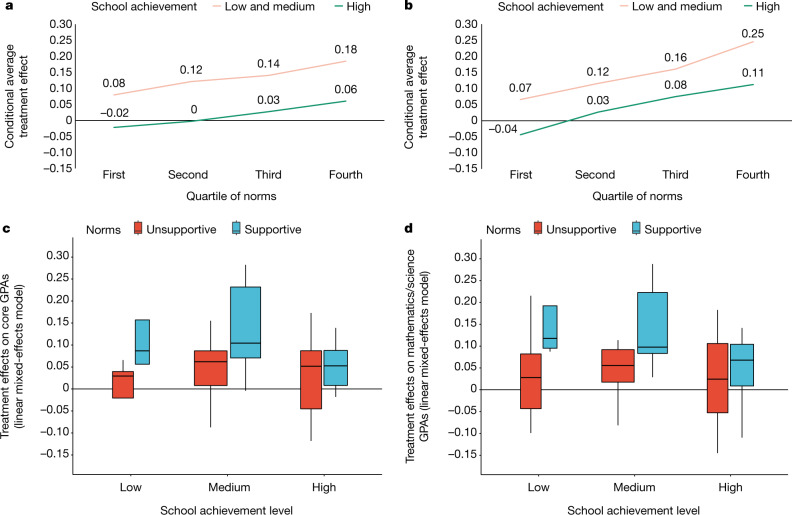
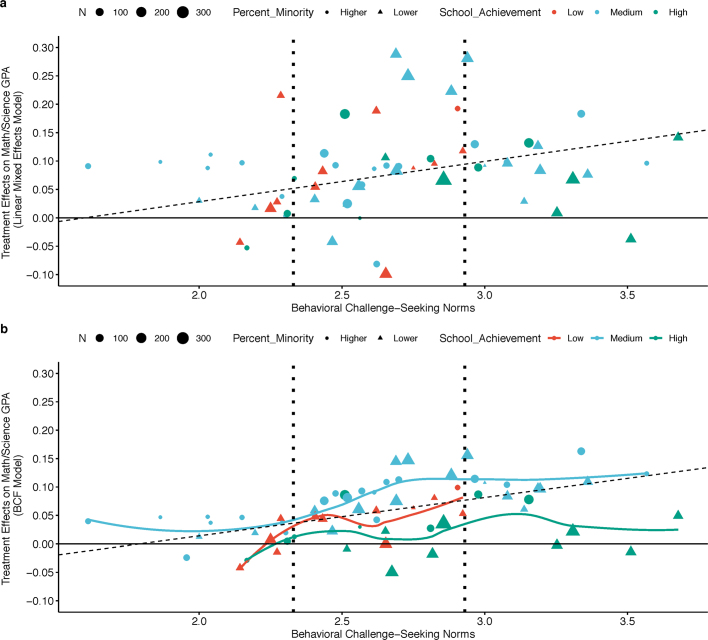
A short, online growth mindset intervention in a nationally representative sample of U.S. secondary students improved outcomes for lower-achieving students and increased advanced mathematics enrollment overall. Its grade effects were strongest in schools whose peer norms supported challenge-seeking, suggesting context matters for sustaining benefits.
Key findings
- Among lower-achieving adolescents, the intervention reduced fixed-mindset beliefs by B = −0.38 and had an effect size of 0.33 (n = 5,650 students, k = 65 schools, P < 0.001).
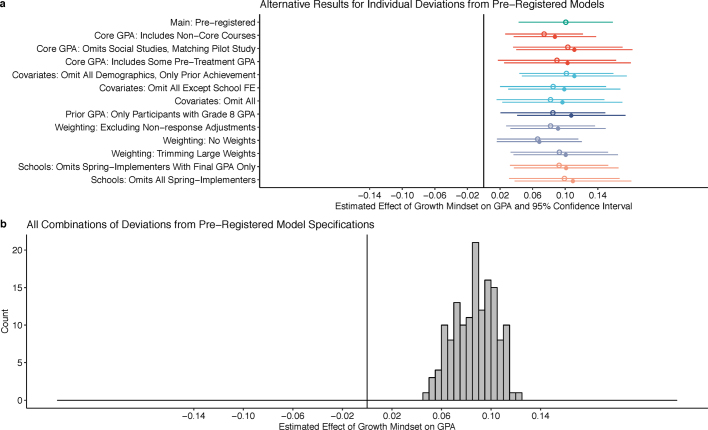
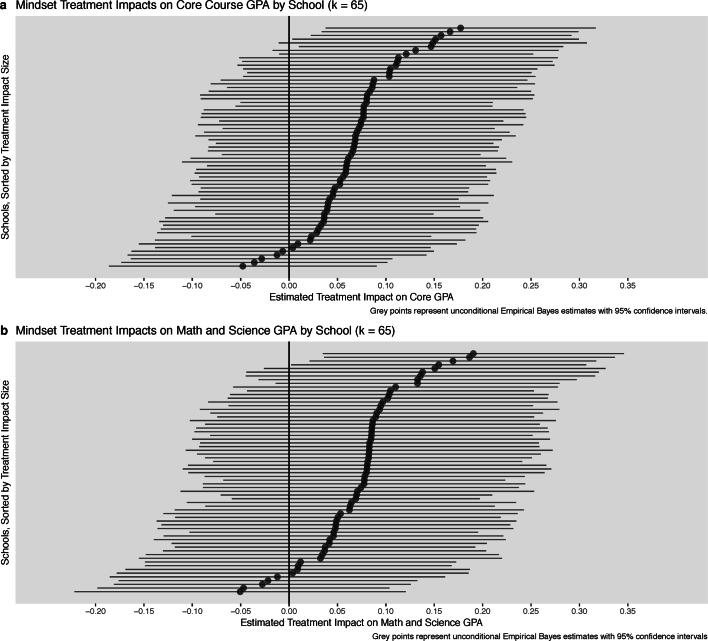
- Lower-achieving adolescents earned higher end-of-year core GPA when assigned to the intervention: B = 0.10 grade points, effect size 0.11, n = 6,320, k = 65, P = 0.001.
- The same GPA conclusion held for mathematics and science GPAs, with B = 0.10.
- Across the full cohort, the intervention increased tenth-grade advanced mathematics enrollment by 3 percentage points, from 33% to 36% (n = 6,690, k = 41, P = 0.001), and overall reduced the share of students below GPA 2.0 from 46% to 41%.
Methods
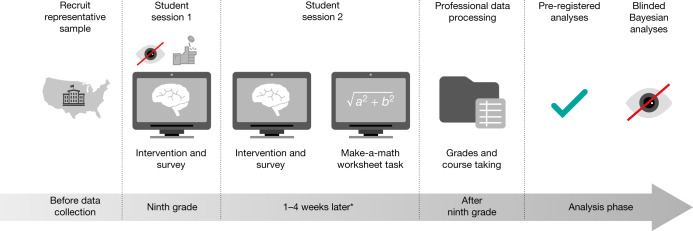
- Randomized, effectiveness-trial design: 12,490 ninth-grade adolescents in 65 regular public schools were individually randomized within schools in the National Study of Learning Mindsets.
- Intervention: two self-administered online sessions of about 25 minutes each, delivered roughly 20 days apart during school hours; control was a similar brain-functions program that did not address intelligence beliefs.
- Main analysis: intention-to-treat cluster-robust fixed-effects linear regression for average effects, mixed-effects models for cross-school heterogeneity, and a blinded Bayesian causal forest robustness analysis.
Limitations
- The paper states that the moderation results cannot support causal conclusions about school norms because norms were measured, not manipulated.
- Advanced mathematics enrollment analyses were exploratory because they were not pre-registered.
- Evident from the text: school-level heterogeneity analyses are limited by the observational nature of the moderators and by only 65 schools contributing to the main analyses.
Model-written summary. Check it against the paper before relying on it.
Integrity signals
Registry
Cites
Statistics
Figures
Verification
Claims the paper makes
15 Valid · 0 Not valid · 17 Not checked · 46 Own results and interpretations
The cited sources support only part of this claim — read each source’s verdict below.
In the paper
“When such students underperform in or opt out of rigorous coursework, they are far less likely to leave secondary school prepared for college or university or for advanced courses in college or university8,9.”
§ A national experiment reveals where a growth mindset improves achievement > Main
What the sources say
- Not checked — no full text of the sourcecites [8] Adelman, C. The Toolbox Revisited: Paths to Degree Completion from High School through College (US Department of Education, 2006).
- Partly supportedcites [9] Schiller KS Schmidt WH Muller C Houang R Hidden disparities: how courses and curricula shape opportunities in mathematics during high school Equity Excell. Educ. 2010 43 414 433 10.1080/10665684.2010.517062 23554547 PMC3612550 sourceExperimental — accuracy not yet measured
The ‘Course Enrollments as Opportunities to Learn’ section (page unavailable) says that mathematics course sequencing affects how far students progress in high school and that mathematics success has consequences for post-secondary schooling. The ‘Dimensions of Learning Opportunities’ section (page unavailable) also discusses undergraduates’ need for remedial courses. But the paper does not establish that students who underperform in or opt out of rigorous coursework are ‘far less likely’ to leave school prepared for college or advanced college courses. (LLM, conf=0.83)
plainstates an association- Asserted: passes — The authors put it forward as true.
- Checkable: passes — It can be checked against evidence.
- Load-bearing: passes — The paper’s conclusions depend on it.
- Based: passes — The paper gives a reason why it holds.
The cited sources support only part of this claim — read each source’s verdict below.
In the paper
“most interventions that are effective in initial efficacy trials go on to show weaker or no effects when they are scaled up in effectiveness trials that deliver treatments under everyday conditions to more heterogeneous samples21–23.”
§ A national experiment reveals where a growth mindset improves achievement > A focus on heterogeneity
What the sources say
- Not checked — no full text of the sourcecites [21] Greenberg MT Abenavoli R Universal interventions: fully exploring their impacts and potential to produce population-level impacts J. Res. Educ. Eff. 2017 10 40 67 source
- Not checked — no full text of the sourcecites [22] Allcott H Site selection bias in program evaluation Q. J. Econ. 2015 130 1117 1165 10.1093/qje/qjv015 source
- Partly supportedcites [23] Singal AG Higgins PDR Waljee AK A primer on effectiveness and efficacy trials Clin. Transl. Gastroenterol. 2014 5 e45 10.1038/ctg.2013.13 24384867 PMC3912314 sourceExperimental — accuracy not yet measured
The Introduction says efficacy trials can overestimate effects in clinical practice, and Study Design describes effectiveness trials as using more heterogeneous populations in routine settings, sometimes without a witnessed effect. The paper does not establish that *most* interventions with positive initial efficacy results subsequently show weaker or no effects in effectiveness trials. (LLM, conf=0.86)
plainstates a cause- Asserted: passes — The authors put it forward as true.
- Checkable: passes — It can be checked against evidence.
- Load-bearing: passes — The paper’s conclusions depend on it.
- Based: passes — The paper gives a reason why it holds.
The cited sources support only part of this claim — read each source’s verdict below.
In the paper
“Beliefs—and particularly beliefs that affect how students make sense of ongoing challenges—are important during high-stakes developmental turning points such as pubertal maturation43,44 or the transition to secondary school6.”
§ A national experiment reveals where a growth mindset improves achievement > Discussion
What the sources say
- Supportedcites [43] Yeager DS Dahl RE Dweck CS Why interventions to influence adolescent behavior often fail but could succeed Perspect. Psychol. Sci. 2018 13 101 122 10.1177/1745691617722620 29232535 PMC5758430 source
The Discussion (page unavailable) says adolescents’ beliefs about whether social traits can change shape how they interpret and cope with social adversity, using a new high school student as an example. The paper also links adolescents’ heightened sensitivity to status and respect to pubertal maturation and school transitions (Abstract, page unavailable). Together, these passages support the attributed point about the importance of beliefs during those developmental turning points. (LLM, conf=0.87)
- Partly supportedcites [44] Dahl RE Allen NB Wilbrecht L Suleiman AB Importance of investing in adolescence from a developmental science perspective Nature 2018 554 441 450 10.1038/nature25770 29469094 sourceExperimental — accuracy not yet measured
The Conclusion (p. 13) describes pubertal maturation as a dynamic period of learning and adaptation, and the Policy and intervention section (p. 10) identifies puberty as an important window for formative learning experiences. This supports the significance of the pubertal turning point, but the paper does not establish the claim about beliefs that shape how students interpret ongoing challenges. The transition to secondary school is attached to a different citation and is not assessed here. (LLM, conf=0.82)
- Not checked — no full text of the sourcecites [6] Crosnoe, R. Fitting In, Standing Out: Navigating the Social Challenges of high School to Get an Education (Cambridge Univ. Press, 2011). source
plainstates an association- Asserted: passes — The authors put it forward as true.
- Checkable: passes — It can be checked against evidence.
- Load-bearing: unclear — It is unclear whether the paper’s conclusions depend on it.
- Based: passes — The paper gives a reason why it holds.
- Supported
The cited sources support only part of this claim — read each source’s verdict below.
In the paper
“previously low-achieving students are the group that shows the steepest decline in grades during the transition to secondary school19”
§ A national experiment reveals where a growth mindset improves achievement > Main
What the sources say
- Partly supportedcites [19] Benner AD The transition to high school: current knowledge, future directions Educ. Psychol. Rev. 2011 23 299 328 10.1007/s10648-011-9152-0 21966178 PMC3182155 sourceExperimental — accuracy not yet measured
The Academic performance and engagement passage (page unavailable) reports that grades generally decline from middle to high school. The feeder-pattern passage (page unavailable) says low-performing students struggled more under a particular transition condition, but it does not establish that previously low-achieving students have the steepest grade decline of all groups. (LLM, conf=0.84)
plainstates an association- Asserted: passes — The authors put it forward as true.
- Checkable: passes — It can be checked against evidence.
- Load-bearing: passes — The paper’s conclusions depend on it.
- Based: passes — The paper gives a reason why it holds.
- Partly supported
The sources with a verdict support this claim; the rest weren’t checked yet, have no full text we could read, or their verdicts aren’t rated yet.
In the paper
“Nonetheless, previous randomized evaluations, including a pre-registered replication, found that online growth mindset interventions improved grades for the targeted group of students in secondary education who previously showed lower achievement13,16,18.”
§ A national experiment reveals where a growth mindset improves achievement > Main
What the sources say
- Supportedcites [13] Yeager DS Using design thinking to improve psychological interventions: the case of the growth mindset during the transition to high school J. Educ. Psychol. 2016 108 374 391 10.1037/edu0000098 27524832 PMC4981081 source
The Focus of the Present Investigation describes a prior randomized online evaluation in which lower-achieving high school students improved their GPA. The Study 2 Results report a pre-registered analysis showing a grade benefit for previously lower-achieving ninth graders, and the General Discussion calls it a rigorous replication. (LLM, conf=0.93)
- Not checked — no full text of the sourcecites [16] Paunesku D Mind-set interventions are a scalable treatment for academic underachievement Psychol. Sci. 2015 26 784 793 10.1177/0956797615571017 25862544 source
- Not checked — no full text of the sourcecites [18] Good C Aronson J Inzlicht M Improving adolescents’ standardized test performance: an intervention to reduce the effects of stereotype threat J. Appl. Dev. Psychol. 2003 24 645 662 10.1016/j.appdev.2003.09.002 source
plainstates a cause- Asserted: passes — The authors put it forward as true.
- Checkable: passes — It can be checked against evidence.
- Load-bearing: passes — The paper’s conclusions depend on it.
- Based: passes — The paper gives a reason why it holds.
- Supported
25 more claims · 2 with their cited sources checked
Create a free account to see all 78 claims and to verify the 6 references still open.
- Probably not a substantial claim. 38
- It may state two separate claims as one. 23
Claims other papers make about this one
Each is checked against this paper’s own text: does it say what the citing paper says it does?
The cited source doesn’t support the claim as written.
In the citing paper
“As another example, Yeager et al. (2019) only reported the results of the 50% of students performing below their school's median.They stated this was in part because lower-achieving students may have more academic difficulties and therefore may benefit more from a growth mindset intervention than higher-achieving students.Yet, they did not report a test of whether the treatment effect for lower-”
From Do growth mindset interventions impact students’ academic achievement? A systematic review and meta-analysis with recommendations for best practices. (2023) · cites this paper as Yeager et al. (2019)
Checked by a reasoning model — may be wrong.
Experimental — accuracy not yet measuredThe source backs part of the claim, not all of it — or backs it for a different population, condition or comparison.
In the citing paper
“For example, growth mindset interventions have been shown to help students alter their fixed mindset in a way that allows them to take a longer term perspective (Cassidy, 2015;Rhew et al., 2018;Yeager et al., 2019).”
From The impact of growth mindset training on entrepreneurial action among necessity entrepreneurs: Evidence from a randomized control trial (2023) · cites this paper as Yeager et al., 2019
Experimental — accuracy not yet measuredThe source backs part of the claim, not all of it — or backs it for a different population, condition or comparison.
In the citing paper
“The intervention offered greater benefits to lower achieving students if they attended schools whose students had an overall higher orientation towards growth mindset”
From Tackling Educational Inequalities with Social Psychology: Identities, Contexts, and Interventions (2021) · cites this paper as Yeager et al., 2019
Experimental — accuracy not yet measuredThe source backs part of the claim, not all of it — or backs it for a different population, condition or comparison.
In the citing paper
“Studies have shown that a growth mindset is associated with improved achievement; moreover, even short interventions can foster an increased growth mindset (Blackwell et al., 2007;Yeager et al., 2019).”
From Impacts of Standards-Based Grading on Students’ Mindset and Test Anxiety (2022) · cites this paper as Yeager et al., 2019
Experimental — accuracy not yet measuredThe source backs part of the claim, not all of it — or backs it for a different population, condition or comparison.
In the citing paper
“While scholars have examined growth mindset in both a poverty context (e.g., Burnette et al., 2018;Yeager et al., 2019) and an entrepreneurship context (e.g., Burnette et al., 2019), to the best of our knowledge none of these studies have examined both of these contexts together, nor have they been studied outside of the context of formal education settings.”
From The impact of growth mindset training on entrepreneurial action among necessity entrepreneurs: Evidence from a randomized control trial (2023) · cites this paper as Yeager et al., 2019
Experimental — accuracy not yet measured
5 more claims about this paper
Create a free account to see every claim other papers make about this one.
Statistics that don’t add up
Each reported p-value recomputed from its test statistic and degrees of freedom, each partial η² from its F, and each ratio, mean difference or B printed with a p checked against its own confidence interval.
Rated minor: it would not touch a result — a value no result rests on, a p-value that stays on the same side of the significance level, or a conflict that is clerical, resolved elsewhere in the paper, or outside its own findings.
In the paper
“B = −0.07 (95% confidence interval = 0.02, 0.13), s.e. = 0.03, z = −2.76, n = 6,320, k = 65, P = 0.006”
§ A national experiment reveals where a growth mindset improves achievement > Moderation by school achievement level
Statistics recomputed
Every reported test result, recomputed from its test statistic and degrees of freedom. A result shows as not adding up only once an independent check has confirmed it.
- Consistentz = 2.26reported p = .024 · recomputed p = .024
“z = 2.26, p = .024”
Self-check
Percentages, sums and reported differences re-computed from the paper’s own numbers.
Self-check results appear here once an independent check has confirmed them.
Citations
Cites
Our future: a Lancet commission on adolescent health and wellbeing
Patton, G. C., Sawyer, S. M., Santelli, J. S., Ross, D. A., Afifi, R., Allen, N. B., Arora, M., Azzopardi, P., Baldwin, W., Bonell, C., et al. (2016) · The Lancet · doi:10.1016/s0140-6736(16)00579-1 · Cited by 3,785
Blackwell, L. S., Trzesniewski, K. H., & Dweck, C. S. (2007) · Child Development · doi:10.1111/j.1467-8624.2007.00995.x · Cited by 3,784
Self-citationAronson, J., Fried, C. B., & Good, C. (2002) · Journal of Experimental Social Psychology · doi:10.1006/jesp.2001.1491 · Cited by 1,889
(2006) · US Department of Education · Cited by 1,586
Expectations of brilliance underlie gender distributions across academic disciplines
Leslie, S.-J., Cimpian, A., Meyer, M., & Freeland, E. (2015) · Science · doi:10.1126/science.1261375 · Cited by 1,516
Mind-sets matter: A meta-analytic review of implicit theories and self-regulation.
Burnette, J. L., O'Boyle, E. H., VanEpps, E. M., Pollack, J. M., & Finkel, E. J. (2013) · Psychological Bulletin · doi:10.1037/a0029531 · Cited by 1,367
Social-Psychological Interventions in Education: They’re Not Magic
Yeager, D. S., & Walton, G. M. (2011) · Review of Educational Research · doi:10.3102/0034654311405999 · Cited by 1,345
Self-citationMindsets: A View From Two Eras
Dweck, C. S., & Yeager, D. S. (2019) · Perspectives on Psychological Science · doi:10.1177/1745691618804166 · Cited by 1,259
Self-citationImportance of investing in adolescence from a developmental science perspective
Dahl, R. E., Allen, N. B., Wilbrecht, L., & Suleiman, A. B. (2018) · Nature · doi:10.1038/nature25770 · Cited by 1,196
Skills, education, and the rise of earnings inequality among the “other 99 percent”
Autor, D. H. (2014) · Science · doi:10.1126/science.1251868 · Cited by 1,160
Research works printed but not linked: 1
- Tipton, E., Yeager, D. S., Iachan, R. & Schneider, B. in Experimental Methods in Survey Research: Techniques that Combine Random Sampling with Random Assignment (ed. Lavrakas, P. J.) (Wiley, 2019).
Cited by
Items 101–200 of 1,523
Bernardo, A. B. I., Cai, Y., & King, R. B. (2021) · British Journal of Educational Psychology · doi:10.1111/bjep.12411 · Cited by 65
Stress and Learning in Pupils: Neuroscience Evidence and its Relevance for Teachers
Whiting, S. B., Wass, S. V., Green, S., & Thomas, M. S. C. (2021) · Mind Brain and Education · doi:10.1111/mbe.12282 · Cited by 92
“However, grade improvements through such manipulations have been noted for the lowest achieving students, so the intervention may work better for some children than others (Yeager et al., 2016, 2019).”
Jeong, I., Gong, Y., & Zhong, B.-J. (2022) · Journal of Management · doi:10.1177/01492063221082537 · Cited by 69
“Often using student samples and grades as the performance measure, research in social or educational psychology has shown that those with a growth mindset tend to perform better than those with a fixed mindset (Yeager et al., 2019).”
BackgroundChu, T. L. (2020) · Scholarship of Teaching and Learning in Psychology · doi:10.1037/stl0000238 · Cited by 77
de Vries, J. H., Spengler, M., Frintrup, A., & Mussel, P. (2021) · Frontiers in Psychology · doi:10.3389/fpsyg.2021.671421 · Cited by 87
“Actively changing one’s mindset toward a growth mindset was found to decrease chronic adolescent aggression, enhance people’s willpower, and redirect critical academic outcomes (Dweck, 2012; Yeager et al., 2019).”
BackgroundMoreu, G., Isenberg, N., & Bräuer, M. (2021) · Frontiers in Education · doi:10.3389/feduc.2021.668250 · Cited by 80
“…example from a different domain: Fostering a growth mindset where students start to believe they can improve through practice will change how they interpret successes and failures, thereby disrupting the negative feedback cycle that leads to poorer performance in school (see Yeager et al., 2019).”
BackgroundFlourishing Women through Sustainable Tourism Entrepreneurship
Ertac, M., & Tanova, C. (2020) · Sustainability · doi:10.3390/su12145643 · Cited by 70
“However, more recent research has revealed that the positive results of growth mindset require certain contexts in which these positive outcomes could be possible [7].”
BackgroundInfluentialBinning, K. R., & Browman, A. S. (2020) · Social Issues and Policy Review · doi:10.1111/sipr.12066 · Cited by 51
“…Peach, Spencer, & Zanna, 2015), growth mindset interventions (Binning et al., 2019; Blackwell, Trzesniewski, & Dweck, 2007; Paunesku et al., 2015; Yeager et al., 2016, 2019), difference-education interventions (Stephens, Hamedani, & Destin, 2014; Stephens, Townsend, Hamedani, Destin, & Manzo,…”
BackgroundInfluentialEmerging neurodevelopmental perspectives on mathematical learning
Menon, V., & Chang, H. (2021) · Developmental Review · doi:10.1016/j.dr.2021.100964 · Cited by 67
A systematic review of growth mindset intervention implementation strategies
Burnette, J. L., Knouse, L. E., Billingsley, J., Earl, S., Pollack, J. M., & Hoyt, C. L. (2022) · Social and Personality Psychology Compass · doi:10.1111/spc3.12723 · Cited by 93
Skinner, E. A. (2023) · Educational Psychology Review · doi:10.1007/s10648-023-09790-w · Cited by 86
“Such analyses have led to top-to-bottom redesign of the classroom, as seen for example in interventions intended to foster growth mindsets (Yeager et al., 2019) and mastery learning goals (Bardach, 2020).”
BackgroundVestad, L., & Bru, E. (2023) · Social Psychology of Education · doi:10.1007/s11218-023-09859-y · Cited by 88
“Most existing studies have focused on individually oriented interventions aimed at stimulating students’ growth mindset (Yeager et al., 2019).”
Frank, J. R., Karpinski, J., Sherbino, J., Snell, L. S., Atkinson, A. R., Oswald, A., Hall, A. K., Cooke, L., Dojeiji, S., Richardson, D. L., et al. (2024) · Perspectives on Medical Education · doi:10.5334/pme.1096 · Cited by 105
Kennedy, L., & Gelman, A. (2021) · Psychological Methods · doi:10.1037/met0000362 · Cited by 67
“An example of a sampling design that aimed to account for heterogeneity between schools, see Yeager et al. (2019).”
Mieczkowski, H., Lee, A. Y., & Hancock, J. T. (2020) · Social Media + Society · doi:10.1177/2056305120961784 · Cited by 50
“Although these mindsets can be maintained over time, they can also be “triggered” by cues in the environment (Turnwald et al., 2019; Yeager et al, 2019).”
BackgroundSeo, E., & Lee, Y. (2021) · Journal of Youth and Adolescence · doi:10.1007/s10964-021-01435-x · Cited by 77
Bauer, C. A., Boemelburg, R., & Walton, G. M. (2021) · Psychological Science · doi:10.1177/09567976211028978 · Cited by 59
Self-citationGrowth-Mindset Intervention Delivered by Teachers Boosts Achievement in Early Adolescence
Porter, T., Molina, D. C., Cimpian, A., Roberts, S., Fredericks, A., Blackwell, L. S., & Trzesniewski, K. H. (2022) · Psychological Science · doi:10.1177/09567976211061109 · Cited by 84
Yan, V. X., & Schuetze, B. A. (2023) · Psychological Bulletin · doi:10.1037/bul0000370 · Cited by 68
A Meta-Analysis on Teachers’ Growth Mindset
Bardach, L., Bostwick, K. C. P., Fütterer, T., Kopatz, M., Hobbi, D. M., Klassen, R. M., & Pietschnig, J. (2024) · Educational Psychology Review · doi:10.1007/s10648-024-09925-7 · Cited by 94
“Adopting a growth mindset (vs. a fixed mindset) should come with benefits for students, for example, because a growth mindset motivates students to take on more rigorous learning experiences and persist in the face of difficulties, thus also improving their performance (e.g., Yeager et al., 2019).”
BackgroundResultInfluentialYik, B. J., Raker, J. R., Apkarian, N., Stains, M., Henderson, C., Dancy, M., & Johnson, E. (2022) · International Journal of STEM Education · doi:10.1186/s40594-022-00333-3 · Cited by 69
“This is advantageous as growth mindsets have been associated with higher achievement in students (e.g., Blackwell et al., 2007; Burnette et al., 2013; Yeager & Dweck, 2012; Yeager et al., 2019).”
BackgroundParada, S., & Verlhiac, J. (2021) · Educational Psychology · doi:10.1080/01443410.2021.1917519 · Cited by 60
“However, Yeager et al. (2019) show the positive effect of a short online growth mindset intervention on academic achievement, especially for lower-achieving high-school students, when school norms aligned with the intervention’s message.”
BackgroundResultInfluentialA meta‐analysis of the effect of values affirmation on academic achievement
Wu, Z., Spreckelsen, T. F., & Cohen, G. L. (2021) · Journal of Social Issues · doi:10.1111/josi.12415 · Cited by 69
The development of grit and growth mindset in Chinese children
Zhang, T., Park, D., Ungar, L., Tsukayama, E., Luo, L., & Duckworth, A. L. (2022) · Journal of Experimental Child Psychology · doi:10.1016/j.jecp.2022.105450 · Cited by 59
Self-citationNumeracy, gist, literal thinking and the value of nothing in decision making
Reyna, V. F., & Brainerd, C. J. (2023) · Nature Reviews Psychology · doi:10.1038/s44159-023-00188-7 · Cited by 99
Mindset Theory and School Psychology
Kapasi, A., & Pei, J. R. (2021) · Canadian Journal of School Psychology · doi:10.1177/08295735211053961 · Cited by 98
“Thus, mindset interventions that deliver messaging about growth without embedding the same messaging in the school and classroom environment will be unlikely to see positive results (Yeager et al., 2019).”
BackgroundInfluentialSheffler, P., Rodríguez, T. M., Cheung, C. S.-S., & Wu, R. (2021) · Wiley Interdisciplinary Reviews Cognitive Science · doi:10.1002/wcs.1585 · Cited by 75
Identifying false growth mindsets in adults and implications for mathematics motivation
Barger, M. M., Xiong, Y., & Ferster, A. E. (2022) · Contemporary Educational Psychology · doi:10.1016/j.cedpsych.2022.102079 · Cited by 68
Hecht, C. A., Bryan, C. J., & Yeager, D. S. (2023) · Proceedings of the National Academy of Sciences · doi:10.1073/pnas.2210704120 · Cited by 68
Self-citationHow Experiments with Children Inform Economics
List, J. A., Petrie, R., & Samek, A. S. (2023) · Journal of Economic Literature · doi:10.1257/jel.20211535 · Cited by 55
Lewis, L. S., Williams, C. A., & Dawson, S. D. (2020) · Teaching and Learning in Nursing · doi:10.1016/j.teln.2020.01.006 · Cited by 45
Passion, grit and mindset in football players
Sigmundsson, H., Clemente, F. M., & Loftesnes, J. M. (2020) · New Ideas in Psychology · doi:10.1016/j.newideapsych.2020.100797 · Cited by 51
“Growth mindset which is considered to be a very important way of thinking to become successful (Yeager et al., 2019) i.”
BackgroundHow malleable are cognitive abilities? A critical perspective on popular brief interventions.
Moreau, D. (2022) · American Psychologist · doi:10.1037/amp0000872 · Cited by 53
GROWTH MINDSET, SCHOOL CONTEXT, AND MATHEMATICS ACHIEVEMENT IN INDONESIA: A MULTILEVEL MODEL
Kismiantini, K., Setiawan, E. P., Pierewan, A. C., & Montesinos-López, O. A. (2021) · Journal on Mathematics Education · doi:10.22342/jme.12.2.13690.279-294 · Cited by 77
“The program can be quite short, done online and scalable as conducted by Yeager et al. (2019) in the United States.”
BackgroundNoskeau, R., Santos, A., & Wang, W. (2021) · Frontiers in Psychology · doi:10.3389/fpsyg.2021.588438 · Cited by 71
“The latter suggests that mindset training supports development by increasing one’s motivation to pursue challenges (Yeager et al., 2019).”
BackgroundNewbold, A., Warren, F. C., Taylor, R. S., Hulme, C. T., Burnett, S., Aas, B., Botella, C., Burkhardt, F., Ehring, T. W., Fontaine, J. R. J., et al. (2020) · BMC Psychiatry · doi:10.1186/s12888-020-02857-w · Cited by 49
“outcomes to increase perceived control, building on a video-based short intervention that has already had benefit in college students [36–38]; (b) mindset training to promote perceived control and growth mindsets, found to improve academic outcomes [39, 40] and which has been shown to reduce and prevent depression and…”
BackgroundSelf‐affirmation theory in educational contexts
Easterbrook, M. J., Harris, P. R., & Sherman, D. K. (2021) · Journal of Social Issues · doi:10.1111/josi.12459 · Cited by 62
“…et al., 2019; Manstead et al., 2020), as may using alternative sources to quantify the context, such as aggregating questionnaire responses (Yeager et al., 2019), interviews with teachers (Gehlbach et al., 2016), or computing measures of student discrepancies from their classmates…”
BackgroundInfluentialGoudeau, S., & Cimpian, A. (2021) · Perspectives on Psychological Science · doi:10.1177/1745691620953781 · Cited by 56
Kim, M., & Park, S. (2021) · Psychology in the Schools · doi:10.1002/pits.22583 · Cited by 61
Gaspard, H., Parrisius, C., Piesch, H., Kleinhansl, M., Wille, E., Nagengast, B., Trautwein, U., & Hulleman, C. S. (2021) · Journal of Educational Psychology · doi:10.1037/edu0000663 · Cited by 70
Self-citationLi, X., Pu, R., & Phakdeephirot, N. (2022) · Frontiers in Psychology · doi:10.3389/fpsyg.2022.972910 · Cited by 105
Enhancing Auditors' Reliance on Data Analytics under Inspection Risk Using Fixed and Growth Mindsets
Cao, T., Duh, R., Tan, H., & Xu, T. (2021) · The Accounting Review · doi:10.2308/tar-2020-0457 · Cited by 65
Morris, S., Carlos, C., Kistruck, G. M., Lount, R. B., & Thomas, T. E. (2023) · Strategic Entrepreneurship Journal · doi:10.1002/sej.1472 · Cited by 42
Theoretical and methodological directions in mindset intervention research
Canning, E. A., & Limeri, L. B. (2023) · Social and Personality Psychology Compass · doi:10.1111/spc3.12758 · Cited by 48
“…nationally representative, randomly-sampled study of mindset interventions found that interventions for high school students were only effective when the peer norms were supportive of growth mindset, indicating the broad importance of context on intervention success (Yeager et al., 2019).”
BackgroundEbn-Abbasi, F., Fattahi, N., Noughabi, M. A., & Botes, E. (2024) · System · doi:10.1016/j.system.2024.103334 · Cited by 59
Zeeb, H., Ostertag, J., & Renkl, A. (2020) · Education Research International · doi:10.1155/2020/8067619 · Cited by 81
“[3] conducted an extensive study with over 6,000 students and found that an online mindset training improved academic achievement among low-achieving students; however, the training effect was stronger when the existing classroom norms supported challenge-seeking behavior (i.”
BackgroundEnhancing Undergraduate Student Success in STEM Fields through Growth-Mindset and Grit
Hacisalihoglu, G., Stephens, D., Stephens, S., Johnson, L. E., & Edington, M. D. (2020) · Education Sciences · doi:10.3390/educsci10100279 · Cited by 59
Global Mindset Initiative Paper 1: Growth Mindset Cultures and Teacher PracticesPreprint
Murphy, M. C., Fryberg, S. A., Brady, L., Canning, E. A., & Hecht, C. A. (2021) · SSRN Electronic Journal · doi:10.2139/ssrn.3911594 · Cited by 62
Tao, V. Y. K., Li, Y., & Wu, A. M. S. (2021) · European Journal of Psychology of Education · doi:10.1007/s10212-020-00524-y · Cited by 55
“Carol Dweck’s work on implicit theories of intelligence (ITI; Dweck and Leggett 1988; Dweck and Yeager 2019), which are also known as intelligence mindsets or self-theory/lay theory of intelligence, has drawn abundant attention and opened up a new direction for * Anise M. S. Wu anisewu@um.edu.mo 1…”
BackgroundEducators’ Beliefs About Students’ Socioeconomic Backgrounds as a Pathway for Supporting Motivation
Silverman, D. M., Hernandez, I. A., & Destin, M. (2021) · Personality and Social Psychology Bulletin · doi:10.1177/01461672211061945 · Cited by 55
“…by educators’ beliefs about students’ backgrounds, researchers may investigate how such beliefs affect other core psychological constructs, including students’ mindsets (e.g., Yeager et al., 2019), as well as other educator-level variables, such as their expectations for students (Sorhagen, 2013).”
BackgroundSchunk, D., Berger, E. M., Hermes, H., Winkel, K., & Fehr, E. (2022) · Nature Human Behaviour · doi:10.1038/s41562-022-01449-w · Cited by 40
Trotter, M. G., Coulter, T. J., Davis, P., Poulus, D., & Polman, R. C. J. (2022) · Frontiers in Psychology · doi:10.3389/fpsyg.2021.807341 · Cited by 59
“Interventions have been shown to be an effective method for increasing the growth mindset of high school students (Yeager et al., 2020).”
MethodBernardo, A. B. I. (2022) · European Journal of Psychology of Education · doi:10.1007/s10212-022-00629-6 · Cited by 53
“One growth mindset intervention study (Yeager et al., 2019) found the intervention to be more effective when the students’ peers were also supportive of the growth mindset assumptions.”
BackgroundLimeri, L. B., Carter, N. T., Lyra, F., Martin, J. W., Mastronardo, H., Patel, J. D., & Dolan, E. L. (2023) · CBE—Life Sciences Education · doi:10.1187/cbe.22-12-0250 · Cited by 53
“Interventions persuading students to adopt growth mindset beliefs have improved students’ academic performance and retention (Blackwell et al. , 2007; Yeager et al. , 2016, 2019).”
An experimental manipulation of the value of effort
Lin, H., Westbrook, A., Fan, F., & Inzlicht, M. (2024) · Nature Human Behaviour · doi:10.1038/s41562-024-01842-7 · Cited by 68
“However, these effects might be less robust than previously thought 40–43 .”
Growth Mindset Messaging in Stigma-Relevant Contexts: Harnessing Benefits Without Costs
Hoyt, C. L., & Burnette, J. L. (2020) · Policy Insights from the Behavioral and Brain Sciences · doi:10.1177/2372732220941216 · Cited by 53
“for at-risk students (e.g., Dweck & Yeager, 2019; Yeager et al., 2019), blindly and incorrectly promoting growth mindsets can backfire (e.”
BackgroundAutomated Educative Nudges to Reduce Missed Assignments in College
Motz, B. A., Mallon, M. G., & Quick, J. D. (2021) · IEEE Transactions on Learning Technologies · doi:10.1109/tlt.2021.3064613 · Cited by 40
“Less paternal-istic approaches, such as growth mindset interventions (e.g., [57]) may be more appropriate for facilitating student engagement and achievement across diverse courses and institutions.”
BackgroundAre the Effects of Informational Interventions Driven by Salience?Preprint
Bettinger, E., Cunha, N., Lichand, G., & Madeira, R. (2020) · SSRN Electronic Journal · doi:10.2139/ssrn.3633821 · Cited by 61
Sustaining school improvement initiatives: advice from educational leaders
Koh, G. A., Askell‐Williams, H., & Barr, S. (2023) · School Effectiveness and School Improvement · doi:10.1080/09243453.2023.2190130 · Cited by 115
“Sub-sequently, a positive education approach was formalised through inclusion in the school ’ s site-improvement plan, 2 with a particular focus on working with students to develop a growth mindset (Yeager et al., 2019).”
BackgroundZhao, H. M., Zhang, M., Li, Y., & Wang, Z. (2023) · Psychology Research and Behavior Management · doi:10.2147/prbm.s428397 · Cited by 58
“69,70 However, this study focuses on the effect of growth mindset on the health domain of individuals and finds that it has a positive relationship with individuals’ meaning in life, which supports hypothesis 1.”
BackgroundOrosz, G., Faragó, L., Paskuj, B., & Krekó, P. (2024) · Computers in Human Behavior · doi:10.1016/j.chb.2024.108338 · Cited by 38
Gottfredson, R. K., & Reina, C. S. (2019) · The Leadership Quarterly · doi:10.1016/j.leaqua.2019.101373 · Cited by 62
“…watching a three-minute video (Crum, Salovey, & Achor, 2013), imagining responses to situations (Gollwitzer, 1993; Gregory, Cialdini, & Carpenter, 1982; Linville & Clark, 1989; Mischel & Shoda, 2008) or engaging in a training (Blackwell et al., 2007; Crum & Langer, 2007; Yeager et al., 2019).”
Muenks, K. M., Yan, V. X., & Telang, N. K. (2021) · Frontiers in Education · doi:10.3389/feduc.2021.633570 · Cited by 42
“Further, people’s intelligence mindsets are strongly linked to other implicit beliefs they hold about effort and failure, and create a broader meanings system (e.g., Dweck, 1999; Molden and Dweck, 2006; Blackwell et al., 2007; Dweck and Yeager, 2019).”
BackgroundBernardo, A. B. I., Cordel, M. O., Lucas, R. I. G., Teves, J. M. M., Yap, S. A., & Chua, U. C. (2021) · Education Sciences · doi:10.3390/educsci11100628 · Cited by 66
“The educational psychology literature points to numerous viable classroom-based or schoolbased interventions to improve students’ mastery-oriented motivations [64,65], beliefs and mindsets [66,67].”
BackgroundGrowth mindset in the maths classroom: a key to teachers’ well-being and effectiveness
Shoshani, A. (2021) · Teachers and Teaching · doi:10.1080/13540602.2021.2007370 · Cited by 65
Implementing and Evaluating Growth Mindset Pedagogy – A Study of Finnish Elementary School Teachers
Rissanen, I., Laine, S., Puusepp, I., Kuusisto, E., & Tirri, K. A. (2021) · Frontiers in Education · doi:10.3389/feduc.2021.753698 · Cited by 64
Socio-emotional Skills and the Socioeconomic Achievement Gap
Gruijters, R. J., Raabe, I. J., & Hübner, N. (2023) · Sociology of Education · doi:10.1177/00380407231216424 · Cited by 69
“Such behavior might, in turn, be reinforced via positive teacher or peer feedback (Yeager et al. 2019).”
BackgroundInfluentialAssessing Treatment Effect Variation in Observational Studies: Results from a Data Challenge
Carvalho, C. M., Feller, A., Murray, J. S., Woody, S., & Yeager, D. S. (2019) · Observational Studies · doi:10.1353/obs.2019.0000 · Cited by 61
Self-citationHamm, J. M., Perry, R. P., Chipperfield, J. G., Hladkyj, S., Parker, P. C., & Weiner, B. L. (2020) · Psychological Science · doi:10.1177/0956797620904451 · Cited by 43
Astronomers Engaging with the Education Ecosystem: A Best-Evidence Synthesis
Pompea, S. M., & Russo, P. (2020) · Annual Review of Astronomy and Astrophysics · doi:10.1146/annurev-astro-032620-021943 · Cited by 47
“Recent research using online interventions that teach students that intellectual abilities can be developed (i.e. a growth mindset) have proven effective in improving grades in lower-achieving students, even though the intervention lasted less than one hour (Yeager et al. 2019).”
BackgroundMotivational Factors Are Varying across Age Groups and Gender
Sigmundsson, H., Haga, M., Elnes, M., Dybendal, B. H., & Hermundsdottir, F. (2022) · International Journal of Environmental Research and Public Health · doi:10.3390/ijerph19095207 · Cited by 49
“A short online growth mindset intervention was found to improve grades among lower-achieving students [6], yet it seems that the concept has a general weak effects [34], indicating that having a growth mindset is even more effective in combination with other relevant traits.”
BackgroundSigmundsson, H., & Haga, M. (2024) · New Ideas in Psychology · doi:10.1016/j.newideapsych.2024.101111 · Cited by 61
Cutumisu, M., & Lou, N. M. (2020) · Computers in Human Behavior · doi:10.1016/j.chb.2020.106445 · Cited by 37
“Yeager, D. S., Hanselman, P., Walton, G. M., Crosnoe, R., Muller, C. L., Tipton, E., … Dweck, C. S. (2019).”
InfluentialMuenks, K. M., Yan, V. X., Woodward, N. R., & Frey, S. E. (2021) · Learning and Individual Differences · doi:10.1016/j.lindif.2021.102088 · Cited by 43
Liu, Q., & Tong, Y. (2022) · Frontiers in Psychology · doi:10.3389/fpsyg.2022.814154 · Cited by 73
Rodriguez, M., Pratt, S., Bellet, B. W., & McNally, R. J. (2023) · Journal of Personality · doi:10.1111/jopy.12887 · Cited by 53
Literature review on teachers’ mindsets, growth-oriented practices and why they matter
Laine, S., & Tirri, K. A. (2023) · Frontiers in Education · doi:10.3389/feduc.2023.1275126 · Cited by 72
Edelsbrunner, P. A., & Thurn, C. (2023) · Educational Research Review · doi:10.1016/j.edurev.2023.100590 · Cited by 61
Teachers as creative agents: How self-beliefs and self-regulation drive teachers’ creative activity
Zielińska, A., Lebuda, I., Gop, A., & Karwowski, M. (2024) · Contemporary Educational Psychology · doi:10.1016/j.cedpsych.2024.102267 · Cited by 58
Yan, J., Tian, L., & Lou, N. M. (2024) · System · doi:10.1016/j.system.2024.103519 · Cited by 60
Characteristics and Validity of an Instrument for Assessing Motivations for Online Reading to Learn
Forzani, E. E., Leu, D. J., Li, Y., Rhoads, C. H., Guthrie, J. T., & McCoach, D. B. (2020) · Reading Research Quarterly · doi:10.1002/rrq.337 · Cited by 54
Law, F., McGuire, L., Winterbottom, M., & Rutland, A. (2021) · Frontiers in Psychology · doi:10.3389/fpsyg.2021.641695 · Cited by 55
Simple questionnaires outperform behavioral tasks to measure socio-emotional skills in students
Boon-Falleur, M., Bouguen, A., Charpentier, A., Algan, Y., Huillery, É., & Chevallier, C. (2022) · Scientific Reports · doi:10.1038/s41598-021-04046-5 · Cited by 55
Wang, M., Zepeda, C. D., Qin, X., Toro, J. D., & Binning, K. R. (2021) · Child Development · doi:10.1111/cdev.13560 · Cited by 57
“As suggested by extant research (Degol et al., 2018; Yeager et al., 2019), our scale used fixed-mindset items in order to avoid potential acquiescence or social desirability biases whereby participants respond more favorably to positively worded growth-mindset items.”
BackgroundMethodWhose ability and growth matter? Gender, mindset and performance in physics
Malespina, A., Schunn, C. D., & Singh, C. (2022) · International Journal of STEM Education · doi:10.1186/s40594-022-00342-2 · Cited by 45
Using Theories of Behavior Change to Develop Interventions for Healthy Aging
Klusmann, V., Gow, A. J., Robert, P. H., & Oettingen, G. (2021) · The Journals of Gerontology Series B · doi:10.1093/geronb/gbab111 · Cited by 42
Growth mindset interventions improve academic performance but not mindset in biochemistry
Miller, H. B., & Srougi, M. C. (2021) · Biochemistry and Molecular Biology Education · doi:10.1002/bmb.21556 · Cited by 48
“However, growth mindset interventions used with these students showed improved grades, especially for those with lower achievement.(9) Growth mindset interventions have been implemented in courses to varying degrees of effectiveness, depending upon students' implicit theories of intelligence and baseline discipline sp…”
BackgroundCherewick, M., Lebu, S., Su, C., Richards, L., Njau, P., & Dahl, R. E. (2021) · BMC Public Health · doi:10.1186/s12889-021-12278-3 · Cited by 49
“Early experiential learning during adolescence—particularly in the realm of social emotional learning about self/other and social relationships shape the development of an individual’s identity, including mindsets, skills, and behavioral proclivities [12, 13].”
BackgroundReeves, S. L., Henderson, M. D., Cohen, G. L., Steingut, R. R., Hirschi, Q., & Yeager, D. S. (2021) · Journal of Personality and Social Psychology · doi:10.1037/pspa0000246 · Cited by 34
“Testing the model of psychological affordances in this manner has implications not only for theories of how best to motivate behavior change, but also for recent discussions about the importance of context in predicting whether and when the effects of a lay theory intervention replicate (Yeager et al., 2019).”
BackgroundInfluentialSelf-citationMotivating low-achievers—Relative performance feedback in primary schools
Hermes, H., Huschens, M., Rothlauf, F., & Schunk, D. (2021) · Journal of Economic Behavior & Organization · doi:10.1016/j.jebo.2021.04.004 · Cited by 38
When Do Growth Mindset Interventions Work?
Miller, D. I. (2019) · Trends in Cognitive Sciences · doi:10.1016/j.tics.2019.08.005 · Cited by 42
Hartley, K., Bendixen, L. D., Gianoutsos, D., & Shreve, E. (2020) · International Journal of Educational Technology in Higher Education · doi:10.1186/s41239-020-00230-1 · Cited by 49
“The exercises were inspired by interventions described by (Morisano et al., 2010) and Yeager et al. (2019).”
BackgroundMethodStunted upward mobility in a learning environment reduces the academic benefits of growth mindsets
Jia, L., Lim, C. H., Ismail, I., & Tan, Y. C. (2021) · Proceedings of the National Academy of Sciences · doi:10.1073/pnas.2011832118 · Cited by 40
“Most notably, in a study with a large, nationally representative sample (n = 12,486), two 25-min online sessions of growth mindset training at the beginning of the ninth grade improved American students’ end-of-the-year performance (19), outperforming many more resource-demanding educational interventions (20).”
Perinelli, E., Pisanu, F., Checchi, D., Scalas, L. F., & Fraccaroli, F. (2022) · Contemporary Educational Psychology · doi:10.1016/j.cedpsych.2022.102071 · Cited by 56
Outes-León, I., Sánchez, A., & Vakis, R. (2020) · World Bank, Washington, DC eBooks · doi:10.1596/1813-9450-9141 · Cited by 41
Lee, H., Yu, S. L., Kim, M., & Koenka, A. C. (2021) · Contemporary Educational Psychology · doi:10.1016/j.cedpsych.2021.102023 · Cited by 36
Calafato, R., & Simmonds, K. (2023) · Cambridge Journal of Education · doi:10.1080/0305764x.2023.2206805 · Cited by 46
“, 1990; Stephens & Moxham, 2019), growth mindsets (Lou & Noels, 2019; Yeager et al., 2019) and learning styles and self-regulation strategies (Loo, 2002; Psaltou-Joycey & Kantaridou, 2009).”
BackgroundPeer Feedback Reflects the Mindset and Academic Motivation of Learners
Zhang, J., Kuusisto, E., Nokelainen, P., & Tirri, K. A. (2020) · Frontiers in Psychology · doi:10.3389/fpsyg.2020.01701 · Cited by 49
Cho, E., Kim, E. H., Ju, U., & Lee, G. (2021) · Reading and Writing · doi:10.1007/s11145-021-10146-5 · Cited by 53
Brick, K., Cooper, J. L., Mason, L., Faeflen, S., Monmia, J., & Dubinsky, J. M. (2021) · Frontiers in Human Neuroscience · doi:10.3389/fnhum.2021.664730 · Cited by 46
Metadata
- Authors
- Yeager, D. S., Hanselman, P., Walton, G. M., Murray, J. S., Crosnoe, R., Muller, C., Tipton, E., Schneider, B., Hulleman, C. S., Hinojosa, C. P., Paunesku, D., Romero, C., Flint, K., Roberts, A., Trott, J., Iachan, R., Buontempo, J., Yang, S. M., Carvalho, C. M., Hahn, P. R., Gopalan, M., Mhatre, P., Ferguson, R., Duckworth, A. L., & Dweck, C. S.
- Affiliations
- The University of Texas at Austin (US)
- University of California, Irvine (US)
- Stanford University (US)
- Northwestern University (US)
- Michigan State University (US)
- University of Virginia (US)
- University of Chicago (US)
- ICF International (United States) (US)
- Arizona State University (US)
- Pennsylvania State University (US)
- Harvard University (US)
- University of Pennsylvania (US)
- Corresponding author
- Yeager, David S.
- Hanselman, Paul
- ORCID
- Yeager, David S.
- Hanselman, Paul
- Walton, Gregory M.
- Murray, Jared S.
- Crosnoe, Robert
- Muller, Chandra
- Tipton, Elizabeth
- Schneider, Barbara
- Hulleman, Chris S.
- Hinojosa, Cintia P.
- Paunesku, David
- Roberts, Alice
- Iachan, Ronaldo
- Buontempo, Jenny
- Carvalho, Carlos M.
- Gopalan, Maithreyi
- Mhatre, Pratik
- Duckworth, Angela L.
- Dweck, Carol S.
- Venue
- Nature
- Published
- 2019-08-07
- Volume
- 573
- Issue
- 7774
- Pages
- 364-369
- ISSN
- 0028-0836 (ISSN-L)
- 1476-4687
- PMC
- PMC6786290
- OpenAlex
- W2964722401
- Semantic Scholar
- f9fb223742fce060785d7f59861d0341d149cb04
- Cited by
- 1,513
- References
- 43
- Citations by year
- 2026: 203 · 2025: 211 · 2024: 219 · 2023: 325 · 2022: 202 · 2021: 200 · 2020: 131 · 2019: 20
- FWCI
- 163.13
- Type
- journal article
- Language
- en
- Open access
- hybrid
- doi.org
- Licence
- cc-by
- creativecommons.org/licenses/by/4.0 (tdm)
- creativecommons.org/licenses/by/4.0 (vor)
- Locations
- Nature (publishedVersion, cc-by)
- PubMed Central (publishedVersion, cc-by)
- PubMed (publishedVersion)
- RePEc: Research Papers in Economics (submittedVersion)
- eScholarship (California Digital Library) (submittedVersion, cc-by)
- Funders
- National Science Foundation (1761179)
- William T. Grant Foundation
- Houston Endowment
- Spencer Foundation
- University of Texas at Austin
- Raikes Foundation
- National Institutes of Health
- Center for Advanced Study in the Behavioral Sciences, Stanford University
- National Institute of Child Health and Human Development (10.13039/100000071, HD042849)
- Center for Advanced Study, University of Illinois at Urbana-Champaign
- Eunice Kennedy Shriver National Institute of Child Health and Human Development (R24HD042849, R01HD084772, P2CHD042849)
- Topics
- Social Sciences › Psychology › Developmental and Educational Psychology › Education, Achievement, and Giftedness
- Social Sciences › Psychology › Social Psychology › Grit, Self-Efficacy, and Motivation
- Social Sciences › Education › School Choice and Performance
- Keywords
- growth mindset, academic performance, adolescents, online intervention, peer norms, secondary education, school context, scalable interventions, preregistration, Bayesian analysis
- MeSH terms
- Psychosocial Support Systems, Academic Success, Adolescent, United Kingdom, Humans, Students
About these checks
Registry, retraction, Cites and statistics results are computed, not judged, with one exception: a printed reference that no index lists is read once by a model before it counts as a citation error. Claims are extracted by a model and kept only when their quote appears verbatim in the text; each cited source is then checked, with a model’s help, for whether it says what the claim relies on. Those verdicts can be wrong — read the claim’s quote and the cited source before relying on one.
The claim verdicts this report counts are experimental: their accuracy is not yet measured.
A language model drew the claims from the paper on 2026-09-28, under version 3 of the claim definition (model deepseek-v4.1-flash, prompt extract-v3).
A second model labelled each claim on 2026-09-28 (model jev-1.13-20260917, definition revision gold-guideline-v0.2).
Cited sources are checked with a language model’s help (gpt-6-sol).
Statistics and arithmetic are recomputed, not judged.
Confidence bands are shown only for fields calibrated on our annotated test set. None is calibrated yet, so no band is shown.
What counts as a claim ›How we measure confidence ›How we check this ›
Are you an author, or do you see a problem with this page? Request a review
Data sources
Bibliographic data: Semantic Scholar, OpenAlex, Crossref.
Contains information from the Semantic Scholar Academic Graph Datasets, made available under the ODC Attribution License (ODC-BY 1.0).
Semantic Scholar’s data is described in: Kinney, R., et al. (2023). The Semantic Scholar Open Data Platform. arXiv:2301.10140.
