

A national experiment reveals where a growth mindset improves achievement
Open accessThe DOI matches its Crossref record; 44 of the 44 references it cites were found in a registry or an index; 16 of the 56 sources its claims cite were checked for support.
Abstract
A short online growth mindset intervention improved grades among lower-achieving students and increased advanced mathematics enrollment in a nationally representative U.S. sample.
Overview
CoChat Summary
TL;DR
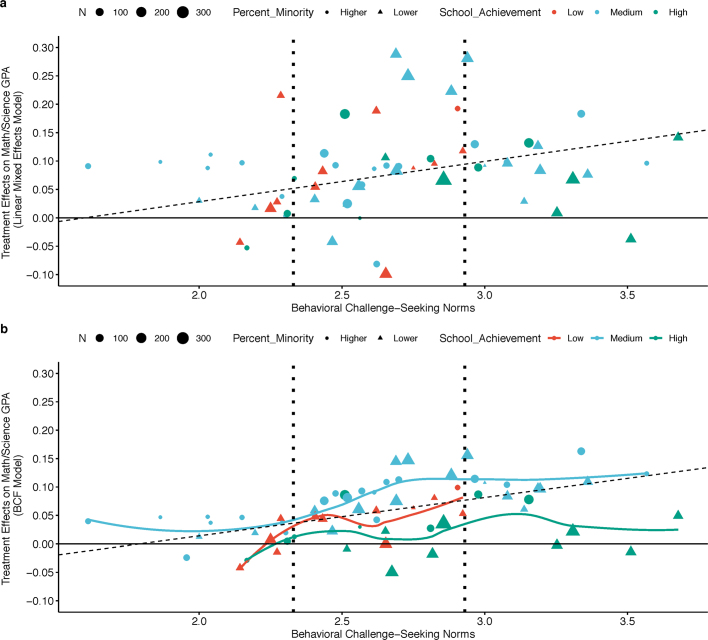
A short, online growth mindset intervention in a nationally representative sample of U.S. secondary students improved outcomes for lower-achieving students and increased advanced mathematics enrollment overall. Its grade effects were strongest in schools whose peer norms supported challenge-seeking, suggesting context matters for sustaining benefits.
Key findings
- Among lower-achieving adolescents, the intervention reduced fixed-mindset beliefs by B = −0.38 and had an effect size of 0.33 (n = 5,650 students, k = 65 schools, P < 0.001).
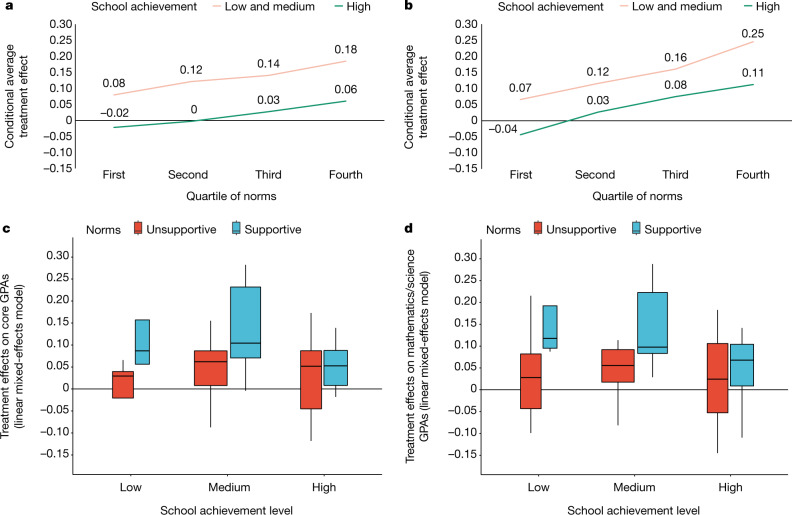
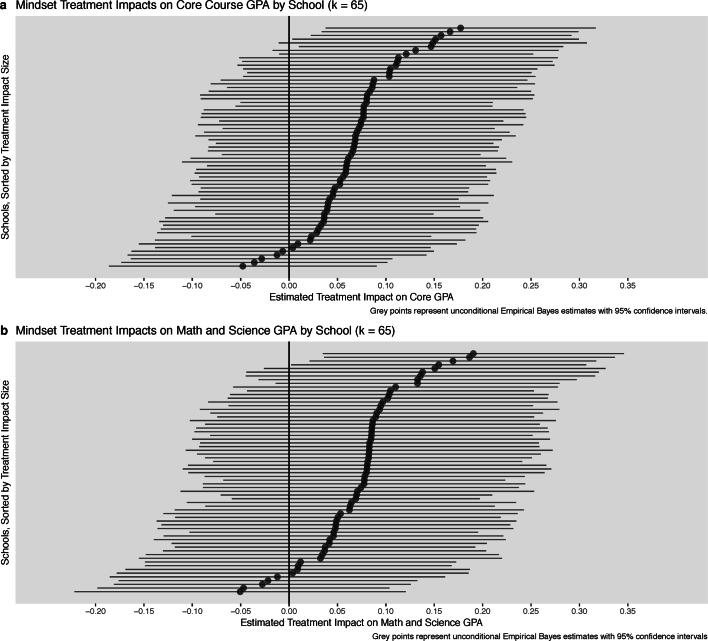
- Lower-achieving adolescents earned higher end-of-year core GPA when assigned to the intervention: B = 0.10 grade points, effect size 0.11, n = 6,320, k = 65, P = 0.001.
- The same GPA conclusion held for mathematics and science GPAs, with B = 0.10.
- Across the full cohort, the intervention increased tenth-grade advanced mathematics enrollment by 3 percentage points, from 33% to 36% (n = 6,690, k = 41, P = 0.001), and overall reduced the share of students below GPA 2.0 from 46% to 41%.
Methods
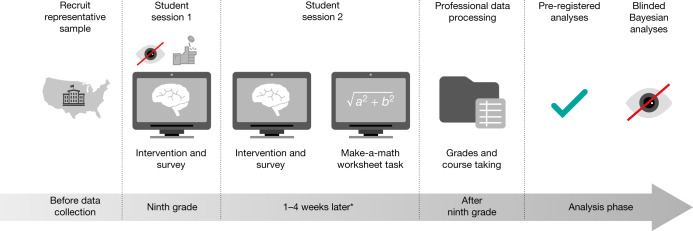
- Randomized, effectiveness-trial design: 12,490 ninth-grade adolescents in 65 regular public schools were individually randomized within schools in the National Study of Learning Mindsets.
- Intervention: two self-administered online sessions of about 25 minutes each, delivered roughly 20 days apart during school hours; control was a similar brain-functions program that did not address intelligence beliefs.
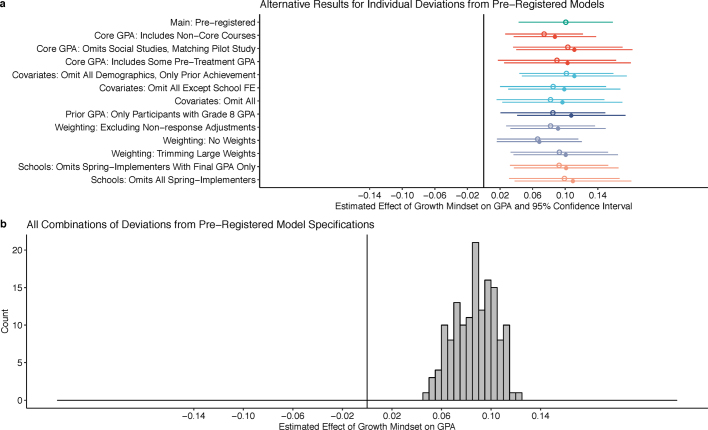
- Main analysis: intention-to-treat cluster-robust fixed-effects linear regression for average effects, mixed-effects models for cross-school heterogeneity, and a blinded Bayesian causal forest robustness analysis.
Limitations
- The paper states that the moderation results cannot support causal conclusions about school norms because norms were measured, not manipulated.
- Advanced mathematics enrollment analyses were exploratory because they were not pre-registered.
- Evident from the text: school-level heterogeneity analyses are limited by the observational nature of the moderators and by only 65 schools contributing to the main analyses.
Model-written summary. Check it against the paper before relying on it.
Integrity signals
Registry
Cites
Statistics
Figures
Verification
Claims the paper makes
15 Valid · 0 Not valid · 17 Not checked · 46 Own results and interpretations
The cited sources support only part of this claim — read each source’s verdict below.
In the paper
“When such students underperform in or opt out of rigorous coursework, they are far less likely to leave secondary school prepared for college or university or for advanced courses in college or university8,9.”
§ A national experiment reveals where a growth mindset improves achievement > Main
What the sources say
- Not checked — no full text of the sourcecites [8] Adelman, C. The Toolbox Revisited: Paths to Degree Completion from High School through College (US Department of Education, 2006).
- Partly supportedcites [9] Schiller KS Schmidt WH Muller C Houang R Hidden disparities: how courses and curricula shape opportunities in mathematics during high school Equity Excell. Educ. 2010 43 414 433 10.1080/10665684.2010.517062 23554547 PMC3612550 sourceExperimental — accuracy not yet measured
The ‘Course Enrollments as Opportunities to Learn’ section (page unavailable) says that mathematics course sequencing affects how far students progress in high school and that mathematics success has consequences for post-secondary schooling. The ‘Dimensions of Learning Opportunities’ section (page unavailable) also discusses undergraduates’ need for remedial courses. But the paper does not establish that students who underperform in or opt out of rigorous coursework are ‘far less likely’ to leave school prepared for college or advanced college courses. (LLM, conf=0.83)
plainstates an association- Asserted: passes — The authors put it forward as true.
- Checkable: passes — It can be checked against evidence.
- Load-bearing: passes — The paper’s conclusions depend on it.
- Based: passes — The paper gives a reason why it holds.
The cited sources support only part of this claim — read each source’s verdict below.
In the paper
“most interventions that are effective in initial efficacy trials go on to show weaker or no effects when they are scaled up in effectiveness trials that deliver treatments under everyday conditions to more heterogeneous samples21–23.”
§ A national experiment reveals where a growth mindset improves achievement > A focus on heterogeneity
What the sources say
- Not checked — no full text of the sourcecites [21] Greenberg MT Abenavoli R Universal interventions: fully exploring their impacts and potential to produce population-level impacts J. Res. Educ. Eff. 2017 10 40 67 source
- Not checked — no full text of the sourcecites [22] Allcott H Site selection bias in program evaluation Q. J. Econ. 2015 130 1117 1165 10.1093/qje/qjv015 source
- Partly supportedcites [23] Singal AG Higgins PDR Waljee AK A primer on effectiveness and efficacy trials Clin. Transl. Gastroenterol. 2014 5 e45 10.1038/ctg.2013.13 24384867 PMC3912314 sourceExperimental — accuracy not yet measured
The Introduction says efficacy trials can overestimate effects in clinical practice, and Study Design describes effectiveness trials as using more heterogeneous populations in routine settings, sometimes without a witnessed effect. The paper does not establish that *most* interventions with positive initial efficacy results subsequently show weaker or no effects in effectiveness trials. (LLM, conf=0.86)
plainstates a cause- Asserted: passes — The authors put it forward as true.
- Checkable: passes — It can be checked against evidence.
- Load-bearing: passes — The paper’s conclusions depend on it.
- Based: passes — The paper gives a reason why it holds.
The cited sources support only part of this claim — read each source’s verdict below.
In the paper
“Beliefs—and particularly beliefs that affect how students make sense of ongoing challenges—are important during high-stakes developmental turning points such as pubertal maturation43,44 or the transition to secondary school6.”
§ A national experiment reveals where a growth mindset improves achievement > Discussion
What the sources say
- Supportedcites [43] Yeager DS Dahl RE Dweck CS Why interventions to influence adolescent behavior often fail but could succeed Perspect. Psychol. Sci. 2018 13 101 122 10.1177/1745691617722620 29232535 PMC5758430 source
The Discussion (page unavailable) says adolescents’ beliefs about whether social traits can change shape how they interpret and cope with social adversity, using a new high school student as an example. The paper also links adolescents’ heightened sensitivity to status and respect to pubertal maturation and school transitions (Abstract, page unavailable). Together, these passages support the attributed point about the importance of beliefs during those developmental turning points. (LLM, conf=0.87)
- Partly supportedcites [44] Dahl RE Allen NB Wilbrecht L Suleiman AB Importance of investing in adolescence from a developmental science perspective Nature 2018 554 441 450 10.1038/nature25770 29469094 sourceExperimental — accuracy not yet measured
The Conclusion (p. 13) describes pubertal maturation as a dynamic period of learning and adaptation, and the Policy and intervention section (p. 10) identifies puberty as an important window for formative learning experiences. This supports the significance of the pubertal turning point, but the paper does not establish the claim about beliefs that shape how students interpret ongoing challenges. The transition to secondary school is attached to a different citation and is not assessed here. (LLM, conf=0.82)
- Not checked — no full text of the sourcecites [6] Crosnoe, R. Fitting In, Standing Out: Navigating the Social Challenges of high School to Get an Education (Cambridge Univ. Press, 2011). source
plainstates an association- Asserted: passes — The authors put it forward as true.
- Checkable: passes — It can be checked against evidence.
- Load-bearing: unclear — It is unclear whether the paper’s conclusions depend on it.
- Based: passes — The paper gives a reason why it holds.
- Supported
The cited sources support only part of this claim — read each source’s verdict below.
In the paper
“previously low-achieving students are the group that shows the steepest decline in grades during the transition to secondary school19”
§ A national experiment reveals where a growth mindset improves achievement > Main
What the sources say
- Partly supportedcites [19] Benner AD The transition to high school: current knowledge, future directions Educ. Psychol. Rev. 2011 23 299 328 10.1007/s10648-011-9152-0 21966178 PMC3182155 sourceExperimental — accuracy not yet measured
The Academic performance and engagement passage (page unavailable) reports that grades generally decline from middle to high school. The feeder-pattern passage (page unavailable) says low-performing students struggled more under a particular transition condition, but it does not establish that previously low-achieving students have the steepest grade decline of all groups. (LLM, conf=0.84)
plainstates an association- Asserted: passes — The authors put it forward as true.
- Checkable: passes — It can be checked against evidence.
- Load-bearing: passes — The paper’s conclusions depend on it.
- Based: passes — The paper gives a reason why it holds.
- Partly supported
The sources with a verdict support this claim; the rest weren’t checked yet, have no full text we could read, or their verdicts aren’t rated yet.
In the paper
“Nonetheless, previous randomized evaluations, including a pre-registered replication, found that online growth mindset interventions improved grades for the targeted group of students in secondary education who previously showed lower achievement13,16,18.”
§ A national experiment reveals where a growth mindset improves achievement > Main
What the sources say
- Supportedcites [13] Yeager DS Using design thinking to improve psychological interventions: the case of the growth mindset during the transition to high school J. Educ. Psychol. 2016 108 374 391 10.1037/edu0000098 27524832 PMC4981081 source
The Focus of the Present Investigation describes a prior randomized online evaluation in which lower-achieving high school students improved their GPA. The Study 2 Results report a pre-registered analysis showing a grade benefit for previously lower-achieving ninth graders, and the General Discussion calls it a rigorous replication. (LLM, conf=0.93)
- Not checked — no full text of the sourcecites [16] Paunesku D Mind-set interventions are a scalable treatment for academic underachievement Psychol. Sci. 2015 26 784 793 10.1177/0956797615571017 25862544 source
- Not checked — no full text of the sourcecites [18] Good C Aronson J Inzlicht M Improving adolescents’ standardized test performance: an intervention to reduce the effects of stereotype threat J. Appl. Dev. Psychol. 2003 24 645 662 10.1016/j.appdev.2003.09.002 source
plainstates a cause- Asserted: passes — The authors put it forward as true.
- Checkable: passes — It can be checked against evidence.
- Load-bearing: passes — The paper’s conclusions depend on it.
- Based: passes — The paper gives a reason why it holds.
- Supported
25 more claims · 2 with their cited sources checked
Create a free account to see all 78 claims and to verify the 6 references still open.
- Probably not a substantial claim. 38
- It may state two separate claims as one. 23
Claims other papers make about this one
Each is checked against this paper’s own text: does it say what the citing paper says it does?
The cited source doesn’t support the claim as written.
In the citing paper
“As another example, Yeager et al. (2019) only reported the results of the 50% of students performing below their school's median.They stated this was in part because lower-achieving students may have more academic difficulties and therefore may benefit more from a growth mindset intervention than higher-achieving students.Yet, they did not report a test of whether the treatment effect for lower-”
From Do growth mindset interventions impact students’ academic achievement? A systematic review and meta-analysis with recommendations for best practices. (2023) · cites this paper as Yeager et al. (2019)
Checked by a reasoning model — may be wrong.
Experimental — accuracy not yet measuredThe source backs part of the claim, not all of it — or backs it for a different population, condition or comparison.
In the citing paper
“For example, growth mindset interventions have been shown to help students alter their fixed mindset in a way that allows them to take a longer term perspective (Cassidy, 2015;Rhew et al., 2018;Yeager et al., 2019).”
From The impact of growth mindset training on entrepreneurial action among necessity entrepreneurs: Evidence from a randomized control trial (2023) · cites this paper as Yeager et al., 2019
Experimental — accuracy not yet measuredThe source backs part of the claim, not all of it — or backs it for a different population, condition or comparison.
In the citing paper
“The intervention offered greater benefits to lower achieving students if they attended schools whose students had an overall higher orientation towards growth mindset”
From Tackling Educational Inequalities with Social Psychology: Identities, Contexts, and Interventions (2021) · cites this paper as Yeager et al., 2019
Experimental — accuracy not yet measuredThe source backs part of the claim, not all of it — or backs it for a different population, condition or comparison.
In the citing paper
“Studies have shown that a growth mindset is associated with improved achievement; moreover, even short interventions can foster an increased growth mindset (Blackwell et al., 2007;Yeager et al., 2019).”
From Impacts of Standards-Based Grading on Students’ Mindset and Test Anxiety (2022) · cites this paper as Yeager et al., 2019
Experimental — accuracy not yet measuredThe source backs part of the claim, not all of it — or backs it for a different population, condition or comparison.
In the citing paper
“While scholars have examined growth mindset in both a poverty context (e.g., Burnette et al., 2018;Yeager et al., 2019) and an entrepreneurship context (e.g., Burnette et al., 2019), to the best of our knowledge none of these studies have examined both of these contexts together, nor have they been studied outside of the context of formal education settings.”
From The impact of growth mindset training on entrepreneurial action among necessity entrepreneurs: Evidence from a randomized control trial (2023) · cites this paper as Yeager et al., 2019
Experimental — accuracy not yet measured
5 more claims about this paper
Create a free account to see every claim other papers make about this one.
Statistics that don’t add up
Each reported p-value recomputed from its test statistic and degrees of freedom, each partial η² from its F, and each ratio, mean difference or B printed with a p checked against its own confidence interval.
Rated minor: it would not touch a result — a value no result rests on, a p-value that stays on the same side of the significance level, or a conflict that is clerical, resolved elsewhere in the paper, or outside its own findings.
In the paper
“B = −0.07 (95% confidence interval = 0.02, 0.13), s.e. = 0.03, z = −2.76, n = 6,320, k = 65, P = 0.006”
§ A national experiment reveals where a growth mindset improves achievement > Moderation by school achievement level
Statistics recomputed
Every reported test result, recomputed from its test statistic and degrees of freedom. A result shows as not adding up only once an independent check has confirmed it.
- Consistentz = 2.26reported p = .024 · recomputed p = .024
“z = 2.26, p = .024”
Self-check
Percentages, sums and reported differences re-computed from the paper’s own numbers.
Self-check results appear here once an independent check has confirmed them.
Citations
Cites
Our future: a Lancet commission on adolescent health and wellbeing
Patton, G. C., Sawyer, S. M., Santelli, J. S., Ross, D. A., Afifi, R., Allen, N. B., Arora, M., Azzopardi, P., Baldwin, W., Bonell, C., et al. (2016) · The Lancet · doi:10.1016/s0140-6736(16)00579-1 · Cited by 3,785
Blackwell, L. S., Trzesniewski, K. H., & Dweck, C. S. (2007) · Child Development · doi:10.1111/j.1467-8624.2007.00995.x · Cited by 3,784
Self-citationAronson, J., Fried, C. B., & Good, C. (2002) · Journal of Experimental Social Psychology · doi:10.1006/jesp.2001.1491 · Cited by 1,889
(2006) · US Department of Education · Cited by 1,586
Expectations of brilliance underlie gender distributions across academic disciplines
Leslie, S.-J., Cimpian, A., Meyer, M., & Freeland, E. (2015) · Science · doi:10.1126/science.1261375 · Cited by 1,516
Mind-sets matter: A meta-analytic review of implicit theories and self-regulation.
Burnette, J. L., O'Boyle, E. H., VanEpps, E. M., Pollack, J. M., & Finkel, E. J. (2013) · Psychological Bulletin · doi:10.1037/a0029531 · Cited by 1,367
Social-Psychological Interventions in Education: They’re Not Magic
Yeager, D. S., & Walton, G. M. (2011) · Review of Educational Research · doi:10.3102/0034654311405999 · Cited by 1,345
Self-citationMindsets: A View From Two Eras
Dweck, C. S., & Yeager, D. S. (2019) · Perspectives on Psychological Science · doi:10.1177/1745691618804166 · Cited by 1,259
Self-citationImportance of investing in adolescence from a developmental science perspective
Dahl, R. E., Allen, N. B., Wilbrecht, L., & Suleiman, A. B. (2018) · Nature · doi:10.1038/nature25770 · Cited by 1,196
Skills, education, and the rise of earnings inequality among the “other 99 percent”
Autor, D. H. (2014) · Science · doi:10.1126/science.1251868 · Cited by 1,160
Research works printed but not linked: 1
- Tipton, E., Yeager, D. S., Iachan, R. & Schneider, B. in Experimental Methods in Survey Research: Techniques that Combine Random Sampling with Random Assignment (ed. Lavrakas, P. J.) (Wiley, 2019).
Cited by
Items 201–300 of 1,523
Growth Mindset Predicts Cognitive Gains in an Older Adult Multi-Skill Learning Intervention
Sheffler, P., Kürüm, E., Sheen, A. M., Ditta, A. S., Ferguson, L., Bravo, D. Y., Rebok, G. W., Strickland-Hughes, C. M., & Wu, R. (2022) · The International Journal of Aging and Human Development · doi:10.1177/00914150221106095 · Cited by 41
Conformal Inference of Counterfactuals and Individual Treatment EffectsPreprint
Lei, L., & Candès, E. J. (2020) · arXiv (Cornell University) · doi:10.48550/arxiv.2006.06138 · Cited by 32
“The blue curves correspond to the median and the blue confidence bands are the 5% and 95% quantiles of these estimates across 100 replicates [Colour figure can be viewed at wileyonlinelibrary.com] BART (Naive) BART (Inexact) CQR (Naive) CQR (Exact) CQR (Inexact) C ATE Var(ITE | X ) 0.1 0.3 0.5 0.7 0.9 0.1 0.3 0.5 0.7…”
MethodInfluentialImpacts of Standards-Based Grading on Students’ Mindset and Test Anxiety
Lewis, D. (2022) · Journal of the Scholarship of Teaching and Learning · doi:10.14434/josotl.v22i2.31308 · Cited by 42
“The reader is referred to Zeidner & Matthews (2005) and Putwain (2008) for more thorough reviews of the test anxiety construct.”
BackgroundThe Growth Mindset at Work: Will Employees Help Others to Develop Themselves?
Rogers, B. A., Christian, J. S., Jennings, R. E., & Lanaj, K. (2022) · Academy of Management Discoveries · doi:10.5465/amd.2021.0144 · Cited by 40
Bui, P., Pongsakdi, N., McMullen, J. A., Lehtinen, E., & Hannula‐Sormunen, M. M. (2023) · Educational Research Review · doi:10.1016/j.edurev.2023.100554 · Cited by 66
Memari, M., Gavinski, K., & Norman, M. K. (2023) · Academic Medicine · doi:10.1097/acm.0000000000005448 · Cited by 43
Students With Growth Mindset Learn More in School: Evidence From California’s CORE School Districts
Claro, S., & Loeb, S. (2024) · Educational Researcher · doi:10.3102/0013189x241242393 · Cited by 48
“Although experimental studies have found greater effects for populations of students with fewer resources (Paunesku et al., 2015; Yeager et al., 2019), if anything, we found a stronger relationship between mindset and achievement for better resourced students, particularly in ELA scores, although…”
InfluentialPassion, grit and mindset in the ages 14 to 77: Exploring relationship and gender differences
Sigmundsson, H. (2020) · New Ideas in Psychology · doi:10.1016/j.newideapsych.2020.100815 · Cited by 38
Rattan, A., & Ozgumus, E. (2019) · Research in Organizational Behavior · doi:10.1016/j.riob.2020.100127 · Cited by 44
Silva, L. M. H. D., Chounta, I., Rodríguez‐Triana, M. J., Roldan-Roa, E., Gramberg, A., & Valk, A. (2022) · Journal of Learning Analytics · doi:10.18608/jla.2022.7507 · Cited by 64
“However, developing actions—and potentially cultures—in which institutional stakeholders and instructors see themselves as able to use this information to support at-risk students and actively work toward this goal is necessary (Yeager et al., 2019; Howell et al., 2018).”
Buckingham, A., & Richardson, E. J. (2020) · Journal of Clinical Psychology in Medical Settings · doi:10.1007/s10880-020-09731-7 · Cited by 45
Growth mindset development in design-based makerspace: a longitudinal study
Vongkulluksn, V. W., Matewos, A. M., & Sinatra, G. M. (2021) · The Journal of Educational Research · doi:10.1080/00220671.2021.1872473 · Cited by 47
Effect of Growth Mindset on Mental Health Two Years Later: The Role of Smartphone Use
Lai, X., Nie, C., Huang, S., Li, Y., Xin, T., Zhang, C., & Wang, Y. (2022) · International Journal of Environmental Research and Public Health · doi:10.3390/ijerph19063355 · Cited by 46
Domingue, B. W., Kanopka, K., Trejo, S., Rhemtulla, M., & Tucker–Drob, E. M. (2024) · Psychological Methods · doi:10.31235/osf.io/u7sh4 · Cited by 58
Prinz, A., Zeeb, H., Flanigan, A. E., Renkl, A., & Kiewra, K. A. (2020) · Educational Psychology Review · doi:10.1007/s10648-020-09552-y · Cited by 34
Qin, X., Kaufman, T. M. L., Laninga‐Wijnen, L., Ren, P., Zhang, Y., & Veenstra, R. (2021) · Research on Child and Adolescent Psychopathology · doi:10.1007/s10802-021-00826-9 · Cited by 36
“Adolescent-reported parental education is widely used in various studies, including the American National Study of Learning Mindsets (NSLM; Yeager et al., 2019) and in Chinese research (Long & Pang, 2016).”
Chan, D. W., Sun, X., & Chan, L. K. (2021) · Applied Research in Quality of Life · doi:10.1007/s11482-020-09899-y · Cited by 39
To use or be used? The role of agency in social media use and well-being
Lee, A. Y., Ellison, N. B., & Hancock, J. T. (2023) · Frontiers in Computer Science · doi:10.3389/fcomp.2023.1123323 · Cited by 42
“Why is it important for people to have such a particular mindset toward their social media use? At a high level, mindsets guide people toward certain pathways of understanding and engaging with social media–mechanisms that have been explored in the context of appraisal effects and behavioral change (Claro et al., 2016…”
BackgroundJohn‐Henderson, N. A., Tintzman, C., Counts, C. J., & Mueller, C. M. (2020) · Journal of Health Psychology · doi:10.1177/1359105319901284 · Cited by 30
“…be predictors of important outcomes across numerous domains including in the context of stress responses (Jamieson et al., 2010, 2012; JohnHenderson et al., 2014), education (Yeager et al., 2016a, 2019), and personal relationships (Dweck, 2012; Van Tongeren and Burnette, 2018; Yeager et al., 2011).”
BackgroundSullivan, A., & Strawhacker, A. L. (2021) · Springer eBooks · doi:10.1007/978-3-030-65624-9_5 · Cited by 35
Brick, K., Cooper, J. L., Mason, L., Faeflen, S., Monmia, J., & Dubinsky, J. M. (2021) · Frontiers in Human Neuroscience · doi:10.3389/fnhum.2021.653069 · Cited by 43
From Demotivation to Remotivation: A Mixed-Methods Investigation
Albalawi, F. H., & Al‐Hoorie, A. H. (2021) · SAGE Open · doi:10.1177/21582440211041101 · Cited by 41
Boles, D. Z., DeSousa, M., Turnwald, B. P., Horii, R. I., Duarte, T., Zahrt, O. H., Markus, H. R., & Crum, A. J. (2021) · Frontiers in Psychology · doi:10.3389/fpsyg.2021.745950 · Cited by 30
Lee, S.-L., Chan, H., Tong, Y., & Chiu, C. (2023) · Journal of Pacific Rim Psychology · doi:10.1177/18344909231167533 · Cited by 44
“Past research shows that the growth mindset can be learned (Bettinger et al., 2018; Perkins et al., 2021; Rege et al., 2020; Yeager et al., 2019).”
BackgroundShifting the mindset culture to address global educational disparities
Hecht, C. A., Murphy, M. C., Dweck, C. S., Bryan, C. J., Trzesniewski, K. H., Medrano, F. N., Giani, M., Mhatre, P. C., & Yeager, D. S. (2023) · npj Science of Learning · doi:10.1038/s41539-023-00181-y · Cited by 44
“An important consequence of this is that students may pro fi t more from learning the growth mindset (e.g., from an intervention activity) when the school or classroom environment is consistent with the growth mindset message 17,18 .”
BackgroundMethodInfluentialSelf-citationSmall effects: The indispensable foundation for a cumulative psychological sciencePreprint
Götz, F. M., Gosling, S. D., & Rentfrow, P. J. (2021) · doi:10.31234/osf.io/hzrxf · Cited by 28
Motivation Science: Controversies and Insights
Bong, M., Reeve, J., & Kim, S.-I. (2023) · doi:10.1093/oso/9780197662359.001.0001 · Cited by 40
How outdoor science education can help girls stay engaged with science
Stevenson, K. T., Szczytko, R., Carrier, S., & Peterson, M. N. (2021) · International Journal of Science Education · doi:10.1080/09500693.2021.1900948 · Cited by 46
“In addition, research around self-efficacy (Sheu et al., 2018) and growth mindset (Yeager et al., 2019) may help shed light on how to encourage simultaneously high science achievement and among girls and persistence to science majors and careers among women.”
BackgroundInfluentialEkman, R., Fletcher, A. K., Giota, J., Eriksson, A., Thomas, B., & Bååthe, F. (2021) · Mind Brain and Education · doi:10.1111/mbe.12305 · Cited by 46
“Fostering a positive stance to learning challenges provides a general framework to conceptualize the role of motivation in social and personality development (Dweck, 2017; Yeager et al., 2019).”
BackgroundFlanagan‐Howard, R., & Symonds, J. E. (2022) · Educational Research Review · doi:10.1016/j.edurev.2022.100432 · Cited by 39
Smith, E. N., Rozek, C. S., Manke, K. J., Dweck, C. S., & Walton, G. M. (2021) · Journal of Social Issues · doi:10.1111/josi.12417 · Cited by 33
Self-citationMindsets and adolescent mental health
Yeager, D. S., & Dweck, C. S. (2023) · Nature Mental Health · doi:10.1038/s44220-022-00009-5 · Cited by 33
Self-citationCampbell, M. R., & Bräuer, M. (2020) · Perspectives on Psychological Science · doi:10.1177/1745691619896622 · Cited by 30
Utility value interventions: Why and how instructors should use them in college psychology courses.
Soicher, R. N., & Becker‐Blease, K. A. (2023) · Scholarship of Teaching and Learning in Psychology · doi:10.1037/stl0000240 · Cited by 28
Shirish, A., Srivastava, S. C., & Panteli, N. (2023) · European Journal of Information Systems · doi:10.1080/0960085x.2023.2166431 · Cited by 47
Carroll, J. M., Yeager, D. S., Buontempo, J., Hecht, C. A., Cimpian, A., Mhatre, P. C., Muller, C. L., & Crosnoe, R. L. (2023) · Monographs of the Society for Research in Child Development · doi:10.1111/mono.12471 · Cited by 42
Self-citationKim, M. H., Han, J., Buford, K. N., Osterhage, J. L., & Usher, E. L. (2024) · Contemporary Educational Psychology · doi:10.1016/j.cedpsych.2024.102280 · Cited by 31
Zhang, L. J., Fathi, J., & Rezaei, N. (2024) · IRAL - International Review of Applied Linguistics in Language Teaching · doi:10.1515/iral-2024-0056 · Cited by 43
“Viewing challenges as opportunities for growth fostered resilience and motivation, aligning with interventions that led to improved academic performance (Yeager et al. 2019).”
InfluentialIbrahim, F., Münscher, J., & Herzberg, P. Y. (2022) · Acta Psychologica · doi:10.1016/j.actpsy.2022.103589 · Cited by 31
What is the process of personal growth? Introducing the Personal Growth Process Model
Maurer, M. M., Maurer, J., Hoff, E. V., & Daukantaité, D. (2023) · New Ideas in Psychology · doi:10.1016/j.newideapsych.2023.101024 · Cited by 67
Zaman, Q. U., Zhao, Y., Zaman, S., Batool, K., & Nasir, R. (2024) · Resources Policy · doi:10.1016/j.resourpol.2024.104851 · Cited by 36
Wanzek, J., Otaiba, S. A., Petscher, Y., Lemons, C. J., Gesel, S. A., Fluhler, S. K., Donegan, R. E., & Rivas, B. K. (2020) · Journal of Learning Disabilities · doi:10.1177/0022219420949281 · Cited by 45
“One recent study using a nationally representative sample of ninth graders with GPAs below their school’s median (n = 6,230) provided online training in growth mindset for less than 1 hr (Yeager et al., 2019).”
BackgroundA prosocial fake news intervention with durable effects
Orosz, G., Paskuj, B., Faragó, L., & Krekó, P. (2023) · Scientific Reports · doi:10.1038/s41598-023-30867-7 · Cited by 24
Why Students Struggle in Undergraduate Biology: Sources and Solutions
Tracy, C. B., Driessen, E. P., Beatty, A. E., Lamb, T., Pruett, J. E., Botello, J. D., Brittain, C., Ford, Í. C., Josefson, C. C., Klabacka, R. L., et al. (2022) · CBE—Life Sciences Education · doi:10.1187/cbe.21-09-0289 · Cited by 37
Creative Mindsets: Scale Validation in the Chinese Setting and Generalization to the Real Workplace
Zhou, Y., Yang, W., & Bai, X. (2020) · Frontiers in Psychology · doi:10.3389/fpsyg.2020.00463 · Cited by 34
“It’s not surprising to see that most mindset intervention programs start with changing participants’ negative effort beliefs (Paunesku et al., 2015; Yeager et al., 2016, 2019; Dweck and Yeager, 2019).”
BackgroundHarnessing growth mindsets to help individuals flourish
Burnette, J. L., Billingsley, J., & Hoyt, C. L. (2022) · Social and Personality Psychology Compass · doi:10.1111/spc3.12657 · Cited by 27
Rosenzweig, E. Q., Song, Y., & Clark, S. (2022) · Learning and Instruction · doi:10.1016/j.learninstruc.2022.101660 · Cited by 29
Camacho, A., Alves, R. A., Silva, M., Ferreira, P., Correia, N. E. F. G., & Daniel, J. R. (2022) · Contemporary Educational Psychology · doi:10.1016/j.cedpsych.2022.102127 · Cited by 40
Janssen, T. W. P., & van Atteveldt, N. (2022) · British Journal of Educational Psychology · doi:10.1111/bjep.12572 · Cited by 27
“An effect size of d = .11 for at-risk students with a low-cost intervention (Yeager et al., 2019) lasting less than an hour, requiring no teacher training, is impressive in that respect.”
InfluentialBrown, G., & Zhao, A. (2023) · Educational Psychologist · doi:10.1080/00461520.2023.2208670 · Cited by 32
“In contrast, with robust methods, it is possible to discover that some theories are less powerful than initially argued (e.g., the now small impact of a growth mindset; Yeager et al., 2019).”
MethodEbn-Abbasi, F., Fattahi, N., Sayyahi, M. J., & Nushi, M. (2023) · Asia Pacific Education Review · doi:10.1007/s12564-023-09901-w · Cited by 36
“These online synchronous classes were mainly held using the Adobe Connect and Skype platforms and mainly lasted from 1 to 1.5 h. L2 researchers suggested that LM is a more potent construct among low-proficiency students compared with advanced learners (Lou & Noels, 2022; Yeager et al., 2019).”
InfluentialIdentity Research That Engages Contextual Forces to Reduce Socioeconomic Disparities in Education
Destin, M. (2020) · Current Directions in Psychological Science · doi:10.1177/0963721420901588 · Cited by 27
Mendoza, N. B., & Yan, Z. (2025) · Social Psychology of Education · doi:10.1007/s11218-025-10032-w · Cited by 37
“…learning outcomes, such as learning and achievement (Bernardo, 2022; Blackwell et al., 2007; De Castella & Byrne, 2015; Karlen et al., 2021; Yeager et al., 2019), self-regulated learning (Bai & Wang, 2020; Bai et al., 2021; Bur-nette et al., 2013; Yan et al., 2014, 2021), and even…”
InfluentialBosch, N. (2021) · Computers & Education · doi:10.1016/j.compedu.2021.104190 · Cited by 40
“Extensive details about the dataset and how it was collected are available in a publication from the initial analysis of the dataset (Yeager et al., 2019); in this section we summarize only key details relevant to the current analyses.”
BackgroundMethodResultInfluentialDemocratizing Creativity by Enhancing Imagery and Agency: A Review and Meta-Analysis
Karwowski, M., Zielińska, A., & Jankowska, D. M. (2022) · Review of Research in Education · doi:10.3102/0091732x221084337 · Cited by 28
“Similarly, the growth-mindset interventions improve school achievement mostly among students who face academic challenges (Yeager et al., 2019).”
BackgroundGrowth mindset in K-8 STEM education: A review of the literature since 2007
Stohlmann, M. S. (2022) · Journal of Pedagogical Research · doi:10.33902/jpr.202213029 · Cited by 40
“The effects of mindset interventions on student outcomes have been replicated but the research results are heterogenous (Sisk et al., 2018; Yeager et al., 2019).”
BackgroundMarraccini, M. E., Pittleman, C., Griffard, M. R., Tow, A. C., Vanderburg, J. L., & Cruz, C. M. (2022) · Journal of School Psychology · doi:10.1016/j.jsp.2022.07.001 · Cited by 31
Chen, L., Chang, H., Rudoler, J., Arnardóttir, E., Zhang, Y., Angeles, C. D. L., & Menon, V. (2022) · npj Science of Learning · doi:10.1038/s41539-022-00146-7 · Cited by 40
Benneker, I. M. B., Lee, N. C., & van Atteveldt, N. (2023) · npj Science of Learning · doi:10.1038/s41539-023-00153-2 · Cited by 33
“Yeager et al. (2019) developed an online growth mindset intervention that teaches adolescents that their intellectual abilities can be improved.”
BackgroundJoy, A., Mathews, C. J., Zhao, M., Law, F., McGuire, L., Hoffman, A. J., Balkwill, F. R., Burns, K. P., Butler, L., Drews, M., et al. (2023) · Journal of Youth and Adolescence · doi:10.1007/s10964-023-01734-5 · Cited by 29
“Growth mindset has been related to improved academic performance and achievement (Bostwick et al., 2020; Yeager et al., 2019), as well as a greater likelihood of taking more advanced math courses and interest in math related careers (Huang et al., 2018; Romero et al., 2014).”
BackgroundBauer, C. A., Job, V., & Hannover, B. (2023) · Journal of Experimental Social Psychology · doi:10.1016/j.jesp.2023.104501 · Cited by 43
Beyond Life Satisfaction: Wellbeing Correlates of Adolescents’ Academic Attainment
Clarke, T., McLellan, R., & Harold, G. T. (2023) · School Psychology Review · doi:10.1080/2372966x.2023.2217980 · Cited by 51
“Each of these theories promulgate that wellbeing cooc-curs alongside motivational states (“mindsets” or “achieve-ment goals”), in turn documented as significant predictors of adolescents’ academic attainment (e.g., Blackwell et al., 2007; Yeager et al., 2019).”
Mental Time Travel as Self-Affirmation
Stephan, E., & Sedikides, C. (2023) · Personality and Social Psychology Review · doi:10.1177/10888683231203143 · Cited by 34
“Beyond these proximal outcomes, wise interventions can confer longer-term or downstream consequences on academic attainment (Yeager et al., 2019; Yeager & Walton, 2011), including that of minority students (Walton & Cohen, 2011).”
BackgroundSlattery, E. J., Lehane, P., Butler, D., O'Leary, M. R., & Marshall, K. (2025) · Review of Education · doi:10.1002/rev3.70035 · Cited by 50
Same Mindset, Different Pedagogical Strategies: A Case Study Comparing Chinese and Finnish Teachers
Zhang, J., Kuusisto, E., & Tirri, K. A. (2020) · International Journal of Learning Teaching and Educational Research · doi:10.26803/ijlter.19.2.15 · Cited by 30
“This positive effect on academic grades has been verified by an online growth mindset intervention among lower-achieving students in secondary education (Yeager et al., 2019).”
BackgroundIlluminating the foundational role that mindsets should play in leadership development
Gottfredson, R. K., & Reina, C. S. (2021) · Business Horizons · doi:10.1016/j.bushor.2021.02.009 · Cited by 31
“…studies, (Kray & Haselhuhn, 2007), write two paragraphs (Kilduff & Galinsky, 2013), watch a three-minute video (Crum et al., 2013), imagine responses to situations (Gollwitzer, 1993; Mischel & Shoda, 2008) or engage in a training (Blackwell et al., 2007; Heslin et al., 2005; Yeager et al., 2019).”
BackgroundTao, V. Y. K., Li, Y., Lam, K. H., Leung, C. W., Sun, C. I., & Wu, A. M. S. (2021) · Journal of Applied Social Psychology · doi:10.1111/jasp.12754 · Cited by 30
The effects of growth mindset on college persistence and completion
Kim, S., Yun, J. T., Schneider, B., Broda, M., Klager, C., & Chen, I. (2022) · Journal of Economic Behavior & Organization · doi:10.1016/j.jebo.2022.01.002 · Cited by 36
“Prior studies have shown that improved emotional skills such as growth mindset have short-run academic benefits (Kim, Schneider, & Yun, 2020; Yeager et al., 2019), however, this type of intervention has not shown persisting effects on academic outcomes (Damgaard & Nielsen, 2018; Oreopoulos & Petronijevic 2019).”
BackgroundSelf-citationThe Potential Application of Mindset Theory to Surgical Education
Coppersmith, N. A., Esposito, A. C., & Yoo, P. S. (2022) · Journal of surgical education · doi:10.1016/j.jsurg.2022.03.008 · Cited by 23
Teachers’ authentic strategies to support student motivation
Radil, A. I., Goegan, L. D., & Daniels, L. M. (2023) · Frontiers in Education · doi:10.3389/feduc.2023.1040996 · Cited by 53
“, 2009) and mindsets from fixed to growth (Yeager et al., 2019) because of the associated benefits with these cognitions relative to the others.”
BackgroundKenneally, A. M., Schadler, A. D., & Cain, J. J. (2023) · Currents in Pharmacy Teaching and Learning · doi:10.1016/j.cptl.2023.02.009 · Cited by 28
Teacher Beliefs and Student Learning
Wolf, S., & Brown, A. (2023) · Human Development · doi:10.1159/000529450 · Cited by 48
Hu, J., & Zhang, Y. (2024) · Learning and Instruction · doi:10.1016/j.learninstruc.2024.101874 · Cited by 31
Zhao, W., Shi, X., Jin, M., Li, Y., Chen, L., Ji, Y., Cao, J., Oubibi, M., Li, X., & Tian, Y. (2024) · Frontiers in Psychology · doi:10.3389/fpsyg.2024.1399343 · Cited by 48
Kroeper, K. M., Gopalan, M., Emerson, K. T. U., & Walton, G. M. (2025) · Educational Psychology Review · doi:10.1007/s10648-025-10010-w · Cited by 32
“This method uses machine-learning to identify complex, non-linear interactions and is known for conservatively detecting true heterogeneity where it exists, while avoiding over-interpretation (Hahn et al., 2020; Yeager et al., 2019).”
Self-citationReinke, W. M., Herman, K. C., Thompson, A. M., Copeland, C., McCall, C. S., Holmes, S. R., & Owens, S. (2021) · School Psychology Review · doi:10.1080/2372966x.2020.1870869 · Cited by 25
“Moreover, a review of preregistered, randomized trials of promising educational interventions found a median effect size of .03 (see Yeager et al., 2019).”
BackgroundYan, V. X., & Wang, L. (2021) · Frontiers in Education · doi:10.3389/feduc.2021.643421 · Cited by 21
“…that are likely related to academic experiences, and which have been validated in the motivational literature: difficulty-as-importance, difficulty-as-impossibility, ease-as-possibility, ease-as-triviality (Fisher and Oyserman, 2017), and the growth intelligence mindset (Dweck and Yeager, 2019).”
BackgroundYüksel, D., Curle, S. M., & Kaya, S. (2021) · Journal for the Psychology of Language Learning · doi:10.52598/jpll/3/1/3 · Cited by 21
“Underachievers especially benefit from learning about growth mindsets (Paunesku et al., 2015; Sisk et al., 2018; Yeager et al., 2019).”
Using a social marketing approach to develop a pro-diversity intervention
Bräuer, M., Dumesnil, A., & Campbell, M. R. (2021) · Journal of Social Marketing · doi:10.1108/jsocm-09-2020-0174 · Cited by 25
Evaluating evidence for a global mindset factor across multiple ability domains
Lewis, K. M., Donnellan, M. B., Ribeiro, J. S., & Trzesniewski, K. H. (2021) · Journal of Research in Personality · doi:10.1016/j.jrp.2021.104165 · Cited by 29
Fink, A., Mattson, P. S., Cahill, M. J., Frey, R. F., & McDaniel, M. A. (2022) · Teaching of Psychology · doi:10.1177/00986283211053806 · Cited by 24
Incremental intelligence mindset, fear of failure, and academic coping
Tao, V. Y. K., Li, Y., & Wu, A. M. S. (2022) · Journal of Pacific Rim Psychology · doi:10.1177/18344909221144703 · Cited by 26
“…mindset and the effectiveness of specific interventions to encourage such mindsets in order to promote students’ motivation and ability to achieve at greater levels (Aronson et al., 2002; Blackwell et al., 2007; Good et al., 2003; OECD, 2021; Yeager & Walton, 2011; Yeager et al., 2019).”
BackgroundJiang, Y., Liu, H., Yao, Y., Li, Q., & Li, Y. (2023) · Sustainability · doi:10.3390/su15032180 · Cited by 57
Rissanen, I., & Kuusisto, E. (2023) · British Educational Research Journal · doi:10.1002/berj.3875 · Cited by 41
Liu, X. (2023) · Frontiers in Psychology · doi:10.3389/fpsyg.2023.1166408 · Cited by 31
“This is in line with previous research (Luo et al., 2019; Yeager et al., 2019; Mesler et al., 2021; Yu et al., 2022), which shows that the school and classroom settings contribute to 5–8.”
BackgroundResultImplicit Theories of Emotional Intelligence and Students’ Emotional and Academic Outcomes
Costa, A., & Faria, L. (2023) · Psychological Reports · doi:10.1177/00332941231183327 · Cited by 38
“…well-being, mental health, social relationships, academic achievement, and job performance (Burnette et al., 2010; Costa & Faria, 2018; Dweck, 2017; G´al et al., 2023; Tamir et al., 2007; Yeager et al., 2019; Zhang et al., 2023), whether in youth or adulthood (Costa & Faria, 2018; Dweck, 2017).”
Hecht, C. A., Gosling, S. D., Bryan, C. J., Jamieson, J. P., Murray, J. S., & Yeager, D. S. (2023) · JCPP Advances · doi:10.1002/jcv2.12191 · Cited by 27
“Here, we test whether the mindset + supportive context hypothesis, which is supported by a growing body of empirical research (e.g., Hecht et al., 2023; Reeves et al., 2020; Yeager, Carroll, et al., 2022; Yeager et al., 2019), can help to address this gap in our current understanding.”
BackgroundSelf-citationHertel, S., Reschke, K., & Karlen, Y. (2023) · Learning and Instruction · doi:10.1016/j.learninstruc.2023.101850 · Cited by 35
The impact of parental health mindset on postoperative recovery in children
Kain, A. S., Mueller, C. M., Golianu, B. J., Jenkins, B. N., & Fortier, M. A. (2020) · Pediatric Anesthesia · doi:10.1111/pan.14071 · Cited by 26
Verberg, F., Helmond, P., Otten, R., & Overbeek, G. (2022) · Journal of Applied Research in Intellectual Disabilities · doi:10.1111/jar.12941 · Cited by 20
Self-regulation from the sociocultural perspective—A literature review
Masaki, F. (2023) · Cogent Education · doi:10.1080/2331186x.2023.2243763 · Cited by 46
Politicians’ Theories of Voting Behavior
Lucas, J., Sheffer, L., Loewen, P. J., Walgrave, S., Soontjens, K., Amsalem, E., Bailer, S., Brack, N., Breunig, C., Bundi, P., et al. (2024) · American Political Science Review · doi:10.1017/s0003055424001060 · Cited by 50
“On these “ growth mindset ” findings specifically, see Dweck (2012), along with the nationally representative double-blind RCT in Yeager et al. (2019) and the meta-analyses in Burnette et al. (2023) and Tipton et al. (2023).”
Growth mindset in Chinese culture: A meta-analysis
Wang, Y., & Sun, X. (2025) · Social Psychology of Education · doi:10.1007/s11218-024-09955-7 · Cited by 23
“…over the past several decades, with numerous intervention studies showing positive effects of cultivating growth mindsets, and curriculums to build ‘mindset cultures’ in schools (Blackwell et al., 2007; Dweck & Yeager, 2019; Hildrew, 2018; Sarrasin et al., 2018; Yeager et al., 2019, 2022).”
Passion, grit and mindset of Iranian wrestlers: A socio-psychological approach
Shamshirian, S., Halldórsson, V., & Sigmundsson, H. (2021) · New Ideas in Psychology · doi:10.1016/j.newideapsych.2021.100871 · Cited by 24
Exploring the mindset and resilience of student teachers
Meierdirk, C., & Fleischer, S. (2022) · Teacher Development · doi:10.1080/13664530.2022.2048687 · Cited by 20
Liu, Y., Wang, Y., Liu, R., Ding, Y., Wang, J., & Mu, X. (2022) · Psychology Research and Behavior Management · doi:10.2147/prbm.s371092 · Cited by 33
“Specifically, some research has shown that the positive evaluation and support of students’ task performance and effort by teachers is more effective in improving lower achieving students’ academic self-concept.(59,60) Compared with higher achieving students, lower achieving students tend to have more negative cogniti…”
BackgroundXu, X., Zhang, Q., Sun, J., & Wei, Y. (2022) · Frontiers in Psychology · doi:10.3389/fpsyg.2022.1039761 · Cited by 30
“Replicated studies (Sisk et al., 2018; Yeager et al., 2019) show that mindset treatments have a positive impact on student learning achievements.”
BackgroundChen, J., & Liu, C. (2023) · Frontiers in Psychology · doi:10.3389/fpsyg.2023.1110944 · Cited by 31
“As a quality that can promote success, a growth mindset has attracted wide attention in academic circles, and its research results have been widely applied in different practical fields, such as education and health and exert a profound impact on academic circles and society (Dweck, 2014; Alvarado et al., 2019; Yeager…”
BackgroundBarroso, C., Ganley, C. M., Schoen, R. C., & Schatschneider, C. W. (2023) · Contemporary Educational Psychology · doi:10.1016/j.cedpsych.2023.102179 · Cited by 23
Li, J., King, R. B., Wang, Y., Leung, S. O., & Wang, C. (2023) · Learning and Individual Differences · doi:10.1016/j.lindif.2023.102344 · Cited by 23
Metadata
- Authors
- Yeager, D. S., Hanselman, P., Walton, G. M., Murray, J. S., Crosnoe, R., Muller, C., Tipton, E., Schneider, B., Hulleman, C. S., Hinojosa, C. P., Paunesku, D., Romero, C., Flint, K., Roberts, A., Trott, J., Iachan, R., Buontempo, J., Yang, S. M., Carvalho, C. M., Hahn, P. R., Gopalan, M., Mhatre, P., Ferguson, R., Duckworth, A. L., & Dweck, C. S.
- Affiliations
- The University of Texas at Austin (US)
- University of California, Irvine (US)
- Stanford University (US)
- Northwestern University (US)
- Michigan State University (US)
- University of Virginia (US)
- University of Chicago (US)
- ICF International (United States) (US)
- Arizona State University (US)
- Pennsylvania State University (US)
- Harvard University (US)
- University of Pennsylvania (US)
- Corresponding author
- Yeager, David S.
- Hanselman, Paul
- ORCID
- Yeager, David S.
- Hanselman, Paul
- Walton, Gregory M.
- Murray, Jared S.
- Crosnoe, Robert
- Muller, Chandra
- Tipton, Elizabeth
- Schneider, Barbara
- Hulleman, Chris S.
- Hinojosa, Cintia P.
- Paunesku, David
- Roberts, Alice
- Iachan, Ronaldo
- Buontempo, Jenny
- Carvalho, Carlos M.
- Gopalan, Maithreyi
- Mhatre, Pratik
- Duckworth, Angela L.
- Dweck, Carol S.
- Venue
- Nature
- Published
- 2019-08-07
- Volume
- 573
- Issue
- 7774
- Pages
- 364-369
- ISSN
- 0028-0836 (ISSN-L)
- 1476-4687
- PMC
- PMC6786290
- OpenAlex
- W2964722401
- Semantic Scholar
- f9fb223742fce060785d7f59861d0341d149cb04
- Cited by
- 1,513
- References
- 43
- Citations by year
- 2026: 203 · 2025: 211 · 2024: 219 · 2023: 325 · 2022: 202 · 2021: 200 · 2020: 131 · 2019: 20
- FWCI
- 163.13
- Type
- journal article
- Language
- en
- Open access
- hybrid
- doi.org
- Licence
- cc-by
- creativecommons.org/licenses/by/4.0 (tdm)
- creativecommons.org/licenses/by/4.0 (vor)
- Locations
- Nature (publishedVersion, cc-by)
- PubMed Central (publishedVersion, cc-by)
- PubMed (publishedVersion)
- RePEc: Research Papers in Economics (submittedVersion)
- eScholarship (California Digital Library) (submittedVersion, cc-by)
- Funders
- National Science Foundation (1761179)
- William T. Grant Foundation
- Houston Endowment
- Spencer Foundation
- University of Texas at Austin
- Raikes Foundation
- National Institutes of Health
- Center for Advanced Study in the Behavioral Sciences, Stanford University
- National Institute of Child Health and Human Development (10.13039/100000071, HD042849)
- Center for Advanced Study, University of Illinois at Urbana-Champaign
- Eunice Kennedy Shriver National Institute of Child Health and Human Development (R24HD042849, R01HD084772, P2CHD042849)
- Topics
- Social Sciences › Psychology › Developmental and Educational Psychology › Education, Achievement, and Giftedness
- Social Sciences › Psychology › Social Psychology › Grit, Self-Efficacy, and Motivation
- Social Sciences › Education › School Choice and Performance
- Keywords
- growth mindset, academic performance, adolescents, online intervention, peer norms, secondary education, school context, scalable interventions, preregistration, Bayesian analysis
- MeSH terms
- Psychosocial Support Systems, Academic Success, Adolescent, United Kingdom, Humans, Students
About these checks
Registry, retraction, Cites and statistics results are computed, not judged, with one exception: a printed reference that no index lists is read once by a model before it counts as a citation error. Claims are extracted by a model and kept only when their quote appears verbatim in the text; each cited source is then checked, with a model’s help, for whether it says what the claim relies on. Those verdicts can be wrong — read the claim’s quote and the cited source before relying on one.
The claim verdicts this report counts are experimental: their accuracy is not yet measured.
A language model drew the claims from the paper on 2026-09-28, under version 3 of the claim definition (model deepseek-v4.1-flash, prompt extract-v3).
A second model labelled each claim on 2026-09-28 (model jev-1.13-20260917, definition revision gold-guideline-v0.2).
Cited sources are checked with a language model’s help (gpt-6-sol).
Statistics and arithmetic are recomputed, not judged.
Confidence bands are shown only for fields calibrated on our annotated test set. None is calibrated yet, so no band is shown.
What counts as a claim ›How we measure confidence ›How we check this ›
Are you an author, or do you see a problem with this page? Request a review
Data sources
Bibliographic data: Semantic Scholar, OpenAlex, Crossref.
Contains information from the Semantic Scholar Academic Graph Datasets, made available under the ODC Attribution License (ODC-BY 1.0).
Semantic Scholar’s data is described in: Kinney, R., et al. (2023). The Semantic Scholar Open Data Platform. arXiv:2301.10140.
