

Ancient Rapanui genomes reveal resilience and pre-European contact with the Americas
Open accessThe DOI matches its Crossref record; 96 of the 102 references it cites were found in a registry or an index; 15 of the 42 sources its claims cite were checked for support.
Abstract
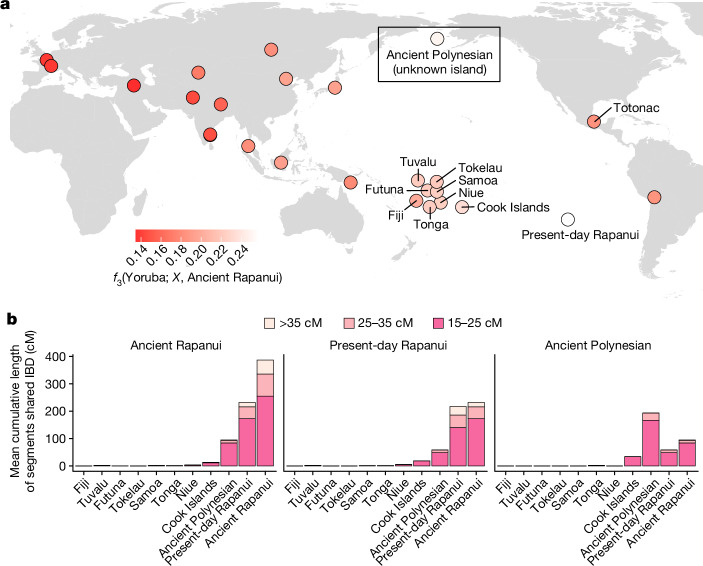
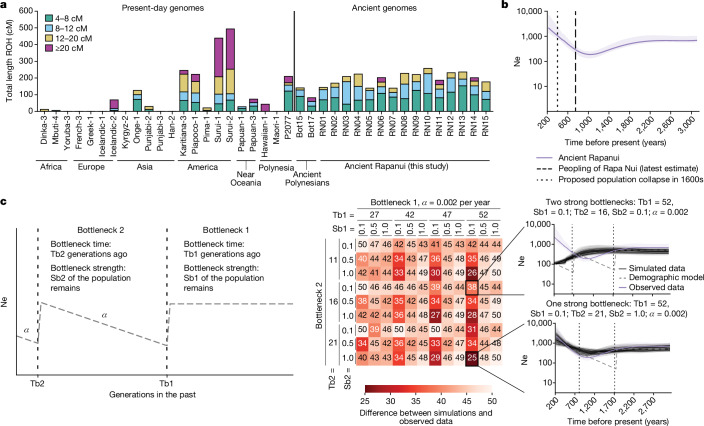
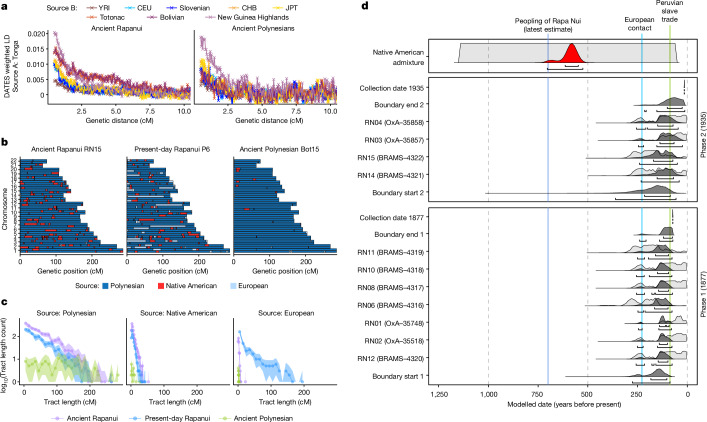
Rapa Nui (also known as Easter Island) is one of the most isolated inhabited places in the world. It has captured the imagination of many owing to its archaeological record, which includes iconic megalithic statues called moai 1. Two prominent contentions have arisen from the extensive study of Rapa Nui. First, the history of the Rapanui has been presented as a warning tale of resource overexploitation that would have culminated in a major population collapse—the ‘ecocide’ theory 2–4. Second, the possibility of trans-Pacific voyages to the Americas pre-dating European contact is still debated 5–7. Here, to address these questions, we reconstructed the genomic history of the Rapanui on the basis of 15 ancient Rapanui individuals that we radiocarbon dated (1670–1950 ce) and whole-genome sequenced (0.4–25.6×). We find that these individuals are Polynesian in origin and most closely related to present-day Rapanui, a finding that will contribute to repatriation efforts. Through effective population size reconstructions and extensive population genetics simulations, we reject a scenario involving a severe population bottleneck during the 1600s, as proposed by the ecocide theory. Furthermore, the ancient and present-day Rapanui carry similar proportions of Native American admixture (about 10%). Using a Bayesian approach integrating genetic and radiocarbon dates, we estimate that this admixture event occurred about 1250–1430 ce.
Overview
CoChat Summary
TL;DR
Ancient genomes from 15 Rapanui individuals show Polynesian ancestry, no evidence of a 1600s population collapse, and about 10% Native American admixture dated to roughly 1250–1430 CE, before European contact. The authors argue this supports Rapanui resilience and pre-European trans-Pacific contact with the Americas.
Key findings
- The 15 ancient individuals (radiocarbon dated 1670–1950 CE; whole-genome coverage 0.4–25.6×; <5% contamination) are Polynesian and most closely related to present-day Rapanui, supporting their identification as Rapanui ancestors.
- The authors reject a severe 1600s population bottleneck: HapNe-LD and simulations favor no size reduction at bottleneck 2, with a permutation test P < 10⁻⁵ separating strong/intermediate from weak bottleneck scenarios; effective population size instead appears to have steadily increased after initial peopling.
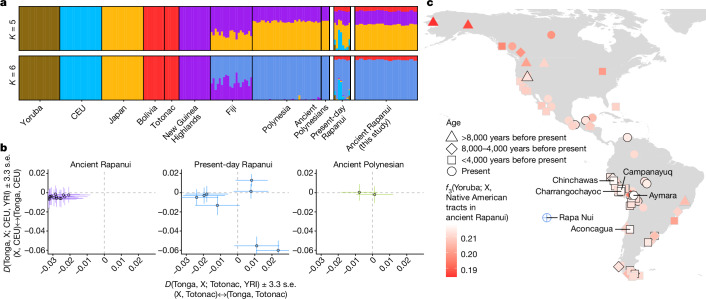
- Ancient and present-day Rapanui carry similar Native American admixture: about 10% (6.0–11.4%) in ancient individuals and about 8% (6.4–10.3%) in present-day Rapanui, with no European-like ancestry detected in the ancient genomes.
- The Rapanui–Native American admixture is dated to about 1250–1430 CE; the favoured joint genetic–radiocarbon model gives 1336–1402 CE at 68.3% probability and 1246–1425 CE at 95.4%, i.e. 364 ± 41 years before 1722. The Native American source is most closely related to ancient and present-day Central Andean Highlands populations.
Methods
- Sampled petrous bone and teeth from 15 museum-curated individuals labelled Rapanui, obtained direct radiocarbon dates for 11, and generated whole-genome sequencing data; imputed diploid genotypes with GLIMPSE and validated with downsampling and benchmarking.
- Used population-genetic analyses including multidimensional scaling, f3- and D-statistics, ADMIXTURE, IBD sharing, ROH, relatedness, HapNe-LD effective population size reconstruction, and msprime coalescent simulations.
- Dated admixture using ALDER, DATES, RFMix local ancestry tracts, and a Bayesian model integrating genetic admixture dates with radiocarbon dates; also reanalysed previously published low-depth ancient Rapanui data.
Limitations
- The paper states that its genomic results address Rapanui demographic history only and cannot directly evaluate the ecological impact of human activity on the island; it also notes that the genomic record in Central and South America, especially Ecuador, Colombia, and Central America, is still sparse, so a better proxy for the contacting Native American population may emerge later.
- The paper states that establishing the number and directionality of trans-Pacific trips remains challenging from genomic data alone, and that effective population sizes should be interpreted qualitatively/relatively rather than as absolute census sizes.
- Evident from the text: the sample is 15 ancient individuals, museum records provide limited information about collection circumstances, and several analyses rely on imputed genotypes or low-depth comparisons, though the authors validate imputation and use downsampling to address power limitations.
Model-written summary. Check it against the paper before relying on it.
Integrity signals
Registry
Cites
Statistics
Figures
Verification
Claims the paper makes
8 Valid · 3 Not valid · 18 Not checked · 58 Own results and interpretations
Some cited sources support this claim and some don’t — read each source’s verdict below.
In the paper
“The results were calibrated to take into account marine reservoir effects derived from the consumption of marine proteins, and broadly range between 1670 and 1950 ce28–30 (Supplementary Information section 2).”
§ Ancient Rapanui genomes reveal resilience and pre-European contact with the Americas > Ancient genomes and radiocarbon dates
What the sources say
- Partly supportedcites [28] Jarman, C. L. et al. Diet of the prehistoric population of Rapa Nui (Easter Island, Chile) shows environmental adaptation and resilience. Am. J. Phys. Anthropol. 164, 343–361 (2017). 28664976 PMC5637906 sourceExperimental — accuracy not yet measured
The Results (Radiocarbon dates, Table 2) show dates calibrated for marine reservoir effects, supporting that part of the citing sentence. But this paper directly dated three individuals, not 15, and its marine-corrected ranges begin as early as AD 1445, not broadly around 1670 CE; the latest endpoint is AD 1945. (LLM, conf=0.88)
- Could not verifycites [29] Bronk Ramsey, C. Bayesian analysis of radiocarbon dates. Radiocarbon 51, 337–360 (2009). sourceExperimental — accuracy not yet measured
The Probability Density Functions section explains radiocarbon calibration methods, but does not report dates for 15 individuals. A search for the 1670–1950 CE range and marine reservoir effects found no passage in our copy addressing those results. (LLM, conf=0.76)
- Disputedcites [30] Arneborg, J. et al. Change of diet of the Greenland Vikings determined from stable carbon isotope analysis and 14 C dating of their bones. Radiocarbon 41, 157–168 (1999). sourceExperimental — accuracy not yet measured
Table 2 (section “Year AD”; page unavailable) lists calendar dates for the Greenland Norse remains in the medieval period, including AD 976–1404, not 1670–1950 CE. The Methods and Analysis section confirms that the authors accounted for marine reservoir effects when calibrating dates, but that does not support the claimed date range. (LLM, conf=0.89)
Checked by a reasoning model — may be wrong.
plainn = 15- Asserted: passes — The authors put it forward as true.
- Checkable: passes — It can be checked against evidence.
- Load-bearing: passes — The paper’s conclusions depend on it.
- Based: passes — The paper gives a reason why it holds.
- Partly supported
The cited sources that could be checked couldn’t confirm or dispute this claim.
In the paper
“We observed that the Ancient Rapanui ROH distribution is similar to that of a present-day Rapanui genome (P2077)45.”
§ Ancient Rapanui genomes reveal resilience and pre-European contact with the Americas > Biological kinship and relatedness
What the sources say
- Could not verifycites [45] Malaspinas, A.-S. et al. A genomic history of Aboriginal Australia. Nature 10.1038/nature18299 (2016). 27654914 PMC7617037 sourceExperimental — accuracy not yet measured
The Dataset section describes Aboriginal Australian and Papuan genomes, while Extended Data discusses other genomic distributions; neither reports a comparison of ancient and present-day Rapanui runs of homozygosity. Searches for P2077, Rapanui, and ROH found no passage addressing the claimed similarity. (LLM, conf=0.76)
plainSingle case- Asserted: passes — The authors put it forward as true.
- Checkable: passes — It can be checked against evidence.
- Load-bearing: unclear — It is unclear whether the paper’s conclusions depend on it.
- Based: passes — The paper gives a reason why it holds.
- Could not verify
Every source the paper cites for this claim was checked and supports it.
In the paper
“the only other ancient whole-genome Rapanui study carried out so far did not find evidence for Rapanui–Native American contact.”
§ Ancient Rapanui genomes reveal resilience and pre-European contact with the Americas > Discussion
What the sources say
- Supportedcites [6] Fehren-Schmitz, L. et al. Genetic ancestry of Rapanui before and after European contact. Curr. Biol. 27, 3209–3215 (2017). 29033334 source
The In Brief section (p. 2) identifies this as a study of low-coverage genomes from ancient Rapanui and says the sampled individuals showed no Native American admixture. The Discussion (p. 6) likewise says none of its analyses detected Native American ancestry; it does not claim that contact never occurred. (LLM, conf=0.92)
plain- Asserted: passes — The authors put it forward as true.
- Checkable: passes — It can be checked against evidence.
- Load-bearing: passes — The paper’s conclusions depend on it.
- Based: passes — The paper gives a reason why it holds.
- Supported
Every source the paper cites for this claim was checked and supports it.
In the paper
“Concordantly, the ancient individuals remained most closely related to present-day Rapanui even when we considered a broader set of Oceanian reference individuals7,39 (Supplementary Fig. 12, Supplementary Table 5 and Supplementary Information section 7).”
§ Ancient Rapanui genomes reveal resilience and pre-European contact with the Americas > Ancient genomes from Rapanui ancestors
What the sources say
- Supportedcites [7] Ioannidis, A. G. et al. Native American gene flow into Polynesia predating Easter Island settlement. Nature 583, 572–577 (2020). 32641827 PMC8939867 source
The citation is attached to the broader set of Oceanian reference individuals, not necessarily to the citing authors’ finding about which population the ancient individuals most closely resemble. The cited paper reports a genome-wide dataset of 166 Rapanui and 188 additional individuals from Pacific islands (opening section, page unavailable), supporting its use as a source of those reference individuals. (LLM, conf=0.89)
- Supportedcites [39] Ioannidis, A. G. et al. Paths and timings of the peopling of Polynesia inferred from genomic networks. Nature 597, 522–526 (2021). 34552258 PMC9710236 source
The citation is attached to the broader set of Oceanian reference individuals, not to the citing authors’ finding about ancient individuals. The source’s Abstract describes genomic data from 430 contemporary people across 21 Pacific island populations, and its Methods (Identity-by-descent analyses) explicitly include Rapa Nui and other remote Pacific islands. It therefore supports the identification of the reference population set. (LLM, conf=0.88)
plainstates an associationn = 15- Asserted: passes — The authors put it forward as true.
- Checkable: passes — It can be checked against evidence.
- Load-bearing: passes — The paper’s conclusions depend on it.
- Based: passes — The paper gives a reason why it holds.
- Supported
The cited sources support only part of this claim — read each source’s verdict below.
In the paper
“Our inferred HapNe-LD curve is pictured in Fig. 2b and Supplementary Fig. 28. It shows a decreasing population size that reaches its minimum about 28 generations (about 800 years) before the Ancient Rapanui time of birth, followed by a steady increase.”
§ Ancient Rapanui genomes reveal resilience and pre-European contact with the Americas > No evidence for 1600s Rapanui collapse
What the sources say
- Partly supportedcites [51] Fournier, R., Tsangalidou, Z., Reich, D. & Palamara, P. F. Haplotype-based inference of recent effective population size in modern and ancient DNA samples. Nat. Commun.14, 7945 (2023). PMC10692198 38040695 sourceExperimental — accuracy not yet measured
The Results section (“Overview of the HapNe algorithm”; page not available) confirms that HapNe-LD infers recent effective population size. The paper’s ancient-population results discuss other populations, not Rapanui; our copy does not support the claimed minimum 28 generations before the Ancient Rapanui birth date or the subsequent steady increase. (LLM, conf=0.80)
plainstates a cause- Asserted: passes — The authors put it forward as true.
- Checkable: passes — It can be checked against evidence.
- Load-bearing: passes — The paper’s conclusions depend on it.
- Based: passes — The paper gives a reason why it holds.
- Partly supported
54 more claims · 4 with their cited sources checked
Create a free account to see all 87 claims and every source verdict.
- It may state two separate claims as one. 18
- Probably not a substantial claim. 12
Self-check
Percentages, sums and reported differences re-computed from the paper’s own numbers.
Each contradiction between two passages listed here was confirmed by an independent check.
Rated minor: it would not touch a result — a value no result rests on, a p-value that stays on the same side of the significance level, or a conflict that is clerical, resolved elsewhere in the paper, or outside its own findings.
In the paper
§ Ancient Rapanui genomes reveal resilience and pre-European contact with the Americas > Abstract
“15 ancient Rapanui individuals that we radiocarbon dated (1670–1950 ce) and whole-genome sequenced (0.4–25.6×)”
§ Ancient Rapanui genomes reveal resilience and pre-European contact with the Americas > Ancient genomes and radiocarbon dates
“We obtained direct radiocarbon dates from 11 individuals at the Oxford Radiocarbon Accelerator Unit and Bristol Radiocarbon Accelerator Mass Spectrometer.”
Citations
Cites
Fast and accurate short read alignment with Burrows-Wheeler transform
Li, H., & Durbin, R. (2009) · Bioinformatics · doi:10.1093/bioinformatics/btp324 · Cited by 58,607
PLINK: a tool set for whole-genome association and population-based linkage analyses.
Purcell, S., Neale, B., Todd-Brown, K., Thomas, L., Ferreira, M. A. R., Bender, D., Maller, J., Sklar, P., de Bakker, P. I. W., Daly, M. J., et al. (2007) · The American Journal of Human Genetics · doi:10.1086/519795 · Cited by 34,089 · cited 7×
“9.20200712 47 to detect ROH.”
InfluentialA global reference for human genetic variation
The 1000 Genomes Project Consortium, authors, C., Auton, A., Abecasis, G. R., Steering committee, Altshuler, D. M., Durbin, R. M., Abecasis, G. R., Bentley, D. R., Chakravarti, A., et al. (2015) · Nature · doi:10.1038/nature15393 · Cited by 18,247 · cited 3×
“For all individuals in this analysis, we phased their diploid genotypes (imputed or from SNP array calls) using shapeit2 106 together with the phased 1000 Genomes project Phase 3 reference dataset 100 and the HapMap genetic map 87 .”
InfluentialWickham, H. (2016) · Use R! · doi:10.1007/978-3-319-24277-4_9 · Cited by 12,516
A framework for variation discovery and genotyping using next-generation DNA sequencing data
DePristo, M. A., Banks, E., Poplin, R., Garimella, K. V., Maguire, J. R., Hartl, C., Philippakis, A. A., del Angel, G., Rivas, M. A., Hanna, M., et al. (2011) · Nature Genetics · doi:10.1038/ng.806 · Cited by 11,456 · cited 1×
“We retained mapped reads with a mapping quality greater than 30, removed PCR duplicates using picard MarkDuplicates (http://picard.sourceforge. net), carried out local realignment using GATK 82 and computed the MD tag and extended BAQ for each read using the samtools calmd command.”
Fast model-based estimation of ancestry in unrelated individuals
Alexander, D. H., Novembre, J., & Lange, K. (2009) · Genome Research · doi:10.1101/gr.094052.109 · Cited by 9,898 · cited 9×
“For multidimensional scaling, f -statistics, ADMIXTURE, local ancestry inference and admixture dating, we considered SNP array data from refs.”
InfluentialBayesian Analysis of Radiocarbon Dates
Bronk Ramsey, C. (2009) · Radiocarbon · doi:10.1017/s0033822200033865 · Cited by 8,725 · cited 1×
“29 and Supplementary Table 22) and characterized by five main parameters.”
Integrating common and rare genetic variation in diverse human populations
The International HapMap 3 Consortium (2010) · Nature · doi:10.1038/nature09298 · Cited by 3,026
ANGSD: Analysis of Next Generation Sequencing Data
Korneliussen, T. S., Albrechtsen, A., & Nielsen, R. (2014) · BMC Bioinformatics · doi:10.1186/s12859-014-0356-4 · Cited by 2,982 · cited 1×
“930 83 (Supplementary Figs.”
Ancient Admixture in Human History
Patterson, N., Moorjani, P., Luo, Y., Mallick, S., Rohland, N., Zhan, Y., Genschoreck, T., Webster, T., & Reich, D. (2012) · Genetics · doi:10.1534/genetics.112.145037 · Cited by 2,848 · cited 3×
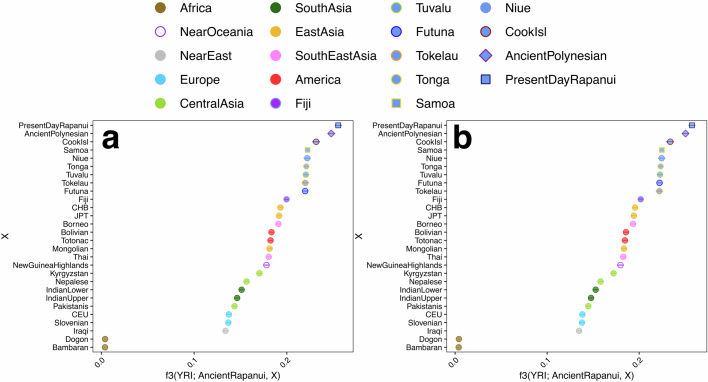
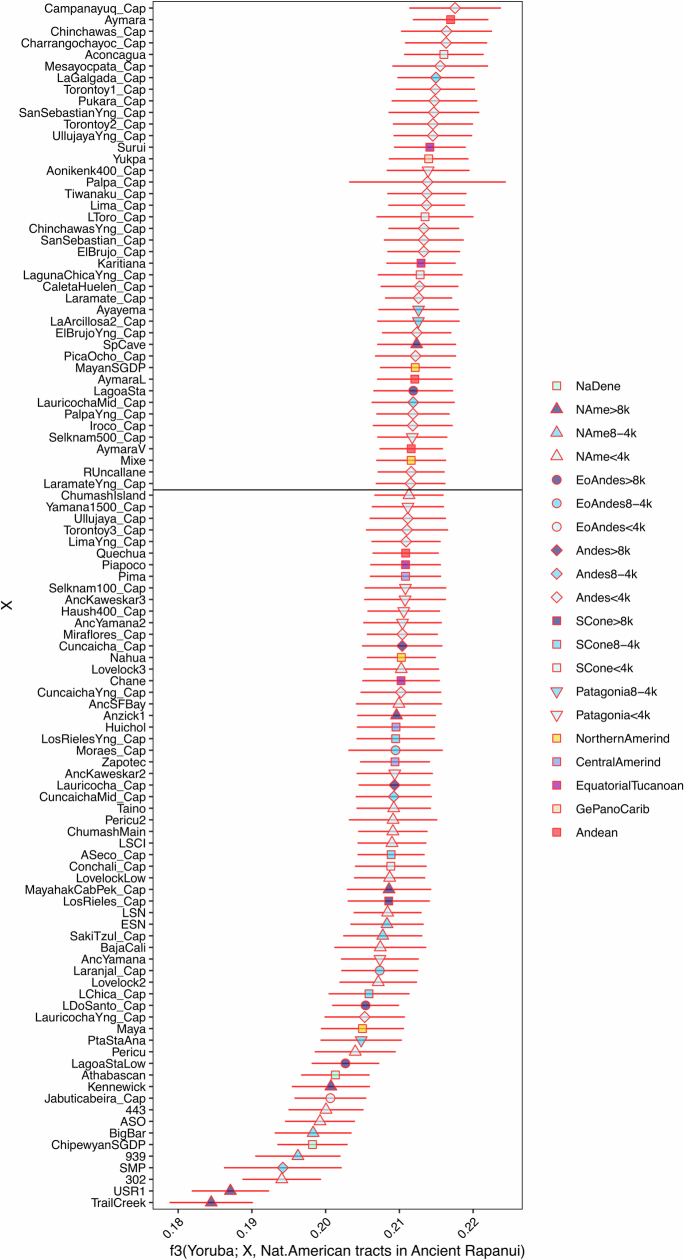
“We estimated allele frequencies on the basis of the 15 individuals and computed f 3 -statistics 37,38 of the form f 3 (Yoruba; X , Ancient Individuals), where X represents different present-day populations.”
InfluentialThe complete genome sequence of a Neanderthal from the Altai Mountains
Prüfer, K., Racimo, F., Patterson, N., Jay, F., Sankararaman, S., Sawyer, S., Heinze, A., Renaud, G., Sudmant, P. H., de Filippo, C., et al. (2014) · Nature · doi:10.1038/nature12886 · Cited by 2,254
Illumina Sequencing Library Preparation for Highly Multiplexed Target Capture and Sequencing
Meyer, M., & Kircher, M. (2010) · Cold Spring Harbor Protocols · doi:10.1101/pdb.prot5448 · Cited by 2,231
Sequencing of 53,831 diverse genomes from the NHLBI TOPMed Program
Taliun, D., Harris, D. N., Kessler, M. D., Carlson, J., Szpiech, Z. A., Torres, R., Taliun, S. A. G., Corvelo, A., Gogarten, S. M., Kang, H. M., et al. (2021) · Nature · doi:10.1038/s41586-021-03205-y · Cited by 2,213
A high-coverage genome sequence from an archaic denisovan individual
Meyer, M., Kircher, M., Gansauge, M.-T., Li, H., Racimo, F., Mallick, S., Schraiber, J. G., Jay, F., Prüfer, K., de Filippo, C., et al. (2012) · Science · doi:10.1126/science.1224344 · Cited by 1,967
The Simons Genome Diversity Project: 300 genomes from 142 diverse populations
Mallick, S., Li, H., Lipson, M., Mathieson, I., Gymrek, M., Racimo, F., Zhao, M., Chennagiri, N., Nordenfelt, S., Tandon, A., et al. (2016) · Nature · doi:10.1038/nature18964 · Cited by 1,584 · cited 3×
“For analyses relying on a whole-genome world-wide panel, we considered the Simons Genome Diversity Project 44 (v4 callset) as distributed in https://sharehost.hms.harvard.edu/genetics/ reich_lab/sgdp/variant_set/.”
Population genomics of Bronze Age Eurasia
Allentoft, M. E., Sikora, M., Sjögren, K.-G., Rasmussen, S., Rasmussen, M., Stenderup, J., Damgaard, P. B., Schroeder, H., Ahlström, T., Vinner, L., et al. (2015) · Nature · doi:10.1038/nature14507 · Cited by 1,550
Self-citationImproved whole-chromosome phasing for disease and population genetic studies
Delaneau, O., Zagury, J.-F., & Marchini, J. (2013) · Nature Methods · doi:10.1038/nmeth.2307 · Cited by 1,315 · cited 1×
“For all individuals in this analysis, we phased their diploid genotypes (imputed or from SNP array calls) using shapeit2 106 together with the phased 1000 Genomes project Phase 3 reference dataset 100 and the HapMap genetic map 87 .”
Self-citationHaploGrep 2: mitochondrial haplogroup classification in the era of high-throughput sequencing
Weissensteiner, H., Pacher, D., Kloss-Brandstätter, A., Forer, L., Specht, G., Bandelt, H.-J., Kronenberg, F., Salas, A., & Schönherr, S. (2016) · Nucleic Acids Research · doi:10.1093/nar/gkw233 · Cited by 944 · cited 1×
“We called majority rule mtDNA consensus sequences for each individual and used HaploGrep2 88 to assign mtDNA haplogroups.”
RFMix: A Discriminative Modeling Approach for Rapid and Robust Local-Ancestry Inference
Maples, B. K., Gravel, S., Kenny, E. E., & Bustamante, C. D. (2013) · The American Journal of Human Genetics · doi:10.1016/j.ajhg.2013.06.020 · Cited by 900 · cited 3×
“Through downsampling experiments of our data, we find that the average depth of coverage of that dataset (0.0004–0.0041×) does not yield enough power to carry out the specific statistical tests Colours correspond to the source populations from RFmix (Polynesian, Native American and European).”
InfluentialA Revised Timescale for Human Evolution Based on Ancient Mitochondrial Genomes
Fu, Q., Mittnik, A., Johnson, P. L. F., Bos, K., Lari, M., Bollongino, R., Sun, C., Giemsch, L., Schmitz, R., Burger, J., et al. (2013) · Current Biology · doi:10.1016/j.cub.2013.02.044 · Cited by 709 · cited 1×
“We estimated the proportion of present-day human mitochondrial DNA (mtDNA) contamination using contamMix 84 on the basis of a majority rule consensus for each individual and an alignment of 311 worldwide mtDNA sequences 85 .”
Reconstructing Native American population history
Reich, D., Patterson, N., Campbell, D., Tandon, A., Mazieres, S., Ray, N., Parra, M. V., Rojas, W., Duque, C., Mesa, N., et al. (2012) · Nature · doi:10.1038/nature11258 · Cited by 696 · cited 1×
“…note that point estimates for some non-Andean populations overlap with the confidence intervals of the highest f 3 (and D ) values, probably owing to low resolution of the reference dataset (Supplementary Information section 4.4) and short internal branches separating Native American groups 57,58 .”
InfluentialEfficient Coalescent Simulation and Genealogical Analysis for Large Sample Sizes
Kelleher, J., Etheridge, A. M., & McVean, G. (2016) · PLOS Computational Biology · doi:10.1371/journal.pcbi.1004842 · Cited by 654
A genomic history of Aboriginal Australia
Malaspinas, A.-S., Westaway, M. C., Muller, C., Sousa, V. C., Lao, O., Alves, I., Bergström, A., Athanasiadis, G., Cheng, J. Y., Crawford, J. E., et al. (2016) · Nature · doi:10.1038/nature18299 · Cited by 650 · cited 3×
“We observed that the Ancient Rapanui ROH distribution is similar to that of a present-day Rapanui genome (P2077) 45 .”
Self-citationRadiocarbon and DNA evidence for a pre-Columbian introduction of Polynesian chickens to Chile
Storey, A. A., Ramírez, J. M., Quiroz, D., Burley, D. V., Addison, D. J., Walter, R., Anderson, A. J., Hunt, T. L., Athens, J. S., Huynen, L., et al. (2007) · Proceedings of the National Academy of Sciences · doi:10.1073/pnas.0703993104 · Cited by 645 · cited 2×
“21 and 22).”
AdapterRemoval: easy cleaning of next-generation sequencing reads
Lindgreen, S. (2012) · BMC Research Notes · doi:10.1186/1756-0500-5-337 · Cited by 620 · cited 1×
“5.3 79 to trim Illumina adaptor sequences, leading N bases and trailing quality-2 runs and collapse paired-end reads overlapping over ≥11 bases.”
InfluentialA Complete Neandertal Mitochondrial Genome Sequence Determined by High-Throughput Sequencing
Green, R. E., Malaspinas, A.-S., Krause, J., Briggs, A. W., Johnson, P. L. F., Uhler, C., Meyer, M., Good, J. M., Maricic, T., Stenzel, U., et al. (2008) · Cell · doi:10.1016/j.cell.2008.06.021 · Cited by 599 · cited 1×
“We estimated the proportion of present-day human mitochondrial DNA (mtDNA) contamination using contamMix 84 on the basis of a majority rule consensus for each individual and an alignment of 311 worldwide mtDNA sequences 85 .”
Self-citationAncient DNA extraction from bones and teeth
Rohland, N., & Hofreiter, M. (2007) · Nature Protocols · doi:10.1038/nprot.2007.247 · Cited by 584
The genome of a Late Pleistocene human from a Clovis burial site in western Montana
Rasmussen, M., Anzick, S. L., Waters, M. R., Skoglund, P., DeGiorgio, M., Stafford, T. W., Rasmussen, S., Moltke, I., Albrechtsen, A., Doyle, S. M., et al. (2014) · Nature · doi:10.1038/nature13025 · Cited by 562
Self-citationGenomic evidence for the Pleistocene and recent population history of Native Americans
Raghavan, M., Steinrücken, M., Harris, K., Schiffels, S., Rasmussen, S., DeGiorgio, M., Albrechtsen, A., Valdiosera, C., Ávila-Arcos, M. C., Malaspinas, A.-S., et al. (2015) · Science · doi:10.1126/science.aab3884 · Cited by 540 · cited 1×
“58,90–98.”
Self-citationRemoval of deaminated cytosines and detection of in vivo methylation in ancient DNA
Briggs, A. W., Stenzel, U., Meyer, M., Krause, J., Kircher, M., & Pääbo, S. (2010) · Nucleic Acids Research · doi:10.1093/nar/gkp1163 · Cited by 491
Inferring admixture histories of human populations using linkage disequilibrium
Loh, P.-R., Lipson, M., Patterson, N., Moorjani, P., Pickrell, J. K., Reich, D., & Berger, B. (2013) · Genetics · doi:10.1534/genetics.112.147330 · Cited by 466 · cited 3×
“We used ALDER 59 and DATES 60 to model the 15 Ancient Rapanui as a mixture of two source populations: Polynesians and a second source representing African, European, East Asian, Papuan or Native American populations (Supplementary Information section 14).”
Efficient phasing and imputation of low-coverage sequencing data using large reference panels
Rubinacci, S., Ribeiro, D. M., Hofmeister, R. J., & Delaneau, O. (2021) · Nature Genetics · doi:10.1038/s41588-020-00756-0 · Cited by 465 · cited 4×
“To leverage the whole-genome dataset, we produced imputed diploid genotypes with GLIMPSE 31 .”
InfluentialSelf-citationSequencing of 53,831 diverse genomes from the NHLBI TOPMed ProgramPreprint
Taliun, D., Harris, D., Kessler, M. D., et al. (2019) · bioRxiv (Cold Spring Harbor Laboratory) · doi:10.1101/563866 · Cited by 427
Genomic insights into the peopling of the Southwest Pacific
Skoglund, P., Posth, C., Sirak, K., Spriggs, M., Valentin, F., Bedford, S., Clark, G. R., Reepmeyer, C., Petchey, F., Fernandes, D., et al. (2016) · Nature · doi:10.1038/nature19844 · Cited by 414
Reconstructing the Deep Population History of Central and South America
Posth, C., Nakatsuka, N., Lazaridis, I., Skoglund, P., Mallick, S., Lamnidis, T. C., Rohland, N., Nägele, K., Adamski, N., Bertolini, E., et al. (2018) · Cell · doi:10.1016/j.cell.2018.10.027 · Cited by 397
Early human dispersals within the Americas
Moreno-Mayar, J. V., Vinner, L., de Barros Damgaard, P., de la Fuente, C., Chan, J., Spence, J. P., Allentoft, M. E., Vimala, T., Racimo, F., Pinotti, T., et al. (2018) · Science · doi:10.1126/science.aav2621 · Cited by 362 · cited 2×
“58,90–98.”
InfluentialSelf-citationBrowning, S. R., & Browning, B. L. (2015) · The American Journal of Human Genetics · doi:10.1016/j.ajhg.2015.07.012 · Cited by 353 · cited 1×
“In population genetics, directly translating effective population sizes into census sizes is challenging owing to, for example, census inclusion criteria or variance in reproductive rates 52,53 .”
Estimating genetic kin relationships in prehistoric populations
Monroy Kuhn, J. M., Jakobsson, M., & Günther, T. (2018) · PLOS ONE · doi:10.1371/journal.pone.0195491 · Cited by 330 · cited 4×
“We applied READ to a pseudohaploid version of the genomes extracted at 755,094 SNP sites (Supplementary Information section 4.1).”
InfluentialThe genetic prehistory of the New World Arctic
Raghavan, M., DeGiorgio, M., Albrechtsen, A., Moltke, I., Skoglund, P., Korneliussen, T. S., Grønnow, B., Appelt, M., Gulløv, H. C., Friesen, T. M., et al. (2014) · Science · doi:10.1126/science.1255832 · Cited by 329
Self-citationImproving ancient DNA read mapping against modern reference genomes
Schubert, M., Ginolhac, A., Lindgreen, S., Thompson, J. F., AL-Rasheid, K. A., Willerslev, E., Krogh, A., & Orlando, L. (2012) · BMC Genomics · doi:10.1186/1471-2164-13-178 · Cited by 325 · cited 1×
“81.”
Terminal Pleistocene Alaskan genome reveals first founding population of Native Americans
Moreno-Mayar, J. V., Potter, B. A., Vinner, L., Steinrücken, M., Rasmussen, S., Terhorst, J., Kamm, J. A., Albrechtsen, A., Malaspinas, A.-S., Sikora, M., et al. (2018) · Nature · doi:10.1038/nature25173 · Cited by 316
Self-citationPopulation Genetics Models of Local Ancestry
Gravel, S. (2012) · Genetics · doi:10.1534/genetics.112.139808 · Cited by 311 · cited 1×
“We obtained tract length distributions per ancestry and used tracts 61 to estimate an admixture date for the joint 15 Ancient Rapanui individuals.”
Questioning Collapse: Human Resilience, Ecological Vulnerability, and the Aftermath of Empire
(2009) · Cambridge University Press eBooks · doi:10.1017/cbo9780511757815 · Cited by 309
The ancestry and affiliations of Kennewick Man
Rasmussen, M., Sikora, M., Albrechtsen, A., Korneliussen, T. S., Moreno-Mayar, J. V., Poznik, G. D., Zollikofer, C. P. E., Ponce de León, M. S., Allentoft, M. E., Moltke, I., et al. (2015) · Nature · doi:10.1038/nature14625 · Cited by 288
Self-citationLate Colonization of Easter Island
Hunt, T. L., & Lipo, C. P. (2006) · Science · doi:10.1126/science.1121879 · Cited by 284 · cited 2×
“Despite the remoteness of Rapa Nui, archaeological and genetic evidence shows that Polynesian peoples from the west had already reached the island about 1250 ce 8–10 .”
INBREEDING AND VARIANCE EFFECTIVE NUMBERS IN POPULATIONS WITH OVERLAPPING GENERATIONS
Felsenstein, J. (1971) · Genetics · doi:10.1093/genetics/68.4.581 · Cited by 277
Improving access to endogenous DNA in ancient bones and teeth
Damgaard, P. B., Margaryan, A., Schroeder, H., Orlando, L., Willerslev, E., & Allentoft, M. E. (2015) · Scientific Reports · doi:10.1038/srep11184 · Cited by 276
Self-citationNeolithic and Bronze Age migration to Ireland and establishment of the insular Atlantic genome
Cassidy, L. M., Martiniano, R., Murphy, E. M., Teasdale, M. D., Mallory, J., Hartwell, B., & Bradley, D. G. (2016) · Proceedings of the National Academy of Sciences · doi:10.1073/pnas.1518445113 · Cited by 255 · cited 1×
“104, we ran PLINK with the following command to detect ROH in imputed ancient genomes and high-coverage present-day genomes: plink --bfile input --homozyg --homozyg-kb 500 --homozyg-gap 100 --homozyg-density 50 --homozyg-snp 50 --homozyg-window-het 1 --homozyg-window-snp 50…”
Parental relatedness through time revealed by runs of homozygosity in ancient DNA
Ringbauer, H., Novembre, J., & Steinrücken, M. (2021) · Nature Communications · doi:10.1038/s41467-021-25289-w · Cited by 245 · cited 3×
“…identified runs of homozygosity (ROH) in the 15 Ancient Rapanui genomes and a set of reference ancient and present-day worldwide genomes 32,44,45 using hapROH 46 with pseudo-haploid data and PLINK 47 with imputed genotypes excluding transition polymorphisms (Supplementary Information section 10).”
Arneborg, J., Heinemeier, J., Lynnerup, N., Nielsen, H. L., Rud, N., & Sveinbjörnsdóttir, Á. E. (1999) · Radiocarbon · doi:10.1017/s0033822200019512 · Cited by 230
Demographic History of Oceania Inferred from Genome-wide Data
Wollstein, A., Lao, O., Becker, C., Brauer, S., Trent, R. J., Nürnberg, P., Stoneking, M., & Kayser, M. (2010) · Current Biology · doi:10.1016/j.cub.2010.10.040 · Cited by 218
Hanghøj, K., Moltke, I., Andersen, P. A., Manica, A., & Korneliussen, T. S. (2019) · GigaScience · doi:10.1093/gigascience/giz034 · Cited by 216 · cited 3×
“Using READ 42 and NGSrelate2 43 , we did not find any first-or second-degree relatives among the Ancient Rapanui (Supplementary Figs.”
A Fast and Efficient Single-stranded Genomic Library Preparation Method Optimized for Ancient DNA
Kapp, J. D., Green, R. E., & Shapiro, B. (2021) · Journal of Heredity · doi:10.1093/jhered/esab012 · Cited by 211
Rethinking Easter Island's ecological catastrophe
Hunt, T. L. (2007) · Journal of Archaeological Science · doi:10.1016/j.jas.2006.10.003 · Cited by 201 · cited 1×
“Although trees once covered Rapa Nui, it has Nature | Vol 633 | 12 September 2024 | 395 been proposed that their decline is likely to be a compound consequence of direct human action and the proliferation of rats brought by Polynesian settlers, as observed in other Polynesian islands 65–68 .”
A Paleogenomic Reconstruction of the Deep Population History of the Andes
Nakatsuka, N., Lazaridis, I., Barbieri, C., Skoglund, P., Rohland, N., Mallick, S., Posth, C., Harkins-Kinkaid, K., Ferry, M., Harney, É., et al. (2020) · Cell · doi:10.1016/j.cell.2020.04.015 · Cited by 201
Native American gene flow into Polynesia predating Easter Island settlement
Ioannidis, A. G., Blanco-Portillo, J., Sandoval, K., Hagelberg, E., Miquel-Poblete, J. F., Moreno-Mayar, J. V., Rodríguez-Rodríguez, J. E., Quinto-Cortés, C. D., Auckland, K., Parks, T., et al. (2020) · Nature · doi:10.1038/s41586-020-2487-2 · Cited by 196 · cited 6×
“Confirmatory f 3 -statistics for a broader set of Oceanian individuals 7,39 are presented in Supplementary Fig.”
InfluentialSelf-citationDetecting Identity by Descent and Estimating Genotype Error Rates in Sequence Data
Browning, B. L., & Browning, S. R. (2013) · The American Journal of Human Genetics · doi:10.1016/j.ajhg.2013.09.014 · Cited by 187 · cited 6×
“Note that IBDseq operates on unphased genotypes and that Remote Oceanians are characterized by historically low effective population sizes, which is expected to give rise to extensive IBD sharing.”
InfluentialThe Anglo-Saxon migration and the formation of the early English gene pool
Gretzinger, J., Sayer, D., Justeau, P., Altena, E., Pala, M., Dulias, K., Edwards, C. J., Jodoin, S., Lacher, L., Sabin, S., et al. (2022) · Nature · doi:10.1038/s41586-022-05247-2 · Cited by 177
Self-citationPeopling of the Pacific: A Holistic Anthropological Perspective
Patrick, V. K. (2010) · Annual Review of Anthropology · doi:10.1146/annurev.anthro.012809.104936 · Cited by 167
Accurate detection of identity-by-descent segments in human ancient DNA
Ringbauer, H., Huang, Y., Akbari, A., Mallick, S., Olalde, I., Patterson, N., & Reich, D. (2024) · Nature Genetics · doi:10.1038/s41588-023-01582-w · Cited by 155 · cited 3×
“We used IBDseq 40 and ancIBD 41 on the imputed genotypes and focused on segments ≥15 cM, which were inferred consistently across methods.”
The spatiotemporal patterns of major human admixture events during the European Holocene
Chintalapati, M., Patterson, N., & Moorjani, P. (2022) · eLife · doi:10.7554/elife.77625 · Cited by 142 · cited 3×
“Using DATES, we inferred that the Rapanui–Native American admixture occurred 17–32 generations before the average time of birth of the ancient individuals.”
Ancient human parallel lineages within North America contributed to a coastal expansion
Scheib, C. L., Li, H., Desai, T., Link, V., Kendall, C., Dewar, G., Griffith, P. W., Mörseburg, A., Johnson, J. R., Potter, A., et al. (2018) · Science · doi:10.1126/science.aar6851 · Cited by 125 · cited 1×
“58,90–98.”
Paths and timings of the peopling of Polynesia inferred from genomic networks
Ioannidis, A. G., Blanco-Portillo, J., Sandoval, K., Hagelberg, E., Barberena-Jonas, C., Hill, A. V. S., Rodríguez-Rodríguez, J. E., Fox, K., Robson, K., Haoa-Cardinali, S., et al. (2021) · Nature · doi:10.1038/s41586-021-03902-8 · Cited by 124 · cited 3×
“Concordantly, the ancient individuals remained most closely related to present-day Rapanui even when we considered a broader set of Oceanian reference individuals 7,39 (Supplementary Fig.”
Untangling Oceanic settlement: the edge of the knowable
Hurles, M. E., Matisoo-Smith, E., Gray, R. D., & Penny, D. (2003) · Trends in Ecology & Evolution · doi:10.1016/s0169-5347(03)00245-3 · Cited by 118 · cited 5×
“Despite the remoteness of Rapa Nui, archaeological and genetic evidence shows that Polynesian peoples from the west had already reached the island about 1250 ce 8–10 .”
InfluentialIndo-European and Asian origins for Chilean and Pacific chickens revealed by mtDNA
Gongora, J., Rawlence, N. J., Mobegi, V. A., Jianlin, H., Alcalde, J. A., Matus, J. T., Hanotte, O., Moran, C., Austin, J. J., Ulm, S., et al. (2008) · Proceedings of the National Academy of Sciences · doi:10.1073/pnas.0801991105 · Cited by 117 · cited 3×
“25–27 and Supplementary Tables 17–21.”
Sirak, K. A., Fernandes, D. M., Cheronet, O., Novak, M., Gamarra, B., Balassa, T., Bernert, Z., Cséki, A., Dani, J., Gallina, J. Z., et al. (2017) · BioTechniques · doi:10.2144/000114558 · Cited by 113 · cited 2×
“Following strict museum guidelines, we sampled petrous bone and teeth material from 15 individuals—labelled as Rapanui—from the Muséum national d’Histoire naturelle, France, Pinart (1877) and Métraux (1935) collections using a minimally invasive method 27 (Supplementary Information section 1).”
de la Fuente, C., Ávila-Arcos, M. C., Galimany, J., Carpenter, M. L., Homburger, J. R., Blanco, A., Contreras, P., Cruz Dávalos, D., Reyes, O., San Roman, M., et al. (2018) · Proceedings of the National Academy of Sciences · doi:10.1073/pnas.1715688115 · Cited by 109
Self-citationPrehistoric sweet potato (Ipomoea batatas) from Mangaia Island, Central Polynesia
Hather, J., & Kirch, P. V. (1991) · Antiquity · doi:10.1017/s0003598x00080613 · Cited by 108
Imputation of ancient human genomes
Sousa da Mota, B., Rubinacci, S., Cruz Dávalos, D. I., G. Amorim, C. E., Sikora, M., Johannsen, N. N., Szmyt, M. H., Włodarczak, P., Szczepanek, A., Przybyła, M. M., et al. (2023) · Nature Communications · doi:10.1038/s41467-023-39202-0 · Cited by 102 · cited 1×
“99,100.”
Self-citationTwo ancient human genomes reveal Polynesian ancestry among the indigenous Botocudos of Brazil
Malaspinas, A.-S., Lao, O., Schroeder, H., Rasmussen, M., Raghavan, M., Moltke, I., Campos, P. F., Sagredo, F. S., Rasmussen, S., Gonçalves, V. F., et al. (2014) · Current Biology · doi:10.1016/j.cub.2014.09.078 · Cited by 98 · cited 11×
“We show results for the 15 Ancient Rapanui (left), three representative present-day Rapanui with low European admixture (middle) and two Ancient Polynesians (right) with unknown sampling location.”
InfluentialSelf-citationJarman, C. L., Larsen, T., Hunt, T., Lipo, C., Solsvik, R., Wallsgrove, N., Ka'apu‐Lyons, C., Close, H. G., & Popp, B. N. (2017) · American Journal of Physical Anthropology · doi:10.1002/ajpa.23273 · Cited by 94 · cited 1×
“The results were calibrated to take into account marine reservoir effects derived from the consumption of marine proteins, and broadly range between 1670 and 1950 ce 28–30 (Supplementary Information section 2).”
Rattus exulans and the catastrophic disappearance of Hawai’i’s native lowland forest
Athens, J. S. (2008) · Biological Invasions · doi:10.1007/s10530-008-9402-3 · Cited by 92
DNA from ancient Easter Islanders
Hagelberg, E., Quevedo, S., Turbon, D., & Clegg, J. B. (1994) · Nature · doi:10.1038/369025a0 · Cited by 84 · cited 1×
“However, the only two ancient DNA studies of ancient Rapanui so far did not find evidence for Native American admixture 6,26 .”
Xing, J., Watkins, W. S., Shlien, A., Walker, E., Huff, C. D., Witherspoon, D. J., Zhang, Y., Simonson, T. S., Weiss, R. B., Schiffman, J. D., et al. (2010) · Genomics · doi:10.1016/j.ygeno.2010.07.004 · Cited by 83 · cited 3×
“34 and 35 and Supplementary Table 24).”
InfluentialPlacing Ancient DNA Sequences into Reference Phylogenies
Martiniano, R., De Sanctis, B., Hallast, P., & Durbin, R. (2022) · Molecular Biology and Evolution · doi:10.1093/molbev/msac017 · Cited by 81 · cited 1×
“To call Y-chromosome haplogroups, we used pathPhynder 89 and the ISOGG Y-chromosome reference data (last curated 13 May 2021) to place each XY individual into a worldwide Y-chromosome phylogeny.”
Genome-wide Ancestry Patterns in Rapanui Suggest Pre-European Admixture with Native Americans
Moreno-Mayar, J. V., Rasmussen, S., Seguin-Orlando, A., Rasmussen, M., Liang, M., Flåm, S. T., Lie, B. A., Gilfillan, G. D., Nielsen, R., Thorsby, E., et al. (2014) · Current Biology · doi:10.1016/j.cub.2014.09.057 · Cited by 74
Self-citationReply to Storey et al. : More DNA and dating studies needed for ancient El Arenal-1 chickens
Gongora, J., Rawlence, N. J., Mobegi, V. A., Jianlin, H., Alcalde, J. A., Matus, J. T., Hanotte, O., Moran, C., Austin, J. J., Ulm, S., et al. (2008) · Proceedings of the National Academy of Sciences · doi:10.1073/pnas.0809681105 · Cited by 73
Puleston, C. O., Ladefoged, T. N., Haoa, S., Chadwick, O. A., Vitousek, P. M., & Stevenson, C. M. (2017) · Frontiers in Ecology and Evolution · doi:10.3389/fevo.2017.00069 · Cited by 62 · cited 2×
“According to the theory of ecological suicide (‘ecocide’), before European contact, the Rapanui would have deforested the island and decimated the local fauna to maintain a flourishing culture and a growing population of about 15,000 individuals 2,3,14 .”
Nakatsuka, N., Luisi, P., Motti, J. M. B., Salemme, M., Santiago, F., D’Angelo del Campo, M. D., Vecchi, R. J., Espinosa-Parrilla, Y., Prieto, A., Adamski, N., et al. (2020) · Nature Communications · doi:10.1038/s41467-020-17656-w · Cited by 60
A model-based approach to the tempo of “collapse”: The case of Rapa Nui (Easter Island)
DiNapoli, R. J., Rieth, T. M., Lipo, C. P., & Hunt, T. L. (2020) · Journal of Archaeological Science · doi:10.1016/j.jas.2020.105094 · Cited by 54
Pre-Columbian chickens, dates, isotopes, and mtDNA
Storey, A. A., Quiroz, D., Ramírez, J. M., Beavan-Athfield, N., Addison, D. J., Walter, R., Hunt, T., Athens, J. S., Huynen, L., & Matisoo-Smith, E. A. (2008) · Proceedings of the National Academy of Sciences · doi:10.1073/pnas.0807625105 · Cited by 50 · cited 2×
“21 and 22).”
Haplotype-based inference of recent effective population size in modern and ancient DNA samples
Fournier, R., Tsangalidou, Z., Reich, D., & Palamara, P. F. (2023) · Nature Communications · doi:10.1038/s41467-023-43522-6 · Cited by 49
Genetic Ancestry of Rapanui before and after European Contact
Fehren-Schmitz, L., Jarman, C. L., Harkins, K. M., Kayser, M., Popp, B. N., & Skoglund, P. (2017) · Current Biology · doi:10.1016/j.cub.2017.09.029 · Cited by 47
Malaspinas, A.-S., Tange, O., Moreno-Mayar, J. V., Rasmussen, M., DeGiorgio, M., Wang, Y., Valdiosera, C. E., Politis, G., Willerslev, E., & Nielsen, R. (2014) · Bioinformatics · doi:10.1093/bioinformatics/btu410 · Cited by 45
Self-citationDiNapoli, R. J., Crema, E. R., Lipo, C. P., Rieth, T. M., & Hunt, T. L. (2021) · Nature Communications · doi:10.1038/s41467-021-24252-z · Cited by 43 · cited 4×
“25–27 and Supplementary Tables 17–21.”
InfluentialIdentifying Genes Responsible for Intellectual Disability in Consanguineous Families
Iqbal, Z., & van Bokhoven, H. (2014) · Human Heredity · doi:10.1159/000360539 · Cited by 41 · cited 2×
“By contrast, in individuals with high consanguinity (for example, the Paiter Suruí from southern Amazon 48 and the Punjabi from Pakistan 49 ), a large proportion of ROH are long: the two Paiter Suruí individuals carry more than 76% ROH ≥ 12 cM (>335 cM) and Punjabi-2 bears 18 cM out of 30 cM in ROH…”
Ecological Catastrophe and Collapse: The Myth of 'Ecocide' on Rapa Nui (Easter Island)Preprint
Hunt, T. L., & Lipo, C. P. (2012) · SSRN Electronic Journal · doi:10.2139/ssrn.2042672 · Cited by 34
The Polynesian gene pool: an early contribution by Amerindians to Easter Island
Thorsby, E. (2012) · Philosophical Transactions of the Royal Society B: Biological Sciences · doi:10.1098/rstb.2011.0319 · Cited by 33 · cited 2×
“We used this panel to maximize the overlap between the reference present-day Polynesian individuals and the present-day Rapanui, who, according to medical and historical records, are unlikely to carry admixture from other Polynesian islands 35 .”
The Survival of Easter Island: Dwindling Resources and Cultural Resilience
Boersema, J. J. (2015) · doi:10.1017/cbo9781139226639 · Cited by 32 · cited 4×
“Although such a small population could have been the result of the proposed population collapse, this estimate is also compatible with a population that would have steadily grown after the initial peopling when assuming pre-industrial growth rates 16,70 .”
InfluentialMoreno-Mayar, J. V., Korneliussen, T. S., Dalal, J., Renaud, G., Albrechtsen, A., Nielsen, R., & Malaspinas, A.-S. (2020) · Bioinformatics · doi:10.1093/bioinformatics/btz660 · Cited by 21 · cited 1×
“We estimated the proportion of present-day human nuclear DNA contamination in XY individuals using contam-inationX 86 on reads with a mapping quality ≥30, bases with quality ≥20, sites with depth between 3 and 20 and the HapMap CEU allele frequencies 87 .”
Self-citationDiNapoli, R. J., Lipo, C. P., & Hunt, T. L. (2020) · Journal of Pacific Archaeology · doi:10.70460/jpa.v12i1.313 · Cited by 13
Inbreeding and surnames: A projection into Easter Island's past
González‐Martín, A., García‐Moro, C., Hernández, M., & Moral, P. (2006) · American Journal of Physical Anthropology · doi:10.1002/ajpa.20285 · Cited by 11 · cited 1×
“Yet unions between kins were seemingly infrequent pre-Peruvian slave raids and could have become more frequent in recent times 50 .”
Moreno-Mayar, J. V. (2022) · G3 Genes|Genomes|Genetics · doi:10.1093/g3journal/jkab357 · Cited by 4
Self-citationAlfred Métraux à l'Île de Pâques, de juillet 1934 à janvier 1935
Laroche, M.-C. (1990) · Journal de la Société des océanistes · doi:10.3406/jso.1990.2886 · Cited by 2 · cited 1×
“…the Pinart and Métraux collections and modelled them as two separate dated phases with termini ante quem corresponding to the time human remains were collected according to the museum archives and published documents 62–64 , accounting for their marine C intake and consequent reservoir offsets.”
Terminologias de parentesco dos grupos da família linguística Mondé
Felzke, L. F., & Moore, D. (2019) · Boletim do Museu Paraense Emílio Goeldi Ciências Humanas · doi:10.1590/1981.81222019000100003 · Cited by 2 · cited 2×
“By contrast, in individuals with high consanguinity (for example, the Paiter Suruí from southern Amazon 48 and the Punjabi from Pakistan 49 ), a large proportion of ROH are long: the two Paiter Suruí individuals carry more than 76% ROH ≥ 12 cM (>335 cM) and Punjabi-2 bears 18 cM out of 30 cM in ROH…”
Mieth, A., Kühlem, A., Vogt, B., & Bork, H.-R. (2022) · Developments in Paleoenvironmental Research · doi:10.1007/978-3-030-91127-0_19 · Cited by 2
Research works printed but not linked: 6
- Hunt, T. L. & Lipo, C. P. The Statues That Walked: Unraveling the Mystery of Easter Island (Free Press, 2011).
- Diamond, J. M. Collapse: How Societies Choose to Fail or Succeed (Penguin, 2006).
- Métraux, A. Ethnology of Easter Island (Bishop Museum Press, 1971).
- Maude, H. E. Slavers in Paradise: the Peruvian Slave Trade in Polynesia, 1862-1864 (Stanford Univ. Press, 1981).
- Pinart, A. Exploration de l’île de Pâques. Bull. Soc. Géogr. VIe Sér. 16, 193–213 (1878).
- Fournier, R., Tsangalidou, Z., Reich, D. & Palamara, P. F. Haplotype-based inference of recent effective population size in modern and ancient DNA samples. Nat. Commun. 14, 7945 (2023). 38040695 PMC10692198 · DOI · Paper page
Cited by
Human transformation of past terrestrial ecosystems
Nogué, S., Morueta‐Holme, N., Fernández‐Palacios, J. M., Alsos, I. G., Brown, A. G., Roberts, P., & Peñuelas, J. (2025) · Nature Reviews Biodiversity · doi:10.1038/s44358-025-00081-6 · Cited by 19
“For example, the identification of genetic changes owing to domestication and the spread of invasive species introduced by humans 110 .”
Understanding the human settlement of the Pacific – Are we there yet?
Matisoo-Smith, E. A., & Gosling, A. L. (2025) · Journal of Archaeological Science · doi:10.1016/j.jas.2025.106307 · Cited by 10
Towards predicting the geographical origin of ancient samples with metagenomic data
Bozzi, D., Neuenschwander, S., Dávalos, D. I. C., da Mota, B. S., Schroeder, H., Moreno-Mayar, J. V., Allentoft, M. E., & Malaspinas, A. (2024) · Scientific Reports · doi:10.1038/s41598-023-40246-x · Cited by 12
“In one dataset (hereafter called Brazil-Polynesia dataset) we included ancient individuals from different areas in Brazil 31 and ancient individuals from Polynesia 32 .”
BackgroundInfluentialSelf-citationAssessing Biocultural Diversity Across Scales Using Ecological Indicators
Mateus-Aguilar, B., Díaz-Salazar, A. F., Andrade‐Rivas, F., Batista, N. M., Cárdenas‐Navarrete, A., Arenas, A. D., Hernandez, K. V., Herrera‐R, G. A., Langhans, K. E., Levey, D. R., et al. (2025) · Ecological Indicators · doi:10.1016/j.ecolind.2025.113616 · Cited by 10
Immunomodulatory hydrogel reprograms IL-17/NF-κB signaling to drive regeneration in diabetic wounds
Xuan, H., Liu, Z., Lu, K., Chen, Y., Gu, H., Li, B., Sun, J., Jin, Y., Yang, Y., & Yuan, H. (2026) · Materials Today Bio · doi:10.1016/j.mtbio.2026.102890 · Cited by 7
“Inflammatory and antibacterial responses are vital for tissue repair and regeneration after injury [50].”
Metadata
- Authors
- Moreno-Mayar, J. V., Sousa da Mota, B., Higham, T., Klemm, S., Gorman Edmunds, M., Stenderup, J., Iraeta-Orbegozo, M., Laborde, V., Heyer, E., Torres Hochstetter, F., Friess, M., Allentoft, M. E., Schroeder, H., Delaneau, O., & Malaspinas, A.-S.
- Affiliations
- University of Copenhagen (DK)
- University College Dublin (IE)
- Muséum national d'Histoire naturelle (FR)
- Centre National de la Recherche Scientifique (FR)
- Regeneron (United States) (US)
- SIB Swiss Institute of Bioinformatics (CH)
- Corresponding author
- Moreno-Mayar, J. Víctor
- Delaneau, Olivier
- Malaspinas, Anna-Sapfo
- ORCID
- Venue
- Nature
- Published
- 2024-09-11
- Volume
- 633
- Issue
- 8029
- Pages
- 389-397
- ISSN
- 0028-0836 (ISSN-L)
- 1476-4687
- PMC
- PMC11390480
- OpenAlex
- W4402435806
- Cited by
- 20
- References
- 102
- Citations by year
- 2026: 9 · 2025: 8 · 2024: 3
- FWCI
- 5.29
- Type
- journal article
- Language
- en
- Open access
- hybrid
- doi.org
- Licence
- cc-by
- creativecommons.org/licenses/by/4.0 (tdm)
- creativecommons.org/licenses/by/4.0 (vor)
- Locations
- Nature (publishedVersion, cc-by)
- PubMed Central (publishedVersion, cc-by)
- PubMed (publishedVersion)
- Research at the University of Copenhagen (University of Copenhagen) (publishedVersion, cc-by)
- SERVAL (Université de Lausanne) (submittedVersion, cc-by)
- HAL (submittedVersion)
- RePEc: Research Papers in Economics (submittedVersion)
- IRIS (submittedVersion, cc-by)
- Funders
- National Science Foundation
- Villum Fonden
- Wellcome Trust (214300/Z/18/Z)
- Schweizerischer Nationalfonds zur Förderung der Wissenschaftlichen Forschung (176977)
- Lundbeckfonden (R302-2018-2155)
- H2020 European Research Council (679330)
- HORIZON EUROPE European Research Council (101045643, 101078151)
- Topics
- Life Sciences › Biochemistry, Genetics and Molecular Biology › Genetics › Forensic and Genetic Research
- Social Sciences › Anthropology › Pacific and Southeast Asian Studies
- Life Sciences › Biochemistry, Genetics and Molecular Biology › Genetics › Genetic diversity and population structure
- Keywords
- Easter Island, ancient genomes, Polynesian ancestry, population bottleneck, population size estimation, radiocarbon dating
- MeSH terms
- DNA, Ancient, Whole Genome Sequencing, Pacific Island People, Americas, Bayes Theorem, Female, Genetics, Population, Humans, Male, Phylogeny, Polynesia, Population Density, Genome, Human, American Indian or Alaska Native, History, 17th Century, History, 18th Century, History, 19th Century, History, 20th Century, History, Ancient, History, Medieval, Radiometric Dating, Human Migration
About these checks
Registry, retraction, Cites and statistics results are computed, not judged, with one exception: a printed reference that no index lists is read once by a model before it counts as a citation error. Claims are extracted by a model and kept only when their quote appears verbatim in the text; each cited source is then checked, with a model’s help, for whether it says what the claim relies on. Those verdicts can be wrong — read the claim’s quote and the cited source before relying on one.
The claim verdicts this report counts are experimental: their accuracy is not yet measured.
A language model drew the claims from the paper on 2026-10-10, under version 3 of the claim definition (model deepseek-v4.1-flash, prompt extract-v3).
A second model labelled each claim on 2026-10-10 (model jev-1.13-20260917, definition revision gold-guideline-v0.2).
Cited sources are checked with a language model’s help (gpt-6-sol).
Statistics and arithmetic are recomputed, not judged.
Confidence bands are shown only for fields calibrated on our annotated test set. None is calibrated yet, so no band is shown.
What counts as a claim ›How we measure confidence ›How we check this ›
Are you an author, or do you see a problem with this page? Request a review
Data sources
Bibliographic data: Semantic Scholar, OpenAlex, Crossref.
Contains information from the Semantic Scholar Academic Graph Datasets, made available under the ODC Attribution License (ODC-BY 1.0).
Semantic Scholar’s data is described in: Kinney, R., et al. (2023). The Semantic Scholar Open Data Platform. arXiv:2301.10140.
