

Layer and rhythm specificity for predictive routing
Open accessPublished version of a preprint
The DOI matches its Crossref record; 82 of the 82 references it cites were found in a registry or an index; 51 of the 86 sources its claims cite were checked for support.
Abstract
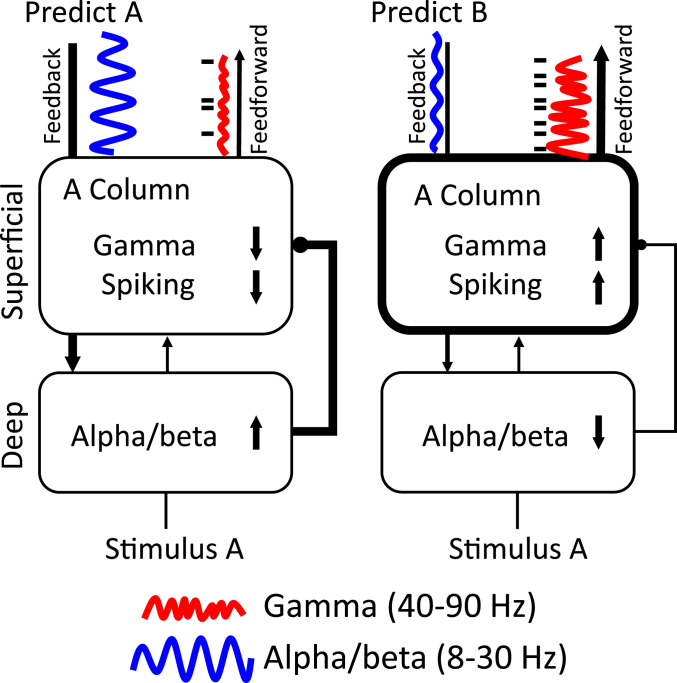
In predictive coding, experience generates predictions that attenuate the feeding forward of predicted stimuli while passing forward unpredicted "errors." Different models have suggested distinct cortical layers, and rhythms implement predictive coding. We recorded spikes and local field potentials from laminar electrodes in five cortical areas (visual area 4 [V4], lateral intraparietal [LIP], posterior parietal area 7A, frontal eye field [FEF], and prefrontal cortex [PFC]) while monkeys performed a task that modulated visual stimulus predictability. During predictable blocks, there was enhanced alpha (8 to 14 Hz) or beta (15 to 30 Hz) power in all areas during stimulus processing and prestimulus beta (15 to 30 Hz) functional connectivity in deep layers of PFC to the other areas. Unpredictable stimuli were associated with increases in spiking and in gamma-band (40 to 90 Hz) power/connectivity that fed forward up the cortical hierarchy via superficial-layer cortex. Power and spiking modulation by predictability was stimulus specific. Alpha/beta power in LIP, FEF, and PFC inhibited spiking in deep layers of V4. Area 7A uniquely showed increases in high-beta (∼22 to 28 Hz) power/connectivity to unpredictable stimuli. These results motivate a conceptual model, predictive routing. It suggests that predictive coding may be implemented via lower-frequency alpha/beta rhythms that "prepare" pathways processing-predicted inputs by inhibiting feedforward gamma rhythms and associated spiking.
Overview
CoChat Summary
## TL;DR
Monkeys performing a delayed match-to-sample task showed stronger spiking, gamma/theta activity, and feedforward interactions for unpredictable stimuli, while predictable stimuli were associated with stronger alpha/beta activity and feedback interactions. The effects were layer-specific and stimulus-specific, supporting the paper’s proposed “predictive routing” model rather than a specialized prediction-error circuit.
## Key findings
- In the task, performance was better for predictable than unpredictable blocks: accuracy was 80.6% vs. 74.2% across sessions, and reaction time was 236 ms vs. 239 ms (both significant; P < 1E-8 and P = 0.017, respectively).
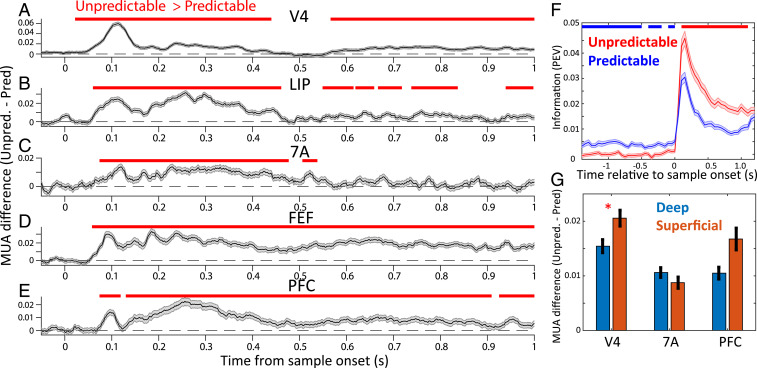
- During sample presentation, MUA/spiking was greater for unpredictable than predictable samples in all areas tested, and single-neuron information about sample identity was also greater for unpredictable samples (P < 0.05 cluster-based randomization).
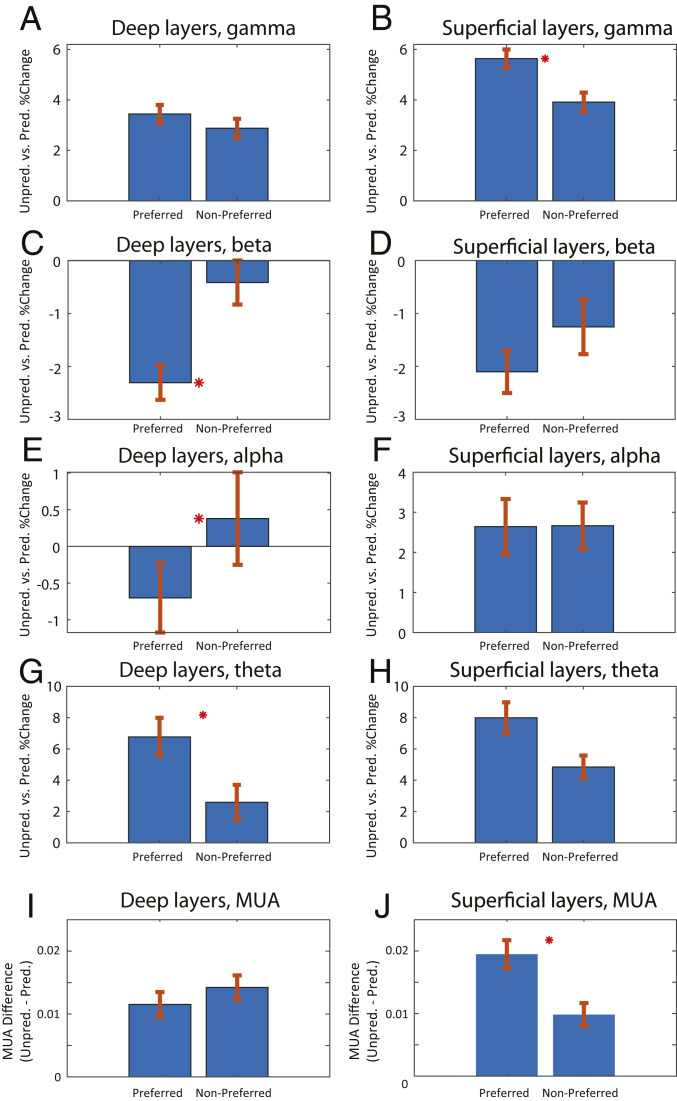
- Unpredictable samples increased gamma power (~40–90 Hz) in all areas, while predictable samples increased alpha/beta power (8–30 Hz); theta (~2–6 Hz) also tended to be higher for unpredictable samples except in FEF.
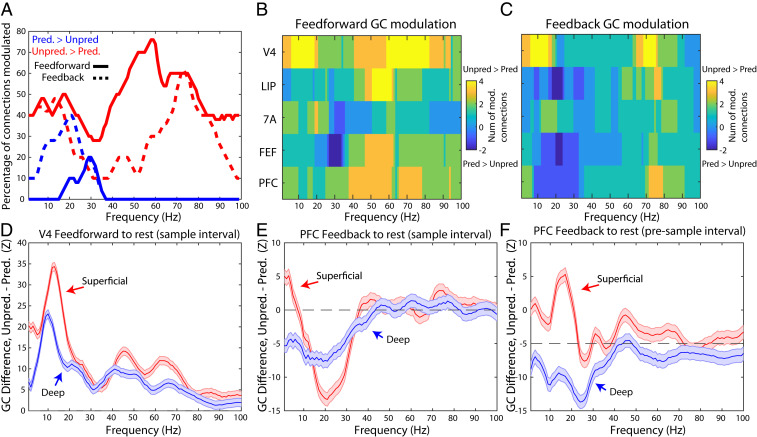
- Network measures matched the same split: feedforward GC was greater for unpredictable samples, especially in gamma, whereas feedback GC was greater for predictable samples, especially in alpha/beta; in the sample interval, 0.57 vs. 0.33 of gamma-band connections were positive in feedforward vs. feedback directions (P < 1E-13), and predictable > unpredictable GC was absent in gamma.
## Methods
- The study recorded multilaminar spiking and LFPs from two macaque monkeys over 71 sessions in five cortical areas: V4, LIP, 7A, FEF, and PFC; laminar resolution was obtained in V4, 7A, and PFC, but not in LIP and FEF.
- Monkeys performed a delayed match-to-sample / visual search task with 50-trial blocks that were either unpredictable (sample randomly chosen each trial) or predictable (same sample repeated across the block).
- Analyses included cluster-based randomization tests, coherence, nonparametric Granger causality, omega-squared neural information, and GLM regressions linking higher-order cortex power to V4 spiking/gamma.
## Limitations
- The paper states that the task did not explicitly manipulate precision weighting, and therefore the issue was not directly considered.
- The text makes evident that only two monkeys were studied and that layer-resolved recordings were not available in LIP and FEF; this limits how broadly the laminar conclusions can be generalized.
Model-written summary. Check it against the paper before relying on it.
Integrity signals
Registry
Cites
Statistics
Figures


Verification
Claims the paper makes
22 Valid · 0 Not valid · 7 Not checked · 141 Own results and interpretations
The cited sources support only part of this claim — read each source’s verdict below.
In the paper
“A key observation is that, all across cortex, gamma power (>35 Hz)/spiking is higher during bottom-up sensory inputs.”
§ Layer and rhythm specificity for predictive routing > Abstract
What the sources say
- Could not verifycites [26] Bastos A. M., Loonis R., Kornblith S., Lundqvist M., Miller E. K., Laminar recordings in frontal cortex suggest distinct layers for maintenance and control of working memory. Proc. Natl. Acad. Sci. U.S.A. 115, 1117– 1122 (2018). 29339471 PMC5798320 sourceExperimental — accuracy not yet measured
The Results section reports that gamma bursts increased during the working-memory delay relative to baseline, and that gamma power peaked in superficial layers of the sampled frontal areas (page unavailable). Neither finding establishes higher gamma power or spiking during bottom-up sensory input across cortex. Searches for “bottom-up,” “sensory inputs,” and stimulus-onset comparisons found no passage making that claim. (LLM, conf=0.72)
- Partly supportedcites [27] Lundqvist M., Gamma and beta bursts underlie working memory. Neuron 90, 152– 164 (2016). 26996084 PMC5220584 sourceExperimental — accuracy not yet measured
In Results, Prediction 1 (page unavailable), gamma power increased after stimulus presentation at 126 of 321 recorded sites, and spiking at those sites carried stimulus information. But 61% of sites showed no significant stimulus-related gamma increase, so the findings do not support “all across cortex.” The passages also establish informative spiking, not a cortex-wide increase in spiking rate during sensory input. (LLM, conf=0.88)
- Supportedcites [28] Lundqvist M., Bastos A. M., Miller E. K., Preservation and changes in oscillatory dynamics across the cortical hierarchy. J. Cogn. Neurosci. 32, 2024– 2035 (2020). 32573380 PMC8780323 source
The Results (Increase of Frequencies Up the Cortical Hierarchy; page unavailable) report that sensory-stimulus presentation increased gamma power in V4, LIP, and PFC. The Introduction and Discussion (pages unavailable) describe gamma as associated with sensory-information spiking and positively correlated with spiking across the studied cortical hierarchy. (LLM, conf=0.88)
- Partly supportedcites [29] Miller E. K., Lundqvist M., Bastos A. M., Working memory 2.0. Neuron 100, 463– 475 (2018). 30359609 PMC8112390 sourceExperimental — accuracy not yet measured
The section “Beta in deep-layer cortex interacts with gamma in superficial-layer cortex” (page unavailable) says bottom-up gamma and informative spiking in sensory areas are typically elevated during sensory stimulation. But “Mechanisms of gamma/beta interplay” (page unavailable) distinguishes prefrontal cortex, where sensory drive has less impact and gamma can occur without a stimulus. The copy therefore supports the sensory-area pattern, not the unqualified claim that it holds all across cortex; the cited passages also do not establish the >35 Hz cutoff. (LLM, conf=0.85)
plainstates an association- Asserted: passes — The authors put it forward as true.
- Checkable: passes — It can be checked against evidence.
- Load-bearing: passes — The paper’s conclusions depend on it.
- Based: passes — The paper gives a reason why it holds.
- Could not verify
The sources with a verdict support this claim; the rest weren’t checked yet, have no full text we could read, or their verdicts aren’t rated yet.
In the paper
“Frontoparietal cortex was targeted because of its well-established role in top-down attention and working memory, cognitive processes that are engaged in the task employed here (30, 31).”
§ Layer and rhythm specificity for predictive routing > Abstract
What the sources say
- Supportedcites [30] Bastos A. M., Visual areas exert feedforward and feedback influences through distinct frequency channels. Neuron 85, 390– 401 (2015). 25556836 source
The Results (p. 3) include frontal area 8/FEF and parietal area 7A in a visuospatial attention task, and the attention analysis (p. 7) reports stronger top-down influences during selective attention. The discussion (p. 9) also describes a short-term-memory task in which a condition requiring feedback increased prefrontal–parietal coherence. Together, these passages support the attributed background role; the citing authors’ own task is not assessed here. (LLM, conf=0.84)
- Not checked — no full text of the sourcecites [31] Buschman T. J., Miller E. K., Top-down versus bottom-up control of attention in the prefrontal and posterior parietal cortices. Science 315, 1860– 1862 (2007). 17395832 source
boostedstates an association- Asserted: passes — The authors put it forward as true.
- Checkable: passes — It can be checked against evidence.
- Load-bearing: passes — The paper’s conclusions depend on it.
- Based: passes — The paper gives a reason why it holds.
- Supported
The cited sources support only part of this claim — read each source’s verdict below.
In the paper
“But there is mounting evidence that oscillatory dynamics play a role in regulating cortical processing and thus can also play a role, especially the gamma (40 to 90 Hz) and alpha/beta (10 to 30 Hz) bands (1, 18–25).”
§ Layer and rhythm specificity for predictive routing > Abstract
What the sources say
- Partly supportedcites [1] Arnal L. H., Giraud A.-L., Cortical oscillations and sensory predictions. Trends Cogn. Sci. 16, 390– 398 (2012). 22682813 sourceExperimental — accuracy not yet measured
The sections on predictive coding and gamma oscillations and on predictive timing and alpha/beta oscillations support a role for these rhythms in cortical sensory processing. The frequency ranges do not match those attributed to the source: our copy defines gamma as >30 Hz and alpha as 8–12 Hz, rather than gamma as 40–90 Hz and the combined alpha/beta bands as 10–30 Hz. No page numbers are available in our copy. (LLM, conf=0.83)
- Partly supportedcites [18] Auksztulewicz R., Friston K., Repetition suppression and its contextual determinants in predictive coding. Cortex 80, 125– 140 (2016). 26861557 PMC5405056 sourceExperimental — accuracy not yet measured
Section 3, “Canonical microcircuits and predictive coding” (page unavailable), links gamma oscillations to cortical synchronization and ascending connections, and alpha/beta activity to lower-frequency synchronization and descending connections. This supports a role for these bands in cortical processing, but our copy does not specify the claimed 40–90 Hz and 10–30 Hz ranges. (LLM, conf=0.86)
- Partly supportedcites [19] Bastos A. M., Canonical microcircuits for predictive coding. Neuron 76, 695– 711 (2012). 23177956 PMC3777738 sourceExperimental — accuracy not yet measured
The Introduction and ‘Segregation of processing streams’ describe gamma oscillations in superficial cortical layers and lower alpha/beta frequencies in deep layers, and suggest that these frequencies contribute differently to cortical signalling. Our copy does not specify the claimed 40–90 Hz and 10–30 Hz ranges, so it supports the general point but not those numerical bounds. (LLM, conf=0.84)
- Partly supportedcites [20] Bauer M., Stenner M.-P., Friston K. J., Dolan R. J., Attentional modulation of alpha/beta and gamma oscillations reflect functionally distinct processes. J. Neurosci. 34, 16117– 16125 (2014). 25429152 PMC4244475 sourceExperimental — accuracy not yet measured
The Introduction (page unavailable) describes distinct attentional effects of alpha/beta and gamma oscillations, supporting their relevance to cortical processing. Materials and Methods (page unavailable) analyzes low frequencies at 2.5–30 Hz and high frequencies at 40–150 Hz; it does not establish the claim’s specific 10–30 Hz and 40–90 Hz band ranges. (LLM, conf=0.82)
- Partly supportedcites [21] Brodski A., Paasch G.-F., Helbling S., Wibral M., The faces of predictive coding. J. Neurosci. 35, 8997– 9006 (2015). 26085625 PMC6605164 sourceExperimental — accuracy not yet measured
The Introduction links gamma-band activity to the propagation of prediction-error signals, and the high-gamma Results report effects in visual cortical areas. However, the paper uses different frequency ranges from those quoted and reports no significant effects in its beta, low-gamma, or mid-gamma ranges; it does not establish the claimed special role for alpha/beta activity. (LLM, conf=0.86)
- Not checked — no full text of the sourcecites [22] Chao Z. C., Takaura K., Wang L., Fujii N., Dehaene S., Large-scale cortical networks for hierarchical prediction and prediction error in the primate brain. Neuron 100, 1252– 1266.e3 (2018). 30482692 source
- Not checked — no full text of the sourcecites [23] Mayer A., Schwiedrzik C. M., Wibral M., Singer W., Melloni L., Expecting to see a letter: Alpha oscillations as carriers of top-down sensory predictions. Cereb. Cortex 26, 3146– 3160 (2016). 26142463 source
- Not checked — no full text of the sourcecites [24] van Pelt S., Beta- and gamma-band activity reflect predictive coding in the processing of causal events. Soc. Cogn. Affect. Neurosci. 11, 973– 980 (2016). 26873806 PMC4884316 source
- Partly supportedcites [25] Todorovic A., van Ede F., Maris E., de Lange F. P., Prior expectation mediates neural adaptation to repeated sounds in the auditory cortex: An MEG study. J. Neurosci. 31, 9118– 9123 (2011). 21697363 PMC6623501 sourceExperimental — accuracy not yet measured
The Discussion links gamma-band activity to auditory prediction-error processing, supporting a role for oscillations in cortical processing. But the MEG data analysis section examines theta/alpha (5–12 Hz) and gamma (50–100 Hz), not the claimed alpha/beta (10–30 Hz) and gamma (40–90 Hz) ranges. Page numbers are unavailable in our copy. (LLM, conf=0.88)
hedgedstates a possible cause- Asserted: passes — The authors put it forward as true.
- Checkable: passes — It can be checked against evidence.
- Load-bearing: passes — The paper’s conclusions depend on it.
- Based: passes — The paper gives a reason why it holds.
- Partly supported
The cited sources support only part of this claim — read each source’s verdict below.
In the paper
“Direct evidence for alpha/beta and gamma in predictive coding per se comes from observations of increased gamma power to stimuli that are prediction errors (22, 24, 25).”
§ Layer and rhythm specificity for predictive routing > Abstract
What the sources say
- Not checked — no full text of the sourcecites [22] Chao Z. C., Takaura K., Wang L., Fujii N., Dehaene S., Large-scale cortical networks for hierarchical prediction and prediction error in the primate brain. Neuron 100, 1252– 1266.e3 (2018). 30482692 source
- Not checked — no full text of the sourcecites [24] van Pelt S., Beta- and gamma-band activity reflect predictive coding in the processing of causal events. Soc. Cogn. Affect. Neurosci. 11, 973– 980 (2016). 26873806 PMC4884316 source
- Partly supportedcites [25] Todorovic A., van Ede F., Maris E., de Lange F. P., Prior expectation mediates neural adaptation to repeated sounds in the auditory cortex: An MEG study. J. Neurosci. 31, 9118– 9123 (2011). 21697363 PMC6623501 sourceExperimental — accuracy not yet measured
The Results section ('Expectation of repetition reduces auditory activity for repeated tones') reports greater gamma-band power for unexpected than expected tone repetitions. The Discussion says this activity may signal a prediction-error response, but presents that interpretation as tentative; the cited passages do not establish an alpha/beta finding. (LLM, conf=0.84)
plainstates a cause- Asserted: passes — The authors put it forward as true.
- Checkable: passes — It can be checked against evidence.
- Load-bearing: passes — The paper’s conclusions depend on it.
- Based: passes — The paper gives a reason why it holds.
The sources with a verdict support this claim; the rest weren’t checked yet, have no full text we could read, or their verdicts aren’t rated yet.
In the paper
“In previous studies where stimulus repetition was not behaviorally relevant, gamma-band power and synchronization in visual cortex increased with repetition, whereas we observed decreases (48, 49).”
§ Layer and rhythm specificity for predictive routing > Discussion
What the sources say
- Supportedcites [48] Brunet N. M., Stimulus repetition modulates gamma-band synchronization in primate visual cortex. Proc. Natl. Acad. Sci. U.S.A. 111, 3626– 3631 (2014). 24554080 PMC3948273 source
The Results section (‘Stimulus Repetition Leads to Increasing Area V1 Gamma-Band Activity,’ page unavailable) reports increasing gamma-band power when the repeated grating was behaviorally irrelevant. The Discussion (page unavailable) also reports repetition-related increases in gamma activity in V1 and V4 and in V1–V4 gamma-band coherence. (LLM, conf=0.93)
- Not checked — no full text of the sourcecites [49] Hansen B. J., Dragoi V., Adaptation-induced synchronization in laminar cortical circuits. Proc. Natl. Acad. Sci. U.S.A. 108, 10720– 10725 (2011). 21659632 PMC3127904 source
plainstates a cause- Asserted: passes — The authors put it forward as true.
- Checkable: passes — It can be checked against evidence.
- Load-bearing: passes — The paper’s conclusions depend on it.
- Based: passes — The paper gives a reason why it holds.
- Supported
115 more claims · 6 with their cited sources checked
Create a free account to see all 170 claims and every source verdict.
- Probably not a substantial claim. 13
- It may state two separate claims as one. 41
- The quote only partly states this claim. 1
Self-check
Percentages, sums and reported differences re-computed from the paper’s own numbers.
Rated major: it would touch a result — a value a result rests on, reported and recomputed p-values on opposite sides of the significance level, two passages that conflict with no sign which is right, or a cited work retracted before this paper was published.
In the paper
“The signal was then low-pass filtered at 250 Hz and resampled to 1,000 kHz.”
§ Layer and rhythm specificity for predictive routing > Discussion > Multiunit Activity Extraction and Spike Sorting.
Reported 1000000 · recomputed 33.333333
Citations
Cites
(2005) · Technometrics · doi:10.1198/tech.2005.s303 · Cited by 17,923
Oostenveld, R., Fries, P., Maris, E., & Schoffelen, J.-M. (2011) · Computational Intelligence and Neuroscience · doi:10.1155/2011/156869 · Cited by 10,323 · cited 1×
“All analyses were performed with customized MATLAB scripts and with Fieldtrip software (72).”
Nonparametric statistical testing of EEG- and MEG-data
Maris, E., & Oostenveld, R. (2007) · Journal of Neuroscience Methods · doi:10.1016/j.jneumeth.2007.03.024 · Cited by 8,496 · cited 1×
“We then quantified whether this raw difference or percent change was significant by performing a cluster-based nonparametric randomization test (78).”
The free-energy principle: a unified brain theory?
Friston, K. (2010) · Nature Reviews Neuroscience · doi:10.1038/nrn2787 · Cited by 8,120 · cited 4×
“Some propose that that prediction errors flow from higher to lower cortex only (Friston, 2010; Rao and Ballard, 1999) while others propose that prediction errors act locally within each cortical area or that predictions flow both up and down the cortical hierarchy (Spratling, 2008).”
BackgroundInfluentialDistributed hierarchical processing in the primate cerebral cortex
Felleman, D. J., & Van Essen, D. C. (1991) · Cerebral Cortex · doi:10.1093/cercor/1.1.1 · Cited by 7,783 · cited 8×
“Alpha/beta power in LIP, FEF, and PFC inhibited spiking in deep layers of V4.”
InfluentialRao, R. P. N., & Ballard, D. H. (1999) · Nature Neuroscience · doi:10.1038/4580 · Cited by 5,483 · cited 1×
“Other models (12, 14) instead suggest that predictions come from higher cortical areas that act on lower cortical (sensory) areas to gate the feeding forward of prediction errors.”
Draper, N. R., & Smith, H. (1998) · Wiley Series in Probability and Statistics · doi:10.1002/9781118625590 · Cited by 5,024 · cited 1×
“We used a GLM with higher-order power (which had laminar resolution in PFC and 7A) as the regressors (77).”
Modulation of Oscillatory Neuronal Synchronization by Selective Visual Attention
Fries, P., Reynolds, J. H., Rorie, A. E., & Desimone, R. (2001) · Science · doi:10.1126/science.1055465 · Cited by 2,786 · cited 1×
“Area V4 was selected as previous studies have shown this area to be a target of top-down signals such as attention (43, 44).”
Rhythms for cognition: communication through coherence
Fries, P. (2015) · Neuron · doi:10.1016/j.neuron.2015.09.034 · Cited by 2,725 · cited 1×
“They suggest that modulation of interareal synchronization at distinct frequencies is a central mechanism in communicating specific (predicted vs. unpredicted) information (65 – 68).”
High Gamma Power Is Phase-Locked to Theta Oscillations in Human Neocortex
Canolty, R. T., Edwards, E., Dalal, S. S., Soltani, M., Nagarajan, S. S., Kirsch, H. E., Berger, M. S., Barbaro, N. M., & Knight, R. T. (2006) · Science · doi:10.1126/science.1128115 · Cited by 2,650 · cited 1×
“However, theta is well known to be a slow rhythm in which faster rhythms such as gamma, can nest (60 – 62) and aid long-range communication (63).”
Canonical Microcircuits for Predictive Coding
Bastos, A. M., Usrey, W. M., Adams, R. A., Mangun, G. R., Fries, P., & Friston, K. J. (2012) · Neuron · doi:10.1016/j.neuron.2012.10.038 · Cited by 2,421 · cited 3×
“Deep-layer cortex (layers 5 and 6) feedback predictions using alpha/beta (1, 19).”
Self-citationTop-Down Versus Bottom-Up Control of Attention in the Prefrontal and Posterior Parietal Cortices
Buschman, T. J., & Miller, E. K. (2007) · Science · doi:10.1126/science.1138071 · Cited by 2,380 · cited 1×
“Frontoparietal cortex was targeted because of its well-established role in top-down attention and working memory, cognitive processes that are engaged in the task employed here (30, 31).”
Self-citationBayesian integration in sensorimotor learning
Körding, K. P., & Wolpert, D. M. (2004) · Nature · doi:10.1038/nature02169 · Cited by 2,004 · cited 1×
“Visuomotor integration, visual/auditory speech perception, and visual perception all benefit when sensory inputs are predictable (1 – 3).”
Entrainment of Neuronal Oscillations as a Mechanism of Attentional Selection
Lakatos, P., Karmos, G., Mehta, A. D., Ulbert, I., & Schroeder, C. E. (2008) · Science · doi:10.1126/science.1154735 · Cited by 1,719 · cited 1×
“However, theta is well known to be a slow rhythm in which faster rhythms such as gamma, can nest (60 – 62) and aid long-range communication (63).”
Olejnik, S., & Algina, J. (2003) · Psychological Methods · doi:10.1037/1082-989x.8.4.434 · Cited by 1,622
The mismatch negativity: a review of underlying mechanisms
Garrido, M. I., Kilner, J. M., Stephan, K. E., & Friston, K. J. (2009) · Clinical Neurophysiology · doi:10.1016/j.clinph.2008.11.029 · Cited by 1,441 · cited 1×
“Responsiveness is recovered if the stimulus is changed or a pattern is violated (i.e., to “ oddballs ” ) (10, 11).”
Modulation of Neuronal Interactions Through Neuronal Synchronization
Womelsdorf, T., Schoffelen, J.-M., Oostenveld, R., Singer, W., Desimone, R., Engel, A. K., & Fries, P. (2007) · Science · doi:10.1126/science.1139597 · Cited by 1,367
Visual areas exert feedforward and feedback influences through distinct frequency channels
Bastos, A. M., Vezoli, J., Bosman, C. A., Schoffelen, J.-M., Oostenveld, R., Dowdall, J. R., De Weerd, P., Kennedy, H., & Fries, P. (2015) · Neuron · doi:10.1016/j.neuron.2014.12.018 · Cited by 1,320
Self-citationA Tutorial Review of Functional Connectivity Analysis Methods and Their Interpretational Pitfalls
Bastos, A. M., & Schoffelen, J.-M. (2016) · Frontiers in Systems Neuroscience · doi:10.3389/fnsys.2015.00175 · Cited by 1,313 · cited 1×
“In addition, bipolar derivation enhances the spatial localization of LFP signals and removes the common reference and any common noise or volume conduction in the signal (75).”
Self-citationCortical oscillations and sensory predictions
Arnal, L. H., & Giraud, A.-L. (2012) · Trends in Cognitive Sciences · doi:10.1016/j.tics.2012.05.003 · Cited by 1,114 · cited 3×
“Deep-layer cortex (layers 5 and 6) feedback predictions using alpha/beta (1, 19).”
On the computational architecture of the neocortex: II The role of cortico-cortical loops
Mumford, D. (1992) · Biological Cybernetics · doi:10.1007/bf00198477 · Cited by 1,074 · cited 1×
“According to Predictive Coding theory (Friston, 2010; Mumford, 1992; Rao and Ballard, 1999), past sensory experience creates models that generate predictions that inhibit processing of expected inputs.”
BackgroundOn the computational architecture of the neocortex: I. The role of the thalamo-cortical loop
Mumford, D. (1991) · Biological Cybernetics · doi:10.1007/bf00202389 · Cited by 929
van Kerkoerle, T., Self, M. W., Dagnino, B., Gariel-Mathis, M.-A., Poort, J., van der Togt, C., & Roelfsema, P. R. (2014) · Proceedings of the National Academy of Sciences · doi:10.1073/pnas.1402773111 · Cited by 918
Gamma and Beta Bursts Underlie Working Memory
Lundqvist, M., Rose, J., Herman, P., Brincat, S. L., Buschman, T. J., & Miller, E. K. (2016) · Neuron · doi:10.1016/j.neuron.2016.02.028 · Cited by 846 · cited 1×
“Further, alpha/beta oscillations in deep cortical layers are anticorrelated with superficial-layer gamma associated with spiking carrying sensory inputs (26, 27).”
Self-citationLess Is More: Expectation Sharpens Representations in the Primary Visual Cortex
Kok, P., Jehee, J. F. M., & de Lange, F. P. (2012) · Neuron · doi:10.1016/j.neuron.2012.04.034 · Cited by 798 · cited 1×
“, 2018; Schwiedrzik and Freiwald, 2017; Zmarz and Keller, 2016) and higher fMRI BOLD signals (Alink et al., 2010; Kok et al., 2012; Summerfield et al., 2008)”
Miller, E. K., Lundqvist, M., & Bastos, A. M. (2018) · Neuron · doi:10.1016/j.neuron.2018.09.023 · Cited by 797 · cited 1×
“They are anticorrelated with alpha/beta (8 to 30 Hz) power (26 – 29), which is higher under conditions of top-down control (e.g., attention and response inhibition) (30 – 34).”
Self-citationHaegens, S., Nácher, V., Luna, R., Romo, R., & Jensen, O. (2011) · Proceedings of the National Academy of Sciences · doi:10.1073/pnas.1117190108 · Cited by 738
Attentional stimulus selection through selective synchronization between monkey visual areas
Bosman, C. A., Schoffelen, J.-M., Brunet, N., Oostenveld, R., Bastos, A. M., Womelsdorf, T., Rubehn, B., Stieglitz, T., De Weerd, P., & Fries, P. (2012) · Neuron · doi:10.1016/j.neuron.2012.06.037 · Cited by 720 · cited 1×
“Area V4 was selected as previous studies have shown this area to be a target of top-down signals such as attention (43, 44).”
Self-citationA Neural Mechanism for Working and Recognition Memory in Inferior Temporal Cortex
Miller, E. K., Li, L., & Desimone, R. (1991) · Science · doi:10.1126/science.1962197 · Cited by 706 · cited 1×
“This effect could be explained, at least in part, by stimulus-specific adaption (SSA) (Miller et al., 1991).”
Self-citationHow does nature program neuron types?
Borst, A. (2008) · Frontiers in Neuroscience · doi:10.3389/neuro.01.016.2008 · Cited by 705
Neural repetition suppression reflects fulfilled perceptual expectations
Summerfield, C., Trittschuh, E. H., Monti, J. M., Mesulam, M.-M., & Egner, T. (2008) · Nature Neuroscience · doi:10.1038/nn.2163 · Cited by 692 · cited 1×
“, 2018; Schwiedrzik and Freiwald, 2017; Zmarz and Keller, 2016) and higher fMRI BOLD signals (Alink et al., 2010; Kok et al., 2012; Summerfield et al., 2008)”
Laminar differences in gamma and alpha coherence in the ventral stream
Buffalo, E. A., Fries, P., Landman, R., Buschman, T. J., & Desimone, R. (2011) · Proceedings of the National Academy of Sciences · doi:10.1073/pnas.1011284108 · Cited by 606 · cited 1×
“When a stimulus needs to be filtered or ignored, gamma power is low and alpha is high (Bauer et al., 2006; Buffalo et al., 2011; Fries et al., 2001; Jokisch and Jensen, 2007).”
Evidence for a hierarchy of predictions and prediction errors in human cortex
Wacongne, C., Labyt, E., van Wassenhove, V., Bekinschtein, T., Naccache, L., & Dehaene, S. (2011) · Proceedings of the National Academy of Sciences · doi:10.1073/pnas.1117807108 · Cited by 560 · cited 1×
“Responsiveness is recovered if the stimulus is changed or a pattern is violated (i.e., to “ oddballs ” ) (10, 11).”
The representation of stimulus familiarity in anterior inferior temporal cortex
Li, L., Miller, E. K., & Desimone, R. (1993) · Journal of Neurophysiology · doi:10.1152/jn.1993.69.6.1918 · Cited by 539
Self-citationGain control by layer six in cortical circuits of vision
Olsen, S. R., Bortone, D. S., Adesnik, H., & Scanziani, M. (2012) · Nature · doi:10.1038/nature10835 · Cited by 539 · cited 1×
“It also suggests a local circuit mechanism in visual cortex where deep layers functionally inhibit activity of superficial layers (70).”
Donoghue, J. P., Sanes, J. N., Hatsopoulos, N. G., & Gaál, G. (1998) · Journal of Neurophysiology · doi:10.1152/jn.1998.79.1.159 · Cited by 538
Jokisch, D., & Jensen, O. (2007) · The Journal of Neuroscience · doi:10.1523/jneurosci.5399-06.2007 · Cited by 515 · cited 1×
“When a stimulus needs to be filtered or ignored, gamma power is low and alpha is high (43, 53 – 55).”
Swann, N., Tandon, N., Canolty, R., Ellmore, T. M., McEvoy, L. K., Dreyer, S., DiSano, M., & Aron, A. R. (2009) · The Journal of Neuroscience · doi:10.1523/jneurosci.3359-09.2009 · Cited by 474 · cited 1×
“They are anticorrelated with alpha/beta (8 to 30 Hz) power (26 – 29), which is higher under conditions of top-down control (e.g., attention and response inhibition) (30 – 34).”
Bauer, M., Oostenveld, R., Peeters, M., & Fries, P. (2006) · The Journal of Neuroscience · doi:10.1523/jneurosci.5228-04.2006 · Cited by 473 · cited 3×
“When a stimulus needs to be filtered or ignored, gamma power is low and alpha is high (Bauer et al., 2006; Buffalo et al., 2011; Fries et al., 2001; Jokisch and Jensen, 2007).”
BackgroundStimulus Predictability Reduces Responses in Primary Visual Cortex
Alink, A., Schwiedrzik, C. M., Kohler, A., Singer, W., & Muckli, L. (2010) · The Journal of Neuroscience · doi:10.1523/jneurosci.3730-10.2010 · Cited by 435 · cited 1×
“, 2018; Schwiedrzik and Freiwald, 2017; Zmarz and Keller, 2016) and higher fMRI BOLD signals (Alink et al., 2010; Kok et al., 2012; Summerfield et al., 2008)”
Neuronal Mechanisms of Cortical Alpha Oscillations in Awake-Behaving Macaques
Bollimunta, A., Chen, Y., Schroeder, C. E., & Ding, M. (2008) · The Journal of Neuroscience · doi:10.1523/jneurosci.2699-08.2008 · Cited by 434 · cited 1×
“This is consistent with gamma power being higher in the superficial, feedforward, cortical layers, and alpha/beta power being higher in the deep, feedback, cortical layers (26, 35 – 40).”
Prior expectation mediates neural adaptation to repeated sounds in the auditory cortex: an MEG study
Todorovic, A., van Ede, F., Maris, E., & de Lange, F. P. (2011) · Journal of Neuroscience · doi:10.1523/jneurosci.1425-11.2011 · Cited by 391 · cited 1×
“This is supported by human electro/magnetoencephalography (MEG/EEG) studies and a recent monkey electrocorticography study (Arnal and Giraud, 2012; Auksztulewicz and Friston, 2016; Bauer et al., 2006; Brodski et al., 2015; Chao et al., 2018; Mayer et al., 2016; van Pelt et al., 2016; Todorovic et al., 2011).”
Estimating Granger Causality from Fourier and Wavelet Transforms of Time Series Data
Dhamala, M., Rangarajan, G., & Ding, M. (2008) · Physical Review Letters · doi:10.1103/physrevlett.100.018701 · Cited by 346 · cited 1×
“Starting from the cross-spectral density matrix (S(ω)) it is possible to factorize the crossspectral density matrix into a noise covariance matrix (Σ) and spectral transfer matrix (H(ω)) by applying spectral matrix factorization (Dhamala et al., 2008) —which provides the necessary ingredients for calculating Granger c…”
Dynamic circuit motifs underlying rhythmic gain control, gating and integration
Womelsdorf, T., Valiante, T. A., Sahin, N. T., Miller, K. J., & Tiesinga, P. (2014) · Nature Neuroscience · doi:10.1038/nn.3764 · Cited by 341 · cited 1×
“They suggest that modulation of interareal synchronization at distinct frequencies is a central mechanism in communicating specific (predicted vs. unpredicted) information (65 – 68).”
Repetition suppression and its contextual determinants in predictive coding
Auksztulewicz, R., & Friston, K. (2016) · Cortex · doi:10.1016/j.cortex.2015.11.024 · Cited by 307
Gamma and beta bursts during working memory readout suggest roles in its volitional control
Lundqvist, M., Herman, P., Warden, M. R., Brincat, S. L., & Miller, E. K. (2018) · Nature Communications · doi:10.1038/s41467-017-02791-8 · Cited by 299 · cited 1×
“The balance between alpha/beta and gamma reflect the encoding, maintenance, and read-out of working memory (56).”
Self-citationBastos, A. M., Loonis, R., Kornblith, S., Lundqvist, M., & Miller, E. K. (2018) · Proceedings of the National Academy of Sciences · doi:10.1073/pnas.1710323115 · Cited by 290 · cited 1×
“Further, alpha/beta oscillations in deep cortical layers are anticorrelated with superficial-layer gamma associated with spiking carrying sensory inputs (26, 27).”
Self-citationEffects of Visual Experience on the Representation of Objects in the Prefrontal Cortex
Rainer, G., & Miller, E. K. (2000) · Neuron · doi:10.1016/s0896-6273(00)00019-2 · Cited by 285 · cited 1×
“This can lead to fewer activated neurons but finer-tuned, more robust representations (8).”
Self-citationMaier (2010) · Frontiers in System Neuroscience · doi:10.3389/fnsys.2010.00031 · Cited by 266
Large-scale cortical networks for hierarchical prediction and prediction error in the primate brain
Chao, Z. C., Takaura, K., Wang, L., Fujii, N., & Dehaene, S. (2018) · Neuron · doi:10.1016/j.neuron.2018.10.004 · Cited by 238
Mejias, J. F., Murray, J. D., Kennedy, H., & Wang, X.-J. (2016) · Science Advances · doi:10.1126/sciadv.1601335 · Cited by 227 · cited 1×
“In addition, computational modeling studies have shown the plausibility of superficial gamma circuits to engage in prediction error computations (38, 41, 42).”
Attentional Modulation of Alpha/Beta and Gamma Oscillations Reflect Functionally Distinct Processes
Bauer, M., Stenner, M.-P., Friston, K. J., & Dolan, R. J. (2014) · The Journal of Neuroscience · doi:10.1523/jneurosci.3474-13.2014 · Cited by 224
Tort, A. B. L., Rotstein, H. G., Dugladze, T., Gloveli, T., & Kopell, N. J. (2007) · Proceedings of the National Academy of Sciences · doi:10.1073/pnas.0705708104 · Cited by 192 · cited 2×
“, 2008) and aid long-range communication (Tort et al., 2007).”
BackgroundSelf-citationLaminar analysis of visually evoked activity in the primary visual cortex
Xing, D., Yeh, C.-I., Burns, S., & Shapley, R. M. (2012) · Proceedings of the National Academy of Sciences · doi:10.1073/pnas.1201478109 · Cited by 191 · cited 1×
“This is consistent with gamma power being higher in the superficial, feedforward, cortical layers, and alpha/beta power being higher in the deep, feedback, cortical layers (26, 35 – 40).”
Mismatch Receptive Fields in Mouse Visual Cortex
Zmarz, P., & Keller, G. B. (2016) · Neuron · doi:10.1016/j.neuron.2016.09.057 · Cited by 178
Prefrontal neurons transmit signals to parietal neurons that reflect executive control of cognition
Crowe, D. A., Goodwin, S. J., Blackman, R. K., Sakellaridi, S., Sponheim, S. R., MacDonald, A. W., & Chafee, M. V. (2013) · Nature Neuroscience · doi:10.1038/nn.3509 · Cited by 159 · cited 1×
“In addition, prefrontal control over behavior is thought to be mediated by dynamic patterns of neuronal functional connectivity (69).”
Reconciling predictive coding and biased competition models of cortical function
Spratling, M. W. (2008) · Frontiers in Computational Neuroscience · doi:10.3389/neuro.10.004.2008 · Cited by 153 · cited 2×
“Some propose that that prediction errors flow from higher to lower cortex only (Friston, 2010; Rao and Ballard, 1999) while others propose that prediction errors act locally within each cortical area or that predictions flow both up and down the cortical hierarchy (Spratling, 2008).”
Bastos, A. M., Litvak, V., Moran, R., Bosman, C. A., Fries, P., & Friston, K. J. (2015) · NeuroImage · doi:10.1016/j.neuroimage.2014.12.081 · Cited by 152 · cited 1×
“In addition, computational modeling studies have shown the plausibility of superficial gamma circuits to engage in prediction error computations (38, 41, 42).”
Self-citationconcatenation underlies interactions between gamma and beta rhythms in neocortex
Roopun, A. K. (2008) · Frontiers in Cellular Neuroscience · doi:10.3389/neuro.03.001.2008 · Cited by 147 · cited 1×
“By contrast, modeling suggests that in parietal cortex, there is a distinction between beta-1 (14-20 Hz) and beta-2 (24-30 Hz) (Roopun et al., 2008) and that parietal beta-1 may act as a memory buffer activated by strong cortical inputs that feeds forward violations to the PFC (Gelastopoulos et…”
BackgroundVisual Imagery and Perception Share Neural Representations in the Alpha Frequency Band
Xie, S., Kaiser, D., & Cichy, R. M. (2020) · Current Biology · doi:10.1016/j.cub.2020.04.074 · Cited by 139 · cited 1×
“This supports the view that oscillations can be modulated in a representationally specific way (64), rather than only in a nonspecific way across wide areas of cortex.”
High-Level Prediction Signals in a Low-Level Area of the Macaque Face-Processing Hierarchy
Schwiedrzik, C. M., & Freiwald, W. A. (2017) · Neuron · doi:10.1016/j.neuron.2017.09.007 · Cited by 136
Stimulus repetition modulates gamma-band synchronization in primate visual cortex
Brunet, N. M., Bosman, C. A., Vinck, M., Roberts, M., Oostenveld, R., Desimone, R., De Weerd, P., & Fries, P. (2014) · Proceedings of the National Academy of Sciences · doi:10.1073/pnas.1309714111 · Cited by 130 · cited 1×
“In previous studies where stimulus repetition was not behaviorally relevant, gammaband power and synchronization in visual cortex increased with repetition, whereas we observed decreases (48, 49).”
Laminar dependence of neuronal correlations in visual cortex
Smith, M. A., Jia, X., Zandvakili, A., & Kohn, A. (2013) · Journal of Neurophysiology · doi:10.1152/jn.00846.2012 · Cited by 129 · cited 1×
“Further, alpha/beta power is higher in deep-layer cortex and gamma power is higher in superficial layers (Bastos et al., 2018; Maier et al., 2010; Smith et al., 2013).”
Expecting to See a Letter: Alpha Oscillations as Carriers of Top-Down Sensory Predictions
Mayer, A., Schwiedrzik, C. M., Wibral, M., Singer, W., & Melloni, L. (2016) · Cerebral Cortex · doi:10.1093/cercor/bhv146 · Cited by 119
Encoding of Stimulus Probability in Macaque Inferior Temporal Cortex
Bell, A. H., Summerfield, C., Morin, E. L., Malecek, N. J., & Ungerleider, L. G. (2016) · Current Biology · doi:10.1016/j.cub.2016.07.007 · Cited by 118 · cited 2×
“Visuomotor integration, visual/auditory speech perception, and visual perception all benefit from predictability of sensory inputs (Arnal and Giraud, 2012; Bell et al., 2016; Körding and Wolpert, 2004).”
Burst Firing Synchronizes Prefrontal and Anterior Cingulate Cortex during Attentional Control
Womelsdorf, T., Ardid, S., Everling, S., & Valiante, T. A. (2014) · Current Biology · doi:10.1016/j.cub.2014.09.046 · Cited by 113
The Faces of Predictive Coding
Brodski, A., Paasch, G.-F., Helbling, S., & Wibral, M. (2015) · Journal of Neuroscience · doi:10.1523/jneurosci.1529-14.2015 · Cited by 99 · cited 1×
“This is supported by human electro/magnetoencephalography (MEG/EEG) studies and a recent monkey electrocorticography study (Arnal and Giraud, 2012; Auksztulewicz and Friston, 2016; Bauer et al., 2006; Brodski et al., 2015; Chao et al., 2018; Mayer et al., 2016; van Pelt et al., 2016; Todorovic et al., 2011).”
Beta- and gamma-band activity reflect predictive coding in the processing of causal events
van Pelt, S., Heil, L., Kwisthout, J., Ondobaka, S., van Rooij, I., & Bekkering, H. (2016) · Social Cognitive and Affective Neuroscience · doi:10.1093/scan/nsw017 · Cited by 98
Adaptation-induced synchronization in laminar cortical circuits
Hansen, B. J., & Dragoi, V. (2011) · Proceedings of the National Academy of Sciences · doi:10.1073/pnas.1102017108 · Cited by 83
Dynamic causal modelling of precision and synaptic gain in visual perception — an EEG study
Brown, H. R., & Friston, K. J. (2012) · NeuroImage · doi:10.1016/j.neuroimage.2012.06.044 · Cited by 78 · cited 1×
“Of special note, many current models of predictive coding emphasize that prediction errors can be modulated by precision weighting, for example, by increasing attention or sensory evidence (12, 51, 52).”
On Dynamics of Integrate-and-Fire Neural Networks with Conductance Based Synapses
Cessac, B., & Viéville, T. (2008) · Frontiers in Computational Neuroscience · doi:10.3389/neuro.10.002.2008 · Cited by 78
How to detect the Granger-causal flow direction in the presence of additive noise?
Vinck, M., Huurdeman, L., Bosman, C. A., Fries, P., Battaglia, F. P., Pennartz, C. M. A., & Tiesinga, P. H. (2015) · NeuroImage · doi:10.1016/j.neuroimage.2014.12.017 · Cited by 77 · cited 1×
“Bipolar derivation is a recommended prestep prior to Granger causality and coherence analysis, as the presence of a common reference can lead to spurious results (73, 74).”
Issa, E. B., Cadieu, C. F., & DiCarlo, J. J. (2018) · eLife · doi:10.7554/elife.42870 · Cited by 76 · cited 1×
“Much of the work on the neural mechanisms of prediction and its violation has focused on spiking activity (2, 15 – 17).”
Trongnetrpunya, A., Nandi, B., Kang, D., Kocsis, B., Schroeder, C. E., & Ding, M. (2016) · Frontiers in Systems Neuroscience · doi:10.3389/fnsys.2015.00189 · Cited by 75 · cited 1×
“Bipolar derivation is a recommended prestep prior to Granger causality and coherence analysis, as the presence of a common reference can lead to spurious results (73, 74).”
Contrast gain control and horizontal interactions in V1: A DCM study
Pinotsis, D. A., Brunet, N., Bastos, A., Bosman, C. A., Litvak, V., Fries, P., & Friston, K. J. (2014) · NeuroImage · doi:10.1016/j.neuroimage.2014.01.047 · Cited by 68 · cited 1×
“In addition, computational modeling studies have shown the plausibility of superficial gamma circuits to engage in prediction error computations (38, 41, 42).”
Self-citationPreservation and Changes in Oscillatory Dynamics across the Cortical Hierarchy
Lundqvist, M., Bastos, A. M., & Miller, E. K. (2020) · Journal of Cognitive Neuroscience · doi:10.1162/jocn_a_01600 · Cited by 58
Self-citationHerman, P. A., Lundqvist, M., & Lansner, A. (2013) · Brain Research · doi:10.1016/j.brainres.2013.08.002 · Cited by 47 · cited 1×
“However, theta is well known to be a slow rhythm in which faster rhythms such as gamma, can nest (Canolty et al., 2006; Herman et al., 2013; Lakatos et al., 2008) and aid long-range communication (Tort et al.”
Self-citationParietal low beta rhythm provides a dynamical substrate for a working memory buffer
Gelastopoulos, A., Whittington, M. A., & Kopell, N. (2019) · Proceedings of the National Academy of Sciences · doi:10.1073/pnas.1902305116 · Cited by 46 · cited 1×
“By contrast, modeling suggests that in parietal cortex, there is a distinction between beta-1 (14 to 20 Hz) and beta-2 (24 to 30 Hz) (58) and that parietal beta-1 may act as a memory buffer activated by strong cortical inputs that feeds forward violations to the PFC (59).”
Self-citationThe functional anatomy of attention: a DCM study
Brown, H. R., & Friston, K. J. (2013) · Frontiers in Human Neuroscience · doi:10.3389/fnhum.2013.00784 · Cited by 37 · cited 1×
“Of special note, many current models of predictive coding emphasize that prediction errors can be modulated by precision weighting, for example, by increasing attention or sensory evidence (12, 51, 52).”
Westerberg, J. A., Cox, M. A., Dougherty, K., & Maier, A. (2019) · Journal of Neurophysiology · doi:10.1152/jn.00113.2019 · Cited by 35 · cited 1×
“Passive adaptation effects tend to reach their maximum after just a single repetition (47).”
Flexible resonance in prefrontal networks with strong feedback inhibition
Sherfey, J. S., Ardid, S., Haß, J., Hasselmo, M. E., & Kopell, N. (2018) · PLoS Computational Biology · doi:10.1371/journal.pcbi.1006357 · Cited by 33
Self-citationCustom-fit radiolucent cranial implants for neurophysiological recording and stimulation
Mulliken, G. H., Bichot, N. P., Ghadooshahy, A., Sharma, J., Kornblith, S., Philcock, M., & Desimone, R. (2014) · Journal of Neuroscience Methods · doi:10.1016/j.jneumeth.2014.12.011 · Cited by 32 · cited 1×
“The process for making the chambers was based on design principles outlined previously (71).”
Cited by
Imagined speech can be decoded from low- and cross-frequency intracranial EEG features
Proix, T., Delgado Saa, J., Christen, A., Martin, S., Pasley, B. N., Knight, R. T., Tian, X., Poeppel, D., Doyle, W. K., Devinsky, O., et al. (2022) · Nature Communications · doi:10.1038/s41467-021-27725-3 · Cited by 212
Neural effects of propofol-induced unconsciousness and its reversal using thalamic stimulation
Bastos, A. M., Donoghue, J. A., Brincat, S. L., Mahnke, M., Yanar, J., Correa, J., Waite, A. S., Lundqvist, M., Roy, J., Brown, E. N., et al. (2021) · eLife · doi:10.7554/elife.60824 · Cited by 166
“With MRI guidance, we introduced the probes to be perpendicular to cortex and to span all cortical layers, as previously described (Bastos et al., 2020).”
MethodSelf-citationPrinciples of large-scale neural interactions
Vinck, M., Uran, C., Spyropoulos, G., Onorato, I., Broggini, A. C., Schneider, M., & Canales-Johnson, A. (2023) · Neuron · doi:10.1016/j.neuron.2023.03.015 · Cited by 164
Lundqvist, M., Miller, E. K., Nordmark, J., Liljefors, J., & Herman, P. (2024) · Trends in Cognitive Sciences · doi:10.1016/j.tics.2024.03.010 · Cited by 169
Self-citationTraveling waves in the prefrontal cortex during working memory
Bhattacharya, S., Brincat, S. L., Lundqvist, M., & Miller, E. K. (2022) · PLoS Computational Biology · doi:10.1371/journal.pcbi.1009827 · Cited by 136
Self-citation
Metadata
- Authors
- Bastos, A. M., Lundqvist, M., Waite, A. S., Kopell, N., & Miller, E. K.
- Affiliations
- Massachusetts Institute of Technology (US)
- Stockholm University (SE)
- Boston University (US)
- Corresponding author
- Bastos, André M.
- Kopell, Nancy
- Venue
- Proceedings of the National Academy of Sciences
- Publisher
- National Academy of Sciences
- Published
- 2020-11-23
- Volume
- 117
- Issue
- 49
- Pages
- 31459-31469
- ISSN
- 0027-8424 (ISSN-L)
- 1091-6490
- PMC
- PMC7733827
- OpenAlex
- W3109215284
- Cited by
- 268
- References
- 82
- Citations by year
- 2026: 40 · 2025: 62 · 2024: 59 · 2023: 52 · 2022: 34 · 2021: 17 · 2020: 4
- FWCI
- 14.38
- Type
- journal article
- Language
- en
- Open access
- hybrid
- doi.org
- Licence
- Locations
- Proceedings of the National Academy of Sciences (publishedVersion, cc-by-nc-nd)
- PubMed Central (publishedVersion, cc-by-nc-nd)
- PubMed (publishedVersion)
- OpenBU (Boston University) (publishedVersion, cc-by-nc-nd)
- Funders
- HHS | NIH | National Institute of Mental Health (R37MH087027, 5K99MH116100-02)
- DOD | United States Navy | Office of Naval Research (N00014-16-1-2832)
- Topics
- Life Sciences › Neuroscience › Cognitive Neuroscience › Neural dynamics and brain function
- Life Sciences › Neuroscience › Cognitive Neuroscience › Visual perception and processing mechanisms
- Life Sciences › Neuroscience › Cellular and Molecular Neuroscience › Neuroscience and Neuropharmacology Research
- Keywords
- predictive coding, predictive routing, cortical layers, neural oscillations, alpha rhythm, beta oscillations, gamma oscillations, feedforward inhibition, functional connectivity, area V4, lateral intraparietal area, frontal eye field, prefrontal cortex, laminar recordings, cortical hierarchy
- MeSH terms
- Action Potentials, Algorithms, Animals, Behavior, Animal, Macaca mulatta, Models, Neurological, Nerve Net, Neurons, Task Performance and Analysis, Time Factors, Gamma Rhythm
About these checks
Registry, retraction, Cites and statistics results are computed, not judged, with one exception: a printed reference that no index lists is read once by a model before it counts as a citation error. Claims are extracted by a model and kept only when their quote appears verbatim in the text; each cited source is then checked, with a model’s help, for whether it says what the claim relies on. Those verdicts can be wrong — read the claim’s quote and the cited source before relying on one.
The claim verdicts this report counts are experimental: their accuracy is not yet measured.
A language model drew the claims from the paper on 2026-10-11, under version 3 of the claim definition (model deepseek-v4.1-flash, prompt extract-v3).
A second model labelled each claim on 2026-10-11 (model jev-1.13-20260917, definition revision gold-guideline-v0.2).
Cited sources are checked with a language model’s help (gpt-6-sol).
Statistics and arithmetic are recomputed, not judged.
Confidence bands are shown only for fields calibrated on our annotated test set. None is calibrated yet, so no band is shown.
What counts as a claim ›How we measure confidence ›How we check this ›
Are you an author, or do you see a problem with this page? Request a review
Data sources
Bibliographic data: Semantic Scholar, OpenAlex, Crossref.
Contains information from the Semantic Scholar Academic Graph Datasets, made available under the ODC Attribution License (ODC-BY 1.0).
Semantic Scholar’s data is described in: Kinney, R., et al. (2023). The Semantic Scholar Open Data Platform. arXiv:2301.10140.
