

The DOI matches its Crossref record; 67 of the 68 references it cites were found in a registry or an index, and 1 are not checked yet; 1 of the 38 sources its claims cite were checked for support.
The effects of skin pigmentation on the accuracy of pulse oximetry in measuring oxygen saturation: a systematic review and meta-analysis
Open accessAbstract
Background: Pulse oximetry was widely used in hospitals and at home to monitor blood oxygen during the COVID-19 pandemic. There have been concerns regarding potential bias in pulse oximetry measurements for people with dark skin. We aimed to assess the effects of skin pigmentation on the accuracy of oxygen saturation measurement by pulse oximetry (SpO 2 ) compared with the gold standard SaO 2 measured by CO-oximetry. Methods: We searched Ovid MEDLINE, Ovid Embase, and EBSCO CINAHL Plus (up to December 2021), as well as ClinicalTrials.gov and World Health Organization International Clinical Trials Registry Platform (up to August 2021). We identified studies comparing SpO 2 values in any population, in any care setting, using any type of pulse oximeter, with SaO 2 by standard CO-oximetry; and measuring the impact of skin pigmentation or ethnicity on pulse oximetry accuracy. We performed meta-analyses for mean bias (the primary outcome in this review) and its standard deviations (SDs) across studies included for each subgroup of level of skin pigmentation and ethnicity. We calculated accuracy root-mean-square ( A rms ) and 95% limits of agreement based on pooled mean bias and pooled SDs for each subgroup. Results: We included 32 studies (6505 participants); 27/32 (84.38%) in hospitals and none in people’s homes. Findings of 14/32 studies (43.75%) were judged, via QUADAS-2, at high overall risk of bias. Fifteen studies measured skin pigmentation and 22 referred only to ethnicity. Compared with standard SaO 2 measurement, pulse oximetry probably overestimates oxygen saturation in people with dark skin (pooled mean bias 1.11%; 95% confidence interval 0.29% to 1.93%) and people described as Black/African American (pooled mean bias 1.52%; 0.95% to 2.09%) (moderate- and low-certainty evidence). These results suggest that, for people with dark skin, pulse oximetry may overestimate blood oxygen saturation by around 1% on average compared with SaO 2 . The bias of pulse oximetry measurements for people with other levels of skin pigmentation, or those from the White/Caucasian group is more uncertain. The data do not suggest overestimation in people from other ethnic groups such as those described as Asian, Hispanic, or mixed ethnicity (pooled mean bias 0.31%, 0.09% to 0.54%), but this evidence is low certainty. Whilst the extent of mean bias is small or negligible for all the subgroups of population evaluated, the associated imprecision is unacceptably large (with the pooled SDs > 1%). Nevertheless, when the extents of measurement bias and precision are considered jointly in A rms , pulse oximetry measurements for all the subgroups appear acceptably accurate (with A rms < 4%). Conclusions: Low-certainty evidence suggests that pulse oximetry may overestimate oxygen saturation in people with dark skin and people whose ethnicity is reported as Black/African American, compared with SaO 2 , although the overestimation may be quite small in hospital settings. The clinical importance of any overestimation will depend on the particular clinical circumstance. Pulse oximetry measurements appear accurate but imprecise for all levels of skin pigmentation. The evidence relates to clinician-measured oximetry in health care environments and may not be reflected in home pulse oximetry where other factors may also influence accuracy. Author summary: Why was this study done?: Pulse oximetry was widely used in hospital and at home to measure blood oxygen levels during the COVID-19 pandemic. There was uncertainty as to whether skin pigmentation affects the accuracy of pulse oximetry measurements. What did the researchers do and find?: We assessed, via systematic review, the effects of skin pigmentation on the accuracy of pulse oximetry measurement (SpO 2 ) compared with SaO 2 measured by standard CO-oximetry. In people with dark skin, oxygen saturation measured in hospital by pulse oximetry may be overestimated by an average of 1% compared with gold standard SaO 2 , however, the evidence is of low certainty. The accuracy of pulse oximetry measured compared with standard SaO 2 is quite uncertain for people with light or medium levels of skin pigmentation and for people from ethnic groups other than those described in papers as Black or African American. Pulse oximetry measurements appear to have acceptable overall accuracy (with A rms < 4%) for all subgroups of population evaluated whilst the variation of oximetry readings appear unacceptably wide (with the pooled SDs > 1%). What do these findings mean?: Hospital measured pulse oximetry may overestimate oxygen saturation in people with dark skin compared with SaO 2 by approximately 1%. The implications of this finding in different clinical scenarios will vary but could be clinically important. Impacts are likely to be at the thresholds of being diagnosed as having hypoxaemia where even a small SpO 2 overestimation could lead to clinically important hypoxaemia remaining undetected and untreated. How these findings extrapolate to community and home care settings is unclear.
Verified 2026-10-09 · 1 reference not checked yet
Overview
AI snapshot
Written from the paper’s full text.
TL;DR
This systematic review and meta-analysis found that pulse oximetry probably overestimates oxygen saturation in people with high skin pigmentation and in people described as Black/African American compared with CO-oximetry SaO2. Although mean bias was small and accuracy root-mean-square remained below recommended thresholds, measurement precision was poor across subgroups.
Key findings
- The review included 32 studies with 6505 participants; 15 studies measured skin pigmentation and 22 referred to ethnicity.
- Pooled mean bias was 1.11% (95% CI 0.29 to 1.93%) for high skin pigmentation (moderate-certainty evidence) and 1.52% (95% CI 0.95 to 2.09%) for people described as Black/African American (low-certainty evidence), indicating overestimation by pulse oximetry.
- For medium pigmentation, low pigmentation, Asian/Hispanic/mixed ethnicity, and White/Caucasian groups, evidence was uncertain or did not suggest clinically important systematic overestimation.
- Pooled SDs were generally >1%, indicating unacceptably large imprecision, but calculated Arms values were <4% for all subgroups, which the authors describe as acceptably accurate when bias and precision are considered jointly.
Methods
- Systematic review and meta-analysis of methods-comparison studies comparing SpO2 from commercially available pulse oximeters with SaO2 measured by standard CO-oximetry; searches covered Ovid MEDLINE, Ovid Embase, EBSCO CINAHL, ClinicalTrials.gov, and WHO ICTRP up to December 2021.
- Data were pooled separately for skin pigmentation level and ethnicity using a correlated hierarchical effects model with robust variance estimation; mean bias was the primary outcome, with pooled SDs used to calculate Arms and 95% limits of agreement.
- Risk of bias was assessed with an adapted QUADAS-2, and certainty of evidence for mean bias was assessed using GRADE.
Limitations
- The authors state that some included studies reported only significance tests or diagnostic accuracy proportions rather than SpO2–SaO2 data by subgroup, limiting meta-analysis; they also note that race and ethnicity were combined for simplicity, that Fitzpatrick-type skin pigmentation scales are blunt, that device, age, condition, and pigmentation-measurement differences were not analysed, that only English-language peer-reviewed publications were searched, and that no risk-of-bias or GRADE approach was specific to this topic.
- The paper states that most included studies were hospital-based and had limited information on whether devices were appropriate for home self-monitoring, so findings may not reflect home pulse oximetry by patients or carers.
- Evident from the text: included studies spanned 1985–2021 and some may have used discontinued devices, and meta-analyses showed substantial between-study heterogeneity (e.g., overall I² values often >90% for several pooled estimates).
Model-written summary. Check it against the paper before relying on it.
Integrity signals
Registry
Cites
Statistics
Figures
Verification
Claims the paper makes
27 Not checked yet · 26 Own result · 20 Own method · 20 Own interpretation · 7 No basis given · 1 Supported
Every source the paper cites for this claim was checked and supports it.
In the paper
“In these studies, people described as Black had a higher risk of ‘occult hypoxemia that was not detected by pulse oximetry’ compared with those described as White [7].”
§ The accuracy of pulse oximetry in measuring oxygen saturation by levels of skin pigmentation: a systematic review and meta-analysis > Discussion > Evidence in context
What the sources say
- Supportedcites [7] source
The study reports higher rates of occult hypoxemia among Black than White patients in both cohorts. It concludes that Black patients had nearly three times the frequency of occult hypoxemia not detected by pulse oximetry. (LLM, conf=0.95)
plaincorrelational- Asserted: passes — The authors put it forward as true.
- Checkable: passes — It can be checked against evidence.
- Load-bearing: passes — The paper’s conclusions depend on it.
- Based: passes — The paper gives a reason why it holds.
- Supported
A result the paper reports from its own data — it cites no other source for it, so there is none to check. The quote shows it is in the paper.
In the paper
“For all the levels of skin pigmentation, the Arms values are around 2% or lower (95% CI non-estimable), and the pooled SD values are around 1.50% on average (Table 2).”
§ The accuracy of pulse oximetry in measuring oxygen saturation by levels of skin pigmentation: a systematic review and meta-analysis > Results > Pulse oximetry accuracy by levels of skin pigmentation
plain- Asserted: passes — The authors put it forward as true.
- Checkable: passes — It can be checked against evidence.
- Load-bearing: unclear — It is unclear whether the paper’s conclusions depend on it.
- Based: passes — The paper gives a reason why it holds.
- Rests on an assumption: SaO2 measured by CO-oximetry is the gold standard for blood oxygen saturation.
A result the paper reports from its own data — it cites no other source for it, so there is none to check. The quote shows it is in the paper.
In the paper
“Whilst the extent of mean bias is small or negligible for all subgroups evaluated, the associated imprecision is unacceptably large (pooled SDs > 1%).”
§ The accuracy of pulse oximetry in measuring oxygen saturation by levels of skin pigmentation: a systematic review and meta-analysis > Abstract > Results
plainn = 6,505- Asserted: passes — The authors put it forward as true.
- Checkable: passes — It can be checked against evidence.
- Load-bearing: passes — The paper’s conclusions depend on it.
- Based: passes — The paper gives a reason why it holds.
- Rests on an assumption: SaO2 measured by CO-oximetry is the gold standard for blood oxygen saturation.
A result the paper reports from its own data — it cites no other source for it, so there is none to check. The quote shows it is in the paper.
In the paper
“The evidence for people with low levels of skin pigmentation does not suggest clinically important systematic bias (pooled mean bias -0.35, 95% CI − 1.36 to 0.67), but the finding is of low certainty.”
§ The accuracy of pulse oximetry in measuring oxygen saturation by levels of skin pigmentation: a systematic review and meta-analysis > Results > Pulse oximetry accuracy by levels of skin pigmentation
hedged- Asserted: passes — The authors put it forward as true.
- Checkable: passes — It can be checked against evidence.
- Load-bearing: passes — The paper’s conclusions depend on it.
- Based: passes — The paper gives a reason why it holds.
- Rests on an assumption: SaO2 measured by CO-oximetry is the gold standard for blood oxygen saturation.
A result the paper reports from its own data — it cites no other source for it, so there is none to check. The quote shows it is in the paper.
In the paper
“For all the levels of skin pigmentation, the Arms values are around 2% or lower (95% CI non-estimable), and the pooled SD values are around 1.50% on average (Table 2).”
§ The accuracy of pulse oximetry in measuring oxygen saturation by levels of skin pigmentation: a systematic review and meta-analysis > Results > Pulse oximetry accuracy by levels of skin pigmentation
plain- Asserted: passes — The authors put it forward as true.
- Checkable: passes — It can be checked against evidence.
- Load-bearing: unclear — It is unclear whether the paper’s conclusions depend on it.
- Based: passes — The paper gives a reason why it holds.
- Rests on an assumption: SaO2 measured by CO-oximetry is the gold standard for blood oxygen saturation.
A result the paper reports from its own data — it cites no other source for it, so there is none to check. The quote shows it is in the paper.
In the paper
“and people described as Black/African American (1.52%; 0.95 to 2.09%) (moderate- and low-certainty evidence).”
- Also stated in: § Conclusions · hedged
“Pulse oximetry may overestimate oxygen saturation in people with high levels of skin pigmentation and people whose ethnicity is reported as Black/African American, compared with SaO2.”
§ The accuracy of pulse oximetry in measuring oxygen saturation by levels of skin pigmentation: a systematic review and meta-analysis > Abstract > Results
plainconditionaln = 6,505- Asserted: passes — The authors put it forward as true.
- Checkable: passes — It can be checked against evidence.
- Load-bearing: passes — The paper’s conclusions depend on it.
- Based: passes — The paper gives a reason why it holds.
- Rests on an assumption: SaO2 measured by CO-oximetry is the gold standard for blood oxygen saturation.
- Also stated in: § Conclusions · hedged
A result the paper reports from its own data — it cites no other source for it, so there is none to check. The quote shows it is in the paper.
In the paper
“For all the subgroups of populations evaluated, whilst the degree of mean bias is small or negligible over the ranges of SaO2 reported (median minimum value of 76% and maximum value of 100%), pulse oximetry readings appear unacceptably imprecise (pooled SDs > the recommended criterion of 1%) [10, 55].”
§ The accuracy of pulse oximetry in measuring oxygen saturation by levels of skin pigmentation: a systematic review and meta-analysis > Discussion > Summary of findings
plain- Asserted: passes — The authors put it forward as true.
- Checkable: passes — It can be checked against evidence.
- Load-bearing: passes — The paper’s conclusions depend on it.
- Based: passes — The paper gives a reason why it holds.
A result the paper reports from its own data — it cites no other source for it, so there is none to check. The quote shows it is in the paper.
In the paper
“Oxygen saturation measured for people described in study reports as Black or African American may be overestimated using hospital pulse oximetry compared with standard SaO2 readings: mean bias 1.52% (95% CI 0.95 to 2.09%), low-certainty evidence.”
§ The accuracy of pulse oximetry in measuring oxygen saturation by levels of skin pigmentation: a systematic review and meta-analysis > Results > Pulse oximetry accuracy by ethnicity
hedgedconditionaln = 3,510- Asserted: passes — The authors put it forward as true.
- Checkable: passes — It can be checked against evidence.
- Load-bearing: passes — The paper’s conclusions depend on it.
- Based: passes — The paper gives a reason why it holds.
A result the paper reports from its own data — it cites no other source for it, so there is none to check. The quote shows it is in the paper.
In the paper
“Additional file 19: Figure S8 presents evidence for each type of pulse oximeter evaluated: overall, most devices overestimated oxygen saturation in people described as Black or African American.”
§ The accuracy of pulse oximetry in measuring oxygen saturation by levels of skin pigmentation: a systematic review and meta-analysis > Results > Pulse oximetry accuracy by ethnicity
plaincorrelational- Asserted: passes — The authors put it forward as true.
- Checkable: passes — It can be checked against evidence.
- Load-bearing: passes — The paper’s conclusions depend on it.
- Based: passes — The paper gives a reason why it holds.
None of the sources cited for this claim have been checked yet.
In the paper
“Nevertheless, when the extents of measurement bias and precision are considered jointly in Arms, pulse oximetry measurements for all the subgroups appear acceptably accurate (with Arms < the internationally recommended threshold of 4% [10, 55], or even the more conservative threshold of 3% in the US FDA guidance) [56].”
§ The accuracy of pulse oximetry in measuring oxygen saturation by levels of skin pigmentation: a systematic review and meta-analysis > Discussion > Summary of findings
What the sources say
hedged- Asserted: passes — The authors put it forward as true.
- Checkable: passes — It can be checked against evidence.
- Load-bearing: passes — The paper’s conclusions depend on it.
- Based: passes — The paper gives a reason why it holds.
- It may state two separate claims as one. 43
- Probably not a substantial claim. 45
A result the paper reports from its own data — it cites no other source for it, so there is none to check. The quote shows it is in the paper.
In the paper
“Compared with standard SaO2 measurement, pulse oximetry probably overestimates oxygen saturation in people with the high level of skin pigmentation (pooled mean bias 1.11%; 95% confidence interval 0.29 to 1.93%)”
- Also stated in: § Pulse oximetry accuracy by levels of skin pigmentation · hedged
“Hospital-based pulse oximetry probably overestimates oxygen saturation for people with high levels of skin pigmentation compared with standard SaO2 (8 studies, 24 comparisons, 3270 SpO2-SaO2 pairs from 221 participants): pooled mean bias 1.11% (95% CI 0.29 to 1.93%), moderate-certainty evidence.”
§ The accuracy of pulse oximetry in measuring oxygen saturation by levels of skin pigmentation: a systematic review and meta-analysis > Abstract > Results
hedgedconditionaln = 221- Asserted: passes — The authors put it forward as true.
- Checkable: passes — It can be checked against evidence.
- Load-bearing: passes — The paper’s conclusions depend on it.
- Based: passes — The paper gives a reason why it holds.
It may state two separate claims as one.
- Rests on an assumption: SaO2 measured by CO-oximetry is the gold standard for blood oxygen saturation.
- Also stated in: § Pulse oximetry accuracy by levels of skin pigmentation · hedged
A result the paper reports from its own data — it cites no other source for it, so there is none to check. The quote shows it is in the paper.
In the paper
“Whilst the extent of mean bias is small or negligible for all subgroups evaluated, the associated imprecision is unacceptably large (pooled SDs > 1%).”
§ The accuracy of pulse oximetry in measuring oxygen saturation by levels of skin pigmentation: a systematic review and meta-analysis > Abstract > Results
plaincorrelationaln = 6,505- Asserted: passes — The authors put it forward as true.
- Checkable: passes — It can be checked against evidence.
- Load-bearing: passes — The paper’s conclusions depend on it.
- Based: passes — The paper gives a reason why it holds.
It may state two separate claims as one.
- Rests on an assumption: SaO2 measured by CO-oximetry is the gold standard for blood oxygen saturation.
A result the paper reports from its own data — it cites no other source for it, so there is none to check. The quote shows it is in the paper.
In the paper
“The bias of pulse oximetry measurements for people with other levels of skin pigmentation or those from other ethnic groups is either more uncertain or suggests no overestimation.”
§ The accuracy of pulse oximetry in measuring oxygen saturation by levels of skin pigmentation: a systematic review and meta-analysis > Abstract > Results
hedged- Asserted: passes — The authors put it forward as true.
- Checkable: passes — It can be checked against evidence.
- Load-bearing: passes — The paper’s conclusions depend on it.
- Based: passes — The paper gives a reason why it holds.
It may state two separate claims as one.
- Rests on an assumption: SaO2 measured by CO-oximetry is the gold standard for blood oxygen saturation.
A result the paper reports from its own data — it cites no other source for it, so there is none to check. The quote shows it is in the paper.
In the paper
“The Arms values are around 2% or lower (95% CI non-estimable) for all these subgroups, and the pooled SD values are around 1.50% on average (Table 2).”
§ The accuracy of pulse oximetry in measuring oxygen saturation by levels of skin pigmentation: a systematic review and meta-analysis > Results > Pulse oximetry accuracy by ethnicity
plainn = 3,510- Asserted: passes — The authors put it forward as true.
- Checkable: passes — It can be checked against evidence.
- Load-bearing: fails — The paper’s conclusions may not depend on it.
- Based: passes — The paper gives a reason why it holds.
Probably not a substantial claim. The paper’s conclusions may not depend on it.
None of the sources cited for this claim have been checked yet.
In the paper
“For all the subgroups of populations evaluated, whilst the degree of mean bias is small or negligible over the ranges of SaO2 reported (median minimum value of 76% and maximum value of 100%), pulse oximetry readings appear unacceptably imprecise (pooled SDs > the recommended criterion of 1%) [10, 55].”
§ The accuracy of pulse oximetry in measuring oxygen saturation by levels of skin pigmentation: a systematic review and meta-analysis > Discussion > Summary of findings
hedged- Asserted: passes — The authors put it forward as true.
- Checkable: passes — It can be checked against evidence.
- Load-bearing: passes — The paper’s conclusions depend on it.
- Based: passes — The paper gives a reason why it holds.
It may state two separate claims as one.
A result the paper reports from its own data — it cites no other source for it, so there is none to check. The quote shows it is in the paper.
In the paper
“We included 32 studies (6505 participants): 15 measured skin pigmentation and 22 referred to ethnicity.”
- Also stated in: § Study selection and characteristics · plain
“The 32 studies (6505 participants) reported SpO2-SaO2 comparison evaluations of 54 different pulse oximeters (26 manufacturers) cf. standard SaO2 (Additional file 7: Table S3).”
§ The accuracy of pulse oximetry in measuring oxygen saturation by levels of skin pigmentation: a systematic review and meta-analysis > Abstract > Results
plainn = 6,505- Asserted: passes — The authors put it forward as true.
- Checkable: passes — It can be checked against evidence.
- Load-bearing: passes — The paper’s conclusions depend on it.
- Based: passes — The paper gives a reason why it holds.
It may state two separate claims as one.
- Also stated in: § Study selection and characteristics · plain
A result the paper reports from its own data — it cites no other source for it, so there is none to check. The quote shows it is in the paper.
In the paper
“We tested the sensitivity of the findings: Arms and SD values were generally consistent but there was increased uncertainty for mean bias findings.”
§ The accuracy of pulse oximetry in measuring oxygen saturation by levels of skin pigmentation: a systematic review and meta-analysis > Results > Pulse oximetry accuracy by levels of skin pigmentation
plain- Asserted: passes — The authors put it forward as true.
- Checkable: passes — It can be checked against evidence.
- Load-bearing: unclear — It is unclear whether the paper’s conclusions depend on it.
- Based: passes — The paper gives a reason why it holds.
It may state two separate claims as one.
- Rests on an assumption: SaO2 measured by CO-oximetry is the gold standard for blood oxygen saturation.
A result the paper reports from its own data — it cites no other source for it, so there is none to check. The quote shows it is in the paper.
In the paper
“Of the 16 studies, four had SaO2 ranges that were in line with the recommended range of 70 to 100%; eight had narrower ranges such as 80 or 90 to 100%; and four had wider ranges such as 50 or 60 to 100%.”
§ The accuracy of pulse oximetry in measuring oxygen saturation by levels of skin pigmentation: a systematic review and meta-analysis > Results > Study selection and characteristics
plain- Asserted: passes — The authors put it forward as true.
- Checkable: passes — It can be checked against evidence.
- Load-bearing: fails — The paper’s conclusions may not depend on it.
- Based: passes — The paper gives a reason why it holds.
Probably not a substantial claim. The paper’s conclusions may not depend on it. It may state two separate claims as one.
A result the paper reports from its own data — it cites no other source for it, so there is none to check. The quote shows it is in the paper.
In the paper
“Of the 32 studies, 16 (50%) reported the ranges of SaO2 over which the accuracy of pulse oximeters was evaluated: the minimum values of these ranges had a median of 76% whilst the maximum values had a median of 100%.”
§ The accuracy of pulse oximetry in measuring oxygen saturation by levels of skin pigmentation: a systematic review and meta-analysis > Results > Study selection and characteristics
plain- Asserted: passes — The authors put it forward as true.
- Checkable: passes — It can be checked against evidence.
- Load-bearing: fails — The paper’s conclusions may not depend on it.
- Based: passes — The paper gives a reason why it holds.
Probably not a substantial claim. The paper’s conclusions may not depend on it. It may state two separate claims as one.
The paper states this without a source or data behind it here, so there is nothing to check it against. The quote shows it is in the paper.
In the paper
“The evidence is uncertain for groups described in papers as White/Caucasian, meaning further research is likely to alter findings (very low certainty evidence).”
§ The accuracy of pulse oximetry in measuring oxygen saturation by levels of skin pigmentation: a systematic review and meta-analysis > Results > Pulse oximetry accuracy by ethnicity
hedged- Asserted: passes — The authors put it forward as true.
- Checkable: passes — It can be checked against evidence.
- Load-bearing: passes — The paper’s conclusions depend on it.
- Based: passes — The paper gives a reason why it holds.
It may state two separate claims as one.
A result the paper reports from its own data — it cites no other source for it, so there is none to check. The quote shows it is in the paper.
In the paper
“We included 32 studies (6505 participants): 15 measured skin pigmentation and 22 referred to ethnicity.”
§ The accuracy of pulse oximetry in measuring oxygen saturation by levels of skin pigmentation: a systematic review and meta-analysis > Abstract > Results
plain- Asserted: passes — The authors put it forward as true.
- Checkable: passes — It can be checked against evidence.
- Load-bearing: fails — The paper’s conclusions may not depend on it.
- Based: passes — The paper gives a reason why it holds.
Probably not a substantial claim. The paper’s conclusions may not depend on it. It may state two separate claims as one.
A result the paper reports from its own data — it cites no other source for it, so there is none to check. The quote shows it is in the paper.
In the paper
“The evidence for people described in studies as Asian, Hispanic or of mixed ethnicity does not indicate a clinically important systematic bias (mean bias 0.31%, 0.09 to 0.54%), but it is of low certainty.”
§ The accuracy of pulse oximetry in measuring oxygen saturation by levels of skin pigmentation: a systematic review and meta-analysis > Results > Pulse oximetry accuracy by ethnicity
hedgedn = 3,510- Asserted: passes — The authors put it forward as true.
- Checkable: passes — It can be checked against evidence.
- Load-bearing: passes — The paper’s conclusions depend on it.
- Based: passes — The paper gives a reason why it holds.
It may state two separate claims as one.
A result the paper reports from its own data — it cites no other source for it, so there is none to check. The quote shows it is in the paper.
In the paper
“The 32 studies (6505 participants) reported SpO2-SaO2 comparison evaluations of 54 different pulse oximeters (26 manufacturers) cf. standard SaO2 (Additional file 7: Table S3).”
§ The accuracy of pulse oximetry in measuring oxygen saturation by levels of skin pigmentation: a systematic review and meta-analysis > Results > Study selection and characteristics
plainn = 6,505- Asserted: passes — The authors put it forward as true.
- Checkable: passes — It can be checked against evidence.
- Load-bearing: fails — The paper’s conclusions may not depend on it.
- Based: passes — The paper gives a reason why it holds.
Probably not a substantial claim. The paper’s conclusions may not depend on it.
A result the paper reports from its own data — it cites no other source for it, so there is none to check. The quote shows it is in the paper.
In the paper
“The remaining seven studies (503 participants) were excluded from meta-analysis due to lack of mean bias data by levels of skin pigmentation (Additional file 9: Table S5).”
§ The accuracy of pulse oximetry in measuring oxygen saturation by levels of skin pigmentation: a systematic review and meta-analysis > Results > Pulse oximetry accuracy by levels of skin pigmentation
plainn = 503- Asserted: passes — The authors put it forward as true.
- Checkable: passes — It can be checked against evidence.
- Load-bearing: fails — The paper’s conclusions may not depend on it.
- Based: passes — The paper gives a reason why it holds.
Probably not a substantial claim. The paper’s conclusions may not depend on it.
In the paper
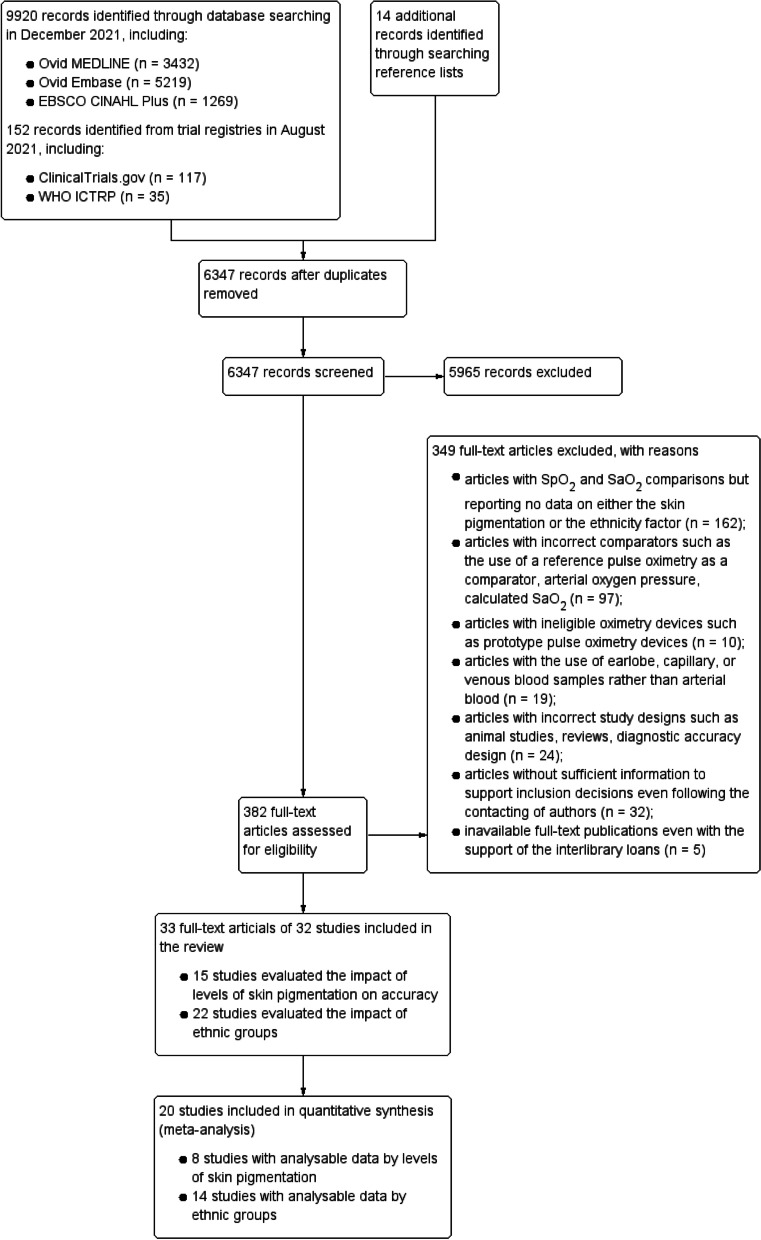
“Of these records, we identified 33 publications of 32 studies—published between 1985 and 2021—as eligible for inclusion (Fig. 1) [21–53].”
§ The accuracy of pulse oximetry in measuring oxygen saturation by levels of skin pigmentation: a systematic review and meta-analysis > Results > Study selection and characteristics
What the sources say
- Not checked yetcites [21–53]
plain- Asserted: passes — The authors put it forward as true.
- Checkable: passes — It can be checked against evidence.
- Load-bearing: fails — The paper’s conclusions may not depend on it.
- Based: passes — The paper gives a reason why it holds.
Probably not a substantial claim. The paper’s conclusions may not depend on it.
In the paper
“Before this review, our scoping exercise using a simple search of Ovid Medline with ‘pulse oximetry’ terms identified one systematic review in this area published by Jensen and colleagues in 1995 [8].”
§ The accuracy of pulse oximetry in measuring oxygen saturation by levels of skin pigmentation: a systematic review and meta-analysis > Discussion > Strengths and limitations of this review
What the sources say
- Not checked yetcites [8] source
plain- Asserted: passes — The authors put it forward as true.
- Checkable: passes — It can be checked against evidence.
- Load-bearing: fails — The paper’s conclusions may not depend on it.
- Based: passes — The paper gives a reason why it holds.
Probably not a substantial claim. The paper’s conclusions may not depend on it.
In the paper
“We also identified a recent rapid review by the NHS Race and Health Observatory that had an unclear methodology [6].”
§ The accuracy of pulse oximetry in measuring oxygen saturation by levels of skin pigmentation: a systematic review and meta-analysis > Discussion > Strengths and limitations of this review
What the sources say
- Not checked yetcites [6] NHS Race and Health Observatory. Pulse oximetry and racial bias: Recommendations for national healthcare, regulatory and research bodies. March 2021. https://www.nhsrho.org/wp-content/uploads/2021/03/Pulse-oximetry-racial-bias-report.pdf
plain- Asserted: passes — The authors put it forward as true.
- Checkable: passes — It can be checked against evidence.
- Load-bearing: fails — The paper’s conclusions may not depend on it.
- Based: passes — The paper gives a reason why it holds.
Probably not a substantial claim. The paper’s conclusions may not depend on it.
None of the sources cited for this claim have been checked yet.
In the paper
“It is interesting to note that, despite clinically important mean bias and unacceptably large imprecision identified, the calculated Arms values are generally around 2% or less over the ranges of SaO2 reported, that is, the Arms values are far below the Arms threshold of 4% required by the current international and UK standards [10, 55].”
§ The accuracy of pulse oximetry in measuring oxygen saturation by levels of skin pigmentation: a systematic review and meta-analysis > Discussion > Evidence in context
plain- Asserted: passes — The authors put it forward as true.
- Checkable: passes — It can be checked against evidence.
- Load-bearing: passes — The paper’s conclusions depend on it.
- Based: passes — The paper gives a reason why it holds.
It may state two separate claims as one.
The paper states this without a source or data behind it here, so there is nothing to check it against. The quote shows it is in the paper.
In the paper
“Whilst the extent of measurement bias and overall accuracy meet current international thresholds, the variation of pulse oximetry measurements appears unacceptably wide.”
§ The accuracy of pulse oximetry in measuring oxygen saturation by levels of skin pigmentation: a systematic review and meta-analysis > Conclusions
hedged- Asserted: passes — The authors put it forward as true.
- Checkable: passes — It can be checked against evidence.
- Load-bearing: passes — The paper’s conclusions depend on it.
- Based: passes — The paper gives a reason why it holds.
It may state two separate claims as one.
The paper states this without a source or data behind it here, so there is nothing to check it against. The quote shows it is in the paper.
In the paper
“However, most included studies in this review were based in hospital settings and had limited information whether the pulse oximeters evaluated were appropriate for home self-monitoring.”
§ The accuracy of pulse oximetry in measuring oxygen saturation by levels of skin pigmentation: a systematic review and meta-analysis > Discussion > Evidence in context
plain- Asserted: passes — The authors put it forward as true.
- Checkable: passes — It can be checked against evidence.
- Load-bearing: unclear — It is unclear whether the paper’s conclusions depend on it.
- Based: passes — The paper gives a reason why it holds.
It may state two separate claims as one.
The paper states this without a source or data behind it here, so there is nothing to check it against. The quote shows it is in the paper.
In the paper
“The included studies were published between 1985 and 2021 and some of the older studies may have used discontinued devices.”
§ The accuracy of pulse oximetry in measuring oxygen saturation by levels of skin pigmentation: a systematic review and meta-analysis > Discussion > Evidence in context
hedged- Asserted: passes — The authors put it forward as true.
- Checkable: passes — It can be checked against evidence.
- Load-bearing: fails — The paper’s conclusions may not depend on it.
- Based: passes — The paper gives a reason why it holds.
Probably not a substantial claim. The paper’s conclusions may not depend on it. It may state two separate claims as one.
A conclusion the paper draws from its own results — it cites no other source for it, so there is none to check. The quote shows it is in the paper.
In the paper
“The extent of overestimation may be small in hospital settings but unknown in community settings.”
§ The accuracy of pulse oximetry in measuring oxygen saturation by levels of skin pigmentation: a systematic review and meta-analysis > Abstract > Conclusions
hedgedconditional- Asserted: passes — The authors put it forward as true.
- Checkable: passes — It can be checked against evidence.
- Load-bearing: passes — The paper’s conclusions depend on it.
- Based: unclear — It is unclear why the paper says it holds.
It may state two separate claims as one.
- Rests on an assumption: SaO2 measured by CO-oximetry is the gold standard for blood oxygen saturation.
What the paper did — it cites no source for this, so there is none to check. The quote shows it is in the paper.
In the paper
“The review was registered with the Open Science Framework (https://osf.io/gm7ty).”
- Also stated in: § Search strategy and selection criteria · plain
“The methods used were described in the registered protocol (https://osf.io/gm7ty).”
§ The accuracy of pulse oximetry in measuring oxygen saturation by levels of skin pigmentation: a systematic review and meta-analysis > Abstract > Methods
plain- Asserted: passes — The authors put it forward as true.
- Checkable: passes — It can be checked against evidence.
- Load-bearing: fails — The paper’s conclusions may not depend on it.
- Based: passes — The paper gives a reason why it holds.
Probably not a substantial claim. The paper’s conclusions may not depend on it.
- Also stated in: § Search strategy and selection criteria · plain
What the paper did — it cites no source for this, so there is none to check. The quote shows it is in the paper.
In the paper
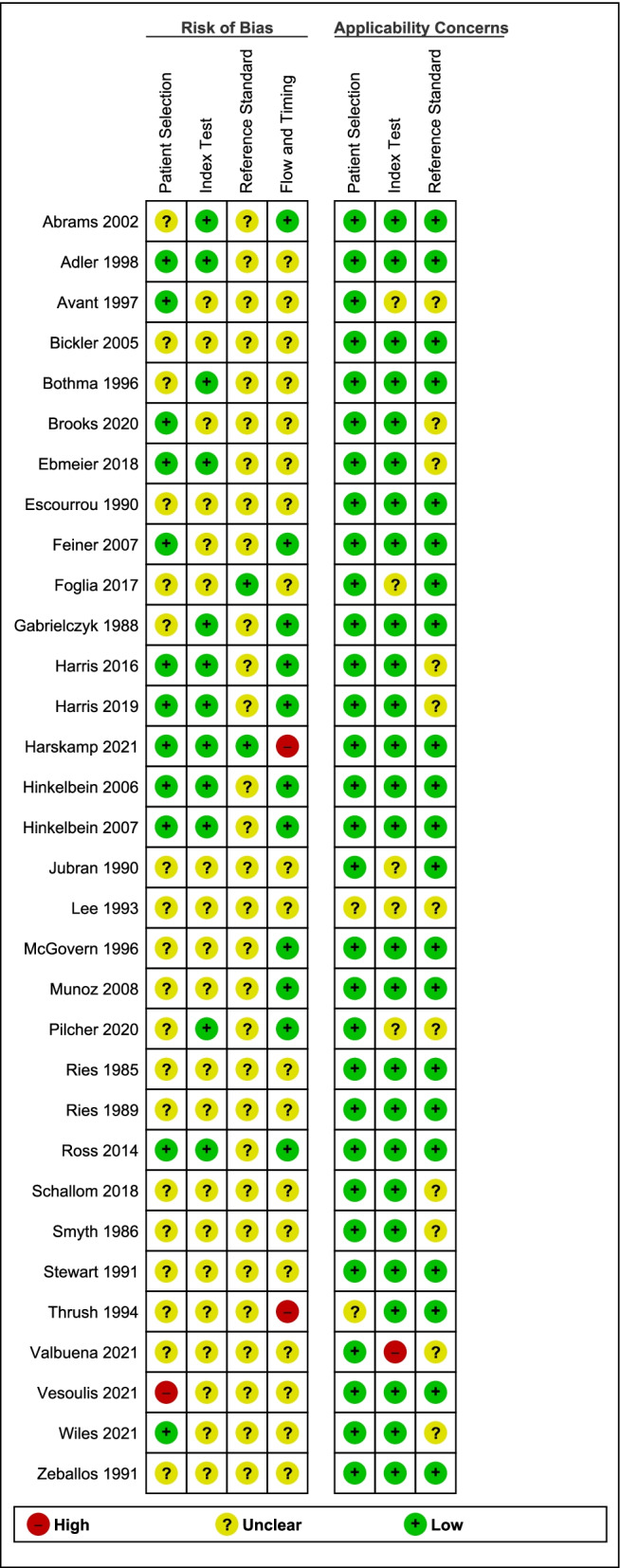
“Using QUADAS-2, we considered 14/32 studies (43.75%) to be at unclear risk of bias for all four domains or high risk of bias for at least one domain, and the remaining 18 (56.25%) to be at low risk of bias for at least one of the four domains (Fig. 2).”
§ The accuracy of pulse oximetry in measuring oxygen saturation by levels of skin pigmentation: a systematic review and meta-analysis > Results > Assessment results of risk of bias and applicability
plain- Asserted: passes — The authors put it forward as true.
- Checkable: passes — It can be checked against evidence.
- Load-bearing: unclear — It is unclear whether the paper’s conclusions depend on it.
- Based: passes — The paper gives a reason why it holds.
It may state two separate claims as one.
In the paper
“We report this review in accordance with the Preferred Reporting Items for Systematic Reviews and Meta-Analyses (PRISMA) statement [9].”
§ The accuracy of pulse oximetry in measuring oxygen saturation by levels of skin pigmentation: a systematic review and meta-analysis > Methods > Search strategy and selection criteria
What the sources say
- Not checked yetcites [9] Higgins JPT , Thomas J , Chandler J , Cumpston M , Li T , Page MJ , Welch VA (editors). Cochrane Handbook for Systematic Reviews of Interventions version 6.2 (updated February 2021). Cochrane, 2021. Available from http://www.training.cochrane.org/handbook.
plain- Asserted: passes — The authors put it forward as true.
- Checkable: passes — It can be checked against evidence.
- Load-bearing: fails — The paper’s conclusions may not depend on it.
- Based: passes — The paper gives a reason why it holds.
Probably not a substantial claim. The paper’s conclusions may not depend on it.
A conclusion the paper draws from its own results — it cites no other source for it, so there is none to check. The quote shows it is in the paper.
In the paper
“These results are for clinician-measured oximetry in controlled clinical environments and do not necessarily reflect the measurement bias of home pulse oximetry by patients or carers.”
§ The accuracy of pulse oximetry in measuring oxygen saturation by levels of skin pigmentation: a systematic review and meta-analysis > Discussion > Summary of findings
hedged- Asserted: passes — The authors put it forward as true.
- Checkable: passes — It can be checked against evidence.
- Load-bearing: fails — The paper’s conclusions may not depend on it.
- Based: passes — The paper gives a reason why it holds.
Probably not a substantial claim. The paper’s conclusions may not depend on it. It may state two separate claims as one.
What the paper did — it cites no source for this, so there is none to check. The quote shows it is in the paper.
In the paper
“We undertook pre-planned sensitivity analyses through (1) excluding studies where all participants had similar skin pigmentation or the same ethnicity, (2) excluding studies with no data available for meta-analysis without transformation, and (3) excluding studies at high overall risk of bias.”
§ The accuracy of pulse oximetry in measuring oxygen saturation by levels of skin pigmentation: a systematic review and meta-analysis > Methods > Data analysis
plain- Asserted: passes — The authors put it forward as true.
- Checkable: passes — It can be checked against evidence.
- Load-bearing: fails — The paper’s conclusions may not depend on it.
- Based: passes — The paper gives a reason why it holds.
Probably not a substantial claim. The paper’s conclusions may not depend on it. It may state two separate claims as one.
A conclusion the paper draws from its own results — it cites no other source for it, so there is none to check. The quote shows it is in the paper.
In the paper
“Pulse oximetry for people with other levels of skin pigmentation is less likely to be overestimated but the evidence is uncertain.”
§ The accuracy of pulse oximetry in measuring oxygen saturation by levels of skin pigmentation: a systematic review and meta-analysis > Discussion > Summary of findings
hedgedconditional- Asserted: passes — The authors put it forward as true.
- Checkable: passes — It can be checked against evidence.
- Load-bearing: passes — The paper’s conclusions depend on it.
- Based: passes — The paper gives a reason why it holds.
It may state two separate claims as one.
What the paper did — it cites no source for this, so there is none to check. The quote shows it is in the paper.
In the paper
“We pre-specified separate analysis of studies reporting level of skin pigmentation and ethnicity.”
§ The accuracy of pulse oximetry in measuring oxygen saturation by levels of skin pigmentation: a systematic review and meta-analysis > Methods > Data analysis
plain- Asserted: passes — The authors put it forward as true.
- Checkable: passes — It can be checked against evidence.
- Load-bearing: fails — The paper’s conclusions may not depend on it.
- Based: passes — The paper gives a reason why it holds.
Probably not a substantial claim. The paper’s conclusions may not depend on it.
None of the sources cited for this claim have been checked yet.
In the paper
“One reviewer (CS) assessed the certainty of evidence on mean bias using the GRADE approach developed for the test accuracy topic, checked by another reviewer (GN) [18, 19].”
§ The accuracy of pulse oximetry in measuring oxygen saturation by levels of skin pigmentation: a systematic review and meta-analysis > Methods > Data analysis
plain- Asserted: passes — The authors put it forward as true.
- Checkable: passes — It can be checked against evidence.
- Load-bearing: fails — The paper’s conclusions may not depend on it.
- Based: passes — The paper gives a reason why it holds.
Probably not a substantial claim. The paper’s conclusions may not depend on it.
What the paper did — it cites no source for this, so there is none to check. The quote shows it is in the paper.
In the paper
“Two reviewers (CS and MG, or JH, OH) independently assessed titles and abstracts of the search results for relevance and the full texts of all potentially eligible studies for inclusion, with disagreements resolved through discussion or involving a third reviewer (GN) where necessary.”
§ The accuracy of pulse oximetry in measuring oxygen saturation by levels of skin pigmentation: a systematic review and meta-analysis > Methods > Search strategy and selection criteria
plain- Asserted: passes — The authors put it forward as true.
- Checkable: passes — It can be checked against evidence.
- Load-bearing: fails — The paper’s conclusions may not depend on it.
- Based: passes — The paper gives a reason why it holds.
Probably not a substantial claim. The paper’s conclusions may not depend on it. It may state two separate claims as one.
What the paper did — it cites no source for this, so there is none to check. The quote shows it is in the paper.
In the paper
“for the flow and timing domain, where the time intervals between SpO2 readings and the arterial blood sampling for SaO2 measurement were too long or participants were excluded from the analysis without rationale (2 studies).”
§ The accuracy of pulse oximetry in measuring oxygen saturation by levels of skin pigmentation: a systematic review and meta-analysis > Results > Assessment results of risk of bias and applicability
plain- Asserted: passes — The authors put it forward as true.
- Checkable: passes — It can be checked against evidence.
- Load-bearing: fails — The paper’s conclusions may not depend on it.
- Based: passes — The paper gives a reason why it holds.
Probably not a substantial claim. The paper’s conclusions may not depend on it.
What the paper did — it cites no source for this, so there is none to check. The quote shows it is in the paper.
In the paper
“We judged the applicability concern as high for one study, moderate for 13 studies, and low in terms of all three applicability considerations for the remaining 18 studies.”
§ The accuracy of pulse oximetry in measuring oxygen saturation by levels of skin pigmentation: a systematic review and meta-analysis > Results > Assessment results of risk of bias and applicability
plain- Asserted: passes — The authors put it forward as true.
- Checkable: passes — It can be checked against evidence.
- Load-bearing: unclear — It is unclear whether the paper’s conclusions depend on it.
- Based: passes — The paper gives a reason why it holds.
It may state two separate claims as one.
None of the sources cited for this claim have been checked yet.
In the paper
“Even though our estimates suggest that the internationally recommended thresholds were met in terms of measurement bias [10, 55], the relatively small amount of mean bias identified could impact on clinical decision-making at threshold values for diagnosis of hypoxaemia.”
§ The accuracy of pulse oximetry in measuring oxygen saturation by levels of skin pigmentation: a systematic review and meta-analysis > Discussion > Evidence in context
hedgedconditional- Asserted: passes — The authors put it forward as true.
- Checkable: passes — It can be checked against evidence.
- Load-bearing: passes — The paper’s conclusions depend on it.
- Based: passes — The paper gives a reason why it holds.
It may state two separate claims as one.
In the paper
“We assessed publication bias following a qualitative approach given funnel plots or Egger’s tests were not considered appropriate for this review [20].”
§ The accuracy of pulse oximetry in measuring oxygen saturation by levels of skin pigmentation: a systematic review and meta-analysis > Methods > Data analysis
What the sources say
- Not checked yetcites [20] 2017, A framework for the meta-analysis of Bland–Altman studies based on a limits of agreement approach, Stat Med source
plain- Asserted: passes — The authors put it forward as true.
- Checkable: passes — It can be checked against evidence.
- Load-bearing: fails — The paper’s conclusions may not depend on it.
- Based: passes — The paper gives a reason why it holds.
Probably not a substantial claim. The paper’s conclusions may not depend on it.
In the paper
“One reviewer (CS, or OH or JH) independently extracted data from included studies for items in Additional file 3: Box S2 and assessed the risk of bias for the included studies using an adapted QUADAS-2 (Additional file 4: Box S3) [12], all checked by another reviewer (JH, MG, OH, GN).”
§ The accuracy of pulse oximetry in measuring oxygen saturation by levels of skin pigmentation: a systematic review and meta-analysis > Methods > Data analysis
What the sources say
- Not checked yetcites [12] British Standards Institution (BSI). BS EN ISO 80601-2-61:2019: Medical electrical equipment – Part 2-61: Particular requirements for basic safety and essential performance of pulse oximeter equipment (ISO 80601-2-61:2017, Corrected version 2018-02). London: British Standards Institution. 2019.
plain- Asserted: passes — The authors put it forward as true.
- Checkable: passes — It can be checked against evidence.
- Load-bearing: fails — The paper’s conclusions may not depend on it.
- Based: passes — The paper gives a reason why it holds.
Probably not a substantial claim. The paper’s conclusions may not depend on it. It may state two separate claims as one.
In the paper
“Results showed people described as Black had ‘nearly three times the frequency of occult hypoxemia that was not detected by pulse oximetry’ as those described as White [7].”
§ The accuracy of pulse oximetry in measuring oxygen saturation by levels of skin pigmentation: a systematic review and meta-analysis > Background
What the sources say
- Not checked yetcites [7] source
plaincorrelational- Asserted: passes — The authors put it forward as true.
- Checkable: passes — It can be checked against evidence.
- Load-bearing: passes — The paper’s conclusions depend on it.
- Based: passes — The paper gives a reason why it holds.
Probably not a substantial claim.
What the paper did — it cites no source for this, so there is none to check. The quote shows it is in the paper.
In the paper
“or CO-oximeter SaO2 readings (30 studies)”
§ The accuracy of pulse oximetry in measuring oxygen saturation by levels of skin pigmentation: a systematic review and meta-analysis > Results > Assessment results of risk of bias and applicability
plain- Asserted: passes — The authors put it forward as true.
- Checkable: passes — It can be checked against evidence.
- Load-bearing: fails — The paper’s conclusions may not depend on it.
- Based: passes — The paper gives a reason why it holds.
Probably not a substantial claim. The paper’s conclusions may not depend on it.
A conclusion the paper draws from its own results — it cites no other source for it, so there is none to check. The quote shows it is in the paper.
In the paper
“Underestimated SpO2 readings could also be harmful, resulting in unnecessary treatment with oxygen (and the risk of hyperoxaemia) and wider impacts such as delayed hospital discharge.”
§ The accuracy of pulse oximetry in measuring oxygen saturation by levels of skin pigmentation: a systematic review and meta-analysis > Discussion > Evidence in context
hedgeddirect- Asserted: passes — The authors put it forward as true.
- Checkable: passes — It can be checked against evidence.
- Load-bearing: fails — The paper’s conclusions may not depend on it.
- Based: passes — The paper gives a reason why it holds.
Probably not a substantial claim. The paper’s conclusions may not depend on it. It may state two separate claims as one.
In the paper
“The only current relevant systematic review, published in 1995, included three studies that explicitly considered the impact of skin pigmentation on pulse oximetry accuracy [8].”
- Also stated in: § Background · hedged
“The review suggested that pulse oximeters may overestimate blood oxygen saturation in people with dark skin [8].”
§ The accuracy of pulse oximetry in measuring oxygen saturation by levels of skin pigmentation: a systematic review and meta-analysis > Background
What the sources say
- Not checked yetcites [8] source
plainconditional- Asserted: passes — The authors put it forward as true.
- Checkable: passes — It can be checked against evidence.
- Load-bearing: passes — The paper’s conclusions depend on it.
- Based: passes — The paper gives a reason why it holds.
It may state two separate claims as one.
- Also stated in: § Background · hedged
A conclusion the paper draws from its own results — it cites no other source for it, so there is none to check. The quote shows it is in the paper.
In the paper
“The low certainty for much of the data presented means that further research could overturn these conclusions.”
§ The accuracy of pulse oximetry in measuring oxygen saturation by levels of skin pigmentation: a systematic review and meta-analysis > Discussion > Summary of findings
hedged- Asserted: passes — The authors put it forward as true.
- Checkable: passes — It can be checked against evidence.
- Load-bearing: passes — The paper’s conclusions depend on it.
- Based: passes — The paper gives a reason why it holds.
Probably not a substantial claim.
What the paper did — it cites no source for this, so there is none to check. The quote shows it is in the paper.
In the paper
“We tested the sensitivity of the findings: Arms and SD values were generally consistent but there was increased uncertainty for mean bias findings.”
§ The accuracy of pulse oximetry in measuring oxygen saturation by levels of skin pigmentation: a systematic review and meta-analysis > Results > Pulse oximetry accuracy by ethnicity
plain- Asserted: passes — The authors put it forward as true.
- Checkable: passes — It can be checked against evidence.
- Load-bearing: unclear — It is unclear whether the paper’s conclusions depend on it.
- Based: passes — The paper gives a reason why it holds.
It may state two separate claims as one.
In the paper
“The recent rapid review by the NHS Race and Health Observatory came to similar conclusions but used a non-systematic review process, i.e., no comprehensive search, risk of bias assessment or meta-analysis [6].”
§ The accuracy of pulse oximetry in measuring oxygen saturation by levels of skin pigmentation: a systematic review and meta-analysis > Background
What the sources say
- Not checked yetcites [6] NHS Race and Health Observatory. Pulse oximetry and racial bias: Recommendations for national healthcare, regulatory and research bodies. March 2021. https://www.nhsrho.org/wp-content/uploads/2021/03/Pulse-oximetry-racial-bias-report.pdf
plain- Asserted: passes — The authors put it forward as true.
- Checkable: passes — It can be checked against evidence.
- Load-bearing: passes — The paper’s conclusions depend on it.
- Based: passes — The paper gives a reason why it holds.
It may state two separate claims as one.
None of the sources cited for this claim have been checked yet.
In the paper
“This approach deals with correlations of multiple effect size estimates within a repeated-measures design study [14, 15].”
§ The accuracy of pulse oximetry in measuring oxygen saturation by levels of skin pigmentation: a systematic review and meta-analysis > Discussion > Strengths and limitations of this review
What the sources say
- Not checked yetcites [14] 2004, Skin color is not the same thing as race, Arch Dermatol
- Not checked yetcites [15] source
plaincorrelationaln = 21- Asserted: passes — The authors put it forward as true.
- Checkable: passes — It can be checked against evidence.
- Load-bearing: passes — The paper’s conclusions depend on it.
- Based: passes — The paper gives a reason why it holds.
Probably not a substantial claim.
In the paper
“Given these, currently recommended thresholds may need re-evaluation, and use of the more conservative criterion of 3% applied by the US FDA guidance may have merit [56].”
§ The accuracy of pulse oximetry in measuring oxygen saturation by levels of skin pigmentation: a systematic review and meta-analysis > Discussion > Evidence in context
What the sources say
- Not checked yetcites [56] 2018, Comparison of nasal and forehead oximetry accuracy and pressure injury in critically ill patients, Heart Lung source
hedged- Asserted: passes — The authors put it forward as true.
- Checkable: fails — It may be too vague to check against evidence.
- Load-bearing: passes — The paper’s conclusions depend on it.
- Based: passes — The paper gives a reason why it holds.
Probably not a substantial claim. It may be too vague to check against evidence. It may state two separate claims as one.
In the paper
“We also acknowledge the limitation of using scales like the Fitzpatrick scale to measure levels of skin pigmentation [59]. Such scales are criticised as being too blunt—an issue that impacts on the findings of this review and should be considered in future research.”
§ The accuracy of pulse oximetry in measuring oxygen saturation by levels of skin pigmentation: a systematic review and meta-analysis > Discussion > Strengths and limitations of this review
What the sources say
- Not checked yetcites [59] 1994, Accuracy of pulse oximetry during hypoxemia, South Med J source
plaindirect- Asserted: passes — The authors put it forward as true.
- Checkable: passes — It can be checked against evidence.
- Load-bearing: fails — The paper’s conclusions may not depend on it.
- Based: passes — The paper gives a reason why it holds.
Probably not a substantial claim. The paper’s conclusions may not depend on it. It may state two separate claims as one.
- The authors state this as an assumption: Scales such as the Fitzpatrick scale used in the included studies provide valid measures of levels of skin pigmentation for assessing pulse oximetry bias.
What the paper did — it cites no source for this, so there is none to check. The quote shows it is in the paper.
In the paper
“Thirdly, we did not consider the differences between specific pulse oximeter devices, the differences between children and adults and their health conditions or the difference between skin pigmentation measurement methods.”
§ The accuracy of pulse oximetry in measuring oxygen saturation by levels of skin pigmentation: a systematic review and meta-analysis > Discussion > Strengths and limitations of this review
plain- Asserted: passes — The authors put it forward as true.
- Checkable: passes — It can be checked against evidence.
- Load-bearing: fails — The paper’s conclusions may not depend on it.
- Based: passes — The paper gives a reason why it holds.
Probably not a substantial claim. The paper’s conclusions may not depend on it. It may state two separate claims as one.
A conclusion the paper draws from its own results — it cites no other source for it, so there is none to check. The quote shows it is in the paper.
In the paper
“This review only addresses skin pigmentation and ethnicity. Therefore, little is known for the case of pulse oximetry undertaken by untrained people at home where other factors such as movement need to be considered.”
§ The accuracy of pulse oximetry in measuring oxygen saturation by levels of skin pigmentation: a systematic review and meta-analysis > Discussion > Evidence in context
plain- Asserted: passes — The authors put it forward as true.
- Checkable: passes — It can be checked against evidence.
- Load-bearing: fails — The paper’s conclusions may not depend on it.
- Based: passes — The paper gives a reason why it holds.
Probably not a substantial claim. The paper’s conclusions may not depend on it. It may state two separate claims as one.
In the paper
“We developed a correlated hierarchical effects model and used the novel RVE approaches to meta-analyse not only independent data (of 11 studies) but also data from studies (n = 21) with repeated-measures design [15].”
§ The accuracy of pulse oximetry in measuring oxygen saturation by levels of skin pigmentation: a systematic review and meta-analysis > Discussion > Strengths and limitations of this review
What the sources say
- Not checked yetcites [15] source
plainn = 21- Asserted: passes — The authors put it forward as true.
- Checkable: passes — It can be checked against evidence.
- Load-bearing: passes — The paper’s conclusions depend on it.
- Based: passes — The paper gives a reason why it holds.
It may state two separate claims as one.
The paper states this without a source or data behind it here, so there is nothing to check it against. The quote shows it is in the paper.
In the paper
“Finally, no available approach to risk of bias and GRADE assessment is specific to the topic of this review.”
§ The accuracy of pulse oximetry in measuring oxygen saturation by levels of skin pigmentation: a systematic review and meta-analysis > Discussion > Strengths and limitations of this review
plain- Asserted: passes — The authors put it forward as true.
- Checkable: passes — It can be checked against evidence.
- Load-bearing: fails — The paper’s conclusions may not depend on it.
- Based: passes — The paper gives a reason why it holds.
Probably not a substantial claim. The paper’s conclusions may not depend on it.
In the paper
“In this rapid review, a summary of narrative findings suggested the overestimation of blood oxygen saturation levels in people with darker skin.”
§ The accuracy of pulse oximetry in measuring oxygen saturation by levels of skin pigmentation: a systematic review and meta-analysis > Discussion > Strengths and limitations of this review
What the sources say
- Not checked yetcites [6] NHS Race and Health Observatory. Pulse oximetry and racial bias: Recommendations for national healthcare, regulatory and research bodies. March 2021. https://www.nhsrho.org/wp-content/uploads/2021/03/Pulse-oximetry-racial-bias-report.pdf
hedgeddirect- Asserted: passes — The authors put it forward as true.
- Checkable: passes — It can be checked against evidence.
- Load-bearing: fails — The paper’s conclusions may not depend on it.
- Based: passes — The paper gives a reason why it holds.
Probably not a substantial claim. The paper’s conclusions may not depend on it.
A conclusion the paper draws from its own results — it cites no other source for it, so there is none to check. The quote shows it is in the paper.
In the paper
“Findings also support calls for better calibrating algorithms used in oximeter device software to inherently address possible measurement bias.”
§ The accuracy of pulse oximetry in measuring oxygen saturation by levels of skin pigmentation: a systematic review and meta-analysis > Discussion > Evidence in context
hedged- Asserted: passes — The authors put it forward as true.
- Checkable: fails — It may be too vague to check against evidence.
- Load-bearing: passes — The paper’s conclusions depend on it.
- Based: passes — The paper gives a reason why it holds.
Probably not a substantial claim. It may be too vague to check against evidence.
What the paper did — it cites no source for this, so there is none to check. The quote shows it is in the paper.
In the paper
“We were only able to use the relevant approaches developed for the test accuracy topic, and the GRADE approach used was only applicable to assess the certainty of evidence for mean bias, rather than precision, Arms and limits of agreement.”
§ The accuracy of pulse oximetry in measuring oxygen saturation by levels of skin pigmentation: a systematic review and meta-analysis > Discussion > Strengths and limitations of this review
plain- Asserted: passes — The authors put it forward as true.
- Checkable: passes — It can be checked against evidence.
- Load-bearing: fails — The paper’s conclusions may not depend on it.
- Based: passes — The paper gives a reason why it holds.
Probably not a substantial claim. The paper’s conclusions may not depend on it. It may state two separate claims as one.
What the paper did — it cites no source for this, so there is none to check. The quote shows it is in the paper.
In the paper
“We considered the possible publication bias in assessing the certainty of evidence using GRADE approach.”
§ The accuracy of pulse oximetry in measuring oxygen saturation by levels of skin pigmentation: a systematic review and meta-analysis > Discussion > Strengths and limitations of this review
plain- Asserted: passes — The authors put it forward as true.
- Checkable: passes — It can be checked against evidence.
- Load-bearing: fails — The paper’s conclusions may not depend on it.
- Based: passes — The paper gives a reason why it holds.
Probably not a substantial claim. The paper’s conclusions may not depend on it.
What the paper did — it cites no source for this, so there is none to check. The quote shows it is in the paper.
In the paper
“We used the gold standard CO-oximetry as the comparator for pulse oximetry, and accuracy outcomes as recommended in the British Standards Institution standards for pulse oximetry.”
§ The accuracy of pulse oximetry in measuring oxygen saturation by levels of skin pigmentation: a systematic review and meta-analysis > Discussion > Strengths and limitations of this review
plain- Asserted: passes — The authors put it forward as true.
- Checkable: passes — It can be checked against evidence.
- Load-bearing: passes — The paper’s conclusions depend on it.
- Based: passes — The paper gives a reason why it holds.
Probably not a substantial claim. It may state two separate claims as one.
A conclusion the paper draws from its own results — it cites no other source for it, so there is none to check. The quote shows it is in the paper.
In the paper
“Such a small overestimation may be crucial for some patients: particularly at the threshold that informs clinical decision-making.”
§ The accuracy of pulse oximetry in measuring oxygen saturation by levels of skin pigmentation: a systematic review and meta-analysis > Conclusions
hedgedconditional- Asserted: passes — The authors put it forward as true.
- Checkable: fails — It may be too vague to check against evidence.
- Load-bearing: passes — The paper’s conclusions depend on it.
- Based: fails — The paper may give no reason why it holds.
Probably not a substantial claim. It may be too vague to check against evidence. The paper may give no reason why it holds.
A conclusion the paper draws from its own results — it cites no other source for it, so there is none to check. The quote shows it is in the paper.
In the paper
“Our findings indicate that sub-population specific recommendations would be needed for future updates.”
§ The accuracy of pulse oximetry in measuring oxygen saturation by levels of skin pigmentation: a systematic review and meta-analysis > Discussion > Evidence in context
hedged- Asserted: passes — The authors put it forward as true.
- Checkable: fails — It may be too vague to check against evidence.
- Load-bearing: passes — The paper’s conclusions depend on it.
- Based: passes — The paper gives a reason why it holds.
Probably not a substantial claim. It may be too vague to check against evidence.
What the paper did — it cites no source for this, so there is none to check. The quote shows it is in the paper.
In the paper
“Our search for research is comprehensive and identified more studies.”
§ The accuracy of pulse oximetry in measuring oxygen saturation by levels of skin pigmentation: a systematic review and meta-analysis > Discussion > Strengths and limitations of this review
plain- Asserted: passes — The authors put it forward as true.
- Checkable: passes — It can be checked against evidence.
- Load-bearing: fails — The paper’s conclusions may not depend on it.
- Based: fails — The paper may give no reason why it holds.
Probably not a substantial claim. The paper’s conclusions may not depend on it. The paper may give no reason why it holds. It may state two separate claims as one.
What the paper did — it cites no source for this, so there is none to check. The quote shows it is in the paper.
In the paper
“Fourthly, we only searched for English language peer-reviewed publications, without considering preprints.”
§ The accuracy of pulse oximetry in measuring oxygen saturation by levels of skin pigmentation: a systematic review and meta-analysis > Discussion > Strengths and limitations of this review
plain- Asserted: passes — The authors put it forward as true.
- Checkable: passes — It can be checked against evidence.
- Load-bearing: fails — The paper’s conclusions may not depend on it.
- Based: passes — The paper gives a reason why it holds.
Probably not a substantial claim. The paper’s conclusions may not depend on it. It may state two separate claims as one.
In the paper
“It included only one study with data on the impact of skin pigmentation, and findings were inconclusive.”
§ The accuracy of pulse oximetry in measuring oxygen saturation by levels of skin pigmentation: a systematic review and meta-analysis > Discussion > Strengths and limitations of this review
What the sources say
- Not checked yetcites [8] source
plain- Asserted: passes — The authors put it forward as true.
- Checkable: passes — It can be checked against evidence.
- Load-bearing: unclear — It is unclear whether the paper’s conclusions depend on it.
- Based: passes — The paper gives a reason why it holds.
It may state two separate claims as one.
A conclusion the paper draws from its own results — it cites no other source for it, so there is none to check. The quote shows it is in the paper.
In the paper
“If more data were received, then the review results could change.”
§ The accuracy of pulse oximetry in measuring oxygen saturation by levels of skin pigmentation: a systematic review and meta-analysis > Discussion > Strengths and limitations of this review
hedgedconditional- Asserted: passes — The authors put it forward as true.
- Checkable: passes — It can be checked against evidence.
- Load-bearing: fails — The paper’s conclusions may not depend on it.
- Based: passes — The paper gives a reason why it holds.
Probably not a substantial claim. The paper’s conclusions may not depend on it.
In the paper
“In terms of COVID-19 management, the 2021 WHO living guidance recommends using pulse oximetry monitoring at home as part of care package for symptomatic people in community settings but does not note the potential impact of level of skin pigmentation [3].”
§ The accuracy of pulse oximetry in measuring oxygen saturation by levels of skin pigmentation: a systematic review and meta-analysis > Discussion > Evidence in context
What the sources say
- Not checked yetcites [3] World Health Organization (WHO). Covid-19 clinical management: living guideline (updated 25.1.21). 2021. https://apps.who.int/iris/handle/10665/338882
plain- Asserted: passes — The authors put it forward as true.
- Checkable: passes — It can be checked against evidence.
- Load-bearing: passes — The paper’s conclusions depend on it.
- Based: passes — The paper gives a reason why it holds.
Probably not a substantial claim. It may state two separate claims as one.
In the paper
“Of the nine studies identified in this rapid review, seven had appropriate SpO2–SaO2 comparison data but the other two used inappropriate designs for the question being addressed.”
§ The accuracy of pulse oximetry in measuring oxygen saturation by levels of skin pigmentation: a systematic review and meta-analysis > Discussion > Strengths and limitations of this review
What the sources say
- Not checked yetcites [6] NHS Race and Health Observatory. Pulse oximetry and racial bias: Recommendations for national healthcare, regulatory and research bodies. March 2021. https://www.nhsrho.org/wp-content/uploads/2021/03/Pulse-oximetry-racial-bias-report.pdf
plain- Asserted: passes — The authors put it forward as true.
- Checkable: passes — It can be checked against evidence.
- Load-bearing: unclear — It is unclear whether the paper’s conclusions depend on it.
- Based: passes — The paper gives a reason why it holds.
It may state two separate claims as one.
A conclusion the paper draws from its own results — it cites no other source for it, so there is none to check. The quote shows it is in the paper.
In the paper
“If we had treated race and ethnicity data separately, the evidence base would change; however, we would not expect the overall conclusion to change.”
§ The accuracy of pulse oximetry in measuring oxygen saturation by levels of skin pigmentation: a systematic review and meta-analysis > Discussion > Strengths and limitations of this review
hedged- Asserted: passes — The authors put it forward as true.
- Checkable: fails — It may be too vague to check against evidence.
- Load-bearing: fails — The paper’s conclusions may not depend on it.
- Based: fails — The paper may give no reason why it holds.
Probably not a substantial claim. It may be too vague to check against evidence. The paper’s conclusions may not depend on it. The paper may give no reason why it holds. It may state two separate claims as one.
In the paper
“For simplicity, we chose to use the term of ‘ethnicity’ throughout this review given race and ethnicity are context/country-specific concepts and there is no globally accepted classification approach to distinguishing them [58].”
§ The accuracy of pulse oximetry in measuring oxygen saturation by levels of skin pigmentation: a systematic review and meta-analysis > Discussion > Strengths and limitations of this review
What the sources say
- Not checked yetcites [58] source
plain- Asserted: passes — The authors put it forward as true.
- Checkable: passes — It can be checked against evidence.
- Load-bearing: fails — The paper’s conclusions may not depend on it.
- Based: passes — The paper gives a reason why it holds.
Probably not a substantial claim. The paper’s conclusions may not depend on it. It may state two separate claims as one.
- The authors state this as an assumption: Ethnicity categories used in the included studies are valid proxies for levels of skin pigmentation when pooling data on pulse oximetry bias.
None of the sources cited for this claim have been checked yet.
In the paper
“However, there are probably no major differences between summary treatment effects in English-language restricted meta-analyses and other language-inclusive meta-analyses [60], and the exclusion of non-English language publications from systematic reviews had no impacts on overall findings [61].”
§ The accuracy of pulse oximetry in measuring oxygen saturation by levels of skin pigmentation: a systematic review and meta-analysis > Discussion > Strengths and limitations of this review
What the sources say
- Not checked yetcites [60] 2021, Racial bias in pulse oximetry measurement among patients about to undergo ECMO in 2019-2020, a retrospective cohort study, Chest
- Not checked yetcites [61] 2021, Racial discrepancy in pulse oximeter accuracy in preterm infants, J Perinatol
hedged- Asserted: passes — The authors put it forward as true.
- Checkable: passes — It can be checked against evidence.
- Load-bearing: passes — The paper’s conclusions depend on it.
- Based: passes — The paper gives a reason why it holds.
It may state two separate claims as one.
What the paper did — it cites no source for this, so there is none to check. The quote shows it is in the paper.
In the paper
“Following prespecified methods to minimise the risk of bias in the review process, this review has important strengths.”
§ The accuracy of pulse oximetry in measuring oxygen saturation by levels of skin pigmentation: a systematic review and meta-analysis > Discussion > Strengths and limitations of this review
plain- Asserted: passes — The authors put it forward as true.
- Checkable: fails — It may be too vague to check against evidence.
- Load-bearing: fails — The paper’s conclusions may not depend on it.
- Based: passes — The paper gives a reason why it holds.
Probably not a substantial claim. It may be too vague to check against evidence. The paper’s conclusions may not depend on it.
A conclusion the paper draws from its own results — it cites no other source for it, so there is none to check. The quote shows it is in the paper.
In the paper
“Regarding pulse oximeters evaluated, there may be differences between devices for the use of health professionals in hospitals and those for home self-monitoring.”
§ The accuracy of pulse oximetry in measuring oxygen saturation by levels of skin pigmentation: a systematic review and meta-analysis > Discussion > Strengths and limitations of this review
hedgedconditional- Asserted: passes — The authors put it forward as true.
- Checkable: passes — It can be checked against evidence.
- Load-bearing: fails — The paper’s conclusions may not depend on it.
- Based: passes — The paper gives a reason why it holds.
Probably not a substantial claim. The paper’s conclusions may not depend on it.
The paper relies on this without support.
SaO2 measured by CO-oximetry is the gold standard for blood oxygen saturation.
“The gold standard measure of blood oxygen saturation levels (SaO2) requires a sample of arterial blood and measurement using CO-oximetry.”
The paper relies on this without support.
Pulse oximetry works by beaming light through skin into the blood and inferring an SpO2 reading from the amount of light absorbed.
“Pulse oximetry works by beaming light through skin into the blood and inferring an SpO2 reading from the amount of light absorbed.”
The authors state this as an assumption.
Ethnicity categories used in the included studies are valid proxies for levels of skin pigmentation when pooling data on pulse oximetry bias.
“For simplicity, we chose to use the term of ‘ethnicity’ throughout this review given race and ethnicity are context/country-specific concepts and there is no globally accepted classification approach to distinguishing them [58].”
The authors state this as an assumption.
Scales such as the Fitzpatrick scale used in the included studies provide valid measures of levels of skin pigmentation for assessing pulse oximetry bias.
“We also acknowledge the limitation of using scales like the Fitzpatrick scale to measure levels of skin pigmentation [59]. Such scales are criticised as being too blunt—an issue that impacts on the findings of this review and should be considered in future research.”
Claims other papers make about this one
Each is checked against this paper’s own text: does it say what the citing paper says it does?
The cited source says what the claim attributes to it.
In the citing paper
“There have been systematic reviews on PPG skin pigmentation bias, but these have been limited to either consumer device PR [35] or pulse oximeter SpO2 [36-38].”
From Impact of skin pigmentation on pulse oximetry blood oxygenation and wearable pulse rate accuracy: systematic review and meta-analysis (2024) · cites this paper as [36]
The cited source says what the claim attributes to it.
In the citing paper
“Only 1 meta-analysis focused on pulse oximetry for this topic is available [36], and an additional 7 studies have been published recently, providing an additional 50,980 participants and 182,369 paired observations.”
From Impact of skin pigmentation on pulse oximetry blood oxygenation and wearable pulse rate accuracy: systematic review and meta-analysis (2024) · cites this paper as [36]
The cited source says what the claim attributes to it.
In the citing paper
“When it comes to providing pooled 95% LoA and Arms, no established methodologies exist, so we followed an analytical approach used in prior meta-analyses within the discipline [36].”
From Impact of skin pigmentation on pulse oximetry blood oxygenation and wearable pulse rate accuracy: systematic review and meta-analysis (2024) · cites this paper as [36]
In the citing paper
“A recent comprehensive review of different studies comparing SpO2 measurements with arterial blood gas analysis SaO2 in different patients and conditions has reported accurate but imprecise measurements across all levels of skin pigmentation [61].”
From Skin pigmentation influence on pulse oximetry accuracy: a systematic review and bibliometric analysis (2022) · cites this paper as [61]
In the citing paper
“Due to this increasing evidence, several health organizations and healthcare professionals have raised growing concerns about the clinical accuracy of pulse oximetry in dark-skinned patients [20,57,58,59,60,61], particularly in detecting occult hypoxemia [54,55].”
From Skin pigmentation influence on pulse oximetry accuracy: a systematic review and bibliometric analysis (2022) · cites this paper as [61]
In the citing paper
“Although not all the reported studies assess specifically the influence of skin pigmentation, low-certainty evidence about overestimations in dark-skinned patients was reported.”
From Skin pigmentation influence on pulse oximetry accuracy: a systematic review and bibliometric analysis (2022) · cites this paper as [61]
In the citing paper
“On the other hand, ancestry descriptors were used in 11 studies (29.73%) [17,21,23,24,41,51,53,61,75,82,93]”
From Skin pigmentation influence on pulse oximetry accuracy: a systematic review and bibliometric analysis (2022) · cites this paper as [61]
In the citing paper
“We find that objective scales such as the Fitzpatrick Skin Pigmentation (FSP) scale or the Munsell scale were used by 6/37 studies (16.21%) [61,69,70,71,76,77] and 4/37 studies (10.81%) [47,48,74,89], respectively.”
From Skin pigmentation influence on pulse oximetry accuracy: a systematic review and bibliometric analysis (2022) · cites this paper as [61]
Self-check
Percentages, sums and reported differences re-computed from the paper’s own numbers.
Each contradiction between two passages listed here was confirmed by an independent check.
Rated minor: it would not touch a result — a value no result rests on, a p-value that stays on the same side of the significance level, or a conflict that is clerical, resolved elsewhere in the paper, or outside its own findings.
In the paper
§ The accuracy of pulse oximetry in measuring oxygen saturation by levels of skin pigmentation: a systematic review and meta-analysis > Discussion > Strengths and limitations of this review
“one systematic review in this area published by Jensen and colleagues in 1995 [8].”
§ The accuracy of pulse oximetry in measuring oxygen saturation by levels of skin pigmentation: a systematic review and meta-analysis > References
“8. Jensen LA Onyskiw JE Prasad NG Meta-analysis of arterial oxygen saturation monitoring by pulse oximetry in adults Heart Lung 1998 27 6 387 408”
Rated minor: it would not touch a result — a value no result rests on, a p-value that stays on the same side of the significance level, or a conflict that is clerical, resolved elsewhere in the paper, or outside its own findings.
In the paper
§ The accuracy of pulse oximetry in measuring oxygen saturation by levels of skin pigmentation: a systematic review and meta-analysis > Discussion > Strengths and limitations of this review
“we only searched for English language peer-reviewed publications, without considering preprints.”
§ The accuracy of pulse oximetry in measuring oxygen saturation by levels of skin pigmentation: a systematic review and meta-analysis > References
“26. [preprint] Brooks JC, Raman S, Gibbons K, et al. Transcutaneous oxygen saturation accuracy in critically ill children. Research Square 2020.”
Citations
Cites
R: A Language and Environment for Statistical Computing
R Core Team (2000) · doi:10.32614/r.manuals · Cited by 355,893
STATISTICAL METHODS FOR ASSESSING AGREEMENT BETWEEN TWO METHODS OF CLINICAL MEASUREMENT
Martin Bland, J., & Altman, D. (1986) · The Lancet · doi:10.1016/s0140-6736(86)90837-8 · Cited by 47,965
Conducting Meta-Analyses in R with the metafor Package
Viechtbauer, W. (2010) · Journal of Statistical Software · doi:10.18637/jss.v036.i03 · Cited by 20,464 · cited 1×
“2; R Foundation for Statistical Computing),[23] we performed RVE meta-analyses using functions available in packages of clubSandwich,[24] and metafor,[25] and used the forestplot package to produce forest plots that graphically present pooled – or originally reported when data pooling was impossible – results of Arms,…”
MethodQUADAS-2: a revised tool for the quality assessment of diagnostic accuracy studies
Whiting, P. F., Rutjes, A. W. S., Westwood, M. E., Mallett, S., Deeks, J. J., Reitsma, J. B., Leeflang, M. M. G., Sterne, J. A. C., Bossuyt, P. M. M., & the QUADAS-2 Group* (2011) · Annals of Internal Medicine · doi:10.7326/0003-4819-155-8-201110180-00009 · Cited by 14,199
Page, M. J., Moher, D., Bossuyt, P. M., Boutron, I., Hoffmann, T. C., Mulrow, C. D., Shamseer, L., Tetzlaff, J. M., Akl, E. A., Brennan, S. E., et al. (2021) · BMJ · doi:10.1136/bmj.n160 · Cited by 13,262 · cited 1×
“We used Cochrane methodologies to conduct this review,[9] and report it in accordance with the Preferred Reporting Items for Systematic Reviews and Meta-Analyses (PRISMA) statement.[10]”
MethodInternational Organization for Standardization
(2011) · Springer eBooks · doi:10.1007/springerreference_16847 · Cited by 12,504
Wan, X., Wang, W., Liu, J., & Tong, T. (2014) · BMC Medical Research Methodology · doi:10.1186/1471-2288-14-135 · Cited by 11,735 · cited 1×
“from reported 95% limits of agreement or confidence interval (CI) to standard deviation (SD) using Wan’s method.[17]”
MethodSynthesis without meta-analysis (SWiM) in systematic reviews: reporting guideline
Campbell, M., McKenzie, J. E., Sowden, A., Katikireddi, S. V., Brennan, S. E., Ellis, S., Hartmann-Boyce, J., Ryan, R., Shepperd, S., Thomas, J., et al. (2020) · BMJ · doi:10.1136/bmj.l6890 · Cited by 4,628
The validity and practicality of sun-reactive skin types I through VI
Fitzpatrick, T. B. (1988) · Archives of Dermatology · doi:10.1001/archderm.1988.01670060015008 · Cited by 4,339 · cited 1×
“For level of skin pigmentation measurement, we included studies that used a standardised measure of level of skin pigmentation such as the Fitzpatrick scale,[13] and studies that used an unstandardised or qualitative judgement of skin pigmentation levels such as so called ‘light’ or ‘dark’ level of skin pigmentation.”
MethodRobust variance estimation in meta‐regression with dependent effect size estimates
Hedges, L. V., Tipton, E., & Johnson, M. C. (2010) · Research Synthesis Methods · doi:10.1002/jrsm.5 · Cited by 2,086 · cited 2×
“mean bias and SD) of a repeated-measures design study in meta-analysis even when the dependence structure is unknown.[19-21] We used Tau2 (95% CI), I2 and the Q statistic and the related Chi2 test to fully assess heterogeneity in meta-analysis.”
MethodTHE ROYAL AUSTRALIAN COLLEGE OF GENERAL PRACTITIONERS
(1974) · The Medical Journal of Australia · doi:10.5694/j.1326-5377.1974.tb93279.x · Cited by 1,335
Morrison, A., Polisena, J., Husereau, D., Moulton, K., Clark, M., Fiander, M., Mierzwinski-Urban, M., Clifford, T., Hutton, B., & Rabb, D. (2012) · International Journal of Technology Assessment in Health Care · doi:10.1017/s0266462312000086 · Cited by 1,257 · cited 1×
“However, there are probably no major differences between summary treatment effects in English-language restricted metaanalyses and other language-inclusive meta-analyses.[73] We did not search for literature in the format of preprints or resources other than trial registries given the limited time and resources availa…”
BackgroundRacial bias in pulse oximetry measurement
Sjoding, M. W., Dickson, R. P., Iwashyna, T. J., Gay, S. E., & Valley, T. S. (2020) · New England Journal of Medicine · doi:10.1056/nejmc2029240 · Cited by 1,114 · cited 8×
“In these studies people described as Black had a higher risk of ‘occult hypoxemia that was not detected by pulse oximetry’ compared with those described as White.”
BackgroundMethodInfluentialMeta-analysis with robust variance estimation: Expanding the range of working models
Pustejovsky, J. E., & Tipton, E. (2022) · Prevention Science · doi:10.1007/s11121-021-01246-3 · Cited by 737 · cited 2×
“mean bias and SD) of a repeated-measures design study in meta-analysis even when the dependence structure is unknown.[19-21] We used Tau2 (95% CI), I2 and the Q statistic and the related Chi2 test to fully assess heterogeneity in meta-analysis.”
MethodQUADAS-2: a revised tool for the quality assessment of diagnostic accuracy studies
Whiting, P. F., Rutjes, A. W., Westwood, M. E., Mallett, S., Deeks, J. J., Reitsma, J. B., Leeflang, M., Sterne, J. A. C., & Bossuyt, P. M. (2011) · Data Archiving and Networked Services (DANS) · doi:10.1059/0003-4819-155-8-201110180-00009 · Cited by 601
Onukwugha, E., Yong, C., Hussain, A., Seal, B., & Mullins, C. D. (2014) · BMC Medical Research Methodology · doi:10.1186/1471-2288-14-1 · Cited by 589
Deploying an interactive machine learning system in an evidence-based practice center: abstrackr
Wallace, B. C., Small, K., Brodley, C. E., Lau, J., & Trikalinos, T. A. (2012) · Proceedings of the 2nd ACM SIGHIT International Health Informatics Symposium · doi:10.1145/2110363.2110464 · Cited by 532 · cited 1×
“8 Study selection Two reviewers (CS and MG, or JH, OH) independently assessed titles and abstracts of the search results for relevance, with records stored and screened in the Abstrackr software.[16] Two reviewers (CS and MG or JH) independently inspected the full texts of all potentially eligible studies.”
MethodNussbaumer-Streit, B., Klerings, I., Dobrescu, A. I., Persad, E., Stevens, A., Garritty, C., Kamel, C., Affengruber, L., King, V. J., & Gartlehner, G. (2020) · Journal of Clinical Epidemiology · doi:10.1016/j.jclinepi.2019.10.011 · Cited by 440
Schünemann, H. J., Mustafa, R. A., Brożek, J., Steingart, K. R., Leeflang, M., Murad, M. H., Bossuyt, P. M., Glasziou, P., Jaeschke, R., Lange, S., et al. (2020) · Journal of Clinical Epidemiology · doi:10.1016/j.jclinepi.2019.12.020 · Cited by 433 · cited 1×
“One reviewer (CS) assessed the certainty of evidence on mean bias by referring to the GRADE approach developed for the test accuracy topic, checked by another reviewer (GN).[28,29] Using this approach the certainty of mean bias findings could be assessed as at high, moderate, low or very low certainty.”
MethodEffects of skin pigmentation on pulse oximeter accuracy at low saturation
Bickler, P. E., Feiner, J. R., & Severinghaus, J. W. (2005) · Anesthesiology · doi:10.1097/00000542-200504000-00004 · Cited by 427 · cited 6×
“75%) to be at unclear risk of bias for all four domains or high risk of bias for at least one domain,[34,38,44,47,48,53,54,56-61,63] and the remaining 18 (56.”
BackgroundInfluentialSchünemann, H. J., Mustafa, R. A., Brozek, J., Steingart, K. R., Leeflang, M., Murad, M. H., Bossuyt, P. M., Glasziou, P., Jaeschke, R., Lange, S., et al. (2020) · Journal of Clinical Epidemiology · doi:10.1016/j.jclinepi.2019.12.021 · Cited by 416
Feiner, J. R., Severinghaus, J. W., & Bickler, P. E. (2007) · Anesthesia & Analgesia · doi:10.1213/01.ane.0000285988.35174.d9 · Cited by 400 · cited 7×
“[32,34,35,37-44,51-54,63] Eight of these studies (1297 participants) had available data and were included in the meta-analyses:[32,34,35,37,39,40,51,52,63] Supporting Information Table S4 presents the mapping of originally reported terms of skin pigmentation into ‘low’, ‘medium’ or ‘high’ pigmentation categories.”
BackgroundMethodInfluentialThe Reporting of Race and Ethnicity in Medical and Science Journals
Flanagin, A., Frey, T., Christiansen, S. L., & Bauchner, H. (2021) · JAMA · doi:10.1001/jama.2021.2104 · Cited by 304 · cited 1×
“Secondly, we are aware of the potential difference between the concepts of race and ethnicity and the recent call to distinguish them from each other.[71] For simplicity, we chose to use the term of ‘ethnicity’ throughout this review given race and ethnicity are context/country-specific concepts and there is no global…”
MethodJubran, A., & Tobin, M. J. (1990) · Chest · doi:10.1378/chest.97.6.1420 · Cited by 296 · cited 6×
“75%) to be at unclear risk of bias for all four domains or high risk of bias for at least one domain,[34,38,44,47,48,53,54,56-61,63] and the remaining 18 (56.”
BackgroundMethodInfluentialWong, A.-K. I., Charpignon, M., Kim, H., Josef, C., de Hond, A. A. H., Fojas, J. J., Tabaie, A., Liu, X., Mireles-Cabodevila, E., Carvalho, L., et al. (2021) · JAMA Network Open · doi:10.1001/jamanetworkopen.2021.31674 · Cited by 268
Luks, A. M., & Swenson, E. R. (2020) · Annals of the American Thoracic Society · doi:10.1513/annalsats.202005-418fr · Cited by 263 · cited 1×
“The reporting of possible bias in pulse oximetry measurement, including due to skin pigmentation, raised a growing concern about the accuracy of oxygen self-monitoring.[5] Measurement bias could have serious clinical implications including the delay of urgent medical care.”
BackgroundMeta-analysis of arterial oxygen saturation monitoring by pulse oximetry in adults
Jensen, L. A., Onyskiw, J. E., & Prasad, N. G. N. (1998) · Heart & Lung · doi:10.1016/s0147-9563(98)90086-3 · Cited by 243 · cited 4×
“Comparison with other studies To our knowledge, there is one existing systematic review (published in 1995) and a rapid review in this area.[6,8] The Jensen review used reference measures of SaO2 (PaO2, calculated SaO2, and %O2Hb) that are now considered incorrect or outdated.”
BackgroundMethodInfluentialHistory of blood gas analysis. VII. Pulse oximetry
Severinghaus, J. W., & Honda, Y. (1987) · The Journal of Clinical Monitoring · doi:10.1007/bf00858362 · Cited by 180
Schünemann, H. J., Mustafa, R. A., Brożek, J., Steingart, K. R., Leeflang, M., Murad, M. H., Bossuyt, P. M., Glasziou, P., Jaeschke, R., Lange, S., et al. (2020) · LSTM Online Archive (Liverpool School of Tropical Medicine) · doi:10.7892/boris.140684 · Cited by 156
Ries, A. L., Prewitt, L. M., & Johnson, J. J. (1989) · Chest · doi:10.1378/chest.96.2.287 · Cited by 145 · cited 2×
“%) to be at unclear risk of bias for all four domains or high risk of bias for at least one domain,[34,38,44,47,48,53,54,56-61 Key limitations in downgrading risk of bias were: (1) for the patient selection domain, where specific sub-populations were inappropriately excluded from a study[61] or…”
BackgroundAccuracy of Pulse Oximetry in Children
Ross, P. A., Newth, C. J. L., & Khemani, R. G. (2014) · Pediatrics · doi:10.1542/peds.2013-1760 · Cited by 129 · cited 1×
“…of the 32 studies (4910 participants) described participants by ethnicity rather than level of skin pigmentation[31,33,34,36,38,39,41,45-50 , 55-63 Oxygen saturation measured for people described in study reports as Black or African American may be overestimated using hospital pulse…”
BackgroundUtility of pulse oximetry in the detection of arterial hypoxemia in liver transplant candidates
Abrams, G. A., Sanders, M. K., & Fallon, M. B. (2002) · Liver Transplantation · doi:10.1053/jlts.2002.32252 · Cited by 127 · cited 3×
“After assessing full texts of 382 potentially relevant records, we identified 33 publications of 32 studies – published between 1985 and 2021 – as eligible for inclusion in this review (Figure 1).[31-63] We also identified one ongoing study from electronic searches.”
BackgroundRacial discrepancy in pulse oximeter accuracy in preterm infants
Vesoulis, Z., Tims, A., Lodhi, H., Lalos, N., & Whitehead, H. (2022) · Journal of Perinatology · doi:10.1038/s41372-021-01230-3 · Cited by 120 · cited 5×
“75%) to be at unclear risk of bias for all four domains or high risk of bias for at least one domain,[34,38,44,47,48,53,54,56-61,63] and the remaining 18 (56.”
BackgroundInfluentialValbuena, V. S. M., Barbaro, R. P., Claar, D. D., Valley, T. S., Dickson, R. P., Gay, S. E., Sjoding, M. W., & Iwashyna, T. J. (2021) · CHEST Journal · doi:10.1016/j.chest.2021.09.025 · Cited by 118
Reliability of noninvasive oximetry in black subjects during exercise and hypoxia
Zeballos, R. J., & Weisman, I. M. (1991) · American Review of Respiratory Disease · doi:10.1164/ajrccm/144.6.1240 · Cited by 108 · cited 6×
“75%) to be at unclear risk of bias for all four domains or high risk of bias for at least one domain,[34,38,44,47,48,53,54,56-61,63] and the remaining 18 (56.”
BackgroundInfluential(2020) · PubMed · Cited by 108
Accuracy of two ear oximeters at rest and during exercise in pulmonary patients.
Ries, A. L., Farrow, J. T., & Clausen, J. L. (1985) · PubMed · doi:10.1164/arrd.1985.132.3.685 · Cited by 106 · cited 5×
“• pulmonary/respiratory conditions including COVID-19,[38,49,53,54,60,62]”
BackgroundInfluentialSotgiu, G., Barassi, A., Miozzo, M. R., Saderi, L., Piana, A. F., Orfeo, N. V., Colosio, C., Felisati, G., Davì, M., Gerli, A. G., et al. (2020) · BMC Pulmonary Medicine · doi:10.1186/s12890-020-01237-0 · Cited by 105
Effect of skin pigmentation on pulse oximetry accuracy in the emergency department
Adler, J. N., Hughes, L. A., Vtvilecchia, R., & Jr., C. A. C. (1998) · Academic Emergency Medicine · doi:10.1111/j.1553-2712.1998.tb02772.x · Cited by 102 · cited 4×
“• postoperative hypothermia,[41] • hospitalised patients in general,[32,51]”
BackgroundInfluentialEffect of nail polish on oxygen saturation determined by pulse oximetry in critically ill patients
Hinkelbein, J., Genzwuerker, H. V., Sogl, R., & Fiedler, F. (2006) · Resuscitation · doi:10.1016/j.resuscitation.2006.06.024 · Cited by 100 · cited 4×
“• critical illnesses or conditions needing intensive care unit admission and/or mechanical ventilation,[35,37,44-48,56]”
BackgroundInfluentialThe Effect of Skin Pigmentation on the Accuracy of Pulse Oximetry in Infants with Hypoxemia
Foglia, E. E., Whyte, R. K., Chaudhary, A., Mott, A., Chen, J., Propert, K. J., & Schmidt, B. (2017) · The Journal of Pediatrics · doi:10.1016/j.jpeds.2016.11.043 · Cited by 96
Ebmeier, S. J., Barker, M., Bacon, M., Beasley, R. C., Bellomo, R., Chong, C. K., Eastwood, G. M., Gilchrist, J., Kagaya, H., Pilcher, J., et al. (2018) · Anaesthesia and Intensive Care · doi:10.1177/0310057x1804600307 · Cited by 92 · cited 5×
“[32,34,35,37-44,51-54,63] Eight of these studies (1297 participants) had available data and were included in the meta-analyses:[32,34,35,37,39,40,51,52,63] Supporting Information Table S4 presents the mapping of originally reported terms of skin pigmentation into ‘low’, ‘medium’ or ‘high’ pigmentation categories.”
BackgroundMethodInfluentialEar oximetry during combined hypoxia and exercise
Smyth, R. J., D'Urzo, A. D., Slutsky, A. S., Galko, B. M., & Rebuck, A. S. (1986) · Journal of Applied Physiology · doi:10.1152/jappl.1986.60.2.716 · Cited by 80 · cited 4×
“75%) to be at unclear risk of bias for all four domains or high risk of bias for at least one domain,[34,38,44,47,48,53,54,56-61,63] and the remaining 18 (56.”
BackgroundMethodInfluentialReliability of Pulse Oximetry During Exercise in Pulmonary Patients
Escourrou, P., Delaperche, M. F., & Visseaux, A. (1990) · CHEST Journal · doi:10.1378/chest.97.3.635 · Cited by 74 · cited 7×
“• pulmonary/respiratory conditions including COVID-19,[38,49,53,54,60,62]”
BackgroundInfluentialArtificial acrylic finger nails may alter pulse oximetry measurement
Hinkelbein, J., Koehler, H., Genzwuerker, H. V., & Fiedler, F. (2007) · Resuscitation · doi:10.1016/j.resuscitation.2006.11.018 · Cited by 69 · cited 4×
“• critical illnesses or conditions needing intensive care unit admission and/or mechanical ventilation,[35,37,44-48,56]”
BackgroundInfluentialSwigris, J. J., Zhou, X., Wamboldt, F. S., du Bois, R. M., Keith, R., Fischer, A., Cosgrove, G. P., Frankel, S. K., Curran‐Everett, D., & Brown, K. K. (2009) · Thorax · doi:10.1136/thx.2008.111393 · Cited by 65 · cited 1×
“Low blood oxygen saturation, if identified to be hypoxemia, requires medical intervention and has been linked to an increased risk of death.[1] The gold standard measure of blood oxygen saturation levels (SaO2) requires a sample of arterial blood and measurement using CO-oximetry.”
Alexandre, F., Héraud, N., Tremey, E., Oliver, N., Bourgouin, D., & Varray, A. L. (2020) · BMC Pulmonary Medicine · doi:10.1186/s12890-019-1042-0 · Cited by 62
GABRIELCZYK, M. R., & BUIST, R. J. (1988) · Anaesthesia · doi:10.1111/j.1365-2044.1988.tb09025.x · Cited by 59
A framework for the meta‐analysis of Bland–Altman studies based on a limits of agreement approach
Tipton, E., & Shuster, J. J. (2017) · Statistics in Medicine · doi:10.1002/sim.7352 · Cited by 59 · cited 2×
“mean bias and SD) of a repeated-measures design study in meta-analysis even when the dependence structure is unknown.[19-21] We used Tau2 (95% CI), I2 and the Q statistic and the related Chi2 test to fully assess heterogeneity in meta-analysis.”
MethodMisconceptions in Reporting Oxygen Saturation
Toffaletti, J. G., & Zijlstra, W. G. (2007) · Anesthesia & Analgesia · doi:10.1213/01.ane.0000278741.29274.e1 · Cited by 58 · cited 2×
“[6,8] The Jensen review used reference measures of SaO2 (PaO2, calculated SaO2, and %O2Hb) that are now considered incorrect or outdated.[12,15] The review considered skin pigmentation as a factor affecting pulse oximetry accuracy, but did not address ethnicity-related evidence.”
BackgroundMethodAccuracy and reliability of pulse oximetry at different arterial carbon dioxide pressure levels
Muñoz, X., Torres, F., Sampol, G., Ríos, J., Martí, S., & Escrich, E. (2008) · European Respiratory Journal · doi:10.1183/09031936.00126507 · Cited by 57 · cited 4×
“• adults under the need of a long-term home oxygen therapy[50] Sample sizes (32 studies) Median 50 (range: 6 to 1562) .”
BackgroundInfluentialAccuracy of Pulse Oximeters Intended for Hypoxemic Pediatric Patients
Harris, B. U., Char, D. S., Feinstein, J. A., Verma, A., Shiboski, S. C., & Ramamoorthy, C. (2016) · Pediatric Critical Care Medicine · doi:10.1097/pcc.0000000000000660 · Cited by 57 · cited 5×
“Seven of the 15 studies (with 503 participants) were not included in meta-analysis (Supporting Information Table S6):[38,41-44,53,54] six compared differences in mean bias between pigmentation levels, rather than reporting mean bias by levels of skin pigmentation.”
BackgroundMethodInfluentialInaccuracy of pulse oximetry in patients with severe tricuspid regurgitation
STEWART, K. G., & Rowbottom, S. J. (1991) · Anaesthesia · doi:10.1111/j.1365-2044.1991.tb09720.x · Cited by 55 · cited 1×
“• cirrhosis,[31] • chronic rheumatic heart disease,[58] • postoperative hypothermia,[41] • hospitalised patients in general,[32,51] • adults under the need of a long-term home oxygen therapy[ The 32 studies (6505 participants) reported SpO 2 -SaO 2 comparison evaluations of 54 different pulse…”
BackgroundMcGovern, J., Sasse, S. A., Stansbury, D. W., Causing, L. A., & Light, R. W. (1996) · CHEST Journal · doi:10.1378/chest.109.5.1151 · Cited by 55 · cited 4×
“• pulmonary/respiratory conditions including COVID-19,[38,49,53,54,60,62]”
BackgroundInfluentialHarskamp, R. E., Bekker, L., Himmelreich, J. C. L., Clercq, L. D., Karregat, E. P. M., Sleeswijk, M. E., & Lucassen, W. A. M. (2021) · BMJ Open Respiratory Research · doi:10.1136/bmjresp-2021-000939 · Cited by 55 · cited 6×
“75%) to be at unclear risk of bias for all four domains or high risk of bias for at least one domain,[34,38,44,47,48,53,54,56-61,63] and the remaining 18 (56.”
BackgroundInfluentialAccuracy of pulse oximetry in pigmented patients.
Bothma, P. A., Joynt, G. M., Lipman, J., Hon, H., Mathala, B., Scribante, J., & Kromberg, J. G. R. (1996) · PubMed · Cited by 50
Pilcher, J., Ploen, L., McKinstry, S., Bardsley, G., Chien, J., Howard, L., Lee, S., Beckert, L., Swanney, M. P., Weatherall, M., et al. (2020) · BMC Pulmonary Medicine · doi:10.1186/s12890-019-1007-3 · Cited by 50 · cited 7×
“• postoperative hypothermia,[41] • hospitalised patients in general,[32,51]”
BackgroundMethodInfluentialAccuracy of Pulse Oximetry During Hypoxemia
Thrush, D., & HODGES, M. R. (1994) · Southern Medical Journal · doi:10.1097/00007611-199404000-00019 · Cited by 49
Wiles, M. D., El‐Nayal, A., Elton, G., Malaj, M., Winterbottom, J., Gillies, C., Moppett, I. K., & Bauchmuller, K. (2022) · Anaesthesia · doi:10.1111/anae.15581 · Cited by 45 · cited 5×
“• pulmonary/respiratory conditions including COVID-19,[38,49,53,54,60,62]”
BackgroundMethodInfluentialAccuracy of a portable pulse oximeter in monitoring hypoxemic infants with cyanotic heart disease
Harris, B. U., Stewart, S. E., Verma, A., Hoen, H. M., Stein, M. L., Wright, G. E., & Ramamoorthy, C. (2019) · Cardiology in the Young · doi:10.1017/s1047951119001355 · Cited by 37 · cited 5×
“Seven of the 15 studies (with 503 participants) were not included in meta-analysis (Supporting Information Table S6):[38,41-44,53,54] six compared differences in mean bias between pigmentation levels, rather than reporting mean bias by levels of skin pigmentation.”
BackgroundMethodInfluentialSmith, R., & Hofmeyr, R. (2019) · South African Medical Journal · doi:10.7196/samj.2019.v109i3.13633 · Cited by 34 · cited 1×
“Of all nine studies included in the rapid review, two had no data on SpO2-SaO2 comparisons: one with a diagnostic accuracy design,[7] and one comparing two types of pulse oximetry with each other[66].”
BackgroundLee, K. H., Hui, K. P., Tan, W. C., & Lim, T. K. (1993) · PubMed · Cited by 30
Comparison of nasal and forehead oximetry accuracy and pressure injury in critically ill patients
Schallom, M., Prentice, D., Sona, C., Arroyo, C., & Mazuski, J. (2018) · Heart & Lung · doi:10.1016/j.hrtlng.2017.12.002 · Cited by 30 · cited 5×
“75%) to be at unclear risk of bias for all four domains or high risk of bias for at least one domain,[34,38,44,47,48,53,54,56-61,63] and the remaining 18 (56.”
InfluentialA Cost-Utility Analysis of Remote Pulse-Oximetry Monitoring of Patients With COVID-19
Padula, W. V., Miano, M., Kelley, M. A., Crawford, S. A., Choy, B. H., Hughes, R. M., Grosso, R., & Pronovost, P. J. (2021) · Value in Health · doi:10.1016/j.jval.2021.09.008 · Cited by 28 · cited 1×
“A recent decision analytical Markov modelling study evaluated the cost-utility of remote pulse oximetry monitoring over a 3-week time horizon from a US health sector perspective.[70] It found that remote monitoring dominates current standard care, by saving USD $11472 and gaining QALYs of 0.”
BackgroundSkin Color Is Not the Same Thing as Race
Silver, S. E. (2004) · Archives of Dermatology · doi:10.1001/archderm.140.3.361-a · Cited by 27 · cited 3×
“22 review did not differentiate between evidence for ethnicity and skin pigmentation, which is considered inappropriate.[14]”
BackgroundMethodInfluentialWiles, M. D., El‐Nayal, A., Elton, G., Malaj, M., Winterbottom, J., Gillies, C., Moppett, I. K., & Bauchmüller, K. (2022) · Anaesthesia · doi:10.1111/anae.15656 · Cited by 26
Avant, M. G., Lowe, N., & Torres, A. (1997) · Respiratory Care · doi:10.1177/002013249704200705 · Cited by 3 · cited 4×
“We judged the applicability concern as high for one study,[60] moderate for 13 studies,[33,36,37,40,42,43,47,48,51,56,57,59,62] and low in terms of all three applicability considerations for the remaining 18 studies.”
BackgroundMethodInfluentialTranscutaneous Oxygen Saturation Accuracy in Critically Ill ChildrenPreprint
Brooks, J. C., Raman, S., GIBBONS, K. S., Williams, T., Dunster, K. R., Pegg, D., Harkins, M., Alphonso, N., Pham, T. M. T., & Schibler, A. (2020) · doi:10.21203/rs.2.21938/v1 · Cited by 2 · cited 4×
“We judged the applicability concern as high for one study,[60] moderate for 13 studies,[33,36,37,40,42,43,47,48,51,56,57,59,62] and low in terms of all three applicability considerations for the remaining 18 studies.”
BackgroundMethodInfluential
Research works printed but not linked: 2
- 2016, An investigation into the bias of pulse oximeters, Respirology, 21, 6
- 2021, Accuracy of pulse oximetry (SpO2) with different oximeters. Oxygap study, Intensive Care Medicine Experimental, 9, 51
Cited by
Sorted by citations
Berg, K. M., Bray, J., Ng, K.-C., Liley, H. G., Greif, R., Carlson, J. N., Morley, P. T., Drennan, I. R., Smyth, M. A., Scholefield, B. R., et al. (2023) · Circulation · doi:10.1161/cir.0000000000001179 · Cited by 177
Cabanas, A. M., Fuentes-Guajardo, M., Latorre, K., León, D., & Martín-Escudero, P. (2022) · Sensors · doi:10.3390/s22093402 · Cited by 124
A review of the effect of skin pigmentation on pulse oximeter accuracy
Al-Halawani, R., Charlton, P. H., Qassem, M., & Kyriacou, P. A. (2023) · Physiological Measurement · doi:10.1088/1361-6579/acd51a · Cited by 119
Berg, K. M., Bray, J., Ng, K.-C., Liley, H. G., Greif, R., Carlson, J. N., Morley, P. T., Drennan, I. R., Smyth, M. A., Scholefield, B. R., et al. (2023) · Resuscitation · doi:10.1016/j.resuscitation.2023.109992 · Cited by 117
Consumer Wearable Health and Fitness Technology in Cardiovascular Medicine
Petek, B. J., Al‐Alusi, M. A., Moulson, N., Grant, A. J., Besson, C., Guseh, J. S., Wasfy, M. M., Grémeaux, V., Churchill, T. W., & Baggish, A. L. (2023) · Journal of the American College of Cardiology · doi:10.1016/j.jacc.2023.04.054 · Cited by 113
Metadata
- Authors
- Shi, C., Goodall, M., Dumville, J., Hill, J., Norman, G., Hamer, O., Clegg, A., Watkins, C. L., Georgiou, G., Hodkinson, A., Lightbody, C. E., Dark, P., & Cullum, N.
- Affiliations
- Manchester Academic Health Science Centre (GB)
- University of Liverpool (GB)
- University of Lancashire (GB)
- University of Manchester (GB)
- Corresponding author
- Shi, Chunhu
- ORCID
- Venue
- BMC Medicine
- Publisher
- openRxiv
- Published
- 2022-02-17
- Volume
- 20
- Issue
- 1
- Pages
- 267-267
- ISSN
- 1741-7015 (ISSN-L)
- PMC
- PMC9377806
- OpenAlex
- W4291754627
- Cited by
- 158
- References
- 68
- Citations by year
- 2026: 32 · 2025: 46 · 2024: 41 · 2023: 33 · 2022: 6
- FWCI
- 2.81
- Type
- journal article
- Language
- en
- Open access
- gold
- doi.org
- Licence
- cc-by
- Locations
- BMC Medicine (publishedVersion, cc-by)
- medRxiv (acceptedVersion, cc-by-nc)
- PubMed Central (publishedVersion, cc-by)
- PubMed (publishedVersion)
- Research Explorer (The University of Manchester) (publishedVersion, cc-by)
- CLOK (University of Central Lancashire) (acceptedVersion)
- Research Explorer (The University of Manchester) (submittedVersion)
- DOAJ (DOAJ: Directory of Open Access Journals) (submittedVersion, cc-by-sa)
- Edge Hill University Research Information Repository (Edge Hill University) (submittedVersion, cc-by)
- Funders
- National Institute for Health and Care Research
- Department of Health and Social Care
- Topics
- Physical Sciences › Engineering › Biomedical Engineering › Non-Invasive Vital Sign Monitoring
- Health Sciences › Medicine › Surgery › Hemodynamic Monitoring and Therapy
- Health Sciences › Medicine › Pulmonary and Respiratory Medicine › Chronic Obstructive Pulmonary Disease (COPD) Research
- Keywords
- pulse oximetry, oxygen saturation, skin pigmentation, measurement accuracy, co-oximetry, arterial oxygen saturation, SpO2, measurement bias, COVID-19 pandemic
- MeSH terms
- COVID-19, Oxygen Saturation, Humans, Oximetry, Oxygen, Skin Pigmentation, Pandemics
About these checks
Registry, retraction, Cites and statistics results are computed, not judged, with one exception: a printed reference that no index lists is read once by a model before it counts as a citation error. Claims are extracted by a model and kept only when their quote appears verbatim in the text; each cited source is then checked, with a model’s help, for whether it says what the claim relies on. Those verdicts can be wrong — read the claim’s quote and the cited source before relying on one.
A language model drew the claims from the paper on 2026-10-09, under version 3 of the claim definition (model deepseek-v4.1-flash, prompt extract-v3).
A second model labelled each claim on 2026-10-09 (model jev-1.13-20260917, definition revision gold-guideline-v0.2).
Cited sources are checked with a language model’s help (gpt-6-sol).
Statistics and arithmetic are recomputed, not judged.
Confidence bands are shown only for fields calibrated on our annotated test set. None is calibrated yet, so no band is shown.
What counts as a claim ›How we measure confidence ›How we check this ›
Are you an author, or do you see a problem with this page? Request a review
