

A systematic review of international franchising
Open accessThe DOI matches its Crossref record; 111 of the 112 references it cites were found in a registry or an index; 4 of the 45 sources its claims cite were checked for support.
Abstract
Purpose This paper aims to provide a bibliometric meta-analysis of the already substantial and growing literature on international franchising. Franchising is a model for businesses to achieve scale with limited resources. International franchising is a mode of entry that allows firms to develop new markets with relatively little risk but also little control.
Overview
CoChat Summary
TL;DR
This systematic bibliometric review analyzes 131 English-language ISI Web of Science articles on international franchising from 1970 to 2018. It identifies four research clusters, traces changes in topics, theories, and methods, and proposes an OLI-based conceptual model of international franchising.
Key findings
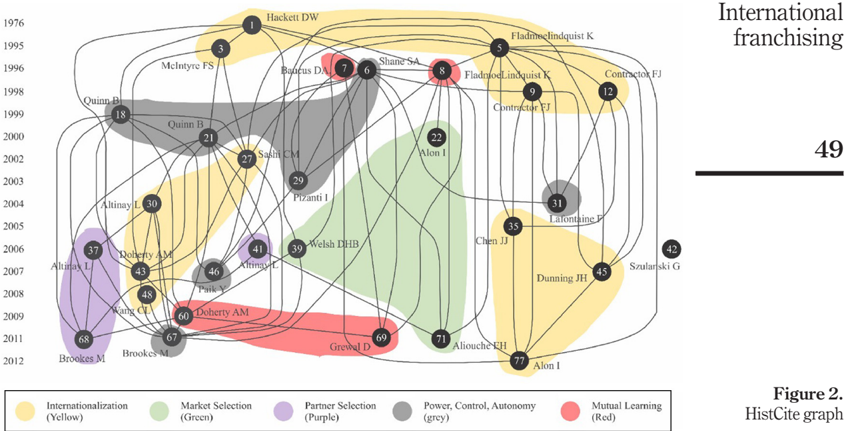
- Four major research clusters are identified: (1) internationalization; (2) selection of international markets and partners; (3) power, control and autonomy; and (4) mutual learning.
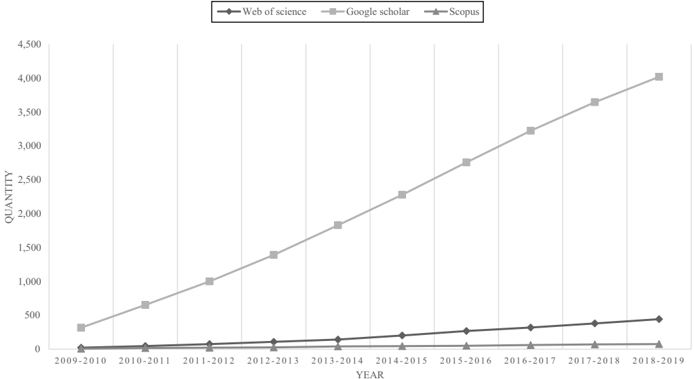
- The review covers 131 articles; from the 131 articles published between 1976 and 2016, there are 5,022 citations in total, and from 2009 to 2019 there was a more than tenfold increase in articles on the subject.
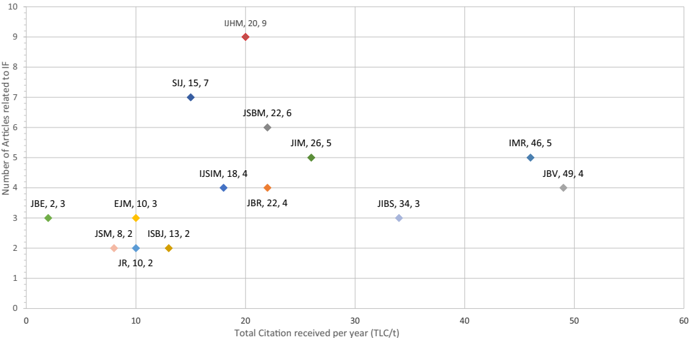
- Leading authors by total local citations include Doherty (47), Fladmoe-Lindquist (43), Altinay (34), Contractor (33), Kundu (33), Quinn (31), Alon (28), Jacque (25), Shane (23), and Brookes (18); 14 journals are identified as most influential.
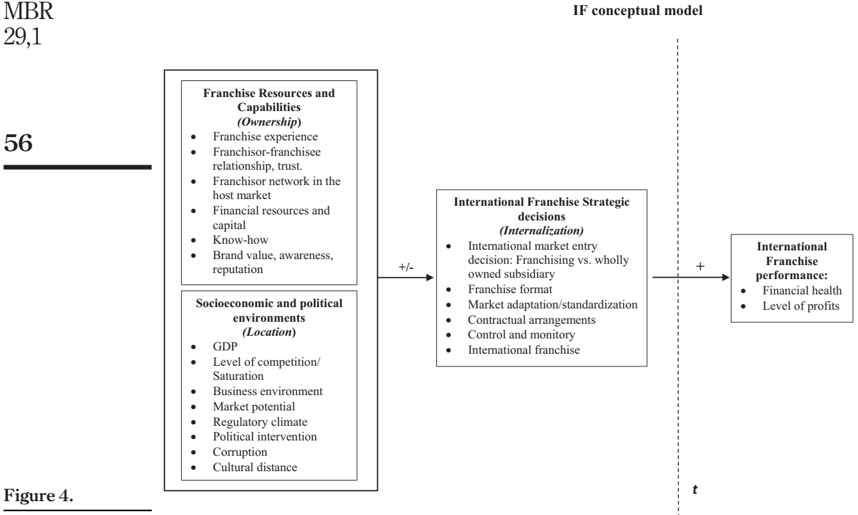
- The proposed conceptual model links franchise resources and capabilities (ownership), socioeconomic and political environments (location), international franchise strategic decisions (internalization), and performance; Lee et al. (2014) document a U-shaped relationship between internationalization and performance in US hotels, and Calderon-Monge and Pastor-Sanz (2017) report that contracts as the only governance mechanism are associated with poor performance, while relational governance is more profitable for single-unit franchisees.
Methods
- Systematic search of ISI Web of Science from 1970 to 2018 for “international franchising” and variants in title, abstract, or keywords; English-language articles only; selected fields included business, economics, management, hospitality/leisure/sports/tourism, business finance, and operational research/management science; at least two authors read each abstract, yielding 131 articles.
- Bibliometric analysis using HistCite to map citation relationships, historiography, research clusters, and leading authors, articles, and journals; content analysis was used to develop a conceptual framework.
Limitations
- Stated: bibliometric analysis may make frequently cited topics or streams appear more significant; citation patterns differ by discipline; fields publish at different rates; important articles may be discovered later; citations can involve bias through self-citations, colleague citations, or journal-based citations; excluding non-English articles may bias results; and the review relies on ISI Web of Knowledge, whose articles are considered among the most prestigious.
- Evident from the text: the review is restricted to English-language Web of Science articles in selected disciplines, so it may omit relevant non-English, non-Web of Science, or non-business franchising work; citation-based impact proxies may also favor older or highly cited work.
Model-written summary. Check it against the paper before relying on it.
Integrity signals
Registry
Cites
Statistics
Figures
Verification
Claims the paper makes
4 Valid · 4 Not valid · 33 Not checked · 39 Own results and interpretations
The cited sources support only part of this claim — read each source’s verdict below.
In the paper
“Calderon-Monge and Pastor-Sanz (2017) report that using contracts as the only governance mechanism is associated with poor performance.”
§ A systematic review of international franchising > 4.1.4 International franchise performance.
What the sources say
- Partly supportedcites Calderon-Monge and Pastor-Sanz, 2017 matched to “Effects of Contract and Trust on Franchisor Performance” (2017) doi:10.5709/ce.1897-9254.251Experimental — accuracy not yet measured
The Conclusions (page not provided) link contract-only governance in the studied SUF network to financially inefficient outlets and poorer franchisor performance. But the paper qualifies this finding: a contract alone does not improve performance unless it is tailored to each franchisee’s situation. The claim omits that condition and states the association more generally. (LLM, conf=0.87)
plainstates an association- Asserted: passes — The authors put it forward as true.
- Checkable: passes — It can be checked against evidence.
- Load-bearing: passes — The paper’s conclusions depend on it.
- Based: passes — The paper gives a reason why it holds.
- Partly supported
The cited sources support only part of this claim — read each source’s verdict below.
In the paper
“Additionally, they found that for single-unit franchisees, it is more profitable to have relational governance mechanisms that strengthen the relationship with the franchisor.”
§ A systematic review of international franchising > 4.1.4 International franchise performance.
What the sources say
- Partly supportedcites Calderon-Monge and Pastor-Sanz, 2017 matched to “Effects of Contract and Trust on Franchisor Performance” (2017) doi:10.5709/ce.1897-9254.251Experimental — accuracy not yet measured
The Conclusions section says an SUF network would be profitable if a relational governance mechanism fostered the relationship and was tailored to each franchisee’s situation. The citing sentence captures the recommendation but omits the tailoring condition and presents the proposed benefit more definitively than the paper does. (LLM, conf=0.86)
plainstates a cause- Asserted: passes — The authors put it forward as true.
- Checkable: passes — It can be checked against evidence.
- Load-bearing: unclear — It is unclear whether the paper’s conclusions depend on it.
- Based: passes — The paper gives a reason why it holds.
- Partly supported
A result the paper reports from its own data — it cites no other source for it, so there is none to check. The quote shows it is in the paper.
In the paper
“Using a systematic approach, the paper identifies all articles in the ISI Web of Science from 1970 to 2018 that includes the term international franchising (in the title, the abstract or keywords) and finds 131 articles.”
- Also stated in: § 2. Research methods · plain
“We systematically examined all articles from 1970 to 2018 in the ISI Web of Science (WoS) that use international franchising (in the title, abstract or author keywords) and identified 131 articles, which formed the analytical database.”
§ A systematic review of international franchising > Abstract
plain- Asserted: passes — The authors put it forward as true.
- Checkable: passes — It can be checked against evidence.
- Load-bearing: passes — The paper’s conclusions depend on it.
- Based: passes — The paper gives a reason why it holds.
- Also stated in: § 2. Research methods · plain
A result the paper reports from its own data — it cites no other source for it, so there is none to check. The quote shows it is in the paper.
In the paper
“From 2009 to 2019, there was a more than tenfold increase in articles on the subject (Table 1 and Figure 1).”
§ A systematic review of international franchising > 1. Introduction
plainstates an association- Asserted: passes — The authors put it forward as true.
- Checkable: passes — It can be checked against evidence.
- Load-bearing: unclear — It is unclear whether the paper’s conclusions depend on it.
- Based: passes — The paper gives a reason why it holds.
A result the paper reports from its own data — it cites no other source for it, so there is none to check. The quote shows it is in the paper.
In the paper
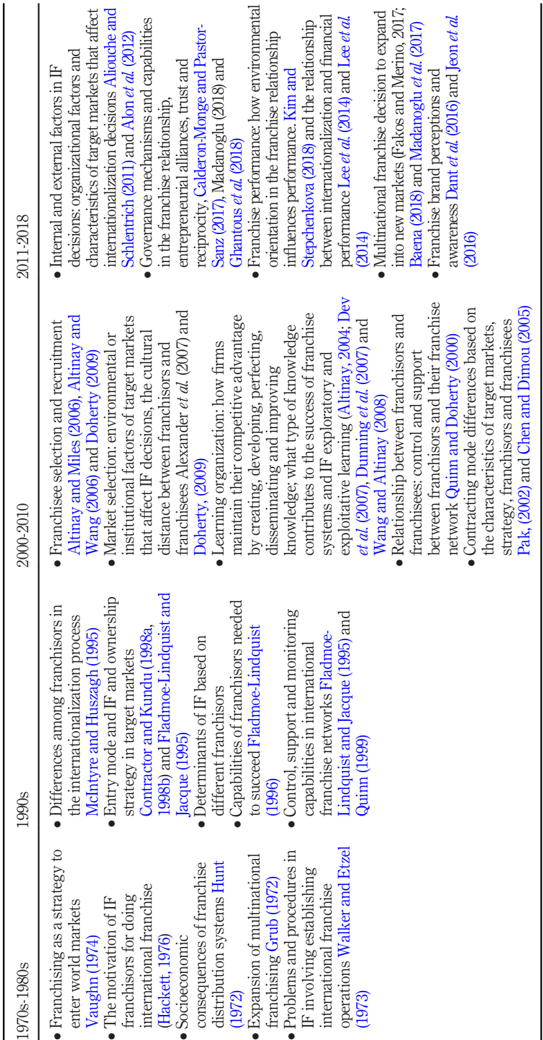
“In addition, this study shows a change in research patterns regarding topics, theories and methodologies from the 1970s through 2018.”
§ A systematic review of international franchising > Abstract
plain- Asserted: passes — The authors put it forward as true.
- Checkable: passes — It can be checked against evidence.
- Load-bearing: passes — The paper’s conclusions depend on it.
- Based: passes — The paper gives a reason why it holds.
28 more claims
Create a free account to see all 80 claims and to verify the 4 references still open.
- Probably not a substantial claim. 37
- It may state two separate claims as one. 20
- The quote only partly states this claim. 1
Self-check
Percentages, sums and reported differences re-computed from the paper’s own numbers.
Each contradiction between two passages listed here was confirmed by an independent check.
Rated minor: it would not touch a result — a value no result rests on, a p-value that stays on the same side of the significance level, or a conflict that is clerical, resolved elsewhere in the paper, or outside its own findings.
In the paper
§ A systematic review of international franchising > 2. Research methods
“We searched for articles from 1945, but the oldest IF article was published in 1973 (Walker and Etzel, 1973).”
§ A systematic review of international franchising > 3.2 Research clusters in international franchising
“Expansion of multinational franchising Grub (1972)”
Rated minor: it would not touch a result — a value no result rests on, a p-value that stays on the same side of the significance level, or a conflict that is clerical, resolved elsewhere in the paper, or outside its own findings.
In the paper
§ A systematic review of international franchising > 3.2.4 Cluster 4: mutual learning.
“Table 3 lists the 14 most influential journals in IF.”
§ A systematic review of international franchising > 3.2.4 Cluster 4: mutual learning.
“Table 3 lists the 10 authors who received the most total local citations (TLC) within the retrieved articles.”
Citations
Cites
Firm Resources and Sustained Competitive Advantage
Barney, J. (1991) · Journal of Management · doi:10.1177/014920639101700108 · Cited by 48,334
Firm resources and sustained competitive advantage
Barney, J. B. (2004) · Advances in Strategic Management · doi:10.1016/s0742-3322(00)17018-4 · Cited by 38,152
The cornerstones of competitive advantage: A resource‐based view
Peteraf, M. A. (1993) · Strategic Management Journal · doi:10.1002/smj.4250140303 · Cited by 10,716
The resource-based theory of competitive advantage: Implications for strategy formulation
Grant, R. M. (1991) · California Management Review · doi:10.2307/41166664 · Cited by 9,699
Strategic Responses to Institutional Processes
Oliver, C. (1991) · The Academy of Management Review · doi:10.5465/amr.1991.4279002 · Cited by 8,950
Bibliometric Methods in Management and Organization
Zupic, I., & Čater, T. (2015) · Organizational Research Methods · doi:10.1177/1094428114562629 · Cited by 7,495
Knowledge of the Firm and the Evolutionary Theory of the Multinational Corporation
Kogut, B., & Zander, U. (1993) · Journal of International Business Studies · doi:10.1057/palgrave.jibs.8490248 · Cited by 3,967
Sustainable competitive advantage: combining institutional and resource-based views
Oliver, C. (1997) · Strategic Management Journal · doi:10.1002/(sici)1097-0266(199710)18:9<697::aid-smj909>3.0.co;2-c · Cited by 2,852
The Economic Institutions of Capitalism. Firms, Markets, Relational Contracting
Williamson, O. E. (2007) · Das Summa Summarum des Management · doi:10.1007/978-3-8349-9320-5_6 · Cited by 2,440
The Eclectic (OLI) Paradigm of International Production: Past, Present and Future
Dunning, J. H. (2001) · International Journal of the Economics of Business · doi:10.1080/13571510110051441 · Cited by 1,560
Boundaries of the Firm: Insights From International Entry Mode Research
Brouthers, K. D., & Hennart, J.-F. (2007) · Journal of Management · doi:10.1177/0149206307300817 · Cited by 885
Shane, S. A. (1996) · Academy of Management Journal · doi:10.2307/256637 · Cited by 536
Franchising: A Review and Avenues to Greater Theoretical Diversity
Combs, J. G., Michael, S. C., & Castrogiovanni, G. J. (2004) · Journal of Management · doi:10.1016/j.jm.2004.06.006 · Cited by 450
Contractor, F. J., & Kundu, S. K. (1998) · Journal of International Business Studies · doi:10.1057/palgrave.jibs.8490039 · Cited by 445
Franchising and Risk Management
Martin, R. E. (1988) · American Economic Review · Cited by 402
International franchising: A literature review and research agenda
Rosado-Serrano, A., Paul, J., & Dikova, D. (2018) · Journal of Business Research · doi:10.1016/j.jbusres.2017.12.049 · Cited by 401
Strategy, Complexity, and Economic Rent
Schoemaker, P. J. H. (1990) · Management Science · doi:10.1287/mnsc.36.10.1178 · Cited by 363
Control Modes in International Service Operations: The Propensity to Franchise
Fladmoe-Lindquist, K., & Jacque, L. L. (1995) · Management Science · doi:10.1287/mnsc.41.7.1238 · Cited by 336 · cited 10×
“Political risks emerge when government policies in the host country create a disadvantageous environment for franchisors, including restrictions on franchising, limits on repatriation at the micro-level, corruption, political turmoil and restrictions on foreign investors (Fladmoe-Lindquist and Jacque, 1995).”
BackgroundInfluentialFranchising Research: A Literature Review and Synthesis
Fried, V. H., & Elango, B. (1997) · Journal of Small Business Management · Cited by 279
Choice Between Non-Equity Entry Modes: An Organizational Capability Perspective
Krishna Erramilli, M., Agarwal, S., & Dev, C. S. (2002) · Journal of International Business Studies · doi:10.1057/palgrave.jibs.8491014 · Cited by 243
Why franchise companies expand overseas
Shane, S. A. (1996) · Journal of Business Venturing · doi:10.1016/0883-9026(95)00110-7 · Cited by 203
Transaction Cost Theory and International Business
Hennart, J. (2010) · Journal of Retailing · doi:10.1016/j.jretai.2010.07.009 · Cited by 194
An Examination of International Retail Franchising in Emerging Markets
Welsh, D. H. B., Alon, I., & Falbe, C. M. (2006) · Journal of Small Business Management · doi:10.1111/j.1540-627x.2006.00158.x · Cited by 193
Self-citationInternationalization and Entry Modes: A Multitheoretical Framework and Research Propositions
Malhotra, N. K., Agarwal, J., & Ulgado, F. M. (2003) · Journal of International Marketing · doi:10.1509/jimk.11.4.1.20144 · Cited by 192
Consensus in franchise organizations: A cooperative arrangement among entrepreneurs
Baucus, D. A., Baucus, M. S., & Human, S. E. (1996) · Journal of Business Venturing · doi:10.1016/0883-9026(96)00055-9 · Cited by 173
The Evolution of Marketing Channels: Trends and Research Directions
Watson, G. F., Worm, S., Palmatier, R. W., & Ganesan, S. (2015) · Journal of Retailing · doi:10.1016/j.jretai.2015.04.002 · Cited by 169
Power and control in international retail franchising – Evidence from theory and practice
Quinn, B., & Doherty, A. M. (2000) · International Marketing Review · doi:10.1108/02651330010339897 · Cited by 169
The Effects of New Franchisor Partnering Strategies on Franchise System Size
Shane, S. A., Shankar, V., & Aravindakshan, A. (2006) · Management Science · doi:10.1287/mnsc.1050.0449 · Cited by 163 · cited 1×
“Signaling theory is used to study how franchisors attract potential franchisees in foreign markets (Shane et al., 2006).”
BackgroundInnovation and international business
Cantwell, J. (2017) · Industry and Innovation · doi:10.1080/13662716.2016.1257422 · Cited by 162
Making Franchising Work: A Framework Based on a Systematic Review
Nijmeijer, K. J., Fabbricotti, I. N., & Huijsman, R. (2013) · International Journal of Management Reviews · doi:10.1111/ijmr.12009 · Cited by 162
The Internationalization Process of Franchise Systems: A Conceptual Model
Eroglu, S. (1992) · International Marketing Review · doi:10.1108/02651339210020277 · Cited by 149 · cited 1×
“Eroglu (1992) studies the effect of cultural distance on an organization’s intention to internationalize its franchise system, suggesting that cultural distance involving differing perceptions and ways of doing business may increase the risks of internationalization.”
BackgroundMarket and partner selection processes in international retail franchising
Doherty, A. M. (2009) · Journal of Business Research · doi:10.1016/j.jbusres.2008.06.011 · Cited by 145
Doherty, A. M. (2007) · International Journal of Service Industry Management · doi:10.1108/09564230710737826 · Cited by 141
Franchising versus Company-Run Operations: Modal Choice in the Global Hotel Sector
Contractor, F. J., & Kundu, S. K. (1998) · Journal of International Marketing · doi:10.1177/1069031x9800600203 · Cited by 140
International franchising: Capabilities and development
Fladmoe-Lindquist, K. (1996) · Journal of Business Venturing · doi:10.1016/0883-9026(96)00056-0 · Cited by 138
Franchising versus Company-Run Operations: Modal Choice in the Global Hotel Sector
Contractor, F. J., & Kundu, S. K. (1998) · Journal of International Marketing · doi:10.1177/1069031x9800600207 · Cited by 132
The Use of Franchising by U.S.-Based Retailers
Alon, I. (2001) · Journal of Small Business Management · doi:10.1111/1540-627x.00011 · Cited by 130
Self-citationGillis, W. E., Combs, J. G., & Yin, X. (2018) · Journal of Business Venturing · doi:10.1016/j.jbusvent.2018.09.004 · Cited by 129
Examining the determinants of hotel chain expansion through international franchising
Alon, I., Ni, L., & Wang, Y. (2011) · International Journal of Hospitality Management · doi:10.1016/j.ijhm.2011.06.009 · Cited by 123
Self-citationFranchising in global markets: towards a conceptual framework
Sashi, C. M., & Prasad Karuppur, D. (2002) · International Marketing Review · doi:10.1108/02651330210445301 · Cited by 122
Examining Control and Autonomy in the Franchisor-Franchisee Relationship
Pizanti, I., & Lerner, M. (2003) · International Small Business Journal: Researching Entrepreneurship · doi:10.1177/0266242603021002001 · Cited by 115
International Franchise Expansion: The Role of Institutions and Transaction Costs
Hoffman, R. C., Munemo, J., & Watson, S. (2016) · Journal of International Management · doi:10.1016/j.intman.2016.01.003 · Cited by 114
International Franchising in the Context of Competitive Strategy and the Theory of the Firm
Huszagh, S. M., Huszagh, F. W., & McIntyre, F. S. (1992) · International Marketing Review · doi:10.1108/02651339210020268 · Cited by 113 · cited 1×
“The franchise concept and its managerial and operating system are extensions of the franchisor’s cultural values and routines in the home country (Huszagh et al., 1992).”
BackgroundExpansion strategy of international hotel firms
Chen, J. J., & Dimou, I. (2005) · Journal of Business Research · doi:10.1016/j.jbusres.2004.11.001 · Cited by 113
Institutional Influences on the Choice of Organizational Form: The Case of Franchising
Combs, J. G., Michael, S. C., & Castrogiovanni, G. J. (2009) · Journal of Management · doi:10.1177/0149206309336883 · Cited by 111
(1999) · Multinational Business Review · Cited by 110
Self-citationDoherty, A. M., & Alexander, N. (2004) · European Journal of Marketing · doi:10.1108/03090560410548942 · Cited by 108
Global Franchising and Development in Emerging and Transitioning Markets
Alon, I. (2004) · Journal of Macromarketing · doi:10.1177/0276146704269320 · Cited by 101
Self-citationThe International Expansion of U.S. Franchise Systems: Status and Strategies
Hackett, D. W. (1976) · Journal of International Business Studies · doi:10.1057/palgrave.jibs.8490883 · Cited by 101 · cited 3×
“Hackett (1976) (1), one of the early international franchise researchers, argues that experience influences that decision.”
BackgroundInfluentialThe Socioeconomic Consequences of the Franchise System of Distribution
Hunt, S. D. (1972) · Journal of Marketing · doi:10.1177/002224297203600306 · Cited by 100
Competitive Advantage Variation over The Life Cycle of a Franchise
Lillis, C. M., Narayana, C. L., & Gilman, J. L. (1976) · Journal of Marketing · doi:10.2307/1251071 · Cited by 97 · cited 2×
“…40 115 653 Entrepreneurship 10 62 328 International business 5 34 596 MBR 29,1 54 resources (Combs et al., 2004; Oxenfeldt and Kelly, 1969) but also to ensure that it can maintain its competitive advantage by transferring its knowledge, reputation and other resources (Lillis et al., 1976).”
BackgroundInternational Outlook of US‐based Franchisers
Aydin, N., & Kacker, M. (1990) · International Marketing Review · doi:10.1108/02651339010143381 · Cited by 94 · cited 1×
“Franchisors may want the standardization they built to apply to their outlets in foreign markets (Aydin and Kacker, 1990).”
BackgroundTowards a Strategic Model of Global Franchise Expansion
Aliouche, E. H., & Schlentrich, U. A. (2011) · Journal of Retailing · doi:10.1016/j.jretai.2011.01.004 · Cited by 90
Market conditions driving international franchising in emerging markets
Graciá, V. B. (2012) · International Journal of Emerging Markets · doi:10.1108/17468801211197879 · Cited by 86
Global franchising: current status and future challenges
Hoffman, R. C., & Preble, J. F. (2004) · Journal of Services Marketing · doi:10.1108/08876040410528700 · Cited by 85
Entrepreneurial signaling to attract resources: the case of franchising
Michael, S. C. (2009) · Managerial and Decision Economics · doi:10.1002/mde.1460 · Cited by 84
The Internationalization Strategy of Spanish Indigenous Franchised Chains: A Resource-Based View
Pérez, R. M., & García-Álvarez, M. T. (2009) · Journal of Small Business Management · doi:10.1111/j.1540-627x.2009.00281.x · Cited by 82
(1995) · Journal of Small Business Management · Cited by 81
Applications of Focus Group Interviews in Marketing
Cox, K. K., Higginbotham, J. B., & Burton, J. F., Jr. (1976) · Journal of Marketing · doi:10.1177/002224297604000117 · Cited by 80
Diffusion of Franchise System Use in International Operations
Welch, L. S. (1989) · International Marketing Review · doi:10.1108/eum0000000001520 · Cited by 79 · cited 2×
“…first to developed economies that are culturally and linguistically similar to the US (the UK, Canada and Australia), then to other developed economies with more cultural distance (Japan) and finally to emerging markets that are economically less developed and are culturally distant (Welch, 1989).”
BackgroundInternational hotel development: A study of potential franchisees in China
Xiao, Q., O’Neill, J. W., & Wang, H. (2008) · International Journal of Hospitality Management · doi:10.1016/j.ijhm.2007.10.006 · Cited by 78
Franchise Partnership and International Expansion: A Conceptual Framework and Research Propositions
Grewal, D., Iyer, G. R., Javalgi, R. (. G., & Radulovich, L. (2011) · Entrepreneurship Theory and Practice · doi:10.1111/j.1540-6520.2011.00444.x · Cited by 78
Control and support in an international franchise network
Quinn, B. (1999) · International Marketing Review · doi:10.1108/02651339910281884 · Cited by 73
International Franchising Practices in Mexico: Do Franchisors Customize Their Contracts?
Lafontaine, F., & Oxley, J. E. (2004) · Journal of Economics & Management Strategy · doi:10.1111/j.1430-9134.2004.00005.x · Cited by 69
Dunning, J. H., Pak, Y. S., & Beldona, S. (2007) · International Business Review · doi:10.1016/j.ibusrev.2007.01.005 · Cited by 68
The franchise relationship in China: agency and institutional theory perspectives
Doherty, A. M., Chen, X., & Alexander, N. (2014) · European Journal of Marketing · doi:10.1108/ejm-04-2012-0199 · Cited by 66 · cited 1×
“Institutional theory confirms that the formal (regulatory) or informal (culture or norms) institutional context may affect the franchise relationship (Doherty et al.2014).”
BackgroundInternational market selection: measuring actions instead of intentions
Alexander, N., Rhodes, M. J., & Myers, H. (2007) · Journal of Services Marketing · doi:10.1108/08876040710818912 · Cited by 65
Kim, M., & Stepchenkova, S. O. (2018) · Journal of Business and Industrial Marketing · doi:10.1108/jbim-02-2017-0046 · Cited by 64
A synergy effect of internationalization and firm size on performance: US hotel industry
Lee, S., Upneja, A., Özdemir, Ö., & Sun, K.-A. (2013) · International Journal of Contemporary Hospitality Management · doi:10.1108/ijchm-09-2012-0173 · Cited by 63 · cited 5×
“Although there are studies analyzing the performance of international franchise firms (Grewal et al., 2011; Lee et al., 2014; Wang and Altinay, 2008) and multinationals operating in advanced and developing economies (Hansen and Gwozdz, 2015), there is more room for research to further investigate…”
BackgroundInfluentialFranchise partner selection: perspectives of franchisors and franchisees
Brookes, M., & Altinay, L. (2011) · Journal of Services Marketing · doi:10.1108/08876041111149694 · Cited by 63 · cited 1×
“Brookes and Altinay (2011) (68) identify the criteria franchisors use to select their partners.”
BackgroundThe Internationalization of U.S. Franchise Systems: Progress and Procedures
Walker, B. J., & Etzel, M. J. (1973) · Journal of Marketing · doi:10.1177/002224297303700208 · Cited by 62 · cited 1×
“We searched for articles from 1945, but the oldest IF article was published in 1973 (Walker and Etzel, 1973).”
MethodEmbedded Patterns of International Alliance Formation
Osborn, R. N., Hagedoorn, J., Denekamp, J. G., Duysters, G. M., & Baughn, C. C. (1998) · Organization Studies · doi:10.1177/017084069801900404 · Cited by 60
Push and pull factors in international franchising
Madanoglu, M., Alon, I., & Shoham, A. (2017) · International Marketing Review · doi:10.1108/imr-03-2015-0037 · Cited by 59
Self-citationMarket Conditions Favoring Master International Franchising
Alon, I. (2006) · Multinational Business Review · doi:10.1108/1525383x200600009 · Cited by 57
Self-citationEuropean franchise expansion into Latin America: Evidence from the Spanish franchise system
Graciá, V. B. (2015) · Management Research Review · doi:10.1108/mrr-08-2013-0185 · Cited by 55 · cited 3×
“There is a lack of franchising research on emerging markets from Asia other than China and India, and countries in Latin America other than Mexico and Brazil.”
BackgroundInfluentialThe organization of relational contracts: The allocation of rights in franchising
Leblebici, H., & Shalley, C. E. (1996) · Journal of Business Venturing · doi:10.1016/0883-9026(96)00051-1 · Cited by 55
The role of prior knowledge in international franchise partner recruitment
Altinay, L., & Wang, C. L. (2006) · International Journal of Service Industry Management · doi:10.1108/09564230610689768 · Cited by 54
Internationalization of Franchise Systems
McIntyre, F. S., & Huszagh, S. M. (1995) · Journal of International Marketing · doi:10.1177/1069031x9500300408 · Cited by 53
Internationalization of Franchise Systems
McIntyre, F. S., & Huszagh, S. M. (1995) · Journal of International Marketing · doi:10.1177/1069031x9500300403 · Cited by 52
International franchising decision-making: An application of stakeholder theory
Altinay, L., & Miles, S. (2006) · The Service Industries Journal · doi:10.1080/02642060600621613 · Cited by 49 · cited 2×
“Altinay and Miles (2006) (41) analyze the influence of cultural distance on franchisee selection.”
BackgroundMethodExecutive Insights: Franchising Opportunities and Threats in Russia
Alon, I., & Banai, M. (2000) · Journal of International Marketing · doi:10.1509/jimk.8.3.104.19634 · Cited by 49
Self-citationImplementing international franchising: the role of intrapreneurship
Altinay, L. (2004) · International Journal of Service Industry Management · doi:10.1108/09564230410564911 · Cited by 49
The dynamics and evolution of knowledge transfer in international master franchise agreements
Brookes, M. (2014) · International Journal of Hospitality Management · doi:10.1016/j.ijhm.2013.07.005 · Cited by 48
Can franchising be an economic development strategy? An empirical investigation
Michael, S. C. (2013) · Small Business Economics · doi:10.1007/s11187-013-9500-1 · Cited by 46
Perrigot, R., López-Fernández, B., & Eroglu, S. (2013) · Journal of Small Business Management · doi:10.1111/jsbm.12006 · Cited by 44
Global Brand Expansion: How to Select a Market Entry Strategy
Dev, C. S., Brown, J. R., & Zhou, K. Z. (2007) · Cornell Hotel and Restaurant Administration Quarterly · doi:10.1177/0010880406294472 · Cited by 39
Antecedents of early terminations in franchising: franchisor versus franchisee cancelations
López-Fernández, B., & López‐Bayón, S. (2017) · Small Business Economics · doi:10.1007/s11187-017-9889-z · Cited by 39 · cited 1×
“Moreover, organizational learning is an important factor when selecting partners, as franchisors need to learn from their franchisees and local markets to improve their adaptability and responsiveness (Doherty, 2009; L opez-Fern andez and L opez-Bay on, 2017).”
BackgroundWang, C. L., & Altınay, L. (2008) · Service Industries Journal · doi:10.1080/02642060701842290 · Cited by 36
Evaluating foreign market entry mode theories from a hotel industry perspective
Kruesi, M. A., Kim, P. B., & Hemmington, N. (2017) · International Journal of Hospitality Management · doi:10.1016/j.ijhm.2016.12.005 · Cited by 36
International franchising and performance: a resource-based perspective
Ghantous, N., & Das, S. S. (2018) · International Journal of Retail & Distribution Management · doi:10.1108/ijrdm-10-2017-0244 · Cited by 35
Brookes, M., & Roper, A. (2011) · European Journal of Marketing · doi:10.1108/03090561111137705 · Cited by 35
Trust, Decision Rights Delegation, and Performance—The Case of Franchising
Herz, M., Hutzinger, C., Seferagic, H., & Windsperger, J. (2016) · Journal of Small Business Management · doi:10.1111/jsbm.12227 · Cited by 35
The hospitality franchise purchase decision making process
Yeung, R. M. W., Brookes, M., & Altınay, L. (2016) · International Journal of Contemporary Hospitality Management · doi:10.1108/ijchm-08-2014-0399 · Cited by 35
Properties of journal impact in relation to bibliometric research group performance indicators
van Raan, A. F. J. (2012) · Scientometrics · doi:10.1007/s11192-012-0747-0 · Cited by 32
What makes MNCs succeed in developing countries? An empirical analysis of subsidiary performance
Hansen, M. W., & Gwozdz, W. (2015) · Multinational Business Review · doi:10.1108/mbr-06-2014-0020 · Cited by 30 · cited 2×
“, 2014; Wang and Altinay, 2008) and multinationals operating in advanced and developing economies (Hansen and Gwozdz, 2015), there is more room for research to further investigate location advantages and their implications for the performance of franchise firms operating in global markets (Lee et al.”
BackgroundReplicate or adapt? Franchising and organizational routines
Maalouf, J. T., Combs, J. G., Gillis, W. E., & Perryman, A. A. (2020) · Journal of Knowledge Management · doi:10.1108/jkm-09-2019-0493 · Cited by 29 · cited 3×
“There is a need for more longitudinal data on franchising (Maalouf et al., 2020), originating beyond the US (Perrigot et al., 2013).”
BackgroundInfluentialJell‐Ojobor, M., & Windsperger, J. (2017) · International Marketing Review · doi:10.1108/imr-10-2015-0208 · Cited by 26
A Cross-National Comparison of Brand Perceptions of Global Franchise Chains in the BRICS
Dant, R. P., Jeon, H. J., Mumdžiev, N., & Windsperger, J. (2016) · Journal of Marketing Channels · doi:10.1080/1046669x.2016.1224304 · Cited by 24
International franchise presence and intensity level: profile of franchisors operating abroad
Graciá, V. B. (2018) · Management Research Review · doi:10.1108/mrr-01-2017-0011 · Cited by 24 · cited 4×
“…Dunning et al. (2007), Doherty (2007), Dev et al. (2007), Aliouche and Schlentrich (2011), Kruesi and Z amborský (2016), Kruesi et al. (2017) and Baena (2018) International franchise performance Dynamic capabilities, agency theory resourcebased view Financial performance Financial health…”
BackgroundInfluentialCultural Convergence in Emerging Markets: The Case of McDonald's in China and India
Jeon, H. J., Meiseberg, B., Dant, R. P., & Grünhagen, M. (2015) · Journal of Small Business Management · doi:10.1111/jsbm.12168 · Cited by 23
Governance capabilities and relationship performance in international franchising
Ghantous, N., Das, S. S., & Chameroy, F. (2017) · Journal of Retailing and Consumer Services · doi:10.1016/j.jretconser.2017.08.022 · Cited by 22
Pak, Y. S. (2002) · Multinational Business Review · Cited by 22
Outback Steakhouse in Korea: A Success Story
Lee, K., Khan, M. A., & Ko, J.-Y. (2008) · Cornell Hospitality Quarterly · doi:10.1177/0010880407307117 · Cited by 21
Verbeke, A., & Yuan, W. (2016) · Multinational Business Review · doi:10.1108/mbr-05-2015-0021 · Cited by 19
International Franchise Expansion: Does Market Propinquity Matter?
Hoffman, R. C., Kincaid, J. F., & Preble, J. F. (2008) · Multinational Business Review · doi:10.1108/1525383x200800017 · Cited by 16 · cited 1×
“Cultural distance may affect franchising decisions (Hoffman et al., 2008), the negotiation process (Weiss, 1996), business format transfers and operating system compatibility (Justis and Judd, 1989).”
BackgroundEffects of Contract and Trust on Franchisor Performance
(2017) · Repositorio Institucional de la Universidad de Burgos (University of Burgos) · doi:10.5709/ce.1897-9254.251 · Cited by 11 · cited 3×
“franchisee and franchisor in industries other than the service sector (Calderon-Monge and Pastor-Sanz, 2017; Yeung et al., 2016).”
InfluentialInternationalization and Financial Health in the US Hotel Industry
Lee, S., Koh, Y., & Xiao, Q. (2014) · Tourism Economics · doi:10.5367/te.2013.0261 · Cited by 10
The Non-Equity Entry Mode Choices of International Hotel Organizations in New Zealand
Kruesi, M. A., & Zámborský, P. (2016) · International Journal of Hospitality & Tourism Administration · doi:10.1080/15256480.2016.1204256 · Cited by 10 · cited 1×
“…International franchise and governance modes Dunning et al. (2007), Doherty (2007), Dev et al. (2007), Aliouche and Schlentrich (2011), Kruesi and Z amborský (2016), Kruesi et al. (2017) and Baena (2018) International franchise performance Dynamic capabilities, agency theory resourcebased…”
BackgroundVaughn, C. L. (1974) · Cornell Hotel and Restaurant Administration Quarterly · doi:10.1177/001088047401400418 · Cited by 4
(1997) · doi:10.1002/(sici)1097-0266(199701)18:1<39::aid-smj841>3.0.co;2-j
The internationalization strategy of Spanish indigenous franchised chains: a resource-based view
Mariz-Perez, R. (2010) · Strategic Direction · doi:10.1108/sd.2010.05626dad.003
Research works printed but not linked: 11
- 3. Brookes, M. 18 (6) Journal of Business Research (JBR); (7) International Journal of Hospitality Management (IJHM);
- 7. Alon, I. (Ed.), (2014), Social Franchising, Springer.
- 52. Grub, P.D. (1972), "Multinational franchising: a new trend in global expansion", Indian Journal of International Economic Law, Vol. 7, p. 21.
- 55. Hennart, J.F. (1991), "The transaction cost theory of the multinational enterprise", The Nature of the Transnational Firm, Vol. 2.
- 61. Hunt, S.D. (1972), "The socioeconomic consequences of the franchise system of distribution", Journal of Marketing, Vol. 36 No. 3, pp. 32-38. International franchising Internatinal Trade Administration (2016), "Franchising", available at: https://2016.export.gov/industry/ franchising/index.asp
- 64. Justis, R. and Judd, R. (1989), Franchising, Southwestern Publishing Co, Cincinnati.
- 69. Lafili, L. and Van Ranst, N. (1990), "Intellectual property rights", in Abell, M. (Ed.), Theinternational Franchise Option, Waterlow, London.
- 83. Noyelle, T.J. and Dutka, A.B. (1988), International Trade in Business Services, American Enterprise Institute, Washington, DC.
- 84. Oxenfeldt, A.R. and Kelly, A.O. (1969), "Will successful franchise systems ultimately become wholly- owned chains", Journal of Retailing, Vol. 44 No. 4, pp. 69-83.
- 105. Weiss, S.E. (1996), "International negotiations: Bricks, mortar, and prospects", in Punnet B. and Shenkar, O. (Eds), Handbook for International Management Research, Vol. 208-265, Blackwell Publishers, Cambridge, MA.
- 110. Young, J.A., McIntyre, F.S. and Green, R.D. (2000), "The international society of franchising proceedings: a thirteen-year review", Proceedings of the International Society of Franchising.
Cited by
Franchising research on emerging markets: Bibliometric and content analyses
Bretas, V. P. G., & Alon, I. (2021) · Journal of Business Research · doi:10.1016/j.jbusres.2021.04.067 · Cited by 276
Self-citationBevilacqua, S., Masárová, J., Perotti, F. A., & Ferraris, A. (2025) · Review of Managerial Science · doi:10.1007/s11846-025-00836-7 · Cited by 187
“Such an investigation serves to illuminate the scholarly networks and collab - orative dynamics within the field while also providing insights into the prominence and impact of individual contributors (Alon et al. 2020).”
Crowdfunding and innovation: a bibliometric review and future research agenda
Bargoni, A., Ferraris, A., Bresciani, S., & Camilleri, M. A. (2022) · European Journal of Innovation Management · doi:10.1108/ejim-06-2022-0310 · Cited by 60
A systematic review of family business and consumer behaviour
Bargoni, A., Alon, I., & Ferraris, A. (2023) · Journal of Business Research · doi:10.1016/j.jbusres.2023.113698 · Cited by 76
“To answer our research questions, we first conducted a systematic literature review on the extant literature from 1991 to 2022, using bibliometric co-citation analysis and content analysis (Bretas & Alon, 2021).”
InfluentialSelf-citationBattisti, E., Graziano, E. A., Leonidou, E., Stylianou, I., & Pereira, V. E. (2021) · International Marketing Review · doi:10.1108/imr-12-2020-0301 · Cited by 48
Metadata
- Authors
- Alon, I., Apriliyanti, I. D., & Henríquez Parodi, M. C.
- Affiliations
- University of Agder (NO)
- Universitas Gadjah Mada (ID)
- Corresponding author
- Apriliyanti, Indri Dwi
- Venue
- Multinational Business Review
- Publisher
- Emerald
- Published
- 2020-11-17
- Volume
- 29
- Issue
- 1
- Pages
- 43-69
- ISSN
- 1525-383X (ISSN-L)
- OpenAlex
- W3105477700
- Cited by
- 106
- References
- 112
- Citations by year
- 2026: 16 · 2025: 29 · 2024: 18 · 2023: 21 · 2022: 15 · 2021: 7
- FWCI
- 1.40
- Type
- journal article
- Language
- en
- Open access
- hybrid
- doi.org
- Licence
- cc-by
- www.emerald.com/insight/site-policies (tdm)
- Locations
- Multinational Business Review (publishedVersion, cc-by)
- Topics
- Social Sciences › Business, Management and Accounting › Strategy and Management › Franchising Strategies and Performance
- Social Sciences › Business, Management and Accounting › Strategy and Management › International Business and FDI
- Social Sciences › Business, Management and Accounting › Management of Technology and Innovation › Entrepreneurship Studies and Influences
- Keywords
- international franchising, franchising, market entry modes, research trends, research clusters, conceptual framework, international business
About these checks
Registry, retraction, Cites and statistics results are computed, not judged, with one exception: a printed reference that no index lists is read once by a model before it counts as a citation error. Claims are extracted by a model and kept only when their quote appears verbatim in the text; each cited source is then checked, with a model’s help, for whether it says what the claim relies on. Those verdicts can be wrong — read the claim’s quote and the cited source before relying on one.
The claim verdicts this report counts are experimental: their accuracy is not yet measured.
A language model drew the claims from the paper on 2026-10-11, under version 3 of the claim definition (model deepseek-v4.1-flash, prompt extract-v3).
A second model labelled each claim on 2026-10-11 (model jev-1.13-20260917, definition revision gold-guideline-v0.2).
Cited sources are checked with a language model’s help (gpt-6-sol).
Statistics and arithmetic are recomputed, not judged.
Confidence bands are shown only for fields calibrated on our annotated test set. None is calibrated yet, so no band is shown.
What counts as a claim ›How we measure confidence ›How we check this ›
Are you an author, or do you see a problem with this page? Request a review
Data sources
Bibliographic data: Semantic Scholar, OpenAlex, Crossref.
Contains information from the Semantic Scholar Academic Graph Datasets, made available under the ODC Attribution License (ODC-BY 1.0).
Semantic Scholar’s data is described in: Kinney, R., et al. (2023). The Semantic Scholar Open Data Platform. arXiv:2301.10140.
