

The DOI matches its Crossref record; 100 of the 100 references it cites were found in a registry or an index; none of the 151 sources its claims cite is checked for support yet.
Attention Bias Modification (ABM): Review of Effects of Multisession ABM Training on Anxiety and Threat-Related Attention in High-Anxious Individuals
Open accessAbstract
Attention bias modification (ABM) aims to reduce anxiety by reducing attention bias (AB) to threat; however, effects on anxiety and AB are variable. This review examines 34 studies assessing effects of multisession-ABM on both anxiety and AB in high-anxious individuals. Methods include ABM-threat-avoidance (promoting attention-orienting away from threat), ABM-positive-search (promoting explicit, goal-directed attention-search for positive/nonthreat targets among negative/threat distractors), and comparison conditions (e.g., control-attention training combining threat-cue exposure and attention-task practice without AB-modification). Findings indicate anxiety reduction often occurs during both ABM-threat-avoidance and control-attention training; anxiety reduction is not consistently accompanied by AB reduction; anxious individuals often show no pretraining AB in orienting toward threat; and ABM-positive-search training appears promising in reducing anxiety. Methodological and theoretical issues are discussed concerning ABM paradigms, comparison conditions, and AB assessment. ABM methods combining explicit goal-directed attention-search for nonthreat/positive information and effortful threat-distractor inhibition (promoting top-down cognitive control during threat-cue exposure) warrant further evaluation.
Overview
AI snapshot
Written from the paper’s full text.
TL;DR
This qualitative review of 34 multisession RCTs in high-anxious individuals finds that ABM-threat-avoidance training has inconsistent anxiolytic effects relative to control-attention training, and anxiety reduction often occurs without reduction in preexisting threat-related attention bias. ABM-positive-search training appears promising for reducing anxiety, but evidence is limited to two included studies.
Key findings
- In about two thirds of studies, ABM-threat-avoidance training was not more effective than comparison conditions in reducing anxiety; 8 studies found it superior to control-attention training, all experimenter-controlled, while 23 studies found no superiority (15 experimenter-controlled, 7 home-based, 1 assessing both settings).
- Anxiety symptoms often reduced during both ABM-threat-avoidance and control-attention training, sometimes with moderate-to-large effects and often without change in AB to threat.
- Most studies using standard visual-probe-task scores did not find pretraining AB in orienting toward threat in anxious individuals; anxiety reduction was not consistently accompanied by AB reduction.
- In two ABM-positive-search studies, anxiety reduction was greater than control or waitlist: 50% of completers versus 8% in control training were free of their principal anxiety disorder in Waters et al. (2013), and 42% versus 8% of waitlist control in Waters et al. (2015).
Methods
- Qualitative review; searched PsycInfo and Medline and checked reference lists for peer-reviewed English-language studies, identifying 34 studies published between 2008 and end of 2016 (33 publications, one describing two studies).
- Inclusion criteria: multisession ABM training aimed at modifying threat-related AB and anxiety; threat and nonthreat stimuli; high-anxious subclinical or clinical participants; RCT design; pre-post assessment of anxiety symptoms and AB. Review articles and studies combining ABM with interpretive bias modification were excluded.
- The review evaluated three predictions: greater anxiety reduction for ABM than comparison conditions, corresponding reduction in AB to threat, and pretraining AB to threat in anxious individuals; it distinguished ABM-threat-avoidance (32 studies) from ABM-positive-search (2 studies) and examined control conditions and AB measures.
Limitations
- The paper states that a limitation is the small number of ABM-positive-search studies that have assessed effects on both AB and anxiety in anxious individuals.
- The paper states that null pretraining AB findings must be interpreted cautiously because sample sizes tend to be modest, ABs are inferred indirectly from RT data, and RT-based AB measures have low reliability; it also notes dissemination bias, including publication bias and outcome-reporting bias.
- The paper states that most studies, but not all, lacked non-attention-training comparison conditions, and that interpretation of AB change is complicated by divergent AB measures and by many studies assessing AB with the same or similar probe-based task used for training, which may reflect task-specific rules rather than generalized change in AB to threat.
Model-written summary. Check it against the paper before relying on it.
Integrity signals
Registry
Cites
Statistics
Figures
Verification
Claims the paper makes
103 Not checked yet · 25 Own interpretation · 22 No basis given · 4 Own result · 1 Own method
In the paper
“In addition, two studies unexpectedly found greater anxiety reduction during CON-attention-training than during ABM-threat-avoidance training in posttraumatic stress disorder (PTSD) (Badura-Brack et al., 2015).”
§ Attention Bias Modification (ABM): Review of Effects of Multisession ABM Training on Anxiety and Threat-Related Attention in High-Anxious Individuals > Findings From ABM Studies Relating to Predictions > Prediction 1: Effect of ABM on anxiety
What the sources say
- Not checked yetcites Badura-Brack et al., 2015
plaindirect- Asserted: passes — The authors put it forward as true.
- Checkable: passes — It can be checked against evidence.
- Load-bearing: unclear — It is unclear whether the paper’s conclusions depend on it.
- Based: passes — The paper gives a reason why it holds.
- Rests on an assumption: The included studies' measures of anxiety and attention bias are sufficiently valid and comparable to permit a qualitative synthesis of their findings.
A result the paper reports from its own data — it cites no other source for it, so there is none to check. The quote shows it is in the paper.
In the paper
“However, in most studies, ABM-threat-avoidance training was not more effective than CON-attention training in reducing anxiety between pre- and posttraining.”
§ Attention Bias Modification (ABM): Review of Effects of Multisession ABM Training on Anxiety and Threat-Related Attention in High-Anxious Individuals > Findings From ABM Studies Relating to Predictions > Prediction 1: Effect of ABM on anxiety
plain- Asserted: passes — The authors put it forward as true.
- Checkable: passes — It can be checked against evidence.
- Load-bearing: passes — The paper’s conclusions depend on it.
- Based: passes — The paper gives a reason why it holds.
- Rests on an assumption: The included studies' measures of anxiety and attention bias are sufficiently valid and comparable to permit a qualitative synthesis of their findings.
None of the sources cited for this claim have been checked yet.
In the paper
“Two other studies, which also used the visual-probe task to both assess and modify AB, reported that anxiety reduction during ABM-threat-avoidance training was accompanied by reduction in within-session AB variability (change between beginning and end of each training session) rather than stable change in standard AB scores between pre- and posttraining”
§ Attention Bias Modification (ABM): Review of Effects of Multisession ABM Training on Anxiety and Threat-Related Attention in High-Anxious Individuals > Findings From ABM Studies Relating to Predictions > Prediction 2: Effect of ABM on AB to threat
plaincorrelational- Asserted: passes — The authors put it forward as true.
- Checkable: passes — It can be checked against evidence.
- Load-bearing: unclear — It is unclear whether the paper’s conclusions depend on it.
- Based: passes — The paper gives a reason why it holds.
- Rests on an assumption: The included studies' measures of anxiety and attention bias are sufficiently valid and comparable to permit a qualitative synthesis of their findings.
The paper states this without a source or data behind it here, so there is nothing to check it against. The quote shows it is in the paper.
In the paper
“anxiety reduction is not consistently accompanied by AB reduction;”
- Also stated in: § Abstract · hedged
“Second, anxiety reduction may occur during ABM training without AB reduction.”
§ Attention Bias Modification (ABM): Review of Effects of Multisession ABM Training on Anxiety and Threat-Related Attention in High-Anxious Individuals > Abstract
plain- Asserted: passes — The authors put it forward as true.
- Checkable: passes — It can be checked against evidence.
- Load-bearing: passes — The paper’s conclusions depend on it.
- Based: passes — The paper gives a reason why it holds.
- Rests on an assumption: The included studies' measures of anxiety and attention bias are sufficiently valid and comparable to permit a qualitative synthesis of their findings.
- Also stated in: § Abstract · hedged
None of the sources cited for this claim have been checked yet.
In the paper
“about a third to a half of children with anxiety disorders were free of their principal anxiety disorder after ABM-positive-search training (50% of those completing ABM versus 8% in control training in Waters et al., 2013, and 42% of those completing ABM versus 8% of waitlist control in Waters et al., 2015).”
§ Attention Bias Modification (ABM): Review of Effects of Multisession ABM Training on Anxiety and Threat-Related Attention in High-Anxious Individuals > Findings From ABM Studies Relating to Predictions > Prediction 1: Effect of ABM on anxiety
What the sources say
- Not checked yetcites Waters et al., 2013
- Not checked yetcites Waters et al., 2015
plaindirect- Asserted: passes — The authors put it forward as true.
- Checkable: passes — It can be checked against evidence.
- Load-bearing: passes — The paper’s conclusions depend on it.
- Based: passes — The paper gives a reason why it holds.
- Rests on an assumption: The included studies' measures of anxiety and attention bias are sufficiently valid and comparable to permit a qualitative synthesis of their findings.
In the paper
“In Shechner et al. (2014), children with anxiety disorders showed pretraining AB for disgust faces that reduced to no bias during both ABM and CON training.”
§ Attention Bias Modification (ABM): Review of Effects of Multisession ABM Training on Anxiety and Threat-Related Attention in High-Anxious Individuals > Findings From ABM Studies Relating to Predictions > Prediction 2: Effect of ABM on AB to threat
What the sources say
- Not checked yetcites Shechner et al., 2014
plaindirect- Asserted: passes — The authors put it forward as true.
- Checkable: passes — It can be checked against evidence.
- Load-bearing: unclear — It is unclear whether the paper’s conclusions depend on it.
- Based: passes — The paper gives a reason why it holds.
- Rests on an assumption: The included studies' measures of anxiety and attention bias are sufficiently valid and comparable to permit a qualitative synthesis of their findings.
In the paper
“Enock et al. (2014) assessed AB change on two tasks (visual-probe and spatial-cuing) and reported that AB reduced during ABM and CON training from no bias to avoidance of disgust faces in socially anxious adults only on the visual-probe assessment task.”
§ Attention Bias Modification (ABM): Review of Effects of Multisession ABM Training on Anxiety and Threat-Related Attention in High-Anxious Individuals > Findings From ABM Studies Relating to Predictions > Prediction 2: Effect of ABM on AB to threat
What the sources say
- Not checked yetcites Enock et al., 2014
plaindirect- Asserted: passes — The authors put it forward as true.
- Checkable: passes — It can be checked against evidence.
- Load-bearing: unclear — It is unclear whether the paper’s conclusions depend on it.
- Based: passes — The paper gives a reason why it holds.
- Rests on an assumption: The included studies' measures of anxiety and attention bias are sufficiently valid and comparable to permit a qualitative synthesis of their findings.
None of the sources cited for this claim have been checked yet.
In the paper
“In the other three studies, anxiety reduction occurred across all attention-training conditions (ABM, inverse-ABM, CON-attention-training; Boettcher et al., 2013; Heeren, Mogoase, McNally et al., 2015; McNally et al., 2013).”
§ Attention Bias Modification (ABM): Review of Effects of Multisession ABM Training on Anxiety and Threat-Related Attention in High-Anxious Individuals > Findings From ABM Studies Relating to Predictions > Prediction 1: Effect of ABM on anxiety
What the sources say
- Not checked yetcites Boettcher et al., 2013
- Not checked yetcites Heeren, Mogoase, McNally et al., 2015
- Not checked yetcites McNally et al., 2013
plain- Asserted: passes — The authors put it forward as true.
- Checkable: passes — It can be checked against evidence.
- Load-bearing: passes — The paper’s conclusions depend on it.
- Based: passes — The paper gives a reason why it holds.
- Rests on an assumption: The included studies' measures of anxiety and attention bias are sufficiently valid and comparable to permit a qualitative synthesis of their findings.
In the paper
“In Eldar et al. (2012), there was reduction in AB to threat during ABM-threat-avoidance but not CON-attention training in anxious children preselected for exhibiting AB towards threat”
§ Attention Bias Modification (ABM): Review of Effects of Multisession ABM Training on Anxiety and Threat-Related Attention in High-Anxious Individuals > Findings From ABM Studies Relating to Predictions > Prediction 2: Effect of ABM on AB to threat
What the sources say
- Not checked yetcites Eldar et al., 2012
plaindirect- Asserted: passes — The authors put it forward as true.
- Checkable: passes — It can be checked against evidence.
- Load-bearing: passes — The paper’s conclusions depend on it.
- Based: passes — The paper gives a reason why it holds.
- Rests on an assumption: The included studies' measures of anxiety and attention bias are sufficiently valid and comparable to permit a qualitative synthesis of their findings.
None of the sources cited for this claim have been checked yet.
In the paper
“Findings indicate anxiety reduction often occurs during both ABM-threat-avoidance and control-attention training;”
- Also stated in: § Prediction 1: Effect of ABM on anxiety · hedged
“Furthermore, in many of these studies, anxiety symptoms reduced irrespective of attention-training condition—that is, during both ABM-threat-avoidance and CON-attention training”
§ Attention Bias Modification (ABM): Review of Effects of Multisession ABM Training on Anxiety and Threat-Related Attention in High-Anxious Individuals > Abstract
hedgeddirect- Asserted: passes — The authors put it forward as true.
- Checkable: passes — It can be checked against evidence.
- Load-bearing: passes — The paper’s conclusions depend on it.
- Based: passes — The paper gives a reason why it holds.
- Rests on an assumption: The included studies' measures of anxiety and attention bias are sufficiently valid and comparable to permit a qualitative synthesis of their findings.
- Also stated in: § Prediction 1: Effect of ABM on anxiety · hedged
- It may state two separate claims as one. 53
- The quote only partly states this claim. 1
- Probably not a substantial claim. 16
None of the sources cited for this claim have been checked yet.
In the paper
“Three studies, which found superior anxiolytic effects of ABM-threat-avoidance training (relative to CON-attention training), assessed AB on spatial-cuing tasks (Amir, Beard, Taylor et al., 2009; Bar-Haim et al., 2011; Liang & Hsu, 2016). Although none of these studies showed pretraining AB to threat”
§ Attention Bias Modification (ABM): Review of Effects of Multisession ABM Training on Anxiety and Threat-Related Attention in High-Anxious Individuals > Findings From ABM Studies Relating to Predictions > Prediction 2: Effect of ABM on AB to threat
What the sources say
- Not checked yetcites Amir, Beard, Taylor et al., 2009
- Not checked yetcites Bar-Haim et al., 2011
- Not checked yetcites Liang & Hsu, 2016
plain- Asserted: passes — The authors put it forward as true.
- Checkable: passes — It can be checked against evidence.
- Load-bearing: passes — The paper’s conclusions depend on it.
- Based: passes — The paper gives a reason why it holds.
It may state two separate claims as one.
- Rests on an assumption: The included studies' measures of anxiety and attention bias are sufficiently valid and comparable to permit a qualitative synthesis of their findings.
A result the paper reports from its own data — it cites no other source for it, so there is none to check. The quote shows it is in the paper.
In the paper
“Consequently, we identified 34 studies published between 2008 and the end of 2016 that met the specifications for this review (33 publications, with one describing two studies; indicated in “References”).2 Of these, 32 studies used ABM-threat-avoidance training and two used ABM-positive-search training.”
§ Attention Bias Modification (ABM): Review of Effects of Multisession ABM Training on Anxiety and Threat-Related Attention in High-Anxious Individuals > Abstract
plain- Asserted: passes — The authors put it forward as true.
- Checkable: passes — It can be checked against evidence.
- Load-bearing: unclear — It is unclear whether the paper’s conclusions depend on it.
- Based: passes — The paper gives a reason why it holds.
It may state two separate claims as one.
None of the sources cited for this claim have been checked yet.
In the paper
“Specifically, eight studies indicated that standard ABM-threat-avoidance training was superior to CON-attention training in reducing anxiety, all of which administered training under experimenter-controlled conditions”
§ Attention Bias Modification (ABM): Review of Effects of Multisession ABM Training on Anxiety and Threat-Related Attention in High-Anxious Individuals > Findings From ABM Studies Relating to Predictions > Prediction 1: Effect of ABM on anxiety
hedgeddirect- Asserted: passes — The authors put it forward as true.
- Checkable: passes — It can be checked against evidence.
- Load-bearing: passes — The paper’s conclusions depend on it.
- Based: passes — The paper gives a reason why it holds.
It may state two separate claims as one.
- Rests on an assumption: The included studies' measures of anxiety and attention bias are sufficiently valid and comparable to permit a qualitative synthesis of their findings.
None of the sources cited for this claim have been checked yet.
In the paper
“Nonstandard AB scores on the visual-probe task suggested pretraining AB to threat (slower RTs on threat-present than threat-absent trials), which reduced from pre- to posttraining during ABM with fear activation and CON-only training but not during ABM-only training.”
§ Attention Bias Modification (ABM): Review of Effects of Multisession ABM Training on Anxiety and Threat-Related Attention in High-Anxious Individuals > Findings From ABM Studies Relating to Predictions > Prediction 2: Effect of ABM on AB to threat
hedgeddirect- Asserted: passes — The authors put it forward as true.
- Checkable: passes — It can be checked against evidence.
- Load-bearing: unclear — It is unclear whether the paper’s conclusions depend on it.
- Based: passes — The paper gives a reason why it holds.
It may state two separate claims as one.
- Rests on an assumption: The included studies' measures of anxiety and attention bias are sufficiently valid and comparable to permit a qualitative synthesis of their findings.
In the paper
“AB reduction was found for threat stimuli used during ABM training, which did not generalize to new threat stimuli.”
§ Attention Bias Modification (ABM): Review of Effects of Multisession ABM Training on Anxiety and Threat-Related Attention in High-Anxious Individuals > Findings From ABM Studies Relating to Predictions > Prediction 2: Effect of ABM on AB to threat
What the sources say
- Not checked yetcites Eldar et al., 2012
plaindirect- Asserted: passes — The authors put it forward as true.
- Checkable: passes — It can be checked against evidence.
- Load-bearing: unclear — It is unclear whether the paper’s conclusions depend on it.
- Based: passes — The paper gives a reason why it holds.
It may state two separate claims as one.
- Rests on an assumption: The included studies' measures of anxiety and attention bias are sufficiently valid and comparable to permit a qualitative synthesis of their findings.
In the paper
“In Amir, Beard, Burns et al. (2009), anxious individuals showed no AB before training and showed threat avoidance after ABM training but not after CON-attention training.”
§ Attention Bias Modification (ABM): Review of Effects of Multisession ABM Training on Anxiety and Threat-Related Attention in High-Anxious Individuals > Findings From ABM Studies Relating to Predictions > Prediction 2: Effect of ABM on AB to threat
What the sources say
- Not checked yetcites Amir, Beard, Burns et al., 2009
plaindirect- Asserted: passes — The authors put it forward as true.
- Checkable: passes — It can be checked against evidence.
- Load-bearing: passes — The paper’s conclusions depend on it.
- Based: passes — The paper gives a reason why it holds.
It may state two separate claims as one.
- Rests on an assumption: The included studies' measures of anxiety and attention bias are sufficiently valid and comparable to permit a qualitative synthesis of their findings.
A result the paper reports from its own data — it cites no other source for it, so there is none to check. The quote shows it is in the paper.
In the paper
“This outcome was found in 23 studies: 15 experimenter-controlled (laboratory-, clinic-, or school-based settings), 7 home-based training, and 1 assessing training in both settings”
§ Attention Bias Modification (ABM): Review of Effects of Multisession ABM Training on Anxiety and Threat-Related Attention in High-Anxious Individuals > Findings From ABM Studies Relating to Predictions > Prediction 1: Effect of ABM on anxiety
plain- Asserted: passes — The authors put it forward as true.
- Checkable: passes — It can be checked against evidence.
- Load-bearing: passes — The paper’s conclusions depend on it.
- Based: passes — The paper gives a reason why it holds.
The quote only partly states this claim.
- Rests on an assumption: The included studies' measures of anxiety and attention bias are sufficiently valid and comparable to permit a qualitative synthesis of their findings.
In the paper
“By contrast, in Heeren et al. (2012), socially anxious adults showed pretraining AB for angry faces on the visual-probe task, which reduced during ABM-threat-avoidance training (resulting in posttraining AB away from angry relative to happy faces) but did not change during CON or inverse-ABM training”
§ Attention Bias Modification (ABM): Review of Effects of Multisession ABM Training on Anxiety and Threat-Related Attention in High-Anxious Individuals > Findings From ABM Studies Relating to Predictions > Prediction 2: Effect of ABM on AB to threat
What the sources say
- Not checked yetcites Heeren et al., 2012
plaindirect- Asserted: passes — The authors put it forward as true.
- Checkable: passes — It can be checked against evidence.
- Load-bearing: passes — The paper’s conclusions depend on it.
- Based: passes — The paper gives a reason why it holds.
It may state two separate claims as one.
- Rests on an assumption: The included studies' measures of anxiety and attention bias are sufficiently valid and comparable to permit a qualitative synthesis of their findings.
In the paper
“Khanna et al. (2016) used different attentional tasks to assess and modify AB in PTSD (modified Stroop and visual-probe tasks, respectively) and found pretraining AB for combat-related threat words (indexed by threat-distractor-interference effect on RT) reduced during both ABM and CON training, so this AB was no longer evident posttraining.”
§ Attention Bias Modification (ABM): Review of Effects of Multisession ABM Training on Anxiety and Threat-Related Attention in High-Anxious Individuals > Findings From ABM Studies Relating to Predictions > Prediction 2: Effect of ABM on AB to threat
What the sources say
- Not checked yetcites Khanna et al., 2016
plaindirect- Asserted: passes — The authors put it forward as true.
- Checkable: passes — It can be checked against evidence.
- Load-bearing: passes — The paper’s conclusions depend on it.
- Based: passes — The paper gives a reason why it holds.
It may state two separate claims as one.
- Rests on an assumption: The included studies' measures of anxiety and attention bias are sufficiently valid and comparable to permit a qualitative synthesis of their findings.
None of the sources cited for this claim have been checked yet.
In the paper
“they reported RT changes from pre- to posttraining, which included faster RTs to probes appearing in a different location to threat cues (i.e., faster RTs on invalid-threat trials) following ABM training.”
§ Attention Bias Modification (ABM): Review of Effects of Multisession ABM Training on Anxiety and Threat-Related Attention in High-Anxious Individuals > Findings From ABM Studies Relating to Predictions > Prediction 2: Effect of ABM on AB to threat
What the sources say
- Not checked yetcites Amir, Beard, Taylor et al., 2009
- Not checked yetcites Bar-Haim et al., 2011
- Not checked yetcites Liang & Hsu, 2016
plaindirect- Asserted: passes — The authors put it forward as true.
- Checkable: passes — It can be checked against evidence.
- Load-bearing: passes — The paper’s conclusions depend on it.
- Based: passes — The paper gives a reason why it holds.
It may state two separate claims as one.
- Rests on an assumption: The included studies' measures of anxiety and attention bias are sufficiently valid and comparable to permit a qualitative synthesis of their findings.
In the paper
“One of these studies showed moderate to large improvements in clinical outcome measures across training conditions; moreover, anxiety reduction was unexpectedly greater for inverse-ABM training (Boettcher et al., 2013).”
§ Attention Bias Modification (ABM): Review of Effects of Multisession ABM Training on Anxiety and Threat-Related Attention in High-Anxious Individuals > Findings From ABM Studies Relating to Predictions > Prediction 1: Effect of ABM on anxiety
What the sources say
- Not checked yetcites Boettcher et al., 2013
plaindirect- Asserted: passes — The authors put it forward as true.
- Checkable: passes — It can be checked against evidence.
- Load-bearing: unclear — It is unclear whether the paper’s conclusions depend on it.
- Based: passes — The paper gives a reason why it holds.
It may state two separate claims as one.
- Rests on an assumption: The included studies' measures of anxiety and attention bias are sufficiently valid and comparable to permit a qualitative synthesis of their findings.
None of the sources cited for this claim have been checked yet.
In the paper
“Thus, both anxiety and AB measures reduced during ABM and CON-attention training in these studies (Enock et al., 2014; Khanna et al., 2016; Shechner et al., 2014).”
§ Attention Bias Modification (ABM): Review of Effects of Multisession ABM Training on Anxiety and Threat-Related Attention in High-Anxious Individuals > Findings From ABM Studies Relating to Predictions > Prediction 2: Effect of ABM on AB to threat
What the sources say
- Not checked yetcites Enock et al., 2014
- Not checked yetcites Khanna et al., 2016
- Not checked yetcites Shechner et al., 2014
plaindirect- Asserted: passes — The authors put it forward as true.
- Checkable: passes — It can be checked against evidence.
- Load-bearing: passes — The paper’s conclusions depend on it.
- Based: passes — The paper gives a reason why it holds.
It may state two separate claims as one.
- Rests on an assumption: The included studies' measures of anxiety and attention bias are sufficiently valid and comparable to permit a qualitative synthesis of their findings.
A result the paper reports from its own data — it cites no other source for it, so there is none to check. The quote shows it is in the paper.
In the paper
“These studies also commonly reported changes in performance on AB tasks from pre- to posttraining. However, the nature of these changes varied across studies.”
§ Attention Bias Modification (ABM): Review of Effects of Multisession ABM Training on Anxiety and Threat-Related Attention in High-Anxious Individuals > Findings From ABM Studies Relating to Predictions > Prediction 2: Effect of ABM on AB to threat
plaincorrelational- Asserted: passes — The authors put it forward as true.
- Checkable: passes — It can be checked against evidence.
- Load-bearing: unclear — It is unclear whether the paper’s conclusions depend on it.
- Based: passes — The paper gives a reason why it holds.
It may state two separate claims as one.
- Rests on an assumption: The included studies' measures of anxiety and attention bias are sufficiently valid and comparable to permit a qualitative synthesis of their findings.
In the paper
“Hence, although anxiety reduction was greater in ABM with fear activation than CON-only training, these conditions had a similar effect on AB scores.”
§ Attention Bias Modification (ABM): Review of Effects of Multisession ABM Training on Anxiety and Threat-Related Attention in High-Anxious Individuals > Findings From ABM Studies Relating to Predictions > Prediction 2: Effect of ABM on AB to threat
What the sources say
- Not checked yetcites Kuckertz, Gildebrant et al., 2014
plain- Asserted: passes — The authors put it forward as true.
- Checkable: passes — It can be checked against evidence.
- Load-bearing: passes — The paper’s conclusions depend on it.
- Based: passes — The paper gives a reason why it holds.
It may state two separate claims as one.
- Rests on an assumption: The included studies' measures of anxiety and attention bias are sufficiently valid and comparable to permit a qualitative synthesis of their findings.
In the paper
“In Heeren et al. (2012), there was similar reduction in self-reported anxiety between pre- and posttraining during both ABM-threat-avoidance and CON-attention training but not during inverse-ABM training, with further anxiety reduction between posttraining and 2-week follow-up for ABM-threat-avoidance training.”
§ Attention Bias Modification (ABM): Review of Effects of Multisession ABM Training on Anxiety and Threat-Related Attention in High-Anxious Individuals > Findings From ABM Studies Relating to Predictions > Prediction 1: Effect of ABM on anxiety
What the sources say
- Not checked yetcites Heeren et al., 2012
plain- Asserted: passes — The authors put it forward as true.
- Checkable: passes — It can be checked against evidence.
- Load-bearing: unclear — It is unclear whether the paper’s conclusions depend on it.
- Based: passes — The paper gives a reason why it holds.
It may state two separate claims as one.
- Rests on an assumption: The included studies' measures of anxiety and attention bias are sufficiently valid and comparable to permit a qualitative synthesis of their findings.
In the paper
“In one study, ABM-threat-avoidance training selectively modified AB to threat but not anxiety (Yao et al., 2015).”
§ Attention Bias Modification (ABM): Review of Effects of Multisession ABM Training on Anxiety and Threat-Related Attention in High-Anxious Individuals > Findings From ABM Studies Relating to Predictions > Prediction 2: Effect of ABM on AB to threat
What the sources say
- Not checked yetcites Yao et al., 2015
plaindirect- Asserted: passes — The authors put it forward as true.
- Checkable: passes — It can be checked against evidence.
- Load-bearing: passes — The paper’s conclusions depend on it.
- Based: passes — The paper gives a reason why it holds.
It may state two separate claims as one.
In the paper
“Clerkin et al. (2016) found reductions in AB variability and anxiety symptoms (but not standard AB scores) in socially anxious alcohol-dependent individuals, which occurred during both ABM-threat-avoidance and CON-attention training.”
§ Attention Bias Modification (ABM): Review of Effects of Multisession ABM Training on Anxiety and Threat-Related Attention in High-Anxious Individuals > Findings From ABM Studies Relating to Predictions > Prediction 2: Effect of ABM on AB to threat
What the sources say
- Not checked yetcites Clerkin et al., 2016
plaindirect- Asserted: passes — The authors put it forward as true.
- Checkable: passes — It can be checked against evidence.
- Load-bearing: passes — The paper’s conclusions depend on it.
- Based: passes — The paper gives a reason why it holds.
It may state two separate claims as one.
In the paper
“In Badura-Brack et al.’s studies, there was greater reduction in PTSD symptoms and AB variability (but not standard AB scores) during CON-attention training compared with ABM-threat-avoidance training”
§ Attention Bias Modification (ABM): Review of Effects of Multisession ABM Training on Anxiety and Threat-Related Attention in High-Anxious Individuals > Findings From ABM Studies Relating to Predictions > Prediction 2: Effect of ABM on AB to threat
What the sources say
- Not checked yetcites Badura-Brack et al., 2015
plaindirect- Asserted: passes — The authors put it forward as true.
- Checkable: passes — It can be checked against evidence.
- Load-bearing: unclear — It is unclear whether the paper’s conclusions depend on it.
- Based: passes — The paper gives a reason why it holds.
It may state two separate claims as one.
None of the sources cited for this claim have been checked yet.
In the paper
“or no RT difference between invalid-threat and invalid-nonthreat trials (Amir, Beard, Taylor et al., 2009; Bar-Haim et al., 2011; Heeren, Mogoase, McNally et al., 2015; Liang & Hsu, 2016) before training”
§ Attention Bias Modification (ABM): Review of Effects of Multisession ABM Training on Anxiety and Threat-Related Attention in High-Anxious Individuals > Findings From ABM Studies Relating to Predictions > Prediction 3: Pretraining AB to threat in anxious individuals
What the sources say
- Not checked yetcites Amir, Beard, Taylor et al., 2009
- Not checked yetcites Bar-Haim et al., 2011
- Not checked yetcites Liang & Hsu, 2016
plain- Asserted: passes — The authors put it forward as true.
- Checkable: passes — It can be checked against evidence.
- Load-bearing: unclear — It is unclear whether the paper’s conclusions depend on it.
- Based: passes — The paper gives a reason why it holds.
It may state two separate claims as one.
The paper states this without a source or data behind it here, so there is nothing to check it against. The quote shows it is in the paper.
In the paper
“in about two thirds of studies, ABM-threat-avoidance training was not more effective in reducing anxiety than comparison conditions, which in most studies was control-attention training”
§ Attention Bias Modification (ABM): Review of Effects of Multisession ABM Training on Anxiety and Threat-Related Attention in High-Anxious Individuals > Discussion: ABM Methods, Outcomes, and Theoretical and Research Implications > ABM-threat-avoidance training
plain- Asserted: passes — The authors put it forward as true.
- Checkable: passes — It can be checked against evidence.
- Load-bearing: passes — The paper’s conclusions depend on it.
- Based: passes — The paper gives a reason why it holds.
It may state two separate claims as one.
None of the sources cited for this claim have been checked yet.
In the paper
“other studies reported reduction in within-session AB variability (Kuckertz, Amir et al., 2014; Li et al., 2008) or changes in RT indices on spatial-cuing tasks that may reflect reduction in general threat-related RT slowing and/or faster orienting away from threat”
§ Attention Bias Modification (ABM): Review of Effects of Multisession ABM Training on Anxiety and Threat-Related Attention in High-Anxious Individuals > Discussion: ABM Methods, Outcomes, and Theoretical and Research Implications > ABM-threat-avoidance training
What the sources say
- Not checked yetcites Kuckertz, Amir et al., 2014
- Not checked yetcites Li et al., 2008
hedgedconditional- Asserted: passes — The authors put it forward as true.
- Checkable: passes — It can be checked against evidence.
- Load-bearing: unclear — It is unclear whether the paper’s conclusions depend on it.
- Based: passes — The paper gives a reason why it holds.
It may state two separate claims as one.
In the paper
“In one study, ABM combined with fear activation was more effective than CON-attention training without fear activation in reducing anxiety (which may have been due to fear activation alone or its combination with ABM) but had a similar effect in reducing nonstandard AB scores (Kuckertz, Gildebrandt et al., 2014).”
§ Attention Bias Modification (ABM): Review of Effects of Multisession ABM Training on Anxiety and Threat-Related Attention in High-Anxious Individuals > Discussion: ABM Methods, Outcomes, and Theoretical and Research Implications > ABM-threat-avoidance training
What the sources say
- Not checked yetcites Kuckertz, Gildebrandt et al., 2014
hedgeddirect- Asserted: passes — The authors put it forward as true.
- Checkable: passes — It can be checked against evidence.
- Load-bearing: unclear — It is unclear whether the paper’s conclusions depend on it.
- Based: passes — The paper gives a reason why it holds.
It may state two separate claims as one.
In the paper
“Price et al.’s (2016) meta-analysis of questionnaire data selected from 11 studies, which indicated that 29% of anxious individuals receiving ABM-threat-avoidance training, and 24% of those receiving CON-attention training, showed improvement in anxiety (indexed by a decrease in social anxiety scores of 30% or more at posttraining relative to pretraining)”
§ Attention Bias Modification (ABM): Review of Effects of Multisession ABM Training on Anxiety and Threat-Related Attention in High-Anxious Individuals > Discussion: ABM Methods, Outcomes, and Theoretical and Research Implications > ABM-threat-avoidance training
What the sources say
- Not checked yetcites Price et al., 2016
hedged- Asserted: passes — The authors put it forward as true.
- Checkable: passes — It can be checked against evidence.
- Load-bearing: passes — The paper’s conclusions depend on it.
- Based: passes — The paper gives a reason why it holds.
It may state two separate claims as one.
None of the sources cited for this claim have been checked yet.
In the paper
“other evidence also indicates that anxious individuals do not consistently show AB in orienting toward threat and sometimes show threat-avoidance or no bias”
§ Attention Bias Modification (ABM): Review of Effects of Multisession ABM Training on Anxiety and Threat-Related Attention in High-Anxious Individuals > Discussion: ABM Methods, Outcomes, and Theoretical and Research Implications > ABM-threat-avoidance training
What the sources say
- Not checked yetcites Cisler & Koster, 2010
- Not checked yetcites Dudeney et al., 2015
- Not checked yetcites Van Bockstaele et al., 2014
hedged- Asserted: passes — The authors put it forward as true.
- Checkable: passes — It can be checked against evidence.
- Load-bearing: passes — The paper’s conclusions depend on it.
- Based: passes — The paper gives a reason why it holds.
It may state two separate claims as one.
None of the sources cited for this claim have been checked yet.
In the paper
“In the latter three studies, ABM-positive-search training was delivered at home to children with anxiety disorders, and about one-third to a half of them were free of their primary anxiety disorder after ABM training.”
§ Attention Bias Modification (ABM): Review of Effects of Multisession ABM Training on Anxiety and Threat-Related Attention in High-Anxious Individuals > Discussion: ABM Methods, Outcomes, and Theoretical and Research Implications > ABM-positive-search training
What the sources say
- Not checked yetcites Waters et al., 2013
- Not checked yetcites Waters et al., 2015
- Not checked yetcites Waters et al., 2016
plaindirect- Asserted: passes — The authors put it forward as true.
- Checkable: passes — It can be checked against evidence.
- Load-bearing: unclear — It is unclear whether the paper’s conclusions depend on it.
- Based: passes — The paper gives a reason why it holds.
It may state two separate claims as one.
None of the sources cited for this claim have been checked yet.
In the paper
“in many studies, anxiety symptoms reduced to a similar degree during both ABM-threat-avoidance and CON-attention training (often without reduction in AB to threat)”
§ Attention Bias Modification (ABM): Review of Effects of Multisession ABM Training on Anxiety and Threat-Related Attention in High-Anxious Individuals > Discussion: ABM Methods, Outcomes, and Theoretical and Research Implications > ABM-threat-avoidance training
plain- Asserted: passes — The authors put it forward as true.
- Checkable: passes — It can be checked against evidence.
- Load-bearing: passes — The paper’s conclusions depend on it.
- Based: passes — The paper gives a reason why it holds.
It may state two separate claims as one.
None of the sources cited for this claim have been checked yet.
In the paper
“To our knowledge, only two studies have so far assessed effects of multisession ABM-positive-search training on both anxiety and AB in the same sample of anxious individuals, and these showed anxiolytic effects relative to comparison conditions (Waters et al., 2013, 2015).”
§ Attention Bias Modification (ABM): Review of Effects of Multisession ABM Training on Anxiety and Threat-Related Attention in High-Anxious Individuals > Discussion: ABM Methods, Outcomes, and Theoretical and Research Implications > ABM-positive-search training
What the sources say
- Not checked yetcites Waters et al., 2013
- Not checked yetcites Waters et al., 2015
hedgeddirect- Asserted: passes — The authors put it forward as true.
- Checkable: passes — It can be checked against evidence.
- Load-bearing: unclear — It is unclear whether the paper’s conclusions depend on it.
- Based: passes — The paper gives a reason why it holds.
It may state two separate claims as one.
The paper states this without a source or data behind it here, so there is nothing to check it against. The quote shows it is in the paper.
In the paper
“Anxiety symptoms often reduced during both ABM-threat-avoidance and control-attention training (sometimes with moderate-to-large effect sizes, and often without change in AB to threat).”
§ Attention Bias Modification (ABM): Review of Effects of Multisession ABM Training on Anxiety and Threat-Related Attention in High-Anxious Individuals > Discussion: ABM Methods, Outcomes, and Theoretical and Research Implications > Summary of findings
hedgeddirect- Asserted: passes — The authors put it forward as true.
- Checkable: passes — It can be checked against evidence.
- Load-bearing: passes — The paper’s conclusions depend on it.
- Based: passes — The paper gives a reason why it holds.
It may state two separate claims as one.
None of the sources cited for this claim have been checked yet.
In the paper
“Inclusion of additional ABM studies in this review does not alter conclusions from previous reviews that ABM-threat-avoidance training has an inconsistent anxiolytic effect, relative to control-attention training, and that any additional benefit of this ABM method is largely restricted to experimenter-controlled settings”
§ Attention Bias Modification (ABM): Review of Effects of Multisession ABM Training on Anxiety and Threat-Related Attention in High-Anxious Individuals > Discussion: ABM Methods, Outcomes, and Theoretical and Research Implications > Summary of findings
What the sources say
- Not checked yetcites Cristea et al., 2015
- Not checked yetcites MacLeod & Clarke, 2015
plain- Asserted: passes — The authors put it forward as true.
- Checkable: passes — It can be checked against evidence.
- Load-bearing: passes — The paper’s conclusions depend on it.
- Based: passes — The paper gives a reason why it holds.
It may state two separate claims as one.
The paper states this without a source or data behind it here, so there is nothing to check it against. The quote shows it is in the paper.
In the paper
“However, the clinical effectiveness of other ABM methods, such as multisession ABM-positive-search training, remains to be established.”
§ Attention Bias Modification (ABM): Review of Effects of Multisession ABM Training on Anxiety and Threat-Related Attention in High-Anxious Individuals > Discussion: ABM Methods, Outcomes, and Theoretical and Research Implications > Implications for ABM research
plain- Asserted: passes — The authors put it forward as true.
- Checkable: passes — It can be checked against evidence.
- Load-bearing: passes — The paper’s conclusions depend on it.
- Based: passes — The paper gives a reason why it holds.
Probably not a substantial claim.
The paper states this without a source or data behind it here, so there is nothing to check it against. The quote shows it is in the paper.
In the paper
“However, such comparisons do not control for expectancy effects or provide information about specific features of ABM training that may convey therapeutic benefit”
§ Attention Bias Modification (ABM): Review of Effects of Multisession ABM Training on Anxiety and Threat-Related Attention in High-Anxious Individuals > Discussion: ABM Methods, Outcomes, and Theoretical and Research Implications > Implications for ABM research
plain- Asserted: passes — The authors put it forward as true.
- Checkable: passes — It can be checked against evidence.
- Load-bearing: passes — The paper’s conclusions depend on it.
- Based: passes — The paper gives a reason why it holds.
It may state two separate claims as one.
In the paper
“Outcome measures of anxiety vary considerably across studies, which poses a problem for meta-analyses (Cristea et al., 2015)”
§ Attention Bias Modification (ABM): Review of Effects of Multisession ABM Training on Anxiety and Threat-Related Attention in High-Anxious Individuals > Methods Used in Anxiety Assessment
What the sources say
- Not checked yetcites Cristea et al., 2015
plaindirect- Asserted: passes — The authors put it forward as true.
- Checkable: passes — It can be checked against evidence.
- Load-bearing: passes — The paper’s conclusions depend on it.
- Based: passes — The paper gives a reason why it holds.
It may state two separate claims as one.
In the paper
“but noted that conclusions were limited by small sample sizes at posttraining (n = 9 and n = 8 in ABM and CON groups, respectively).”
§ Attention Bias Modification (ABM): Review of Effects of Multisession ABM Training on Anxiety and Threat-Related Attention in High-Anxious Individuals > Findings From ABM Studies Relating to Predictions > Prediction 2: Effect of ABM on AB to threat
What the sources say
- Not checked yetcites Hazen et al., 2009
plainn = 9- Asserted: passes — The authors put it forward as true.
- Checkable: passes — It can be checked against evidence.
- Load-bearing: fails — The paper’s conclusions may not depend on it.
- Based: passes — The paper gives a reason why it holds.
Probably not a substantial claim. The paper’s conclusions may not depend on it.
What the paper did — it cites no source for this, so there is none to check. The quote shows it is in the paper.
In the paper
“This control-attention-training (CON-attention-training) condition is designed to control for the effects of multisession practice on the visual-probe task and threat-cue exposure but without modifying AB to threat.”
§ Attention Bias Modification (ABM): Review of Effects of Multisession ABM Training on Anxiety and Threat-Related Attention in High-Anxious Individuals > Methods Used in ABM Training > ABM-threat-avoidance training
plain- Asserted: passes — The authors put it forward as true.
- Checkable: passes — It can be checked against evidence.
- Load-bearing: passes — The paper’s conclusions depend on it.
- Based: passes — The paper gives a reason why it holds.
Probably not a substantial claim.
A conclusion the paper draws from its own results — it cites no other source for it, so there is none to check. The quote shows it is in the paper.
In the paper
“Top-down attention control processes may also be modified by control training conditions, thereby contributing to evidence of anxiety reductions in both active ABM as well as control conditions”
§ Attention Bias Modification (ABM): Review of Effects of Multisession ABM Training on Anxiety and Threat-Related Attention in High-Anxious Individuals > Abstract
hedgedconditional- Asserted: passes — The authors put it forward as true.
- Checkable: passes — It can be checked against evidence.
- Load-bearing: passes — The paper’s conclusions depend on it.
- Based: passes — The paper gives a reason why it holds.
It may state two separate claims as one.
None of the sources cited for this claim have been checked yet.
In the paper
“Moreover, the efficacy of ABM-threat-avoidance training depends on its mode of delivery; that is, it tends to be more effective in reducing anxiety relative to control conditions when delivered in laboratory settings but not when delivered at home”
§ Attention Bias Modification (ABM): Review of Effects of Multisession ABM Training on Anxiety and Threat-Related Attention in High-Anxious Individuals > Abstract
What the sources say
- Not checked yetcites Cristea et al., 2015
- Not checked yetcites MacLeod & Clarke, 2015
hedgedconditional- Asserted: passes — The authors put it forward as true.
- Checkable: passes — It can be checked against evidence.
- Load-bearing: passes — The paper’s conclusions depend on it.
- Based: passes — The paper gives a reason why it holds.
It may state two separate claims as one.
None of the sources cited for this claim have been checked yet.
In the paper
“Although early studies using ABM-threat-avoidance training with clinically anxious individuals were promising (e.g., Amir, Beard, Burns et al., 2009; Amir, Beard, Taylor et al., 2009), replication failures and meta-analyses indicate inconsistent effects on anxiety and question its clinical utility”
§ Attention Bias Modification (ABM): Review of Effects of Multisession ABM Training on Anxiety and Threat-Related Attention in High-Anxious Individuals > Abstract
What the sources say
- Not checked yetcites Beard, Sawyer, & Hofmann, 2012
- Not checked yetcites Cristea, Kok, & Cuijpers, 2015
- Not checked yetcites Emmelkamp, 2012
hedged- Asserted: passes — The authors put it forward as true.
- Checkable: passes — It can be checked against evidence.
- Load-bearing: passes — The paper’s conclusions depend on it.
- Based: passes — The paper gives a reason why it holds.
It may state two separate claims as one.
In the paper
“Of 22 multisession studies, 45% indicated change in both AB and anxiety during ABM training relative to control conditions, whereas the others showed no difference in change in either measure.”
§ Attention Bias Modification (ABM): Review of Effects of Multisession ABM Training on Anxiety and Threat-Related Attention in High-Anxious Individuals > Abstract
What the sources say
- Not checked yetcites MacLeod and Clarke, 2015
plain- Asserted: passes — The authors put it forward as true.
- Checkable: passes — It can be checked against evidence.
- Load-bearing: passes — The paper’s conclusions depend on it.
- Based: passes — The paper gives a reason why it holds.
It may state two separate claims as one.
In the paper
“These AB measures are typically uncorrelated, consistent with different underlying processes (Cisler, Bacon, & Williams, 2009).”
§ Attention Bias Modification (ABM): Review of Effects of Multisession ABM Training on Anxiety and Threat-Related Attention in High-Anxious Individuals > Methods Used in AB Assessment
What the sources say
- Not checked yetcites Cisler, Bacon, & Williams, 2009
plain- Asserted: passes — The authors put it forward as true.
- Checkable: passes — It can be checked against evidence.
- Load-bearing: unclear — It is unclear whether the paper’s conclusions depend on it.
- Based: passes — The paper gives a reason why it holds.
It may state two separate claims as one.
The paper states this without a source or data behind it here, so there is nothing to check it against. The quote shows it is in the paper.
In the paper
“For example, meta-analyses commonly treat AB as a unitary construct and do not discriminate between differing ABM training methods and AB indices.”
§ Attention Bias Modification (ABM): Review of Effects of Multisession ABM Training on Anxiety and Threat-Related Attention in High-Anxious Individuals > Abstract
plain- Asserted: passes — The authors put it forward as true.
- Checkable: passes — It can be checked against evidence.
- Load-bearing: passes — The paper’s conclusions depend on it.
- Based: unclear — It is unclear why the paper says it holds.
It may state two separate claims as one.
A conclusion the paper draws from its own results — it cites no other source for it, so there is none to check. The quote shows it is in the paper.
In the paper
“If so, AB reduction may be a consequence of improved attention control and/or reduced anxiety (rather than being a cause of anxiety reduction).”
§ Attention Bias Modification (ABM): Review of Effects of Multisession ABM Training on Anxiety and Threat-Related Attention in High-Anxious Individuals > Discussion: ABM Methods, Outcomes, and Theoretical and Research Implications > ABM-threat-avoidance training
hedgedconditional- Asserted: passes — The authors put it forward as true.
- Checkable: passes — It can be checked against evidence.
- Load-bearing: passes — The paper’s conclusions depend on it.
- Based: passes — The paper gives a reason why it holds.
It may state two separate claims as one.
A conclusion the paper draws from its own results — it cites no other source for it, so there is none to check. The quote shows it is in the paper.
In the paper
“This task-specific rule applies to both visual-probe and spatial-cuing tasks (i.e., learning this rule would have a similar effect on RTs on threat-incongruent trials on the visual-probe task and invalid-threat trials on the spatial-cuing task), so switching between these tasks for assessment and training would not eliminate this problem.”
§ Attention Bias Modification (ABM): Review of Effects of Multisession ABM Training on Anxiety and Threat-Related Attention in High-Anxious Individuals > Discussion: ABM Methods, Outcomes, and Theoretical and Research Implications > ABM-threat-avoidance training
plain- Asserted: passes — The authors put it forward as true.
- Checkable: passes — It can be checked against evidence.
- Load-bearing: passes — The paper’s conclusions depend on it.
- Based: passes — The paper gives a reason why it holds.
It may state two separate claims as one.
A conclusion the paper draws from its own results — it cites no other source for it, so there is none to check. The quote shows it is in the paper.
In the paper
“Thus, the combination of attention training and threat exposure may have an anxiolytic effect (which is common to ABM-threat-avoidance and CON-attention-training), whereas trying to modify the direction of AB in orienting away from threat conveyed no additional anxiolytic benefit in many studies.”
§ Attention Bias Modification (ABM): Review of Effects of Multisession ABM Training on Anxiety and Threat-Related Attention in High-Anxious Individuals > Discussion: ABM Methods, Outcomes, and Theoretical and Research Implications > ABM-threat-avoidance training
hedgedconditional- Asserted: passes — The authors put it forward as true.
- Checkable: passes — It can be checked against evidence.
- Load-bearing: passes — The paper’s conclusions depend on it.
- Based: passes — The paper gives a reason why it holds.
It may state two separate claims as one.
In the paper
“Null findings have to be interpreted with caution (e.g., sample sizes tend to be modest; ABs are inferred indirectly from RT data; and RT-based AB measures have low reliability, which poses a challenge for ABM research; MacLeod & Clarke, 2015).”
§ Attention Bias Modification (ABM): Review of Effects of Multisession ABM Training on Anxiety and Threat-Related Attention in High-Anxious Individuals > Discussion: ABM Methods, Outcomes, and Theoretical and Research Implications > ABM-threat-avoidance training
What the sources say
- Not checked yetcites MacLeod & Clarke, 2015
plain- Asserted: passes — The authors put it forward as true.
- Checkable: passes — It can be checked against evidence.
- Load-bearing: passes — The paper’s conclusions depend on it.
- Based: passes — The paper gives a reason why it holds.
It may state two separate claims as one.
A conclusion the paper draws from its own results — it cites no other source for it, so there is none to check. The quote shows it is in the paper.
In the paper
“Thus, this ABM method seems promising in treating anxiety disorders in home settings, and its anxiolytic effect does not seem to depend on reducing AB in orienting to threat.”
§ Attention Bias Modification (ABM): Review of Effects of Multisession ABM Training on Anxiety and Threat-Related Attention in High-Anxious Individuals > Discussion: ABM Methods, Outcomes, and Theoretical and Research Implications > ABM-positive-search training
hedged- Asserted: passes — The authors put it forward as true.
- Checkable: passes — It can be checked against evidence.
- Load-bearing: passes — The paper’s conclusions depend on it.
- Based: passes — The paper gives a reason why it holds.
It may state two separate claims as one.
A conclusion the paper draws from its own results — it cites no other source for it, so there is none to check. The quote shows it is in the paper.
In the paper
“participants may implicitly or explicitly learn a task-specific rule during ABM-threat-avoidance training—that is, probes are more likely to appear in the opposite location to threat cues—which would speed RTs on threat-incongruent or invalid-threat trials and result in apparent AB reduction”
§ Attention Bias Modification (ABM): Review of Effects of Multisession ABM Training on Anxiety and Threat-Related Attention in High-Anxious Individuals > Discussion: ABM Methods, Outcomes, and Theoretical and Research Implications > ABM-threat-avoidance training
hedgedconditional- Asserted: passes — The authors put it forward as true.
- Checkable: passes — It can be checked against evidence.
- Load-bearing: passes — The paper’s conclusions depend on it.
- Based: passes — The paper gives a reason why it holds.
It may state two separate claims as one.
None of the sources cited for this claim have been checked yet.
In the paper
“However, most cognitive models of anxiety propose that both bottom-up (automatic) and top-down (controlled) processes play an important role in anxiety and attention responses to threat”
§ Attention Bias Modification (ABM): Review of Effects of Multisession ABM Training on Anxiety and Threat-Related Attention in High-Anxious Individuals > Discussion: ABM Methods, Outcomes, and Theoretical and Research Implications > Theoretical considerations
What the sources say
- Not checked yetcites Bar-Haim et al., 2007
- Not checked yetcites Beck & Clark, 1997
- Not checked yetcites Cisler & Koster, 2010
plaincorrelational- Asserted: passes — The authors put it forward as true.
- Checkable: passes — It can be checked against evidence.
- Load-bearing: fails — The paper’s conclusions may not depend on it.
- Based: passes — The paper gives a reason why it holds.
Probably not a substantial claim. The paper’s conclusions may not depend on it.
A conclusion the paper draws from its own results — it cites no other source for it, so there is none to check. The quote shows it is in the paper.
In the paper
“Multisession ABM-positive-search training seems promising in reducing anxiety, including when used in home settings, and its anxiolytic effect does not depend on reducing AB in orienting to threat.”
§ Attention Bias Modification (ABM): Review of Effects of Multisession ABM Training on Anxiety and Threat-Related Attention in High-Anxious Individuals > Discussion: ABM Methods, Outcomes, and Theoretical and Research Implications > Summary of findings
hedgedconditional- Asserted: passes — The authors put it forward as true.
- Checkable: passes — It can be checked against evidence.
- Load-bearing: passes — The paper’s conclusions depend on it.
- Based: passes — The paper gives a reason why it holds.
It may state two separate claims as one.
None of the sources cited for this claim have been checked yet.
In the paper
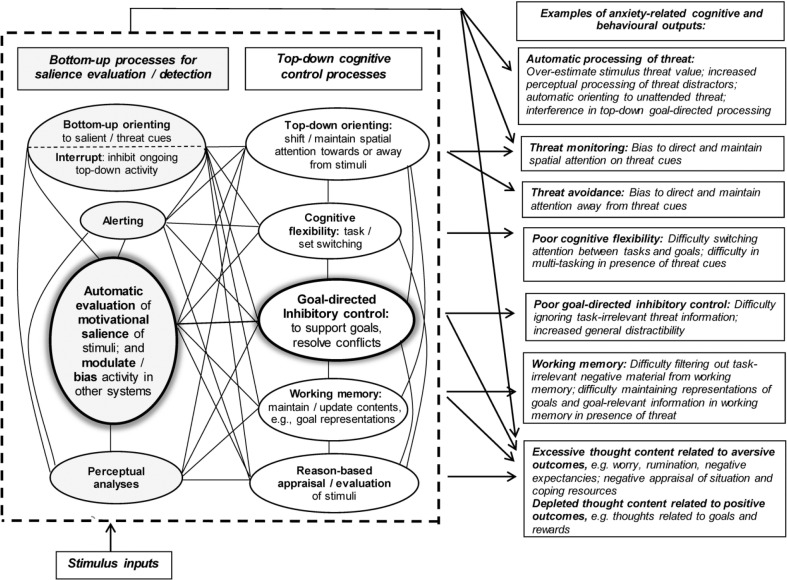
“Bottom-up functions include automatic stimulus-salience evaluation, alerting, automatic interrupt/inhibition of ongoing goal-directed activity, and automatic attention orienting to threat”
§ Attention Bias Modification (ABM): Review of Effects of Multisession ABM Training on Anxiety and Threat-Related Attention in High-Anxious Individuals > Discussion: ABM Methods, Outcomes, and Theoretical and Research Implications > Theoretical considerations
What the sources say
- Not checked yetcites Corbetta & Shulman, 2002
- Not checked yetcites Pessoa & Adolphs, 2010
- Not checked yetcites Petersen & Posner, 2012
plain- Asserted: passes — The authors put it forward as true.
- Checkable: passes — It can be checked against evidence.
- Load-bearing: fails — The paper’s conclusions may not depend on it.
- Based: passes — The paper gives a reason why it holds.
Probably not a substantial claim. The paper’s conclusions may not depend on it. It may state two separate claims as one.
In the paper
“ABM-threat-avoidance training is supported by a cognitive view of anxiety, which proposes that anxious individuals are characterized by an enhanced automatic AB toward threat, which plays a causal role in anxiety (e.g., Williams, Watts, MacLeod, & Mathews, 1988).”
§ Attention Bias Modification (ABM): Review of Effects of Multisession ABM Training on Anxiety and Threat-Related Attention in High-Anxious Individuals > Discussion: ABM Methods, Outcomes, and Theoretical and Research Implications > Theoretical considerations
What the sources say
- Not checked yetcites Williams et al., 1988
plaindirect- Asserted: passes — The authors put it forward as true.
- Checkable: passes — It can be checked against evidence.
- Load-bearing: passes — The paper’s conclusions depend on it.
- Based: passes — The paper gives a reason why it holds.
Probably not a substantial claim. It may state two separate claims as one.
None of the sources cited for this claim have been checked yet.
In the paper
“top-down functions include goal-directed inhibitory-control (which is a core component underlying a wide range of top-down control functions), cognitive flexibility, maintaining and updating goals in working memory, reason-based appraisal, and controlled attention orienting”
§ Attention Bias Modification (ABM): Review of Effects of Multisession ABM Training on Anxiety and Threat-Related Attention in High-Anxious Individuals > Discussion: ABM Methods, Outcomes, and Theoretical and Research Implications > Theoretical considerations
What the sources say
- Not checked yetcites Diamond, 2013
- Not checked yetcites Miyake & Friedman, 2012
- Not checked yetcites Petersen & Posner, 2012
plain- Asserted: passes — The authors put it forward as true.
- Checkable: passes — It can be checked against evidence.
- Load-bearing: fails — The paper’s conclusions may not depend on it.
- Based: passes — The paper gives a reason why it holds.
Probably not a substantial claim. The paper’s conclusions may not depend on it. It may state two separate claims as one.
The paper states this without a source or data behind it here, so there is nothing to check it against. The quote shows it is in the paper.
In the paper
“Hence, it predicts that an intervention that reduces preexisting AB toward threat in anxious individuals and instead makes them threat avoidant should reduce anxiety.”
§ Attention Bias Modification (ABM): Review of Effects of Multisession ABM Training on Anxiety and Threat-Related Attention in High-Anxious Individuals > Discussion: ABM Methods, Outcomes, and Theoretical and Research Implications > Theoretical considerations
plaindirect- Asserted: passes — The authors put it forward as true.
- Checkable: passes — It can be checked against evidence.
- Load-bearing: passes — The paper’s conclusions depend on it.
- Based: passes — The paper gives a reason why it holds.
Probably not a substantial claim.
- The authors state this as an assumption: The cognitive view assumes that low-anxious individuals are characterized by attentional avoidance of threat.
In the paper
“These top-down functions typically operate in a unified manner to support goal-directed activity (Duncan, 2010).”
§ Attention Bias Modification (ABM): Review of Effects of Multisession ABM Training on Anxiety and Threat-Related Attention in High-Anxious Individuals > Discussion: ABM Methods, Outcomes, and Theoretical and Research Implications > Theoretical considerations
What the sources say
- Not checked yetcites Duncan, 2010
plaincorrelational- Asserted: passes — The authors put it forward as true.
- Checkable: passes — It can be checked against evidence.
- Load-bearing: fails — The paper’s conclusions may not depend on it.
- Based: passes — The paper gives a reason why it holds.
Probably not a substantial claim. The paper’s conclusions may not depend on it.
The paper states this without a source or data behind it here, so there is nothing to check it against. The quote shows it is in the paper.
In the paper
“According to this framework, both excessive anxiety and ABs to threat reflect imbalance between these bottom-up and top-down systems.”
§ Attention Bias Modification (ABM): Review of Effects of Multisession ABM Training on Anxiety and Threat-Related Attention in High-Anxious Individuals > Discussion: ABM Methods, Outcomes, and Theoretical and Research Implications > Theoretical considerations
plaincorrelational- Asserted: passes — The authors put it forward as true.
- Checkable: passes — It can be checked against evidence.
- Load-bearing: fails — The paper’s conclusions may not depend on it.
- Based: passes — The paper gives a reason why it holds.
Probably not a substantial claim. The paper’s conclusions may not depend on it. It may state two separate claims as one.
The paper states this without a source or data behind it here, so there is nothing to check it against. The quote shows it is in the paper.
In the paper
“Thus, AB to threat is not a unitary construct, and its manifestations reflect differing combinations of processes (Fig. 1).”
§ Attention Bias Modification (ABM): Review of Effects of Multisession ABM Training on Anxiety and Threat-Related Attention in High-Anxious Individuals > Discussion: ABM Methods, Outcomes, and Theoretical and Research Implications > Theoretical considerations
plain- Asserted: passes — The authors put it forward as true.
- Checkable: passes — It can be checked against evidence.
- Load-bearing: passes — The paper’s conclusions depend on it.
- Based: passes — The paper gives a reason why it holds.
It may state two separate claims as one.
A conclusion the paper draws from its own results — it cites no other source for it, so there is none to check. The quote shows it is in the paper.
In the paper
“Excessive anxiety may arise from a combination of inadequate top-down goal-directed inhibitory control and hyperreactivity to threat cues of the bottom-up threat-salience-evaluation mechanism”
§ Attention Bias Modification (ABM): Review of Effects of Multisession ABM Training on Anxiety and Threat-Related Attention in High-Anxious Individuals > Discussion: ABM Methods, Outcomes, and Theoretical and Research Implications > Theoretical considerations
hedgedconditional- Asserted: passes — The authors put it forward as true.
- Checkable: passes — It can be checked against evidence.
- Load-bearing: passes — The paper’s conclusions depend on it.
- Based: fails — The paper may give no reason why it holds.
Probably not a substantial claim. The paper may give no reason why it holds.
A conclusion the paper draws from its own results — it cites no other source for it, so there is none to check. The quote shows it is in the paper.
In the paper
“such findings may be explained by a differing theoretical view, which proposes that dysfunction in multiple processes (including top-down attention control and threat-distractor inhibition) contributes to anxiety and differing manifestations of ABs and may be modified by both active ABM and control-attention training”
§ Attention Bias Modification (ABM): Review of Effects of Multisession ABM Training on Anxiety and Threat-Related Attention in High-Anxious Individuals > Discussion: ABM Methods, Outcomes, and Theoretical and Research Implications > Implications for ABM research
hedgedconditional- Asserted: passes — The authors put it forward as true.
- Checkable: passes — It can be checked against evidence.
- Load-bearing: passes — The paper’s conclusions depend on it.
- Based: passes — The paper gives a reason why it holds.
Probably not a substantial claim. It may state two separate claims as one.
None of the sources cited for this claim have been checked yet.
In the paper
“However, preliminary studies indicate that this method is effective in reducing nonclinical and clinical anxiety in both experimenter-controlled and home-based settings and thus merits further evaluation (Dandeneau et al., 2007; De Voogd et al., 2014; Waters et al., 2013, 2015, 2016).”
§ Attention Bias Modification (ABM): Review of Effects of Multisession ABM Training on Anxiety and Threat-Related Attention in High-Anxious Individuals > Concluding Comments
What the sources say
- Not checked yetcites Dandeneau et al., 2007
- Not checked yetcites De Voogd et al., 2014
- Not checked yetcites Waters et al., 2013, 2015, 2016
hedgeddirect- Asserted: passes — The authors put it forward as true.
- Checkable: passes — It can be checked against evidence.
- Load-bearing: passes — The paper’s conclusions depend on it.
- Based: passes — The paper gives a reason why it holds.
It may state two separate claims as one.
None of the sources cited for this claim have been checked yet.
In the paper
“Potential sources of bias include publication bias (“file-drawer” problem) and outcome-reporting bias (“cherry-picking”), which may influence the ratio of significant to null findings in published reports.”
§ Attention Bias Modification (ABM): Review of Effects of Multisession ABM Training on Anxiety and Threat-Related Attention in High-Anxious Individuals > Concluding Comments
What the sources say
- Not checked yetcites Cristea et al., 2015
- Not checked yetcites Song, Hooper, & Loke, 2013
plainconditional- Asserted: passes — The authors put it forward as true.
- Checkable: passes — It can be checked against evidence.
- Load-bearing: passes — The paper’s conclusions depend on it.
- Based: passes — The paper gives a reason why it holds.
It may state two separate claims as one.
None of the sources cited for this claim have been checked yet.
In the paper
“recent models of anxiety predict that ABM methods that recruit multiple top-down goal-directed cognitive-control processes to oppose threat processing will be more effective in reducing anxiety than methods targeting one specific bias in direction of orienting toward threat”
§ Attention Bias Modification (ABM): Review of Effects of Multisession ABM Training on Anxiety and Threat-Related Attention in High-Anxious Individuals > Discussion: ABM Methods, Outcomes, and Theoretical and Research Implications > Implications for ABM research
What the sources say
- Not checked yetcites Mogg & Bradley, 2016
- Not checked yetcites Waters & Craske, 2016
plaindirect- Asserted: passes — The authors put it forward as true.
- Checkable: passes — It can be checked against evidence.
- Load-bearing: passes — The paper’s conclusions depend on it.
- Based: passes — The paper gives a reason why it holds.
Probably not a substantial claim.
In the paper
“ABs may have both state- and trait-like characteristics and reflect an individual’s current motivational/goal priorities that are dominant in a particular situation (e.g., to automatically detect unattended threat; to maintain attention on threat to allow more detailed evaluation; to avoid attending to threat cues to minimize subjective discomfort; or to suppress threat-related AB to support task-”
§ Attention Bias Modification (ABM): Review of Effects of Multisession ABM Training on Anxiety and Threat-Related Attention in High-Anxious Individuals > Discussion: ABM Methods, Outcomes, and Theoretical and Research Implications > Implications for ABM research
What the sources say
- Not checked yetcites Mogg & Bradley, 2016
hedgedcorrelational- Asserted: passes — The authors put it forward as true.
- Checkable: passes — It can be checked against evidence.
- Load-bearing: unclear — It is unclear whether the paper’s conclusions depend on it.
- Based: passes — The paper gives a reason why it holds.
It may state two separate claims as one.
A conclusion the paper draws from its own results — it cites no other source for it, so there is none to check. The quote shows it is in the paper.
In the paper
“Anxiolytic effects of ABM may relate to improvements in attention control and threat-distractor inhibition, which are distinct from modifying the direction of AB in orienting away from threat.”
§ Attention Bias Modification (ABM): Review of Effects of Multisession ABM Training on Anxiety and Threat-Related Attention in High-Anxious Individuals > Discussion: ABM Methods, Outcomes, and Theoretical and Research Implications > Implications for ABM research
hedgedconditional- Asserted: passes — The authors put it forward as true.
- Checkable: passes — It can be checked against evidence.
- Load-bearing: passes — The paper’s conclusions depend on it.
- Based: fails — The paper may give no reason why it holds.
Probably not a substantial claim. The paper may give no reason why it holds.
In the paper
“Establishing whether an intervention is effective in treating anxiety requires a systematic approach comparing it with a series of different conditions to examine specific issues (Lohr, Lilienfeld, & Rosen, 2012).”
§ Attention Bias Modification (ABM): Review of Effects of Multisession ABM Training on Anxiety and Threat-Related Attention in High-Anxious Individuals > Discussion: ABM Methods, Outcomes, and Theoretical and Research Implications > Implications for ABM research
What the sources say
- Not checked yetcites Lohr, Lilienfeld, & Rosen, 2012
plain- Asserted: passes — The authors put it forward as true.
- Checkable: fails — It may be too vague to check against evidence.
- Load-bearing: passes — The paper’s conclusions depend on it.
- Based: passes — The paper gives a reason why it holds.
Probably not a substantial claim. It may be too vague to check against evidence.
In the paper
“it highlights the role of multiple top-down and bottom-up mechanisms, which are proposed by cognitive models to underlie anxiety and which may contribute to anxiolytic effects of ABM, such as goal-directed attention control and threat-distractor inhibition (Mogg & Bradley, 2016);”
§ Attention Bias Modification (ABM): Review of Effects of Multisession ABM Training on Anxiety and Threat-Related Attention in High-Anxious Individuals > Concluding Comments
What the sources say
- Not checked yetcites Mogg & Bradley, 2016
hedgedconditional- Asserted: passes — The authors put it forward as true.
- Checkable: passes — It can be checked against evidence.
- Load-bearing: passes — The paper’s conclusions depend on it.
- Based: passes — The paper gives a reason why it holds.
It may state two separate claims as one.
In the paper
“and these priorities may in turn depend on multiple task-related and individual-difference variables”
§ Attention Bias Modification (ABM): Review of Effects of Multisession ABM Training on Anxiety and Threat-Related Attention in High-Anxious Individuals > Discussion: ABM Methods, Outcomes, and Theoretical and Research Implications > Implications for ABM research
What the sources say
- Not checked yetcites Mogg & Bradley, 2016
hedgedconditional- Asserted: passes — The authors put it forward as true.
- Checkable: fails — It may be too vague to check against evidence.
- Load-bearing: fails — The paper’s conclusions may not depend on it.
- Based: passes — The paper gives a reason why it holds.
Probably not a substantial claim. It may be too vague to check against evidence. The paper’s conclusions may not depend on it.
The paper relies on this without support.
The included studies' measures of anxiety and attention bias are sufficiently valid and comparable to permit a qualitative synthesis of their findings.
“In common with MacLeod and Clarke (2015), we conducted a qualitative review to allow detailed examination of variations in methodology and findings across studies that may be obscured in a quantitative review (Cristea et al., 2015).”
The authors state this as an assumption.
ABM-threat-avoidance training assumes that anxious individuals have a preexisting AB to orient attention toward threat cues relative to nonthreat cues.
“ABM-threat-avoidance training assumes that anxious individuals have a preexisting AB to orient attention toward threat cues relative to nonthreat cues”
The authors state this as an assumption.
The cognitive view assumes that low-anxious individuals are characterized by attentional avoidance of threat.
“This view further assumes that low-anxious individuals are characterized by attentional avoidance of threat.”
The authors state this as an assumption.
The anxiety-related AB toward threat is assumed to operate automatically and outside awareness.
“the anxiety-related AB toward threat is assumed to operate automatically and outside awareness”
Claims other papers make about this one
Each is checked against this paper’s own text: does it say what the citing paper says it does?
The cited source says what the claim attributes to it.
In the citing paper
“Many ABM studies have shown that this redirection of attention yields greater reduction of self-reported and clinically rated fear symptoms than attending directly to phobic stimuli (Hakamata, Lissek, Bar-Haim, Britton, et al. 2010; Heeren, Reese, McNally & Philippot, 2012; however, see Mogg, Waters & Bradley (2017) for inconsistent findings when ABM is compared to more rigorous control conditions”
From Advancing the treatment of anxiety disorders in transition‐age youth: a review of the therapeutic effects of unconscious exposure. (2025) · cites this paper as Mogg, Waters & Bradley (2017)
In the citing paper
“In addition, ABM threat-avoidance training studies often use similar tasks to both modify AB and assess AB change (e.g., probe-based spatial attention tasks are used in both ABM threatavoidance training and AB assessment), and it is therefore unclear whether effects of training transfer to other AB measures or related cognitive functions [7,82].”
From Anxiety and Threat-Related Attention: Cognitive-Motivational Framework and Treatment (2018) · cites this paper as [7]
In the citing paper
“However, this cooccurrence is not consistently found [7], and conclusions are complicated by methodological issues (e.g., differing outcome measures, confounding variables, low-quality studies, publication bias) [9,79].”
From Anxiety and Threat-Related Attention: Cognitive-Motivational Framework and Treatment (2018) · cites this paper as [7]
In the citing paper
“In addition, ABM threat-avoidance training studies often use similar tasks to both modify AB and assess AB change (e.g., probe-based spatial attention tasks are used in both ABM threatavoidance training and AB assessment), and it is therefore unclear whether effects of training transfer to other AB measures or related cognitive functions [7,82].”
From Anxiety and Threat-Related Attention: Cognitive-Motivational Framework and Treatment (2018) · cites this paper as [7]
In the citing paper
“AB assessment methods include visual probe, spatial cueing, modified Stroop, flanker, and visual search tasks [6,7,12,19,35,53-55,86,98-100].”
From Anxiety and Threat-Related Attention: Cognitive-Motivational Framework and Treatment (2018) · cites this paper as [7]
Citations
Cites
Diamond, A. (2013) · Annual Review of Psychology · doi:10.1146/annurev-psych-113011-143750 · Cited by 13,268
Control of goal-directed and stimulus-driven attention in the brain
Corbetta, M., & Shulman, G. L. (2002) · Nature Reviews Neuroscience · doi:10.1038/nrn755 · Cited by 12,881
Anxiety and cognitive performance: Attentional control theory
Eysenck, M. W., Derakshan, N., Santos, R., & Calvo, M. G. (2007) · Emotion · doi:10.1037/1528-3542.7.2.336 · Cited by 5,289
Miyake, A., & Friedman, N. P. (2012) · Current Directions in Psychological Science · doi:10.1177/0963721411429458 · Cited by 3,944
Threat-related attentional bias in anxious and nonanxious individuals: a meta-analytic study.
Bar-Haim, Y., Lamy, D., Pergamin, L., Bakermans-Kranenburg, M. J., & van IJzendoorn, M. H. (2007) · Psychological Bulletin · doi:10.1037/0033-2909.133.1.1 · Cited by 3,721
Testing the efficiency and independence of attentional networks
Fan, J., McCandliss, B. D., Sommer, T., Raz, A., & Posner, M. I. (2002) · Journal of Cognitive Neuroscience · doi:10.1162/089892902317361886 · Cited by 3,717 · cited 2×
“(e) When assessing attention control, it is helpful to use both objective and subjective measures (e.g., Attention Network Task, Fan et al., 2002; and Attention Control Scale, Derryberry & Reed, 2002; Melendez, Bechor, Rey, Pettit, & Silverman, 2016; see Heeren, Mogoase, McNally et al., 2015; McNally et al., 2013).”
MethodThe attention system of the human brain: 20 years after
Petersen, S. E., & Posner, M. I. (2012) · Annual Review of Neuroscience · doi:10.1146/annurev-neuro-062111-150525 · Cited by 3,439
The emotional Stroop task and psychopathology
Williams, J. M. G., Mathews, A., & MacLeod, C. (1996) · Psychological Bulletin · doi:10.1037/0033-2909.120.1.3 · Cited by 2,420
Cognitive Psychology and Emotional Disorders
Williams, J. M. G. (1988) · UWA Profiles and Research Repository (UWA) · Cited by 1,871
The multiple-demand (MD) system of the primate brain: mental programs for intelligent behaviour
Duncan, J. (2010) · Trends in Cognitive Sciences · doi:10.1016/j.tics.2010.01.004 · Cited by 1,846
Pessoa, L., & Adolphs, R. (2010) · Nature Reviews Neuroscience · doi:10.1038/nrn2920 · Cited by 1,794
Mechanisms of attentional biases towards threat in anxiety disorders: An integrative review
Cisler, J. M., & Koster, E. H. W. (2010) · Clinical Psychology Review · doi:10.1016/j.cpr.2009.11.003 · Cited by 1,753
Anxiety-related attentional biases and their regulation by attentional control.
Derryberry, D., & Reed, M. A. (2002) · Journal of Abnormal Psychology · doi:10.1037/0021-843x.111.2.225 · Cited by 1,729
A cognitive-motivational analysis of anxiety.
Mogg, K., & Bradley, B. P. (1998) · Behaviour Research and Therapy · doi:10.1016/s0005-7967(98)00063-1 · Cited by 1,642
Self-citationFrontiers in Human Neuroscience
Avenanti, A. (2013) · Archivio istituzionale della ricerca (Alma Mater Studiorum Università di Bologna) · Cited by 1,572
The neural bases of momentary lapses in attention
Weissman, D. H., Roberts, K. C., Visscher, K. M., & Woldorff, M. G. (2006) · Nature Neuroscience · doi:10.1038/nn1727 · Cited by 1,566
MacLeod, C., Rutherford, E., Campbell, L., Ebsworthy, G., & Holker, L. (2002) · Journal of Abnormal Psychology · doi:10.1037/0021-843x.111.1.107 · Cited by 1,334 · cited 2×
“…visual-probe task (described later), which is designed to reduce AB in orienting toward threat cues (e.g., Amir, Beard, Burns, & Bomyea, 2009; Amir, Beard, Taylor et al., 2009; Heeren, Mogoase, McNally, Schmitz, & Philippot, 2015; MacLeod et al., 2002; McNally, Enock, Tsai, & Tousian, 2013).”
MethodAn information processing model of anxiety: Automatic and strategic processes
Beck, A. T., & Clark, D. A. (1997) · Behaviour Research and Therapy · doi:10.1016/s0005-7967(96)00069-1 · Cited by 1,317
Andrews, G., Cuijpers, P., Craske, M. G., McEvoy, P., & Titov, N. (2010) · PLoS ONE · doi:10.1371/journal.pone.0013196 · Cited by 1,311
Cognitive Psychology and Emotional Disorders
Wilhelm, S. A. (1998) · Journal of Behavior Therapy and Experimental Psychiatry · Cited by 1,101
Cognitive psychology and emotional disorders
Brewin, C. (1989) · Behaviour Research and Therapy · doi:10.1016/0005-7967(89)90110-1 · Cited by 880
Cognitive Bias Modification Approaches to Anxiety
MacLeod, C., & Mathews, A. (2012) · Annual Review of Clinical Psychology · doi:10.1146/annurev-clinpsy-032511-143052 · Cited by 664
A rational look at the emotional Stroop phenomenon: a generic slowdown, not a Stroop effect
Algom, D., Chajut, E., & Lev, S. (2004) · Journal of Experimental Psychology General · doi:10.1037/0096-3445.133.3.323 · Cited by 565
Research review: attention bias modification (ABM): a novel treatment for anxiety disorders
Bar‐Haim, Y. (2010) · Journal of Child Psychology and Psychiatry · doi:10.1111/j.1469-7610.2010.02251.x · Cited by 556
Efficacy of cognitive bias modification interventions in anxiety and depression: Meta-analysis
Cristea, I. A., Kok, R. N., & Cuijpers, P. (2015) · British Journal of Psychiatry · doi:10.1192/bjp.bp.114.146761 · Cited by 553
Attention modification program in individuals with generalized anxiety disorder
Amir, N., Beard, C., Burns, M., & Bomyea, J. (2009) · Journal of Abnormal Psychology · doi:10.1037/a0012589 · Cited by 539
Attention training in individuals with generalized social phobia: A randomized controlled trial.
Amir, N., Beard, C., Taylor, C. T., Klumpp, H., Elias, J. A., Burns, M. N., & Chen, X. (2009) · Journal of Consulting and Clinical Psychology · doi:10.1037/a0016685 · Cited by 486
A review of current evidence for the causal impact of attentional bias on fear and anxiety
Van Bockstaele, B., Verschuere, B., Tibboel, H., De Houwer, J., Crombez, G., & Koster, E. H. W. (2014) · Psychological Bulletin · doi:10.1037/a0034834 · Cited by 485
Clinical Efficacy of Attentional Bias Modification Procedures: An Updated Meta-Analysis
Mogoaşe, C., David, D. O., & Koster, E. H. W. (2014) · Journal of Clinical Psychology · doi:10.1002/jclp.22081 · Cited by 386
Dandeneau, S. D., Baldwin, M. W., Baccus, J. R., Sakellaropoulo, M., & Pruessner, J. C. (2007) · Journal of Personality and Social Psychology · doi:10.1037/0022-3514.93.4.651 · Cited by 341
The attentional bias modification approach to anxiety intervention
MacLeod, C., & Clarke, P. J. F. (2015) · Clinical Psychological Science · doi:10.1177/2167702614560749 · Cited by 315
Anxiety and attention to threat: cognitive mechanisms and treatment with attention bias modification
Mogg, K., & Bradley, B. P. (2016) · Behaviour Research and Therapy · doi:10.1016/j.brat.2016.08.001 · Cited by 313
Self-citationAttention bias modification for social anxiety: A systematic review and meta-analysis
Heeren, A., Mogoașe, C., Philippot, P., & McNally, R. J. (2015) · Clinical Psychology Review · doi:10.1016/j.cpr.2015.06.001 · Cited by 312
Phenomenological characteristics of attentional biases towards threat: A critical review
Cisler, J. M., Bacon, A. K., & Williams, N. L. (2009) · Cognitive Therapy and Research · doi:10.1007/s10608-007-9161-y · Cited by 306
Temperament, anxiety, and the processing of threat-relevant stimuli
Lonigan, C. J., Vasey, M. W., Phillips, B. M., & Hazen, R. A. (2004) · Journal of Clinical Child & Adolescent Psychology · doi:10.1207/s15374424jccp3301_2 · Cited by 303
Publication bias: what is it? How do we measure it? How do we avoid it?
Song, F., Hooper, L., & Loke, Y. K. (2013) · Open Access Journal of Clinical Trials · doi:10.2147/oajct.s34419 · Cited by 298
Efficacy of attention bias modification using threat and appetitive stimuli: a meta-analytic review
Beard, C., Sawyer, A. T., & Hofmann, S. G. (2012) · Behavior Therapy · doi:10.1016/j.beth.2012.01.002 · Cited by 291
Mogg, K., Holmes, A., Garner, M. J., & Bradley, B. P. (2008) · Behaviour Research and Therapy · doi:10.1016/j.brat.2008.02.011 · Cited by 262
Self-citationAttentional bias towards threatening stimuli in children with anxiety: A meta-analysis
Dudeney, J., Sharpe, L., & Hunt, C. (2015) · Clinical Psychology Review · doi:10.1016/j.cpr.2015.05.007 · Cited by 247
Temporal dynamics of attentional bias
Zvielli, A., Bernstein, A., & Koster, E. H. W. (2015) · Clinical Psychological Science · doi:10.1177/2167702614551572 · Cited by 237
Attention bias modification treatment for pediatric anxiety disorders: A randomized controlled trial
Eldar, S., Apter, A., Lotan, D., Edgar, K. P., Naim, R., Fox, N. A., Pine, D. S., & Bar-Haim, Y. (2012) · American Journal of Psychiatry · doi:10.1176/appi.ajp.2011.11060886 · Cited by 220
See, J., MacLeod, C., & Bridle, R. (2009) · Journal of Abnormal Psychology · doi:10.1037/a0014377 · Cited by 215
Carlbring, P., Apelstrand, M., Sehlin, H., Amir, N., Rousseau, A., Hofmann, S. G., & Andersson, G. (2012) · BMC Psychiatry · doi:10.1186/1471-244x-12-66 · Cited by 215
Enock, P. M., Hofmann, S. G., & McNally, R. J. (2014) · Cognitive Therapy and Research · doi:10.1007/s10608-014-9606-z · Cited by 201
Heeren, A., Reese, H. E., McNally, R. J., & Philippot, P. (2012) · Behaviour Research and Therapy · doi:10.1016/j.brat.2011.10.005 · Cited by 198 · cited 9×
“Furthermore, in many of these studies, anxiety symptoms reduced irrespective of attention-training condition—that is, during both ABM-threat-avoidance and CON-attention training (Boettcher et al., 2012, 2013; Britton et al., 2015; Carlbring et al., 2012; Carleton et al., 2015; Clerkin et al., 2016; Enock et al., 2014;…”
BackgroundMethodInfluentialDennis, T. A., & O’Toole, L. J. (2014) · Clinical Psychological Science · doi:10.1177/2167702614522228 · Cited by 197
Badura-Brack, A. S., Naim, R., Ryan, T. J., Levy, O., Abend, R., Khanna, M. M., McDermott, T. J., Pine, D. S., & Bar-Haim, Y. (2015) · American Journal of Psychiatry · doi:10.1176/appi.ajp.2015.14121578 · Cited by 185
Linetzky, M., Pergamin-Hight, L., Pine, D. S., & Bar-Haim, Y. (2015) · Depression and Anxiety · doi:10.1002/da.22344 · Cited by 185
Training anxious children to disengage attention from threat: a randomized controlled trial
Bar‐Haim, Y., Morag, I., & Glickman, S. (2011) · Journal of Child Psychology and Psychiatry · doi:10.1111/j.1469-7610.2011.02368.x · Cited by 173
Suppression of the emotional Stroop effect by increased anxiety in patients with social phobia
Amir, N., McNally, R. J., Riemann, B. C., Burns, J. L., Lorenz, M., & Mullen, J. T. (1996) · Behaviour Research and Therapy · doi:10.1016/s0005-7967(96)00054-x · Cited by 171
Craske, M. G., Rose, R. D., Lang, A., Welch, S. S., Campbell-Sills, L., Sullivan, G., Sherbourne, C., Bystritsky, A., Stein, M. B., & Roy-Byrne, P. P. (2009) · Depression and Anxiety · doi:10.1002/da.20542 · Cited by 170 · cited 1×
“…with other potential first-line interventions, such as computerdelivered CBT, which may also be used in primary care within a stepped-care approach (Craske et al., 2009; NICE, 2011; Richards, Richardson, Timulak, & McElvaney, 2015; WSIPP, 2016b); and (e) comparing conventional treatments (e.g.,…”
BackgroundPrice, R. B., Wallace, M., Kuckertz, J. M., Amir, N., Graur, S., Cummings, L., Popa, P., Carlbring, P., & Bar-Haim, Y. (2016) · Clinical Psychology Review · doi:10.1016/j.cpr.2016.09.009 · Cited by 144
Attentional retraining: A randomized clinical trial for pathological worry
Hazen, R. A., Vasey, M. W., & Schmidt, N. B. (2008) · Journal of Psychiatric Research · doi:10.1016/j.jpsychires.2008.07.004 · Cited by 140
Attention training towards positive stimuli in clinically anxious children
Waters, A. M., Pittaway, M., Mogg, K., Bradley, B. P., & Pine, D. S. (2013) · Developmental Cognitive Neuroscience · doi:10.1016/j.dcn.2012.09.004 · Cited by 135 · cited 14×
“…2014; Britton et al., 2015; Carleton et al., 2015; Enock et al., 2014; Fitzgerald et al., 2016; Kuckertz, Amir et al., 2014; Li et al., 2008; Maoz et al., 2013; McNally et al., 2013; Pergamin-Hight et al., 2016; Rapee et al., 2013; Schoorl et al., 2013; Waters et al., 2013, 2015; Yao et al., 2015).”
BackgroundMethodResultInfluentialSelf-citationHeeren, A., Mogoaşe, C., McNally, R. J., Schmitz, A., & Philippot, P. (2015) · Journal of Anxiety Disorders · doi:10.1016/j.janxdis.2014.10.007 · Cited by 134
Continual training of attentional bias in social anxiety
Li, S., Tan, J., Qian, M., & Liu, X. (2008) · Behaviour Research and Therapy · doi:10.1016/j.brat.2008.04.005 · Cited by 133
Internet-Based Attention Training for Social Anxiety: A Randomized Controlled Trial
Boettcher, J., Berger, T., & Renneberg, B. (2012) · Cognitive Therapy and Research · doi:10.1007/s10608-011-9374-y · Cited by 130
Linetzky, M., Pergamin‐Hight, L., Pine, D. S., & Bar‐Haim, Y. (2017) · Depression and Anxiety · doi:10.1002/da.22690 · Cited by 130
Common mental health disorders — identification and pathways to care: NICE clinical guideline
Kendrick, T., & Pilling, S. (2011) · British Journal of General Practice · doi:10.3399/bjgp12x616481 · Cited by 128
Threat bias in attention orienting: Evidence of specificity in a large community-based study
Salum, G. A., Mogg, K., Bradley, B. P., Gadelha, A., Pan, P., Tamanaha, A. C., Moriyama, T., Graeff-Martins, A. S., Jarros, R. B., Polanczyk, G., et al. (2013) · Psychological Medicine · doi:10.1017/s0033291712001651 · Cited by 126
Waters, A. M., Bradley, B. P., & Mogg, K. (2014) · Psychological Medicine · doi:10.1017/s0033291713000779 · Cited by 126
Neubauer, K., von Auer, M., Murray, E., Petermann, F., Helbig‐Lang, S., & Gerlach, A. L. (2012) · Behaviour Research and Therapy · doi:10.1016/j.brat.2012.10.006 · Cited by 121
Behavioral and neural stability of attention bias to threat in healthy adolescents
White, L. K., Britton, J. C., Sequeira, S. L., Ronkin, E. G., Chen, G., Bar‐Haim, Y., Shechner, T., Monique Ernst, D., Fox, N. A., Leibenluft, E., et al. (2016) · NeuroImage · doi:10.1016/j.neuroimage.2016.04.058 · Cited by 119
Shechner, T., Rimon-Chakir, A., Britton, J. C., Lotan, D., Apter, A., Bliese, P. D., Pine, D. S., & Bar-Haim, Y. (2014) · Journal of the American Academy of Child & Adolescent Psychiatry · doi:10.1016/j.jaac.2013.09.016 · Cited by 118
Moderation and mediation of the effect of attention training in social anxiety disorder
Kuckertz, J. M., Gildebrant, E., Liliequist, B., Karlström, P., Väppling, C., Bodlund, O., Stenlund, T., Hofmann, S. G., Andersson, G., Amir, N., et al. (2014) · Behaviour Research and Therapy · doi:10.1016/j.brat.2013.12.003 · Cited by 117
Richards, D., Richardson, T., Timulak, L., & McElvaney, J. (2015) · Internet Interventions · doi:10.1016/j.invent.2015.07.003 · Cited by 111
Visual search attentional bias modification reduced social phobia in adolescents
De Voogd, E. L., Wiers, R. W., Prins, P. J. M., & Salemink, E. (2014) · Journal of Behavior Therapy and Experimental Psychiatry · doi:10.1016/j.jbtep.2013.11.006 · Cited by 111 · cited 4×
“…cues in training (Britton et al., 2013); another used a case-series rather than RCT design (Schoorl et al., 2014); and two studies used unselected rather than high-anxious participants (ABM-threatavoidance training, See, MacLeod, & Bridle, 2009; ABM-positivesearch training, De Voogd et al., 2014).”
ResultInfluentialBoettcher, J., Leek, L., Matson, L., Holmes, E. A., Browning, M., MacLeod, C., Andersson, G., & Carlbring, P. (2013) · PLoS ONE · doi:10.1371/journal.pone.0071760 · Cited by 109
Britton, J. C., Bar-Haim, Y., Clementi, M. A., Sankin, L. S., Chen, G., Shechner, T., Norcross, M. A., Spiro, C. N., Lindstrom, K. M., & Pine, D. S. (2013) · Developmental Cognitive Neuroscience · doi:10.1016/j.dcn.2012.11.001 · Cited by 101
Kuckertz, J. M., Amir, N., Boffa, J. W., Warren, C. K., Rindt, S. E. M., Norman, S. B., Ram, V., Ziajko, L. A., Webb-Murphy, J. A., & McLay, R. N. (2014) · Behaviour Research and Therapy · doi:10.1016/j.brat.2014.09.002 · Cited by 95
Attention bias modification for reducing speech anxiety
McNally, R. J., Enock, P. M., Tsai, C., & Tousian, M. (2013) · Behaviour Research and Therapy · doi:10.1016/j.brat.2013.10.001 · Cited by 95
Rapee, R. M., MacLeod, C., Carpenter, L., Gaston, J. E., Frei, J., Peters, L., & Baillie, A. J. (2013) · Behaviour Research and Therapy · doi:10.1016/j.brat.2013.01.005 · Cited by 92
Waters, A. M., & Craske, M. G. (2016) · Clinical Psychology Review · doi:10.1016/j.cpr.2016.09.008 · Cited by 92
Self-citationCapturing dynamics of biased attention: are new attention variability measures the way forward
Kruijt, A.-W., Field, A. P., & Fox, E. (2016) · PLoS ONE · doi:10.1371/journal.pone.0166600 · Cited by 91
Attentional bias modification in posttraumatic stress disorder: a randomized controlled trial
Schoorl, M., Putman, P., & Van Der Does, W. (2013) · Psychotherapy and Psychosomatics · doi:10.1159/000341920 · Cited by 86
Waters, A. M., Zimmer-Gembeck, M. J., Craske, M. G., Pine, D. S., Bradley, B. P., & Mogg, K. (2015) · Behaviour Research and Therapy · doi:10.1016/j.brat.2015.08.005 · Cited by 80
Neural changes with attention bias modification for anxiety: a randomized trial.
Britton, J. C., Suway, J. G., Clementi, M., Fox, N., Pine, D., & Bar-Haim, Y. (2015) · Social Cognitive and Affective Neuroscience · doi:10.1093/scan/nsu141 · Cited by 79
Attention bias modification: the Emperor's new suit?
Emmelkamp, P. M. (2012) · BMC Medicine · doi:10.1186/1741-7015-10-63 · Cited by 76
Attention bias modification for youth with social anxiety disorder
Pergamin‐Hight, L., Pine, D. S., Fox, N. A., & Bar‐Haim, Y. (2016) · Journal of Child Psychology and Psychiatry · doi:10.1111/jcpp.12599 · Cited by 72
Boettcher, J., Hasselrot, J., Sund, E., Andersson, G., & Carlbring, P. (2014) · Cognitive Behaviour Therapy · doi:10.1080/16506073.2013.809141 · Cited by 68
Holmes, A., Mogg, K., de Fockert, J. W., Nielsen, M. K., & Bradley, B. P. (2013) · Cognitive Affective & Behavioral Neuroscience · doi:10.3758/s13415-013-0212-4 · Cited by 63
Self-citationLowther, H., & Newman, E. (2014) · Journal of Affective Disorders · doi:10.1016/j.jad.2014.06.051 · Cited by 61
Attentional bias modification facilitates attentional control mechanisms: Evidence from eye tracking
Chen, N. T. M., Clarke, P. J. F., Watson, T. L., MacLeod, C., & Guastella, A. J. (2015) · Biological Psychology · doi:10.1016/j.biopsycho.2014.12.002 · Cited by 49
Validation of a novel attentional bias modification task: the future may be in the cards
Notebaert, L., Clarke, P. J. F., Grafton, B., & MacLeod, C. (2015) · Behaviour Research and Therapy · doi:10.1016/j.brat.2014.12.007 · Cited by 48
When ignorance is bliss: explicit instruction and the efficacy of CBM-A for anxiety
Grafton, B., Mackintosh, B., Vujic, T., & MacLeod, C. (2014) · Cognitive Therapy and Research · doi:10.1007/s10608-013-9579-3 · Cited by 46
Waters, A. M., Zimmer-Gembeck, M. J., Craske, M. G., Pine, D. S., Bradley, B. P., & Mogg, K. (2016) · Journal of Experimental Psychopathology · doi:10.5127/jep.053315 · Cited by 40 · cited 7×
“…of diverse pictorial cues, in which goal-relevant nonthreat targets are simultaneously presented with multiple threat distractors, and encouraging explicit rehearsal of adaptive attention-search goals, such as self-instruction to look for good and calm stimuli (e.g., Waters et al., 2015, 2016).”
BackgroundMethodResultInfluentialSelf-citationZvielli, A., Amir, I., Goldstein, P., & Bernstein, A. (2016) · Clinical Psychological Science · doi:10.1177/2167702615588048 · Cited by 35
Fitzgerald, A., Rawdon, C., & Dooley, B. A. (2016) · Behaviour Research and Therapy · doi:10.1016/j.brat.2016.06.003 · Cited by 35
Melendez, R., Bechor, M., Rey, Y., Pettit, J. W., & Silverman, W. K. (2016) · Journal of Clinical Psychology · doi:10.1002/jclp.22346 · Cited by 34
Subliminal attention bias modification training in socially anxious individuals
Maoz, K. B., Abend, R., Fox, N. A., Pine, D. S., & Bar‐Haim, Y. (2013) · Frontiers in Human Neuroscience · doi:10.3389/fnhum.2013.00389 · Cited by 32
Clerkin, E. M., Magee, J. C., Wells, T. T., Beard, C., & Barnett, N. P. (2016) · Behaviour Research and Therapy · doi:10.1016/j.brat.2016.08.010 · Cited by 32
Khanna, M. M., Badura-Brack, A. S., McDermott, T. J., Shepherd, A., Heinrichs‐Graham, E., Pine, D. S., Bar‐Haim, Y., & Wilson, T. W. (2015) · Cognition & Emotion · doi:10.1080/02699931.2015.1076769 · Cited by 30
Van Bockstaele, B., Salemink, E., Bögels, S. M., & Wiers, R. W. (2017) · Cognition and Emotion · doi:10.1080/02699931.2015.1092418 · Cited by 26
Money talks in attention bias modification: Reward in a dot-probe task affects attentional biases
Sigurjónsdóttir, Ó., Bjornsson, A. S., Ludvigsdottir, S. J., & Kristjansson, A. K. (2014) · Visual Cognition · doi:10.1080/13506285.2014.984797 · Cited by 25
A randomized controlled trial of attention modification for social anxiety disorder
Carleton, R. N., Teale Sapach, M. J. N., Oriet, C., Duranceau, S., Lix, L. M., Thibodeau, M. A., Horswill, S. C., Ubbens, J. R., & Asmundson, G. J. G. (2015) · Journal of Anxiety Disorders · doi:10.1016/j.janxdis.2015.03.011 · Cited by 24
Anxiety and its treatment: Promoting science-based practice
Lohr, J. M., Lilienfeld, S. O., & Rosen, G. M. (2012) · Journal of Anxiety Disorders · doi:10.1016/j.janxdis.2012.06.007 · Cited by 22
Bastiaansen, J. A., van Roon, A. M., Buitelaar, J. K., & Oldehinkel, A. J. (2014) · European Psychiatry · doi:10.1016/j.eurpsy.2014.03.005 · Cited by 16
Liang, C., & Hsu, W. (2016) · Psychiatry Research · doi:10.1016/j.psychres.2016.04.019 · Cited by 16
Schoorl, M., Putman, P., Mooren, T. T. M., van der Werff, S. J., & van der Does, W. A. J. (2014) · Journal of Traumatic Stress · doi:10.1002/jts.21896 · Cited by 13
Yao, N., Yu, H., Qian, M., & Li, S. (2015) · Journal of Anxiety Disorders · doi:10.1016/j.janxdis.2015.09.006 · Cited by 13
Research works printed but not linked: 2
- *Maoz K., 2013, Frontiers of Human Neuroscience, 7, 389
- Van Bockstaele B., 2015, Cognition and Emotion, 23, 1
Cited by
Sorted by citations
Attentional bias for threat: Crisis or opportunity?
McNally, R. J. (2018) · Clinical Psychology Review · doi:10.1016/j.cpr.2018.05.005 · Cited by 272
Anxiety and Threat-Related Attention: Cognitive-Motivational Framework and Treatment
Mogg, K., & Bradley, B. P. (2018) · Trends in Cognitive Sciences · doi:10.1016/j.tics.2018.01.001 · Cited by 210
Self-citationAnxiety disorders in children and adolescents: A summary and overview of the literature
Rapee, R. M., Creswell, C., Kendall, P. C., Pine, D. S., & Waters, A. M. (2023) · Behaviour Research and Therapy · doi:10.1016/j.brat.2023.104376 · Cited by 227
Self-citationThe Cambridge Handbook of Personality Psychology
(2020) · Cambridge University Press eBooks · doi:10.1017/9781108264822 · Cited by 148
Mennin, D. S., Fresco, D. M., O'Toole, M. S., & Heimberg, R. G. (2018) · Journal of Consulting and Clinical Psychology · doi:10.1037/ccp0000289 · Cited by 119
Metadata
- Authors
- Mogg, K., Waters, A. M., & Bradley, B. P.
- Affiliations
- University of Southampton (GB)
- Griffith University (AU)
- Corresponding author
- Mogg, Karin
- Venue
- Clinical Psychological Science
- Publisher
- SAGE Publications
- Published
- 2017-04-26
- Volume
- 5
- Issue
- 4
- Pages
- 698-717
- ISSN
- 2167-7026 (ISSN-L)
- 2167-7034
- PMC
- PMC5513441
- OpenAlex
- W2607627610
- Semantic Scholar
- 33dc86184688b3d716fef304156afd0a429a078d
- Cited by
- 215
- References
- 100
- Citations by year
- 2026: 7 · 2025: 16 · 2024: 16 · 2023: 17 · 2022: 18 · 2021: 23 · 2020: 65 · 2019: 24 · 2018: 22 · 2017: 7
- FWCI
- 5.10
- Type
- journal article
- Language
- en
- Open access
- hybrid
- doi.org
- Locations
- Clinical Psychological Science (publishedVersion, cc-by)
- PubMed Central (publishedVersion, cc-by)
- PubMed (publishedVersion)
- ePrints Soton (University of Southampton) (acceptedVersion)
- Griffith Research Online (submittedVersion, cc-by)
- Topics
- Social Sciences › Psychology › Experimental and Cognitive Psychology › Anxiety, Depression, Psychometrics, Treatment, Cognitive Processes
- Life Sciences › Neuroscience › Cognitive Neuroscience › Neural and Behavioral Psychology Studies
- Physical Sciences › Computer Science › Computer Vision and Pattern Recognition › Visual Attention and Saliency Detection
- Keywords
- attentional bias modification, attention bias to threat, anxiety reduction, threat avoidance, top-down cognitive control, attentional orienting
About these checks
Registry, retraction, Cites and statistics results are computed, not judged, with one exception: a printed reference that no index lists is read once by a model before it counts as a citation error. Claims are extracted by a model and kept only when their quote appears verbatim in the text; each cited source is then checked, with a model’s help, for whether it says what the claim relies on. Those verdicts can be wrong — read the claim’s quote and the cited source before relying on one.
A language model drew the claims from the paper on 2026-10-09, under version 3 of the claim definition (model deepseek-v4.1-flash, prompt extract-v3).
A second model labelled each claim on 2026-10-09 (model jev-1.13-20260917, definition revision gold-guideline-v0.2).
Statistics and arithmetic are recomputed, not judged.
Confidence bands are shown only for fields calibrated on our annotated test set. None is calibrated yet, so no band is shown.
What counts as a claim ›How we measure confidence ›How we check this ›
Are you an author, or do you see a problem with this page? Request a review
