

voom: precision weights unlock linear model analysis tools for RNA-seq read counts
Open accessThe DOI matches its Crossref record; 65 of the 67 references it cites were found in a registry or an index; 1 of the 51 sources its claims cite were checked for support.
Abstract
New normal linear modeling strategies are presented for analyzing read counts from RNA-seq experiments. The voom method estimates the mean-variance relationship of the log-counts, generates a precision weight for each observation and enters these into the limma empirical Bayes analysis pipeline. This opens access for RNA-seq analysts to a large body of methodology developed for microarrays. Simulation studies show that voom performs as well or better than count-based RNA-seq methods even when the data are generated according to the assumptions of the earlier methods. Two case studies illustrate the use of linear modeling and gene set testing methods.
Overview
CoChat Summary
TL;DR
voom estimates the mean-variance relationship of log-counts per million and generates observation-level precision weights for limma, allowing normal-based linear model analysis of RNA-seq read counts. Simulations and case studies show voom controls error rates well and often has better power or lower FDR than negative binomial/Poisson methods, especially when library sizes are unequal.
Key findings
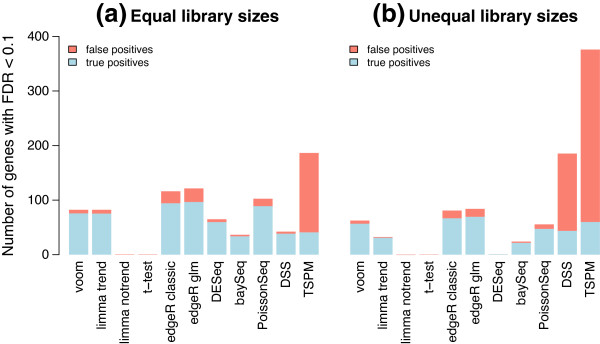
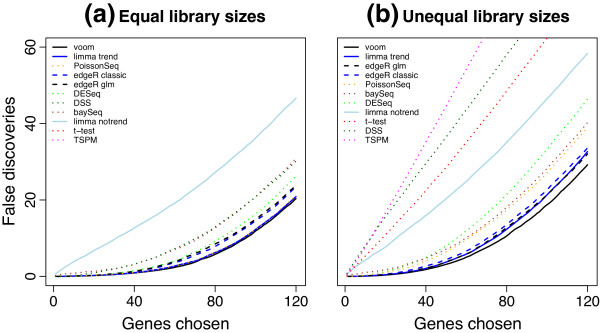
- In simulations with 6 libraries, 10,000 genes, and 100 upregulated plus 100 downregulated genes, voom had the best power among methods that controlled type I and FDR error rates; with unequal library sizes, voom had the best power except for edgeR while maintaining low FDR. edgeR and PoissonSeq were somewhat liberal, while DESeq and DSS became very conservative when library sizes were unequal.
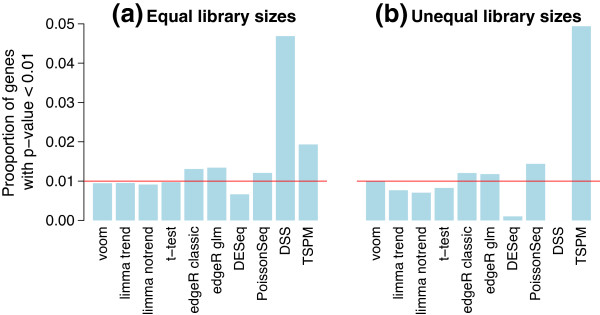
- For type I error at P<0.01, NB/Poisson methods did not control error accurately; voom was close to the nominal rate in both equal and unequal library size scenarios, while limma-trend was similar when sizes were equal but conservative when unequal. In SEQC HBRR technical replicates, voom returned no DE genes at 5% FDR for 6 of 7 possible partitions.
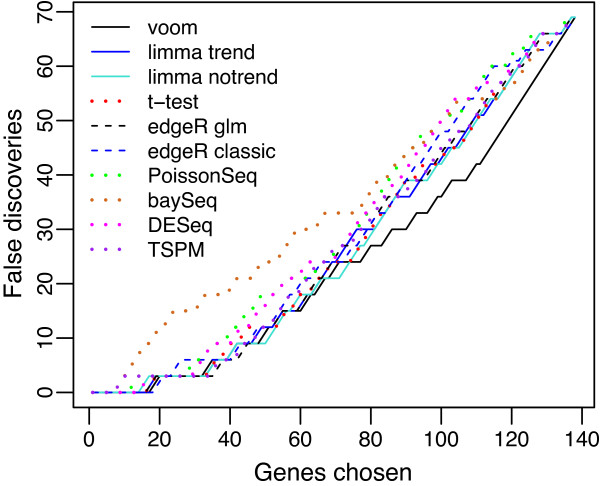
- voom had the lowest FDR at any cutoff in simulations and in SEQC spike-in data; the spike-in analysis used 138 transcripts, half truly DE and half non-DE.
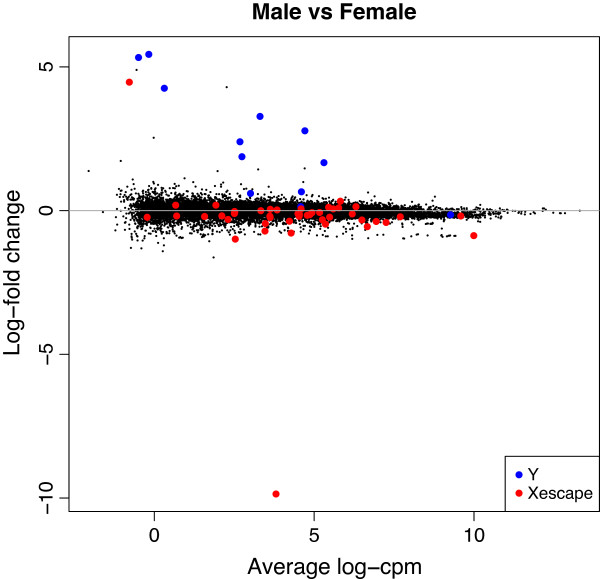
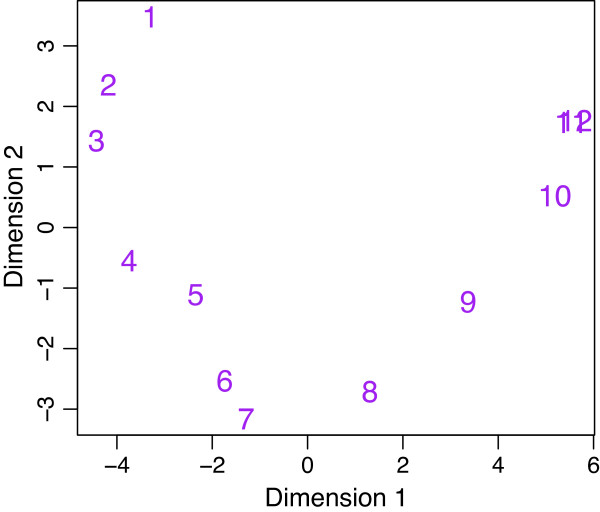
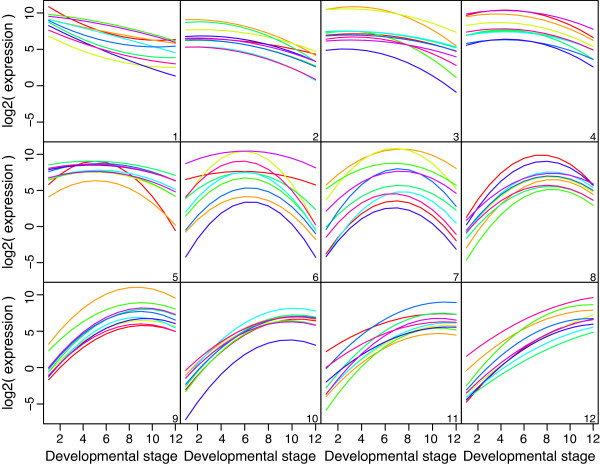
- In the Nigerian lymphoblastoid dataset (29 males, 40 females), voom found 16 genes upregulated in males and 43 upregulated in females at 5% FDR, with XIST the top gene; ROAST and CAMERA confirmed male-specific Y chromosome genes and X-inactivation escape genes. In Drosophila embryonic stages, 8,366 of 14,869 expressed genes showed a significant trend at 5% FDR.
Methods
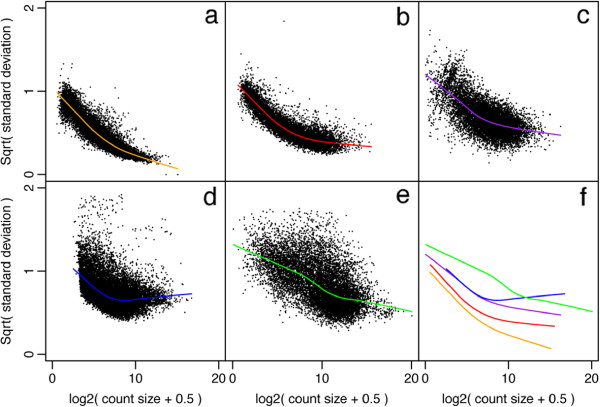
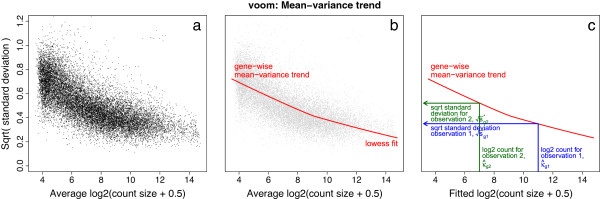
- voom works on log-cpm values: fit gene-wise linear models, estimate residual standard deviations as a function of average log-count using a robust LOWESS trend, interpolate that trend to each observation’s predicted count, and use inverse squared predicted standard deviation as a precision weight in limma’s empirical Bayes pipeline. limma-trend applies the mean-variance trend at the gene level instead.
- Simulations generated NB counts for 6 libraries and 10,000 genes, with baseline cpm distribution matched to real data and dispersion trend ψ^1/2 = 0.2 + λ^-1/2; gene-wise dispersions were drawn from an inverse chi-square with 40 degrees of freedom. Equal library sizes used 11 million reads per library; unequal sizes used 20 million for odd libraries and 2 million for even libraries. Results were averaged over 100 simulations and compared with edgeR, DESeq, baySeq, TSPM, PoissonSeq, and DSS.
- Case studies used SEQC pilot libraries (16 libraries in groups A–D; 4 HBRR libraries; 92 spike-in transcripts expanded to 138), Nigerian lymphoblastoid cell lines from 69 unrelated individuals, Drosophila melanogaster embryonic stages (12 libraries), and C57BL/6J versus DBA/2J mouse striatum data. Gene set testing used ROAST and CAMERA.
Limitations
- Stated: gene-level analysis does not allow different isoforms of the same gene to be differentially expressed in different directions, though voom can be run at exon level. The Drosophila quadratic time trends do not match all intricacies of gene expression over time. Simulations were generated under NB assumptions, and other scenarios may differ. baySeq was excluded from the type I error comparison because it does not return P values.
- Evident: the Drosophila analysis has no replicate libraries, so variances are estimated by assuming smooth expression over time and fitting quadratic trends. Performance comparisons rely on specific simulation settings and default software pipelines, and the case studies illustrate use rather than provide independent experimental validation.
Model-written summary. Check it against the paper before relying on it.
Integrity signals
Registry
Cites
Statistics
Figures
Verification
Claims the paper makes
1 Valid · 4 Not valid · 34 Not checked · 142 Own results and interpretations
The cited sources support only part of this claim — read each source’s verdict below.
In the paper
“voom and limma could be used to analyze any gene-level RNA-seq differential expression experiment, including those with multiple experimental factors [34].”
§ voom: precision weights unlock linear model analysis tools for RNA-seq read counts > Results > Development stages of Drosophila melanogaster
What the sources say
- Partly supportedcites [34] McCarthy DJ Chen Y Smyth GK Differential expression analysis of multifactor RNA-Seq experiments with respect to biological variation Nucleic Acids Res 2012 40 4288 4297 10.1093/nar/gks042 22287627 PMC3378882 sourceExperimental — accuracy not yet measured
Our copy of McCarthy et al. (2012) supports the scope part of the claim: the INTRODUCTION states 'The methodology provides a pipeline for analysing arbitrarily complex RNA-Seq experiments provided that there is some degree of biological replication', the Abstract describes analysis of 'complex experiments involving multiple treatment conditions and blocking variables', and the article's focus is gene-level counts ('For simplicity... counts are summarized at the gene level', RESULTS > Technical and biological variation). However, the capability is attributed to negative-binomial generalized linear models implemented in the edgeR package (DISCUSSION: 'The methods described in this article are implemented in the software package edgeR'), and no passage of our copy mentions voom or limma at all — the closest the paper comes to normal-linear-model analysis of transformed counts is a critique in the INTRODUCTION that transforming counts to approximate normality and analysing as for microarray data 'is however not fully tuned to the characteristics of read count data'. Thus the specific tools named in the citing sentence (voom and limma) are not this paper's methods, while the multifactor/gene-level applicability is. (LLM, conf=0.72)
hedged- Asserted: passes — The authors put it forward as true.
- Checkable: passes — It can be checked against evidence.
- Load-bearing: unclear — It is unclear whether the paper’s conclusions depend on it.
- Based: passes — The paper gives a reason why it holds.
- Rests on an assumption not shown here.
- Partly supported
A result the paper reports from its own data — it cites no other source for it, so there is none to check. The quote shows it is in the paper.
In the paper
“When the library sizes are unequal, DSS and DESeq became extremely conservative.”
§ voom: precision weights unlock linear model analysis tools for RNA-seq read counts > Results > voom and limma-trend control the type I error rate correctly
plainstates a cause- Asserted: passes — The authors put it forward as true.
- Checkable: passes — It can be checked against evidence.
- Load-bearing: unclear — It is unclear whether the paper’s conclusions depend on it.
- Based: passes — The paper gives a reason why it holds.
A result the paper reports from its own data — it cites no other source for it, so there is none to check. The quote shows it is in the paper.
In the paper
“Figures 3 and 4 together show that voom has the best power of those methods that correctly control the type I and FDR error rates.”
§ voom: precision weights unlock linear model analysis tools for RNA-seq read counts > Results > voom has the best power of methods that control the type I error rate
plain- Asserted: passes — The authors put it forward as true.
- Checkable: passes — It can be checked against evidence.
- Load-bearing: passes — The paper’s conclusions depend on it.
- Based: passes — The paper gives a reason why it holds.
- Rests on an assumption not shown here.
A result the paper reports from its own data — it cites no other source for it, so there is none to check. The quote shows it is in the paper.
In the paper
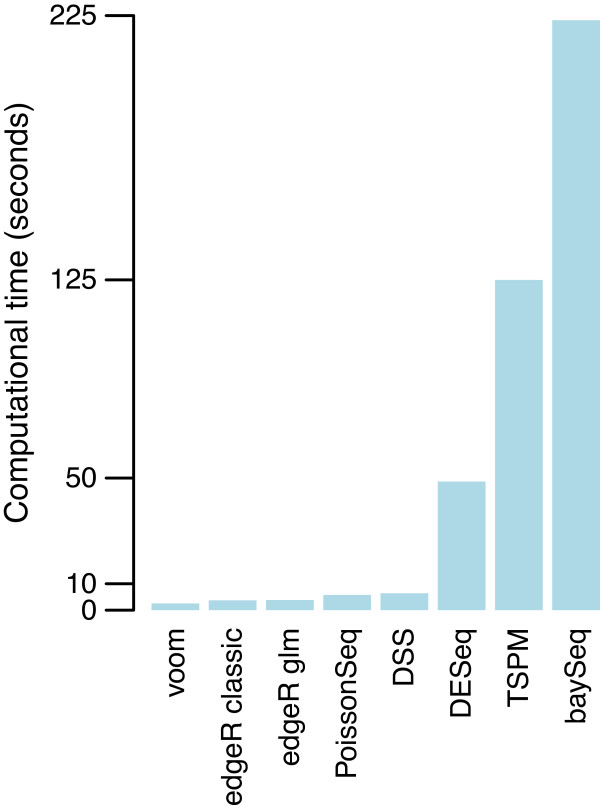
“voom is easily the fastest of the methods compared, with edgeR-classic next fastest (Figure 7).”
§ voom: precision weights unlock linear model analysis tools for RNA-seq read counts > Results > voom and limma-trend are faster than specialist RNA-seq methods
plain- Asserted: passes — The authors put it forward as true.
- Checkable: passes — It can be checked against evidence.
- Load-bearing: unclear — It is unclear whether the paper’s conclusions depend on it.
- Based: passes — The paper gives a reason why it holds.
A result the paper reports from its own data — it cites no other source for it, so there is none to check. The quote shows it is in the paper.
In the paper
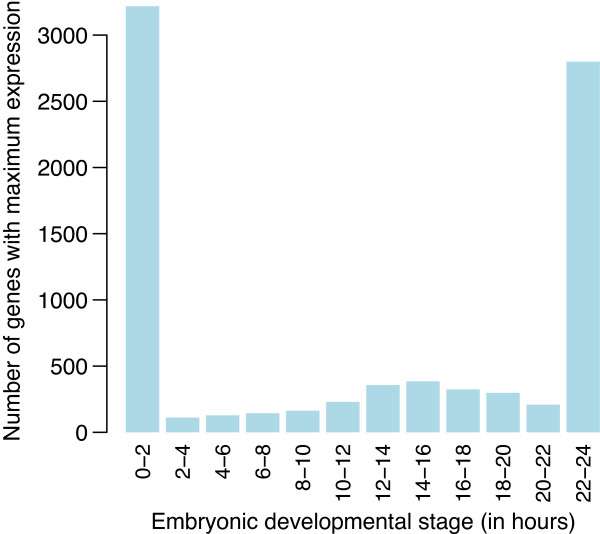
“Genes peaking at the last stage tended to be associated with precursor metabolites and energy, the oxidation-reduction process and with metabolic pathways.”
§ voom: precision weights unlock linear model analysis tools for RNA-seq read counts > Results > Development stages of Drosophila melanogaster
plainstates an association- Asserted: passes — The authors put it forward as true.
- Checkable: passes — It can be checked against evidence.
- Load-bearing: unclear — It is unclear whether the paper’s conclusions depend on it.
- Based: passes — The paper gives a reason why it holds.
79 more claims
Create a free account to see all 181 claims and to verify the 45 references still open.
- It may state two separate claims as one. 48
- Probably not a substantial claim. 68
- The quote only partly states this claim. 2
Claims other papers make about this one
Each is checked against this paper’s own text: does it say what the citing paper says it does?
The source backs part of the claim, not all of it — or backs it for a different population, condition or comparison.
In the citing paper
“First, specific caution is needed with all the methods when the number of replicate samples is very small or for genes that are expressed at very low levels [55, 64, 209].”
From A survey of best practices for RNA-seq data analysis (2016) · cites this paper as [55]
Experimental — accuracy not yet measuredThe cited source says what the claim attributes to it.
In the citing paper
“Methods for transforming normalized counts of RNA-seq reads while learning the variance structure of the data have been shown to perform well in comparison to the discrete distribution approaches described above [55, 56].”
From A survey of best practices for RNA-seq data analysis (2016) · cites this paper as [55]
The cited source says what the claim attributes to it.
In the citing paper
“First, the global variance estimate can now incorporate a mean-variance trend (10,17,18).”
From limma powers differential expression analyses for RNA-sequencing and microarray studies (2015) · cites this paper as [10]
The cited source says what the claim attributes to it.
In the citing paper
“This approach is commonly applied in learning error models for bulk RNA-seq in the context of differential expression analysis [22–25], but to our knowledge has not been previously applied in this context for single-cell normalization.”
From Normalization and variance stabilization of single-cell RNA-seq data using regularized negative binomial regression (2019) · cites this paper as [25]
The check wasn’t confident either way, so it gives no verdict — never disputed.
In the citing paper
“SAMseq performs well in terms of FDR but presents an acceptable sensitivity when the number of replicates is relatively high, at least 10 [20, 55, 209].”
From A survey of best practices for RNA-seq data analysis (2016) · cites this paper as [55]
Experimental — accuracy not yet measured
12 more claims about this paper
Create a free account to see every claim other papers make about this one.
Self-check
Percentages, sums and reported differences re-computed from the paper’s own numbers.
Each contradiction between two passages listed here was confirmed by an independent check.
Rated minor: it would not touch a result — a value no result rests on, a p-value that stays on the same side of the significance level, or a conflict that is clerical, resolved elsewhere in the paper, or outside its own findings.
In the paper
§ voom: precision weights unlock linear model analysis tools for RNA-seq read counts > Materials and methods > Lymphoblastoid cell lines from Nigerian individuals
“Read counts, summarized by Ensembl gene, and transcript annotations were obtained from version 1.0.9 of the tweeDEseqCountData Bioconductor package [43]”
§ voom: precision weights unlock linear model analysis tools for RNA-seq read counts > Materials and methods > Software
“The results presented in this article were obtained using R version 3.0.0 and the software packages limma 3.16.2, edgeR 3.2.3, baySeq 1.14.1, DESeq 1.12.0, DSS 1.4.0, PoissonSeq 1.1.2 and tweeDEseqCountData 1.0.8.”
Citations
Cites
Subramanian, A., Tamayo, P., Mootha, V. K., Mukherjee, S., Ebert, B. L., Gillette, M. A., Paulovich, A., Pomeroy, S. L., Golub, T. R., Lander, E. S., et al. (2005) · Proceedings of the National Academy of Sciences · doi:10.1073/pnas.0506580102 · Cited by 53,625 · cited 1×
“This includes methods for differential expression analysis [1, 2, 3], random effects [4, 5], gene set enrichment [6], gene set testing [7, 8] and so on.”
MethodRobinson, M. D., McCarthy, D. J., & Smyth, G. K. (2010) · Bioinformatics · doi:10.1093/bioinformatics/btp616 · Cited by 41,364 · cited 2×
“Specifically we used the goodTuringProportions function of the edgeR package [12], which implements the Good-Turing algorithm [55], to predict the true proportion of total RNA attributable to each gene.”
BackgroundMethodSelf-citationfeatureCounts: an efficient general purpose program for assigning sequence reads to genomic features
Liao, Y., Smyth, G. K., & Shi, W. (2014) · Bioinformatics · doi:10.1093/bioinformatics/btt656 · Cited by 27,219
Self-citation(2005) · Statistics for Biology and Health · doi:10.1007/0-387-27255-0_9 · Cited by 20,133
McCullagh, P., & Nelder, J. A. (1989) · doi:10.1007/978-1-4899-3242-6 · Cited by 16,836
Differential expression analysis for sequence count data
Anders, S., & Huber, W. (2010) · Genome Biology · doi:10.1186/gb-2010-11-10-r106 · Cited by 15,581
Mapping and quantifying mammalian transcriptomes by RNA-Seq
Mortazavi, A., Williams, B. A., McCue, K., Schaeffer, L., & Wold, B. (2008) · Nature Methods · doi:10.1038/nmeth.1226 · Cited by 13,696
RNA-Seq: a revolutionary tool for transcriptomics
Wang, Z., Gerstein, M., & Snyder, M. (2009) · Nature Reviews Genetics · doi:10.1038/nrg2484 · Cited by 13,174 · cited 1×
“olutionary new technology for expression profiling [10].”
Bioconductor: open software development for computational biology and bioinformatics
Gentleman, R. C., Carey, V. J., Bates, D. M., Bolstad, B., Dettling, M., Dudoit, S., Ellis, B., Gautier, L., Ge, Y., Gentry, J., et al. (2004) · Genome Biology · doi:10.1186/gb-2004-5-10-r80 · Cited by 12,172 · cited 1×
“All of these packages are part of the Bioconductor project [67,68], except for PoissonSeq, which is part of the Comprehensive R Archive Network [69].”
BackgroundSelf-citationSmyth, G. K. (2004) · Statistical Applications in Genetics and Molecular Biology · doi:10.2202/1544-6115.1027 · Cited by 11,829
Self-citation
Research works printed but not linked: 2
- Law CW Chen Y Shi W Smyth GK Supplementary information for ‘Voom: precision weights unlock linear model analysis tools for RNA-seq read counts’ [ http://bioinf.wehi.edu.au/voom] PMC4053721 24485249
- Frazee A Langmead B Leek J ReCount: a multi-experiment resource of analysis-ready RNA-seq gene count datasets [ http://bowtie-bio.sourceforge.net/recount] PMC3229291 22087737
Cited by
Items 101–200 of 7,059
Pan-cancer analyses reveal cancer-type-specific fungal ecologies and bacteriome interactions
Narunsky-Haziza, L., Sepich-Poore, G. D., Livyatan, I., Asraf, O., Martino, C., Nejman, D., Gavert, N., Stajich, J. E., Amit, G., González, A., et al. (2022) · Cell · doi:10.1016/j.cell.2022.09.005 · Cited by 538
Mitochondrial DNA copy number variation across human cancers
Reznik, E., Miller, M. L., Şenbabaoğlu, Y., Riaz, N., Sarungbam, J., Tickoo, S. K., Al-Ahmadie, H. A., Lee, W., Seshan, V. E., Hakimi, A. A., et al. (2016) · eLife · doi:10.7554/elife.10769 · Cited by 530
“We then use the geneSetTest function in the limma (Law et al., 2014) package to test whether particular gene sets showed an enrichment for positive/”
MethodMounir, M., Lucchetta, M., Silva, T. C., Olsen, C., Bontempi, G., Chen, X., Noushmehr, H., Colaprico, A., & Papaleo, E. (2019) · PLOS Computational Biology · doi:10.1371/journal.pcbi.1006701 · Cited by 530
“TCGAanalyze_DEA extension We revised and expanded the pre-existing TCGAbiolinks function TCGAanalyze_DEA that performs differential expression analysis (DEA) by calling the commonly used R package, edgeR [37].”
BackgroundMethodMetabolic modeling of single Th17 cells reveals regulators of autoimmunity
Wagner, A., Wang, C., Fessler, J., DeTomaso, D., Avila-Pacheco, J., Kaminski, J., Zaghouani, S., Christian, E., Thakore, P., Schellhaass, B., et al. (2021) · Cell · doi:10.1016/j.cell.2021.05.045 · Cited by 524
Comparison of Cas9 activators in multiple species
Chavez, A., Tuttle, M., Pruitt, B. W., Ewen-Campen, B., Chari, R., Ter-Ovanesyan, D., Haque, S. J., Cecchi, R. J., Kowal, E. J. K., Buchthal, J., et al. (2016) · Nature Methods · doi:10.1038/nmeth.3871 · Cited by 519
Differential methylation analysis for BS-seq data under general experimental design
Park, Y., & Wu, H. (2016) · Bioinformatics · doi:10.1093/bioinformatics/btw026 · Cited by 518
“Similar approaches that operate on transformed data have been developed for other sequencing data such as RNA-seq (Law et al., 2013) and ChIP-seq (Chen et al.”
MethodarcOGEN Consortium, Tachmazidou, I., Hatzikotoulas, K., Southam, L., Esparza-Gordillo, J., Haberland, V., Zheng, J., Johnson, T., Koprulu, M., Zengini, E., et al. (2019) · Nature Genetics · doi:10.1038/s41588-018-0327-1 · Cited by 516
Crowell, H. L., Soneson, C., Germain, P.-L., Calini, D., Collin, L., Raposo, C., Malhotra, D., & Robinson, M. D. (2020) · Nature Communications · doi:10.1038/s41467-020-19894-4 · Cited by 515
Quality control, modeling, and visualization of CRISPR screens with MAGeCK-VISPR
Li, W., Köster, J., Xu, H., Chen, C.-H., Xiao, T., Liu, J. S., Brown, M., & Liu, X. S. (2015) · Genome Biology · doi:10.1186/s13059-015-0843-6 · Cited by 507
“If sgRNA i is inefficient ( π i = 0), then its read counts in all samples are not determined by any experimental conditions except the baseline abundance: The design matrix Design matrices have been used in many gene expression analysis algorithms for modeling complex experimental designs, including LIMMA [39], VOOM […”
MethodInfluentialMan, K., Gabriel, S. S., Liao, Y., Gloury, R., Preston, S., Henstridge, D. C., Pellegrini, M., Zehn, D., Berberich-Siebelt, F., Febbraio, M. A., et al. (2017) · Immunity · doi:10.1016/j.immuni.2017.11.021 · Cited by 506
Self-citationLoss of p53 triggers WNT-dependent systemic inflammation to drive breast cancer metastasis
Wellenstein, M. D., Coffelt, S. B., Duits, D. E. M., van Miltenburg, M. H., Slagter, M., de Rink, I., Henneman, L., Kas, S. M., Prekovic, S., Hau, C.-S., et al. (2019) · Nature · doi:10.1038/s41586-019-1450-6 · Cited by 500
Single-cell analysis of experience-dependent transcriptomic states in the mouse visual cortex
Hrvatin, S., Hochbaum, D. R., Nagy, M. A., Cicconet, M., Robertson, K., Cheadle, L., Zilionis, R., Ratner, A., Borges-Monroy, R., Klein, A. M., et al. (2018) · Nature Neuroscience · doi:10.1038/s41593-017-0029-5 · Cited by 497
TORC1 inhibition enhances immune function and reduces infections in the elderly
Mannick, J. B., Morris, M., Hockey, H.-U. P., Roma, G., Beibel, M., Kulmatycki, K., Watkins, M., Shavlakadze, T., Zhou, W., Quinn, D., et al. (2018) · Science Translational Medicine · doi:10.1126/scitranslmed.aaq1564 · Cited by 496
Salter, A. I., Ivey, R. G., Kennedy, J. J., Voillet, V., Rajan, A., Alderman, E. J., Voytovich, U. J., Lin, C., Sommermeyer, D., Liu, L., et al. (2018) · Science Signaling · doi:10.1126/scisignal.aat6753 · Cited by 495
A transcriptomic atlas of aged human microglia
Olah, M., Patrick, E., Villani, A.-C., Xu, J., White, C. C., Ryan, K. J., Piehowski, P., Kapasi, A., Nejad, P., Cimpean, M., et al. (2018) · Nature Communications · doi:10.1038/s41467-018-02926-5 · Cited by 482
“Interleukin-1 signaling (21) Cell Cycle, Mitotic (66) Translation (39) Neurodegenerative Diseases (10) CLEC7A (Dectin-1) signaling (20) Cell-extracellular matrix interactions (7) IGF1R signaling cascade (39) Detoxification of Reactive Oxygen Species (13) Interleukin-17 signaling (39) Unfolded Protein Response (UPR) (2…”
BackgroundNecroptosis activation in Alzheimer's disease
Caccamo, A., Branca, C., Piras, I. S., Ferreira, E., Huentelman, M. J., Liang, W. S., Readhead, B., Dudley, J. T., Spangenberg, E. E., Green, K. N., et al. (2017) · Nature Neuroscience · doi:10.1038/nn.4608 · Cited by 482
Erny, D., Dokalis, N., Mezö, C., Castoldi, A., Mossad, O., Staszewski, O., Frosch, M., Villa, M., Fuchs, V., Mayer, A., et al. (2021) · Cell Metabolism · doi:10.1016/j.cmet.2021.10.010 · Cited by 478
Healthy infants harbor intestinal bacteria that protect against food allergy
Feehley, T., Plunkett, C. H., Bao, R., Choi Hong, S. M., Culleen, E., Belda-Ferre, P., Campbell, E., Aitoro, R., Nocerino, R., Paparo, L., et al. (2019) · Nature Medicine · doi:10.1038/s41591-018-0324-z · Cited by 474
Yáñez, A., Coetzee, S. G., Olsson, A., Muench, D. E., Berman, B. P., Hazelett, D. J., Salomonis, N., Grimes, H. L., & Goodridge, H. S. (2017) · Immunity · doi:10.1016/j.immuni.2017.10.021 · Cited by 470
Tsoi, L. C., Rodriguez, E., Degenhardt, F., Baurecht, H., Wehkamp, U., Volks, N., Szymczak, S., Swindell, W. R., Sarkar, M. K., Raja, K., et al. (2019) · Journal of Investigative Dermatology · doi:10.1016/j.jid.2018.12.018 · Cited by 469
“TMM was used to normalize the RNA-seq data (Robinson and Oshlack, 2010), and we applied voom transformation to model the mean-variance relationship of the expression data (Law et al., 2014).”
MethodAcceleration of β Cell Aging Determines Diabetes and Senolysis Improves Disease Outcomes
Aguayo-Mazzucato, C., Andle, J., Lee, T. B., Midha, A., Talemal, L., Chipashvili, V., Hollister-Lock, J., van Deursen, J., Weir, G., & Bonner-Weir, S. (2019) · Cell Metabolism · doi:10.1016/j.cmet.2019.05.006 · Cited by 469
Pal, B., Chen, Y., Vaillant, F., Capaldo, B. D., Joyce, R., Song, X., Bryant, V. L., Penington, J. S., Di Stefano, L., Tubau Ribera, N., et al. (2021) · The EMBO Journal · doi:10.15252/embj.2020107333 · Cited by 469
“Differential expression analysis was performed using limma-voom and TREAT with a fold change threshold of 1.5 (McCarthy & Smyth, 2009; Law et al, 2014).”
InfluentialSelf-citationYarnall, M. T. N., Ioannidi, E. I., Schmitt-Ulms, C., Krajeski, R. N., Lim, J., Villiger, L., Zhou, W., Jiang, K., Garushyants, S. K., Roberts, N., et al. (2023) · Nature Biotechnology · doi:10.1038/s41587-022-01527-4 · Cited by 469
WRN helicase is a synthetic lethal target in microsatellite unstable cancers
Chan, E. M., Shibue, T., McFarland, J. M., Gaeta, B., Ghandi, M., Dumont, N., Gonzalez, A., McPartlan, J. S., Li, T., Zhang, Y., et al. (2019) · Nature · doi:10.1038/s41586-019-1102-x · Cited by 458
Reproducible RNA-seq analysis using recount2
Collado-Torres, L., Nellore, A., Kammers, K., Ellis, S. E., Taub, M. A., Hansen, K. D., Jaffe, A. E., Langmead, B., & Leek, J. T. (2017) · Nature Biotechnology · doi:10.1038/nbt.3838 · Cited by 458
AP-1 Transcription Factors and the BAF Complex Mediate Signal-Dependent Enhancer Selection
Vierbuchen, T., Ling, E., Cowley, C. J., Couch, C. H., Wang, X., Harmin, D. A., Roberts, C. W. M., & Greenberg, M. E. (2017) · Molecular Cell · doi:10.1016/j.molcel.2017.11.026 · Cited by 455
Linear models enable powerful differential activity analysis in massively parallel reporter assays
Myint, L., Avramopoulos, D. G., Goff, L. A., & Hansen, K. D. (2019) · BMC Genomics · doi:10.1186/s12864-019-5556-x · Cited by 450
Targeting REGNASE-1 programs long-lived effector T cells for cancer therapy
Wei, J., Long, L., Zheng, W., Dhungana, Y., Lim, S. A., Guy, C., Wang, Y., Wang, Y.-D., Qian, C., Xu, B., et al. (2019) · Nature · doi:10.1038/s41586-019-1821-z · Cited by 447
Benchmarking of cell type deconvolution pipelines for transcriptomics data
Avila Cobos, F., Alquicira-Hernandez, J., Powell, J. E., Mestdagh, P., & De Preter, K. (2020) · Nature Communications · doi:10.1038/s41467-020-19015-1 · Cited by 446
Sex Differences in Gene Expression and Regulatory Networks across 29 Human Tissues
Lopes-Ramos, C. M., Chen, C.-Y., Kuijjer, M. L., Paulson, J. N., Sonawane, A. R., Fagny, M., Platig, J., Glass, K., Quackenbush, J., & DeMeo, D. L. (2020) · Cell Reports · doi:10.1016/j.celrep.2020.107795 · Cited by 445
“Differential expression analysis—Differential expression analysis was performed using voom to transform RNA-seq read counts to log counts per million (log-cpm) with associated precision weights, followed by linear modeling and empirical Bayes procedure using limma (Law et al., 2014).”
CMScaller: an R package for consensus molecular subtyping of colorectal cancer pre-clinical models
Eide, P. W., Bruun, J., Lothe, R. A., & Sveen, A. (2017) · Scientific Reports · doi:10.1038/s41598-017-16747-x · Cited by 437
“For RNA-sequencing data, voom transformation with quantile normalization was performed prior to the limma modeling 56 .”
MethodDeciphering osteoarthritis genetics across 826,690 individuals from 9 populations
Boer, C. G., Hatzikotoulas, K., Southam, L., Stefánsdóttir, L., Zhang, Y., Coutinho de Almeida, R., Wu, T. T., Zheng, J., Hartley, A., Teder-Laving, M., et al. (2021) · Cell · doi:10.1016/j.cell.2021.07.038 · Cited by 434
Differential cytokine contributions of perivascular haematopoietic stem cell niches
Asada, N., Kunisaki, Y., Pierce, H., Wang, Z., Fernandez, N. F., Birbrair, A., Ma’ayan, A., & Frenette, P. S. (2017) · Nature Cell Biology · doi:10.1038/ncb3475 · Cited by 430
the BIOS Consortium, van Iterson, M., van Zwet, E. W., & Heijmans, B. T. (2017) · Genome biology · doi:10.1186/s13059-016-1131-9 · Cited by 421
Single-nucleus profiling of human dilated and hypertrophic cardiomyopathy
Chaffin, M., Papangeli, I., Simonson, B., Akkad, A.-D., Hill, M. C., Arduini, A., Fleming, S. J., Melanson, M., Hayat, S., Kost-Alimova, M., et al. (2022) · Nature · doi:10.1038/s41586-022-04817-8 · Cited by 418
Cronk, J. C., Filiano, A. J., Louveau, A., Marin, I., Marsh, R., Ji, E., Goldman, D. H., Smirnov, I., Geraci, N., Acton, S., et al. (2018) · Journal of Experimental Medicine · doi:10.1084/jem.20180247 · Cited by 412
“To use CAM ERA with the RNA sequencing data, the raw counts needed to be transformed and normalized with the voom function (Law et al., 2014).”
MethodRNA-Seq workflow: gene-level exploratory analysis and differential expression
Love, M. I., Anders, S., Kim, V., & Huber, W. (2015) · F1000Research · doi:10.12688/f1000research.7035.1 · Cited by 412
Quantifying tumor-infiltrating immune cells from transcriptomics data
Finotello, F., & Trajanoski, Z. (2018) · Cancer Immunology, Immunotherapy · doi:10.1007/s00262-018-2150-z · Cited by 407
“Although data normalization can ameliorate this issue [62], future deconvolution approaches might exploit methods that do not rely on data normality, like LDA models [18, 52].”
MethodMediator kinase inhibition further activates super-enhancer-associated genes in AML
Pelish, H. E., Liau, B. B., Nitulescu, I. I., Tangpeerachaikul, A., Poss, Z. C., Da Silva, D. H., Caruso, B. T., Arefolov, A., Fadeyi, O., Christie, A. L., et al. (2015) · Nature · doi:10.1038/nature14904 · Cited by 403
“Counts were normalized for GSEA using the limma voom function 43 .”
Zhou, Y., Fei, M., Zhang, G., Liang, W.-C., Lin, W., Wu, Y., Piskol, R., Ridgway, J., McNamara, E., Huang, H., et al. (2020) · Immunity · doi:10.1016/j.immuni.2020.01.014 · Cited by 399
Yu, X., Taylor, A. M. W., Nagai, J., Golshani, P., Evans, C. J., Coppola, G., & Khakh, B. S. (2018) · Neuron · doi:10.1016/j.neuron.2018.08.015 · Cited by 398
“Differential gene expression analysis was performed with genes with CPM > 3 in at least 4 samples, using Bio-conductor packages edgeR (Robinson et al., 2010) and limmaVoom (Law et al., 2014) with false discovery rate (FDR) threshold 0.1 or 0.05 (http://www.bioconductor.org).”
MethodInfluentialHodes, G. E., Pfau, M. L., Purushothaman, I., Ahn, H. F., Golden, S. A., Christoffel, D. J., Magida, J., Brancato, A., Takahashi, A., Flanigan, M. E., et al. (2015) · The Journal of Neuroscience · doi:10.1523/jneurosci.1392-15.2015 · Cited by 395
“Counts were converted to precision weighted log2 counts per million using the voom transformation, a function of the Bioconductor R package limma (Law et al., 2014; Ritchie et al., 2015).”
MethodEarly life stress confers lifelong stress susceptibility in mice via ventral tegmental area OTX2
Peña, C. J., Kronman, H. G., Walker, D. M., Cates, H. M., Bagot, R. C., Purushothaman, I., Issler, O., Loh, Y.-H. E., Leong, T., Kiraly, D. D., et al. (2017) · Science · doi:10.1126/science.aan4491 · Cited by 394
ReactomeGSA - Efficient Multi-Omics Comparative Pathway Analysis
Griss, J., Viteri, G., Sidiropoulos, K., Nguyen, V., Fabregat, A., & Hermjakob, H. (2020) · Molecular & Cellular Proteomics · doi:10.1074/mcp.tir120.002155 · Cited by 390
Robustly detecting differential expression in RNA sequencing data using observation weights
Zhou, X., Lindsay, H., & Robinson, M. D. (2014) · Nucleic Acids Research · doi:10.1093/nar/gku310 · Cited by 387
“limma-voom is an extension to DE analysis of RNA-seq count data from limma (11); it transforms the count data with special treatment given to fitting the mean–variance relationship.”
MethodMulti-omics of 34 colorectal cancer cell lines - a resource for biomedical studies
Berg, K. C. G., Eide, P. W., Eilertsen, I. A., Johannessen, B., Bruun, J., Danielsen, S. A., Bjørnslett, M., Meza-Zepeda, L. A., Eknæs, M., Lind, G. E., et al. (2017) · Molecular Cancer · doi:10.1186/s12943-017-0691-y · Cited by 382
“Differential expression analysis of miRNA data was performed with R package limma using voom with cyclic loess normalization [30, 33].”
MethodShi, W., Liao, Y., Willis, S. N., Taubenheim, N., Inouye, M., Tarlinton, D. M., Smyth, G. K., Hodgkin, P. D., Nutt, S. L., & Corcoran, L. M. (2015) · Nature Immunology · doi:10.1038/ni.3154 · Cited by 381
Self-citationzUMIs - A fast and flexible pipeline to process RNA sequencing data with UMIs
Parekh, S., Ziegenhain, C., Vieth, B., Enard, W., & Hellmann, I. (2018) · GigaScience · doi:10.1093/gigascience/giy059 · Cited by 380
“In each of the 25 simulation iterations, we draw an equal sample size of 300 cells per group and test for di erential expression using limma-trend [41] on log2 CPM values with scran [42] library size correction.”
CGRP sensory neurons promote tissue healing via neutrophils and macrophages
Lu, Y.-Z., Nayer, B., Singh, S. K., Alshoubaki, Y. K., Yuan, E., Park, A. J., Maruyama, K., Akira, S., & Martino, M. M. (2024) · Nature · doi:10.1038/s41586-024-07237-y · Cited by 378
Tellier, J., Shi, W., Minnich, M., Liao, Y., Crawford, S., Smyth, G. K., Kallies, A., Busslinger, M., & Nutt, S. L. (2016) · Nature Immunology · doi:10.1038/ni.3348 · Cited by 377
Self-citationModeling microbial abundances and dysbiosis with beta-binomial regression
Martin, B. D., Witten, D., & Willis, A. D. (2020) · The Annals of Applied Statistics · doi:10.1214/19-aoas1283 · Cited by 376
“Alternative approaches to modeling absolute abundances include the use of transformations such as cumulative sum scaling (Wahba and others , 1995; Paulson and others , 2013), trimmed mean of M-values (Robinson and Oshlack, 2010; Law and others , 2014), and ratio approaches (Sohn and others , 2015; Chen and others , 20…”
Selecting between-sample RNA-Seq normalization methods from the perspective of their assumptions
Evans, C., Hardin, J., & Stoebel, D. M. (2018) · Briefings in Bioinformatics · doi:10.1093/bib/bbx008 · Cited by 374
“The code for the simulations and the plots of the results can be found at (https://github.com/ciaranlevans/rnaSeqAssumptions), and was adapted from the R code used in the simulations of Law et al. [34].”
MethodThe genetic basis and cell of origin of mixed phenotype acute leukaemia
Alexander, T. B., Gu, Z., Iacobucci, I., Dickerson, K., Choi, J. K., Xu, B., Payne-Turner, D., Yoshihara, H., Loh, M. L., Horan, J., et al. (2018) · Nature · doi:10.1038/s41586-018-0436-0 · Cited by 367
Zhang, L., Riley-Gillis, B., Vijay, P., & Shen, Y. (2019) · Molecular Cancer Therapeutics · doi:10.1158/1535-7163.mct-18-1129 · Cited by 365
“Differential gene expression (DGE) analysis comparing parental versusO1R and parental versusO3R (n1⁄4 3 for each) was then performed using linear modeling in limma with TMM normalization and voom transformation (21) DGE results were plotted using GLIMMA (22).”
MethodTumour and host cell PD-L1 is required to mediate suppression of anti-tumour immunity in mice
Lau, J., Cheung, J., Navarro, A., Lianoglou, S., Haley, B., Totpal, K., Sanders, L., Koeppen, H., Caplazi, P., McBride, J., et al. (2017) · Nature Communications · doi:10.1038/ncomms14572 · Cited by 365
Intratumoral heterogeneity and clonal evolution in liver cancer
Losic, B., Craig, A. J., Villacorta-Martin, C., Martins-Filho, S. N., Akers, N., Chen, X., Ahsen, M. E., von Felden, J., Labgaa, I., DʹAvola, D., et al. (2020) · Nature Communications · doi:10.1038/s41467-019-14050-z · Cited by 363
Pearce, S. L., Clarke, D. F., East, P. D., Elfekih, S., Gordon, K. H. J., Jermiin, L. S., McGaughran, A., Oakeshott, J. G., Papanikolaou, A., Perera, O. P., et al. (2017) · BMC Biology · doi:10.1186/s12915-017-0402-6 · Cited by 358
“Read counts were normalised between samples using the trimmed mean of M-values method [139] and converted to log2 counts per million values (log2cpm) with associated quality weights using the voom-limma pipeline [140].”
MethodTximeta: Reference sequence checksums for provenance identification in RNA-seq
Love, M. I., Soneson, C., Hickey, P. F., Johnson, L. K., Pierce, N. T., Shepherd, L., Morgan, M., & Patro, R. (2020) · PLOS Computational Biology · doi:10.1371/journal.pcbi.1007664 · Cited by 354
“223 The SummarizedExperiment object, se, that is returned by tximeta can then be 224 passed to various downstream packages such as DESeq2, edgeR, limma-voom, or 225 fishpond, with example code in the tximeta package vignette [32, 34–37].”
MethodUnderstanding sequencing data as compositions: an outlook and review
Quinn, T. P., Erb, I., Richardson, M. F., & Crowley, T. M. (2018) · Bioinformatics · doi:10.1093/bioinformatics/bty175 · Cited by 350
“have shown how it is possible to use the limma package to apply an empirical Bayes model with underlying count-based precision weights ([62]; [39]) to gene ratios, thus quantifying “second order” expression effects while still avoiding normalization ([23]).”
BATF and IRF4 cooperate to counter exhaustion in tumor-infiltrating CAR T cells
Seo, H., González-Avalos, E., Zhang, W., Ramchandani, P., Yang, C., Lio, C.-W. J., Rao, A., & Hogan, P. G. (2021) · Nature Immunology · doi:10.1038/s41590-021-00964-8 · Cited by 350
Spatiotemporal co-dependency between macrophages and exhausted CD8+ T cells in cancer
Kersten, K., Hu, K. H., Combes, A. J., Samad, B., Harwin, T., Ray, A., Rao, A. A., Cai, E., Marchuk, K., Artichoker, J., et al. (2022) · Cancer Cell · doi:10.1016/j.ccell.2022.05.004 · Cited by 349
Single-cell meta-analysis of SARS-CoV-2 entry genes across tissues and demographics
Muus, C., Luecken, M. D., Eraslan, G., Sikkema, L., Waghray, A., Heimberg, G., Kobayashi, Y., Vaishnav, E. D., Subramanian, A., Smillie, C., et al. (2021) · Nature Medicine · doi:10.1038/s41591-020-01227-z · Cited by 348
A field guide for the compositional analysis of any-omics data
Quinn, T. P., Erb, I., Gloor, G., Notredame, C., Richardson, M. F., & Crowley, T. M. (2019) · GigaScience · doi:10.1093/gigascience/giz107 · Cited by 345
The enteric nervous system relays psychological stress to intestinal inflammation
Schneider, K. M., Blank, N., Alvarez, Y., Thum, K., Lundgren, P., Litichevskiy, L., Sleeman, M., Bahnsen, K., Kim, J., Kardo, S., et al. (2023) · Cell · doi:10.1016/j.cell.2023.05.001 · Cited by 344
Dejanovic, B., Wu, T., Tsai, M.-C., Graykowski, D., Gandham, V. D., Rose, C. M., Bakalarski, C. E., Ngu, H., Wang, Y., Pandey, S., et al. (2022) · Nature Aging · doi:10.1038/s43587-022-00281-1 · Cited by 341
Bergamaschi, L., Mescia, F., Turner, L., Hanson, A. L., Kotagiri, P., Dunmore, B. J., Ruffieux, H., De Sa, A., Huhn, O., Morgan, M. D., et al. (2021) · Immunity · doi:10.1016/j.immuni.2021.05.010 · Cited by 338
Cas9 gRNA engineering for genome editing, activation and repression
Kiani, S., Chavez, A., Tuttle, M., Hall, R. N., Chari, R., Ter-Ovanesyan, D., Qian, J., Pruitt, B. W., Beal, J., Vora, S., et al. (2015) · Nature Methods · doi:10.1038/nmeth.3580 · Cited by 334
Hyperactivity with Disrupted Attention by Activation of an Astrocyte Synaptogenic Cue
Nagai, J., Rajbhandari, A. K., Gangwani, M. R., Hachisuka, A., Coppola, G., Masmanidis, S. C., Fanselow, M. S., & Khakh, B. S. (2019) · Cell · doi:10.1016/j.cell.2019.03.019 · Cited by 330
Patnode, M. L., Beller, Z. W., Han, N. D., Cheng, J., Peters, S. L., Terrapon, N., Henrissat, B., Le Gall, S., Saulnier, L., Hayashi, D. K., et al. (2019) · Cell · doi:10.1016/j.cell.2019.08.011 · Cited by 329
Programmable m6A modification of cellular RNAs with a Cas13-directed methyltransferase
Wilson, C., Chen, P. J., Miao, Z., & Liu, D. R. (2020) · Nature Biotechnology · doi:10.1038/s41587-020-0572-6 · Cited by 328
Machine learning for multi-omics data integration in cancer
Cai, Z., Poulos, R. C., Liu, J., & Zhong, Q. (2022) · iScience · doi:10.1016/j.isci.2022.103798 · Cited by 327
Host-Protozoan Interactions Protect from Mucosal Infections through Activation of the Inflammasome
Chudnovskiy, A., Mortha, A., Kana, V., Kennard, A., Ramirez, J. D., Rahman, A., Remark, R., Mogno, I., Ng, R., Gnjatic, S., et al. (2016) · Cell · doi:10.1016/j.cell.2016.08.076 · Cited by 325
Schurch, N., Schofield, P., Gierliński, M., Cole, C., Sherstnev, A., Singh, V., Wrobel, N., Gharbi, K., Simpson, G. G., Owen‐Hughes, T., et al. (2015) · Edinburgh Research Explorer (University of Edinburgh) · doi:10.48550/arxiv.1505.02017 · Cited by 325
Inhibition of Endosteal Vascular Niche Remodeling Rescues Hematopoietic Stem Cell Loss in AML
Duarte, D., Hawkins, E. D., Akinduro, O., Ang, H., De Filippo, K., Kong, I. Y., Haltalli, M., Ruivo, N., Straszkowski, L., Vervoort, S. J., et al. (2018) · Cell Stem Cell · doi:10.1016/j.stem.2017.11.006 · Cited by 324
“FeatureCounts was used for read counting (Liao et al., 2014) after which differential gene expression analysis was performed using Voom-LIMMA packages (Law et al., 2014).”
MethodDream: powerful differential expression analysis for repeated measures designs
Hoffman, G. E., & Roussos, P. (2021) · Bioinformatics · doi:10.1093/bioinformatics/btaa687 · Cited by 319
Zengini, E., Hatzikotoulas, K., Tachmazidou, I., Steinberg, J., Hartwig, F. P., Southam, L., Hackinger, S., Boer, C. G., Styrkarsdottir, U., Gilly, A., et al. (2018) · Nature Genetics · doi:10.1038/s41588-018-0079-y · Cited by 319
Sieberts, S. K., Perumal, T. M., Carrasquillo, M. M., Allen, M., Reddy, J. S., Hoffman, G. E., Dang, K. K., Calley, J., Ebert, P. J., Eddy, J., et al. (2020) · Scientific Data · doi:10.1038/s41597-020-00642-8 · Cited by 318
Pérez-Cobas, A. E., Gomez-Valero, L., & Buchrieser, C. (2020) · Microbial Genomics · doi:10.1099/mgen.0.000409 · Cited by 314
“Other methods also considering the compositional data effect are Deseq2 [258], edgeR [219], Voom [259], or metagenomeSeq [212].”
MethodEarly precursor T cells establish and propagate T cell exhaustion in chronic infection
Utzschneider, D. T., Gabriel, S. S., Chisanga, D., Gloury, R., Gubser, P. M., Vasanthakumar, A., Shi, W., & Kallies, A. (2020) · Nature Immunology · doi:10.1038/s41590-020-0760-z · Cited by 314
Self-citationGaidatzis, D., Burger, L., Florescu, M., & Stadler, M. B. (2015) · Nature Biotechnology · doi:10.1038/nbt.3269 · Cited by 313
CRISPR screens in cancer spheroids identify 3D growth-specific vulnerabilities
Han, K., Pierce, S. E., Li, A., Spees, K., Anderson, G. R., Seoane, J. A., Lo, Y.-H., Dubreuil, M., Olivas, M., Kamber, R. A., et al. (2020) · Nature · doi:10.1038/s41586-020-2099-x · Cited by 311
γδ T cells are effectors of immunotherapy in cancers with HLA class I defects
de Vries, N. L., van de Haar, J., Veninga, V., Chalabi, M., Ijsselsteijn, M. E., van der Ploeg, M., van den Bulk, J., Ruano, D., van den Berg, J. G., Haanen, J. B., et al. (2023) · Nature · doi:10.1038/s41586-022-05593-1 · Cited by 311
Isern, J., García-García, A., Martín, A. M., Arranz, L., Martín-Pérez, D., Torroja, C., Sánchez-Cabo, F., & Méndez-Ferrer, S. (2014) · eLife · doi:10.7554/elife.03696 · Cited by 310
“Data were then normalized and differential expression assessed using the function Voom from the bioconductor package Limma (Law et al., 2014; Smyth, 2005).”
MethodRANK ligand as a potential target for breast cancer prevention in BRCA1-mutation carriers
Nolan, E., Vaillant, F., Branstetter, D., Pal, B., Giner, G., Whitehead, L., Lok, S. W., Mann, G. B., Kathleen Cuningham Foundation Consortium for Research into Familial Breast Cancer (kConFab), Rohrbach, K., et al. (2016) · Nature Medicine · doi:10.1038/nm.4118 · Cited by 309
Self-citationWalter, M., Teissandier, A., Pérez-Palacios, R., & Bourc'his, D. (2016) · eLife · doi:10.7554/elife.11418 · Cited by 303
“DOI: 10.7554/eLife.11418 24 of 30 voom method (Law et al., 2014) to convert them into log2 counts per million with associated precision weights.”
MethodInfluentialLi, Y., Ge, X., Peng, F., Li, W., & Li, J. J. (2022) · Genome Biology · doi:10.1186/s13059-022-02648-4 · Cited by 303
“The four representative methods include two popular methods limma-voom [14, 15] and NOISeq [16], a new method dearseq [11] (which claimed to overcome the FDR inflation issue of DESeq2 and edgeR on large-sample-size data), and the classic Wilcoxon rank-sum test [17].”
MethodTrem2 restrains the enhancement of tau accumulation and neurodegeneration by β-amyloid pathology
Lee, S.-H., Meilandt, W. J., Xie, L., Gandham, V. D., Ngu, H., Barck, K. H., Rezzonico, M. G., Imperio, J., Lalehzadeh, G., Huntley, M. A., et al. (2021) · Neuron · doi:10.1016/j.neuron.2021.02.010 · Cited by 300
A Bayesian framework for multiple trait colocalization from summary association statistics
Giambartolomei, C., Zhenli Liu, J., Zhang, W., Hauberg, M., Shi, H., Boocock, J., Pickrell, J., Jaffe, A. E., The CommonMind Consortium, Pasaniuc, B., et al. (2018) · Bioinformatics · doi:10.1093/bioinformatics/bty147 · Cited by 300
Rapid and Dynamic Alternative Splicing Impacts the Arabidopsis Cold Response Transcriptome
Calixto, C. P. G., Guo, W., James, A. B., Tzioutziou, N. A., Entizne, J. C., Panter, P. E., Knight, H., Nimmo, H. G., Zhang, R., & Brown, J. W. S. (2018) · The Plant Cell · doi:10.1105/tpc.18.00177 · Cited by 298
“and differential transcript usage (DTU) results, we developed an analysis pipeline that 155 exploited the general linear models available in limma [30-32] (see Methods), which allowed 156”
MethodCursons, J., Souza-Fonseca-Guimaraes, F., Foroutan, M., Anderson, A., Hollande, F., Hediyeh-Zadeh, S., Behren, A., Huntington, N. D., & Davis, M. J. (2019) · Cancer Immunology Research · doi:10.1158/2326-6066.cir-18-0500 · Cited by 296
“2) pipeline (45) was used by applying the TREAT criteria (ref.”
MethodDetection of renal cell carcinoma using plasma and urine cell-free DNA methylomes
Nuzzo, P. V., Berchuck, J. E., Korthauer, K., Spisak, S., Nassar, A. H., Abou Alaiwi, S., Chakravarthy, A., Shen, S. Y., Bakouny, Z., Boccardo, F., et al. (2020) · Nature Medicine · doi:10.1038/s41591-020-0933-1 · Cited by 296
Rivellese, F., Surace, A. E. A., Goldmann, K., Sciacca, E., Çubuk, C., Giorli, G., John, C. R., Nerviani, A., Fossati-Jimack, L., Thorborn, G., et al. (2022) · Nature Medicine · doi:10.1038/s41591-022-01789-0 · Cited by 294
Endothelial heterogeneity across distinct vascular beds during homeostasis and inflammation
Jambusaria, A., Hong, Z., Zhang, L., Srivastava, S., Jana, A., Toth, P. T., Dai, Y., Malik, A. B., & Rehman, J. (2020) · eLife · doi:10.7554/elife.51413 · Cited by 292
“We utilized the limma R package and applied the standard limma pipeline (Ritchie et al., 2015) to RNA-Seq data after voom transformation (Law et al., 2014).”
BackgroundMethodLiu, S., Kracher, B., Ziegler, J., Birkenbihl, R. P., & Somssich, I. E. (2015) · eLife · doi:10.7554/elife.07295 · Cited by 292
“, 2010) and ‘voom’ (R package limma) (Law et al., 2014).”
MethodTranscriptional Convergence of Oligodendrocyte Lineage Progenitors during Development
Marques, S., van Bruggen, D., Vanichkina, D. P., Floriddia, E. M., Munguba, H., Väremo, L., Giacomello, S., Falcão, A. M., Meijer, M., Björklund, Å. K., et al. (2018) · Developmental Cell · doi:10.1016/j.devcel.2018.07.005 · Cited by 290
Single-cell RNA sequencing reveals evolution of immune landscape during glioblastoma progression
Yeo, A. T., Rawal, S., Delcuze, B., Christofides, A., Atayde, A., Strauss, L., Balaj, L., Rogers, V. A., Uhlmann, E. J., Varma, H., et al. (2022) · Nature Immunology · doi:10.1038/s41590-022-01215-0 · Cited by 290
Pontis, J., Planet, E., Offner, S., Turelli, P., Duc, J., Coudray, A., Theunissen, T. W., Jaenisch, R., & Trono, D. (2019) · Cell Stem Cell · doi:10.1016/j.stem.2019.03.012 · Cited by 290
Stone, M. L., Chiappinelli, K. B., Li, H., Murphy, L. M., Travers, M. E., Topper, M. J., Mathios, D., Lim, M., Shih, I.-M., Wang, T.-L., et al. (2017) · Proceedings of the National Academy of Sciences · doi:10.1073/pnas.1712514114 · Cited by 290
“Filtered count data were later normalized using quantile normalization, and differentially expressed transcripts were identified using Limma Voom (63).”
MethodDEqMS: A Method for Accurate Variance Estimation in Differential Protein Expression Analysis
Zhu, Y., Orre, L. M., Zhou Tran, Y., Mermelekas, G., Johansson, H. J., Malyutina, A., Anders, S., & Lehtiö, J. (2020) · Molecular & Cellular Proteomics · doi:10.1074/mcp.tir119.001646 · Cited by 289
Resolving host–pathogen interactions by dual RNA-seq
Westermann, A. J., Barquist, L., & Vogel, J. (2017) · PLOS Pathogens · doi:10.1371/journal.ppat.1006033 · Cited by 289
“Popular analysis packages include edgeR [66], DESeq2 [67], and limma/ voom [68].”
Method
Metadata
- Authors
- Law, C. W., Chen, Y., Shi, W., & Smyth, G. K.
- Affiliations
- The University of Melbourne (AU)
- Corresponding author
- Smyth, Gordon K
- Venue
- Genome Biology
- Published
- 2014-02-03
- Volume
- 15
- Issue
- 2
- Pages
- R29-R29
- ISSN
- 1465-6906 (ISSN-L)
- 1474-760X
- PMC
- PMC4053721
- OpenAlex
- W2137526110
- Semantic Scholar
- f85a6cb90dbe6f064e37b427a129e3976e87a86d
- Cited by
- 6,155
- References
- 67
- Citations by year
- 2026: 472 · 2025: 640 · 2024: 713 · 2023: 671 · 2022: 664 · 2021: 761 · 2020: 586 · 2019: 471 · 2018: 420 · 2017: 307 · 2016: 241 · 2015: 145 · 2014: 52
- FWCI
- 101.89
- Type
- journal article
- Language
- en
- Open access
- gold
- doi.org
- Licence
- cc-by
- creativecommons.org/licenses/by/2.0/ (tdm)
- creativecommons.org/licenses/by/2.0/ (vor)
- Locations
- Genome biology (publishedVersion, cc-by)
- Europe PMC (PubMed Central) (publishedVersion, cc-by)
- PubMed Central (publishedVersion, cc-by)
- PubMed (publishedVersion)
- Minerva Access (University of Melbourne) (submittedVersion, cc-by)
- Topics
- Life Sciences › Biochemistry, Genetics and Molecular Biology › Molecular Biology › Gene expression and cancer classification
- Life Sciences › Biochemistry, Genetics and Molecular Biology › Molecular Biology › Genomics and Phylogenetic Studies
- Life Sciences › Biochemistry, Genetics and Molecular Biology › Molecular Biology › Single-cell and spatial transcriptomics
- Keywords
- RNA-seq read counts, mean-variance relationship, limma, empirical Bayes, linear modeling, differential gene expression
- MeSH terms
- Algorithms, Base Sequence, Bayes Theorem, Computer Simulation, RNA, Linear Models, Sequence Analysis, RNA, Gene Expression Profiling, High-Throughput Nucleotide Sequencing
About these checks
Registry, retraction, Cites and statistics results are computed, not judged, with one exception: a printed reference that no index lists is read once by a model before it counts as a citation error. Claims are extracted by a model and kept only when their quote appears verbatim in the text; each cited source is then checked, with a model’s help, for whether it says what the claim relies on. Those verdicts can be wrong — read the claim’s quote and the cited source before relying on one.
The claim verdicts this report counts are experimental: their accuracy is not yet measured.
A language model drew the claims from the paper on 2026-11-23, under version 3 of the claim definition (model deepseek-v4.1-flash, prompt extract-v3).
A second model labelled each claim on 2026-11-23 (model jev-1.13-20260917, definition revision gold-guideline-v0.2).
Cited sources are checked with a language model’s help (qwen3.8-omni-flash).
Statistics and arithmetic are recomputed, not judged.
Confidence bands are shown only for fields calibrated on our annotated test set. None is calibrated yet, so no band is shown.
What counts as a claim ›How we measure confidence ›How we check this ›
Are you an author, or do you see a problem with this page? Request a review
Data sources
Bibliographic data: Semantic Scholar, OpenAlex, Crossref.
Contains information from the Semantic Scholar Academic Graph Datasets, made available under the ODC Attribution License (ODC-BY 1.0).
Semantic Scholar’s data is described in: Kinney, R., et al. (2023). The Semantic Scholar Open Data Platform. arXiv:2301.10140.
