

When the infectious environment meets the AD brain
Open accessThe DOI matches its Crossref record; 138 of the 138 references it cites were found in a registry or an index.
Abstract
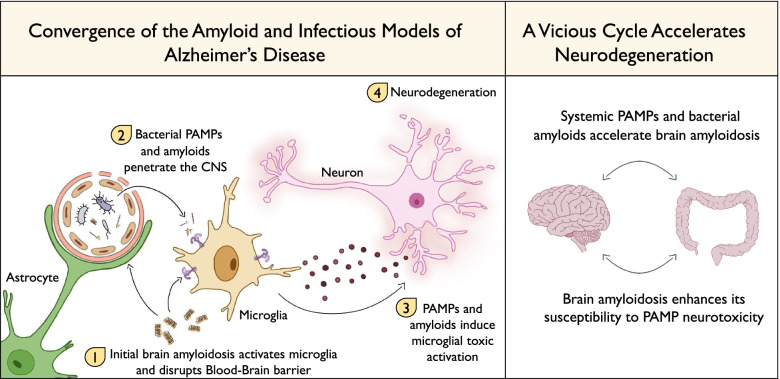
Background: The Amyloid theory of Alzheimer’s disease (AD) suggests that the deposition of Amyloid β (Aβ) in the brain triggers a chain of events, involving the deposition of phosphorylated Tau and other misfolded proteins, leading to neurodegeneration via neuroinflammation, oxidative stress, and neurovascular factors. The infectious theory linked various infectious agents with the development of AD, raising the possibility that they serve as etiological causes of the disease. Are these theories mutually exclusive, or do they coincide? Main body: In this review, we will discuss how the two theories converge. We present a model by which (1) the systemic infectious burden accelerates the development of AD brain pathology via bacterial Amyloids and other pathogen-associated molecular patterns (PAMPs), and (2) the developing AD brain pathology increases its susceptibility to the neurotoxicity of infectious agents -derived PAMPs, which drive neurodegeneration via activated microglia. Conclusions: The reciprocal effects of amyloid deposition and systemic infectious burden may lead to a vicious cycle fueling Alzheimer’s disease pathogenesis.
Overview
The claims and statistics of this paper haven’t been checked yet.
Free: it reads the open-access text and checks the first 5 claims that cite a source we can check. Create a free account to check every claim.
Integrity signals
Registry
Cites
Statistics
Figures
Verification
Claims the paper makes
The claims and statistics of this paper haven’t been checked yet.
Free: it reads the open-access text and checks the first 5 claims that cite a source we can check. Create a free account to check every claim.
Claims other papers make about this one
Each is checked against this paper’s own text: does it say what the citing paper says it does?
The cited source says what the claim attributes to it.
In the citing paper
“While some epidemiological data and preclinical studies suggest the association between HSV1 and AD, more research is needed to further validate and understand the relationship.596–598”
From Recent advances in Alzheimer's disease: Mechanisms, clinical trials and new drug development strategies. (2024) · cites this paper as [596]
The cited source says what the claim attributes to it.
In the citing paper
“More recently, infectious triggers [18, 19] and neurovascular dysfunction [20] have been proposed as additional contributors, broadening the scope of investigation and linking AD to systemic physiology.”
From Toward a Unified Framework in Molecular Neurobiology of Alzheimer’s Disease: Revisiting the Pathophysiological Hypotheses (2026) · cites this paper as [18]
Self-check
Percentages, sums and reported differences re-computed from the paper’s own numbers.
The self-check needs the paper’s full text.
Citations
Cites
Polazzi, E., Mengoni, I., Caprini, M., Peña-Altamira, E., Kurtys, E., & Monti, B. (2013) · Neurosignals · doi:10.1159/000337115 · Cited by 8,994
A Unique Microglia Type Associated with Restricting Development of Alzheimer’s Disease
Keren-Shaul, H., Spinrad, A., Weiner, A., Matcovitch-Natan, O., Dvir-Szternfeld, R., Ulland, T. K., David, E., Baruch, K., Lara-Astaiso, D., Toth, B., et al. (2017) · Cell · doi:10.1016/j.cell.2017.05.018 · Cited by 5,493
Host-gut microbiota metabolic interactions
Nicholson, J. K., Holmes, E., Kinross, J., Burcelin, R., Gibson, G., Jia, W., & Pettersson, S. (2012) · Science · doi:10.1126/science.1223813 · Cited by 4,760 · cited 1×
“Therefore, a high load of gram-negative bacteria carrying endotoxins in the microbiome is associated with increased levels of endotoxin in the systemic circulation [67].”
BackgroundMicroglia-mediated neurotoxicity: uncovering the molecular mechanisms
Block, M. L., Zecca, L., & Hong, J.-S. (2007) · Nature Reviews Neuroscience · doi:10.1038/nrn2038 · Cited by 4,110
Introduction to the human gut microbiota
Thursby, E., & Juge, N. (2017) · Biochemical Journal · doi:10.1042/bcj20160510 · Cited by 3,600 · cited 1×
“The huge mass of microbial organisms in the gut, containing more microorganisms than the entire cell population in the brain [62], makes the brain-gut-microbiota axis another important infectious factor in AD pathogenesis.”
BackgroundBlood–brain barrier breakdown in Alzheimer disease and other neurodegenerative disorders
Sweeney, M. D., Sagare, A. P., & Zlokovic, B. V. (2018) · Nature Reviews Neurology · doi:10.1038/nrneurol.2017.188 · Cited by 3,076
Neurovascular pathways to neurodegeneration in Alzheimer’s disease and other disorders
Zlokovic, B. V. (2011) · Nature Reviews Neuroscience · doi:10.1038/nrn3114 · Cited by 2,969
Microglia Function in the Central Nervous System During Health and Neurodegeneration
Colonna, M., & Butovsky, O. (2017) · Annual Review of Immunology · doi:10.1146/annurev-immunol-051116-052358 · Cited by 2,894
Villemagne, V. L., Burnham, S., Bourgeat, P., Brown, B., Ellis, K. A., Salvado, O., Szoeke, C., Macaulay, S. L., Martins, R., Maruff, P., et al. (2013) · The Lancet Neurology · doi:10.1016/s1474-4422(13)70044-9 · Cited by 2,279
Tau-mediated neurodegeneration in Alzheimer’s disease and related disorders
Ballatore, C., Lee, V. M.-Y., & Trojanowski, J. Q. (2007) · Nature Reviews Neuroscience · doi:10.1038/nrn2194 · Cited by 2,174
Gut microbiome alterations in Alzheimer’s disease
Vogt, N. M., Kerby, R. L., Dill-McFarland, K. A., Harding, S. J., Merluzzi, A. P., Johnson, S. C., Carlsson, C. M., Asthana, S., Zetterberg, H., Blennow, K., et al. (2017) · Scientific Reports · doi:10.1038/s41598-017-13601-y · Cited by 2,137 · cited 1×
“In addition, recent studies in transgenic mouse models of AD have demonstrated that manipulation of gut microbiota can influence cerebral amyloid deposition and attenuate neuroinflammation [64, 65], supporting the notion that the resident microbial flora may affect the pathogenesis of AD brain pathology.”
BackgroundDominy, S. S., Lynch, C., Ermini, F., Benedyk, M., Marczyk, A., Konradi, A., Nguyen, M., Haditsch, U., Raha, D., Griffin, C., et al. (2019) · Science Advances · doi:10.1126/sciadv.aau3333 · Cited by 1,966
Amyloid Beta: Structure, Biology and Structure-Based Therapeutic Development
Chen, G.-F., Xu, T.-H., Yan, Y., Zhou, Y.-R., Jiang, Y., Melcher, K., & Xu, H. E. (2017) · Acta Pharmacologica Sinica · doi:10.1038/aps.2017.28 · Cited by 1,965 · cited 1×
“The deposition of Aβ peptides is probably one of the earliest pathological events in AD pathogenesis [2].”
BackgroundMicroglia in Alzheimer’s disease
Hansen, D. V., Hanson, J. E., & Sheng, M. (2018) · Journal of Cell Biology · doi:10.1083/jcb.201709069 · Cited by 1,935 · cited 1×
“Microgliosis, described first by Alois Alzheimer himself, was considered initially the consequence of AD pathology rather than a cause [20].”
BackgroundAlzheimer's Disease and the Amyloid-β Peptide
Murphy, M. P., & LeVine, H. (2010) · Journal of Alzheimer's Disease · doi:10.3233/jad-2010-1221 · Cited by 1,750 · cited 2×
“Pathological studies were unable to prove a direct correlation or causality between Aβ deposition, clinical dementia, and neuronal loss [3].”
Blood–brain barrier breakdown is an early biomarker of human cognitive dysfunction
Nation, D. A., Sweeney, M. D., Montagne, A., Sagare, A. P., D’Orazio, L. M., Pachicano, M., Sepehrband, F., Nelson, A. R., Buennagel, D. P., Harrington, M. G., et al. (2019) · Nature Medicine · doi:10.1038/s41591-018-0297-y · Cited by 1,728
Establishment and Dysfunction of the Blood-Brain Barrier
Zhao, Z., Nelson, A. R., Betsholtz, C., & Zlokovic, B. V. (2015) · Cell · doi:10.1016/j.cell.2015.10.067 · Cited by 1,670
RAGE mediates amyloid-β peptide transport across the blood-brain barrier and accumulation in brain
Deane, R., Du Yan, S., Submamaryan, R. K., LaRue, B., Jovanovic, S., Hogg, E., Welch, D., Manness, L., Lin, C., Yu, J., et al. (2003) · Nature Medicine · doi:10.1038/nm890 · Cited by 1,611 · cited 1×
“These changes not only lead to local CNS inflammation but are associated also with upregulation and activation of the receptor for advanced glycation end products (RAGE), which transports Aβ from the blood into the brain across the BBB [31], and therefore may increase Aβ deposition in the brain [32, 33].”
BackgroundDisease-Associated Microglia: A Universal Immune Sensor of Neurodegeneration
Deczkowska, A., Keren-Shaul, H., Weiner, A., Colonna, M., Schwartz, M., & Amit, I. (2018) · Cell · doi:10.1016/j.cell.2018.05.003 · Cited by 1,474
Iturria-Medina, Y., Sotero, R. C., Toussaint, P. J., Mateos-Pérez, J. M., Evans, A. C., Initiative, T. A. D. N., Weiner, M. W., Aisen, P., Petersen, R., Jack, C. R., et al. (2016) · Nature Communications · doi:10.1038/ncomms11934 · Cited by 1,202 · cited 1×
“Moreover, in preclinical AD, changes in vascular biomarkers occur before a detectable increase in standard AD biomarkers, including amyloid deposition, decreased cerebrospinal fluid (CSF) levels of Aβ42 (the most amyloidogenic form of Aβ), and increased CSF levels of tau and phosphorylated tau [47].”
BackgroundMicroglia development and function
Nayak, D., Roth, T. L., & McGavern, D. B. (2014) · Annual Review of Immunology · doi:10.1146/annurev-immunol-032713-120240 · Cited by 1,154 · cited 1×
“CNS microglia serve as resident phagocytes that dynamically survey the environment, playing crucial roles in CNS tissue maintenance, injury response, and pathogen defense [18, 19].”
BackgroundMicroglial Activation and Chronic Neurodegeneration
Lull, M. E., & Block, M. L. (2010) · Neurotherapeutics · doi:10.1016/j.nurt.2010.05.014 · Cited by 1,047
Blood-based biomarkers for Alzheimer's disease: towards clinical implementation
Teunissen, C. E., Verberk, I. M. W., Thijssen, E. H., Vermunt, L., Hansson, O., Zetterberg, H., van der Flier, W. M., Mielke, M. M., & del Campo, M. (2022) · The Lancet Neurology · doi:10.1016/s1474-4422(21)00361-6 · Cited by 1,045
Systemic infections and inflammation affect chronic neurodegeneration
Perry, V. H., Cunningham, C., & Holmes, C. (2007) · Nature Reviews Immunology · doi:10.1038/nri2015 · Cited by 1,027
Biomarkers for Alzheimer's disease: current status and prospects for the future
Blennow, K., & Zetterberg, H. (2018) · Journal of Internal Medicine · doi:10.1111/joim.12816 · Cited by 1,000
Kumar, D. K. V., Choi, S. H., Washicosky, K. J., Eimer, W. A., Tucker, S., Ghofrani, J., Lefkowitz, A., McColl, G., Goldstein, L. E., Tanzi, R. E., et al. (2016) · Science Translational Medicine · doi:10.1126/scitranslmed.aaf1059 · Cited by 971
Bacterial outer membrane vesicles and the host–pathogen interaction
Kuehn, M. J., & Kesty, N. C. (2005) · Genes & Development · doi:10.1101/gad.1299905 · Cited by 951
Neuroinflammation induced by lipopolysaccharide causes cognitive impairment in mice
Zhao, J., Bi, W., Xiao, S., Lan, X., Cheng, X., Zhang, J., Lu, D., Wei, W., Wang, Y., Li, H., et al. (2019) · Scientific Reports · doi:10.1038/s41598-019-42286-8 · Cited by 896
The Gut Microbiota and Alzheimer’s Disease
Jiang, C., Li, G., Huang, P., Liu, Z., & Zhao, B. (2017) · Journal of Alzheimer's Disease · doi:10.3233/jad-161141 · Cited by 852
Neutrophil ageing is regulated by the microbiome
Zhang, D., Chen, G., Manwani, D., Mortha, A., Xu, C., Faith, J. J., Burk, R. D., Kunisaki, Y., Jang, J.-E., Scheiermann, C., et al. (2015) · Nature · doi:10.1038/nature15367 · Cited by 839 · cited 1×
“Thus, TLR2 agonists are produced by multiple systemic infectious agents affecting patients, including chronic gingivitis [78], skin pathogens [79], and gut microbiome [80].”
BackgroundReconsideration of Amyloid Hypothesis and Tau Hypothesis in Alzheimer's Disease
Kametani, F., & Hasegawa, M. (2018) · Frontiers in Neuroscience · doi:10.3389/fnins.2018.00025 · Cited by 836 · cited 1×
“However, in aged subjects or under pathological conditions, the metabolic ability to degrade Aβ is decreased, and Aβ peptides may accumulate [1].”
BackgroundLongitudinal assessment of Aβ and cognition in aging and Alzheimer disease
Villemagne, V. L., Pike, K. E., Chételat, G., Ellis, K. A., Mulligan, R. S., Bourgeat, P., Ackermann, U., Jones, G., Szoeke, C., Salvado, O., et al. (2011) · Annals of Neurology · doi:10.1002/ana.22248 · Cited by 833
Caspase cleavage of tau: Linking amyloid and neurofibrillary tangles in Alzheimer's disease
Gamblin, T. C., Chen, F., Zambrano, A., Abraha, A., Lagalwar, S., Guillozet, A. L., Lu, M., Fu, Y., Garcia-Sierra, F., LaPointe, N., et al. (2003) · Proceedings of the National Academy of Sciences · doi:10.1073/pnas.1630428100 · Cited by 831
Hypercholesterolemia Accelerates the Alzheimer's Amyloid Pathology in a Transgenic Mouse Model
Refolo, L. M., Pappolla, M. A., Malester, B., LaFrancois, J., Bryant-Thomas, T., Wang, R., Tint, G. S., Sambamurti, K., & Duff, K. (2000) · Neurobiology of Disease · doi:10.1006/nbdi.2000.0304 · Cited by 783
Lee, J. W., Lee, Y. K., Yuk, D. Y., Choi, D. Y., Ban, S. B., Oh, K. W., & Hong, J. T. (2008) · Journal of Neuroinflammation · doi:10.1186/1742-2094-5-37 · Cited by 772
Vascular dysfunction—The disregarded partner of Alzheimer's disease
Sweeney, M. D., Montagne, A., Sagare, A. P., Nation, D. A., Schneider, L. S., Chui, H. C., Harrington, M. G., Pa, J., Law, M., Wang, D. J. J., et al. (2019) · Alzheimer's & Dementia · doi:10.1016/j.jalz.2018.07.222 · Cited by 711
Eimer, W. A., Vijaya Kumar, D. K., Navalpur Shanmugam, N. K., Rodriguez, A. S., Mitchell, T., Washicosky, K. J., György, B., Breakefield, X. O., Tanzi, R. E., & Moir, R. D. (2018) · Neuron · doi:10.1016/j.neuron.2018.06.030 · Cited by 674
Alzheimer’s disease: A matter of blood–brain barrier dysfunction?
Montagne, A., Zhao, Z., & Zlokovic, B. V. (2017) · Journal of Experimental Medicine · doi:10.1084/jem.20171406 · Cited by 672 · cited 2×
“In close agreement, BBB integrity is compromised in transgenic AD mice from an early stage, even prior to amyloid deposition [39, 48, 49].”
BackgroundMinter, M. R., Zhang, C., Leone, V., Ringus, D. L., Zhang, X., Oyler-Castrillo, P., Musch, M. W., Liao, F., Ward, J. F., Holtzman, D. M., et al. (2016) · Scientific Reports · doi:10.1038/srep30028 · Cited by 655 · cited 1×
“In addition, recent studies in transgenic mouse models of AD have demonstrated that manipulation of gut microbiota can influence cerebral amyloid deposition and attenuate neuroinflammation [64, 65], supporting the notion that the resident microbial flora may affect the pathogenesis of AD brain pathology.”
BackgroundVascular contributions to cognitive impairment and dementia including Alzheimer's disease
Snyder, H. M., Corriveau, R. A., Craft, S., Faber, J. E., Greenberg, S. M., Knopman, D., Lamb, B. T., Montine, T. J., Nedergaard, M., Schaffer, C. B., et al. (2015) · Alzheimer's & Dementia · doi:10.1016/j.jalz.2014.10.008 · Cited by 603
Blood-Brain Barrier Leakage in Patients with Early Alzheimer Disease
van de Haar, H. J., Burgmans, S., Jansen, J. F. A., van Osch, M. J. P., van Buchem, M. A., Muller, M., Hofman, P. A. M., Verhey, F. R. J., & Backes, W. H. (2016) · Radiology · doi:10.1148/radiol.2016152244 · Cited by 601
Poole, S., Singhrao, S. K., Kesavalu, L., Curtis, M. A., & Crean, S. (2013) · Journal of Alzheimer’s Disease · doi:10.3233/jad-121918 · Cited by 598
Neurovascular dysfunction and neurodegeneration in dementia and Alzheimer's disease
Nelson, A. R., Sweeney, M. D., Sagare, A. P., & Zlokovic, B. V. (2016) · Biochimica et Biophysica Acta (BBA) - Molecular Basis of Disease · doi:10.1016/j.bbadis.2015.12.016 · Cited by 559
Role of the Toll-Like Receptor 4 in Neuroinflammation in Alzheimer’s Disease
Walter, S., Letiembre, M., Liu, Y., Heine, H., Penke, B., Hao, W., Bode, B., Manietta, N., Walter, J., Schulz-Schüffer, W., et al. (2007) · Cellular Physiology and Biochemistry · doi:10.1159/000110455 · Cited by 543
Devanand, D. P., Michaels-Marston, K. S., Liu, X., Pelton, G. H., Padilla, M., Marder, K., Bell, K., Stern, Y., & Mayeux, R. (2000) · American Journal of Psychiatry · doi:10.1176/appi.ajp.157.9.1399 · Cited by 532
Chételat, G., Arbizu, J., Barthel, H., Garibotto, V., Law, I., Morbelli, S., van de Giessen, E., Agosta, F., Barkhof, F., Brooks, D. J., et al. (2020) · The Lancet Neurology · doi:10.1016/s1474-4422(20)30314-8 · Cited by 526
Identification and localization of Chlamydia pneumoniae in the Alzheimer's brain
Balin, B. J., Gérard, H. C., Arking, E. J., Appelt, D. M., Branigan, P. J., Abrams, J. T., Whittum-Hudson, J. A., & Hudson, A. P. (1998) · Medical Microbiology and Immunology · doi:10.1007/s004300050071 · Cited by 506 · cited 1×
“Furthermore, studies have found Chlamydophila pneumoniae present in the olfactory bulb of AD patients, as well as in the entorhinal cortex, hippocampus, and temporal cortex [106].”
BackgroundTakeda, S., Sato, N., Uchio-Yamada, K., Sawada, K., Kunieda, T., Takeuchi, D., Kurinami, H., Shinohara, M., Rakugi, H., & Morishita, R. (2010) · Proceedings of the National Academy of Sciences · doi:10.1073/pnas.1000645107 · Cited by 505
How does diabetes accelerate Alzheimer disease pathology?
Sims-Robinson, C., Kim, B., Rosko, A., & Feldman, E. L. (2010) · Nature Reviews Neurology · doi:10.1038/nrneurol.2010.130 · Cited by 492 · cited 1×
“These changes not only lead to local CNS inflammation but are associated also with upregulation and activation of the receptor for advanced glycation end products (RAGE), which transports Aβ from the blood into the brain across the BBB [31], and therefore may increase Aβ deposition in the brain [32, 33].”
BackgroundBaruch, K., Rosenzweig, N., Kertser, A., Deczkowska, A., Sharif, A. M., Spinrad, A., Tsitsou-Kampeli, A., Sarel, A., Cahalon, L., & Schwartz, M. (2015) · Nature Communications · doi:10.1038/ncomms8967 · Cited by 491 · cited 1×
“Contrarily, others have indicated that pharmacological inhibition of Foxp3 + Tregs is followed by Aβ plaque clearance, mitigation of the neuroinflammation response, and reversal of cognitive decline [38].”
BackgroundHerpes simplex virus type 1 DNA is located within Alzheimer's disease amyloid plaques
Wozniak, M., Mee, A., & Itzhaki, R. (2009) · The Journal of Pathology · doi:10.1002/path.2449 · Cited by 464 · cited 1×
“Viral DNA is found within senile plaques [96], Aβ deposition and tau abnormalities typical of AD are observed after infection with HSV1 and are diminished following antiviral treatments [96–98].”
BackgroundPeriodontitis and Cognitive Decline in Alzheimer’s Disease
Ide, M., Harris, M., Stevens, A., Sussams, R., Hopkins, V., Culliford, D., Fuller, J., Ibbett, P., Raybould, R., Thomas, R., et al. (2016) · PLOS ONE · doi:10.1371/journal.pone.0151081 · Cited by 461 · cited 2×
“Indeed, people with chronic gingival disease (periodontitis) have elevated blood endotoxin [75], a higher risk of AD [76], and a faster rate of cognitive decline [59, 75, 77].”
BackgroundThe antimicrobial protection hypothesis of Alzheimer’s disease
Moir, R. D., Lathe, R., & Tanzi, R. E. (2018) · Alzheimer's & Dementia · doi:10.1016/j.jalz.2018.06.3040 · Cited by 456
TLR2 Is a Primary Receptor for Alzheimer’s Amyloid β Peptide To Trigger Neuroinflammatory Activation
Liu, S., Liu, Y., Hao, W., Wolf, L., Kiliaan, A. J., Penke, B., Rübe, C. E., Walter, J., Heneka, M. T., Hartmann, T., et al. (2012) · The Journal of Immunology · doi:10.4049/jimmunol.1101121 · Cited by 439 · cited 1×
“TLR2 agonists are of particular interest since TLR2 serves as a receptor for Aβ-induced microglial activation [81].”
BackgroundBrain β-amyloid load approaches a plateau
Jack, C. R., Wiste, H. J., Lesnick, T. G., Weigand, S. D., Knopman, D. S., Vemuri, P., Pankratz, V. S., Senjem, M. L., Gunter, J. L., Mielke, M. M., et al. (2013) · Neurology · doi:10.1212/wnl.0b013e3182840bbe · Cited by 406
Zhao, Y., Jaber, V., & Lukiw, W. J. (2017) · Frontiers in Cellular and Infection Microbiology · doi:10.3389/fcimb.2017.00318 · Cited by 379
Citron, M., Vigo-Pelfrey, C., Teplow, D. B., Miller, C., Schenk, D., Johnston, J., Winblad, B., Venizelos, N., Lannfelt, L., & Selkoe, D. J. (1994) · Proceedings of the National Academy of Sciences · doi:10.1073/pnas.91.25.11993 · Cited by 366
Regulatory T cells delay disease progression in Alzheimer-like pathology
Dansokho, C., Ait Ahmed, D., Aid, S., Toly-Ndour, C., Chaigneau, T., Calle, V., Cagnard, N., Holzenberger, M., Piaggio, E., Aucouturier, P., et al. (2016) · Brain · doi:10.1093/brain/awv408 · Cited by 359
Minimal penetration of lipopolysaccharide across the murine blood–brain barrier
Banks, W. A., & Robinson, S. M. (2010) · Brain, Behavior, and Immunity · doi:10.1016/j.bbi.2009.09.001 · Cited by 356
Miklossy, J. (2011) · Journal of Neuroinflammation · doi:10.1186/1742-2094-8-90 · Cited by 355
Mildner, A., Schlevogt, B., Kierdorf, K., Böttcher, C., Erny, D., Kummer, M. P., Quinn, M., Brück, W., Bechmann, I., Heneka, M. T., et al. (2011) · The Journal of Neuroscience · doi:10.1523/jneurosci.6209-10.2011 · Cited by 351 · cited 1×
“It was shown that circulating myeloid cells mitigate the neuroinflammatory response in AD models and that CNS-infiltrating monocyte-derived macrophages facilitate Aβ plaque removal [34, 35].”
BackgroundBlood—Brain Barrier Permeability Precedes Senile Plaque Formation in an Alzheimer Disease Model
UJIIE, M., DICKSTEIN, D. L., CARLOW, D. A., & JEFFERIES, W. A. (2003) · Microcirculation · doi:10.1038/sj.mn.7800212 · Cited by 351
Herpes simplex virus infection causes cellular β-amyloid accumulation and secretase upregulation
Wozniak, M. A., Itzhaki, R. F., Shipley, S. J., & Dobson, C. B. (2007) · Neuroscience Letters · doi:10.1016/j.neulet.2007.09.077 · Cited by 341
Mechanisms of Molecular Mimicry Involving the Microbiota in Neurodegeneration
Friedland, R. P. (2015) · Journal of Alzheimer's Disease · doi:10.3233/jad-142841 · Cited by 338
Fibrillar Amyloid-β Peptides Activate Microglia via TLR2: Implications for Alzheimer’s Disease
Jana, M., Palencia, C. A., & Pahan, K. (2008) · The Journal of Immunology · doi:10.4049/jimmunol.181.10.7254 · Cited by 330
Systemic infection, interleukin 1beta, and cognitive decline in Alzheimer's disease
Holmes, C. (2003) · Journal of Neurology, Neurosurgery & Psychiatry · doi:10.1136/jnnp.74.6.788 · Cited by 329
Zhang, R., Miller, R. G., Gascon, R., Champion, S., Katz, J., Lancero, M., Narvaez, A., Honrada, R., Ruvalcaba, D., & McGrath, M. S. (2009) · Journal of Neuroimmunology · doi:10.1016/j.jneuroim.2008.09.017 · Cited by 319 · cited 1×
“These findings are of clinical relevance, as studies found a threefold increase in mean blood endotoxin levels, a 2–threefold increase in brain endotoxin levels in AD patients, and up to a 26-fold increase in hippocampal tissue [68].”
BackgroundTau pathophysiology in neurodegeneration: a tangled issue
Spires-Jones, T. L., Stoothoff, W. H., de Calignon, A., Jones, P. B., & Hyman, B. T. (2009) · Trends in Neurosciences · doi:10.1016/j.tins.2008.11.007 · Cited by 315
Tau Activates Transposable Elements in Alzheimer’s Disease
Guo, C., Jeong, H.-H., Hsieh, Y.-C., Klein, H.-U., Bennett, D. A., De Jager, P. L., Liu, Z., & Shulman, J. M. (2018) · Cell Reports · doi:10.1016/j.celrep.2018.05.004 · Cited by 315
The identity and function of microglia in neurodegeneration
Song, W. M., & Colonna, M. (2018) · Nature Immunology · doi:10.1038/s41590-018-0212-1 · Cited by 308
Sun, W., Samimi, H., Gamez, M., Zare, H., & Frost, B. (2018) · Nature Neuroscience · doi:10.1038/s41593-018-0194-1 · Cited by 300 · cited 1×
“TE dysregulation may contribute to neuronal death in tauopathies, a significant increase in HERVs transcripts was found in AD [109], and differential expression of several retrotransposons was observed in association with burden of neurofibrillary tangle in human AD brains [110].”
BackgroundMicroglia in Alzheimer Disease: Well-Known Targets and New Opportunities
Hemonnot, A.-L., Hua, J., Ulmann, L., & Hirbec, H. (2019) · Frontiers in Aging Neuroscience · doi:10.3389/fnagi.2019.00233 · Cited by 298
Role of Microglia TLRs in Neurodegeneration
Fiebich, B. L., Batista, C. R. A., Saliba, S. W., Yousif, N. M., & de Oliveira, A. C. P. (2018) · Frontiers in Cellular Neuroscience · doi:10.3389/fncel.2018.00329 · Cited by 291
TDP-43 pathology and neuronal loss in amyotrophic lateral sclerosis spinal cord
Brettschneider, J., Arai, K., Del Tredici, K., Toledo, J. B., Robinson, J. L., Lee, E. B., Kuwabara, S., Shibuya, K., Irwin, D. J., Fang, L., et al. (2014) · Acta Neuropathologica · doi:10.1007/s00401-014-1299-6 · Cited by 275
Multimodal imaging in Alzheimer's disease: validity and usefulness for early detection
Teipel, S., Drzezga, A., Grothe, M. J., Barthel, H., Chételat, G., Schuff, N., Skudlarski, P., Cavedo, E., Frisoni, G. B., Hoffmann, W., et al. (2015) · The Lancet Neurology · doi:10.1016/s1474-4422(15)00093-9 · Cited by 267
Diabetes Mellitus and Blood-Brain Barrier Dysfunction: An Overview
Pooja Naik, L. C. (2014) · Journal of Pharmacovigilance · doi:10.4172/2329-6887.1000125 · Cited by 259
Different Brain Regions are Infected with Fungi in Alzheimer’s Disease
Pisa, D., Alonso, R., Rábano, A., Rodal, I., & Carrasco, L. (2015) · Scientific Reports · doi:10.1038/srep15015 · Cited by 248
TREM2 is upregulated in amyloid plaque-associated microglia in aged APP23 transgenic mice
Frank, S., Burbach, G. J., Bonin, M., Walter, M., Streit, W., Bechmann, I., & Deller, T. (2008) · Glia · doi:10.1002/glia.20710 · Cited by 247 · cited 1×
“Pathological Aβ deposits are associated with surrounding (plaque-associated) activated microglia [14, 15].”
BackgroundRole of neuroinflammation in neurodegeneration: new insights
McManus, R. M., & Heneka, M. T. (2017) · Alzheimer's Research & Therapy · doi:10.1186/s13195-017-0241-2 · Cited by 247
“Limbic Predilection in Alzheimer Dementia: Is Reactivated Herpesvirus Involved?”
Ball, M. J. (1982) · Canadian Journal of Neurological Sciences / Journal Canadien des Sciences Neurologiques · doi:10.1017/s0317167100044115 · Cited by 244
Immune hyperreactivity of Aβ plaque-associated microglia in Alzheimer's disease
Yin, Z., Raj, D., Saiepour, N., Van Dam, D., Brouwer, N., Holtman, I. R., Eggen, B. J. L., Möller, T., Tamm, J. A., Abdourahman, A., et al. (2017) · Neurobiology of Aging · doi:10.1016/j.neurobiolaging.2017.03.021 · Cited by 238 · cited 1×
“Pathological Aβ deposits are associated with surrounding (plaque-associated) activated microglia [14, 15].”
BackgroundReciprocal Interactions Between Microglia and Neurons: From Survival to Neuropathology
Polazzi, E., & Contestabile, A. (2002) · Reviews in the Neurosciences · doi:10.1515/revneuro.2002.13.3.221 · Cited by 233
Blood-derived amyloid-β protein induces Alzheimer’s disease pathologies
Bu, X.-L., Xiang, Y., Jin, W.-S., Wang, J., Shen, L.-L., Huang, Z.-L., Zhang, K., Liu, Y.-H., Zeng, F., Liu, J.-H., et al. (2018) · Molecular Psychiatry · doi:10.1038/mp.2017.204 · Cited by 229
Infectious Agents and Neurodegeneration
De Chiara, G., Marcocci, M. E., Sgarbanti, R., Civitelli, L., Ripoli, C., Piacentini, R., Garaci, E., Grassi, C., & Palamara, A. T. (2012) · Molecular Neurobiology · doi:10.1007/s12035-012-8320-7 · Cited by 228
Screening of innate immune receptors in neurodegenerative diseases: A similar pattern
Letiembre, M., Liu, Y., Walter, S., Hao, W., Pfander, T., Wrede, A., Schulz-Schaeffer, W., & Fassbender, K. (2009) · Neurobiology of Aging · doi:10.1016/j.neurobiolaging.2007.08.018 · Cited by 228
Ishida, N., Ishihara, Y., Ishida, K., Tada, H., Funaki-Kato, Y., Hagiwara, M., Ferdous, T., Abdullah, M., Mitani, A., Michikawa, M., et al. (2017) · npj Aging and Mechanisms of Disease · doi:10.1038/s41514-017-0015-x · Cited by 222
Amyloid-DNA Composites of Bacterial Biofilms Stimulate Autoimmunity
Gallo, P. M., Rapsinski, G. J., Wilson, R. P., Oppong, G. O., Sriram, U., Goulian, M., Buttaro, B., Caricchio, R., Gallucci, S., & Tükel, Ç. (2015) · Immunity · doi:10.1016/j.immuni.2015.06.002 · Cited by 218
Alzheimer’s disease-specific tau phosphorylation is induced by herpes simplex virus type 1
Wozniak, M. A., Frost, A. L., & Itzhaki, R. F. (2009) · Journal of Alzheimer's Disease · doi:10.3233/jad-2009-0963 · Cited by 216
Dioguardi, M., Crincoli, V., Laino, L., Alovisi, M., Sovereto, D., Mastrangelo, F., Lo Russo, L., & Lo Muzio, L. (2020) · Journal of Clinical Medicine · doi:10.3390/jcm9020495 · Cited by 212
Olfactory transmission of neurotropic viruses
Mori, I., Nishiyama, Y., Yokochi, T., & Kimura, Y. (2005) · Journal of Neurovirology · doi:10.1080/13550280590922793 · Cited by 209
Honjo, K., van Reekum, R., & Verhoeff, N. P. L. G. (2009) · Alzheimer's & Dementia · doi:10.1016/j.jalz.2008.12.001 · Cited by 204
Reactivated herpes simplex infection increases the risk of Alzheimer's disease
Lövheim, H., Gilthorpe, J., Adolfsson, R., Nilsson, L.-G., & Elgh, F. (2015) · Alzheimer's & Dementia · doi:10.1016/j.jalz.2014.04.522 · Cited by 202
Itzhaki, R. F. (2014) · Frontiers in Aging Neuroscience · doi:10.3389/fnagi.2014.00202 · Cited by 199
Pathways by Which Aβ Facilitates Tau Pathology
Blurton-Jones, M., & LaFerla, F. (2006) · Current Alzheimer Research · doi:10.2174/156720506779025242 · Cited by 195
Olfactory dysfunction in Alzheimer’s disease
Zou, Y.-M., Lu, D., Liu, L.-P., Zhang, H.-H., & Zhou, Y.-Y. (2016) · Neuropsychiatric Disease and Treatment · doi:10.2147/ndt.s104886 · Cited by 187
Chlamydophila (Chlamydia) pneumoniae in the Alzheimer's brain
Gérard, H. C., Dreses-Werringloer, U., Wildt, K. S., Deka, S., Oszust, C., Balin, B. J., Frey, W. H., Bordayo, E. Z., Whittum-Hudson, J. A., & Hudson, A. P. (2006) · FEMS Immunology & Medical Microbiology · doi:10.1111/j.1574-695x.2006.00154.x · Cited by 186
Aβ-independent processes—rethinking preclinical AD
Chételat, G. (2013) · Nature Reviews Neurology · doi:10.1038/nrneurol.2013.21 · Cited by 184
Can a Bacterial Endotoxin be a Key Factor in the Kinetics of Amyloid Fibril Formation?
Asti, A., & Gioglio, L. (2014) · Journal of Alzheimer's Disease · doi:10.3233/jad-131394 · Cited by 180 · cited 1×
“Furthermore, endotoxin has been shown to exacerbate brain pathology in animal models, specifically Aβ production and aggregation [71] and Tau hyperphosphorylation [71, 72].”
BackgroundCan oral infection be a risk factor for Alzheimer's disease?
Olsen, I., & Singhrao, S. K. (2015) · Journal of Oral Microbiology · doi:10.3402/jom.v7.29143 · Cited by 180
Cytomegalovirus Infection and Risk of Alzheimer Disease in Older Black and White Individuals
Barnes, L. L., Capuano, A. W., Aiello, A. E., Turner, A. D., Yolken, R. H., Torrey, E. F., & Bennett, D. A. (2015) · Journal of Infectious Diseases · doi:10.1093/infdis/jiu437 · Cited by 177
The Possibility of an Infectious Etiology of Alzheimer Disease
Ashraf, G. M., Tarasov, V. V., Makhmutovа, A., Chubarev, V. N., Avila-Rodriguez, M., Bachurin, S. O., & Aliev, G. (2019) · Molecular Neurobiology · doi:10.1007/s12035-018-1388-y · Cited by 175 · cited 1×
“The Amyloid-burdened brain displays activated glial cells, lymphocytes, and macrophages which release large amounts of inflammatory mediators escalating the inflammatory state and exacerbating other AD pathologies [17].”
BackgroundNeuroprotective effects of CD4+CD25+Foxp3+ regulatory T cells in a 3xTg-AD Alzheimer's disease model
Baek, H., Ye, M., Kang, G.-H., Lee, C., Lee, G., Choi, D. B., Jung, J., Kim, H., Lee, S., Kim, J. S., et al. (2016) · Oncotarget · doi:10.18632/oncotarget.12469 · Cited by 168
Serrano-Castro, P. J., Estivill-Torrús, G., Cabezudo-García, P., Reyes-Bueno, J. A., Ciano Petersen, N., Aguilar-Castillo, M. J., Suárez-Pérez, J., Jiménez-Hernández, M. D., Moya-Molina, M. Á., Oliver-Martos, B., et al. (2020) · Neurología · doi:10.1016/j.nrl.2020.04.002 · Cited by 168
Kuo, Y.-M., Kokjohn, T. A., Watson, M. D., Woods, A. S., Cotter, R. J., Sue, L. I., Kalback, W. M., Emmerling, M. R., Beach, T. G., & Roher, A. E. (2000) · The American Journal of Pathology · doi:10.1016/s0002-9440(10)64947-4 · Cited by 167
Association between periodontitis and alzheimer′s disease
Abbayya, K., Chidambar, Y., Naduwinmani, S., & Puthanakar, N. (2015) · North American Journal of Medical Sciences · doi:10.4103/1947-2714.159325 · Cited by 151
Microbiome or Infections: Amyloid-Containing Biofilms as a Trigger for Complex Human Diseases
Miller, A. L., Bessho, S., Grando, K. C. M., & Tükel, Ç. (2021) · Frontiers in Immunology · doi:10.3389/fimmu.2021.638867 · Cited by 141
Rangasamy, S. B., Jana, M., Roy, A., Corbett, G. T., Kundu, M., Chandra, S., Mondal, S., Dasarathi, S., Mufson, E. J., Mishra, R. K., et al. (2018) · Journal of Clinical Investigation · doi:10.1172/jci96209 · Cited by 139 · cited 1×
“progression of AD pathology and loss of cortical neurons in AD transgenic mice [83].”
BackgroundTakeda, S., Sato, N., Ikimura, K., Nishino, H., Rakugi, H., & Morishita, R. (2013) · Neurobiology of Aging · doi:10.1016/j.neurobiolaging.2013.02.010 · Cited by 135 · cited 2×
“In close agreement, BBB integrity is compromised in transgenic AD mice from an early stage, even prior to amyloid deposition [39, 48, 49].”
BackgroundBrain Uptake of Circulating Apolipoproteins J and E Complexed to Alzheimer′s Amyloid β
Zloković, B. V., Martel, C. L., Mačkić, J. B., Matsubara, E., Wısnıewskı, T., McComb, J. G., Frangione, B., & Ghiso, J. A. (1994) · Biochemical and Biophysical Research Communications · doi:10.1006/bbrc.1994.2825 · Cited by 133
Review: Impact of Helicobacter pylori on Alzheimer's disease: What do we know so far?
Doulberis, M., Kotronis, G., Thomann, R., Polyzos, S. A., Boziki, M., Gialamprinou, D., Deretzi, G., Katsinelos, P., & Kountouras, J. (2018) · Helicobacter · doi:10.1111/hel.12454 · Cited by 127
Watts, A., Gatz, M., & Crimmins, E. M. (2008) · Neuropsychiatric Disease and Treatment · doi:10.2147/ndt.s3610 · Cited by 126
Tomlinson, A. H., & Esiri, M. M. (1983) · Journal of the Neurological Sciences · doi:10.1016/0022-510x(83)90158-2 · Cited by 126
McDonald, C. L., Hennessy, E., Rubio-Araiz, A., Keogh, B., McCormack, W., McGuirk, P., Reilly, M., & Lynch, M. A. (2016) · Brain, Behavior, and Immunity · doi:10.1016/j.bbi.2016.07.143 · Cited by 108
Porphyromonas gingivalis Infection Induces Amyloid-β Accumulation in Monocytes/Macrophages
Nie, R., Wu, Z., Ni, J., Zeng, F., Yu, W., Zhang, Y., Kadowaki, T., Kashiwazaki, H., Teeling, J. L., & Zhou, Y. (2019) · Journal of Alzheimer's Disease · doi:10.3233/jad-190298 · Cited by 108
Proteolytic Processing of Alzheimer's Disease βA4 Amyloid Precursor Protein in Human Platelets
Li, Q.-X., Evin, G., Small, D. H., Multhaup, G., Beyreuther, K., & Masters, C. L. (1995) · Journal of Biological Chemistry · doi:10.1074/jbc.270.23.14140 · Cited by 105
Perov, S., Lidor, O., Salinas, N., Golan, N., Tayeb- Fligelman, E., Deshmukh, M., Willbold, D., & Landau, M. (2019) · PLOS Pathogens · doi:10.1371/journal.ppat.1007978 · Cited by 105
Lövheim, H., Olsson, J., Weidung, B., Johansson, A., Eriksson, S., Hallmans, G., & Elgh, F. (2018) · Journal of Alzheimer’s Disease · doi:10.3233/jad-161305 · Cited by 103
Jain, S., Coats, S. R., Chang, A. M., & Darveau, R. P. (2013) · Infection and Immunity · doi:10.1128/iai.01036-12 · Cited by 95
Local Inflammatory Markers and Systemic Endotoxin in Aggressive Periodontitis
Shaddox, L. M., Wiedey, J., Calderon, N. L., Magnusson, I., Bimstein, E., Bidwell, J. A., Zapert, E. F., Aukhil, I., & Wallet, S. M. (2011) · Journal of Dental Research · doi:10.1177/0022034511413928 · Cited by 95
Linking mechanisms of periodontitis to Alzheimer's disease
Sadrameli, M., Bathini, P., & Alberi, L. (2020) · Current Opinion in Neurology · doi:10.1097/wco.0000000000000797 · Cited by 89
Frank, S., Copanaki, E., Burbach, G. J., Müller, U. C., & Deller, T. (2009) · Neuroscience Letters · doi:10.1016/j.neulet.2009.01.075 · Cited by 86
van de Haar, H. J., Jansen, J. F. A., Jeukens, C. R. L. P. N., Burgmans, S., van Buchem, M. A., Muller, M., Hofman, P. A. M., Verhey, F. R. J., van Osch, M. J. P., & Backes, W. H. (2017) · Medical Physics · doi:10.1002/mp.12328 · Cited by 85
Lam, V., Takechi, R., Hackett, M. J., Francis, R., Bynevelt, M., Celliers, L. M., Nesbit, M., Mamsa, S., Arfuso, F., Das, S., et al. (2021) · PLOS Biology · doi:10.1371/journal.pbio.3001358 · Cited by 80
Serrano-Castro, P. J., Estivill-Torrús, G., Cabezudo-García, P., Reyes-Bueno, J. A., Ciano Petersen, N., Aguilar-Castillo, M. J., Suárez-Pérez, J., Jiménez-Hernández, M. D., Moya-Molina, M. Á., Oliver-Martos, B., et al. (2020) · Neurología (English Edition) · doi:10.1016/j.nrleng.2020.04.002 · Cited by 78
TLR2 Mediates Recognition of Live Staphylococcus epidermidis and Clearance of Bacteremia
Strunk, T., Coombs, M. R. P., Currie, A. J., Richmond, P., Golenbock, D. T., Stoler‐Barak, L., Gallington, L. C., Otto, M. J., Burgner, D. P., & Levy, O. (2010) · PLoS ONE · doi:10.1371/journal.pone.0010111 · Cited by 77
Zeng, F., Liu, Y., Huang, W., Qing, H., Kadowaki, T., Kashiwazaki, H., Ni, J., & Wu, Z. (2021) · Journal of Neurochemistry · doi:10.1111/jnc.15096 · Cited by 70
Immune cells may fend off Alzheimer disease
Britschgi, M., & Wyss‐Coray, T. (2007) · Nature Medicine · doi:10.1038/nm0407-408 · Cited by 62
Friedland, R. P., McMillan, J. D., & Kurlawala, Z. (2020) · International Journal of Molecular Sciences · doi:10.3390/ijms21051652 · Cited by 56
Lin, W. R., Casas, I., Wilcock, G. K., & Itzhaki, R. F. (1997) · Journal of Neurology, Neurosurgery & Psychiatry · doi:10.1136/jnnp.62.6.586 · Cited by 53
Lipopolysaccharide Induced Opening of the Blood Brain Barrier on Aging 5XFAD Mouse Model
Barton, S. M., Janve, V. A., McClure, R., Anderson, A., Matsubara, J. A., Gore, J. C., & Pham, W. (2019) · Journal of Alzheimer’s Disease · doi:10.3233/jad-180755 · Cited by 49
Systemic microbial TLR2 agonists induce neurodegeneration in Alzheimer’s disease mice
Lax, N., Fainstein, N., Nishri, Y., Ben‐Zvi, A., & Ben‐Hur, T. (2020) · Journal of Neuroinflammation · doi:10.1186/s12974-020-01738-z · Cited by 39
Self-citationLicastro, F., & Porcellini, E. (2021) · International Journal of Molecular Sciences · doi:10.3390/ijms22147263 · Cited by 33
Wahaidi, V. Y., Kowolik, M. J., Eckert, G. J., & Galli, D. M. (2011) · Journal of Clinical Periodontology · doi:10.1111/j.1600-051x.2011.01710.x · Cited by 32
Nostrand, W. E. V., & Melchor, J. P. (2001) · PubMed · Cited by 31
Ganz, T., Fainstein, N., Elad, A., Lachish, M., Goldfarb, S., Einstein, O., & Ben‐Hur, T. (2022) · Journal of Neuroinflammation · doi:10.1186/s12974-021-02369-8 · Cited by 31
Self-citationFainstein, N., Dan-Goor, N., & Ben‐Hur, T. (2018) · Neurobiology of Aging · doi:10.1016/j.neurobiolaging.2018.07.020 · Cited by 17
Self-citationAuthor response: Gram-negative bacterial molecules associate with Alzheimer disease pathology
Zhan, X. (2017) · Neurology · doi:10.1212/wnl.0000000000004048 · Cited by 14
Editorial: Clinical Relevance of the Immune-to-Brain and Brain-to-Immune Communications
Lasselin, J., Schedlowski, M., Lekander, M., & Hadamitzky, M. (2019) · Frontiers in Behavioral Neuroscience · doi:10.3389/fnbeh.2018.00336 · Cited by 12
Research works printed but not linked: 2
- Perry VH Cunningham C Holmes C Systemic infections and inflammation affect chronic neurodegeneration Nat Rev Immunol. 2007 7 2 161 7 10.1038/nri2015 17220915 · DOI · Paper page
- Friedland RP, McMillan JD, Kurlawala Z. What Are the Molecular Mechanisms by Which Functional Bacterial Amyloids Influence Amyloid Beta Deposition and Neuroinflammation in Neurodegenerative Disorders? International Journal of Molecular Sciences 2020, Vol 21, Page 1652 [Internet]. 2020 Feb 28 [cited 2022 Apr 1];21(5):1652. Available from: https://www.mdpi.com/1422-0067/21/5/1652/htm. PMC7084682 32121263 · DOI · Paper page
Cited by
Zhang, J., Zhang, Y., Wang, J., Xia, Y., Zhang, J., & Chen, L. (2024) · Signal Transduction and Targeted Therapy · doi:10.1038/s41392-024-01911-3 · Cited by 1,138
Microbiota from Alzheimer’s patients induce deficits in cognition and hippocampal neurogenesis
Grabrucker, S., Marizzoni, M., Silajdžić, E., Lopizzo, N., Mombelli, E., Nicolas, S., Dohm-Hansen, S., Scassellati, C., Moretti, D. V., Rosa, M., et al. (2023) · Brain · doi:10.1093/brain/awad303 · Cited by 236
Updates in Alzheimer's disease: from basic research to diagnosis and therapies
Liu, E., Zhang, Y., & Wang, J.-Z. (2024) · Translational Neurodegeneration · doi:10.1186/s40035-024-00432-x · Cited by 199
“Various factors can induce chronic neuroin-flammation through different mechanisms, promoting AD onset and progression [112].”
BackgroundThe role of peripheral inflammatory insults in Alzheimer’s disease: a review and research roadmap
Walker, K. A., Le Page, L. M., Terrando, N., Duggan, M. R., Heneka, M. T., & Bettcher, B. M. (2023) · Molecular Neurodegeneration · doi:10.1186/s13024-023-00627-2 · Cited by 113
Rao, R. V., Subramaniam, K. G., Gregory, J., Bredesen, A. L., Coward, C., Okada, S., Kelly, L., & Bredesen, D. E. (2023) · International Journal of Molecular Sciences · doi:10.3390/ijms24021659 · Cited by 102
Metadata
- Authors
- Ganz, T., Fainstein, N., & Ben-Hur, T.
- Affiliations
- Hebrew University of Jerusalem (IL)
- Venue
- Molecular Neurodegeneration
- Published
- 2022-08-19
- Volume
- 17
- Issue
- 1
- Pages
- 53-53
- ISSN
- 1750-1326 (ISSN-L)
- PMC
- PMC9388962
- OpenAlex
- W4292373530
- Cited by
- 39
- References
- 138
- Citations by year
- 2026: 3 · 2025: 14 · 2024: 11 · 2023: 11
- FWCI
- 1.24
- Type
- journal article
- Language
- en
- Open access
- gold
- doi.org
- Licence
- cc-by
- creativecommons.org/licenses/by/4.0 (tdm)
- creativecommons.org/licenses/by/4.0 (vor)
- Locations
- Molecular Neurodegeneration (publishedVersion, cc-by)
- PubMed Central (publishedVersion, cc-by)
- PubMed (publishedVersion)
- DOAJ (DOAJ: Directory of Open Access Journals) (submittedVersion, cc-by-sa)
- Topics
- Life Sciences › Neuroscience › Cellular and Molecular Neuroscience › Alzheimer's disease research and treatments
- Life Sciences › Neuroscience › Neurology › Neuroinflammation and Neurodegeneration Mechanisms
- Health Sciences › Medicine › Psychiatry and Mental health › Dementia and Cognitive Impairment Research
- Keywords
- Alzheimer's disease, amyloid hypothesis, infectious hypothesis, amyloid-beta, bacterial amyloids, pathogen-associated molecular patterns, microglial activation, neuroinflammation, neurodegeneration, systemic infection, tau phosphorylation, oxidative stress
- MeSH terms
- Pathogen-Associated Molecular Pattern Molecules, Alzheimer Disease, Amyloid, Brain, Humans, Amyloid beta-Peptides
About these checks
Registry, retraction, Cites and statistics results are computed, not judged, with one exception: a printed reference that no index lists is read once by a model before it counts as a citation error. Claims are extracted by a model and kept only when their quote appears verbatim in the text; each cited source is then checked, with a model’s help, for whether it says what the claim relies on. Those verdicts can be wrong — read the claim’s quote and the cited source before relying on one.
Statistics and arithmetic are recomputed, not judged.
Confidence bands are shown only for fields calibrated on our annotated test set. None is calibrated yet, so no band is shown.
What counts as a claim ›How we measure confidence ›How we check this ›
Are you an author, or do you see a problem with this page? Request a review
Data sources
Bibliographic data: Semantic Scholar, OpenAlex, Crossref.
Contains information from the Semantic Scholar Academic Graph Datasets, made available under the ODC Attribution License (ODC-BY 1.0).
Semantic Scholar’s data is described in: Kinney, R., et al. (2023). The Semantic Scholar Open Data Platform. arXiv:2301.10140.
