

The Confrontation between General Relativity and Experiment
Open accessThe DOI matches its Crossref record; 322 of the 322 references it cites were found in a registry or an index.
Abstract
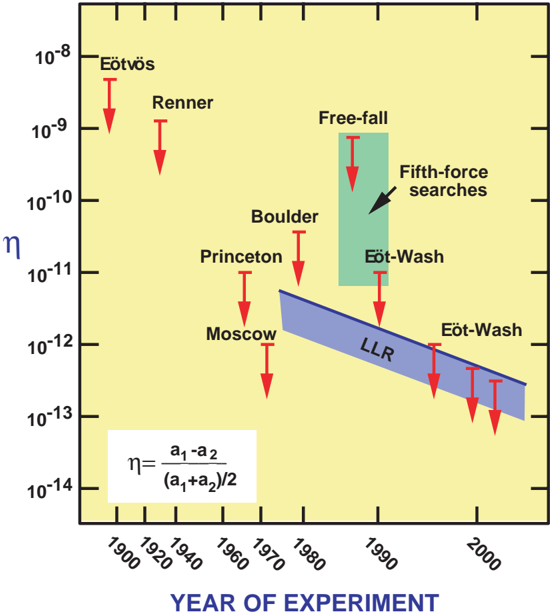
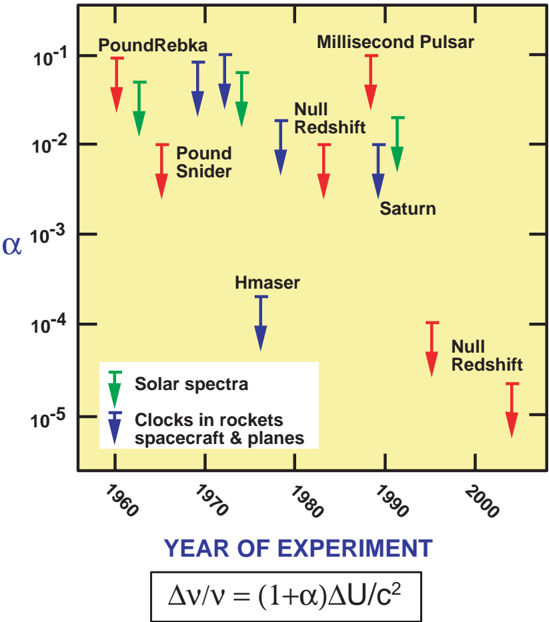
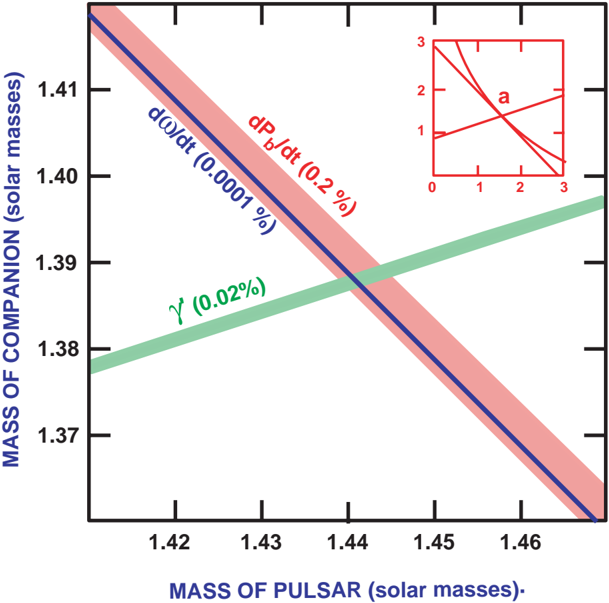
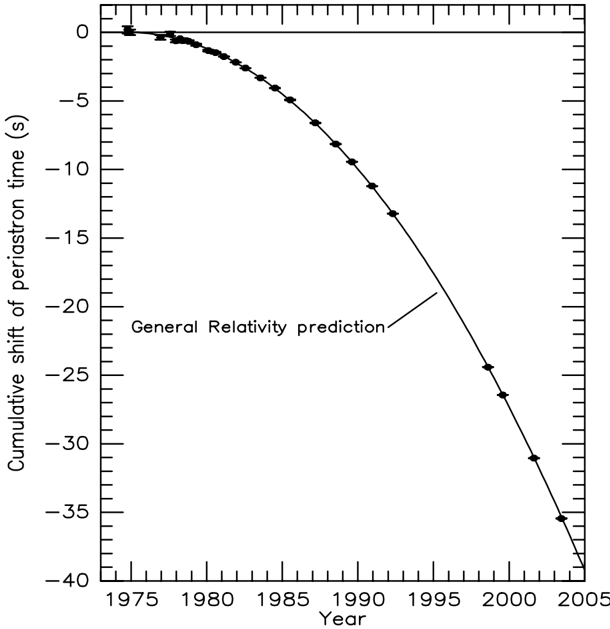
The status of experimental tests of general relativity and of theoretical frameworks for analyzing them is reviewed. Einstein’s equivalence principle (EEP) is well supported by experiments such as the Eötvös experiment, tests of special relativity, and the gravitational redshift experiment. Ongoing tests of EEP and of the inverse square law are searching for new interactions arising from unification or quantum gravity. Tests of general relativity at the post-Newtonian level have reached high precision, including the light deflection, the Shapiro time delay, the perihelion advance of Mercury, and the Nordtvedt effect in lunar motion. Gravitational wave damping has been detected in an amount that agrees with general relativity to better than half a percent using the Hulse-Taylor binary pulsar, and other binary pulsar systems have yielded other tests, especially of strong-field effects. When direct observation of gravitational radiation from astrophysical sources begins, new tests of general relativity will be possible.
Overview
The claims and statistics of this paper haven’t been checked yet.
Free: it reads the open-access text and checks the first 5 claims that cite a source we can check. Create a free account to check every claim.
Integrity signals
Registry
Cites
Statistics
Figures



Verification
Claims the paper makes
The claims and statistics of this paper haven’t been checked yet.
Free: it reads the open-access text and checks the first 5 claims that cite a source we can check. Create a free account to check every claim.
Claims other papers make about this one
Each is checked against this paper’s own text: does it say what the citing paper says it does?
The source backs part of the claim, not all of it — or backs it for a different population, condition or comparison.
In the citing paper
“The assumption of a metric coupling is actually well tested in the Solar system through 4 types of experiments; see Will (1993Will ( , 2006) ) for a detailed discussion and Peik et al. (2021), Herrmann and Ra ¨tzel (2023) for recent developments on quantum tests of relativity.”
From Fundamental constants: from measurement to the universe, a window on gravitation and cosmology (2025) · cites this paper as Will 2006
Experimental — accuracy not yet measuredIn the citing paper
“Its is a general formalism that introduces 10 phenomenological parameters to describe any possible deviation from General Relativity at the first post-Newtonian order (Will 1993(Will , 2006)); see also Blanchet 2006 for a review on higher orders.”
From Fundamental constants: from measurement to the universe, a window on gravitation and cosmology (2025) · cites this paper as Will 2006
Self-check
Percentages, sums and reported differences re-computed from the paper’s own numbers.
The self-check needs the paper’s full text.
Citations
Cites
Large Mass Hierarchy from a Small Extra Dimension
Randall, L., & Sundrum, R. (1999) · Physical Review Letters · doi:10.1103/physrevlett.83.3370 · Cited by 9,227
An Alternative to Compactification
Randall, L., & Sundrum, R. (1999) · Physical Review Letters · doi:10.1103/physrevlett.83.4690 · Cited by 7,217
An Alternative to Compactification
Randall, L., & Sundrum, R. (1999) · arXiv · doi:10.48550/arxiv.hep-th/9906064 · Cited by 7,212
Eidelman, S., Hayes, K. G., Olive, K. A., Aguilar-Benitez, M., Amsler, C., Asner, D., Babu, K. S., Barnett, R. M., Beringer, J., Burchat, P. R., et al. (2004) · Physics Letters B · doi:10.1016/j.physletb.2004.06.001 · Cited by 6,673
The hierarchy problem and new dimensions at a millimeter
Arkani–Hamed, N., Dimopoulos, S., & Dvali, G. (1998) · Physics Letters B · doi:10.1016/s0370-2693(98)00466-3 · Cited by 6,563 · cited 1×
“One set of ideas [13, 11, 221, 220] posited that some of the extra spatial dimensions that come with”
BackgroundNew dimensions at a millimeter to a fermi and superstrings at a TeV
Antoniadis, I., Arkani-Hamed, N., Dimopoulos, S., & Dvali, G. (1998) · Physics Letters B · doi:10.1016/s0370-2693(98)00860-0 · Cited by 3,915
Theory and Experiment in Gravitational Physics
Will, C. M. (2018) · doi:10.1017/9781316338612 · Cited by 3,637
Self-citationTheory and Experiment in Gravitational Physics
Will, C. M. (1993) · doi:10.1017/cbo9780511564246 · Cited by 3,632
Self-citationGravitation and Cosmology: Principles and Applications of the General Theory of Relativity
Weinberg, S., & Dicke, R. H. (1973) · American Journal of Physics · doi:10.1119/1.1987308 · Cited by 3,103
Lorentz-violating extension of the standard model
Colladay, D., & Kostelecký, V. A. (1998) · Physical Review D · doi:10.1103/physrevd.58.116002 · Cited by 2,403
LIGO: The Laser Interferometer Gravitational-Wave Observatory
Abramovici, A., Althouse, W. E., Drever, R. W. P., Gürsel, Y., Kawamura, S., Raab, F. J., Shoemaker, D., Sievers, L., Spero, R. E., Thorne, K. S., et al. (1992) · Science · doi:10.1126/science.256.5055.325 · Cited by 2,244
Gravitational Radiation from Post-Newtonian Sources and Inspiralling Compact Binaries
Blanchet, L. (2014) · Living Reviews in Relativity · doi:10.12942/lrr-2014-2 · Cited by 2,224
Quasi-Normal Modes of Stars and Black Holes
Kokkotas, K. D., & Schmidt, B. G. (1999) · Living Reviews in Relativity · doi:10.12942/lrr-1999-2 · Cited by 2,055
A test of general relativity using radio links with the Cassini spacecraft
Bertotti, B., Iess, L., & Tortora, P. (2003) · Nature · doi:10.1038/nature01997 · Cited by 2,017 · cited 2×
“A significant improvement was reported in 2003 from Doppler tracking of the Cassini spacecraft while it was on its way to Saturn [29], with a result γ − 1 = (2.”
MethodCPT violation and the standard model
Colladay, D., & Kostelecký, V. A. (1997) · Physical Review D · doi:10.1103/physrevd.55.6760 · Cited by 1,779 · cited 2×
“frame of the universe. The c2 framework focusses exclusively on classical electrodynamics. It has recently been extended to the entire standard model of particle physics by Kostelecky´ and colleagues [65, 66, 156]. The “StandardModel Extension”(SME) hasa largenumber ofLorentz-violatingparameters, opening up many new o…”
BackgroundInfluentialCutler, C., & Flanagan, É. E. (1994) · Physical Review D · doi:10.1103/physrevd.49.2658 · Cited by 1,615
On the relative motion of the Earth and the luminiferous ether
Michelson, A. A., & Morley, E. W. (1887) · American Journal of Science · doi:10.2475/ajs.s3-34.203.333 · Cited by 1,507
Massive and mass-less Yang-Mills and gravitational fields
van Dam, H., & Veltman, M. (1970) · Nuclear Physics B · doi:10.1016/0550-3213(70)90416-5 · Cited by 1,288
The string dilation and a least coupling principle
Damour, T., & Polyakov, A. M. (1994) · Nuclear Physics B · doi:10.1016/0550-3213(94)90143-0 · Cited by 1,233
The fundamental constants and their variation: observational and theoretical status
Uzan, J.-P. (2003) · Reviews of Modern Physics · doi:10.1103/revmodphys.75.403 · Cited by 1,162
Modern Tests of Lorentz Invariance
Mattingly, D. (2005) · Living Reviews in Relativity · doi:10.12942/lrr-2005-5 · Cited by 1,061
Tensor-multi-scalar theories of gravitation
Damour, T., & Esposito-Farese, G. (1992) · Classical and Quantum Gravity · doi:10.1088/0264-9381/9/9/015 · Cited by 1,016
Quasi-normal modes of stars and Black holes
Kokkotas, K. D., & Schmidt, B. G. (1999) · Max Planck Institute for Plasma Physics · Cited by 984
Burgay, M., D'Amico, N., Possenti, A., Manchester, R. N., Lyne, A. G., Joshi, B. C., McLaughlin, M. A., Kramer, M., Sarkissian, J. M., Camilo, F., et al. (2003) · Nature · doi:10.1038/nature02124 · Cited by 954
Gravity with a dynamical preferred frame
Jacobson, T., & Mattingly, D. (2001) · Physical Review D · doi:10.1103/physrevd.64.024028 · Cited by 944 · cited 1×
“The general class of theories was analyzed by Jacobson and collaborators [137, 183, 138, 99, 113], motivated in part by [156].”
BackgroundA Double-Pulsar System: A Rare Laboratory for Relativistic Gravity and Plasma Physics
Lyne, A. G., Burgay, M., Kramer, M., Possenti, A., Manchester, R. N., Camilo, F., McLaughlin, M. A., Lorimer, D. R., D'Amico, N., Joshi, B. C., et al. (2004) · Science · doi:10.1126/science.1094645 · Cited by 932
Three Hundred Years of Gravitation
McCrea, W. (1988) · Physics Bulletin · doi:10.1088/0031-9112/39/4/033 · Cited by 825
T ESTS OF THE G RAVITATIONAL I NVERSE-S QUARE L AW
Adelberger, E. G., Heckel, B. R., & Nelson, A. E. (2003) · Annual Review of Nuclear and Particle Science · doi:10.1146/annurev.nucl.53.041002.110503 · Cited by 819
Lunar Laser Ranging: A Continuing Legacy of the Apollo Program
Dickey, J. O., Bender, P. L., Faller, J. E., Newhall, X. X., Ricklefs, R. L., Ries, J. G., Shelus, P. J., Veillet, C., Whipple, A. L., Wiant, J. R., et al. (1994) · Science · doi:10.1126/science.265.5171.482 · Cited by 797
Coalescing binary systems of compact objects to (post)5/2-Newtonian order. V. Spin effects
Kidder, L. E. (1995) · Physical Review D · doi:10.1103/physrevd.52.821 · Cited by 768
Signals for Lorentz violation in electrodynamics
Kostelecký, V. A., & Mewes, M. (2002) · Physical Review D · doi:10.1103/physrevd.66.056005 · Cited by 767
Search for Time Variation of the Fine Structure Constant
Webb, J. K., Flambaum, V. V., Churchill, C. W., Drinkwater, M. J., & Barrow, J. D. (1999) · Physical Review Letters · doi:10.1103/physrevlett.82.884 · Cited by 754 · cited 1×
“[269, 193] announced that measurements of absorption lines in Mg, Al, Si, Cr, Fe, Ni, and Zn in quasars in the redshift range 0.”
BackgroundObserving binary inspiral in gravitational radiation: One interferometer
Finn, L. S., & Chernoff, D. F. (1993) · Physical Review D · doi:10.1103/physrevd.47.2198 · Cited by 736
Progress in Lunar Laser Ranging Tests of Relativistic Gravity
Williams, J. G., Turyshev, S. G., & Boggs, D. H. (2004) · Physical Review Letters · doi:10.1103/physrevlett.93.261101 · Cited by 719
Relativity in the Global Positioning System
Ashby, N. (2003) · Living Reviews in Relativity · doi:10.12942/lrr-2003-1 · Cited by 691
Test of Relativistic Gravitation with a Space-Borne Hydrogen Maser
Vessot, R. F. C., Levine, M. W., Mattison, E. M., Blomberg, E. L., Hoffman, T. E., Nystrom, G. U., Farrel, B. F., Decher, R., Eby, P. B., Baugher, C. R., et al. (1980) · Physical Review Letters · doi:10.1103/physrevlett.45.2081 · Cited by 649 · cited 1×
“The most precise standard redshift test to date was the Vessot–Levine rocket experiment that took place in June 1976 [264].”
BackgroundBinary and Millisecond Pulsars
Lorimer, D. R. (2008) · Living Reviews in Relativity · doi:10.12942/lrr-2008-8 · Cited by 616
(1970) · Cited by 600
High-precision timing of millisecond pulsars. 3: Long-term monitoring of PSRs B1855+09 and B1937+21
Kaspi, V. M., Taylor, J. H., & Ryba, M. F. (1994) · The Astrophysical Journal · doi:10.1086/174280 · Cited by 595
The equivalence of inertial and passive gravitational mass
Roll, P. G., Krotkov, R., & Dicke, R. H. (1964) · Annals of Physics · doi:10.1016/0003-4916(64)90259-3 · Cited by 561
Submillimeter Test of the Gravitational Inverse-Square Law: A Search for “Large” Extra Dimensions
Hoyle, C. D., Schmidt, U., Heckel, B. R., Adelberger, E. G., Gundlach, J. H., Kapner, D. J., & Swanson, H. E. (2001) · Physical Review Letters · doi:10.1103/physrevlett.86.1418 · Cited by 557
Gravitational phenomenology in higher-dimensional theories and strings
Kostelecký, V. A., & Samuel, S. (1989) · Physical Review D · doi:10.1103/physrevd.40.1886 · Cited by 546
Viking relativity experiment - Verification of signal retardation by solar gravity
Reasenberg, R. D., Shapiro, I. I., MacNeil, P. E., Goldstein, R. B., Breidenthal, J. C., Brenkle, J. P., Cain, D. L., Kaufman, T. M., Komarek, T. A., & Zygielbaum, A. I. (1979) · The Astrophysical Journal · doi:10.1086/183144 · Cited by 539
Gravitational-Radiation Damping of Compact Binary Systems to Second Post-Newtonian Order
Blanchet, L., Damour, T., Iyer, B. R., Will, C. M., & Wiseman, A. G. (1995) · Physical Review Letters · doi:10.1103/physrevlett.74.3515 · Cited by 533
Self-citationA confirmation of the general relativistic prediction of the Lense–Thirring effect
Ciufolini, I., & Pavlis, E. C. (2004) · Nature · doi:10.1038/nature03007 · Cited by 528
The last three minutes: Issues in gravitational-wave measurements of coalescing compact binaries
Cutler, C., Apostolatos, T. A., Bildsten, L., Finn, L. S., Flanagan, E. E., Kennefick, D., Markovic, D. M., Ori, A., Poisson, E., Sussman, G. J., et al. (1993) · Physical Review Letters · doi:10.1103/physrevlett.70.2984 · Cited by 527
Tensor-scalar cosmological models and their relaxation toward general relativity
Damour, T., & Nordtvedt, K. (1993) · Physical Review D · doi:10.1103/physrevd.48.3436 · Cited by 525
Strong-field tests of relativistic gravity and binary pulsars
Damour, T., & Taylor, J. H. (1992) · Physical Review D · doi:10.1103/physrevd.45.1840 · Cited by 523
Will, C. M., & Nordtvedt, K., Jr. (1972) · The Astrophysical Journal · doi:10.1086/151754 · Cited by 516
Self-citationPoisson, E., & Will, C. M. (1995) · Physical Review D · doi:10.1103/physrevd.52.848 · Cited by 515
Self-citationThe Search for Non-Newtonian Gravity
Fischbach, E., & Talmadge, C. L. (1999) · Springer eBooks · doi:10.1007/978-1-4612-1438-0 · Cited by 507
Nonperturbative continuity in graviton mass versus perturbative discontinuity
Deffayet, C., Dvali, G., Gabadadze, G., & Vainshtein, A. (2002) · Physical Review D · doi:10.1103/physrevd.65.044026 · Cited by 507
On the orbital period change of the binary pulsar PSR 1913 + 16
Damour, T., & Taylor, J. H. (1991) · The Astrophysical Journal · doi:10.1086/169585 · Cited by 496
Reanalysis of the Eo uml tvös experiment
Fischbach, E., Sudarsky, D., Szafer, A., Talmadge, C., & Aronson, S. H. (1986) · Physical Review Letters · doi:10.1103/physrevlett.56.3 · Cited by 482
General relativity as a cosmological attractor of tensor-scalar theories
Damour, T., & Nordtvedt, K. (1993) · Physical Review Letters · doi:10.1103/physrevlett.70.2217 · Cited by 471
Will, C. M. (1998) · Physical Review D · doi:10.1103/physrevd.57.2061 · Cited by 467
Self-citationSubmillimeter tests of the gravitational inverse-square law
Hoyle, C. D., Kapner, D. J., Heckel, B. R., Adelberger, E. G., Gundlach, J. H., Schmidt, U., & Swanson, H. E. (2004) · Physical Review D · doi:10.1103/physrevd.70.042004 · Cited by 459
Cosmological Constraints on Lorentz Violation in Electrodynamics
Kostelecký, V. A., & Mewes, M. (2001) · Physical Review Letters · doi:10.1103/physrevlett.87.251304 · Cited by 454
Hereditary effects in gravitational radiation
Blanchet, L., & Damour, T. (1992) · Physical Review D · doi:10.1103/physrevd.46.4304 · Cited by 443
New Limits on the Drift of Fundamental Constants from Laboratory Measurements
Fischer, M., Kolachevsky, N., Zimmermann, M., Holzwarth, R., Udem, T., Hänsch, T. W., Abgrall, M., Grünert, J., Maksimovic, I., Bize, S., et al. (2004) · Physical Review Letters · doi:10.1103/physrevlett.92.230802 · Cited by 431 · cited 2×
“The most recent experiments have exploited the techniques of laser cooling and trapping, and of atom fountains, in order to achieve extreme clock stability, and compared the Rubidium-87 hyperfine transition [181], the Mercury-199 ion electric quadrupole transition [31], the atomic Hydrogen 1S–2S transition [111], or a…”
BackgroundBeiträge zum Gesetze der Proportionalität von Trägheit und Gravität
v. Eötvös, R., Pekár, D., & Fekete, E. (1922) · Annalen der Physik · doi:10.1002/andp.19223730903 · Cited by 431
Testing General Relativity with Pulsar Timing
Stairs, I. H. (2003) · Living Reviews in Relativity · doi:10.12942/lrr-2003-5 · Cited by 430
Ryan, F. D. (1995) · Physical Review D · doi:10.1103/physrevd.52.5707 · Cited by 424
An Experimental Study of the Rate of a Moving Atomic Clock
Ives, H. E., & Stilwell, G. R. (1938) · Journal of the Optical Society of America · doi:10.1364/josa.28.000215 · Cited by 416
Violations of the equivalence principle in a dilaton-runaway scenario
Damour, T., Piazza, F., & Veneziano, G. (2002) · Physical Review D · doi:10.1103/physrevd.66.046007 · Cited by 411
Equivalence Principle for Massive Bodies. II. Theory
Nordtvedt, K. (1968) · Physical Review · doi:10.1103/physrev.169.1017 · Cited by 402
Estimating spinning binary parameters and testing alternative theories of gravity with LISA
Berti, E., Buonanno, A., & Will, C. M. (2005) · Physical Review D · doi:10.1103/physrevd.71.084025 · Cited by 400
Self-citationBlanchet, L., & Damour, T. (1986) · Philosophical Transactions of the Royal Society of London. Series A, Mathematical and Physical Sciences · doi:10.1098/rsta.1986.0125 · Cited by 397
Relativity parameters determined from lunar laser ranging
Williams, J. G., Newhall, X. X., & Dickey, J. O. (1996) · Physical Review D · doi:10.1103/physrevd.53.6730 · Cited by 390
Runaway Dilaton and Equivalence Principle Violations
Damour, T., Piazza, F., & Veneziano, G. (2002) · Physical Review Letters · doi:10.1103/physrevlett.89.081601 · Cited by 387
Jacobson, T., & Mattingly, D. (2004) · Physical Review D · doi:10.1103/physrevd.70.024003 · Cited by 382
Constraints on Lorentz violation from clock-comparison experiments
Kostelecký, V. A., & Lane, C. D. (1999) · Physical Review D · doi:10.1103/physrevd.60.116010 · Cited by 378
The Oklo bound on the time variation of the fine-structure constant revisited
Damour, T., & Dyson, F. (1996) · Nuclear Physics B · doi:10.1016/s0550-3213(96)00467-1 · Cited by 374 · cited 2×
“15 Oklo Natural Reactor [72] < 5× 10⁻¹² 10(9) Big Bang nucleosynthesis [179, 223] e-p mass ratio < 3× 10⁻¹⁵ 2.”
BackgroundSpin effects in the inspiral of coalescing compact binaries
Kidder, L. E., Will, C. M., & Wiseman, A. G. (1993) · Physical Review D · doi:10.1103/physrevd.47.r4183 · Cited by 366
Self-citationAnalytic Black Hole Perturbation Approach to Gravitational Radiation
Sasaki, M., & Tagoshi, H. (2003) · Living Reviews in Relativity · doi:10.12942/lrr-2003-6 · Cited by 360
Murphy, M. T., Webb, J. K., Flambaum, V. V., Dzuba, V. A., Churchill, C. W., Prochaska, J. X., Barrow, J. D., & Wolfe, A. M. (2001) · Monthly Notices of the Royal Astronomical Society · doi:10.1046/j.1365-8711.2001.04840.x · Cited by 355
Will, C. M., & Wiseman, A. G. (1996) · Physical Review D · doi:10.1103/physrevd.54.4813 · Cited by 350
Self-citationImproved Laser Test of the Isotropy of Space
Brillet, A., & Hall, J. L. (1979) · Physical Review Letters · doi:10.1103/physrevlett.42.549 · Cited by 350
Srianand, R., Chand, H., Petitjean, P., & Aracil, B. (2004) · Physical Review Letters · doi:10.1103/physrevlett.92.121302 · Cited by 335 · cited 2×
“Measurements by other groups have so far failed to confirm this non-zero effect [242, 51, 219]; a recent analysis of Mg absorption systems in quasars at 0.”
BackgroundUpper limits to submillimetre-range forces from extra space-time dimensions
Long, J. C., Chan, H. W., Churnside, A. B., Gulbis, E. A., Varney, M. C. M., & Price, J. C. (2003) · Nature · doi:10.1038/nature01432 · Cited by 328
Binary pulsars and relativistic gravity
Taylor, J. H. (1994) · Reviews of Modern Physics · doi:10.1103/revmodphys.66.711 · Cited by 324
Dimensional regularization of the gravitational interaction of point masses
Damour, T., Jaranowski, P., & Schäfer, G. (2001) · Physics Letters B · doi:10.1016/s0370-2693(01)00642-6 · Cited by 316
Variation of the Rate of Decay of Mesotrons with Momentum
Rossi, B., & Hall, D. B. (1941) · Physical Review · doi:10.1103/physrev.59.223 · Cited by 314
Shapiro, S. S., Davis, J. L., Lebach, D. E., & Gregory, J. S. (2004) · Physical Review Letters · doi:10.1103/physrevlett.92.121101 · Cited by 308
Modern Michelson-Morley Experiment using Cryogenic Optical Resonators
Müller, H., Herrmann, S., Braxmaier, C., Schiller, S., & Peters, A. (2003) · Physical Review Letters · doi:10.1103/physrevlett.91.020401 · Cited by 301
New tests of the universality of free fall
Su, Y., Heckel, B. R., Adelberger, E. G., Gundlach, J. H., Harris, M., Smith, G. L., & Swanson, H. E. (1994) · Physical Review D · doi:10.1103/physrevd.50.3614 · Cited by 301
Creminelli, P., Nicolis, A., Papucci, M., & Trincherini, E. (2005) · Journal of High Energy Physics · doi:10.1088/1126-6708/2005/09/003 · Cited by 299
Search for Variations of Fundamental Constants using Atomic Fountain Clocks
Marion, H., Pereira Dos Santos, F., Abgrall, M., Zhang, S., Sortais, Y., Bize, S., Maksimovic, I., Calonico, D., Grünert, J., Mandache, C., et al. (2003) · Physical Review Letters · doi:10.1103/physrevlett.90.150801 · Cited by 298 · cited 2×
“The most recent experiments have exploited the techniques of laser cooling and trapping, and of atom fountains, in order to achieve extreme clock stability, and compared the Rubidium-87 hyperfine transition [181], the Mercury-199 ion electric quadrupole transition [31], the atomic Hydrogen 1S–2S transition [111], or a…”
BackgroundAtomic Clocks and Variations of the Fine Structure Constant
Prestage, J. D., Tjoelker, R. L., & Maleki, L. (1995) · Physical Review Letters · doi:10.1103/physrevlett.74.3511 · Cited by 298
Experimental status of gravitational-strength forces in the sub-centimeter regime
Long, J. C., Chan, H. W., & Price, J. C. (1999) · Nuclear Physics B · doi:10.1016/s0550-3213(98)00711-1 · Cited by 293
Tail-transported temporal correlations in the dynamics of a gravitating system
Blanchet, L., & Damour, T. (1988) · Physical Review D · doi:10.1103/physrevd.37.1410 · Cited by 293
Limit on the Present Temporal Variation of the Fine Structure Constant
Peik, E., Lipphardt, B., Schnatz, H., Schneider, T., Tamm, C., & Karshenboim, S. G. (2004) · Physical Review Letters · doi:10.1103/physrevlett.93.170801 · Cited by 282
Upper Limit for the Anisotropy of Inertial Mass from Nuclear Resonance Experiments
Hughes, V. W., Robinson, H. G., & Beltran-Lopez, V. (1960) · Physical Review Letters · doi:10.1103/physrevlett.4.342 · Cited by 280
Model-Independent Constraints on Possible Modifications of Newtonian Gravity
Talmadge, C., Berthias, J. P., Hellings, R. W., & Standish, E. M. (1988) · Physical Review Letters · doi:10.1103/physrevlett.61.1159 · Cited by 276
Equivalence Principles and Electromagnetism
Ni, W.-T. (1977) · Physical Review Letters · doi:10.1103/physrevlett.38.301 · Cited by 271
Blanchet, L., Damour, T., & Iyer, B. R. (1995) · Physical Review D · doi:10.1103/physrevd.51.5360 · Cited by 269
Direct test of the constancy of fundamental nuclear constants
SHLYAKHTER, A. I. (1976) · Nature · doi:10.1038/264340a0 · Cited by 269 · cited 1×
“he energy of this level of only 20 meV over a billion years would change the capture cross-section from its present value by more than the observed amount. This was first analyzed in 1976 by Shlyakter [336]. Recent reanalyses of the Oklo data [91, 151, 293] lead to a bound on ˙α EM at the level of around 5×10⁻¹⁷ yr−1.…”
ResultBiller, S. D., Breslin, A. C., Buckley, J., Catanese, M., Carson, M., Carter-Lewis, D. A., Cawley, M. F., Fegan, D. J., Finley, J. P., Gaidos, J. A., et al. (1999) · Physical Review Letters · doi:10.1103/physrevlett.83.2108 · Cited by 269
Third post-Newtonian higher order ADM Hamilton dynamics for two-body point-mass systems
Jaranowski, P., & Schäfer, G. (1998) · Physical Review D · doi:10.1103/physrevd.57.7274 · Cited by 266
New varying speed of light theories
Magueijo, J. (2003) · Reports on Progress in Physics · doi:10.1088/0034-4885/66/11/r04 · Cited by 263
Improved Test of the Equivalence Principle for Gravitational Self-Energy
Baeßler, S., Heckel, B. R., Adelberger, E. G., Gundlach, J. H., Schmidt, U., & Swanson, H. E. (1999) · Physical Review Letters · doi:10.1103/physrevlett.83.3585 · Cited by 258
Relativistic Binary Pulsar B1913+16: Thirty Years of Observations and AnalysisPreprint
Weisberg, J. M., & Taylor, J. H. (2004) · arXiv (Cornell University) · doi:10.48550/arxiv.astro-ph/0407149 · Cited by 257
Gravitational-wave versus binary-pulsar tests of strong-field gravity
Damour, T., & Esposito-Farèse, G. (1998) · Physical Review D · doi:10.1103/physrevd.58.042001 · Cited by 249 · cited 1×
“Unfortunately, because of the near equality of the neutron star masses in the binary pulsar, dipole radiation is suppressed, and the bounds obtained are not competitive with the Cassini bound on γ [293], except for those generalized scalar-tensor theories, with β0 < 0 [74].”
BackgroundTesting the Stability of Fundamental Constants with theHg+199Single-Ion Optical Clock
Bize, S., Diddams, S. A., Tanaka, U., Tanner, C. E., Oskay, W. H., Drullinger, R. E., Parker, T. E., Heavner, T. P., Jefferts, S. R., Hollberg, L., et al. (2003) · Physical Review Letters · doi:10.1103/physrevlett.90.150802 · Cited by 249
A search for anisotropy of inertial mass using a free precession technique
Drever, R. W. P. (1961) · Philosophical Magazine · doi:10.1080/14786436108244418 · Cited by 247
Will, C. M. (1971) · The Astrophysical Journal · doi:10.1086/150804 · Cited by 247
Self-citationEquivalence Principle for Massive Bodies. I. Phenomenology
Nordtvedt, K. (1968) · Physical Review · doi:10.1103/physrev.169.1014 · Cited by 246
New Experimental Constraints on Non-Newtonian Forces below100 μm
Chiaverini, J., Smullin, S. J., Geraci, A. A., Weld, D. M., & Kapitulnik, A. (2003) · Physical Review Letters · doi:10.1103/physrevlett.90.151101 · Cited by 241
Gravitational Radiation from Post-Newtonian Sources and Inspiralling Compact Binaries
Blanchet, L. (2002) · Living Reviews in Relativity · doi:10.12942/lrr-2002-3 · Cited by 240
New limits on spatial anisotropy from optically-pumped sup201 Hg and Hg 199
Lamoreaux, S. K., Jacobs, J. P., Heckel, B. R., Raab, F. J., & Fortson, E. N. (1986) · Physical Review Letters · doi:10.1103/physrevlett.57.3125 · Cited by 235 · cited 1×
“s–Drever experiments yielded extremely accurate results, quoted as limits on the parameter δ≡ c−2−1 in Figure 2. Dramatic improvements were made in the 1980s using laser-cooled trapped atoms and ions [298, 221, 71]. This technique made it possible to reduce the broading of resonance lines caused by collisions, leading…”
Test of General Relativity and Measurement of the Lense-Thirring Effect with Two Earth Satellites
Ciufolini, I., Pavlis, E., Chieppa, F., Fernandes-Vieira, E., & Pérez-Mercader, J. (1998) · Science · doi:10.1126/science.279.5359.2100 · Cited by 233
Numerical relativity and compact binaries
Baumgarte, T. (2003) · Physics Reports · doi:10.1016/s0370-1573(02)00537-9 · Cited by 231
LISA - an ESA cornerstone mission for a gravitational wave observatory
Team, K. D. F. T. L. S. (1997) · Classical and Quantum Gravity · doi:10.1088/0264-9381/14/6/002 · Cited by 230
Pati, M. E., & Will, C. M. (2000) · Physical Review D · doi:10.1103/physrevd.62.124015 · Cited by 227
Self-citationNumerical relativity: a review
Lehner, L. (2001) · Classical and Quantum Gravity · doi:10.1088/0264-9381/18/17/202 · Cited by 224
Dilaton couplings at large distances
Taylor, T. R., & Veneziano, G. (1988) · Physics Letters B · doi:10.1016/0370-2693(88)91290-7 · Cited by 217
The Dipole Observed in the COBE DMR 4 Year Data
Lineweaver, C. H., Tenorio, L., Smoot, G. F., Keegstra, P., Banday, A. J., & Lubin, P. (1996) · The Astrophysical Journal · doi:10.1086/177846 · Cited by 216
Lebach, D. E., Corey, B. E., Shapiro, I. I., Ratner, M. I., Webber, J. C., Rogers, A. E. E., Davis, J. L., & Herring, T. A. (1995) · Physical Review Letters · doi:10.1103/physrevlett.75.1439 · Cited by 213
Post-Newtonian gravitational radiation from orbiting point masses
Wagoner, R. V., & Will, C. M. (1976) · The Astrophysical Journal · doi:10.1086/154886 · Cited by 213
Self-citationGravitational radiation, close binary systems, and the Brans-Dicke theory of gravity
Will, C. M., & Zaglauer, H. W. (1989) · The Astrophysical Journal · doi:10.1086/168016 · Cited by 205
Self-citationProbing the early universe: a review of primordial nucleosynthesis beyond the standard big bang
Malaney, R. A., & Mathews, G. J. (1993) · Physics Reports · doi:10.1016/0370-1573(93)90134-y · Cited by 205
Relativistic effects and solar oblateness from radar observations of planets and spacecraft
Pitjeva, E. V. (2005) · Astronomy Letters · doi:10.1134/1.1922533 · Cited by 204
Determination of the Geometry of the PSR B1913+16 System by Geodetic Precession
Kramer, M. (1998) · The Astrophysical Journal · doi:10.1086/306535 · Cited by 203
Limits for Spatial Anisotropy by Use of Nuclear-Spin-PolarizedBe+9Ions
Prestage, J. D., Bollinger, J. J., Itano, W. M., & Wineland, D. J. (1985) · Physical Review Letters · doi:10.1103/physrevlett.54.2387 · Cited by 200
New Nucleosynthesis Constraint on the Variation ofG
Copi, C. J., Davis, A. N., & Krauss, L. M. (2004) · Physical Review Letters · doi:10.1103/physrevlett.92.171301 · Cited by 193
Results of a new test of local Lorentz invariance: A search for mass anisotropy in Ne 21
Chupp, T. E., Hoare, R. J., Loveman, R. A., Oteiza, E. R., Richardson, J. M., Wagshul, M. E., & Thompson, A. K. (1989) · Physical Review Letters · doi:10.1103/physrevlett.63.1541 · Cited by 193
Testing scalar-tensor gravity with gravitational-wave observations of inspiralling compact binaries
Will, C. M. (1994) · Physical Review D · doi:10.1103/physrevd.50.6058 · Cited by 188
Self-citationPost-Newtonian parameters and constraints on Einstein-aether theory
Foster, B. Z., & Jacobson, T. (2006) · Physical Review D · doi:10.1103/physrevd.73.064015 · Cited by 187
On the origin of the light elements (Z<6)
Reeves, H. (1994) · Reviews of Modern Physics · doi:10.1103/revmodphys.66.193 · Cited by 186
Phasing of gravitational waves from inspiralling eccentric binaries
Damour, T., Gopakumar, A., & Iyer, B. R. (2004) · Physical Review D · doi:10.1103/physrevd.70.064028 · Cited by 185
Experimental constraints on strong-field relativistic gravity
Taylor, J. H., Wolszzan, A., Damour, T., & Weisberg, J. M. (1992) · Nature · doi:10.1038/355132a0 · Cited by 183
Bounding the mass of the graviton using binary pulsar observations
Finn, L. S., & Sutton, P. J. (2002) · Physical Review D · doi:10.1103/physrevd.65.044022 · Cited by 179
Poincaré invariance in the ADM Hamiltonian approach to the general relativistic two-body problem
Damour, T., Jaranowski, P., & Schäfer, G. (2000) · Physical Review D · doi:10.1103/physrevd.62.021501 · Cited by 178
New Limit on Signals of Lorentz Violation in Electrodynamics
Lipa, J. A., Nissen, J. A., Wang, S., Stricker, D. A., & Avaloff, D. (2003) · Physical Review Letters · doi:10.1103/physrevlett.90.060403 · Cited by 178
The confrontation between general relativity and experiment: An update1
Will, C. M. (1984) · Physics Reports · doi:10.1016/0370-1573(84)90119-4 · Cited by 178
Self-citationThe Measurement of the Light Deflection from Jupiter: Experimental Results
Fomalont, E. B., & Kopeikin, S. M. (2003) · The Astrophysical Journal · doi:10.1086/378785 · Cited by 175
Analytic Black Hole Perturbation Approach to Gravitational Radiation
Sasaki, M., & Tagoshi, H. (2003) · DOAJ (DOAJ: Directory of Open Access Journals) · Cited by 170
Binary and Millisecond Pulsars
Lorimer, D. R. (2005) · Living Reviews in Relativity · doi:10.12942/lrr-2005-7 · Cited by 169
Probing the variability of the fine-structure constant with the VLT UVES
Quast, R., Reimers, D., & Levshakov, S. A. (2003) · Springer Link (Chiba Institute of Technology) · doi:10.1051/0004-6361:20040013/pdf · Cited by 167
Tests of Lorentz Invariance using a Microwave Resonator
Wolf, P., Bize, S., Clairon, A., Luiten, A. N., Santarelli, G., & Tobar, M. E. (2003) · Physical Review Letters · doi:10.1103/physrevlett.90.060402 · Cited by 166
Probing the variability of the fine-structure constant with the VLT/UVES
Quast, R., Reimers, D., & Levshakov, S. A. (2004) · Astronomy & Astrophysics · doi:10.1051/0004-6361:20040013 · Cited by 163
Zur Theorie der Gravitation vom Standpunkt des Relativitätsprinzips
Nordström, G. (1913) · Annalen der Physik · doi:10.1002/andp.19133471303 · Cited by 160
Damour, T., Jaranowski, P., & Schäfer, G. (2001) · Physical Review D · doi:10.1103/physrevd.63.044021 · Cited by 160
Restricted Proof that the Weak Equivalence Principle Implies the Einstein Equivalence Principle
Lightman, A. P., & Lee, D. L. (1973) · Physical Review D · doi:10.1103/physrevd.8.364 · Cited by 159 · cited 1×
“2 The TH μ formalism The first successful attempt to prove Schiff’s conjecture more formally was made by Lightman and Lee [166].”
BackgroundFischbach, E., & Talmadge, C. (1992) · Nature · doi:10.1038/356207a0 · Cited by 159
Astrophysical limits on quantum gravity motivated birefringence
Gleiser, R., & Kozameh, C. (2001) · Physical Review D · doi:10.1103/physrevd.64.083007 · Cited by 156
Test of the second postulate of special relativity in the GeV region
Alväger, T., Farley, F. J. M., Kjellman, J., & Wallin, L. (1964) · Physics Letters · doi:10.1016/0031-9163(64)91095-9 · Cited by 153
Helioseismic determination of the solar gravitational quadrupole moment
Pijpers, F. P. (1998) · Monthly Notices of the Royal Astronomical Society · doi:10.1046/j.1365-8711.1998.01801.x · Cited by 153
THE PROBLEM OF MOTION IN NEWTONIAN AND EINSTEINIAN GRAVITY
Damour, T. (1986) · Cited by 152
PSR J1756-2251: A New Relativistic Double Neutron Star System
Faulkner, A. J., Krämer, M., Lyne, A. G., Manchester, R. N., McLaughlin, M. A., Stairs, I. H., Hobbs, G. B., Possenti, A., Lorimer, D. R., D’Amico, N., et al. (2004) · The Astrophysical Journal · doi:10.1086/427776 · Cited by 152
Chapter 1. Black Hole Perturbation
Mino, Y., Sasaki, M., Shibata, M., Tagoshi, H., & Tanaka, T. (1997) · Progress of Theoretical Physics Supplement · doi:10.1143/ptps.128.1 · Cited by 152
Memoirs of the American Philosophical Society 89
Scharfe, H., & Metalanguage, P. (1973) · Cited by 150
Test of the principle of equivalence by a null gravitational red-shift experiment
Turneaure, J. P., Will, C. M., Farrell, B. F., Mattison, E. M., & Vessot, R. F. C. (1983) · Physical Review D · doi:10.1103/physrevd.27.1705 · Cited by 149
Self-citationSecond-post-Newtonian generation of gravitational radiation
Blanchet, L. (1995) · Physical Review D · doi:10.1103/physrevd.51.2559 · Cited by 146
Test of constancy of speed of light with rotating cryogenic optical resonators
Antonini, P., Okhapkin, M., Göklü, E., & Schiller, S. (2005) · Physical Review A · doi:10.1103/physreva.71.050101 · Cited by 146
Weisberg, J. M., & Taylor, J. H. (2002) · The Astrophysical Journal · doi:10.1086/341803 · Cited by 144
Stanwix, P. L., Tobar, M. E., Wolf, P., Susli, M., Locke, C. R., Ivanov, E. N., Winterflood, J., & van Kann, F. (2005) · Physical Review Letters · doi:10.1103/physrevlett.95.040404 · Cited by 143
Vector-Metric Theory of Gravity
Hellings, R. W., & Nordtvedt, K. (1973) · Physical Review D · doi:10.1103/physrevd.7.3593 · Cited by 142
Testing general relativity with the BepiColombo radio science experiment
Milani, A., Vokrouhlický, D., Villani, D., Bonanno, C., & Rossi, A. (2002) · Physical Review D · doi:10.1103/physrevd.66.082001 · Cited by 142
Visser, M. (1998) · General Relativity and Gravitation · doi:10.1023/a:1026611026766 · Cited by 141
Test of the Isotropy of the Speed of Light Using Fast-Beam Laser Spectroscopy
Riis, E., Andersen, L.-U. A., Bjerre, N., Poulsen, O., Lee, S. A., & Hall, J. L. (1988) · Physical Review Letters · doi:10.1103/physrevlett.60.81 · Cited by 140
Test of Special Relativity or of the Isotropy of Space by Use of Infrared Masers
Jaseja, T. S., Javan, A., Murray, J., & Townes, C. H. (1964) · Physical Review · doi:10.1103/physrev.133.a1221 · Cited by 140
Itoh, Y., & Futamase, T. (2003) · Physical Review D · doi:10.1103/physrevd.68.121501 · Cited by 139
Searches for New Macroscopic Forces
Adelberger, E. G., Heckel, B. R., Stubbs, C. W., & Rogers, W. F. (1991) · Annual Review of Nuclear and Particle Science · doi:10.1146/annurev.ns.41.120191.001413 · Cited by 139
Jaranowski, P., & Schäfer, G. (1999) · Physical Review D · doi:10.1103/physrevd.60.124003 · Cited by 139
Testing the Constancy of the Gravitational Constant Using Helioseismology
Guenther, D. B., Krauss, L. M., & Demarque, P. (1998) · The Astrophysical Journal · doi:10.1086/305567 · Cited by 137
New tests of the strong equivalence principle using binary-pulsar data
Damour, T., & Schäfer, G. (1991) · Physical Review Letters · doi:10.1103/physrevlett.66.2549 · Cited by 137
Thorne, K. S. (1998) · Princeton University Press eBooks · doi:10.1515/9780691227498-010 · Cited by 137
Arecibo Pulsar Survey Using ALFA. II. The Young, Highly Relativistic Binary Pulsar J1906+0746
Lorimer, D. R., Stairs, I. H., Freire, P. C. C., Cordes, J. M., Camilo, F., Faulkner, A. J., Lyne, A. G., Nice, D. J., Ransom, S. M., Arzoumanian, Z., et al. (2006) · The Astrophysical Journal · doi:10.1086/499918 · Cited by 134
Test of the isotropy of the one-way speed of light using hydrogen-maser frequency standards
Krisher, T. P., Maleki, L., Lutes, G. F., Primas, L. E., Logan, R. T., Anderson, J. D., & Will, C. M. (1990) · Physical Review D · doi:10.1103/physrevd.42.731 · Cited by 130
Self-citationDetecting a Tail Effect in Gravitational-Wave Experiments
Blanchet, L., & Sathyaprakash, B. S. (1995) · Physical Review Letters · doi:10.1103/physrevlett.74.1067 · Cited by 129
New Analysis of the Interferometer Observations of Dayton C. Miller
Shankland, R. S., McCuskey, S. W., Leone, F. C., & Kuerti, G. (1955) · Reviews of Modern Physics · doi:10.1103/revmodphys.27.167 · Cited by 128
Petrov, Y. V., Nazarov, A. I., Onegin, M. S., Petrov, V. Y., & Sakhnovsky, E. G. (2006) · Physical Review C · doi:10.1103/physrevc.74.064610 · Cited by 127 · cited 2×
“r a billion years would change the capture cross-section from its present value by more than the observed amount. This was first analyzed in 1976 by Shlyakter [336]. Recent reanalyses of the Oklo data [91, 151, 293] lead to a bound on ˙α EM at the level of around 5×10⁻¹⁷ yr−1. In a similar manner, recent reanalyses of…”
BackgroundResultInfluentialThe discovery of the binary pulsar
Hulse, R. A. (1994) · Reviews of Modern Physics · doi:10.1103/revmodphys.66.699 · Cited by 127
Will, C. M. (2005) · Physical Review D · doi:10.1103/physrevd.71.084027 · Cited by 124
Self-citationNew tests of Einstein's equivalence principle and Newton's inverse-square law
Adelberger, E. G. (2001) · Classical and Quantum Gravity · doi:10.1088/0264-9381/18/13/302 · Cited by 123
Detection strategies for scalar gravitational waves with interferometers and resonant spheres
Maggiore, M., & Nicolis, A. (2000) · Physical Review D · doi:10.1103/physrevd.62.024004 · Cited by 123
Clock synchronization and isotropy of the one-way speed of light
Will, C. M. (1992) · Physical Review D · doi:10.1103/physrevd.45.403 · Cited by 122 · cited 2×
“Such kinematical approaches have been discussed by Robertson, Mansouri and Sexl, and Will (see [279]).”
MethodSelf-citationLimits on the Variation of Fundamental Atomic Quantities over Cosmic Time Scales
Wolfe, A. M., Brown, R. L., & Roberts, M. S. (1976) · Physical Review Letters · doi:10.1103/physrevlett.37.179 · Cited by 121
Bambi, C., Giannotti, M., & Villante, F. L. (2005) · Physical Review D · doi:10.1103/physrevd.71.123524 · Cited by 121
Static post-Newtonian equivalence of general relativity and gravity with a dynamical preferred frame
Eling, C., & Jacobson, T. (2004) · Physical Review D · doi:10.1103/physrevd.69.064005 · Cited by 119
Energy conservation and the principle of equivalence
Haugan, M. P. (1979) · Annals of Physics · doi:10.1016/0003-4916(79)90238-0 · Cited by 118
Testing general relativity and probing the merger history of massive black holes with LISA
Berti, E., Buonanno, A., & Will, C. M. (2005) · Classical and Quantum Gravity · doi:10.1088/0264-9381/22/18/s08 · Cited by 117
Self-citationTesting alternative theories of gravity using LISA
Will, C. M., & Yunes, N. (2004) · Classical and Quantum Gravity · doi:10.1088/0264-9381/21/18/006 · Cited by 117
Self-citationKrólak, A., Kokkotas, K. D., & Schäfer, G. (1995) · Physical Review D · doi:10.1103/physrevd.52.2089 · Cited by 115
Testing scalar-tensor gravity using space gravitational-wave interferometers
Scharre, P. D., & Will, C. M. (2002) · Physical Review D · doi:10.1103/physrevd.65.042002 · Cited by 110
Self-citationAn ‘aether drift’ experiment based on the Mössbauer effect
Champeney, D. C., Isaak, G. R., & Khan, A. (1963) · Physics Letters · doi:10.1016/0031-9163(63)90312-3 · Cited by 108
Big bang nucleosynthesis and tensor-scalar gravity
Damour, T., & Pichon, B. (1999) · Physical Review D · doi:10.1103/physrevd.59.123502 · Cited by 107 · cited 1×
“certainties, one can assess the quantitative difference between the BBN predictions of GR and scalar-tensor gravity under strong-field conditions and compare with observations. For recent analyses, see [322, 104, 79, 80]. In addition, many alternative theories, such as f(R) theories have been developed in order to provi…”
Stairs, I. H., Faulkner, A. J., Lyne, A. G., Kramer, M., Lorimer, D. R., McLaughlin, M. A., Manchester, R. N., Hobbs, G. B., Camilo, F., Possenti, A., et al. (2005) · The Astrophysical Journal · doi:10.1086/432526 · Cited by 105
New experimental limit on the validity of local position invariance
Bauch, A., & Weyers, S. (2002) · Physical Review D · doi:10.1103/physrevd.65.081101 · Cited by 103
Is the Speed of Light Independent of the Velocity of the Source?
Brecher, K. (1977) · Physical Review Letters · doi:10.1103/physrevlett.39.1051 · Cited by 101
Ivanchik, A., Petitjean, P., Varshalovich, D., Aracil, B., Srianand, R., Chand, H., Ledoux, C., & Boissé, P. (2005) · Astronomy & Astrophysics · doi:10.1051/0004-6361:20052648 · Cited by 99
Propagation Speed of Gravity and the Relativistic Time Delay
Will, C. M. (2003) · The Astrophysical Journal · doi:10.1086/375164 · Cited by 97
Self-citationGopakumar, A., & Iyer, B. R. (1997) · Physical Review D · doi:10.1103/physrevd.56.7708 · Cited by 96
IMPROVING LLR TESTS OF GRAVITATIONAL THEORY
WILLIAMS, J. G., TURYSHEV, S. G., & MURPHY, T. W. (2004) · International Journal of Modern Physics D · doi:10.1142/s0218271804004682 · Cited by 96
Reexamination of the187Rebound on the variation of fundamental couplings
Olive, K. A., Pospelov, M., Qian, Y.-Z., Manhès, G., Vangioni-Flam, E., Coc, A., & Cassé, M. (2004) · Physical Review D · doi:10.1103/physrevd.69.027701 · Cited by 95
Ġ/G and a cosmological acceleration of gravitationally compact bodies
Nordtvedt, K. (1990) · Physical Review Letters · doi:10.1103/physrevlett.65.953 · Cited by 93
Solar system tests of general relativity: recent results and present plans
Shapiro, I. I. (1990) · General Relativity and Gravitation, 1989 · doi:10.1017/cbo9780511564178.025 · Cited by 93
Post-Newtonian generation of gravitational waves.
Luc Blanchet, A., & Damour, T. (1989) · French digital mathematics library (Numdam) · Cited by 91
STEP (satellite test of the equivalence principle)
Sumner, T. J., Anderson, J. P., Blaser, J. P., Cruise, A. M., Damour, T., Dittus, H., Everitt, C. W. F., Foulon, B., Jafry, Y., Kent, B. J., et al. (2006) · Advances in Space Research · doi:10.1016/j.asr.2006.09.019 · Cited by 91
Research works printed but not linked: 16
- Ashby, N., "Relativistic effects in the Global Positioning System", in Dadhich, N., and Narlikar, J.V., eds., Gravitation and Relativity: At the Turn of the Millenium, Proceed- ings of the 15th International Conference on General Relativity and Gravitation (GR-15), held at IUCAA, Pune, India, December 16-21, 1997, 231-258, (Inter-University Center for Astronomy and Astrophysics, Pune, India, 1998). 2.1.3
- Brillet, A., "VIRGO -Status Report, November 1997", in Coccia, E., Veneziano, G., and Pizzella, G., eds., Second Edoardo Amaldi Conference on Gravitational Waves, Proceedings of the conference, held at CERN, Switzerland, 1-4 July, 1997, vol. 4 of Edoardo Amaldi Foundation Series, 86-96, (World Scientific, Singapore;
- River Edge, U.S.A., 1998). 6.1
- Damour, T., "Gravitation, experiment and cosmology", in Gazis, E.N., Koutsoumbas, G., Tracas, N.D., and Zoupanos, G., eds., Proceedings of the 5th Hellenic School and Workshops on Elementary Particle Physics, Proceedings of the workshops, held at Corfu, Greece, 3-24 September 1995, 332-368.
- Dicke, R.H., "Experimental relativity", in DeWitt, C.M., and DeWitt, B.S., eds., Relativity, Groups and Topology. Relativité, Groupes et Topologie, Lectures delivered at Les Houches during the 1963 session of the Summer School of Theoretical Physics, University of Grenoble, 165-313, (Gordon and Breach, New York, U.S.A., 1964). 2.1
- Fritschel, P., "The LIGO project: Progress and plans", in Coccia, E., Veneziano, G., and Pizzella, G., eds., Second Edoardo Amaldi Conference on Gravitational Waves, Proceedings of the conference, held at CERN, Switzerland, 1-4 July, 1997, Edoardo Amaldi Foundation Series, 74-85, (World Scientific, Singapore; River Edge, U.S.A., 1998). 6.1 Living Reviews in Relativity http://www.livingreviews.org/lrr-2006-3
- Froeschlé, M., Mignard, F., and Arenou, F., "Determination of the PPN parameter γ with the Hipparcos data", in Proceedings from the Hipparcos Venice '97 Symposium, Proceedings of the symposium held on 13-16 May 1997, (ESA, Noordwijk, Netherlands, 1997). URL (cited on 15 January 2001): http://astro.estec.esa.nl/Hipparcos/venice.html. 3.4.1
- Kopeikin, S.M., "Comments on the paper by S. Samuel "On the speed of gravity and the Jupiter/Quasar measurement"", (January, 2005). URL (cited on 15 February 2006): http://arXiv.org/abs/gr-qc/0501001. 3.4.3 · arXiv
- Mattingly, D., and Jacobson, T.A., "Relativistic Gravity with a Dynamical Preferred Frame", in Kostelecký, V.A., ed., CPT and Lorentz Symmetry II, Proceedings of the Second Meeting, held at Indiana University, Bloomington, August 15-18, 2001, 331-335, (World Scientific, Singapore;
- Misner, C.W., Thorne, K.S., and Wheeler, J.A., Gravitation, (W.H. Freeman, San Francisco, U.S.A., 1973). 3.1.1, 3.2, 4.3
- Müller, J., Schneider, M., Nordtvedt, K., and Vokrouhlický, D., "What can LLR provide to relativity?", in Piran, T., ed., The Eighth Marcel Grossmann Meeting on Recent De- velopments in Theoretical and Experimental General Relativity, Gravitation and Relativistic Field Theories, Proceedings of the meeting held at the Hebrew University of Jerusalem, June 22-27, 1997, 1151-1153, (World Scientific, Singapore, 1999). 3.6.1, 3.6.3
- of Edoardo Amaldi Foundation Series, 105-114, (World Scientific, Singapore; River Edge, U.S.A., 1998). 6.1
- Paterno, L., Sofia, S., and di Mauro, M.P., "The rotation of the Sun's core", Astron. Astro- phys., 314, 940-946, (1996). 3.5
- Noll, C., and Pearlman, M., eds., Proceedings of the 13th International Workshop on Laser Ranging: Science Session and Full Proceedings CD-ROM, "Toward Millimeter Accuracy" Workshop held in Washington, DC, October 07-11, 2002, NASA Conference Proceedings, 211-248.
- River Edge, U.S.A., 1995). Related online version (cited on 15 January 2001): http://arXiv.org/abs/gr-qc/9506086. 4.2, 6.1 · arXiv
- Will, C.M., Was Einstein Right?: Putting General Relativity to the Test, (Basic Books, New York, U.S.A., 1993), 2nd edition. 1
Cited by
Modified gravity and cosmology
Clifton, T., Ferreira, P. G., Padilla, A., & Skordis, C. (2012) · Physics Reports · doi:10.1016/j.physrep.2012.01.001 · Cited by 4,146
De Felice, A., & Tsujikawa, S. (2010) · Living Reviews in Relativity · doi:10.12942/lrr-2010-3 · Cited by 3,871
A Massive Pulsar in a Compact Relativistic Binary
Antoniadis, J., Freire, P. C. C., Wex, N., Tauris, T. M., Lynch, R. S., van Kerkwijk, M. H., Kramer, M., Bassa, C., Dhillon, V. S., Driebe, T., et al. (2013) · Science · doi:10.1126/science.1233232 · Cited by 3,831
Capozziello, S., & De Laurentis, M. (2011) · Physics Reports · doi:10.1016/j.physrep.2011.09.003 · Cited by 3,321
Planck 2018 results: I. Overview and the cosmological legacy of Planck
Planck Collaboration, Aghanim, N., Akrami, Y., Arroja, F., Ashdown, M., Aumont, J., Baccigalupi, C., Ballardini, M., Banday, A. J., Barreiro, R. B., et al. (2020) · Astronomy & Astrophysics · doi:10.1051/0004-6361/201833880 · Cited by 1,635
Metadata
- Authors
- Will, C. M.
- Affiliations
- Washington University in St. Louis (US)
- Corresponding author
- Will, Clifford M.
- ORCID
- Will, Clifford M.
- Venue
- Living Reviews in Relativity
- Published
- 2006-03-27
- Volume
- 9
- Issue
- 1
- ISSN
- 1433-8351 (ISSN-L)
- 2367-3613
- OpenAlex
- W4246028735
- Cited by
- 1,606
- References
- 299
- Citations by year
- 2026: 21 · 2025: 42 · 2024: 46 · 2023: 50 · 2022: 54 · 2021: 72 · 2020: 64 · 2019: 109 · 2018: 51 · 2017: 68 · 2016: 107 · 2015: 121 · 2014: 128 · 2013: 130 · 2012: 123
- FWCI
- 6.85
- Type
- journal article
- Language
- en
- Update notices
- new_version (2014-06-11)
- Open access
- diamond
- doi.org
- Licence
- cc-by
- creativecommons.org/licenses/by/4.0 (tdm)
- creativecommons.org/licenses/by/4.0 (vor)
- Locations
- Living Reviews in Relativity (publishedVersion, cc-by)
- arXiv (Cornell University) (publishedVersion)
- Europe PMC (PubMed Central) (publishedVersion)
- CERN Document Server (European Organization for Nuclear Research) (submittedVersion)
- arXiv (Cornell University)
- Funders
- National Aeronautics and Space Administration
- Centre National de la Recherche Scientifique
- Topics
- Physical Sciences › Physics and Astronomy › Astronomy and Astrophysics › Pulsars and Gravitational Waves Research
- Physical Sciences › Physics and Astronomy › Astronomy and Astrophysics › Relativity and Gravitational Theory
- Physical Sciences › Physics and Astronomy › Astronomy and Astrophysics › Cosmology and Gravitation Theories
- Keywords
- general relativity, tests of general relativity, equivalence principle, Eötvös experiment, gravitational redshift, inverse-square law, post-Newtonian tests, light deflection, Shapiro delay, Nordtvedt effect, gravitational wave damping, Hulse-Taylor binary pulsar, strong-field tests, quantum gravity, unification
About these checks
Registry, retraction, Cites and statistics results are computed, not judged, with one exception: a printed reference that no index lists is read once by a model before it counts as a citation error. Claims are extracted by a model and kept only when their quote appears verbatim in the text; each cited source is then checked, with a model’s help, for whether it says what the claim relies on. Those verdicts can be wrong — read the claim’s quote and the cited source before relying on one.
Statistics and arithmetic are recomputed, not judged.
Confidence bands are shown only for fields calibrated on our annotated test set. None is calibrated yet, so no band is shown.
What counts as a claim ›How we measure confidence ›How we check this ›
Are you an author, or do you see a problem with this page? Request a review
Data sources
Bibliographic data: Semantic Scholar, OpenAlex, Crossref.
Contains information from the Semantic Scholar Academic Graph Datasets, made available under the ODC Attribution License (ODC-BY 1.0).
Semantic Scholar’s data is described in: Kinney, R., et al. (2023). The Semantic Scholar Open Data Platform. arXiv:2301.10140.
