

Bioactive Compounds and Bioactivities of Ginger (Zingiber officinale Roscoe)
Open accessThe DOI matches its Crossref record; 117 of the 117 references it cites were found in a registry or an index.
Abstract
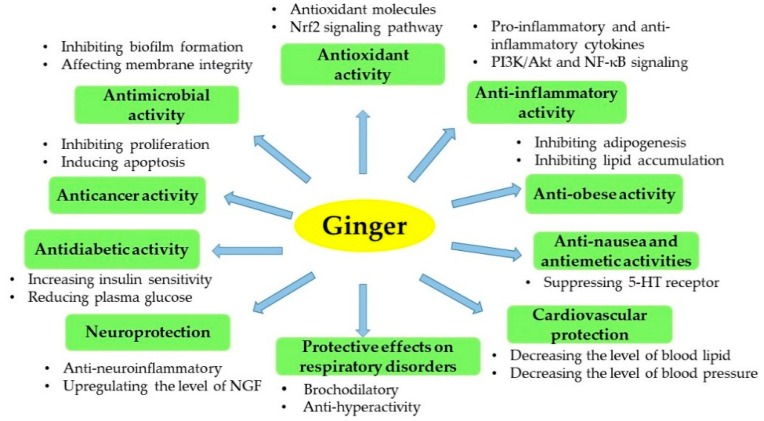
Ginger (Zingiber officinale Roscoe) is a common and widely used spice. It is rich in various chemical constituents, including phenolic compounds, terpenes, polysaccharides, lipids, organic acids, and raw fibers. The health benefits of ginger are mainly attributed to its phenolic compounds, such as gingerols and shogaols. Accumulated investigations have demonstrated that ginger possesses multiple biological activities, including antioxidant, anti-inflammatory, antimicrobial, anticancer, neuroprotective, cardiovascular protective, respiratory protective, antiobesity, antidiabetic, antinausea, and antiemetic activities. In this review, we summarize current knowledge about the bioactive compounds and bioactivities of ginger, and the mechanisms of action are also discussed. We hope that this updated review paper will attract more attention to ginger and its further applications, including its potential to be developed into functional foods or nutraceuticals for the prevention and management of chronic diseases.
Overview
The claims and statistics of this paper haven’t been checked yet.
Free: it reads the open-access text and checks the first 5 claims that cite a source we can check. Create a free account to check every claim.
Integrity signals
Registry
Cites
Statistics
Figures
Verification
Claims the paper makes
The claims and statistics of this paper haven’t been checked yet.
Free: it reads the open-access text and checks the first 5 claims that cite a source we can check. Create a free account to check every claim.
Claims other papers make about this one
Each is checked against this paper’s own text: does it say what the citing paper says it does?
In the citing paper
“A meta-analysis of 13 randomized control trials (n = 1174) found that ginger significantly improves overall pregnancy-associated nausea and vomiting, comparable to vitamin B6 [230] and as effective as standard antiemetics like dimenhydrinate [231].”
From Nutritional Approaches to Enhance GLP-1 Analogue Therapy in Obesity: A Narrative Review (2025) · cites this paper as [231]
Self-check
Percentages, sums and reported differences re-computed from the paper’s own numbers.
The self-check needs the paper’s full text.
Citations
Cites
Bray, F., Ferlay, J., Soerjomataram, I., Siegel, R. L., Torre, L. A., & Jemal, A. (2018) · CA: A Cancer Journal for Clinicians · doi:10.3322/caac.21492 · Cited by 84,109
Targeting Free Radicals in Oxidative Stress-Related Human Diseases
Poprac, P., Jomova, K., Simunkova, M., Kollar, V., Rhodes, C. J., & Valko, M. (2017) · Trends in Pharmacological Sciences · doi:10.1016/j.tips.2017.04.005 · Cited by 1,107 · cited 1×
“It has been known that overproduction of free radicals, such as reactive oxygen species (ROS), plays an important part in the development of many chronic diseases [17].”
BackgroundPlant-derived exosomal MicroRNAs shape the gut microbiota
Teng, Y., Ren, Y., Sayed, M., Hu, X., Lei, C., Kumar, A., Hutchins, E., Mu, J., Deng, Z., Luo, C., et al. (2018) · Cell Host & Microbe · doi:10.1016/j.chom.2018.10.001 · Cited by 1,027 · cited 1×
“Moreover, microRNAs of ginger exosome-like nanoparticles (GELN) ameliorated mouse colitis by inducing the production of IL-22, a barrier function improvement factor [41].”
BackgroundZhang, M., Viennois, E., Prasad, M., Zhang, Y., Wang, L., Zhang, Z., Han, M. K., Xiao, B., Xu, C., Srinivasan, S., et al. (2016) · Biomaterials · doi:10.1016/j.biomaterials.2016.06.018 · Cited by 1,026 · cited 12×
“Besides, ginger extract and zingerone inhibited NF-κB activation and decreased the level of IL-1β in the colons of mice, which alleviated colitis induced by 2, 4, 6-trinitrobenzene sulfonic acid [38].”
BackgroundInfluentialAntioxidant capacities and total phenolic contents of 62 fruits
Fu, L., Xu, B.-T., Xu, X.-R., Gan, R.-Y., Zhang, Y., Xia, E.-Q., & Li, H.-B. (2011) · Food Chemistry · doi:10.1016/j.foodchem.2011.04.079 · Cited by 757
Self-citationGinger and Its Constituents: Role in Prevention and Treatment of Gastrointestinal Cancer
Prasad, S., & Tyagi, A. K. (2015) · Gastroenterology Research and Practice · doi:10.1155/2015/142979 · Cited by 439 · cited 2×
“Besides these, polysaccharides, lipids, organic acids, and raw fibers are also present in ginger [13,16].”
BackgroundChang, J. S., Wang, K. C., Yeh, C. F., Shieh, D. E., & Chiang, L. C. (2013) · Journal of Ethnopharmacology · doi:10.1016/j.jep.2012.10.043 · Cited by 369 · cited 2×
“Ginger was effective in blocking viral attachment and internalization [52].”
BackgroundXu, X.-Y., Meng, X., Li, S., Gan, R.-Y., Li, Y., & Li, H.-B. (2018) · Nutrients · doi:10.3390/nu10101553 · Cited by 358
Self-citationLi, C.-L., Ou, C.-M., Huang, C.-C., Wu, W.-C., Chen, Y.-P., Lin, T.-E., Ho, L.-C., Wang, C.-W., Shih, C.-C., Zhou, H.-C., et al. (2014) · Journal of Materials Chemistry B · doi:10.1039/c4tb00216d · Cited by 350 · cited 2×
“The in vitro experiment found that C-dots increased the content of ROS in the HepG2 cells, which upregulated the expression of p53 and promoted apoptosis [67].”
BackgroundTotal Phenolic Contents and Antioxidant Capacities of Selected Chinese Medicinal Plants
Song, F.-L., Gan, R.-Y., Zhang, Y., Xiao, Q., Kuang, L., & Li, H.-B. (2010) · International Journal of Molecular Sciences · doi:10.3390/ijms11062362 · Cited by 346
Self-citation
Cited by
Items 901–1,000 of 1,001
El‐Malah, A., Ibrahim, T. A., Attia, H., Eid, B. G., Bagher, A. M., Binmahfouz, L. S., & Sokkar, N. M. (2022) · Pharmacy Practice · doi:10.18549/pharmpract.2022.3.2700 · Cited by 2
Root Vegetables: Biology, Nutritional Value and Health Implications
Ahmadi, M., Hulea, Ș. A., & Peț, I. (2023) · IntechOpen eBooks · doi:10.5772/intechopen.106240 · Cited by 3
Mohammed, S. A., & Aliyu, A. Y. (2022) · UMYU Scientifica · doi:10.56919/usci.1122.002 · Cited by 2
Nugraha, N. B., Faisal, M., & Herman, H. (2022) · Proceeding of Mulawarman Pharmaceuticals Conferences · doi:10.25026/mpc.v15i1.634 · Cited by 2
Kharisma, V. D., Utami, S. L., Rizky, W. C., Dings, T. G. A., Ullah, M. E., Jakhmola, V., & Nugraha, A. P. (2023) · Dental Journal (Majalah Kedokteran Gigi) · doi:10.20473/j.djmkg.v56.i1.p23-29 · Cited by 2
Aderibigbe, O., Kareem, O. I., & Akinwumi, S. (2023) · African Journal of Food Agriculture Nutrition and Development · doi:10.18697/ajfand.117.22080 · Cited by 2
Herbal Medicines Used for the Management of COVID-19
Kumar, V., Kumar, Y., Huria, R., Kumar, S., Kalson, T., Jangra, D., Kumar, D., & Mangla, B. (2023) · Coronaviruses · doi:10.2174/2666796704666230403101610 · Cited by 2
al., S. M. M. E. (2023) · Egyptian Journal of Aquatic Biology and Fisheries · doi:10.21608/ejabf.2023.294937 · Cited by 3
Nutrition facts and antioxidant activity of spices biscuits as functional snacks to immune booster
Dainy, N. C., & Yunieswati, W. (2023) · AcTion Aceh Nutrition Journal · doi:10.30867/action.v8i2.835 · Cited by 3
Rizqi, J., Ammakiw, C. L., Rahil, N. H., Nunu, A., & Adolfo, M. (2023) · Jurnal Keperawatan Respati Yogyakarta · doi:10.35842/jkry.v10i2.740 · Cited by 3
Rahim, U. A., Roos, N. A. C., Mustapa, M., Nurdin, A., Taridi, N. M., & Yusof, Y. A. M. (2023) · Advances in Human Biology · doi:10.4103/aihb.aihb_222_22 · Cited by 5
MUFLIKHATI, Z., Sianipar, N. F., Syamsunarno, M. R. A. A., & Anas, A. (2023) · Biodiversitas Journal of Biological Diversity · doi:10.13057/biodiv/d240846 · Cited by 3
Mulyani, H., Artanti, N., Filailla, E., Budiari, S., Maryati, Y., Melanie, H., Susilowati, A., Yuniati, R., & Yasman, Y. (2023) · AIP conference proceedings · doi:10.1063/5.0173149 · Cited by 2
Uronnachi, E., Okpalaku, O., & Ikeotuonye, C. B. (2024) · Sciences of Phytochemistry · doi:10.58920/sciphy0301228 · Cited by 2
Feasibility of the inhibitor development for cancer: A systematic approach for drug design
Jiang, Y., Liu, L., Geng, Y., Li, Q., Luo, D., Liang, L., Liu, W., Ouyang, W., & Hu, J. (2024) · PLoS ONE · doi:10.1371/journal.pone.0306632 · Cited by 3
Kim, S. J., Lee, J. Y., Ju, J.-S., & Lee, Y. (2020) · Journal of the Korean Society of Food Science and Nutrition · doi:10.3746/jkfn.2020.49.5.425 · Cited by 2
Artasya, R., & Parapasan, S. A. (2019) · Jurnal Penelitian Perawat Profesional · doi:10.37287/jppp.v2i3.144 · Cited by 2
Sleiman, L., Alkhatib, A., Tlais, S., & Hussein, H. H. (2021) · International Journal of Environment Agriculture and Biotechnology · doi:10.22161/ijeab.63.14 · Cited by 2
“Its content of phenolic compounds such as shogaols and gingerols contributes to its health benefits [15].”
BackgroundMusheer, N., Ashraf, S., Choudhary, A., Jamil, A., Kumar, M., & Saeed, S. (2021) · Springer eBooks · doi:10.1007/978-981-16-1350-0_11 · Cited by 4
Sharma, P., Verma, P. K., Sood, S., Yousuf, R., & Raina, R. (2022) · Research Square · doi:10.21203/rs.3.rs-1653918/v1 · Cited by 2
Londoño, M. B. Z., Uribe, D., Osma, J. A., & Celis, M. E. M. (2022) · Wiley eBooks · doi:10.1002/9781119804055.ch12 · Cited by 5
Neurorestorative Potential of Medicinal Plants and Their Phytochemicals
Adetuyi, B. O., Odelade, K. A., Odine, G. O., Adetuyi, O. A., Omowumi, S. O., Ogunlana, O. O., & Egbuna, C. (2023) · Wiley eBooks · doi:10.1002/9781119794127.ch12 · Cited by 5
McFaddin, L. P. (2024) · Wiley eBooks · doi:10.1002/9781119879558.ch11 · Cited by 2
Role of Antioxidants for the Treatment of Metabolic Disorders
Sanshita, S., Sharma, M., Dande, P. R., Ghode, P., Shirkhedkar, A. A., Chaudhary, A., & Singh, I. (2024) · Wiley eBooks · doi:10.1002/9781394270576.ch10 · Cited by 3
Ghose, S., Bhattacharjee, B., Rynjah, D., & Laloo, D. (2025) · Wiley eBooks · doi:10.1002/9781394203680.ch16 · Cited by 3
Conference, I. (2022) · Egyptian Journal of Chemistry · doi:10.21608/ejchem.2022.155718.6734 · Cited by 3
Effect of a fruit and vegetable drink on muscle recovery after resistance exercise
Pinheiro, M. H. A., Fonseca, L. P., de Oliveira, J. C. G., de Castro, G. D. C., Rezende, V. H. S., Gouveia, M. D. S., Viveiros, B. D., Martins, E. M. F., Franco, F. S. C., & Ferreira‐Júnior, J. B. (2022) · HSJ. · doi:10.21876/rcshci.v12i4.1325 · Cited by 1
Gani, M. A., Nurhan, A. D., Rantam, F. A., Ardianto, C., & Khotib, J. (2022) · Research Journal of Pharmacy and Technology · doi:10.52711/0974-360x.2022.00948 · Cited by 1
Effect of Ginger Tea Consumption on the Tear Film Parameters in Subjects with Healthy and Dry Eyes
Alanazi, M. A. (2023) · doi:10.11648/j.ijovs.20230802.12 · Cited by 1
“Ginger also has antimicrobial, anti-inflammatory, and anticancer activities [12–15].”
BackgroundFazlollahi, M., Divsalar, A., Masteri‐Farahani, M., Sahebi, U., & Rasouli, M. (2023) · Journal of Biomolecular Structure and Dynamics · doi:10.1080/07391102.2023.2279282 · Cited by 1
“The important phytochemical constituents of ginger rhizome include terpenes, phenolics, flavonoids, polysaccharides, lipids, organic acids, and raw fibers (Mao et al., 2019).”
Thakkar, A. P., Vora, A., Kaur, G., & Akhtar, J. (2023) · Journal of Analytical Chemistry · doi:10.1134/s1061934823110102 · Cited by 3
The Potential of the zingiberaceae family as spice plants medicinal effectiveness
Wahyuni, F. R. E., Ege, B., & Bustami, Y. (2023) · JPBIO (Jurnal Pendidikan Biologi) · doi:10.31932/jpbio.v8i2.2790 · Cited by 1
Memory-boosting fruits and foods for elderly
Arya, R. K. K., Kausar, M., Bisht, D., Keservani, R. K., & Kumar, A. (2024) · Elsevier eBooks · doi:10.1016/b978-0-443-18951-7.00005-0 · Cited by 3
Torre, V. E. V.-L., Chávez, J., Silva-Correa, C. R., Calderón-Peña, A. A., Aspajo-Villalaz, C. L., Hilario-Vargas, J. S., Abanto-Vaella, M. J., Gamarra-Sánchez, C. D., Curo-Vallejos, Y. F., Castillo, M. L. S., et al. (2024) · Pharmacognosy Journal · doi:10.5530/pj.2024.16.49 · Cited by 1
NGUYEN, P. T. T., Nguyen, D. T., Tong, T. V. B., Dang, H. H., An, N. H., Tran, B. D. D., Phan, T. V., Tran, L. T., Quảng, H. T., Tiến, N. Q. Đ., et al. (2024) · Acta Agrobotanica · doi:10.5586/aa/185311 · Cited by 1
Gaikwad, D., & Fulpagare, Y. (2024) · Journal of World s Poultry Research · doi:10.36380/jwpr.2024.24 · Cited by 1
“Ginger and its extract have been found to possess several beneficial properties, including antioxidant, anti-inflammatory, antimicrobial, radio-protective activities analgesic, and hepatoprotective (Mao et al., 2019).”
BackgroundOgbu, C. C., Ndifereke, S., & Ogbu, N. N. (2024) · Discover Animals · doi:10.1007/s44338-024-00010-5 · Cited by 1
Etnomedicine Tumbuhan Obat di Masyarakat Desa Belangian, Kalimantan Selatan
Syahfitri, L. S. A., Nastiti, K., Kurniawati, D., & Rohama, R. (2024) · Journal Pharmaceutical Care and Sciences · doi:10.33859/jpcs.v4i2.549 · Cited by 1
Potential Indonesian Plants as Energy Boosters
Pertiwi, M. S., Batubara, I., Indariani, S., Murni, A., Wati, V. S., & Kuroki, Y. (2024) · Reviews in Agricultural Science · doi:10.7831/ras.12.0_401 · Cited by 4
Desai, S., Upadhyay, S., Chakraborty, G., Banoth, J., Sharanagat, V. S., & Mani, S. (2024) · International Journal of Food Engineering · doi:10.1515/ijfe-2024-0019 · Cited by 1
Wei, L. S., Tahiluddin, A. B., & Wee, W. (2025) · Heliyon · doi:10.1016/j.heliyon.2025.e41914 · Cited by 1
Ethnobotanical survey and economic impact of plants used to relieve COVID-19 related infections
Aphane, T., Gololo, S. S., & Thibane, V. S. (2025) · Journal of Medicinal Plants for Economic Development · doi:10.4102/jomped.v9i1.274 · Cited by 1
“These plants are rich in bioactive compounds such as gingerol and curcumin, respectively, which possess strong anti-inflammatory properties by modulating key inflammatory pathways (Alolga et al. 2022; Mao et al. 2019).”
Mohammadabadi, T., Ayad, A. E. B., & Maheshwari, A. (2025) · Cureus · doi:10.7759/cureus.80841 · Cited by 10
“The effective anti-inflammatory and antioxidative doses ranged from 200 to 500 mg/kg/day of ginger extract [15].”
InfluentialIslam, M. R., Alzahrani, D. A., Albokhari, E. J., Molla, M. H. R., & Shater, A. M. (2025) · Discover Plants. · doi:10.1007/s44372-025-00177-5 · Cited by 1
“Its aromatic rhizomes are employed in cooking, traditional medicine, and the production of various beverages and food products [1].”
Zhu, Q., Li, Y., Wang, R., Ren, F., Zhou, W., Zhao, H., Wu, D., & Xu, F. (2025) · Chemistry & Biodiversity · doi:10.1002/cbdv.202402404 · Cited by 1
Medicinal rhizomatous plants of the Zingiberaceae family: A review
Poojita, P., & Nandha, A. K. (2025) · Journal of Pharmacognosy and Phytochemistry · doi:10.22271/phyto.2025.v14.i3e.15393 · Cited by 1
Rahman, S. M., Gowrab, F. S., Islam, S., Tabassum, S., Hossen, M. S., Miah, A., Islam, M. S., & Barek, M. A. (2025) · Biomedical & Pharmacology Journal · doi:10.13005/bpj/3209 · Cited by 1
Li, C., Kou, F., Uthamapriya, R. A., Rajasekar, P., Hwang, J. S., Prabhu, N. M., Lee, D., Palanisamy, S., You, S., & Kim, J. C. (2025) · International Journal of Biological Macromolecules · doi:10.1016/j.ijbiomac.2025.146027 · Cited by 1
Mandal, S. K., Saha, S., & Rahaman, C. H. (2025) · Journal of Ethnopharmacology · doi:10.1016/j.jep.2025.120390 · Cited by 1
Development of Functional Foods Using Biotechnological Approaches
Sharath Kumar, N., Thakur, A., Sharma, A., & Sharma, A. (2025) · Springer eBooks · doi:10.1007/978-3-031-96526-5_6 · Cited by 1
Tong, Y., Xu, S., Shi, J., He, Y., Li, H., Tian, Y. T., Zhang, S., & Xing, H.-T. (2025) · International Journal of Molecular Sciences · doi:10.3390/ijms26178412 · Cited by 1
“Despite its dual significance as a medicinal and culinary crop, ginger faces persistent productivity constraints due to abiotic stressors, including high temperatures, drought, and soil salinity that collectively impair rhizome development and diminish yields [31,32].”
Self-citationÇobur, H., Al, S., & Ros, G. (2025) · Anales de Veterinaria de Murcia · doi:10.6018/analesvet.646741 · Cited by 1
Chuljerm, H., Paradee, N., Settakorn, K., Srichairatanakool, S., Yawootti, A., Kulprachakarn, K., Parklak, W., & Koonyosying, P. (2025) · PLoS ONE · doi:10.1371/journal.pone.0332386 · Cited by 1
Kačániová, M., Bianchi, A., Ban, Z., Li, L., Lou, J., Elizondo‐Luévano, J. H., Hsouna, A. B., Saad, R. B., & Garzoli, S. (2025) · Journal of Food Safety · doi:10.1111/jfs.70037 · Cited by 1
Lei, G., Yan, S., Gao, X., Shilbayeh, S. A. R., Vohra, S., Rasheed, S., Khan, S.-U.-D., & Khan, S. (2025) · Urologic Oncology Seminars and Original Investigations · doi:10.1016/j.urolonc.2025.08.009 · Cited by 1
Medicinal Plants and Sustainable Human Health
Mishra, A. K., Sharma, D., Maurya, R., Jain, S., & Jagtap, C. (2025) · Springer eBooks · doi:10.1007/978-981-95-1213-3_14 · Cited by 2
Hossain, M. S., & Alam, A. K. (2025) · Biochemistry · doi:10.5772/intechopen.1012362 · Cited by 2
Lalehgani, H., Amini, A., & Shakerin, H. (2025) · Journal of Herbmed Pharmacology · doi:10.34172/jhp.2025.53171 · Cited by 1
“Ginger, or the root of the Zingiber officinale , belongs to the Zingiberaceae family, which potentially has antioxidant, anti-inflammatory, and antimicrobial activities (15).”
InfluentialMedicinal Plant-Derived Nanoparticles Against Foodborne Pathogens
Jeyaram, Y., Paul, F. R. E., Jeyaram, M., & Gurusamy, M. (2025) · Springer eBooks · doi:10.1007/978-3-032-03604-9_3 · Cited by 2
Formulation Strategies and Evaluation of Antifungal Herbal Nanogels: A Comprehensive Review
Kamble, S., & Dhenge, S. (2025) · Asian Journal of Pharmaceutical Research · doi:10.52711/2231-5691.2025.00067 · Cited by 1
Santoso, P., Annisa, N., Ilham, K., Fadil, M. S., & Nawawi, J. A. (2025) · Journal of Research in Pharmacy · doi:10.12991/jrespharm.1796199 · Cited by 2
Dey, S., Adhikary, K., & Dutta, D. (2025) · Molecular Nutrition & Food Research · doi:10.1002/mnfr.70305 · Cited by 1
“Ginger is beneficial for many age-related health concerns, such as neurological illnesses, metabolic disorders, arthritis, and CVD [85].”
Immunomodulatory Effects of Medicinal Plants
Nittayananta, W. (2025) · Advances in experimental medicine and biology · doi:10.1007/978-3-032-03176-1_34 · Cited by 4
Ramadan, N. S., Zayed, A., El-Sayed, M. M., Mohamed, T. A., Mohamed, R. S., Fouda, K. A., & Farag, M. A. (2025) · Food Research International · doi:10.1016/j.foodres.2025.117936 · Cited by 1
The role of herbal products in the treatment of osteoarthritis
Radosavljevic, N., Matovina, E., Krasić, S., Radovanović, S. Z., Ristović, M. P. V., Pavićević, M. M., & Nikolić, D. (2025) · Elsevier eBooks · doi:10.1016/b978-0-443-33152-7.00017-x · Cited by 1
Kaewmanee, T., Issuriya, A., Choochana, P., Na-Phatthalung, P., Limsuwan, S., & Chusri, S. (2025) · PLoS ONE · doi:10.1371/journal.pone.0339571 · Cited by 1
“Several herbs, such as P. emblica [37], T. arjuna [38], T. bellirica [39], T. crispa [40], A. sativum [41], and Z. officinale [42] are widely supported by animal and clinical studies for their beneficial biological effects, including antioxidant, glucose-lowering, lipid-lowering, anti-inflammatory,…”
Husain, I., Idrisi, M., Kotwal, P., Khan, I. A., & Khan, S. I. (2025) · Journal of Dietary Supplements · doi:10.1080/19390211.2025.2606752 · Cited by 1
“Furthermore, through hydrogenation, shogaols can be converted into their respective paradols, which are present in both fresh and dried ginger (Johnson et al. 2021; Mao et al. 2019; Jiang 2025).”
Zargarchi, S., Weber, M., Hillebrand, S., Gök, R., & Esatbeyoglu, T. (2026) · LWT · doi:10.1016/j.lwt.2026.118994 · Cited by 1
An Overview of Natural Antioxidant Pharmacodynamics and Pharmacokinetics
Moni, S. S. (2026) · Springer eBooks · doi:10.1007/978-981-95-3758-7_13 · Cited by 1
Kwon, J. E., Lee, Y.-G., Kim, I., Bae, J., Kang, S.-C., & Baek, H.-I. (2026) · Nutrients · doi:10.3390/nu18020366 · Cited by 2
“…gingerols, shogaols, paradols, and zingerone, which are collectively responsible for its antioxidant, anti-inflammatory, antimicrobial, anticancer, neuroprotective, cardiovascular protective, respiratory protective, anti-obesity, antidiabetic, antinausea, and antiemetic activities [22,27–29].”
Oloruntola, O. D. (2026) · Tropical Animal Health and Production · doi:10.1007/s11250-026-04861-w · Cited by 3
“MSP bioactives such as gingerols, shogaols, and paradols possess antioxidant and hepatoprotective effects (Mao et al. 2019), while vitamin C likely acts similarly by reducing oxidative stress and sup - porting protein anabolism.”
Zhao, X., Yuan, J., Yu, Y., Wu, L., Wei, L., & Liu, Y. (2026) · BMC Plant Biology · doi:10.1186/s12870-026-08199-1 · Cited by 1
“Its mature rhizomes have extensive applications in biopharmaceuticals, food preservation and health food development [28, 29].”
Therapeutic Potential of Ginger Rhizomes ( Zingiber officinale ) on Leukemia
Hajizadeh, A., Nafei, P., Seraj, K., Zargari, F., Rastgar, N., Zare, F., Khamidov, O., Basha, G. M. A., Sattar, M., Amirhooshangi, M., et al. (2026) · Biotechnology and Applied Biochemistry · doi:10.1002/bab.70130 · Cited by 2
Liao, Y., Wang, L., & Tsai, F. (2026) · Natural Product Communications · doi:10.1177/1934578x261418804 · Cited by 1
Park, M. J., Hong, J., Jeong, S., & Kim, J. Y. (2026) · Food Science and Biotechnology · doi:10.1007/s10068-026-02113-z · Cited by 1
Qumsani, A. T. (2026) · Journal of King Saud University - Science · doi:10.25259/jksus_1182_2025 · Cited by 1
Rizkita, C. W., Qadariyah, L., Mahfud, M., & Sukardi, S. (2026) · BIO Web of Conferences · doi:10.1051/bioconf/202622601004 · Cited by 1
Ozbek, I. I., Aktas, M., Saybaşılı, H., & Ülgen, K. Ö. (2026) · Phytochemical Analysis · doi:10.1002/pca.70067 · Cited by 1
“Ginger possesses numerous phenolic compounds such as 6-gingerol, 8-gingerol, 10-gingerol, gingerenone-A, quercetin, 6-dehydrogingerdione, and zingerone with pharmacological properties [70].”
Sammulia, S. F., Suhaera, S., Prayoga, D. K., Pitriani, P., Ramadhania, Z. M., Fristiohady, A., & Milanda, T. (2026) · Drug Design Development and Therapy · doi:10.2147/dddt.s604038 · Cited by 1
Zhou, T., Zeng, Y., Jiang, L., Wu, Y., Liu, D., Jiang, L., Liu, Y., & Zhang, X. (2026) · Horticulturae · doi:10.3390/horticulturae12050536 · Cited by 2
The quality of dehydrated ginger (Zingiber officinale Roscoe) on the market of Ghana
Amoah, R. E., Wireko‐Manu, F. D., Oduro, I., Saalia, F. K., Dodoo, A., & Appaw, W. O. (2026) · Exploration of Foods and Foodomics · doi:10.37349/eff.2026.1010150 · Cited by 1
Rizkita, C. W., Qadariyah, L., Mahfud, M., & Sukardi, S. (2026) · Food Chemistry Advances · doi:10.1016/j.focha.2026.101331 · Cited by 1
Lukan, C. J., Karimzadeh, I., Tran, T. L., Sestito, M. R., Abanyie, K., Boyce, R. D., & Kane‐Gill, S. L. (2026) · Journal of Integrative and Complementary Medicine · doi:10.1177/27683605261456017 · Cited by 1
Bioactive Natural Products in Cardiovascular Disease: Focus on Thrombotic Events
Magkoulia, M. N., & Pantazi, D. (2026) · Phytotherapy Research · doi:10.1002/ptr.70415 · Cited by 2
Jerang, M., Gurusubramanian, G., & Roy, V. K. (2026) · Journal of Molecular Histology · doi:10.1007/s10735-026-10881-5 · Cited by 1
“Research conducted both in vitro and in vivo indicated that ginger crude extract possesses biological activities including antioxidant, anti-inflammatory, antibac - terial, antiviral, and anticancer properties (Mao et al. 2019).”
Derese, D. B., Ejeta, H. K., Teshome, D., & Beshaha, K. H. (2026) · Animal Advances · doi:10.48130/animadv-0026-0009 · Cited by 1
Mashrur, M. N., Sami, M. R. S., Islam, O., Mahfuz, S., Biswas, K., Islam, E., & Akhand, M. R. N. (2026) · In Silico Research in Biomedicine · doi:10.1016/j.insi.2026.100536 · Cited by 2
Karimi, M., Asbaghi, O., Rafiei, H., Kazemi, K., Yazdizadeh, S., Radman, G., Hosseini, R., Hosseiny, M. H., Sabet, M., & Goudarzi, M. A. (2026) · Journal of Human Nutrition and Dietetics · doi:10.1111/jhn.70329 · Cited by 1
Ayuba, S. A., Shehu, A., Isah, M., Ibrahim, T., & Labbo, A. M. (2021) · Asian Food Science Journal · doi:10.9734/afsj/2021/v20i1030365 · Cited by 1
Downs, B. W., Banik, S. P., Bagchi, M., Morrison, B. S., Kushner, S. W., Piacentino, M., & Bagchi, D. (2021) · American Journal of Biopharmacy and Pharmaceutical Sciences · doi:10.25259/ajbps_2_2021 · Cited by 1
New Research Headed to Station Helping NASA Explore the Universe
Webb, C. (2016) · Cited by 1
Pharmacological Aspects of 6-Gingerol: A Review
Chauhan, N. (2021) · Agricultural Science Digest - A Research Journal · doi:10.18805/ag.d-5387 · Cited by 1
Resham, B., Amrita, P., Anish, P., Bikash, G., & Babu, B. K. (2021) · Annals of Agricultural & Crop Sciences · doi:10.26420/annagriccropsci.2021.1093 · Cited by 1
“It is used as antimicrobial, antioxidant, anti-inflammatory, anticancer, neuroprotective, cardiovascular protective, respiratory protective, antiobesity, antidiabetic, antinausea, and antiemetic agents [6].”
BackgroundTHE KEY TO STRONG IMMUNITY: LIFESTYLE
İZLER, K. (2021) · Academic Platform Journal of Halal Life Style · doi:10.53569/apjhls.991895 · Cited by 2
Kas-İskelet Sistemi Rahatsızlıklarında Kullanılan Bitkisel Droglar
Hakverdi, Ö. A., & Önder, A. (2022) · Bütünleyici ve Anadolu Tıbbı Dergisi · doi:10.53445/batd.944819 · Cited by 1
Kousch, A. (2022) · Food and health · doi:10.1007/978-3-030-93240-4_8 · Cited by 1
Anti‐shigellosis activity of the aqueous extract of garlic, clove and fenugreek
Amer, S. A., & El-Rahman, H. S. M. A. (2022) · Journal of Food Safety · doi:10.1111/jfs.12978 · Cited by 1
Sharma, S., Sharma, S., Rai, A., Singh, S., Pandey, A., & Sisodia, R. (2022) · Medicinal Plants - International Journal of Phytomedicines and Related Industries · doi:10.5958/0975-6892.2022.00004.1 · Cited by 2
Ordaz, J. J., Contreras‐López, E., González-Mesillas, F., González-Olivares, L. G., Sánchez, J. E. O., & Godínez, J. R. (2021) · PÄDI Boletín Científico de Ciencias Básicas e Ingenierías del ICBI · doi:10.29057/icbi.v9i17.7153 · Cited by 1
Mahmudati, N., Nurdiana, H., & Wahyono, P. (2022) · GSC Biological and Pharmaceutical Sciences · doi:10.30574/gscbps.2022.20.3.0336 · Cited by 1
“[3] Mao QQ, Xu XY, Cao SY, Gan RY, Corke H, Beta T, et al.”
Background
Metadata
- Authors
- Mao, Q.-Q., Xu, X.-Y., Cao, S.-Y., Gan, R.-Y., Corke, H., Beta, T., & Li, H.-B.
- Affiliations
- Guangdong Provincial Key Laboratory of Food, Nutrition and Health, Department of Nutrition, School of Public Health, Sun Yat-sen University, Guangzhou 510080, China
- Sun Yat-sen University (CN)
- Shanghai Jiao Tong University (CN)
- Department of Food & Human Nutritional Sciences, University of Manitoba, Winnipeg, MB R3T 2N2, Canada
- Corresponding author
- Gan, Ren-You
- Li, Hua-Bin
- Venue
- Foods
- Publisher
- MDPI AG
- Published
- 2019-05-30
- Volume
- 8
- Issue
- 6
- Pages
- 185
- ISSN
- 2304-8158 (ISSN-L)
- PMC
- PMC6616534
- OpenAlex
- W2947671311
- Cited by
- 1,418
- References
- 117
- Citations by year
- 2026: 162 · 2025: 247 · 2024: 255 · 2023: 254 · 2022: 255 · 2021: 159 · 2020: 74 · 2019: 10
- FWCI
- 19.61
- Type
- journal article
- Language
- en
- Open access
- gold
- dx.doi.org
- Licence
- Locations
- Foods (publishedVersion, cc-by)
- Europe PMC (PubMed Central) (publishedVersion, cc-by)
- PubMed Central (publishedVersion, cc-by)
- PubMed (publishedVersion)
- DOAJ (DOAJ: Directory of Open Access Journals) (submittedVersion, cc-by-sa)
- Funders
- the National Key R&D Program of China (2017YFC1600100)
- Shanghai Basic and Key Program (18JC1410800)
- the Agri-X Interdisciplinary Fund of Shanghai Jiao Tong University (Agri-X2017004)
- the Key Project of Guangdong Provincial Science and Technology Program (2014B020205002)
- Topics
- Life Sciences › Pharmacology, Toxicology and Pharmaceutics › Pharmacology › Ginger and Zingiberaceae research
- Life Sciences › Agricultural and Biological Sciences › Plant Science › Garlic and Onion Studies
- Life Sciences › Pharmacology, Toxicology and Pharmaceutics › Pharmacology › Ginseng Biological Effects and Applications
- Keywords
- ginger, bioactive compounds, phenolic compounds, gingerol, shogaol, antioxidant activity, anti-inflammatory activity, antimicrobial activity, anticancer activity, neuroprotection, cardioprotection, respiratory protection, anti-obesity, antidiabetic activity, antiemetic activity, functional foods, nutraceuticals, chronic disease prevention
About these checks
Registry, retraction, Cites and statistics results are computed, not judged, with one exception: a printed reference that no index lists is read once by a model before it counts as a citation error. Claims are extracted by a model and kept only when their quote appears verbatim in the text; each cited source is then checked, with a model’s help, for whether it says what the claim relies on. Those verdicts can be wrong — read the claim’s quote and the cited source before relying on one.
Statistics and arithmetic are recomputed, not judged.
Confidence bands are shown only for fields calibrated on our annotated test set. None is calibrated yet, so no band is shown.
What counts as a claim ›How we measure confidence ›How we check this ›
Are you an author, or do you see a problem with this page? Request a review
Data sources
Bibliographic data: Semantic Scholar, OpenAlex, Crossref.
Contains information from the Semantic Scholar Academic Graph Datasets, made available under the ODC Attribution License (ODC-BY 1.0).
Semantic Scholar’s data is described in: Kinney, R., et al. (2023). The Semantic Scholar Open Data Platform. arXiv:2301.10140.
