

Bioactive Compounds and Bioactivities of Ginger (Zingiber officinale Roscoe)
Open accessThe DOI matches its Crossref record; 117 of the 117 references it cites were found in a registry or an index.
Abstract
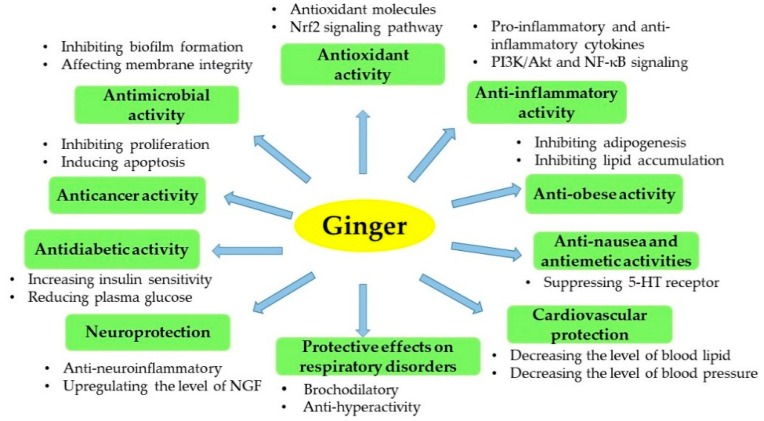
Ginger (Zingiber officinale Roscoe) is a common and widely used spice. It is rich in various chemical constituents, including phenolic compounds, terpenes, polysaccharides, lipids, organic acids, and raw fibers. The health benefits of ginger are mainly attributed to its phenolic compounds, such as gingerols and shogaols. Accumulated investigations have demonstrated that ginger possesses multiple biological activities, including antioxidant, anti-inflammatory, antimicrobial, anticancer, neuroprotective, cardiovascular protective, respiratory protective, antiobesity, antidiabetic, antinausea, and antiemetic activities. In this review, we summarize current knowledge about the bioactive compounds and bioactivities of ginger, and the mechanisms of action are also discussed. We hope that this updated review paper will attract more attention to ginger and its further applications, including its potential to be developed into functional foods or nutraceuticals for the prevention and management of chronic diseases.
Overview
The claims and statistics of this paper haven’t been checked yet.
Free: it reads the open-access text and checks the first 5 claims that cite a source we can check. Create a free account to check every claim.
Integrity signals
Registry
Cites
Statistics
Figures
Verification
Claims the paper makes
The claims and statistics of this paper haven’t been checked yet.
Free: it reads the open-access text and checks the first 5 claims that cite a source we can check. Create a free account to check every claim.
Claims other papers make about this one
Each is checked against this paper’s own text: does it say what the citing paper says it does?
In the citing paper
“A meta-analysis of 13 randomized control trials (n = 1174) found that ginger significantly improves overall pregnancy-associated nausea and vomiting, comparable to vitamin B6 [230] and as effective as standard antiemetics like dimenhydrinate [231].”
From Nutritional Approaches to Enhance GLP-1 Analogue Therapy in Obesity: A Narrative Review (2025) · cites this paper as [231]
Self-check
Percentages, sums and reported differences re-computed from the paper’s own numbers.
The self-check needs the paper’s full text.
Citations
Cites
Bray, F., Ferlay, J., Soerjomataram, I., Siegel, R. L., Torre, L. A., & Jemal, A. (2018) · CA: A Cancer Journal for Clinicians · doi:10.3322/caac.21492 · Cited by 84,109
Targeting Free Radicals in Oxidative Stress-Related Human Diseases
Poprac, P., Jomova, K., Simunkova, M., Kollar, V., Rhodes, C. J., & Valko, M. (2017) · Trends in Pharmacological Sciences · doi:10.1016/j.tips.2017.04.005 · Cited by 1,107 · cited 1×
“It has been known that overproduction of free radicals, such as reactive oxygen species (ROS), plays an important part in the development of many chronic diseases [17].”
BackgroundPlant-derived exosomal MicroRNAs shape the gut microbiota
Teng, Y., Ren, Y., Sayed, M., Hu, X., Lei, C., Kumar, A., Hutchins, E., Mu, J., Deng, Z., Luo, C., et al. (2018) · Cell Host & Microbe · doi:10.1016/j.chom.2018.10.001 · Cited by 1,027 · cited 1×
“Moreover, microRNAs of ginger exosome-like nanoparticles (GELN) ameliorated mouse colitis by inducing the production of IL-22, a barrier function improvement factor [41].”
BackgroundZhang, M., Viennois, E., Prasad, M., Zhang, Y., Wang, L., Zhang, Z., Han, M. K., Xiao, B., Xu, C., Srinivasan, S., et al. (2016) · Biomaterials · doi:10.1016/j.biomaterials.2016.06.018 · Cited by 1,026 · cited 12×
“Besides, ginger extract and zingerone inhibited NF-κB activation and decreased the level of IL-1β in the colons of mice, which alleviated colitis induced by 2, 4, 6-trinitrobenzene sulfonic acid [38].”
BackgroundInfluentialAntioxidant capacities and total phenolic contents of 62 fruits
Fu, L., Xu, B.-T., Xu, X.-R., Gan, R.-Y., Zhang, Y., Xia, E.-Q., & Li, H.-B. (2011) · Food Chemistry · doi:10.1016/j.foodchem.2011.04.079 · Cited by 757
Self-citationGinger and Its Constituents: Role in Prevention and Treatment of Gastrointestinal Cancer
Prasad, S., & Tyagi, A. K. (2015) · Gastroenterology Research and Practice · doi:10.1155/2015/142979 · Cited by 439 · cited 2×
“Besides these, polysaccharides, lipids, organic acids, and raw fibers are also present in ginger [13,16].”
BackgroundChang, J. S., Wang, K. C., Yeh, C. F., Shieh, D. E., & Chiang, L. C. (2013) · Journal of Ethnopharmacology · doi:10.1016/j.jep.2012.10.043 · Cited by 369 · cited 2×
“Ginger was effective in blocking viral attachment and internalization [52].”
BackgroundXu, X.-Y., Meng, X., Li, S., Gan, R.-Y., Li, Y., & Li, H.-B. (2018) · Nutrients · doi:10.3390/nu10101553 · Cited by 358
Self-citationLi, C.-L., Ou, C.-M., Huang, C.-C., Wu, W.-C., Chen, Y.-P., Lin, T.-E., Ho, L.-C., Wang, C.-W., Shih, C.-C., Zhou, H.-C., et al. (2014) · Journal of Materials Chemistry B · doi:10.1039/c4tb00216d · Cited by 350 · cited 2×
“The in vitro experiment found that C-dots increased the content of ROS in the HepG2 cells, which upregulated the expression of p53 and promoted apoptosis [67].”
BackgroundTotal Phenolic Contents and Antioxidant Capacities of Selected Chinese Medicinal Plants
Song, F.-L., Gan, R.-Y., Zhang, Y., Xiao, Q., Kuang, L., & Li, H.-B. (2010) · International Journal of Molecular Sciences · doi:10.3390/ijms11062362 · Cited by 346
Self-citation
Cited by
Items 601–700 of 1,001
Bare, Y., Mansur, S., Pili, A. P., & Helvina, M. (2020) · BIOEDUSCIENCE · doi:10.22236/j.bes/424944 · Cited by 6
Forest-Based Medicinal Plants for Cancer Cure
Rana, A., Anand, J., Tyagi, M., & Rai, N. (2021) · Springer eBooks · doi:10.1007/978-3-030-73077-2_11 · Cited by 6
Effect of ginger extract (Zingiber officinale) as a natural antioxidant on sunflower oil oxidation
Elsorady, M. E., & Elgindy, A. (2022) · Food and Feed Research · doi:10.5937/ffr49-39298 · Cited by 6
Unravelling the Approaches to Treat Osteoarthritis: A Focus on the Potential of Medicinal Plants
Verma, S., Gupta, S., Das, R., Munjal, K., Dhanawat, M., Mehta, D. K., Goyal, G., & Gupta, A. (2022) · Pharmacognosy Research · doi:10.5530/097484900001 · Cited by 7
Hidayatullah, A., Putra, W. E., Salma, W. O., Muchtaromah, B., Permatasari, G. W., Susanto, H., Widiastuti, D., & Kismurtono, M. (2020) · Chiang Mai University Journal of Natural Sciences · doi:10.12982/cmujns.2021.018 · Cited by 10
“However, this antiviral claim still requires further evidence and research (Mao et al., 2019).”
BackgroundA review on therapeutic potential of Indian medicinal plants against COVID-19 pandemic
Thakur, A., Gautam, S., Kaushal, K., Kumari, A., Thakur, A., Bhatt, K., & Jasta, S. (2022) · Annals of Phytomedicine An International Journal · doi:10.54085/ap.covid19.2022.11.3.6 · Cited by 6
Prevention and cure of dermatology disorders using herbal medications: summary
Srivastav, A., Srivastav, Y., Hameed, A., & Ahmad, M. I. (2024) · International Journal of Indigenous Herbs and Drugs · doi:10.46956/ijihd.v9i1.568 · Cited by 14
Kasmara, D. P., Abdullah, E., Harun, Z. B., Sari, F. N., Rashid, N. A., & Teoh, S. L. (2025) · Frontiers in Pharmacology · doi:10.3389/fphar.2025.1522814 · Cited by 12
Zeiner, M., Fiedler, H., Toma, D., Nemet, I., & Cindrić, I. J. (2025) · Microchemical Journal · doi:10.1016/j.microc.2025.113333 · Cited by 5
Yassaroh, Y., Daulay, A., Prabowo, S., Wulandari, R. A., Yuliati, F., Yurohman, Y., Paramitasari, D., Pramana, Y. S., Putra, O. N., Suparman, S., et al. (2025) · Journal of Food Science and Technology · doi:10.1007/s13197-025-06308-w · Cited by 7
“This antioxidant ability is ascribed to the phenolic compounds such as gingerols, shogaols, paradols, and other bioactive compounds found in the ginger extract (Mao et al. 2019).”
Matlala, M. E., Lubisi, N. P., Chauke, S., Kola, E., Ramarumo, L. J., & Ndhlovu, P. T. (2025) · Next research. · doi:10.1016/j.nexres.2025.100446 · Cited by 6
Yu, L., Dong, Y. Y., Li, M., Liu, H., Yan, C., Li, X., Gu, Y., Wang, L., Xu, C. L., Xu, J., et al. (2025) · Frontiers in Cell and Developmental Biology · doi:10.3389/fcell.2025.1580479 · Cited by 6
“Zingiber officinale Roscoe (ginger), a Chinese medicinal herb, has long been applied for headaches, colds, nausea, and emesis, etc. (Mao et al., 2019).”
Officinal Plants as New Frontiers of Cosmetic Ingredients
Vitalone, A., D’Andrea, L., Sotto, A. D., Caruso, A., & Parente, R. (2025) · Cosmetics · doi:10.3390/cosmetics12040140 · Cited by 8
Medicinal Plants for a Healthy Gut Microbiome: Scientific Insights into Modern Herbal Applications
Pacyga, K., Tabiś, A., & Pacyga, P. (2025) · International Journal of Molecular Sciences · doi:10.3390/ijms262210875 · Cited by 12
Dietary Bioactive Compounds and Their Role in Allergy Prevention: A Comprehensive Review
Zafrilla, P., Ballester, P., Victoria‐Montesinos, D., Cerdá, B., Marhuenda, J., Arcusa, R., & García‐Muñoz, A. M. (2025) · Nutrients · doi:10.3390/nu17223506 · Cited by 7
Mawunu, M., Mampasi, N., de Carvalho, M., Pedro, M., Ndiku, L., Luyeye, L., Ashande, C. M., & Ngbolua, K.-T.-N. (2025) · Discover Social Science and Health · doi:10.1007/s44155-025-00319-w · Cited by 13
“For instance, Zingiber officinale has frequently been reported as a culturally important species with multiple therapeutic applications, including in Angola, China, Nigeria, and Cameroon, where its use in treating gastrointestinal and respiratory conditions is well documented [86, 87].”
The immunostimulant activity of Tibb an-Nabawi natural products: a literature review
UNISBA, P. S. F., & Priani, S. E. (2021) · Jurnal Ilmiah Farmasi (Scientific Journal of Pharmacy) · doi:10.20885/jif.vol17.iss1.art5 · Cited by 12
“Senyawa fenolik utama dari jahe adalah gingerols, shogaols, dan paradols (Mao et al., 2019).”
Background30 Days Randomized Ginger Ingestion on Blood Lipid and Sugar Levels in Hypertensive Older Women
Pariwat, P., Masodsai, K., & Chuanchaiyakul, R. (2022) · Trends in Sciences · doi:10.48048/tis.2022.4606 · Cited by 7
Subramaniam, S. D., Yahaya, W. A. W., Azman, N. A. M., Arshad, Z. I. M., & Basrawi, F. (2023) · Chemical Engineering & Technology · doi:10.1002/ceat.202300007 · Cited by 5
Antioxidant and inflammatory-modulating properties of ginger and bitterleaf teas
Adeyemı, O. S., Rotimi, D. E., Fatinukun, H. D., Adeogun, V. O., Evbuomwan, I. O., Adebayo, O. L., Atolanı, O., & Akanji, M. A. (2024) · International Journal of Environmental Health Research · doi:10.1080/09603123.2024.2338894 · Cited by 5
Akomolafe, S. F., & Oriyomi, I. A. (2024) · Phytomedicine Plus · doi:10.1016/j.phyplu.2024.100618 · Cited by 7
Yan, D., Zhang, X., Ma, C., Huang, W., Hao, M., & Xie, L. (2024) · Pharmaceuticals · doi:10.3390/ph17091128 · Cited by 7
“Studies found that ZRR and its active compounds are bioactive, inducing cancer cell apoptosis by inhibiting STAT3 and NF κ B, repressing inflammation by inhibiting NF κ B, and fighting obesity by upregulating PPAR γ [28].”
Background小山, 幸., Weber, E. L., & Heinbockel, T. (2024) · International Journal of Molecular Sciences · doi:10.3390/ijms251910353 · Cited by 6
Tran, T. H. M., Dhandapani, S., Abdus, S., & Kim, Y. (2024) · Phytotherapy Research · doi:10.1002/ptr.8331 · Cited by 5
Immunosuppressive phytochemicals and phytonutrients in plants in Nigeria: a systematic review
Olaniyan, M. F., Olaniyi, O. D., Ojediran, T. B., Akpoyovwere, O. J., Tijani, A. W., & Odegbemi, O. B. (2024) · Discover Immunity. · doi:10.1007/s44368-024-00004-1 · Cited by 6
“Discover Immunity (2024) 1:3 | https://doi.org/10.1007/s44368-024-00004-1 press immune cell activation, suggesting the potential benefits of ginger in chronic inflammatory and autoimmune diseases [40–46].”
InfluentialAnti-ageing natural supplements: the main players in promoting healthy lifespan
Izadi, M., Sadri, N., Abdi, A., Zadeh, M. M. R., Jalaei, D., Ghazimoradi, M. M., Shouri, S., & Tahmasebi, S. (2024) · Nutrition Research Reviews · doi:10.1017/s0954422424000301 · Cited by 7
Current Combinatorial Therapeutic Aspects: The Future Prospect for Glioblastoma Treatment
Gautam, M., & Gabrani, R. (2024) · Current Medical Science · doi:10.1007/s11596-024-2950-7 · Cited by 9
“Other plant-derived compounds such as gingerol and silibinin have been reported to have anticarcinogenic effects [68, 69] .”
Nursidika, P., Julianti, E., & Kurniati, N. F. (2025) · Narra J · doi:10.52225/narra.v5i1.1714 · Cited by 7
Ginger ( Zingiber officinale Roscoe) Bioactive Components: Potential Resources for Kidney Health
Wang, Y., Jiang, Y., Han, C., Zhou, L., Hu, H., Song, H., & Li, W. (2025) · Journal of Food Biochemistry · doi:10.1155/jfbc/2625586 · Cited by 10
Zingiberaceae wonders: the antioxidant powerhouse for optimal health
Boyina, H. K., Chakraborty, S., Atrooz, O. M., Adamska, O., Sanka, K., Atanasov, A. G., Stolarczyk, A., Chellammal, H. S. J., Arora, V., Gangarapu, K., et al. (2025) · Animal Science Papers and Reports · doi:10.2478/aspr-2025-0001 · Cited by 10
Xu, C., Lv, Y.-Y., Liu, D., & Gong, W. (2025) · Food Research International · doi:10.1016/j.foodres.2025.116423 · Cited by 5
Mafruchati, M. (2020) · Systematic Reviews in Pharmacy · doi:10.31838/srp.2020.10.78 · Cited by 5
“…a study by Mao et al using 2.2 grams of ground ginger per day on 41 participants with type 2 diabetes, 2 grams of powdered ginger per day, ginger successfully lowered HbA1c, a marker of long-term sugar levels, showing a decrease of 10% and blood sugar levels by 12%. in 12 weeks (Mao et al., 2019).”
BackgroundInfluentialJoshua, Z. P., Abarshi, M. M., Sani, I. H., Owolabi, O. A., David, M. A., Mada, S. B., Saliu, M. A., & Muhammad, A. (2021) · Human Nutrition & Metabolism · doi:10.1016/j.hnm.2021.200133 · Cited by 5
Jethalia, V., Hasyagar, S. V., Bhamidipati, K., & Chatterjee, J. (2021) · Neuroscience Research Notes · doi:10.31117/neuroscirn.v3i5.106 · Cited by 7
Casula, E., Manconi, M., López-Méndez, T. B., Pedraz, J. L., Calvo, E., Lozano, A., Zaru, M., Castangia, I., Orrù, G., Fais, S., et al. (2021) · Colloids and Surfaces B Biointerfaces · doi:10.1016/j.colsurfb.2021.112170 · Cited by 5
Kabilan, S. J., Kunjiappan, S., Sundaresan, H., Mahesh, S., & Srinivasan, G. (2022) · Anti-Infective Agents · doi:10.2174/2211352520666220527102858 · Cited by 6
Potential Role of Herbs and Spices on the Immune System
Monica, V., Nimbkar, S., Elumalai, A., Moses, J. A., & Anandharamakrishnan, C. (2022) · Springer eBooks · doi:10.1007/978-981-16-6379-6_2 · Cited by 5
Kumar, V., Mishra, A., & Singh, A. K. (2022) · RSC Advances · doi:10.1039/d2ra03287b · Cited by 5
Elebiyo, T. C., Olori, O. O., Rotimi, D. E., Al‐Megrin, W. A. I., WAARD, M. M. D., ALKHURIJI, A. F., Batiha, G. E., Adeyanju, A. A., & Adeyemı, O. S. (2022) · Biomedicine & Pharmacotherapy · doi:10.1016/j.biopha.2022.113788 · Cited by 8
Sethunga, M., Ranaweera, K. K. D. S., Munaweera, I., & Gunathilake, K. D. P. P. (2022) · JSFA reports · doi:10.1002/jsf2.95 · Cited by 8
Application of engineered extracellular vesicles to overcome drug resistance in cancer
NONAKA, T. (2022) · Frontiers in Oncology · doi:10.3389/fonc.2022.1070479 · Cited by 5
“Ginger may also decrease the risk of cancer and diabetes (112, 114).”
BackgroundViggiano, S., Panzella, L., Reichenbach, M., Hans, J., & Napolitano, A. (2023) · Cosmetics · doi:10.3390/cosmetics10010022 · Cited by 5
Nufus, H., Gazali, M., Alaudin, A., Mursawal, A., Wahyuni, S., ‘Akla, C. M. N., Syahrial, S., & Marlian, N. (2020) · Jurnal Kelautan Tropis · doi:10.14710/jkt.v26i1.16211 · Cited by 11
“…2017; Suryaningtyas, 2019) maupun non esensial (misalnya vitamin atau polifenol) yang terdapat di alam (Gazali et al., 2018; Shang et al., 2019; Mao et al., 2019; Denaro et al., 2020; Uwineza dan Waskiewicz, 2020) dan menjadi bagian dari rantai makanan (Chhikara et al., 2019; Chugh dan…”
BAKIR, B. (2023) · Kafkas Universitesi Veteriner Fakultesi Dergisi · doi:10.9775/kvfd.2023.29480 · Cited by 9
Implications of Herbal Components in the Treatment of Neurological Disorders
Ali, M. D., Verma, S., Malviya, R., Mishra, S., & Sundram, S. (2023) · Current Nutrition & Food Science · doi:10.2174/1573401319666230821102546 · Cited by 7
Martínez–Esquivias, F., Guzmán‐Flores, J. M., Chávez-Díaz, I. F., Iñiguez-Muñoz, L. E., & Reyes‐Chaparro, A. (2023) · Journal of Biomolecular Structure and Dynamics · doi:10.1080/07391102.2023.2264943 · Cited by 5
“…is a plant known for its medicinal properties due to its antioxidant, anti-inflammatory, antimicrobial, and anticancer properties and its effect on preventing and controlling cardiovascular, neurodegenerative, respiratory, and respiratory diseases, obesity, and diabetes mellitus (Mao et al., 2019).”
Paneri, M., Sevta, P., & Yagnik, V. D. (2023) · Global Journal of Medical Pharmaceutical and Biomedical Update · doi:10.25259/gjmpbu_154_2022 · Cited by 7
Aromatic Plants as Potential Resources to Combat Osteoarthritis
Maring, M., Balaji, C., Komala, M., Nandi, S., Latha, S., & Raghavendran, H. R. B. (2023) · Combinatorial Chemistry & High Throughput Screening · doi:10.2174/0113862073267213231004094629 · Cited by 5
Immunomodulatory and Antiallergic Potentials of the Bioactive Compounds of Ginger
Lalruatfela, L. B., Lalthanpuii, P. B., Lalrinmawia, L. C., & Lalchhandama, K. (2024) · Pharmacognosy Journal · doi:10.5530/pj.2023.15.212 · Cited by 5
Dimeric diarylheptanoids with anti-inflammatory activity from Zingiber officinale
Fang, H.-B., Si, Y.-Y., Niu, H.-Y., Yan, Y., Feng, W., Cheng, Y., & Wang, Y.-Z. (2024) · Phytochemistry · doi:10.1016/j.phytochem.2024.113975 · Cited by 5
Asoka, A. S., Kolikkandy, A., Nair, B., Kamath, A. J., Sethi, G., & Nath, L. R. (2024) · Molecular Nutrition & Food Research · doi:10.1002/mnfr.202300793 · Cited by 8
Gunawan, S., Soetikno, V., Purwaningsih, E. H., Ferdinal, F., Wuyung, P. E., & Ramadhani, D. A. (2024) · Journal of Experimental Pharmacology · doi:10.2147/jep.s492971 · Cited by 7
“18,42,43 This suggests that 6-gingerol can act as antiapoptotic and apoptotic in non-tumor cells and tumor cells, respectively.”
10-gingerol induces oxidative stress through HTR1A in cumulus cells: in-vitro and in-silico studies
Kiptiyah, K., Widodo, W., Ciptadi, G., Aulanni’am, A., Widodo, M. A., & Sumitro, S. B. (2020) · Journal of Complementary and Integrative Medicine · doi:10.1515/jcim-2019-0042 · Cited by 5
“Phytochemical compounds of gingerols have potential activity to induce apoptosis and inhibit cell proliferation in cancer [57].”
BackgroundAshok, A., Ravivarman, J., & Kayalvizhi, K. (2020) · International Journal of Chemical Studies · doi:10.22271/chemi.2020.v8.i4b.9675 · Cited by 5
“…have demonstrated that ginger possesses multiple biological activities, including antioxidant, anti-inflammatory, antimicrobial, anticancer, neuroprotective, cardiovascular protective, respiratory protective, antiobesity, antidiabetic, antinausea, and antiemetic activities (Mao et al., 2019) [41].”
BackgroundIn Vitro Remineralizing Effect of Some Herbals on Initial Enamel Carious Lesions.
Attia, N. M., & Ramadan, R. I. (2021) · Al-Azhar Dental Journal for Girls · doi:10.21608/adjg.2021.29117.1253 · Cited by 7
“In addition to the antimicrobial properties, its antifungal effects on oral cavity pathogens was proved (19,20).”
BackgroundRole of herbs for elevating immunity against SARS-CoV-2: a concise review
Anand, A., Saraswat, J., & Patel, R. (2021) · Universa Medicina · doi:10.18051/univmed.2021.v40.176-188 · Cited by 8
“A protocol has been shared by the Ministry of AYUSH, India regarding the management of Covid-19 with Ayurvedic approach and Yoga that also incorporates the use of AYUSH 64 and kwatha, both polyherbal medications.((68-70)) The recovery shown by the usage of such formulations ID Title Approach Remarks 226923 Siddha and…”
MethodAdrianta, K. A., & Somantara, I. G. B. (2021) · The Natural Products Journal · doi:10.2174/2210315511666211119123421 · Cited by 9
Current trends and future prospect of medicinal plants derived nutraceuticals: A review
Chelladurai, G., Waqas, S., Akram, M., Panda, A. K., Elbossaty, W. F., Hegazil, A. G., Ghasemian, A., Aharwal, R. P., & Mandal, S. K. (2022) · Current Trends in Pharmacy and Pharmaceutical Chemistry · doi:10.18231/j.ctppc.2022.006 · Cited by 5
Hao, S., Cho, B. O., Wang, F., Shin, J. Y., Da Jeong, S. H. I. N., & Jang, S. I. (2022) · Food Science and Technology · doi:10.1590/fst.111221 · Cited by 5
Subcritical reactive extraction of shogaol and gingerol: Effect of time and temperature
Yulianto, M. E., Purwanitisari, S., Hartanti, I., Nisa, Q. A. K., & Nyamiati, R. D. (2022) · International Food Research Journal · doi:10.47836/ifrj.29.4.12 · Cited by 5
“Ginger has shown biological activities such as antiinflammatory, antioxidative, anticancer, and antimicrobial (Mao et al., 2019).”
BackgroundMicheli, L., Toti, A., Lucarini, E., Ferrara, V., Ciampi, C., Olivero, G., Pittaluga, A., Mattoli, L., Pelucchini, C., Burico, M., et al. (2022) · Frontiers in Nutrition · doi:10.3389/fnut.2022.887378 · Cited by 7
“The beneficial effects of ginger have been mainly attributed to the presence of gingerols and shogaols (phenolic compounds) (27).”
BackgroundWang, Y., Huang, Y., Shi, L., Huang, L., Wen, Y., Cao, Y., Yang, Z., Liu, Q., Yin, X., & Ji, X. (2022) · Evidence-based Complementary and Alternative Medicine · doi:10.1155/2022/6382205 · Cited by 7
“-e bioactive constituents of ginger contained terpenes, polysaccharides, lipids, and organic acids, which had antioxidant, anti-inflammatory, and antimicrobial effects [16].”
BackgroundJelali, N., Wasli, H., Youssef, R. B., Hessini, K., & Cardoso, S. M. (2022) · Applied Sciences · doi:10.3390/app122010351 · Cited by 5
Siddiqui, S., Ahmed, N., Devi, C. A., Singh, P. R., & Lalramhlimi, B. (2023) · IntechOpen eBooks · doi:10.5772/intechopen.108875 · Cited by 8
Basharat, Z., Murtaza, Z., Siddiqa, A., Alnasser, S. M., & Alotaibi, M. (2023) · Molecular Diversity · doi:10.1007/s11030-023-10604-y · Cited by 5
“6-Gingerol 6-Gingerol is present in the rhizome of ginger ( Zingiber officinalis ) and the physicochemical properties of this tuber have made it a timeless traditional medicinal plant against several ailments [51].”
GOPALASATHEESKUMAR, K., Lakshmanan, K., Moulishankar, A., Suresh, J., Babu, D. K., & Kalaichelvan, V. K. (2020) · Asian Journal of Organic & Medicinal Chemistry · doi:10.14233/ajomc.2020.ajomc-p299 · Cited by 5
A review on pharmacological properties of
Kushwaha, S., & Dubey, S. (2022) · IP Journal of Nutrition Metabolism and Health Science · doi:10.18231/j.ijnmhs.2022.003 · Cited by 5
Majie Cataplasm Promotes Th1 Response to Fight against Asthmatic Th2 Inflammation through NKs
Ji, W., Shi, H., Feng, T., Zhang, S., Liu, H., Xu, W., Wang, X., & Wang, Q. (2022) · Evidence-based Complementary and Alternative Medicine · doi:10.1155/2022/6745420 · Cited by 5
Kim, H., Kim, M. K., Oh, S., Hwang, Y.-J., & Choe, J. (2024) · Preventive Nutrition and Food Science · doi:10.3746/pnf.2024.29.2.228 · Cited by 4
“The primary active ingredients in ginger include gingerol and shogaol, along with zingiberol, zingiberene, and -cardi- nen (Mao et al., 2019).”
Bushra, R., Saeed, F., Ahmed, Z., Naeem, S., Ishaq, J., & Saleem, S. Y. (2025) · Prospects in Pharmaceutical Sciences · doi:10.56782/pps.341 · Cited by 7
From Phytochemicals to Physiology: The Metabolic and Redox Effects of Botanical Extracts on Crops
Pérez-Labrada, F., Juárez‐Maldonado, A., Fincheira, P., Rincón-Sánchez, F., Tortella, G., González-Morales, S., & Benavides‐Mendoza, A. (2026) · Plants · doi:10.3390/plants15081237 · Cited by 7
KUALITAS PRODUK CASCARA CELUP DENGAN PENAMBAHAN JAHE MERAH (Zingiber officinale var. Rubrum)
Nalurita, I., Suwasono, S., Kuswardhani, N., & Isnain, F. S. (2023) · Pro Food · doi:10.29303/profood.v9i1.300 · Cited by 4
Lin, C., Huang, S.-H., Tam, K., Huang, T., & Gautama, M. S. N. (2024) · Cancer Nursing · doi:10.1097/ncc.0000000000001355 · Cited by 10
Spigarelli, R., Calabrese, C., Spisni, E., Vinciguerra, S., Saracino, I. M., Dussias, N. K., Filippone, E., & Valerii, M. C. (2024) · Life · doi:10.3390/life14101221 · Cited by 6
“The bioactive compounds of ZN were also much studied and the mechanisms of its antioxidant, antinausea, anti-obesity, anticancer, anti-inflammatory action are known [45].”
BackgroundMakhija, D. P., Mata, S., Sharma, A., Kachare, K., Manathottathil, A., Jain, S., Jameela, S., Rao, B. C. S., Rana, R. K., Tripathi, A., et al. (2025) · JMIR Research Protocols · doi:10.2196/57918 · Cited by 8
“Shunthi is known to have anti-inflammatory, analgesic, immunomodulatory, and antioxidant activities [27].”
Essa, H. A., Hashim, A. F., Abdelaziz, N., Mohamed, F. E.-Z., & Ali, A. M. (2024) · Molecular Nutrition & Food Research · doi:10.1002/mnfr.202400497 · Cited by 4
Ibrahim, S., Hassanin, F., EL-Roos, N. A. A., & Shaltout, F. A. E. (2025) · Egyptian Journal of Veterinary Science · doi:10.21608/ejvs.2024.329509.2439 · Cited by 7
“It contains several bioactive compounds that contribute to its antimicrobial and antioxidant properties[24].”
Esomchi, C. N., Nwofia, J. O., Chukwu, A. M., Chukwuka, E., Ejezie, T. C., Emelife, C. J., Elu-Idam, S. U., Egwudike, I. M., & Egwu, A. C. (2025) · Journal of Experimental and Clinical Anatomy · doi:10.4314/jeca.v22i1.16 · Cited by 5
“(2020) and Mao et al .”
Samba, N., Barrios, A. M., León, E. G. D., Raposo, C., Lahlou, R. A., Curto, J. M. R., Rodilla, J. M., Roncero, A. M., David Diez, A., & Silva, L. (2025) · Molecules · doi:10.3390/molecules30132768 · Cited by 5
Derese, D. B., Sun, H., Xiong, X., Li, Z., Malyar, R. M., Lu, L., & Shi, F. (2025) · Animals · doi:10.3390/ani15152315 · Cited by 4
“Widely used as a spice and medicinal plant, it is rich in bioactive compounds like gingerol, shogaols, paradols, zingerone, and essential oils, which have antioxidant, anti-inflammatory, anticancer, digestive-enhancing, and antimicrobial properties [16].”
Baek, H.-I., Ha, N.-R., Kim, C., Im, T. J., Kim, Y. Y., Hwang, S. H., & Bae, J. W. (2025) · Food & Function · doi:10.1039/d5fo01172h · Cited by 6
Kumar, A., Yadav, B., Kumar, U., Gupta, B., Patel, K., Khanduri, S., Sharma, B. S., Singhal, R., Chandrasekhararao, B., Srikanth, N., et al. (2025) · JMIR Research Protocols · doi:10.2196/68306 · Cited by 7
Chang, Q., Zhang, Y., & Zeng, H. (2025) · International Journal of Biological Macromolecules · doi:10.1016/j.ijbiomac.2025.147988 · Cited by 4
Zhang, Y., Huang, B., Shen, W., Lv, L., Saensouk, P., Boonma, T., Jitpromma, T., & Saensouk, S. (2025) · Journal of Ethnobiology and Ethnomedicine · doi:10.1186/s13002-025-00828-7 · Cited by 5
“Compared with synthetic drugs, these plants provide complex bioactive compounds—flavonoids, polysaccharides, and essential oils—that are gradually released and support long-term preventive healthcare [34].”
Natural Ginger-Derived Exosomes as Effective Therapeutics for Glioblastoma
Wang, S., Zhang, D., Zheng, M., Zou, Y., & Shi, B. (2025) · Nano Letters · doi:10.1021/acs.nanolett.5c04780 · Cited by 4
Chen, Z., Zhang, Y., Ma, L., Song, Y. Y., Li, W., Sun, Z., Chen, T., Cheng, S., & Liu, M. (2025) · Biochemical Pharmacology · doi:10.1016/j.bcp.2025.117563 · Cited by 4
Tabe, M. B., İşbilen, Ö., Walker, J. N., & Cinar, E. (2026) · BMC Complementary Medicine and Therapies · doi:10.1186/s12906-026-05281-x · Cited by 4
“Gingerol inhibits bacterial growth by disrupting cellular functions, including protein synthesis and membrane integrity [40].”
Herbal Medicines and Drugs Interactions: Cytochrome P450 Responsibility
Shanaida, M., Oleshchuk, O., Shevchuk, O. O., Посохова, К. А., Ivankiv, Y. I., Мочернюк, Х. І., Кланца, М. П., & Korda, M. M. (2026) · Current Medicinal Chemistry · doi:10.2174/0109298673428595251209114801 · Cited by 6
Saraswathi, S., Venkataravanappa, J. T., Nambiar, C., Saji, S., Kori, V., Murthy, M. N., Somanna, P., Suresh Babu, S. V., Sreeramulu, A. K., Dayalan, A., et al. (2026) · Metabolic Brain Disease · doi:10.1007/s11011-026-01868-y · Cited by 4
“It also reduced markers of lipid peroxidation like malondialdehyde (MDA) (Mao et al. 2019).”
Singh, P., & Rao, G. P. (2021) · Medicinal Plants - International Journal of Phytomedicines and Related Industries · doi:10.5958/0975-6892.2021.00021.8 · Cited by 4
El‐Borm, H. T., & Atallah, M. N. (2021) · The Journal of Basic and Applied Zoology · doi:10.1186/s41936-021-00238-7 · Cited by 4
Wen Dan Tang: A Potential Jing Fang Decoction for Headache Disorders?
Pradhan, S. K., Li, Y., Gantenbein, A. R., Angst, F., Lehmann, S., & Shaban, H. (2022) · Medicines · doi:10.3390/medicines9030022 · Cited by 7
Mouslem, A. K. A., Khalil, H. E., Emeka, P. M., & Alotaibi, G. (2022) · Molecules · doi:10.3390/molecules27206941 · Cited by 4
Zhang, X., Li, Z., Song, Z., Zhu, Y.-T., Feng, W., Cheng, Y., & Wang, Y.-Z. (2022) · Phytochemistry · doi:10.1016/j.phytochem.2022.113546 · Cited by 5
Madhuranga, H. D. T., Wijekumar, P. J., & Samarakoon, D. N. A. W. (2023) · Journal of Ayurvedic and Herbal Medicine · doi:10.31254/jahm.2023.9106 · Cited by 7
Horticultural crops as natural therapeutic plants for the therapy of diabetes mellitus
Mustapha, B. O., Ademoyegun, O. T., & Ahmed, R. S. (2023) · Egyptian Journal of Basic and Applied Sciences · doi:10.1080/2314808x.2023.2217387 · Cited by 8
“Its active chemical compound is gingerol and shogaol, which is responsible for their anti-diabetic potential [24].”
BackgroundCharacteristics of Soto, an ethnic food that reflects Indonesian diversity: Based on ingredients
Cempaka, L., Rizki, A. A., Asiah, N., David, W., Ramadhan, K., Mukaromah, A. S., Pramastya, H., Husain, F., & Huda, N. (2023) · Canrea Journal Food Technology Nutritions and Culinary Journal · doi:10.20956/canrea.v6i1.680 · Cited by 4
Absorption and Metabolism of Ginger Compounds in Broiler Chicks
Zhang, S., Fasina, Y. O., Dosu, G., & Sang, S. (2023) · Journal of Agricultural and Food Chemistry · doi:10.1021/acs.jafc.3c01857 · Cited by 6
Ouyang, J.-Y., Lin, W. V., Dong, J.-M., Yang, Y., Yang, H., Zhou, Z., & Wang, R. (2023) · World Journal of Clinical Cases · doi:10.12998/wjcc.v11.i27.6327 · Cited by 5
“Shengjiang, with a long clinical history, has various biological activities, including anti-inflammatory, antimicrobial, and antiemetic activities[14].”
Adebayo, O. G., Ben‐Azu, B., Akpofure, E., Emmanuel, M. U., Wopara, I., Aduema, W., Adedayo, L. D., & Abeje, J. I. (2023) · Clinical Complementary Medicine and Pharmacology · doi:10.1016/j.ccmp.2023.100116 · Cited by 6
Metadata
- Authors
- Mao, Q.-Q., Xu, X.-Y., Cao, S.-Y., Gan, R.-Y., Corke, H., Beta, T., & Li, H.-B.
- Affiliations
- Guangdong Provincial Key Laboratory of Food, Nutrition and Health, Department of Nutrition, School of Public Health, Sun Yat-sen University, Guangzhou 510080, China
- Sun Yat-sen University (CN)
- Shanghai Jiao Tong University (CN)
- Department of Food & Human Nutritional Sciences, University of Manitoba, Winnipeg, MB R3T 2N2, Canada
- Corresponding author
- Gan, Ren-You
- Li, Hua-Bin
- Venue
- Foods
- Publisher
- MDPI AG
- Published
- 2019-05-30
- Volume
- 8
- Issue
- 6
- Pages
- 185
- ISSN
- 2304-8158 (ISSN-L)
- PMC
- PMC6616534
- OpenAlex
- W2947671311
- Semantic Scholar
- d16da9cb8957f5f43f25ac947958cef199e438d8
- Cited by
- 1,418
- References
- 117
- Citations by year
- 2026: 162 · 2025: 247 · 2024: 255 · 2023: 254 · 2022: 255 · 2021: 159 · 2020: 74 · 2019: 10
- FWCI
- 19.61
- Type
- journal article
- Language
- en
- Open access
- gold
- dx.doi.org
- Licence
- Locations
- Foods (publishedVersion, cc-by)
- Europe PMC (PubMed Central) (publishedVersion, cc-by)
- PubMed Central (publishedVersion, cc-by)
- PubMed (publishedVersion)
- DOAJ (DOAJ: Directory of Open Access Journals) (submittedVersion, cc-by-sa)
- Funders
- the National Key R&D Program of China (2017YFC1600100)
- Shanghai Basic and Key Program (18JC1410800)
- the Agri-X Interdisciplinary Fund of Shanghai Jiao Tong University (Agri-X2017004)
- the Key Project of Guangdong Provincial Science and Technology Program (2014B020205002)
- Topics
- Life Sciences › Pharmacology, Toxicology and Pharmaceutics › Pharmacology › Ginger and Zingiberaceae research
- Life Sciences › Agricultural and Biological Sciences › Plant Science › Garlic and Onion Studies
- Life Sciences › Pharmacology, Toxicology and Pharmaceutics › Pharmacology › Ginseng Biological Effects and Applications
- Keywords
- ginger, bioactive compounds, phenolic compounds, gingerol, shogaol, antioxidant activity, anti-inflammatory activity, antimicrobial activity, anticancer activity, neuroprotection, cardioprotection, respiratory protection, anti-obesity, antidiabetic activity, antiemetic activity, functional foods, nutraceuticals, chronic disease prevention
About these checks
Registry, retraction, Cites and statistics results are computed, not judged, with one exception: a printed reference that no index lists is read once by a model before it counts as a citation error. Claims are extracted by a model and kept only when their quote appears verbatim in the text; each cited source is then checked, with a model’s help, for whether it says what the claim relies on. Those verdicts can be wrong — read the claim’s quote and the cited source before relying on one.
Statistics and arithmetic are recomputed, not judged.
Confidence bands are shown only for fields calibrated on our annotated test set. None is calibrated yet, so no band is shown.
What counts as a claim ›How we measure confidence ›How we check this ›
Are you an author, or do you see a problem with this page? Request a review
Data sources
Bibliographic data: Semantic Scholar, OpenAlex, Crossref.
Contains information from the Semantic Scholar Academic Graph Datasets, made available under the ODC Attribution License (ODC-BY 1.0).
Semantic Scholar’s data is described in: Kinney, R., et al. (2023). The Semantic Scholar Open Data Platform. arXiv:2301.10140.
