

Bioactive Compounds and Bioactivities of Ginger (Zingiber officinale Roscoe)
Open accessThe DOI matches its Crossref record; 117 of the 117 references it cites were found in a registry or an index.
Abstract
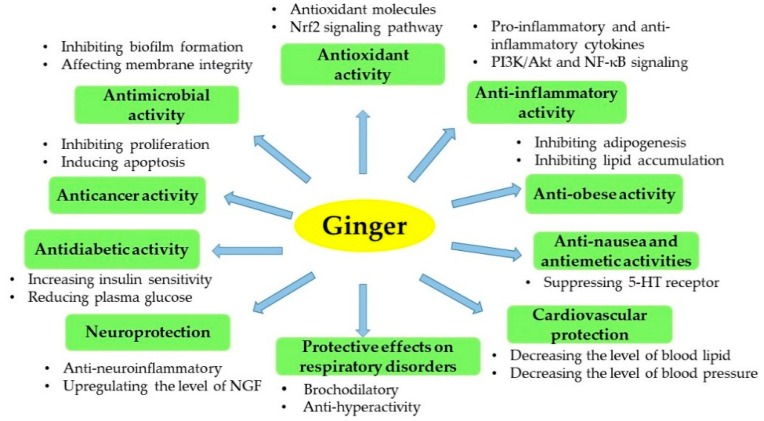
Ginger (Zingiber officinale Roscoe) is a common and widely used spice. It is rich in various chemical constituents, including phenolic compounds, terpenes, polysaccharides, lipids, organic acids, and raw fibers. The health benefits of ginger are mainly attributed to its phenolic compounds, such as gingerols and shogaols. Accumulated investigations have demonstrated that ginger possesses multiple biological activities, including antioxidant, anti-inflammatory, antimicrobial, anticancer, neuroprotective, cardiovascular protective, respiratory protective, antiobesity, antidiabetic, antinausea, and antiemetic activities. In this review, we summarize current knowledge about the bioactive compounds and bioactivities of ginger, and the mechanisms of action are also discussed. We hope that this updated review paper will attract more attention to ginger and its further applications, including its potential to be developed into functional foods or nutraceuticals for the prevention and management of chronic diseases.
Overview
The claims and statistics of this paper haven’t been checked yet.
Free: it reads the open-access text and checks the first 5 claims that cite a source we can check. Create a free account to check every claim.
Integrity signals
Registry
Cites
Statistics
Figures
Verification
Claims the paper makes
The claims and statistics of this paper haven’t been checked yet.
Free: it reads the open-access text and checks the first 5 claims that cite a source we can check. Create a free account to check every claim.
Claims other papers make about this one
Each is checked against this paper’s own text: does it say what the citing paper says it does?
In the citing paper
“A meta-analysis of 13 randomized control trials (n = 1174) found that ginger significantly improves overall pregnancy-associated nausea and vomiting, comparable to vitamin B6 [230] and as effective as standard antiemetics like dimenhydrinate [231].”
From Nutritional Approaches to Enhance GLP-1 Analogue Therapy in Obesity: A Narrative Review (2025) · cites this paper as [231]
Self-check
Percentages, sums and reported differences re-computed from the paper’s own numbers.
The self-check needs the paper’s full text.
Citations
Cites
Bray, F., Ferlay, J., Soerjomataram, I., Siegel, R. L., Torre, L. A., & Jemal, A. (2018) · CA: A Cancer Journal for Clinicians · doi:10.3322/caac.21492 · Cited by 84,109
Targeting Free Radicals in Oxidative Stress-Related Human Diseases
Poprac, P., Jomova, K., Simunkova, M., Kollar, V., Rhodes, C. J., & Valko, M. (2017) · Trends in Pharmacological Sciences · doi:10.1016/j.tips.2017.04.005 · Cited by 1,107 · cited 1×
“It has been known that overproduction of free radicals, such as reactive oxygen species (ROS), plays an important part in the development of many chronic diseases [17].”
BackgroundPlant-derived exosomal MicroRNAs shape the gut microbiota
Teng, Y., Ren, Y., Sayed, M., Hu, X., Lei, C., Kumar, A., Hutchins, E., Mu, J., Deng, Z., Luo, C., et al. (2018) · Cell Host & Microbe · doi:10.1016/j.chom.2018.10.001 · Cited by 1,027 · cited 1×
“Moreover, microRNAs of ginger exosome-like nanoparticles (GELN) ameliorated mouse colitis by inducing the production of IL-22, a barrier function improvement factor [41].”
BackgroundZhang, M., Viennois, E., Prasad, M., Zhang, Y., Wang, L., Zhang, Z., Han, M. K., Xiao, B., Xu, C., Srinivasan, S., et al. (2016) · Biomaterials · doi:10.1016/j.biomaterials.2016.06.018 · Cited by 1,026 · cited 12×
“Besides, ginger extract and zingerone inhibited NF-κB activation and decreased the level of IL-1β in the colons of mice, which alleviated colitis induced by 2, 4, 6-trinitrobenzene sulfonic acid [38].”
BackgroundInfluentialAntioxidant capacities and total phenolic contents of 62 fruits
Fu, L., Xu, B.-T., Xu, X.-R., Gan, R.-Y., Zhang, Y., Xia, E.-Q., & Li, H.-B. (2011) · Food Chemistry · doi:10.1016/j.foodchem.2011.04.079 · Cited by 757
Self-citationGinger and Its Constituents: Role in Prevention and Treatment of Gastrointestinal Cancer
Prasad, S., & Tyagi, A. K. (2015) · Gastroenterology Research and Practice · doi:10.1155/2015/142979 · Cited by 439 · cited 2×
“Besides these, polysaccharides, lipids, organic acids, and raw fibers are also present in ginger [13,16].”
BackgroundChang, J. S., Wang, K. C., Yeh, C. F., Shieh, D. E., & Chiang, L. C. (2013) · Journal of Ethnopharmacology · doi:10.1016/j.jep.2012.10.043 · Cited by 369 · cited 2×
“Ginger was effective in blocking viral attachment and internalization [52].”
BackgroundXu, X.-Y., Meng, X., Li, S., Gan, R.-Y., Li, Y., & Li, H.-B. (2018) · Nutrients · doi:10.3390/nu10101553 · Cited by 358
Self-citationLi, C.-L., Ou, C.-M., Huang, C.-C., Wu, W.-C., Chen, Y.-P., Lin, T.-E., Ho, L.-C., Wang, C.-W., Shih, C.-C., Zhou, H.-C., et al. (2014) · Journal of Materials Chemistry B · doi:10.1039/c4tb00216d · Cited by 350 · cited 2×
“The in vitro experiment found that C-dots increased the content of ROS in the HepG2 cells, which upregulated the expression of p53 and promoted apoptosis [67].”
BackgroundTotal Phenolic Contents and Antioxidant Capacities of Selected Chinese Medicinal Plants
Song, F.-L., Gan, R.-Y., Zhang, Y., Xiao, Q., Kuang, L., & Li, H.-B. (2010) · International Journal of Molecular Sciences · doi:10.3390/ijms11062362 · Cited by 346
Self-citation
Cited by
Dirir, A. M., Daou, M., Yousef, A. F., & Yousef, L. F. (2022) · Phytochemistry Reviews · doi:10.1007/s11101-021-09773-1 · Cited by 586
Antioxidant, phytochemical, and therapeutic properties of medicinal plants: a review
Nwozo, O. S., Effiong, E. M., Aja, P. M., & Awuchi, C. G. (2023) · International Journal of Food Properties · doi:10.1080/10942912.2022.2157425 · Cited by 327
“[88] Ethanol [43] Eletta et al .”
BackgroundMethodInfluentialBanwo, K., Olojede, A. O., Adesulu-Dahunsi, A. T., Verma, D. K., Thakur, M., Tripathy, S., Singh, S., Patel, A. R., Gupta, A. K., Aguilar, C. N., et al. (2021) · Food Bioscience · doi:10.1016/j.fbio.2021.101320 · Cited by 313
Plant-derived extracellular vesicles: a novel nanomedicine approach with advantages and challenges
Nemati, M., Singh, B., Mir, R. A., Nemati, M., Babaei, A., Ahmadi, M., Rasmi, Y., Golezani, A. G., & Rezaie, J. (2022) · Cell Communication and Signaling · doi:10.1186/s12964-022-00889-1 · Cited by 307
“Ginger may also decrease the risk of cancer and diabetes [27, 29].”
BackgroundNutritional implications of ginger: chemistry, biological activities and signaling pathways
Kiyama, R. (2020) · The Journal of Nutritional Biochemistry · doi:10.1016/j.jnutbio.2020.108486 · Cited by 288
Ginger on Human Health: A Comprehensive Systematic Review of 109 Randomized Controlled Trials
Anh, N. H., Kim, S. J., Long, N. P., Min, J. E., Yoon, Y. C., Lee, E. G., Kim, M., Kim, T. J., Yang, Y. Y., Son, E. Y., et al. (2020) · Nutrients · doi:10.3390/nu12010157 · Cited by 227
“This result was supported by the biological property of ginger’s constituents inhibiting cyclooxygenase, which has a role in gastric mucosal defense [9,72].”
BackgroundResultEffect of Ginger on Inflammatory Diseases
Ballester, P., Cerdá, B., Arcusa, R., Marhuenda, J., Yamedjeu, K., & Zafrilla, P. (2022) · Molecules · doi:10.3390/molecules27217223 · Cited by 214
The Management of Diabetes Mellitus Using Medicinal Plants and Vitamins
Yedjou, C. G., Grigsby, J., Mbemi, A., Nelson, D., Mildort, B., Latinwo, L., & Tchounwou, P. B. (2023) · International Journal of Molecular Sciences · doi:10.3390/ijms24109085 · Cited by 202
Garza-Cadena, C., Ortega-Rivera, D. M., Machorro-García, G., Gonzalez-Zermeño, E. M., Homma-Dueñas, D., Plata-Gryl, M., & Castro-Muñoz, R. (2023) · Food Chemistry · doi:10.1016/j.foodchem.2023.135629 · Cited by 199
Zhao, X.-X., Lin, F.-J., Li, H., Li, H.-B., Wu, D.-T., Geng, F., Ma, W., Wang, Y., Miao, B.-H., & Gan, R.-Y. (2021) · Frontiers in Nutrition · doi:10.3389/fnut.2021.669805 · Cited by 182
Self-citationEncapsulation of bioactive compounds by “extrusion” technologies: a review
Bamidele, O. P., & Emmambux, M. N. (2021) · Critical Reviews in Food Science and Nutrition · doi:10.1080/10408398.2020.1793724 · Cited by 180
“Bioactive compounds exhibit health promoting effect like inhibition of enzymes, e.g., pancreatic lipases in obese patient (Correia et al. 2012); scavenging of free radical, and potential for prevention of formation of cancer cells (Mao et al. 2019).”
BackgroundSuharta, S., Barlian, A., Hidajah, A. C., Notobroto, H. B., Ana, I. D., Indariani, S., Wungu, T. D. K., & Wijaya, C. H. (2021) · Journal of Food Science · doi:10.1111/1750-3841.15787 · Cited by 175
Ayustaningwarno, F., Anjani, G., Ayu, A. M., & Fogliano, V. (2024) · Frontiers in Nutrition · doi:10.3389/fnut.2024.1364836 · Cited by 161
Arcusa, R., Villaño, D., Marhuenda, J., Cano, M., Cerdá, B., & Zafrilla, P. (2022) · Frontiers in Nutrition · doi:10.3389/fnut.2022.809621 · Cited by 398
“In this sense, numerous studies have demonstrated that ginger possesses the potential to prevent cardiovascular diseases and associated pathologies that act as risk factors (diabetes, obesity and metabolic syndrome), chemotherapy-induced emesis and nausea, arthritis, gastric dysfunction, pain, respiratory disorders an…”
BackgroundMa, R., Ni, Z., Zhu, Y.-Y., Thakur, K., Zhang, F., Zhang, Y.-Y., Hu, F., Zhang, J., & Wei, Z. (2021) · Food & Function · doi:10.1039/d0fo02834g · Cited by 351
Ginger Bioactives: A Comprehensive Review of Health Benefits and Potential Food Applications
Shaukat, M. N., Nazir, A., & Fallico, B. (2023) · Antioxidants · doi:10.3390/antiox12112015 · Cited by 210
Shaik Mohamed Sayed, U. F., Moshawih, S., Goh, H. P., Kifli, N., Gupta, G., Singh, S. K., Chellappan, D. K., Dua, K., Hermansyah, A., Ser, H. L., et al. (2023) · Frontiers in Pharmacology · doi:10.3389/fphar.2023.1182937 · Cited by 136
“Also, a randomized, double-blind, placebo-controlled study showed a reduction in BMI among female participants when they took 2 g of ginger powder daily (Mao et al., 2019).”
BackgroundShrihastini, V., Muthuramalingam, P., Adarshan, S., Mariappan, S., Chen, J., Shin, H., & Ramesh, M. (2021) · Cancers · doi:10.3390/cancers13246222 · Cited by 157
Zhou, D.-D., Luo, M., Shang, A., Mao, Q., Li, B., Gan, R., & Li, H. (2021) · Oxidative Medicine and Cellular Longevity · doi:10.1155/2021/6627355 · Cited by 151
Self-citationEffects and Mechanisms of Curcumin for the Prevention and Management of Cancers: An Updated Review
Yang, Z., Huang, S., Zhou, D.-D., Xiong, R.-G., Zhao, C., Fang, A., Zhang, Y., Li, H., & Zhu, H. (2022) · Antioxidants · doi:10.3390/antiox11081481 · Cited by 322
Self-citationEffects and mechanisms of edible and medicinal plants on obesity: an updated review
Shang, A., Gan, R.-Y., Xu, X.-Y., Mao, Q.-Q., Zhang, P.-Z., & Li, H.-B. (2021) · Critical Reviews in Food Science and Nutrition · doi:10.1080/10408398.2020.1769548 · Cited by 124
Self-citationPlants Used as Antihypertensive
Verma, T., Sinha, M. D., Bansal, N., Yadav, S. R., Shah, K., & Chauhan, N. S. (2020) · Natural Products and Bioprospecting · doi:10.1007/s13659-020-00281-x · Cited by 152
Research Progress on Chemical Constituents of Zingiber officinale Roscoe
Liu, Y., Liu, J., & Zhang, Y. (2019) · BioMed Research International · doi:10.1155/2019/5370823 · Cited by 123
“Ginger, as a kind of food and medicine, has many functions, such as antioxidant, anti-inflammatory, antimicrobial, anticancer, antiobesity, antidiabetic, antinausea, antiemetic, antiallergic, neuroprotective, hepatoprotective, cardiovascular protective, and respiratory protective activities [67].”
BackgroundLi, H., Wu, L., Dong, Z., Jiang, Y., Jiang, S., Xing, H., Li, Q., Liu, G., Tian, S., Wu, Z., et al. (2021) · Horticulture Research · doi:10.1038/s41438-021-00627-7 · Cited by 146
Self-citationAnti-Inflammatory Diets and Fatigue
Haß, U., Herpich, C., & Norman, K. (2019) · Nutrients · doi:10.3390/nu11102315 · Cited by 138
Li, B., Xu, X., Gan, R., Sun, Q., Meng, J.-M., Shang, A., Mao, Q., & Li, H. (2019) · Foods · doi:10.3390/foods8100440 · Cited by 123
Self-citationImmunomodulatory and anti-inflammatory therapeutic potential of gingerols and their nanoformulations
Yücel, Ç., Karatoprak, G. Ş., Açıkara, Ö. B., Akkol, E. K., Barak, T. H., Sobarzo‐Sánchez, E., Aschner, M., & Shirooie, S. (2022) · Frontiers in Pharmacology · doi:10.3389/fphar.2022.902551 · Cited by 114
“, α-zingiberene, β-bisabolene, β-sesquiphellandrene, arcurcumene, or (E,E)-α-farnesene) and phenolic compounds (gingerols, paradols, shogaols, and zingerone) (Semwal et al., 2015; Koch et al., 2017; Mao et al., 2019).”
Ginger from Farmyard to Town: Nutritional and Pharmacological Applications
Unuofin, J. O., Masuku, N. P., Paimo, O. K., & Lebelo, S. L. (2021) · Frontiers in Pharmacology · doi:10.3389/fphar.2021.779352 · Cited by 139
“Furthermore, ginger possesses lifeimproving potential and other pharmacological activities such as anticancer, anti-diabetes antioxidant, antimicrobial, antineuroinflammation, chemotherapy-induced nausea, and vomiting (Nile and Park, 2015; Zhu et al., 2018; Crichton et al., 2018; Mao et al., 2019).”
BackgroundShahzad, F., Anderson, D. C., & Najafzadeh, M. (2020) · Nutrients · doi:10.3390/nu12092573 · Cited by 111
Li, H., Gan, R., Shang, A., Mao, Q., Quan-cai, S., Wu, D., Geng, F., He, X.-Q., & Li, H. (2021) · Oxidative Medicine and Cellular Longevity · doi:10.1155/2021/6621644 · Cited by 123
“Plant-based foods Bioactive component Study type Models Doses Main effects Molecular mechanisms Ref Improving steatosis, gut dysbiosis, and glucose metabolism Accelerating ethanol degradation, decreasing ratio of Firmicutes to Bacteroidetes Açai In vivo Wistar rats 1mL/100 g Alleviating oxidative stress and inflammati…”
BackgroundInfluentialSelf-citationGut microbiota and Autism Spectrum Disorder: From pathogenesis to potential therapeutic perspectives
Mehra, A., Arora, G., Sahni, G., Kaur, M., Singh, H. B., Singh, B., & Kaur, S. (2022) · Journal of Traditional and Complementary Medicine · doi:10.1016/j.jtcme.2022.03.001 · Cited by 127
Fouda, A., Eid, A. M., Guibal, E., Hamza, M. F., Hassan, S. E., Alkhalifah, D. H. M., & El-Hossary, D. (2022) · Applied Sciences · doi:10.3390/app122412879 · Cited by 118
Bommakanti, V., Ajikumar, A. P., Sivi, C., Prakash, G., Shanker, M. A., Ahmad, F., Haque, S., Prieto, M. A., & Rana, S. (2023) · Separations · doi:10.3390/separations10030177 · Cited by 139
Özkur, M., Benlier, N., Takan, I., Vasileiou, C., Georgakilas, A. G., Pavlopoulou, A., Çetin, Z., & Saygılı, E. İ. (2022) · Oxidative Medicine and Cellular Longevity · doi:10.1155/2022/4748447 · Cited by 133
“Recent studies have demonstrated that 6-SG has superior biological actions as compared to 6-GN [12, 13] with no associated side effects, and, as such, shuntha is considered more powerful medicinally than raw ginger [14, 15].”
Low pH-Based Method to Increase the Yield of Plant-Derived Nanoparticles from Fresh Ginger Rhizomes
Suresh, A. P., Kalarikkal, S. P., Pullareddy, B., & Sundaram, G. M. (2021) · ACS Omega · doi:10.1021/acsomega.1c02162 · Cited by 98
“16,21 Hence, PEG precipitation can increase the PDNP yield much higher in lower pH without losing the integrity and key bioactives of PDNP. 22,23 We also noted that the relative levels of bioactive miRNA content were lesser in PDNPs puri fi ed under both pH 4 and 5 compared to other conditions.”
Toydemir, G., Subaşı, B. G., Hall, R. D., Beekwilder, J., Boyacıoğlu, D., & Çapanoğlu, E. (2022) · Food Chemistry X · doi:10.1016/j.fochx.2022.100334 · Cited by 118
Bioactive compounds in functional food and their role as therapeutics
Mondal, S., Soumya, N. P. P., Mini, S., & Shali, K. S. (2021) · Bioactive Compounds in Health and Disease · doi:10.31989/bchd.v4i3.786 · Cited by 177
Dalsasso, R. R., Valencia, G. A., & Monteiro, A. R. (2022) · Food Research International · doi:10.1016/j.foodres.2022.111043 · Cited by 108
Ansari, P., Reberio, A. D., Ansari, N. J., Kumar, S., Khan, J. T., Chowdhury, S., El‐Mordy, F. M. A., Hannan, J. M. A., Flatt, P. R., Abdel‐Wahab, Y. H. A., et al. (2025) · Biomedicines · doi:10.3390/biomedicines13020454 · Cited by 159
Manohar, T. S., Balan, V., & Sivaramakrishnan, V. (2020) · Phytotherapy Research · doi:10.1002/ptr.6794 · Cited by 115
Ansari, P., Khan, J. T., Choudhary, S., Reberio, A. D., Kumar, S., Seidel, V., Abdel-Wahab, Y. H. A., & Flatt, P. R. (2024) · doi:10.20944/preprints202408.1739.v1 · Cited by 89
Functionalized graphene oxide based membranes for ultrafast molecular separation
Janjhi, F. A., Chandio, I., Memon, A. A., Ahmed, Z., Thebo, K. H., Pirzado, A. A. A., Hakro, A. A., & Iqbal, M. (2020) · Separation and Purification Technology · doi:10.1016/j.seppur.2020.117969 · Cited by 89
Ansari, P., Khan, J. T., Chowdhury, S., Reberio, A. D., Kumar, S., Seidel, V., Abdel‐Wahab, Y. H. A., & Flatt, P. R. (2024) · Nutrients · doi:10.3390/nu16213709 · Cited by 137
Therapeutic potential of ginger against COVID-19: Is there enough evidence?
Jafarzadeh, A., Jafarzadeh, S., & Nemati, M. (2021) · Journal of Traditional Chinese Medical Sciences · doi:10.1016/j.jtcms.2021.10.001 · Cited by 110
Antioxidant Activity in Extracts from Zingiberaceae Family: Cardamom, Turmeric, and Ginger
Ballester, P., Cerdá, B., Arcusa, R., García‐Muñoz, A. M., Marhuenda, J., & Zafrilla, P. (2023) · Molecules · doi:10.3390/molecules28104024 · Cited by 126
Palatable functional cucumber juices supplemented with polyphenols-rich herbal extracts
Saad, A. M., Mohamed, A. S., El‐Saadony, M. T., & Sitohy, M. Z. (2021) · LWT · doi:10.1016/j.lwt.2021.111668 · Cited by 100
Wijaya, R. M., Hafidzhah, M. A., Kharisma, V. D., Ansori, A. N. M., & Parikesit, A. A. (2021) · Makara Journal of Science · doi:10.7454/mss.v25i3.1244 · Cited by 81
Lo, K.-J., Wang, M., Ho, C., & Pan, M. (2024) · Journal of Agricultural and Food Chemistry · doi:10.1021/acs.jafc.3c06867 · Cited by 94
Fabozzi, G., Verdone, G., Allori, M., Cimadomo, D., Tatone, C., Stuppia, L., Franzago, M., Ubaldi, N., Vaiarelli, A., Ubaldi, F. M., et al. (2022) · Nutrients · doi:10.3390/nu14091918 · Cited by 109
Rizvi, A., Ahmed, B., Khan, M. S., EL-BELTAGI, H. S., Umar, S., & Lee, J. (2022) · Molecules · doi:10.3390/molecules27041407 · Cited by 94
[6]-Gingerol: A narrative review of its beneficial effect on human health
Promdam, N., & Panichayupakaranant, P. (2022) · Food Chemistry Advances · doi:10.1016/j.focha.2022.100043 · Cited by 92
Irahal, I. N., Hmimid, F., Lahlou, F. A., Errami, A., Guenaou, I., Diawara, I., Mohamed, K.-H., Fahde, S., Ouafik, L., & Bourhim, N. (2020) · European Journal of Integrative Medicine · doi:10.1016/j.eujim.2020.101074 · Cited by 87
Jalali, M., Mahmoodi, M., Moosavian, S. P., Jalali, R., Ferns, G. A., Mosallanezhad, A., Imanieh, M. H., & Mosallanezhad, Z. (2020) · Phytotherapy Research · doi:10.1002/ptr.6638 · Cited by 80
“Therefore, it protected against oxidative stress and prevented the depletion of antioxidants (Al Hroob, Abukhalil, Alghonmeen, & Mahmoud, 2018; Mao et al., 2019) which lead to markedly lower MDA concentration (Attia et al., 2013).”
BackgroundResultNutritional Management of Thyroiditis of Hashimoto
Danailova, Y., Velikova, T. V., Nikolaev, G., Mitova, Z., Shinkov, A. D., Gagov, H., & Konakchieva, R. (2022) · International Journal of Molecular Sciences · doi:10.3390/ijms23095144 · Cited by 87
“T helper; N/A—not applicable.”
Background[6]-Gingerol exhibits potent anti-mycobacterial and immunomodulatory activity against tuberculosis
Bhaskar, A., Kumari, A., Singh, M., Kumar, S., Kumar, S., Dabla, A., Chaturvedi, S., Yadav, V., Chattopadhyay, D., & Dwivedi, V. P. (2020) · International Immunopharmacology · doi:10.1016/j.intimp.2020.106809 · Cited by 80
Xue, C., Deng, P., Quan, W., Li, Y., He, Z., Qin, F., Wang, Z., Chen, J., & Zeng, M. (2022) · Food Control · doi:10.1016/j.foodcont.2022.109038 · Cited by 70
Cytokine Storm and Mucus Hypersecretion in COVID-19: Review of Mechanisms
Khan, M. A., Khan, Z. A., Charles, M. R., Pratap, P. D., Naeem, A., Siddiqui, Z., Naqvi, N., & Srivastava, S. (2021) · Journal of Inflammation Research · doi:10.2147/jir.s271292 · Cited by 77
Ahmed, N., Karobari, M. I., Yousaf, A., Mohamed, R. N., Arshad, S., Basheer, S. N., Peeran, S. W., Noorani, T. Y., Assiry, A. A., Alharbi, A. S., et al. (2022) · Infection and Drug Resistance · doi:10.2147/idr.s364175 · Cited by 95
Alolga, R. N., Wang, F., Zhang, X., Li, J., Tran, L. P., & Yin, X. (2022) · Antioxidants · doi:10.3390/antiox11071281 · Cited by 101
Antioxidant and Anti-Inflammatory Effects of Bioactive Compounds in Atherosclerosis
Roşian, Ş. H., Boarescu, I., & Boarescu, P.-M. (2025) · International Journal of Molecular Sciences · doi:10.3390/ijms26031379 · Cited by 84
Plants of the Genus Zingiber: A Review of Their Ethnomedicine, Phytochemistry and Pharmacology
Deng, M., Yun, X., Ren, S., Qing, Z., & Luo, F. (2022) · Molecules · doi:10.3390/molecules27092826 · Cited by 115
NF-κB pathway and angiogenesis: insights into colorectal cancer development and therapeutic targets
Bahrami, A., Khalaji, A., Najafi, M. B., Sadati, S., Raisi, A., Abolhassani, A., Eshraghi, R., Mahabady, M. K., Rahimian, N., & Mirzaei, H. (2024) · European journal of medical research · doi:10.1186/s40001-024-02168-w · Cited by 79
Sp, N., Kang, D. Y., Lee, J., Bae, S. W., & Jang, K. (2021) · International Journal of Molecular Sciences · doi:10.3390/ijms22094660 · Cited by 78
Ali, M., Ijaz, M. U., Ikram, M., Ul‐Hamid, A., Avais, M., & Anjum, A. A. (2021) · Nanoscale Research Letters · doi:10.1186/s11671-021-03605-z · Cited by 78
Herbal Medicines—Are They Effective and Safe during Pregnancy?
Sarecka‐Hujar, B., & Szulc-Musioł, B. (2022) · Pharmaceutics · doi:10.3390/pharmaceutics14010171 · Cited by 99
Possible Use of Phytochemicals for Recovery from COVID-19-Induced Anosmia and Ageusia
小山, 幸., Kondo, K., Ueha, R., Kashiwadani, H., & Heinbockel, T. (2021) · International Journal of Molecular Sciences · doi:10.3390/ijms22168912 · Cited by 72
Revisiting the therapeutic potential of gingerols against different pharmacological activities
Sharma, S., Shukla, M. K., Sharma, K. C., Tirath, Kumar, L., Anãl, J. M. H., Upadhyay, S. K., Bhattacharyya, S., & Kumar, D. (2022) · Naunyn-Schmiedeberg s Archives of Pharmacology · doi:10.1007/s00210-022-02372-7 · Cited by 91
Phytofabrication of Nanoparticles as Novel Drugs for Anticancer Applications
Wei, Q.-Y., He, K.-M., Chen, J.-L., Xu, Y., & Lau, A. T. Y. (2019) · Molecules · doi:10.3390/molecules24234246 · Cited by 68
In silico investigation of spice molecules as potent inhibitor of SARS-CoV-2
Rout, J., Swain, B. C., & Tripathy, U. (2020) · Journal of Biomolecular Structure and Dynamics · doi:10.1080/07391102.2020.1819879 · Cited by 68
George, J., Edwards, D., Pun, S., & Williams, D. (2022) · International Journal of Food Science · doi:10.1155/2022/2581470 · Cited by 84
“The phenolic compounds in ginger are mainly gingerols, shogaols, and paradols, along with quercetin, zingerone, gingerenone A, and 6dehydrogingerdione [59].”
BackgroundYu, D.-X., Guo, S., Wang, J., Yan, H., Zhang, Z., Yang, J. T., & Duan, J. (2022) · Foods · doi:10.3390/foods11111611 · Cited by 63
Yang, Z., Guo, Z., Yan, J. Y., & Xie, J. (2024) · Journal of Food Composition and Analysis · doi:10.1016/j.jfca.2024.106057 · Cited by 80
Chen, X., Wang, Z., & Kan, J. (2021) · Food Bioscience · doi:10.1016/j.fbio.2021.101166 · Cited by 68
Long, Z., Wang, X., He, Q., Xiao, W., Wei, H., Li, H., Guo, H., Chen, Y., Yuan, M., Yuan, X. H., et al. (2023) · Frontiers in Immunology · doi:10.3389/fimmu.2023.1024120 · Cited by 80
Self-citationStojanović, N. M., Randjelović, P. J., Simonović, M., Radić, M., Todorović, S., Corrigan, M., Harkin, A., & Boylan, F. (2024) · International Journal of Molecular Sciences · doi:10.3390/ijms25105168 · Cited by 71
“The medicinal effects of ginger primarily arise from its active constituents, which include paradols, shogaols, and gingerols [62].”
BackgroundBioactivities and green advanced extraction technologies of ginger oleoresin extracts: A review
Kamaruddin, M. S. H., Chong, G. H., Daud, N. M., Putra, N. R., Salleh, L. M., & Suleiman, N. (2022) · Food Research International · doi:10.1016/j.foodres.2022.112283 · Cited by 72
Ma, Z.-J., Wang, H.-J., Ma, X.-J., Li, Y., Yang, H.-J., Li, H., Su, J.-R., Zhang, C.-E., & Huang, L.-Q. (2020) · Food & Function · doi:10.1039/d0fo01536a · Cited by 62
Self-citationPharmacology of Natural Volatiles and Essential Oils in Food, Therapy, and Disease Prophylaxis
Sadgrove, N. J., Padilla-González, G. F., Leuner, O., Melnikovová, I., & Fernández-Cusimamani, E. (2021) · Frontiers in Pharmacology · doi:10.3389/fphar.2021.740302 · Cited by 73
“The gingerols are also potent antioxidants (Mao et al., 2019).”
Deleanu, M., Toma, L., Sanda, G. M., Barbălată, T., Niculescu, L. S., Sima, A. V., Deleanu, C., Săcărescu, L., Suciu, A., Alexandru, G., et al. (2023) · Pharmaceutics · doi:10.3390/pharmaceutics15041066 · Cited by 73
The potential role of plant secondary metabolites on antifungal and immunomodulatory effect
Zhou, X., Zeng, M., Huang, F., Qin, G., Song, Z., & Liu, F. (2023) · Applied Microbiology and Biotechnology · doi:10.1007/s00253-023-12601-5 · Cited by 83
Akullo, J. O., Kiage-Mokua, B., Nakimbugwe, D., Ng’ang’a, J., & Kinyuru, J. N. (2023) · Heliyon · doi:10.1016/j.heliyon.2023.e18806 · Cited by 90
“The main bioactive compounds in ginger are gingerols, shogaols, and paradols, with gingerols being the most abundant polyphenol in fresh ginger [27].”
BackgroundRecent development in zebrafish model for bioactivity and safety evaluation of natural products
Lin, F., Li, H., Wu, D., Zhuang, Q., Li, H., Geng, F., & Gan, R. (2021) · Critical Reviews in Food Science and Nutrition · doi:10.1080/10408398.2021.1931023 · Cited by 62
“Natural product extracts or purified compounds exhibit a broad spectrum of bioactivities, such as antioxidant, antiinflammatory, anti-cancer, anti-diabetic, and anti-obesity effects (Gandhi et al. 2020; Mao et al. 2019; Meng et al. 2020; Tang et al. 2019).”
BackgroundSelf-citationPlant Essential Oils as Biocides in Sustainable Strategies for the Conservation of Cultural Heritage
Russo, R., & Palla, F. (2023) · Sustainability · doi:10.3390/su15118522 · Cited by 71
Bahri, F., Mansoori, M., Vafaei, S., Fooladi, S., Mir, Y., Mehrabani, M., Hozhabri, Y., Nematollahi, M. H., & Iravani, S. (2024) · Materials Advances · doi:10.1039/d3ma00856h · Cited by 68
Li, N., Li, X., Deng, L., Yang, H., Gong, Z., Wang, Q., Pan, D., Zeng, S., & Chen, J. (2022) · Phytomedicine · doi:10.1016/j.phymed.2022.154562 · Cited by 56
The “root” causes behind the anti-inflammatory actions of ginger compounds in immune cells
Pázmándi, K., Szöllősi, A. G., & Fekete, T. (2024) · Frontiers in Immunology · doi:10.3389/fimmu.2024.1400956 · Cited by 93
Wang, W., Portal-González, N., Wang, X., Li, J., Li, H., Portieles, R., Borrás‐Hidalgo, O., He, W., & Santos, R. (2024) · Microbiome · doi:10.1186/s40168-024-01885-y · Cited by 55
Self-citationAntonino, C., Difonzo, G., Faccia, M., & Caponio, F. (2023) · Journal of Food Science · doi:10.1111/1750-3841.16894 · Cited by 67
Choi, J., Lee, J., Kim, K., Choi, H.-K., Lee, S.-A., & Lee, H.-J. (2022) · Nutrients · doi:10.3390/nu14234982 · Cited by 53
Magnetic solid-phase extraction of gingerols in ginger containing products
Akamine, L. A., Medina, D. A. V., & Lanças, F. M. (2020) · Talanta · doi:10.1016/j.talanta.2020.121683 · Cited by 53
Koss‐Mikołajczyk, I., Todorović, V., Sobajic, S. S., Mahajna, J. A., Gerić, M., Tur, J. A., & Bartoszek, A. (2021) · International Journal of Molecular Sciences · doi:10.3390/ijms221810037 · Cited by 65
“Likewise, findings obtained from a study on DOX-treated rabbit hearts demonstrated that saffron extract improved the cardiomyocyte survival and function, preserved cardiac troponin T proteins, inhibited the p38 MAPK pathway, and activated the AKT/mTOR/4EBP1 pathway [76].”
BackgroundOrally consumed ginger and human health: an umbrella review
Crichton, M., Davidson, A. R., Innerarity, C., Marx, W., Lohning, A. E., Isenring, E. A., & Marshall, S. (2022) · American Journal of Clinical Nutrition · doi:10.1093/ajcn/nqac035 · Cited by 77
“Briefly, the anti-inflammatory effects of ginger have been linked to reducing pain and the vasodilatory effects to lowering blood pressure (3, 4).”
InfluentialAdeleye, O. A., Femi-Oyewo, M. N., Bamiro, O. A., Bakre, L. G., Alabi, A., Ashidi, J. S., Balogun‐Agbaje, O. A., Hassan, O. M., & Fakoya, G. (2021) · Future Journal of Pharmaceutical Sciences · doi:10.1186/s43094-021-00223-5 · Cited by 71
Yousfi, F. Z., Abrigach, F., Petrović, J. D., Sokóvić, M., & Ramdani, M. (2021) · South African Journal of Botany · doi:10.1016/j.sajb.2021.07.010 · Cited by 71
Khan, A., Ali, S., Murad, W., Hayat, K., Siraj, S., Jawad, M., Khan, R. A., Uddin, J., Al‐Harrasi, A., & Khan, A. (2021) · Journal of Ethnopharmacology · doi:10.1016/j.jep.2021.114437 · Cited by 63
Ren, M., Ren, Z., Chen, L., Zhou, C., Okonkwo, C. E., & MUJUMDAR, A. S. (2022) · Food Chemistry · doi:10.1016/j.foodchem.2022.132759 · Cited by 54
Kciuk, M., Garg, A., Rohilla, M., Chaudhary, R., Dhankhar, S., Dhiman, S., Bansal, S., Saini, M., Singh, T. G., Chauhan, S., et al. (2024) · Antioxidants · doi:10.3390/antiox13070775 · Cited by 72
“The aforementioned compounds are known to play a role in the collective bioactivity exhibited by ginger [150].”
Fatima, N., Baqri, S. S. R., Alsulimani, A., Fagoonee, S., Sláma, P., Kesari, K. K., Roychoudhury, S., & Haque, S. (2021) · Antioxidants · doi:10.3390/antiox10101606 · Cited by 68
Gunasena, M. T., Rafi, A., Zobir, S. A. M., Hussein, M. Z., Ali, A., Kutawa, A. B., Wahab, M. A. A., Sulaiman, M. R., Adzmi, F., & Ahmad, K. (2022) · Plants · doi:10.3390/plants11111466 · Cited by 62
Carrier-free nanoplatforms from natural plants for enhanced bioactivity
Li, Z., Xu, X., Wang, Y., Kong, L., & Han, C. (2022) · Journal of Advanced Research · doi:10.1016/j.jare.2022.09.013 · Cited by 58
“Ginger (Zingiber officinale) has been used to treat a diversity of health issues, such as colds, migraines, nausea, and gastrointestinal disorders [114].”
BackgroundSelf-citation
Metadata
- Authors
- Mao, Q.-Q., Xu, X.-Y., Cao, S.-Y., Gan, R.-Y., Corke, H., Beta, T., & Li, H.-B.
- Affiliations
- Guangdong Provincial Key Laboratory of Food, Nutrition and Health, Department of Nutrition, School of Public Health, Sun Yat-sen University, Guangzhou 510080, China
- Sun Yat-sen University (CN)
- Shanghai Jiao Tong University (CN)
- Department of Food & Human Nutritional Sciences, University of Manitoba, Winnipeg, MB R3T 2N2, Canada
- Corresponding author
- Gan, Ren-You
- Li, Hua-Bin
- Venue
- Foods
- Publisher
- MDPI AG
- Published
- 2019-05-30
- Volume
- 8
- Issue
- 6
- Pages
- 185
- ISSN
- 2304-8158 (ISSN-L)
- PMC
- PMC6616534
- OpenAlex
- W2947671311
- Cited by
- 1,418
- References
- 117
- Citations by year
- 2026: 162 · 2025: 247 · 2024: 255 · 2023: 254 · 2022: 255 · 2021: 159 · 2020: 74 · 2019: 10
- FWCI
- 19.61
- Type
- journal article
- Language
- en
- Open access
- gold
- dx.doi.org
- Licence
- Locations
- Foods (publishedVersion, cc-by)
- Europe PMC (PubMed Central) (publishedVersion, cc-by)
- PubMed Central (publishedVersion, cc-by)
- PubMed (publishedVersion)
- DOAJ (DOAJ: Directory of Open Access Journals) (submittedVersion, cc-by-sa)
- Funders
- the National Key R&D Program of China (2017YFC1600100)
- Shanghai Basic and Key Program (18JC1410800)
- the Agri-X Interdisciplinary Fund of Shanghai Jiao Tong University (Agri-X2017004)
- the Key Project of Guangdong Provincial Science and Technology Program (2014B020205002)
- Topics
- Life Sciences › Pharmacology, Toxicology and Pharmaceutics › Pharmacology › Ginger and Zingiberaceae research
- Life Sciences › Agricultural and Biological Sciences › Plant Science › Garlic and Onion Studies
- Life Sciences › Pharmacology, Toxicology and Pharmaceutics › Pharmacology › Ginseng Biological Effects and Applications
- Keywords
- ginger, bioactive compounds, phenolic compounds, gingerol, shogaol, antioxidant activity, anti-inflammatory activity, antimicrobial activity, anticancer activity, neuroprotection, cardioprotection, respiratory protection, anti-obesity, antidiabetic activity, antiemetic activity, functional foods, nutraceuticals, chronic disease prevention
About these checks
Registry, retraction, Cites and statistics results are computed, not judged, with one exception: a printed reference that no index lists is read once by a model before it counts as a citation error. Claims are extracted by a model and kept only when their quote appears verbatim in the text; each cited source is then checked, with a model’s help, for whether it says what the claim relies on. Those verdicts can be wrong — read the claim’s quote and the cited source before relying on one.
Statistics and arithmetic are recomputed, not judged.
Confidence bands are shown only for fields calibrated on our annotated test set. None is calibrated yet, so no band is shown.
What counts as a claim ›How we measure confidence ›How we check this ›
Are you an author, or do you see a problem with this page? Request a review
Data sources
Bibliographic data: Semantic Scholar, OpenAlex, Crossref.
Contains information from the Semantic Scholar Academic Graph Datasets, made available under the ODC Attribution License (ODC-BY 1.0).
Semantic Scholar’s data is described in: Kinney, R., et al. (2023). The Semantic Scholar Open Data Platform. arXiv:2301.10140.
