

Bioactive Compounds and Bioactivities of Ginger (Zingiber officinale Roscoe)
Open accessThe DOI matches its Crossref record; 117 of the 117 references it cites were found in a registry or an index.
Abstract
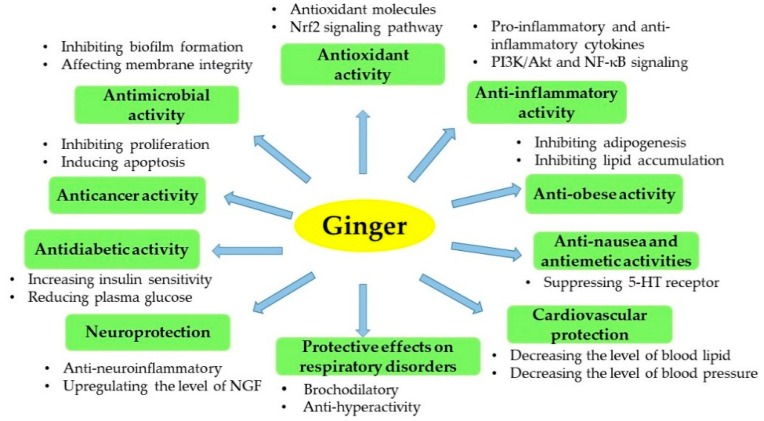
Ginger (Zingiber officinale Roscoe) is a common and widely used spice. It is rich in various chemical constituents, including phenolic compounds, terpenes, polysaccharides, lipids, organic acids, and raw fibers. The health benefits of ginger are mainly attributed to its phenolic compounds, such as gingerols and shogaols. Accumulated investigations have demonstrated that ginger possesses multiple biological activities, including antioxidant, anti-inflammatory, antimicrobial, anticancer, neuroprotective, cardiovascular protective, respiratory protective, antiobesity, antidiabetic, antinausea, and antiemetic activities. In this review, we summarize current knowledge about the bioactive compounds and bioactivities of ginger, and the mechanisms of action are also discussed. We hope that this updated review paper will attract more attention to ginger and its further applications, including its potential to be developed into functional foods or nutraceuticals for the prevention and management of chronic diseases.
Overview
The claims and statistics of this paper haven’t been checked yet.
Free: it reads the open-access text and checks the first 5 claims that cite a source we can check. Create a free account to check every claim.
Integrity signals
Registry
Cites
Statistics
Figures
Verification
Claims the paper makes
The claims and statistics of this paper haven’t been checked yet.
Free: it reads the open-access text and checks the first 5 claims that cite a source we can check. Create a free account to check every claim.
Claims other papers make about this one
Each is checked against this paper’s own text: does it say what the citing paper says it does?
In the citing paper
“A meta-analysis of 13 randomized control trials (n = 1174) found that ginger significantly improves overall pregnancy-associated nausea and vomiting, comparable to vitamin B6 [230] and as effective as standard antiemetics like dimenhydrinate [231].”
From Nutritional Approaches to Enhance GLP-1 Analogue Therapy in Obesity: A Narrative Review (2025) · cites this paper as [231]
Self-check
Percentages, sums and reported differences re-computed from the paper’s own numbers.
The self-check needs the paper’s full text.
Citations
Cites
Bray, F., Ferlay, J., Soerjomataram, I., Siegel, R. L., Torre, L. A., & Jemal, A. (2018) · CA: A Cancer Journal for Clinicians · doi:10.3322/caac.21492 · Cited by 84,109
Targeting Free Radicals in Oxidative Stress-Related Human Diseases
Poprac, P., Jomova, K., Simunkova, M., Kollar, V., Rhodes, C. J., & Valko, M. (2017) · Trends in Pharmacological Sciences · doi:10.1016/j.tips.2017.04.005 · Cited by 1,107 · cited 1×
“It has been known that overproduction of free radicals, such as reactive oxygen species (ROS), plays an important part in the development of many chronic diseases [17].”
BackgroundPlant-derived exosomal MicroRNAs shape the gut microbiota
Teng, Y., Ren, Y., Sayed, M., Hu, X., Lei, C., Kumar, A., Hutchins, E., Mu, J., Deng, Z., Luo, C., et al. (2018) · Cell Host & Microbe · doi:10.1016/j.chom.2018.10.001 · Cited by 1,027 · cited 1×
“Moreover, microRNAs of ginger exosome-like nanoparticles (GELN) ameliorated mouse colitis by inducing the production of IL-22, a barrier function improvement factor [41].”
BackgroundZhang, M., Viennois, E., Prasad, M., Zhang, Y., Wang, L., Zhang, Z., Han, M. K., Xiao, B., Xu, C., Srinivasan, S., et al. (2016) · Biomaterials · doi:10.1016/j.biomaterials.2016.06.018 · Cited by 1,026 · cited 12×
“Besides, ginger extract and zingerone inhibited NF-κB activation and decreased the level of IL-1β in the colons of mice, which alleviated colitis induced by 2, 4, 6-trinitrobenzene sulfonic acid [38].”
BackgroundInfluentialAntioxidant capacities and total phenolic contents of 62 fruits
Fu, L., Xu, B.-T., Xu, X.-R., Gan, R.-Y., Zhang, Y., Xia, E.-Q., & Li, H.-B. (2011) · Food Chemistry · doi:10.1016/j.foodchem.2011.04.079 · Cited by 757
Self-citationGinger and Its Constituents: Role in Prevention and Treatment of Gastrointestinal Cancer
Prasad, S., & Tyagi, A. K. (2015) · Gastroenterology Research and Practice · doi:10.1155/2015/142979 · Cited by 439 · cited 2×
“Besides these, polysaccharides, lipids, organic acids, and raw fibers are also present in ginger [13,16].”
BackgroundChang, J. S., Wang, K. C., Yeh, C. F., Shieh, D. E., & Chiang, L. C. (2013) · Journal of Ethnopharmacology · doi:10.1016/j.jep.2012.10.043 · Cited by 369 · cited 2×
“Ginger was effective in blocking viral attachment and internalization [52].”
BackgroundXu, X.-Y., Meng, X., Li, S., Gan, R.-Y., Li, Y., & Li, H.-B. (2018) · Nutrients · doi:10.3390/nu10101553 · Cited by 358
Self-citationLi, C.-L., Ou, C.-M., Huang, C.-C., Wu, W.-C., Chen, Y.-P., Lin, T.-E., Ho, L.-C., Wang, C.-W., Shih, C.-C., Zhou, H.-C., et al. (2014) · Journal of Materials Chemistry B · doi:10.1039/c4tb00216d · Cited by 350 · cited 2×
“The in vitro experiment found that C-dots increased the content of ROS in the HepG2 cells, which upregulated the expression of p53 and promoted apoptosis [67].”
BackgroundTotal Phenolic Contents and Antioxidant Capacities of Selected Chinese Medicinal Plants
Song, F.-L., Gan, R.-Y., Zhang, Y., Xiao, Q., Kuang, L., & Li, H.-B. (2010) · International Journal of Molecular Sciences · doi:10.3390/ijms11062362 · Cited by 346
Self-citation
Cited by
Items 701–800 of 1,001
Indonesian threatened Zingiberaceae: Exploring their potential traditional and modern uses
Atmaja, M. B., Andila, P. S., Oktavia, G. A. E., & Merriansyah, H. (2023) · IOP Conference Series Earth and Environmental Science · doi:10.1088/1755-1315/1255/1/012036 · Cited by 4
Clinical dermatologic applications of ginger: a focused review
Alhanshali, L., & Khachemoune, A. (2023) · International Journal of Dermatology · doi:10.1111/ijd.16963 · Cited by 7
In vitro assessment of thrombolytic potential of red and white ginger (Zingiber officinale)
Pinontoan, R., Leke, P. A. I., Lesmana, J. A., Purnomo, J. S., Dikson, D., & Samantha, A. (2024) · Functional Foods in Health and Disease · doi:10.31989/ffhd.v14i1.1245 · Cited by 4
“While most studies have identified the beneficial bioactive compounds in ginger as phytochemicals [27], there is no comprehensive study on ginger protease as one of the mechanisms that confer health benefits.”
BackgroundPhytochemical composition and biological activity of native Australian ginger (Alpinia caerulea)
Johnson, J. B., Batley, R. J., Mani, J. S., du Preez, R., Trotter, T., Netzel, M. E., & Naiker, M. (2024) · Journal of Food Measurement & Characterization · doi:10.1007/s11694-023-02326-4 · Cited by 4
Santhyami, Laraswati, Agustina, L., & Agustina, P. (2024) · Tropical Journal of Natural Product Research · doi:10.26538/tjnpr/v8i4.13 · Cited by 4
Phyto-pharmacological review on bioavailability enhancer [Trikatu]
Joshi, S., & Gupta, R. K. (2024) · Journal of Pharmacognosy and Phytochemistry · doi:10.22271/phyto.2024.v13.i3d.14971 · Cited by 4
Choi, J.-H., Nah, J.-Y., Lee, M.-J., Yim, S.-B., Jang, J. Y., Lee, T., & Kim, J.-S. (2024) · Food Control · doi:10.1016/j.foodcont.2024.110631 · Cited by 6
Ginger (Zingiber officinale) - A Beneficial Effect on Health and Physical Activity
Popławska, N. A., Śliz, J., Skorupska, M., Czeczotka, M. J., & Woźniak, K. (2024) · Quality in Sport · doi:10.12775/qs.2024.16.52218 · Cited by 7
Ko, H., Kim, B. S., Lee, Y. E., Choi, T. H., Lee, Y., Youn, H., & Gu, G. (2024) · European Journal of Pharmacology · doi:10.1016/j.ejphar.2024.176997 · Cited by 4
Gingerol acts as a potent radiosensitizer in head and neck squamous cell carcinoma
Rutihinda, C., Haroun, R., Ordoñez, J. P., Mohssine, S., Oweida, H., Sharma, M., Fares, M., Ruiz-Dominguez, N., Pacheco, M. F. M., Naasri, S., et al. (2024) · Discover Oncology · doi:10.1007/s12672-024-01425-y · Cited by 4
“Many plant-derived substances have demonstrated anti-cancer effects, such as the alkaloid vinka, epipodophyllotoxin, taxanes, cephalotaxanes and flavones [10].”
BackgroundThongwong, P., Wattanathorn, J., & Thukham-mee, W. (2024) · Nutrients · doi:10.3390/nu16234144 · Cited by 4
Jung, K.-S., Lee, Y., Ganbat, D., Park, S.-J., & Lee, S.-E. (2024) · Applied Food Research · doi:10.1016/j.afres.2024.100664 · Cited by 6
Kim, I. Y., Lee, H. L., Choi, H., Ju, Y., Heo, Y. M., Na, H. R., Lee, D. Y., Jeong, W. M., & Heo, H. J. (2024) · Antioxidants · doi:10.3390/antiox13121572 · Cited by 5
Tiwari, U., Akhtar, S., Mir, S. S., & Khan, M. K. A. (2025) · Molecular Diversity · doi:10.1007/s11030-025-11122-9 · Cited by 4
Bashir, B., Sethi, P., Panda, S., Manikyam, H. K., Vishwas, S., Singh, S. K., Singh, K., Jain, D., Chaitanya, M., & Coutinho, H. D. M. (2025) · Cellular Signalling · doi:10.1016/j.cellsig.2025.111743 · Cited by 5
Trang, Đ. T. X., Chau, T. T., Linh, T. C., & Tai, T. L. (2025) · Current Microbiology · doi:10.1007/s00284-025-04197-y · Cited by 5
Netshiluvhi, T. R. (2025) · Natural Product Communications · doi:10.1177/1934578x251321725 · Cited by 5
Ethnobotany in a Modern City: The Persistence in the Use of Medicinal Plants in Guadalajara, Mexico
Martínez-González, R. E., Huerta‐Martínez, F. M., Neri-Luna, C., Barrientos-Ramírez, L., & Muñoz‐Urias, A. (2025) · Plants · doi:10.3390/plants14172788 · Cited by 5
Sukoco, A., Novenda, I., Maryanto, Kuswardhani, N., & Sari, P. (2021) · IOP Conference Series Earth and Environmental Science · doi:10.1088/1755-1315/709/1/012035 · Cited by 7
Variability of exotic ginger (Zingiber officinale Rosc.) accessions for quality parameters
Babu, P. A., Leela, N. K., Venkatesh, J., & Prasath, D. (2021) · Journal of Plantation Crops · doi:10.25081/jpc.2021.v49.i2.7257 · Cited by 4
“In addition, it possesses the potential to prevent and manage many diseases due to the bioactive compounds viz., gingerols and shogaols (Mao et al., 2019).”
BackgroundRamjane, H., Bahorun, T., Ramasawmy, B., Ramful‐Baboolall, D., Boodia, N., Aruoma, O. I., & Neergheen, V. S. (2021) · American Journal of Biopharmacy and Pharmaceutical Sciences · doi:10.25259/ajbps_3_2021 · Cited by 6
Ghafoor, B., & Ali, M. N. (2022) · Journal of Bioactive and Compatible Polymers · doi:10.1177/08839115221085735 · Cited by 4
Ravi, Y., Narayanpur, V. B., Gangadharappa, P. M., Hiremath, J. S., Shantappa, T., Prashant, A., & Doddamani, M. B. (2022) · International Journal of Bio-resource and Stress Management · doi:10.23910/1.2022.2780a · Cited by 4
Gupta, N., Agarwal, A., & Yadav, V. K. (2023) · Ethnobotany Research and Applications · doi:10.32859/era.25.2.1-17 · Cited by 10
Anxiety and Metabolic Disorders: The Role of Botanicals
Trebesova, H., Orlandi, V., Boggia, R., & Grilli, M. (2023) · Current Issues in Molecular Biology · doi:10.3390/cimb45020068 · Cited by 4
Budiari, S., Mulyani, H., Maryati, Y., Filailla, E., Devi, A. F., & Melanie, H. (2023) · AGROINTEK · doi:10.21107/agrointek.v17i1.14269 · Cited by 7
“The strong antioxidant properties of ginger are linked to its bioactive compounds, e.g., 6-shogaol, 6-gingerol, and oleoresin (Mao et al. 2019).”
InfluentialEffectiveness of biofungicide formula on rhizome rot disease of red ginger and its plant growth
Marwan, H., Hayati, I., & MULYATI, S. (2023) · Biodiversitas Journal of Biological Diversity · doi:10.13057/biodiv/d240425 · Cited by 4
Plants as herbal medicine at Nguter Traditional Market, Sukoharjo, Central Java, Indonesia
MARDIYANTO, M. B., FORESTY, R. S., Arlysia, V., CHORUNISSA, Z. F. N., NUGROHO, G. D., Yasa, A., Naim, D. M., & SETYAWAN, A. D. (2023) · Asian Journal of Ethnobiology · doi:10.13057/asianjethnobiol/y060108 · Cited by 7
Rumahorbo, C. G. P., Situmorang, P. C., Zagoto, E. R. M. P., Nisfa, L., & Hasanah, U. (2023) · Journal of Pharmacy & Pharmacognosy Research · doi:10.56499/jppres23.1618_11.3.537 · Cited by 8
“The current study also found that the powerful phenolic gingerol components have recently been identified as the main active components in ginger extracts that enhance GLUT-1 (Mao et al., 2019).”
BackgroundMollaamin, F. (2023) · Trends in Immunotherapy · doi:10.24294/ti.v7.i2.2329 · Cited by 5
“Gingerols have anticancer activity, anti-inflammatory, antioxidant, antiangiogenesis, anti-metastasis, antimicrobial, antifungal, neuroprotective, antiemetic and antihyperlipidemic effects([27,28]).”
Anugrah, S. M., Kusnanik, N. W., Wahjuni, E. S., Muhammad, H. N., Sulistyarto, S., Purwanto, B. T., Resmana, D., Juniarsyah, A. D., Ayubi, N., & Sari, E. (2023) · Retos · doi:10.47197/retos.v51.100616 · Cited by 4
“Ginger also suppresses the metabolism of arachidonic acid by inhibiting or blocking pro-inflammatory mediator pathways like cyclooxygenase (COX) and lipoxygenase (LOX), which reduces the production of prostaglandins, corticosterone, and subsequent inflammatory responses (Mao et al., 2019).”
BackgroundXu, D., Yuan, L., Che, M., Liu, W., Li, X., Yang, Y., Wang, K., & Nan, Y. (2024) · Heliyon · doi:10.1016/j.heliyon.2024.e24776 · Cited by 4
“Zingiberis Rhizoma Recens (Shengjiang), which is a member of the ginger family, is the fresh rhizome of Zingiber Officinale Roscoe and contains the major components of the volatile oil, gingerol, and has the effects of anti-vomiting, antitumour, blood lipids, etc [10].”
BackgroundSheybatzadeh, K., Moshtaghie, S. A. A., Shahanipour, K., & Golab, F. (2024) · Asian Pacific Journal of Cancer Prevention · doi:10.31557/apjcp.2024.25.3.893 · Cited by 7
“A molecule derived from Ginger ( Zingiber officinale Roscoe), which belongs to the Zingiberaceae family, has been identified as a possible inhibitor of it [11].”
BackgroundThe potential of ginger (Zingiber officinale Rosc.) extracts as a bio-pesticide
Sinha, N., & Ray, S. (2024) · Journal of Entomology and Zoology Studies · doi:10.22271/j.ento.2024.v12.i3a.9317 · Cited by 4
“Polysaccharides, raw fibers, lipids, and organic acids [20] Dried ginger Shogaol (6,8,10-shogaol) and gingerol [21] Ginger powder gingerol,paradols, and shogaol ingiberene, 𝛽 -sesquiphellandrene, 𝛽 -bisabolene, 𝛼 -curcumene,and 𝛼 - farnesene, amino acids, protein, raw fiber, ash, vitamins, and…”
BackgroundUkwubile, C. A., Malgwi, T. S., Angyu, A. E., Otalu, O., & Bingari, M. S. (2020) · Journal of Scientific Research in Medical and Biological Sciences · doi:10.47631/jsrmbs.v1i2.50 · Cited by 4
Surya, R., Romulo, A., & Susilo, E. (2021) · IOP Conference Series Earth and Environmental Science · doi:10.1088/1755-1315/794/1/012138 · Cited by 4
Potential of Prospective Medicinal Plants of Bangladesh for the Complementary Management of COVID-19
Shahriar, S., Sarker, M. M. R., Soma, M. A., Jannat, T., Mina, S. T., Rahman, R., Rahman, M. S., & Rashid, M. A. (2022) · Bangladesh Pharmaceutical Journal · doi:10.3329/bpj.v25i1.57845 · Cited by 4
Lin, H., Lin, M., Tsai, C.-H., Wang, Y.-H., Chen, C., Hwang, S., Yen, M., & Chiu, Y. (2021) · Frontiers in Pharmacology · doi:10.3389/fphar.2021.573145 · Cited by 3
“) is the main chief herb within the listed composition of many harmonizing formulas identified in our study (Supplementary Table S2) (Xie et al., 2013; Ji et al., 2014; Tian et al., 2014; Zhang et al., 2017; Pastorino et al., 2018; Stanisiere et al., 2018; Mao et al., 2019; Wang et al., 2019; Yang et. al, 2020).”
BackgroundBenefits of Ginger as Medicine for COVID-19: Literature Study
Utami, A. T., & Qarrah, A. G. A. (2022) · Journal of Biomedical Research & Environmental Sciences · doi:10.37871/jbres1580 · Cited by 6
Saldaña-Chafloque, C. F., León, J. M., & Cruz-Castillo, A. J. D. L. (2022) · TAYACAJA · doi:10.46908/tayacaja.v5i2.199 · Cited by 4
A Possible Role of Medicinal Plants in finding a Cure for Covid-19
Qazi, A. S., Akhtar, N., Khalil, A. A. K., Ahmed, M. S., & Mumtaz, S. (2020) · Life and Science · doi:10.37185/lns.1.1.156 · Cited by 4
Li, L., Jia, S., Yu, C., Shi, S., & Peng, F. (2024) · Frontiers in Pharmacology · doi:10.3389/fphar.2024.1393597 · Cited by 3
Xu, C., Liu, D., Lv, Y.-Y., & Ni, C.-Y. (2025) · Food Chemistry · doi:10.1016/j.foodchem.2025.144346 · Cited by 3
Tang, Z., Zhang, X., Qiao, W., Shao, X.-D., Li, X.-X., Dong, J.-F., Shao, L., Hu, W., Zhang, R., & Chen, X. (2025) · Journal of Agricultural and Food Chemistry · doi:10.1021/acs.jafc.5c01166 · Cited by 3
Williams, J. T., Tiani, K. A., Foster, M., MacFarlane, A. J., Bailey, R. L., Stover, P. J., & Field, M. S. (2025) · BMC Complementary Medicine and Therapies · doi:10.1186/s12906-025-04904-z · Cited by 3
“Ginger ( Zingiber officinale ) also belongs to the Zingiberaceae family and is known for its distinct flavor and numerous potential health benefits including anti-inflammatory, antiemetic, and digestive properties [1].”
Sánchez-Peña, M. J., Magallón-Chávez, O., & Rivas-Loaiza, J. A. (2025) · Cosmetics · doi:10.3390/cosmetics12050179 · Cited by 7
Nutrient and biomass dynamics for dual-organ yield in turmeric (Curcuma longa L.)
Liao, W., Wang, H., Fan, H., Chen, J., Yin, L., Cai, X., & Li, M. (2025) · PeerJ · doi:10.7717/peerj.19933 · Cited by 3
“Plants in the Zingiberaceae family are renowned for their rich active compounds, such as curcuminoids in turmeric and gingerols and shogaols in ginger, which determine their medicinal properties and market value ( Mao et al., 2019 ).”
Okpoghono, J., Acha, J. O., Okom, S. U., Dunkwu, C. C., & Onyesom, I. (2025) · Food Chemistry Advances · doi:10.1016/j.focha.2025.101110 · Cited by 3
Dwijayanti, D. R., Mamamia, A., Maulana, R. Y. N., Rosyadah, N., & Widodo, N. (2025) · Cogent Food & Agriculture · doi:10.1080/23311932.2025.2568198 · Cited by 6
“Many research has proven the anti-oxidant and anti-inflammatory activity of gingerol, especially 6-gingerol, 8-gingerol and 10-gingerol (Mao et al., 2019).”
InfluentialWang, Y., Pan, W., Yang, X., Song, E., Zhang, H., Liu, Y., Wang, K., Wu, H., & Liu, Q. (2025) · Ultrasonics Sonochemistry · doi:10.1016/j.ultsonch.2025.107721 · Cited by 7
“Plants represent an abundant reservoir of natural compounds, offering sustainable and environmentally friendly solutions for applications in human health and food safety [3].”
Vieira, G. P., Martins, C. P. D. C., Pereira, T. R. D. C., Cipriano, L. D. C., Goulart, M. B., Guimarães, J. T., Pagani, M. M., Duarte, M. C. K. H., Cruz, A. G., Mano, S. B., et al. (2025) · Food Research International · doi:10.1016/j.foodres.2025.118195 · Cited by 3
Basuini, M. F. E., Shehata, A., Rasheed, M., Galal, M., El-Hais, A., Soliman, A. A., Teiba, I. I., Alhoshy, M., Gabr, A. A., Gewaily, M. S., et al. (2026) · Aquaculture & Fisheries · doi:10.1016/j.aaf.2026.03.002 · Cited by 3
Otekunrin, O. A. (2026) · Discover Plants. · doi:10.1007/s44372-026-00555-7 · Cited by 4
The Multi‐Biological Targeted Role of Dehydrozingerone and its Analogues
Kumar, V., Bala, R., Dhawan, S., Singh, P., & Karpoormath, R. V. (2022) · ChemistrySelect · doi:10.1002/slct.202201938 · Cited by 3
Choi, S. Y., & Kim, K. (2022) · Korean Journal of Food Preservation · doi:10.11002/kjfp.2022.29.5.762 · Cited by 3
Formulation and evaluation of herbal syrup of ginger extract
Nerkar, A. G., & Ghadge, S. (2023) · Current Trends in Pharmacy and Pharmaceutical Chemistry · doi:10.18231/j.ctppc.2023.007 · Cited by 3
Chandran, A., Koland, M., & Mulleria, S. S. (2023) · International Journal of Pharmaceutical Investigation · doi:10.5530/ijpi.14.1.16 · Cited by 3
Karizak, S. Z., Shahnehzad, M., & Zar, A. (2024) · Comparative Exercise Physiology · doi:10.1163/17552559-20230041 · Cited by 3
Subtain, M., Pasha, I., Rakha, A., & Jamil, A. (2024) · Journal of Food Measurement & Characterization · doi:10.1007/s11694-024-02518-6 · Cited by 6
Ginger Root Bioactive Compounds Specifically Inhibits Growth of Colon Cancer Cells in Culture
Lin, S., & Lu, P. (2024) · Nutrition and Metabolic Insights · doi:10.1177/11786388241231163 · Cited by 3
“In the literature, high doses (at ~30 µmoL/L or higher) were used in treating cancer cells, 7,8 but there were no normal colon epithelial cells as a negative control.”
BackgroundMethodInfluentialIdoko, A. S., Usman, I. N., & Zaharaddeen, S. A. (2024) · Sahel Journal of Life Sciences FUDMA · doi:10.33003/sajols-2024-0202-07 · Cited by 3
Mittal, V., & Sharma, A. (2024) · Recent Advances in Inflammation & Allergy Drug Discovery · doi:10.2174/0127722708292961240508110207 · Cited by 5
10-Gingerol reduces cytoplasmic lipid droplets and induces lipolysis in 3T3-L1 adipocytes
Preciado-Ortiz, M. E., Martínez‐López, E., García‐Iglesias, T., Gembe‐Olivarez, G., Torres‐Castillo, N., Llamas-Covarrubias, I. M., & Rivera-Valdes, J. J. (2024) · Adipocyte · doi:10.1080/21623945.2024.2411453 · Cited by 4
“Ginger root presents a variety of bioactive compounds, particularly ginger-ols, that could help in the prevention and treatment of different diseases, including obesity [16–21].”
BackgroundTherapeutic Potential of Herbal Compounds in Curing Dysmenorrhea Naturally: A Review
Kumar, M., Kaushik, D., Gaba, N., Öz, E., Singh, J., Bansal, V., Nair, A. P., Proestos, C., Babagil, G. E., Brennan, M. A., et al. (2024) · Journal of the American Nutrition Association · doi:10.1080/27697061.2024.2421525 · Cited by 3
Thermodynamic and kinetic modelling of 6-gingerol scCO2 extraction
Kamaruddin, M. S. H., Chong, G. H., Hassan, M. H. A., & Suleiman, N. (2025) · Food and Bioproducts Processing · doi:10.1016/j.fbp.2025.01.013 · Cited by 4
Olaniyan, M. F., Olaniyi, O. D., Odegbemi, F., Ojediran, T. B., & Odegbemi, O. B. (2025) · Discover Chemistry. · doi:10.1007/s44371-025-00098-y · Cited by 7
Bioactive Phytochemicals from Ginger (Zingiber officinale) By-products
Ijaz, S., Iqbal, J., Abbasi, B. A., Ullah, Z., Uddin, S., Yaseen, T., Zarshan, F., Ali, H., Sher, H., Ullah, Z., et al. (2025) · Springer eBooks · doi:10.1007/978-3-031-80700-8_15 · Cited by 3
Mukherjee, D. R., Tanbir, S., Mondal, S., Tarafder, S., Biswas, D., Dutta, S., Santra, S., & Biswas, P. (2025) · Journal of Drug Delivery and Therapeutics · doi:10.22270/jddt.v15i4.7088 · Cited by 3
Potential Antioxidant and Antiviral Activities of Various Hydroethanolic Extracts
Jain, H., & Aggarwal, N. K. (2025) · Springer eBooks · doi:10.1007/978-981-96-3663-1_3 · Cited by 4
Effect of Thermal Processing by Spray Drying on Key Ginger Compounds
Warren‐Walker, A., Beckmann, M., Watson, A., McAllister, S., & Lloyd, A. J. (2025) · Metabolites · doi:10.3390/metabo15060350 · Cited by 5
“They have been reported to exhibit a wide range of pharmacological activities, including anti-inflammatory, antioxidant, and metabolic effects [2,3].”
Anorexia – Aromatic strategies in managing dietary changes in end-of-life patients
Gonçalves, S. D. (2025) · Nutrition Clinique et Métabolisme · doi:10.1016/j.nupar.2025.06.003 · Cited by 4
Yeasmin, F., Hira, N. N., Rahman, H., & Islam, M. N. (2021) · Food Research · doi:10.26656/fr.2017.5(1).383 · Cited by 3
“Due to its anti-inflammatory activity endurance runners take 500mg ginger powder capsules (Mao et al., 2019) and overweight females can decrease the body mass index by taking 2 g ginger powder per day (Ebrahimzadeh Attari et al.”
BackgroundEffect of Ginger on Oxidative Stress Induced by Hydrogen Peroxide in Male Quail
Abdul-Majeed, A. F., & Abdul-Rahman, S. Y. (2022) · International Multi-Disciplinary Conference: Integrated Sciences and Technologies (IMDC-IST) · doi:10.4108/eai.7-9-2021.2315485 · Cited by 3
Gao, Z., Ren, Y., Liu, B., Ma, R., Li, F., Li, D., & Wang, Y. (2022) · International Food Research Journal · doi:10.47836/ifrj.29.2.20 · Cited by 3
“Ginger extracts, especially gingerol and shogaol, have some degree of pharmacological effects including antioxidant, anti-inflammatory, anti-tumour, and analgesic (Kou et al., 2018; Mao et al., 2019; Ma et al., 2021).”
BackgroundThe Therapeutic Potential of Panax Ginseng and Ginger on Postsurgical Adhesion Band Formation
Nazari, S. E., Khalili‐Tanha, G., Mobasheri, L., Asgharzadeh, F., Naimi, H., Eskandari, M., Askarnia-Faal, M.-M., Mehr, S. M. H., Gharib, M., Ghorbani, H. R., et al. (2022) · Letters in Drug Design & Discovery · doi:10.2174/1570180819666220630094320 · Cited by 3
Afshar, Z., Shahali, S., & Rastad, H. (2022) · Sexologies · doi:10.1016/j.sexol.2022.03.004 · Cited by 4
Quorum Quenching Potential of Biogenic Silver Nanoparticles against Chromobacterium violaceum 4212
Anju, S., & Sarada, J. (2022) · Journal of Pure and Applied Microbiology · doi:10.22207/jpam.16.3.77 · Cited by 4
Tanideh, N., Bordbar, A., Bordbar, H., Khaghaninejad, M. S., Daneshi, S., Ardekani, S. T., Iraji, A., Zare, S., Khodabandeh, Z., Sarafraz, N., et al. (2022) · Journal of Maxillofacial and Oral Surgery · doi:10.1007/s12663-022-01829-9 · Cited by 3
“Other important components such as amino acids, raw fiber, protein, phytosterols, vitamins (including niacin and vitamin A), and minerals are also present in ginger [9].”
Yuda, P. E. S. K., Mahardika, I. M. A. A., Cahyaningsih, E., Sasadara, M. M. V., Nayaka, N. M. D. M. W., & Dewi, N. L. K. A. A. (2022) · JPSCR Journal of Pharmaceutical Science and Clinical Research · doi:10.20961/jpscr.v7i3.60529 · Cited by 7
“…polisakarida, lipid, asam organik, dan serat dengan berbagai aktivitas biologis, termasuk antioksidan, anti-inflamasi, antimikroba, antikanker, neuroprotektif, pelindung kardiovaskular, pelindung pernapasan, antiobesitas, antidiabetik, antinausea, dan aktivitas antiemetik (Mao et al ., 2019).”
BackgroundYanti, Y., Harijono, C., & Lay, B. W. (2023) · Pharmaceuticals · doi:10.3390/ph16030371 · Cited by 3
Widowati, W., Wargasetia, T. L., Zakaria, T. M., Gunadi, M. S., Santiadi, S., Marthania, M., & Ziyad, A. R. (2023) · Pharmaciana · doi:10.12928/pharmaciana.v13i1.22655 · Cited by 3
Reviono, R., Hapsari, B. D. A., Sutanto, Y. S., Adhiputri, A., Harsini, H., Suryawati, B., Marwoto, M., & Syaikhu, A. (2023) · Narra J · doi:10.52225/narra.v3i1.142 · Cited by 3
“A study in mice models found that the administration of Z. officinale increased the anti-inflammatory cytokines including IL-10 and reduced the proinflammatory cytokines such as TNF-α , IL-6, and IL-1 β [14].”
BackgroundPrabhakar, P., Marakala, V., Sacheendran, D., George, T., D’souza, R. K., Palatty, P. L., & Baliga, M. S. (2023) · Current Nutrition & Food Science · doi:10.2174/1573401319666230913122317 · Cited by 3
Rajput, A. H., Gavali, R. D., & Jadhav, A. P. (2023) · Journal of Planar Chromatography – Modern TLC · doi:10.1007/s00764-023-00268-7 · Cited by 3
Adhikari, R., Bhattarai, K., & Sharma, K. R. (2023) · Amrit Research Journal · doi:10.3126/arj.v4i1.61181 · Cited by 3
“Ginger is abundant in secondary metabolites like phenolics, terpenes, organic acids, and lipids, with its biological activities attributed to the presence of phenolic compounds[10].”
Background[6]-Shogaol Induces Apoptosis of Murine Bladder Cancer Cells
Nina, D. G. N., Robeldo, T. A., da Silva, J. A., Gonçalves, V. S. D. S., Borra, R. C., & Aníbal, F. D. F. (2024) · Cellular Physiology and Biochemistry · doi:10.33594/000000682 · Cited by 3
Parvathy, P., Natarajan, M., Kannan, B. N., Lekha, G. S., & Kanagarajan, A. (2024) · Research Journal of Pharmacy and Technology · doi:10.52711/0974-360x.2024.00113 · Cited by 3
Nur Diyana, A., Nor Azlan, S. N., Lazim, M. I. M., Hussin, A., Mansor, A., & Ibrahim, A. H. (2024) · Food Research · doi:10.26656/fr.2017.6(s3).1 · Cited by 3
Traditional Galactogogues and the Practices Related to Their Use by Post-Natal Women of India
Jain, M., Pahuja, A. N., Singh, E. P., & Chandra, S. (2024) · Malaysian Journal of Medicine and Health Sciences · doi:10.47836/mjmhs.20.1.19 · Cited by 5
Frimayanti, N., Febrina, M., & Amalia, A. Y. (2024) · Jurnal Riset Kimia · doi:10.25077/jrk.v15i1.638 · Cited by 1
Gupta, N., Bano, U., Kimta, N., Khan, A. A., Nepovimová, E., Alomar, S. Y., & Kuča, K. (2024) · Phytochemistry Reviews · doi:10.1007/s11101-024-09971-7 · Cited by 3
Xu, X., Guo, S., Chen, J., Song, Y., Xue-li, W., Liu, F., & Duan, J. (2024) · Journal of Chromatography B · doi:10.1016/j.jchromb.2024.124193 · Cited by 3
Self-citationNatural Anticarcinogens: The Efficacy of Herbs and Spices
Vikas, B., Sweety, V. K., Anil, S., & Palaniyandi, S. (2024) · IntechOpen eBooks · doi:10.5772/intechopen.1004335 · Cited by 5
Ethnobotany of medicinal plants in homegarden of Menoreh Karst Area, Purworejo District, Indonesia
IGUSTITA, I., FATIKHA, L. A., ASTIKASARI, L., Kusuma, D. A. C., NUGRAHENI, R. S., MURYANTO, B. S., Anshory, D. A., Hidayat, S., Sujarta, P., Yasa, A., et al. (2023) · Asian Journal of Ethnobiology · doi:10.13057/asianjethnobiol/y060208 · Cited by 10
Dwira, S., Tedjo, A., Dharmawan, M. A., Erlina, L., & Fadilah, F. (2024) · Tropical Journal of Natural Product Research · doi:10.26538/tjnpr/v8i8.12 · Cited by 3
Revisiting the protective effects of ginger phenolic compounds on the kidneys: A narrative review
Moghaddam, S. H., Vatankhah, A., Armide, N., & Keshavarzi, Z. (2024) · Food and Humanity · doi:10.1016/j.foohum.2024.100442 · Cited by 4
Khan, M. W. A., Sherwani, S., Alshammari, M. H. E., Alsukaibi, A. K. D., Khan, W. A., Haque, A., Alenezi, K. M., & Shahab, U. (2024) · Pharmaceuticals · doi:10.3390/ph17111469 · Cited by 5
Hussain, S., Sadiq, I., Baig, J. A., Solangi, S. A., Khan, Z. U., Solangi, I. B., Riaz, S., Pullar, R. C., Thebo, K. H., & Kazi, M. (2025) · Microscopy Research and Technique · doi:10.1002/jemt.24810 · Cited by 3
Inhibitory effect of [6]-shogaol against 3CLpro activity and SARS-CoV-2 infection
Tanikawa, T., Hayashi, T., Kiba, Y., Kamauchi, H., Someya, Y., & Kitamura, M. (2025) · BMC Complementary Medicine and Therapies · doi:10.1186/s12906-025-05094-4 · Cited by 3
“It has attracted considerable attention because of its wide range of pharmacological activities, including antioxidant, anti-inflammatory, anticancer, antiemetic, and antibacterial effects [15, 16].”
Wong, L. H., Tay, L., Goh, R. M., Tan, T. J., Zhou, R., Ho, A. K. H., & Wong, P. O. (2021) · Evidence-based Complementary and Alternative Medicine · doi:10.1155/2021/4319657 · Cited by 7
“+ese included Glycyrrhiza uralensis [7–24], Prunus armeniaca [25, 26], Pinellia ternata [27], Asarum sieboldii [28, 29], Pheretima aspergillum [30–37], Aster tataricus [38, 39], Fritillaria cirrhosa [40–43], Lepidium apetalum [44], Pericarpium Citri Reticulatae [45–47], Cortex Mori [48–52], Ephedra sinica Stapf [53–56…”
BackgroundInfluential
Metadata
- Authors
- Mao, Q.-Q., Xu, X.-Y., Cao, S.-Y., Gan, R.-Y., Corke, H., Beta, T., & Li, H.-B.
- Affiliations
- Guangdong Provincial Key Laboratory of Food, Nutrition and Health, Department of Nutrition, School of Public Health, Sun Yat-sen University, Guangzhou 510080, China
- Sun Yat-sen University (CN)
- Shanghai Jiao Tong University (CN)
- Department of Food & Human Nutritional Sciences, University of Manitoba, Winnipeg, MB R3T 2N2, Canada
- Corresponding author
- Gan, Ren-You
- Li, Hua-Bin
- Venue
- Foods
- Publisher
- MDPI AG
- Published
- 2019-05-30
- Volume
- 8
- Issue
- 6
- Pages
- 185
- ISSN
- 2304-8158 (ISSN-L)
- PMC
- PMC6616534
- OpenAlex
- W2947671311
- Semantic Scholar
- d16da9cb8957f5f43f25ac947958cef199e438d8
- Cited by
- 1,418
- References
- 117
- Citations by year
- 2026: 162 · 2025: 247 · 2024: 255 · 2023: 254 · 2022: 255 · 2021: 159 · 2020: 74 · 2019: 10
- FWCI
- 19.61
- Type
- journal article
- Language
- en
- Open access
- gold
- dx.doi.org
- Licence
- Locations
- Foods (publishedVersion, cc-by)
- Europe PMC (PubMed Central) (publishedVersion, cc-by)
- PubMed Central (publishedVersion, cc-by)
- PubMed (publishedVersion)
- DOAJ (DOAJ: Directory of Open Access Journals) (submittedVersion, cc-by-sa)
- Funders
- the National Key R&D Program of China (2017YFC1600100)
- Shanghai Basic and Key Program (18JC1410800)
- the Agri-X Interdisciplinary Fund of Shanghai Jiao Tong University (Agri-X2017004)
- the Key Project of Guangdong Provincial Science and Technology Program (2014B020205002)
- Topics
- Life Sciences › Pharmacology, Toxicology and Pharmaceutics › Pharmacology › Ginger and Zingiberaceae research
- Life Sciences › Agricultural and Biological Sciences › Plant Science › Garlic and Onion Studies
- Life Sciences › Pharmacology, Toxicology and Pharmaceutics › Pharmacology › Ginseng Biological Effects and Applications
- Keywords
- ginger, bioactive compounds, phenolic compounds, gingerol, shogaol, antioxidant activity, anti-inflammatory activity, antimicrobial activity, anticancer activity, neuroprotection, cardioprotection, respiratory protection, anti-obesity, antidiabetic activity, antiemetic activity, functional foods, nutraceuticals, chronic disease prevention
About these checks
Registry, retraction, Cites and statistics results are computed, not judged, with one exception: a printed reference that no index lists is read once by a model before it counts as a citation error. Claims are extracted by a model and kept only when their quote appears verbatim in the text; each cited source is then checked, with a model’s help, for whether it says what the claim relies on. Those verdicts can be wrong — read the claim’s quote and the cited source before relying on one.
Statistics and arithmetic are recomputed, not judged.
Confidence bands are shown only for fields calibrated on our annotated test set. None is calibrated yet, so no band is shown.
What counts as a claim ›How we measure confidence ›How we check this ›
Are you an author, or do you see a problem with this page? Request a review
Data sources
Bibliographic data: Semantic Scholar, OpenAlex, Crossref.
Contains information from the Semantic Scholar Academic Graph Datasets, made available under the ODC Attribution License (ODC-BY 1.0).
Semantic Scholar’s data is described in: Kinney, R., et al. (2023). The Semantic Scholar Open Data Platform. arXiv:2301.10140.
