

Bioactive Compounds and Bioactivities of Ginger (Zingiber officinale Roscoe)
Open accessThe DOI matches its Crossref record; 117 of the 117 references it cites were found in a registry or an index.
Abstract
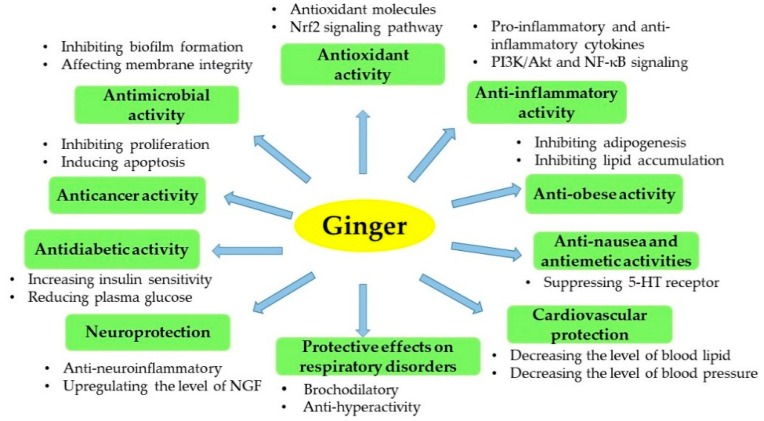
Ginger (Zingiber officinale Roscoe) is a common and widely used spice. It is rich in various chemical constituents, including phenolic compounds, terpenes, polysaccharides, lipids, organic acids, and raw fibers. The health benefits of ginger are mainly attributed to its phenolic compounds, such as gingerols and shogaols. Accumulated investigations have demonstrated that ginger possesses multiple biological activities, including antioxidant, anti-inflammatory, antimicrobial, anticancer, neuroprotective, cardiovascular protective, respiratory protective, antiobesity, antidiabetic, antinausea, and antiemetic activities. In this review, we summarize current knowledge about the bioactive compounds and bioactivities of ginger, and the mechanisms of action are also discussed. We hope that this updated review paper will attract more attention to ginger and its further applications, including its potential to be developed into functional foods or nutraceuticals for the prevention and management of chronic diseases.
Overview
The claims and statistics of this paper haven’t been checked yet.
Free: it reads the open-access text and checks the first 5 claims that cite a source we can check. Create a free account to check every claim.
Integrity signals
Registry
Cites
Statistics
Figures
Verification
Claims the paper makes
The claims and statistics of this paper haven’t been checked yet.
Free: it reads the open-access text and checks the first 5 claims that cite a source we can check. Create a free account to check every claim.
Claims other papers make about this one
Each is checked against this paper’s own text: does it say what the citing paper says it does?
In the citing paper
“A meta-analysis of 13 randomized control trials (n = 1174) found that ginger significantly improves overall pregnancy-associated nausea and vomiting, comparable to vitamin B6 [230] and as effective as standard antiemetics like dimenhydrinate [231].”
From Nutritional Approaches to Enhance GLP-1 Analogue Therapy in Obesity: A Narrative Review (2025) · cites this paper as [231]
Self-check
Percentages, sums and reported differences re-computed from the paper’s own numbers.
The self-check needs the paper’s full text.
Citations
Cites
Bray, F., Ferlay, J., Soerjomataram, I., Siegel, R. L., Torre, L. A., & Jemal, A. (2018) · CA: A Cancer Journal for Clinicians · doi:10.3322/caac.21492 · Cited by 84,109
Targeting Free Radicals in Oxidative Stress-Related Human Diseases
Poprac, P., Jomova, K., Simunkova, M., Kollar, V., Rhodes, C. J., & Valko, M. (2017) · Trends in Pharmacological Sciences · doi:10.1016/j.tips.2017.04.005 · Cited by 1,107 · cited 1×
“It has been known that overproduction of free radicals, such as reactive oxygen species (ROS), plays an important part in the development of many chronic diseases [17].”
BackgroundPlant-derived exosomal MicroRNAs shape the gut microbiota
Teng, Y., Ren, Y., Sayed, M., Hu, X., Lei, C., Kumar, A., Hutchins, E., Mu, J., Deng, Z., Luo, C., et al. (2018) · Cell Host & Microbe · doi:10.1016/j.chom.2018.10.001 · Cited by 1,027 · cited 1×
“Moreover, microRNAs of ginger exosome-like nanoparticles (GELN) ameliorated mouse colitis by inducing the production of IL-22, a barrier function improvement factor [41].”
BackgroundZhang, M., Viennois, E., Prasad, M., Zhang, Y., Wang, L., Zhang, Z., Han, M. K., Xiao, B., Xu, C., Srinivasan, S., et al. (2016) · Biomaterials · doi:10.1016/j.biomaterials.2016.06.018 · Cited by 1,026 · cited 12×
“Besides, ginger extract and zingerone inhibited NF-κB activation and decreased the level of IL-1β in the colons of mice, which alleviated colitis induced by 2, 4, 6-trinitrobenzene sulfonic acid [38].”
BackgroundInfluentialAntioxidant capacities and total phenolic contents of 62 fruits
Fu, L., Xu, B.-T., Xu, X.-R., Gan, R.-Y., Zhang, Y., Xia, E.-Q., & Li, H.-B. (2011) · Food Chemistry · doi:10.1016/j.foodchem.2011.04.079 · Cited by 757
Self-citationGinger and Its Constituents: Role in Prevention and Treatment of Gastrointestinal Cancer
Prasad, S., & Tyagi, A. K. (2015) · Gastroenterology Research and Practice · doi:10.1155/2015/142979 · Cited by 439 · cited 2×
“Besides these, polysaccharides, lipids, organic acids, and raw fibers are also present in ginger [13,16].”
BackgroundChang, J. S., Wang, K. C., Yeh, C. F., Shieh, D. E., & Chiang, L. C. (2013) · Journal of Ethnopharmacology · doi:10.1016/j.jep.2012.10.043 · Cited by 369 · cited 2×
“Ginger was effective in blocking viral attachment and internalization [52].”
BackgroundXu, X.-Y., Meng, X., Li, S., Gan, R.-Y., Li, Y., & Li, H.-B. (2018) · Nutrients · doi:10.3390/nu10101553 · Cited by 358
Self-citationLi, C.-L., Ou, C.-M., Huang, C.-C., Wu, W.-C., Chen, Y.-P., Lin, T.-E., Ho, L.-C., Wang, C.-W., Shih, C.-C., Zhou, H.-C., et al. (2014) · Journal of Materials Chemistry B · doi:10.1039/c4tb00216d · Cited by 350 · cited 2×
“The in vitro experiment found that C-dots increased the content of ROS in the HepG2 cells, which upregulated the expression of p53 and promoted apoptosis [67].”
BackgroundTotal Phenolic Contents and Antioxidant Capacities of Selected Chinese Medicinal Plants
Song, F.-L., Gan, R.-Y., Zhang, Y., Xiao, Q., Kuang, L., & Li, H.-B. (2010) · International Journal of Molecular Sciences · doi:10.3390/ijms11062362 · Cited by 346
Self-citation
Cited by
Items 801–900 of 1,001
Plant species forbidden in health food and their toxic constituents
Malik, G., Chugh, S., Rustagi, A., & Arora, R. (2021) · Elsevier eBooks · doi:10.1016/b978-0-12-822360-4.00013-3 · Cited by 5
The diversity of plant species used in traditional herbal massage oil in Indonesia
Rahayu, M., Susan, D., Keim, A. P., Susiarti, S., & Sujarwo, W. (2021) · Pacific Conservation Biology · doi:10.1071/pc21022 · Cited by 4
Widyapuspa, A. H., Kristiani, E. B. E., & Martono, Y. (2022) · Pharmaciana · doi:10.12928/pharmaciana.v12i1.20903 · Cited by 7
Chan, Y.-C., Zhao, J., Hu, Q., Guo, H., Yuxi, L., Wu, J., Zheng, Z.-G., & Yu, Z. (2021) · Natural Product Communications · doi:10.1177/1934578x211021691 · Cited by 3
“6Gingerol has been reported as an important active constituent of ginger and has various biological effects, including antioxidant, antiinflammatory and immunomodulatory activities.(34) A study showed that 6gingerol has protective effects against carbendazimmediated hematotoxicity and prevents oxidative damage in the…”
BackgroundKhusuma, A., Roselyn, A. P., & Agata, A. (2021) · Proceeding International Conference on Science (ICST) · Cited by 3
Ismail, H. N., & Musa, N. N. (2021) · Malaysian Journal of Science · doi:10.22452/mjs.vol40no2.4 · Cited by 3
“Both herbaceous plants are uncommon around Malaysia and their ethnobotanical properties are well-documented (Mao et al., 2019; Mahboubi, 2019; Priyadarshi & Ram, 2018; Srivastava & Singh, 2016).”
BackgroundUniversitas Muhammadiyah Kudus, C. J., Sholikhati, A., Farikhah, L., Universitas Muhammadiyah Kudus, C. J., Ridwanto, M., & Universitas Muhammadiyah Kudus, C. J. (2021) · International Conference on Public Health (ICPH) · doi:10.26911/icphmedicine.fp.08.2021.09 · Cited by 3
Nanoencapsulation: A New Way of Using Herbs and Spices in Food and Its Related Products
Muhammad, D. R. A. (2022) · Reviews in Agricultural Science · doi:10.7831/ras.10.0_288 · Cited by 4
Abdul-Majeed, A. F., & Al-Krad, H. (2023) · Mağallaẗ zirāʿaẗ al-rāfidayn · doi:10.33899/magrj.2023.139269.1224 · Cited by 3
“Ginger is grown by tubers under the soil, and these roots (tubers or rhizomes) are the most used part of the plant, as they contain volatile oils that reflect the pungent smell and pungent taste of ginger (Mao et al., 2019).”
InfluentialNatural Oral Care Products for the Treatment of Stomatitis
Kattimani, V. S., Panga, G. S. K., Gnanavel, S., Saravanan, D., & Chintalapati, N. H. (2023) · Wiley eBooks · doi:10.1002/9781394167197.ch17 · Cited by 4
Gunasena, M. T., Hussein, M. Z., Ali, A., Wahab, M. A. A., Kutawa, A. B., Rafif, A., Zobir, S. A. M., & Ahmad, K. (2023) · Chemistry & Biodiversity · doi:10.1002/cbdv.202300686 · Cited by 2
Qasem, F. A., Awad, S. M., & ELagamy, R. A. (2024) · International Journal of Dentistry · doi:10.1155/2024/5528260 · Cited by 3
Nurani, L. H., Rofida, S., Utami, D., Edityaningrum, C. A., & Guntarti, A. (2024) · Medical Sains Jurnal Ilmiah Kefarmasian · doi:10.37874/ms.v9i1.1059 · Cited by 2
“This pathway begins by increasing the expression of the proapoptotic proteins Bax and Bad, while decreasing the expression of antiapoptotic proteins, such as Bcl-2 and Bcl-xL (Mao et al., 2019).”
BackgroundNuraini, P., Budi, H. S., Wahluyo, S., Wicaksono, D. P., Wiguno, A. A., Antonius, Y., & Laosuwan, K. (2024) · Trends in Sciences · doi:10.48048/tis.2024.7787 · Cited by 3
“In addition, polysaccharides, lipids, organic acids and raw fibre are also present in ginger [6,8].”
BackgroundExploring Therapeutic Potential of Indian Ayurvedic Plants for Parkinson’s Disease Treatment
Thomas, P., & Patil, R. (2024) · Sustainable landscape planning and natural resources management · doi:10.1007/978-3-031-60117-0_10 · Cited by 4
Sugiharto, S., Faradila, D., Aningrum, K. R., Hakiki, F. D. N., Sa'adah, A. Z., Zahroh, U. F., Soepriandono, H., & Manuhara, Y. S. W. (2024) · Research Journal of Pharmacy and Technology · doi:10.52711/0974-360x.2024.00562 · Cited by 4
Abdel-Rasol, M. A., El‐Beih, N. M., & El-Sayed, W. M. (2025) · Mediterranean Journal of Nutrition and Metabolism · doi:10.1177/1973798x251319503 · Cited by 2
Synthesis of Fe3O4–Zingiber officinale extract/ZnO/OA/DMSO ferrofluid as antimicrobial agent
Ramadhani, D. B., Hidayat, A., Nasikhudin, N., Subadra, S. U. I., Susanto, D., Frida, E., Ratnawulan, R., Munasir, M., & Taufiq, A. (2025) · Physica Scripta · doi:10.1088/1402-4896/adbd86 · Cited by 4
Rana, J., & Desai, S. (2025) · Food Analytical Methods · doi:10.1007/s12161-025-02788-w · Cited by 2
“In response to the COVID-19 pandemic, the Ministry of Ayush in India released guidelines recommending the use of Ayush Kwath and other Ayurve-dic formulations to boost immunity (Dhanik et al. 2017; Mao et al. 2019).”
Shanmugam, L., Kaliyamoorthy, P., Sashikumar, V. Y., Ravichandran, S., Padmanaban, K., & Elango, N. (2025) · Medical Oncology · doi:10.1007/s12032-025-02637-0 · Cited by 2
Abdel-Aziz, M. F., Azab, M., Mohamed, A. R., El-Dakar, A. Y., Hamza, D. S., Elshopakey, G. E., Shehab, A., & Rahman, A. N. A. (2025) · Fish Physiology and Biochemistry · doi:10.1007/s10695-025-01496-w · Cited by 2
Research on nutritional, phytochemical and antioxidant properties of Zingiber rubens Roxb
Zaman, S. S., & Kayang, H. (2025) · Proceedings of the Indian National Science Academy · doi:10.1007/s43538-025-00463-6 · Cited by 3
“They’ve also been employed for neurodegenerative diseases, eye inflammation, cardiovascular issues, diuretic effects, and respiratory disorders (Mao et al. 2019; Li et al. 2019; Yob et al. 2011).”
Akomolafe, S. F., & Atoyebi, D. A. (2025) · BMC Complementary Medicine and Therapies · doi:10.1186/s12906-025-04948-1 · Cited by 4
“Ginger’s pharmacological potency stems from active phytochemicals like 6-gingerol, gingerol, parasols, zingerone, and many more [26, 27].”
Widowati, W., Kusuma, H. S. W., Priyandoko, D., Surakusumah, W., Dewi, N. S. M., Rahmat, D., Laksmıtawatı, D. R., Pratamı, D. K., Azis, R., Hadiprasetyo, D. S., et al. (2025) · Annals of African Medicine · doi:10.4103/aam.aam_91_24 · Cited by 4
“[28] Therefore, this experiment aims to evaluate the hepatoprotective activity of red ginger extract (RGE) on APAP-induced human liver cells based on several parameters, including enzyme-linked immunosorbent assay (ELISA; IL-1 β , IL-6, and IL-10), colorimetric method (LDH, NO), and real-time…”
Historical and health insights into wedang uwuh: a traditional Indonesian beverage
Fauziyyah, A., Rahma, A. S., Hakiki, D. N., & Utama, Q. D. (2025) · Journal of Ethnic Foods · doi:10.1186/s42779-025-00291-5 · Cited by 2
“Its primary active compounds including gingerol, shogaol, and zin-gerone are responsible for both its pungent flavor and its wide-ranging bioactivities, including antioxidant, anti-inflammatory, antimicrobial, and digestive-enhancing effects [10].”
Ersedo, T. L., Teka, T. A., Forsido, S. F., & Dessalegn, E. (2025) · Cogent Food & Agriculture · doi:10.1080/23311932.2025.2534427 · Cited by 2
“…spoilage microorganisms and show potential for addressing antimicrobial resistance, providing sustainable alternatives to synthetic preservatives (Mao et al., 2019; Shaukat et al., 2023). in addition to these benefits, ginger’s bioactive compounds are effective against a broad spectrum of…”
Application of sage and ginger extracts in dry fermented salami
Hruška, F., Beňo, F., Krátká, G., & Ševčík, R. (2025) · Food Chemistry X · doi:10.1016/j.fochx.2025.102809 · Cited by 3
“Zingerone has been linked to anti-bacterial effects (Larijanian et al., 2024), while 6-shogaol has demonstrated antiviral, anti-biofilm, and antimicrobial activities (Lee et al., 2018; Mao et al., 2019).”
Jayakumar, S., Subramanian, A., Sabarinathan, S., Shalini, H. R., John, B. M., & Saravanan, R. (2025) · Journal of Conservative Dentistry and Endodontics · doi:10.4103/jcde.jcde_416_25 · Cited by 2
“[23] A study by Abdollahi‑Mansoorkhani [24] HR, revealed that the ethanolic ginger extract provided comparable and analogous results to 2.5% NaOCl against E. Faecalis.”
InfluentialFactors Influencing Clinical Trials of Herbal Medicinal Products – Using Ginger as Example
Hook, I., Krenn, L., Steinhoff, B., & Wolfram, E. (2025) · Planta Medica · doi:10.1055/a-2686-6315 · Cited by 3
“…such positive outcomes can be explained by the fact that ginger constituents interact with receptors of neurotransmitters mediating nausea and vomiting [143], as well as COX-2 associated with inflammation [144] and have anti-nociceptive activity involved in pain [122,145], thereby proving activity.”
Potential mechanism of ginger (Zingiber Officinale Roscoe) in alleviating osteoporosis
Luo, M., Li, N., Deng, L., Pei, H., Wang, F., Ma, C., Yang, P., Wu, Y., Li, L., & Qing2, D. (2025) · Frontiers in Pharmacology · doi:10.3389/fphar.2025.1607278 · Cited by 3
Bahrun, B., Melanie, H., Artanti, N., Anita, Y., Marraskuranto, E., Tuwo, A., & Miyamae, Y. (2025) · Phytochemistry Reviews · doi:10.1007/s11101-025-10197-4 · Cited by 3
Adarthaiya, S., Arivarasan, V. K., Prakasham, K., & Sehgal, A. K. (2025) · Food Bioscience · doi:10.1016/j.fbio.2025.108002 · Cited by 3
Ukwubile, C. A., Menkiti, N. D., Ahuchaogu, A. A., Dibal, N. I., & Umeokoli, B. O. (2025) · Pharmacological Research - Reports · doi:10.1016/j.prerep.2025.100073 · Cited by 2
Kurniawan, A. E. (2025) · Journal of Ethnic Foods · doi:10.1186/s42779-025-00299-x · Cited by 2
“Gingerol and shogaol from ginger exhibit antidiabetic and cardioprotective properties through the modulation of insulin sensitivity and reduction of oxidative stress [36].”
Kuzia, N., Adamska, O., Ksepka, N., Wierzbicka, A., & Jóźwik, A. (2026) · Molecules · doi:10.3390/molecules31020311 · Cited by 9
Pettinau, F., & Orrù, A. (2026) · Applied Sciences · doi:10.3390/app16041860 · Cited by 3
Ghodake, G. S., Kim, M., Sung, J., Chandrasekaran, K., Patil, S., Mehta, V., Syed, A., Bahkali, A. H., & Kim, D. Y. (2026) · Frontiers in Cellular and Infection Microbiology · doi:10.3389/fcimb.2026.1798925 · Cited by 2
Said, A. H., Ebnalwaled, A. A., Samir, M., & Gamal, G. A. (2026) · Scientific Reports · doi:10.1038/s41598-026-50697-7 · Cited by 2
Lukiati, B., Sulisetijono, S., Setiowati, F. K., & Klaritasari, A. (2021) · AIP conference proceedings · doi:10.1063/5.0052726 · Cited by 2
Mian, S. S., Tajuddin, T., & Upadhyay, S. (2021) · Biomedical & Pharmacology Journal · doi:10.13005/bpj/2224 · Cited by 2
“(Mao et al., 2019) Terpene components are zingiberene, á-farnesene, á-curcumene, â-bisabolene and â-sesquiphellandrene while phenolic components include gingerol , shogaol and paradols (Anonymous.”
BackgroundKarseno, Setyawati, R., Haryanti, P., & Yanto, T. (2021) · Food Research · doi:10.26656/fr.2017.5(6).750 · Cited by 2
Amoah, R. E., Kalakandan, S. K., Wireko‐Manu, F. D., Oduro, I., Saalia, F. K., Ellis, W. O., & Krishnamoorthy, S. (2022) · Journal of Food Quality · doi:10.1155/2022/3675626 · Cited by 2
Experimental Antithrombotic Effect of Medicinal Plants
Mandloi, S., Ujjaliya, N., & Jain, P. V. (2022) · INDIAN JOURNAL OF AYURVEDA & INTEGRATIVE MEDICINE KLEU · doi:10.4103/ijaim.ijaim_9_22 · Cited by 2
Shockwave an Emerging Technology for Improving Processed Foods Quality: Mini Overview
Esmat, E.-Z. (2022) · Alexandria Journal of Food Science and Technology · doi:10.21608/ajfs.2022.255777 · Cited by 2
Kim, T.-J., Seo, K., Chon, J., Youn, H., Jeong, D., & Song, K. (2022) · Journal of Dairy Science and Biotechnology · doi:10.22424/jdsb.2022.40.3.110 · Cited by 2
“In general, it was also known that ginger could contain up to 400 different ingredients [4,5].”
BackgroundPermatasari, D., Purwati, A. I., & Yunianto, P. (2022) · Jurnal Sains Natural · doi:10.31938/jsn.v12i4.434 · Cited by 2
The Effect of Red Ginger Extract on Tnf-α and Malondialdehyde Serum Level
Sari, T. F., Trisnadi, S., & Isradji, I. (2022) · INTERNATIONAL JOURNAL OF MULTIDISCIPLINARY RESEARCH AND ANALYSIS · doi:10.47191/ijmra/v5-i12-06 · Cited by 2
Mehmood, T., Fatima, Z., Anwar, F., Nadeem, F., Sultan, A., Tabassam, Q., Iqbal, M., Mustaqeem, M., & Khan, S. (2022) · Brazilian Journal of Pharmaceutical Sciences · doi:10.1590/s2175-97902022e20743 · Cited by 2
Johannes, E., Tuwo, M., KATAPPANAN, N., HENRA, H., & WIRIANTI, G. (2022) · Agrotrop Journal on Agriculture Science · doi:10.24843/ajoas.2022.v12.i02.p03 · Cited by 2
The Effectiveness of Red Ginger and Brotowali Extract on Broiler Productivity and Carcass Quality
Shaffira, M. R., Nurhayati, N., & Putri, D. D. (2022) · Advances in Animal and Veterinary Sciences · doi:10.17582/journal.aavs/2023/11.3.431.436 · Cited by 2
The Analgesic Effect of Ginger on Postoperative Pain: A Systematic Review of Clinical Trials
Farsani, H. A., Heidari-Soureshjani, S., Sherwin, C. M. T., Tafrishinejad, A., & Azadegan-Dehkordi, Z. (2023) · The Natural Products Journal · doi:10.2174/2210315513666230614103154 · Cited by 3
Halpern, G., Braga, D. P. A. F., Setti, A. S., Morishima, C., Iaconelli, A., & Borges, E. (2023) · JBRA · doi:10.5935/1518-0557.20230012 · Cited by 3
Zingiber: synonymy, accepted and excluded species
de Castro, C. E. F., Gonçalves, C., Loges, V., Tavares, A. R., de Barros, F., & de Castro, A. C. R. (2023) · Ornamental Horticulture · doi:10.1590/2447-536x.v29i2.2558 · Cited by 2
Insight View on the Pharmacological Potential and Bio-active Components of Ginger
Sethiya, A., Teli, P., Agarwal, D. K., & Agarwal, S. (2023) · Letters in Drug Design & Discovery · doi:10.2174/1570180820666230807152019 · Cited by 2
Azizi, B., Mohseni, S., Tabatabaei‐Malazy, O., Esmaeili, F., Khodaeian, M., Qorbani, M., Nazeri, E., & Nouhi, Z. (2023) · Inflammopharmacology · doi:10.1007/s10787-023-01315-9 · Cited by 4
“The underlying mechanisms of its anti-inflammatory effects are the inhibition of phosphatidyl inositol-3-kinase (PI3K)/ protein kinase B (Akt) and the nuclear factor kappa light chain-enhancer of activated B cells (NF-κB) signaling pathways (Mao et al. 2019).”
BackgroundGinger’s Antiapoptotic and Antioxidant Effects on Ovaries of Cyclophosphamide-therapied Rats
Shahidi, M., Abazari, O., Dayati, P., Haghiralsadat, F., Oroojalian, F., Reza, J. Z., & Naghib, S. M. (2023) · Current Pharmaceutical Design · doi:10.2174/0113816128263943230920093609 · Cited by 2
Medicinal Herbs for the Treatment of Peptic Ulcers
Tiwari, D., Alam, A., Dhoundiyal, S., Sharma, S., & Yadav, S. (2023) · Current Traditional Medicine · doi:10.2174/0122150838262681230920054706 · Cited by 4
The Antiviral Potential of Zingiber officinale (Ginger): A Comprehensive Literature Review
fard, M. A. A., Anar, M. A., Erabi, G., Nikzad, F., Ghasemi, M., Seyfi-Ghale-Jogh, M., Javaherchian, F., baghban, L., Jafari‐Nasirmahalleh, A., Olangian‐Tehrani, S., et al. (2023) · Current Traditional Medicine · doi:10.2174/0122150838250624230926043708 · Cited by 2
Kolba, N., & Tako, E. (2023) · Critical Reviews in Food Science and Nutrition · doi:10.1080/10408398.2023.2281623 · Cited by 3
Imani, B., Alizade, S., Khazaei, S., & Hajian, P. (2023) · Journal of Herbmed Pharmacology · doi:10.34172/jhp.2023.46050 · Cited by 2
“…shown that ginger has antioxidant, anti-inflammatory, antimicrobial, and anticancer properties and may help prevent or manage various conditions such as neurodegenerative diseases, cardiovascular disease, diabetes, obesity, chemotherapy-induced nausea and vomiting, and respiratory illnesses (13).”
BackgroundYanti, N. A., Ahmad, S. W., Ramadhan, L. O. A. N., & Walhidayah, T. (2023) · IOP Conference Series Earth and Environmental Science · doi:10.1088/1755-1315/1271/1/012061 · Cited by 3
Sandupama, P., & Wansapala, J. (2023) · Food Chemistry Advances · doi:10.1016/j.focha.2023.100575 · Cited by 2
Untargeted metabolomic profiling on the effect of ginger on rat hepatic changes during ageing
Ekeuku, S. O., Shahzalli, A. B. A., Tan, J. K., & Makpol, S. (2024) · Journal of Functional Foods · doi:10.1016/j.jff.2024.106054 · Cited by 3
Tanmay, V., Swarali, C., Umap, S. A., & Arju, S. (2024) · doi:10.61851/coas.v1i10.01 · Cited by 1
“Chron Aquat Sci. 2024 ;1(10):1-18 Mao et al.,2019”
Bartella, L., Mazzotti, F., Talarico, I. R., Santoro, I., & Donna, L. D. (2024) · Journal of Mass Spectrometry · doi:10.1002/jms.5036 · Cited by 2
Nasser, R., Ibrahim, E., Fouad, H., Li, W., Zhou, Q., Chidwala, N., Yu, T., & Mo, J. (2024) · Industrial Crops and Products · doi:10.1016/j.indcrop.2024.118866 · Cited by 2
Jarrar, H. M., Alatrash, M., & Amer, F. (2024) · European Journal of Integrative Medicine · doi:10.1016/j.eujim.2024.102374 · Cited by 2
Novel Cavity Disinfectants and Their Effects: A Review
Alp, Ş. (2024) · Journal of Contemporary Medical Sciences · doi:10.22317/jcms.v10i3.1488 · Cited by 5
“It neutralizes the acidity of the cavity at high pH (11.8) and prevents the proliferation of bacteria.”
BackgroundInfluentialRoy, S., Harish, V., Mohd, S., & Singh, S. K. (2024) · Advanced Therapeutics · doi:10.1002/adtp.202400126 · Cited by 2
A systematic review on the effectiveness of Zingiber officinale in reducing dental caries
Dhanapal, R., Parasuraman, S., Nizami, M. Z. I., Lin, G. S. S., & Krithikadatta, J. (2024) · Intelligent Pharmacy · doi:10.1016/j.ipha.2024.08.001 · Cited by 6
Arefpour, H., Sadeghi, A., Zayeri, F., & Hekmatdoost, A. (2024) · Clinical Nutrition Open Science · doi:10.1016/j.nutos.2024.08.008 · Cited by 7
Орлова, С. В., Vodolazkaya, A. N., Tarasova, O., Никитина, Е. А., Prokopenko, E. V., Balashova, N. V., Minosyan, I. S., & Urazov, V. V. (2024) · Medical alphabet · doi:10.33667/2078-5631-2024-16-13-18 · Cited by 3
Natural small molecule compounds targeting Wnt signaling pathway inhibit HPV infection
Zhang, T., Wang, Z., Muaibati, M., Huang, F., Li, K., Abasi, A., Tong, Q., Wang, D., Jin, L., Huang, X., et al. (2024) · Microbial Pathogenesis · doi:10.1016/j.micpath.2024.106960 · Cited by 3
Antioxidant Activity of Zingiber officinale R. Extract Using Pressurized Liquid Extraction Method
Saldaña-Olguin, M., Quispe-Ciudad, B. J., & Aguirre, E. (2024) · AgriEngineering · doi:10.3390/agriengineering6040220 · Cited by 2
Yusuf, A. J., Ibrahim, N., Abdullahi, M. I., Adegboyega, A. E., & Salihu, M. (2024) · Chemistry & Biodiversity · doi:10.1002/cbdv.202402449 · Cited by 2
Marsh, J., Li, L., Knowles, S. L., Locker, K. C. S., Pearson, K., Bacon, R., Kozak, K., Laughlin, T. L., & Schwartz, J. R. (2024) · International Journal of Cosmetic Science · doi:10.1111/ics.13031 · Cited by 2
Boora, S., Wadhwa, S., Kaushik, S., Vats, V., & Kaushik, S. (2024) · Anti-Infective Agents · doi:10.2174/0122113525324132241121064908 · Cited by 2
Puteri, M. U., Afifah, N., Mathriul, A. Q., Wicaksono, F. M., Sugiarti, M. T., Izzatinisa, R., Kato, M., & Saputri, F. C. (2024) · Advances in Pharmacological and Pharmaceutical Sciences · doi:10.1155/adpp/5543717 · Cited by 2
Patel, N. R., Thummar, K. N., Chauhan, S. P., & Vadalia, J. M. (2025) · Revista Brasileira de Farmacognosia · doi:10.1007/s43450-025-00619-x · Cited by 3
“Numerous therapeutic benefits, including anti-viral, antibacterial, immunomodulatory, anti-inflammatory, and antioxidant, can be obtained from these medicinal plants (Pattanayak et al. 2010; Jeena et al. 2014; Mao et al. 2019).”
Rawat, P., Kaur, V. I., Tyagi, A., Norouzitallab, P., & Baruah, K. (2025) · Biology · doi:10.3390/biology14020135 · Cited by 2
“These studies have consistently identified diverse chemical compounds in gingers, which include phenolic and terpene compounds, polysaccharides, and organic acids (for details, see review by Mao et al. [34]).”
Unlocking the mechanistic potential of clinically proven natural products against Arthritis
Jiyad, M. A. K., Alam, M. S., Devi, P., Shakawat, M., Ishrat, N., Mrittika, S. A., Suma, K. J., Ahmed, M. K. U., Chowdhury, S., Mostaq, M. S., et al. (2025) · Pharmacological Research - Natural Products · doi:10.1016/j.prenap.2025.100183 · Cited by 2
Healing wounds in diabetes: Exploring cutting-edge natural extracellular vesicle therapeutics
Miya, M. B., Chaturvedi, P., Pathak, V., Gupta, P. C., & Kalani, A. (2025) · Obesity Medicine · doi:10.1016/j.obmed.2025.100597 · Cited by 4
Haryanti, S., Widiyastuti, Y., Widodo, H., Mujahid, R., Safrina, D., Subositi, D., Rahmawati, N., Jokopriyambodo, W., & -, S. (2025) · The Journal of Animal and Plant Sciences · doi:10.36899/japs.2025.2.0027 · Cited by 2
“Literature reviews indicate the benefits of ginger as a nutraceutical source for preventing chronic diseases, antioxidant properties, neuroprotection, and cardiovascular protection (Mao et al. , 2019).”
Sun, L., Ni, X., Liu, Y., Jiang, Y., Wang, P., & Gao, J. (2025) · Planta Medica · doi:10.1055/a-2574-2730 · Cited by 2
“Ginger contains various active compounds such as polysaccharides, poly-phenols, terpenoids, and curcumin and its derivatives [3].”
Functional Foods for Health: Evidence and Insights
Toy, J. Y. H., Yu, L., & Huang, D. (2025) · Royal Society of Chemistry eBooks · doi:10.1039/9781837674046-00001 · Cited by 2
Impact of Ginger on Gut Microbiota Composition and Function in a Bacteroides-Dominant Enterotype
Kim, J., Ha, J., Kim, S., Kim, G., & Shin, H. (2025) · Journal of Microbiology and Biotechnology · doi:10.4014/jmb.2503.03032 · Cited by 6
“Ginger contains various bioactive compounds with antioxidant, anti-inflammatory, and antimicrobial properties [13].”
Jafari, A., & Sahebkar, A. (2025) · Systematic Reviews · doi:10.1186/s13643-025-02867-3 · Cited by 5
“Ginger, with its long history in traditional medicine systems across diverse cultures, exemplifies a natu-ral remedy that warrants rigorous scientific investigation for its potential to contribute to cardiovascular health improvement goals outlined in global health agendas [16].”
Mashaal, A., Mousa, M. A. E. H., Hamza, H. T., Abdelhafez, H., Eid, F. A., El-Shamy, S. A., & Elqasem, A. A. A. (2025) · Journal of Taibah University for Science · doi:10.1080/16583655.2025.2514286 · Cited by 2
IDENTIFICATION AND CHARACTERIZATION OF SHOGAOL AND 6-GINGEROL COMPLEX FROM MADURESE HERBAL MEDICINE
Kristianto, S., Widyarti, S., Santjojo, D. J. D. H., & Sumitro, S. B. (2021) · Egyptian Journal of Chemistry · doi:10.21608/ejchem.2021.87143.4215 · Cited by 2
Manalo, R. V. M., Lapuz, B. L., Lim, K. K., Legaspi, K. E. Y., Lota, P. M. M., Francine Melissa, B., Maldisa, L. A. N., Malipot, V. C., Lo, C. B. O., Lichauco, A. K. P., et al. (2022) · Journal of Applied Pharmaceutical Science · doi:10.7324/japs.2022.120517 · Cited by 3
“, 2018), while 6-shogaol has been found to have the strongest inhibitory activity on serotonin 5-HT receptors for its antiemetic activity (Mao et al., 2019).”
BackgroundZingiber officinale Roscoe: Scientometric Analysis
Campos, E. Í. A., Martins, C. F., Silva, L. D. S., & de Paula, J. R. (2022) · Revista Virtual de Química · doi:10.21577/1984-6835.20220077 · Cited by 2
Gutiérrez-Fidencio, M., Crosby-Galván, M. M., Ramírez‐Bribiesca, J. E., Sánchez‐Villarreal, A., Hernández‐Rodríguez, M., López‐Rosas, I., & Ramírez-Mella, M. (2023) · Ecosistemas y Recursos Agropecuarios · doi:10.19136/era.a10n1.3570 · Cited by 1
Aouacheri, O., & Saka, S. (2020) · Phytothérapie · doi:10.3166/phyto-2020-0221 · Cited by 2
Lee, S., Lee, A. Y., Lim, J., Lee, J. H., Jung, T.-Y., Pak, S., Kim, W., Seo, Y. S., Kim, J.-C., Ko, J.-W., et al. (2021) · Evidence-based Complementary and Alternative Medicine · doi:10.1155/2021/5585692 · Cited by 2
Cathepsin K Inhibitors Isolated from Ginger Rhizome
da Silva, J. A., dos Santos, C. Y., Mohammadi, M., Fernandes, J. B., da Silva, M. F. D. G. F., & Vieira, P. C. (2021) · Revista Brasileira de Farmacognosia · doi:10.1007/s43450-021-00223-9 · Cited by 2
Rahman, H., Pambudi, S. N., & Endrunaka, W. (2021) · Jurnal Rekayasa Proses · doi:10.22146/jrekpros.67955 · Cited by 3
Atun, S., Pertiwi, K. R., qolbiah, M., & Safa, S. (2022) · Open Access Macedonian Journal of Medical Sciences · doi:10.3889/oamjms.2022.7886 · Cited by 4
“officinale plant has bioactive compounds gingerol, shogaol, and paradol, as well as a number of terpenoid compounds that have been shown to exhibit biological activity that is very beneficial for health [9].”
BackgroundAyad, N., Benaraba, R., Hemida, H., & Abdellah, F. (2022) · Phytothérapie · doi:10.3166/phyto-2022-0306 · Cited by 2
Nwankwo, O. L., Bunu, S. J., Miediegha, O., Iloh, E. S., Adione, N. M., Onwuzuligbo, N., Dash, A. K., & Okoye, F. B. (2022) · Journal of Pharmacognosy and Phytochemistry · doi:10.22271/phyto.2022.v11.i2a.14378 · Cited by 5
“Gingerol is an active compound that has exhibited numerous healing activities against respiratory syncytial virus (RSV) (Mao et al., 2019) [48], type-2 diabetes (Vagedes et al., 2018) [78], osteoarthritis and rheumatoid arthritis through a mechanism which inhibits the formation of inflammatory cytokines and chemical m…”
BackgroundInfluentialRahayu, S., Marisa, Y., & Matondang, I. (2021) · Biosaintifika Journal of Biology & Biology Education · doi:10.15294/biosaintifika.v13i3.32011 · Cited by 2
Metadata
- Authors
- Mao, Q.-Q., Xu, X.-Y., Cao, S.-Y., Gan, R.-Y., Corke, H., Beta, T., & Li, H.-B.
- Affiliations
- Guangdong Provincial Key Laboratory of Food, Nutrition and Health, Department of Nutrition, School of Public Health, Sun Yat-sen University, Guangzhou 510080, China
- Sun Yat-sen University (CN)
- Shanghai Jiao Tong University (CN)
- Department of Food & Human Nutritional Sciences, University of Manitoba, Winnipeg, MB R3T 2N2, Canada
- Corresponding author
- Gan, Ren-You
- Li, Hua-Bin
- Venue
- Foods
- Publisher
- MDPI AG
- Published
- 2019-05-30
- Volume
- 8
- Issue
- 6
- Pages
- 185
- ISSN
- 2304-8158 (ISSN-L)
- PMC
- PMC6616534
- OpenAlex
- W2947671311
- Semantic Scholar
- d16da9cb8957f5f43f25ac947958cef199e438d8
- Cited by
- 1,418
- References
- 117
- Citations by year
- 2026: 162 · 2025: 247 · 2024: 255 · 2023: 254 · 2022: 255 · 2021: 159 · 2020: 74 · 2019: 10
- FWCI
- 19.61
- Type
- journal article
- Language
- en
- Open access
- gold
- dx.doi.org
- Licence
- Locations
- Foods (publishedVersion, cc-by)
- Europe PMC (PubMed Central) (publishedVersion, cc-by)
- PubMed Central (publishedVersion, cc-by)
- PubMed (publishedVersion)
- DOAJ (DOAJ: Directory of Open Access Journals) (submittedVersion, cc-by-sa)
- Funders
- the National Key R&D Program of China (2017YFC1600100)
- Shanghai Basic and Key Program (18JC1410800)
- the Agri-X Interdisciplinary Fund of Shanghai Jiao Tong University (Agri-X2017004)
- the Key Project of Guangdong Provincial Science and Technology Program (2014B020205002)
- Topics
- Life Sciences › Pharmacology, Toxicology and Pharmaceutics › Pharmacology › Ginger and Zingiberaceae research
- Life Sciences › Agricultural and Biological Sciences › Plant Science › Garlic and Onion Studies
- Life Sciences › Pharmacology, Toxicology and Pharmaceutics › Pharmacology › Ginseng Biological Effects and Applications
- Keywords
- ginger, bioactive compounds, phenolic compounds, gingerol, shogaol, antioxidant activity, anti-inflammatory activity, antimicrobial activity, anticancer activity, neuroprotection, cardioprotection, respiratory protection, anti-obesity, antidiabetic activity, antiemetic activity, functional foods, nutraceuticals, chronic disease prevention
About these checks
Registry, retraction, Cites and statistics results are computed, not judged, with one exception: a printed reference that no index lists is read once by a model before it counts as a citation error. Claims are extracted by a model and kept only when their quote appears verbatim in the text; each cited source is then checked, with a model’s help, for whether it says what the claim relies on. Those verdicts can be wrong — read the claim’s quote and the cited source before relying on one.
Statistics and arithmetic are recomputed, not judged.
Confidence bands are shown only for fields calibrated on our annotated test set. None is calibrated yet, so no band is shown.
What counts as a claim ›How we measure confidence ›How we check this ›
Are you an author, or do you see a problem with this page? Request a review
Data sources
Bibliographic data: Semantic Scholar, OpenAlex, Crossref.
Contains information from the Semantic Scholar Academic Graph Datasets, made available under the ODC Attribution License (ODC-BY 1.0).
Semantic Scholar’s data is described in: Kinney, R., et al. (2023). The Semantic Scholar Open Data Platform. arXiv:2301.10140.
