

Bioactive Compounds and Bioactivities of Ginger (Zingiber officinale Roscoe)
Open accessThe DOI matches its Crossref record; 117 of the 117 references it cites were found in a registry or an index.
Abstract
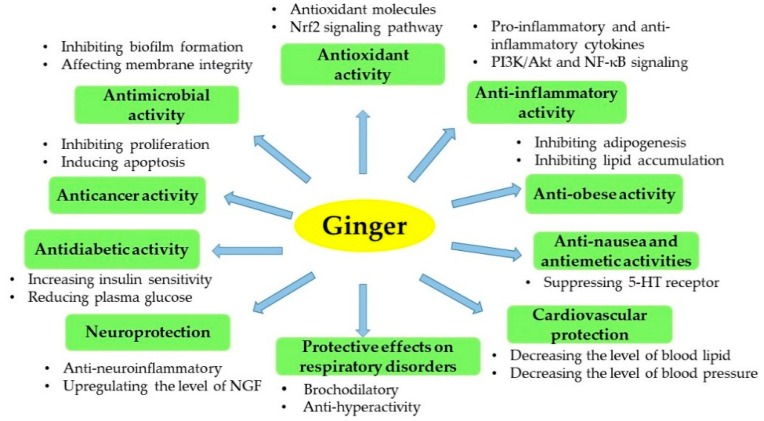
Ginger (Zingiber officinale Roscoe) is a common and widely used spice. It is rich in various chemical constituents, including phenolic compounds, terpenes, polysaccharides, lipids, organic acids, and raw fibers. The health benefits of ginger are mainly attributed to its phenolic compounds, such as gingerols and shogaols. Accumulated investigations have demonstrated that ginger possesses multiple biological activities, including antioxidant, anti-inflammatory, antimicrobial, anticancer, neuroprotective, cardiovascular protective, respiratory protective, antiobesity, antidiabetic, antinausea, and antiemetic activities. In this review, we summarize current knowledge about the bioactive compounds and bioactivities of ginger, and the mechanisms of action are also discussed. We hope that this updated review paper will attract more attention to ginger and its further applications, including its potential to be developed into functional foods or nutraceuticals for the prevention and management of chronic diseases.
Overview
The claims and statistics of this paper haven’t been checked yet.
Free: it reads the open-access text and checks the first 5 claims that cite a source we can check. Create a free account to check every claim.
Integrity signals
Registry
Cites
Statistics
Figures
Verification
Claims the paper makes
The claims and statistics of this paper haven’t been checked yet.
Free: it reads the open-access text and checks the first 5 claims that cite a source we can check. Create a free account to check every claim.
Claims other papers make about this one
Each is checked against this paper’s own text: does it say what the citing paper says it does?
In the citing paper
“A meta-analysis of 13 randomized control trials (n = 1174) found that ginger significantly improves overall pregnancy-associated nausea and vomiting, comparable to vitamin B6 [230] and as effective as standard antiemetics like dimenhydrinate [231].”
From Nutritional Approaches to Enhance GLP-1 Analogue Therapy in Obesity: A Narrative Review (2025) · cites this paper as [231]
Self-check
Percentages, sums and reported differences re-computed from the paper’s own numbers.
The self-check needs the paper’s full text.
Citations
Cites
Bray, F., Ferlay, J., Soerjomataram, I., Siegel, R. L., Torre, L. A., & Jemal, A. (2018) · CA: A Cancer Journal for Clinicians · doi:10.3322/caac.21492 · Cited by 84,109
Targeting Free Radicals in Oxidative Stress-Related Human Diseases
Poprac, P., Jomova, K., Simunkova, M., Kollar, V., Rhodes, C. J., & Valko, M. (2017) · Trends in Pharmacological Sciences · doi:10.1016/j.tips.2017.04.005 · Cited by 1,107 · cited 1×
“It has been known that overproduction of free radicals, such as reactive oxygen species (ROS), plays an important part in the development of many chronic diseases [17].”
BackgroundPlant-derived exosomal MicroRNAs shape the gut microbiota
Teng, Y., Ren, Y., Sayed, M., Hu, X., Lei, C., Kumar, A., Hutchins, E., Mu, J., Deng, Z., Luo, C., et al. (2018) · Cell Host & Microbe · doi:10.1016/j.chom.2018.10.001 · Cited by 1,027 · cited 1×
“Moreover, microRNAs of ginger exosome-like nanoparticles (GELN) ameliorated mouse colitis by inducing the production of IL-22, a barrier function improvement factor [41].”
BackgroundZhang, M., Viennois, E., Prasad, M., Zhang, Y., Wang, L., Zhang, Z., Han, M. K., Xiao, B., Xu, C., Srinivasan, S., et al. (2016) · Biomaterials · doi:10.1016/j.biomaterials.2016.06.018 · Cited by 1,026 · cited 12×
“Besides, ginger extract and zingerone inhibited NF-κB activation and decreased the level of IL-1β in the colons of mice, which alleviated colitis induced by 2, 4, 6-trinitrobenzene sulfonic acid [38].”
BackgroundInfluentialAntioxidant capacities and total phenolic contents of 62 fruits
Fu, L., Xu, B.-T., Xu, X.-R., Gan, R.-Y., Zhang, Y., Xia, E.-Q., & Li, H.-B. (2011) · Food Chemistry · doi:10.1016/j.foodchem.2011.04.079 · Cited by 757
Self-citationGinger and Its Constituents: Role in Prevention and Treatment of Gastrointestinal Cancer
Prasad, S., & Tyagi, A. K. (2015) · Gastroenterology Research and Practice · doi:10.1155/2015/142979 · Cited by 439 · cited 2×
“Besides these, polysaccharides, lipids, organic acids, and raw fibers are also present in ginger [13,16].”
BackgroundChang, J. S., Wang, K. C., Yeh, C. F., Shieh, D. E., & Chiang, L. C. (2013) · Journal of Ethnopharmacology · doi:10.1016/j.jep.2012.10.043 · Cited by 369 · cited 2×
“Ginger was effective in blocking viral attachment and internalization [52].”
BackgroundXu, X.-Y., Meng, X., Li, S., Gan, R.-Y., Li, Y., & Li, H.-B. (2018) · Nutrients · doi:10.3390/nu10101553 · Cited by 358
Self-citationLi, C.-L., Ou, C.-M., Huang, C.-C., Wu, W.-C., Chen, Y.-P., Lin, T.-E., Ho, L.-C., Wang, C.-W., Shih, C.-C., Zhou, H.-C., et al. (2014) · Journal of Materials Chemistry B · doi:10.1039/c4tb00216d · Cited by 350 · cited 2×
“The in vitro experiment found that C-dots increased the content of ROS in the HepG2 cells, which upregulated the expression of p53 and promoted apoptosis [67].”
BackgroundTotal Phenolic Contents and Antioxidant Capacities of Selected Chinese Medicinal Plants
Song, F.-L., Gan, R.-Y., Zhang, Y., Xiao, Q., Kuang, L., & Li, H.-B. (2010) · International Journal of Molecular Sciences · doi:10.3390/ijms11062362 · Cited by 346
Self-citation
Cited by
Items 201–300 of 1,001
Pharmacokinetics of Gingerols, Shogaols, and Their Metabolites in Asthma Patients
Zhang, S., DiMango, E., Zhu, Y., Saroya, T. K., Emala, C. W., & Sang, S. (2022) · Journal of Agricultural and Food Chemistry · doi:10.1021/acs.jafc.2c03150 · Cited by 29
Gasparinetti, P., Brandão, D. O., Maningo, E. V., Khan, A., Cabanillas, F. A., Farfan, J., Román‐Dañobeytia, F., Bahri, A. D., Ponlork, D., Lentini, M. W., et al. (2022) · Forests · doi:10.3390/f13111878 · Cited by 32
Stoyanova, N., Nachev, N., & Spasova, M. (2023) · Membranes · doi:10.3390/membranes13100840 · Cited by 30
Xiang, S., Jian, Q., Wu, C., Xu, Q., Li, J., Wang, C., Wang, R., Zhang, D., Lin, J., & Zheng, C. (2024) · Journal of Ethnopharmacology · doi:10.1016/j.jep.2024.117733 · Cited by 212
Ezzat, D., Azab, A., Kamel, I. S., Abdelmonem, M., Ibrahim, M. A., Ayad, A., Soomro, R., Wagdy, M., & Eldebawy, M. (2025) · Beni-Suef University Journal of Basic and Applied Sciences · doi:10.1186/s43088-025-00633-x · Cited by 32
“is an evergreen tree belonging to the Cupressaceae family that is recognized for its significant bioactive components, such as α-pinene, limonene, camphene, and myrcene [146].”
Dacrema, M., Ali, A., Ullah, H., Khan, A., Minno, A. D., Xiao, J., Martins, A. M. C., & Daglia, M. (2022) · Cancers · doi:10.3390/cancers14225682 · Cited by 31
Khatri, P., Rani, A., Hameed, S., Chandra, S., Chang, C.-M., & Pandey, R. P. (2023) · Antibiotics · doi:10.3390/antibiotics12020270 · Cited by 35
Dietary-Derived Exosome-like Nanoparticles as Bacterial Modulators: Beyond MicroRNAs
Manzaneque-López, M. C., Sánchez‐López, C. M., Pérez‐Bermúdez, P., Soler, C., & Marcilla, A. (2023) · Nutrients · doi:10.3390/nu15051265 · Cited by 27
Razak, A. M., Tan, J. K., Said, M. M., & Makpol, S. (2023) · Nutrients · doi:10.3390/nu15112564 · Cited by 31
Effects of Ginger (Zingiber officinale) on the Hallmarks of Aging
Matin, M., Joshi, T., Wang, D., Tzvetkov, N. T., Matin, F. B., Wierzbicka, A., Jóźwik, A., Horbańczuk, J. O., & Atanasov, A. G. (2024) · Biomolecules · doi:10.3390/biom14080940 · Cited by 34
“Ginger ( Zingiber officinale Roscoe) is broadly used in culinary as well as utilized as a versatile remedy in the traditional folk medicine of many countries [6,7].”
BackgroundSpecific Secondary Metabolites of Medicinal Plants and Their Role in Stress Adaptation
Sytar, O., & Hajihashemi, S. (2024) · Wiley eBooks · doi:10.1002/9781394186457.ch15 · Cited by 32
Sheikhhossein, F., Borazjani, M., Jafari, A., Askari, M., Vataniyan, E., Gholami, F., & Amini, M. R. (2021) · Clinical Nutrition ESPEN · doi:10.1016/j.clnesp.2021.07.010 · Cited by 24
Sulejmanović, M., Panić, M., Redovniković, I. R., Milić, N., Drljača, J., Damjanović, A., & Vidović, S. S. (2024) · Food Chemistry · doi:10.1016/j.foodchem.2024.141545 · Cited by 28
Edo, G. I., Igbuku, U. A., Makia, R. S., Isoje, E. F., Gaaz, T. S., Yousif, E., Jikah, A. N., Zainulabdeen, K., Akpoghelie, P. O., Opiti, R. A., et al. (2025) · Discover Food · doi:10.1007/s44187-025-00280-2 · Cited by 47
“It is essential to note that although ginger contains these essential inorganic nutrients, its primary benefits arise from its bioactive compounds, such as gingerols and shogaols [24].”
InfluentialStudi in Silico Prediksi Potensi 6-Gingerol sebagai inhibitor c-Jun N-terminal kinases (JNK)
Bare, Y., Maulidi, A., Sari, D. R. T., & Tiring, S. S. N. D. (2019) · Jurnal Jejaring Matematika dan Sains · doi:10.36873/jjms.v1i2.211 · Cited by 29
“Jahe segar memiliki kandungan gingerol yang merupakan komponen terbesar polifenol seperti 6gingerol, 8-gingerol, dan 10-gingerol [12].”
BackgroundMustafa, Z. A., Ali, R., Ali, D. R., Abdulkarimi, R., Abdulkareem, N. K., & Akbari, A. (2020) · Journal of Food Biochemistry · doi:10.1111/jfbc.13546 · Cited by 30
Sohaimy, S. A. E., Abdo, N., Shehata, M. G., & Moheyeldin, O. (2021) · Egyptian Journal of Chemistry · doi:10.21608/ejchem.2021.45739.2947 · Cited by 24
Sampath, S. J. P., Birineni, S., Shyam, P., Kotikalapudi, N., & Venkatesan, V. (2021) · Food Bioscience · doi:10.1016/j.fbio.2021.101211 · Cited by 26
Kaggwa, B., Kyeyune, H., Munanura, E. I., Anywar, G., Lutoti, S., Aber, J., Bagoloire, L. K., Weisheit, A., Tolo, C. U., Kamba, P. F., et al. (2022) · Evidence-based Complementary and Alternative Medicine · doi:10.1155/2022/1304839 · Cited by 36
“)e pharmacological activities of ginger have however been attributed to phenolic compounds such as gingerols and shogaols [141].”
BackgroundOoi, S. L., Pak, S. C., Campbell, R., & Manoharan, A. (2022) · Molecules · doi:10.3390/molecules27196417 · Cited by 39
Ghaeidamini, M., Rahgozar, S., Babasheikhali, S. R., Safavi, A., & Ghodousi, E. S. (2020) · Scientific Reports · doi:10.1038/s41598-020-70839-9 · Cited by 25
Venkateswaran, M. R., Jayabal, S., Hemaiswarya, S., Murugesan, S., Enkateswara, S., Doble, M., & Periyasamy, S. (2021) · Journal of Food Biochemistry · doi:10.1111/jfbc.13600 · Cited by 26
Aboismaiel, M. G., Amin, M. N., & Eissa, L. A. (2024) · Biological Research · doi:10.1186/s40659-024-00527-9 · Cited by 36
“…activity via ROS scavenging, nuclear factor erythroid 2-related factor 2 up-regulation, improving the activities of antioxidant enzymes catalase, superoxide dismutase, glutathione peroxidase, and glutathione S-transferase as well as GSH level and reducing the level of MDA [37, 41, 94, 95].”
BackgroundMethodUtama‐ang, N., Sida, S., Wanachantararak, P., & Kawee‐ai, A. (2021) · Scientific Reports · doi:10.1038/s41598-021-94430-y · Cited by 29
Liu, H., Yang, H., Zhao, T., Lin, C., Li, Y., Zhang, X., Ye, Y., & Liao, J. (2021) · Frontiers in Genetics · doi:10.3389/fgene.2021.795201 · Cited by 25
“It is biosynthesized through stilbenoid, diarylheptanoid, and gingerol biosynthesis pathway (Mao et al., 2019).”
BackgroundZhou, Y., Zhang, H., Cheng, Z., & Wang, H. (2021) · Arabian Journal of Chemistry · doi:10.1016/j.arabjc.2021.103607 · Cited by 24
Saher, T., Manzoor, R., Abbas, K., Mudassir, J., Wazir, M. A., Ali, E., Siddiqui, F. A., Rasul, A., Qadir, M. I., Aleem, A., et al. (2022) · Journal of Pain Research · doi:10.2147/jpr.s351921 · Cited by 25
Vaz, M. S. M., Simionatto, E., de Souza, G. H. D. A., Fraga, T. L., de Oliveira, G. G., Coutinho, E. J., dos Santos, M. V. O., & Simionatto, S. (2022) · Industrial Crops and Products · doi:10.1016/j.indcrop.2022.115065 · Cited by 27
Mazyed, E. A., Badria, F. A.-E., ElNaggar, M. H., El-Masry, S. M., & Helmy, S. A. (2022) · Pharmaceutics · doi:10.3390/pharmaceutics14061170 · Cited by 24
Ahmed, S., El-Murr, A. E., Elhakim, Y. A., Metwally, M. M. M., Gharib, A. A. E. A., Amer, S. A., Younis, E. M., Abdel‐Warith, A. A., Davies, S. J., & Khalil, E. N. M. (2023) · Fishes · doi:10.3390/fishes8050259 · Cited by 25
Mafe, A. N., & Büsselberg, D. (2025) · Foods · doi:10.3390/foods14173079 · Cited by 30
Antioxidant Properties of Soybean Oil Supplemented with Ginger and Turmeric Powders
Tinello, F., Zannoni, S., & Lante, A. (2020) · Applied Sciences · doi:10.3390/app10238438 · Cited by 22
Chen, F., & Liu, Q. (2022) · Advanced Drug Delivery Reviews · doi:10.1016/j.addr.2022.114317 · Cited by 25
Zingiber officinale Roscoe: A comprehensive review of clinical properties
Bitari, A., Oualdi, I., Touzani, R., Elachouri, M., & Legssyer, A. (2022) · Materials Today Proceedings · doi:10.1016/j.matpr.2022.09.316 · Cited by 28
Sivaraman, D., Selvadoss, P. P., Manoharan, S. S., Jeyabalan, S., & Rajeswari, V. D. (2023) · Journal of Biomolecular Structure and Dynamics · doi:10.1080/07391102.2023.2196703 · Cited by 28
Alhaddad, R., Abualsoud, B. M., Al‐Deeb, I., & Nsairat, H. (2024) · Future Science OA · doi:10.1080/20565623.2024.2419806 · Cited by 25
Mairuae, N., Noisa, P., & Palachai, N. (2024) · Molecules · doi:10.3390/molecules29246046 · Cited by 24
Functional foods: A review of foods ingredient and their health benefits
Marcía-Fuentes, J. A., Alemán, R. S., Areche, F. O., Flores, D. C., Roman, A. V., Martín‐Vertedor, D., & Fernández, I. M. (2025) · Food and Humanity · doi:10.1016/j.foohum.2025.100953 · Cited by 37
Bioactive Compounds, Therapeutic Activities, and Applications of Ficus pumila L.
Qi, Z., Zhao, J.-Y., Lin, F., Zhou, W., & Gan, R. (2021) · Agronomy · doi:10.3390/agronomy11010089 · Cited by 32
Self-citationFaiqoh, K. E. N., Muhammad, D. R. A., & Praseptiangga, D. (2021) · Food Research · doi:10.26656/fr.2017.5(s2).004 · Cited by 21
Amponsah, I. K., Boakye, A. A., Orman, E., Armah, F. A., Borquaye, L. S., Adjei, S., Dwamena, Y. A., Baah, K. A., & Harley, B. K. (2022) · Heliyon · doi:10.1016/j.heliyon.2022.e09150 · Cited by 27
The Immunomodulatory effects of Zingiber officinale (Ginger): A Systematic Review
Harun, N. H., & Mohamad, M. F. (2022) · Research Journal of Pharmacy and Technology · doi:10.52711/0974-360x.2022.00634 · Cited by 36
Kim, H.-R., Noh, E., & Kim, S. (2023) · Heliyon · doi:10.1016/j.heliyon.2022.e12778 · Cited by 28
“These compounds exhibit antioxidant, anti-inflammatory, antibacterial, and anticancer properties [17].”
BackgroundKang, D. Y., Park, S., Song, K. S., Bae, S. W., Lee, J., Jang, K., & Park, Y. (2023) · Cells · doi:10.3390/cells12222628 · Cited by 26
Allelochemicals as biocontrol agents: Promising aspects, challenges and opportunities
Arora, S., Husain, T., & Prasad, S. M. (2024) · South African Journal of Botany · doi:10.1016/j.sajb.2024.01.029 · Cited by 33
Dorcheh, S. N., Rahgozar, S., & Talei, D. (2021) · Journal of Cellular and Molecular Medicine · doi:10.1111/jcmm.16528 · Cited by 21
“Case No Patient’s condition Source (WB/ BM) Sex Age(y) ALL subtype ALL related translocations including: T (4;11)/KMT2A- AFF1 T (9;22)/BCR- ABL1 T (1;19)/TCF3- PBX1 T (12;21)/ETV6- RUNX1”
BackgroundMane, M. B., Bhandari, V. M., & Ranade, V. V. (2021) · Journal of Water Process Engineering · doi:10.1016/j.jwpe.2021.102280 · Cited by 25
Sulieman, A. M. E., Ibrahim, S. M., Alshammari, M., Abdulaziz, F., Idriss, H., Alanazi, N. A. H., Abdallah, E. M., Siddiqui, A. J., Shommo, S. A. M., Jamal, A., et al. (2024) · Pharmaceuticals · doi:10.3390/ph17111551 · Cited by 20
“Research conducted in different climates on these chemicals has shown that, although all rhizomes of Z. officinale contain the same class of compounds, the amounts and bioactivity of these compounds might vary [39,41].”
Famurewa, A. C., Akhigbe, R. E., George, M. Y., Adekunle, Y. A., Oyedokun, P. A., Akhigbe, T. M., & Fatokun, A. A. (2024) · Naunyn-Schmiedeberg s Archives of Pharmacology · doi:10.1007/s00210-024-03623-5 · Cited by 33
“The pharmacological activities of ginger include antioxidant, anti-inflammatory, antihypertensive, antibacterial, immunosuppressive, respiratory protective, neuroprotective and anticancer activities (Ali et al. 2008; Mao et al. 2019; Ali and Mamo 2023).”
Integrative role of traditional and modern technologies to combat COVID-19
Heiat, M., Hashemi-Aghdam, M.-R., Heiat, F., Panahi, M. R. S., Aghamollaei, H., Moghaddam, M. M., Sathyapalan, T., Ranjbar, R., & Sahebkar, A. (2020) · Expert Review of Anti-infective Therapy · doi:10.1080/14787210.2020.1799784 · Cited by 24
Hamdona, S. K., El‐Aassar, A. H. M., Ahmed, A. E. M. M., Nasra, A. E. S., & Morsy, A. (2021) · Chemical Engineering and Processing - Process Intensification · doi:10.1016/j.cep.2021.108404 · Cited by 20
Natural Anti-inflammatory and Anti-allergy Agents: Herbs and Botanical Ingredients
Saini, R., & Dhiman, N. K. (2021) · Anti-Inflammatory & Anti-Allergy Agents in Medicinal Chemistry · doi:10.2174/1871523021666220411111743 · Cited by 32
Mukjerjee, S., & Karati, D. (2022) · Pharmacological Research - Modern Chinese Medicine · doi:10.1016/j.prmcm.2022.100173 · Cited by 26
Zhao, X., Yu, S., Wang, Y., Jiang, D., Zhang, Y., Hu, L., Zhu, Y., Jia, Q., Yin, J., Liu, Y., et al. (2022) · Agronomy · doi:10.3390/agronomy13010074 · Cited by 22
Immune System and Epidemics: The Role of African Indigenous Bioactive Substances
Frazzoli, C., Grasso, G., Husaini, D. C., Ajibo, D. N., Orish, F. C., & Orisakwe, O. E. (2023) · Nutrients · doi:10.3390/nu15020273 · Cited by 25
Gunawan, S., Munika, E., Wulandari, E. T., Ferdinal, F., Purwaningsih, E. H., Wuyung, P. E., Louisa, M., & Soetikno, V. (2023) · Saudi Pharmaceutical Journal · doi:10.1016/j.jsps.2023.01.003 · Cited by 28
Rostamkhani, H., Veisi, P., Niknafs, B., Jafarabadi, M. A., & Ghoreishi, Z. (2023) · BMC Complementary Medicine and Therapies · doi:10.1186/s12906-023-03874-4 · Cited by 207
“This study aimed to assess the effect of ginger supplementation on glycemic control, renal function, and prooxidant-antioxidant balance in patients with diabetes and ESRD undergoing hemodialysis, taking into account all of the potential benefits of ginger in glycemic control and improving health outcomes [13, 14, 21,…”
BackgroundBoarescu, I., Pop, R. M., Boarescu, P.-M., Bocșan, I. C., Gheban, D., Bulboacă, A. E., Buzoianu, A. D., & Bolboaca, S. D. (2023) · Antioxidants · doi:10.3390/antiox12030745 · Cited by 22
Rouhi, A. A., Valizadeh, A., Sedghizadeh, N., Pozharani, L. B., Dadashi, H., Kazempour, M., Adibkia, K., Vandghanooni, S., & Eskandani, M. (2024) · Journal of Drug Delivery Science and Technology · doi:10.1016/j.jddst.2024.105734 · Cited by 21
Lee, W., Kwon, M.-S., Yun, Y.-R., Choi, H., Jung, M.-J., Hwang, H., Shin, M.-J., Park, J.-H., Kim, D.-R., Yoon Chang, J., et al. (2024) · Journal of Functional Foods · doi:10.1016/j.jff.2024.106401 · Cited by 21
Mohammed, S. S. S., Vishal, L. A., Sampath, S., Sunderam, V., & Madhavan, Y. (2020) · Materials Technology · doi:10.1080/10667857.2020.1863571 · Cited by 30
“Zingiber officinale, commonly known as ginger possesses various constituents exhibiting high antioxidant property which confers resistance to cell damage from a biological molecule and reduces the oxidation process on the inter-cell surface [24,25].”
BackgroundAbdelaziz, A. A., Doghish, A. S., Salah, A. N., Mansour, R. M., Moustafa, Y. M., Mageed, S. S. A., Moustafa, H. A. M., El‐Dakroury, W. A., Doghish, S. A., Mohammed, O. A., et al. (2025) · Infection · doi:10.1007/s15010-025-02533-9 · Cited by 29
Spices and herbs as immune enhancers and anti-inflammatory agents: a review
Garnier, A., & Shahidi, F. (2021) · Journal of Food Bioactives · doi:10.31665/jfb.2021.14266 · Cited by 31
Sahraee, S., Ghanbarzadeh, B., & Falcone, P. M. (2022) · Food Science & Nutrition · doi:10.1002/fsn3.2834 · Cited by 19
“While gingerols, shogaols, and paradols are primary polyphenols of ginger extract (Mao et al., 2019).”
BackgroundCurrent Topics in Functional Food
Shiomi, N., & Savitskaya, A. (2022) · IntechOpen eBooks · doi:10.5772/intechopen.98161 · Cited by 20
Shin, S. H., Oh, S. M., Park, J. H. Y., Lee, K. W., & Yang, H. Y. (2022) · BMC Bioinformatics · doi:10.1186/s12859-022-04752-5 · Cited by 20
“Among the 160 identified NCs present within ginger, phenolic and terpene compounds, such as gingerols and shogaols, have been widely investigated for their pungent stringency, abundance, and multiple health benefits [47, 49, 50].”
BackgroundStyawan, A. A., Susidarti, R. A., Purwanto, P., Windarsih, A., Rahmawati, N., Sholikhah, I., & Rohman, A. (2022) · Food Research · doi:10.26656/fr.2017.6(4).500 · Cited by 44
“In addition, ginger is widely used to prevent some chronic diseases through its capability to act as an antioxidant by suppressing reactive oxygen species (Mao et al., 2019).”
BackgroundGumbarewicz, E., Jarząb, A., Stepulak, A., & Kukuła‐Koch, W. (2022) · International Journal of Molecular Sciences · doi:10.3390/ijms232415545 · Cited by 33
6-Shogaol Overcomes Gefitinib Resistance via ER Stress in Ovarian Cancer Cells
Kim, T. W., & Lee, H. G. (2023) · International Journal of Molecular Sciences · doi:10.3390/ijms24032639 · Cited by 22
Fadhlina, A., Alias, N. F. A., Sheikh, H. I., Zakaria, N. H., Majid, F. A. A., Hairani, M. A. S., & Hudiyanti, D. (2023) · Journal of Agriculture and Food Research · doi:10.1016/j.jafr.2023.100649 · Cited by 25
Rangani, S. C., & Ranaweera, K. K. D. S. (2023) · Applied Food Research · doi:10.1016/j.afres.2023.100325 · Cited by 19
Zagórska, J., Pietrzak, K., Kukula-Koch, W. A., Czop, M., Laszuk, J., & Koch, W. (2023) · Foods · doi:10.3390/foods12213897 · Cited by 19
Research progress of ginger in the treatment of gastrointestinal tumors
Chen, G., Nan, Y., Huang, S.-C., Ning, N., Du, Y., Lu, D., Yang, Y., Meng, F., & Yuan, L. (2023) · World Journal of Gastrointestinal Oncology · doi:10.4251/wjgo.v15.i11.1835 · Cited by 30
“Ginger possesses a multifaceted chemical composition that comprises phenolic compounds, terpenes, polysaccharides, fibrils, etc [24].”
Alqahtani, N. K., Salih, Z. A., Asiri, S. A., Siddeeg, A., Elssiddiq, S. A. D., Alnemr, T. M., & Habib, H. M. (2024) · Heliyon · doi:10.1016/j.heliyon.2024.e36473 · Cited by 24
“Ginger, resulting from the rhizome of Zingiber officinale Roscoe from the Zingiberaceae family, is a highly popular spice with various culinary and medicinal uses [1,2].”
BackgroundChanges in flavor profile of vegetable seasonings by innovative drying technologies: A review
Okonkwo, C. E., Onyeaka, H. N., Olaniran, A. F., Isaac-Bamgboye, F. J., Nwaiwu, O., Ukwuru, M. U., Adeyanju, A. A., Nwonuma, C. O., Alejolowo, O. O., Inyinbor, A. A., et al. (2024) · Journal of Food Science · doi:10.1111/1750-3841.17346 · Cited by 19
Mekala, P., & Murthy, T. R. G. K. (2020) · Journal of Pharmacognosy and Phytochemistry · doi:10.22271/phyto.2020.v9.i3q.11428 · Cited by 19
“Perry Eugenyl acetate, eugenol, β-caryophyllene [16] Stimulant, expectorant, carminative, analgesic, and aphrodisiac.”
Shaukat, M. N., Fallico, B., & Nazir, A. (2024) · Foods · doi:10.3390/foods13071096 · Cited by 18
Chen, M., Lin, E., Xiao, R., Li, Z., Liu, B., & Wang, J. (2024) · Foods · doi:10.3390/foods13101498 · Cited by 18
“The phenolic compounds comprise a homologous series of phenolic ketones including gingerols, shogaols, paradols, zingerones, gingerdiones, and gingerdiols, which are responsible for ginger’s pungent odor [7].”
BackgroundPurohit, K., Pathak, R., Hayes, E., & Sunna, A. (2025) · Food Chemistry · doi:10.1016/j.foodchem.2025.144432 · Cited by 18
Magzoub, M. M. (2020) · Saudi Journal of Biomedical Research · doi:10.36348/sjbr.2020.v05i06.006 · Cited by 19
Rizk, M. A., El‒Sayed, S. A. E., & Igarashi, I. (2021) · Parasitology International · doi:10.1016/j.parint.2021.102431 · Cited by 23
Implications of synthetic chemicals and natural plant extracts in improving vase life of flowers
Singh, K., Sharma, R., & Sahare, H. A. (2022) · Scientia Horticulturae · doi:10.1016/j.scienta.2022.111133 · Cited by 28
Arogundade, T. J., Oluwamukomi, M. O., & Dada, M. A. (2023) · Food Frontiers · doi:10.1002/fft2.203 · Cited by 18
Sheikh, H. I., Zakaria, N. H., Majid, F. A. A., Zamzuri, F., Fadhlina, A., & Hairani, M. A. S. (2023) · Journal of Agriculture and Food Research · doi:10.1016/j.jafr.2023.100680 · Cited by 31
“Administration of ginger, turmeric and bitter gourd extracts in preclinical studies have shown to reduce inflammation in the body, improve oxidative status as well as improve the body’s antibody responses toward infections [5,6,12,13].”
Singh, H., Yadav, B., Rai, A. K., Srivastava, S., Saiprasad, A. J. V., Jameela, S., Singhal, R., Muralidharan, S., Mohan, R., Chaudhary, S., et al. (2023) · Complementary Therapies in Medicine · doi:10.1016/j.ctim.2023.102966 · Cited by 18
Duque-Soto, C. M., Ruiz-Vargas, A., Rueda‐Robles, A., Quirantes‐Piné, R., Borrás‐Linares, I., & Lozano‐Sánchez, J. (2023) · Foods · doi:10.3390/foods12163031 · Cited by 25
Kayath, C. A., Zamba, A. I., Mokémiabeka, S. N., Opa-Iloy, M., Wilson, P. S. E., Kaya-Ongoto, M. D., Maboulou, R. J. M., & Nguimbi, E. (2020) · International Journal of Microbiology · doi:10.1155/2020/8417693 · Cited by 19
“isolated from ginger wine are also able to use the sugars of rhizomes and many other molecules [5] by releasing the enzymes which will destroy the walls of plant cells.”
BackgroundEl‐Borm, H. T., Gobara, M. S., & Badawy, G. M. (2020) · Saudi Journal of Biological Sciences · doi:10.1016/j.sjbs.2020.10.027 · Cited by 19
Zarei, M., Uppin, V., Acharya, P., & Talahalli, R. R. (2020) · Metabolic Brain Disease · doi:10.1007/s11011-020-00642-y · Cited by 20
Chiaramonte, M., Bonaventura, R., Costa, C., Zito, F., & Russo, R. (2020) · Food Bioscience · doi:10.1016/j.fbio.2020.100833 · Cited by 23
Jing, Y., Cheng, W., Li, M., Zhang, Y., Pang, X., Qiu, X., Zheng, Y., Zhang, D., & Wu, L. (2022) · Plant Foods for Human Nutrition · doi:10.1007/s11130-022-01033-7 · Cited by 18
Afroz, S., Fairuz, S., Joty, J. A., Uddin, M. N., & Rahman, M. A. (2021) · Journal of Food Biochemistry · doi:10.1111/jfbc.13961 · Cited by 19
Ogino, M., Nakazawa, A., Shiokawa, K.-I., Kikuchi, H., Sato, H., & Onoue, S. (2021) · PharmaNutrition · doi:10.1016/j.phanu.2021.100285 · Cited by 18
Bioactive Compounds for Fibromyalgia-like Symptoms: A Narrative Review and Future Perspectives
Shen, C., Schuck, A., Tompkins, C., Dunn, D. M., & Neugebauer, V. (2022) · International Journal of Environmental Research and Public Health · doi:10.3390/ijerph19074148 · Cited by 18
Ishfaq, M., Hu, W., Hu, Z., Guan, Y., & Zhang, R. (2022) · Italian Journal of Food Science · doi:10.15586/ijfs.v34i3.2212 · Cited by 29
Lee, K., Wu, K., Chang, S., Chang, H., Chen, C., & Chen, Y.-Y. (2022) · Antioxidants · doi:10.3390/antiox11102057 · Cited by 21
Herbs and Spices - New Advances
Ivanišová, E. (2022) · IntechOpen eBooks · doi:10.5772/intechopen.104270 · Cited by 19
Preparation and Evaluation of 6-Gingerol Derivatives as Novel Antioxidants and Antiplatelet Agents
Ahmed, S. H. H., Gonda, T., Agbadua, O. G., Girst, G., Berkecz, R., Kúsz, N., Tsai, M.-C., Wu, C., Balogh, G. T., & Hunyadi, A. (2023) · Antioxidants · doi:10.3390/antiox12030744 · Cited by 26
Prisacaru, A. E., Ghinea, C., Albu, E., & Ursachi, F. (2023) · Foods · doi:10.3390/foods12061311 · Cited by 23
“Ginger (Zingiber officinale Roscoe) is used as a spice [41] or seasoning for food and beverage [42] and contains phenolic (gingerols, shogaols, and paradols) and terpene compounds, polysaccharides, lipids, organic acids, and raw fibers [43].”
BackgroundAssemie, A., & Gemeda, T. (2023) · BioMed Research International · doi:10.1155/2023/6636837 · Cited by 17
“The crude extracts that have biological activities contain bioactive compounds which are chemical substances responsible for the mortality of half (50%) of the test organism [29, 30].”
Background
Metadata
- Authors
- Mao, Q.-Q., Xu, X.-Y., Cao, S.-Y., Gan, R.-Y., Corke, H., Beta, T., & Li, H.-B.
- Affiliations
- Guangdong Provincial Key Laboratory of Food, Nutrition and Health, Department of Nutrition, School of Public Health, Sun Yat-sen University, Guangzhou 510080, China
- Sun Yat-sen University (CN)
- Shanghai Jiao Tong University (CN)
- Department of Food & Human Nutritional Sciences, University of Manitoba, Winnipeg, MB R3T 2N2, Canada
- Corresponding author
- Gan, Ren-You
- Li, Hua-Bin
- Venue
- Foods
- Publisher
- MDPI AG
- Published
- 2019-05-30
- Volume
- 8
- Issue
- 6
- Pages
- 185
- ISSN
- 2304-8158 (ISSN-L)
- PMC
- PMC6616534
- OpenAlex
- W2947671311
- Semantic Scholar
- d16da9cb8957f5f43f25ac947958cef199e438d8
- Cited by
- 1,418
- References
- 117
- Citations by year
- 2026: 162 · 2025: 247 · 2024: 255 · 2023: 254 · 2022: 255 · 2021: 159 · 2020: 74 · 2019: 10
- FWCI
- 19.61
- Type
- journal article
- Language
- en
- Open access
- gold
- dx.doi.org
- Licence
- Locations
- Foods (publishedVersion, cc-by)
- Europe PMC (PubMed Central) (publishedVersion, cc-by)
- PubMed Central (publishedVersion, cc-by)
- PubMed (publishedVersion)
- DOAJ (DOAJ: Directory of Open Access Journals) (submittedVersion, cc-by-sa)
- Funders
- the National Key R&D Program of China (2017YFC1600100)
- Shanghai Basic and Key Program (18JC1410800)
- the Agri-X Interdisciplinary Fund of Shanghai Jiao Tong University (Agri-X2017004)
- the Key Project of Guangdong Provincial Science and Technology Program (2014B020205002)
- Topics
- Life Sciences › Pharmacology, Toxicology and Pharmaceutics › Pharmacology › Ginger and Zingiberaceae research
- Life Sciences › Agricultural and Biological Sciences › Plant Science › Garlic and Onion Studies
- Life Sciences › Pharmacology, Toxicology and Pharmaceutics › Pharmacology › Ginseng Biological Effects and Applications
- Keywords
- ginger, bioactive compounds, phenolic compounds, gingerol, shogaol, antioxidant activity, anti-inflammatory activity, antimicrobial activity, anticancer activity, neuroprotection, cardioprotection, respiratory protection, anti-obesity, antidiabetic activity, antiemetic activity, functional foods, nutraceuticals, chronic disease prevention
About these checks
Registry, retraction, Cites and statistics results are computed, not judged, with one exception: a printed reference that no index lists is read once by a model before it counts as a citation error. Claims are extracted by a model and kept only when their quote appears verbatim in the text; each cited source is then checked, with a model’s help, for whether it says what the claim relies on. Those verdicts can be wrong — read the claim’s quote and the cited source before relying on one.
Statistics and arithmetic are recomputed, not judged.
Confidence bands are shown only for fields calibrated on our annotated test set. None is calibrated yet, so no band is shown.
What counts as a claim ›How we measure confidence ›How we check this ›
Are you an author, or do you see a problem with this page? Request a review
Data sources
Bibliographic data: Semantic Scholar, OpenAlex, Crossref.
Contains information from the Semantic Scholar Academic Graph Datasets, made available under the ODC Attribution License (ODC-BY 1.0).
Semantic Scholar’s data is described in: Kinney, R., et al. (2023). The Semantic Scholar Open Data Platform. arXiv:2301.10140.
