

Bioactive Compounds and Bioactivities of Ginger (Zingiber officinale Roscoe)
Open accessThe DOI matches its Crossref record; 117 of the 117 references it cites were found in a registry or an index.
Abstract
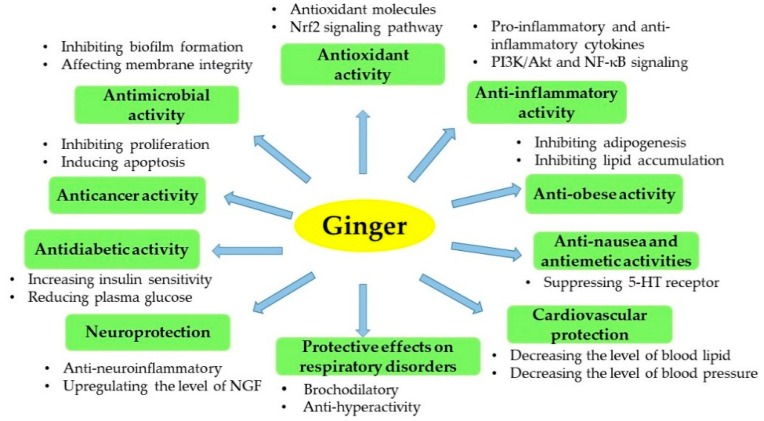
Ginger (Zingiber officinale Roscoe) is a common and widely used spice. It is rich in various chemical constituents, including phenolic compounds, terpenes, polysaccharides, lipids, organic acids, and raw fibers. The health benefits of ginger are mainly attributed to its phenolic compounds, such as gingerols and shogaols. Accumulated investigations have demonstrated that ginger possesses multiple biological activities, including antioxidant, anti-inflammatory, antimicrobial, anticancer, neuroprotective, cardiovascular protective, respiratory protective, antiobesity, antidiabetic, antinausea, and antiemetic activities. In this review, we summarize current knowledge about the bioactive compounds and bioactivities of ginger, and the mechanisms of action are also discussed. We hope that this updated review paper will attract more attention to ginger and its further applications, including its potential to be developed into functional foods or nutraceuticals for the prevention and management of chronic diseases.
Overview
The claims and statistics of this paper haven’t been checked yet.
Free: it reads the open-access text and checks the first 5 claims that cite a source we can check. Create a free account to check every claim.
Integrity signals
Registry
Cites
Statistics
Figures
Verification
Claims the paper makes
The claims and statistics of this paper haven’t been checked yet.
Free: it reads the open-access text and checks the first 5 claims that cite a source we can check. Create a free account to check every claim.
Claims other papers make about this one
Each is checked against this paper’s own text: does it say what the citing paper says it does?
In the citing paper
“A meta-analysis of 13 randomized control trials (n = 1174) found that ginger significantly improves overall pregnancy-associated nausea and vomiting, comparable to vitamin B6 [230] and as effective as standard antiemetics like dimenhydrinate [231].”
From Nutritional Approaches to Enhance GLP-1 Analogue Therapy in Obesity: A Narrative Review (2025) · cites this paper as [231]
Self-check
Percentages, sums and reported differences re-computed from the paper’s own numbers.
The self-check needs the paper’s full text.
Citations
Cites
Bray, F., Ferlay, J., Soerjomataram, I., Siegel, R. L., Torre, L. A., & Jemal, A. (2018) · CA: A Cancer Journal for Clinicians · doi:10.3322/caac.21492 · Cited by 84,109
Targeting Free Radicals in Oxidative Stress-Related Human Diseases
Poprac, P., Jomova, K., Simunkova, M., Kollar, V., Rhodes, C. J., & Valko, M. (2017) · Trends in Pharmacological Sciences · doi:10.1016/j.tips.2017.04.005 · Cited by 1,107 · cited 1×
“It has been known that overproduction of free radicals, such as reactive oxygen species (ROS), plays an important part in the development of many chronic diseases [17].”
BackgroundPlant-derived exosomal MicroRNAs shape the gut microbiota
Teng, Y., Ren, Y., Sayed, M., Hu, X., Lei, C., Kumar, A., Hutchins, E., Mu, J., Deng, Z., Luo, C., et al. (2018) · Cell Host & Microbe · doi:10.1016/j.chom.2018.10.001 · Cited by 1,027 · cited 1×
“Moreover, microRNAs of ginger exosome-like nanoparticles (GELN) ameliorated mouse colitis by inducing the production of IL-22, a barrier function improvement factor [41].”
BackgroundZhang, M., Viennois, E., Prasad, M., Zhang, Y., Wang, L., Zhang, Z., Han, M. K., Xiao, B., Xu, C., Srinivasan, S., et al. (2016) · Biomaterials · doi:10.1016/j.biomaterials.2016.06.018 · Cited by 1,026 · cited 12×
“Besides, ginger extract and zingerone inhibited NF-κB activation and decreased the level of IL-1β in the colons of mice, which alleviated colitis induced by 2, 4, 6-trinitrobenzene sulfonic acid [38].”
BackgroundInfluentialAntioxidant capacities and total phenolic contents of 62 fruits
Fu, L., Xu, B.-T., Xu, X.-R., Gan, R.-Y., Zhang, Y., Xia, E.-Q., & Li, H.-B. (2011) · Food Chemistry · doi:10.1016/j.foodchem.2011.04.079 · Cited by 757
Self-citationGinger and Its Constituents: Role in Prevention and Treatment of Gastrointestinal Cancer
Prasad, S., & Tyagi, A. K. (2015) · Gastroenterology Research and Practice · doi:10.1155/2015/142979 · Cited by 439 · cited 2×
“Besides these, polysaccharides, lipids, organic acids, and raw fibers are also present in ginger [13,16].”
BackgroundChang, J. S., Wang, K. C., Yeh, C. F., Shieh, D. E., & Chiang, L. C. (2013) · Journal of Ethnopharmacology · doi:10.1016/j.jep.2012.10.043 · Cited by 369 · cited 2×
“Ginger was effective in blocking viral attachment and internalization [52].”
BackgroundXu, X.-Y., Meng, X., Li, S., Gan, R.-Y., Li, Y., & Li, H.-B. (2018) · Nutrients · doi:10.3390/nu10101553 · Cited by 358
Self-citationLi, C.-L., Ou, C.-M., Huang, C.-C., Wu, W.-C., Chen, Y.-P., Lin, T.-E., Ho, L.-C., Wang, C.-W., Shih, C.-C., Zhou, H.-C., et al. (2014) · Journal of Materials Chemistry B · doi:10.1039/c4tb00216d · Cited by 350 · cited 2×
“The in vitro experiment found that C-dots increased the content of ROS in the HepG2 cells, which upregulated the expression of p53 and promoted apoptosis [67].”
BackgroundTotal Phenolic Contents and Antioxidant Capacities of Selected Chinese Medicinal Plants
Song, F.-L., Gan, R.-Y., Zhang, Y., Xiao, Q., Kuang, L., & Li, H.-B. (2010) · International Journal of Molecular Sciences · doi:10.3390/ijms11062362 · Cited by 346
Self-citation
Cited by
Items 401–500 of 1,001
Tocai, A. C., Rosan, C. A., Teodorescu, A. G., Venter, A. C., & Vicaş, S. I. (2025) · Plants · doi:10.3390/plants14172737 · Cited by 17
Soliman, M. K. Y., El-Ashmony, M. M., Bendary, H. A., Rasslan, F., & Salem, S. S. (2026) · BMC Biotechnology · doi:10.1186/s12896-026-01124-2 · Cited by 15
Dutta, A., Hsiao, S.-H., Hung, C., Chang, C., Lin, Y., Lin, C., Chen, T., & Huang, C. (2022) · Phytomedicine Plus · doi:10.1016/j.phyplu.2022.100387 · Cited by 15
Oke, E. O., Adeyi, O., Okolo, B. I., Adeyi, J. A., Nnabodo, D., Ude, C. J., Ajala, O. O., Okhale, S., Okolie, J. A., Otolorin, J. A., et al. (2023) · Cleaner Chemical Engineering · doi:10.1016/j.clce.2023.100097 · Cited by 11
Herbs and plants in immunomodulation (Review)
Kadiyska, T., Tourtourikov, I., Dabchev, K., Zlatarova, A. S., Stoynev, N., Tafradjiiska-Hadjiolova, R. K., Spandidos, D. A., Adamaki, M., & Zoumpourlis, V. C. (2023) · International Journal of Functional Nutrition · doi:10.3892/ijfn.2023.31 · Cited by 24
“The ginger rhizome contains multiple compounds of interest, such as carbohydrates, minerals, phytochemi‑ cals, phenolic compounds, terpenes, polysaccharides, lipids, organic acids, and raw fibers (66).”
A review of frequently used Kampo prescriptions: Part 2— Hangekobokuto
Suzuki, T., Kikuchi, A., Kaneko, A., Arita, R., Nogami, T., Saito, N., & Takayama, S. (2023) · Traditional & Kampo Medicine · doi:10.1002/tkm2.1373 · Cited by 11
“It protects the cardiovascular and respiratory organs [34].”
BackgroundVelayati, A., Vafa, M. R., Saniee, N., & Darabi, Z. (2023) · Nutrition Reviews · doi:10.1093/nutrit/nuad156 · Cited by 15
Influence of Thermal Treatment on the Composition of Alpinia officinarum Rhizome
Zagórska, J., Pietrzak, K., Kukuła‐Koch, W., Czop, M., Wojtysiak, K., & Koch, W. (2024) · International Journal of Molecular Sciences · doi:10.3390/ijms25073625 · Cited by 11
“It comprises many species of plants with valuable therapeutic and nutritional properties and have various pharmacological and biological activities, including antiseptic, antiallergic and antipruritic properties [3–11].”
BackgroundAladejana, E. B., Adelabu, O. A., Aladejana, A. E., & Ndlovu, S. I. (2024) · Pharmacological Research - Modern Chinese Medicine · doi:10.1016/j.prmcm.2024.100432 · Cited by 20
Tama, R. T., Hossain, M. S., Rahaman, M. A., Alam, M. A., Rahman, M.-M., Parvin, A., Chowdhury, R. S., & Islam, M. S. (2024) · Health Sciences Review · doi:10.1016/j.hsr.2024.100199 · Cited by 23
Sun, Y., Liu, K., Liu, Z., Liu, Y., Yang, X., Du, B., Li, X., Li, N., Zhou, B., Zhu, X., et al. (2025) · BMC Microbiology · doi:10.1186/s12866-025-03791-1 · Cited by 14
Autophagy Modulators From Chinese Herbal Medicines: Mechanisms and Therapeutic Potentials for Asthma
Zhang, Y., Wang, X., Zhang, H., Tang, H., Hu, H., Wang, S., Wong, V. K. W., Li, Y., & Deng, J. (2021) · Frontiers in Pharmacology · doi:10.3389/fphar.2021.710679 · Cited by 12
“Pharmalogical activities of ginger and its constituents in health management work through modulation of various biological activities, including antioxidant activity, antiinflammatory activity, anti-tumor activity, anti-microbial activity, anti-diabetic activity, and neuroprotective, gastroprotective, hepatoprotective…”
BackgroundAhad, T., Gull, A., Masoodi, F. A., Nissar, J., Masoodi, L., & Wani, M. S. (2022) · Journal of the Science of Food and Agriculture · doi:10.1002/jsfa.12113 · Cited by 11
Impact of Sulfur Fumigation on Ginger: Chemical and Biological Evidence
Zhang, W.-H., Luo, H.-Y., Fang, J., Zhao, C., Chan, K.-C., Chan, Y.-M., Dong, C.-X., Chen, H., Zhao, Z.-Z., Li, S., et al. (2022) · Journal of Agricultural and Food Chemistry · doi:10.1021/acs.jafc.2c05710 · Cited by 11
Faloye, K. O., Tripathi, M. K., Adesida, S. A., Oguntimehin, S. A., Oyetunde, Y. M., Adewole, A. H., Ogunlowo, I. I., Idowu, E. A., Olayemi, U. I., & Dosumu, O. D. (2023) · Journal of Biomolecular Structure and Dynamics · doi:10.1080/07391102.2023.2205949 · Cited by 13
“Shogaols are a class of phenolic compounds commonly found in ginger (Prasad and Tyagi 2015; Mao et al. 2019).”
BackgroundAl-Suwayyid, L. S. A., Janakiraman, A. K., Thiagarajah, S., Gunasekaran, B., Khanna, K., Kumar, A., Mohamed, J. M., & Wong, L. S. (2023) · Journal of Advanced Pharmaceutical Technology amp Research · doi:10.4103/japtr.japtr_313_23 · Cited by 11
“[15,16] Numerous carrier systems loaded with ginger have been discovered in recent investigations, although their specific applications remain unclear.”
BackgroundMeiyu, S., Wang, J., Hai-Pei, S., Yan, H., Chen, P., Yao, W., Bao, B., & Li, Z. (2020) · Pharmaceutical Biology · doi:10.1080/13880209.2019.1711431 · Cited by 11
“Zingiber officinale Roscoe (Zingiberaceae), commonly known as ginger, is one of the most important plant species, and of high value in the world for its various uses such as spice and medicine (Sharifi-Rad et al. 2017; Arablou and Aryaeian 2018; Mao et al. 2019).”
BackgroundUddin, M. I., Srikar, P. V. R., Karunya, Y. P., Chakraborty, R., & Deepika, R. M. (2020) · Annals of Phytomedicine An International Journal · doi:10.21276/ap.2020.9.2.14 · Cited by 11
Botanical Interventions to Improve Glucose Control and Options for Diabetes Therapy
Smoak, P., Burke, S. J., & Collier, J. J. (2021) · SN Comprehensive Clinical Medicine · doi:10.1007/s42399-021-01034-8 · Cited by 16
“Ginger has been reported to have anti-inflammatory, cardioprotective, anti-nausea, and neuroprotective effects [120].”
BackgroundOoi, S. L., Campbell, R., Pak, S. C., Golombick, T., Manoharan, A., Ramakrishna, R., Badmaev, V., & Schloss, J. M. (2021) · Integrative Cancer Therapies · doi:10.1177/15347354211065038 · Cited by 11
COVID-19: an In Silico Analysis on Potential Therapeutic Uses of Trikadu as Immune System Boosters
Khasamwala, R. H., Ranjani, S., Nivetha, S. S., & Hemalatha, S. (2022) · Applied Biochemistry and Biotechnology · doi:10.1007/s12010-021-03793-5 · Cited by 12
benefícios do gengibre (Zingiber officinale) para a saúde humana
de Sousa, L. S., & Proença, D. C. (2023) · Saúde e meio ambiente revista interdisciplinar · doi:10.24302/sma.v12.4675 · Cited by 11
Sulejmanović, M., Jerković, I., Zloh, M., Nastić, N. M., Milić, N., Drljača, J., Jokić, S., Aladić, K., & Vidović, S. S. (2024) · Food Bioscience · doi:10.1016/j.fbio.2024.104074 · Cited by 13
Koppula, S., Wankhede, N. L., Sammeta, S. S., Shende, P. V., Pawar, R. S., Chimthanawala, N. M. A., Umare, M. D., Taksande, B. G., Upaganlawar, A. B., Umekar, M. J., et al. (2024) · Ageing Research Reviews · doi:10.1016/j.arr.2024.102389 · Cited by 11
Phytonutrients in the promotion of healthspan: a new perspective
Jacquier, E. F., Kassis, A. N., Marcu, D. E., Contractor, N., Hong, J., Hu, C., Kuehn, M., Lenderink, C., & Rajgopal, A. (2024) · Frontiers in Nutrition · doi:10.3389/fnut.2024.1409339 · Cited by 14
Mahardika, M., Firmanda, A., Pratama, A. W., Amelia, D., Abral, H., Fahma, F., Ilyas, R. A., & Rizal, M. A. M. (2024) · Elsevier eBooks · doi:10.1016/b978-0-443-14126-3.00003-5 · Cited by 13
Rafeeq, M. M., Al-Abbasi, F. A., Afzal, M., Moglad, E. H. O., Al-Qahtani, S. D., Alzarea, S. I., Almalki, N. A. R., Imam, F., Sayyed, N., & Kazmi, I. A. (2024) · Pharmaceuticals · doi:10.3390/ph17101348 · Cited by 10
“Rhizomes of Zingiber officinale L., usually known as ginger, play an essential role in culinary preparation and medical procedures [14].”
BackgroundAbdullah, Ahmad, N., Xiao, J., Tian, W., Khan, N. U., Hussain, M., Ahsan, H. M., Hamed, Y. S., Zhong, H., & Guan, R. (2024) · Phytomedicine · doi:10.1016/j.phymed.2024.156352 · Cited by 14
Kh, A. A., Abdo, A. A. A., Khan, S. H., Aleryani, H., Mi, S., & Wang, X. (2025) · Food Reviews International · doi:10.1080/87559129.2025.2473009 · Cited by 20
Review on encapsulating bioactive compounds in spices
Babu, A., Shams, R., Dash, K. K., Bashir, O., Mukarram, S. A., & Kovács, B. (2025) · Food and Humanity · doi:10.1016/j.foohum.2025.100583 · Cited by 10
Ismat, M. S., Mudassir, M. S., Nawaz, M. H., Aizaz, A., Alqahtani, M. S., Abbas, M. A. E., & Rehman, M. A. U. (2025) · The International Journal of Advanced Manufacturing Technology · doi:10.1007/s00170-025-15776-5 · Cited by 10
“Its extract has strong antimicrobial, antioxidant, and anti-inflammatory properties, which are beneficial for wound-healing applications [37].”
Okpoghono, J. (2025) · Heliyon · doi:10.1016/j.heliyon.2025.e44306 · Cited by 12
Studi In Silico: Prediksi Potensi 6-shogaol dalam Zingiber officinale sebagai Inhibitor JNK
Tiring, S. S. N. D., Bare, Y., Maulidi, A., Mansur, S., & Nugraha, F. A. D. (2019) · Al-Kimia · doi:10.24252/al-kimia.v7i2.10638 · Cited by 10
Studi In silico Potensi aktivitas 10-shogaol dalam Jahe (Zingiber officinale) terhadap gen ACE
Mansur, S., Bare, Y., Helvina, M., Pili, A. P., & Krisnamurti, G. C. (2020) · Spizaetus Jurnal Biologi dan Pendidikan Biologi · doi:10.55241/spibio.v1i3.23 · Cited by 12
“Rimpang jahe memiliki komponen polifenol terbesar, salah satunya adalah 10-shogaol [5], [6].”
BackgroundPrabakaran, S., & Rajan, M. (2021) · New Journal of Chemistry · doi:10.1039/d1nj02363b · Cited by 10
Inflammatory Process and Role of Cytokines in Inflammation: An Overview
Muzamil, A., Tahir, H. M., Ali, S., Liaqat, I., Ali, A., & Summer, M. (2022) · Punjab University journal of zoology · doi:10.17582/journal.pujz/2021.36.2.237.252 · Cited by 28
Antibacterial and Antioxidant Activities of Ginger Essential Oils
Warsito, M. F., Untari, F., Prasetyoputri, A., Rachman, F., Septiana, E., Bayu, A., Atikana, A., Sukmarini, L., & Putra, M. Y. (2022) · Microbiology Indonesia · doi:10.5454/mi.15.4.1 · Cited by 13
Interaction Phloroglucinol as inflammation therapy through Cyclooxygenase-2 (COX-2) gene inhibition
Bare, Y. (2022) · Jurnal Ilmiah Medicamento · doi:10.36733/medicamento.v8i1.3162 · Cited by 13
Binyane, M. E., & Mfengwana, P.-M.-A. H. (2022) · IntechOpen eBooks · doi:10.5772/intechopen.104491 · Cited by 12
Potential Applications of Ginger Rhizomes as a Green Biomaterial: A Review
Akhlaghi, N., & Najafpour, G. D. (2023) · International Journal of Engineering · doi:10.5829/ije.2023.36.02b.16 · Cited by 15
Beyond Seasoning—The Role of Herbs and Spices in Rheumatic Diseases
Charneca, S., Hernando, A. J. B., Costa‐Reis, P., & Guerreiro, C. S. (2023) · Nutrients · doi:10.3390/nu15122812 · Cited by 14
Fatima, K., Tehseen, S., Ashfaq, F., Bilal, A., Khalid, M. Z., Khalid, W., & Madilo, F. K. (2024) · International Journal of Food Properties · doi:10.1080/10942912.2024.2317740 · Cited by 16
Mattioli, L., Frosini, M., Corazza, I., Fiorino, S., Zippi, M., Micucci, M., & Budriesi, R. (2024) · Phytotherapy Research · doi:10.1002/ptr.8163 · Cited by 13
“The drug is represented by the fresh root which mainly contains essential oils, phenols (gingerols), diarylheptanoids, polysaccharides, lipids, organic acids, and fibers (Li, Ao, et al., 2021; Li, Cui, et al., 2021; Mao et al., 2019).”
BackgroundThe Clinical Research on Ginger (Zingiber officinale): Insights from ClinicalTrials.gov analysis
Matin, M., Matin, F. B., Ksepka, N., Wysocki, K., Mickael, M., Wieczorek, M., Horbańczuk, J. O., Jóźwik, A., & Atanasov, A. G. (2024) · Planta Medica · doi:10.1055/a-2357-7064 · Cited by 18
“Ginger has been found to contain diverse constituents including carbohydrates, lipids, terpenes, and phenolic compounds [5 – 6].”
Zarei, M., Acharya, P., & Talahalli, R. R. (2020) · British Journal Of Nutrition · doi:10.1017/s0007114520003967 · Cited by 11
Lewis, D. (1998) · London School of Economics and Political Science Research Online (London School of Economics and Political Science) · Cited by 25
Odukoya, J. O., Odukoya, J. O., Mmutlane, E. M., & Ndinteh, D. T. (2021) · Pharmaceutics · doi:10.3390/pharmaceutics13091367 · Cited by 13
ALI, A. M. A., El-Nour, M. E. M., Yagi, S. M. A., Qahtan, A. A., Alatar, A. A., Abdel-Salam, E. M., & Zengin, G. (2021) · South African Journal of Botany · doi:10.1016/j.sajb.2021.11.011 · Cited by 11
Kim, J., Lee, H., & You, S. (2022) · Nutrients · doi:10.3390/nu14091984 · Cited by 10
Fawal, G. F. E., Abu-Serie, M. M., & Omar, A. M. (2022) · Polymer Bulletin · doi:10.1007/s00289-022-04338-4 · Cited by 10
GINGER AS AN ANIMAL FEED ADDITIVE: AN OVERVIEW
Siregar, R. S., Widiyastuti, Y., Siregar, M. S., & Silalahi, M. (2023) · The Journal of Animal and Plant Sciences · doi:10.36899/japs.2024.1.0693 · Cited by 16
Rosli, N. A., Hasham, R., Aziz, A. A., Noh, T. U., & Jemon, K. B. (2024) · Microchemical Journal · doi:10.1016/j.microc.2024.110470 · Cited by 12
Evaluation and efficacy of plant extracts in eradicating medically important mosquitoes: a review
Dass, K. (2024) · Toxicology and Environmental Health Sciences · doi:10.1007/s13530-024-00214-y · Cited by 11
Jyothi, M. V., Ashoka Babu, V. L., Wagh, V. D., Rasheed, A., Dayaramani, R. A., Panigrahy, U. P., Wal, P., & Gunjal, S. D. (2024) · Current Drug Safety · doi:10.2174/0115748863289321240424063819 · Cited by 11
rizi, A. Z., Sadeghi, A., Jafari, S. M., Feizi, H., & Purabdolah, H. (2024) · Journal of Agriculture and Food Research · doi:10.1016/j.jafr.2024.101218 · Cited by 12
Yu, Y., Gao, M., & Xu, H. (2024) · Physiological Research · doi:10.33549/physiolres.935266 · Cited by 12
“Ginger also contains various antioxidants such as zingerone and flavonoids that scavenge free radicals and reduce oxidative stress [51].”
Schumacher, J. C., Mueller, V., Sousa, C., Peres, K. K., da Mata, I. R., Menezes, R. C. R., & Bosco, S. M. D. (2024) · Clinical Nutrition ESPEN · doi:10.1016/j.clnesp.2024.07.011 · Cited by 19
Role of ginger in fish nutrition with special emphasis on growth, health, gut and liver morphology
Ahmad, I., Irm, M., Ahmed, I., Yin, H., Taj, S., Bhat, T. A., Khan, S. K., Puswal, S. M., Khalil, H. S., Sopjani, M., et al. (2024) · Journal of the World Aquaculture Society · doi:10.1111/jwas.13101 · Cited by 18
“For instance, gingerols are well-known for their antioxidant properties, which can help mitigate oxidative stress — a common issue in aquaculture environments (Mao et al., 2019; Naliato et al., 2021).”
Dzigbor, A., Neglo, D., Tettey, C. O., Nsaful, F., Addo, E. O., & Ofosu-Pomaa, J. (2024) · Heliyon · doi:10.1016/j.heliyon.2024.e40172 · Cited by 11
“Lemongrass contains several phenolic compounds such as gallic acid, isoquercetin, quercetin, rutin, catechin, and tannic acid [40] while ginger contains gingerols, shogaols, and paradols [9].”
Ghosh, A. K., Islam, S. S., & Hasanuzzaman, A. F. M. (2025) · Aquaculture Fish and Fisheries · doi:10.1002/aff2.70084 · Cited by 15
Preciado-Ortiz, M. E., Gembe‐Olivarez, G., Martínez‐López, E., & Rivera-Valdes, J. J. (2025) · Molecules · doi:10.3390/molecules30142933 · Cited by 14
“A total of 194 volatile oil components have been characterized, predominantly terpenoids, although various alcohols, aldo-ketones, arenes, and fatty hydrocarbons have also been identified [9,22].”
InfluentialPhytochemicals as emerging therapeutics for acne vulgaris: a comprehensive review
El‐Shiekh, R. A., Merghany, R. M., Fayez, N., Hassan, M., Bakr, A. F., Eid, O., Ali, D. E., & Sweilam, S. H. (2025) · Future Journal of Pharmaceutical Sciences · doi:10.1186/s43094-025-00842-2 · Cited by 16
“Key compounds in this class include acetic acid [154], gly-colic acid [155], citric acid [156], salicylic acid [157, 158], and azelaic acid [159–162].”
Rashpa, S., Chadha, J., Khullar, L., Sharma, B., & Harjai, K. (2025) · European Journal of Medicinal Chemistry · doi:10.1016/j.ejmech.2025.117971 · Cited by 11
Plana, L., Marhuenda, J., Arcusa, R., García‐Muñoz, A. M., Ballester, P., Cerdá, B., Victoria‐Montesinos, D., & Zafrilla, P. (2025) · Antioxidants · doi:10.3390/antiox14070873 · Cited by 13
“This effect may result from the improved dispersion and solubility of phenolic compounds, the greater homogeneity of the system, and the possible application of formulation technologies aimed at enhancing the stability and bioavailability of antioxidants [7].”
InfluentialSun, X., Nie, F., Sun, J., Zhang, J., & Wang, Y. (2025) · Therapeutics and Clinical Risk Management · doi:10.2147/tcrm.s531645 · Cited by 18
Matin, M., Singla, R. K., Jóźwik, A., Horbańczuk, J. O., Ksepka, N., Wysocki, K., Ijinu, T. P., Krishnakumar, N. M., Sasidharan, S. P., Ezenyi, I. C., et al. (2025) · Current Research in Biotechnology · doi:10.1016/j.crbiot.2025.100329 · Cited by 12
Self-citationBhom, N., Ramburrun, P., Somandi, K., & Choonara, Y. E. (2026) · Scientific Reports · doi:10.1038/s41598-025-33187-0 · Cited by 11
Morariu-Briciu, D. M., Jîjie, A.-R., Bolintineanu, S. L., Pah, A.-M., Chiriac, S. D., Chevereșan, A., Dumitrascu, V. C., Prodan-Bărbulescu, C., & Jipa, R. (2026) · Life · doi:10.3390/life16010175 · Cited by 18
Li, C., Li, Z., & Zheng, Y. (2026) · Frontiers in Pharmacology · doi:10.3389/fphar.2025.1721584 · Cited by 20
Yavari, M., Jaafari, M. R., Mirzavi, F., Mosayebi, G., Ghazavi, A., & Ganji, A. (2022) · PubMed Central · doi:10.22038/ijbms.2022.63870.14075 · Cited by 10
“Ginger plays anticancer effects via induction of cancer cell death, cell cycle arrest, metastasis inhibition, and angiogenesis prevention (9-11).”
BackgroundZingiber officinale (ginger): A systematic review and meta-analysis on antimicrobial activities
Harun, N. H., & Mohamad, M. F. (2022) · Journal of Applied Pharmaceutical Science · doi:10.7324/japs.2023.8330 · Cited by 9
Milani, F., Bottoni, M., Bardelli, L., Colombo, L., Colombo, P. S., Bruschi, P., Giuliani, C., & Fico, G. (2023) · Plants · doi:10.3390/plants12142748 · Cited by 9
Vaithiyalingam, M., Kumar, R. M., Khagar, P. S., Sabarathinam, S., Alghazwani, Y., & Chidambaram, K. (2024) · Saudi Journal of Biological Sciences · doi:10.1016/j.sjbs.2024.104048 · Cited by 9
“( Mao et al., 2019) Gingerols were found to facilitate insulin-independent glucose absorption by promoting the translocation of the glucose transporter GLUT4 to the plasma membrane surface of muscle cells, in conjunction with slight elevations in the expression of GLUT4 protein overall.”
Holistic Approach during a Pandemic for Healthy Well-Being
Rawat, D., Gulati, A., Singh, N., Vikram, N. K., Kumar, A., & Sharma, A. (2020) · The Indian Journal of Nutrition and Dietetics · doi:10.21048/ijnd.2020.57.3.25459 · Cited by 12
Rasheed, N. (2020) · PubMed Central · Cited by 10
Hao, S., Cho, B. O., Wang, F., Shin, J. Y., Da Jeong, S. H. I. N., & Jang, S. I. (2022) · Food Science and Technology · doi:10.1590/fst.104221 · Cited by 9
Practice of traditional herbal medicine in animal husbandry of rural India
Barman, D., Das, A., Ahirwar, M. K., Singh, A. K., & Vikram, R. (2021) · Annals of Phytomedicine An International Journal · doi:10.21276/ap.2021.10.2.67 · Cited by 9
Nurinda, E., Kusumawardani, N., Wulandari, A. S., Fatmawati, A., Emelda, E., Nisa, H., Hasan, N. A., Iriyanti, W. F., Rohmah, M., Lestari, P. A., et al. (2022) · Open Access Macedonian Journal of Medical Sciences · doi:10.3889/oamjms.2022.9462 · Cited by 13
Andila, P., & Nugroho, L. H. (2022) · Biodiversitas Journal of Biological Diversity · doi:10.13057/biodiv/d230742 · Cited by 12
Spices boosting immunity in COVID-19
Palai, S., Dehuri, M., & Patra, R. (2020) · Annals of Phytomedicine An International Journal · doi:10.21276/ap.2020.9.2.7 · Cited by 15
“The results of a study also indicated that aqueous extract of ginger is very effective in prevention of the contamination of fresh vegetables (Mao et al ., 2019).”
Nutritional Approaches to Enhance GLP-1 Analogue Therapy in Obesity: A Narrative Review
Dias, D. D., Vasconcelos, A. R., Souza, A. C. R., Menezes, C. D., Silva, I. S. T. E., & Name, J. J. (2025) · Obesities · doi:10.3390/obesities5040088 · Cited by 8
“Its active compounds (gingerols and shogaols) act through multiple mechanisms: antagonism of 5-HT3 receptors, vagal modulation, and acceleration of gastric emptying [225–228].”
Molecular Docking Approach in Screening of Ayurvedic Phytoconstituent Leads Against COVID-19
(2022) · Biointerface Research in Applied Chemistry · doi:10.33263/briac132.108 · Cited by 8
“These are the formulations consist of 10 different medicinal plants like Curcuma longa [13-18], Withania somnifera [19], Albizia lebbeck [20], Adhatoda vasica [21], Hemidesmus”
BackgroundMatin, M., Yeung, A. W. K., Joshi, T., Tzvetkov, N. T., Matin, F. B., Strzałkowska, N., Ksepka, N., Wysocki, K., Tomasik, C., Mickael, M., et al. (2024) · Animal Science Papers and Reports · doi:10.2478/aspr-2023-0042 · Cited by 12
Jalali‐Jivan, M., Nejatian, M., Fathi, M., Rezaei, A., McClements, D. J., & Jafari, S. M. (2025) · Phytochemistry Reviews · doi:10.1007/s11101-025-10083-z · Cited by 11
“…has been used as a flavoring agent in foods because of its unique aroma and taste profile, as well as an herbal medicine due to its potential to inhibit or mitigate neurodegenerative, diabetes mellitus, cardiovascular, obesity, chemotherapy-induced nausea, and respiratory disorders (Mao et al. 2019).”
Wang, J., Chen, Y., Hsieh, S., & Kung, M. (2025) · Environmental Toxicology · doi:10.1002/tox.24470 · Cited by 11
Shen, C., Santos, J. M., Elmassry, M. M., Chen, F., Ji, G., Presto, P., Kiritoshi, T., Liu, X., & Neugebauer, V. (2025) · Nutrients · doi:10.3390/nu17091444 · Cited by 10
“In the present study, we used GEG rich in gingerols (~24% gingerols, especially 6-gingerol), which is a much higher concentration of gingerols than in standard ginger extract (~5% gingerols) [24].”
Nguyên, N. H. K., Tran, N. T. A., Nguyen, N. T., & Nguyen, H. L. (2025) · Journal of Food Processing and Preservation · doi:10.1155/jfpp/8811106 · Cited by 10
Askarizadeh, F., Karav, S., & Sahebkar, A. (2025) · Phytotherapy Research · doi:10.1002/ptr.70025 · Cited by 11
Maisaroh, M., Hartono, L. K., Pongtuluran, O. B., Atmaji, P., Yuliani, S., Setianto, W. B., Restiawaty, E., & Bindar, Y. (2025) · South African Journal of Chemical Engineering · doi:10.1016/j.sajce.2025.08.004 · Cited by 12
Szymczak, J., Zielińska, A., Chen, J., Denora, N., Souto, E. B., & Cielecka‐Piontek, J. (2025) · Food Chemistry · doi:10.1016/j.foodchem.2025.147161 · Cited by 8
Li, H., Yan, H., Xiong, J., Wang, Y., Wu, X., Cheng, D., Lin, D., Li, X., Lu, M., & Mao, Y. (2025) · Nature Communications · doi:10.1038/s41467-025-67639-y · Cited by 17
Self-citationKaneta, H., Nakasa, T., Yimiti, D., Moriwaki, D., Kawasaki, R., Ogura, T., Miyaki, S., & Adachi, N. (2026) · Molecular Therapy — Nucleic Acids · doi:10.1016/j.omtn.2026.102840 · Cited by 12
Lin, P. H., Kan, K.-W., Chen, J.-H., Lin, Y.-K., Lin, Y., Lin, Y.-H., Hu, W., Chiang, C., & Kuan, C.-T. (2020) · Evidence-based Complementary and Alternative Medicine · doi:10.1155/2020/3596085 · Cited by 9
Zhang, X., Chen, X., Tang, Y., Guan, X.-X., Deng, J., & Fan, J. (2022) · Journal of Food Biochemistry · doi:10.1111/jfbc.14130 · Cited by 10
KAJIAN IN SILICO 6-PARADOL SEBAGAI HERBAL ALTERNATIF PENGOBATAN PENYAKIT ALZHEIMER
Bare, Y., Sari, D. R. T., Ujiana, W. O., Ra'o, P. Y. S., & Pada, K. (2022) · Medical Sains Jurnal Ilmiah Kefarmasian · doi:10.37874/ms.v7i2.289 · Cited by 8
Herawati, H., Anisa, A. K., Widiatmoko, K. D., Alam, S. S. P., Diari, I. A., Naprila, Z. H., Kisya, R. L. A., Puspabela, A., & Permata, F. S. (2022) · Veterinary World · doi:10.14202/vetworld.2022.1506-1514 · Cited by 8
Rukmana, R., & Zulkarnain, Z. (2022) · TEKNOSAINS MEDIA INFORMASI SAINS DAN TEKNOLOGI · doi:10.24252/teknosains.v16i1.25970 · Cited by 13
Bahuguna, A., Kumar, V., Ramalingam, S., Yadav, A. K., & Kim, M. (2022) · Journal of Cleaner Production · doi:10.1016/j.jclepro.2022.135155 · Cited by 8
Suthar, C., & Kanugo, A. (2022) · Indian Journal of Pharmaceutical Sciences · doi:10.36468/pharmaceutical-sciences.1040 · Cited by 7
Zaman, M. F. U., & Cho, S. H. (2023) · Journal of the World Aquaculture Society · doi:10.1111/jwas.12978 · Cited by 10
Metadata
- Authors
- Mao, Q.-Q., Xu, X.-Y., Cao, S.-Y., Gan, R.-Y., Corke, H., Beta, T., & Li, H.-B.
- Affiliations
- Guangdong Provincial Key Laboratory of Food, Nutrition and Health, Department of Nutrition, School of Public Health, Sun Yat-sen University, Guangzhou 510080, China
- Sun Yat-sen University (CN)
- Shanghai Jiao Tong University (CN)
- Department of Food & Human Nutritional Sciences, University of Manitoba, Winnipeg, MB R3T 2N2, Canada
- Corresponding author
- Gan, Ren-You
- Li, Hua-Bin
- Venue
- Foods
- Publisher
- MDPI AG
- Published
- 2019-05-30
- Volume
- 8
- Issue
- 6
- Pages
- 185
- ISSN
- 2304-8158 (ISSN-L)
- PMC
- PMC6616534
- OpenAlex
- W2947671311
- Semantic Scholar
- d16da9cb8957f5f43f25ac947958cef199e438d8
- Cited by
- 1,418
- References
- 117
- Citations by year
- 2026: 162 · 2025: 247 · 2024: 255 · 2023: 254 · 2022: 255 · 2021: 159 · 2020: 74 · 2019: 10
- FWCI
- 19.61
- Type
- journal article
- Language
- en
- Open access
- gold
- dx.doi.org
- Licence
- Locations
- Foods (publishedVersion, cc-by)
- Europe PMC (PubMed Central) (publishedVersion, cc-by)
- PubMed Central (publishedVersion, cc-by)
- PubMed (publishedVersion)
- DOAJ (DOAJ: Directory of Open Access Journals) (submittedVersion, cc-by-sa)
- Funders
- the National Key R&D Program of China (2017YFC1600100)
- Shanghai Basic and Key Program (18JC1410800)
- the Agri-X Interdisciplinary Fund of Shanghai Jiao Tong University (Agri-X2017004)
- the Key Project of Guangdong Provincial Science and Technology Program (2014B020205002)
- Topics
- Life Sciences › Pharmacology, Toxicology and Pharmaceutics › Pharmacology › Ginger and Zingiberaceae research
- Life Sciences › Agricultural and Biological Sciences › Plant Science › Garlic and Onion Studies
- Life Sciences › Pharmacology, Toxicology and Pharmaceutics › Pharmacology › Ginseng Biological Effects and Applications
- Keywords
- ginger, bioactive compounds, phenolic compounds, gingerol, shogaol, antioxidant activity, anti-inflammatory activity, antimicrobial activity, anticancer activity, neuroprotection, cardioprotection, respiratory protection, anti-obesity, antidiabetic activity, antiemetic activity, functional foods, nutraceuticals, chronic disease prevention
About these checks
Registry, retraction, Cites and statistics results are computed, not judged, with one exception: a printed reference that no index lists is read once by a model before it counts as a citation error. Claims are extracted by a model and kept only when their quote appears verbatim in the text; each cited source is then checked, with a model’s help, for whether it says what the claim relies on. Those verdicts can be wrong — read the claim’s quote and the cited source before relying on one.
Statistics and arithmetic are recomputed, not judged.
Confidence bands are shown only for fields calibrated on our annotated test set. None is calibrated yet, so no band is shown.
What counts as a claim ›How we measure confidence ›How we check this ›
Are you an author, or do you see a problem with this page? Request a review
Data sources
Bibliographic data: Semantic Scholar, OpenAlex, Crossref.
Contains information from the Semantic Scholar Academic Graph Datasets, made available under the ODC Attribution License (ODC-BY 1.0).
Semantic Scholar’s data is described in: Kinney, R., et al. (2023). The Semantic Scholar Open Data Platform. arXiv:2301.10140.
