

The DOI matches its Crossref record; 68 of the 71 references it cites were found in a registry or an index; none of the 75 sources its claims cite is checked for support yet.
Evolutionary medicine and chronic inflammatory state—known and new concepts in pathophysiology
Open accessAbstract
During the last 10 years, a series of exciting observations has led to a new theory of pathophysiology using insights from evolutionary biology and neuroendocrine immunology to understand the sequelae of chronic inflammatory disease. According to this theory, disease sequelae can be explained based on redirection of energy-rich fuels from storage organs to the activated immune system. These disease sequelae are highly diverse and include the following: sickness behavior, anorexia, malnutrition, muscle wasting-cachexia, cachectic obesity, insulin resistance with hyperinsulinemia, dyslipidemia, increase of adipose tissue near inflamed tissue, alterations of steroid hormone axes, elevated sympathetic tone and local sympathetic nerve fiber loss, decreased parasympathetic tone, hypertension, inflammation-related anemia, and osteopenia. Since these disease sequelae can be found in many animal models of chronic inflammatory diseases with mammals (e.g., monkeys, mice, rats, rabbits, etc.), the evolutionary time line goes back at least 70 million years. While the initial version of this theory could explain prominent sequelae of chronic inflammatory disease, it did not however address two features important in the pathogenesis of immune-mediated diseases: the time point when an acute inflammatory disease becomes chronic, and the appearance of hypertension in chronic inflammation. To address these aspects more specifically, a new version of the theory has been developed. This version defines more precisely the moment of transition from acute inflammatory disease to chronic inflammatory disease as a time in which energy stores become empty (complete energy consumption). Depending on the amount of stored energy, this time point can be calculated to be 19-43 days. Second, the revised theory addresses the mechanisms of essential hypertension since, on the basis of water loss, acute inflammatory diseases can stimulate water retention using a positively selected water retention system (identical to the energy provision system). In chronic smoldering inflammation, however, there is no increased water loss. In contrast, there is increased water generation in inflamed tissue and inflammatory cells, and the activation of the water retention system persists. This combination leads to a net increase of the systemic fluid volume, which is hypothesized to be the basis of essential hypertension (prevalence in adults 22-32%).
Overview
AI snapshot
Written from the paper’s full text.
TL;DR
This minireview recapitulates and revises an evolutionary-medicine framework in which chronic inflammatory disease sequelae arise from redirection of energy-rich fuels to the activated immune system. The revision defines the acute-to-chronic transition as complete energy-store depletion (calculated at 19–43 days) and proposes that persistent water retention without increased water loss in chronic smoldering inflammation underlies essential hypertension.
Key findings
- Chronic inflammatory disease sequelae—including sickness behavior, anorexia, cachexia, insulin resistance, dyslipidemia, altered steroid axes, elevated sympathetic tone, decreased parasympathetic tone, anemia, and osteopenia—are unified as consequences of energy allocation to the activated immune system.
- The revised theory defines the transition from acute to chronic inflammatory disease as the point when energy stores become empty, calculated as 19–43 days depending on stored energy; Table 6 reports female total consumption times of 19.2–43.1 days and male times of 22.2–41.4 days, with domestic fowl at 18.3 days.
- Essential hypertension is hypothesized to result when chronic smoldering inflammation activates the water retention system but lacks the increased water loss of acute inflammation, leading to net systemic fluid volume increase; the paper cites adult essential hypertension prevalence of 22–32%.
- Antagonistic pleiotropy is illustrated by HLA DR4 (DRB1*04), a rheumatoid arthritis risk factor whose homozygous carriers are reported to be 12 times less likely to develop dengue hemorrhagic fever.
Methods
- Design: conceptual minireview that recapitulates a previously published evolutionary and neuroendocrine-immune energy-regulation framework and presents two novel amendments.
- Data: published literature and tables, including energy expenditure of organs/systems, ancestral body mass and stored energy estimates, and clinical examples of water loss.
- Main analysis: theoretical synthesis and calculations, including total consumption time as stored energy divided by sickness-related metabolic rate (basal metabolic rate × 1.5), plus a water-flux model comparing acute inflammatory episodes with chronic inflammation.
Limitations
- Stated: the paper notes that issues around the origin and selection of relevant genes “remain under investigation,” and it presents the new mechanisms as hypotheses.
- Stated: it argues there are no positively selected programs for aging or chronic inflammatory diseases, so prolonged operation of acute-response programs is inferred to become pathogenic.
- Evident: the work reports no primary experimental or clinical data; the calculations depend on estimated ancestral body masses, stored energy, and a fixed 1.5× sickness-related metabolic rate, and the hypertension link is hypothesized rather than directly tested.
Model-written summary. Check it against the paper before relying on it.
Integrity signals
Registry
Cites
Statistics
Figures
Verification
Claims the paper makes
44 Own interpretation · 43 Not checked yet · 1 Own result · 1 No basis given
None of the sources cited for this claim have been checked yet.
In the paper
“Depending on the amount of stored energy, this time point can be calculated to be 19–43 days.”
- Also stated in: § From acute to chronic inflammatory disease—where is the boundary? · hedged
“Under conditions of sickness behavior and anorexia without uptake of energy-rich substrates but an increased sickness-related metabolic rate (Tables 1 and 6), the total amount of stored energy would only last for 19 to 43 days in females and 28 to 41 days in males (Table 6).”
§ Evolutionary medicine and chronic inflammatory state—known and new concepts in pathophysiology > Abstract
What the sources say
- Not checked yetcites [11] Rolfe DF, Brown GC (1997) Cellular energy utilization and molecular origin of standard metabolic rate in mammals. Physiol Rev 77:731–758 source
- Not checked yetcites [12] Blaxter K (1989) Energy metabolism in animals and man. Cambridge University Press, Cambridge
plaindirect- Asserted: passes — The authors put it forward as true.
- Checkable: passes — It can be checked against evidence.
- Load-bearing: passes — The paper’s conclusions depend on it.
- Based: passes — The paper gives a reason why it holds.
- Also stated in: § From acute to chronic inflammatory disease—where is the boundary? · hedged
A result the paper reports from its own data — it cites no other source for it, so there is none to check. The quote shows it is in the paper.
In the paper
“The number is relatively similar for domestic fowl which have an evolutionary distance to Homo sapiens of 300 million years (Table 6).”
§ Evolutionary medicine and chronic inflammatory state—known and new concepts in pathophysiology > Refinement of the existing theory > From acute to chronic inflammatory disease—where is the boundary?
plain- Asserted: passes — The authors put it forward as true.
- Checkable: passes — It can be checked against evidence.
- Load-bearing: passes — The paper’s conclusions depend on it.
- Based: passes — The paper gives a reason why it holds.
In the paper
“HLA DR4 (DRB1*04) homozygous individuals are 12 times less likely to develop dengue hemorrhagic fever [21].”
§ Evolutionary medicine and chronic inflammatory state—known and new concepts in pathophysiology > The framework of evolutionary biology and neuroendocrine immune energy regulation in pathophysiology of chronic inflammatory diseases
What the sources say
- Not checked yetcites [21] LaFleur C et al (2002) HLA-DR antigen frequencies in Mexican patients with dengue virus infection: HLA-DR4 as a possible genetic resistance factor for dengue hemorrhagic fever. Hum Immunol 63:1039–1044 source
plaincorrelational- Asserted: passes — The authors put it forward as true.
- Checkable: passes — It can be checked against evidence.
- Load-bearing: passes — The paper’s conclusions depend on it.
- Based: passes — The paper gives a reason why it holds.
In the paper
“According to this theory, disease sequelae can be explained based on redirection of energy-rich fuels from storage organs to the activated immune system.”
- Also stated in: § The framework of evolutionary biology and neuroendocrine immune energy regulation in pathophysiology of chronic inflammatory diseases · plain
“As a common denominator, the redirection of energy-rich fuels from energy stores to the activated immune system can explain systemic disease sequelae [9].”
§ Evolutionary medicine and chronic inflammatory state—known and new concepts in pathophysiology > Abstract
What the sources say
- Not checked yetcites [9] Straub RH, Cutolo M, Buttgereit F, Pongratz G (2010) Energy regulation and neuroendocrine-immune control in chronic inflammatory diseases. J Intern Med 267:543–560 source
plaindirect- Asserted: passes — The authors put it forward as true.
- Checkable: passes — It can be checked against evidence.
- Load-bearing: passes — The paper’s conclusions depend on it.
- Based: passes — The paper gives a reason why it holds.
- Also stated in: § The framework of evolutionary biology and neuroendocrine immune energy regulation in pathophysiology of chronic inflammatory diseases · plain
A conclusion the paper draws from its own results — it cites no other source for it, so there is none to check. The quote shows it is in the paper.
In the paper
“In other words, an acute consuming infectious disease that uses all energy stores can only last until the stores are empty, say 19 to 43 days.”
§ Evolutionary medicine and chronic inflammatory state—known and new concepts in pathophysiology > Refinement of the existing theory > From acute to chronic inflammatory disease—where is the boundary?
plaindirect- Asserted: passes — The authors put it forward as true.
- Checkable: passes — It can be checked against evidence.
- Load-bearing: passes — The paper’s conclusions depend on it.
- Based: passes — The paper gives a reason why it holds.
A conclusion the paper draws from its own results — it cites no other source for it, so there is none to check. The quote shows it is in the paper.
In the paper
“Due to the physical restrictions of energy storage under natural paleolithic conditions, an acute infectious disease may not last much longer than 3 to 6 weeks.”
§ Evolutionary medicine and chronic inflammatory state—known and new concepts in pathophysiology > Refinement of the existing theory > From acute to chronic inflammatory disease—where is the boundary?
hedgedconditional- Asserted: passes — The authors put it forward as true.
- Checkable: passes — It can be checked against evidence.
- Load-bearing: passes — The paper’s conclusions depend on it.
- Based: passes — The paper gives a reason why it holds.
None of the sources cited for this claim have been checked yet.
In the paper
“On the basis of these considerations, typical disease-related sequelae that are very common in chronic inflammatory diseases have been linked to transient inflammatory episodes [9, 10]. Here, these sequelae have an important function in supporting the transiently activated immune system and tissue inflammation (Table 4).”
§ Evolutionary medicine and chronic inflammatory state—known and new concepts in pathophysiology > The framework of evolutionary biology and neuroendocrine immune energy regulation in pathophysiology of chronic inflammatory diseases
What the sources say
- Not checked yetcites [9] Straub RH, Cutolo M, Buttgereit F, Pongratz G (2010) Energy regulation and neuroendocrine-immune control in chronic inflammatory diseases. J Intern Med 267:543–560 source
- Not checked yetcites [10] Straub RH (2011) Concepts of evolutionary medicine and energy regulation contribute to the etiology of systemic chronic inflammatory diseases. Brain Behav Immun 25:1–5 source
plaincorrelational- Asserted: passes — The authors put it forward as true.
- Checkable: passes — It can be checked against evidence.
- Load-bearing: passes — The paper’s conclusions depend on it.
- Based: passes — The paper gives a reason why it holds.
A conclusion the paper draws from its own results — it cites no other source for it, so there is none to check. The quote shows it is in the paper.
In the paper
“Antagonistic pleiotropy can explain why genes positively selected at younger ages can have disease-supporting roles in later life independent of the selection process.”
§ Evolutionary medicine and chronic inflammatory state—known and new concepts in pathophysiology > The framework of evolutionary biology and neuroendocrine immune energy regulation in pathophysiology of chronic inflammatory diseases
plaindirect- Asserted: passes — The authors put it forward as true.
- Checkable: passes — It can be checked against evidence.
- Load-bearing: passes — The paper’s conclusions depend on it.
- Based: passes — The paper gives a reason why it holds.
None of the sources cited for this claim have been checked yet.
In the paper
“Since uptake of energy-rich substrates has an upper threshold of 20,000 kJ per day (the absorptive capacity in the gut) [11, 12], it is important for the organism to partition energy-rich substrates according to fine-tuned mechanisms of energy regulation.”
§ Evolutionary medicine and chronic inflammatory state—known and new concepts in pathophysiology > The framework of evolutionary biology and neuroendocrine immune energy regulation in pathophysiology of chronic inflammatory diseases
What the sources say
- Not checked yetcites [11] Rolfe DF, Brown GC (1997) Cellular energy utilization and molecular origin of standard metabolic rate in mammals. Physiol Rev 77:731–758 source
- Not checked yetcites [12] Blaxter K (1989) Energy metabolism in animals and man. Cambridge University Press, Cambridge
plain- Asserted: passes — The authors put it forward as true.
- Checkable: passes — It can be checked against evidence.
- Load-bearing: passes — The paper’s conclusions depend on it.
- Based: passes — The paper gives a reason why it holds.
A conclusion the paper draws from its own results — it cites no other source for it, so there is none to check. The quote shows it is in the paper.
In the paper
“In this regard, the point can represent a range in time because the consumption curve depends on stored energy reserves (Table 6).”
§ Evolutionary medicine and chronic inflammatory state—known and new concepts in pathophysiology > Refinement of the existing theory > From acute to chronic inflammatory disease—where is the boundary?
plaindirect- Asserted: passes — The authors put it forward as true.
- Checkable: passes — It can be checked against evidence.
- Load-bearing: passes — The paper’s conclusions depend on it.
- Based: passes — The paper gives a reason why it holds.
None of the sources cited for this claim have been checked yet.
In the paper
“To explain these seemingly disparate observations, it can be proposed that sickness behavior represents an element of an adaptive program that has been positively selected for transient immune and inflammatory reactions to limit energy utilization for such activities as foraging and courtship behavior [8, 26, 27].”
§ Evolutionary medicine and chronic inflammatory state—known and new concepts in pathophysiology > Refinement of the existing theory > From acute to chronic inflammatory disease—where is the boundary?
What the sources say
- Not checked yetcites [8] Straub RH, Besedovsky HO (2003) Integrated evolutionary, immunological, and neuroendocrine framework for the pathogenesis of chronic disabling inflammatory diseases. FASEB J 17:2176–2183 source
- Not checked yetcites [26] Dantzer R, Kelley KW (2007) Twenty years of research on cytokine-induced sickness behavior. Brain Behav Immun 21:153–160 source
- Not checked yetcites [27] Dantzer R, O'Connor JC, Freund GG, Johnson RW, Kelley KW (2008) From inflammation to sickness and depression: when the immune system subjugates the brain. Nat Rev Neurosci 9:46–56 source
hedgeddirect- Asserted: passes — The authors put it forward as true.
- Checkable: passes — It can be checked against evidence.
- Load-bearing: passes — The paper’s conclusions depend on it.
- Based: passes — The paper gives a reason why it holds.
A conclusion the paper draws from its own results — it cites no other source for it, so there is none to check. The quote shows it is in the paper.
In the paper
“In this scenario, the energy appeal reaction has been positively selected for transient inflammatory episodes.”
§ Evolutionary medicine and chronic inflammatory state—known and new concepts in pathophysiology > The framework of evolutionary biology and neuroendocrine immune energy regulation in pathophysiology of chronic inflammatory diseases
plaindirect- Asserted: passes — The authors put it forward as true.
- Checkable: passes — It can be checked against evidence.
- Load-bearing: passes — The paper’s conclusions depend on it.
- Based: passes — The paper gives a reason why it holds.
A conclusion the paper draws from its own results — it cites no other source for it, so there is none to check. The quote shows it is in the paper.
In the paper
“These considerations thus suggest that the time point of total energy consumption marks the upper threshold of an acute disease period for which genes, signaling pathways, and networks can be subject to positive selection.”
§ Evolutionary medicine and chronic inflammatory state—known and new concepts in pathophysiology > Refinement of the existing theory > From acute to chronic inflammatory disease—where is the boundary?
hedgeddirect- Asserted: passes — The authors put it forward as true.
- Checkable: passes — It can be checked against evidence.
- Load-bearing: passes — The paper’s conclusions depend on it.
- Based: passes — The paper gives a reason why it holds.
A conclusion the paper draws from its own results — it cites no other source for it, so there is none to check. The quote shows it is in the paper.
In the paper
“If an acute inflammatory response lasted longer than the time point at which energy stores were exhausted, the affected person would probably have died due to inanition and starvation, preventing transfer of genes to any offspring.”
§ Evolutionary medicine and chronic inflammatory state—known and new concepts in pathophysiology > Refinement of the existing theory > From acute to chronic inflammatory disease—where is the boundary?
hedgedconditional- Asserted: passes — The authors put it forward as true.
- Checkable: passes — It can be checked against evidence.
- Load-bearing: passes — The paper’s conclusions depend on it.
- Based: passes — The paper gives a reason why it holds.
A conclusion the paper draws from its own results — it cites no other source for it, so there is none to check. The quote shows it is in the paper.
In the paper
“However, prolonged operation of these adaptive programs such as in chronic inflammatory diseases of today can in itself become pathogenic.”
§ Evolutionary medicine and chronic inflammatory state—known and new concepts in pathophysiology > The framework of evolutionary biology and neuroendocrine immune energy regulation in pathophysiology of chronic inflammatory diseases
plaindirect- Asserted: passes — The authors put it forward as true.
- Checkable: passes — It can be checked against evidence.
- Load-bearing: passes — The paper’s conclusions depend on it.
- Based: passes — The paper gives a reason why it holds.
In the paper
“To meet the challenges of infection and other environmental stress, an activated immune system has an urgent need for energy-rich substrates that must be allocated from internal and external energy stores (glycogen, proteins, triglycerides, or free fatty acids) [9].”
§ Evolutionary medicine and chronic inflammatory state—known and new concepts in pathophysiology > The framework of evolutionary biology and neuroendocrine immune energy regulation in pathophysiology of chronic inflammatory diseases
What the sources say
- Not checked yetcites [9] Straub RH, Cutolo M, Buttgereit F, Pongratz G (2010) Energy regulation and neuroendocrine-immune control in chronic inflammatory diseases. J Intern Med 267:543–560 source
plaindirect- Asserted: passes — The authors put it forward as true.
- Checkable: passes — It can be checked against evidence.
- Load-bearing: passes — The paper’s conclusions depend on it.
- Based: passes — The paper gives a reason why it holds.
In the paper
“The response of the adaptive immune system with a maximum of proliferation until days 12 to 14 and subsequent contraction until days 21 to 28 is surprisingly constant in various acute infectious diseases [24].”
§ Evolutionary medicine and chronic inflammatory state—known and new concepts in pathophysiology > Refinement of the existing theory > From acute to chronic inflammatory disease—where is the boundary?
What the sources say
- Not checked yetcites [24] Murphy KM, Travers P, Walport M (2011) Janeway’s immunobiology. Taylor & Francis, Oxford
plain- Asserted: passes — The authors put it forward as true.
- Checkable: passes — It can be checked against evidence.
- Load-bearing: passes — The paper’s conclusions depend on it.
- Based: passes — The paper gives a reason why it holds.
None of the sources cited for this claim have been checked yet.
In the paper
“Studies in a number of systems have demonstrated that circadian rhythms of neuronal, endocrine, and immune systems can regulate energy metabolism and partition fuels to daytime and nighttime consumers [9, 13–15].”
§ Evolutionary medicine and chronic inflammatory state—known and new concepts in pathophysiology > The framework of evolutionary biology and neuroendocrine immune energy regulation in pathophysiology of chronic inflammatory diseases
What the sources say
- Not checked yetcites [9] Straub RH, Cutolo M, Buttgereit F, Pongratz G (2010) Energy regulation and neuroendocrine-immune control in chronic inflammatory diseases. J Intern Med 267:543–560 source
- Not checked yetcites [13] Le Magnen J (1988) Lipogenesis, lipolysis and feeding rhythms. Ann Endocrinol (Paris) 49:98–104
- Not checked yetcites [14] Lange T, Dimitrov S, Fehm HL, Westermann J, Born J (2006) Shift of monocyte function toward cellular immunity during sleep. Arch Intern Med 166:1695–1700 source
- Not checked yetcites [15] Lange T, Dimitrov S, Bollinger T, Diekelmann S, Born J (2011) Sleep after vaccination boosts immunological memory. J Immunol 187:283–290 source
boosteddirect- Asserted: passes — The authors put it forward as true.
- Checkable: passes — It can be checked against evidence.
- Load-bearing: passes — The paper’s conclusions depend on it.
- Based: passes — The paper gives a reason why it holds.
A conclusion the paper draws from its own results — it cites no other source for it, so there is none to check. The quote shows it is in the paper.
In the paper
“In chronic smoldering inflammation, however, there is no increased water loss. In contrast, there is increased water generation in inflamed tissue and inflammatory cells, and the activation of the water retention system persists. This combination leads to a net increase of the systemic fluid volume”
§ Evolutionary medicine and chronic inflammatory state—known and new concepts in pathophysiology > Abstract
plaindirect- Asserted: passes — The authors put it forward as true.
- Checkable: passes — It can be checked against evidence.
- Load-bearing: passes — The paper’s conclusions depend on it.
- Based: passes — The paper gives a reason why it holds.
- Rests on an assumption: In chronic smoldering inflammation, there is no increased water loss.
- Rests on an assumption: In chronic smoldering inflammation, there is increased water generation in inflamed tissue and inflammatory cells.
- Rests on an assumption: In chronic smoldering inflammation, the activation of the water retention system persists.
None of the sources cited for this claim have been checked yet.
In the paper
“Acute inflammatory episodes require abundant energy and are often accompanied by local and systemic water loss (Table 7).”
§ Evolutionary medicine and chronic inflammatory state—known and new concepts in pathophysiology > Refinement of the existing theory > Inflammation, energy demand, and water retention—an evolutionary link between inflammation and hypertension
What the sources say
- Not checked yetcites [28] Davies JW, Lamke LO, Liljedahl SO (1974) A guide to the rate of non-renal water loss from patients with burns. Br J Plast Surg 27:325–329 source
- Not checked yetcites [29] Jacob M, Chappell D, Hofmann-Kiefer K, Conzen P, Peter K, Rehm M (2007) Determinants of insensible fluid loss. Perspiration, protein shift and endothelial glycocalyx. Anaesthesist 56:747–758, 760–764 source
plaincorrelational- Asserted: passes — The authors put it forward as true.
- Checkable: passes — It can be checked against evidence.
- Load-bearing: passes — The paper’s conclusions depend on it.
- Based: passes — The paper gives a reason why it holds.
None of the sources cited for this claim have been checked yet.
In the paper
“the overall stimulus might be strong enough to induce a mild systemic water retention and energy appeal reaction (responses shown for low IL-6 serum concentrations in ref. [42, 43]).”
§ Evolutionary medicine and chronic inflammatory state—known and new concepts in pathophysiology > Refinement of the existing theory > Inflammation, energy demand, and water retention—an evolutionary link between inflammation and hypertension
What the sources say
- Not checked yetcites [42] Tsigos C, Papanicolaou DA, Defensor R, Mitsiadis CS, Kyrou I, Chrousos GP (1997) Dose effects of recombinant human interleukin-6 on pituitary hormone secretion and energy expenditure. Neuroendocrinology 66:54–62 source
- Not checked yetcites [43] Tsigos C, Papanicolaou DA, Kyrou I, Raptis SA, Chrousos GP (1999) Dose-dependent effects of recombinant human interleukin-6 on the pituitary-testicular axis. J Interferon Cytokine Res 19:1271–1276 source
hedgedconditional- Asserted: passes — The authors put it forward as true.
- Checkable: passes — It can be checked against evidence.
- Load-bearing: passes — The paper’s conclusions depend on it.
- Based: passes — The paper gives a reason why it holds.
None of the sources cited for this claim have been checked yet.
In the paper
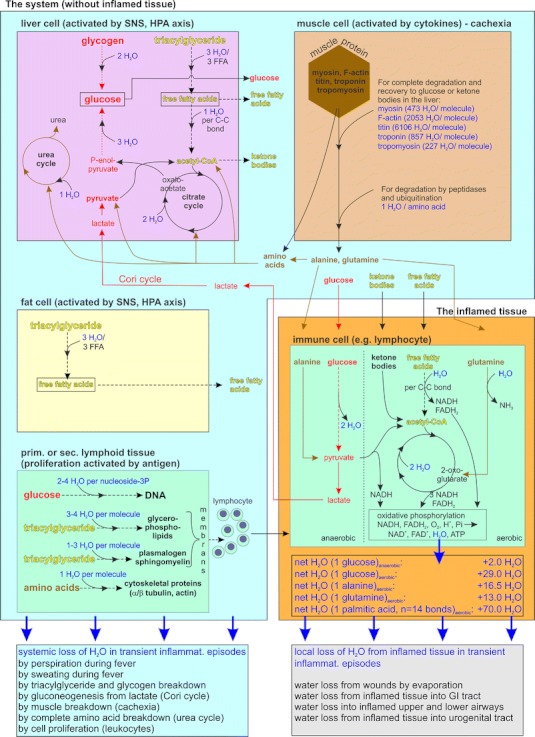
“many metabolic reactions that degrade storage forms of energy-rich substrates need water for hydrolysis (Fig. 1) [30–32].”
§ Evolutionary medicine and chronic inflammatory state—known and new concepts in pathophysiology > Refinement of the existing theory > Inflammation, energy demand, and water retention—an evolutionary link between inflammation and hypertension
What the sources say
- Not checked yetcites [30] Berg JM, Tymoczko JL, Stryer L (2002) Biochemistry. Freeman, New York
- Not checked yetcites [31] Michal G (1999) Biochemical pathways. Spektrum Akademischer Verlag, Heidelberg
- Not checked yetcites [32] Rassow J, Hauser K, Netzker R, Deutzmann R (2008) Biochemistry. Georg Thieme, Stuttgart
plain- Asserted: passes — The authors put it forward as true.
- Checkable: passes — It can be checked against evidence.
- Load-bearing: passes — The paper’s conclusions depend on it.
- Based: passes — The paper gives a reason why it holds.
In the paper
“Under normal conditions in adults, insensible perspiration through skin and respiratory tract can reach 0.5 ml/kg/h (example, 80 kg and 24 h = 960 ml/day) [29].”
§ Evolutionary medicine and chronic inflammatory state—known and new concepts in pathophysiology > Refinement of the existing theory > Inflammation, energy demand, and water retention—an evolutionary link between inflammation and hypertension
What the sources say
- Not checked yetcites [29] Jacob M, Chappell D, Hofmann-Kiefer K, Conzen P, Peter K, Rehm M (2007) Determinants of insensible fluid loss. Perspiration, protein shift and endothelial glycocalyx. Anaesthesist 56:747–758, 760–764 source
plain- Asserted: passes — The authors put it forward as true.
- Checkable: passes — It can be checked against evidence.
- Load-bearing: passes — The paper’s conclusions depend on it.
- Based: passes — The paper gives a reason why it holds.
A conclusion the paper draws from its own results — it cites no other source for it, so there is none to check. The quote shows it is in the paper.
In the paper
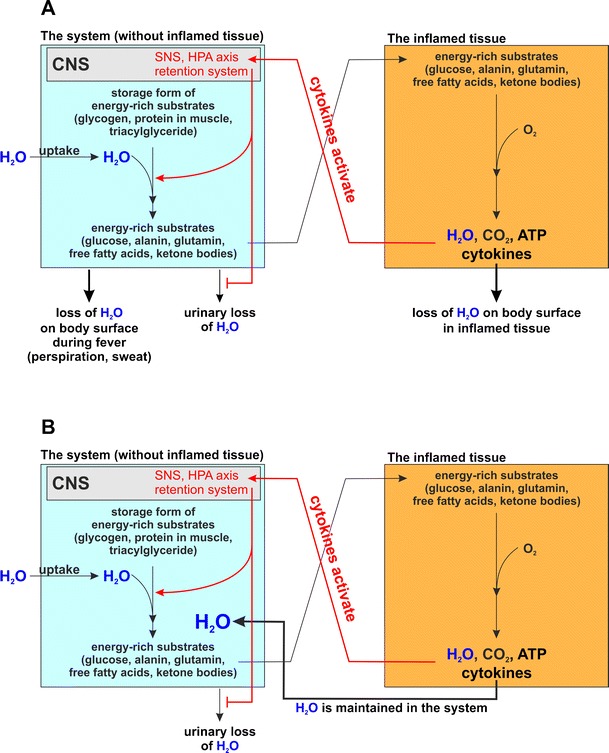
“due to low-grade inflammation without fever and due to a lack of inflamed exposed surface areas, water is not lost from the system and from inflamed tissue. Water can recirculate between activated immune cells and the system.”
§ Evolutionary medicine and chronic inflammatory state—known and new concepts in pathophysiology > Refinement of the existing theory > Inflammation, energy demand, and water retention—an evolutionary link between inflammation and hypertension
plaindirect- Asserted: passes — The authors put it forward as true.
- Checkable: passes — It can be checked against evidence.
- Load-bearing: passes — The paper’s conclusions depend on it.
- Based: passes — The paper gives a reason why it holds.
A conclusion the paper draws from its own results — it cites no other source for it, so there is none to check. The quote shows it is in the paper.
In the paper
“genes, signaling pathways, and networks that are operative in this setting are similar to those that determine acute episodes of inflammation (Table 2).”
§ Evolutionary medicine and chronic inflammatory state—known and new concepts in pathophysiology > Refinement of the existing theory > Inflammation, energy demand, and water retention—an evolutionary link between inflammation and hypertension
plaincorrelational- Asserted: passes — The authors put it forward as true.
- Checkable: passes — It can be checked against evidence.
- Load-bearing: passes — The paper’s conclusions depend on it.
- Based: passes — The paper gives a reason why it holds.
A conclusion the paper draws from its own results — it cites no other source for it, so there is none to check. The quote shows it is in the paper.
In the paper
“During transient inflammatory episodes, due to sickness behavior and anorexia, lipogenic insulin most probably plays a minor role because insulin secretion activated by the presence of carbohydrates would be downregulated.”
§ Evolutionary medicine and chronic inflammatory state—known and new concepts in pathophysiology > Refinement of the existing theory > Inflammation, energy demand, and water retention—an evolutionary link between inflammation and hypertension
hedgedconditional- Asserted: passes — The authors put it forward as true.
- Checkable: passes — It can be checked against evidence.
- Load-bearing: passes — The paper’s conclusions depend on it.
- Based: passes — The paper gives a reason why it holds.
- Rests on an assumption: Insulin is lipogenic and water retentive.
In the paper
“degradation of muscle protein needs particularly many molecules of water (Fig. 1, brown area in right upper corner) [31].”
§ Evolutionary medicine and chronic inflammatory state—known and new concepts in pathophysiology > Refinement of the existing theory > Inflammation, energy demand, and water retention—an evolutionary link between inflammation and hypertension
What the sources say
- Not checked yetcites [31] Michal G (1999) Biochemical pathways. Spektrum Akademischer Verlag, Heidelberg
plaindirect- Asserted: passes — The authors put it forward as true.
- Checkable: passes — It can be checked against evidence.
- Load-bearing: passes — The paper’s conclusions depend on it.
- Based: passes — The paper gives a reason why it holds.
A conclusion the paper draws from its own results — it cites no other source for it, so there is none to check. The quote shows it is in the paper.
In the paper
“Since the local inflammatory process leads to water loss over local surfaces, locally formed water—by degradation of energy-rich fuels in activated inflammatory cells (Fig. 1, orange area)—can be rapidly lost via the exposed surface (Fig. 2a).”
§ Evolutionary medicine and chronic inflammatory state—known and new concepts in pathophysiology > Refinement of the existing theory > Inflammation, energy demand, and water retention—an evolutionary link between inflammation and hypertension
plaindirect- Asserted: passes — The authors put it forward as true.
- Checkable: passes — It can be checked against evidence.
- Load-bearing: passes — The paper’s conclusions depend on it.
- Based: passes — The paper gives a reason why it holds.
A conclusion the paper draws from its own results — it cites no other source for it, so there is none to check. The quote shows it is in the paper.
In the paper
“Thus, important differences exist for water loss from the system and the generation of water from locally inflamed tissue.”
§ Evolutionary medicine and chronic inflammatory state—known and new concepts in pathophysiology > Refinement of the existing theory > Inflammation, energy demand, and water retention—an evolutionary link between inflammation and hypertension
plain- Asserted: passes — The authors put it forward as true.
- Checkable: passes — It can be checked against evidence.
- Load-bearing: passes — The paper’s conclusions depend on it.
- Based: passes — The paper gives a reason why it holds.
A conclusion the paper draws from its own results — it cites no other source for it, so there is none to check. The quote shows it is in the paper.
In the paper
“Chronic inflammation accompanied by essential hypertension is a necessary consequence”
§ Evolutionary medicine and chronic inflammatory state—known and new concepts in pathophysiology > Refinement of the existing theory > Inflammation, energy demand, and water retention—an evolutionary link between inflammation and hypertension
boosteddirect- Asserted: passes — The authors put it forward as true.
- Checkable: passes — It can be checked against evidence.
- Load-bearing: passes — The paper’s conclusions depend on it.
- Based: unclear — It is unclear why the paper says it holds.
- The authors state this as an assumption: The water retention system will not induce hypertension under acute inflammatory conditions with local and systemic water loss.
A conclusion the paper draws from its own results — it cites no other source for it, so there is none to check. The quote shows it is in the paper.
In the paper
“These numbers show that loss of water can be quite high during acute inflammatory episodes.”
§ Evolutionary medicine and chronic inflammatory state—known and new concepts in pathophysiology > Refinement of the existing theory > Inflammation, energy demand, and water retention—an evolutionary link between inflammation and hypertension
plaindirect- Asserted: passes — The authors put it forward as true.
- Checkable: passes — It can be checked against evidence.
- Load-bearing: passes — The paper’s conclusions depend on it.
- Based: passes — The paper gives a reason why it holds.
In the paper
“water retention hormones such as angiotensin II have proinflammatory activities [37].”
§ Evolutionary medicine and chronic inflammatory state—known and new concepts in pathophysiology > Refinement of the existing theory > Inflammation, energy demand, and water retention—an evolutionary link between inflammation and hypertension
What the sources say
- Not checked yetcites [37] Dorffel Y, Latsch C, Stuhlmuller B, Schreiber S, Scholze S, Burmester GR, Scholze J (1999) Preactivated peripheral blood monocytes in patients with essential hypertension. Hypertension 34:113–117 source
plaindirect- Asserted: passes — The authors put it forward as true.
- Checkable: passes — It can be checked against evidence.
- Load-bearing: passes — The paper’s conclusions depend on it.
- Based: passes — The paper gives a reason why it holds.
- Rests on an assumption: Angiotensin II is a water retention hormone.
A conclusion the paper draws from its own results — it cites no other source for it, so there is none to check. The quote shows it is in the paper.
In the paper
“Under conditions of local inflammation with exposed outer and inner surfaces, circulating cytokines from inflamed tissue activate the energy appeal and water retention reaction.”
§ Evolutionary medicine and chronic inflammatory state—known and new concepts in pathophysiology > Refinement of the existing theory > Inflammation, energy demand, and water retention—an evolutionary link between inflammation and hypertension
plaindirect- Asserted: passes — The authors put it forward as true.
- Checkable: passes — It can be checked against evidence.
- Load-bearing: passes — The paper’s conclusions depend on it.
- Based: passes — The paper gives a reason why it holds.
In the paper
“During surgical intervention, which is a model of mild acute inflammatory activation, water loss by insensible perspiration can amount to 1 ml/kg/h (example, 80 kg and 24 h = 1,820 ml/day) [29].”
§ Evolutionary medicine and chronic inflammatory state—known and new concepts in pathophysiology > Refinement of the existing theory > Inflammation, energy demand, and water retention—an evolutionary link between inflammation and hypertension
What the sources say
- Not checked yetcites [29] Jacob M, Chappell D, Hofmann-Kiefer K, Conzen P, Peter K, Rehm M (2007) Determinants of insensible fluid loss. Perspiration, protein shift and endothelial glycocalyx. Anaesthesist 56:747–758, 760–764 source
plain- Asserted: passes — The authors put it forward as true.
- Checkable: passes — It can be checked against evidence.
- Load-bearing: passes — The paper’s conclusions depend on it.
- Based: passes — The paper gives a reason why it holds.
None of the sources cited for this claim have been checked yet.
In the paper
“In these settings, circulating cytokine levels can be 5 to 10 times higher than normal (e.g., IL-6 from 2 pg/ml to 10–20 pg/ml), and the overall stimulus might be strong enough to induce a mild systemic water retention and energy appeal reaction (responses shown for low IL-6 serum concentrations in ref. [42, 43]).”
§ Evolutionary medicine and chronic inflammatory state—known and new concepts in pathophysiology > Refinement of the existing theory > Inflammation, energy demand, and water retention—an evolutionary link between inflammation and hypertension
What the sources say
- Not checked yetcites [42] Tsigos C, Papanicolaou DA, Defensor R, Mitsiadis CS, Kyrou I, Chrousos GP (1997) Dose effects of recombinant human interleukin-6 on pituitary hormone secretion and energy expenditure. Neuroendocrinology 66:54–62 source
- Not checked yetcites [43] Tsigos C, Papanicolaou DA, Kyrou I, Raptis SA, Chrousos GP (1999) Dose-dependent effects of recombinant human interleukin-6 on the pituitary-testicular axis. J Interferon Cytokine Res 19:1271–1276 source
plaincorrelational- Asserted: passes — The authors put it forward as true.
- Checkable: passes — It can be checked against evidence.
- Load-bearing: passes — The paper’s conclusions depend on it.
- Based: passes — The paper gives a reason why it holds.
The paper states this without a source or data behind it here, so there is nothing to check it against. The quote shows it is in the paper.
In the paper
“Water is formed when glucose, amino acids, and free fatty acids undergo degradation in the Krebs cycle and during oxidative phosphorylation; these processes occur in the mitochondria of activated cells in inflamed tissue (Fig. 1, orange area).”
§ Evolutionary medicine and chronic inflammatory state—known and new concepts in pathophysiology > Refinement of the existing theory > Inflammation, energy demand, and water retention—an evolutionary link between inflammation and hypertension
plaindirect- Asserted: passes — The authors put it forward as true.
- Checkable: passes — It can be checked against evidence.
- Load-bearing: passes — The paper’s conclusions depend on it.
- Based: passes — The paper gives a reason why it holds.
In the paper
“the breakdown of one molecule of glucose from glycogen needs two molecules of water (Fig. 1, pink area in left upper corner)”
§ Evolutionary medicine and chronic inflammatory state—known and new concepts in pathophysiology > Refinement of the existing theory > Inflammation, energy demand, and water retention—an evolutionary link between inflammation and hypertension
What the sources say
- Not checked yetcites [31] Michal G (1999) Biochemical pathways. Spektrum Akademischer Verlag, Heidelberg
plaindirect- Asserted: passes — The authors put it forward as true.
- Checkable: passes — It can be checked against evidence.
- Load-bearing: passes — The paper’s conclusions depend on it.
- Based: passes — The paper gives a reason why it holds.
A conclusion the paper draws from its own results — it cites no other source for it, so there is none to check. The quote shows it is in the paper.
In the paper
“systemic hypertension could result from the continuous activation of a water retention and energy appeal reaction but without the usual water loss (Fig. 2b).”
§ Evolutionary medicine and chronic inflammatory state—known and new concepts in pathophysiology > Refinement of the existing theory > Inflammation, energy demand, and water retention—an evolutionary link between inflammation and hypertension
hedgedconditional- Asserted: passes — The authors put it forward as true.
- Checkable: passes — It can be checked against evidence.
- Load-bearing: passes — The paper’s conclusions depend on it.
- Based: passes — The paper gives a reason why it holds.
- The authors state this as an assumption: The water retention system will not induce hypertension under acute inflammatory conditions with local and systemic water loss.
None of the sources cited for this claim have been checked yet.
In the paper
“the generation of the Cori cycle between the lactate-producing inflamed tissue and the glucose-producing liver [33], involving gluconeogenesis, needs five molecules of water to reactivate one molecule of lactate (Fig. 1, red lines with arrows) [31].”
§ Evolutionary medicine and chronic inflammatory state—known and new concepts in pathophysiology > Refinement of the existing theory > Inflammation, energy demand, and water retention—an evolutionary link between inflammation and hypertension
What the sources say
- Not checked yetcites [31] Michal G (1999) Biochemical pathways. Spektrum Akademischer Verlag, Heidelberg
- Not checked yetcites [33] Tredget EE, Yu YM (1992) The metabolic effects of thermal injury. World J Surg 16:68–79 source
plaindirect- Asserted: passes — The authors put it forward as true.
- Checkable: passes — It can be checked against evidence.
- Load-bearing: passes — The paper’s conclusions depend on it.
- Based: passes — The paper gives a reason why it holds.
In the paper
“triglyceride breakdown needs three molecules of water for three molecules of free fatty acids (Fig. 1, pink and yellow area on the left side)”
§ Evolutionary medicine and chronic inflammatory state—known and new concepts in pathophysiology > Refinement of the existing theory > Inflammation, energy demand, and water retention—an evolutionary link between inflammation and hypertension
What the sources say
- Not checked yetcites [31] Michal G (1999) Biochemical pathways. Spektrum Akademischer Verlag, Heidelberg
plaindirect- Asserted: passes — The authors put it forward as true.
- Checkable: passes — It can be checked against evidence.
- Load-bearing: passes — The paper’s conclusions depend on it.
- Based: passes — The paper gives a reason why it holds.
In the paper
“Inhibition of the renin–angiotensin–aldosterone system by angiotensin-converting enzyme inhibitors or angiotensin II receptor antagonists exert anti-inflammatory effects as summarized elsewhere [39].”
§ Evolutionary medicine and chronic inflammatory state—known and new concepts in pathophysiology > Refinement of the existing theory > Inflammation, energy demand, and water retention—an evolutionary link between inflammation and hypertension
What the sources say
- Not checked yetcites [39] Boos CJ, Lip GY (2006) Is hypertension an inflammatory process? Curr Pharm Des 12:1623–1635 source
plaindirect- Asserted: passes — The authors put it forward as true.
- Checkable: passes — It can be checked against evidence.
- Load-bearing: unclear — It is unclear whether the paper’s conclusions depend on it.
- Based: passes — The paper gives a reason why it holds.
In the paper
“the operation of a proper adaptive immune response with proliferation of B cells and T cells and proliferation of innate immune cells (neutrophils, monocytes) in primary and secondary lymphoid organs needs enormous amounts of water (Fig. 1, green area in left lower corner) [31].”
§ Evolutionary medicine and chronic inflammatory state—known and new concepts in pathophysiology > Refinement of the existing theory > Inflammation, energy demand, and water retention—an evolutionary link between inflammation and hypertension
What the sources say
- Not checked yetcites [31] Michal G (1999) Biochemical pathways. Spektrum Akademischer Verlag, Heidelberg
plaindirect- Asserted: passes — The authors put it forward as true.
- Checkable: passes — It can be checked against evidence.
- Load-bearing: passes — The paper’s conclusions depend on it.
- Based: passes — The paper gives a reason why it holds.
A conclusion the paper draws from its own results — it cites no other source for it, so there is none to check. The quote shows it is in the paper.
In the paper
“In the acute situation, water is lost from the system and from inflamed tissue via outer and inner surfaces. The water fluxes are in a balance.”
§ Evolutionary medicine and chronic inflammatory state—known and new concepts in pathophysiology > Refinement of the existing theory > Inflammation, energy demand, and water retention—an evolutionary link between inflammation and hypertension
plain- Asserted: passes — The authors put it forward as true.
- Checkable: passes — It can be checked against evidence.
- Load-bearing: passes — The paper’s conclusions depend on it.
- Based: passes — The paper gives a reason why it holds.
In the paper
“To overcome systemic water loss during acute inflammatory episodes and events such as trauma, hemorrhage, and burns, a water retention system is activated.”
§ Evolutionary medicine and chronic inflammatory state—known and new concepts in pathophysiology > Refinement of the existing theory > Inflammation, energy demand, and water retention—an evolutionary link between inflammation and hypertension
What the sources say
- Not checked yetcites [34] Bader M, Ganten D (2000) Regulation of renin: new evidence from cultured cells and genetically modified mice. J Mol Med (Berl) 78:130–139 source
plaindirect- Asserted: passes — The authors put it forward as true.
- Checkable: passes — It can be checked against evidence.
- Load-bearing: passes — The paper’s conclusions depend on it.
- Based: passes — The paper gives a reason why it holds.
A conclusion the paper draws from its own results — it cites no other source for it, so there is none to check. The quote shows it is in the paper.
In the paper
“In the setting of acute inflammatory episodes such as infectious disease, it is important that the energy appeal reaction and the water retention reaction support the proinflammatory process to eliminate the infectious agent.”
§ Evolutionary medicine and chronic inflammatory state—known and new concepts in pathophysiology > Refinement of the existing theory > Inflammation, energy demand, and water retention—an evolutionary link between inflammation and hypertension
plaindirect- Asserted: passes — The authors put it forward as true.
- Checkable: passes — It can be checked against evidence.
- Load-bearing: passes — The paper’s conclusions depend on it.
- Based: passes — The paper gives a reason why it holds.
In the paper
“Angiotensin II uses the important proinflammatory signaling cascade of NF-κB activation similar as TNF [38].”
§ Evolutionary medicine and chronic inflammatory state—known and new concepts in pathophysiology > Refinement of the existing theory > Inflammation, energy demand, and water retention—an evolutionary link between inflammation and hypertension
What the sources say
- Not checked yetcites [38] Phillips MI, Kagiyama S (2002) Angiotensin II as a pro-inflammatory mediator. Curr Opin Investig Drugs 3:569–577
plaindirect- Asserted: passes — The authors put it forward as true.
- Checkable: passes — It can be checked against evidence.
- Load-bearing: passes — The paper’s conclusions depend on it.
- Based: passes — The paper gives a reason why it holds.
In the paper
“If amino acids are completely degraded within the urea cycle in the liver, one molecule of water is needed for one molecule of amino acid (Fig. 1, pink area in the left upper corner).”
§ Evolutionary medicine and chronic inflammatory state—known and new concepts in pathophysiology > Refinement of the existing theory > Inflammation, energy demand, and water retention—an evolutionary link between inflammation and hypertension
What the sources say
- Not checked yetcites [31] Michal G (1999) Biochemical pathways. Spektrum Akademischer Verlag, Heidelberg
plaindirect- Asserted: passes — The authors put it forward as true.
- Checkable: passes — It can be checked against evidence.
- Load-bearing: passes — The paper’s conclusions depend on it.
- Based: passes — The paper gives a reason why it holds.
A conclusion the paper draws from its own results — it cites no other source for it, so there is none to check. The quote shows it is in the paper.
In the paper
“The revised version of the theory predicts that the operation of these mechanisms will not depend on the site of inflammation and whether it occurs in arteries, kidneys, gastrointestinal tract, joints, or at various tissues with inflammatory cells.”
§ Evolutionary medicine and chronic inflammatory state—known and new concepts in pathophysiology > Refinement of the existing theory > Inflammation, energy demand, and water retention—an evolutionary link between inflammation and hypertension
plain- Asserted: passes — The authors put it forward as true.
- Checkable: passes — It can be checked against evidence.
- Load-bearing: passes — The paper’s conclusions depend on it.
- Based: passes — The paper gives a reason why it holds.
A conclusion the paper draws from its own results — it cites no other source for it, so there is none to check. The quote shows it is in the paper.
In the paper
“the energy appeal reaction and water retention reaction appear to be the result of selection in evolution for their role in transient inflammatory episodes.”
- Also stated in: § Conclusions · plain
“The revised theory states that energy appeal and water retention reaction have been positively selected for transient inflammatory episodes”
§ Evolutionary medicine and chronic inflammatory state—known and new concepts in pathophysiology > Refinement of the existing theory > Inflammation, energy demand, and water retention—an evolutionary link between inflammation and hypertension
plaindirect- Asserted: passes — The authors put it forward as true.
- Checkable: passes — It can be checked against evidence.
- Load-bearing: passes — The paper’s conclusions depend on it.
- Based: unclear — It is unclear why the paper says it holds.
- Also stated in: § Conclusions · plain
A conclusion the paper draws from its own results — it cites no other source for it, so there is none to check. The quote shows it is in the paper.
In the paper
“The magnitude of these changes would determine any detrimental effect on the induction of hypertension.”
§ Evolutionary medicine and chronic inflammatory state—known and new concepts in pathophysiology > Refinement of the existing theory > Inflammation, energy demand, and water retention—an evolutionary link between inflammation and hypertension
hedgedconditional- Asserted: passes — The authors put it forward as true.
- Checkable: passes — It can be checked against evidence.
- Load-bearing: passes — The paper’s conclusions depend on it.
- Based: unclear — It is unclear why the paper says it holds.
A conclusion the paper draws from its own results — it cites no other source for it, so there is none to check. The quote shows it is in the paper.
In the paper
“prolonged operation of these adaptive programs such as in chronic inflammatory diseases of today can in itself become pathogenic because there is no program to counteract continuous water retention and energy appeal reaction during long-term age-related inflammation and in chronic inflammatory diseases.”
- Also stated in: § Conclusions · plain
“prolonged use of these adaptive programs can in itself become pathogenic.”
§ Evolutionary medicine and chronic inflammatory state—known and new concepts in pathophysiology > Refinement of the existing theory > Inflammation, energy demand, and water retention—an evolutionary link between inflammation and hypertension
plaindirect- Asserted: passes — The authors put it forward as true.
- Checkable: passes — It can be checked against evidence.
- Load-bearing: passes — The paper’s conclusions depend on it.
- Based: passes — The paper gives a reason why it holds.
- Also stated in: § Conclusions · plain
A conclusion the paper draws from its own results — it cites no other source for it, so there is none to check. The quote shows it is in the paper.
In the paper
“Induction of energy appeal reaction and water retention reaction provide a survival value if used for a short period of time.”
§ Evolutionary medicine and chronic inflammatory state—known and new concepts in pathophysiology > Refinement of the existing theory > Inflammation, energy demand, and water retention—an evolutionary link between inflammation and hypertension
plaindirect- Asserted: passes — The authors put it forward as true.
- Checkable: passes — It can be checked against evidence.
- Load-bearing: passes — The paper’s conclusions depend on it.
- Based: passes — The paper gives a reason why it holds.
A conclusion the paper draws from its own results — it cites no other source for it, so there is none to check. The quote shows it is in the paper.
In the paper
“these features can now be unified in terms of a redirection of energy-rich fuels from energy stores to the activated immune system and activation of the water retention system.”
§ Evolutionary medicine and chronic inflammatory state—known and new concepts in pathophysiology > Conclusions
plaindirect- Asserted: passes — The authors put it forward as true.
- Checkable: passes — It can be checked against evidence.
- Load-bearing: passes — The paper’s conclusions depend on it.
- Based: passes — The paper gives a reason why it holds.
- It may state two separate claims as one. 26
- Probably not a substantial claim. 10
A conclusion the paper draws from its own results — it cites no other source for it, so there is none to check. The quote shows it is in the paper.
In the paper
“Many chronic inflammatory diseases only become manifested in patients at older ages. Because of the short life expectancy in the past, our ancestors have not suffered from the chronic inflammatory diseases that we know today.”
§ Evolutionary medicine and chronic inflammatory state—known and new concepts in pathophysiology > The framework of evolutionary biology and neuroendocrine immune energy regulation in pathophysiology of chronic inflammatory diseases
plaindirect- Asserted: passes — The authors put it forward as true.
- Checkable: passes — It can be checked against evidence.
- Load-bearing: passes — The paper’s conclusions depend on it.
- Based: unclear — It is unclear why the paper says it holds.
It may state two separate claims as one.
A conclusion the paper draws from its own results — it cites no other source for it, so there is none to check. The quote shows it is in the paper.
In the paper
“Thus, the evolutionary time line of the neuroendocrine immune network that is basis of the present theory goes back at least 400 million years (distance to the suggested common ancestor).”
§ Evolutionary medicine and chronic inflammatory state—known and new concepts in pathophysiology > Introduction
plain- Asserted: passes — The authors put it forward as true.
- Checkable: passes — It can be checked against evidence.
- Load-bearing: fails — The paper’s conclusions may not depend on it.
- Based: fails — The paper may give no reason why it holds.
Probably not a substantial claim. The paper’s conclusions may not depend on it. The paper may give no reason why it holds.
A conclusion the paper draws from its own results — it cites no other source for it, so there is none to check. The quote shows it is in the paper.
In the paper
“Since these disease sequelae can be found in many animal models of chronic inflammatory diseases with mammals (e.g., monkeys, mice, rats, rabbits, etc.), the evolutionary time line goes back at least 70 million years.”
§ Evolutionary medicine and chronic inflammatory state—known and new concepts in pathophysiology > Abstract
plaindirect- Asserted: passes — The authors put it forward as true.
- Checkable: passes — It can be checked against evidence.
- Load-bearing: unclear — It is unclear whether the paper’s conclusions depend on it.
- Based: unclear — It is unclear why the paper says it holds.
It may state two separate claims as one.
None of the sources cited for this claim have been checked yet.
In the paper
“It has been hypothesized that genes responsible for energy regulation have been positively selected under conditions without chronic inflammation [8, 10].”
§ Evolutionary medicine and chronic inflammatory state—known and new concepts in pathophysiology > The framework of evolutionary biology and neuroendocrine immune energy regulation in pathophysiology of chronic inflammatory diseases
What the sources say
- Not checked yetcites [8] Straub RH, Besedovsky HO (2003) Integrated evolutionary, immunological, and neuroendocrine framework for the pathogenesis of chronic disabling inflammatory diseases. FASEB J 17:2176–2183 source
- Not checked yetcites [10] Straub RH (2011) Concepts of evolutionary medicine and energy regulation contribute to the etiology of systemic chronic inflammatory diseases. Brain Behav Immun 25:1–5 source
hedgeddirect- Asserted: fails — The authors may not put it forward as true.
- Checkable: passes — It can be checked against evidence.
- Load-bearing: fails — The paper’s conclusions may not depend on it.
- Based: passes — The paper gives a reason why it holds.
Probably not a substantial claim. The authors may not put it forward as true. The paper’s conclusions may not depend on it.
None of the sources cited for this claim have been checked yet.
In the paper
“Chronic inflammatory diseases can lead to loss of reproduction potential because affected individuals are at strong disadvantage. Such individuals can be excluded or impaired in the competition for food; they can also have low social status in the group and limited choice or availability of sexual partners.”
- Also stated in: § The framework of evolutionary biology and neuroendocrine immune energy regulation in pathophysiology of chronic inflammatory diseases · boosted
“In addition, intense, persistent inflammation can inhibit the hypothalamic–pituitary–gonadal axis, leading to impairment of fertility as demonstrated in studies on the effect of chronic inflammatory diseases on fertility despite good medical control [16–20].”
§ Evolutionary medicine and chronic inflammatory state—known and new concepts in pathophysiology > The framework of evolutionary biology and neuroendocrine immune energy regulation in pathophysiology of chronic inflammatory diseases
What the sources say
- Not checked yetcites [16] Ostensen M, Almberg K, Koksvik HS (2000) Sex, reproduction, and gynecological disease in young adults with a history of juvenile chronic arthritis. J Rheumatol 27:1783–1787
- Not checked yetcites [17] Silva CA et al (2010) Hormone profile in juvenile systemic lupus erythematosus with previous or current amenorrhea. Rheumatol Int 31(8):1037–1043 source
- Not checked yetcites [18] Villiger PM, Caliezi G, Cottin V, Forger F, Senn A, Ostensen M (2010) Effects of TNF antagonists on sperm characteristics in patients with spondyloarthritis. Ann Rheum Dis 69:1842–1844 source
- Not checked yetcites [19] Soares PM, Borba EF, Bonfa E, Hallak J, Correa AL, Silva CA (2007) Gonad evaluation in male systemic lupus erythematosus. Arthritis Rheum 56:2352–2361 source
- Not checked yetcites [20] Suehiro RM, Borba EF, Bonfa E, Okay TS, Cocuzza M, Soares PM, Silva CA (2008) Testicular Sertoli cell function in male systemic lupus erythematosus. Rheumatology (Oxford) 47:1692–1697 source
boosteddirect- Asserted: passes — The authors put it forward as true.
- Checkable: passes — It can be checked against evidence.
- Load-bearing: passes — The paper’s conclusions depend on it.
- Based: passes — The paper gives a reason why it holds.
It may state two separate claims as one.
- Also stated in: § The framework of evolutionary biology and neuroendocrine immune energy regulation in pathophysiology of chronic inflammatory diseases · boosted
A conclusion the paper draws from its own results — it cites no other source for it, so there is none to check. The quote shows it is in the paper.
In the paper
“Second, the revised theory addresses the mechanisms of essential hypertension since, on the basis of water loss, acute inflammatory diseases can stimulate water retention using a positively selected water retention system (identical to the energy provision system).”
§ Evolutionary medicine and chronic inflammatory state—known and new concepts in pathophysiology > Abstract
plaindirect- Asserted: passes — The authors put it forward as true.
- Checkable: passes — It can be checked against evidence.
- Load-bearing: passes — The paper’s conclusions depend on it.
- Based: passes — The paper gives a reason why it holds.
It may state two separate claims as one.
- Rests on an assumption: The water retention system is identical to the energy provision system.
In the paper
“It has been hypothesized that the genes relevant to the etiology of today’s chronic inflammatory diseases have been positively selected for their effects on normal host defense as well as the host response to serious, albeit non-life-threatening, inflammatory episodes in contrast to chronic inflammatory diseases (Table 2) [8].”
§ Evolutionary medicine and chronic inflammatory state—known and new concepts in pathophysiology > The framework of evolutionary biology and neuroendocrine immune energy regulation in pathophysiology of chronic inflammatory diseases
What the sources say
- Not checked yetcites [8] Straub RH, Besedovsky HO (2003) Integrated evolutionary, immunological, and neuroendocrine framework for the pathogenesis of chronic disabling inflammatory diseases. FASEB J 17:2176–2183 source
hedgeddirect- Asserted: fails — The authors may not put it forward as true.
- Checkable: passes — It can be checked against evidence.
- Load-bearing: passes — The paper’s conclusions depend on it.
- Based: passes — The paper gives a reason why it holds.
Probably not a substantial claim. The authors may not put it forward as true.
A conclusion the paper draws from its own results — it cites no other source for it, so there is none to check. The quote shows it is in the paper.
In the paper
“which is hypothesized to be the basis of essential hypertension (prevalence in adults 22–32%).”
§ Evolutionary medicine and chronic inflammatory state—known and new concepts in pathophysiology > Abstract
hedgedconditional- Asserted: passes — The authors put it forward as true.
- Checkable: passes — It can be checked against evidence.
- Load-bearing: passes — The paper’s conclusions depend on it.
- Based: passes — The paper gives a reason why it holds.
Probably not a substantial claim.
A conclusion the paper draws from its own results — it cites no other source for it, so there is none to check. The quote shows it is in the paper.
In the paper
“It can be hypothesized that energy considerations can help explain the relatively constant time course of an adaptive immune response in the context of acute infection.”
§ Evolutionary medicine and chronic inflammatory state—known and new concepts in pathophysiology > Refinement of the existing theory > From acute to chronic inflammatory disease—where is the boundary?
hedgedconditional- Asserted: passes — The authors put it forward as true.
- Checkable: passes — It can be checked against evidence.
- Load-bearing: passes — The paper’s conclusions depend on it.
- Based: passes — The paper gives a reason why it holds.
Probably not a substantial claim.
A conclusion the paper draws from its own results — it cites no other source for it, so there is none to check. The quote shows it is in the paper.
In the paper
“For the chronic phase of such immune-mediated diseases, the organism would lack positively selected genes, signaling pathways, and networks to be able to stop the chronic disease in a coordinated fashion.”
§ Evolutionary medicine and chronic inflammatory state—known and new concepts in pathophysiology > Refinement of the existing theory > From acute to chronic inflammatory disease—where is the boundary?
hedgeddirect- Asserted: passes — The authors put it forward as true.
- Checkable: passes — It can be checked against evidence.
- Load-bearing: passes — The paper’s conclusions depend on it.
- Based: fails — The paper may give no reason why it holds.
Probably not a substantial claim. The paper may give no reason why it holds.
A conclusion the paper draws from its own results — it cites no other source for it, so there is none to check. The quote shows it is in the paper.
In the paper
“If a disease is progressive and longstanding (e.g., autoimmunity) and therapies are available to stop lethal emaciation (i.e., immunosuppression), a chronic phase can develop.”
§ Evolutionary medicine and chronic inflammatory state—known and new concepts in pathophysiology > Refinement of the existing theory > From acute to chronic inflammatory disease—where is the boundary?
plainconditional- Asserted: passes — The authors put it forward as true.
- Checkable: passes — It can be checked against evidence.
- Load-bearing: passes — The paper’s conclusions depend on it.
- Based: fails — The paper may give no reason why it holds.
Probably not a substantial claim. The paper may give no reason why it holds.
A conclusion the paper draws from its own results — it cites no other source for it, so there is none to check. The quote shows it is in the paper.
In the paper
“This version defines more precisely the moment of transition from acute inflammatory disease to chronic inflammatory disease as a time in which energy stores become empty (complete energy consumption).”
- Also stated in: § From acute to chronic inflammatory disease—where is the boundary? · plain
“The framework of evolutionary biology and neuroendocrine immune energy regulation thus defines the point of transition from acute disease to chronic disease as the time point of complete energy consumption (19–43 days).”
§ Evolutionary medicine and chronic inflammatory state—known and new concepts in pathophysiology > Abstract
plaindirect- Asserted: passes — The authors put it forward as true.
- Checkable: passes — It can be checked against evidence.
- Load-bearing: passes — The paper’s conclusions depend on it.
- Based: passes — The paper gives a reason why it holds.
Probably not a substantial claim.
- Also stated in: § From acute to chronic inflammatory disease—where is the boundary? · plain
A conclusion the paper draws from its own results — it cites no other source for it, so there is none to check. The quote shows it is in the paper.
In the paper
“Thus, sickness behavior and energy disturbance would remain and impair the function of the individual. It becomes a perpetuating factor (Table 5).”
§ Evolutionary medicine and chronic inflammatory state—known and new concepts in pathophysiology > Refinement of the existing theory > From acute to chronic inflammatory disease—where is the boundary?
hedgeddirect- Asserted: passes — The authors put it forward as true.
- Checkable: passes — It can be checked against evidence.
- Load-bearing: passes — The paper’s conclusions depend on it.
- Based: passes — The paper gives a reason why it holds.
It may state two separate claims as one.
A conclusion the paper draws from its own results — it cites no other source for it, so there is none to check. The quote shows it is in the paper.
In the paper
“It can be hypothesized that networks for more persistent inflammatory diseases do not exist because they have not undergone the pressure of positive selection.”
§ Evolutionary medicine and chronic inflammatory state—known and new concepts in pathophysiology > Refinement of the existing theory > From acute to chronic inflammatory disease—where is the boundary?
hedgeddirect- Asserted: fails — The authors may not put it forward as true.
- Checkable: passes — It can be checked against evidence.
- Load-bearing: passes — The paper’s conclusions depend on it.
- Based: fails — The paper may give no reason why it holds.
Probably not a substantial claim. The authors may not put it forward as true. The paper may give no reason why it holds.
None of the sources cited for this claim have been checked yet.
In the paper
“In considering energy stores available during these responses, it is important to note that storage occurs primarily in fat tissue (12 kg of triglycerides in the body of a contemporary person, 500,000 kJ), as well as in the liver (150 g glycogen, 2.500 kJ) or muscles (300 g glycogen, 5,000 kJ; 6–7 kg muscle protein, 50,000 kJ) [11, 12].”
§ Evolutionary medicine and chronic inflammatory state—known and new concepts in pathophysiology > Refinement of the existing theory > From acute to chronic inflammatory disease—where is the boundary?
What the sources say
- Not checked yetcites [11] Rolfe DF, Brown GC (1997) Cellular energy utilization and molecular origin of standard metabolic rate in mammals. Physiol Rev 77:731–758 source
- Not checked yetcites [12] Blaxter K (1989) Energy metabolism in animals and man. Cambridge University Press, Cambridge
plain- Asserted: passes — The authors put it forward as true.
- Checkable: passes — It can be checked against evidence.
- Load-bearing: passes — The paper’s conclusions depend on it.
- Based: passes — The paper gives a reason why it holds.
It may state two separate claims as one.
In the paper
“HLA DR4 (DRB1*04) is a well-known risk factor for rheumatoid arthritis and other chronic autoimmune diseases, but HLA DR4 (DRB1*04) also has a strong negative association with dengue hemorrhagic fever [21].”
§ Evolutionary medicine and chronic inflammatory state—known and new concepts in pathophysiology > The framework of evolutionary biology and neuroendocrine immune energy regulation in pathophysiology of chronic inflammatory diseases
What the sources say
- Not checked yetcites [21] LaFleur C et al (2002) HLA-DR antigen frequencies in Mexican patients with dengue virus infection: HLA-DR4 as a possible genetic resistance factor for dengue hemorrhagic fever. Hum Immunol 63:1039–1044 source
boostedcorrelational- Asserted: passes — The authors put it forward as true.
- Checkable: passes — It can be checked against evidence.
- Load-bearing: passes — The paper’s conclusions depend on it.
- Based: passes — The paper gives a reason why it holds.
It may state two separate claims as one.
In the paper
“In this conceptualization, the induction of systemic responses results from an appeal for energy-rich substrates, called the energy appeal reaction [9].”
§ Evolutionary medicine and chronic inflammatory state—known and new concepts in pathophysiology > The framework of evolutionary biology and neuroendocrine immune energy regulation in pathophysiology of chronic inflammatory diseases
What the sources say
- Not checked yetcites [9] Straub RH, Cutolo M, Buttgereit F, Pongratz G (2010) Energy regulation and neuroendocrine-immune control in chronic inflammatory diseases. J Intern Med 267:543–560 source
plaindirect- Asserted: passes — The authors put it forward as true.
- Checkable: passes — It can be checked against evidence.
- Load-bearing: passes — The paper’s conclusions depend on it.
- Based: passes — The paper gives a reason why it holds.
Probably not a substantial claim.
In the paper
“Thus, one can add the “systemic response” to the list of classical etiologic factors of chronic inflammatory diseases (Table 5) [10]. The “systemic response” in itself can be disease perpetuating.”
§ Evolutionary medicine and chronic inflammatory state—known and new concepts in pathophysiology > The framework of evolutionary biology and neuroendocrine immune energy regulation in pathophysiology of chronic inflammatory diseases
What the sources say
- Not checked yetcites [10] Straub RH (2011) Concepts of evolutionary medicine and energy regulation contribute to the etiology of systemic chronic inflammatory diseases. Brain Behav Immun 25:1–5 source
plaindirect- Asserted: passes — The authors put it forward as true.
- Checkable: passes — It can be checked against evidence.
- Load-bearing: passes — The paper’s conclusions depend on it.
- Based: passes — The paper gives a reason why it holds.
It may state two separate claims as one.
A conclusion the paper draws from its own results — it cites no other source for it, so there is none to check. The quote shows it is in the paper.
In the paper
“In summary, it seems plausible that specific genes have not been selected or conserved in evolution because of their putative role in chronic inflammatory diseases, either positive or negative. Rather, genes, signaling pathways, and networks operative in symptomatic chronic inflammatory diseases were likely adapted from normal physiology or serious, albeit non-life-threatening, inflammatory”
§ Evolutionary medicine and chronic inflammatory state—known and new concepts in pathophysiology > The framework of evolutionary biology and neuroendocrine immune energy regulation in pathophysiology of chronic inflammatory diseases
hedged- Asserted: passes — The authors put it forward as true.
- Checkable: passes — It can be checked against evidence.
- Load-bearing: passes — The paper’s conclusions depend on it.
- Based: unclear — It is unclear why the paper says it holds.
It may state two separate claims as one.
None of the sources cited for this claim have been checked yet.
In the paper
“An acute infectious disease can be self-limiting and involve an innate immune response of 2 to 3 days; the subsequent phase of the adaptive immune response can last approximately 3 to 4 weeks.”
§ Evolutionary medicine and chronic inflammatory state—known and new concepts in pathophysiology > Refinement of the existing theory > From acute to chronic inflammatory disease—where is the boundary?
What the sources say
- Not checked yetcites [22] Meyer-Hermann ME, Maini PK (2005) Cutting edge: back to “one-way” germinal centers. J Immunol 174:2489–2493 source
- Not checked yetcites [23] Meyer-Hermann M (2002) A mathematical model for the germinal center morphology and affinity maturation. J Theor Biol 216:273–300 source
plain- Asserted: passes — The authors put it forward as true.
- Checkable: passes — It can be checked against evidence.
- Load-bearing: passes — The paper’s conclusions depend on it.
- Based: passes — The paper gives a reason why it holds.
It may state two separate claims as one.
In the paper
“Thus, it seems likely that HLA DR4 (DRB1*04) was positively selected to overcome dengue hemorrhagic fever but not to stimulate rheumatoid arthritis and other autoimmune diseases in later life.”
§ Evolutionary medicine and chronic inflammatory state—known and new concepts in pathophysiology > The framework of evolutionary biology and neuroendocrine immune energy regulation in pathophysiology of chronic inflammatory diseases
What the sources say
- Not checked yetcites [21] LaFleur C et al (2002) HLA-DR antigen frequencies in Mexican patients with dengue virus infection: HLA-DR4 as a possible genetic resistance factor for dengue hemorrhagic fever. Hum Immunol 63:1039–1044 source
hedgedconditional- Asserted: passes — The authors put it forward as true.
- Checkable: passes — It can be checked against evidence.
- Load-bearing: passes — The paper’s conclusions depend on it.
- Based: passes — The paper gives a reason why it holds.
It may state two separate claims as one.
None of the sources cited for this claim have been checked yet.
In the paper
“Both the aging process and medically treated chronic inflammatory diseases are accompanied by mild inflammation, a state that one might call low-grade smoldering chronic inflammation [40, 41].”
§ Evolutionary medicine and chronic inflammatory state—known and new concepts in pathophysiology > Refinement of the existing theory > Inflammation, energy demand, and water retention—an evolutionary link between inflammation and hypertension
What the sources say
- Not checked yetcites [40] Pawelec G, Akbar A, Caruso C, Solana R, Grubeck-Loebenstein B, Wikby A (2005) Human immunosenescence: is it infectious? Immunol Rev 205:257–268, 257-268 source
- Not checked yetcites [41] Straub RH, Cutolo M, Zietz B, Schölmerich J (2001) The process of aging changes the interplay of the immune, endocrine and nervous systems. Mech Ageing Dev 122:1591–1611 source
hedgedcorrelational- Asserted: passes — The authors put it forward as true.
- Checkable: passes — It can be checked against evidence.
- Load-bearing: passes — The paper’s conclusions depend on it.
- Based: passes — The paper gives a reason why it holds.
It may state two separate claims as one.
A conclusion the paper draws from its own results — it cites no other source for it, so there is none to check. The quote shows it is in the paper.
In the paper
“Thus, while sickness behavior may have antilipogenic consequences by suppressing insulin secretion, it can also be prolipolytic through activation of the SNS and the HPA axis. It leads to redirection of stored energy to the activated immune system.”
§ Evolutionary medicine and chronic inflammatory state—known and new concepts in pathophysiology > Refinement of the existing theory > Inflammation, energy demand, and water retention—an evolutionary link between inflammation and hypertension
hedgeddirect- Asserted: passes — The authors put it forward as true.
- Checkable: passes — It can be checked against evidence.
- Load-bearing: passes — The paper’s conclusions depend on it.
- Based: passes — The paper gives a reason why it holds.
It may state two separate claims as one.
In the paper
“ACTH can stimulate aldosterone as well as cortisol, which also has mineralocorticoid activity [35].”
§ Evolutionary medicine and chronic inflammatory state—known and new concepts in pathophysiology > Refinement of the existing theory > Inflammation, energy demand, and water retention—an evolutionary link between inflammation and hypertension
What the sources say
- Not checked yetcites [35] Hattangady N, Olala L, Bollag WB, Rainey WE (2011) Acute and chronic regulation of aldosterone production. Mol Cell Endocrinol. doi: 10.1016/j.mce.2011.07.034 source
plaindirect- Asserted: passes — The authors put it forward as true.
- Checkable: passes — It can be checked against evidence.
- Load-bearing: passes — The paper’s conclusions depend on it.
- Based: passes — The paper gives a reason why it holds.
It may state two separate claims as one.
None of the sources cited for this claim have been checked yet.
In the paper
“there are obvious signs of volume overload in chronic inflammatory diseases because serum levels of atrial natriuretic factor and NT-brain natriuretic factor are markedly increased in different diseases [49–52].”
§ Evolutionary medicine and chronic inflammatory state—known and new concepts in pathophysiology > Refinement of the existing theory > Inflammation, energy demand, and water retention—an evolutionary link between inflammation and hypertension
What the sources say
- Not checked yetcites [49] Yasuda M, Yasuda D, Tomooka K, Nobunaga M (1993) Plasma concentration of human atrial natriuretic hormone in patients with connective tissue diseases. Clin Rheumatol 12:231–235 source
- Not checked yetcites [50] Straub RH, Hall C, Kramer BK, Elbracht R, Palitzsch KD, Lang B, Schölmerich J (1996) Atrial natriuretic factor and digoxin-like immunoreactive factor in diabetic patients: their interrelation and the influence of the autonomic nervous system. J Clin Endocrinol Metab 81:3385–3389 source
- Not checked yetcites [51] Peters MJ, Welsh P, McInnes IB, Wolbink G, Dijkmans BA, Sattar N, Nurmohamed MT (2010) Tumour necrosis factor alpha blockade reduces circulating N-terminal pro-brain natriuretic peptide levels in patients with active rheumatoid arthritis: results from a prospective cohort study. Ann Rheum Dis 69:1281–1285 source
- Not checked yetcites [52] Provan S, Angel K, Semb AG, Atar D, Kvien TK (2010) NT-proBNP predicts mortality in patients with rheumatoid arthritis: results from 10-year follow-up of the EURIDISS study. Ann Rheum Dis 69:1946–1950 source
boosteddirect- Asserted: passes — The authors put it forward as true.
- Checkable: passes — It can be checked against evidence.
- Load-bearing: passes — The paper’s conclusions depend on it.
- Based: passes — The paper gives a reason why it holds.
It may state two separate claims as one.
None of the sources cited for this claim have been checked yet.
In the paper
“Since no positively selected programs exist for aging [44] and chronic inflammatory diseases [8, 45]”
§ Evolutionary medicine and chronic inflammatory state—known and new concepts in pathophysiology > Refinement of the existing theory > Inflammation, energy demand, and water retention—an evolutionary link between inflammation and hypertension
What the sources say
- Not checked yetcites [44] Kirkwood TB, Austad SN (2000) Why do we age? Nature 408:233–238 source
- Not checked yetcites [8] Straub RH, Besedovsky HO (2003) Integrated evolutionary, immunological, and neuroendocrine framework for the pathogenesis of chronic disabling inflammatory diseases. FASEB J 17:2176–2183 source
- Not checked yetcites [45] Straub RH, Del Rey A, Besedovsky HO (2007) Emerging concepts for the pathogenesis of chronic disabling inflammatory diseases: neuroendocrine-immune interactions and evolutionary biology. In: Ader R (ed) Psychoneuroimmunology. Elsevier, San Diego, pp 217–232 source
plain- Asserted: passes — The authors put it forward as true.
- Checkable: passes — It can be checked against evidence.
- Load-bearing: passes — The paper’s conclusions depend on it.
- Based: passes — The paper gives a reason why it holds.
It may state two separate claims as one.
A conclusion the paper draws from its own results — it cites no other source for it, so there is none to check. The quote shows it is in the paper.
In the paper
“In conclusion, the water retention system shows important similarities to the energy provision system, with operation of the two interacting systems subject to positive selection in evolution to overcome serious, albeit non-life-threatening, transient inflammatory episodes (Table 2).”
§ Evolutionary medicine and chronic inflammatory state—known and new concepts in pathophysiology > Refinement of the existing theory > Inflammation, energy demand, and water retention—an evolutionary link between inflammation and hypertension
plaindirect- Asserted: passes — The authors put it forward as true.
- Checkable: passes — It can be checked against evidence.
- Load-bearing: passes — The paper’s conclusions depend on it.
- Based: unclear — It is unclear why the paper says it holds.
It may state two separate claims as one.
- Rests on an assumption: Angiotensin II is a water retention hormone.
None of the sources cited for this claim have been checked yet.
In the paper
“The key elements of this system are the sympathetic nervous system (SNS) that activates the renin–angiotensin–aldosterone pathway [34], and the hypothalamic–pituitary–adrenal (HPA) axis with ACTH, aldosterone, and cortisol.”
§ Evolutionary medicine and chronic inflammatory state—known and new concepts in pathophysiology > Refinement of the existing theory > Inflammation, energy demand, and water retention—an evolutionary link between inflammation and hypertension
What the sources say
- Not checked yetcites [34] Bader M, Ganten D (2000) Regulation of renin: new evidence from cultured cells and genetically modified mice. J Mol Med (Berl) 78:130–139 source
- Not checked yetcites [35] Hattangady N, Olala L, Bollag WB, Rainey WE (2011) Acute and chronic regulation of aldosterone production. Mol Cell Endocrinol. doi: 10.1016/j.mce.2011.07.034 source
plaindirect- Asserted: passes — The authors put it forward as true.
- Checkable: passes — It can be checked against evidence.
- Load-bearing: passes — The paper’s conclusions depend on it.
- Based: passes — The paper gives a reason why it holds.
It may state two separate claims as one.
In the paper
“water loss through skin wounds depends on the surface area and can amount to 0.35 ml/cm2/day (area, 30 × 30 cm2 = 315 ml/day) [28].”
§ Evolutionary medicine and chronic inflammatory state—known and new concepts in pathophysiology > Refinement of the existing theory > Inflammation, energy demand, and water retention—an evolutionary link between inflammation and hypertension
What the sources say
- Not checked yetcites [28] Davies JW, Lamke LO, Liljedahl SO (1974) A guide to the rate of non-renal water loss from patients with burns. Br J Plast Surg 27:325–329 source
plaindirect- Asserted: passes — The authors put it forward as true.
- Checkable: passes — It can be checked against evidence.
- Load-bearing: passes — The paper’s conclusions depend on it.
- Based: passes — The paper gives a reason why it holds.
It may state two separate claims as one.
A conclusion the paper draws from its own results — it cites no other source for it, so there is none to check. The quote shows it is in the paper.
In the paper
“It may not be a simple coincidence that the SNS and the HPA axis can redirect energy-rich substrates from energy stores to the activated immune system as well as serve as major water retention systems.”
§ Evolutionary medicine and chronic inflammatory state—known and new concepts in pathophysiology > Refinement of the existing theory > Inflammation, energy demand, and water retention—an evolutionary link between inflammation and hypertension
hedgeddirect- Asserted: passes — The authors put it forward as true.
- Checkable: passes — It can be checked against evidence.
- Load-bearing: passes — The paper’s conclusions depend on it.
- Based: passes — The paper gives a reason why it holds.
It may state two separate claims as one.
- Rests on an assumption: Vasopressin is lipolytic and water retentive, and growth hormone is glucogenic, lipolytic, and water retentive.
In the paper
“Today we can say that Selye’s alarm reaction was not “nonspecific” but rather had important physiologic functions as both, a highly specific energy appeal reaction (as described earlier [9, 10]) as well as a specific water retention reaction.”
§ Evolutionary medicine and chronic inflammatory state—known and new concepts in pathophysiology > Refinement of the existing theory > Inflammation, energy demand, and water retention—an evolutionary link between inflammation and hypertension
What the sources say
- Not checked yetcites [36] Selye H (1951) The general adaptation syndrome and the diseases of adaptation. Am J Med 10:549–555 source
plaindirect- Asserted: passes — The authors put it forward as true.
- Checkable: passes — It can be checked against evidence.
- Load-bearing: passes — The paper’s conclusions depend on it.
- Based: passes — The paper gives a reason why it holds.
It may state two separate claims as one.
A conclusion the paper draws from its own results — it cites no other source for it, so there is none to check. The quote shows it is in the paper.
In the paper
“The amount of locally formed water can be large (Fig. 1, orange area), but usually water is lost rapidly in the environment of inflamed tissue via outer and inner surfaces (Table 7).”
§ Evolutionary medicine and chronic inflammatory state—known and new concepts in pathophysiology > Refinement of the existing theory > Inflammation, energy demand, and water retention—an evolutionary link between inflammation and hypertension
plaindirect- Asserted: passes — The authors put it forward as true.
- Checkable: passes — It can be checked against evidence.
- Load-bearing: passes — The paper’s conclusions depend on it.
- Based: unclear — It is unclear why the paper says it holds.
It may state two separate claims as one.
None of the sources cited for this claim have been checked yet.
In the paper
“Indeed, in aging and in chronic inflammatory diseases, both the SNS and the HPA axis are chronically activated [41, 46–48].”
§ Evolutionary medicine and chronic inflammatory state—known and new concepts in pathophysiology > Refinement of the existing theory > Inflammation, energy demand, and water retention—an evolutionary link between inflammation and hypertension
What the sources say
- Not checked yetcites [41] Straub RH, Cutolo M, Zietz B, Schölmerich J (2001) The process of aging changes the interplay of the immune, endocrine and nervous systems. Mech Ageing Dev 122:1591–1611 source
- Not checked yetcites [46] Dekkers JC, Geenen R, Godaert GL, Bijlsma JW, van Doornen LJ (2004) Elevated sympathetic nervous system activity in patients with recently diagnosed rheumatoid arthritis with active disease. Clin Exp Rheumatol 22:63–70
- Not checked yetcites [47] Jessop DS, Harbuz MS (2005) A defect in cortisol production in rheumatoid arthritis: why are we still looking? Rheumatology (Oxford) 44:1097–1100 source
- Not checked yetcites [48] Straub RH, Paimela L, Peltomaa R, Schölmerich J, Leirisalo-Repo M (2002) Inadequately low serum levels of steroid hormones in relation to IL-6 and TNF in untreated patients with early rheumatoid arthritis and reactive arthritis. Arthritis Rheum 46:654–662 source
plaincorrelational- Asserted: passes — The authors put it forward as true.
- Checkable: passes — It can be checked against evidence.
- Load-bearing: passes — The paper’s conclusions depend on it.
- Based: passes — The paper gives a reason why it holds.
It may state two separate claims as one.
A conclusion the paper draws from its own results — it cites no other source for it, so there is none to check. The quote shows it is in the paper.
In the paper
“The induction of systemic responses results from an appeal for energy-rich substrates, called the energy appeal reaction, and for water retention, called the water retention reaction.”
§ Evolutionary medicine and chronic inflammatory state—known and new concepts in pathophysiology > Conclusions
plaindirect- Asserted: passes — The authors put it forward as true.
- Checkable: passes — It can be checked against evidence.
- Load-bearing: passes — The paper’s conclusions depend on it.
- Based: unclear — It is unclear why the paper says it holds.
It may state two separate claims as one.
A conclusion the paper draws from its own results — it cites no other source for it, so there is none to check. The quote shows it is in the paper.
In the paper
“The key feature relates to the production of cytokines of inflammatory cells, their activation of the energy appeal and water retention reaction, and the extent of water loss via inner and outer surfaces.”
§ Evolutionary medicine and chronic inflammatory state—known and new concepts in pathophysiology > Refinement of the existing theory > Inflammation, energy demand, and water retention—an evolutionary link between inflammation and hypertension
plaindirect- Asserted: passes — The authors put it forward as true.
- Checkable: passes — It can be checked against evidence.
- Load-bearing: passes — The paper’s conclusions depend on it.
- Based: unclear — It is unclear why the paper says it holds.
It may state two separate claims as one.
None of the sources cited for this claim have been checked yet.
In the paper
“NT-brain natriuretic factor decreased with TNF neutralization therapy but increased under therapy with volume retention—inducing glucocorticoids [49, 51].”
§ Evolutionary medicine and chronic inflammatory state—known and new concepts in pathophysiology > Refinement of the existing theory > Inflammation, energy demand, and water retention—an evolutionary link between inflammation and hypertension
What the sources say
- Not checked yetcites [49] Yasuda M, Yasuda D, Tomooka K, Nobunaga M (1993) Plasma concentration of human atrial natriuretic hormone in patients with connective tissue diseases. Clin Rheumatol 12:231–235 source
- Not checked yetcites [51] Peters MJ, Welsh P, McInnes IB, Wolbink G, Dijkmans BA, Sattar N, Nurmohamed MT (2010) Tumour necrosis factor alpha blockade reduces circulating N-terminal pro-brain natriuretic peptide levels in patients with active rheumatoid arthritis: results from a prospective cohort study. Ann Rheum Dis 69:1281–1285 source
plaindirect- Asserted: passes — The authors put it forward as true.
- Checkable: passes — It can be checked against evidence.
- Load-bearing: passes — The paper’s conclusions depend on it.
- Based: passes — The paper gives a reason why it holds.
It may state two separate claims as one.
The paper relies on this without support.
The water retention system is identical to the energy provision system.
“using a positively selected water retention system (identical to the energy provision system)”
The paper relies on this without support.
In chronic smoldering inflammation, there is no increased water loss.
“In chronic smoldering inflammation, however, there is no increased water loss.”
The paper relies on this without support.
In chronic smoldering inflammation, there is increased water generation in inflamed tissue and inflammatory cells.
“In contrast, there is increased water generation in inflamed tissue and inflammatory cells”
The paper relies on this without support.
In chronic smoldering inflammation, the activation of the water retention system persists.
“and the activation of the water retention system persists.”
The paper relies on this without support.
The prevalence of essential hypertension in adults is 22–32%.
“Since prevalence of essential hypertension in adults is 22–32%, these theoretical considerations are highly clinically relevant.”
The paper relies on this without support.
Angiotensin II is a water retention hormone.
“water retention hormones such as angiotensin II have proinflammatory activities [37].”
The paper relies on this without support.
Insulin is lipogenic and water retentive.
“insulin (lipogenic and water retentive).”
The paper relies on this without support.
Vasopressin is lipolytic and water retentive, and growth hormone is glucogenic, lipolytic, and water retentive.
“vasopressin (which is lipolytic and water retentive), growth hormone (glucogenic, lipolytic, and water retentive)”
The authors state this as an assumption.
The water retention system will not induce hypertension under acute inflammatory conditions with local and systemic water loss.
“It can be hypothesized that, in the presence of local and systemic water loss, the water retention system will not induce hypertension under these acute inflammatory conditions.”
Claims other papers make about this one
Each is checked against this paper’s own text: does it say what the citing paper says it does?
In the citing paper
“(ii) increased activity of the water retention system accompanies energy allocation to the immune system [6]”
From Interaction of the endocrine system with inflammation: a function of energy and volume regulation (2014) · cites this paper as [6]
Self-check
Percentages, sums and reported differences re-computed from the paper’s own numbers.
Each contradiction between two passages listed here was confirmed by an independent check.
Rated minor: it would not touch a result — a value no result rests on, a p-value that stays on the same side of the significance level, or a conflict that is clerical, resolved elsewhere in the paper, or outside its own findings.
In the paper
“water loss by insensible perspiration can amount to 1 ml/kg/h (example, 80 kg and 24 h = 1,820 ml/day)”
§ Evolutionary medicine and chronic inflammatory state—known and new concepts in pathophysiology > Refinement of the existing theory > Inflammation, energy demand, and water retention—an evolutionary link between inflammation and hypertension
Reported 1820 · recomputed 1920
Rated minor: it would not touch a result — a value no result rests on, a p-value that stays on the same side of the significance level, or a conflict that is clerical, resolved elsewhere in the paper, or outside its own findings.
In the paper
§ Evolutionary medicine and chronic inflammatory state—known and new concepts in pathophysiology > Refinement of the existing theory > From acute to chronic inflammatory disease—where is the boundary?
“multiplied by a factor of 1.5”
§ Evolutionary medicine and chronic inflammatory state—known and new concepts in pathophysiology > Refinement of the existing theory > From acute to chronic inflammatory disease—where is the boundary?
“(an 150% increase)”
Rated minor: it would not touch a result — a value no result rests on, a p-value that stays on the same side of the significance level, or a conflict that is clerical, resolved elsewhere in the paper, or outside its own findings.
In the paper
§ Evolutionary medicine and chronic inflammatory state—known and new concepts in pathophysiology > Refinement of the existing theory > From acute to chronic inflammatory disease—where is the boundary?
“28 to 41 days in males (Table 6)”
§ Evolutionary medicine and chronic inflammatory state—known and new concepts in pathophysiology > Refinement of the existing theory > From acute to chronic inflammatory disease—where is the boundary?
“| H. habilis | 1.9–1.6 Ma | 37 | 8,952 | 198,282 | 22.2 |”
Citations
Cites
From inflammation to sickness and depression: when the immune system subjugates the brain
Dantzer, R., O'Connor, J. C., Freund, G. G., Johnson, R. W., & Kelley, K. W. (2008) · Nature Reviews Neuroscience · doi:10.1038/nrn2297 · Cited by 7,395
Pleiotropy, natural selection, and the evolution of senescence.
Williams, G. C. (1957) · Evolution · doi:10.1111/j.1558-5646.1957.tb02911.x · Cited by 4,279
MURPHY, K. M. M., & Weaver, C. T. (2016) · W.W. Norton eBooks · doi:10.1201/9781315533247 · Cited by 2,262
Cellular energy utilization and molecular origin of standard metabolic rate in mammals
Rolfe, D. F., & Brown, G. C. (1997) · Physiological Reviews · doi:10.1152/physrev.1997.77.3.731 · Cited by 2,021
Pleiotropy, natural selection, and the evolution of senescence
Williams, G. C. (1957) · Evolution · doi:10.2307/2406060 · Cited by 1,912
Kirkwood, T. B. L., & Austad, S. N. (2000) · Nature · doi:10.1038/35041682 · Cited by 1,774
Immune-neuro-endocrine interactions: facts and hypotheses.
BESEDOVSKY, H. O., & REY, A. D. (1996) · Endocrine Reviews · doi:10.1210/edrv-17-1-64 · Cited by 1,564
Twenty years of research on cytokine-induced sickness behavior
Dantzer, R., & Kelley, K. W. (2007) · Brain, Behavior, and Immunity · doi:10.1016/j.bbi.2006.09.006 · Cited by 1,420
Cytokine-induced sickness behaviour: mechanisms and implications
Konsman, J. P., Parnet, P., & Dantzer, R. (2002) · Trends in Neurosciences · doi:10.1016/s0166-2236(00)02088-9 · Cited by 999
Nesse, R. M. (2000) · Archives of General Psychiatry · doi:10.1001/archpsyc.57.1.14 · Cited by 891
Research works printed but not linked: 3
- Berg JM, Tymoczko JL, Stryer L (2002) Biochemistry. Freeman, New York
- Michal G (1999) Biochemical pathways. Spektrum Akademischer Verlag, Heidelberg
- Rassow J, Hauser K, Netzker R, Deutzmann R (2008) Biochemistry. Georg Thieme, Stuttgart
Cited by
Sorted by citations
Effects of stress on immune function: The good, the bad, and the beautiful
Dhabhar, F. S. (2014) · Immunologic Research · doi:10.1007/s12026-014-8517-0 · Cited by 1,343
Depression and sickness behavior are Janus-faced responses to shared inflammatory pathways
Maes, M., Berk, M., Goehler, L., Song, C., Anderson, G., Gałecki, P., & Leonard, B. (2012) · BMC Medicine · doi:10.1186/1741-7015-10-66 · Cited by 629
Cancer cachexia in adult patients: ESMO Clinical Practice Guidelines☆
Arends, J., Strasser, F., Gonella, S., Solheim, T. S., Madeddu, C., Ravasco, P., Buonaccorso, L., de van der Schueren, M. A. E., Baldwin, C., Chasen, M., et al. (2021) · ESMO Open · doi:10.1016/j.esmoop.2021.100092 · Cited by 586
The sympathetic nervous response in inflammation
Pongratz, G., & Straub, R. H. (2014) · Arthritis Research & Therapy · doi:10.1186/s13075-014-0504-2 · Cited by 427
Self-citationStress induces endotoxemia and low-grade inflammation by increasing barrier permeability
de Punder, K., & Pruimboom, L. (2015) · Frontiers in Immunology · doi:10.3389/fimmu.2015.00223 · Cited by 321
Metadata
- Authors
- Straub, R. H.
- Affiliations
- University Hospital Regensburg (DE)
- Corresponding author
- Straub, Rainer H.
- ORCID
- Straub, Rainer H.
- Venue
- Journal of Molecular Medicine
- Published
- 2012-01-22
- Volume
- 90
- Issue
- 5
- Pages
- 523-534
- ISSN
- 0946-2716 (ISSN-L)
- 1432-1440
- PMC
- PMC3354326
- OpenAlex
- W2015756822
- Semantic Scholar
- 5dbe0cbbe13e8eecec6a8abdf21b08bacef198e0
- Cited by
- 105
- References
- 71
- Citations by year
- 2026: 2 · 2025: 2 · 2024: 3 · 2023: 8 · 2022: 5 · 2021: 5 · 2020: 8 · 2019: 5 · 2018: 7 · 2017: 7 · 2016: 10 · 2015: 18 · 2014: 11 · 2013: 8 · 2012: 6
- FWCI
- 1.72
- Type
- journal article
- Language
- en
- Open access
- hybrid
- doi.org
- Licence
- cc-by-nc
- Locations
- Journal of Molecular Medicine (publishedVersion, cc-by-nc)
- PubMed Central (publishedVersion, cc-by-nc)
- PubMed (publishedVersion)
- Funders
- Deutscher Akademischer Austauschdienst
- Deutsche Forschungsgemeinschaft (FOR696, 287/35-1, Str 511/5–1, STR 511/15-1, /14-1)
- Bundesministerium für Bildung und Forschung
- Topics
- Health Sciences › Medicine › Endocrinology, Diabetes and Metabolism › Adipokines, Inflammation, and Metabolic Diseases
- Life Sciences › Immunology and Microbiology › Immunology › Immune Response and Inflammation
- Life Sciences › Neuroscience › Neurology › Vagus Nerve Stimulation Research
- Keywords
- evolutionary medicine, chronic inflammation, sickness behavior, cachexia, insulin resistance, dyslipidemia, essential hypertension, water retention, anemia of chronic disease, osteopenia, sympathetic nervous system, parasympathetic nervous system, immune-mediated diseases
- MeSH terms
- Animals, Chronic Disease, Energy Metabolism, Biological Evolution, Humans, Inflammation, Medicine, Models, Biological
About these checks
Registry, retraction, Cites and statistics results are computed, not judged, with one exception: a printed reference that no index lists is read once by a model before it counts as a citation error. Claims are extracted by a model and kept only when their quote appears verbatim in the text; each cited source is then checked, with a model’s help, for whether it says what the claim relies on. Those verdicts can be wrong — read the claim’s quote and the cited source before relying on one.
A language model drew the claims from the paper on 2026-10-10, under version 3 of the claim definition (model deepseek-v4.1-flash, prompt extract-v3).
A second model labelled each claim on 2026-10-10 (model jev-1.13-20260917, definition revision gold-guideline-v0.2).
Statistics and arithmetic are recomputed, not judged.
Confidence bands are shown only for fields calibrated on our annotated test set. None is calibrated yet, so no band is shown.
What counts as a claim ›How we measure confidence ›How we check this ›
Are you an author, or do you see a problem with this page? Request a review
