

Adolescent Loneliness and Negative Affect during the COVID-19 Pandemic: The Role of Extraversion and Neuroticism
Open accessThe DOI matches its Crossref record; 123 of the 128 references it cites were found in a registry or an index; 48 of the 110 sources its claims cite were checked for support.
Abstract
The COVID-19 pandemic had varied but significant effects on the lives of adolescents. This study aimed to examine the effects of extraversion and neuroticism on changes in loneliness and negative affect among adolescents during the pandemic. Longitudinal data were collected in three waves from 673 German adolescents and young adults (Mage = 16.8 years, SDage = 0.91; female = 59%), affected by local lockdowns. The data collection was one time before (T1) and two times during the pandemic (T2, T3). Change score models were used to assess the relationship between loneliness and negative affect with consideration of extraversion and neuroticism. Results showed that pre-pandemic loneliness was predictive of changes in negative affect during the pandemic, with higher loneliness predicting increases in negative affect. Negative affect did not predict later loneliness. Extraverts showed an increase in negative affect over time, particularly between pre-pandemic measurement and the first phase of the pandemic. Higher neuroticism appeared to have increased vulnerability for negative affect during the pandemic, as a rise in negative affect were found among these adolescents throughout the course of the pandemic. In conclusion, the study highlights the significant impact of the COVID-19 pandemic on the mental health of adolescents and suggests that managing the pandemic during this specific developmental period is a challenge.
Overview
CoChat Summary
TL;DR
In a three-wave longitudinal sample of 673 German adolescents and young adults, pre-pandemic loneliness predicted increases in negative affect during the COVID-19 pandemic, while negative affect did not predict later loneliness. Extraversion and neuroticism predicted changes in negative affect but not loneliness, with neuroticism linked to higher and increasing negative affect and extraversion linked to an early increase in negative affect.
Key findings
- Pre-pandemic loneliness predicted greater increases in negative affect from T1 to T2 and from T2 to T3 (both p < 0.001; Table 3 B = 0.30 and 0.22), but T1 negative affect did not significantly predict later changes in loneliness.
- Higher neuroticism predicted greater increases in negative affect from T1 to T2 (B = 0.06, p = 0.007) and T2 to T3 (B = 0.09, p < 0.001), higher general levels of loneliness (B = 0.52, p < 0.001) and negative affect (B = 0.45, p < 0.001), and a stronger general increase in negative affect over time (B = 0.16, p < 0.001), but not loneliness (B = 0.06, p = 0.636).
- Higher extraversion predicted a stronger increase in negative affect from T1 to T2 (B = 0.03, p = 0.014), but not from T2 to T3; extraversion was also associated with lower general loneliness (B = −0.10, p = 0.035), higher overall negative affect (B = 0.20, p < 0.001), and greater general increase in negative affect (B = 0.05, p = 0.004).
- On average, loneliness and negative affect increased across the study: general slopes were 1.56 for loneliness and 1.46 for negative affect (both p < 0.001), with local increases from T1 to T2 and T2 to T3 for both outcomes (all p < 0.001).
Methods
- Longitudinal three-wave design using pairfam Cohort 4 data: T1 before the pandemic (2019), T2 during the first COVID-19 wave (May 19–July 13, 2020), and T3 about one year later (2020/21). Final sample: 673 German adolescents/young adults aged 15–18 (M = 16.82, SD = 0.91; 59% female).
- Measures included negative affect (four items from the State-Trait Depression Scales), loneliness (single UCLA-based item), extraversion and neuroticism (BFI-S, assessed only at T1), and covariates (age, gender, migration background, school track, education at T3).
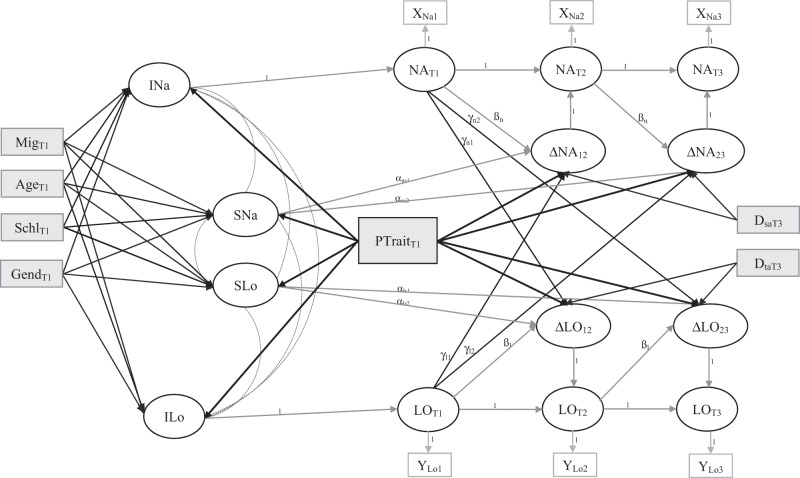
- Dual latent change score models were estimated in R with lavaan using robust maximum likelihood and full information maximum likelihood for missing data; models separated general change (slopes/intercepts) from proportional/local change and included feedback and coupling parameters.
Limitations
- The paper states that loneliness and negative affect were measured with brief self-reports: negative affect covered only negative affect (not positive affect), and loneliness used a single item, so reliability and validity may be suboptimal.
- The paper states that T2 negative affect was assessed retrospectively with reference to the first lockdown, which may introduce recall bias, and that the study lacks information from other family members to contextualize adolescents’ subjective reports.
- The paper notes possible more complex pathways (e.g., mediation or moderated mediation via loneliness, coping, or parental support); evident from the text, personality traits were measured only at T1, so personality change could not be modeled, and the analytic sample dropped from 1,688 at T1 to 673, with a predominantly no-migration-background and highest-school-track sample.
Model-written summary. Check it against the paper before relying on it.
Integrity signals
Registry
Cites
Statistics
Figures
Verification
Claims the paper makes
31 Valid · 3 Not valid · 24 Not checked · 76 Own results and interpretations
The cited sources support only part of this claim — read each source’s verdict below.
In the paper
“Measures to stop the spread of the virus led to reduced social contact, likely increasing loneliness and negative emotions”
§ Adolescent Loneliness and Negative Affect during the COVID-19 Pandemic: The Role of Extraversion and Neuroticism > Introduction
What the sources say
- Not matchedcites Newlove-Delgado et al., 2022
An author–year citation the paper’s reference list doesn’t settle. We don’t search these by name.
- Not checked — no full text of the sourcecites Racine et al., 2021 matched to “Global Prevalence of Depressive and Anxiety Symptoms in Children and Adolescents During COVID-19: A Meta-analysis” (2021) source
- Partly supportedcites Ravens-Sieberer et al., 2022 matched to “Child and Adolescent Mental Health During the COVID-19 Pandemic: Results of the Three-Wave Longitudinal COPSY Study” (2022) sourceExperimental — accuracy not yet measured
The Results section (page unavailable) associates reduced social contact with a higher risk of low health-related quality of life, and the Discussion reports elevated emotional problems during the pandemic. The paper does not establish that reduced contact increased loneliness or directly link it to the rise in emotional problems. (LLM, conf=0.86)
hedgedstates a possible cause- Asserted: passes — The authors put it forward as true.
- Checkable: passes — It can be checked against evidence.
- Load-bearing: passes — The paper’s conclusions depend on it.
- Based: passes — The paper gives a reason why it holds.
- Not matched
The cited sources support only part of this claim — read each source’s verdict below.
In the paper
“Increased negative affect during adolescence is associated with psychological maladjustment”
§ Adolescent Loneliness and Negative Affect during the COVID-19 Pandemic: The Role of Extraversion and Neuroticism > Introduction > Loneliness and Negative Affect during Adolescence
What the sources say
- Not checked — no full text of the sourcecites Hanish et al., 2004 matched to “The expression and regulation of negative emotions: Risk factors for young children's peer victimization” (2004) source
- Partly supportedcites Young et al., 2019 matched to “Positive and Negative Emotion Regulation in Adolescence: Links to Anxiety and Depression” (2019) sourceExperimental — accuracy not yet measured
Section 7.2 reports heightened emotional reactivity to negative images in adolescents with anxiety, supporting an association between stronger negative emotional responses and one form of psychological maladjustment. The paper’s broader conclusion in Section 9 concerns disrupted emotion regulation and anxiety or depression, rather than increased negative affect itself across adolescent psychological maladjustment generally. No page numbers are available in our copy. (LLM, conf=0.82)
plainstates an association- Asserted: passes — The authors put it forward as true.
- Checkable: passes — It can be checked against evidence.
- Load-bearing: unclear — It is unclear whether the paper’s conclusions depend on it.
- Based: passes — The paper gives a reason why it holds.
The cited sources support only part of this claim — read each source’s verdict below.
In the paper
“The first lockdown implemented in March 2020 and subsequent lockdown measures created a stressful situation for most individuals and adolescents in particular”
§ Adolescent Loneliness and Negative Affect during the COVID-19 Pandemic: The Role of Extraversion and Neuroticism > Introduction > Neuroticism and Extraversion during the COVID-19 Pandemic
What the sources say
- Partly supportedcites Flesia et al., 2020 matched to “Predicting Perceived Stress Related to the Covid-19 Outbreak through Stable Psychological Traits and Machine Learning Models” (2020) sourceExperimental — accuracy not yet measured
The Discussion and Conclusions section reports that participants experienced the COVID-19 crisis as stressful, and the Methods section places data collection during the March 2020 lockdown. The study included Italian adults aged 18 and older; it does not establish that adolescents were particularly affected or assess subsequent lockdowns. Its sample findings also do not establish stress in most individuals generally. (LLM, conf=0.88)
- Partly supportedcites Zager Kocjan et al., 2021 matched to “Resilience matters: Explaining the association between personality and psychological functioning during the COVID-19 pandemic” (2021) sourceExperimental — accuracy not yet measured
The Method (Procedure; page not provided) places the study in Slovenia during the first days of the March 2020 lockdown, and the Discussion describes lockdown restrictions as potentially stressful. But the study excluded respondents under 18 and did not examine subsequent lockdowns or establish that most people—and adolescents in particular—experienced stress. The Discussion also says its design precludes causal conclusions about the lockdown’s effect. (LLM, conf=0.88)
plainstates a cause- Asserted: passes — The authors put it forward as true.
- Checkable: passes — It can be checked against evidence.
- Load-bearing: passes — The paper’s conclusions depend on it.
- Based: passes — The paper gives a reason why it holds.
- Partly supported
Every source the paper cites for this claim was checked and supports it.
In the paper
“Adolescents as well as young and middle-aged adults (age range between 16 and 49 years) perceive and handle stressful situations differently according to their personality”
§ Adolescent Loneliness and Negative Affect during the COVID-19 Pandemic: The Role of Extraversion and Neuroticism > Introduction > Neuroticism and Extraversion during the COVID-19 Pandemic
What the sources say
- Supportedcites Schmiedeberg & Thönnissen, 2021 matched to “Positive and negative perceptions of the COVID-19 pandemic: Does personality play a role?” (2021) source
The Background states that people may perceive stressful situations differently according to personality and that both appraisal and coping depend partly on personality. The Methods describe the study population as young and middle-aged people aged 16–49; the study itself examines their perceptions of the COVID-19 lockdown, rather than stressful situations generally. No page numbers are available in our copy. (LLM, conf=0.90)
plainstates an association- Asserted: passes — The authors put it forward as true.
- Checkable: passes — It can be checked against evidence.
- Load-bearing: passes — The paper’s conclusions depend on it.
- Based: passes — The paper gives a reason why it holds.
- Supported
The sources with a verdict support this claim; the rest weren’t checked yet, have no full text we could read, or their verdicts aren’t rated yet.
In the paper
“Personality traits such as extraversion and neuroticism are linked to interindividual differences in how situations are perceived and evaluated”
§ Adolescent Loneliness and Negative Affect during the COVID-19 Pandemic: The Role of Extraversion and Neuroticism > Introduction > Relevance of Extraversion and Neuroticism
What the sources say
- Supportedcites Flesia et al., 2020 matched to “Predicting Perceived Stress Related to the Covid-19 Outbreak through Stable Psychological Traits and Machine Learning Models” (2020) source
The Introduction (§1.2; page unavailable) says dispositional traits help explain individual differences and encompass how people think, feel, and perceive. The Measures section (§2.1; page unavailable) identifies extraversion and neuroticism as personality traits. Together, these support the broad claim about differences in perceiving and evaluating situations; the claim does not assert that both traits predicted COVID-19 stress in this study. (LLM, conf=0.86)
- Not checked — no full text of the sourcecites Horstmann et al., 2021 matched to “Unveiling an exclusive link: Predicting behavior with personality, situation perception, and affect in a preregistered experience sampling study.” (2021) source
- Supportedcites Schmiedeberg & Thönnissen, 2021 matched to “Positive and negative perceptions of the COVID-19 pandemic: Does personality play a role?” (2021) source
The Background states that individuals may perceive a stressful situation differently according to their personality. The Discussion also reports associations between personality traits and how respondents evaluated the pandemic’s consequences, including neuroticism and extraversion among respondents without a partner. (LLM, conf=0.90)
plainstates an association- Asserted: passes — The authors put it forward as true.
- Checkable: passes — It can be checked against evidence.
- Load-bearing: passes — The paper’s conclusions depend on it.
- Based: passes — The paper gives a reason why it holds.
- Supported
74 more claims · 4 with their cited sources checked
Create a free account to see all 134 claims and to verify the 11 references still open.
- It may state two separate claims as one. 32
- Probably not a substantial claim. 28
Statistics recomputed
Every reported test result, recomputed from its test statistic and degrees of freedom. A result shows as not adding up only once an independent check has confirmed it.
- Consistentχ²(1) = 1.46reported p = .227 · recomputed p = .227
“χ2(1) = 1.46, p = .227”
- Consistentχ²(28) = 45.141reported p = .021 · recomputed p = .021
“χ2(28) = 45.141, p = .021”
Self-check
Percentages, sums and reported differences re-computed from the paper’s own numbers.
Each contradiction between two passages listed here was confirmed by an independent check.
Rated minor: it would not touch a result — a value no result rests on, a p-value that stays on the same side of the significance level, or a conflict that is clerical, resolved elsewhere in the paper, or outside its own findings.
In the paper
§ Adolescent Loneliness and Negative Affect during the COVID-19 Pandemic: The Role of Extraversion and Neuroticism > Method > Measures
“T3 (40.07% attended secondary school system)”
§ Adolescent Loneliness and Negative Affect during the COVID-19 Pandemic: The Role of Extraversion and Neuroticism > Method > Sample
“At T3, ~40.7% of adolescents were still in school”
Rated minor: it would not touch a result — a value no result rests on, a p-value that stays on the same side of the significance level, or a conflict that is clerical, resolved elsewhere in the paper, or outside its own findings.
In the paper
§ Adolescent Loneliness and Negative Affect during the COVID-19 Pandemic: The Role of Extraversion and Neuroticism > Method > Sample
“with 16.5% having started vocational training”
§ Adolescent Loneliness and Negative Affect during the COVID-19 Pandemic: The Role of Extraversion and Neuroticism > Method > Measures
“| Vocational Training T3 | y | n = 113 | 16.79%”
Rated minor: it would not touch a result — a value no result rests on, a p-value that stays on the same side of the significance level, or a conflict that is clerical, resolved elsewhere in the paper, or outside its own findings.
In the paper
§ Adolescent Loneliness and Negative Affect during the COVID-19 Pandemic: The Role of Extraversion and Neuroticism > Results > Main Analysis
“Higher pre-pandemic loneliness was linked with greater increases in negative affect between T1 and T2 (B = 0.23, p < 0.001)”
§ Adolescent Loneliness and Negative Affect during the COVID-19 Pandemic: The Role of Extraversion and Neuroticism > Results > Main Analysis
“| Loneliness T1 | 0.298 | 0.071 | 0.506 | <0.001 | [0.158; | 0.437] |”
Rated minor: it would not touch a result — a value no result rests on, a p-value that stays on the same side of the significance level, or a conflict that is clerical, resolved elsewhere in the paper, or outside its own findings.
In the paper
§ Adolescent Loneliness and Negative Affect during the COVID-19 Pandemic: The Role of Extraversion and Neuroticism > Method > Sample
“16.2% having enrolled in a university program”
§ Adolescent Loneliness and Negative Affect during the COVID-19 Pandemic: The Role of Extraversion and Neuroticism > Method > Measures
“| Academic Education T3 | y | n = 111 | 16.49%”
Citations
Cites
Hu, L., & Bentler, P. M. (1999) · Structural Equation Modeling A Multidisciplinary Journal · doi:10.1080/10705519909540118 · Cited by 108,788 · cited 1×
“Additional fit indices were utilized to evaluate goodness of fit (e.g., RMSEA, TLI/CFI), but also present the χ2-test statistic (Hu & Bentler, 1999; Xia & Yang, 2019).”
Methodlavaan : An R Package for Structural Equation Modeling
Rosseel, Y. (2012) · Journal of Statistical Software · doi:10.18637/jss.v048.i02 · Cited by 27,955 · cited 1×
“00 1 package lavaan (Rosseel, 2012), using a robust maximum likelihood (ML) estimator (Finney & DiStefano, 2006).”
MethodEvaluating Goodness-of-Fit Indexes for Testing Measurement Invariance
Cheung, G. W., & Rensvold, R. B. (2002) · Structural Equation Modeling: A Multidisciplinary Journal · doi:10.1207/s15328007sem0902_5 · Cited by 16,280 · cited 1×
“…restrictions), weak (i.e., equal loadings), strong (i.e., equal loadings and intercepts) and strict (i.e., equal loadings, intercepts and residuals) invariant models, were tested for statistical significance using the difference of the χ2-values (Chen et al., 2001; Cheung & Rensvold, 2002).”
MethodA test of missing completely at random for multivariate data with missing values
Little, R. J. A. (1988) · Journal of the American Statistical Association · doi:10.1080/01621459.1988.10478722 · Cited by 8,963 · cited 1×
“The MCAR test by Little (1988) was used to assess randomness of missing data in the analytical sample across three measurement points.”
MethodThe Revised UCLA Loneliness Scale: concurrent and discriminant validity evidence
Russell, D., Peplau, L. A., & Cutrona, C. E. (1980) · Journal of Personality and Social Psychology · doi:10.1037/0022-3514.39.3.472 · Cited by 5,173 · cited 1×
“This item is based on the UCLA Loneliness Scale (Russell et al., 1980).”
MethodTripartite model of anxiety and depression: psychometric evidence and taxonomic implications
Clark, L. A., & Watson, D. (1991) · Journal of Abnormal Psychology · doi:10.1037/0021-843x.100.3.316 · Cited by 4,601 · cited 2×
“In the tripartite model of depression and anxiety, depressive symptoms are generally characterized by high negative and low positive affect (Clark & Watson, 1991).”
BackgroundRammstedt, B., & John, O. P. (2007) · Journal of Research in Personality · doi:10.1016/j.jrp.2006.02.001 · Cited by 4,244 · cited 2×
“Extraversion and neuroticism were only assessed at T1 (Hahn et al., 2012; Rammstedt & John, 2007).”
BackgroundMethodTransactional theory and research on emotions and coping
Lazarus, R. S., & Folkman, S. (1987) · European Journal of Personality · doi:10.1002/per.2410010304 · Cited by 3,053 · cited 1×
“Depending on personal dispositions such as being more or less extraverted, individuals first evaluate whether a situation or event is relevant to their life and then focus on ways to deal with it (Lazarus & Folkman, 1987).”
BackgroundLoades, M. E., Chatburn, E., Higson-Sweeney, N., Reynolds, S., Shafran, R., Brigden, A., Linney, C., McManus, M. N., Borwick, C., & Crawley, E. (2020) · Journal of the American Academy of Child & Adolescent Psychiatry · doi:10.1016/j.jaac.2020.05.009 · Cited by 2,906 · cited 1×
“Findings support the assumption that pre-pandemic loneliness increased the risk of poor mental health outcomes, but not vice versa (Houghton et al., 2022; Loades et al., 2020).”
BackgroundRacine, N., McArthur, B. A., Cooke, J. E., Eirich, R., Zhu, J., & Madigan, S. (2021) · JAMA Pediatrics · doi:10.1001/jamapediatrics.2021.2482 · Cited by 2,805 · cited 2×
“Managing the COVID-19 situation during the specific developmental period between late adolescence and early adulthood is a challenge for most young people (e.g., Racine et al., 2021; Ravens-Sieberer et al., 2022).”
BackgroundPierce, M., Hope, H., Ford, T., Hatch, S., Hotopf, M., John, A., Kontopantelis, E., Webb, R., Wessely, S., McManus, S., et al. (2020) · The Lancet Psychiatry · doi:10.1016/s2215-0366(20)30308-4 · Cited by 2,621
Cacioppo, J. T., Hughes, M. E., Waite, L. J., Hawkley, L. C., & Thisted, R. A. (2006) · Psychology and Aging · doi:10.1037/0882-7974.21.1.140 · Cited by 2,380 · cited 2×
“Fewer studies, however, have examined associations between these traits and loneliness, though those that have suggest neuroticism and extraversion may be important correlates of loneliness (Cacioppo et al., 2006; Vanhalst et al., 2012).”
BackgroundLatent Variable Modeling of Differences and Changes with Longitudinal Data
McArdle, J. J. (2009) · Annual Review of Psychology · doi:10.1146/annurev.psych.60.110707.163612 · Cited by 1,952 · cited 1×
“At step two, dual Latent Change Score models were applied (LCSM, Kievit et al., 2018; Klopack & Wickrama, 2020; McArdle, 2009).”
MethodNonnormaland Categorical Data in Structural Equation Modeling
Finney, S. J., & DiStefano, C. (2013) · Structural Equation Modeling · doi:10.1108/978-1-62396-246-320251015 · Cited by 1,855
(1996) · Dialnet (Universidad de la Rioja) · Cited by 1,733
Xia, Y., & Yang, Y. (2019) · Behavior Research Methods · doi:10.3758/s13428-018-1055-2 · Cited by 1,596
Chen, F., Curran, P. J., Bollen, K. A., Kirby, J., & Paxton, P. (2008) · Sociological Methods & Research · doi:10.1177/0049124108314720 · Cited by 1,538
Magson, N. R., Freeman, J. Y. A., Rapee, R. M., Richardson, C. E., Oar, E. L., & Fardouly, J. (2021) · Journal of Youth and Adolescence · doi:10.1007/s10964-020-01332-9 · Cited by 1,498 · cited 1×
“In contrast, the increase in loneliness and decline in wellbeing (Hussong et al., 2021; Magson et al., 2021) attributed to extraverts during the first lockdown, reverses”
BackgroundSocial isolation, loneliness and health in old age: a scoping review
Courtin, E., & Knapp, M. (2017) · Health & Social Care in the Community · doi:10.1111/hsc.12311 · Cited by 1,463
Relations between personality and coping: A meta-analysis.
Connor-Smith, J. K., & Flachsbart, C. (2007) · Journal of Personality and Social Psychology · doi:10.1037/0022-3514.93.6.1080 · Cited by 1,453 · cited 1×
“Individuals high in neuroticism are more likely to perceive ambiguous situations as threatening, are more reactive to social stressors (Connor-Smith & Flachsbart, 2007; Vollrath, 2001), and more sensitive to possible social rejection (Denissen & Penke, 2008).”
BackgroundThe effects of social deprivation on adolescent development and mental health
Orben, A., Tomova, L., & Blakemore, S.-J. (2020) · The Lancet Child & Adolescent Health · doi:10.1016/s2352-4642(20)30186-3 · Cited by 1,383 · cited 1×
“These individuals may have used more successful coping strategies to navigate through the pandemic, while others struggle to cope with an unpredictable and worrying situation (e.g., Branje & Morris, 2021; Orben et al., 2020).”
BackgroundHankin, B. L., & Abramson, L. Y. (2001) · Psychological Bulletin · doi:10.1037/0033-2909.127.6.773 · Cited by 1,343 · cited 2×
“Further, from early adolescence onward, females are affected by depressive symptoms such as negative affect significantly more often than males (Hankin & Abramson, 2001; Rutter, 2007; Zahn-Waxler et al., 2008), yet gender differences are not commonly observed for loneliness (Maes et al., 2019).”
BackgroundResultLoneliness Across the Life Span
Qualter, P., Vanhalst, J., Harris, R., Van Roekel, E., Lodder, G., Bangee, M., Maes, M., & Verhagen, M. (2015) · Perspectives on Psychological Science · doi:10.1177/1745691615568999 · Cited by 1,080 · cited 4×
“…of social relationships and support, an increased stress perception and rumination, as well as a reduced self-esteem and unpleasant subjective feelings of being alone may lead to increased and prolonged depressive symptoms, such as negative affect (Qualter et al., 2015; van Roekel et al., 2018).”
BackgroundInfluentialPersonality and susceptibility to positive and negative emotional states.
Larsen, R. J., & Ketelaar, T. (1991) · Journal of Personality and Social Psychology · doi:10.1037/0022-3514.61.1.132 · Cited by 1,062 · cited 1×
“These differences can be attributed to the fact that primary personality traits are associated with differences in individual’s subjective evaluations of emotional experiences (e.g., Larsen & Ketelaar, 1991; Verduyn & Brans, 2012).”
BackgroundLoneliness within a nomological net: An evolutionary perspective
Cacioppo, J. T., Hawkley, L. C., Ernst, J. M., Burleson, M., Berntson, G. G., Nouriani, B., & Spiegel, D. (2006) · Journal of Research in Personality · doi:10.1016/j.jrp.2005.11.007 · Cited by 1,010 · cited 4×
“Both loneliness and negative affect are conceptualized as subjectively unpleasant and emotionally distressing experiences (Cacioppo et al., 2006), and are both related to interpersonal problems, such as lack of support from close others (Spithoven et al.”
BackgroundInfluentialThe trajectory of loneliness in response to COVID-19
Luchetti, M., Lee, J. H., Aschwanden, D., Sesker, A., Strickhouser, J. E., Terracciano, A., & Sutin, A. R. (2020) · American Psychologist · doi:10.1037/amp0000690 · Cited by 903 · cited 2×
“Although there was a relatively high number of participants lost between T1 and T2, this was within the expected attrition rate for longitudinal studies, typically ranging between 30 and 70% (see, Benke et al., 2022; Luchetti et al., 2020).”
ResultWidaman, K. F., Ferrer, E., & Conger, R. D. (2010) · Child Development Perspectives · doi:10.1111/j.1750-8606.2009.00110.x · Cited by 890 · cited 1×
“For negative affect, invariance was specified on several consecutive and differently restricted models (Widaman et al., 2010).”
MethodBu, F., Steptoe, A., & Fancourt, D. (2020) · Public Health · doi:10.1016/j.puhe.2020.06.036 · Cited by 703 · cited 1×
“Socioeconomic (Bu et al., 2020), familial (Immel et al., 2022; Low & Mounts, 2022), and personality factors have been studied as possible risk factors for loneliness and negative affect (Choi et al., 2022; Cooper et al., 2021; Schmiedeberg & Thönnissen, 2021; López-Núñez et al., 2021).”
BackgroundGruber, J., Prinstein, M. J., Clark, L. A., Rottenberg, J., Abramowitz, J. S., Albano, A. M., Aldao, A., Borelli, J. L., Chung, T., Davila, J., et al. (2021) · American Psychologist · doi:10.1037/amp0000707 · Cited by 697 · cited 1×
“One explanation for this may lie in the specificity of the pandemic situation, which differed from other disaster-like events in which higher extraversion has been shown to be a protective factor (Brock & Laifer, 2020; Gruber et al., 2021; Polizzi et al., 2020).”
BackgroundShanahan, L., Steinhoff, A., Bechtiger, L., Murray, A. L., Nivette, A., Hepp, U., Ribeaud, D., & Eisner, M. (2022) · Psychological Medicine · doi:10.1017/s003329172000241x · Cited by 675 · cited 1×
“It is possible that prepandemic loneliness increases vulnerability to experience psychological distress during difficult times (Pierce et al., 2020; Shanahan et al., 2022), leading to increased capacity for negative affect.”
BackgroundGender Differences in Self-Concept and Psychological Well-Being in Old Age: A Meta-Analysis
Pinquart, M., & Sorensen, S. (2001) · The Journals of Gerontology Series B: Psychological Sciences and Social Sciences · doi:10.1093/geronb/56.4.p195 · Cited by 646 · cited 1×
“A single indicator for loneliness is typical in large-scale panel surveys (Mund et al., 2019; Mund et al., 2022; Pinquart & Sörensen, 2001) and has been found to be a sufficient method to capture loneliness as compared to multiindicator assessments (see, Mund et al., 2022).”
MethodKurzversion des Big Five Inventory (BFI-K):
Rammstedt, B., & John, O. P. (2005) · Diagnostica · doi:10.1026/0012-1924.51.4.195 · Cited by 644 · cited 1×
“A well-established and widely used short version of the Big Five Inventory was used (BFI-S; Hahn et al., 2012; Rammstedt & John, 2005; Rammstedt & John, 2007) to assess extraversion and neuroticism.”
MethodDynamics of Identity Development in Adolescence: A Decade in Review
Branje, S., de Moor, E. L., Spitzer, J., & Becht, A. I. (2021) · Journal of Research on Adolescence · doi:10.1111/jora.12678 · Cited by 584 · cited 1×
“The transition from adolescence to young adulthood can be challenging as young people seek autonomy, identity formation, and stable relationships while facing puberty, school transitions, and post-school challenges (Branje et al., 2012; Branje et al., 2021).”
BackgroundMultisystem Resilience for Children and Youth in Disaster: Reflections in the Context of COVID-19
Masten, A. S., & Motti-Stefanidi, F. (2020) · Adversity and Resilience Science · doi:10.1007/s42844-020-00010-w · Cited by 556 · cited 1×
“…a close family environment, known to play an important role in overcoming pandemic-related challenges (Brock & Laifer, 2020; Donker et al., 2021; Masten & Motti-Stefanidi, 2020), might not be able to fully compensate for extraverts’ need of real-life contact with friends and their extended…”
BackgroundHuinink, J., Brüderl, J., Nauck, B., Walper, S., Castiglioni, L., & Feldhaus, M. (2011) · Journal of Family Research · doi:10.20377/jfr-235 · Cited by 548
Stress and coping in the time of COVID-19: Pathways to resilience and recovery
Polizzi, C., Lynn, S. J., & Perry, A. (2020) · PubMed Central · doi:10.36131/cn20200204 · Cited by 520 · cited 1×
“One explanation for this may lie in the specificity of the pandemic situation, which differed from other disaster-like events in which higher extraversion has been shown to be a protective factor (Brock & Laifer, 2020; Gruber et al., 2021; Polizzi et al., 2020).”
BackgroundDevelopmental cognitive neuroscience using latent change score models: A tutorial and applications
Kievit, R. A., Brandmaier, A. M., Ziegler, G., van Harmelen, A.-L., de Mooij, S. M. M., Moutoussis, M., Goodyer, I. M., Bullmore, E., Jones, P. B., Fonagy, P., et al. (2018) · Developmental Cognitive Neuroscience · doi:10.1016/j.dcn.2017.11.007 · Cited by 516 · cited 3×
“At step two, dual Latent Change Score models were applied (LCSM, Kievit et al., 2018; Klopack & Wickrama, 2020; McArdle, 2009).”
BackgroundMethodImproper Solutions in Structural Equation Models: Causes, Consequences, and Strategies
CHEN, F., BOLLEN, K. A., PAXTON, P., CURRAN, P. J., & KIRBY, J. B. (2001) · Sociological Methods & Research · doi:10.1177/0049124101029004003 · Cited by 512 · cited 1×
“…restrictions), weak (i.e., equal loadings), strong (i.e., equal loadings and intercepts) and strict (i.e., equal loadings, intercepts and residuals) invariant models, were tested for statistical significance using the difference of the χ2-values (Chen et al., 2001; Cheung & Rensvold, 2002).”
MethodSelfhout, M., Burk, W., Branje, S., Denissen, J., van Aken, M., & Meeus, W. (2010) · Journal of Personality · doi:10.1111/j.1467-6494.2010.00625.x · Cited by 506 · cited 1×
“Extraversion, however, is the tendency to actively engage in social behaviors and enjoy social activities and interpersonal relationships (Mueller et al., 2019; Selfhout et al., 2010).”
BackgroundShanahan, L., Steinhoff, A., Bechtiger, L., Murray, A. L., Nivette, A. E., Hepp, U., Ribeaud, D., & Eisner, M. (2020) · Zurich Open Repository and Archive (University of Zurich) · doi:10.17863/cam.57251 · Cited by 499
Positive and Negative Emotion Regulation in Adolescence: Links to Anxiety and Depression
Young, K., Sandman, C., & Craske, M. (2019) · Brain Sciences · doi:10.3390/brainsci9040076 · Cited by 485 · cited 1×
“Increased negative affect during adolescence is associated with psychological maladjustment, perhaps being an indicator of ineffective adaptation to the changing demands and pressures of the social environment (Hanish et al., 2004; Young et al., 2019).”
BackgroundThe Stability and Change of Loneliness Across the Life Span: A Meta-Analysis of Longitudinal Studies
Mund, M., Freuding, M. M., Möbius, K., Horn, N., & Neyer, F. J. (2020) · Personality and Social Psychology Review · doi:10.1177/1088868319850738 · Cited by 417 · cited 8×
“A single indicator for loneliness is typical in large-scale panel surveys (Mund et al., 2019; Mund et al., 2022; Pinquart & Sörensen, 2001) and has been found to be a sufficient method to capture loneliness as compared to multiindicator assessments (see, Mund et al., 2022).”
BackgroundMethodInfluentialGender differences in loneliness across the lifespan: a meta-analysis
Maes, M., Qualter, P., Vanhalst, J., Van den Noortgate, W., & Goossens, L. (2019) · European Journal of Personality · doi:10.1002/per.2220 · Cited by 405 · cited 1×
“Further, from early adolescence onward, females are affected by depressive symptoms such as negative affect significantly more often than males (Hankin & Abramson, 2001; Rutter, 2007; Zahn-Waxler et al., 2008), yet gender differences are not commonly observed for loneliness (Maes et al., 2019).”
BackgroundVollrath, M. (2001) · Scandinavian Journal of Psychology · doi:10.1111/1467-9450.00245 · Cited by 402
Ravens-Sieberer, U., Erhart, M., Devine, J., Gilbert, M., Reiss, F., Barkmann, C., Siegel, N. A., Simon, A. M., Hurrelmann, K., Schlack, R., et al. (2022) · Journal of Adolescent Health · doi:10.1016/j.jadohealth.2022.06.022 · Cited by 401 · cited 1×
“Managing the COVID-19 situation during the specific developmental period between late adolescence and early adulthood is a challenge for most young people (e.g., Racine et al., 2021; Ravens-Sieberer et al., 2022).”
BackgroundPersonality–Relationship Transaction in Adolescence: Core Versus Surface Personality Characteristics
Asendorpf, J. B., & Van Aken, M. A. G. (2003) · Journal of Personality · doi:10.1111/1467-6494.7104005 · Cited by 396 · cited 1×
“Extraverts typically receive more support from others and experience positive interpersonal outcomes such as likeability and popularity (Asendorpf & Van Aken, 2003; Nikitin & Freund, 2015; van der Linden et al., 2010).”
BackgroundThe effects of weather on daily mood: A multilevel approach.
Denissen, J. J. A., Butalid, L., Penke, L., & van Aken, M. A. G. (2008) · Emotion · doi:10.1037/a0013497 · Cited by 384
Dekker, M. C., Ferdinand, R. F., Van Lang, N. D. J., Bongers, I. L., Van Der Ende, J., & Verhulst, F. C. (2007) · Journal of Child Psychology and Psychiatry · doi:10.1111/j.1469-7610.2007.01742.x · Cited by 383 · cited 1×
“Gender (1=male, 2= female) served as a control variable, due to the robust finding that female adolescents are more prone to emotional problems than males (Dekker et al., 2007; Rutter, 2007).”
BackgroundTrajectories of loneliness during childhood and adolescence: Predictors and health outcomes
Qualter, P., Brown, S. L., Rotenberg, K. J., Vanhalst, J., Harris, R. A., Goossens, L., Bangee, M., & Munn, P. (2013) · Journal of Adolescence · doi:10.1016/j.adolescence.2013.01.005 · Cited by 377 · cited 1×
“The association between negative affect and loneliness in adolescents is well established cross-sectionally and longitudinally (Lasgaard et al., 2011; Spithoven et al., 2017; Qualter et al., 2013; van Roekel et al., 2018).”
BackgroundExtraversion, social support processes, and stress
Swickert, R. J., Rosentreter, C. J., Hittner, J. B., & Mushrush, J. E. (2002) · Personality and Individual Differences · doi:10.1016/s0191-8869(01)00093-9 · Cited by 376 · cited 1×
“Restrictions made these strategies ineffective (Swickert et al., 2002; Vollrath, 2001).”
BackgroundChildhood loneliness as a predictor of adolescent depressive symptoms: an 8-year longitudinal study
Qualter, P., Brown, S. L., Munn, P., & Rotenberg, K. J. (2010) · European Child & Adolescent Psychiatry · doi:10.1007/s00787-009-0059-y · Cited by 373 · cited 1×
“increasing the risk of loneliness (Vanhalst et al., 2012; Qualter et al., 2015; Qualter et al., 2010).”
Short measurements of personality – Validity and reliability of the GSOEP Big Five Inventory (BFI-S)
Hahn, E., Gottschling, J., & Spinath, F. M. (2012) · Journal of Research in Personality · doi:10.1016/j.jrp.2012.03.008 · Cited by 360 · cited 2×
“Extraversion and neuroticism were only assessed at T1 (Hahn et al., 2012; Rammstedt & John, 2007).”
BackgroundMethodEbstrup, J. F., Eplov, L. F., Pisinger, C., & Jørgensen, T. (2011) · Anxiety, Stress & Coping · doi:10.1080/10615806.2010.540012 · Cited by 359 · cited 3×
“Extraversion is also linked to a tendency to perceive challenging situations as manageable (Ebstrup et al., 2011), and to actually manage such situations more effectively through the use of appropriate emotion regulation and coping strategies (Barańczuk, 2019).”
BackgroundPersonality, peer relations, and self-confidence as predictors of happiness and loneliness
CHENG, H., & FURNHAM, A. (2002) · Journal of Adolescence · doi:10.1006/jado.2002.0475 · Cited by 349 · cited 1×
“Loneliness is often considered a specific form of emotional distress, whereas negative affect is considered to be a more general form (Cheng & Furnham, 2002; Spithoven et al., 2017).”
BackgroundNikčević, A. V., Marino, C., Kolubinski, D. C., Leach, D., & Spada, M. M. (2021) · Journal of Affective Disorders · doi:10.1016/j.jad.2020.10.053 · Cited by 344 · cited 2×
“Perhaps, extraversion may function as a protective factor (Nikčević et al., 2021) beyond the first weeks of the pandemic, because measures of social contact restrictions were increasingly relaxed and alternative strategies for making social contact were found.”
BackgroundResultLaursen, B., & Hartl, A. C. (2013) · Journal of Adolescence · doi:10.1016/j.adolescence.2013.06.003 · Cited by 339 · cited 1×
“Loneliness differs from solitude, which refers to being alone by one’s own choice (Mund et al., 2019), and social isolation, which is the objective absence of close relationships (Laursen & Hartl, 2013; van Baarsen et al., 2001).”
BackgroundFlesia, L., Monaro, M., Mazza, C., Fietta, V., Colicino, E., Segatto, B., & Roma, P. (2020) · Journal of Clinical Medicine · doi:10.3390/jcm9103350 · Cited by 291 · cited 3×
“This result is in line with other findings with adolescents (Breaux et al., 2021) and adults (Flesia et al., 2020; Nikčević et al., 2021; Schmiedeberg & Thönnissen, 2021).”
BackgroundResultJamshidian, M., Jalal, S., & Jansen, C. (2014) · Journal of Statistical Software · doi:10.18637/jss.v056.i06 · Cited by 262 · cited 1×
“The test was conducted using the R package MissMech (Jamshidian et al., 2014) and yielded a p value of 0.530, indicating random missingness.”
MethodInfluentialLasgaard, M., Goossens, L., & Elklit, A. (2011) · Journal of Abnormal Child Psychology · doi:10.1007/s10802-010-9442-x · Cited by 258
Breaux, R., Dvorsky, M. R., Marsh, N. P., Green, C. D., Cash, A. R., Shroff, D. M., Buchen, N., Langberg, J. M., & Becker, S. P. (2021) · Journal of Child Psychology and Psychiatry · doi:10.1111/jcpp.13382 · Cited by 239 · cited 4×
“…traits, further research showed that in a sample of adolescents (15–17 years), poor pre-pandemic emotion regulation strategies—a defining aspect of neuroticism—were linked with increased depression and anxiety symptoms both during strict and relaxed contact restrictions (Breaux et al., 2021).”
BackgroundResultInfluentialThe Impact of the COVID‐19 Pandemic on Adolescent Emotional, Social, and Academic Adjustment
Branje, S., & Morris, A. S. (2021) · Journal of Research on Adolescence · doi:10.1111/jora.12668 · Cited by 234 · cited 2×
“Although the pandemic was challenging for most adolescents, the pandemic affected adolescents differently, suggesting individual differences in vulnerability (Branje & Morris, 2021; Zager Kocjan et al., 2021).”
BackgroundThe five factor model of personality and emotion regulation: A meta-analysis
Barańczuk, U. (2019) · Personality and Individual Differences · doi:10.1016/j.paid.2018.11.025 · Cited by 225 · cited 5×
“In this line, neuroticism represents a reduced capacity to effectively regulate negative emotions (Barańczuk, 2019; Ebstrup et al., 2011).”
BackgroundInfluentialBuecker, S., & Horstmann, K. T. (2021) · European Psychologist · doi:10.1027/1016-9040/a000453 · Cited by 225
van Baarsen, B., Snijders, T. A. B., Smit, J. H., & van Duijn, M. A. J. (2001) · Educational and Psychological Measurement · doi:10.1177/00131640121971103 · Cited by 217 · cited 1×
“Loneliness differs from solitude, which refers to being alone by one’s own choice (Mund et al., 2019), and social isolation, which is the objective absence of close relationships (Laursen & Hartl, 2013; van Baarsen et al., 2001).”
BackgroundNivard, M. G., Dolan, C. V., Kendler, K. S., Kan, K.-J., Willemsen, G., van Beijsterveldt, C. E. M., Lindauer, R. J. L., van Beek, J. H. D. A., Geels, L. M., Bartels, M., et al. (2015) · Psychological Medicine · doi:10.1017/s003329171400213x · Cited by 213 · cited 1×
“…affect also differ during adolescence (12.1–17 years) and emerging adulthood (17.1–25 years), with feelings of loneliness typically peaking during middle adolescence, whereas negative affect continue to increase between adolescence and young adulthood (Mund et al., 2019; Nivard et al., 2015).”
BackgroundInfluentialLoneliness, social relationships, and mental health in adolescents during the COVID-19 pandemic
Cooper, K., Hards, E., Moltrecht, B., Reynolds, S., Shum, A., McElroy, E., & Loades, M. (2021) · Journal of Affective Disorders · doi:10.1016/j.jad.2021.04.016 · Cited by 213 · cited 2×
“, 2022; Low & Mounts, 2022), and personality factors have been studied as possible risk factors for loneliness and negative affect (Choi et al., 2022; Cooper et al., 2021; Schmiedeberg & Thönnissen, 2021; López-Núñez et al., 2021).”
Backgroundvon Soest, T., Luhmann, M., & Gerstorf, D. (2020) · Developmental Psychology · doi:10.1037/dev0001102 · Cited by 210 · cited 2×
“A predominant way of defining loneliness sees it as a mismatch between the kinds of social relationships a person desires and those that they actually have (Peplau, 1985; see also, Von Soest et al., 2020).”
BackgroundVanhalst, J., Klimstra, T. A., Luyckx, K., Scholte, R. H. J., Engels, R. C. M. E., & Goossens, L. (2012) · Journal of Youth and Adolescence · doi:10.1007/s10964-011-9726-7 · Cited by 208 · cited 7×
“Much research has highlighted the interwoven and bidirectional relationship between loneliness and negative affect (Lasgaard et al., 2011; Spithoven et al., 2017; Vanhalst et al., 2012).”
BackgroundInfluentialMaes, M., Nelemans, S. A., Danneel, S., Fernández-Castilla, B., Van den Noortgate, W., Goossens, L., & Vanhalst, J. (2019) · Developmental Psychology · doi:10.1037/dev0000719 · Cited by 207 · cited 1×
“Further, from early adolescence onward, females are affected by depressive symptoms such as negative affect significantly more often than males (Hankin & Abramson, 2001; Rutter, 2007; Zahn-Waxler et al., 2008), yet gender differences are not commonly observed for loneliness (Maes et al., 2019).”
Backgroundvan der Linden, D., Scholte, R. H. J., Cillessen, A. H. N., Nijenhuis, J. T., & Segers, E. (2010) · Journal of Research in Personality · doi:10.1016/j.jrp.2010.08.007 · Cited by 196 · cited 2×
“For instance, as research under non-pandemic situations has shown, extraversion is linked to more positivity and likeability as well as popularity (Nikitin & Freund, 2015; van der Linden et al., 2010).”
BackgroundZager Kocjan, G., Kavčič, T., & Avsec, A. (2021) · International Journal of Clinical and Health Psychology · doi:10.1016/j.ijchp.2020.08.002 · Cited by 195 · cited 3×
“Although the pandemic was challenging for most adolescents, the pandemic affected adolescents differently, suggesting individual differences in vulnerability (Branje & Morris, 2021; Zager Kocjan et al., 2021).”
BackgroundHANISH, L. D., EISENBERG, N., FABES, R. A., SPINRAD, T. L., RYAN, P., & SCHMIDT, S. (2004) · Development and Psychopathology · doi:10.1017/s0954579404044542 · Cited by 194 · cited 1×
“Increased negative affect during adolescence is associated with psychological maladjustment, perhaps being an indicator of ineffective adaptation to the changing demands and pressures of the social environment (Hanish et al., 2004; Young et al., 2019).”
BackgroundMund, M., Maes, M., Drewke, P. M., Gutzeit, A., Jaki, I., & Qualter, P. (2023) · Assessment · doi:10.1177/10731911221077227 · Cited by 192 · cited 2×
“However, a single indicator can be an adequate replacement for a larger scale and is widely used (Mund et al., 2019; Mund et al., 2022).”
BackgroundMethodHoughton, S., Kyron, M., Hunter, S. C., Lawrence, D., Hattie, J., Carroll, A., & Zadow, C. (2022) · Journal of Adolescence · doi:10.1002/jad.12017 · Cited by 185 · cited 2×
“…in internalization symptoms over four time points (two before and two after the first lockdown), confirmed increasing symptoms of loneliness and negative affect, yet also that friendship quality—a possible indicator for extraversion— was predictive of positive developments (Houghton et al., 2022).”
BackgroundVater, A., & Schröder–Abé, M. (2015) · European Journal of Personality · doi:10.1002/per.1993 · Cited by 162
Personality and stressor-related affect.
Leger, K. A., Charles, S. T., Turiano, N. A., & Almeida, D. M. (2016) · Journal of Personality and Social Psychology · doi:10.1037/pspp0000083 · Cited by 161 · cited 2×
“One explanation is that the pandemic increased unhealthy tendencies associated with higher neuroticism such as paying more attention to negative and threatening everyday stimuli or failing to respond effectively to stress, which could have added to feelings of negative affect (Ebstrup et al., 2011; Leger et al., 2016;…”
BackgroundMund, M., & Neyer, F. J. (2014) · Journal of Personality and Social Psychology · doi:10.1037/a0036719 · Cited by 146
Cassinat, J. R., Whiteman, S. D., Serang, S., Dotterer, A. M., Mustillo, S. A., Maggs, J. L., & Kelly, B. C. (2021) · Developmental Psychology · doi:10.1037/dev0001217 · Cited by 146 · cited 1×
“For example, some prior research showed differences between adolescents’ and parents’ reports on family life and adolescent wellbeing during the COVID-19 pandemic (Cassinat et al., 2021; Li et al., 2021).”
ResultNeuroticism predicts reactions to cues of social inclusion
Denissen, J. J. A., & Penke, L. (2008) · European Journal of Personality · doi:10.1002/per.682 · Cited by 143
Donker, M. H., Mastrotheodoros, S., & Branje, S. (2021) · Developmental Psychology · doi:10.1037/dev0001212 · Cited by 134
Personality traits, loneliness, and attitudes toward aloneness in adolescence
Teppers, E., Klimstra, T. A., Damme, C. V., Luyckx, K., Vanhalst, J., & Goossens, L. (2013) · Journal of Social and Personal Relationships · doi:10.1177/0265407513481445 · Cited by 122 · cited 1×
“Numerous studies show that negative affect is correlated with both extraversion (negatively) and neuroticism (positively; Klimstra et al., 2010; Teppers et al., 2013; Vanhalst et al., 2012).”
BackgroundLoneliness Research: Basic Concepts and Findings
Peplau, L. A. (1985) · Springer eBooks · doi:10.1007/978-94-009-5115-0_15 · Cited by 117 · cited 1×
“A predominant way of defining loneliness sees it as a mismatch between the kinds of social relationships a person desires and those that they actually have (Peplau, 1985; see also, Von Soest et al., 2020).”
Backgroundvan Roekel, E., Verhagen, M., Engels, R. C. M. E., Scholte, R. H. J., Cacioppo, S., & Cacioppo, J. T. (2018) · Journal of Clinical Child & Adolescent Psychology · doi:10.1080/15374416.2016.1146993 · Cited by 103
Modeling Latent Change Score Analysis and Extensions in Mplus: A Practical Guide for Researchers
Klopack, E. T., & Wickrama, K. (. A. S. ). (2020) · Structural Equation Modeling: A Multidisciplinary Journal · doi:10.1080/10705511.2018.1562929 · Cited by 102
Big Five traits as predictors of perceived stressfulness of the COVID-19 pandemic
Zacher, H., & Rudolph, C. W. (2021) · Personality and Individual Differences · doi:10.1016/j.paid.2021.110694 · Cited by 100 · cited 2×
“In line with previous studies, evidence is provided that heightened extraversion can be a burden under certain conditions such as the social restrictions of the COVID-19 pandemic (Alt et al., 2021; Wijngaards et al., 2020; Zacher & Rudolph, 2021).”
BackgroundResultNewlove‐Delgado, T., Russell, A. E., Mathews, F., Cross, L., Bryant, E., Gudka, R., Ukoumunne, O. C., & Ford, T. J. (2023) · Journal of Child Psychology and Psychiatry · doi:10.1111/jcpp.13716 · Cited by 100
Psychological Variables Related to Adaptation to the COVID-19 Lockdown in Spain
Morales-Vives, F., Dueñas, J.-M., Vigil-Colet, A., & Camarero-Figuerola, M. (2020) · Frontiers in Psychology · doi:10.3389/fpsyg.2020.565634 · Cited by 99 · cited 1×
“…it was found that studies, assessing well-being immediately during the (first) lockdown mostly found no or only very small changes in well-being (Morales-Vives et al., 2020; Zager Kocjan et al., 2021), while studies with a longer time interval between (first) lockdown and assessment of…”
BackgroundLongitudinal associations between personality traits and problem behavior symptoms in adolescence
Klimstra, T. A., Akse, J., Hale, W. W., Raaijmakers, Q. A. W., & Meeus, W. H. J. (2010) · Journal of Research in Personality · doi:10.1016/j.jrp.2010.02.004 · Cited by 97 · cited 1×
“Numerous studies show that negative affect is correlated with both extraversion (negatively) and neuroticism (positively; Klimstra et al., 2010; Teppers et al., 2013; Vanhalst et al., 2012).”
BackgroundThe relationship between extraversion, neuroticism and aspects of trait affect
Verduyn, P., & Brans, K. (2012) · Personality and Individual Differences · doi:10.1016/j.paid.2011.12.017 · Cited by 96 · cited 1×
“These differences can be attributed to the fact that primary personality traits are associated with differences in individual’s subjective evaluations of emotional experiences (e.g., Larsen & Ketelaar, 1991; Verduyn & Brans, 2012).”
BackgroundDepression history and memory bias for specific daily emotions
Urban, E. J., Charles, S. T., Levine, L. J., & Almeida, D. M. (2018) · PLOS ONE · doi:10.1371/journal.pone.0203574 · Cited by 96 · cited 1×
“Retrospective assessment may show a recall-bias with recalled negative affect being worse than the actual experience (Urban et al., 2018).”
BackgroundHorstmann, K. T., Rauthmann, J. F., Sherman, R. A., & Ziegler, M. (2021) · Journal of Personality and Social Psychology · doi:10.1037/pspp0000357 · Cited by 89
Longitudinal associations between trait neuroticism and negative daily experiences in adolescence.
Borghuis, J., Bleidorn, W., Sijtsma, K., Branje, S., Meeus, W. H. J., & Denissen, J. J. A. (2020) · Journal of Personality and Social Psychology · doi:10.1037/pspp0000233 · Cited by 88 · cited 1×
“A recent study that examined adolescent neuroticism and daily experiences provides evidence that neurotic individuals perceive everyday stimuli as more negative (Borghuis et al., 2020) than less neurotic individuals.”
BackgroundSpithoven, A. W. M., Lodder, G. M. A., Goossens, L., Bijttebier, P., Bastin, M., Verhagen, M., & Scholte, R. H. J. (2017) · Journal of Youth and Adolescence · doi:10.1007/s10964-016-0478-2 · Cited by 86 · cited 3×
“Much research has highlighted the interwoven and bidirectional relationship between loneliness and negative affect (Lasgaard et al., 2011; Spithoven et al., 2017; Vanhalst et al., 2012).”
BackgroundLópez-Núñez, M. I., Díaz‐Morales, J. F., & García, M. E. A. (2020) · Personality and Individual Differences · doi:10.1016/j.paid.2020.110562 · Cited by 81 · cited 2×
“, 2022; Low & Mounts, 2022), and personality factors have been studied as possible risk factors for loneliness and negative affect (Choi et al., 2022; Cooper et al., 2021; Schmiedeberg & Thönnissen, 2021; López-Núñez et al., 2021).”
BackgroundFamily Science in the Context of the COVID‐19 Pandemic: Solutions and New Directions
Brock, R. L., & Laifer, L. M. (2020) · Family Process · doi:10.1111/famp.12582 · Cited by 79 · cited 2×
“One explanation for this may lie in the specificity of the pandemic situation, which differed from other disaster-like events in which higher extraversion has been shown to be a protective factor (Brock & Laifer, 2020; Gruber et al., 2021; Polizzi et al., 2020).”
BackgroundImmigrants’ Children's Transition to Secondary School in Italy
Barban, N., & White, M. J. (2011) · International Migration Review · doi:10.1111/j.1747-7379.2011.00863.x · Cited by 74 · cited 4×
“In Germany, the first nationwide lockdown was implemented between March and May 2020.”
MethodInfluentialThe State-Trait Depression Scales: An International Comparison
Krohne, H. W., Schmukle, S. C., Spaderna, H., & Spielberger, C. D. (2002) · Anxiety, Stress & Coping · doi:10.1080/10615800290028422 · Cited by 73 · cited 1×
“Negative affect was measured at all measurement points using a trait-scale of the State-Trait Depression Scales (STDS; Krohne et al., 2002).”
MethodEconomic stress, parenting, and adolescents’ adjustment during the COVID ‐19 pandemic
Low, N., & Mounts, N. S. (2022) · Family Relations · doi:10.1111/fare.12623 · Cited by 69
Benke, C., Autenrieth, L. K., Asselmann, E., & Pané-Farré, C. A. (2023) · European Archives of Psychiatry and Clinical Neuroscience · doi:10.1007/s00406-022-01400-0 · Cited by 69 · cited 1×
“Although there was a relatively high number of participants lost between T1 and T2, this was within the expected attrition rate for longitudinal studies, typically ranging between 30 and 70% (see, Benke et al., 2022; Luchetti et al., 2020).”
Adolescence Amid a Pandemic: Short‐ and Long‐Term Implications
Hussong, A. M., Benner, A. D., Erdem, G., Lansford, J. E., Makila, L. M., Petrie, R. C., & The SRA COVID‐19 Response Team (2021) · Journal of Research on Adolescence · doi:10.1111/jora.12671 · Cited by 67 · cited 1×
“In contrast, the increase in loneliness and decline in wellbeing (Hussong et al., 2021; Magson et al., 2021) attributed to extraverts during the first lockdown, reverses the typical pattern of results whereby extraversion is negatively associated with loneliness and mental health problems (Buecker…”
Alt, P., Reim, J., & Walper, S. (2021) · Journal of Research on Adolescence · doi:10.1111/jora.12648 · Cited by 63 · cited 8×
“One study found extraverted adolescents (aged 14–17) to be more prone to negative changes in loneliness and negative affect than introverts during the early stages of the pandemic (Alt et al., 2021).”
BackgroundResultInfluentialLoneliness and social engagement in older adults: A bivariate dual change score analysis.
McHugh Power, J. E., Steptoe, A., Kee, F., & Lawlor, B. A. (2019) · Psychology and Aging · doi:10.1037/pag0000287 · Cited by 63 · cited 1×
“…change refer to the change between two neighbored variables (i.e., change in NA between T1 and T2=ΔNA12; change in LO between T1 and T2=ΔLO12) and represents a more local change (cf. McHugh Power et al., 2019) of a variable relative to the previous state of that variable (Kievit et al., 2018).”
BackgroundZahn-Waxler, C., Park, J.-H., Usher, B., Belouad, F., Cole, P., & Gruber, R. (2008) · Development and Psychopathology · doi:10.1017/s0954579408000059 · Cited by 62 · cited 1×
“Further, from early adolescence onward, females are affected by depressive symptoms such as negative affect significantly more often than males (Hankin & Abramson, 2001; Rutter, 2007; Zahn-Waxler et al., 2008), yet gender differences are not commonly observed for loneliness (Maes et al., 2019).”
BackgroundLi, M., Li-li, L., Wu, F., Cao, Y., Zhang, H., Li, X., Zou, J., Guo, Z., & Kong, L. (2021) · Journal of Affective Disorders · doi:10.1016/j.jad.2021.03.048 · Cited by 60 · cited 1×
“For example, some prior research showed differences between adolescents’ and parents’ reports on family life and adolescent wellbeing during the COVID-19 pandemic (Cassinat et al., 2021; Li et al., 2021).”
ResultPsychopathological Development Across Adolescence
Rutter, M. (2007) · Journal of Youth and Adolescence · doi:10.1007/s10964-006-9125-7 · Cited by 55 · cited 2×
“tive affect significantly more often than males (Hankin & Abramson, 2001; Rutter, 2007; Zahn-Waxler et al., 2008),”
BackgroundLoneliness During a Nationwide Lockdown and the Moderating Effect of Extroversion
Entringer, T. M., & Gosling, S. D. (2022) · Social Psychological and Personality Science · doi:10.1177/19485506211037871 · Cited by 55 · cited 5×
“It is likely that social isolation followed by repeated lockdowns caused particular difficulties for the more extraverted, who tend to thrive with face-to-face contact (Entringer & Gosling, 2021).”
BackgroundInfluentialThe ZPID lockdown measures dataset for Germany
Steinmetz, H., Batzdorfer, V., & Bošnjak, M. (2020) · doi:10.23668/psycharchives.3019 · Cited by 54
Houghton, S., Hattie, J., Carroll, A., Wood, L., & Baffour, B. (2016) · Journal of Psychologists and Counsellors in Schools · doi:10.1017/jgc.2016.1 · Cited by 53 · cited 1×
“As such, even individuals with similar degrees of actual social connection and sizes of support networks can differ in the extent to which they feel lonely (Houghton et al., 2016; Lasgaard et al., 2016).”
BackgroundRisk and Protective Factors for Changes in Adolescent Psychosocial Adjustment During COVID‐19
Romm, K. F., Park, Y. W., Hughes, J. L., & Gentzler, A. L. (2021) · Journal of Research on Adolescence · doi:10.1111/jora.12667 · Cited by 51 · cited 2×
“Although some previous research had found higher extraversion to be associated with increases in loneliness (Alt et al., 2021; Romm et al., 2021), the underlying results suggest no higher increase in loneliness among extraverted youth (Luchetti et al.”
ResultWijngaards, I., Sisouw de Zilwa, S. C. M., & Burger, M. J. (2020) · Frontiers in Psychology · doi:10.3389/fpsyg.2020.568907 · Cited by 50 · cited 1×
“In line with previous studies, evidence is provided that heightened extraversion can be a burden under certain conditions such as the social restrictions of the COVID-19 pandemic (Alt et al., 2021; Wijngaards et al., 2020; Zacher & Rudolph, 2021).”
ResultDunn, C., & Sicouri, G. (2022) · Behaviour Change · doi:10.1017/bec.2022.13 · Cited by 48 · cited 1×
“Evidence shows that loneliness predicts deterioration in mental and physical health as well as elevated risk for early mortality (Courtin & Knapp, 2017; Dunn & Sicouri, 2022; Spithoven et al., 2017).”
BackgroundMajor Life Events as Predictors of Loneliness in Adolescence
Lasgaard, M., Armour, C., Bramsen, R. H., & Goossens, L. (2015) · Journal of Child and Family Studies · doi:10.1007/s10826-015-0243-2 · Cited by 47
Mueller, S., Ram, N., Conroy, D. E., Pincus, A. L., Gerstorf, D., & Wagner, J. (2019) · European Journal of Personality · doi:10.1002/per.2198 · Cited by 47 · cited 1×
“Extraversion, however, is the tendency to actively engage in social behaviors and enjoy social activities and interpersonal relationships (Mueller et al., 2019; Selfhout et al., 2010).”
BackgroundPositive and negative perceptions of the COVID-19 pandemic: Does personality play a role?
Schmiedeberg, C., & Thönnissen, C. (2021) · Social Science & Medicine · doi:10.1016/j.socscimed.2021.113859 · Cited by 42 · cited 5×
“Previous research on personality traits during the pandemic has yielded mixed results, often lacking baseline measurements or focusing on broad age ranges (e.g., 14–70 years; Schmiedeberg & Thönnissen, 2021).”
BackgroundResultInfluentialGomez‐Baya, D., Mendoza, R., Paino, S., & Gillham, J. E. (2017) · Journal of Adolescence · doi:10.1016/j.adolescence.2017.01.005 · Cited by 36
Immel, L., Neumeier, F., & Peichl, A. (2022) · Review of Income and Wealth · doi:10.1111/roiw.12571 · Cited by 33 · cited 2×
“Values in bold represent significant effects suggesting that there may be individual differences in vulnerability (e.g., Immel et al., 2022; Low & Mounts, 2022).”
BackgroundNikitin, J., & Freund, A. M. (2015) · Journal of Personality · doi:10.1111/jopy.12086 · Cited by 30
Beziehungs- und Familienpanel (pairfam)
Brüderl, J., Drobnič, S., Hank, K., Neyer, F. J., Walper, S., Alt, P., Bozoyan, C., Finn, C., Frister, R., Garrett, M., et al. (2020) · GESIS Data Archive · doi:10.4232/pairfam.5678.11.0.0 · Cited by 29
Interpersonal and Intrapersonal Processes in the Development of Adolescent Relationships
Branje, S., Keijsers, L., Doorn, M. D. V., & Meeus, W. (2012) · Sage eBooks · doi:10.4135/9781452240565.n12 · Cited by 15 · cited 1×
“The transition from adolescence to young adulthood can be challenging as young people seek autonomy, identity formation, and stable relationships while facing puberty, school transitions, and post-school challenges (Branje et al., 2012; Branje et al., 2021).”
BackgroundBeziehungs- und Familienpanel (pairfam)
Brüderl, J., & Brüderl, J. (2015) · GESIS Data Archive · doi:10.4232/pairfam.5678.6.0.0 · Cited by 12
Choi, J., Kim, N. H., Kim, J., & Choi, I. (2022) · Journal of Research in Personality · doi:10.1016/j.jrp.2022.104306 · Cited by 10 · cited 2×
“, 2022; Low & Mounts, 2022), and personality factors have been studied as possible risk factors for loneliness and negative affect (Choi et al., 2022; Cooper et al., 2021; Schmiedeberg & Thönnissen, 2021; López-Núñez et al., 2021).”
BackgroundWalper, S., Sawatzki, B., Alt, P., et al. (2020) · GESIS Data Archive · doi:10.4232/pairfam.5959.1.0.0 · Cited by 6
Feeling lonely during the pandemic: Towards personality-tailored risk profiles
Schemer, L., Milde, C., Lischetzke, T., In‐Albon, T., Karbach, J., Könen, T., & Glombiewski, J. A. (2022) · Psychology Health & Medicine · doi:10.1080/13548506.2022.2058030 · Cited by 4 · cited 1×
“Even more complex pathways, describing moderated mediation processes are also possible (see for example, Entringer & Gosling, 2021; Schemer et al., 2022).”
BackgroundGniewosz, G. (2022) · OSF Preprints (OSF Preprints) · doi:10.17605/osf.io/5umgh · Cited by 1
Self-citation
Research works printed but not linked: 1
- 50. John, O. P., Naumann, L. P., & Soto, C. J. (2008). Paradigm shift to the integrative big-five trait taxonomy: History, measurement, and conceptual issues. In O. P. John, R. W. Robins, & L. A. Pervin (Eds.), Handbook of personality: Theory and research (3rd ed., pp. 114–158). New York, NY: Guilford Press.
Cited by
Gniewosz, G. (2024) · Journal of Youth and Adolescence · doi:10.1007/s10964-024-02012-8 · Cited by 11
“Thus, expanding the number of items and facets of individuals ’ emotional states and perceived stress would provide deeper insight, especially as lockdowns may have in fl uenced not only positive or negative affect but also other dimensions of emotional well-being (Gniewosz, 2023).”
BackgroundSelf-citationWirtz, M. A., Devine, J., Erhart, M., Reiß, F., Böcker, M., Schulz, A. A., Zöllner, F., Napp, A.-K., Ravens‐Sieberer, U., & Kaman, A. (2025) · Frontiers in Psychology · doi:10.3389/fpsyg.2025.1444524 · Cited by 2
“Disruptions to education have widened academic gaps and strained peer relationships that are important for social and emotional development (Farrell et al., 2023; Gniewosz, 2023).”
Owner of a Lonely Mind: Loneliness and Theory of Mind in Adolescents
Bosacki, S. (2025) · Springer eBooks · doi:10.1007/978-3-032-02959-1_27
de Oliveira, K. P., Uribe, F. A. R., da Cruz, E. J. S., & Pedroso, J. D. S. (2026) · Psicologia Reflexão e Crítica · doi:10.1186/s41155-026-00392-3
“According to ample empirical evidence, these results confirm that feelings of loneliness are positively related to negative feelings and negatively related to positive feelings (Gniewosz, 2023; Newman & Sachs, 2020; Steptoe, 2023).”
Yang, Z., Liang, C., Wang, D., & Wang, S. (2026) · Frontiers in Psychology · doi:10.3389/fpsyg.2026.1842308
“A review of recent analyses of the psychological variable of loneliness reveals a predominant focus from a negative psychology perspective (Twenge et al., 2021; Gniewosz, 2023), often seeking to “eliminate” loneliness through external interventions such as increased social support (Zhang, 2022).”
Metadata
- Authors
- Gniewosz, G.
- Affiliations
- Universität Innsbruck (AT)
- Corresponding author
- Gniewosz, Gabriela
- ORCID
- Gniewosz, Gabriela
- Venue
- Journal of Youth and Adolescence
- Published
- 2023-06-30
- Volume
- 52
- Issue
- 9
- Pages
- 1965-1982
- ISSN
- 0047-2891 (ISSN-L)
- 1573-6601
- PMC
- PMC10328868
- OpenAlex
- W4382632250
- Semantic Scholar
- cf737a755b7f3fe8111e9d57f4b922492686a38d
- Cited by
- 9
- References
- 128
- Citations by year
- 2026: 3 · 2025: 4 · 2024: 2
- FWCI
- 2.05
- Type
- journal article
- Language
- en
- Open access
- hybrid
- doi.org
- Licence
- cc-by
- creativecommons.org/licenses/by/4.0 (tdm)
- creativecommons.org/licenses/by/4.0 (vor)
- Locations
- Journal of Youth and Adolescence (publishedVersion, cc-by)
- PubMed Central (publishedVersion, cc-by)
- PubMed (publishedVersion)
- Digital Library of the University of Innsbruck (University of Innsbruck) (submittedVersion, cc-by)
- Funders
- Deutsche Forschungsgemeinschaft
- Medizinische Universität Innsbruck
- Universität Innsbruck
- Topics
- Social Sciences › Psychology › Clinical Psychology › COVID-19 and Mental Health
- Social Sciences › Psychology › Clinical Psychology › Child and Adolescent Psychosocial and Emotional Development
- Social Sciences › Psychology › Clinical Psychology › Personality Traits and Psychology
- Keywords
- adolescent loneliness, negative affect, COVID-19 pandemic, extraversion, neuroticism, personality traits, lockdown, adolescent mental health
- MeSH terms
- Neuroticism, COVID-19, Adolescent, Affect, Communicable Disease Control, Extraversion, Psychological, Female, Humans, Infant, Loneliness, Young Adult, Pandemics
About these checks
Registry, retraction, Cites and statistics results are computed, not judged, with one exception: a printed reference that no index lists is read once by a model before it counts as a citation error. Claims are extracted by a model and kept only when their quote appears verbatim in the text; each cited source is then checked, with a model’s help, for whether it says what the claim relies on. Those verdicts can be wrong — read the claim’s quote and the cited source before relying on one.
The claim verdicts this report counts are experimental: their accuracy is not yet measured.
A language model drew the claims from the paper on 2026-10-05, under version 3 of the claim definition (model deepseek-v4.1-flash, prompt extract-v3).
A second model labelled each claim on 2026-10-05 (model jev-1.13-20260917, definition revision gold-guideline-v0.2).
Cited sources are checked with a language model’s help (gpt-6-sol).
Statistics and arithmetic are recomputed, not judged.
Confidence bands are shown only for fields calibrated on our annotated test set. None is calibrated yet, so no band is shown.
What counts as a claim ›How we measure confidence ›How we check this ›
Are you an author, or do you see a problem with this page? Request a review
Data sources
Bibliographic data: Semantic Scholar, OpenAlex, Crossref.
Contains information from the Semantic Scholar Academic Graph Datasets, made available under the ODC Attribution License (ODC-BY 1.0).
Semantic Scholar’s data is described in: Kinney, R., et al. (2023). The Semantic Scholar Open Data Platform. arXiv:2301.10140.
