

Analysis of protein-coding genetic variation in 60,706 humans
Open accessPublished version of a preprint
The DOI matches its Crossref record; 44 of the 44 references it cites were found in a registry or an index.
Abstract
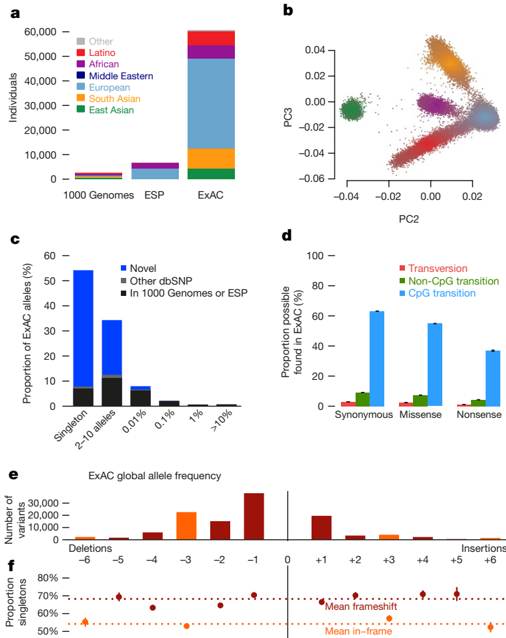
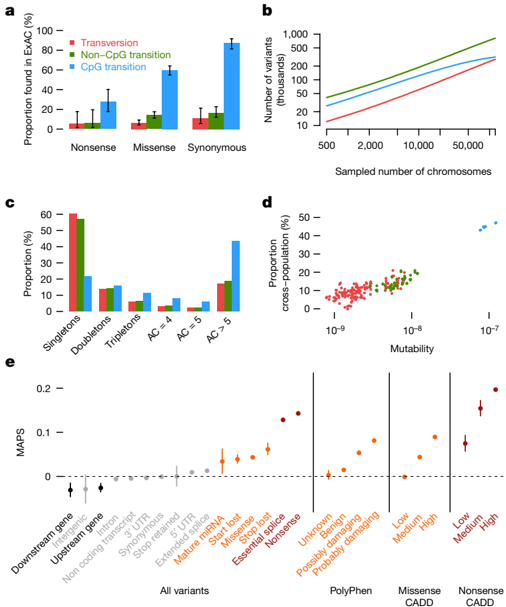
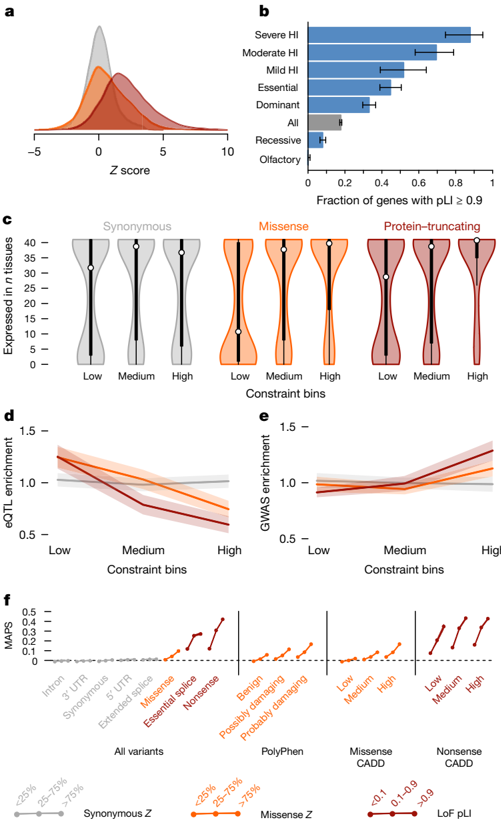
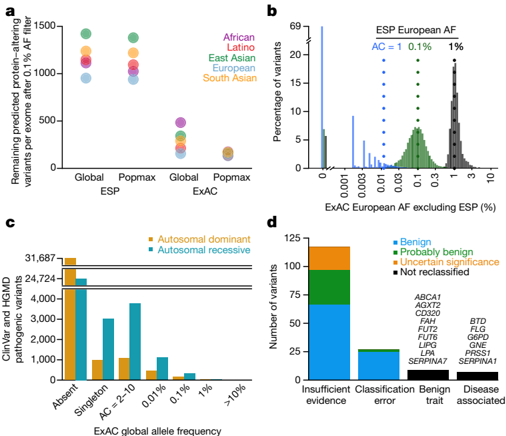
Large-scale reference data sets of human genetic variation are critical for the medical and functional interpretation of DNA sequence changes. Here we describe the aggregation and analysis of high-quality exome (protein-coding region) DNA sequence data for 60,706 individuals of diverse ancestries generated as part of the Exome Aggregation Consortium (ExAC). This catalogue of human genetic diversity contains an average of one variant every eight bases of the exome, and provides direct evidence for the presence of widespread mutational recurrence. We have used this catalogue to calculate objective metrics of pathogenicity for sequence variants, and to identify genes subject to strong selection against various classes of mutation; identifying 3,230 genes with near-complete depletion of predicted protein-truncating variants, with 72% of these genes having no currently established human disease phenotype. Finally, we demonstrate that these data can be used for the efficient filtering of candidate disease-causing variants, and for the discovery of human ‘knockout’ variants in protein-coding genes. Exome sequencing data from 60,706 people of diverse geographic ancestry is presented, providing insight into genetic variation across populations, and illuminating the relationship between DNA variants and human disease. As part of the Exome Aggregation Consortium (ExAC) project, Daniel MacArthur and colleagues report on the generation and analysis of high-quality exome sequencing data from 60,706 individuals of diverse ancestry. This provides the most comprehensive catalogue of human protein-coding genetic variation to date, yielding unprecedented resolution for the analysis of very rare variants across multiple human populations. The catalogue is freely accessible and provides a critical reference panel for the clinical interpretation of genetic variants and the discovery of disease-related genes.
Overview
The claims and statistics of this paper haven’t been checked yet.
Free: it reads the open-access text and checks the first 5 claims that cite a source we can check. Create a free account to check every claim.
Integrity signals
Registry
Cites
Statistics
Figures


Verification
Claims the paper makes
The claims and statistics of this paper haven’t been checked yet.
Free: it reads the open-access text and checks the first 5 claims that cite a source we can check. Create a free account to check every claim.
Claims other papers make about this one
Each is checked against this paper’s own text: does it say what the citing paper says it does?
The source backs part of the claim, not all of it — or backs it for a different population, condition or comparison.
In the citing paper
“Variants in constrained genes (pLI ≥ 0.5)12 explain most of the burden of dnLGD variants and de novo D-mis variants (defined by an MPC score ≥2) in the affected offspring in our study”
From Exome sequencing of 457 autism families recruited online provides evidence for autism risk genes (2019) · cites this paper as [12]
Experimental — accuracy not yet measuredThe source backs part of the claim, not all of it — or backs it for a different population, condition or comparison.
In the citing paper
“Known dominant DD-associated genes are strongly enriched in the minority of genes that exhibit strong selective constraint on heterozygous PTVs7.”
From Evidence for 28 genetic disorders discovered by combining healthcare and research data (2020) · cites this paper as [7]
Experimental — accuracy not yet measuredThe source backs part of the claim, not all of it — or backs it for a different population, condition or comparison.
In the citing paper
“As expected, all ten genes are among the most constrained genes in the genome, with a substantial depletion of PTVs compared to chance expectation24.”
From Rare coding variants in ten genes confer substantial risk for schizophrenia (2022) · cites this paper as [24]
Experimental — accuracy not yet measuredThe source backs part of the claim, not all of it — or backs it for a different population, condition or comparison.
In the citing paper
“In our evolution-focused SNP-h2 enrichment analysis, we detected an overabundance of genic and LoF intolerant loci in both EAS and EUR, suggesting that functionally important regions of the genome contribute to SNP-h2 to a different extent compared to the other annotations tested [10, 33, 40, 44].”
From Denisovan and Neanderthal archaic introgression differentially impacted the genetics of complex traits in modern populations (2022) · cites this paper as [33]
Experimental — accuracy not yet measuredThe source backs part of the claim, not all of it — or backs it for a different population, condition or comparison.
In the citing paper
“In line with previous studies [10, 33], the strongest enrichments in both ancestry groups were observed for annotations related to genic and LoF intolerant regions.”
From Denisovan and Neanderthal archaic introgression differentially impacted the genetics of complex traits in modern populations (2022) · cites this paper as [33]
Experimental — accuracy not yet measured
9 more claims about this paper
Create a free account to see every claim other papers make about this one.
Self-check
Percentages, sums and reported differences re-computed from the paper’s own numbers.
The self-check needs the paper’s full text.
Citations
Cites
Richards, S., Aziz, N., Bale, S., Bick, D., Das, S., Gastier-Foster, J., Grody, W. W., Hegde, M., Lyon, E., Spector, E., et al. (2015) · Genetics in Medicine · doi:10.1038/gim.2015.30 · Cited by 32,594
A global reference for human genetic variation
The 1000 Genomes Project Consortium, authors, C., Auton, A., Abecasis, G. R., Steering committee, Altshuler, D. M., Durbin, R. M., Abecasis, G. R., Bentley, D. R., Chakravarti, A., et al. (2015) · Nature · doi:10.1038/nature15393 · Cited by 18,247
Self-citationA framework for variation discovery and genotyping using next-generation DNA sequencing data
DePristo, M. A., Banks, E., Poplin, R., Garimella, K. V., Maguire, J. R., Hartl, C., Philippakis, A. A., del Angel, G., Rivas, M. A., Hanna, M., et al. (2011) · Nature Genetics · doi:10.1038/ng.806 · Cited by 11,456
Self-citationLethality and centrality in protein networks
Jeong, H., Mason, S. P., Barabási, A.-L., & Oltvai, Z. N. (2001) · Nature · doi:10.1038/35075138 · Cited by 5,287
The Genotype-Tissue Expression (GTEx) pilot analysis: Multitissue gene regulation in humans
The GTEx Consortium, Ardlie, K. G., Deluca, D. S., Segrè, A. V., Sullivan, T. J., Young, T. R., Gelfand, E. T., Trowbridge, C. A., Maller, J. B., Tukiainen, T., et al. (2015) · Science · doi:10.1126/science.1262110 · Cited by 5,062
Self-citationGoh, K.-I., Cusick, M. E., Valle, D., Childs, B., Vidal, M., & Barabási, A.-L. (2007) · Proceedings of the National Academy of Sciences · doi:10.1073/pnas.0701361104 · Cited by 3,242
Inference of human population history from individual whole-genome sequences
Li, H., & Durbin, R. (2011) · Nature · doi:10.1038/nature10231 · Cited by 2,590
Exome sequencing as a tool for Mendelian disease gene discovery
Bamshad, M. J., Ng, S. B., Bigham, A. W., Tabor, H. K., Emond, M. J., Nickerson, D. A., & Shendure, J. (2011) · Nature Reviews Genetics · doi:10.1038/nrg3031 · Cited by 1,673
De novo mutations in schizophrenia implicate synaptic networks
Fromer, M., Pocklington, A. J., Kavanagh, D. H., Williams, H. J., Dwyer, S., Gormley, P., Georgieva, L., Rees, E., Palta, P., Ruderfer, D. M., et al. (2014) · Nature · doi:10.1038/nature12929 · Cited by 1,617
Self-citationEvolution and functional impact of rare coding variation from deep sequencing of human exomes
Tennessen, J. A., Bigham, A. W., O’Connor, T. D., Fu, W., Kenny, E. E., Gravel, S., McGee, S., Do, R., Liu, X., Jun, G., et al. (2012) · Science · doi:10.1126/science.1219240 · Cited by 1,613
Self-citation
Cited by
Items 1,001–1,100 of 1,209
Predicting the impact of Lynch syndrome-causing missense mutations from structural calculations
Nielsen, S. V., Stein, A., Dinitzen, A. B., Papaleo, E., Tatham, M. H., Poulsen, E. G., Kassem, M. M., Rasmussen, L. J., Lindorff-Larsen, K., & Hartmann-Petersen, R. (2017) · PLOS Genetics · doi:10.1371/journal.pgen.1006739 · Cited by 98
“Finally, we analyzed the predicted protein stabilities of MSH2 missense mutations found the Exome Aggregation Consortium (ExAC) database [38].”
MethodLi, J., Wang, L., Guo, H., Shi, L., Zhang, K., Tang, M., Hu, S., Dong, S., Liu, Y., Wang, T., et al. (2017) · Molecular Psychiatry · doi:10.1038/mp.2017.140 · Cited by 104
De novo and rare inherited copy-number variations in the hemiplegic form of cerebral palsy
Zarrei, M., Fehlings, D. L., Mawjee, K., Switzer, L., Thiruvahindrapuram, B., Walker, S., Merico, D., Casallo, G., Uddin, M., MacDonald, J. R., et al. (2018) · Genetics in Medicine · doi:10.1038/gim.2017.83 · Cited by 99
WD40-repeat 47, a microtubule-associated protein, is essential for brain development and autophagy
Kannan, M., Bayam, E., Wagner, C., Rinaldi, B., Kretz, P. F., Tilly, P., Roos, M., McGillewie, L., Bär, S., Minocha, S., et al. (2017) · Proceedings of the National Academy of Sciences · doi:10.1073/pnas.1713625114 · Cited by 101
Roy, S., LaFramboise, W. A., Liu, T., Cao, D., Luvison, A., Miller, C., Lyons, M. A., O’Sullivan, R. J., Zureikat, A. H., Hogg, M. E., et al. (2018) · Gastroenterology · doi:10.1053/j.gastro.2018.02.026 · Cited by 103
Charbit‐Henrion, F., Parlato, M., Hanein, S., Duclaux‐Loras, R., Nowak, J. K., Bègue, B., Rakotobé, S., Bruneau, J., Fourrage, C., Alibeu, O., et al. (2018) · Journal of Crohn s and Colitis · doi:10.1093/ecco-jcc/jjy068 · Cited by 107
Mutations in TOP3A Cause a Bloom Syndrome-like Disorder
Martin, C.-A., Sarlós, K., Logan, C. V., Thakur, R. S., Parry, D. A., Bizard, A. H., Leitch, A., Cleal, L., Ali, N. S., Al-Owain, M. A., et al. (2018) · The American Journal of Human Genetics · doi:10.1016/j.ajhg.2018.07.001 · Cited by 97
Targeted next generation sequencing as a tool for precision medicine
Gulilat, M., Lamb, T., Teft, W. A., Wang, J., Dron, J. S., Robinson, J. F., Tirona, R. G., Hegele, R. A., Kim, R. B., & Schwarz, U. I. (2019) · BMC Medical Genomics · doi:10.1186/s12920-019-0527-2 · Cited by 114
Reynolds, R. H., Botía, J., Nalls, M. A., International Parkinson’s Disease Genomics Consortium (IPDGC), Noyce, A. J., Nicolas, A., Cookson, M. R., Bandres-Ciga, S., Gibbs, J. R., Hernandez, D. G., et al. (2019) · npj Parkinson's Disease · doi:10.1038/s41531-019-0076-6 · Cited by 100
The role of protein complexes in human genetic disease
Bergendahl, L. T., Gerasimavicius, L., Miles, J., Macdonald, L., Wells, J. N., Welburn, J. P. I., & Marsh, J. A. (2019) · Protein Science · doi:10.1002/pro.3667 · Cited by 95
COVID-19 Compared to Other Pandemic Diseases
Pitlik, S. D. (2020) · Rambam Maimonides Medical Journal · doi:10.5041/rmmj.10418 · Cited by 100
Opportunities and Challenges for Molecular Understanding of Ciliopathies–The 100,000 Genomes Project
Wheway, G., Genomics England Research Consortium, & Mitchison, H. M. (2019) · Frontiers in Genetics · doi:10.3389/fgene.2019.00127 · Cited by 99
“, 2017) and Genome Aggregation Database (GnomAD) (Lek et al., 2016), and public databases such as ClinVar (Landrum and Kattman, 2018), Human Gene Mutation Database HGMD (Stenson et al.”
BackgroundXiao, X., Liu, H., Liu, X., Zhang, W., Zhang, S., & Jiao, B. (2021) · Frontiers in Aging Neuroscience · doi:10.3389/fnagi.2021.695808 · Cited by 99
Jiang, X., Raju, P. K., D'Avanzo, N., Lachance, M., Pepin, J., Dubeau, F., Mitchell, W. G., Bello‐Espinosa, L. E., Pierson, T. M., Minassian, B. A., et al. (2019) · Epilepsia · doi:10.1111/epi.16316 · Cited by 97
“30 The variants were located in highly conserved sequences (Figure 1B) and were predicted damaging by bioinformatics scores (SIFT, PolyphenV2) (Table 1), thus suggesting that they are likely pathogenic according to the American College of Medical Genetics and Genomics guidelines.”
BackgroundHuguet, G., Schramm, C., Douard, E., Jiang, L., Labbe, A., Tihy, F., Mathonnet, G., Nizard, S., Lemyre, E., Mathieu, A., et al. (2018) · JAMA Psychiatry · doi:10.1001/jamapsychiatry.2018.0039 · Cited by 96
“With the routine implementation of whole genome chromosomal microarrays in medical diagnostics, pathogenic CNVs (as defined by the American College of Medical Genetics(10)) are identified in 10% to 15%of children referred for NDDs.(11)Copy number variants may arise recurrently by nonhomologous recombination inunrelate…”
InfluentialMassively parallel phenotyping of coding variants in cancer with Perturb-seq
Ursu, O., Neal, J. T., Shea, E., Thakore, P. I., Jerby-Arnon, L., Nguyen, L., Dionne, D., Diaz, C., Bauman, J., Mosaad, M. M., et al. (2022) · Nature Biotechnology · doi:10.1038/s41587-021-01160-7 · Cited by 96
The cargo receptor SURF4 promotes the efficient cellular secretion of PCSK9
Emmer, B. T., Hesketh, G. G., Kotnik, E., Tang, V. T., Lascuna, P. J., Xiang, J., Gingras, A.-C., Chen, X.-W., & Ginsburg, D. (2018) · eLife · doi:10.7554/elife.38839 · Cited by 96
Zeng, B., Bendl, J., Kosoy, R., Fullard, J. F., Hoffman, G. E., & Roussos, P. (2022) · Nature Genetics · doi:10.1038/s41588-021-00987-9 · Cited by 96
Evans, D. G. R., van Veen, E. M., Byers, H. J., Wallace, A. J., Ellingford, J. M., Beaman, G., Santoyo-Lopez, J., Aitman, T. J., Eccles, D. M., Lalloo, F. I., et al. (2018) · The American Journal of Human Genetics · doi:10.1016/j.ajhg.2018.07.002 · Cited by 95
SCN3A‐Related Neurodevelopmental Disorder: A Spectrum of Epilepsy and Brain Malformation
Zaman, T., Helbig, K. L., Clatot, J., Thompson, C. H., Kang, S. K., Stouffs, K., Jansen, A. E., Verstraete, L., Jacquinet, A., Parrini, E., et al. (2020) · Annals of Neurology · doi:10.1002/ana.25809 · Cited by 94
Common risk variants identified in autism spectrum disorder
Grove, J., Ripke, S., Als, T. D., Mattheisen, M., Walters, R., Won, H., Pallesen, J., Agerbo, E., Andreassen, O. A., Anney, R., et al. (2017) · doi:10.1101/224774 · Cited by 89
Self-citationThe UCL low-density lipoprotein receptor gene variant database: pathogenicity update
Leigh, S., Futema, M., Whittall, R., Taylor-Beadling, A., Williams, M., den Dunnen, J. T., & Humphries, S. E. (2017) · Journal of Medical Genetics · doi:10.1136/jmedgenet-2016-104054 · Cited by 88
Burns, D. T., Donkervoort, S., Müller, J. S., Knierim, E., Bharucha-Goebel, D., Faqeih, E. A., Bell, S. K., AlFaifi, A. Y., Monies, D., Millan, F., et al. (2018) · The American Journal of Human Genetics · doi:10.1016/j.ajhg.2018.03.011 · Cited by 88
Self-citationRivas, M. A., Avila, B. E., Koskela, J., Huang, H., Stevens, C., Pirinen, M., Haritunians, T., Neale, B. M., Kurki, M., Ganna, A., et al. (2018) · PLoS Genetics · doi:10.1371/journal.pgen.1007329 · Cited by 87
Wang, Q. S., Kelley, D. R., Ulirsch, J., Kanai, M., Sadhuka, S., Cui, R., Albors, C., Cheng, N., Okada, Y., The Biobank Japan Project, et al. (2021) · Nature Communications · doi:10.1038/s41467-021-23134-8 · Cited by 87
Self-citationNovel insights into genetics and clinics of the HNF1A-MODY
Valkovicova, T., Skopkova, M., Stanik, J., & Gasperikova, D. (2019) · Endocrine Regulations · doi:10.2478/enr-2019-0013 · Cited by 84
“…variants, ExAC database presents 894 variants and GnomAD 1231 variants spanning from the HNF1A promoter to 3´UTR region, including missense, frame shift, nonsense, splicing mutations, in-frame amino acid deletions, insertions, duplications or partial and whole-gene deletions (Lek et al. 2016).”
BackgroundBeggs, A. H., Byrne, B. J., De Chastonay, S., Haselkorn, T., Hughes, I., James, E. S., Kuntz, N. L., Simon, J., Swanson, L. C., Yang, M. L., et al. (2018) · Muscle & Nerve · doi:10.1002/mus.26018 · Cited by 83
“Penile therapeutic procedures 10 (27) 18 (26) 28 (27) Circumcision 10 (27) 18 (26) 28 (27)”
Huang, D., Yi, X., Zhang, S., Zheng, Z., Wang, P., Xuan, C., Sham, P. C., Wang, J., & Li, M. J. (2018) · Nucleic Acids Research · doi:10.1093/nar/gky407 · Cited by 83
Haplotype-aware pantranscriptome analyses using spliced pangenome graphs
Sibbesen, J. A., Eizenga, J. M., Novak, A. M., Sirén, J., Chang, X., Garrison, E., & Paten, B. (2023) · Nature Methods · doi:10.1038/s41592-022-01731-9 · Cited by 83
“The number of predicted protein truncating variants (frameshift, splice donor, splice acceptor and stop gain) is comparable to or lower than what have previously been described dependent on the study [48, 49].”
ResultSomatic variants in autosomal dominant genes are a rare cause of sporadic Alzheimer’s disease
Nicolas, G., Acuña‐Hidalgo, R., Keogh, M. J., Quenez, O., Steehouwer, M., Lelieveld, S., Rousseau, S., Richard, A., Oud, M. S., Marguet, F., et al. (2018) · Alzheimer's & Dementia · doi:10.1016/j.jalz.2018.06.3056 · Cited by 81
“However, this gene is not under strong constraint against loss of function, similar to PSEN2, judging by the probability of loss of function intolerance established from Exome Aggregation Consortium data [20].”
Clinical utility of genomic analysis in adults with idiopathic liver disease
Hakim, A., Zhang, X., DeLisle, A., Oral, E. A., Dykas, D., Drzewiecki, K., Assis, D. N., Silveira, M., Batisti, J., Jain, D., et al. (2019) · Journal of Hepatology · doi:10.1016/j.jhep.2019.01.036 · Cited by 81
“Allele frequencies were determined using the genome aggregation database (gnomAD) [17], including the Exome Aggregation Consortium database (ExAC), 1000 Genomes, and the National Heart, Lung and Blood Institute’s (NHLBI) Exome Variant Server.”
MethodThe Genetics of Intellectual Disability
Jansen, S., Vissers, L. E. L. M., & de Vries, B. B. A. (2023) · Brain Sciences · doi:10.3390/brainsci13020231 · Cited by 81
“the 1000 Genomes Project [59], GoNL [60] and gnomAD [61] (successor of ExAC [62]).”
BackgroundMethodOn behalf of the Brotman Baty Institute Mutational Scanning Working Group, Gelman, H., Dines, J. N., Berg, J., Berger, A. H., Brnich, S., Hisama, F. M., James, R. G., Rubin, A. F., Shendure, J., et al. (2019) · Genome Medicine · doi:10.1186/s13073-019-0698-7 · Cited by 81
Bayesian estimation of gene constraint from an evolutionary model with gene features
Zeng, T., Spence, J. P., Mostafavi, H., & Pritchard, J. K. (2024) · Nature Genetics · doi:10.1038/s41588-024-01820-9 · Cited by 81
Need for high-resolution Genetic Analysis in iPSC: Results and Lessons from the ForIPS Consortium
Popp, B., Krumbiegel, M., Grosch, J., Sommer, A., Uebe, S., Kohl, Z., Plötz, S., Farrell, M., Trautmann, U., Kraus, C., et al. (2018) · Scientific Reports · doi:10.1038/s41598-018-35506-0 · Cited by 81
Ramos, E. M., Dokuru, D. R., Van Berlo, V., Wojta, K., Wang, Q., Huang, A. Y., Deverasetty, S., Qin, Y., van Blitterswijk, M., Jackson, J., et al. (2020) · Alzheimer's & Dementia · doi:10.1002/alz.12011 · Cited by 80
Shigemizu, D., Mitsumori, R., Akiyama, S., Miyashita, A., Morizono, T., Higaki, S., Asanomi, Y., Hara, N., Tamiya, G., Kinoshita, K., et al. (2021) · Translational Psychiatry · doi:10.1038/s41398-021-01272-3 · Cited by 80
De novo hotspot variants in CYFIP2 cause early‐onset epileptic encephalopathy
Nakashima, M., Kato, M., Aoto, K., Shiina, M., Belal, H., Mukaida, S., Kumada, S., Sato, A., Zerem, A., Lerman‐Sagie, T., et al. (2018) · Annals of Neurology · doi:10.1002/ana.25208 · Cited by 80
“The CYFIP2 variant was unrecognized in 575 in-house control exomes, and was not detected in public databases including dbSNP137, the 1000 Genomes Project, the 6500 Exome Sequencing Project, or the Exome Aggregation Consortium.(33) We then searched for possible pathogenic CYFIP2 variants using case-only 489 WES data.”
MethodNovel PLCG2 Mutation in a Patient With APLAID and Cutis Laxa
Neves, J. F., Doffinger, R., Barcena-Morales, G., Martins, C., Papapietro, O., Plagnol, V., Curtis, J., Martins, M., Kumararatne, D., Cordeiro, A. I., et al. (2018) · Frontiers in Immunology · doi:10.3389/fimmu.2018.02863 · Cited by 79
“, it is absent from more than 120,000 subjects in the gnomAD database (12).”
BackgroundLost in translation: returning germline genetic results in genome-scale cancer research
Initiative, A. P. C. G., Johns, A. L., McKay, S. H., Humphris, J. L., Pinese, M., Chantrill, L. A., Mead, R. S., Tucker, K., Andrews, L., Goodwin, A., et al. (2017) · Genome Medicine · doi:10.1186/s13073-017-0430-4 · Cited by 79
“org/ about) [27] and dbSNPv141 (http://www.”
AllTheBacteria: a community resource empowers biology and discovers novel peptide antibiotics
Hunt, M., Torres, M. D. T., Alikhan, N.-F., Anderson, D., Andreani, M. L., Blom, J., Bouras, G., Brinkman, F. S. L., Carroll, L. M., Croxen, M. A., et al. (2024) · doi:10.1101/2024.03.08.584059 · Cited by 79
Gazzellone, M. J., Zarrei, M., Burton, C. L., Walker, S., Uddin, M., Shaheen, S. M., Coste, J., Rajendram, R., Schachter, R. J., Colasanto, M., et al. (2016) · Journal of Neurodevelopmental Disorders · doi:10.1186/s11689-016-9170-9 · Cited by 77
“A Residual Variation Intolerance Score (RVIS) [33] and Probability of Loss of Function (LoF) Intolerance score (pLI) [34] were retrieved for each variant discovered.”
BackgroundMethodStudy, D. (. D. I. S. A. C., Liu, J., Zhou, Y., Liu, S., Song, X., Yang, X.-Z., Fan, Y., Chen, W., Akdemir, Z. C., Yan, Z., et al. (2018) · Human Genetics · doi:10.1007/s00439-018-1910-3 · Cited by 77
SORL1 mutations in early- and late-onset Alzheimer disease
Cuccaro, M. L., Carney, R. M., Zhang, Y., Bohm, C., Kunkle, B. W., Vardarajan, B. N., Whitehead, P. L., Cukier, H. N., Mayeux, R., St. George-Hyslop, P., et al. (2016) · Neurology Genetics · doi:10.1212/nxg.0000000000000116 · Cited by 77
The Critical Needs and Challenges for Genetic Architecture Studies in Africa
Martin, A. R., Teferra, S., Möller, M., Hoal, E. G., & Daly, M. J. (2018) · Current Opinion in Genetics & Development · doi:10.1016/j.gde.2018.08.005 · Cited by 76
“African Americans and West Africans, leaving huge swaths of African diversity 16 uncatalogued [8,12].”
InfluentialSelf-citationDe novo variants in SETD1B are associated with intellectual disability, epilepsy and autism
Hiraide, T., Nakashima, M., Yamoto, K., Fukuda, T., Kato, M., Ikeda, H., Sugie, Y., Aoto, K., Kaname, T., Nakabayashi, K., et al. (2018) · Human Genetics · doi:10.1007/s00439-017-1863-y · Cited by 75
Jønch, A. E., Douard, E., Moreau, C., Van Dijck, A., Passeggeri, M., Kooy, F., Puechberty, J., Campbell, C., Sanlaville, D., Lefroy, H., et al. (2019) · Journal of Medical Genetics · doi:10.1136/jmedgenet-2018-105879 · Cited by 75
Goldfeder, R. L., Wall, D. P., Khoury, M. J., Ioannidis, J. P. A., & Ashley, E. A. (2017) · American Journal of Epidemiology · doi:10.1093/aje/kww224 · Cited by 75
TBR1 regulates autism risk genes in the developing neocortex
Notwell, J. H., Heavner, W. E., Darbandi, S. F., Katzman, S., McKenna, W. L., Ortiz-Londono, C. F., Tastad, D., Eckler, M. J., Rubenstein, J. L. R., McConnell, S. K., et al. (2016) · Genome Research · doi:10.1101/gr.203612.115 · Cited by 74
High prevalence of focal and multi-focal somatic genetic variants in the human brain
Keogh, M. J., Wei, W., Aryaman, J., Walker, L., van den Ameele, J., Coxhead, J., Wilson, I., Bashton, M., Beck, J., West, J., et al. (2018) · Nature Communications · doi:10.1038/s41467-018-06331-w · Cited by 74
Amelogenesis imperfecta: Next-generation sequencing sheds light on Witkop’s classification
Bloch-Zupan, A., Rey, T., Jimenez-Armijo, A., Kawczynski, M., Kharouf, N., O-Rare consortium, Dure-Molla, M. D. L., Noirrit, E., Hernandez, M., Joseph-Beaudin, C., et al. (2023) · Frontiers in Physiology · doi:10.3389/fphys.2023.1130175 · Cited by 74
Self-citationCappi, C., Brentani, H., Lima, L., Sanders, S. J., Zai, G., Diniz, B. J., Reis, V. N. S., Hounie, A. G., Conceição do Rosário, M., Mariani, D., et al. (2016) · Translational Psychiatry · doi:10.1038/tp.2016.30 · Cited by 71
The challenging interpretation of instrumental variable estimates under monotonicity
Swanson, S. A., & Hernán, M. A. (2018) · International Journal of Epidemiology · doi:10.1093/ije/dyx038 · Cited by 71
Reduced reproductive success is associated with selective constraint on human genes
Gardner, E. J., Neville, M. D. C., Samocha, K. E., Barclay, K., Kolk, M., Niemi, M. E. K., Kirov, G., Martin, H. C., & Hurles, M. E. (2022) · Nature · doi:10.1038/s41586-022-04549-9 · Cited by 72
“ratio = fertility shet(1) fertility shet(0) To then calculate the proportion of reduced reproductive success explained by IQ (and by extrapolation, other traits) we then divide this fertility ratio by the overall reduction in fitness given by shet as described above.”
MethodSelf-citationHogan, G. J., Vysotskaia, V. S., Beauchamp, K. A., Seisenberger, S., Grauman, P. V., Haas, K. R., Hong, S. H., Jeon, D., Kash, S., Lai, H. H., et al. (2018) · Clinical Chemistry · doi:10.1373/clinchem.2018.286823 · Cited by 71
Study, D. D. D. (., Zweier, M., Begemann, A., McWalter, K., Cho, M. T., Abela, L., Banka, S., Behring, B., Berger, A., Brown, C. W., et al. (2019) · European Journal of Human Genetics · doi:10.1038/s41431-018-0331-z · Cited by 71
Truncating mutations in RBM12 are associated with psychosis
Steinberg, S., Gudmundsdottir, S., Sveinbjornsson, G., Suvisaari, J., Paunio, T., Torniainen-Holm, M., Frigge, M. L., Jonsdottir, G. A., Huttenlocher, J., Arnarsdottir, S., et al. (2017) · Nature Genetics · doi:10.1038/ng.3894 · Cited by 70
Low levels of NMNAT2 compromise axon development and survival
Gilley, J., Mayer, P. R., Yu, G., & Coleman, M. P. (2019) · Human Molecular Genetics · doi:10.1093/hmg/ddy356 · Cited by 62
Wang, W., Corominas, R., & Lin, G. N. (2019) · Frontiers in Genetics · doi:10.3389/fgene.2019.00258 · Cited by 70
The Medical Genome Reference Bank contains whole genome and phenotype data of 2570 healthy elderly
Pinese, M., Lacaze, P., Rath, E. M., Stone, A., Brion, M.-J., Ameur, A., Nagpal, S., Puttick, C., Husson, S., Degrave, D., et al. (2020) · Nature Communications · doi:10.1038/s41467-019-14079-0 · Cited by 70
Constrained chromatin accessibility in PU.1-mutated agammaglobulinemia patients
Le Coz, C., Nguyen, D. N., Su, C., Nolan, B. E., Albrecht, A. V., Xhani, S., Sun, D., Demaree, B., Pillarisetti, P., Khanna, C., et al. (2021) · Journal of Experimental Medicine · doi:10.1084/jem.20201750 · Cited by 69
“1 altered to contain one of three common, nonsynonymous gnomAD variants (Lek et al., 2016), reporter cells expressing H212P, L233Afs*53, and V242G mutated PU.”
BackgroundDetecting genome-wide directional effects of transcription factor binding on polygenic disease risk
Reshef, Y. A., Finucane, H. K., Kelley, D. R., Gusev, A., Kotliar, D., Ulirsch, J. C., Hormozdiari, F., Nasser, J., O’Connor, L., van de Geijn, B., et al. (2018) · Nature Genetics · doi:10.1038/s41588-018-0196-7 · Cited by 68
Clonal hematopoiesis in sickle cell disease
Pincez, T., Lee, S. S. K., Ilboudo, Y., Preuss, M., Pham Hung d’Alexandry d’Orengiani, A.-L., Bartolucci, P., Galactéros, F., Joly, P., Bauer, D. E., Loos, R. J. F., et al. (2021) · Blood · doi:10.1182/blood.2021011121 · Cited by 66
Kröll‐Hermi, A., Ebstein, F., Stoetzel, C., Geoffroy, V., Schaefer, E., Scheidecker, S., Bär, S., Takamiya, M., Kawakami, K., Zieba, B. A., et al. (2020) · EMBO Molecular Medicine · doi:10.15252/emmm.201911861 · Cited by 65
“…of more than 1% in public variation databases including the 1000 Genomes (1000 Genomes Project Consortium et al., 2015), the gnomAD database (Lek et al., 2016), the DGV (MacDonald et al., 2014) or our internal exome database, (ii) variants in 5′ and 3′ UTR, downstream, upstream, intronic…”
Huang, M., Liu, Y. U., Yao, X., Qin, D., & Su, H. (2024) · Translational Neurodegeneration · doi:10.1186/s40035-024-00416-x · Cited by 64
“Notably, certain rare variants may not be linked to ALS, as SOD1 polymorphisms exist in the broader population without disease association [80, 185].”
BackgroundNFIB haploinsufficiency is associated with intellectual disability and macrocephaly
Schanze, I., Bunt, J., Lim, J. W. C., Schanze, D., Dean, R. J., Alders, M., Blanchet, P., Attié-Bitach, T., Berland, S., Boogert, S., et al. (2018) · The American Journal of Human Genetics · doi:10.1016/j.ajhg.2018.10.006 · Cited by 63
Baysac, K., Sun, G., Nakano, H., Schmitz, E. G., Cruz, A. C., Fisher, C., Bailey, A. C., Abbott, J. K., Aldave Becerra, J. C., Allenspach, E. J., et al. (2024) · Journal of Allergy and Clinical Immunology · doi:10.1016/j.jaci.2023.08.036 · Cited by 63
Mazzarotto, F., Olivotto, I., Boschi, B., Girolami, F., Poggesi, C., Barton, P. J. R., & Walsh, R. (2020) · Journal of the American Heart Association · doi:10.1161/jaha.119.015473 · Cited by 63
“…in October 2014 with the release of the Exome Aggregation Consortium (ExAC) data set, a large collation of WES data from over 60 000 individuals, 62 in which the average individual was shown to carry ≈54 variants previously reported as pathogenic in widely used databases of disease-causing…”
Betti, M., Aspesi, A., Ferrante, D., Sculco, M., Righi, L., Mirabelli, D., Napoli, F., Rondón‐Lagos, M., Casalone, E., Vignolo Lutati, F., et al. (2018) · Genes, Chromosomes and Cancer · doi:10.1002/gcc.22670 · Cited by 62
“We searched for the minor allele frequency (MAF) for all germline variants identified in the following population databases: dbSNP,(41) EVS (the NHLBI GO Exome Sequencing Project), 1000Genomes (The 1000 Genomes Project Consortium, 2015), ExAC and gnomAD.(42) The pathogenicity of germline variants was evaluated in sili…”
Gowrishankar, S., Lyons, L., Rafiq, N. M., Roczniak-Ferguson, A., De Camilli, P., & Ferguson, S. M. (2021) · Molecular Biology of the Cell · doi:10.1091/mbc.e20-06-0382 · Cited by 62
“Consistent with this interpretation, large-scale exome sequencing revealed strong selective pressure against predicted deleterious variants in the human MAPK8IP3 gene (Lek et al. , 2016).”
Rare TREM2 variants associated with Alzheimer’s disease display reduced cell surface expression
Sirkis, D. W., Bonham, L. W., Aparicio, R. E., Geier, E. G., Ramos, E. M., Wang, Q., Karydas, A., Miller, Z. A., Miller, B. L., Coppola, G., et al. (2016) · Acta Neuropathologica Communications · doi:10.1186/s40478-016-0367-7 · Cited by 61
“0001381, respectively (2 observations in 1,564 alleles and 1 observations in 7,240 alleles, respectively) in the Exome Aggregation Consortium (ExAC) database [38].”
BackgroundCostas, J. (2018) · American Journal of Medical Genetics Part B: Neuropsychiatric Genetics · doi:10.1002/ajmg.b.32545 · Cited by 58
“This is in agreement with an index of intolerance to loss-of-function variation, pLI, created by ExAC based on 60,706 human exome sequences (Lek et al., 2016).”
BackgroundMethodThe 22q11.2 region regulates presynaptic gene-products linked to schizophrenia
Nehme, R., Pietiläinen, O., Artomov, M., Tegtmeyer, M., Valakh, V., Lehtonen, L., Bell, C., Singh, T., Trehan, A., Sherwood, J., et al. (2022) · Nature Communications · doi:10.1038/s41467-022-31436-8 · Cited by 58
Self-citationNEXMIF encephalopathy: an X-linked disorder with male and female phenotypic patterns
Stamberger, H., Hammer, T. B., Gardella, E., Vlaskamp, D. R. M., Bertelsen, B., Mandelstam, S., de Lange, I., Zhang, J., Myers, C. T., Fenger, C., et al. (2021) · Genetics in Medicine · doi:10.1038/s41436-020-00988-9 · Cited by 57
MN, W., L, J., JW, H., KS, R., J, T., AT, H., & CF, W. (2021) · BMJ · doi:10.1136/bmj.n214 · Cited by 51
Smogavec, M., Cleall, A., Hoyer, J., Lederer, D., Nassogne, M.-C., Palmer, E. E., Deprez, M., Benoit, V., Maystadt, I., Noakes, C., et al. (2016) · Journal of Medical Genetics · doi:10.1136/jmedgenet-2016-103880 · Cited by 56
Jagadeesh, K. A., Birgmeier, J., Guturu, H., Deisseroth, C. A., Wenger, A. M., Bernstein, J. A., & Bejerano, G. (2019) · Genetics in Medicine · doi:10.1038/s41436-018-0072-y · Cited by 56
A Gain-of-Function Mutation in EPO in Familial Erythrocytosis
Zmajkovic, J., Lundberg, P., Nienhold, R., Torgersen, M. L., Sundan, A., Waage, A., & Skoda, R. C. (2018) · New England Journal of Medicine · doi:10.1056/nejmoa1709064 · Cited by 56
Absence of iron-responsive element-binding protein 2 causes a novel neurodegenerative syndrome.
Costain, G., Ghosh, M. C., Maio, N., Carnevale, A., Si, Y. C., Rouault, T. A., & Yoon, G. (2019) · Brain · doi:10.1093/brain/awz072 · Cited by 55
Popovitchenko, T., Park, Y., Page, N. F., Luo, X., Krsnik, Z., Liu, Y., Salamon, I., Stephenson, J. D., Kraushar, M. L., Volk, N. L., et al. (2020) · Nature Communications · doi:10.1038/s41467-020-15412-8 · Cited by 55
Farwell Hagman, K. D., Shinde, D. N., Mroske, C., Smith, E., Radtke, K., Shahmirzadi, L., El-Khechen, D., Powis, Z., Chao, E. C., Alcaraz, W. A., et al. (2017) · Genetics in Medicine · doi:10.1038/gim.2016.95 · Cited by 54
The clinical presentation caused by truncating CHD8 variants
Douzgou, S., Liang, H. W., Metcalfe, K., Somarathi, S., Tischkowitz, M., Mohamed, W., Kini, U., McKee, S., Yates, L., Bertoli, M., et al. (2019) · Clinical Genetics · doi:10.1111/cge.13554 · Cited by 52
“We report an 84% ASD rate in this cohort, similar to previous studies.(17,18,22,33,39,40) Of note, this cohort includes the segregation of a CHD8 PTV, on one occasion, from a mildly affected parent (macrocephaly, milder autism): this highlights the variable expressivity of CHD8 PTVs, contributing to the genetic hetero…”
BackgroundResultThe clinical spectrum of the congenital myasthenic syndrome resulting from COL13A1 mutations
Rodríguez Cruz, P. M., Cossins, J., de Paula Estephan, E., Munell, F., Selby, K., Hirano, M., Maroofin, R., Mehrjardi, M. Y. V., Chow, G., Carr, A., et al. (2019) · Brain · doi:10.1093/brain/awz107 · Cited by 51
Inferred divergent gene regulation in archaic hominins reveals potential phenotypic differences
Colbran, L. L., Gamazon, E. R., Zhou, D., Evans, P., Cox, N. J., & Capra, J. A. (2019) · Nature Ecology & Evolution · doi:10.1038/s41559-019-0996-x · Cited by 50
Population history and gene divergence in native Mexicans inferred from 76 human exomes
Ávila-Arcos, M. C., McManus, K. F., Sandoval, K., Rodríguez-Rodríguez, J. E., Villa-Islas, V., Martin, A. R., Luisi, P., Peñaloza-Espinosa, R. I., Eng, C., Huntsman, S., et al. (2020) · Molecular Biology and Evolution · doi:10.1093/molbev/msz282 · Cited by 50
“New variants were defined as those not present in ExAC (Lek et al. 2016b), NHLBI Exome Sequencing Project (ESP) (https://esp.gs.washington.edu), 1000g (The 1000 Genomes Project Consortium 2015b), and dbSNP142 datasets.”
BackgroundInfluentialWarnet, X. L., Bakke Krog, H., Sevillano‐Quispe, O. G., Poulsen, H., & Kjaergaard, M. (2021) · European Journal of Neuroscience · doi:10.1111/ejn.14842 · Cited by 50
“(2015) (Continues) For GRIN2B, disease-associated mutations were compared to the exomes of a large control population (Lek et al., 2016), and it was found that the TM and LBD sequences are much more conserved than the NTD and CTD (Hu et al., 2016).”
BackgroundEpigenetic control of variation and stochasticity in metabolic disease
Panzeri, I., & Pospisilik, J. A. (2018) · Molecular Metabolism · doi:10.1016/j.molmet.2018.05.010 · Cited by 50
“contained multiple distinct sequence variants [2].”
De novo variants in SNAP25 cause an early-onset developmental and epileptic encephalopathy
Klöckner, C., Sticht, H., Zacher, P., Popp, B., Babcock, H. E., Bakker, D. P., Barwick, K., Bonfert, M. V., Bönnemann, C. G., Brilstra, E. H., et al. (2021) · Genetics in Medicine · doi:10.1038/s41436-020-01020-w · Cited by 47
“19 Therefore, causality of both LoF and missense variants was assessed according to the guidelines of the American College of Medical Genetics and Genomics (ACMG), 20 focusing on the following criteria: PS2 (de novo origin), PM2 (absent in population databases), and PP3 (multiple lines of…”
Ponroy Bally, B., Farmer, W. T., Jones, E. V., Jessa, S., Kacerovsky, J. B., Mayran, A., Peng, H., Lefebvre, J. L., Drouin, J., Hayer, A., et al. (2020) · Human Molecular Genetics · doi:10.1093/hmg/ddaa003 · Cited by 49
Comparing Ethnicity-Specific Reference Intervals for Clinical Laboratory Tests from EHR Data
Rappoport, N., Paik, H., Oskotsky, B., Tor, R., Ziv, E., Zaitlen, N., & Butte, A. J. (2018) · The Journal of Applied Laboratory Medicine · doi:10.1373/jalm.2018.026492 · Cited by 49
“001 in Asians as well as in Europeans (25).”
BackgroundInfluentialMucha, S., Baurecht, H., Novak, N., Rodríguez, E., Bej, S., Mayr, G., Emmert, H., Stölzl, D., Gerdes, S., Jung, E. S., et al. (2020) · Journal of Allergy and Clinical Immunology · doi:10.1016/j.jaci.2019.10.030 · Cited by 48
The cytoskeletal regulator HEM1 governs B cell development and prevents autoimmunity
Salzer, E., Zoghi, S., Kiss, M. G., Kage, F., Rashkova, C., Stahnke, S., Haimel, M., Platzer, R., Caldera, M., Ardy, R. C., et al. (2020) · Science Immunology · doi:10.1126/sciimmunol.abc3979 · Cited by 48
Helkkula, P., Kiiskinen, T., Havulinna, A. S., Karjalainen, J., Koskinen, S., Salomaa, V., Daly, M. J., Palotie, A., Surakka, I., Ripatti, S., et al. (2021) · PLOS Genetics · doi:10.1371/journal.pgen.1009501 · Cited by 47
“The four PTVs showed 27 to 210-fold enrichment in Finns compared to non-Finnish Europeans in the gnomAD database [21], version 2.”
BackgroundSelf-citationFarahi, N., Lazar, T., Wodak, S. J., Tompa, P., & Pancsa, R. (2021) · International Journal of Molecular Sciences · doi:10.3390/ijms22063017 · Cited by 46
Concentration and dosage sensitivity of proteins driving liquid-liquid phase separation
Farahi, N., Lazar, T., Wodak, S. J., Tompa, P., & Pancsa, R. (2021) · doi:10.1101/2021.02.19.430946 · Cited by 46
Ansar, M., Ebstein, F., Özkoç, H., Paracha, S. A., Iwaszkiewicz, J., Gesemann, M., Zoete, V., Ranza, E., Santoni, F. A., Sarwar, M. T., et al. (2020) · Human Molecular Genetics · doi:10.1093/hmg/ddaa032 · Cited by 44
Clarke, C. M., Fok, V. T., Gustafson, J. A., Smyth, M. D., Timms, A. E., Frazar, C. D., Smith, J. D., Birgfeld, C. B., Lee, A., Ellenbogen, R. G., et al. (2018) · American Journal of Medical Genetics Part A · doi:10.1002/ajmg.a.38540 · Cited by 44
“Using the same parameters for identification of variants predicted to be disruptive or damaging we used a two-tailed Chi-square test with Yates correction to determine if damaging variants in all tested craniosynostosis genes were more common in our cohort than in the historical controls available in the ExAC database.”
MethodInfluentialNovice, T., Kariminia, A., Del Bel, K. L., Lu, H., Sharma, M., Lim, C. J., Read, J., Lugt, M. V., Hannibal, M. C., O’Dwyer, D., et al. (2020) · Journal of Clinical Immunology · doi:10.1007/s10875-019-00731-3 · Cited by 44
“This variant was not found in any population databases that aggregate next-generation sequencing data, including Exome Aggregation Consortium (ExAC) [13], Genome Aggregation Database (gnomAD) (https://doi.”
BackgroundHamilton, M. J., Caswell, R. C., Canham, N., Cole, T., Firth, H. V., Foulds, N., Heimdal, K., Hobson, E., Houge, G., Joss, S., et al. (2018) · Journal of Medical Genetics · doi:10.1136/jmedgenet-2017-104620 · Cited by 43
Iepsen, E. W., Have, C. T., Veedfald, S., Madsbad, S., Holst, J. J., Grarup, N., Pedersen, O., Brandslund, I., Holm, J.-C., Hansen, T., et al. (2020) · Cell Reports Medicine · doi:10.1016/j.xcrm.2020.100006 · Cited by 43
Metadata
- Authors
- Exome Aggregation Consortium, Lek, M., Karczewski, K. J., Minikel, E. V., Samocha, K. E., Banks, E., Fennell, T., O’Donnell-Luria, A. H., Ware, J. S., Hill, A. J., Cummings, B. B., Tukiainen, T., Birnbaum, D. P., Kosmicki, J. A., Duncan, L. E., Estrada, K., Zhao, F., Zou, J., Pierce-Hoffman, E., Berghout, J., Cooper, D. N., Deflaux, N., DePristo, M., Do, R., Flannick, J., Fromer, M., Gauthier, L., Goldstein, J., Gupta, N., Howrigan, D., Kiezun, A., Kurki, M. I., Moonshine, A. L., Natarajan, P., Orozco, L., Peloso, G. M., Poplin, R., Rivas, M. A., Ruano-Rubio, V., Rose, S. A., Ruderfer, D. M., Shakir, K., Stenson, P. D., Stevens, C., Thomas, B. P., Tiao, G., Tusie-Luna, M. T., Weisburd, B., Won, H.-H., Yu, D., Altshuler, D. M., Ardissino, D., Boehnke, M., Danesh, J., Donnelly, S., Elosua, R., Florez, J. C., Gabriel, S. B., Getz, G., Glatt, S. J., Hultman, C. M., Kathiresan, S., Laakso, M., McCarroll, S., McCarthy, M. I., McGovern, D., McPherson, R., Neale, B. M., Palotie, A., Purcell, S. M., Saleheen, D., Scharf, J. M., Sklar, P., Sullivan, P. F., Tuomilehto, J., Tsuang, M. T., Watkins, H. C., Wilson, J. G., Daly, M. J., & MacArthur, D. G.
- Affiliations
- Broad Institute (US)
- University of Arizona (US)
- Cardiff University (GB)
- Google (United States) (US)
- Icahn School of Medicine at Mount Sinai (US)
- National Institute of Genomic Medicine (MX)
- Instituto Nacional de Ciencias Médicas y Nutrición Salvador Zubirán (MX)
- Samsung Medical Center (KR)
- University of Michigan (US)
- University of Cambridge (GB)
- SUNY Upstate Medical University (US)
- Karolinska Institutet (SE)
- University of Eastern Finland (FI)
- Centre for Human Genetics (GB)
- Cedars-Sinai Medical Center (US)
- Ottawa Heart Institute (CA)
- Center for Non-Communicable Diseases (PK)
- University of North Carolina at Chapel Hill (US)
- University of Helsinki (FI)
- University of California San Diego (US)
- University of Mississippi Medical Center (US)
- Corresponding author
- MacArthur, Daniel G.
- ORCID
- Lek, Monkol
- Karczewski, Konrad J.
- Minikel, Eric V.
- Samocha, Kaitlin E.
- Banks, Eric
- Ware, James S.
- Cummings, Beryl B.
- Tukiainen, Taru
- Kosmicki, Jack A.
- Duncan, Laramie E.
- Estrada, Karol
- Zhao, Fengmei
- Zou, James
- Berghout, Joanne
- Cooper, David N.
- Deflaux, Nicole
- Do, Ron
- Flannick, Jason
- Fromer, Menachem
- Gupta, Namrata
- Howrigan, Daniel
- Kurki, Mitja I.
- Natarajan, Pradeep
- Orozco, Lorena
- Peloso, Gina M.
- Rivas, Manuel A.
- Rose, Samuel A.
- Ruderfer, Douglas M.
- Stevens, Christine
- Tiao, Grace
- Weisburd, Ben
- Won, Hong-Hee
- Yu, Dongmei
- Altshuler, David M.
- Ardissino, Diego
- Boehnke, Michael
- Danesh, John
- Donnelly, Stacey
- Gabriel, Stacey B.
- Getz, Gad
- Glatt, Stephen J.
- Hultman, Christina M.
- Kathiresan, Sekar
- Laakso, Markku
- McCarroll, Steven
- McCarthy, Mark I.
- McGovern, Dermot
- McPherson, Ruth
- Neale, Benjamin M.
- Palotie, Aarno
- Purcell, Shaun M.
- Saleheen, Danish
- Scharf, Jeremiah M.
- Sklar, Pamela
- Sullivan, Patrick F.
- Tuomilehto, Jaakko
- Tsuang, Ming T.
- Watkins, Hugh C.
- Wilson, James G.
- Daly, Mark J.
- MacArthur, Daniel G.
- Venue
- Nature
- Published
- 2016-08
- Volume
- 536
- Issue
- 7616
- Pages
- 285-291
- ISSN
- 0028-0836 (ISSN-L)
- 1476-4687
- PMC
- PMC5018207
- OpenAlex
- W2256016639
- Semantic Scholar
- 6509e32048b95c233cca1fd9e40cb9cbcacf2bfd
- Cited by
- 9,587
- References
- 41
- Citations by year
- 2026: 196 · 2025: 344 · 2024: 516 · 2023: 538 · 2022: 674 · 2021: 955 · 2020: 1390 · 2019: 1717 · 2018: 1664 · 2017: 1235 · 2016: 340
- FWCI
- 1334.22
- Type
- journal article
- Language
- en
- Open access
- hybrid
- doi.org
- Licence
- cc-by
- creativecommons.org/licenses/by/4.0 (tdm)
- Locations
- Nature (publishedVersion, cc-by)
- bioRxiv (Cold Spring Harbor Laboratory) (acceptedVersion, cc-by-nd)
- PubMed (publishedVersion)
- VU Research Portal (publishedVersion, other-oa)
- ORCA Online Research @Cardiff (Cardiff University) (acceptedVersion)
- PubMed Central (acceptedVersion)
- Apollo (University of Cambridge) (submittedVersion, cc-by)
- Digital Access to Scholarship at Harvard (DASH) (Harvard University) (submittedVersion, cc-by)
- RePEc: Research Papers in Economics (submittedVersion)
- eScholarship (California Digital Library) (submittedVersion)
- eScholarship (California Digital Library) (submittedVersion, cc-by)
- Työväentutkimus Vuosikirja (submittedVersion)
- The Mouseion at the JAXlibrary (Jackson Laboratory) (submittedVersion)
- Spiral (Imperial College London) (submittedVersion, cc-by)
- Data Archiving and Networked Services (DANS) (submittedVersion, other-oa)
- Apollo (cc-by)
- Funders
- ACMG Foundation for Genetic and Genomic Medicine
- Wellcome Trust (090367, 098381, 090532, 107469/Z/15/Z)
- National Institute for Health and Care Research (NF-SI-0507-10228, NF-SI-0611-10099, NF-SI-0611-10219, NF-SI-0514-10027, NF-SI-0513-10087)
- British Heart Foundation (FS/14/55/30806, CH/12/2/29428, RG/13/13/30194, RG/16/4/32218)
- European Commission (279143, 279233)
- Cambridge University Hospitals (3819-1516-29, BRC 2012-2017, 3819-1617-25, 146281)
- National Institutes of Health (5rc2dk088389-02, 5u01mh094432-04)
- U.S. Public Health Service (NIMHRC2MH089905)
- Pfizer Foundation
- Canadian Institutes of Health Research (MOP--82810, #MOP77682, MOP136936)
- Medical Research Council (MR/L003120/1, MR/L010305/1)
- National Health and Medical Research Council
- National Medical Research Council
- National Institute on Aging (P30AG038072)
- National Heart, Lung, and Blood Institute (HHSN268201300050C, HHSN268201300046C, R01HL024799, HHSN268201300048C, HHSN268201300049C, K01HL125751, HHSN268201300047C, R01HL24799, R01HL107816, T32HL007208)
- National Institute of Mental Health (R01MH077139, R01MH085521, U01 MH094432, MH094421, MH095034, P50MH066392, R01MH085560, RC2MH089905, U01MH094421, R01MH095034, MH077139, MH089905)
- National Human Genome Research Institute (U54HG003067, U41HG000330)
- National Institute of General Medical Sciences (F32GM115208, R01GM104371)
- National Institute of Diabetes and Digestive and Kidney Diseases (U01DK085526, U01DK085584, DK098032, U01DK085501, U01DK062370, U01DK085524, DK085545, RC2-DK088389, U01DK085545, 1RC2DK088389, DK088389, RC2F DK088389, R01DK098032, U54DK105566, P30DK020572, P30DK043351, R01DK062370)
- National Institute of Neurological Disorders and Stroke (U01 NS40024-09S1, K02NS085048, NS40024-09S1, U01NS040024, NS085048)
- Topics
- Life Sciences › Biochemistry, Genetics and Molecular Biology › Genetics › Genomics and Rare Diseases
- Life Sciences › Biochemistry, Genetics and Molecular Biology › Genetics › Genetic Associations and Epidemiology
- Life Sciences › Biochemistry, Genetics and Molecular Biology › Molecular Biology › Genomics and Phylogenetic Studies
- Keywords
- human genetic variation, ExAC, exome sequencing, rare variants, variant pathogenicity, truncating mutations, purifying selection, population genetic variation
- MeSH terms
- DNA Mutational Analysis, Humans, Phenotype, Genetic Variation, Sample Size, Proteome, Rare Diseases, Exome, Datasets as Topic
About these checks
Registry, retraction, Cites and statistics results are computed, not judged, with one exception: a printed reference that no index lists is read once by a model before it counts as a citation error. Claims are extracted by a model and kept only when their quote appears verbatim in the text; each cited source is then checked, with a model’s help, for whether it says what the claim relies on. Those verdicts can be wrong — read the claim’s quote and the cited source before relying on one.
Statistics and arithmetic are recomputed, not judged.
Confidence bands are shown only for fields calibrated on our annotated test set. None is calibrated yet, so no band is shown.
What counts as a claim ›How we measure confidence ›How we check this ›
Are you an author, or do you see a problem with this page? Request a review
Data sources
Bibliographic data: Semantic Scholar, OpenAlex, Crossref.
Contains information from the Semantic Scholar Academic Graph Datasets, made available under the ODC Attribution License (ODC-BY 1.0).
Semantic Scholar’s data is described in: Kinney, R., et al. (2023). The Semantic Scholar Open Data Platform. arXiv:2301.10140.
