

Sleep quality, duration, and consistency are associated with better academic performance in college students
Open accessThe DOI matches its Crossref record; 49 of the 50 references it cites were found in a registry or an index; 32 of the 71 sources its claims cite were checked for support.
Abstract
Although numerous survey studies have reported connections between sleep and cognitive function, there remains a lack of quantitative data using objective measures to directly assess the association between sleep and academic performance. In this study, wearable activity trackers were distributed to 100 students in an introductory college chemistry class (88 of whom completed the study), allowing for multiple sleep measures to be correlated with in-class performance on quizzes and midterm examinations. Overall, better quality, longer duration, and greater consistency of sleep correlated with better grades. However, there was no relation between sleep measures on the single night before a test and test performance; instead, sleep duration and quality for the month and the week before a test correlated with better grades. Sleep measures accounted for nearly 25% of the variance in academic performance. These findings provide quantitative, objective evidence that better quality, longer duration, and greater consistency of sleep are strongly associated with better academic performance in college. Gender differences are discussed.
Overview
CoChat Summary
TL;DR
In an introductory MIT chemistry course, 88 students wore Fitbit Charge HR trackers across a semester; better sleep quality, longer duration, and greater consistency correlated with higher overall scores. Sleep measures explained about 24.44% of variance in academic performance, while sleep on the night before a test did not correlate with test performance.
Key findings
- Mean sleep duration was 7 h 8 min; mean bedtime was 1:54 a.m. and mean wake-up time was 9:17 a.m. Earlier bedtime and earlier wake-up time were associated with higher overall score: bedtime r(86) = −0.45, p < 0.0001; wake-up r(86) = −0.35, p < 0.001. Students who went to bed before median bedtime scored 77.25% vs 70.68% for those after median bedtime; those who woke before median wake-up time scored 78.28% vs 69.63%.
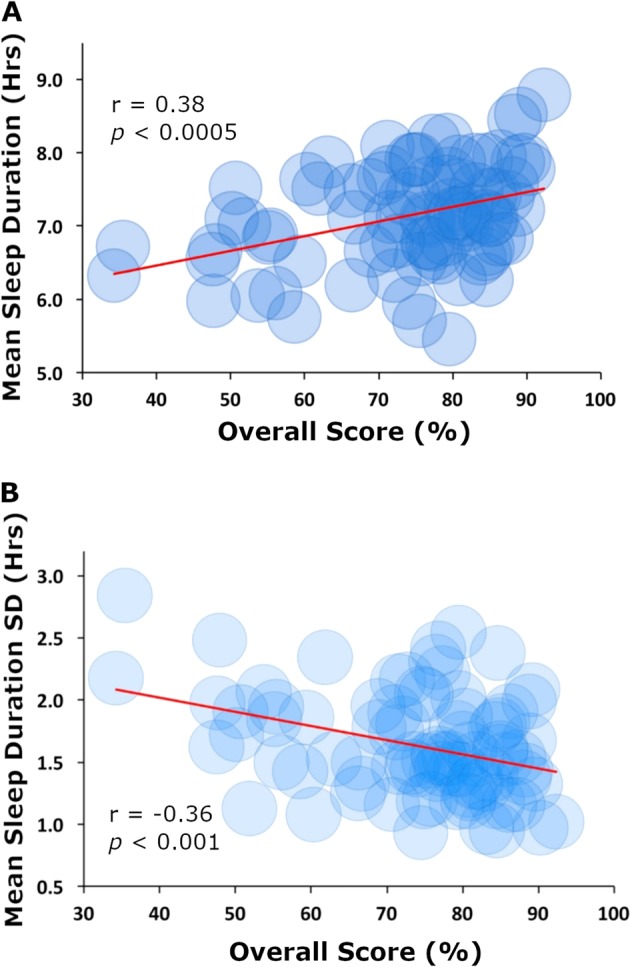
- Across the semester, sleep duration correlated positively with overall score (r(86) = 0.38, p < 0.0005), sleep quality correlated positively with overall score (r(86) = 0.44, p < 0.00005), and sleep inconsistency correlated negatively with overall score (r(86) = −0.36, p < 0.001).
- Sleep the night before assessments was not significantly correlated with performance: for midterms, all rs < 0.20, all ps > 0.05; for quizzes, rs from 0.01 to 0.26, all ps > 0.05. Sleep over the month before midterms did correlate with scores: duration rs from 0.25 to 0.34, all ps < 0.02; quality rs from 0.21 to 0.38, all ps < 0.05.
- A stepwise regression on overall score using sleep duration, sleep quality, and sleep inconsistency was significant, F(3,84) = 8.95, p = .00003, with R² = 0.24; the three regressors explained 24.44% of variance. Relative importance was 7.16% sleep duration, 9.68% sleep quality, and 7.6% sleep inconsistency. Females had better sleep quality (t(88) = 2.63, p = 0.01) and less sleep inconsistency (t(88) = 2.18, p = 0.03) than males, with no significant duration difference; females scored higher overall (t(88) = −2.48, p = 0.01), but this difference was not significant when controlling for sleep quality, F(1,85) = 2.22, p = 0.14.
Methods
- One hundred volunteers were selected from 370 students enrolled in Introduction to Solid State Chemistry at MIT; 88 completed the study (45 females; mean age 18.19 years; 85 freshmen). Exclusions were 7 participants with <80% tracker wear, 3 who lost the tracker, and 2 who completed <75% of assessments. Participants wore a Fitbit Charge HR for the semester, with average usage of 89.4% (SD = 5.5%).
- Academic performance came from 9 quizzes, 3 midterms, and a final exam; Quiz 9 and the final exam were excluded from analyses due to motivation concerns, and overall score was the sum of 8 quizzes and 3 midterms. Sleep quality was Fitbit’s proprietary 0–10 score.
- Analyses included Pearson correlations, ANOVA, stepwise regression with the relaimpo package, and ANCOVA; correlations with three or more comparisons were corrected for multiple comparisons using false discovery rate.
Limitations
- Stated in the paper: sleep quality used proprietary algorithms, and there is no published evidence that Fitbit’s 1–10 sleep quality scores are a valid assessment of sleep quality; stress, anxiety, motivation, personality traits, and gender roles may moderate the sleep–academic performance relation; causal relations require randomized controlled trials; and findings came from a particular MIT student population in a particular course, so generalizability is unknown.
- Evident from the text: the study is observational and correlational, so it cannot establish causality; participants were the first 100 volunteers rather than a random sample; sleep was estimated by a consumer wearable rather than research-grade sleep staging; and the final exam and Quiz 9 were excluded from the main academic outcome.
Model-written summary. Check it against the paper before relying on it.
Integrity signals
Registry
Cites
Statistics
Figures
Verification
Claims the paper makes
17 Valid · 0 Not valid · 5 Not checked · 46 Own results and interpretations
The cited sources support only part of this claim — read each source’s verdict below.
In the paper
“While a few studies report null effects,20,21 most studies looking at the effects of sleep quality and duration on academic performance have linked longer and better-quality sleep with better academic performance such as school grades and study effort.4,6,9–13,22–27”
§ Sleep quality, duration, and consistency are associated with better academic performance in college students > Introduction
What the sources say
- Not checked — no full text of the sourcecites [4] Wagner U Gais S Haider H Verleger R Born J Sleep inspires insight Nature 2004 427 352 355 10.1038/nature02223 14737168 source
- Not checked — no full text of the sourcecites [6] Wong ML The interplay between sleep and mood in predicting academic functioning, physical health and psychological health: a longitudinal study J. Psychosom. Res. 2013 74 271 277 10.1016/j.jpsychores.2012.08.014 23497826 source
- Not checked — no full text of the sourcecites [9] Eliasson AH Lettieri CJ Early to bed, early to rise! Sleep habits and academic performance in college students Sleep. Breath. 2010 14 71 75 10.1007/s11325-009-0282-2 19603214 source
- Supportedcites [10] Gaultney JF The prevalence of sleep disorders in college students: Impact on academic performance J. Am. Coll. Health 2010 59 91 97 10.1080/07448481.2010.483708 20864434 source
The Abstract reviews studies linking reduced sleep time and poor sleep quality with worse school performance, including lower grades, and describes a sleep-loss experiment in which students chose easier math problems. The Results also report that students who slept more before school or work and those who reported sleeping less badly had higher GPAs, while cautioning that the correlations were small. (LLM, conf=0.85)
- Not checked — no full text of the sourcecites [11] Gilbert SP Weaver CC Sleep quality and academic performance in university students: A wake-up call for college psychologists J. Coll. Stud. Psychother. 2010 24 295 306 10.1080/87568225.2010.509245 source
- Partly supportedcites [12] Gomes AA Tavares J de Azevedo MHP Sleep and academic performance in undergraduates: A multi-measure, multi-predictor approach Chronobiol. Int. 2011 28 786 801 10.3109/07420528.2011.606518 22080785 sourceExperimental — accuracy not yet measured
The Introduction and Discussion link shorter or poorer-quality sleep with lower academic grades, both in this study and in prior studies. They do not establish study effort as an academic-performance outcome linked to sleep; time devoted to study is treated as a potential predictor considered alongside sleep. Page numbers are unavailable in our copy. (LLM, conf=0.84)
- Partly supportedcites [13] Lemma S Berhane Y Worku A Gelaye B Williams MA Good quality sleep is associated with better academic performance among university students in Ethiopia Sleep. Breath. 2014 18 257 263 10.1007/s11325-013-0874-8 23928956 PMC3918486 sourceExperimental — accuracy not yet measured
The Introduction reports that good sleep quality predicts better academic performance and that most prior studies associate performance with an optimal sleep duration of 7–8 hours. It does not support a general claim that longer sleep is better: it notes a study linking sleep over eight hours to poor performance, and this paper's Abstract Results found no sleep-duration association. The cited passages also do not establish an association with study effort. (LLM, conf=0.88)
- Not checked — no full text of the sourcecites [22] Merikanto I Lahti T Puusniekka R Partonen T Late bedtimes weaken school performance and predispose adolescents to health hazards Sleep. Med. 2013 14 1105 1111 10.1016/j.sleep.2013.06.009 24051113 source
- Partly supportedcites [23] Zeek ML Sleep duration and academic performance among student pharmacists Am. J. Pharm. Educ. 2015 79 5 12 10.5688/ajpe79563 PMC4571043 26396272 sourceExperimental — accuracy not yet measured
The Discussion (page not supplied) reports that longer sleep before an examination was associated with better course grades and semester GPA, and describes consistent findings in other studies. The limitations section (page not supplied) says sleep quality was not measured, though it notes that quality can affect academic performance. The paper does not establish a link with study effort or substantiate the claim about what most studies found. (LLM, conf=0.84)
- Not checked — no full text of the sourcecites [24] Hartmann ME Prichard JR Calculating the contribution of sleep problems to undergraduates’ academic success Sleep. Health 2018 4 463 471 10.1016/j.sleh.2018.07.002 30241662 source
plainstates an association- Asserted: passes — The authors put it forward as true.
- Checkable: passes — It can be checked against evidence.
- Load-bearing: passes — The paper’s conclusions depend on it.
- Based: passes — The paper gives a reason why it holds.
The sources with a verdict support this claim; the rest weren’t checked yet, have no full text we could read, or their verdicts aren’t rated yet.
In the paper
“Sleep is thought to play a crucial and specific role in memory consolidation.”
§ Sleep quality, duration, and consistency are associated with better academic performance in college students > Introduction
What the sources say
- Not checked — no full text of the sourcecites [5] Walker MP Stickgold R Sleep, memory, and plasticity Annu. Rev. Psychol. 2006 57 139 166 10.1146/annurev.psych.56.091103.070307 16318592 source
- Supportedcites [14] Gilestro GF Tononi G Cirelli C Widespread changes in synaptic markers as a function of sleep and wakefulness in drosophila Science 2009 324 109 112 10.1126/science.1166673 19342593 PMC2715914 source
The passage labeled Abstract states that sleep consolidates memories and that sleep deprivation interferes with memory acquisition. This supports the citing sentence’s characterization of sleep as having an important role in memory consolidation. (LLM, conf=0.88)
- Supportedcites [15] Rasch B Born J About sleep’s role in memory Physiol. Rev. 2013 93 681 766 10.1152/physrev.00032.2012 23589831 PMC3768102 source
The Memory processes section describes sleep’s role in memory consolidation as critical and says the sleeping brain provides optimal conditions for it. The Concluding Remarks state that current theorizing assumes an active consolidation process specifically established during sleep, matching the claim’s qualified wording. (LLM, conf=0.94)
hedgedstates a possible cause- Asserted: passes — The authors put it forward as true.
- Checkable: passes — It can be checked against evidence.
- Load-bearing: passes — The paper’s conclusions depend on it.
- Based: passes — The paper gives a reason why it holds.
The cited sources support only part of this claim — read each source’s verdict below.
In the paper
“Adolescents who experience greater sleep inconsistency perform worse in school.28–31”
§ Sleep quality, duration, and consistency are associated with better academic performance in college students > Introduction
What the sources say
- Partly supportedcites [28] Lee YJ Park J Soohyun K Seong-jin C Seog Ju K Academic performance among adolescents with behaviorally J. Clin. Sleep. Med. 2015 11 61 68 25515277 PMC4265661 sourceExperimental — accuracy not yet measured
The Sleep Duration and Schedule section defines weekend oversleep as the difference between weekend and weekday sleep duration. The Predictors of Academic Performance and Discussion sections associate a larger difference with poorer school performance, particularly among adolescents with behaviorally induced insufficient sleep syndrome; they do not establish the broader claim for sleep inconsistency generally or for adolescents without the syndrome. Page numbers were not available in our copy. (LLM, conf=0.85)
- Not checked — no full text of the sourcecites [29] Díaz-Morales JF Escribano C Social jetlag, academic achievement and cognitive performance: Understanding gender/sex differences Chronobiol. Int. 2015 32 822 831 10.3109/07420528.2015.1041599 26061587 source
- Partly supportedcites [30] Raley H Naber J Cross S Perlow M The impact of duration of sleep on academic performance in University students Madr. J. Nurs. 2016 1 11 18 10.18689/mjn-1000103 sourceExperimental — accuracy not yet measured
The Discussion (page unavailable) says irregular sleep schedules have been linked to poorer academic performance in university students. The paper does not establish this relationship specifically for adolescents, and its own results focus on sleep duration rather than inconsistency. (LLM, conf=0.86)
- Not checked — no full text of the sourcecites [31] Haraszti RÁ Ella K Gyöngyösi N Roenneberg T Káldi K Social jetlag negatively correlates with academic performance in undergraduates Chronobiol. Int. 2014 31 603 612 10.3109/07420528.2013.879164 24491157 source
plainstates an association- Asserted: passes — The authors put it forward as true.
- Checkable: passes — It can be checked against evidence.
- Load-bearing: unclear — It is unclear whether the paper’s conclusions depend on it.
- Based: passes — The paper gives a reason why it holds.
- Partly supported
The cited sources support only part of this claim — read each source’s verdict below.
In the paper
“The outcome that better “content-relevant sleep” leads to improved performance is supported by previous controlled studies on the role of sleep in memory consolidation.14,15”
§ Sleep quality, duration, and consistency are associated with better academic performance in college students > Discussion
What the sources say
- Partly supportedcites [14] Gilestro GF Tononi G Cirelli C Widespread changes in synaptic markers as a function of sleep and wakefulness in drosophila Science 2009 324 109 112 10.1126/science.1166673 19342593 PMC2715914 sourceExperimental — accuracy not yet measured
The opening passage (indexed as Abstract; page unavailable) says that sleep consolidates memories and that learning involving local brain regions can produce local changes in sleep intensity. But this paper’s controlled Drosophila experiments measured synaptic markers, not whether better content-relevant sleep improved performance. It therefore supports the general sleep–memory link, not the specific performance outcome. (LLM, conf=0.84)
- Supportedcites [15] Rasch B Born J About sleep’s role in memory Physiol. Rev. 2013 93 681 766 10.1152/physrev.00032.2012 23589831 PMC3768102 source
In ‘Selectivity of memory consolidation during sleep’ (page not provided), the review reports controlled studies in which sleep produced greater gains for rewarded or later-relevant material, including improved recall. Its discussion of active system consolidation also reports numerous studies finding that sleep after learning benefits memory performance. (LLM, conf=0.86)
plainstates a cause- Asserted: passes — The authors put it forward as true.
- Checkable: passes — It can be checked against evidence.
- Load-bearing: unclear — It is unclear whether the paper’s conclusions depend on it.
- Based: passes — The paper gives a reason why it holds.
- Partly supported
The sources with a verdict support this claim; the rest weren’t checked yet, have no full text we could read, or their verdicts aren’t rated yet.
In the paper
“Well-controlled sleep studies conducted with healthy adults have shown that better sleep is associated with a myriad of superior cognitive functions,1–6 including better learning and memory.7,8”
§ Sleep quality, duration, and consistency are associated with better academic performance in college students > Introduction
What the sources say
- Not checked — no full text of the sourcecites [1] Dawson D Reid K Fatigue, alcohol and performance impairment Nature 1997 388 540 545 10.1038/40775 9230429 source
- Supportedcites [2] Lim J Dinges DF A meta-analysis of the impact of short-term sleep deprivation on cognitive variables Psychol. Bull. 2010 136 375 389 10.1037/a0018883 20438143 PMC3290659 source
The Results (Aggregate Effect Sizes; page unavailable) report that 24–48 hours of total sleep deprivation reduced performance across the tested cognitive domains, including working and short-term memory. The Method (Cognitive Domains; page unavailable) identifies word-list learning as a short-term-memory test. This supports the cited comparison with sleep-deprived adults; the paper examines acute sleep loss rather than sleep quality generally. (LLM, conf=0.85)
- Not checked — no full text of the sourcecites [3] Harrison Y Horne JA The impact of sleep deprivation on decision making: a review J. Exp. Psychol. Appl. 2000 6 236 249 10.1037/1076-898X.6.3.236 11014055 source
- Not checked — no full text of the sourcecites [4] Wagner U Gais S Haider H Verleger R Born J Sleep inspires insight Nature 2004 427 352 355 10.1038/nature02223 14737168 source
- Not checked — no full text of the sourcecites [5] Walker MP Stickgold R Sleep, memory, and plasticity Annu. Rev. Psychol. 2006 57 139 166 10.1146/annurev.psych.56.091103.070307 16318592 source
- Not checked — no full text of the sourcecites [6] Wong ML The interplay between sleep and mood in predicting academic functioning, physical health and psychological health: a longitudinal study J. Psychosom. Res. 2013 74 271 277 10.1016/j.jpsychores.2012.08.014 23497826 source
- Not checked — no full text of the sourcecites [7] Diekelmann S Wilhelm I Born J The whats and whens of sleep-dependent memory consolidation Sleep. Med. Rev. 2009 13 309 321 10.1016/j.smrv.2008.08.002 19251443 source
- Not checked — no full text of the sourcecites [8] Fogel SM Smith CT Cote KA Dissociable learning-dependent changes in REM and non-REM sleep in declarative and procedural memory systems Behav. Brain Res. 2007 180 48 61 10.1016/j.bbr.2007.02.037 17400305 source
boostedstates an association- Asserted: passes — The authors put it forward as true.
- Checkable: passes — It can be checked against evidence.
- Load-bearing: passes — The paper’s conclusions depend on it.
- Based: passes — The paper gives a reason why it holds.
35 more claims · 3 with their cited sources checked
Create a free account to see all 68 claims and every source verdict.
- It may state two separate claims as one. 12
- Probably not a substantial claim. 19
Claims other papers make about this one
Each is checked against this paper’s own text: does it say what the citing paper says it does?
The source backs part of the claim, not all of it — or backs it for a different population, condition or comparison.
In the citing paper
“poor sleep quality and stress before exams are associated with poorer academic performance [8]”
From A systematic review and meta-analysis of poor sleep, insomnia symptoms and stress in undergraduate students (2022) · cites this paper as [8]
Experimental — accuracy not yet measuredThe source backs part of the claim, not all of it — or backs it for a different population, condition or comparison.
In the citing paper
“alternative strategies, such as spaced practice and sufficient sleep, are likely to have a greater impact on academic performance for students (e.g., Cepeda et al., 2006, Okano et al, 2019).”
From Effects of stimulant medication on neuropsychological functioning in college students without ADHD. (2026) · cites this paper as Okano et al, 2019
Experimental — accuracy not yet measuredThe check wasn’t confident either way, so it gives no verdict — never disputed.
In the citing paper
“negative family life events and academic stress both predict symptoms of insomnia”
From A systematic review and meta-analysis of poor sleep, insomnia symptoms and stress in undergraduate students (2022) · cites this paper as [8]
Experimental — accuracy not yet measured
Statistics recomputed
Every reported test result, recomputed from its test statistic and degrees of freedom. A result shows as not adding up only once an independent check has confirmed it.
- ConsistentF(1, 82) = 6.45reported p = .01 · recomputed p = .013
“F (1, 82) = 6.45, p = .01”
- ConsistentF(1, 82) = 6.43reported p = .01 · recomputed p = .013
“F (1, 82) = 6.43, p = .01”
- ConsistentF(1, 82) = 0.66reported p = .42 · recomputed p = .419
“F (1, 82) = 0.66, p = .42”
- Consistentr(86) = -0.45reported p < .0001 · recomputed p < .001
“r (86) = −0.45, p < .0001”
- Consistentr(86) = -0.35reported p < .001 · recomputed p < .001
“r (86) = −0.35, p < .001”
23 more recomputed tests
Create a free account to see every test the Stats check recomputed.
Self-check
Percentages, sums and reported differences re-computed from the paper’s own numbers.
Each contradiction between two passages listed here was confirmed by an independent check.
Rated minor: it would not touch a result — a value no result rests on, a p-value that stays on the same side of the significance level, or a conflict that is clerical, resolved elsewhere in the paper, or outside its own findings.
In the paper
§ Sleep quality, duration, and consistency are associated with better academic performance in college students > Discussion
“the use of cardiac, respiratory, and movement information from Fitbit devices can accurately estimate sleep stages,32”
§ Sleep quality, duration, and consistency are associated with better academic performance in college students > References
“32. Scullin MK The eight hour sleep challenge during final exams week Teach. Psychol. 2018 46 55 63 10.1177/0098628318816142 PMC12360386 40832444”
Rated minor: it would not touch a result — a value no result rests on, a p-value that stays on the same side of the significance level, or a conflict that is clerical, resolved elsewhere in the paper, or outside its own findings.
In the paper
§ Sleep quality, duration, and consistency are associated with better academic performance in college students > Discussion
“the two linked studies that found longer sleep duration during the week before final exams47 and consistent sleep duration five days prior to a final assignment48 enhanced students’ performance”
§ Sleep quality, duration, and consistency are associated with better academic performance in college students > References
“47. Benjamini Y Hochberg Y Controlling the false discovery rate: A practical and powerful approach to multiple testing J. R. Stat. Soc. Ser. B (Methodol.) 1995 57 289 300 48. Grömping U Relative importance for linear regression in R: The package relaimpo J. Stat. Softw. 2015 17 1 27”
Rated minor: it would not touch a result — a value no result rests on, a p-value that stays on the same side of the significance level, or a conflict that is clerical, resolved elsewhere in the paper, or outside its own findings.
In the paper
§ Sleep quality, duration, and consistency are associated with better academic performance in college students > Results > Gender differences
“Females had better Sleep Quality (t (88) = 2.63, p = 0.01), and less sleep inconsistency (t (88) = 2.18, p = 0.03)”
§ Sleep quality, duration, and consistency are associated with better academic performance in college students > Methods > Participants
“Of the 88 participants who completed the study (45 females)”
Citations
Cites
Controlling the False Discovery Rate: A Practical and Powerful Approach to Multiple Testing
Benjamini, Y., & Hochberg, Y. (1995) · Journal of the Royal Statistical Society Series B: Statistical Methodology · doi:10.1111/j.2517-6161.1995.tb02031.x · Cited by 109,482 · cited 1×
“All Pearson correlations with three or more comparisons were corrected for multiple comparisons using false discovery rate.(47)”
MethodRasch, B., & Born, J. (2013) · Physiological Reviews · doi:10.1152/physrev.00032.2012 · Cited by 2,783 · cited 2×
“The outcome that better “content-relevant sleep” leads to improved performance is supported by previous controlled studies on the role of sleep in memory consolidation.(14,15) Consistent with some previous research(45,46) female students tended to experience better quality sleep and with more consistency than male stu…”
BackgroundResultRelative Importance for Linear Regression in R : The Package relaimpo
Grömping, U. (2006) · Journal of Statistical Software · doi:10.18637/jss.v017.i01 · Cited by 2,615
Neurocognitive consequences of sleep deprivation
Goel, N., Rao, H., Durmer, J., & Dinges, D. (2009) · Seminars in Neurology · doi:10.1055/s-0029-1237117 · Cited by 2,154 · cited 1×
“Wellcontrolled sleep deprivation studies have shown that lack of sleep not only increases fatigue and sleepiness but also worsens cognitive performance.(2,3,16,17) In fact, the cognitive performance of an individual who has been awake for 17 h is equivalent to that exhibited by one who has a blood alcohol concentratio…”
BackgroundNeurocognitive Consequences of Sleep Deprivation
Durmer, J. S., & Dinges, D. F. (2005) · Seminars in Neurology · doi:10.1055/s-2005-867080 · Cited by 1,473
A meta-analysis of the impact of short-term sleep deprivation on cognitive variables
Lim, J., & Dinges, D. F. (2010) · Psychological Bulletin · doi:10.1037/a0018883 · Cited by 1,389 · cited 1×
“Wellcontrolled sleep deprivation studies have shown that lack of sleep not only increases fatigue and sleepiness but also worsens cognitive performance.(2,3,16,17) In fact, the cognitive performance of an individual who has been awake for 17 h is equivalent to that exhibited by one who has a blood alcohol concentratio…”
BackgroundThe impact of sleep deprivation on decision making: A review.
Harrison, Y., & Horne, J. A. (2000) · Journal of Experimental Psychology: Applied · doi:10.1037/1076-898x.6.3.236 · Cited by 1,238 · cited 1×
“Wellcontrolled sleep deprivation studies have shown that lack of sleep not only increases fatigue and sleepiness but also worsens cognitive performance.(2,3,16,17) In fact, the cognitive performance of an individual who has been awake for 17 h is equivalent to that exhibited by one who has a blood alcohol concentratio…”
BackgroundFatigue, alcohol and performance impairment
Dawson, D., & Reid, K. (1997) · Nature · doi:10.1038/40775 · Cited by 1,199 · cited 1×
“05%.(1) Outside of a laboratory setting, studies examining sleep in the comfort of peoples’ own homes via self-report surveys have found that persistently poor sleepers experience significantly more daytime difficulties in regards to fatigue, sleepiness, and poor cognition compared with persistently good sleepers.”
BackgroundDuckworth, A. L., & Seligman, M. E. P. (2006) · Journal of Educational Psychology · doi:10.1037/0022-0663.98.1.198 · Cited by 1,097
Walker, M. P., & Stickgold, R. (2006) · Annual Review of Psychology · doi:10.1146/annurev.psych.56.091103.070307 · Cited by 1,075 · cited 1×
“Although the exact mechanisms behind the relationship between sleep, memory, and neuro-plasticity are yet unknown, the general understanding is that specific synaptic connections that were active during awake-periods are strengthened during sleep, allowing for the consolidation of memory, and synaptic connections that…”
Background
Cited by
Gardani, M., Bradford, D. R. R., Russell, K., Allan, S., Beattie, L., Ellis, J. G., & Akram, U. (2022) · Sleep Medicine Reviews · doi:10.1016/j.smrv.2021.101565 · Cited by 368
“Indeed, negative family life events and academic stress both predict symptoms of insomnia, and poor sleep quality and stress before exams are associated with poorer academic performance [8].”
BackgroundSleep and Athletic Performance
Charest, J., & Grandner, M. A. (2020) · Sleep Medicine Clinics · doi:10.1016/j.jsmc.2019.11.005 · Cited by 264
Sletten, T. L., Weaver, M. D., Foster, R. G., Gozal, D., Klerman, E. B., Rajaratnam, S. M. W., Roenneberg, T., Takahashi, J. S., Turek, F. W., Vitiello, M. V., et al. (2023) · Sleep Health · doi:10.1016/j.sleh.2023.07.016 · Cited by 240
Charest (2022) · doi:10.1016/j.jsmc.2022.03.006 · Cited by 127
Exploring Pharmacological Mechanisms of Essential Oils on the Central Nervous System
Soares, G. A. B. E., Bhattacharya, T., Chakrabarti, T., Tagde, P., & Cavalu, S. D. (2021) · Plants · doi:10.3390/plants11010021 · Cited by 142
Sleep and academic performance: measuring the impact of sleep
Hershner, S. (2020) · Current Opinion in Behavioral Sciences · doi:10.1016/j.cobeha.2019.11.009 · Cited by 95
The Science of Habit and Its Implications for Student Learning and Well-being
Fiorella, L. (2020) · Educational Psychology Review · doi:10.1007/s10648-020-09525-1 · Cited by 160
“A recent study by Okano et al. (2019) demonstrated the importance of sleep habits among college undergraduates using objective sleep measures.”
BackgroundHjetland, G. J., Skogen, J. C., Hysing, M., & Sivertsen, B. (2021) · Frontiers in Public Health · doi:10.3389/fpubh.2021.794307 · Cited by 85
Mehta, K. J. (2022) · Humanities and Social Sciences Communications · doi:10.1057/s41599-021-01031-1 · Cited by 72
“Sleep quality and quantity are strongly associated with academic achievement in college students (Curcio et al., 2006; Okano et al., 2019).”
BackgroundZhang, X., Luo, G., Xie, J., & Liu, J. (2021) · Indoor Air · doi:10.1111/ina.12809 · Cited by 70
Minimum number of nights for reliable estimation of habitual sleep using a consumer sleep tracker
Lau, T., Ong, J. L., Ng, B. K. L., Chan, L. F., Koek, D., Tan, C. S., Müller‐Riemenschneider, F., Cheong, K., Massar, S. A. A., & Chee, M. W. L. (2022) · SLEEP Advances · doi:10.1093/sleepadvances/zpac026 · Cited by 69
“Sleep duration and variability [1, 2] are increasingly recognized as lifestyle factors that can be modified to avert adverse long-term health outcomes [3–7].”
BackgroundMoriarty, T. A., Bourbeau, K., Fontana, F. E., McNamara, S. W. T., & da Silva, M. P. (2021) · International Journal of Environmental Research and Public Health · doi:10.3390/ijerph18094752 · Cited by 64
Arora, A., Chakraborty, P., & Bhatia, M. P. S. (2020) · Arabian Journal for Science and Engineering · doi:10.1007/s13369-020-04877-w · Cited by 62
Fazio, R. D., Mattei, V., Al-Naami, B. O., Vittorio, M. D., & Visconti, P. (2022) · Micromachines · doi:10.3390/mi13081335 · Cited by 57
Sleep Predicts Collegiate Academic Performance
Prichard, J. R. (2020) · Sleep Medicine Clinics · doi:10.1016/j.jsmc.2019.10.003 · Cited by 46
Nepal, S. K., Liu, W., Pillai, A., Wang, W., Vojdanovski, V., Huckins, J. F., Rogers, C., Meyer, M. L., & Campbell, A. T. (2024) · Proceedings of the ACM on Interactive Mobile Wearable and Ubiquitous Technologies · doi:10.1145/3643501 · Cited by 94
“Some studies report that female students tend to sleep longer on free days [59], while others find no difference in sleep duration [56].”
BackgroundGusman, M. S., Grimm, K. J., Cohen, A. B., & Doane, L. D. (2021) · SLEEP · doi:10.1093/sleep/zsab193 · Cited by 48
“Truncated sleep duration and poorer subjective sleep quality in young adults in college are consequently directly and bidirectionally linked with greater depressive and anxiety symptoms [22] and poorer psychosocial functioning [27], and directly linked with worse academic performance [28].”
BackgroundSleep, Well-Being and Academic Performance: A Study in a Singapore Residential College
Armand, M. A., Biassoni, F., & Corrias, A. (2021) · Frontiers in Psychology · doi:10.3389/fpsyg.2021.672238 · Cited by 44
Flegenheimer, C., & Scherf, K. S. (2021) · Journal of Autism and Developmental Disorders · doi:10.1007/s10803-021-05088-4 · Cited by 88
“Management of health behaviors, like sleep duration (Okano et al., 2019; Trockel et al., 2000) and healthy eating behaviors (Peltzer & Pengpid, 2015; Phillips, 2005), are positively related to college outcomes.”
BackgroundWüst, L. N., Capdevila, N. C., Lane, L. T., Reichert, C., & Lasauskaite, R. (2024) · Sleep Medicine Reviews · doi:10.1016/j.smrv.2024.101940 · Cited by 64
Dalpati, N., Jena, S., Jain, S., & Sarangi, P. P. (2022) · Brain Behavior & Immunity - Health · doi:10.1016/j.bbih.2022.100420 · Cited by 61
“In addition to mental wellbeing, researchers have also endorsed the bene fi cial effects of regular yogic practices in improving metabolic and vascular functions of the human body (Erogul et al., 2014; Falsa fi , 2016; Kim, 2016; Nemati, 2013; Oman et al., 2008; Ross et al., 2015).”
Shammari, M. A., AlAmer, N. A., Mulhim, S. N. A., Mohammedsaleh, H. N. A., & AlOmar, R. S. (2020) · Journal of Family and Community Medicine · doi:10.4103/jfcm.jfcm_160_19 · Cited by 57
“[1] The results of our study also support the previously published data on the negative association between suboptimal sleep quality, excessive daytime sleepiness, and poor academic achievement, represented by the GPA of the students,[15,27] and the direct positive association between good sleep quality and longer dur…”
ResultSocial Determinants of Health: Considerations for Athletic Health Care
Picha, K. J., Bacon, C. E. W., Normore, C., & Valier, A. R. S. (2021) · Journal of Athletic Training · doi:10.4085/1062-6050-0010.21 · Cited by 52
Shift work is associated with extensively disordered sleep, especially when working nights
Boersma, G. J., Mijnster, T., Vantyghem, P., KERKHOF, G. A., & Lancel, M. (2023) · Frontiers in Psychiatry · doi:10.3389/fpsyt.2023.1233640 · Cited by 56
Cassaretto, M., Vilela, P., & Gamarra, L. (2021) · Liberabit Revista Peruana de Psicología · doi:10.24265/liberabit.2021.v27n2.07 · Cited by 114
Bai, Y., Tan, J., Liu, X., Cui, X., Li, D., & Yin, H. (2022) · Brain Imaging and Behavior · doi:10.1007/s11682-022-00654-5 · Cited by 33
“There were also several studies reporting that sleep quality in males was worse than in their females counterparts (Berkout et al. 2011; Bixler et al., 2009; Mallampalli and Carter, 2014; Okano et al., 2019).”
Physical Activity and Inhibitory Control: The Mediating Role of Sleep Quality and Sleep Efficiency
Li, L., Yu, Q., Zhao, W., Herold, F., Cheval, B., Kong, Z., Li, J., Mueller, N. G., Kramer, A. F., Cui, J., et al. (2021) · Brain Sciences · doi:10.3390/brainsci11050664 · Cited by 51
Impact of COVID‐19 pandemic on sleep of undergraduate students: A systematic literature review
Valenzuela, R. L. G., Velasco, R. I. B., & Jorge, M. P. P. C. (2022) · Stress and Health · doi:10.1002/smi.3171 · Cited by 43
Morning brain: real-world neural evidence that high school class times matter
Dikker, S., Haegens, S., Bevilacqua, D., Davidesco, I., Wan, L., Kaggen, L., McClintock, J., Chaloner, K., Ding, M., West, T. V., et al. (2020) · Social Cognitive and Affective Neuroscience · doi:10.1093/scan/nsaa142 · Cited by 50
“For example, a recent study used wearable activity trackers to assess the relationship between sleep patterns and academic performance in college students (Okano et al., 2019).”
Sleep Quality and Sleep Behaviors in Varsity Athletes: A Pilot Study
Rebello, L. J., Roberts, A. W., Fenuta, A. M., Coté, A. T., & Bodner, M. E. (2022) · Frontiers in Sports and Active Living · doi:10.3389/fspor.2022.906663 · Cited by 45
“As such, sleep is vital for university athletes, contributing not only to recovery from physical stresses arising from training schedules and competition but also to academic success via learning and cognition (Okano et al., 2019).”
BackgroundAlmarzouki, A. F., Mandili, R. L., Salloom, J., Kamal, L. K., Alharthi, O. H., Alharthi, S., Khayyat, N., & Baglagel, A. M. (2022) · Brain Sciences · doi:10.3390/brainsci12111525 · Cited by 78
Moshayedi, A. J., Uddin, N. M. I., Khan, A. S., Zhu, J., & Andani, M. E. (2023) · Sensors · doi:10.3390/s23208422 · Cited by 32
“Additionally, individual differences can also play a significant role in how news affects sleep, as some people may be more affected by negative news than others [19,20].”
BackgroundGao, C., Fillmore, P., & Scullin, M. K. (2020) · Neurobiology of Learning and Memory · doi:10.1016/j.nlm.2020.107206 · Cited by 42
Cousins, J. N., Leong, R. L. F., Jamaluddin, S. A., Ng, A., Ong, J. L., & Chee, M. W. L. (2021) · Scientific Reports · doi:10.1038/s41598-021-84625-8 · Cited by 34
Sharisha Shanbhog, M., & Medikonda, J. (2023) · Computer Methods and Programs in Biomedicine · doi:10.1016/j.cmpb.2023.107521 · Cited by 37
Mao, Y., Xie, B., Chen, B., Cai, Y., Wu, J., Zhang, J., Shao, R., & Li, Y. (2022) · Nature and Science of Sleep · doi:10.2147/nss.s346851 · Cited by 46
Xie, M., Fowle, J., Ip, P. S., Haskin, M., & Yip, T. (2021) · Journal of Youth and Adolescence · doi:10.1007/s10964-021-01436-w · Cited by 32
“…higher WASO reflecting poorer sleep quality), and sleep inconsistency (i.e., inconsistency in sleep schedule and/or duration from day to day, see Okano et al., 2019; the present study used the standard deviation of sleep duration across 14 days as a proxy for sleep inconsistency, with higher…”
MethodResearch trends in college students' sleep from 2012 to 2021: A bibliometric analysis
Zhou, J., Qu, J., Ji, S., Bu, Y., Yi-cheng, H., Sun, H., Xue, M., Zhou, T., Qu, J., & Liu, Y. (2022) · Frontiers in Psychiatry · doi:10.3389/fpsyt.2022.1005459 · Cited by 33
“To some extent, the grade point average could be predicted by sleep duration (37), sleep quality (38), and the frequency and consistency of nighttime sleep awakening (39).”
BackgroundScreen time and sleep among medical students in Germany
Liebig, L., Bergmann, A., Voigt, K., Balogh, E., Birkás, B., Faubl, N., Kraft, T. A., Schöniger, K., & Riemenschneider, H. (2023) · Scientific Reports · doi:10.1038/s41598-023-42039-8 · Cited by 42
Sleep Characteristics According to Gender and Age Measured by Wrist Actigraphy
Kováčová, K., & Stebelová, K. (2021) · International Journal of Environmental Research and Public Health · doi:10.3390/ijerph182413213 · Cited by 27
Mao, Y., Xie, B., Chen, B., et al. (2022) · DOAJ (DOAJ: Directory of Open Access Journals) · Cited by 21
Wara, T. U., Fahad, A. H., Das, A. S., & Shawon, M. M. H. (2025) · Heliyon · doi:10.1016/j.heliyon.2025.e43576 · Cited by 43
“If any hindrance occurs in regular sleep, body functioning and metabolism tend to be disoriented; for example, a recent study also showed that sleep quality affects academic performance [1].”
Bani‐Issa, W., Hijazi, H. H. A., Radwan, H. M., Saqan, R., Al‐Sharman, A., Samsudin, A. B. R., Fakhry, R., Al‐Yateem, N., Rossiter, R. C., Ibrahim, A., et al. (2023) · Frontiers in Public Health · doi:10.3389/fpubh.2023.1182758 · Cited by 27
“A US study that used the FITBIT as a sleep tracker to measure sleep among 100 students in an introductory college chemistry class (88 of whom completed the study) found it correlated well with academic performance (41).”
MethodChan, N. Y., Wu, W. J., Chan, J. W. Y., Chan, K. C. C., Li, A. M., Chan, S. S. M., Hau, K., & Wing, Y. K. (2023) · Sleep Medicine · doi:10.1016/j.sleep.2023.04.001 · Cited by 29
Badri, M. A., Alkhaili, M., Aldhaheri, H., Yang, G., Albahar, M., & AlRashdi, A. S. (2023) · Sleep Science and Practice · doi:10.1186/s41606-023-00083-3 · Cited by 35
“While this result is consistent with outcomes from similar studies (Chen et al. 2019; Okano et al. 2019), our research did not show a significant bi-directional association between sleep quality and mental health, as did in some research (Luo et al.”
ResultMobile sensor-based community gaming for improving vocational students’ sleep and academic outcomes
Wang, J.-S., Gamble, J. H., & Yang, Y.-T. C. (2020) · Computers & Education · doi:10.1016/j.compedu.2020.103812 · Cited by 27
Kim, K.-Y., Hur, M., & Kim, W. (2024) · Healthcare · doi:10.3390/healthcare12161581 · Cited by 21
Pérez-Domínguez, F., Polanco-Ilabaca, F., Pinto-Toledo, F., Michaeli, D. T., Achiardi, J., Santana, V. S. D. J., Urnelli, C., Sawaguchi, Y., Rodríguez, P., Maldonado, M., et al. (2021) · Health Education & Behavior · doi:10.1177/10901981211019292 · Cited by 27
“…and better sleep quality are positively correlated with a higher overall score in examinations, as well as sleep inconsistency is negatively associated with lower overall scores (Okano et al., 2019), an undesirable impact on sleep patterns may significantly alter student’s academic performance.”
BackgroundCompassion Mediates Poor Sleep Quality and Mental Health Outcomes
Kim, J. J., Oldham, M., Fernando, A. T., & Kirby, J. N. (2021) · Mindfulness · doi:10.1007/s12671-021-01595-8 · Cited by 22
Defining and exploring online engagement fatigue in a university context
Maloney, S., Axelsen, M., Stone, C., Galligan, L., Redmond, P., Brown, A., Turner, J. F., & Lawrence, J. (2023) · Computers and Education Open · doi:10.1016/j.caeo.2023.100139 · Cited by 33
Valladares-Garrido, M. J., Morocho-Alburqueque, N., Zila-Velasque, J. P., Solis, L. A. Z., Saldaña-Cumpa, H. M., Rueda, D. A., Peralta, C. I., Jiménez-Mozo, F., Valdiviezo-Morales, C. G., Alburqueque, E. S. B., et al. (2025) · BMC Public Health · doi:10.1186/s12889-025-21569-y · Cited by 35
“Additionally, the nicotine present in tobacco can act as a stimulant, increasing blood pressure [90], and stimulating the release of dopamine, which produces euphoria, excitement and reduction of fatigue [93], making the person who consumes it feel less likely to sleep.”
Wang, Q., Zhong, Y., Zhao, G., Song, R., & Zeng, C. (2022) · Education and Information Technologies · doi:10.1007/s10639-022-11222-1 · Cited by 29
“For university students, sufficient sleep is an essential predictor of good academic performance (Okano et al., 2019), the lack of quality sleep may lead to decreased academic achievements, such as lower grade point averages.”
BackgroundBustamante-Ara, N. E., Russell‐Guzmán, J., Godoy-Cumillaf, A. E. R., Merellano-Navarro, E., & Uribe, N. (2022) · Cultura Ciencia y Deporte · doi:10.12800/ccd.v17i53.1897 · Cited by 47
Ng, A. S. C., Massar, S. A. A., Bei, B., & Chee, M. W. L. (2023) · Sleep Medicine · doi:10.1016/j.sleep.2023.09.028 · Cited by 25
Vik, F. N., Nilsen, T., & Øverby, N. C. (2022) · BMC Public Health · doi:10.1186/s12889-022-14161-1 · Cited by 22
Hargens, T. A., Scott, M. C., Olijar, V., Bigman, M. B., & Edwards, E. S. (2020) · Sleep And Breathing · doi:10.1007/s11325-020-02190-2 · Cited by 26
Optimism and mental health in college students: the mediating role of sleep quality and stress
Lai, Y., Tsai, E.-Y., Jarustanaput, P., Wu, Y., Chen, Y., O’Leary, S. E., Manachevakul, S., Zhang, Y., Shen, J., & Wang, Y. (2024) · Frontiers in Psychology · doi:10.3389/fpsyg.2024.1403146 · Cited by 27
“…sleep quality often confronted high levels of perceived stress, which in turn precipitated anxiety or depression symptoms (Doane et al., 2015; Zhang et al., 2018), impaired psychosocial functioning (Tavernier and Willoughby, 2014), and negatively impacted academic performance (Okano et al., 2019).”
BackgroundGupta, S. K., Prithviraj, M., Gangwar, A., & Rath, R. S. (2023) · Cureus · doi:10.7759/cureus.50413 · Cited by 25
“Various factors, including medical students’ attitudes, knowledge of sleep, and academic demands, have been recognized as the causative factors [5].”
BackgroundAstridge, D. J., Sommerville, A., Verheul, M. H. G., & Turner, A. P. (2020) · European Journal of Sport Science · doi:10.1080/17461391.2020.1857442 · Cited by 25
“…the body of evidence suggesting that collegiate swimmers do not often obtain a sufficient duration of high-quality sleep, potentially having negative implications for academic performance (Okano et al., 2019), athletic performance (Kirschen et al., 2020) and mental wellbeing (Walters, 2002).”
BackgroundSleep disparities in the first month of college: Implications for academic achievement
Bermudez, V. N., Fearon-Drake, D., Wheelis, M., Cohenour, M., Suntai, Z., & Scullin, M. K. (2022) · SLEEP Advances · doi:10.1093/sleepadvances/zpac041 · Cited by 16
“late bedtimes and short sleep patterns in students enrolled in physics [66], biology [67], and chemistry [68] collegiate courses.”
BackgroundImpact of sleep deprivation on monocyte subclasses and function
Al‐Rashed, F., AlSaeed, H., Akhter, N., Alabduljader, H., Al‐Mulla, F., & Ahmad, R. (2025) · The Journal of Immunology · doi:10.1093/jimmun/vkae016 · Cited by 22
Co-design personal sleep health technology for and with university students
Liang, Z., Melcer, E. F., Khotchasing, K., & Hoang, N. H. (2024) · Frontiers in Digital Health · doi:10.3389/fdgth.2024.1371808 · Cited by 18
“There is a large body of sleep science research investigating the mechanism and causes underlying the sleep problems of university students and their associated consequences (8, 2, 5, 4, 6, 3, 7, 1).”
BackgroundSubjective Sleep Quality, Caffeine, and Dieting Behaviors Among University-Attending Young Adults
Claydon, E. A., Kahwash, J., Lilly, C. L., Alamir, Y. A., & Zullig, K. J. (2023) · Nature and Science of Sleep · doi:10.2147/nss.s420568 · Cited by 26
“Recent studies suggest that both sleep quality and quantity are associated with academic performance indicators, such as grade point average (GPA) and that higher sleep quality and quantity for a consistent time period is associated with better grades.(6,10) Assessing causes of stress, as well as the coping mechanisms…”
BackgroundBarley, B. K., Gao, C., Luster, T. G., Porro, A., Parizi‐Robinson, M., Quigley, D., Zinke, P., & Scullin, M. K. (2023) · Chronobiology International · doi:10.1080/07420528.2023.2203251 · Cited by 20
“…chronotype, academic demands/stress, and sleep-related behavioral choices in college students who were enrolled in demanding science courses, a student population that shows increased risk for short sleep and late bedtimes (Bermudez et al. 2022; Coletta et al. 2018; Okano et al. 2019; Smarr 2015).”
BackgroundAl-Haifi, A. R., Alawadhi, B., Bumaryoum, N. Y., Alajmi, F. A., Ashkanani, R. H., & Al-Hazzaa, H. M. (2023) · Journal of Health Population and Nutrition · doi:10.1186/s41043-023-00370-w · Cited by 22
Patrono, A., Renzetti, S., Manco, A., Brunelli, P., Moncada, S. M., Macgowan, M. J., Placidi, D., Calza, S., Cagna, G., Rota, M., et al. (2022) · International Journal of Environmental Research and Public Health · doi:10.3390/ijerph19148587 · Cited by 17
Hashim, H., Ng, J. S., Ngo, J. X., Ng, Y. Z., & Aravindkumar, B. (2022) · Sleep Science · doi:10.5935/1984-0063.20220070 · Cited by 24
Defining dental operative skills curricula: An ADEE consensus paper
Field, J. C., Dixon, J., Towers, A., Green, R., Albagami, H., Lambourn, G., Mallinson, J., Fokkinga, W. A., Tricio, J., Crnić, T., et al. (2020) · European Journal Of Dental Education · doi:10.1111/eje.12595 · Cited by 18
Sleep Irregularity and Circadian Rhythmicity: Implications for Health and Well-Being
Hartstein, L. E., Grandner, M. A., & Behn, C. D. (2025) · Current Sleep Medicine Reports · doi:10.1007/s40675-025-00318-y · Cited by 17
“Greater sleep irregularity is associated with poorer academic performance among both high school and college students [15, 38] and executive function in adults [39].”
Managing Circadian Rhythms: A Key to Enhancing Mental Health in College Students
Yeom, J. W., Park, S., & Lee, H. (2024) · Psychiatry Investigation · doi:10.30773/pi.2024.0250 · Cited by 31
Knapik, J. J., Caldwell, J. A., Steelman, R. A., Trone, D. W., Farina, E. K., & Lieberman, H. R. (2022) · Sleep Medicine · doi:10.1016/j.sleep.2022.11.015 · Cited by 15
Luo, X., & Hu, C. (2022) · Psychology in the Schools · doi:10.1002/pits.22721 · Cited by 24
Hemşirelik Öğrencilerinde Uyku Kalitesi ile Akademik Başarı Arasındaki İlişkinin İncelenmesi
EKENLER, G., & Altınel, B. (2021) · Online Türk Sağlık Bilimleri Dergisi · doi:10.26453/otjhs.883544 · Cited by 21
Brunyé, T. T., Yau, K., Okano, K., Elliott, G., Olenich, S., Giles, G. E., Navarro, E., Elkin-Frankston, S., Young, A. L., & Miller, E. L. (2021) · Frontiers in Physiology · doi:10.3389/fphys.2021.738973 · Cited by 14
“…al., 2017; Heuberger et al., 2018; Sandra and Otto, 2018; Schumacher et al., 2018; Angelidis et al., 2019; Bock et al., 2019; Goldfarb et al., 2019; Okano et al., 2019; Pyke et al., 2019; Sanabria et al., 2019; Wei et al., 2019; Barrett et al., 2020; Baumert et al., 2020; Fiedler et al., 2020;…”
Self-citationZhang, P., Wang, Y., Chen, X., Yan, W., Zhu, Y., & Peng, K. (2023) · International Journal of Adolescence and Youth · doi:10.1080/02673843.2023.2277379 · Cited by 17
“In a single study, it was found that sleep explained 25% of the variation in total performance (Okano et al., 2019).”
BackgroundChe, X., Lu, Z., & Jin, Y. (2025) · Scientific Reports · doi:10.1038/s41598-025-11225-1 · Cited by 19
Meteier, Q., Favre, R., Viola, S., Capallera, M., Angelini, L., Mugellini, E., & Sonderegger, A. (2024) · Transportation Research Interdisciplinary Perspectives · doi:10.1016/j.trip.2024.101148 · Cited by 24
Shinto, T., Tahara, Y., Watabe, A., Makino, N., Tomonaga, M., Kimura, H., Nozawa, Y., Kobayashi, K., Takahashi, M., & Shibata, S. (2022) · SLEEP Advances · doi:10.1093/sleepadvances/zpac035 · Cited by 19
Estevan, I., Sardi, R., Tejera, A. C., da Silva, A. C. R., & Tassino, B. (2021) · PLoS ONE · doi:10.1371/journal.pone.0247104 · Cited by 24
“However, other studies did not find an association between long night study sessions and test scores [31, 32].”
BackgroundResultAn examination of the mental health and academic performance of student veterans
Hinkson, K. D., Drake-Brooks, M. M., Christensen, K. L., Chatterley, M. D., Robinson, A. K., Crowell, S. E., Williams, P., & Bryan, C. J. (2021) · Journal of American College Health · doi:10.1080/07448481.2020.1858837 · Cited by 20
“For example, one study found that the amount of sleep the night before a test can greatly impact exam results, 23 while another found that sleep consistency over an extended period has a large impact on overall academic success.24 Both of these studies demonstrated that over time poor sleep is likely to result in redu…”
BackgroundInfluentialThe Effects of Sleep Deprivation on College Students
Guadiana, N., & Okashima, T. (2020) · Dominican Scholar (Dominican University of California) · doi:10.33015/dominican.edu/2021.nurs.st.09 · Cited by 18
“A cumulative final exam was administered that tested the content that was covered throughout the semester (Okano et al., 2019).”
InfluentialTong, X., Gao, M., Zhang, L., Song, J., Feng, Y., Tao, Y., Zhu, L.-J., Wen, L.-Y., Jin, Y.-L., & Chang, W. (2023) · BMJ Open · doi:10.1136/bmjopen-2023-076782 · Cited by 18
Almansa, J. F. F., Trivilin, T., Hutz, C. S., de Almeida, R. M. M., Vazquez, A. C. S., & de Freitas, C. P. P. (2024) · Trends in Psychiatry and Psychotherapy · doi:10.47626/2237-6089-2022-0496 · Cited by 15
“14,15 In a study with 257 college students, it was found that students’ positive perception of their life also reflects positively on their physical, psychological, social relationship, and environment domains, increasing the frequency of positive affect and reducing adverse effects.”
BackgroundBono, T. J., & Hill, P. L. (2021) · Psychology Health & Medicine · doi:10.1080/13548506.2021.1971724 · Cited by 17
“…linking sleep consistency to later academic performance and well-being, which may require researchers to combine short-term burst assessments (e.g. Okano et al., 2019; Phillips et al., 2017; Taylor et al., 2013) with longer-term designs like the current one in order to increase measurement…”
BackgroundStefansdottir, R. S., Rögnvaldsdóttir, V., Chen, K. Y., Jóhannsson, E., & Brychta, R. J. (2021) · Journal of Sleep Research · doi:10.1111/jsr.13422 · Cited by 14
Kuhn, T., Heisz, J. J., & Middleton, L. E. (2025) · Frontiers in Education · doi:10.3389/feduc.2025.1565920 · Cited by 23
A Narrative Review on Obstructive Sleep Apnea in China: A Sleeping Giant in Disease Pathology
Wei, Y., Liu, Y., Ayas, N. T., & Laher, I. (2022) · Heart and Mind · doi:10.4103/hm.hm_49_22 · Cited by 11
Garbers, S., Umar, N. Q., Hand, R. E., Usseglio, J., Gold, M. A., & Bruzzese, J. (2021) · Adolescent Research Review · doi:10.1007/s40894-021-00176-z · Cited by 14
“, 2018), poor academic performance (Ahrberg et al., 2012; Okano et al., 2019) and current (Javaheri et al.”
BackgroundVenkatesh, S. B., Shetty, S. S., & Kamath, V. (2021) · Pesquisa Brasileira em Odontopediatria e Clínica Integrada · doi:10.1590/pboci.2021.029 · Cited by 10
“Sleep Assessment Assessment of normal sleep habits was performed by considering the sleep timing, which should be regular and conventional with no sign of sleep disruption [24].”
MethodFabio, R. A., Pietro, A. D., & Suriano, R. (2025) · Psychiatry International · doi:10.3390/psychiatryint7010005 · Cited by 16
“In line with H4, poorer sleep quality was associated with higher levels of perceived stress, anxiety, and depression, in accordance with previous studies identifying sleep as a transdiagnostic factor related to psychological distress [22,23].”
Ontogeny and social context regulate the circadian activity patterns of Lake Malawi cichlids
Lloyd, E., Rastogi, A., Holtz, N., Aaronson, B., Albertson, R. C., & Keene, A. C. (2023) · Journal of Comparative Physiology B · doi:10.1007/s00360-023-01523-3 · Cited by 9
“Furthermore, crepuscular behavior is thought to be a critical output of the circadian clock that is under evolutionary selection (Okano et al. 2019; Grima et al. 2004) To understand this trait, we calculated a crepuscular-ity index, which measures the ratio of activity in the hour following the…”
MethodRelación entre Inteligencia Emocional y Rendimiento Académico en la Educación Secundaria
Moneo, J. F., Fincias, P. T., & Conde, M. J. R. (2022) · REOP - Revista Española de Orientación y Psicopedagogía · doi:10.5944/reop.vol.33.num.2.2022.34362 · Cited by 29
Physical Activity and Inhibitory Control: The Mediating Role of Sleep Quality and Sleep EfficiencyPreprint
Li, L., Yu, Q., Zhao, W., et al. (2021) · Preprints.org · doi:10.20944/preprints202105.0181.v1 · Cited by 9
Mahfouz, H. A., Alhazmi, N. F., Almatrafi, M. K., Almehmadi, S. S., Alharbi, J. K., Qadi, L. R., & Tawakul, A. (2024) · Cureus · doi:10.7759/cureus.56759 · Cited by 9
Benítez-Agudelo, J. C., Restrepo, D., & Clemente‐Suárez, V. J. (2025) · Physiology & Behavior · doi:10.1016/j.physbeh.2025.114970 · Cited by 19
“This finding aligns with previous research that emphasizes the physiological differences in sleep requirements between genders [25,52, 55] indicating that college women may benefit more from extended sleep duration for their academic success compared to their male counterparts [26,28,31].”
Chaabane, S., Chaabna, K., Khawaja, S., Aboughanem, J., Mamtani, R., & Cheema, S. (2025) · Journal of Global Health · doi:10.7189/jogh.15.04099 · Cited by 18
“The literature remains inconsistent on the association between insufficient sleep duration and poor academic performance in medical students [ 48 , 92 , 95 ].”
Tariq, A., Gray, E., Gregory, A. M., & Chan, S. W. Y. (2024) · Wellcome Open Research · doi:10.12688/wellcomeopenres.22685.1 · Cited by 14
“Could this be any clearer?”
Moebus, M., & Holz, C. (2024) · PLoS ONE · doi:10.1371/journal.pone.0305258 · Cited by 12
Patrono, A., Renzetti, S., Guerini, C., Macgowan, M. J., Moncada, S. M., Placidi, D., Memo, M., & Lucchini, R. G. (2024) · BMC Public Health · doi:10.1186/s12889-024-18064-1 · Cited by 9
“The coloured area represents the estimated 95% confidence intervals of the two curves quantity has a negative impact on memory performance, furthermore it could affect other aspects such as mental health and quality of life [50].”
BackgroundSleep quality and stress: An investigation of collegiate aviation pilots
Mendonca, F. A. C., Keller, J. C., & Albelo, J. L. D. (2023) · Journal of American College Health · doi:10.1080/07448481.2023.2237598 · Cited by 15
“11( p1) Sleep deprivation could also have detrimental effects on academic performance.”
Metadata
- Authors
- Okano, K., Kaczmarzyk, J. R., Dave, N., Gabrieli, J. D. E., & Grossman, J. C.
- Affiliations
- McGovern Institute for Brain Research (US)
- Harvard University (US)
- Massachusetts Institute of Technology (US)
- Corresponding author
- Grossman, Jeffrey C.
- Venue
- npj Science of Learning
- Published
- 2019-10-01
- Volume
- 4
- Issue
- 1
- Pages
- 16-16
- ISSN
- 2056-7936 (ISSN-L)
- PMC
- PMC6773696
- OpenAlex
- W2977675766
- Cited by
- 335
- References
- 50
- Citations by year
- 2026: 48 · 2025: 56 · 2024: 59 · 2023: 55 · 2022: 52 · 2021: 43 · 2020: 18 · 2019: 3
- FWCI
- 34.05
- Type
- journal article
- Language
- en
- Open access
- gold
- doi.org
- Licence
- cc-by
- creativecommons.org/licenses/by/4.0 (tdm)
- creativecommons.org/licenses/by/4.0 (vor)
- Locations
- npj Science of Learning (publishedVersion, cc-by)
- PubMed Central (publishedVersion, cc-by)
- PubMed (publishedVersion)
- DOAJ (DOAJ: Directory of Open Access Journals) (submittedVersion)
- DSpace@MIT (Massachusetts Institute of Technology) (submittedVersion, cc-by-nc)
- Topics
- Social Sciences › Psychology › Experimental and Cognitive Psychology › Sleep and related disorders
- Life Sciences › Neuroscience › Cognitive Neuroscience › Sleep and Wakefulness Research
- Social Sciences › Psychology › Experimental and Cognitive Psychology › Sleep and Work-Related Fatigue
- Keywords
- sleep quality, sleep duration, sleep consistency, academic performance, university students, wearable activity trackers, objective sleep measurement, test performance, gender differences, cognitive function
About these checks
Registry, retraction, Cites and statistics results are computed, not judged, with one exception: a printed reference that no index lists is read once by a model before it counts as a citation error. Claims are extracted by a model and kept only when their quote appears verbatim in the text; each cited source is then checked, with a model’s help, for whether it says what the claim relies on. Those verdicts can be wrong — read the claim’s quote and the cited source before relying on one.
The claim verdicts this report counts are experimental: their accuracy is not yet measured.
A language model drew the claims from the paper on 2026-10-10, under version 3 of the claim definition (model deepseek-v4.1-flash, prompt extract-v3).
A second model labelled each claim on 2026-10-10 (model jev-1.13-20260917, definition revision gold-guideline-v0.2).
Cited sources are checked with a language model’s help (gpt-6-sol).
Statistics and arithmetic are recomputed, not judged.
Confidence bands are shown only for fields calibrated on our annotated test set. None is calibrated yet, so no band is shown.
What counts as a claim ›How we measure confidence ›How we check this ›
Are you an author, or do you see a problem with this page? Request a review
Data sources
Bibliographic data: Semantic Scholar, OpenAlex, Crossref.
Contains information from the Semantic Scholar Academic Graph Datasets, made available under the ODC Attribution License (ODC-BY 1.0).
Semantic Scholar’s data is described in: Kinney, R., et al. (2023). The Semantic Scholar Open Data Platform. arXiv:2301.10140.
