

Using social and behavioural science to support COVID-19 pandemic response
Open accessThe DOI matches its Crossref record; 257 of the 259 references it cites were found in a registry or an index; 24 of the 89 sources its claims cite were checked for support.
Abstract
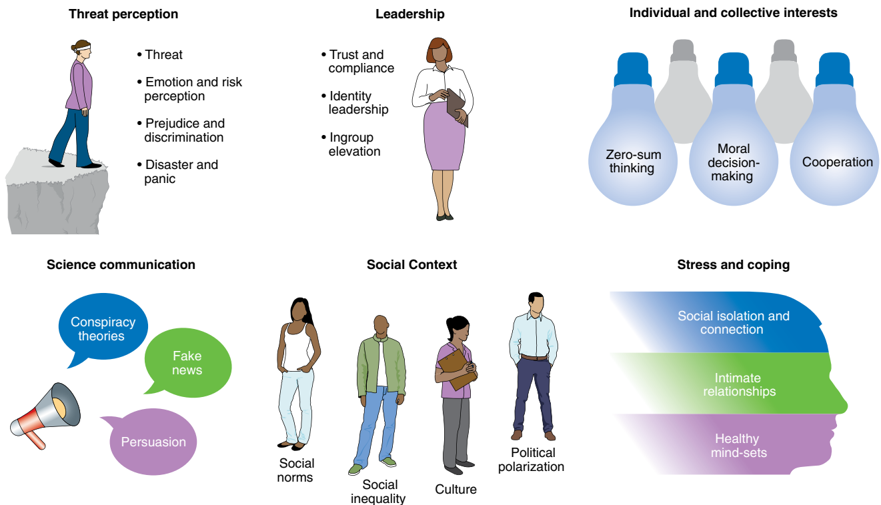
The COVID-19 pandemic represents a massive global health crisis. Because the crisis requires large-scale behaviour change and places significant psychological burdens on individuals, insights from the social and behavioural sciences can be used to help align human behaviour with the recommendations of epidemiologists and public health experts. Here we discuss evidence from a selection of research topics relevant to pandemics, including work on navigating threats, social and cultural influences on behaviour, science communication, moral decision-making, leadership, and stress and coping. In each section, we note the nature and quality of prior research, including uncertainty and unsettled issues. We identify several insights for effective response to the COVID-19 pandemic and highlight important gaps researchers should move quickly to fill in the coming weeks and months.
Overview
CoChat Summary
TL;DR
This perspective argues that social and behavioural science can help align public behaviour with COVID-19 public health recommendations across threat perception, social context, science communication, cooperation, leadership, and stress/coping. It synthesizes prior evidence and policy insights while cautioning that evidence is limited, often drawn from non-pandemic contexts, and in many areas unsettled.
Key findings
- The paper notes the scale of infectious disease threats: the bubonic plague killed approximately 25% of the European population, and by March 2020 COVID-19 had spread to more than 118,000 cases and caused 4,291 deaths in 114 countries. It also notes that 21 countries donated medical supplies to China in February, with China reciprocating widely.
- Fear appeals can change behaviour when people feel capable of dealing with the threat, but produce defensive reactions when people feel helpless; optimism bias can lead people to underestimate personal risk and ignore public health warnings.
- Social norms, inequality, culture, and political polarization shape pandemic behaviour: correcting misperceived norms can help when most people are already doing the desirable behaviour, but descriptive norms can backfire if the behaviour is undesirable unless paired with prescriptive norms.
- Effective communication and leadership may involve credible sources, messages that protect others or align with moral values, prebunking/inoculation against misinformation, accuracy nudges, shared social identity, and leaders modelling prosocial sacrifice; excessive national self-image concerns (“collective narcissism”) can backfire.
Methods
- Design: Perspective/narrative review; no primary data collection or sample. Topics were identified by the corresponding authors as potentially relevant to pandemic response and are explicitly not exhaustive.
- Evidence base: synthesizes prior social and behavioural research on threat perception, social context, science communication, moral decision-making, cooperation, leadership, and stress/coping, drawing on laboratory experiments, correlational studies, field experiments, meta-analyses, and preprints/forthcoming work.
- Analysis: narrative synthesis with policy implications and identified research gaps; no systematic search strategy or quantitative synthesis is reported.
Limitations
- Stated: due to space constraints, the paper provides only a brief summary of each topic; research on these topics is ongoing and in many cases far from settled; there is very little published social science research on the current pandemic, so discussion often draws from different circumstances and evidence quality varies substantially.
- Stated: insights and policy implications should be interpreted with caution.
- Evident: as a perspective rather than a systematic review or empirical study, it does not provide a comprehensive evidence appraisal, and its reliance on preprints and forthcoming sources limits certainty.
Model-written summary. Check it against the paper before relying on it.
Integrity signals
Registry
Cites
Statistics
Figures
Verification
Claims the paper makes
19 Valid · 5 Not valid · 37 Not checked · 13 Own results and interpretations
At least one cited source doesn’t support this claim or points to a different paper, and none confirmed it — see the verdicts below.
In the paper
“For instance, in hypothetical scenarios about deciding whether to go to work while sick, American and British participants reported they would be less willing to stay home when it was uncertain they would infect a co-worker.”
What the sources say
- Disputedcites [176] Kappes, A. et al. Uncertainty about the impact of social decisions increases prosocial behaviour. Nat. Hum. Behav. 2, 573–580 (2018). sourceExperimental — accuracy not yet measured
In the paper’s account of the infectious-disease scenario (Abstract; page not provided), participants facing uncertainty about how severely a co-worker might be affected were more likely to stay home than controls, not less. The paper distinguishes that impact uncertainty from uncertainty about whether a co-worker would be infected. Its Study 6 Methods (page not provided) describe recruitment through AMT, but do not establish the claimed American and British participant groups. (LLM, conf=0.88)
Checked by a reasoning model — may be wrong.
hedgedstates an association- Asserted: passes — The authors put it forward as true.
- Checkable: passes — It can be checked against evidence.
- Load-bearing: passes — The paper’s conclusions depend on it.
- Based: passes — The paper gives a reason why it holds.
- Disputed
The cited sources that could be checked couldn’t confirm or dispute this claim.
In the paper
“Moreover, there is mixed research regarding whether corrections may actually increase belief in the original misinformation 121,124-126 or in other misleading claims that fail to get corrected 127 .”
What the sources say
- Not checked — no full text of the sourcecites [121] Guess, A. & Coppock, A. Does counter-attitudinal information cause backlash? Results from three large survey experiments. Br. J. Polit. Sci. https://doi.org/10.1017/S0007123418000327 (2018). source
- Not matchedcites [124] Wittenberg, C. & Berinsky, A.J. Misinformation and its correction. in Social Media and Democracy: The State of the Field (eds Persily, N. & Tucker, J. A.) (Cambridge University Press, forthcoming).
Its entry has no title and year that we can search by.
- Not checked — no full text of the sourcecites [125] Swire, B. & Ecker, U.K.H. Misinformation and its correction: Cognitive mechanisms and recommendations for mass communication. in Misinformation and Mass Audiences (eds. Southwell, B. G., Thorson, E. A. & Sheble, L.) 195–2011 (University of Texas Press, 2018). source
- Not checked — no full text of the sourcecites [126] Wood, T. & Porter, E. The elusive backfire effect: mass attitudes’ steadfast factual adherence. Polit. Behav. 41, 135–163 (2018). source
- Could not verifycites [127] Pennycook, G., McPhetres, J., Zhang, Y. & Rand, D. Fighting COVID-19 misinformation on social media: Experimental evidence for a scalable accuracy nudge intervention. Preprint at PsyArXiv https://doi.org/10.31234/osf.io/uhbk9 (2020). sourceExperimental — accuracy not yet measured
Citation 127 is attached to the suggestion that corrections may increase belief in other misleading claims that go uncorrected. The Statement of Relevance and Discussion describe an accuracy nudge that improved sharing decisions, not corrections or their effects on belief in uncorrected claims. Searches for correction backfire and uncorrected misinformation found no passage addressing that point; page numbers were unavailable in our copy. (LLM, conf=0.76)
hedgedstates a possible cause- Asserted: passes — The authors put it forward as true.
- Checkable: passes — It can be checked against evidence.
- Load-bearing: passes — The paper’s conclusions depend on it.
- Based: passes — The paper gives a reason why it holds.
The sources with a verdict support this claim; the rest weren’t checked yet, have no full text we could read, or their verdicts aren’t rated yet.
In the paper
“Indeed, laboratory research has found that people prioritize local over global (or international) interests 185,186 .”
What the sources say
- Supportedcites [185] Milinski, M., Hilbe, C., Semmann, D., Sommerfeld, R. & Marotzke, J. Humans choose representatives who enforce cooperation in social dilemmas through extortion. Nat. Commun. 7, 10915 (2016). source
The Results section (‘Voters choose selfish representatives’; page unavailable) reports that participants preferentially re-elected representatives who contributed less to the shared climate account and elected candidates who pledged to contribute less than a fair share. In this simulated international dilemma, that supports the claim that participants favored their own group’s interests over the collective goal; it does not establish that everyone did so. (LLM, conf=0.85)
- Not checked — no full text of the sourcecites [186] Reinders Folmer, C. P. et al. One for all: what representing a group may do to us. J. Exp. Soc. Psychol. 48, 1047–1056 (2012). source
plain- Asserted: passes — The authors put it forward as true.
- Checkable: passes — It can be checked against evidence.
- Load-bearing: passes — The paper’s conclusions depend on it.
- Based: passes — The paper gives a reason why it holds.
- Supported
Every source the paper cites for this claim was checked and supports it.
In the paper
“However, when going to work risked infecting an elderly co-worker who would suffer a serious illness, participants reported they would be more willing to stay home 176 .”
What the sources say
- Supportedcites [176] Kappes, A. et al. Uncertainty about the impact of social decisions increases prosocial behaviour. Nat. Hum. Behav. 2, 573–580 (2018). source
The Study 6 Methods (page not provided) describe a scenario in which going to work could infect an older, vulnerable co-worker who would suffer severely, followed by a rating of willingness to go to work. The reported Study 6 findings (indexed under Abstract; page not provided) say participants given that risk information were significantly more likely to stay home than controls. (LLM, conf=0.92)
hedgedstates a cause- Asserted: passes — The authors put it forward as true.
- Checkable: passes — It can be checked against evidence.
- Load-bearing: passes — The paper’s conclusions depend on it.
- Based: passes — The paper gives a reason why it holds.
- Supported
The sources with a verdict support this claim; the rest weren’t checked yet, have no full text we could read, or their verdicts aren’t rated yet.
In the paper
“Several techniques, such as sanctioning defectors 187 or rewarding cooperators 188 , tend to increase cooperative behaviour in laboratory experiments using economic games.”
What the sources say
- Not checked — no full text of the sourcecites [187] Yamagishi, T. The provision of a sanctioning system as a public good. J. Pers. Soc. Psychol. 51, 110–116 (1986). source
- Supportedcites [188] Rand, D. G., Dreber, A., Ellingsen, T., Fudenberg, D. & Nowak, M. A. Positive interactions promote public cooperation. Science 325, 1272–1275 (2009). source
Citation 188 is attached to rewarding cooperators. The paper’s Abstract reports a laboratory comparison using repeated public goods games and finds that reward maintained public cooperation and, when both reward and punishment were available, increased contributions. (LLM, conf=0.93)
plainstates a cause- Asserted: passes — The authors put it forward as true.
- Checkable: passes — It can be checked against evidence.
- Load-bearing: unclear — It is unclear whether the paper’s conclusions depend on it.
- Based: passes — The paper gives a reason why it holds.
50 more claims · 13 with their cited sources checked
Create a free account to see all 74 claims and to verify the 2 references still open.
- It may state two separate claims as one. 13
- Probably not a substantial claim. 6
Claims other papers make about this one
Each is checked against this paper’s own text: does it say what the citing paper says it does?
The source backs part of the claim, not all of it — or backs it for a different population, condition or comparison.
In the citing paper
“COVID-19 is an international public health crisis, putting substantial burden on medical centers and increasing the psychological toll on health care workers (HCW).”
From Supporting the well-being of health care providers during the COVID-19 pandemic: The CopeColumbia response (2020) · cites this paper as [6]
Experimental — accuracy not yet measuredThe source backs part of the claim, not all of it — or backs it for a different population, condition or comparison.
In the citing paper
“these population-wide measures affected psychological well-being and mental health as well as increased social isolation [68] and loneliness.”
From Psychological correlates of perceived loneliness in college students before and during the COVID-19 stay-at-home period: a longitudinal study (2023) · cites this paper as [68]
Experimental — accuracy not yet measuredThe source backs part of the claim, not all of it — or backs it for a different population, condition or comparison.
In the citing paper
“they may eventually increase the social isolation of students and affect their psychological well-being and mental health [3].”
From Students under lockdown: Comparisons of students’ social networks and mental health before and during the COVID-19 crisis in Switzerland (2020) · cites this paper as [3]
Experimental — accuracy not yet measuredThe source backs part of the claim, not all of it — or backs it for a different population, condition or comparison.
In the citing paper
“effective interventions are hard to scale to a population level (12);”
From Psychological inoculation improves resilience against misinformation on social media (2022) · cites this paper as [12]
Experimental — accuracy not yet measuredThe source backs part of the claim, not all of it — or backs it for a different population, condition or comparison.
In the citing paper
“There is a shortage of studies that test anti-misinformation interventions in an ecologically valid manner, i.e., testing an intervention as consumers would interact with it in online environments (8, 12).”
From Psychological inoculation improves resilience against misinformation on social media (2022) · cites this paper as [12]
Experimental — accuracy not yet measured
6 more claims about this paper
Create a free account to see every claim other papers make about this one.
Citations
Cites
Items 201–257 of 257
Elevation Puts Moral Values Into Action
Schnall, S., & Roper, J. (2012) · Social Psychological and Personality Science · doi:10.1177/1948550611423595 · Cited by 145
Self-citationEmphasizing publishers does not effectively reduce susceptibility to misinformation on social media
Dias, N., Pennycook, G., & Rand, D. G. (2020) · Harvard Kennedy School Misinformation Review · doi:10.37016/mr-2020-001 · Cited by 145
Self-citationEcological and cultural factors underlying the global distribution of prejudice
Jackson, J. C., van Egmond, M., Choi, V. K., Ember, C. R., Halberstadt, J., Balanovic, J., Basker, I. N., Boehnke, K., Buki, N., Fischer, R., et al. (2019) · PLOS ONE · doi:10.1371/journal.pone.0221953 · Cited by 144
Self-citationEvans, A. T., Peters, E., Strasser, A. A., Emery, L. F., Sheerin, K. M., & Romer, D. (2015) · PLOS ONE · doi:10.1371/journal.pone.0142879 · Cited by 142
Self-citationPandemics: waves of disease, waves of hate from the Plague of Athens to A.I.D.S.*
Cohn, S. K. (2012) · Historical Research · doi:10.1111/j.1468-2281.2012.00603.x · Cited by 141
Biology of plagues: evidence from historical populations
(2001) · Choice Reviews Online · doi:10.5860/choice.39-0349 · Cited by 141
The Many Ways to Be Marginal in a Group
Ellemers, N., & Jetten, J. (2013) · Personality and Social Psychology Review · doi:10.1177/1088868312453086 · Cited by 139
Self-citationJ. Leman, P., & Cinnirella, M. (2007) · Social Psychological Review · doi:10.53841/bpsspr.2007.9.2.18 · Cited by 138
Folk-economic beliefs: An evolutionary cognitive model
Boyer, P., & Petersen, M. B. (2018) · Behavioral and Brain Sciences · doi:10.1017/s0140525x17001960 · Cited by 137
Morality and the Regulation of Social Behavior: Groups as Moral Anchors
Ellemers, N. (2017) · doi:10.4324/9781315661322 · Cited by 137
Self-citationScientific agreement can neutralize politicization of facts
Linden, S. V. D., Leiserowitz, A., & Maibach, E. (2017) · Nature Human Behaviour · doi:10.1038/s41562-017-0259-2 · Cited by 136
Self-citationThe popularity of conspiracy theories of presidential assassination: A Bayesian analysis.
McCauley, C., & Jacques, S. (1979) · Journal of Personality and Social Psychology · doi:10.1037/0022-3514.37.5.637 · Cited by 135
Increasing altruistic and cooperative behaviour with simple moral nudges
Capraro, V., Jagfeld, G., Klein, R., Mul, M., & de Pol, I. V. (2019) · Scientific Reports · doi:10.1038/s41598-019-48094-4 · Cited by 135
Self-citationSchroeder, J., Kardas, M., & Epley, N. (2017) · Psychological Science · doi:10.1177/0956797617713798 · Cited by 129
Self-assertive interdependence in Arab culture
San Martin, A., Sinaceur, M., Madi, A., Tompson, S., Maddux, W. W., & Kitayama, S. (2018) · Nature Human Behaviour · doi:10.1038/s41562-018-0435-z · Cited by 124
Self-citationThe Incidental Pundit: Who Talks Politics with Whom, and Why?
Minozzi, W., Song, H., Lazer, D. M. J., Neblo, M. A., & Ognyanova, K. (2020) · American Journal of Political Science · doi:10.1111/ajps.12469 · Cited by 123
Leach, C. W., Bilali, R., & Pagliaro, S. (2015) · APA handbook of personality and social psychology, Volume 2: Group processes. · doi:10.1037/14342-005 · Cited by 120
Zero-Sum Bias: Perceived Competition Despite Unlimited Resources
Meegan, D. V. (2010) · Frontiers in Psychology · doi:10.3389/fpsyg.2010.00191 · Cited by 114
Doré, B. P., Morris, R. R., Burr, D. A., Picard, R. W., & Ochsner, K. N. (2017) · Personality and Social Psychology Bulletin · doi:10.1177/0146167217695558 · Cited by 111
Making it moral: Merely labeling an attitude as moral increases its strength
Luttrell, A., Petty, R. E., Briñol, P., & Wagner, B. C. (2016) · Journal of Experimental Social Psychology · doi:10.1016/j.jesp.2016.04.003 · Cited by 107
Self-citationQuarantelli, E. L. (2001) · International Encyclopedia of the Social & Behavioral Sciences · doi:10.1016/b0-08-043076-7/01867-2 · Cited by 98
Comparing the Happiness Effects of Real and On-Line Friends
Helliwell, J. F., & Huang, H. (2013) · PLoS ONE · doi:10.1371/journal.pone.0072754 · Cited by 96
The Robust Relationship Between Conspiracism and Denial of (Climate) Science
Lewandowsky, S., Gignac, G. E., & Oberauer, K. (2015) · Psychological Science · doi:10.1177/0956797614568432 · Cited by 88
Morse, B., Grépin, K. A., Blair, R. A., & Tsai, L. (2016) · BMJ Global Health · doi:10.1136/bmjgh-2015-000007 · Cited by 82
Uncertainty about the impact of social decisions increases prosocial behaviour
Kappes, A., Nussberger, A.-M., Faber, N. S., Kahane, G., Savulescu, J., & Crockett, M. J. (2018) · Nature Human Behaviour · doi:10.1038/s41562-018-0372-x · Cited by 79
Self-citationPeters, E. M., Västfjäll, D., Slovic, P., Mazzocco, K., & Dickert, S. (2005) · PsycEXTRA Dataset · doi:10.1037/e640112011-034 · Cited by 78
Self-citationSoper, G. A. (1919) · Science · doi:10.1126/science.49.1274.501 · Cited by 76
Swire, B., & Ecker, U. (2018) · Misinformation and Mass Audiences · doi:10.7560/314555-013 · Cited by 75
Tsai, L. L., Morse, B. S., & Blair, R. A. (2020) · Comparative Political Studies · doi:10.1177/0010414019897698 · Cited by 74
Slovic, P. (1988) · Springer eBooks · doi:10.1007/978-1-4684-5484-0_13 · Cited by 71
The effects of perceived social norms on handwashing behaviour in students
Dickie, R., Rasmussen, S., Cain, R., Williams, L., & MacKay, W. (2018) · Psychology, Health & Medicine · doi:10.1080/13548506.2017.1338736 · Cited by 69
Applying Crowd Psychology to Develop Recommendations for the Management of Mass Decontamination
Carter, H., Drury, J., Rubin, G. J., Williams, R., & Amlôt, R. (2015) · Health Security · doi:10.1089/hs.2014.0061 · Cited by 63
Self-citationHumans choose representatives who enforce cooperation in social dilemmas through extortion
Milinski, M., Hilbe, C., Semmann, D., Sommerfeld, R., & Marotzke, J. (2016) · Nature Communications · doi:10.1038/ncomms10915 · Cited by 62
Ambiguity and excuse-driven behavior in charitable giving
Garcia, T., Massoni, S., & Villeval, M. C. (2020) · European Economic Review · doi:10.1016/j.euroecorev.2020.103412 · Cited by 62
Kitayama, S., Park, J., Miyamoto, Y., Date, H., Boylan, J. M., Markus, H. R., Karasawa, M., Kawakami, N., Coe, C. L., Love, G. D., et al. (2018) · Personality and Social Psychology Bulletin · doi:10.1177/0146167217748603 · Cited by 59
Self-citationA neurobiological association of revenge propensity during intergroup conflict
Han, X., Gelfand, M. J., Wu, B., Zhang, T., Li, W., Gao, T., Pang, C., Wu, T., Zhou, Y., Zhou, S., et al. (2020) · eLife · doi:10.7554/elife.52014 · Cited by 58
Self-citationUsing behavioural science to help fight the coronavirusPreprint
Lunn, P., Belton, C. A., Lavin, C., McGowan, F., Timmons, S., & Robertson, D. A. (2020) · RePEc: Research Papers in Economics · Cited by 52
Valuing different human lives.
Goodwin, G. P., & Landy, J. F. (2014) · Journal of Experimental Psychology: General · doi:10.1037/a0032796 · Cited by 48
Kraus, B., & Kitayama, S. (2019) · Biological Psychology · doi:10.1016/j.biopsycho.2019.107733 · Cited by 46
Self-citationCouples and Stress: How Demands Outside a Relationship Affect Intimacy within the Relationship
Karney, B. (2013) · Oxford Handbooks Online · doi:10.1093/oxfordhb/9780195398694.013.0030 · Cited by 41
Infectious Diseases, Non–Zero-Sum Thinking, and the Developing World
Folch, E., Hernandez, I., Barragan, M., & Franco-Paredes, C. (2003) · The American Journal of the Medical Sciences · doi:10.1097/00000441-200308000-00003 · Cited by 39
Race, alienation, and interpersonal mistrust
Demaris, A., & Yang, R. (1994) · Sociological Spectrum · doi:10.1080/02732173.1994.9982075 · Cited by 39
On sanction-goal justifications: How and why deterrence justifications undermine rule compliance.
Mooijman, M., van Dijk, W. W., van Dijk, E., & Ellemers, N. (2017) · Journal of Personality and Social Psychology · doi:10.1037/pspi0000084 · Cited by 36
Self-citation(2004) · Cited by 33
Benefit Inequality among American Workers by Gender, Race, and Ethnicity, 1982-2015
Kristal, T., Cohen, Y., & Navot, E. (2018) · Sociological Science · doi:10.15195/v5.a20 · Cited by 32
Looking up to virtue: averting gaze facilitates moral construals via posteromedial activations
Yang, X., Pavarini, G., Schnall, S., & Immordino‐Yang, M. H. (2018) · Social Cognitive and Affective Neuroscience · doi:10.1093/scan/nsy081 · Cited by 31
Self-citationLessons from the Faith-Driven Response to the West africa Ebola Epidemic†
Greyling, C., Maulit, J. A., Parry, S., Robinson, D., Smith, S., Street, A., & Vitillo, R. (2016) · The Review of Faith & International Affairs · doi:10.1080/15570274.2016.1215829 · Cited by 30
Self-citationMoney, kisses, and electric shocks: On the affective psychology of risk
Rottenstreich, Y., & Hsee, C. K. (2000) · PsycEXTRA Dataset · doi:10.1037/e683322011-018 · Cited by 29
The dark side of inclusion: Undesired acceptance increases aggression
Greenaway, K. H., Jetten, J., Ellemers, N., & van Bunderen, L. (2015) · Group Processes & Intergroup Relations · doi:10.1177/1368430214536063 · Cited by 27
Self-citationOne for all: What representing a group may do to us
Reinders Folmer, C. P., Klapwijk, A., De Cremer, D., & Van Lange, P. A. M. (2012) · Journal of Experimental Social Psychology · doi:10.1016/j.jesp.2012.04.009 · Cited by 26
Community-Based Crisis Response: Evidence from Sierra Leone's Ebola Outbreak
Christensen, D., Dube, O., Haushofer, J., Siddiqi, B. M., & Voors, M. J. (2020) · AEA Papers and Proceedings · doi:10.1257/pandp.20201015 · Cited by 25
Self-citationO’Keefe, D. J. (2016) · doi:10.4135/9781483398853 · Cited by 19
The All-or-Nothing Marriage: How the Best Marriages Work
Finkel, E. J. (2017) · Cited by 13
Self-citationAuthoritarianism and Polarization in American Politics, Still?
Hetherington, M. J., & Weiler, J. D. (2015) · American Gridlock · doi:10.1017/cbo9781316287002.006 · Cited by 12
Why People Cooperate: The Role of Social Motivations by Tom Tyler .
Beltran, F. S. (2011) · Journal of Artificial Societies and Social Simulation · Cited by 10
Rethinking the Emotional Brain
LeDoux, J. (2012) · Neuron · doi:10.1016/j.neuron.2012.02.018
Research works printed but not linked: 3
- Berkowitz, A.D. An overview of the social norms approach. in Changing the Culture of College Drinking: A Socially Situated Health Communication Campaign (eds. Stewart, L. & Lederman, L. C.) 193–214 (Hampton Press, 2005).
- Wittenberg, C. & Berinsky, A.J. Misinformation and its correction. in Social Media and Democracy: The State of the Field (eds Persily, N. & Tucker, J. A.) (Cambridge University Press, forthcoming).
- Ransohoff, K.J. Patients on the Trolley Track: The Moral Cognition of Medical Practitioners and Public Health Professionals. (Harvard Univ. Press, 2011).
Cited by
COVID-19 and the workplace: Implications, issues, and insights for future research and action.
Kniffin, K. M., Narayanan, J., Anseel, F., Antonakis, J., Ashford, S. P., Bakker, A. B., Bamberger, P., Bapuji, H., Bhave, D. P., Choi, V. K., et al. (2021) · American Psychologist · doi:10.1037/amp0000716 · Cited by 1,712
Self-citationSusceptibility to misinformation about COVID-19 around the world
Roozenbeek, J., Schneider, C. R., Dryhurst, S., Kerr, J., Freeman, A. L. J., Recchia, G., van der Bles, A. M., & van der Linden, S. (2020) · Royal Society Open Science · doi:10.1098/rsos.201199 · Cited by 1,447
Elmer, T., Mepham, K., & Stadtfeld, C. (2020) · PLOS ONE · doi:10.1371/journal.pone.0236337 · Cited by 1,658
“While social distancing measures may successfully slow down the spread of the infection and relieve the public health systems [2], they may eventually increase the social isolation of students and affect their psychological well-being and mental health [3].”
BackgroundStress and parenting during the global COVID-19 pandemic
Brown, S. M., Doom, J. R., Lechuga-Peña, S., Watamura, S. E., & Koppels, T. (2020) · Child Abuse & Neglect · doi:10.1016/j.chiabu.2020.104699 · Cited by 1,344
COVID-19 vaccine acceptance and hesitancy in low- and middle-income countries
(2021) · doi:10.1038/s41591-021-01454-y · Cited by 1,105
Metadata
- Authors
- Bavel, J. J. V., Baicker, K., Boggio, P. S., Capraro, V., Cichocka, A., Cikara, M., Crockett, M. J., Crum, A. J., Douglas, K. M., Druckman, J. N., Drury, J., Dube, O., Ellemers, N., Finkel, E. J., Fowler, J. H., Gelfand, M., Han, S., Haslam, S. A., Jetten, J., Kitayama, S., Mobbs, D., Napper, L. E., Packer, D. J., Pennycook, G., Peters, E., Petty, R. E., Rand, D. G., Reicher, S. D., Schnall, S., Shariff, A., Skitka, L. J., Smith, S. S., Sunstein, C. R., Tabri, N., Tucker, J. A., Linden, S. V. D., Lange, P. V., Weeden, K. A., Wohl, M. J. A., Zaki, J., Zion, S. R., & Willer, R.
- Affiliations
- New York University (US)
- Universidade Presbiteriana Mackenzie (BR)
- Middlesex University London (GB)
- University of Kent (GB)
- Harvard University (US)
- Yale University (US)
- Stanford University (US)
- Northwestern University (US)
- University of Sussex (GB)
- University of Chicago (US)
- Utrecht University (NL)
- University of California San Diego (US)
- University of Maryland, College Park (US)
- Peking University (CN)
- The University of Queensland (AU)
- University of Michigan (US)
- California Institute of Technology (US)
- Lehigh University (US)
- University of Regina (CA)
- University of Oregon (US)
- The Ohio State University (US)
- Massachusetts Institute of Technology (US)
- University of St Andrews (GB)
- University of Cambridge (GB)
- University of British Columbia (CA)
- University of Illinois Chicago (US)
- University of California, Berkeley (US)
- Carleton University (CA)
- Cornell University (US)
- Corresponding author
- Bavel, Jay J. Van
- Willer, Robb
- ORCID
- Bavel, Jay J. Van
- Baicker, Katherine
- Boggio, Paulo S.
- Capraro, Valerio
- Cichocka, Aleksandra
- Cikara, Mina
- Crockett, Molly J.
- Crum, Alia J.
- Douglas, Karen M.
- Druckman, James N.
- Drury, John
- Ellemers, Naomi
- Finkel, Eli J.
- Fowler, James H.
- Gelfand, Michele
- Han, Shihui
- Haslam, S. Alexander
- Jetten, Jolanda
- Kitayama, Shinobu
- Mobbs, Dean
- Napper, Lucy E.
- Packer, Dominic J.
- Pennycook, Gordon
- Peters, Ellen
- Petty, Richard E.
- Rand, David G.
- Reicher, Stephen D.
- Schnall, Simone
- Shariff, Azim
- Skitka, Linda J.
- Sunstein, Cass R.
- Tabri, Nassim
- Tucker, Joshua A.
- Linden, Sander van der
- Weeden, Kim A.
- Wohl, Michael J. A.
- Zaki, Jamil
- Zion, Sean R.
- Willer, Robb
- Venue
- Nature Human Behaviour
- Published
- 2020-04-30
- Volume
- 4
- Issue
- 5
- Pages
- 460-471
- ISSN
- 2397-3374 (ISSN-L)
- OpenAlex
- W3016902371
- Cited by
- 4,964
- References
- 259
- Citations by year
- 2026: 177 · 2025: 288 · 2024: 483 · 2023: 741 · 2022: 1094 · 2021: 1474 · 2020: 702
- FWCI
- 175.81
- Type
- journal article
- Language
- en
- Open access
- bronze
- doi.org
- Licence
- www.springernature.com/gp/researchers/text-and-data-mining (tdm)
- www.springernature.com/gp/researchers/text-and-data-mining (vor)
- Locations
- Nature Human Behaviour (publishedVersion)
- PubMed (publishedVersion)
- Middlesex University Research Repository (Middlesex University Of London) (acceptedVersion)
- Kent Academic Repository (University of Kent) (acceptedVersion)
- DSpace@MIT (Massachusetts Institute of Technology) (submittedVersion, cc-by-nc-sa)
- Sussex Research Online (University of Sussex) (submittedVersion)
- CaltechAUTHORS (California Institute of Technology) (submittedVersion)
- RePEc: Research Papers in Economics (submittedVersion)
- BOA (University of Milano-Bicocca) (submittedVersion)
- Carleton University's Institutional Repository (MacOdrum Library, Carleton University) (submittedVersion, other-oa)
- Utrecht University Repository (Utrecht University) (submittedVersion)
- Figshare (submittedVersion)
- VU Research Portal (submittedVersion, other-oa)
- Utrecht University Repository (Utrecht University) (submittedVersion, other-oa)
- Data Archiving and Networked Services (DANS) (submittedVersion, other-oa)
- Funders
- U.S. Department of Health and Human Services (2P50 MH094258)
- National Institute of Mental Health (P50MH094258)
- Topics
- Social Sciences › Sociology and Political Science › COVID-19 Prevention and Impact
- Social Sciences › Communication › Communication and COVID-19 Impact
- Physical Sciences › Mathematics › Modeling and Simulation › COVID-19 epidemiological studies
- Keywords
- COVID-19 pandemic, pandemic response, behavior change, science communication, ethical decision-making, leadership, stress coping, psychological burden, public health recommendations
- MeSH terms
- Betacoronavirus, COVID-19, SARS-CoV-2, Adaptation, Psychological, Communicable Disease Control, Decision Making, Humans, Human Activities, Health Knowledge, Attitudes, Practice, Leadership, Pneumonia, Viral, Public Health, Quarantine, Stress, Psychological, Global Health, Coronavirus, Coronavirus Infections, Pandemics, Social Media, Epidemiological Monitoring
About these checks
Registry, retraction, Cites and statistics results are computed, not judged, with one exception: a printed reference that no index lists is read once by a model before it counts as a citation error. Claims are extracted by a model and kept only when their quote appears verbatim in the text; each cited source is then checked, with a model’s help, for whether it says what the claim relies on. Those verdicts can be wrong — read the claim’s quote and the cited source before relying on one.
The claim verdicts this report counts are experimental: their accuracy is not yet measured.
A language model drew the claims from the paper on 2026-10-10, under version 3 of the claim definition (model deepseek-v4.1-flash, prompt extract-v3).
A second model labelled each claim on 2026-10-10 (model jev-1.13-20260917, definition revision gold-guideline-v0.2).
Cited sources are checked with a language model’s help (gpt-6-sol).
Statistics and arithmetic are recomputed, not judged.
Confidence bands are shown only for fields calibrated on our annotated test set. None is calibrated yet, so no band is shown.
What counts as a claim ›How we measure confidence ›How we check this ›
Are you an author, or do you see a problem with this page? Request a review
Data sources
Bibliographic data: Semantic Scholar, OpenAlex, Crossref.
Contains information from the Semantic Scholar Academic Graph Datasets, made available under the ODC Attribution License (ODC-BY 1.0).
Semantic Scholar’s data is described in: Kinney, R., et al. (2023). The Semantic Scholar Open Data Platform. arXiv:2301.10140.
