

A 98-qubit trapped-ion quantum computer with all-to-all connectivity
Open accessPublished version of a preprint
The DOI matches its Crossref record; 106 of the 106 references it cites were found in a registry or an index; 42 of the 72 sources its claims cite were checked for support.
Abstract
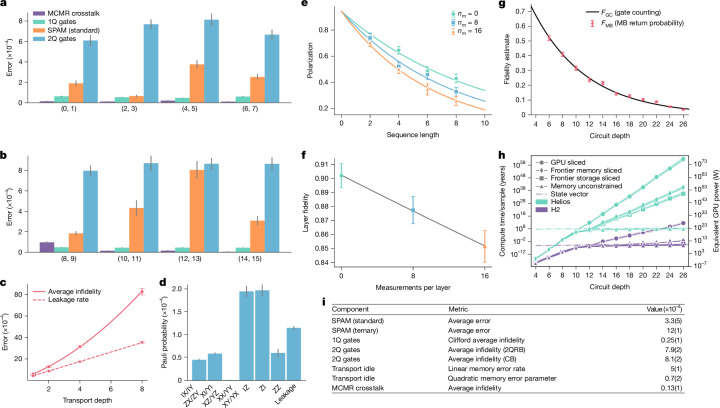
Quantum computers require both high-fidelity operations and large qubit numbers to surpass classical capabilities1. Trapped-ion platforms have demonstrated the highest gate fidelities of any modality2–6 but scaling to larger qubit numbers while preserving performance has remained a central challenge. We report on Quantinuum Helios, a 98-qubit trapped-ion quantum processor based on the quantum charge-coupled device (QCCD) architecture7. Helios features 137Ba+ hyperfine qubits8,9, all-to-all connectivity enabled by a rotatable ion storage ring connecting two quantum operation regions by a junction10,11, speed improvements from parallelized operations12 and a new software stack with real-time compilation of dynamic programs13. Averaged over all operational zones in the system, we achieve average infidelities of 2.5(1) × 10−5 for single-qubit (1Q) gates, 7.9(2) × 10−4 for two-qubit (2Q) gates and 3.3(5) × 10−4 for state preparation and measurement (SPAM), none of which are fundamentally limited and probably able to be improved. These component infidelities are predictive of system-level performance in both random Clifford circuits and random circuit sampling (RCS), the latter demonstrating that Helios operates well beyond the reach of classical simulation and establishes a new frontier of fidelity and complexity for quantum computers14. A new quantum computer, Quantinuum Helios, which is a 98-qubit trapped-ion quantum processor built on the QCCD architecture, demonstrates performance well beyond classical capabilities and provides a path for scaling up quantum computing.
Overview
CoChat Summary
## TL;DR
Helios is a 98-qubit trapped-ion QCCD quantum processor with all-to-all connectivity, real-time compilation, and parallelized operations. The paper reports average infidelities of 2.5(1) × 10−5 for 1Q gates, 7.9(2) × 10−4 for 2Q gates, and 3.3(5) × 10−4 for SPAM, and argues that its random circuit sampling is beyond classical simulation.
## Key findings
- Helios is a 98-qubit trapped-ion processor using 137Ba+ hyperfine qubits, with all-to-all connectivity enabled by a rotatable ion storage ring and junction-based routing.
- Component benchmarks report average infidelities of:
- 2.5(1) × 10−5 for single-qubit gates, including a leakage rate of 1.12(6) × 10−5
- 7.9(2) × 10−4 for two-qubit gates, including a leakage rate of 2.4(1) × 10−4
- 3.3(5) × 10−4 for SPAM
- The paper reports a per-MCMR crosstalk error of 1.3(1) × 10−5, a linear memory error rate of 5(1) × 10−4, and a quadratic memory error parameter of 7(2) × 10−5.
- System-level benchmarks give an effective 2Q error of 1.7(2) × 10−3 from random Clifford circuits and 2.00(6) × 10−3 from mirror benchmarking for RCS; the paper states this demonstrates operation “well beyond the reach of classical simulation.”
## Methods
- The system is a transport-based QCCD architecture with spatially separated memory and logic regions; up to 16 qubits are processed at a time across eight operation zones, with parallel sorting and ground-state cooling.
- Benchmarking includes component-level tests (SPAM, 1Q RB, 2Q RB, cycle benchmarking, memory-error transport RB, and MCMR crosstalk) and system-level tests (random Clifford circuits with MCMR and mirror benchmarking for RCS).
- Main analyses fit decay models to randomized benchmarking and mirror-benchmarking data, using leakage-aware infidelity estimates and stabilizer tracking / polarization fits to extract effective error rates.
## Limitations
- The authors explicitly state that some reported error sources are “not fundamentally limited” and “probably able to be improved.”
- They note a discrepancy between the measured 2Q infidelity, 7.9(2) × 10−4, and the lower predicted value, 3.5(4) × 10−4; they suggest possible causes such as higher leakage, non-thermal motion, crosstalk, or other unaccounted effects.
- The paper states that its comparison between component-level and system-level benchmarking is heuristic and that a rigorous methodology for comparing them is “an open problem.”
Model-written summary. Check it against the paper before relying on it.
Integrity signals
Registry
Cites
Statistics
Figures
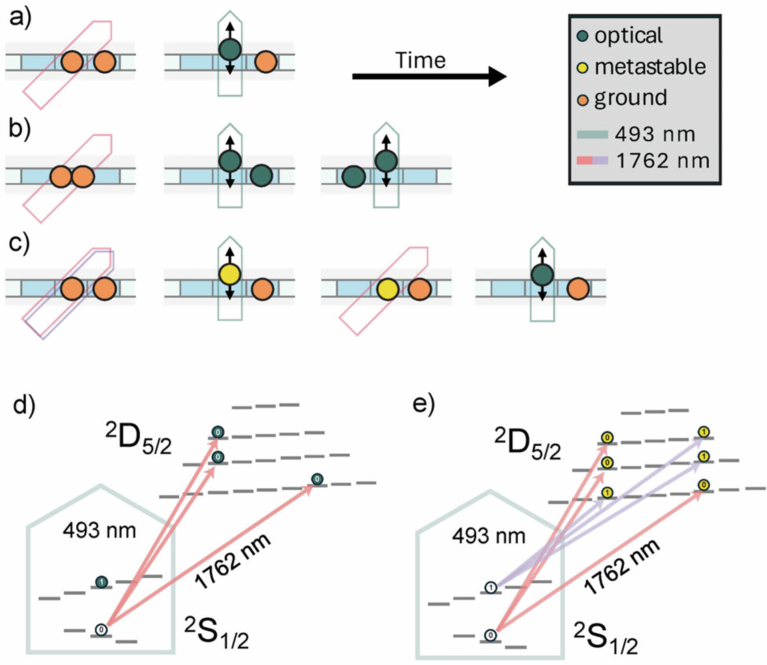
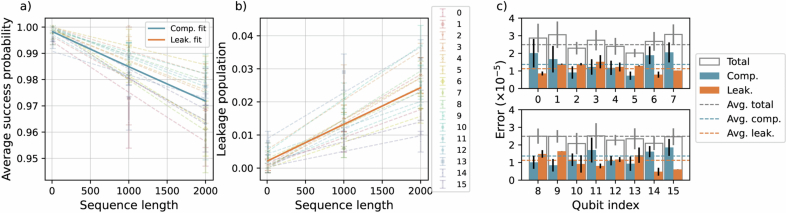
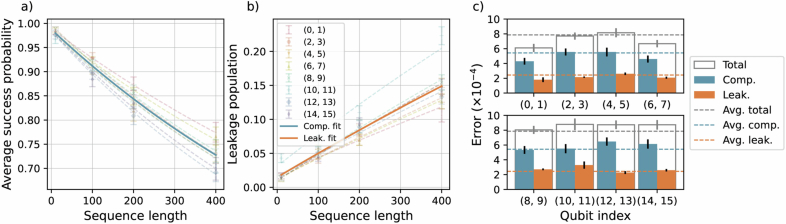
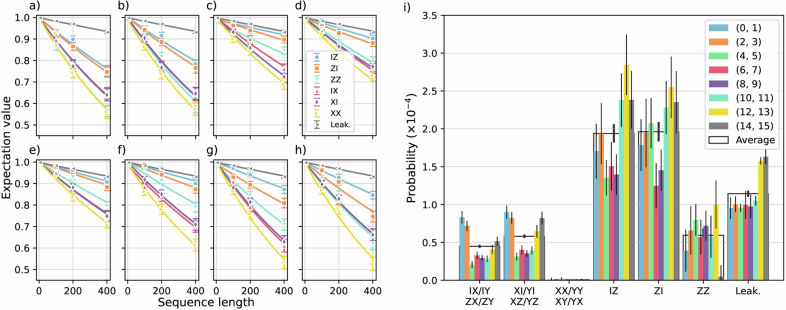
Verification
Claims the paper makes
21 Valid · 4 Not valid · 18 Not checked · 102 Own results and interpretations
Some cited sources support this claim and some don’t — read each source’s verdict below.
In the paper
“However, mobile qubit architectures, such as QCCD and optical tweezers24,25, can distribute resources more efficiently than stationary qubit architectures26–28, because qubits flow through the QPU like bits in a classical processor, with separated memory structures, data buses and logic units, each optimized for their purpose12.”
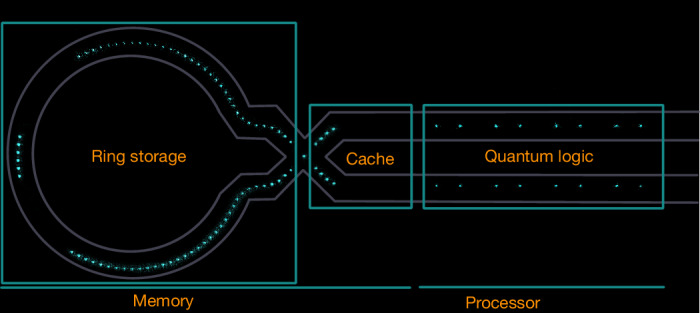
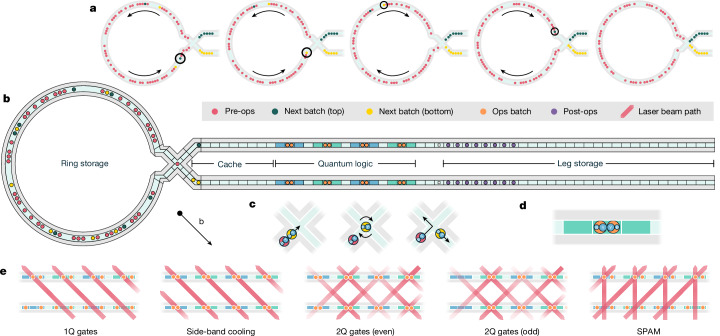
§ A 98-qubit trapped-ion quantum computer with all-to-all connectivity > Main As several quantum processing units (QPUs) demonstrate key milestones on the path to utility, including experimental evidence of quantum supremacy14–16 and the feasibility of fault tolerance17,18, the focus of progress is shifting to making use of the unique advantages of each architecture to scale to much larger sizes without affecting performance. Like all modalities, the trapped-ion QPU based on the QCCD architecture7,19–23 has its unique set of challenges and advantages in scaling. For example, trapped ions can require complex optical systems for implementing quantum operations. However, mobile qubit architectures, such as QCCD and optical tweezers24,25, can distribute resources more efficiently than stationary qubit architectures26–28, because qubits flow through the QPU like bits in a classical processor, with separated memory structures, data buses and logic units, each optimized for their purpose12. Here we present Quantinuum Helios, a 98-qubit trapped-ion QCCD quantum processor with three key advances from earlier Quantinuum QPUs21,22. First, Helios uses barium ions as the qubits8, achieving 99.92% two-qubit gate fidelity with a more scalable laser architecture. Second, Helios uses a four-way ‘X’ junction10,11,29–35 to connect memory regions to quantum logic regions without increasing electrical control or device fabrication complexity. Third, Helios is orchestrated by a new classical control implementation capable of executing truly arbitrary quantum programs with all-to-all connectivity and complex control flow logic. The cumulative impact of these advances enable us to scale the system size, from six qubits in the first QCCD quantum computer demonstrated five years ago21 to now 98 qubits, while setting a new state-of-the-art performance across all metrics, confirmed here by system benchmarks, including RCS, and seen in associated applications run on Helios in materials science and cryptography36–38.
What the sources say
- Supportedcites [24] Bluvstein, D. et al. A quantum processor based on coherent transport of entangled atom arrays. Nature 604, 451–456 (2022). 35444318 PMC9021024 source
The citation identifies optical tweezers as an example of a mobile-qubit architecture. The Main section describes entangled neutral atoms shuttled by optical tweezers between operation zones, and the Methods describe moving atoms in mobile traps. The broader efficiency comparison and classical-processor analogy are not specifically attributed to this citation. (LLM, conf=0.92)
- Supportedcites [25] Reichardt, B. W. et al. Fault-tolerant quantum computation with a neutral atom processor. Preprint at https://arxiv.org/abs/2411.11822 (2025). source
The citation is attached to 'optical tweezers' as an example of a mobile qubit architecture, and our copy of Reichardt et al. (2024) is exactly that: NEUTRAL ATOM QUANTUM PROCESSOR (p. 3) states 'By moving atoms between arrays of static optical tweezer traps using mobile tweezers, this platform enables arbitrary connectivity between large numbers of qubits', and the Fig. 1 caption (p. 1) notes 'Moving atoms between the zones enables arbitrary 2Q gate connectivity'. The same pages describe the resource separation the claim rests on — storage and 1Q operations in the register array, 2Q gates in a dedicated interaction zone, readout/cooling in cavity-enhanced optical lattices (p. 3) — and the methods (Register loading and atom reuse, p. 9) add that extra loaded sites let atoms be reused across circuit instances to 'improve data rates'. The comparative verdict against stationary architectures and the classical-processor analogy are the citing authors' framing (cited elsewhere, to refs 26–28 and 12), not something this source must state; nothing in our copy contradicts the attributed content. (LLM, conf=0.85)
- Supportedcites [26] Kim, Y. et al. Evidence for the utility of quantum computing before fault tolerance. Nature 618, 500–505 (2023). 37316724 PMC10266970 source
Citation 26–28 is attached to “stationary qubit architectures,” so this paper serves as an example of that architecture, not as evidence for the claimed efficiency advantage of mobile qubits. The Main section describes its processor as 127 fixed-frequency transmon qubits with heavy-hex connectivity and gates between neighbours. (LLM, conf=0.88)
- Disputedcites [27] Radnaev, A. G. et al. Universal neutral-atom quantum computer with individual optical addressing and nondestructive readout. PRX Quantum 6, 030334 (2025). sourceExperimental — accuracy not yet measured
The Introduction (Sec. 1, p. 2) of our copy compares exactly these two architecture families, but its verdict runs the other way: the shuttling/mobility approach 'increases compilation complexity and limits gate rates ... due to constraints on the speed of atom movement', whereas keeping qubits stationary and addressing them individually enables 'gate rates limited only by optical switching, which is inherently faster than atom movement' and 'the promise of faster circuits'. The only efficiency credit it gives to mobility is flexible connectivity and avoiding near-diffraction-limited addressing beams (p. 2), and the Outlook (Sec. 5, p. 7) again frames motion as unlocking long-range connectivity while individual addressing is preferable for parallel RZ and lower-power addressing. Nothing in our copy states that mobile architectures distribute resources more efficiently than stationary ones, and no passage offers the classical-processor rationale (qubits flowing through the QPU, separated memory, data buses, logic units) — searches for 'resource distribution', 'classical processor analogy', 'memory/data bus/logic units' returned only the architecture-comparison passage. The paper is also a stationary-qubit individual-addressing demonstration and does not mention QCCD or ion-trap architectures at all. (LLM, conf=0.65)
Checked by a reasoning model — may be wrong.
- Partly supportedcites [28] Chen, J.-S. et al. Benchmarking a trapped-ion quantum computer with 30 qubits. Quantum 8, 1516 (2024). sourceExperimental — accuracy not yet measured
Our copy supports only the 'stationary qubit architecture' side of the sentence: the Introduction (p. 1–2) states that in Forte 'the 30 qubits are all-to-all connected in a single, linear ion chain' and that 'the number of distinct gate pairs in an all-to-all connected architecture scales as O(N^2), and so the task of calibrating all gate pairs ... also scales as O(N^2)', and Sec. 2 (p. 2) confirms the chain 'generally persists in the quantum region' during computation (ions are transported only during loading/merging). Nothing in the paper compares this with mobile-qubit schemes: searched for QCCD, shuttling, race-track/moving-qubit and optical-tweezer architectures, and for any classical-processor analogy (memory/data-bus/logic separation) — the only mobile-architecture work mentioned is Klein et al.'s race-track processor, appearing in the reference list as a citation, not as a basis for an efficiency claim. The attribution that mobile architectures 'distribute resources more efficiently' is therefore not supported by this source. (LLM, conf=0.65)
- Supportedcites [12] Brandl, M. F. A quantum von Neumann architecture for large-scale quantum computing. Preprint at https://arxiv.org/abs/1702.02583 (2017). source
Brandl (2017) states exactly this content: Sec. 4 (p. 10) introduces the quantum von Neumann architecture whose 'operation principle ... is similar to that of classical von Neumann architecture', with a quantum bus system moving quantum information between a specialized QALU and a multiplexed quantum memory, in contrast to massively parallel architectures where the DiVincenzo criteria must be met at every qubit site; Sec. 3.1 (p. 7) and Sec. 4.2 (p. 12) give the efficiency argument (separate regions give low hardware demand per stored qubit, avoiding Rent's-rule/wiring limits of 'sea of qubits', Sec. 1 p. 2). The named mobile implementations are in our copy: QCCD in segmented ion traps (Sec. 5, p. 13) and optical tweezers with MEMS beam steering to move atoms/qubits (Sec. 4.4, p. 12). The only narrowing the source adds is that this advantage pertains to large-scale systems (small/medium-scale favours massively parallel hardware, Sec. 3.2 p. 10), consistent with the claim's hedged 'can'. (LLM, conf=0.85)
plainstates a cause- Asserted: passes — The authors put it forward as true.
- Checkable: passes — It can be checked against evidence.
- Load-bearing: unclear — It is unclear whether the paper’s conclusions depend on it.
- Based: passes — The paper gives a reason why it holds.
- Supported
Some cited sources support this claim and some don’t — read each source’s verdict below.
In the paper
“Second, Helios uses a four-way ‘X’ junction10,11,29–35 to connect memory regions to quantum logic regions without increasing electrical control or device fabrication complexity.”
§ A 98-qubit trapped-ion quantum computer with all-to-all connectivity > Main As several quantum processing units (QPUs) demonstrate key milestones on the path to utility, including experimental evidence of quantum supremacy14–16 and the feasibility of fault tolerance17,18, the focus of progress is shifting to making use of the unique advantages of each architecture to scale to much larger sizes without affecting performance. Like all modalities, the trapped-ion QPU based on the QCCD architecture7,19–23 has its unique set of challenges and advantages in scaling. For example, trapped ions can require complex optical systems for implementing quantum operations. However, mobile qubit architectures, such as QCCD and optical tweezers24,25, can distribute resources more efficiently than stationary qubit architectures26–28, because qubits flow through the QPU like bits in a classical processor, with separated memory structures, data buses and logic units, each optimized for their purpose12. Here we present Quantinuum Helios, a 98-qubit trapped-ion QCCD quantum processor with three key advances from earlier Quantinuum QPUs21,22. First, Helios uses barium ions as the qubits8, achieving 99.92% two-qubit gate fidelity with a more scalable laser architecture. Second, Helios uses a four-way ‘X’ junction10,11,29–35 to connect memory regions to quantum logic regions without increasing electrical control or device fabrication complexity. Third, Helios is orchestrated by a new classical control implementation capable of executing truly arbitrary quantum programs with all-to-all connectivity and complex control flow logic. The cumulative impact of these advances enable us to scale the system size, from six qubits in the first QCCD quantum computer demonstrated five years ago21 to now 98 qubits, while setting a new state-of-the-art performance across all metrics, confirmed here by system benchmarks, including RCS, and seen in associated applications run on Helios in materials science and cryptography36–38.
What the sources say
- Supportedcites [10] Blakestad, R. B. et al. High-fidelity transport of trapped-ion qubits through an X -junction trap array. Phys. Rev. Lett. 102, 153002 (2009). 19518628 source
The trap description (p. 1) identifies two intersecting channels as an X-junction with zones for ion transport, supporting the citation’s identification of a four-way junction. The citation appears immediately after “X junction”; the statements about Helios’s memory and logic regions and its complexity are the citing authors’ own design claims, not findings attributed to this paper. (LLM, conf=0.87)
- Supportedcites [11] Blakestad, R. B. et al. Near-ground-state transport of trapped-ion qubits through a multidimensional array. Phys. Rev. A 84, 032314 (2011). source
The citation is attached to the identification of a four-way X-junction. Section II (p. 3) describes two channels crossing to form an X-junction with four entrances. The sentence’s statements about Helios and its control or fabrication complexity are not attributed to this source by that citation. (LLM, conf=0.91)
- Partly supportedcites [29] Burton, W. C. et al. Transport of multispecies ion crystals through a junction in a radio-frequency Paul trap. Phys. Rev. Lett. 130, 173202 (2023). 37172235 sourceExperimental — accuracy not yet measured
The paper describes transport through a four-leg X junction (p. 1) and says junctions connect linear trap sections (p. 1). It does not discuss Helios, identify the connected sections as memory and quantum-logic regions, or establish that this arrangement avoids additional electrical-control or fabrication complexity. (LLM, conf=0.85)
- Partly supportedcites [30] Hensinger, W. K. et al. T-junction ion trap array for two-dimensional ion shuttling, storage, and manipulation. Appl. Phys. Lett. 88, 034101 (2006). sourceExperimental — accuracy not yet measured
Our copy of Hensinger et al. (2006) supports the functional role the claim describes — the Introduction (p. 1) frames shuttling ions between memory (storage) and interaction (entanglement) regions through a multi-dimensional junction as the building block for a scaled ion-trap computer — but the junction demonstrated here is explicitly a three-arm T, not a four-way 'X': the Abstract (p. 1) states the geometry is 'two linear rf ion trap sections that are joined at a 90 degree angle to form a T-shaped structure,' and the shuttling discussion (p. 2) refers to 'linear rf nodes leading towards the junction from all three directions.' The added assertion that this comes 'without increasing electrical control or device fabrication complexity' is also absent: the paper instead reports needing a symmetric three-layer geometry because transverse confinement in the junction region is difficult with two layers, plus 28 individually controlled electrodes (p. 2) and carefully synchronised, numerically optimised voltage sequences for corner turning (p. 2, Fig. 4). So the memory/logic-junction concept is supported while the four-way X geometry and the no-added-complexity claim are not. (LLM, conf=0.72)
- Not checked yetcites [31] Decaroli, C. et al. Design, fabrication and characterization of a micro-fabricated stacked-wafer segmented ion trap with two X-junctions. Quantum Sci. Technol. 6, 044001 (2021). source
Checked before — its earlier verdict is held back until a new check runs.
- Partly supportedcites [32] Wright, K. et al. Reliable transport through a microfabricated X -junction surface-electrode ion trap. New J. Phys. 15, 033004 (2013). sourceExperimental — accuracy not yet measured
Our copy supports the device and its role: the Abstract (p. 1) and Introduction (p. 3) describe a microfabricated surface-electrode X-junction ('linear trapping zones arranged in a ninety-degree cross', i.e. a four-way junction) made with standard VLSI-compatible processes, and the Conclusions (p. 11) state such an X-junction 'could be used ... to shift ions between registers of a future large-scale trapped-ion quantum information processor' — the memory-to-logic shuttling idea is introduced (p. 2) via the Kielpinski/Monroe/Wineland array proposal [7]. The clause 'without increasing electrical control or device fabrication complexity' is not supported: Section 2 (p. 3) reports seventy-eight independent DC control electrodes, a three-patterned-metal-layer (M1/M2/M3) stack with segmented control electrodes and on-chip filter capacitors, and states that 'a junction naively assembled from the intersection of two linear sections does not provide adequate three-dimensional confinement', requiring genetically optimized RF-electrode shapes (p. 3, Section 2). So the source supports scalability of the fabrication approach, not an absence of added control or fabrication complexity. (LLM, conf=0.80)
- Misattributedcites [33] Amini, J. M. et al. Toward scalable ion traps for quantum information processing. New J. Phys. 12, 033031 (2010). sourceExperimental — accuracy not yet measured
Our copy of Amini et al. (2010) reports and demonstrates only a three-leg 'Y'-type surface-electrode junction (Introduction p. 2; Sec. 3.2 p. 7 with threefold rotational symmetry; Sec. 4.1 p. 9 and Fig. 6 p. 10, transport between the junction's three legs) — no four-way 'X' junction is built or tested here. The X-junction is mentioned only to credit other work: Sec. 3 (p. 5) says junctions between multiple ponderomotive tubes 'have been demonstrated in larger, multi-substrate traps [11, 12]' and that 'as was shown in [12], efficient transport through a junction is possible', where reference [12] (References p. 11) is Blakestad et al., 'High-fidelity transport of trapped-ion qubits through an X-junction trap array', PRL 102, 153002 (2009). Memory regions appear in this paper only as a future possibility ('these legs could be extended in future designs to integrate ... other components such as memory storage regions', Sec. 3 p. 4), so the connectivity claim as stated is not this paper's result. (LLM, conf=0.72) It matches “High-fidelity transport of trapped-ion qubits through an X-junction trap array” (2009) instead.
Checked by a reasoning model — may be wrong.
- Disputedcites [34] Moehring, D. L. et al. Design, fabrication and experimental demonstration of junction surface ion traps. New J. Phys. 13, 075018 (2011). sourceExperimental — accuracy not yet measured
The Introduction and Abstract describe the demonstrated traps as three-arm Y-junctions, not four-way X-junctions. The Operation section reports shuttling through those Y-junctions; it does not establish the claimed connection between memory and logic regions or the absence of added complexity. (LLM, conf=0.86)
Checked by a reasoning model — may be wrong.
- Disputedcites [35] Shu, G. et al. Heating rates and ion-motion control in a Y-junction surface-electrode trap. Phys. Rev. A 89, 062308 (2014). sourceExperimental — accuracy not yet measured
The Introduction (p. 1) identifies the trap studied as having a central Y-junction, not the four-way X-junction attributed to this source. The Conclusion (p. 10) treats an X-junction as a separate trap in Ref. [42]. This paper also does not establish the claimed connection between memory and logic regions without added control or fabrication complexity. (LLM, conf=0.88)
Checked by a reasoning model — may be wrong.
plain- Asserted: passes — The authors put it forward as true.
- Checkable: passes — It can be checked against evidence.
- Load-bearing: passes — The paper’s conclusions depend on it.
- Based: passes — The paper gives a reason why it holds.
- Supported
The cited sources support only part of this claim — read each source’s verdict below.
In the paper
“Helios features 137Ba+ hyperfine qubits8,9, all-to-all connectivity enabled by a rotatable ion storage ring connecting two quantum operation regions by a junction10,11, speed improvements from parallelized operations12 and a new software stack with real-time compilation of dynamic programs13.”
§ A 98-qubit trapped-ion quantum computer with all-to-all connectivity > Abstract
What the sources say
- Partly supportedcites [10] Blakestad, R. B. et al. High-fidelity transport of trapped-ion qubits through an X -junction trap array. Phys. Rev. Lett. 102, 153002 (2009). 19518628 sourceExperimental — accuracy not yet measured
The introduction (p. 1) says junction-based trap arrays could bring ions from arbitrary locations together for multiqubit gates, and the trap description (p. 1) describes an X-junction connecting transport zones. The paper does not describe Helios, a rotatable ion storage ring, or two quantum operation regions, so it supports the junction-based connectivity concept but not the specific architecture claimed. (LLM, conf=0.84)
- Partly supportedcites [11] Blakestad, R. B. et al. Near-ground-state transport of trapped-ion qubits through a multidimensional array. Phys. Rev. A 84, 032314 (2011). sourceExperimental — accuracy not yet measured
The Introduction (p. 1) says ion transport through an array can bring arbitrarily selected qubits together for operations, and Section II (p. 2) describes an X-junction with an experiment zone. The paper does not describe Helios, a rotatable ion storage ring, or two quantum-operation regions connected by a junction. (LLM, conf=0.85)
plainstates a cause- Asserted: passes — The authors put it forward as true.
- Checkable: passes — It can be checked against evidence.
- Load-bearing: passes — The paper’s conclusions depend on it.
- Based: passes — The paper gives a reason why it holds.
- Partly supported
Every source the paper cites for this claim was checked and supports it.
In the paper
“We report on Quantinuum Helios, a 98-qubit trapped-ion quantum processor based on the quantum charge-coupled device (QCCD) architecture7.”
§ A 98-qubit trapped-ion quantum computer with all-to-all connectivity > Abstract
What the sources say
- Supportedcites [7] Kielpinski, D., Monroe, C. & Wineland, D. J. Architecture for a large-scale ion-trap quantum computer. Nature 417, 709–711 (2002). 12066177 source
The citation is attached to the QCCD architecture, rather than to the processor’s name or qubit count. In “The quantum CCD,” the paper proposes a quantum charge-coupled device architecture using interconnected ion traps, which supports that attribution. (LLM, conf=0.92)
plain- Asserted: passes — The authors put it forward as true.
- Checkable: passes — It can be checked against evidence.
- Load-bearing: passes — The paper’s conclusions depend on it.
- Based: passes — The paper gives a reason why it holds.
- Supported
The cited sources support only part of this claim — read each source’s verdict below.
In the paper
“Helios features 137Ba+ hyperfine qubits8,9, all-to-all connectivity enabled by a rotatable ion storage ring connecting two quantum operation regions by a junction10,11, speed improvements from parallelized operations12 and a new software stack with real-time compilation of dynamic programs13.”
§ A 98-qubit trapped-ion quantum computer with all-to-all connectivity > Abstract
What the sources say
- Supportedcites [8] Dietrich, M., Kurz, N., Noel, T., Shu, G. & Blinov, B. Hyperfine and optical barium ion qubits. Phys. Rev. A 81, 052328 (2010). source
The abstract (p. 1) states that state preparation, rotation and high-fidelity readout are demonstrated for two 137Ba+ qubit types, including 'a ground state hyperfine qubit using the magnetically insensitive transition at 8 GHz', and the Conclusion (p. 8) restates 'two implementations of ionic qubits using 137Ba+, first an optical qubit, and then a hyperfine qubit'. The Results (III, p. 6) describe using the mF = 0 levels of the two ground-state hyperfine levels as qubit states. As an identification citation for 137Ba+ hyperfine qubits, this source is that thing; the 'Helios' architecture claim is the citing paper's own and not attributed here. (LLM, conf=0.90)
- Partly supportedcites [9] An, F. A. et al. High fidelity state preparation and measurement of ion hyperfine qubits with. Phys. Rev. Lett. 129, 130501 (2022). 36206427 sourceExperimental — accuracy not yet measured
The paper describes preparing ¹³⁷Ba⁺ hyperfine qubit states (p. 1) and trapping single ¹³⁷Ba⁺ ions (p. 2). It does not identify Helios or establish which qubits that system uses, so it supports the qubit technology but not the Helios-specific claim. (LLM, conf=0.85)
plain- Asserted: passes — The authors put it forward as true.
- Checkable: passes — It can be checked against evidence.
- Load-bearing: unclear — It is unclear whether the paper’s conclusions depend on it.
- Based: passes — The paper gives a reason why it holds.
- Supported
71 more claims · 10 with their cited sources checked
Create a free account to see all 145 claims and to verify the 24 references still open.
- It may state two separate claims as one. 29
- Probably not a substantial claim. 47
- The quote only partly states this claim. 1
Citations
Cites
An Introduction to the Bootstrap
Efron, B., & Tibshirani, R. J. (1993) · doi:10.1007/978-1-4899-4541-9 · Cited by 21,230
Quantum supremacy using a programmable superconducting processor
Arute, F., Arya, K., Babbush, R., Bacon, D., Bardin, J. C., Barends, R., Biswas, R., Boixo, S., Brandao, F. G. S. L., Buell, D. A., et al. (2019) · Nature · doi:10.1038/s41586-019-1666-5 · Cited by 7,720 · cited 2×
“RCS is a system-level benchmark assessing how effectively a quantum computer can generate computationally complex quantum states 15 .”
Architecture for a large-scale ion-trap quantum computer
Kielpinski, D., Monroe, C., & Wineland, D. J. (2002) · Nature · doi:10.1038/nature00784 · Cited by 1,589 · cited 2×
“We report on Quantinuum Helios, a 98-qubit trapped-ion quantum processor based on the quantum charge-coupled device (QCCD) architecture 7 .”
Experimental issues in coherent quantum-state manipulation of trapped atomic ions
Wineland, D. J., Monroe, C., Itano, W. M., Leibfried, D., King, B. E., & Meekhof, D. M. (1998) · Journal of Research of the National Institute of Standards and Technology · doi:10.6028/jres.103.019 · Cited by 1,497 · cited 1×
“Like all modalities, the trapped-ion QPU based on the QCCD architecture 7,19–23 has its unique set of challenges and advantages in scaling.”
Monte Carlo wave-function method in quantum optics
Mølmer, K., Castin, Y., & Dalibard, J. (1993) · Journal of the Optical Society of America B · doi:10.1364/josab.10.000524 · Cited by 1,233
Characterizing quantum supremacy in near-term devices
Boixo, S., Isakov, S. V., Smelyanskiy, V. N., Babbush, R., Ding, N., Jiang, Z., Bremner, M. J., Martinis, J. M., & Neven, H. (2018) · Nature Physics · doi:10.1038/s41567-018-0124-x · Cited by 1,175 · cited 1×
“Although the fidelity of such circuits can in principle be inferred by running them and performing cross-entropy benchmarking 101 , evaluating the cross-entropy requires exact simulation of the circuits in question and is infeasible except for small depth or qubit number.”
Strong Quantum Computational Advantage Using a Superconducting Quantum Processor
Wu, Y., Bao, W.-S., Cao, S., Chen, F., Chen, M.-C., Chen, X., Chung, T.-H., Deng, H., Du, Y., Fan, D., et al. (2021) · Physical Review Letters · doi:10.1103/physrevlett.127.180501 · Cited by 1,059 · cited 1×
“…several quantum processing units (QPUs) demonstrate key mile-stones on the path to utility, including experimental evidence of quantum supremacy 14–16 and the feasibility of fault tolerance 17,18 , the focus of progress is shifting to making use of the unique advantages of each architecture to…”
Evidence for the utility of quantum computing before fault tolerance
Kim, Y., Eddins, A., Anand, S., Wei, K. X., van den Berg, E., Rosenblatt, S., Nayfeh, H., Wu, Y., Zaletel, M., Temme, K., et al. (2023) · Nature · doi:10.1038/s41586-023-06096-3 · Cited by 1,050 · cited 3×
“As well as the mirrored random circuits run to assess RCS performance, we also directly sampled the output of a single (unmirrored) random circuit of depth d = 26.”
InfluentialEntanglement and quantum computation with ions in thermal motion
Sørensen, A., & Mølmer, K. (2000) · Physical Review A · doi:10.1103/physreva.62.022311 · Cited by 783
Quantum error correction below the surface code threshold
Collaborators, G. Q. A. A., Acharya, R., Abanin, D. A., Aghababaie-Beni, L., Aleiner, I., Andersen, T. I., Ansmann, M., Arute, F., Arya, K., Asfaw, A., et al. (2025) · Nature · doi:10.1038/s41586-024-08449-y · Cited by 778
High-Fidelity Quantum Logic Gates Using Trapped-Ion Hyperfine Qubits
Ballance, C. J., Harty, T. P., Linke, N. M., Sepiol, M. A., & Lucas, D. M. (2016) · Physical Review Letters · doi:10.1103/physrevlett.117.060504 · Cited by 777
K S, U. (2025) · Zenodo (CERN European Organization for Nuclear Research) · doi:10.5281/zenodo.18067974 · Cited by 733
A simple formula for the average gate fidelity of a quantum dynamical operation
Nielsen, M. A. (2002) · Physics Letters A · doi:10.1016/s0375-9601(02)01272-0 · Cited by 725 · cited 1×
“To see whether the results are consistent with our component benchmarks, we first compute an effective 2Q gate error ϵ eff,2Q from the n m = 0 data, using in which the factor 5/4 comes from the conversion between process and average fidelity 99 .”
Validating quantum computers using randomized model circuits
Cross, A. W., Bishop, L. S., Sheldon, S., Nation, P. D., & Gambetta, J. M. (2019) · Physical Review A · doi:10.1103/physreva.100.032328 · Cited by 704 · cited 1×
“We perform two separate system-level benchmarking experiments 43–48 , both of which are examples of volumetric benchmarks 44 .”
Optimized dynamical decoupling in a model quantum memory
Biercuk, M. J., Uys, H., VanDevender, A. P., Shiga, N., Itano, W. M., & Bollinger, J. J. (2009) · Nature · doi:10.1038/nature07951 · Cited by 654 · cited 2×
“…assuming so-called ‘embarrassing parallelization’ (by means of slicing) into independent computations involving various amounts of available memory (corresponding to cotengra contraction widths of = 30 , 49 and 54) and were obtained using (sliced) simulated annealing built into cotengra 107 .”
Demonstration of the trapped-ion quantum CCD computer architecture
Pino, J. M., Dreiling, J. M., Figgatt, C., Gaebler, J. P., Moses, S. A., Allman, M. S., Baldwin, C. H., Foss-Feig, M., Hayes, D., Mayer, K., et al. (2021) · Nature · doi:10.1038/s41586-021-03318-4 · Cited by 547 · cited 16×
“…impact of these advances enable us to scale the system size, from six qubits in the first QCCD quantum computer demonstrated five years ago 21 to now 98 qubits, while setting a new state-of-the-art performance across all metrics, confirmed here by system benchmarks, including RCS, and…”
InfluentialSelf-citation(2016) · doi:10.1103/physrevlett.117.060505 · Cited by 540
Noise tailoring for scalable quantum computation via randomized compiling
Wallman, J. J., & Emerson, J. (2016) · Physical Review A · doi:10.1103/physreva.94.052325 · Cited by 535
Characterizing quantum gates via randomized benchmarking
Magesan, E., Gambetta, J. M., & Emerson, J. (2012) · Physical Review A · doi:10.1103/physreva.85.042311 · Cited by 464 · cited 1×
“4a,b. 1Q and 2Q gate errors are measured with Clifford RB 50 , SPAM errors are measured with repeated SPAM and MCMR crosstalk is measured with a state decay test 51 .”
Manipulation and detection of a trappedYb+hyperfine qubit
Olmschenk, S., Younge, K. C., Moehring, D. L., Matsukevich, D. N., Maunz, P., & Monroe, C. (2007) · Physical Review A · doi:10.1103/physreva.76.052314 · Cited by 464 · cited 1×
“The 171 Yb + ion is chosen because of its similar mass to 137 Ba + and for the established and straightforward methods for qubit control and state measurement 82 .”
A Race-Track Trapped-Ion Quantum Processor
Moses, S. A., Baldwin, C. H., Allman, M. S., Ancona, R., Ascarrunz, L., Barnes, C., Bartolotta, J., Bjork, B., Blanchard, P., Bohn, M., et al. (2023) · Physical Review X · doi:10.1103/physrevx.13.041052 · Cited by 391
Self-citationPhase transitions in random circuit sampling
Morvan, A., Villalonga, B., Mi, X., Mandrà, S., Bengtsson, A., Klimov, P. V., Chen, Z., Hong, S., Erickson, C., Drozdov, I., et al. (2024) · Nature · doi:10.1038/s41586-024-07998-6 · Cited by 354 · cited 1×
“14 ,102–105 and infer the fidelity of a layer depth-l circuit by computing the return-probability F MB of a ‘mirrored’ layer depth-l /2 circuit, with the second (mirrored) half of the circuit using randomized compiling to prevent unintended cancellation of coherent errors.”
High-Fidelity Readout of Trapped-Ion Qubits
Myerson, A. H., Szwer, D. J., Webster, S. C., Allcock, D. T. C., Curtis, M. J., Imreh, G., Sherman, J. A., Stacey, D. N., Steane, A. M., & Lucas, D. M. (2008) · Physical Review Letters · doi:10.1103/physrevlett.100.200502 · Cited by 334
Quantum Low-Density Parity-Check Codes
Breuckmann, N. P., & Eberhardt, J. N. (2021) · PRX Quantum · doi:10.1103/prxquantum.2.040101 · Cited by 328
Open Quantum Assembly Language
Cross, A. W., Bishop, L. S., Smolin, J. A., & Gambetta, J. M. (2017) · arXiv · doi:10.48550/arxiv.1707.03429 · Cited by 310
Realization of Real-Time Fault-Tolerant Quantum Error Correction
Ryan-Anderson, C., Bohnet, J. G., Lee, K., Gresh, D., Hankin, A., Gaebler, J. P., Francois, D., Chernoguzov, A., Lucchetti, D., Brown, N. C., et al. (2021) · Physical Review X · doi:10.1103/physrevx.11.041058 · Cited by 306
Self-citationEffective operator formalism for open quantum systems
Reiter, F., & Sørensen, A. S. (2012) · Physical Review A · doi:10.1103/physreva.85.032111 · Cited by 295
Characterization of Addressability by Simultaneous Randomized Benchmarking
Gambetta, J. M., Córcoles, A. D., Merkel, S. T., Johnson, B. R., Smolin, J. A., Chow, J. M., Ryan, C. A., Rigetti, C., Poletto, S., Ohki, T. A., et al. (2012) · Physical Review Letters · doi:10.1103/physrevlett.109.240504 · Cited by 289
Complete Methods Set for Scalable Ion Trap Quantum Information Processing
Home, J. P., Hanneke, D., Jost, J. D., Amini, J. M., Leibfried, D., & Wineland, D. J. (2009) · Science · doi:10.1126/science.1177077 · Cited by 283
Surface-electrode architecture for ion-trap quantum information processing
Chiaverini, J., Blakestad, R. B., Britton, J., Jost, J. D., Langer, C., Leibfried, D., Ozeri, R., & Wineland, D. J. (2005) · Quantum Information and Computation · doi:10.26421/qic5.6-1 · Cited by 257
Coherent Diabatic Ion Transport and Separation in a Multizone Trap Array
Bowler, R., Gaebler, J., Lin, Y., Tan, T. R., Hanneke, D., Jost, J. D., Home, J. P., Leibfried, D., & Wineland, D. J. (2012) · Physical Review Letters · doi:10.1103/physrevlett.109.080502 · Cited by 254 · cited 1×
“…include: (1) fewer gate errors, as our two-qubit gate error model suggests that the 2Q gate error could be cut in half; (2) smaller memory errors using dynamic decoupling strategies 54 ; and (3) reduced circuit times from both faster transport operations 55–57 and better compilation methods.”
Self-citationControlling Fast Transport of Cold Trapped Ions
Walther, A., Ziesel, F., Ruster, T., Dawkins, S. T., Ott, K., Hettrich, M., Singer, K., Schmidt-Kaler, F., & Poschinger, U. (2012) · Physical Review Letters · doi:10.1103/physrevlett.109.080501 · Cited by 253
Characterizing large-scale quantum computers via cycle benchmarking
Erhard, A., Wallman, J. J., Postler, L., Meth, M., Stricker, R., Martinez, E. A., Schindler, P., Monz, T., Emerson, J., & Blatt, R. (2019) · Nature Communications · doi:10.1038/s41467-019-13068-7 · Cited by 253 · cited 2×
“53) to estimate a partial Pauli error model for the 2Q gate in each operation zone, with the experimental and theoretical details provided in the Supplementary Information.”
OpenQASM 3: A Broader and Deeper Quantum Assembly Language
Cross, A., Javadi-Abhari, A., Alexander, T., De Beaudrap, N., Bishop, L. S., Heidel, S., Ryan, C. A., Sivarajah, P., Smolin, J., Gambetta, J. M., et al. (2022) · ACM Transactions on Quantum Computing · doi:10.1145/3505636 · Cited by 248 · cited 1×
“88,89), Cirq 90 and CUDA-Q 91 , can use QIR adaptive profile features to implement these control flow constructs for programs executing on Helios.”
Q#: Enabling Scalable Quantum Computing and Development with a High-level DSL
Svore, K., Geller, A., Troyer, M., Azariah, J., Granade, C., Heim, B., Kliuchnikov, V., Mykhailova, M., Paz, A., & Roetteler, M. (2018) · Proceedings of the Real World Domain Specific Languages Workshop 2018 · doi:10.1145/3183895.3183901 · Cited by 234
Javadi-Abhari, A., Treinish, M., Krsulich, K., Wood, C. J., Lishman, J., Gacon, J., Martiel, S., Nation, P. D., Bishop, L. S., Cross, A. W., et al. (2024) · arXiv (Cornell University) · doi:10.48550/arxiv.2405.08810 · Cited by 208
Surface-electrode architecture for ion-trap quantum information processing
(2005) · CERN Document Server (European Organization for Nuclear Research) · doi:10.5555/2011670.2011671 · Cited by 195
Hyper-optimized tensor network contraction
Gray, J., & Kourtis, S. (2021) · Quantum · doi:10.22331/q-2021-03-15-410 · Cited by 186
Toward scalable ion traps for quantum information processing
Amini, J. M., Uys, H., Wesenberg, J. H., Seidelin, S., Britton, J., Bollinger, J. J., Leibfried, D., Ospelkaus, C., VanDevender, A. P., & Wineland, D. J. (2010) · New Journal of Physics · doi:10.1088/1367-2630/12/3/033031 · Cited by 183
Phase control of trapped ion quantum gates
Lee, P. J., Brickman, K.-A., Deslauriers, L., Haljan, P. C., Duan, L.-M., & Monroe, C. (2005) · Journal of Optics B: Quantum and Semiclassical Optics · doi:10.1088/1464-4266/7/10/025 · Cited by 181
High-fidelity laser-free universal control of trapped ion qubits
Srinivas, R., Burd, S. C., Knaack, H. M., Sutherland, R. T., Kwiatkowski, A., Glancy, S., Knill, E., Wineland, D. J., Leibfried, D., Wilson, A. C., et al. (2021) · Nature · doi:10.1038/s41586-021-03809-4 · Cited by 174
Bowdrey, M. D., Oi, D. K. L., Short, A. J., Banaszek, K., & Jones, J. A. (2002) · Physics Letters A · doi:10.1016/s0375-9601(02)00069-5 · Cited by 172
High-Fidelity Transport of Trapped-Ion Qubits through anX-Junction Trap Array
Blakestad, R. B., Ospelkaus, C., VanDevender, A. P., Amini, J. M., Britton, J., Leibfried, D., & Wineland, D. J. (2009) · Physical Review Letters · doi:10.1103/physrevlett.102.153002 · Cited by 167 · cited 3×
“Trapped-ion platforms have demonstrated the highest gate fidelities of any modality 2–6 but scaling to larger qubit numbers while preserving performance has remained a central challenge.”
High-Fidelity Bell-State Preparation with Ca + 40 Optical Qubits
Clark, C. R., Tinkey, H. N., Sawyer, B. C., Meier, A. M., Burkhardt, K. A., Seck, C. M., Shappert, C. M., Guise, N. D., Volin, C. E., Fallek, S. D., et al. (2021) · Physical Review Letters · doi:10.1103/physrevlett.127.130505 · Cited by 165 · cited 1×
“Trapped-ion platforms have demonstrated the highest gate fidelities of any modality 2–6 but scaling to larger qubit numbers while preserving performance has remained a central challenge.”
T-junction ion trap array for two-dimensional ion shuttling, storage, and manipulation
Hensinger, W. K., Olmschenk, S., Stick, D., Hucul, D., Yeo, M., Acton, M., Deslauriers, L., Monroe, C., & Rabchuk, J. (2006) · Applied Physics Letters · doi:10.1063/1.2164910 · Cited by 164
Application-Oriented Performance Benchmarks for Quantum Computing
Lubinski, T., Johri, S., Varosy, P., Coleman, J., Zhao, L., Necaise, J., Baldwin, C. H., Mayer, K., & Proctor, T. (2021) · arXiv · doi:10.48550/arxiv.2110.03137 · Cited by 159
Self-citationApplication-Oriented Performance Benchmarks for Quantum Computing
Lubinski, T., Johri, S., Varosy, P., Coleman, J., Zhao, L., Necaise, J., Baldwin, C. H., Mayer, K., & Proctor, T. (2023) · IEEE Transactions on Quantum Engineering · doi:10.1109/tqe.2023.3253761 · Cited by 154
Self-citationCharacterizing errors on qubit operations via iterative randomized benchmarking
Sheldon, S., Bishop, L. S., Magesan, E., Filipp, S., Chow, J. M., & Gambetta, J. M. (2016) · Physical Review A · doi:10.1103/physreva.93.012301 · Cited by 152 · cited 3×
“We measure memory error with a variant of 1QRB that inter-leaves random transport between 1Q Clifford gates, referred to as transport-1QRB 22,52 .”
Sympathetic cooling of trapped ions for quantum logic
Kielpinski, D., King, B. E., Myatt, C. J., Sackett, C. A., Turchette, Q. A., Itano, W. M., Monroe, C., Wineland, D. J., & Zurek, W. H. (2000) · Physical Review A · doi:10.1103/physreva.61.032310 · Cited by 149
Measuring the capabilities of quantum computers
Proctor, T., Rudinger, K., Young, K., Nielsen, E., & Blume-Kohout, R. (2022) · Nature Physics · doi:10.1038/s41567-021-01409-7 · Cited by 146
Self-citationComputational advantage of quantum random sampling
Hangleiter, D., & Eisert, J. (2023) · Reviews of Modern Physics · doi:10.1103/revmodphys.95.035001 · Cited by 145 · cited 1×
“At the same time, because the classical difficulty of sampling from the outputs of random quantum circuits has been extremely well studied over the past decade 100 , RCS provides a well-vetted benchmark for the computational power of a quantum computer.”
SupermarQ: A Scalable Quantum Benchmark Suite
Tomesh, T., Gokhale, P., Omole, V., Ravi, G. S., Smith, K. N., Viszlai, J., Wu, X.-C., Hardavellas, N., Martonosi, M. R., & Chong, F. T. (2022) · arXiv · doi:10.48550/arxiv.2202.11045 · Cited by 143
SupermarQ: A Scalable Quantum Benchmark Suite
Tomesh, T., Gokhale, P., Omole, V., Ravi, G. S., Smith, K. N., Viszlai, J., Wu, X.-C., Hardavellas, N., Martonosi, M. R., & Chong, F. T. (2022) · 2022 IEEE International Symposium on High-Performance Computer Architecture (HPCA) · doi:10.1109/hpca53966.2022.00050 · Cited by 139
Phase transition in Random Circuit Sampling
Morvan, A., Villalonga, B., Mi, X., Mandrà, S., Bengtsson, A., Klimov, P. V., Chen, Z., Hong, S., Erickson, C., Drozdov, I. K., et al. (2023) · arXiv · doi:10.48550/arxiv.2304.11119 · Cited by 138 · cited 1×
“14 ,102–105 and infer the fidelity of a layer depth-l circuit by computing the return-probability F MB of a ‘mirrored’ layer depth-l /2 circuit, with the second (mirrored) half of the circuit using randomized compiling to prevent unintended cancellation of coherent errors.”
The learnability of Pauli noise
Chen, S., Liu, Y., Otten, M., Seif, A., Fefferman, B., & Jiang, L. (2023) · Nature Communications · doi:10.1038/s41467-022-35759-4 · Cited by 108
Benchmarking a trapped-ion quantum computer with 30 qubits
Chen, J.-S., Nielsen, E., Ebert, M., Inlek, V., Wright, K., Chaplin, V., Maksymov, A., Páez, E., Poudel, A., Maunz, P., et al. (2024) · Quantum · doi:10.22331/q-2024-11-07-1516 · Cited by 103 · cited 1×
“…qubit architectures, such as QCCD and optical tweezers 24,25 , can distribute resources more efficiently than stationary qubit architectures 26–28 , because qubits flow through the QPU like bits in a classical processor, with separated memory structures, data buses and logic units, each…”
Decoherence due to Elastic Rayleigh Scattering
Uys, H., Biercuk, M. J., VanDevender, A. P., Ospelkaus, C., Meiser, D., Ozeri, R., & Bollinger, J. J. (2010) · Physical Review Letters · doi:10.1103/physrevlett.105.200401 · Cited by 98 · cited 1×
“…architectures should allow QCCD machines to maintain all-to-all connectivity for large numbers of qubits, opening the design space for fault tolerance to high-efficiency encodings 58 , transversal logic 59,60 , low-overhead magic state factories 61 and single-shot error correction 62–76 .”
A theory of single-shot error correction for adversarial noise
Campbell, E. T. (2019) · Quantum Science and Technology · doi:10.1088/2058-9565/aafc8f · Cited by 95 · cited 1×
“…architectures should allow QCCD machines to maintain all-to-all connectivity for large numbers of qubits, opening the design space for fault tolerance to high-efficiency encodings 58 , transversal logic 59,60 , low-overhead magic state factories 61 and single-shot error correction 62–76 .”
Near-ground-state transport of trapped-ion qubits through a multidimensional array
Blakestad, R. B., Ospelkaus, C., VanDevender, A. P., Wesenberg, J. H., Biercuk, M. J., Leibfried, D., & Wineland, D. J. (2011) · Physical Review A · doi:10.1103/physreva.84.032314 · Cited by 94 · cited 2×
“…features 137 Ba + hyperfine qubits 8,9 , all-to-all connectivity enabled by a rotatable ion storage ring connecting two quantum operation regions by a junction 10,11 , speed improvements from parallelized operations 12 and a new software stack with real-time compilation of dynamic programs 13 .”
Design, fabrication and experimental demonstration of junction surface ion traps
Moehring, D. L., Highstrete, C., Stick, D., Fortier, K. M., Haltli, R., Tigges, C., & Blain, M. G. (2011) · New Journal of Physics · doi:10.1088/1367-2630/13/7/075018 · Cited by 93
Self-citationExperimental quantum-information processing withC43a+ions
Benhelm, J., Kirchmair, G., Roos, C. F., & Blatt, R. (2008) · Physical Review A · doi:10.1103/physreva.77.062306 · Cited by 89
Reliable transport through a microfabricated X -junction surface-electrode ion trap
Wright, K., Amini, J. M., Faircloth, D. L., Volin, C., Charles Doret, S., Hayden, H., Pai, C.-S., Landgren, D. W., Denison, D., Killian, T., et al. (2013) · New Journal of Physics · doi:10.1088/1367-2630/15/3/033004 · Cited by 87
omg blueprint for trapped ion quantum computing with metastable states
Allcock, D. T. C., Campbell, W. C., Chiaverini, J., Chuang, I. L., Hudson, E. R., Moore, I. D., Ransford, A., Roman, C., Sage, J. M., & Wineland, D. J. (2021) · Applied Physics Letters · doi:10.1063/5.0069544 · Cited by 87 · cited 1×
“1c) without the use of ancillas or 2Q gates 79–81 .”
Self-citationMagneto-optical trapping of barium
De, S., Dammalapati, U., Jungmann, K. P., & Willmann, L. (2009) · Physical Review A · doi:10.1103/physreva.79.041402 · Cited by 86 · cited 1×
“22, based on a neutral atom magneto-optical trap 83,84 .”
A volumetric framework for quantum computer benchmarks
Blume-Kohout, R., & Young, K. C. (2020) · Quantum · doi:10.22331/q-2020-11-15-362 · Cited by 85 · cited 1×
“We perform two separate system-level benchmarking experiments 43–48 , both of which are examples of volumetric benchmarks 44 .”
Self-citationHigh-fidelity manipulation of a qubit enabled by a manufactured nucleus
Christensen, J. E., Hucul, D., Campbell, W. C., & Hudson, E. R. (2020) · npj Quantum Information · doi:10.1038/s41534-020-0265-5 · Cited by 78 · cited 1×
“It is difficult to differentiate state preparation errors from measurement errors 93 , although from detailed modelling of 137 Ba + qubits, we expect state preparation errors to be the largest contributor 9 .”
Benchmarking quantum computers
Proctor, T., Young, K., Baczewski, A. D., & Blume-Kohout, R. (2025) · Nature Reviews Physics · doi:10.1038/s42254-024-00796-z · Cited by 67 · cited 1×
“We perform two separate system-level benchmarking experiments 43–48 , both of which are examples of volumetric benchmarks 44 .”
Self-citationWack, A., Paik, H., Javadi-Abhari, A., Jurcevic, P., Faro, I., Gambetta, J. M., & Johnson, B. R. (2021) · arXiv · doi:10.48550/arxiv.2110.14108 · Cited by 61
High Fidelity State Preparation and Measurement of Ion Hyperfine Qubits with I>12
An, F. A., Ransford, A., Schaffer, A., Sletten, L. R., Gaebler, J., Hostetter, J., & Vittorini, G. (2022) · Physical Review Letters · doi:10.1103/physrevlett.129.130501 · Cited by 59
Self-citationMultizone Trapped-Ion Qubit Control in an Integrated Photonics QCCD Device
Mordini, C., Vásquez, A. R., Motohashi, Y., Müller, M., Malinowski, M., Zhang, C., Mehta, K. K., Kienzler, D., & Home, J. (2025) · Physical Review X · doi:10.1103/physrevx.15.011040 · Cited by 59
Heating rates and ion-motion control in a Y -junction surface-electrode trap
Shu, G., Vittorini, G., Buikema, A., Nichols, C. S., Volin, C., Stick, D., & Brown, K. R. (2014) · Physical Review A · doi:10.1103/physreva.89.062308 · Cited by 58 · cited 1×
“Second, Helios uses a four-way ‘X’ junction 10,11,29–35 to connect memory regions to quantum logic regions without increasing electrical control or device fabrication complexity.”
Radnaev, A. G., Chung, W. C., Cole, D. C., Mason, D., Ballance, T. G., Bedalov, M. J., Belknap, D. A., Berman, M. R., Blakely, M., Bloomfield, I. L., et al. (2025) · PRX Quantum · doi:10.1103/66s8-jj18 · Cited by 54
High-fidelity teleportation of a logical qubit using transversal gates and lattice surgery
Ryan-Anderson, C., Brown, N. C., Baldwin, C. H., Dreiling, J. M., Foltz, C., Gaebler, J. P., Gatterman, T. M., Hewitt, N., Holliman, C., Horst, C. V., et al. (2024) · Science · doi:10.1126/science.adp6016 · Cited by 52 · cited 1×
“…architectures should allow QCCD machines to maintain all-to-all connectivity for large numbers of qubits, opening the design space for fault tolerance to high-efficiency encodings 58 , transversal logic 59,60 , low-overhead magic state factories 61 and single-shot error correction 62–76 .”
Self-citationElectric field compensation and sensing with a single ion in a planar trap
Narayanan, S., Daniilidis, N., Möller, S. A., Clark, R., Ziesel, F., Singer, K., Schmidt-Kaler, F., & Häffner, H. (2011) · Journal of Applied Physics · doi:10.1063/1.3665647 · Cited by 47
Computational Power of Random Quantum Circuits in Arbitrary Geometries
(2025) · doi:10.1103/physrevx.15.021052 · Cited by 45
The computational power of random quantum circuits in arbitrary geometries
DeCross, M., Haghshenas, R., Liu, M., Rinaldi, E., Gray, J., Alexeev, Y., Baldwin, C. H., Bartolotta, J. P., Bohn, M., Chertkov, E., et al. (2024) · arXiv · doi:10.48550/arxiv.2406.02501 · Cited by 45
Self-citationHyperfine and optical barium ion qubits
Dietrich, M. R., Kurz, N., Noel, T., Shu, G., & Blinov, B. B. (2010) · Physical Review A · doi:10.1103/physreva.81.052328 · Cited by 41 · cited 2×
“Helios features 137 Ba + hyperfine qubits 8,9 , all-to-all connectivity enabled by a rotatable ion storage ring connecting two quantum operation regions by a junction 10,11 , speed improvements from parallelized operations 12 and a new software stack with real-time compilation of dynamic programs…”
InfluentialEstablishing trust in quantum computationsPreprint
Proctor, T. J., Seritan, S., Nielsen, E., Rudinger, K., Young, K. C., Blume-Kohout, R., & Sarovar, M. (2022) · arXiv (Cornell University) · doi:10.48550/arxiv.2204.07568 · Cited by 41
Self-citationClosed-loop optimization of fast trapped-ion shuttling with sub-quanta excitation
Sterk, J. D., Coakley, H., Goldberg, J., HIETALA, V. M., Lechtenberg, J., McGuinness, H., McMurtrey, D., Parazzoli, L. P., Wall, J. W. V. D., & Stick, D. (2022) · npj Quantum Information · doi:10.1038/s41534-022-00579-3 · Cited by 38 · cited 1×
“…include: (1) fewer gate errors, as our two-qubit gate error model suggests that the 2Q gate error could be cut in half; (2) smaller memory errors using dynamic decoupling strategies 54 ; and (3) reduced circuit times from both faster transport operations 55–57 and better compilation methods.”
Implementing Fault-tolerant Entangling Gates on the Five-qubit Code and the Color Code
Ryan-Anderson, C., Brown, N. C., Allman, M. S., Arkin, B., Asa-Attuah, G., Baldwin, C., Berg, J., Bohnet, J. G., Braxton, S., Burdick, N., et al. (2022) · arXiv · doi:10.48550/arxiv.2208.01863 · Cited by 38 · cited 1×
“…architectures should allow QCCD machines to maintain all-to-all connectivity for large numbers of qubits, opening the design space for fault tolerance to high-efficiency encodings 58 , transversal logic 59,60 , low-overhead magic state factories 61 and single-shot error correction 62–76 .”
Self-citationCorrelated Decoding of Logical Algorithms with Transversal Gates
Cain, M., Zhao, C., Zhou, H., Meister, N., Ataides, J. P. B., Jaffe, A., Bluvstein, D., & Lukin, M. D. (2024) · Physical Review Letters · doi:10.1103/physrevlett.133.240602 · Cited by 37
Theory of mirror benchmarking and demonstration on a quantum computerPreprint
Mayer, K., Hall, A. G., Gatterman, T. M., Halit, S. K., Lee, K., Bohnet, J., Gresh, D., Hankin, A. M., Gilmore, K., Gerber, J., et al. (2021) · arXiv (Cornell University) · doi:10.48550/arxiv.2108.10431 · Cited by 37
Self-citationBerthusen, N., Dreiling, J., Foltz, C., Gaebler, J., Gatterman, T. M., Gresh, D., Hewitt, N., Mills, M., Moses, S. A., Neyenhuis, B., et al. (2024) · Physical Review A · doi:10.1103/physreva.110.062413 · Cited by 36
Self-citationSuppression of midcircuit measurement crosstalk errors with micromotion
Gaebler, J. P., Baldwin, C. H., Moses, S. A., Dreiling, J. M., Figgatt, C., Foss-Feig, M., Hayes, D., & Pino, J. M. (2021) · Physical Review A · doi:10.1103/physreva.104.062440 · Cited by 34 · cited 1×
“4a,b. 1Q and 2Q gate errors are measured with Clifford RB 50 , SPAM errors are measured with repeated SPAM and MCMR crosstalk is measured with a state decay test 51 .”
Self-citationProbing Qubit Memory Errors at the Part-per-Million Level
Sepiol, M. A., Hughes, A. C., Tarlton, J. E., Nadlinger, D. P., Ballance, T. G., Ballance, C. J., Harty, T. P., Steane, A. M., Goodwin, J. F., & Lucas, D. M. (2019) · Physical Review Letters · doi:10.1103/physrevlett.123.110503 · Cited by 31 · cited 1×
“The expected scaling of memory error with delay time varies depending on the timescale of the noise sources 97 .”
Transport of Multispecies Ion Crystals through a Junction in a Radio-Frequency Paul Trap
Burton, W. C., Estey, B., Hoffman, I. M., Perry, A. R., Volin, C., & Price, G. (2023) · Physical Review Letters · doi:10.1103/physrevlett.130.173202 · Cited by 29 · cited 2×
“Looking further ahead, the successful integration of the four-way junction 29 paves the way for much larger QCCD processors.”
Self-citationWeak dissipation for high-fidelity qubit-state preparation and measurement
Ransford, A., Roman, C., Dellaert, T., McMillin, P., & Campbell, W. C. (2021) · Physical Review A · doi:10.1103/physreva.104.l060402 · Cited by 24
Self-citationPhoton scattering errors during stimulated Raman transitions in trapped-ion qubits
Moore, I. D., Campbell, W. C., Hudson, E. R., Boguslawski, M. J., Wineland, D. J., & Allcock, D. T. C. (2023) · Physical Review A · doi:10.1103/physreva.107.032413 · Cited by 24 · cited 1×
“96, and from the leakage memory error (discussed in the section ‘Memory errors’).”
A Quantum von Neumann Architecture for Large-Scale Quantum Computing
Brandl, M. F. (2017) · arXiv · doi:10.48550/arxiv.1702.02583 · Cited by 24
Decaroli, C., Matt, R., Oswald, R., Axline, C., Ernzer, M., Flannery, J., Ragg, S., & Home, J. P. (2021) · Quantum Science and Technology · doi:10.1088/2058-9565/ac07ee · Cited by 22
Quantum logic operations and algorithms in a single 25-level atomic qudit
Low, P. J., Zutt, N., Tathed, G. A., & Senko, C. (2026) · Nature Communications · doi:10.1038/s41467-026-72662-8 · Cited by 15
A quantum processor based on coherent transport of entangled atom arrays
Bluvstein, D., Levine, H., Semeghini, G., Wang, T. T., Ebadi, S., Kalinowski, M., Keesling, A., Maskara, N., Pichler, H., Greiner, M., et al. (2022) · Nature · doi:10.1038/s41586-022-04592-6 · Cited by 14 · cited 1×
“However, mobile qubit architectures, such as QCCD and optical tweezers 24,25 , can distribute resources more efficiently than stationary qubit architectures 26–28 , because qubits flow through the QPU like bits in a classical processor, with separated memory structures, data buses and logic units,…”
Fully Scalable Randomized Benchmarking Without Motion Reversal
Hines, J., Hothem, D., Blume-Kohout, R., Whaley, B., & Proctor, T. (2024) · PRX Quantum · doi:10.1103/prxquantum.5.030334 · Cited by 12 · cited 2×
“Reference 98 introduced circuits with random Clifford layers as a scalable system-level benchmark called binary randomized benchmarking.”
Self-citationRandomized benchmarking with leakage errors
Chen, Y.-H., & Baldwin, C. H. (2025) · Physical Review Research · doi:10.1103/j8sz-6ws9 · Cited by 12
Self-citationFault-tolerant quantum computation with a neutral atom processor
Reichardt, B. W., Paetznick, A., Aasen, D., Basov, I., Bello-Rivas, J. M., Bonderson, P., Chao, R., van Dam, W., Hastings, M. B., Mishmash, R. V., et al. (2024) · arXiv · doi:10.48550/arxiv.2411.11822 · Cited by 7
Fast Loading of a Trapped Ion Quantum Computer Using a 2D Magneto-Optical Trap
Johansen, J., Estey, B., Rowe, M., & Ransford, A. (2022) · IEEE International Conference on Quantum Computing and Engineering (QCE) · doi:10.1109/qce53715.2022.00050 · Cited by 5 · cited 1×
“22, based on a neutral atom magneto-optical trap 83,84 .”
Self-citationMeasuring error rates of mid-circuit measurements
Hothem, D., Hines, J., Baldwin, C., Gresh, D., Blume-Kohout, R., & Proctor, T. (2025) · Nature Communications · doi:10.1038/s41467-025-60923-x · Cited by 5 · cited 2×
“…assuming so-called ‘embarrassing parallelization’ (by means of slicing) into independent computations involving various amounts of available memory (corresponding to cotengra contraction widths of = 30 , 49 and 54) and were obtained using (sliced) simulated annealing built into cotengra 107 .”
Self-citationBrown, N. C., Campora, J. P., Granade, C., Heim, B., Wernli, S., Ryan-Anderson, C., Lucchetti, D., Paetznick, A., Roetteler, M., Svore, K., et al. (2023) · arXiv · doi:10.48550/arxiv.2310.12106 · Cited by 4
Self-citationGUPPY: Pythonic Quantum-Classical Programming
Koch, M., Lawrence, A., Singhal, K., Sivarajah, S., & Duncan, R. (2025) · arXiv · doi:10.48550/arxiv.2510.12582 · Cited by 2
Self-citationBreaking even with magic: demonstration of a high-fidelity logical non-Clifford gate
Dasu, S., Burton, S., Mayer, K., Amaro, D., Gerber, J. A., Gilmore, K., Gresh, D., DelVento, D., Potter, A. C., & Hayes, D. (2025) · arXiv · doi:10.48550/arxiv.2506.14688 · Cited by 1
Self-citationTrapped-ion two-qubit gates with >99.99% fidelity without ground-state cooling
Hughes, A. C., Srinivas, R., Löschnauer, C. M., Knaack, H. M., Matt, R., Ballance, C. J., Malinowski, M., Harty, T. P., & Sutherland, R. T. (2025) · arXiv · doi:10.48550/arxiv.2510.17286 · Cited by 1
High-fidelity heralded quantum state preparation and measurement
Sotirova, A. S., Leppard, J. D., Vazquez-Brennan, A., Decoppet, S. M., Pokorny, F., Malinowski, M., & Ballance, C. J. (2024) · arXiv · doi:10.48550/arxiv.2409.05805
Certified randomness amplification by dynamically probing remote random quantum states
Liu, M., Niroula, P., DeCross, M., Foreman, C., Kon, W. Y., Primaatmaja, I. W., Allman, M. S., Campora, J. P., Isanaka, A., Singhal, K., et al. (2025) · arXiv · doi:10.48550/arxiv.2511.03686
Self-citationRealization of a Quantum Streaming Algorithm on Long-lived Trapped-ion Qubits
Niroula, P., Chakrabarti, S., Kordonowy, S., Kumar, N., Omanakuttan, S., Perlin, M. A., Allman, M. S., Campora, J. P., Chernoguzov, A., Cooper, S. F., et al. (2025) · arXiv · doi:10.48550/arxiv.2511.03689
Self-citationSuperconducting pairing correlations on a trapped-ion quantum computer
Granet, E., Lin, S.-H., Hémery, K., Haghshenas, R., Andres-Martinez, P., Stephen, D. T., Ransford, A., Arkinstall, J., Allman, M. S., Campora, P., et al. (2025) · arXiv · doi:10.48550/arxiv.2511.02125
Self-citationThe Physical Implementation of Quantum Computation
DiVincenzo, D. P. (2000) · Fortschritte der Physik · doi:10.1002/1521-3978(200009)48:9/11<771::aid-prop771>3.0.co;2-e
Research works printed but not linked: 1
- Gaebler, J. et al. Detecting leakage errors in hyperfine qubits. US patent 20,240,211,792 (2023).
Cited by
Yang, B., & Negishi, N. (2026) · AVS Quantum Science · doi:10.1116/5.0308618 · Cited by 2
Variational compilation of native gates for efficient trapped-ion Hamiltonian simulation
Wang, P., Li, C. Z., Shi, H., & Chen, P. (2026) · Chinese Physics B · doi:10.1088/1674-1056/ae6b33
Barium autoionization for efficient ion trap loading
Wall, Z. J., Piel, J., Vizvary, S. R., Bareian, M., Diaz, S., Mossman, E., Ransford, A., Greene, C. H., Hudson, E. R., & Campbell, W. C. (2026) · Physical Review A · doi:10.1103/c5m6-kt93 · Cited by 1
Self-citationDesign and fabrication of ion traps for low RF power dissipation
Sterk, J. D., Blain, M. G., Delaney, M. A., Haltli, R. A., Heller, E., Holterhoff, A. L., Jennings, T., Jimenez, N., Katz, O., Kozhanov, A. E., et al. (2026) · AVS Quantum Science · doi:10.1116/5.0332336 · Cited by 1
Self-citationReconfigurable quantum computer juggles 98 qubits
Noel, C. (2026) · Nature · doi:10.1038/d41586-026-01702-6
Metadata
- Authors
- Ransford, A., Allman, M. S., Arkinstall, J., Campora, J. P., Cooper, S. F., Delaney, R. D., Dreiling, J. M., Estey, B., Figgatt, C., Hall, A., Husain, A. A., Isanaka, A., Kennedy, C. J., Kotibhaskar, N., Madjarov, I. S., Mayer, K., Milne, A. R., Park, A. J., Reed, A. P., Ancona, R., Andersen, M. P., Andres-Martinez, P., Angenent, W., Argueta, L., Arkin, B., Ascarrunz, L., Baker, W., Barnes, C., Bartolotta, J., Berg, J., Besand, R., Bjork, B., Blain, M., Blanchard, P., Blume-Kohout, R., Bohn, M., Borgna, A., Botamanenko, D. Y., Boutelle, R., Brown, N., Buckingham, G. T., Burdick, N. Q., Burton, W. C., Carey, V., Carron, C. J., Chambers, J., Chan, J. W., Children, J., Colussi, V. E., Crepinsek, S., Cureton, A., Davies, J., Davis, D., DeCross, M., Deen, D., Delaney, C., DelVento, D., DeSalvo, B. J., Dominy, J., Drotar, S., Duncan, R., Eccles, V., Edgington, A., Erickson, N., Erickson, S., Ertsgaard, C. T., Esposito, J., Evans, B., Evans, T., Fabrikant, M. I., Fischer, A., Foltz, C., Foss-Feig, M., Francois, D., Freyberg, B., Gao, C., Garay, R., Garvin, J., Gaudiosi, D. M., Gilbreth, C. N., Giles, J., Glynn, E., Graves, J., Hansen, A., Hayes, D., Heidemann, L., Higashi, B., Hilbun, T., Hines, J., Hlavaty, A., Hoffman, K., Hoffman, I. M., Holliman, C., Hooper, I., Horning, B., Hostetter, J., Hothem, D., Houlton, J., Hout, J., Hutson, R., Jacobs, R. T., Jacobs, T., Johannsen, M., Johansen, J., Jones, L., Julian, S., Jung, R., Keay, A., Klein, T., Koch, M., Kondo, R., Kong, C., Kosto, A., Lawrence, A., Liefer, D., Lollie, M., Lucchetti, D., Lysne, N. K., Lytle, C., MacPherson, C., Malm, A., Mather, S., Mathewson, B., Maxwell, D., McCaffrey, L., McDougall, H., Mendoza, R., Miller, D. B., Mills, M., Morrison, R., Narmour, L., Nguyen, N., Nugent, L., Olson, S., Ouellette, D., Parks, J., Peters, Z., Peterson, T. A., Petricka, J., Pino, J. M., Polito, F., Potter, A. C., Preidl, M., Price, G., Proctor, T., Pugh, M., Ratcliff, N., Raymondson, D., Rhodes, P., Roman, C., Roy, C., Ryan-Anderson, C., Sanchez, F. B., Sangiolo, G., Sawadski, T., Schaffer, A., Schow, P., Sedlacek, J., Semenenko, H., Shevchuk, P., Shore, S., Siegfried, P., Singhal, K., Sivarajah, S., Skripka, T., Sletten, L., Spaun, B., Sprenkle, R. T., Stoufer, P., Tader, M., Taylor, S. F., Thompson, T. H., Tobey, R., Tran, A., Tran, T., Vittorini, G., Volin, C., Walker, J., White, S., Williams, G. R., Wilson, D., Wolf, Q., Wringe, C., Young, K., Zheng, J., Zuraski, K., Baldwin, C. H., Chernoguzov, A., Gaebler, J. P., Sanders, S. J., Neyenhuis, B., Stutz, R., & Bohnet, J. G.
- Affiliations
- Quantinuum (United States) (US)
- Quantinuum (United Kingdom) (GB)
- Sandia National Laboratories (US)
- Sandia National Laboratories California (US)
- Corresponding author
- Ransford, Anthony
- ORCID
- Ransford, Anthony
- Arkinstall, Jake
- Delaney, Robert D.
- Dreiling, Joan M.
- Figgatt, Caroline
- Husain, Ali A.
- Kennedy, Colin J.
- Kotibhaskar, Nikhil
- Milne, Alistair R.
- Park, Annie J.
- Reed, Adam P.
- Andersen, Molly P.
- Bartolotta, John
- Bjork, Bryce
- Blume-Kohout, Robin
- Borgna, Agustín
- Burton, William Cody
- Carron, Christopher J.
- Colussi, Victor E.
- DeCross, Matthew
- Ertsgaard, Christopher T.
- Fabrikant, Maya I.
- Gilbreth, Christopher N.
- Hansen, Azure
- Hayes, David
- Heidemann, Lukas
- Hines, Jordan
- Hoffman, Ian M.
- Holliman, Craig
- Hothem, Daniel
- Hutson, Ross
- Lawrence, Alan
- Lysne, Nathan K.
- Maxwell, Daniel
- Miller, David B.
- Narmour, Louis
- Pino, Juan M.
- Potter, Andrew C.
- Proctor, Timothy
- Roman, Conrad
- Roy, Craig
- Schaffer, Andrew
- Semenenko, Henry
- Siegfried, Peter
- Singhal, Kartik
- Sivarajah, Seyon
- Sletten, Lucas
- Sprenkle, R. Tucker
- Tader, Mariel
- Taylor, Stephen F.
- Tran, Anh
- Vittorini, Grahame
- Wringe, Chester
- Young, Kevin
- Zuraski, Kristen
- Baldwin, Charles H.
- Gaebler, John P.
- Neyenhuis, Brian
- Stutz, Russell
- Bohnet, Justin G.
- Venue
- Nature
- Published
- 2026-06-17
- Volume
- 655
- Issue
- 8121
- Pages
- 81-86
- ISSN
- 0028-0836 (ISSN-L)
- 1476-4687
- PMC
- PMC13322971
- OpenAlex
- W7165026787
- Cited by
- 16
- References
- 82
- Citations by year
- 2026: 16
- FWCI
- 54.32
- Type
- journal article
- Language
- en
- Update notices
- correction (2026-07-07)
- Open access
- hybrid
- doi.org
- Licence
- cc-by-nc-nd
- creativecommons.org/licenses/by-nc-nd/4.0 (tdm)
- creativecommons.org/licenses/by-nc-nd/4.0 (vor)
- Locations
- Nature (publishedVersion, cc-by-nc-nd)
- Research Square (acceptedVersion, cc-by)
- PubMed Central (publishedVersion, cc-by-nc-nd)
- PubMed (publishedVersion)
- Funders
- U.S. Department of Energy (DENA0003525, 0003525)
- Office of Science (DE-NA0003525)
- National Nuclear Security Administration (DENA-0003525)
- Advanced Scientific Computing Research (DE-NA-0003525)
- Sandia National Laboratories (DE‐NA,0003525)
- Topics
- Physical Sciences › Computer Science › Artificial Intelligence › Quantum Computing Algorithms and Architecture
- Physical Sciences › Physics and Astronomy › Atomic and Molecular Physics, and Optics › Quantum Information and Cryptography
- Physical Sciences › Physics and Astronomy › Atomic and Molecular Physics, and Optics › Cold Atom Physics and Bose-Einstein Condensates
- Keywords
- trapped-ion quantum computer, quantum charge-coupled device, all-to-all connectivity, gate fidelity, random circuit sampling, quantum advantage, quantum processor scaling
About these checks
Registry, retraction, Cites and statistics results are computed, not judged, with one exception: a printed reference that no index lists is read once by a model before it counts as a citation error. Claims are extracted by a model and kept only when their quote appears verbatim in the text; each cited source is then checked, with a model’s help, for whether it says what the claim relies on. Those verdicts can be wrong — read the claim’s quote and the cited source before relying on one.
The claim verdicts this report counts are experimental: their accuracy is not yet measured.
A language model drew the claims from the paper on 2026-10-10, under version 3 of the claim definition (model deepseek-v4.1-flash, prompt extract-v3).
A second model labelled each claim on 2026-10-10 (model jev-1.13-20260917, definition revision gold-guideline-v0.2).
Cited sources are checked with a language model’s help (gpt-6-sol and qwen3.8-omni-flash).
Statistics and arithmetic are recomputed, not judged.
Confidence bands are shown only for fields calibrated on our annotated test set. None is calibrated yet, so no band is shown.
What counts as a claim ›How we measure confidence ›How we check this ›
Are you an author, or do you see a problem with this page? Request a review
Data sources
Bibliographic data: Semantic Scholar, OpenAlex, Crossref.
Contains information from the Semantic Scholar Academic Graph Datasets, made available under the ODC Attribution License (ODC-BY 1.0).
Semantic Scholar’s data is described in: Kinney, R., et al. (2023). The Semantic Scholar Open Data Platform. arXiv:2301.10140.
