

Predictive Processing in Cognitive Robotics: A Review
Open accessThe DOI matches its Crossref record; 101 of the 101 references it cites were found in a registry or an index.
Abstract
Predictive processing has become an influential framework in cognitive sciences. This framework turns the traditional view of perception upside down, claiming that the main flow of information processing is realized in a top-down, hierarchical manner. Furthermore, it aims at unifying perception, cognition, and action as a single inferential process. However, in the related literature, the predictive processing framework and its associated schemes, such as predictive coding, active inference, perceptual inference, and free-energy principle, tend to be used interchangeably. In the field of cognitive robotics, there is no clear-cut distinction on which schemes have been implemented and under which assumptions. In this letter, working definitions are set with the main aim of analyzing the state of the art in cognitive robotics research working under the predictive processing framework as well as some related nonrobotic models. The analysis suggests that, first, research in both cognitive robotics implementations and nonrobotic models needs to be extended to the study of how multiple exteroceptive modalities can be integrated into prediction error minimization schemes. Second, a relevant distinction found here is that cognitive robotics implementations tend to emphasize the learning of a generative model, while in nonrobotics models, it is almost absent. Third, despite the relevance for active inference, few cognitive robotics implementations examine the issues around control and whether it should result from the substitution of inverse models with proprioceptive predictions. Finally, limited attention has been placed on precision weighting and the tracking of prediction error dynamics. These mechanisms should help to explore more complex behaviors and tasks in cognitive robotics research under the predictive processing framework.
Overview
The claims and statistics of this paper haven’t been checked yet.
Free: it reads the open-access text and checks the first 5 claims that cite a source we can check. Create a free account to check every claim.
Integrity signals
Registry
Cites
Statistics
Figures
Verification
Claims the paper makes
The claims and statistics of this paper haven’t been checked yet.
Free: it reads the open-access text and checks the first 5 claims that cite a source we can check. Create a free account to check every claim.
Claims other papers make about this one
Each is checked against this paper’s own text: does it say what the citing paper says it does?
The source backs part of the claim, not all of it — or backs it for a different population, condition or comparison.
In the citing paper
“The ability to make predictions has been hailed as a general feature of both biological and artificial intelligence, cutting across disparate perspectives on what constitutes intelligence (e.g., Ciria et al., 2021; Clark, 2013; Friston and Kiebel, 2009; Ha and Schmidhuber, 2018; Hawkins and Blakeslee, 2004; Littman and Sutton, 2001; Lotter et al., 2016).”
From Predictive Representations: Building Blocks of Intelligence (2024) · cites this paper as Ciria et al., 2021
Experimental — accuracy not yet measured
Self-check
Percentages, sums and reported differences re-computed from the paper’s own numbers.
The self-check needs the paper’s full text.
Citations
Cites
Learning representations by back-propagating errors
Rumelhart, D. E., Hinton, G. E., & Williams, R. J. (1986) · Nature · doi:10.1038/323533a0 · Cited by 31,892 · cited 1×
“The free parameters of the architecture are trained on-line using the back-propagation through time algorithm (Rumelhart et al., 1986).”
MethodThe free-energy principle: a unified brain theory?
Friston, K. (2010) · Nature Reviews Neuroscience · doi:10.1038/nrn2787 · Cited by 8,120
Whatever next? Predictive brains, situated agents, and the future of cognitive science
Clark, A. (2013) · Behavioral and Brain Sciences · doi:10.1017/s0140525x12000477 · Cited by 5,924 · cited 4×
“There are several Bayesian approaches centered on the idea that perceptual and cognitive processes are supported by internal probabilistic generative models (Clark, 2013, 2015; Friston, 2010a; Hohwy, 2013; Rao and Ballard, 1999).”
BackgroundInfluentialMarr, D. (1982) · Cumulative Index of Computer Aided Architectural Design · Cited by 5,733
Rao, R. P. N., & Ballard, D. H. (1999) · Nature Neuroscience · doi:10.1038/4580 · Cited by 5,483 · cited 2×
“There are several Bayesian approaches centered on the idea that perceptual and cognitive processes are supported by internal probabilistic generative models (Clark, 2013, 2015; Friston, 2010a; Hohwy, 2013; Rao and Ballard, 1999).”
BackgroundA theory of cortical responses.
Friston, K. (2005) · Philosophical Transactions of the Royal Society B: Biological Sciences · doi:10.1098/rstb.2005.1622 · Cited by 4,578 · cited 1×
“’Hierarchical predictive coding’ suggests that the brain predicts its sensory inputs on the basis of how higherlevels provide predictions about lower-levels activation until eventually making predictions about incoming sensory information (Friston, 2002, 2005).”
BackgroundAn internal model for sensorimotor integration
Wolpert, D. M., Ghahramani, Z., & Jordan, M. I. (1995) · Science · doi:10.1126/science.7569931 · Cited by 3,553
Internal models for motor control and trajectory planning.
Kawato, M. (1999) · Current Opinion in Neurobiology · doi:10.1016/s0959-4388(99)00028-8 · Cited by 2,685 · cited 1×
“In OCT, a copy of a motor command predicted by an inverse model or controller is passed to a forward model that in turn, predicts the sensory consequences of the execution of the movement (D M Wolpert and Jordan, 1995; Wolpert and Kawato, 1998; Kawato, 1999).”
BackgroundThe Bayesian brain: The role of uncertainty in neural coding and computation
Knill, D. C., & Pouget, A. (2004) · Trends in Neurosciences · doi:10.1016/j.tins.2004.10.007 · Cited by 2,588 · cited 1×
“In humans, there is psychophysical evidence that shows how Bayesian models can account for perceptual and motor biases by encoding uncertainty in the internal representations of the brain (Knill and Pouget, 2004).”
BackgroundMultiple paired forward and inverse models for motor control
Wolpert, D. M., & Kawato, M. (1998) · Neural Networks · doi:10.1016/s0893-6080(98)00066-5 · Cited by 2,151 · cited 1×
“In OCT, a copy of a motor command predicted by an inverse model or controller is passed to a forward model that in turn, predicts the sensory consequences of the execution of the movement (D M Wolpert and Jordan, 1995; Wolpert and Kawato, 1998; Kawato, 1999).”
BackgroundHohwy, J. (2013) · doi:10.1093/acprof:oso/9780199682737.001.0001 · Cited by 1,914 · cited 18×
“Does the study adopt a Bayesian or probabilistic formalization?”
BackgroundInfluentialThe free-energy principle: a rough guide to the brain?
Friston, K. (2009) · Trends in Cognitive Sciences · doi:10.1016/j.tics.2009.04.005 · Cited by 1,831 · cited 7×
“The FEP claims that because biological systems cannot minimize surprise directly, they need to minimize an upper bound called ‘free energy’ (Buckley et al., 2017).”
BackgroundMethodInfluentialA free energy principle for the brain
Friston, K., Kilner, J., & Harrison, L. (2006) · Journal of Physiology-Paris · doi:10.1016/j.jphysparis.2006.10.001 · Cited by 1,369
Attention, uncertainty, and free-energy
Feldman, H., & Friston, K. J. (2010) · Frontiers in Human Neuroscience · doi:10.3389/fnhum.2010.00215 · Cited by 1,365 · cited 1×
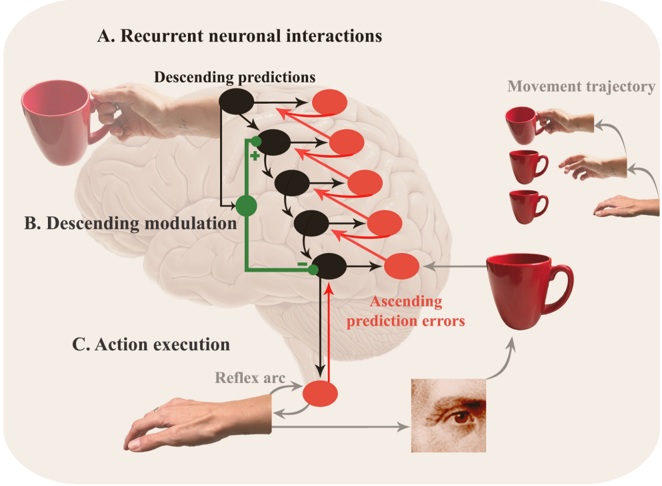
“Going further, predictive processing suggests that the brain is an active organ that constantly generates explanations about sensory inputs and then tests these hypotheses against incoming sensory information (Feldman and Friston, 2010) – in a way that is coherent with Helmholtz’s view of perception as an unconscious…”
BackgroundIntrinsic Motivation Systems for Autonomous Mental Development
Oudeyer, P.-Y., Kaplan, F., & Hafner, V. V. (2007) · IEEE Transactions on Evolutionary Computation · doi:10.1109/tevc.2006.890271 · Cited by 1,126
Self-citationThe Computational Anatomy of Psychosis
Adams, R. A., Stephan, K. E., Brown, H. R., Frith, C. D., & Friston, K. J. (2013) · Frontiers in Psychiatry · doi:10.3389/fpsyt.2013.00047 · Cited by 850 · cited 2×
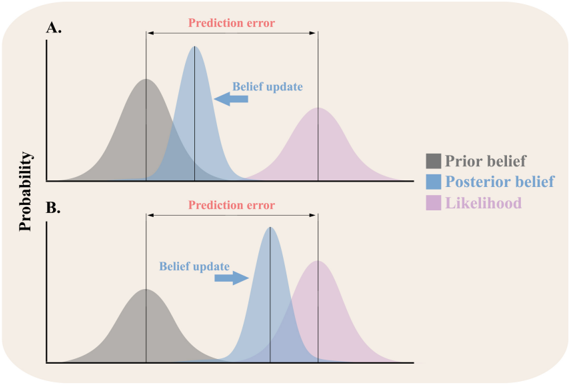
“A posterior density is a posterior belief generated by combining the prior and the likelihood weighted according to their precision, defined as the inverse variance (Adams et al., 2013b).”
BackgroundPredictions not commands: Active inference in the motor system
Adams, R. A., Shipp, S., & Friston, K. J. (2013) · Brain Structure and Function · doi:10.1007/s00429-012-0475-5 · Cited by 765 · cited 2×
“The freeenergy principle is a biological and a neuroscientific framework in which prediction error minimization is conceived as a fundamental process of self-organizing systems to maintain their sensory states within their physiological bounds in the face of constant environmental changes (Adams et al., 2013a; Friston…”
BackgroundActive inference and epistemic value
Friston, K., Rigoli, F., Ognibene, D., Mathys, C., Fitzgerald, T., & Pezzulo, G. (2015) · Cognitive Neuroscience · doi:10.1080/17588928.2015.1020053 · Cited by 731
Self-citationAction understanding and active inference
Friston, K., Mattout, J., & Kilner, J. (2011) · Biological Cybernetics · doi:10.1007/s00422-011-0424-z · Cited by 665 · cited 8×
“…in predictive processing is an Integral Forward Model (Pickering and Clark, 2014), or better known as a generative model, in which motor commands are replaced by proprioceptive top-down predictions, mapping prior beliefs to sensory consequences (Friston, 2011; Clark, 2015; Friston et al., 2012b).”
BackgroundMethodInfluentialActive Inference, homeostatic regulation and adaptive behavioural control
Pezzulo, G., Rigoli, F., & Friston, K. (2015) · Progress in Neurobiology · doi:10.1016/j.pneurobio.2015.09.001 · Cited by 650 · cited 1×
“Some authors suggest that the integration of different streams of unimodal sensory surprise occurs in hierarchically higher multimodal areas (Limanowski and Blankenburg, 2013; Apps and Tsakiris, 2014; Clark, 2013; Pezzulo et al., 2015), and therefore multimodal predictions and prediction errors would be generated (Fri…”
BackgroundSelf-citationComputational psychiatry: the brain as a phantastic organ
Friston, K. J., Stephan, K. E., Montague, R., & Dolan, R. J. (2014) · The Lancet Psychiatry · doi:10.1016/s2215-0366(14)70275-5 · Cited by 531 · cited 2×
“In the brain, precision weighting might be mediated by a neuromodulatory gain control which can be conceived as a Bayes-optimal encoding of precision at a synaptic level of neuronal populations encoding prediction errors (Friston et al., 2014).”
BackgroundMethodThe free-energy self: a predictive coding account of self-recognition
Apps, M. A. J., & Tsakiris, M. (2014) · Neuroscience & Biobehavioral Reviews · doi:10.1016/j.neubiorev.2013.01.029 · Cited by 514 · cited 1×
“Some authors suggest that the integration of different streams of unimodal sensory surprise occurs in hierarchically higher multimodal areas (Limanowski and Blankenburg, 2013; Apps and Tsakiris, 2014; Clark, 2013; Pezzulo et al., 2015), and therefore multimodal predictions and prediction errors would be generated (Fri…”
BackgroundDeep Learning Sensor Fusion for Autonomous Vehicle Perception and Localization: A Review
Fayyad, J., Jaradat, M. A., Gruyer, D., & Najjaran, H. (2020) · Sensors · doi:10.3390/s20154220 · Cited by 498 · cited 1×
“There is a wide literature on sensor fusion techniques in the machine learning community which focuses on very related challenges, such as the learning and modulation of the relevance of single sensors in multimodal and predictive settings (Fayyad et al., 2020).”
BackgroundActive inference, sensory attenuation and illusions
Brown, H., Adams, R. A., Parees, I., Edwards, M., & Friston, K. (2013) · Cognitive Processing · doi:10.1007/s10339-013-0571-3 · Cited by 488 · cited 1×
“The second strategy is the standard approach to action in predictive processing, known as active inference (Adams et al., 2013a; Brown et al., 2013), which consists of an agent changing sensory inputs through actions that conform to predictions.”
BackgroundHuang, Y., & Rao, R. P. N. (2011) · WIREs Cognitive Science · doi:10.1002/wcs.142 · Cited by 470 · cited 1×
“It is a framework for understanding redundancy reduction and efficient coding in the brain (Huang and Rao, 2011) by means of neuronal message passing among different levels of cortical hierarchies (Rao and Ballard, 1999).”
Perceptions as Hypotheses: Saccades as Experiments
Friston, K., Adams, R. A., Perrinet, L., & Breakspear, M. (2012) · Frontiers in Psychology · doi:10.3389/fpsyg.2012.00151 · Cited by 462 · cited 2×
“The information coming from different modalities are weighted according to the expected confidence given a certain task in a certain context (Parr and Friston, 2017; Friston et al., 2012a; Donnarumma et al., 2017).”
BackgroundEvidence for ‘motionese’: modifications in mothers’ infant‐directed action
Brand, R. J., Baldwin, D. A., & Ashburn, L. A. (2002) · Developmental Science · doi:10.1111/1467-7687.00211 · Cited by 438 · cited 1×
“, with and without presenting actions that reveal distinctive characteristics amplifying or exaggerating meaning and structure within bodily motions (also named motionese (Brand et al., 2002)).”
BackgroundA review of predictive coding algorithms
Spratling, M. W. (2017) · Brain and Cognition · doi:10.1016/j.bandc.2015.11.003 · Cited by 437 · cited 1×
“…increasing number of predictive coding variants, for example, there are differences in the algorithms and in the type of generative model they use (Spratling, 2017), and in the excitatory or inhibitory properties of the hierarchical connections (e.g. Rao and Ballard (1999); Spratling (2008),…”
MethodElias, P. (1955) · IEEE Transactions on Information Theory · doi:10.1109/tit.1955.1055126 · Cited by 428
Theories of Error Back-Propagation in the Brain
Whittington, J. C. R., & Bogacz, R. (2019) · Trends in Cognitive Sciences · doi:10.1016/j.tics.2018.12.005 · Cited by 420 · cited 1×
“This refers, in particular, to the lack of local error representations in ANNs and at the symmetry between forwards and backwards weights, which is not always present in cortical networks (Whittington and Bogacz, 2019).”
BackgroundIntrinsically Motivated Learning in Natural and Artificial Systems
(2013) · Springer eBooks · doi:10.1007/978-3-642-32375-1 · Cited by 379 · cited 1×
“In artificial systems, they are essential components for implementing intrinsically motivated exploration behaviors and artificial curiosity (Oudeyer et al., 2007; Schillaci et al., 2020b; Baldassarre and Mirolli, 2013; Graziano et al., 2011).”
BackgroundBeing a Beast Machine: The Somatic Basis of Selfhood
Seth, A. K., & Tsakiris, M. (2018) · Trends in Cognitive Sciences · doi:10.1016/j.tics.2018.08.008 · Cited by 371 · cited 2×
“(Seth and Tsakiris, 2018), can be integrated in prediction error minimization schemes.”
BackgroundThe free energy principle for action and perception: A mathematical review
Buckley, C. L., Kim, C. S., McGregor, S., & Seth, A. K. (2017) · Journal of Mathematical Psychology · doi:10.1016/j.jmp.2017.09.004 · Cited by 363 · cited 9×
“The FEP claims that because biological systems cannot minimize surprise directly, they need to minimize an upper bound called ‘free energy’ (Buckley et al., 2017).”
BackgroundMethodInfluentialPrediction, perception and agency.
Friston, K. (2012) · International Journal of Psychophysiology · doi:10.1016/j.ijpsycho.2011.11.014 · Cited by 359 · cited 2×
“…of different streams of unimodal sensory surprise occurs in hierarchically higher multimodal areas (Limanowski and Blankenburg, 2013; Apps and Tsakiris, 2014; Clark, 2013; Pezzulo et al., 2015), and therefore multimodal predictions and prediction errors would be generated (Friston, 2012).”
BackgroundVelocity relation: Satisfaction as a function of the first derivative of outcome over time.
Hsee, C. K., & Abelson, R. P. (1991) · Journal of Personality and Social Psychology · doi:10.1037//0022-3514.60.3.341 · Cited by 334
What is optimal about motor control?
Friston, K. (2011) · Neuron · doi:10.1016/j.neuron.2011.10.018 · Cited by 332 · cited 5×
“better known as a generative model, in which motor commands are replaced by proprioceptive top-down predictions, mapping prior beliefs to sensory consequences (Friston, 2011; Clark, 2015; Friston et al., 2012b).”
BackgroundMethodInfluentialFunctional integration and inference in the brain
Friston, K. (2002) · Progress in Neurobiology · doi:10.1016/s0301-0082(02)00076-x · Cited by 330 · cited 12×
“Pio-Lopez, Nizard, Friston, and Pezzulo (2016) present a proof-ofconcept implementation of a control scheme based on active inference using the 7 degrees-of-freedom arm of a simulated PR2 humanoid robot.”
BackgroundMethodInfluentialEmotional Valence and the Free-Energy Principle
Joffily, M., & Coricelli, G. (2013) · PLoS Computational Biology · doi:10.1371/journal.pcbi.1003094 · Cited by 322 · cited 2×
“, 2020a) and the emotional valence of actions (Joffily and Coricelli, 2013).”
BackgroundMinimal self-models and the free energy principle.
Limanowski, J., & Blankenburg, F. (2013) · Frontiers in Human Neuroscience · doi:10.3389/fnhum.2013.00547 · Cited by 263 · cited 1×
“Some authors suggest that the integration of different streams of unimodal sensory surprise occurs in hierarchically higher multimodal areas (Limanowski and Blankenburg, 2013; Apps and Tsakiris, 2014; Clark, 2013; Pezzulo et al., 2015), and therefore multimodal predictions and prediction errors…”
BackgroundTani, J., & Nolfi, S. (1999) · Neural Networks · doi:10.1016/s0893-6080(99)00060-x · Cited by 259
Computational mechanisms of curiosity and goal-directed exploration
Schwartenbeck, P., Passecker, J., Hauser, T. U., FitzGerald, T. H., Kronbichler, M., & Friston, K. J. (2019) · eLife · doi:10.7554/elife.41703 · Cited by 254 · cited 3×
“Studies such as those from Tschantz et al. (2020), Friston et al. (2015), Schwartenbeck et al. (2019) and Schillaci et al. (2020a) have discussed epistemic and emotional value, homeostatic drives and intrinsic motivation that regulate behaviors.”
BackgroundHierarchical attentive multiple models for execution and recognition of actions
Demiris, Y., & Khadhouri, B. (2006) · Robotics and Autonomous Systems · doi:10.1016/j.robot.2006.02.003 · Cited by 243 · cited 1×
“This leads to multiple implementations using artificial agents with different computational approaches (Demiris and Khadhouri, 2006; Möller and Schenck, 2008; Escobar-Juárez et al., 2016; Schillaci et al., 2016b).”
MethodActive inference and agency: optimal control without cost functions
Friston, K., Samothrakis, S., & Montague, R. (2012) · Biological Cybernetics · doi:10.1007/s00422-012-0512-8 · Cited by 241 · cited 4×
“The core mechanism in predictive processing is an Integral Forward Model (Pickering and Clark, 2014), or better known as a generative model, in which motor commands are replaced by proprioceptive top-down predictions, mapping prior beliefs to sensory consequences (Friston, 2011; Clark, 2015; Friston et al., 2012b).”
BackgroundInfluentialPredictive coding as a model of biased competition in visual attention
Spratling, M. W. (2008) · Vision Research · doi:10.1016/j.visres.2008.03.009 · Cited by 241 · cited 1×
“…number of predictive coding variants, for example, there are differences in the algorithms and in the type of generative model they use (Spratling, 2017), and in the excitatory or inhibitory properties of the hierarchical connections (e.g. Rao and Ballard (1999); Spratling (2008), among others).”
MethodWorking memory, attention, and salience in active inference
Parr, T., & Friston, K. J. (2017) · Scientific Reports · doi:10.1038/s41598-017-15249-0 · Cited by 227 · cited 1×
“The information coming from different modalities are weighted according to the expected confidence given a certain task in a certain context (Parr and Friston, 2017; Friston et al., 2012a; Donnarumma et al., 2017).”
BackgroundA tale of two densities: active inference is enactive inference
Ramstead, M. J., Kirchhoff, M. D., & Friston, K. J. (2020) · Adaptive Behavior · doi:10.1177/1059712319862774 · Cited by 220 · cited 1×
“Bayesian beliefs are treated as inferences about the posterior probability distribution (recognition density) via a process of belief updating (Ramstead et al., 2020).”
BackgroundPlanning and navigation as active inference
Kaplan, R., & Friston, K. J. (2018) · Biological Cybernetics · doi:10.1007/s00422-018-0753-2 · Cited by 203 · cited 1×
“In other words, this mechanism permits an agent to monitor how good it is in performing an action, and it has been suggested as the basis for intrinsic motivation and value related learning (Kiverstein et al., 2019; Kaplan and Friston, 2018).”
BackgroundGetting ahead: forward models and their place in cognitive architecture
Pickering, M. J., & Clark, A. (2014) · Trends in Cognitive Sciences · doi:10.1016/j.tics.2014.05.006 · Cited by 190 · cited 3×
“The core mechanism in predictive processing is an Integral Forward Model (Pickering and Clark, 2014), or better known as a generative model, in which motor commands are replaced by proprioceptive top-down predictions, mapping prior beliefs to sensory consequences (Friston, 2011; Clark, 2015; Friston et al., 2012b).”
BackgroundThe depressed brain: an evolutionary systems theory
Badcock, P. B., Davey, C. G., Whittle, S., Allen, N. B., & Friston, K. J. (2017) · Trends in Cognitive Sciences · doi:10.1016/j.tics.2017.01.005 · Cited by 190 · cited 1×
“It is usually specified in terms of the likelihood probability distribution of observing some sensory information given its causes, and a prior probability distribution of the beliefs about the hidden causes of sensory information (before sampling new observations) (Badcock et al., 2017).”
BackgroundIn the body's eye: the computational anatomy of interoceptive inference
Allen, M., Levy, A., Parr, T., & Friston, K. J. (2022) · PLOS Computational Biology · doi:10.1371/journal.pcbi.1010490 · Cited by 185 · cited 1×
“Allen et al. (2019) study active inference in a multimodal domain, simulating interactions between interoceptive cardiac cycle and exteroceptive (visual) perception.”
BackgroundA nice surprise? Predictive processing and the active pursuit of novelty
Clark, A. (2018) · Phenomenology and the Cognitive Sciences · doi:10.1007/s11097-017-9525-z · Cited by 156 · cited 1×
“(Clark, 2018, p. 522).”
The feeling of grip: novelty, error dynamics, and the predictive brain
Kiverstein, J., Miller, M., & Rietveld, E. (2019) · Synthese · doi:10.1007/s11229-017-1583-9 · Cited by 143 · cited 2×
“In other words, this mechanism permits an agent to monitor how good it is in performing an action, and it has been suggested as the basis for intrinsic motivation and value related learning (Kiverstein et al., 2019; Kaplan and Friston, 2018).”
BackgroundFriston, K. J. (2019) · PLOS Biology · doi:10.1371/journal.pbio.3000426 · Cited by 140 · cited 1×
““These issues matter when it comes to finding definitive empirical evidence for the computational architectures entailed by predictive coding” (Friston, 2019, p. 3).”
BackgroundPredictive Processing and the Representation Wars
Williams, D. (2018) · Minds and Machines · doi:10.1007/s11023-017-9441-6 · Cited by 134 · cited 1×
“According to Friston et al. (2006), predictive processing must be situated within the context of the free-energy principle (Williams, 2018), given that ’prediction error minimization’, under certain assumptions, corresponds to minimizing free energy (Friston, 2010b).”
BackgroundLearning action-oriented models through active inference
Tschantz, A., Seth, A. K., & Buckley, C. L. (2020) · PLOS Computational Biology · doi:10.1371/journal.pcbi.1007805 · Cited by 121 · cited 4×
“The few non-robotic models that focus on learning of generative models are based on the expected free energy formulations and use very simplified agents and behaviors (Tschantz et al., 2020; Baltieri and Buckley, 2017; Ueltzhöffer, 2018; Millidge, 2020).”
BackgroundInfluentialDeep active inference as variational policy gradients
Millidge, B. (2020) · Journal of Mathematical Psychology · doi:10.1016/j.jmp.2020.102348 · Cited by 115
A Novel Adaptive Controller for Robot Manipulators Based on Active Inference
Pezzato, C., Ferrari, R., & Corbato, C. H. (2020) · IEEE Robotics and Automation Letters · doi:10.1109/lra.2020.2974451 · Cited by 104 · cited 1×
“Similarly, Pezzato et al. (2020) present an active inference framework using a pre-coded controller and a generative function.”
MethodA Novel Predictive-Coding-Inspired Variational RNN Model for Online Prediction and Recognition
Ahmadi, A., & Tani, J. (2019) · Neural Computation · doi:10.1162/neco_a_01228 · Cited by 101 · cited 1×
“Another relevant work from the same group (Ahmadi and Tani, 2019) stands out for its formulation of active inference and a training strategy based on variational Bayes Recurrent Neural Networks.”
MethodAffective Value in the Predictive Mind
Van De Cruys, S. (2017) · Theoretical Philosophy/MIND Group – JGU Mainz · doi:10.15502/9783958573253 · Cited by 100 · cited 2×
“Scholars such as Van de Cruys (2017), Kiverstein et al. (2019) and Hsee and Abelson (1991) argue that what motivates engagement in a behavior is not just the final outcome, but the satisfaction that emerges from the pattern and the velocity of an outcome over time1.”
BackgroundMoving Forward: On the Limits of Motor-Based Forward Models
Dogge, M., Custers, R., & Aarts, H. (2019) · Trends in Cognitive Sciences · doi:10.1016/j.tics.2019.06.008 · Cited by 100 · cited 1×
“The mere existence of the efference copy of the motor command is nowadays a controversial issue (Dogge et al., 2019; Pickering and Clark, 2014).”
Ueltzhöffer, K. (2018) · Biological Cybernetics · doi:10.1007/s00422-018-0785-7 · Cited by 98 · cited 1×
“The few non-robotic models that focus on learning of generative models are based on the expected free energy formulations and use very simplified agents and behaviors (Tschantz et al., 2020; Baltieri and Buckley, 2017; Ueltzhöffer, 2018; Millidge, 2020).”
BackgroundAction perception as hypothesis testing
Donnarumma, F., Costantini, M., Ambrosini, E., Friston, K., & Pezzulo, G. (2017) · Cortex · doi:10.1016/j.cortex.2017.01.016 · Cited by 90 · cited 1×
“The information coming from different modalities are weighted according to the expected confidence given a certain task in a certain context (Parr and Friston, 2017; Friston et al., 2012a; Donnarumma et al., 2017).”
BackgroundSelf-citationIn the Body’s Eye: The Computational Anatomy of Interoceptive InferencePreprint
Allen, M., Levy, A., Parr, T., et al. (2019) · bioRxiv (Cold Spring Harbor Laboratory) · doi:10.1101/603928 · Cited by 86
Active inference and robot control: a case study
Pio-Lopez, L., Nizard, A., Friston, K., & Pezzulo, G. (2016) · Journal of The Royal Society Interface · doi:10.1098/rsif.2016.0616 · Cited by 84
Self-citationBeyond Desire? Agency, Choice, and the Predictive Mind
Clark, A. (2020) · Australasian Journal of Philosophy · doi:10.1080/00048402.2019.1602661 · Cited by 78 · cited 1×
“Importantly, precision weights are not only assigned according to their reliability, but also by their context-varying usefulness, and are thus considered to be a mechanism for behavior control (Clark, 2020).”
BackgroundAll Thinking is ‘Wishful’ Thinking
Kruglanski, A. W., Jasko, K., & Friston, K. (2020) · Trends in Cognitive Sciences · doi:10.1016/j.tics.2020.03.004 · Cited by 74 · cited 2×
“The expected action consequences include the expected inaccuracy or ambiguity, and the expected complexity or risk, which are combined into the expected free energy (Kruglanski et al., 2020).”
BackgroundAdaptive Robot Body Learning and Estimation Through Predictive Coding
Lanillos, P., & Cheng, G. (2018) · 2018 IEEE/RSJ International Conference on Intelligent Robots and Systems (IROS) · doi:10.1109/iros.2018.8593684 · Cited by 71 · cited 1×
“3 Lanillos and Cheng (2018) address also the tactile modality in their study, but do not fully integrate it in the error minimization scheme.”
BackgroundSchillaci, G., Hafner, V. V., & Lara, B. (2016) · Frontiers in Robotics and AI · doi:10.3389/frobt.2016.00039 · Cited by 67 · cited 2×
“It is through bodily-interactions with their environment that agents are expected to learn and then be capable of performing cognitive tasks autonomously (Lara et al., 2018; Schillaci et al., 2016a).”
BackgroundSelf-citationIs the free-energy principle neurocentric?
Friston, K. (2010) · Nature reviews. Neuroscience · doi:10.1038/nrn2787-c2 · Cited by 63 · cited 15×
“Therefore, minimizing VFE makes the recognition density, the probabilistic representation of the causes of sensory inputs, an approximate of the true posterior (Friston, 2010a).”
BackgroundInfluentialEnd-to-End Pixel-Based Deep Active Inference for Body Perception and Action
Sancaktar, C., van Gerven, M. A. J., & Lanillos, P. (2020) · 2020 Joint IEEE 10th International Conference on Development and Learning and Epigenetic Robotics (ICDL-EpiRob) · doi:10.1109/icdl-epirob48136.2020.9278105 · Cited by 58 · cited 1×
“Sancaktar and Lanillos (2019) apply a similar approach on the humanoid robot Nao.”
BackgroundAn active inference implementation of phototaxis
Baltieri, M., & Buckley, C. L. (2017) · European Conference on Artificial Life · doi:10.7551/ecal_a_011 · Cited by 51
Bootstrapping Cognition from Behavior—A Computerized Thought Experiment
Möller, R., & Schenck, W. (2008) · Cognitive Science · doi:10.1080/03640210802035241 · Cited by 49 · cited 1×
“This leads to multiple implementations using artificial agents with different computational approaches (Demiris and Khadhouri, 2006; Möller and Schenck, 2008; Escobar-Juárez et al., 2016; Schillaci et al., 2016b).”
MethodDegeneracy and Redundancy in Active Inference
Sajid, N., Parr, T., Hope, T. M., Price, C. J., & Friston, K. J. (2020) · Cerebral Cortex · doi:10.1093/cercor/bhaa148 · Cited by 49 · cited 1×
“Rewritten as in the second line it is read as complexity, which is the difference between the posterior beliefs and prior beliefs before new evidence is available and accuracy, the expected log likelihood of the sensory outcomes given some posterior about the causes of the data (Sajid et al., 2020).”
BackgroundAn Investigation of the Free Energy Principle for Emotion Recognition
Demekas, D., Parr, T., & Friston, K. J. (2020) · Frontiers in Computational Neuroscience · doi:10.3389/fncom.2020.00030 · Cited by 48 · cited 1×
“inferences of the hidden causes to find the best ‘guess’ of the environment (Demekas et al., 2020).”
BackgroundHwang, J., Kim, J.-H., Ahmadi, A., Choi, M., & Tani, J. (2018) · IEEE Transactions on Systems Man and Cybernetics Systems · doi:10.1109/tsmc.2018.2791984 · Cited by 47 · cited 3×
“An illustrative architecture, that comprises most of the characteristics of the networks used by these authors can be seen in Figure 1 in Hwang et al. (2018).”
BackgroundInfluentialModel-Based Approaches to Active Perception and Control
Pezzulo, G., Donnarumma, F., Iodice, P., Maisto, D., & Stoianov, I. (2017) · Entropy · doi:10.3390/e19060266 · Cited by 45 · cited 1×
“Action-oriented models are a common approach to solve this issue by learning and generating inferences that allow adaptive behavior, even when the world is not modelled in a precise manner (e.g. Tschantz et al. (2020); Baltieri and Buckley (2017); Pezzulo et al. (2017)).”
BackgroundSelf-citationA Neurorobotics Simulation of Autistic Behavior Induced by Unusual Sensory Precision
Idei, H., Murata, S., Chen, Y., Yamashita, Y., Tani, J., & Ogata, T. (2018) · Computational Psychiatry · doi:10.1162/cpsy_a_00019 · Cited by 37 · cited 2×
“On the contrary, some cognitive robotics implementations do have the emphasis slightly shifted towards the learning of generative models (e.g. Lanillos et al. (2020); Ahmadi and Tani (2017); Idei et al. (2018); Schillaci et al. (2020a,b)).”
BackgroundMethodMatsumoto, T., & Tani, J. (2020) · Entropy · doi:10.3390/e22050564 · Cited by 36 · cited 1×
“In more recent works (e.g. (Matsumoto and Tani, 2020; Jung et al., 2019)), authors use explicitly variational inference.”
BackgroundIntrinsic motivation and episodic memories for robot exploration of high-dimensional sensory spaces
Schillaci, G., Villalpando, A. P., Hafner, V. V., Hanappe, P., Colliaux, D., & Wintz, T. (2020) · Adaptive Behavior · doi:10.1177/1059712320922916 · Cited by 35
Self-citationRobot self/other distinction: active inference meets neural networks learning in a mirror
Lanillos, P., Pages, J., & Cheng, G. (2020) · arXiv · doi:10.48550/arxiv.2004.05473 · Cited by 35 · cited 3×
“Lanillos et al. (2020) extend the active inference implementation presented in Oliver et al. (2019).”
BackgroundRobot Self/Other Distinction: Active Inference Meets Neural Networks Learning in a Mirror*
Pablo, L., Jordi, P., & Gordon, C. (2020) · Frontiers in Artificial Intelligence and Applications · doi:10.3233/faia200372 · Cited by 32
Active inference body perception and action for humanoid robots
Oliver, G., Lanillos, P., & Cheng, G. (2019) · arXiv · doi:10.48550/arxiv.1906.03022 · Cited by 30 · cited 3×
“Differently from (Oliver et al., 2019), visual inputs consist of movements estimated through an optical flow algorithm.”
BackgroundMethodSchillaci, G., Ritter, C.-N., Hafner, V. V., & Lara, B. (2016) · Conference on Artificial Life (ALIFE) · doi:10.1162/978-0-262-33936-0-ch065 · Cited by 29
Self-citationJung, M., Matsumoto, T., & Tani, J. (2019) · IEEE/RSJ International Conference on Intelligent Robots and Systems (IROS) · doi:10.1109/iros40897.2019.8968597 · Cited by 27 · cited 1×
“In more recent works (e.g. (Matsumoto and Tani, 2020; Jung et al., 2019)), authors use explicitly variational inference.”
BackgroundA Deep Convolutional Neural Network Model for Sense of Agency and Object Permanence in Robots
Lang, C., Schillaci, G., & Hafner, V. V. (2018) · IEEE International Conference on Development and Learning (ICDL) · doi:10.1109/devlrn.2018.8761015 · Cited by 26
Self-citationAhmadi, A., & Tani, J. (2017) · Neural Networks · doi:10.1016/j.neunet.2017.02.015 · Cited by 24
Embodied Cognitive Robotics and the learning of sensorimotor schemes
Lara, B., Astorga, D., Mendoza-Bock, E., Pardo, M., Escobar, E., & Ciria, A. (2018) · Adaptive Behavior · doi:10.1177/1059712318780679 · Cited by 23
Self-citationTracking Emotions: Intrinsic Motivation Grounded on Multi - Level Prediction Error Dynamics
Schillaci, G., Ciria, A., & Lara, B. (2020) · IEEE International Conference on Development and Learning (ICDL) · doi:10.1109/icdl-epirob48136.2020.9278106 · Cited by 21 · cited 1×
“Recent studies suggest that error dynamics may influence the regulation of computational resources (Schillaci et al., 2020a) and the emotional valence of actions (Joffily and Coricelli, 2013).”
BackgroundSelf-citationA Self-Organized Internal Models Architecture for Coding Sensory–Motor Schemes
Escobar, E., Schillaci, G., Hermosillo, J., & Lara, B. (2016) · Frontiers in Robotics and AI · doi:10.3389/frobt.2016.00022 · Cited by 20 · cited 1×
“This leads to multiple implementations using artificial agents with different computational approaches (Demiris and Khadhouri, 2006; Möller and Schenck, 2008; Escobar-Juárez et al., 2016; Schillaci et al., 2016b).”
MethodSelf-citationArtificial Curiosity for Autonomous Space Exploration
Graziano, V., Glasmachers, T., Schaul, T., Pape, L., Cuccu, G., Leitner, J., & Schmidhuber, J. (2011) · QUT ePrints (Queensland University of Technology) · doi:10.26180/19959179 · Cited by 15
Ohata, W., & Tani, J. (2020) · Institutional Repositories DataBase (IRDB) · Cited by 15
Learning for Goal-Directed Actions Using RNNPB: Developmental Change of “What to Imitate”
Park, J.-C., Kim, D., & Nagai, Y. (2017) · IEEE Transactions on Cognitive and Developmental Systems · doi:10.1109/tcds.2017.2679765 · Cited by 13
A predictive coding model of representational drawing in human children and chimpanzees
Philippsen, A. K., & Nagai, Y. (2019) · IEEE International Conference on Development and Learning (ICDL) · doi:10.1109/devlrn.2019.8850701 · Cited by 12 · cited 1×
“In a follow-up work (Philippsen and Nagai, 2019), the framework is applied to simulate the generation of representational drawings – i.”
MethodPredictive Coding Strategies for Developmental Neurorobotics
Park, J.-C., Lim, J. H., Choi, H., & Kim, D. (2012) · Frontiers in Psychology · doi:10.3389/fpsyg.2012.00134 · Cited by 9
AFA-PredNet: The Action Modulation Within Predictive Coding
Zhong, J., Cangelosi, A., Zhang, X., & Ogata, T. (2018) · International Joint Conference on Neural Networks (IJCNN) · doi:10.1109/ijcnn.2018.8489751 · Cited by 9
How development in the Bayesian brain facilitates learning
Oliva, D., Philippsen, A. K., & Nagai, Y. (2019) · IEEE International Conference on Development and Learning (ICDL) · doi:10.1109/devlrn.2019.8850720 · Cited by 8 · cited 3×
“The framework “shares crucial properties with the developmental process of humans in that it naturally switches from a strong reliance on sensory input at an early learning stage to a proper integration of sensory input and own predictions at later learning stages” (Oliva et al., 2019, pp. 254).”
BackgroundMethodAutonomous learning and chaining of motor primitives using the Free Energy Principle
Annabi, L., Pitti, A., & Quoy, M. (2020) · International Joint Conference on Neural Networks (IJCNN) · doi:10.1109/ijcnn48605.2020.9206699 · Cited by 8 · cited 1×
“A similar approach for the self-generation of goals has been employed by Annabi et al. (2020) in a simulated experiment where a two degrees-of-freedom robotic arm has to learn how to write digits.”
MethodActive Inference: Computational Models of Motor Control without Efference Copy
Baltieri, M., & Buckley, C. L. (2019) · Conference on Cognitive Computational Neuroscience (CCN) · doi:10.32470/ccn.2019.1144-0 · Cited by 7 · cited 8×
“(2016) is also apparent in the work of Baltieri and Buckley (2019), where the authors design an active inference-based linear quadratic gaussian controller to manipulate a one-degree-of-freedom system. The study aims at showing that such a controller can achieve goal positions without the need of an efference copy, as…”
BackgroundInfluentialMurata, S., Tomioka, S., Nakajo, R., Yamada, T., Arie, H., Ogata, T., & Sugano, S. (2015) · IEEE International Conference on Development and Learning (ICDL) · doi:10.1109/devlrn.2015.7346162 · Cited by 3 · cited 1×
“A similar approach is presented by Murata et al. (2015), who propose a RNN-based model named stochastic continuous-time RNN (S-CTRNN).”
MethodTani, J. (2019) · Institutional Repositories DataBase (IRDB) · Cited by 1
Affective value in the predictive mind
Van de Cruys, S. (2017) · MIND Group · doi:10.25358/openscience-647 · Cited by 1
Research works printed but not linked: 4
- Clark, 2015, Embodied prediction
- Jung, 2019, Goal-directed behavior under variational predictive coding:
- Ohata, 2020, Investigation of multimodal and agential interactions in human-robot imitation, based on frameworks of predictive coding and active inference
- Zhong, 2018, Proceedings of the 2018 International Joint Conference on Neural Networks, 1
Cited by
Precision control for a flexible body representation
Limanowski, J. (2021) · Neuroscience & Biobehavioral Reviews · doi:10.1016/j.neubiorev.2021.10.023 · Cited by 118
“of predictive coding (Rao & Ballard, 1999; Friston & Kiebel, 2009), has provided a new perspective on the mechanisms underlying body representation (Apps & Tsakiris, 2014; Allen & Friston, 2018; Hohwy, 2013; Seth et al., 2012; Seth & Tsakiris, 2018; Ciria et al., 2021; Limanowski & Blankenburg, 2013; Crucianelli et al…”
BackgroundTaniguchi, T., Murata, S., Suzuki, M., Ognibene, D., Lanillos, P., Ugur, E., Jamone, L., Nakamura, T., Ciria, A., Lara, B., et al. (2023) · Advanced Robotics · doi:10.1080/01691864.2023.2225232 · Cited by 66
“active inference and predictive processing in robotics can be found in [21, 23], respectively.”
BackgroundSelf-citationTaniguchi, T., Yamakawa, H., Nagai, T., Doya, K., Sakagami, M., Suzuki, M., Nakamura, T., & Taniguchi, A. (2022) · Neural Networks · doi:10.1016/j.neunet.2022.02.026 · Cited by 52
Emergent communication through Metropolis-Hastings naming game with deep generative models
Taniguchi, T., Yoshida, Y., Matsui, Y., Le Hoang, N., Taniguchi, A., & Hagiwara, Y. (2023) · Advanced Robotics · doi:10.1080/01691864.2023.2260856 · Cited by 33
“In cognitive science and neuroscience, the generative perspective of cognition, which is also known as the free-energy principle and predictive coding , has become dominant as a general principle of cognition [39–41].”
BackgroundUnderstanding brain functional architecture through robotics
Prescott, T. J., & Wilson, S. P. (2023) · Science Robotics · doi:10.1126/scirobotics.adg6014 · Cited by 42
“…reviewed in this paper, is that it provides a specific formal methodology for calibrating a given control network (to minimize surprise), which has led to impressive demonstrations of robot control and provided new insights into how perception and action can interact in cognitive systems ( 57 ).”
BackgroundMethod
Metadata
- Authors
- Ciria, A., Schillaci, G., Pezzulo, G., Hafner, V. V., & Lara, B.
- Affiliations
- Universidad Nacional Autónoma de México (MX)
- Scuola Superiore Sant'Anna (IT)
- National Research Council (IT)
- Humboldt-Universität zu Berlin (DE)
- Universidad Autónoma del Estado de Morelos (MX)
- Venue
- Neural Computation
- Publisher
- MIT Press - Journals
- Published
- 2021-04-13
- Volume
- 33
- Issue
- 5
- Pages
- 1402-1432
- ISSN
- 0899-7667 (ISSN-L)
- 1530-888X
- OpenAlex
- W3124118165
- Cited by
- 51
- References
- 98
- Citations by year
- 2026: 6 · 2025: 8 · 2024: 13 · 2023: 10 · 2022: 8 · 2021: 6
- FWCI
- 1.37
- Type
- journal article
- Language
- en
- Open access
- green
- arxiv.org
- Licence
- cc-by
- Locations
- Neural Computation (publishedVersion)
- PubMed (publishedVersion)
- arXiv (Cornell University) (submittedVersion, cc-by)
- arXiv (Cornell University) (submittedVersion)
- arXiv (Cornell University) (cc-by)
- Funders
- Alexander von Humboldt-Stiftung
- European Commission (HORIZON2020, 838861)
- Deutsche Forschungsgemeinschaft (402790442)
- Topics
- Life Sciences › Neuroscience › Cognitive Neuroscience › Embodied and Extended Cognition
- Social Sciences › Psychology › Social Psychology › Social Robot Interaction and HRI
- Social Sciences › Psychology › Social Psychology › Action Observation and Synchronization
- Keywords
- predictive processing, cognitive robotics, predictive coding, active inference, free energy principle, perceptual inference, top-down processing, prediction error minimization, generative models, inverse model, precision weighting
- MeSH terms
- Cognition, Learning, Robotics
About these checks
Registry, retraction, Cites and statistics results are computed, not judged, with one exception: a printed reference that no index lists is read once by a model before it counts as a citation error. Claims are extracted by a model and kept only when their quote appears verbatim in the text; each cited source is then checked, with a model’s help, for whether it says what the claim relies on. Those verdicts can be wrong — read the claim’s quote and the cited source before relying on one.
Statistics and arithmetic are recomputed, not judged.
Confidence bands are shown only for fields calibrated on our annotated test set. None is calibrated yet, so no band is shown.
What counts as a claim ›How we measure confidence ›How we check this ›
Are you an author, or do you see a problem with this page? Request a review
Data sources
Bibliographic data: Semantic Scholar, OpenAlex, Crossref.
Contains information from the Semantic Scholar Academic Graph Datasets, made available under the ODC Attribution License (ODC-BY 1.0).
Semantic Scholar’s data is described in: Kinney, R., et al. (2023). The Semantic Scholar Open Data Platform. arXiv:2301.10140.
